CHAPTER 14
Long-Term Liabilities
ASSIGNMENT CLASSIFICATION TABLE (BY TOPIC)
Topics
Questions
Brief
Exercises
Exercises
Problems
Concepts
for Analysis
1.
Long-term liability;
classification; definitions.
1, 10,
14, 22
1, 2
10, 11
1, 2
11, 13,
14, 15
10, 11
4.
Retirement and refunding
of debt.
12, 13
11
12, 13,
14, 15
2, 4, 5,
6, 7, 10
2, 3
5.
Imputation of interest on
notes.
14, 15, 16,
17, 18
12, 13,
14, 15
16, 17, 18
8, 9
6.
Fair value option.
19, 20
16
19
7.
Disclosures of long-term
obligations.
21, 22,
23, 24
9
20
10
1, 3, 4
restructuring.
28, 29, 30
24, 25,
26, 27
14, 15
ASSIGNMENT CLASSIFICATION TABLE (BY LEARNING OBJECTIVE)
Learning Objectives
Questions
Brief
Exercises
Exercises
Problems
Concepts
for
Analysis
1. Describe the formal
procedures associated
with issuing long-term
debt.
1
of bond issues.
2
1, 2
CA14-1,
4. Apply the methods of
bond discount
and premium
amortization.
7,8,9,10,11,12
2, 3, 4, 5, 6,
7, 8, 10
3, 4, 5, 6,
7, 8, 9, 10,
1, 2, 3, 4, 5,
6, 7, 10, 11
CA14-3
5. Describe the
accounting for the
extinguishment of
debt.
13
11
12, 13, 14,
15
2, 4, 5, 6,
7, 10
accounting for the fair
value option.
19, 20
16
19
8. Explain the reporting
of off-balance-sheet
financing
arrangements.
22, 23, 24
CA14-4
accounting for a debt
restructuring.
25, 26, 27, 28,
21, 22, 23,
12, 13, 14
ASSIGNMENT CHARACTERISTICS TABLE
Item
Description
Level of
Difficulty
Time
(minutes)
E14-1
Classification of liabilities.
Simple
15–20
E14-2
Classification.
Simple
15–20
E14-3
Entries for bond transactions.
Simple
15–20
E14-4
Entries for bond transactions—straight-line.
Simple
15–20
E14-5
Entries for bond transactions—effective-interest.
Simple
15–20
E14-6
Amortization schedule—straight-line.
Simple
15–20
E14-7
Amortization schedule—effective-interest.
Simple
15–20
E14-8
Determine proper amounts in account balances.
15–20
E14-9
Entries and questions for bond transactions.
Moderate
20–30
E14-10
Entries for bond transactions.
Moderate
15–20
E14-11
Information related to various bond issues.
Simple
20–30
E14-12
Entry for redemption of bond; bond issue costs.
Simple
E14-13
Entries for redemption and issuance of bonds.
Simple
15–20
E14-14
Entries for redemption and issuance of bonds.
Simple
12–16
E14-15
Entries for redemption and issuance of bonds.
Simple
10–15
E14-16
Entries for zero-interest-bearing notes.
Simple
15–20
E14-17
Imputation of interest.
Simple
15–20
E14-18
Imputation of interest with right.
Moderate
15–20
E14-19
Fair value option.
Simple
10–15
E14-20
Long-term debt disclosure.
Simple
10–15
*E14-21
Settlement of debt.
Moderate
15–20
*E14-22
Term modification without gain—debtor’s entries.
Moderate
20–30
Term modification without gain—creditor’s entries.
25–30
*E14-24
Term modification with gain—debtor’s entries.
Moderate
25–30
*E14-25
Term modification with gain—creditor’s entries.
Moderate
20–30
Debtor/creditor entries for settlement of troubled debt.
Simple
15–20
*E14-27
Debtor/creditor entries for modification of troubled debt.
Moderate
20–25
P14-1
Analysis of amortization schedule and interest entries.
Simple
15–20
P14-2
Issuance and redemption of bonds.
Moderate
25–30
P14-3
Negative amortization.
Moderate
20–30
P14-4
Issuance and redemption of bonds; income statement
presentation.
Simple
15–20
P14-5
Comprehensive bond problem.
Moderate
50–65
P14-6
Issuance of bonds between interest dates, straight-line,
retirement.
20–25
P14-7
Entries for life cycle of bonds.
Moderate
20–25
P14-8
Entries for zero-interest-bearing note.
Simple
15–25
P14-10
Comprehensive problem; issuance, classification,
reporting.
20–25
P14-11
Effective-interest method.
Moderate
40–50
ASSIGNMENT CHARACTERISTICS TABLE (Continued)
Item
Description
Level of
Difficulty
Time
(minutes)
Debtor/creditor entries for continuation of troubled debt.
Restructure of note under different circumstances.
30–45
Debtor/creditor entries for continuation of troubled debt
40–50
with new effective interest.
CA14-1
Bond theory: balance sheet presentations, interest rate,
premium.
Moderate
25–30
CA14-2
Bond theory: price, presentation, and redemption.
Moderate
15–25
CA14-4
Off-balance-sheet financing.
20–30
CA14-5
Bond issue, ethics.
23–30
SOLUTIONS TO CODIFICATION EXERCISES
CE14-1
Master Glossary
(a) An obligation is callable at a given date if the creditor has the right at that date to demand, or to
give notice of its intention to demand, repayment of the obligation owed to it by the debtor.
CE14-2
According to FASB ASC 470-10–50-1 (Disclosure of Long-Term Obligations):
CE14-3
According of FASB ASC 470-10–45-1 (Classification of Debt that Includes Covenants):
Some long-term loans contain certain covenants that must be met on a quarterly or semiannual basis.
If a covenant violation occurs that would otherwise give the lender the right to call the debt, a lender may
waive its call right arising from the current violation for a period greater than one year while retaining
CE14-4
According to FASB ASC 470-10-S99-2 (SAB Topic 4.A, Subordinated Debt):
Subordinated debt may not be included in the stockholders’ equity section of the balance sheet. Any
ANSWERS TO QUESTIONS
1. (a) Funds might be obtained through long-term debt from the issuance of bonds, and from the
signing of long-term notes and mortgages.
(b) A bond indenture is a contractual agreement (signed by the issuer of bonds) between the
2. If the entire bond matures on a single date, the bonds are referred to as term bonds. Mortgage
bonds are secured by real estate. Debenture bonds are unsecured. The interest payments for
income bonds depend on the existence of operating income in the issuing company. Callable
3. (a) Yield rate—the rate of interest actually earned by the bondholders; it is synonymous with the
effective and market rates.
4. (a) Maturity value—the face value of the bonds; the amount which is payable upon maturity.
5. A discount on bonds payable results when investors demand a rate of interest higher than the rate
stated on the bonds. The investors are not satisfied with the nominal interest rate because they
Questions Chapter 14 (Continued)
6. Discount (premium) on bonds payable should be reported in the balance sheet as a direct
deduction from (addition to) the face amount of the bond. Both are liability valuation accounts.
7. Bond discount and bond premium may be amortized on a straight-line basis or on an effective-
interest basis. The profession recommends the effective-interest method but permits the straight-
line method when the results obtained are not materially different from the effective-interest
8. The annual interest expense will decrease each period throughout the life of the bonds. Under the
effective-interest method the interest expense each period is equal to the effective or yield interest
9. Bond issuance costs should be debited to a deferred charge account for Unamortized Bond Issue
Costs and amortized over the life of the issue, separately from but in a manner similar to that used
for discount on bonds.
10. Amortization of Discount on Bonds Payable will increase interest expense. A discount on bonds
payable results when investors demand a rate of interest higher than the rate stated on the bonds.
11. The call feature of a bond issue grants the issuer the privilege of purchasing, after a certain date
12. It is sometimes desirable to reduce bond indebtedness in order to take advantage of lower
prevailing interest rates. Also the company may not want to make a very large cash outlay all at
13. Gains or losses from extinguishment of debt should be aggregated and reported in income.
For extinguishment of debt transactions disclosure is required of the following items:
(1) A description of the transactions, including the sources of any funds used to extinguish debt
Questions Chapter 14 (Continued)
14. The entire arrangement must be evaluated and an appropriate interest rate imputed. This is done
by (1) determining the fair value of the property, goods, or services exchanged or (2) determining
the fair value of the note, whichever is more clearly determinable.
15. If a note is issued for cash, the present value is assumed to be the cash proceeds. If a note is
16. When a debt instrument is exchanged in a bargained transaction entered into at arm’s-length, the
stated interest rate is presumed to be fair unless: (1) no interest rate is stated, or (2) the stated
17. Imputed interest is the interest factor (a rate or amount) assumed or assigned which is different
from the stated interest factor. It is necessary to impute an interest rate when the stated interest
rate is presumed to be unreasonable. The imputed interest rate is used to establish the present
(5) the existing prime interest rate, and (6) the prevailing rates for similar instruments of issuers
with similar credit ratings.
18. A fixed-rate mortgage is a note that requires payment of interest by the mortgagor at a rate that
does not change during the life of the note. A variable-rate mortgage is a note that features an
19. The fair value option is an accounting option where the company can elect to record fair values
in their accounts for most financial assets and liabilities, including bonds and notes payable.
With bonds at fair value, we assume that the decline in value of the bonds is due to an interest
rate increase. In other situations, the decline may occur because the bonds become more likely to
Questions Chapter 14 (Continued)
21. The required disclosures at the balance sheet date are future payments for sinking fund
requirements and the maturity amounts of long-term debt during each of the next five years.
22. Off-balance-sheet financing is an attempt to borrow monies in such a way that the obligations are
not recorded. Reasons for off-balance sheet financing are:
(1) Many believe removing debt enhances the quality of the balance sheet and permits credit to
23. Forms of off-balance-sheet financing include (1) investments in non-consolidated subsidiaries for
which the parent is liable for the subsidiary debt; (2) use of special purpose entities (SPEs), which
24. Under GAAP, a parent company does not have to consolidate a subsidiary company that is less
than 50 percent owned. In such cases, the parent therefore does not report the assets and
liabilities of the subsidiary. All the parent reports on its balance sheet is the investment in the
subsidiary. As a result, users of the financial statements may not understand that the subsidiary
has considerable debt for which the parent may ultimately be liable if the subsidiary runs into
financial difficulty.
*25. Two different types of situations result with troubled debt: (1) Impairments, and (2) Restructurings.
Restructurings can be further classified into:
*26. A transfer of noncash assets (real estate, receivables, or other assets) or the issuance of the
debtor’s stock can be used to settle a debt obligation in a troubled debt restructuring. In these
situations, the noncash assets or equity interest given should be accounted for at fair value. The
Questions Chapter 14 (Continued)
*27. (a) The creditor will grant concessions in a troubled debt situation because it appears to be the
more likely way to maximize recovery of the investment.
(b) The creditor might grant any one or a combination of the following concessions:
*28. When a loan is restructured, the creditor should calculate the loss due to restructuring by sub-
tracting the present value of the restructured cash flows (using the historical effective rate) from
*29. “Accounting symmetry” between the entries recorded by the debtor and the creditor in a troubled
debt restructuring means that there is a correspondence or agreement between the entries
recorded by each party. Impairments are nonsymmetrical because, while the creditor records
a loss, the debtor makes no entry at all. Troubled debt restructurings are nonsymmetrical because
creditors calculate their losses using the discounted present value of future cash flows, while
debtors calculate their gains using the undiscounted cash flows.
*30. A transaction would be recorded as a troubled debt restructuring by only the debtor if the amount
for which the liability is settled is less than its carrying amount on the debtor’s books, but equal to
SOLUTIONS TO BRIEF EXERCISES
BRIEF EXERCISE 14-1
Present value of the principal
$500,000 X .37689 …………………………………………………
$188,445
Present value of the interest payments
$22,500* X 12.46221 ………………………………………………
BRIEF EXERCISE 14-2
(a)
Cash …………………………..…………………………………………..
300,000
Bonds Payable ………………………………………………..
300,000
(b)
Interest Expense ……………………………………………………..
Cash ($300,000 X 10% X 6/12) …………………………..
(c)
Interest Expense ……………………………………………………..
Interest Payable ………………………………………………
BRIEF EXERCISE 14-3
(a)
Cash ($300,000 X 98%) …………………………………………….
294,000
Discount on Bonds Payable ……………………………………..
6,000
Bonds Payable ………………………………………………..
300,000
(b)
Interest Expense ……………………………………………………..
($6,000 X 1/10 = $600) …………………………..
Cash ($300,000 X 10% X 6/12) …………………………..
(c)
Interest Expense ……………………………………………………..
Discount on Bonds Payable
($6,000 X 1/10 = $600) …………………………..
BRIEF EXERCISE 14-4
(a)
Cash ($300,000 X 103%) ………………………………………….
309,000
Bonds Payable ……………………………………………….
300,000
Premium on Bonds Payable …………………………..
9,000
(b)
Interest Expense …………………………………………………….
14,100
Premium on Bonds Payable
($9,000 X 1/10 = $900) …………………………………………..
Cash ($300,000 X 10% X 6/12) ………………………….
(c)
Interest Expense …………………………………………………….
14,100
Premium on Bonds Payable
($9,000 X 1/10 = $900) …………………………………………..
Interest Payable ……………………………………………..
BRIEF EXERCISE 14-5
(a)
Cash ………………………………………………………………………
408,000
Bonds Payable ……………………………………………….
400,000
Interest Expense ($400,000 X 6% X 4/12) ………….
8,000
(b)
Interest Expense …………………………………………………….
Cash ($400,000 X 6% X 6/12) …………………………..
(c)
Interest Expense …………………………………………………….
12,000
Interest Payable ……………………………………………..
BRIEF EXERCISE 14-6
(a)
Cash ………………………………………………………………………
559,224
Discount on Bonds Payable …………………………………….
40,776
Bonds Payable ……………………………………………….
600,000
(b)
Interest Expense ($559,224 X 8% X 6/12)…………………..
22,369
Cash ($600,000 X 7% X 6/12) …………………………..
Discount on Bonds Payable …………………………..
1,369
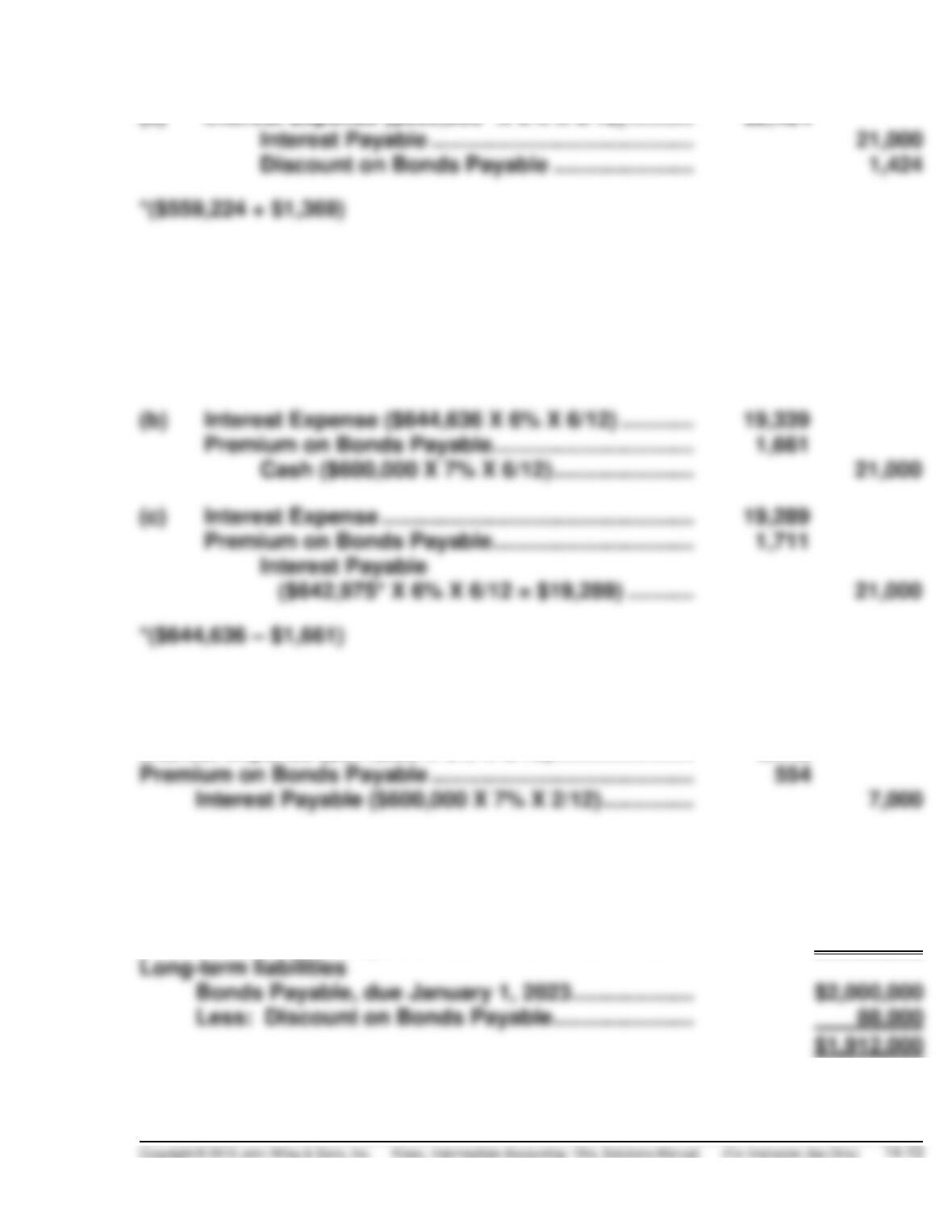
BRIEF EXERCISE 14-6 (Continued)
(c)
Interest Expense ($560,593* X 8% X 6/12) ………………….
22,424
Interest Payable ………………………………………………
Discount on Bonds Payable …………………………..
BRIEF EXERCISE 14-7
(a)
Cash …………………………..…………………………………………..
644,636
Bonds Payable ………………………………………………..
600,000
Premium on Bonds Payable …………………………..
44,636
(b)
Interest Expense ($644,636 X 6% X 6/12) …………………..
Premium on Bonds Payable ……………………………………..
Cash ($600,000 X 7% X 6/12) …………………………..
(c)
Interest Expense ……………………………………………………..
Premium on Bonds Payable ……………………………………..
Interest Payable
($642,975* X 6% X 6/12 = $19,289) ………………….
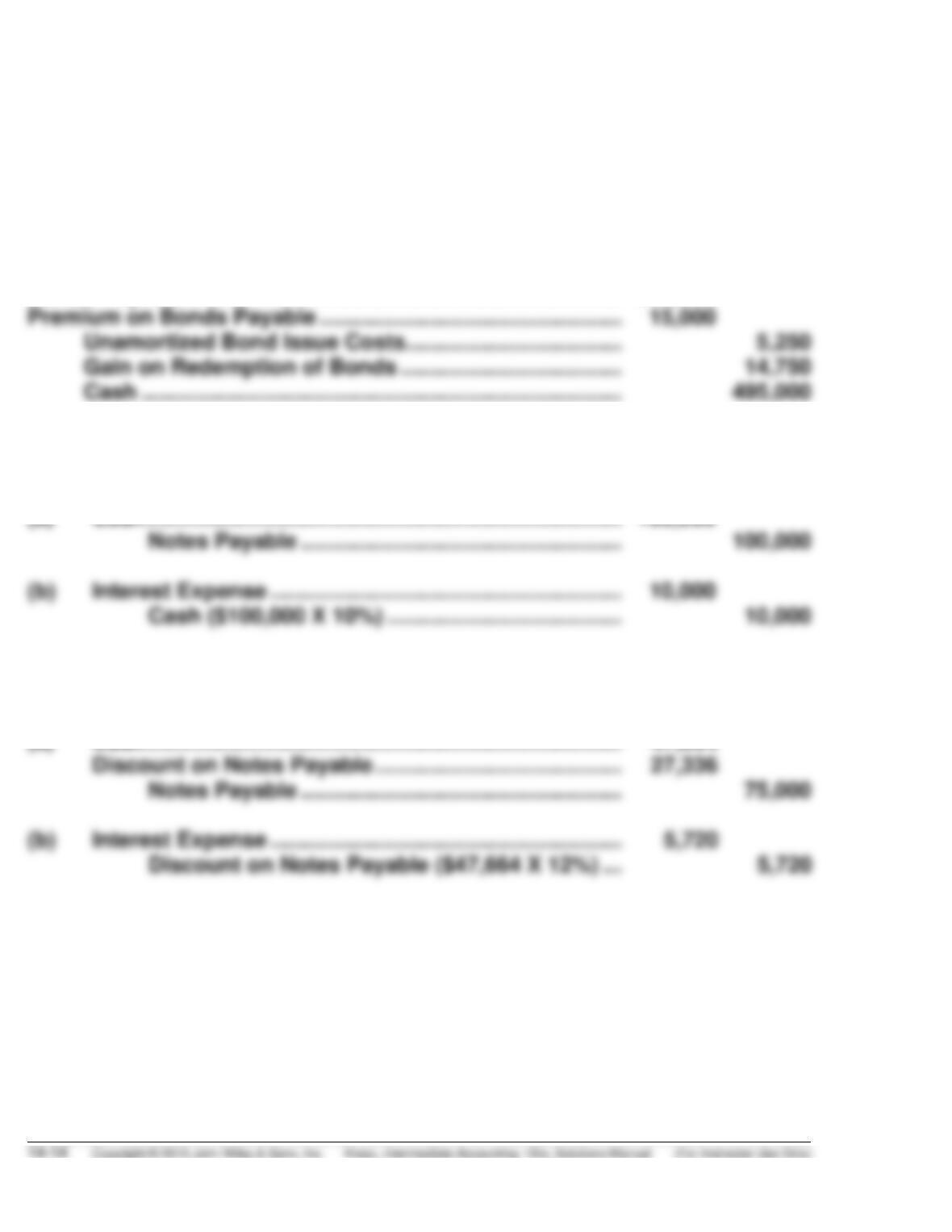
BRIEF EXERCISE 14-8
Interest Expense ($644,636 X 6% X 2/12) …………………..
6,446
Premium on Bonds Payable …………………………………….
Interest Payable ($600,000 X 7% X 2/12) ……………
BRIEF EXERCISE 14-9
Current liabilities
Bond Interest Payable ……………………………………..
$ 80,000
Long-term liabilities
Bonds Payable, due January 1, 2023 ………………..
Less: Discount on Bonds Payable …………………..
BRIEF EXERCISE 14-10
Bond Issue Expense …………………………………………………….
16,000
Unamortized Bond Issue Costs
($160,000 X 1/10) ………………………………………………..
16,000
BRIEF EXERCISE 14–11
Bonds Payable ……………………………………………………………..
500,000
Premium on Bonds Payable ………………………………………….
15,000
Unamortized Bond Issue Costs ……………………………..
Gain on Redemption of Bonds ………………………………
Cash ……………………………………………………………………
BRIEF EXERCISE 14-12
(a)
Cash ………………………………………………………………………
100,000
Notes Payable ………………………………………………..
(b)
Interest Expense …………………………………………………….
Cash ($100,000 X 10%) ……………………………………
10,000
BRIEF EXERCISE 14-13
(a)
Cash ………………………………………………………………………
47,664
Discount on Notes Payable ……………………………………..
Notes Payable ………………………………………………..
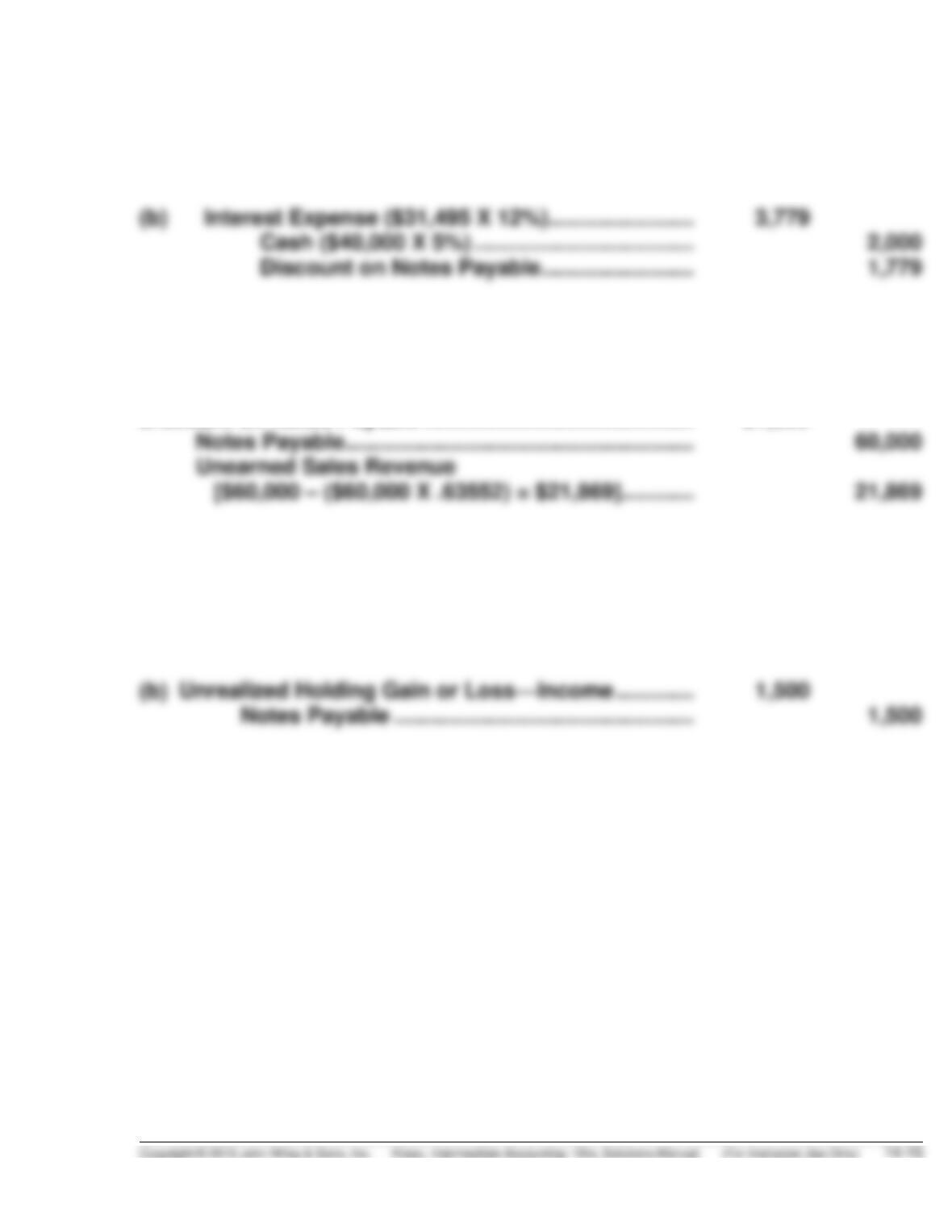
(b)
Interest Expense …………………………………………………….
Discount on Notes Payable ($47,664 X 12%) …….
BRIEF EXERCISE 14-14
(a)
Equipment ……………………………………………………….
31,495
Discount on Notes Payable ………………………………………
8,505
Notes Payable …………………………………………………
40,000
(b)
Interest Expense ($31,495 X 12%)…………………………..
3,779
Cash ($40,000 X 5%) ………………………………………..
Discount on Notes Payable …………………………..
BRIEF EXERCISE 14-15
Cash ………………………………………………………………………
60,000
Discount on Notes Payable ……………………………………..
21,869
Notes Payable…………………………………………………
Unearned Sales Revenue
[$60,000 – ($60,000 X .63552) = $21,869] …………
BRIEF EXERCISE 14-16
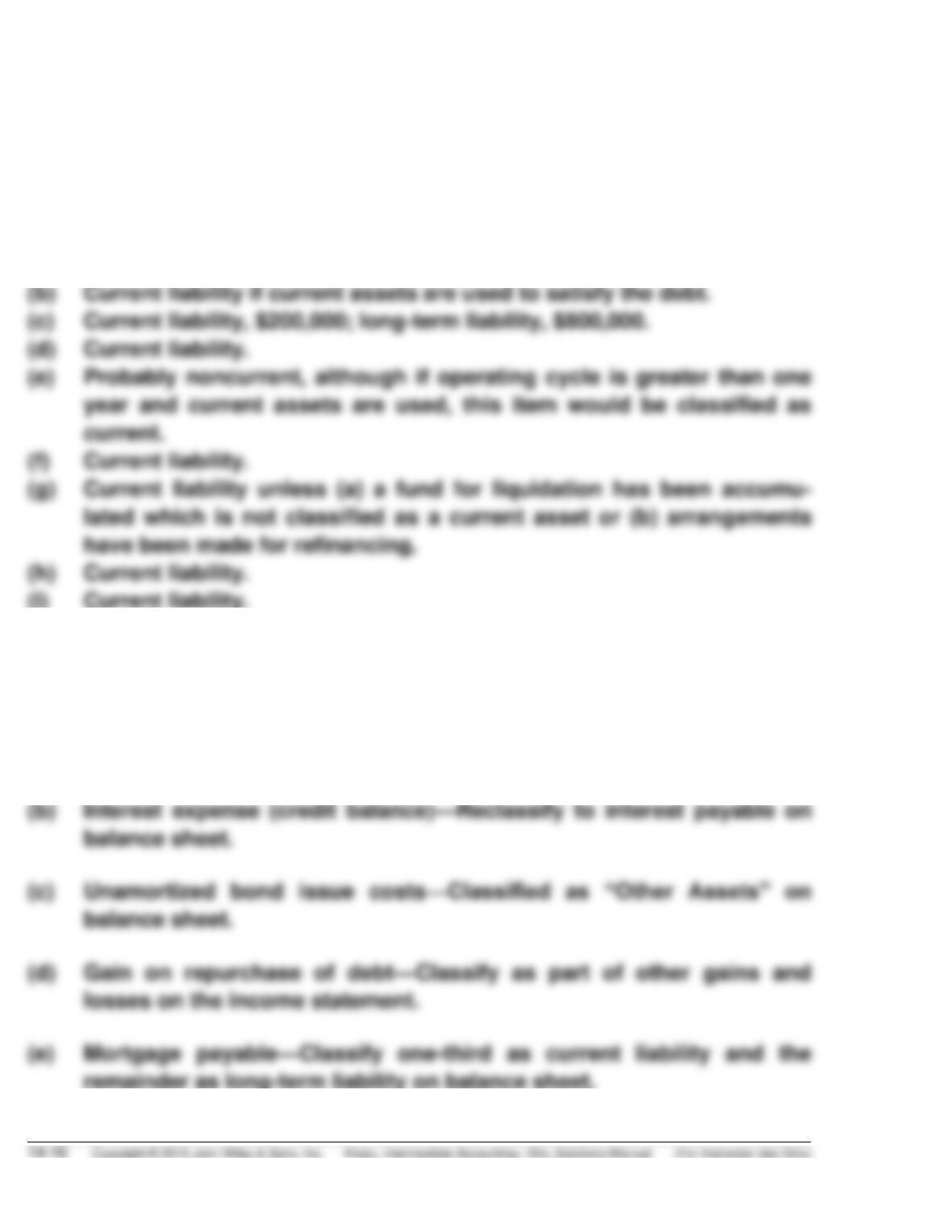
(a) Fair Value – Book Value = $17,500 – $16,000 = $1,500 unrealized holding
loss.
Notes Payable …………………………………………………
SOLUTIONS TO EXERCISES
EXERCISE 14-1 (15–20 minutes)
(a) Valuation account relating to the long-term liability, bonds payable
(sometimes referred to as an adjunct account). The $3,000 would
continue to be reported as long-term.
EXERCISE 14-2 (15–20 minutes)
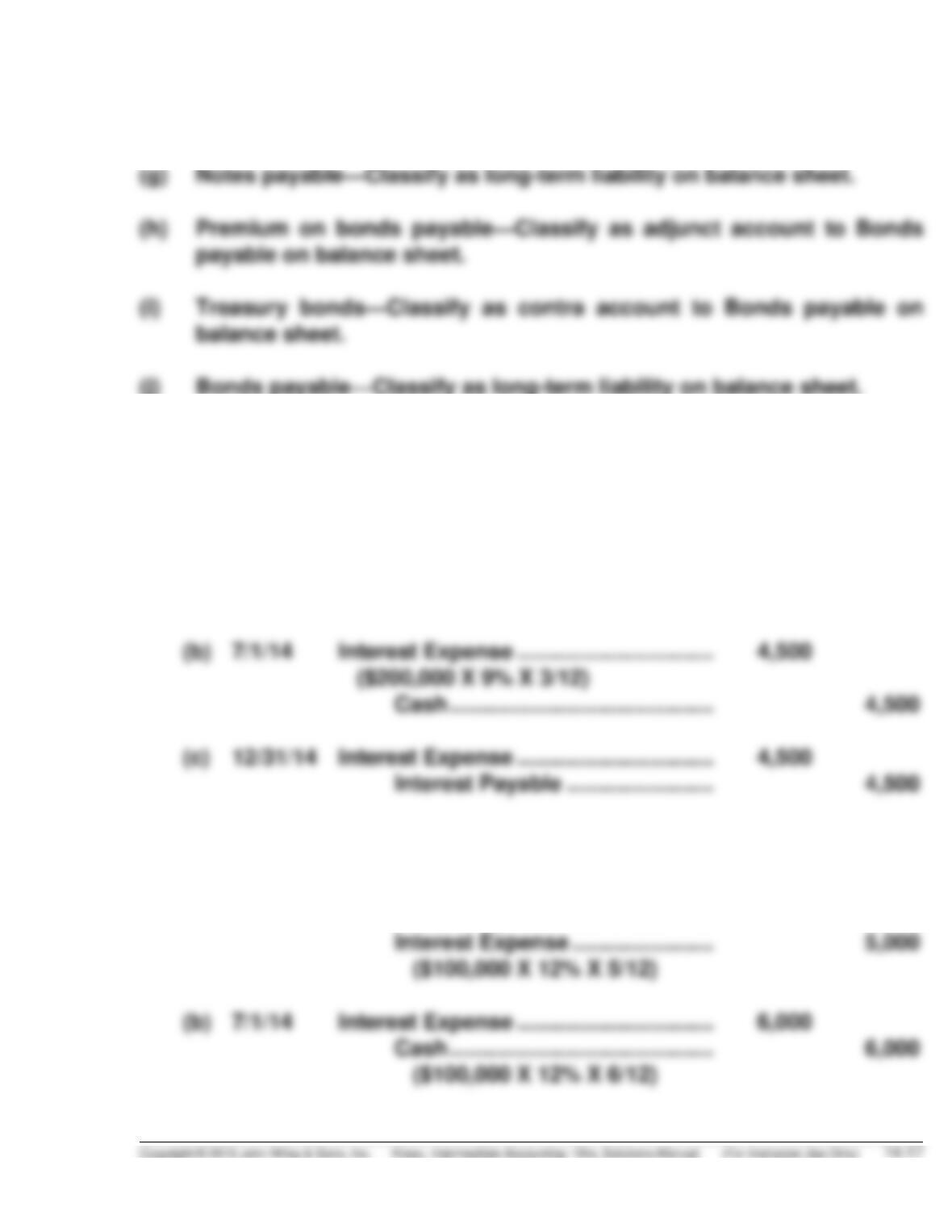
(a) Discount on bonds payable—Contra account to bonds payable on
balance sheet.
EXERCISE 14-2 (Continued)
(f) Debenture bonds—Classify as long-term liability on balance sheet.
EXERCISE 14-3 (15–20 minutes)
1.
Simon Company:
(a)
1/1/14
Cash ……………………………………………………….
200,000
Bonds Payable …………………………..
200,000
(b)
7/1/14
Interest Expense …………………………..
($200,000 X 9% X 3/12)
Cash ……………………………………………………….
(c)
12/31/14
Interest Expense …………………………..
Interest Payable …………………………..
2.
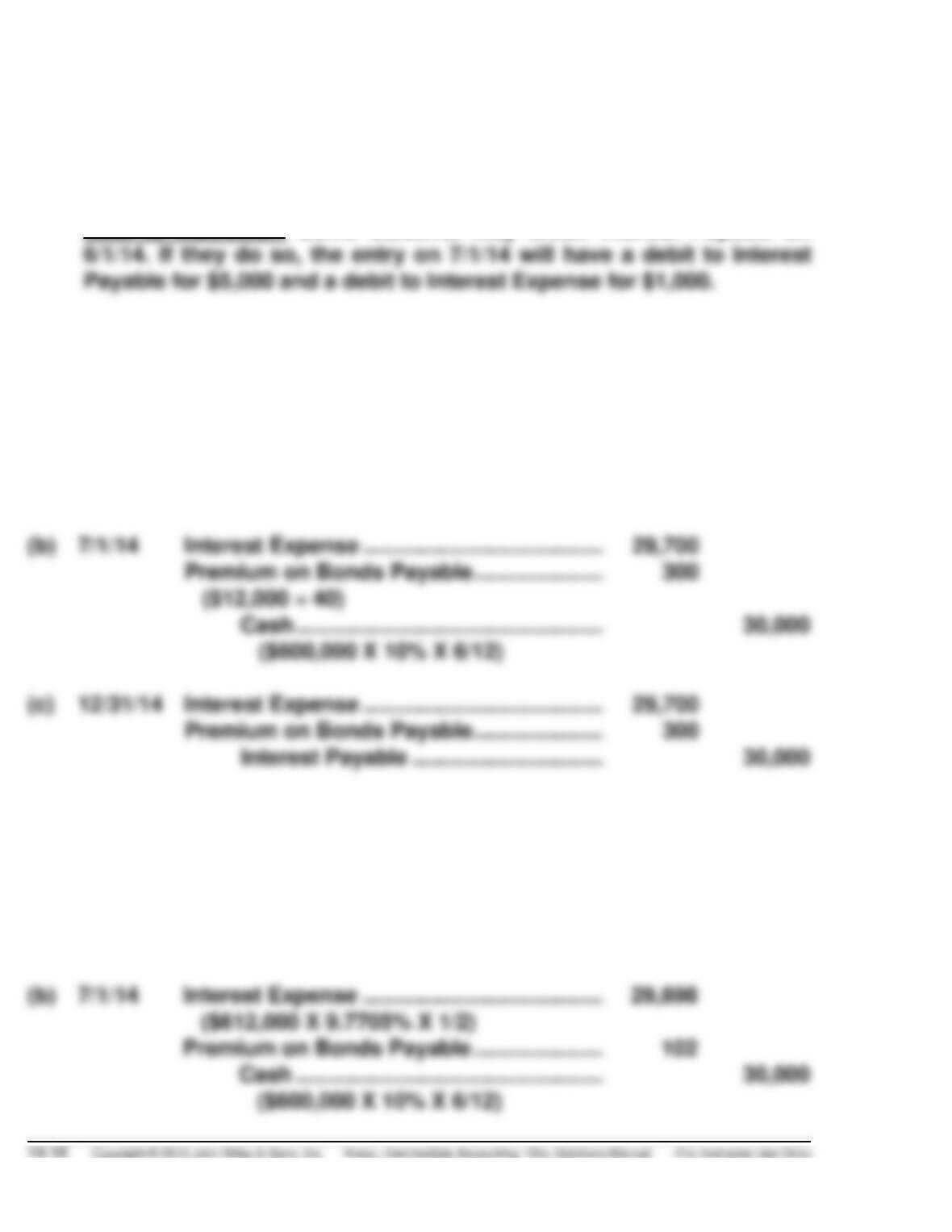
Garfunkle Company:
(a)
6/1/14
Cash ……………………………………………………….
105,000
Bonds Payable …………………………..
100,000
Interest Expense …………………………..
($100,000 X 12% X 5/12)
(b)
7/1/14
Interest Expense …………………………..
Cash ……………………………………………………….
EXERCISE 14-3 (Continued)
(c)
12/31/14
Interest Expense …………………………..
6,000
Interest Payable …………………………..
6,000
Note to instructor: Some students may credit Interest Payable on
EXERCISE 14-4 (15–20 minutes)
(a)
1/1/14
Cash ($600,000 X 102%) …………………………..
612,000
Bonds Payable ……………………………………………….
600,000
Premium on Bonds
Payable ……………………………………………………….
12,000
(b)
7/1/14
Interest Expense …………………………………………………….
29,700
Premium on Bonds Payable …………………………..
($12,000 ÷ 40)
Cash ……………………………………………………….
30,000
($600,000 X 10% X 6/12)
(c)
12/31/14
Interest Expense …………………………………………………….
29,700
Premium on Bonds Payable …………………………..
Interest Payable …………………………..
30,000
EXERCISE 14-5 (15–20 minutes)
(a)
1/1/14
Cash ($600,000 X 102%) …………………………..
612,000
Bonds Payable ……………………………………………….
600,000
Premium on Bonds Payable …………………………..
12,000
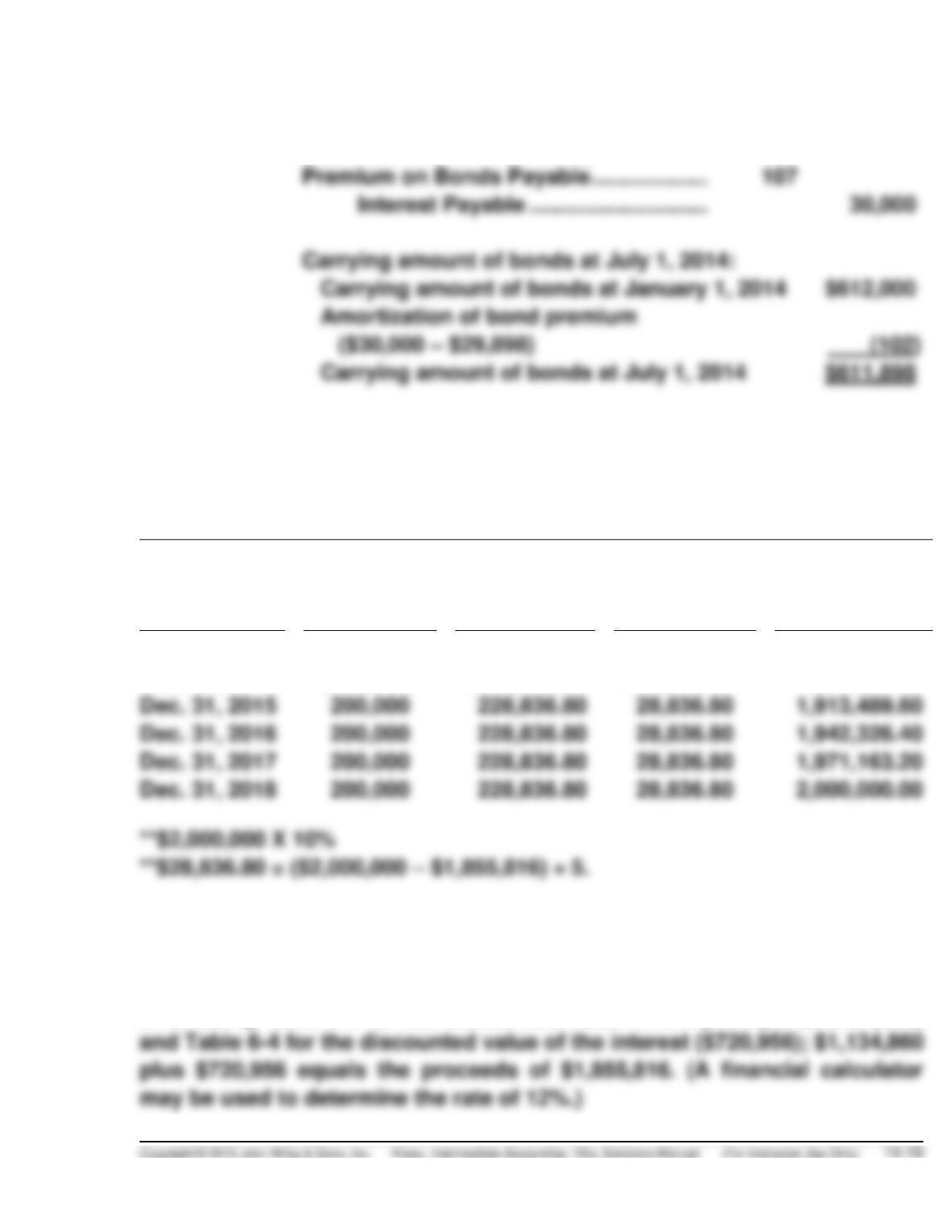
(b)
7/1/14
Interest Expense …………………………………………………….
($612,000 X 9.7705% X 1/2)
Premium on Bonds Payable …………………………..
EXERCISE 14-5 (Continued)
(c)
12/31/14
Interest Expense ……………………………………………………..
29,893
($611,898 X 9.7705% X 1/2)
Premium on Bonds Payable …………………………..
Interest Payable …………………………..
Carrying amount of bonds at July 1, 2014:
Carrying amount of bonds at January 1, 2014
Amortization of bond premium
($30,000 – $29,898)
EXERCISE 14-6 (15–20 minutes)
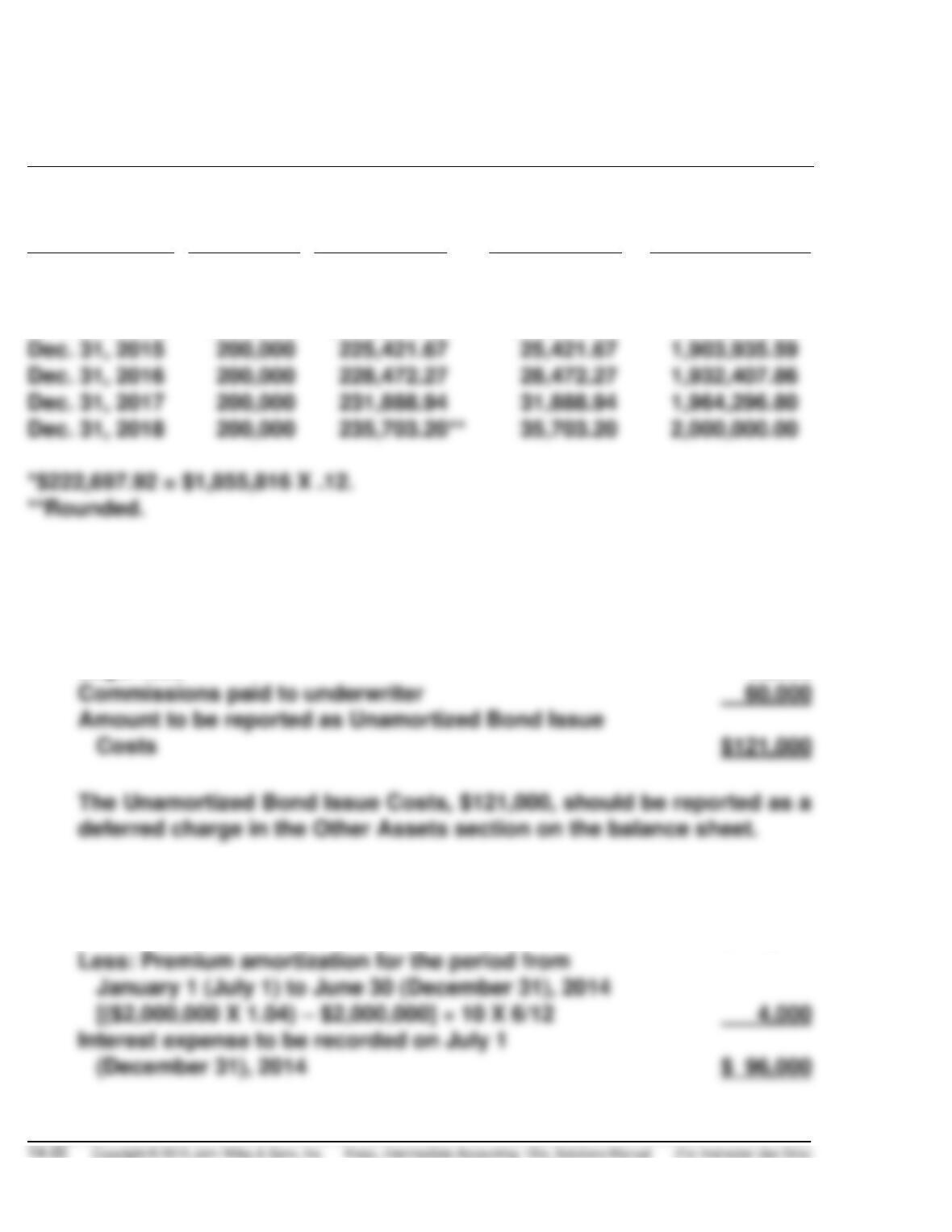
Schedule of Discount Amortization
Straight-Line Method
Year
Cash Paid
Interest
Expense
Discount
Amortized
Carrying
Amount of
Bonds
Jan. 1, 2014
$1,855,816.00
Dec. 31, 2014
$200,000**
$228,836.80
$28,836.80**
1,884,652.80
Dec. 31, 2015
1,913,489.60
Dec. 31, 2016
1,942,326.40
Dec. 31, 2017
1,971,163.20
Dec. 31, 2018
2,000,000.00
EXERCISE 14-7 (15–20 minutes)
The effective-interest or yield rate is 12%. It is determined through trial and
error using Table 6-2 for the discounted value of the principal ($1,134,860)
EXERCISE 14-7 (Continued)
Schedule of Discount Amortization
Effective-Interest Method (12%)
Year
Cash
Paid
Interest
Expense
Discount
Amortized
Carrying
Amount of
Bonds
(1)
(2)
(3)
(4)
Jan. 1, 2014
$1,855,816.00
Dec. 31, 2014
$200,000
$222,697.92
*
$22,697.92
1,878,513.92
Dec. 31, 2015
1,903,935.59
Dec. 31, 2016
1,932,407.86
Dec. 31, 2017
1,964,296.80
Dec. 31, 2018
2,000,000.00
EXERCISE 14-8 (15–20 minutes)
(a)
Printing and engraving costs of bonds
$12,000
Legal fees
49,000
Commissions paid to underwriter
60,000
Amount to be reported as Unamortized Bond Issue
(b)
Interest paid for the period from January 1
(July 1) to June 30 (December 31), 2014;
$2,000,000 X 10% X 6/12
$100,000
Less: Premium amortization for the period from
[($2,000,000 X 1.04) – $2,000,000] ÷ 10 X 6/12
4,000
Interest expense to be recorded on July 1