CHAPTER 14
The Mechanics of Profits Maximization
CHAPTER SUMMARY AND TEACHING OBJECTIVES
Regardless of selling environment (perfect competition, monopolistic competition, monopoly,
oligopoly) it is assumed that firms operate so as to maximize profits. They find a level of output where
marginal revenue equals marginal cost. This can be shown graphically or with the use of simple
mathematics. Each selling environment has its own process of adjustment.
IMPORTANT TERMS
Determinants of Demand these are variables that shift the demand curve and influence consumer
spending
TOPICS AND TEACHING SUGGESTIONS
1. Golden Rule of Profit Maximization
2. The Simple Mathematics of Profit Maximization
The golden rule of profit maximization can also be shown using simple mathematics
3. Oligopoly
ANSWERS TO EXERCISES
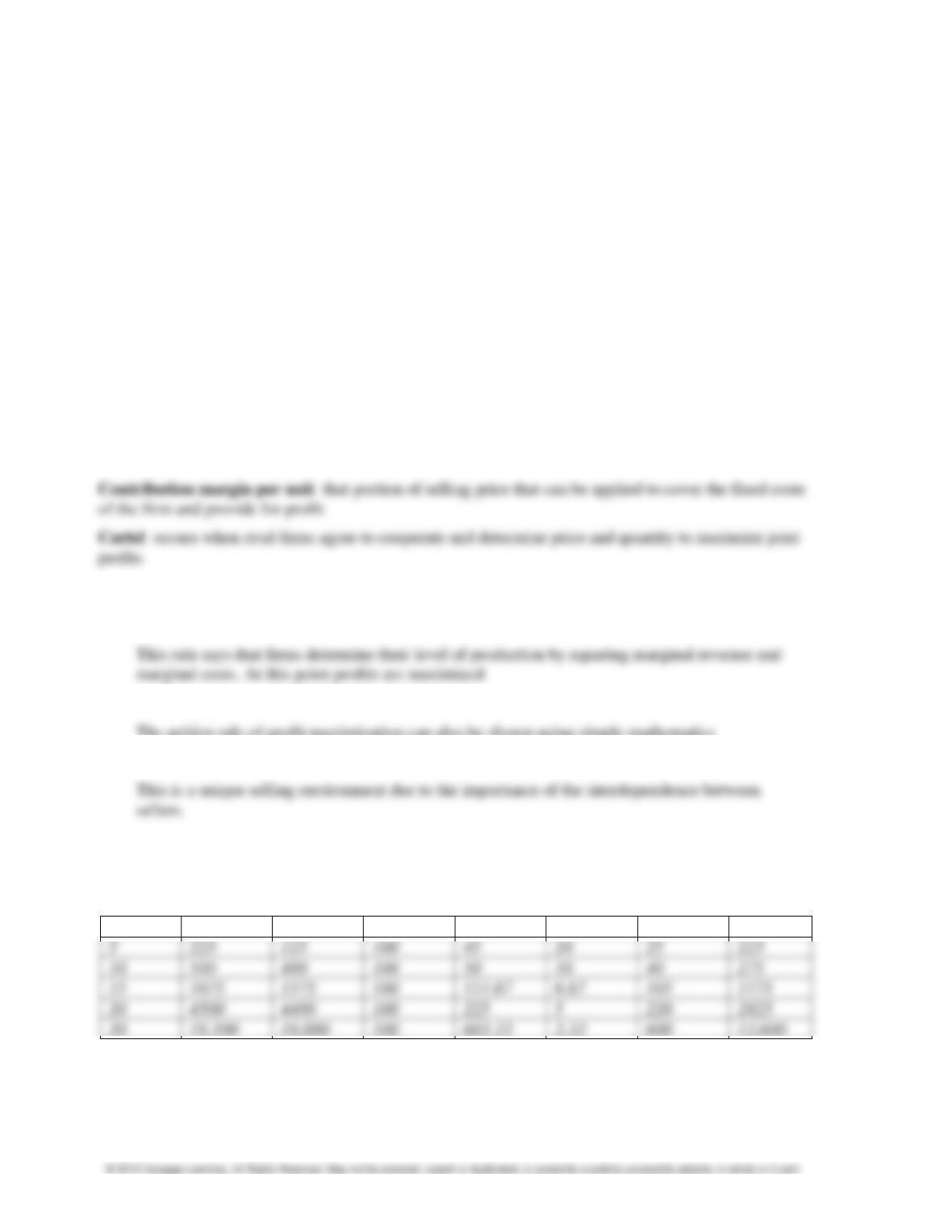
1. Using the following cost equation create a table showing TC, TVC, TFC, ATC, AFC, AVC,
and MC for quantities of 5, 10, 15, 20 and 30. C = 100 + 60(Q) -12(Q)2 + (Q)3.
Q
TC
TVC
TFC
ATC
AFC
AVC
MC
4500
4400
5
2825
18,100
18,000
603.33
3.33
13,600
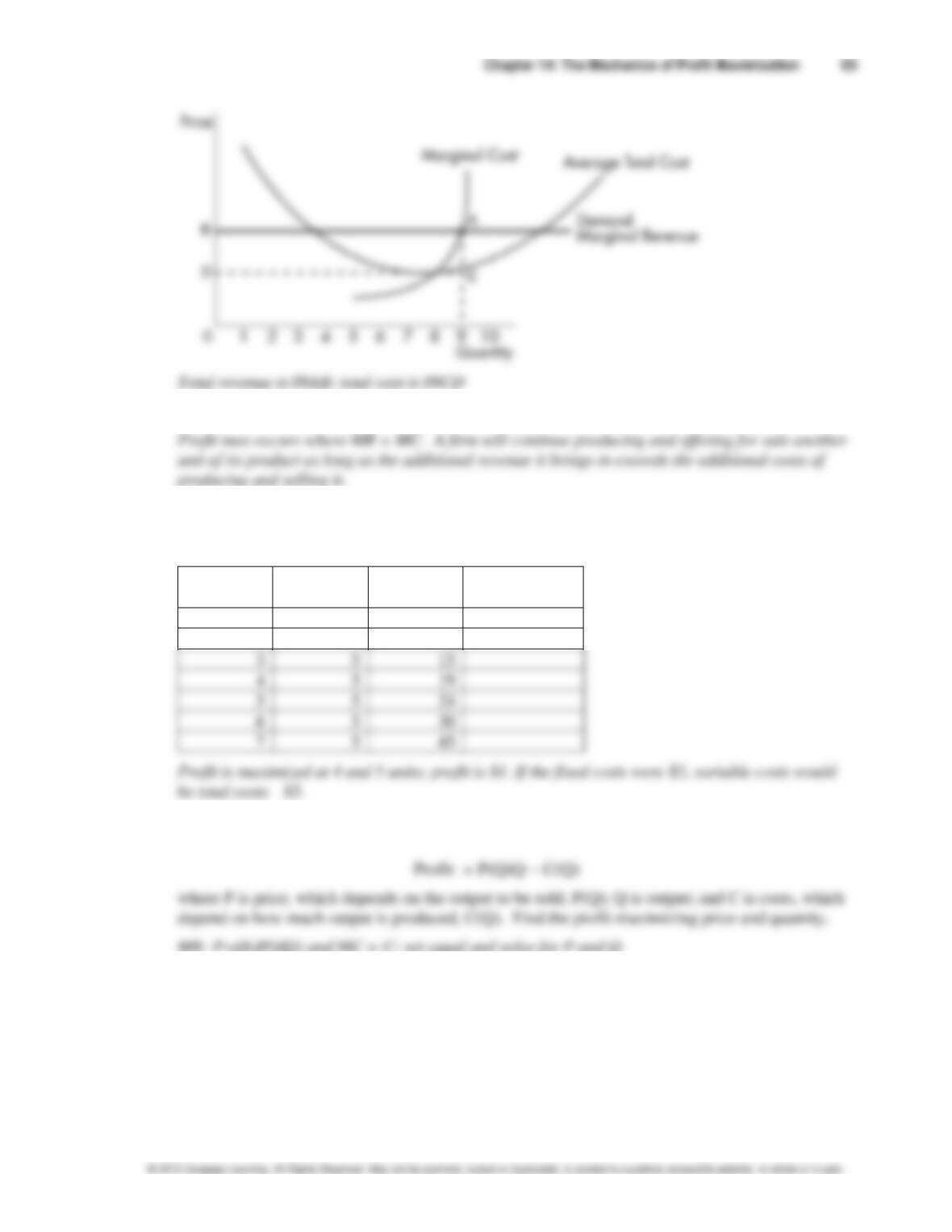
2. Draw a perfectly elastic demand curve on top of a standard U-shaped average total cost curve.
Now add in the marginal cost and marginal revenue curves. Find the profit-maximizing point,
MR = MC. Indicate the firm’s total revenues and total cost.
3. Describe profit maximization in terms of marginal revenue and marginal cost.
4. Use the information below to calculate total revenue, marginal revenue, and marginal cost.
Indicate the profit-maximizing level of output. If the price was $3 and fixed costs were $5,
what would variable costs be? At what level of output would the firm produce?
Output
Price
Total
Costs
Total Revenue
(P Q)
1
$5
$10
2
5
12
3
5
15
4
5
19
5
5
24
6
5
30
7
5
45
5. A firm’s profits are the difference between its revenues and costs as represented by the
function
MR– P+Q(dP/dQ) and MC = C; set equal and solve for P and Q.
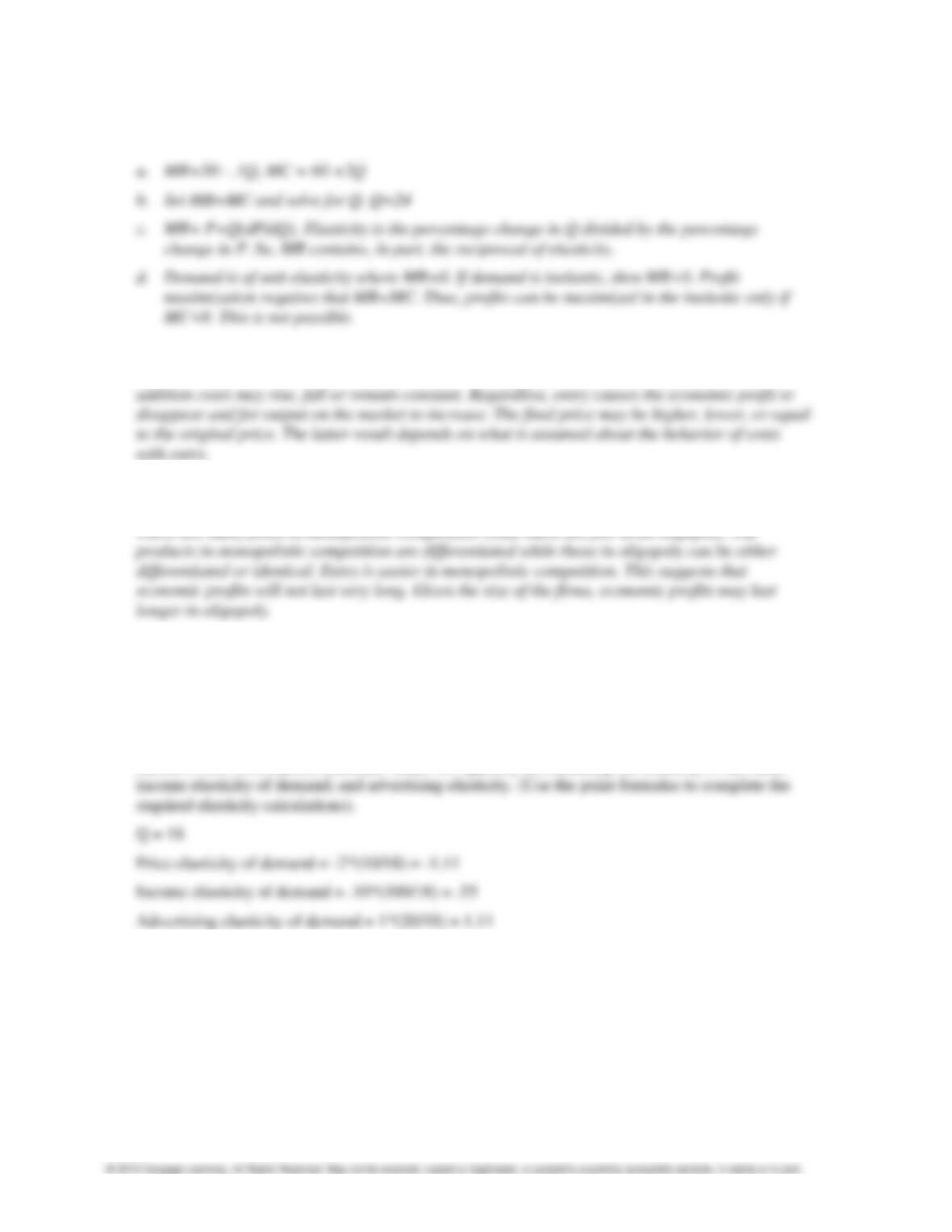
6. The demand function is Q = 100 – .5P. The cost function is TC = C = 100 + 60(Q) +(Q)2
a. Find MR and MC.
b. Demonstrate that profit is maximized at the quantity where MR = MC.
c. Derive the relationship between marginal revenue and the price elasticity of demand, and
show that the profit-maximizing price and quantity will never be the unit-elastic point on the
demand curve.
66 Chapter 14: The Mechanics of Profit Maximization
d. Using the information in part b, demonstrate that the profit-maximizing price and quantity
will never be in the inelastic portion of the demand curve.
7. Explain the competitive process when a firm earns a positive economic profit.
New firms enter the market attracted to the economic profits. As entry occurs price falls. In
8. Explain what is different between firms in monopolistic competition and firms in oligopoly?
What does this difference mean for prices and quantities and for economic profit.
9. A firm has estimated the following demand function for its product:
Q = 8 – 2P + 0.10I + A
Where Q is quantity demanded per month in thousands, P is product price, I is an index of
consumer income, and A is advertising expenditures per month in thousands. Assume that P=$10,
I=100, and A=20.
Based on this information, calculate values for: quantity demanded; price elasticity of demand;
10. The market demand and marginal cost functions for a product sold by a monopolist are given below:
Demand: QD = 100 – 2P
Marginal Cost: MC = 1.5Q
Chapter 14: The Mechanics of Profit Maximization 67
Based on this information, calculate the profit-maximizing price and quantity and the revenue
maximizing price and quantity:
Create the inverse demand function and then calculate total revenue: TR=50Q-.5Q2. Take the
11. You have begun a new business of transcential learning. You have fixed costs of $1800 a
month and a variable cost of $48. You charge $16 per session. You can provide sessions at
12. The market supply and demand functions for a product traded on a perfectly competitive
market are given below:
13. Now, suppose the competitive market Exercise 12 is monopolized. Calculate the price and
quantity for the monopolist.
14. If the (profit–maximizing) level of output that a monopolist produces is such that marginal
revenue, marginal cost, and average total costs are equal then economic profits must be:
a. negative.
b. positive.
c. zero.
d. indeterminate from the given information.
15. Draw a demand curve for a firm with market power. Portray the situation where the firm is
earning economic profits. Now illustrate what occurs as entry occurs and rivals begin
competing with that firm.
A demand curve for a firm with market power would be downward sloping indicating that
average total costs will be equal and economic profits will have dissipated.
16. Show that it is possible for a monopolist to earn negative economic profit.