CHAPTER 14 – 1
CHAPTER 14
DIVIDENDS AND DIVIDEND POLICY
Answers to Concepts Review and Critical Thinking Questions
1. Dividend policy deals with the timing of dividend payments, not the amounts ultimately paid.
Dividend policy is irrelevant when the timing of dividend payments doesn’t affect the present value
of all future dividends.
3. First, relatively young and less profitable firms generally should not make cash distributions. They
need the cash to fund investments (and flotation costs discourage the raising of outside cash).
However, as a firm matures, it begins to generate free cash flow (which, you will recall, is internally
generated cash flow beyond that needed to fund profitable investment activities). Significant free cash
flow can lead to agency problems if it is not distributed. Managers may become tempted to pursue
empire building or otherwise spend the excess cash in ways not in the shareholders’ best interests.
Thus, firms come under pressure to make distributions rather than hoard cash. And, consistent with
what we observe, we expect large firms with a history of profitability to make large distributions.
Thus, the life cycle theory says that firms trade off the agency costs of excess cash retention against
the potential future costs of external equity financing. A firm should begin making distributions when
it generates sufficient internal cash flow to fund its investment needs now and into the foreseeable
future.
7. The stock price dropped because of an expected drop in future dividends. Since the stock price is the
present value of all future dividend payments, if the expected future dividend payments decrease, then
the stock price will decline.
8. The plan will probably have little effect on shareholder wealth. The shareholders can reinvest on their
own, and the shareholders must pay the taxes on the dividends either way. However, the shareholders
CHAPTER 14 – 2
9. If these firms just went public, they probably did so because they were growing and needed the
additional capital. Growth firms typically pay very small cash dividends, if they pay a dividend at all.
This is because they have numerous projects, and therefore reinvest the earnings in the firm instead of
paying cash dividends.
associated with the municipal bonds. Therefore, it should prefer to hold higher yielding, taxable bonds.
Solutions to Questions and Problems
Basic
NOTE: All end-of–chapter problems were solved using a spreadsheet. Many problems require multiple
steps. Due to space and readability constraints, when these intermediate steps are included in this solutions
manual, rounding may appear to have occurred. However, the final answer for each problem is found
without rounding during any step in the problem.
1. With no taxes we would expect the stock price to drop by exactly the amount of the dividend, so the
new stock price will be:
2. Your total portfolio value will be the total stock value plus the dividends received, so:
Portfolio value = $12,852 + (150 × $1.32)
3. The aftertax dividend is the pretax dividend times one minus the tax rate, so:
Aftertax dividend = $7.40(1 – .15)
Aftertax dividend = $6.29
CHAPTER 14 – 3
4. a. The shares outstanding increases by 10 percent, so:
New shares outstanding = 35,000(1.10)
New shares outstanding = 38,500
b. The shares outstanding increases by 25 percent, so:
New shares outstanding = 35,000(1.25)
New shares outstanding = 43,750
New shares issued = 8,750
5. a. To find the new shares outstanding, we multiply the current shares outstanding times the ratio of
old shares to new shares, so:
New shares outstanding = 35,000(2/1)
New shares outstanding = 70,000
CHAPTER 14 – 4
b. To find the new shares outstanding, we multiply the current shares outstanding times the ratio of
new shares to old shares, so:
6. To find the new stock price, we multiply the current stock price by the ratio of old shares to new
shares, so:
a. $86(3/5) = $51.60
b. $86(1/1.15) = $74.78
c. $86(1/1.425) = $60.35
7. The stock price is the total market value of equity divided by the shares outstanding, so:
P0 = $724,500 equity / 23,000 shares
P0 = $31.50 per share
Ignoring tax effects, the stock price will drop by the amount of the dividend, so:
CHAPTER 14 – 5
The equity and cash accounts will both decline by $31,050. The new balance sheet will be:
Market Value Balance Sheet
Cash
$128,950
Equity
$693,450
Fixed assets
564,500
Total
$693,450
Total
$693,450
8. Repurchasing the shares will reduce shareholders’ equity by $31,050. The shares repurchased will be
the total purchase amount divided by the stock price, so:
Shares bought = $31,050 / $31.50
Shares bought = 986
9. The stock price is the total market value of equity divided by the shares outstanding, so:
P0 = $650,000 equity / 24,000 shares
P0 = $27.08 per share
The shares outstanding will increase by 20 percent, so:
10. With a stock dividend, the shares outstanding will increase by one plus the dividend percentage, so:
New shares outstanding = 245,000(1.10)
New shares outstanding = 269,500
CHAPTER 14 – 6
The capital surplus is the capital paid in excess of par value, which is $1, so:
11. The only equity account that will be affected is the par value of the stock. The par value will change
by the ratio of old shares to new shares, so:
New par value = $1(1/2)
New par value = $.50 per share
Last year’s dividends = $357,700 / 1.10
Last year’s dividends = $325,181.82
And to find the dividends per share, we simply divide this amount by the shares outstanding last year.
Doing so, we get:
Dividends per share last year = $325,181.82 / 245,000 shares
Dividends per share last year = $1.33
Intermediate
12. a. If the company makes a dividend payment, we can calculate the wealth of a shareholder as:
Dividend per share = $9,065 / 4,900 shares
Dividend per share = $1.85
CHAPTER 14 – 7
b. If the company pays dividends, the current EPS is $2.65, and the PE ratio is:
PE = $57.15 / $2.65
PE = 21.57
c. A share repurchase would seem to be the preferred course of action. Only those shareholders who
wish to sell will do so, giving the shareholder a tax timing option that he or she doesn’t get with a
dividend payment.
13. a. The price of a share of stock is the present value of the dividends. The dividend per share each
year will be:
CHAPTER 14 – 8
b. The dividend increase for existing shareholders for Year 1 will be the new dividend amount
minus by the current dividend amount, which is:
Dividend increase = $650,000 – 550,000 = $100,000
Since this amount must be paid to the new shareholders at Year 2, it will reduce the amount
available to current shareholders. The amount available to current shareholders at Year 2 will be:
Total dividends to current shareholders at Year 2 = $840,000 – 112,000 = $728,000
So, the dividend per share to the current shareholders will now be:
Challenge
14. Assuming no capital gains tax, the aftertax return for the Gordon Company is the capital gains growth
rate, plus the dividend yield times one minus the tax rate. Using the constant growth dividend model,
we get:
Aftertax return = g + D(1 – T) = .12
CHAPTER 14 – 9
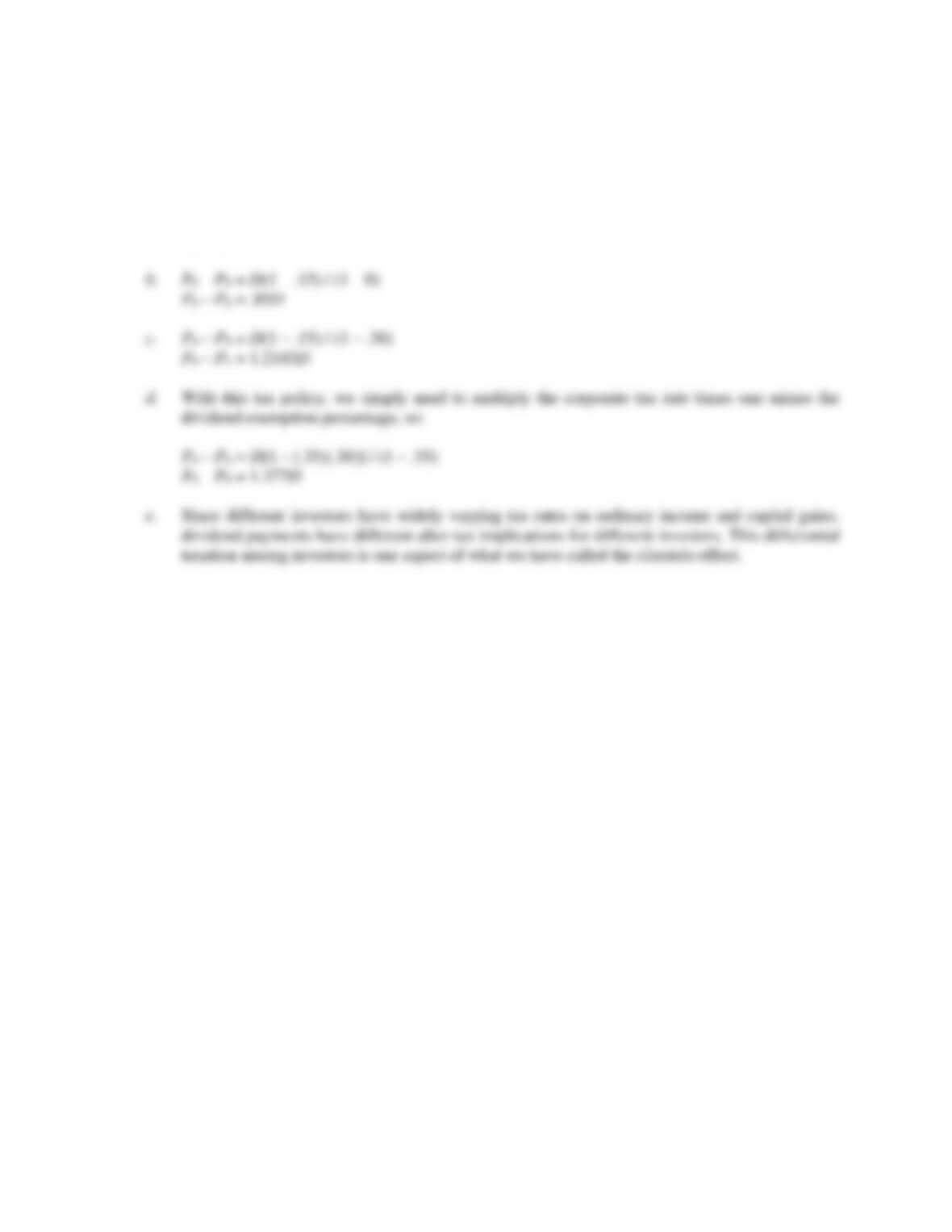
15. Using the equation for the decline in the stock price ex-dividend for each of the tax rate policies,
we get:
(P0 – PX) / D = (1 – TP) / (1 – TG)
a. P0 – PX = D(1 – 0) / (1 – 0)
P0 – PX = D