Problem 14-9 (continued)
The net cash provided by operating activities is computed as follows:
Net income …………………………………………………..
$63,000
Adjustments to convert net income to cash basis:
Net cash provided by operating activities …………….
$39,000
2. Prepare a statement of cash flows.
Investing and Financing activities:
The guidelines from Exhibit 14-3 can be used to analyze the changes in
noncash balance sheet accounts that impact investing and financing
Problem 14-9 (continued)
The loan to Harker ($40,000) is recorded as a cash outflow in the
investing activities section of the statement. Because Foxboro did not
retire any bonds during the year, the corresponding amount in the table
on the prior page (+90,000) represents a cash inflow pertaining to a
bond issuance. Foxboro did not repurchase any of its own stock during
the year, so the increase in common stock (+60,000) is reported as a
cash inflow in the financing activities section of the statement. Property,
plant, and equipment and retained earnings require further analysis as
follows:
Property, plant, and equipment:
Problem 14-9 (continued)
Foxboro Company
Statement of Cash Flows
For Year 2
Operating activities:
Net income ……………………………………………….
$ 63,000
Adjustments to convert net income to cash basis:
Depreciation ……………………………………………
$ 45,000
Increase in accounts receivable …………………..
(70,000)
Increase in inventory ………………………………..
(48,000)
Decrease in prepaid expenses …………………….
9,000
Increase in accounts payable ………………………
Decrease in accrued liabilities ……………………..
Increase in income taxes payable ………………..
Gain on sale of equipment …………………………
Net cash provided by operating activities …………
Investing activities:
Proceeds from sale of equipment …………………..
Loan to Harker Company ……………………………..
Additions to plant and equipment …………………..
Net cash used in investing activities ……………….
Financing activities:
Issuance of bonds payable …………………………...
Issuance of common stock…………………………...
Cash dividends …………………………………………..
Net cash provided by financing activities ………….
Net decrease in cash …………………………………..
Cash balance, beginning of year …………………….
Cash balance, end of year …………………………...
$ 11,000
Problem 14-9 (continued)
3. Free cash flow computation:
Net cash provided by operating activities ……………..
$ 39,000
4. The relatively small amount of net cash provided by operating activities
during the year was largely the result of a large increase in accounts
receivable. (The large increase in inventory was offset by a large
Problem 14-10 (20 minutes)
Transaction
Operating
Investing
Financing
Cash
Inflow
Cash
Outflow
a.
Bonds were retired by paying the
principal amount due ………………………
X
X
b.
Interest was paid to a lender ………………
X
X
c.
Income taxes were paid …………………….
X
X
d.
A long-term loan was made to a supplier.
X
X
e.
Cash dividends were declared and paid …
X
X
X
X
h.
Paid wages to employees …………………..
X
X
i.
X
Paid cash to repurchase its own stock …..
X
X
Bought equipment for cash ………………..
X
X
X
X
Problem 14-11 (45 minutes)
1 Prepare a statement of cash flows (all numbers in millions).
Operating activities:
Step 1: The following equation can be applied to the Accumulated
Depreciation account to compute the depreciation to add back to net
income:
Beginning balance – Debits + Credits = Ending balance
$651 – $7 + Credits = $770
Credits = $770 – $651 + $7
Credits = $126
Problem 14-11 (continued)
As an intermediate step, the net cash provided by operating activities
can now be calculated as follows:
Net income ……………………………………………….
$170
Adjustments to convert net income to cash basis:
Depreciation ……………………………………………
$126
Increase in accounts receivable …………………..
(52)
Increase in inventory ………………………………..
(40)
Increase in accounts payable ………………………
Gain on sale of equipment …………………………
$317
Investing and Financing activities:
The guidelines from Exhibit 14-3 can be used to analyze the changes in
noncash balance sheet accounts that impact investing and financing
cash flows as follows:
Problem 14-11 (continued)
Blankley did not issue any bonds during the year; therefore, the amount
in the table on the prior page (–185) represents a cash outflow
pertaining to a bond retirement. Property, plant, and equipment and
retained earnings require further analysis as follows:
Property, plant, and equipment:
Problem 14-11 (continued)
Blankley Company
Statement of Cash Flows
Operating activities:
Net income ……………………………………………….
$ 170
Adjustments to convert net income to cash basis:
Depreciation ……………………………………………
$126
Increase in accounts receivable …………………..
(52)
Increase in inventory ………………………………..
(40)
Increase in accounts payable ………………………
100
Increase in accrued liabilities ………………………
Increase in income taxes payable ………………..
Gain on sale of equipment …………………………
Net cash provided by operating activities …………
Investing activities:
Proceeds from sale of equipment …………………..
Additions to plant and equipment …………………..
Net cash used in investing activities ……………….
Retirement of bonds payable ………………………..
Cash dividends …………………………………………..
Net cash used in financing activities ……………….
Net decrease in cash …………………………………..
Cash balance, beginning of year …………………….
Cash balance, end of year …………………………...
$ 39
2. Blankley’s net income decreased by $20 million; however, its net cash
provided by operating activities increased by $157 million over the prior
year. When net income and net cash provided by operating activities
move in opposite directions it warrants further inquiry. It appears that
Problem 14-11 (continued)
This suggests that Blankley may be inflating its net income by failing to
record a growing amount of uncollectible accounts. The company’s
inventory has increased (+40 million) even though sales have declined.
Problem 14-12 (45 minutes)
To begin the problem, fill in the question mark pertaining to item “a”
using the following T-account:
Retained Earnings
Dividends
10,000
Net income
85,000
Change
75,000
Step 2: The guidelines from Exhibit 14-2 can be used to analyze the
changes in noncash balance sheet accounts that impact net income as
follows:
Increase in
Account Balance
Decrease in
Account Balance
Problem 14-12 (continued)
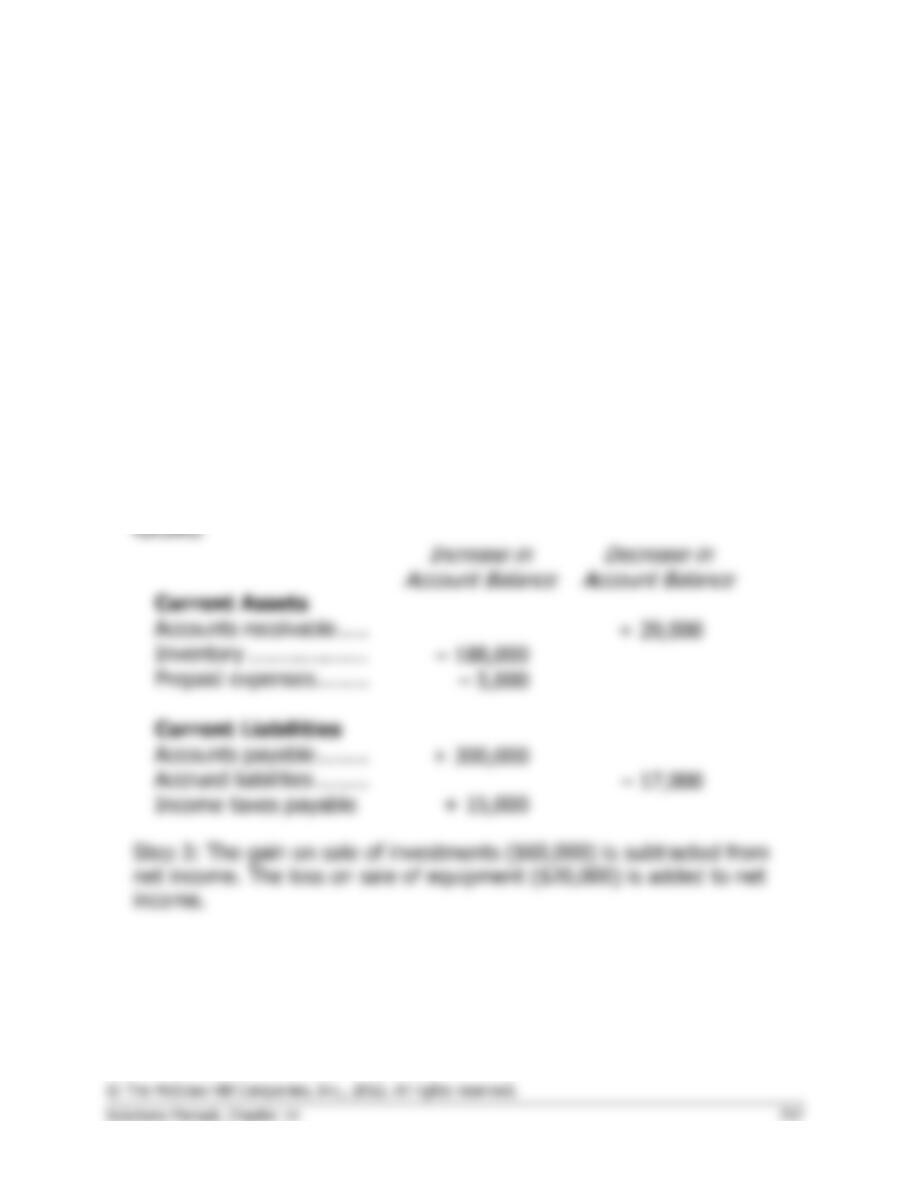
Step 3: The company had a $20,000 gain on the sale of equipment. The
book value of the equipment was $15,000 (= $160,000 – $145,000).
The company sold the equipment for $35,000, so its gain on the sale of
$20,000 (= $35,000 – $15,000) is subtracted from net income.
Depreciation ……………………………………….
Increase in accounts receivable ………………
(170,000)
Decrease in inventory …………………………..
Increase in prepaid expenses …………………
Increase in accounts payable ………………….
Decrease in accrued liabilities …………………
Increase in income taxes payable ……………
9,000
Gain on sale of equipment ……………………..
(20,000)
131,000
Net cash provided by operating activities …….
$216,000
Investing and Financing activities:
The guidelines from Exhibit 14-3 can be used to analyze the changes in
noncash balance sheet accounts that impact investing and financing
cash flows as follows:
Problem 14-12 (continued)
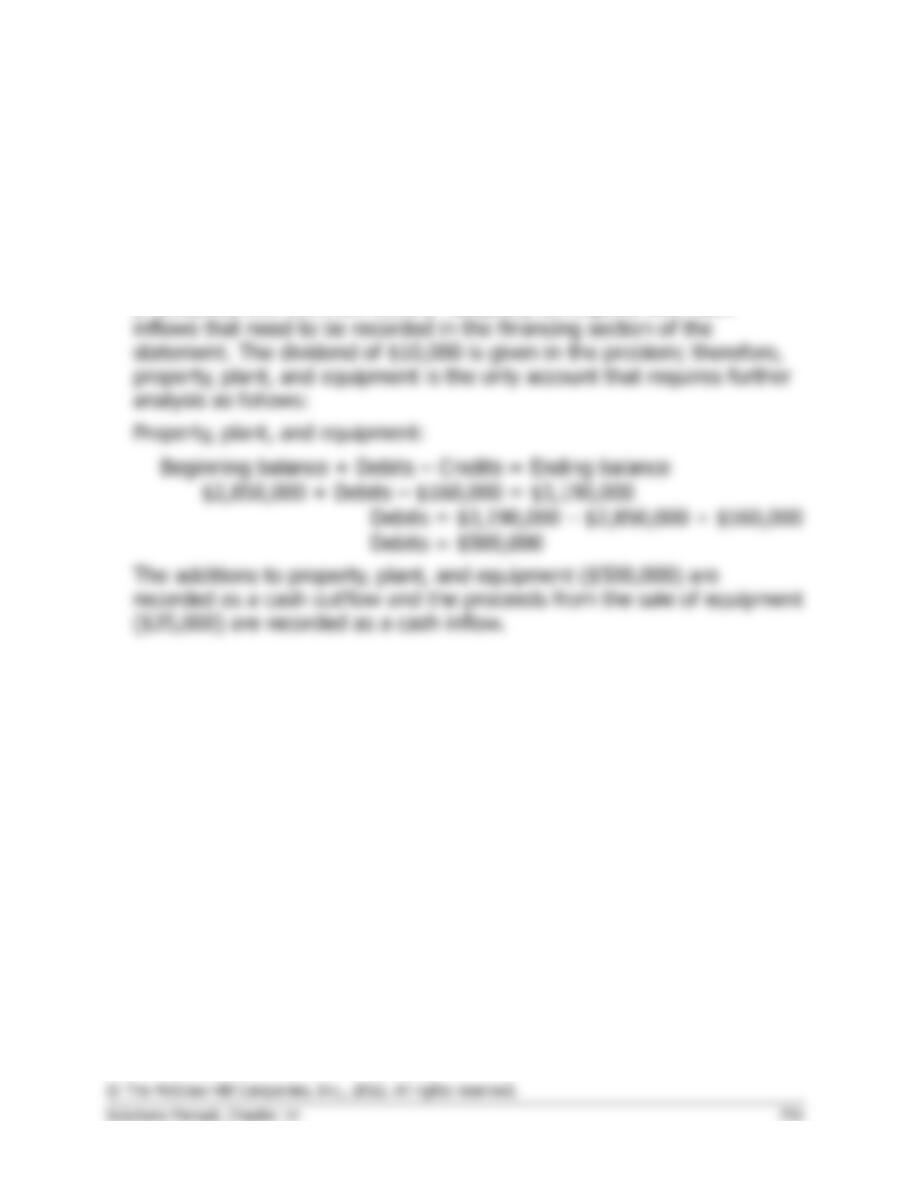
As stated in item “f” in the problem, it is reasonable to assume that the
$90,000 increase in long-term investments corresponds with a cash
outflow that needs to be recorded in the investing section of the
statement. The $80,000 repayment of loan received from a subsidiary
corresponds with a cash inflow that needs to be recorded in the
investing section of the statement. The increase in bonds payable
(+200,000) and common stock (+120,000) correspond with cash
Problem 14-12 (continued)
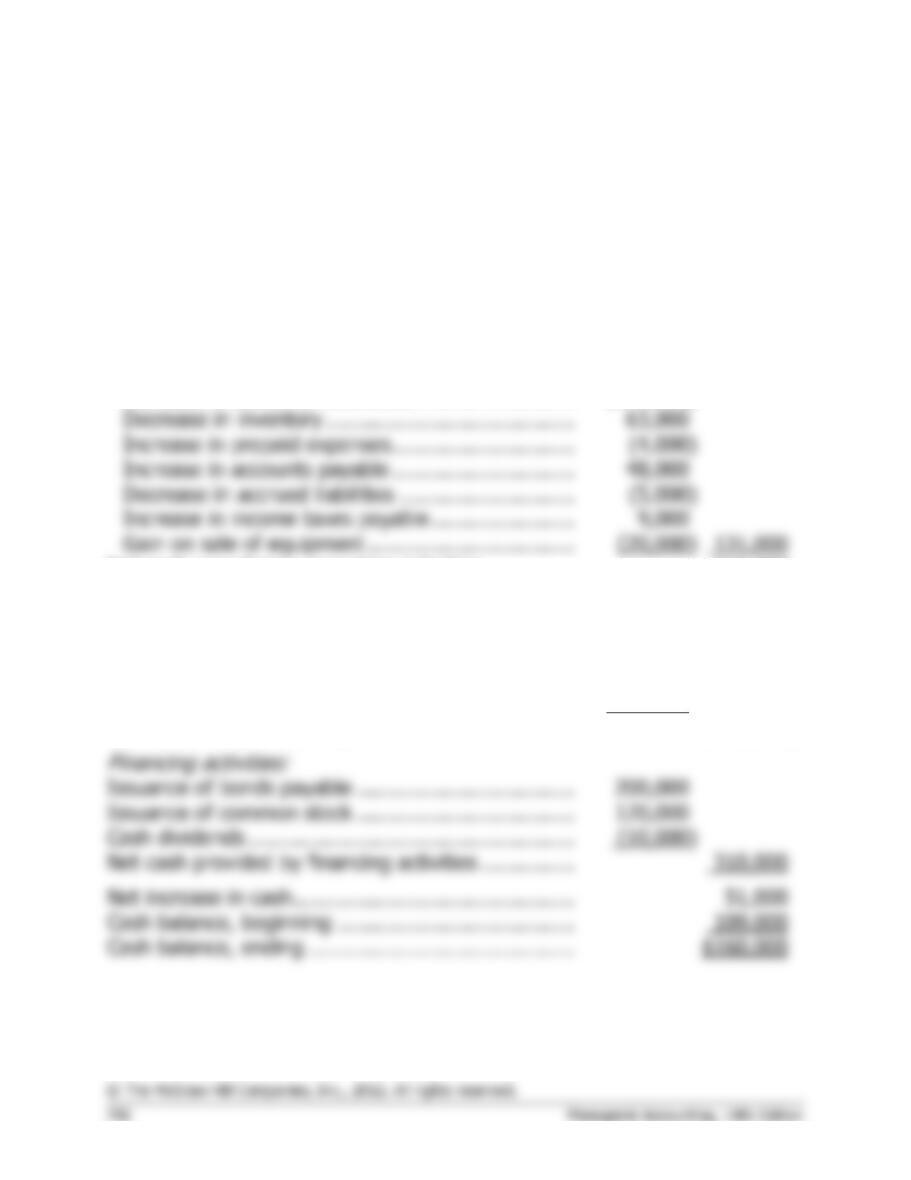
Given the amounts above, the statement of cash flows would be as follows:
Estes Company
Statement of Cash Flows
Operating activities:
Net income ………………………………………………….
$ 85,000
Adjustments to convert net income to cash basis:
Depreciation ……………………………………………..
$210,000
Increase in accounts receivable ……………………..
(170,000)
Decrease in inventory ………………………………….
Increase in prepaid expenses ………………………..
Increase in accounts payable ………………………..
48,000
Decrease in accrued liabilities ……………………….
Increase in income taxes payable …………………..
Gain on sale of equipment …………………………...
Net cash provided by operating activities ……………
216,000
Investing activities:
Decrease in long-term loan to subsidiary ……………
80,000
Proceeds from sale of equipment ……………………..
35,000
Additions to long-term investments …………………..
(90,000)
Additions to plant and equipment …………………….
(500,000)
Net cash used in investing activities ………………….
(475,000)
Issuance of bonds payable ……………………………..
Issuance of common stock …………………………..…
Cash dividends …………………………………………….
Net increase in cash ………………………………………
51,000
Cash balance, beginning ………………………………..
Cash balance, ending …………………………………….
Problem 14-13 (45 minutes)
1. Prepare a statement of cash flows.
Operating activities:
Step 1: The following equation can be applied to the Accumulated
Depreciation account to compute the depreciation to add back to net
income:
Beginning balance – Debits + Credits = Ending balance
$560,000 – $40,000 + Credits = $615,000
Credits = $615,000 – $560,000 + $40,000
Credits = $95,000
Step 2: The guidelines from Exhibit 14-2 can be used to analyze the
changes in noncash balance sheet accounts that impact net income as
Problem 14-13 (continued)
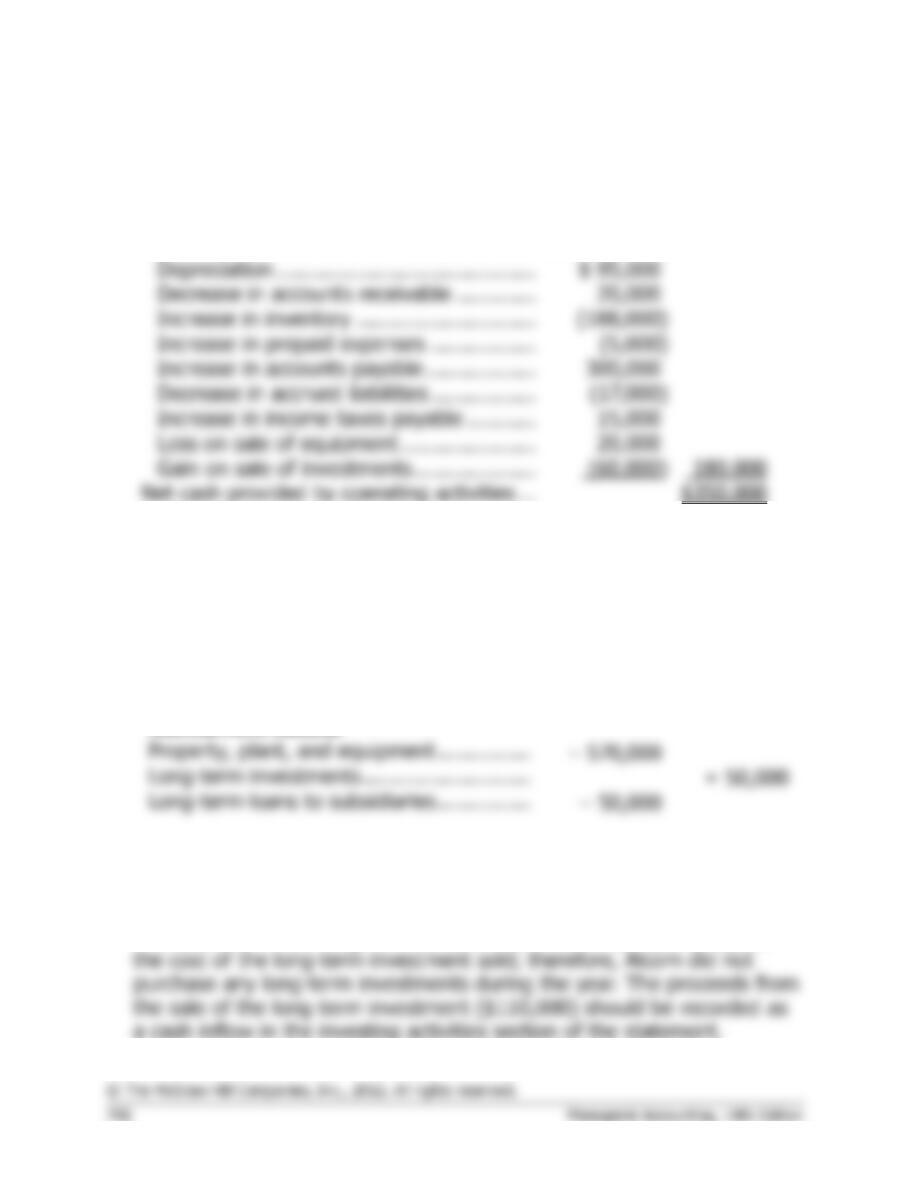
The net cash provided by operating activities can now be calculated as
follows:
Net income …………………………..…………..
$170,000
Adjustments to convert net income to cash basis:
Net cash provided by operating activities …
$350,000
Investing and Financing activities:
The guidelines from Exhibit 14-3 can be used to analyze the changes in
noncash balance sheet accounts that impact investing and financing
cash flows as follows:
Increase in
Account
Balance
Decrease in
Account
Balance
Noncurrent Assets
Property, plant, and equipment ……………
+ 50,000
Long-term loans to subsidiaries ……………
Liabilities and Stockholders’ Equity
Bonds payable …………………………………
+ 220,000
Common stock …………………………………
+ 90,000
The decrease in the long-term investments account ($50,000) equals
Problem 14-13 (continued)
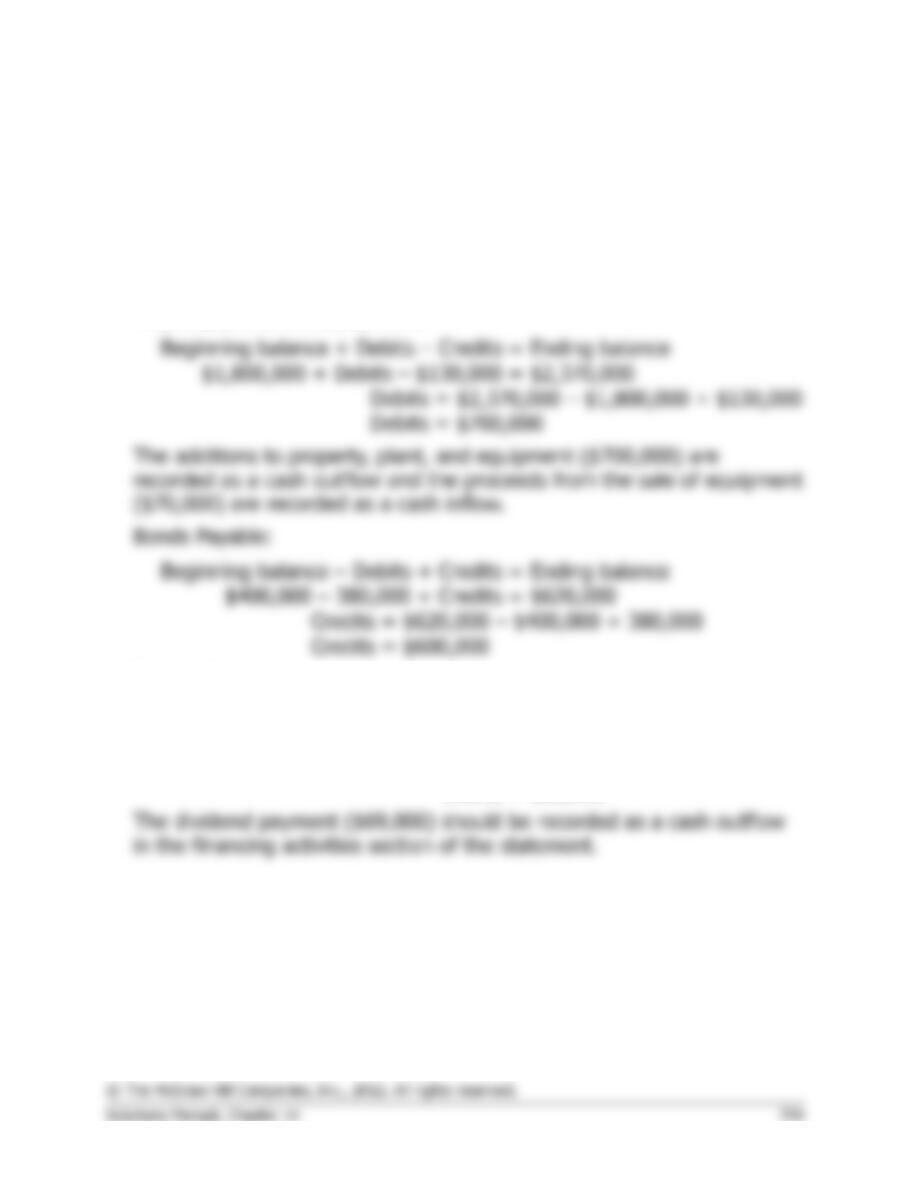
Alcorn’s subsidiaries did not repay any loans during the year, therefore,
the amount in the table on the prior page (–50,000) represents a cash
outflow pertaining to a new loan. The company did not repurchase any
of its own stock, so the amount on the prior page represents a $90,000
cash inflow related to a stock issuance. Property, plant, and equipment,
bonds payable and, retained earnings require further analysis as follows:
Property, plant, and equipment:
Retained earnings:
Beginning balance – Debits + Credits = Ending balance
$395,000 – Debits + $170,000 = $496,000
$565,000 = $496,000 + Debits
Debits = $69,000
Problem 14-13 (continued)
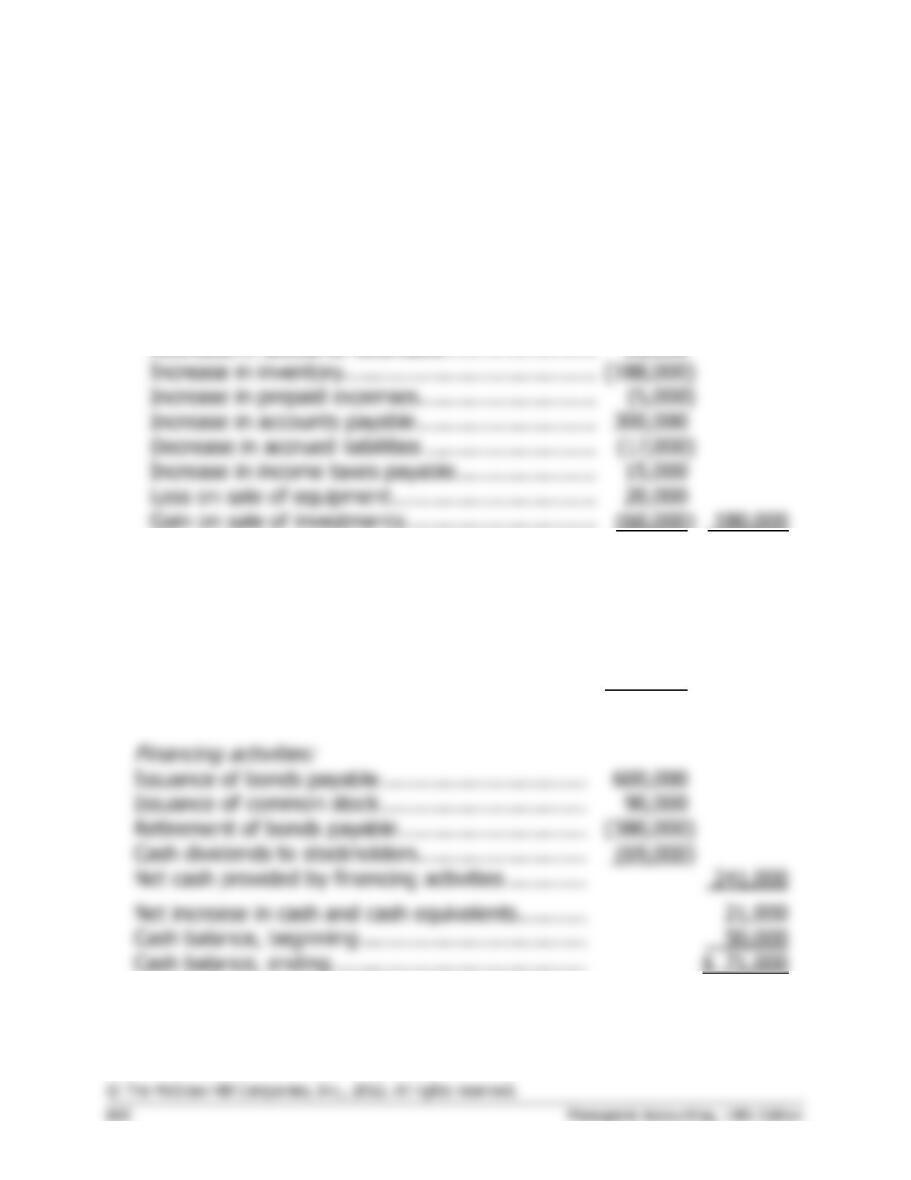
Alcorn Company
Statement of Cash Flows
Operating activities:
Net income …………………………………………………
$170,000
Adjustments to convert net income to cash basis:
Depreciation ……………………………………………..
$ 95,000
Decrease in accounts receivable …………………….
20,000
Increase in inventory …………………………………..
(188,000)
Increase in prepaid expenses ………………………..
Increase in accounts payable ………………………..
300,000
Decrease in accrued liabilities ……………………….
Increase in income taxes payable …………………..
Loss on sale of equipment …………………………...
20,000
Gain on sale of investments ………………………….
(60,000)
180,000
Net cash provided by operating activities …………..
350,000
Investing activities:
Proceeds from sale of long-term investments ……
110,000
Proceeds from sale of equipment ……………………
70,000
Loans to subsidiaries …………………………………..
(50,000)
Additions to plant and equipment …………………..
(700,000)
Net cash used in investing activities ………………..
(570,000)
Issuance of bonds payable …………………………...
600,000
Issuance of common stock …………………………...
90,000
Retirement of bonds payable …………………………
(380,000)
Cash dividends to stockholders ………………………
Net cash provided by financing activities ………….
241,000
Net increase in cash and cash equivalents ………..
Cash balance, beginning ………………………………
50,000
Cash balance, ending …………………………………..