48
XIV. CHAPTER FOURTEEN: SYLLOGISTIC LOGIC
A. General Theory
1. Assuming existential import, explain what the differences are between (a)
contradictories; (b) contraries; and (c) subcontraries.
2. Prove that no valid syllogism in the second figure can have an affirmative
conclusion.
3. a. If we interpret the sentence “All scientists are philosophers” so that it is
correctly symbolized by (x)(Sx Px), then why will “All scientists are
philosophers” not imply “Some scientists are philosophers”?
b. If we interpret “All scientists are philosophers” so that it has existential import,
then does “All scientists are philosophers” imply “Some scientists are
philosophers” or not? (Defend your answer.)
4. Assume for the moment (whether it actually is the case or not) that the four types
of categorical propositions are adequately represented by the four formulas below,
and show (a) why Aand Epropositions will not have the properties that contraries
are traditionally supposed to have; and (b) why I and O propositions will not have
the properties that subcontraries are traditionally supposed to have.
A: (x)(Sx Px)
E: (x)(Sx ~ Px)
I: (x)(Sx Px)
0: (x)(Sx ~ Px)
A. Answers
2. The general form of a syllogism in the second figure is
49
b. If we interpret the sentence to have existentential import, then we require the
4. a. It is not supposed to be possible for two propositions that are contraries both
B. True-False
1. The predicate term of “Some scientists are not philosophers” is not distributed.
2. The subject term of “All scientists are philosophers” is not distributed.
3. The subject term of “Some scientists are philosophers” is not distributed.
4. “All scientists are philosophers” and “No scientists are philosophers” are
contradictories.
5. “Some scientists are not philosophers” and “All scientists are philosophers” are
contradictories.
6. “Some scientists are not philosophers” and “Some scientists are philosophers” are
contradictories.
7. We can validly infer from “All scientists are philosophers” to its contrapositive.
8. We can validly infer from “Some scientists are philosophers” to its contrapositive.
9. We can validly infer from “No scientists are philosophers” to its obverse.
10. We can validly infer from “Some scientists are not philosophers” to its obverse.
50
B. Answers
C. Multiple choice: Assume existential import.
1. The proposition “All scientists are
philosophers” entails:
a. No nonscientists are philosophers
b. No scientists are nonphilosophers
c. No nonphilosophers are scientists
d. Some scientists are philosophers
e. none of these
2. The proposition “Some scientists
are not philosophers” follows from:
a. Some scientists are
nonphilosophers
b. Some nonscientists are
philosophers
c. No nonphilosophers are scientists
d. Some scientists are philosophers
e. none of these
3. The proposition “Some
nonscientists are nonphilosophers”
is equivalent to:
a. Some nonphilosophers are
scientists
b. Some scientists are not
nonphilosophers
c. No nonphilosophers are scientists
d. Some scientists are philosophers
e. none of these
4. The contrapositive of “No scientists
are nonphilosophers” is:
a. No philosophers are nonscientists
b. No nonphilosophers are scientists
c. No philosophers are scientists
d. No scientists are philosophers
e. none of these
5. The obverse of “No nonscientists
are philosophers” is:
a. All nonphilosophers are scientists
b. No nonphilosophers are scientists
c. All nonscientists are
nonphilosophers
d. All nonphilosophers are scientists
e. none of these
C. Answers

51
D. Inference: Answer the following questions, not assuming existential import.
1. Suppose it is true that “All logicians are mathematicians.” Then what can be said
about the truth values of the following:
a. Some logicians are not mathematicians
b. Some logicians are mathematicians
c. No logicians are nonmathematicians
d. All mathematicians are logicians
e. All nonmathematicians are nonlogicians
f. No logicians are mathematicians
g. Some nonmathematicians are logicians
h. Some logicians are nonmathematicians
2. Suppose it is false that “No logicians are mathematicians.” Then what can be said
about the truth value of the following sentences?
a. Some logicians are not mathematicians
b. Some logicians are mathematicians
c. All logicians are mathematicians
d. All logicians are nonmathematicians
e. All mathematicians are nonlogicians
f. No mathematicians are logicians
g. Some mathematicians are logicians
h. Some logicians are nonmathematicians
3. Suppose it is true that “Some logicians are not mathematicians.” Then what can
be said about the truth value of the following sentences?
a. Some mathematicians are not logicians
b. Some logicians are mathematicians
c. All logicians are mathematicians
d. No logicians are nonmathematicians
e. Some nonmathematicians are logicians
f. No logicians are mathematicians
g. Some nonmathematicians are not nonlogicians
h. Some logicians are nonmathematicians
52
4. Suppose it is false that “Some logicians are mathematicians.” Then what can be
said about the truth value of the following sentences?
a. Some logicians are not mathematicians
b. No logicians are mathematicians
c. All logicians are mathematicians
d. All logicians are nonmathematicians
e. All mathematicians are nonlogicians
f. No mathematicians are logicians
g. Some mathematicians are logicians
h. Some mathematicians are not nonlogicians
D. Answers
h. False
53
E. Syllogisms
Put the following into standard syllogistic form and test for validity, using either the five
rules for valid syllogism or Venn diagrams:
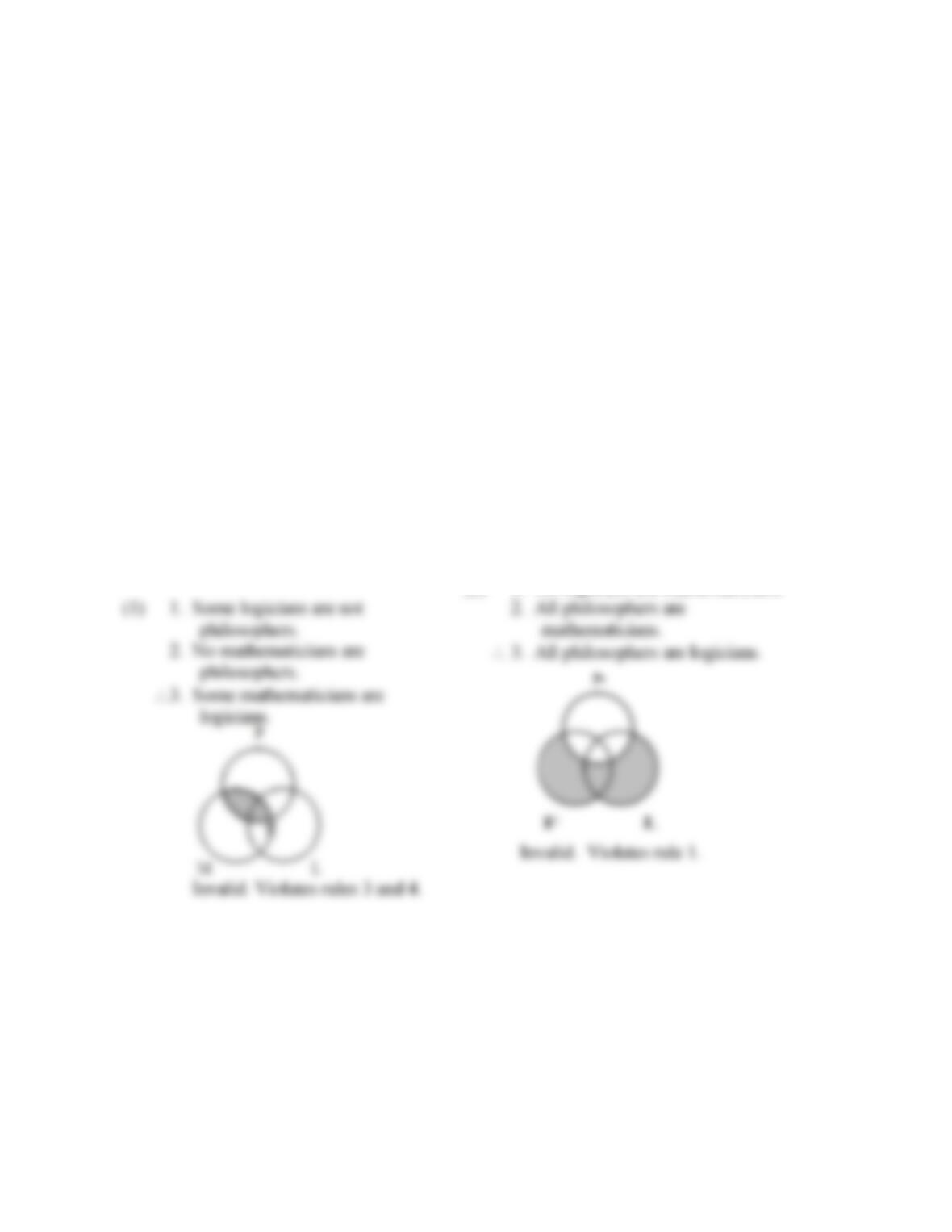
1. Some logicians are nonphilosophers, so some mathematicians are logicians, since
all mathematicians are nonphilosophers.
2. All nonlogicians are nonphilosophers, because all logicians are mathematicians,
while no philosophers are nonmathematicians.
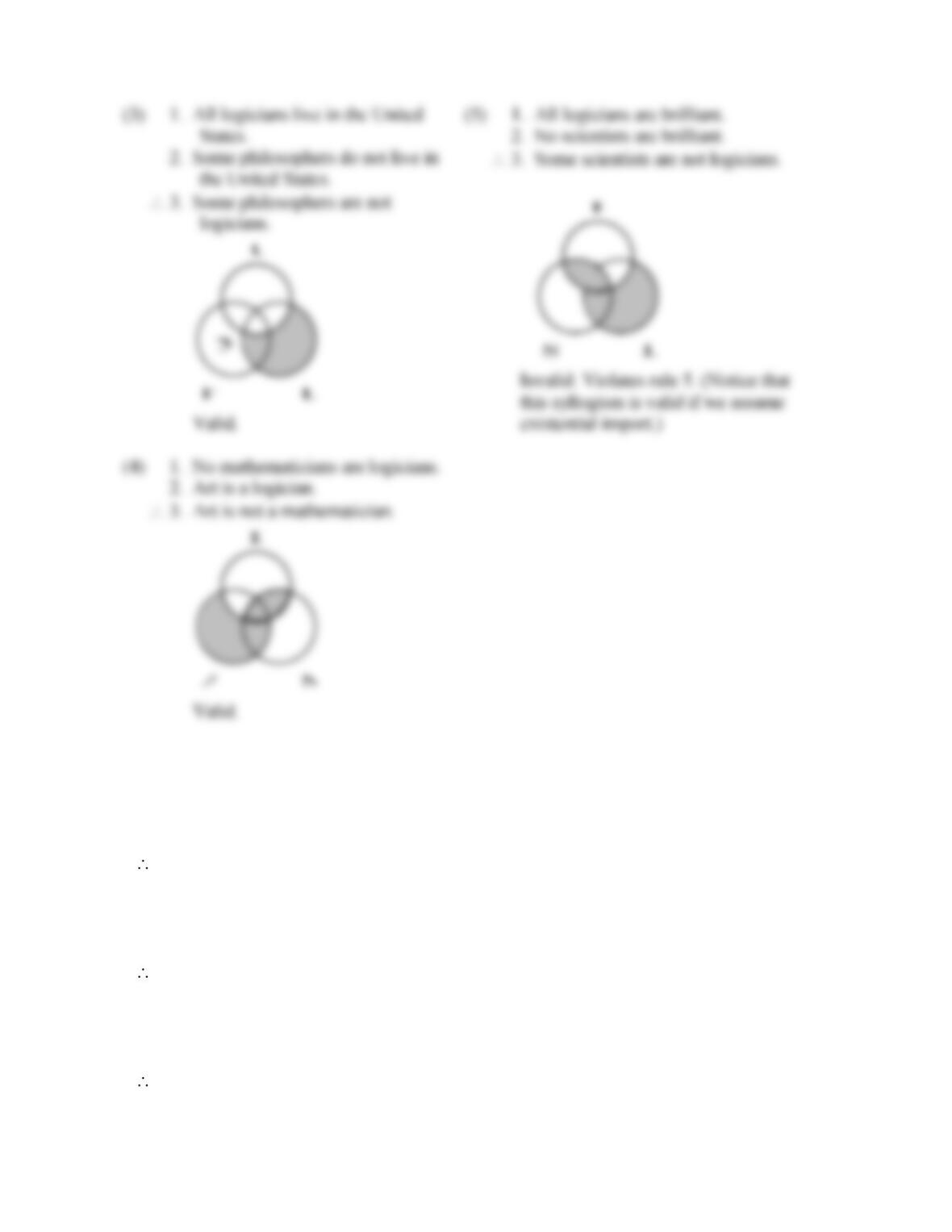
3. All logicians live in the United States, but some philosophers dwell elsewhere; so
some philosophers are nonlogicians.
4. It follows from the fact that no mathematicians are logicians that Art is not a
mathematician, since Art is a logician.
5. Due to the fact that logicians are brilliant but scientists are not brilliant, some
scientists are nonlogicians.
E. Answers
(2) 1. All logicians are mathematicians.
54
F. Sorites. Translate the following sorites into standard form and test for validity:
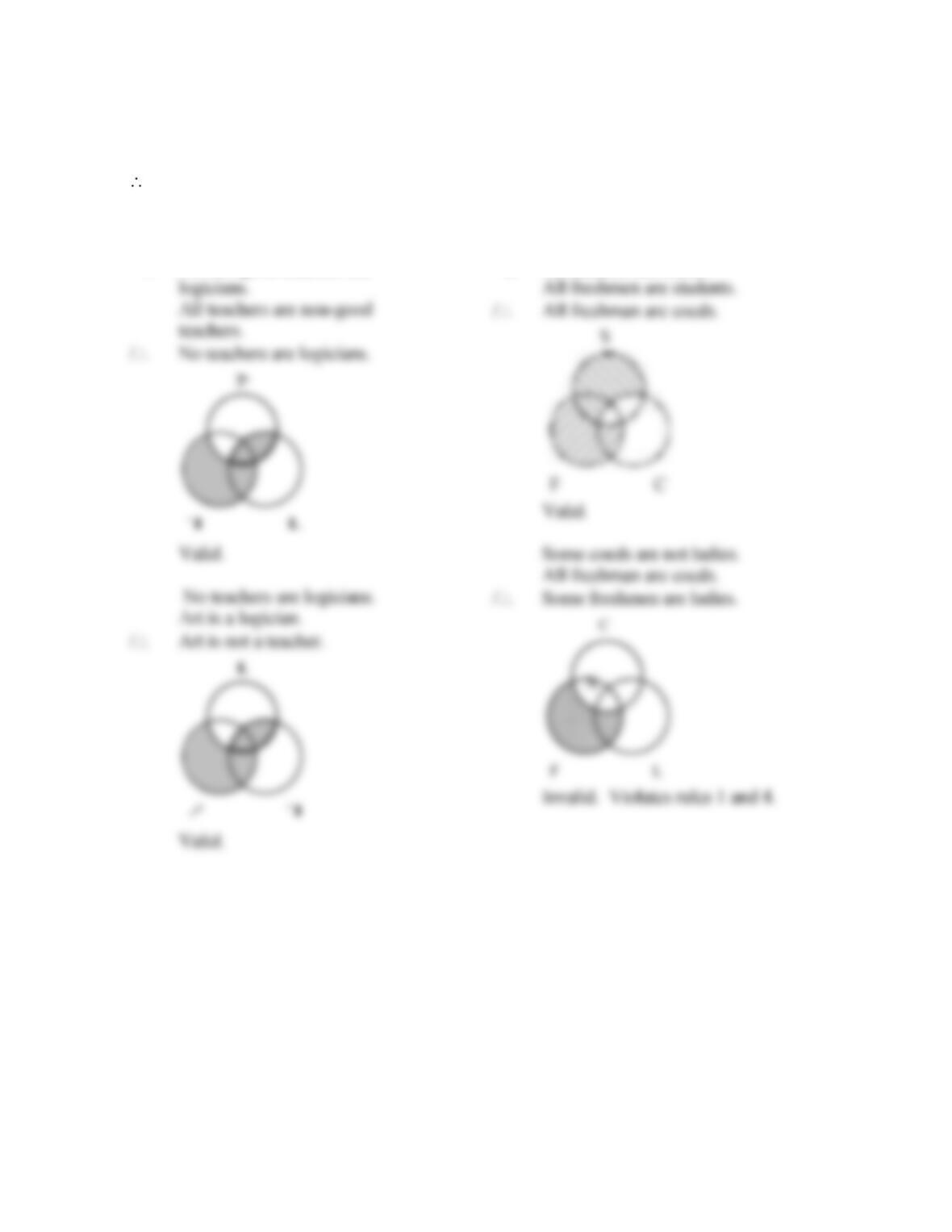
1. No teachers are good teachers.
Art is a logician.
No one who is not a good teacher is a logician.
/ Art is not a teacher.
2. No freshmen are nonstudents.
Some coeds are not ladies.
All noncoeds are nonstudents.
/ Some freshmen are ladies.
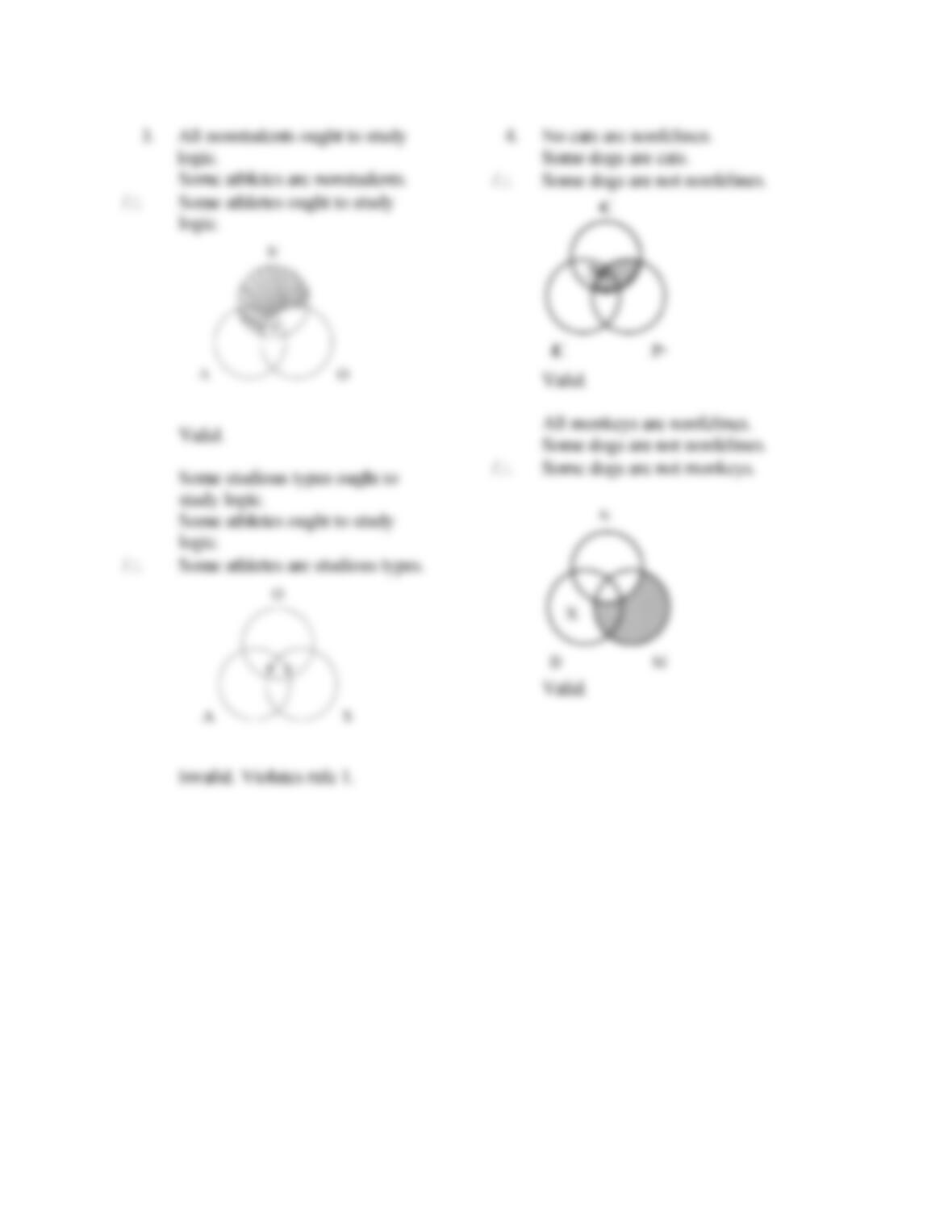
3. Anyone who is a nonstudent ought to study logic.
There are some athletes who are nonstudents.
There are some studious types that ought to study logic.
/ There are some athletes who are studious.
55
4. There are dogs that are cats.
There are no cats that are nonfelines.
All monkeys are nonfelines.
/ There are dogs that aren’t monkeys.
F. Answers
1. No non-good teachers are
2. All students are coeds.
56