Chapter 14
Country and Political Risk
QUESTIONS
1. Describe the differences between country risk and political risk. What is sovereign risk?
Answer: Political risk is the risk that a government action will negatively affect a company’s
cash flows. In the most extreme form of political risk, governments seize property without
compensating the owners in a total expropriation (or nationalization).
2. What economic variables would give some indication of the country risk present in a
particular country?
Answer: To help investors discriminate between financially and economically sound and
financially and economically troubled countries, a number of economic variables are used,
including the following:
3. Suppose an MNC is considering investing in Bolivia. Will an overall assessment of
Bolivia’s country risk suffice to understand the political risk present in the investment?
Chapter 14: Political and Country Risk
2
Answer: First, an analysis of country risk may definitely be informative about political risk in
a narrow sense. The better a country’s economic situation, the less likely it is to face political
and social turmoil that will inevitably harm foreign and domestic companies. However, as
4. What are three political risk factors?
Answer: Political risk factors include the risk of expropriation (see Question 1), contract
5. When, where, and why did the Debt Crisis start?
Answer: The Debt Crisis started in Mexico on August 12, 1982 when Mexico announced that
it could no longer make the scheduled payments on its foreign debt. Mexico requested loans
6. What is debt overhang?
7. What is a debt buyback? Why was a program of debt buybacks not sufficient to resolve
the Debt Crisis?
Answer: A debt buyback is one example of the policies that many countries attempted to
employ in an effort to reduce their debt burden. In a debt buyback, the country repays a loan
8. What were the main characteristics of the Brady Plan?
Answer: The 1989 Brady Plan, developed by then U.S. Treasury Secretary Nicholas Brady,
had the following important characteristics: 1) It put pressure on banks to offer some form
9. Why should the discount rate not be adjusted for political risk?
Answer: Consider a multinational corporation with a shareholder base that is globally
diversified. In this case, the discount rate should reflect only international, systematic risks.
10. What are some examples of organizations that provide country risk ratings?
11. How can we use current quantitative information to predict future political events, such
as expropriation?
Answer: Most risk-rating services look for measurable attributes and indicators that, in the
past, have been correlated with future risk events. For example, left-wing governments may
12. Suppose a multinational corporation is particularly worried about ethnic warfare in a
few countries in which it is considering investing. Do country risk ratings have
information on this particular risk?
Chapter 14: Political and Country Risk
6
13. Can Panama issue a bond denominated in dollars at the same terms (that is, at the
same yield) as the U.S. government? Why or why not?
Answer: When a sovereign borrower issues bonds in its own currency, there is technically no
14. What stops governments from defaulting on loans or bonds held by foreigners?
Answer: Sovereign defaults are different from a company going bankrupt because it is very
difficult to take a country to court, and there are no formal bankruptcy proceedings in place
15. What is a Brady bond?
Chapter 14: Political and Country Risk 7
Answer: Brady bonds were created as a consequence of the Brady plan which aimed at
resolving the Debt Crisis for many countries. In February 1990, Mexico became the first
16. How is a political risk probability related to a country spread?
Answer: First, recall that the country spread is an indication of the default risk of a bond.
However, although a government might default on its bonds as a result of a political event,
this does not necessarily mean that it will also expropriate the assets of the MNCs that lie

Chapter 14: Political and Country Risk
8
17. What are Cetes? What are Tesobonos?
Answer: Cetes are treasury bills issued by the Mexican government, denominated in Mexican
peso. Tesobonos are also treasury bills issued by the Mexican government, but they are
18. What are the three main types of political risk covered by political risk insurance?
Answer: Insurance is typically available for currency inconvertibility (when a company is
19. What are some organizations or firms that provide political risk insurance?
Answer: There are three potential sources of political risk insurance: international
organizations aimed at promoting foreign direct investment (FDI) in developing countries,
20. How is it possible to embed political risk insurance in a capital budgeting analysis?
21. What is project finance?
Answer: Project finance is a method of financing that is specific to a particular project,
PROBLEMS
1. In February 1994, Argentina’s currency board was in place, and 1 peso was
exchangeable into 1 dollar. The following interest rates were available:
U.S. LIBOR 90 days:
3.25%
Peso 90-day deposits:
8.99%
Dollar interest rate in Argentina, 90-day deposits:
7.10%
The latter two rates were offered by Argentine banks. What risk does the difference
between the 7.10% dollar interest and 3.25% LIBOR reflect? What risk does the

Chapter 14: Political and Country Risk
10
difference between the rate on 90-day pesos and 90-day dollar deposits by Argentine
banks reflect?
Answer: The difference between the 7.10% dollar interest rate and the 3.25% LIBOR rate
2. Consider the numbers in the previous question. Assume that if the peso were to
depreciate, investors figure it will depreciate by 25%. Also, assume that if the Argentine
bank were to default on its dollar obligations, it would pay nothing to investors.
Compute the probability that the peso will devalue and the probability that there will
be a default.
Answer: We can follow the analysis done on the Tesobonos case in Chapter 14 to compute
the default probability. We equate the return of the LIBOR rate [iLIBOR] with the return for
dollar deposits in Argentina [iARG], taking into account a default probability of p.

3. Consider a 10-year Brady bond issued by Brazil. The coupon payment is 6.50%, and
the par value has been collateralized by a U.S. Treasury bond. The current price of the
bond is $98 (per $100 in par value). Compute the (blended) yield-to-maturity for the
bond. What is the stripped yield? Assume that the spot rates on the dollar are the ones
reported in Exhibit 14.8.
Answer: We list the cash flows as in Exhibit 14.8:
Year
Dollar Cash Flows
Dollar Spot Rates
1
6.5
3.50
2
6.5
4.10
3
6.5
4.65
4
6.5
5.05
5
6.5
5.55
6
6.5
5.85
7
6.5
6.05
8
6.5
6.25
9
6.5
6.35
6.50

4. At the height of the Mexican peso crisis in January 1995, the default probabilities on
U.S. dollar-denominated emerging-market bonds were quite high. A British investment
bank, assuming that these bonds would pay 15 cents on the dollar upon default,
calculated a 61% chance of default on Venezuelan bonds. Consider a bond with 5 years
left to maturity, paying a coupon of 12%. The par value is 80% collateralized by
American Treasury bonds. Assume that the U.S. interest rate is 5% for all maturities.
What is the price of a bond with $100 par?
To figure out the value of the remaining cash flows, we list the cash flows and probabilities
in an exhibit:
Year
Discount
Factor
No Default Case
Default Case
Cash
Flow
Probability
Cash
Flow
Probability

Chapter 14: Political and Country Risk 13
5. Badwella United Company (BUC) is worried that its banana plantation in El Salvador
will be expropriated during the next 2 years. However, BUC, through an agreement
with El Salvador’s central bank, knows that compensation of $100 million will be paid
if the plantation is expropriated. If the expropriation does not occur, the plantation will
be worth $400 million 2 years from now. A wealthy El Salvadoran has just offered $160
million for the plantation. BUC would have used a discount rate of 23% to discount the
cash flows from its Honduran operations if the threat of expropriation were not
present. Evaluate whether BUC should sell the plantation now for $160 million. (Hint:
Set up a cash flow diagram.)
Answer: Let’s first make the simplifying assumption that the probability of expropriation is
constant and let’s denote it by p. There are three possible scenarios as indicated in the
following diagram:
Scenario
Probability
Value
Discount
Factor
No expropriation
(1 – p)2
400
Expropriation in
(1 – p) p
100
1 = 0.6610
1 = 0.6610
6. You are the chief financial officer of Clad Metal, a U.S. multinational with operations
throughout the world. Your capital budgeting department has presented a proposal to
you for a 5-year ore-extraction project in Mexico. The expected year-end net dollar
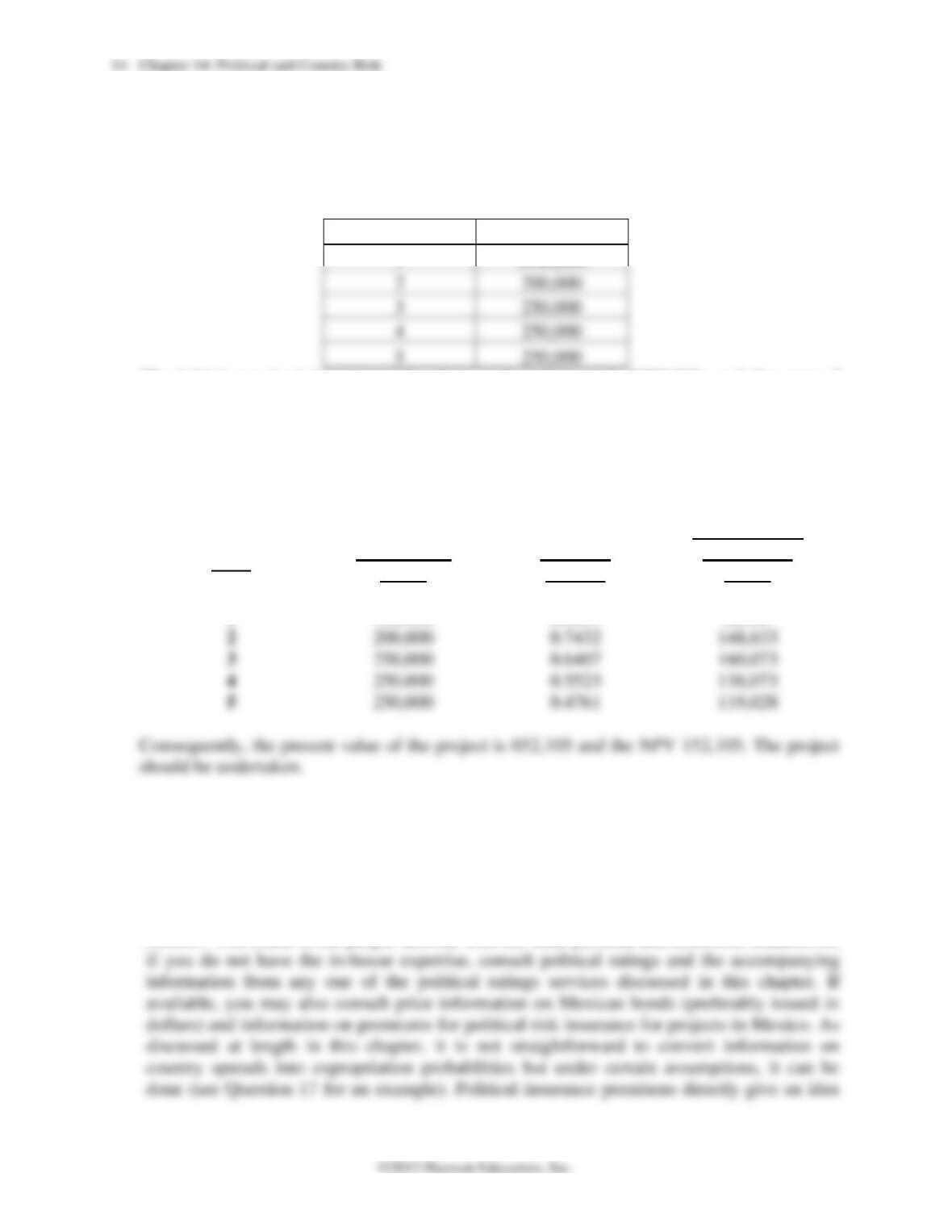
cash flows are as follows:
Year
Net Cash Flow
1
$100,000
2
3
4
5
The initial required investment in plant and equipment is $500,000, and the cost of
capital is 16%.
a. What is the present value of the project? Should the project be undertaken?
Answer: We can construct the following cash flow diagram:
Year
Dollar Cash
Flows
Discount
Factors
Present Value
of the Cash
Flows
1
100,000
0.8621
86,207
2
200,000
0.7432
148,633
3
250,000
0.6407
160,073
4
250,000
0.5523
138,073
5
250,000
0.4761
119,028
b. You notice that the proposal does not include any analysis of political risk,
but you are concerned about potential expropriation of the investment. You
therefore decide to call a meeting to discuss political risk. Who would you
invite to this meeting? What information or data would you need? How
would you arrive at a political risk probability estimate?
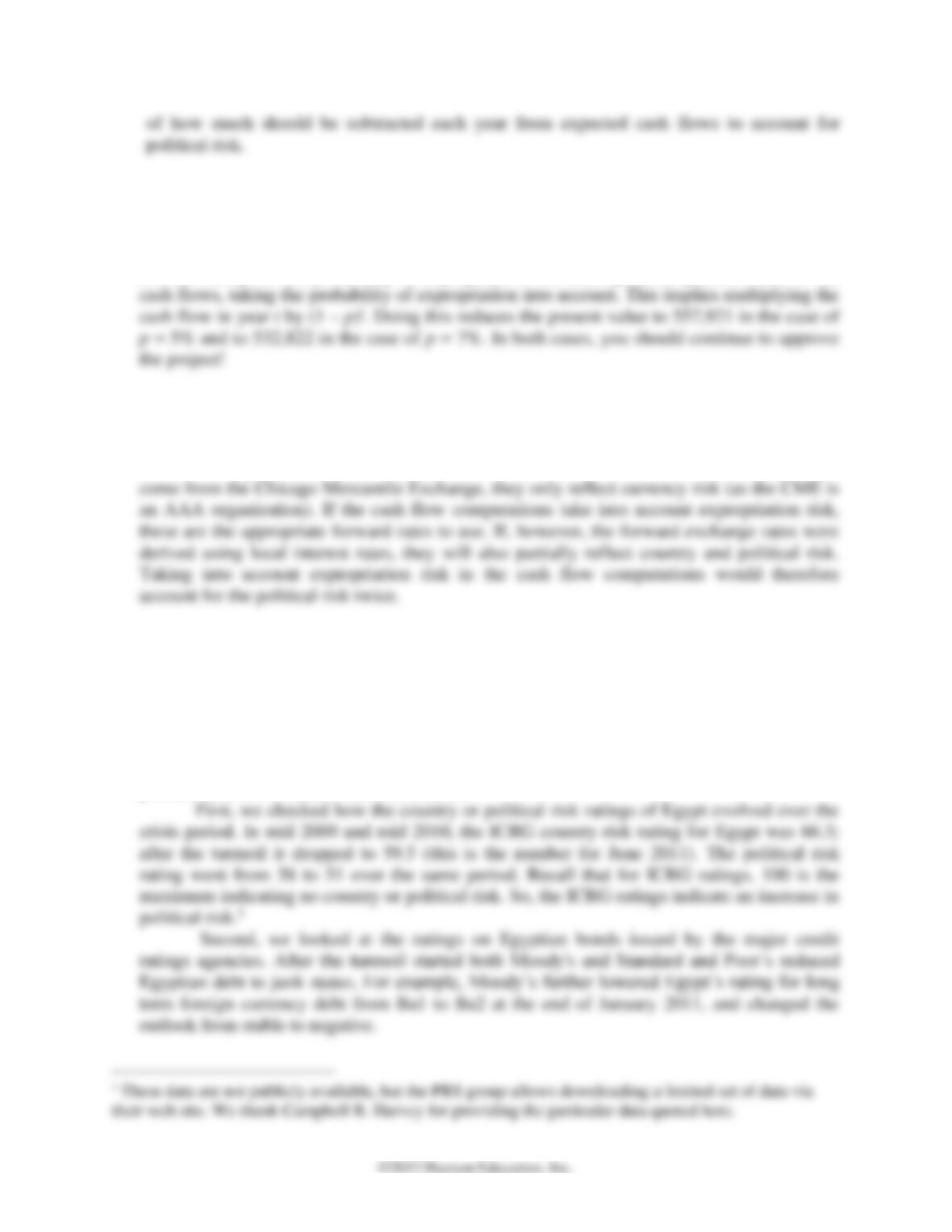
Answer: You could invite people familiar with the local political and economic situation or,
Chapter 14: Political and Country Risk 15
c. Assume that, at the end of the meeting, you decide that the probability of
expropriation is between 5% and 7%. Also assume that there is no
compensation in the case of expropriation. Would you approve the project?
Answer: Let p be the probability of expropriation. We recompute the present value of the
d. Given the possibility of expropriation, might you want to reconsider
converting Mexican peso expected cash flows at forward rates?
Answer: It depends how these forward rates were derived. If the forward exchange rates
7. Web Question: How will political turmoil in a number of Middle East countries in early
2011, such as Egypt, affect political risk? Try to use the Web resources on ratings and
spreads to come up with a quantitative answer.
Answer: You would think that the turmoil should increase the possibility of a political risk
event, so that any quantitative indicators of political risk should indicate an increase in
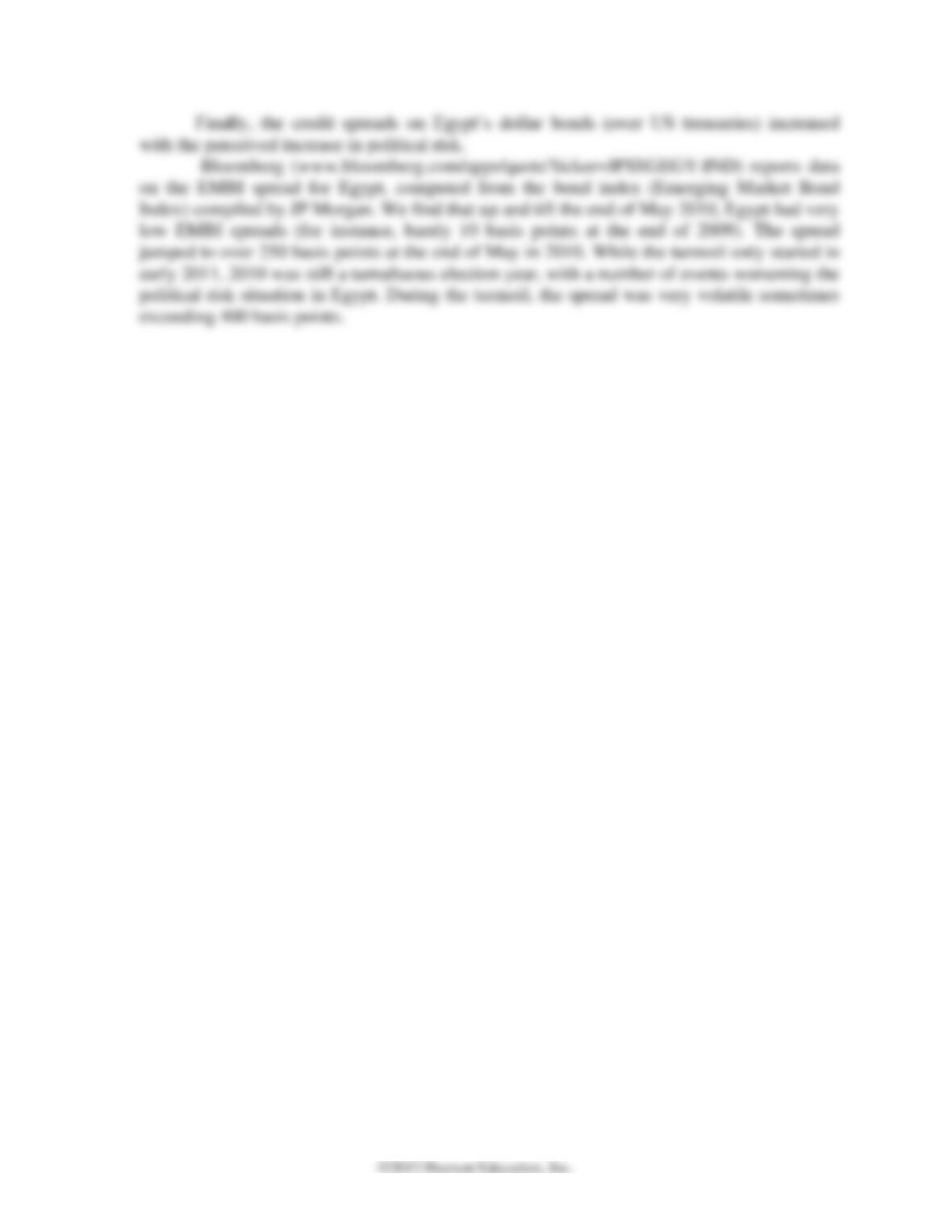
political risk. We looked at three indicators.
Chapter 14: Political and Country Risk
16