
Accounting Information Systems, 10e 1
SOLUTIONS FOR CHAPTER 14
Each end-of-chapter question in the Solutions Manual is tagged to correspond with AACSB, AICPA
and CISA standards, allowing professors to more easily manage the task of reporting outcomes to these
professional and accrediting bodies. Please see the corresponding spreadsheet file for the tagging
information.
Discussion Questions
DQ 14-1 Discuss the significance of having a separate organizational unit for the HR
function (reporting to the vice president of HR), as opposed to having the HR
function housed within an administrative organizational unit (reporting to a
manager of HR).
ANS. A separate organizational unit demonstrates and permits emphasis on and
DQ 14-2 Examine the placement of the manager of HR systems in the organization chart of
Figure 14.2, and review the typical functional responsibilities of this manager,
decisions made, and information needs as shown in Table 14.1. Describe possible
alternatives for the placement of this function in the formal organization chart,
and discuss the relative advantages for each placement. Consider the variables of
centralized versus decentralized organizational structures.
ANS. In answering this question, we offer the following thoughts:

2 Solutions for Chapter 14
DQ 14-3 A number of organizations have recently instituted a position called “manager of
human resource systems.” Speculate about why this position may become
strategically important to organizations in the future.
ANS. HR systems fill the information needs of the staff and management of the HR
.
DQ 14-4 Discuss the role unions and government agencies play in the design of procedures
for the HR management process.
ANS. Unions and government agencies can dictate how HR activities are conducted,
may require that data be collected and reports generated, and so on. These
requirements may affect the HR management process as follows:

Accounting Information Systems, 10e 3
DQ 14-5 Tax rates data are depicted in both the logical DFDs and the physical
implementation systems flowchart for the payroll process in this chapter. Discuss
the advantages of maintaining a separate data store versus incorporating such
data into “master” data such as the employee master data. Support your
argument by constructing an analogy between the tax rates data and pay rates
data (i.e., one containing hourly pay rates) for employees who are compensated
for the hours actually worked.
ANS. Because tax rates apply to all employees, it would not be efficient to store the
change the amounts to be paid by changing the rates data only.
DQ 14-6 Discuss the significance of the employee/payroll master data in relation to the HR
function and the payroll function.
ANS. Payroll function: Data contained in the employee/payroll master data establishes
authorization for payroll event and provides many inputs—such as pay rates,
performance evaluations may be retained in the employee/payroll master data.
DQ 14-7 Consult the systems flowcharts in Figures 14.4 and 14.9. Discuss how these
processes implement the concept of segregation of duties discussed in Chapter 8.
Be specific as to which entity (or entities) performs each of the four functions
depicted in Table 8.2. Limit your discussion to the process of preparing employee
paychecks.
ANS.
Function
Entity in Figure 14.4
Entity in Figure 14.9
Authorizing events
HR creates employee records
Department supervisors approve
4 Solutions for Chapter 14
Short Problems
SP 14-1 ANS.
The HR management process supports the optimization of an organization’s
human capital as follows:
• Captures, records, and stores data concerning personnel activities, such as
location, skills, benefits, and performance.
Specifically, the HR management process supports the managers depicted in
Figure 14.2 as follows:
• Manager of safety, health services, and benefits: A computerized HR
management process handles the large amounts of data necessary to
administer a flexible benefits plan. The HR management process can assist in
administering an organization’s insurance programs, including self-insurance.

Accounting Information Systems, 10e 5
SP 14-2
• a. Paying a worker for vacation or sick pay, as opposed to paying for hours
actually worked
• ANS. In all three figures, a data flow—paralleling the data flows “Attendance
time records” and “Validated attendance time records”—will request the
payment of sick or vacation pay. The flow from the employee/payroll master
• ANS. HR department data maintenance activities—not depicted in these
DFDs—will include establishing and changing piece rates. Job time records
• ANS. Bubble 4.1 in Figure 14.8 would access sales event data to determine the
amount of sales for each employee. The amount of sales and the commission
rates would be used to calculate gross pay. A parallel change would be
required in Figure 14.7.
• d. Preparing and distributing a paycheck “early” (i.e., in advance of the
customary pay date)
• ANS. Normally, the payroll department would prepare early paychecks
manually. A form describing the payment would be input with the time cards
6 Solutions for Chapter 14
• ANS. The “Attendance time records” and “Validated attendance time records”
SP 14-3 ANS.
1. C; explanation: Termination procedures reduce opportunities for terminated
employees to harm the organization by limiting their access to the computer
and to the organization’s offices.
2. B; explanation: By comparing input time card hours to output pay stub hours,
we can ensure the accuracy of the input (and the update) process.
SP 14-4 ANS.
1. C; explanation: By requiring that the supervisor of the HR department
approve all personnel changes, we preclude employee-initiated changes.
2. B; explanation: With an electronic time management system, employees enter
attendance time data using a scanner, bar code reader, and so on. The data is
then available as entered and is as accurate as the clock and entry device.
SP 14-5 ANS.
Note: H is an alternative, but not preferred, solution to number 2.

Accounting Information Systems, 10e 7
SP 14-6
ANS. to a: Goals for an HR management process might include the following:
• Ensure that the organization has adequate levels of qualified staffing.
ANS. to b: HRMS files might include the following:
• Grievance history
• Exit interviews
• Training (courses available, courses taken)
ANS. to c: The data stores listed in part b might be used to support the goals in part a as
follows:
• To minimize disruptions from health hazards, accidents, and grievances, a
personnel manager might analyze reports generated from the grievance history

8 Solutions for Chapter 14
Problems
Problems 14-1 and 14-2
Note: In the pages that follow, we provide solutions for problems 1 and 2 for both of the Case
Studies (Cases A and B), as applicable. Although the solution for each case study comprises
several pages, it is not necessarily comprehensive, nor does it represent the only acceptable
answer. Students’ answers may easily vary in two areas. First, the grouping on the annotated
table of entities and activities determines the configuration of the current logical DFD. Second,
we have included in the formal controls analysis only a sample of the possible present and
missing controls. At the end of the descriptions of the controls for each case, we include a list of
other controls that you or your students might want to include in a solution.
Oxford Supplies Solutions
P 14-1 ANS. a. Table of Entities and Activities for Oxford Supplies
Entities
Para
Activities
Department supervisors
2
1. Fill out and sign employee requisition form.
2
2. File employee requisition form.
2
3. Give two copies of employee requisition form to the production
supervisor.
2
4. Review and sign employee requisition form.
2
5. Give employee requisition form to the HR manager.
2
2

Accounting Information Systems, 10e 9
Entities
Para
Activities
2
9. (With supervisor) Interview and evaluate applicants and select
employee.
2
10. (With employee) Fill out wage and deduction form.
2
11. File wage and deduction form and personnel requisition form.
Media
2
Applicant
2
Department supervisors
3
16. Complete and sign the review form.
3
17. File a copy of the review form.
3
18. Give the review form to the production supervisor.
3
19. Review and sign the employee form.
3
20. Return the review form to the HR manager.
3
22. Give the form to the division accountant.
Division accountant
4
23. Prepare and sign the payroll action notices.
4
24. File payroll action notices and other related forms.
Corporate payroll
25. Retrieve the payroll file from the division accountant.
4
26. Check the signature on payroll action notices.
4
27. Process payroll.
Division accountant
4
29. Refile forms in the payroll file.
30. Give checks to the production supervisor.
Production supervisor
4
31. Distribute paychecks.
2
12. Give copies of forms to the division accountant.
3
13. Select and review records from the employee file.
3
14. Prepare review form.

10 Solutions for Chapter 14
Employment
application
Advertisements
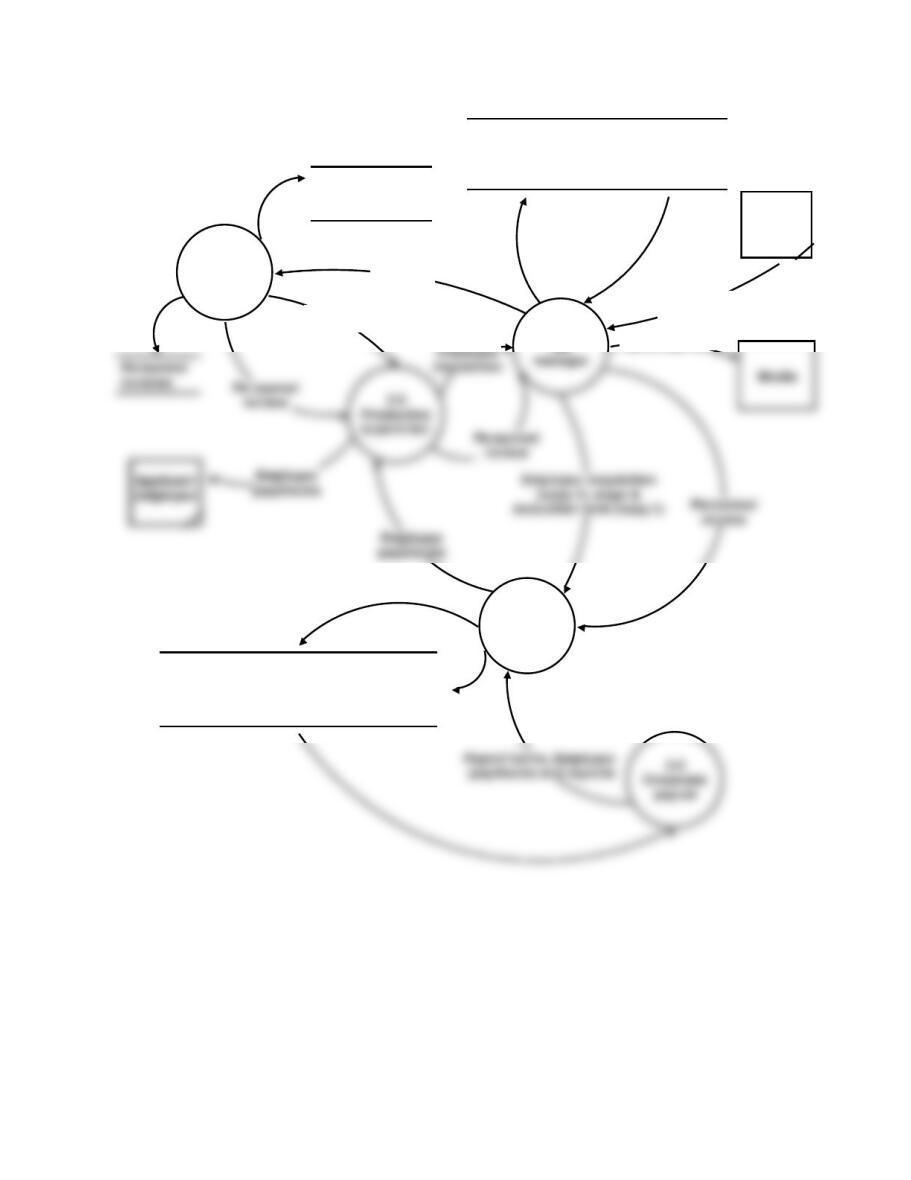
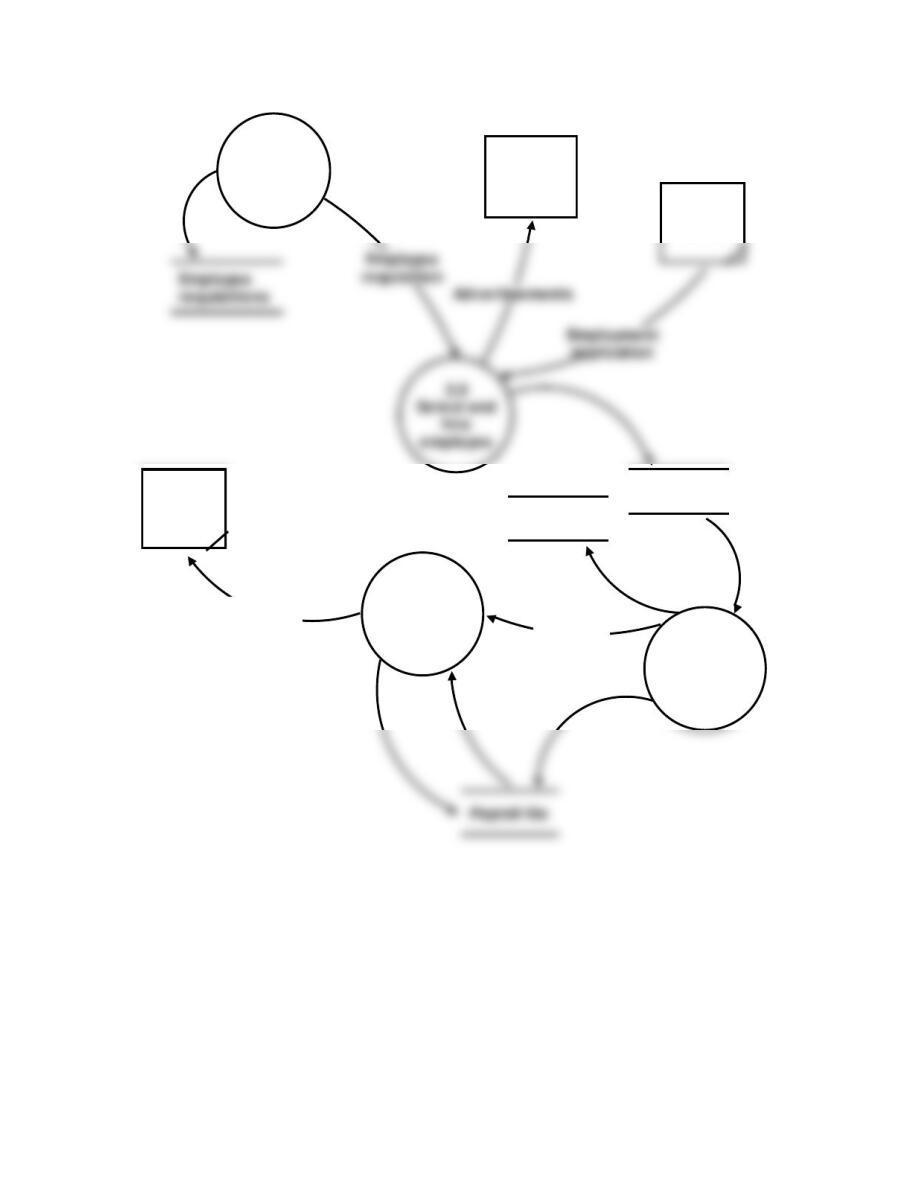
FIGURE SM-14.1 Problem 1, Part b Solution—Context Diagram for Oxford Supplies
Accounting Information Systems, 10e 11
Applicant/
employee
1.0
Department
supervisor
Employee
requisitions ––
date sequence
Employee
requisition
3.0
HR
Personnel
review
Employment
application
Employee requisitions (copy 2),
wage & deduction form (copy 2) ––
employee name sequence
(employee file)
4.0
Division
accountant
Employee requisitions (copy 1), wage
& deduction form (copy 1), employee
review (copy 1), personne l actions
— date sequence
Advertisements
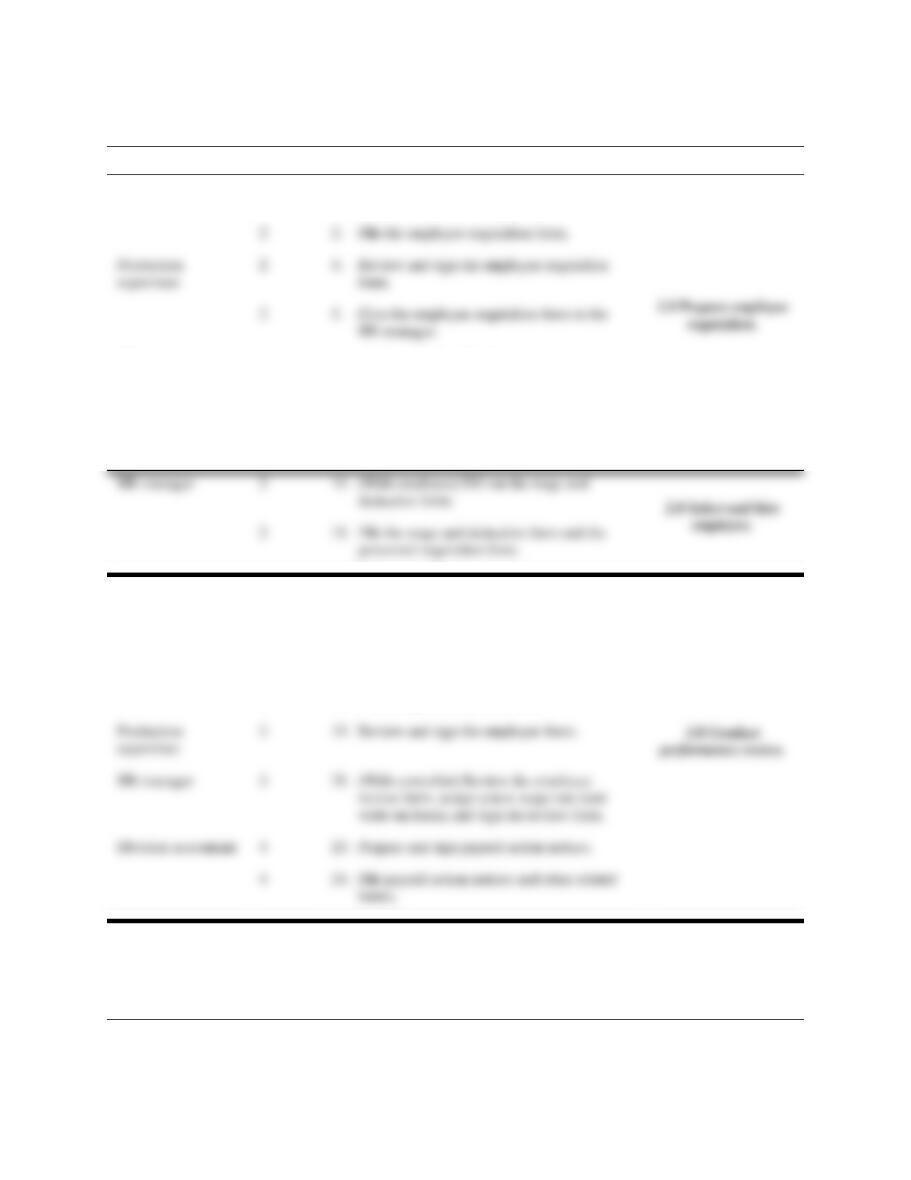
FIGURE SM-14.2 Problem 1, Part c Solution—Physical DFD for Oxford Supplies
12 Solutions for Chapter 14
P 14-1 d. Table of Entities and Activities (Annotated) for Oxford Supplies
Entities
Para
Activities
Process
Department
supervisors
2
1. Fill out and sign the employee requisition
form.
HR manager
2
6. (With controller) Review and sign the
personnel requisition with the division
controller.
2
7. (With controller) Determine pay rate and
include on approved requisition.
HR manager
2
10. (With employee) Fill out the wage and
deduction form.
2
11. File the wage and deduction form and the
personnel requisition form.
HR manager
3
13. Select and review records from the employee
file.
Production
3
19. Review and sign the employee form.
4
23. Prepare and sign payroll action notices.
4
24. File payroll action notices and other related
forms.
3
14. Prepare the review form.
Department
supervisors
3
16. Complete and sign the review form.
3
17. File a copy of the review form.
Corporate payroll
4
26. Check the signature on payroll action notices.
4.0 Prepare payroll.
4
27. Process the payroll.
Division accountant
29. Refile the forms.
2
2. File the employee requisition form.
2
4. Review and sign the employee requisition
form.
2
5. Give the employee requisition form to the
HR manager.
Accounting Information Systems, 10e 13
Applicant/
employee
1.0
Prepare
employee
requisition
Personnel
reviews
Applicant/
employee
Employee
paychecks
3.0
Conduct
performance
review
Employee
file
4.0
Prepare
payroll Personne l
actions
Media
FIGURE SM-14.3 Problem 1, Part e Solution—Logical DFD for Oxford Supplies
14 Solutions for Chapter 14
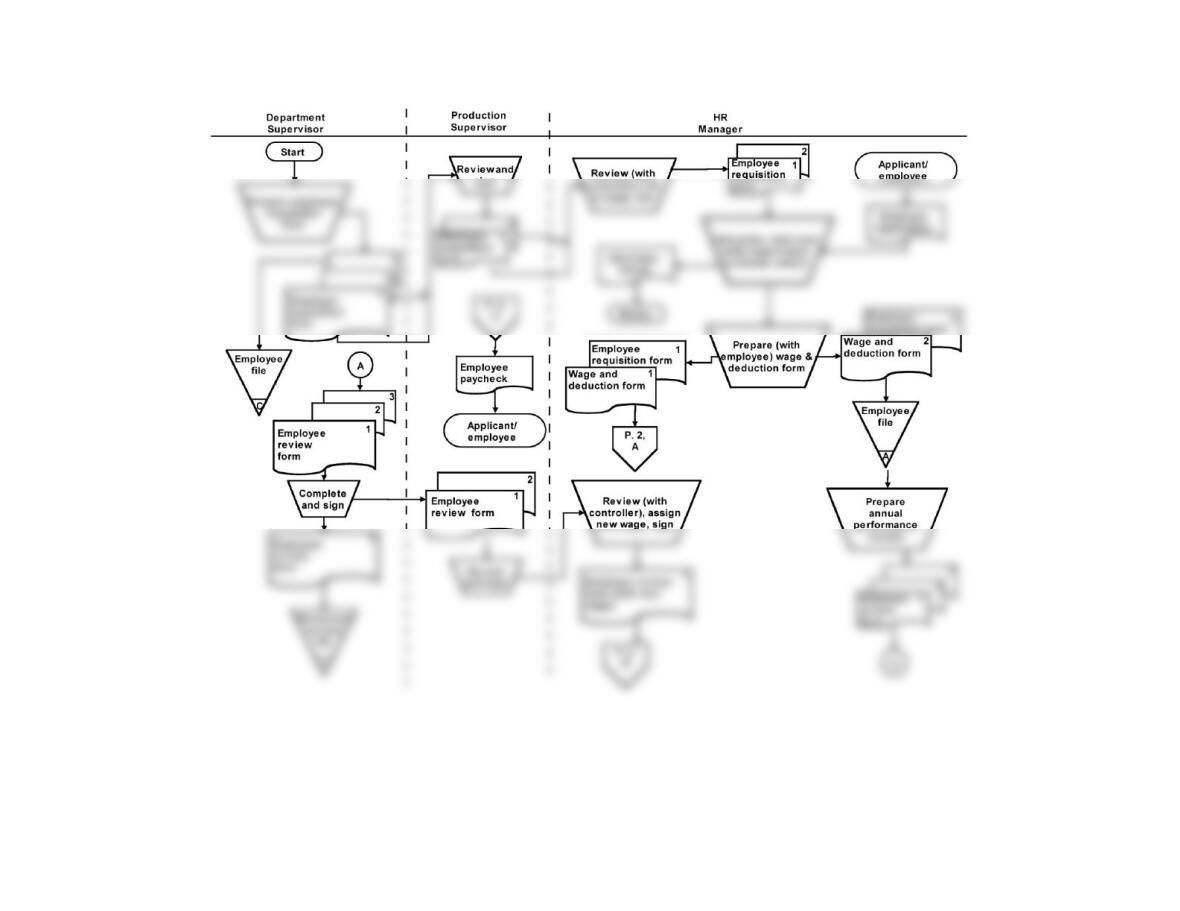
FIGURE SM-14.4 Problem 2, Part a Solution—Systems Flowchart for Oxford Supplies
Accounting Information Systems, 9e 15
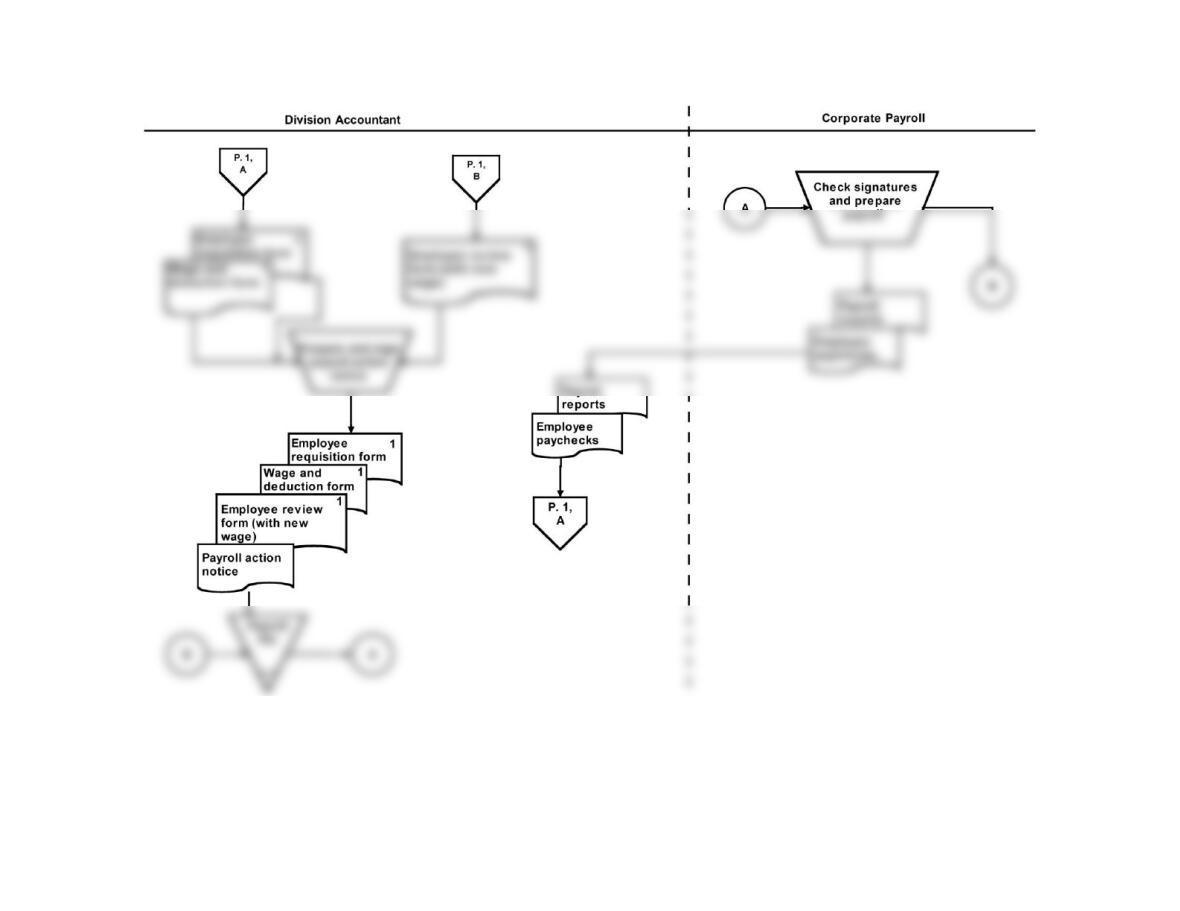
FIGURE SM-14.4 Problem 2, Part a Solution—Systems Flowchart for Oxford Supplies (continued)
16 Solutions for Chapter 14
Control Goals of the Oxford HR and Payroll Business Process
Control Goals of the Operations Process
Control Goals of the Information Process
Ensure effectiveness
of operations
Ensure
efficient
employment
of resources
(people and
computers)
Ensure
security of
resources
(cash,
employee/
payroll master
data)
For time data inputs,
ensure:
For employee/
payroll master
data, ensure:
Recommended control plans
A
B
C
IV
IC
IA
UC
UA
Present controls
P-1: Document design
P-1
P-1
P-1
P-1
P-6: Written approvals for payroll action notices
P-6
P-6
P-6
P-7: Prepare miscellaneous reports
P-7
P-7
P-7
P-7
P-8: HR initiates annual performance reviews
P-8
P-11: HR and controller assign new wage rates
P-2: Written approvals
P-2
P-2
P-3: Controller and HR approval before hiring
P-3
P-3
P-4: Evaluate applicants
P-4
P-4
P-5: Prepare wage and deduction form
P-5
P-5
P-5

Accounting Information Systems, 9e 17
Control Goals of the Oxford HR and Payroll Business Process
Control Goals of the Operations Process
Control Goals of the Information Process
Ensure effectiveness
of operations
Ensure
efficient
employment
of resources
(people and
computers)
Ensure
security of
resources
(cash,
employee/
payroll master
data)
For time data inputs,
ensure:
For employee/
payroll master
data, ensure:
Recommended control plans
A
B
C
IV
IC
IA
UC
UA
Missing controls
M-1: Reconcile attendance time cards and job
time tickets
M-1
M-1
M-1
M-1
M-1
Legend:
Possible effectiveness goals include the following:
A – Provide employees with timely paychecks
IV = input validity
IC = input completeness
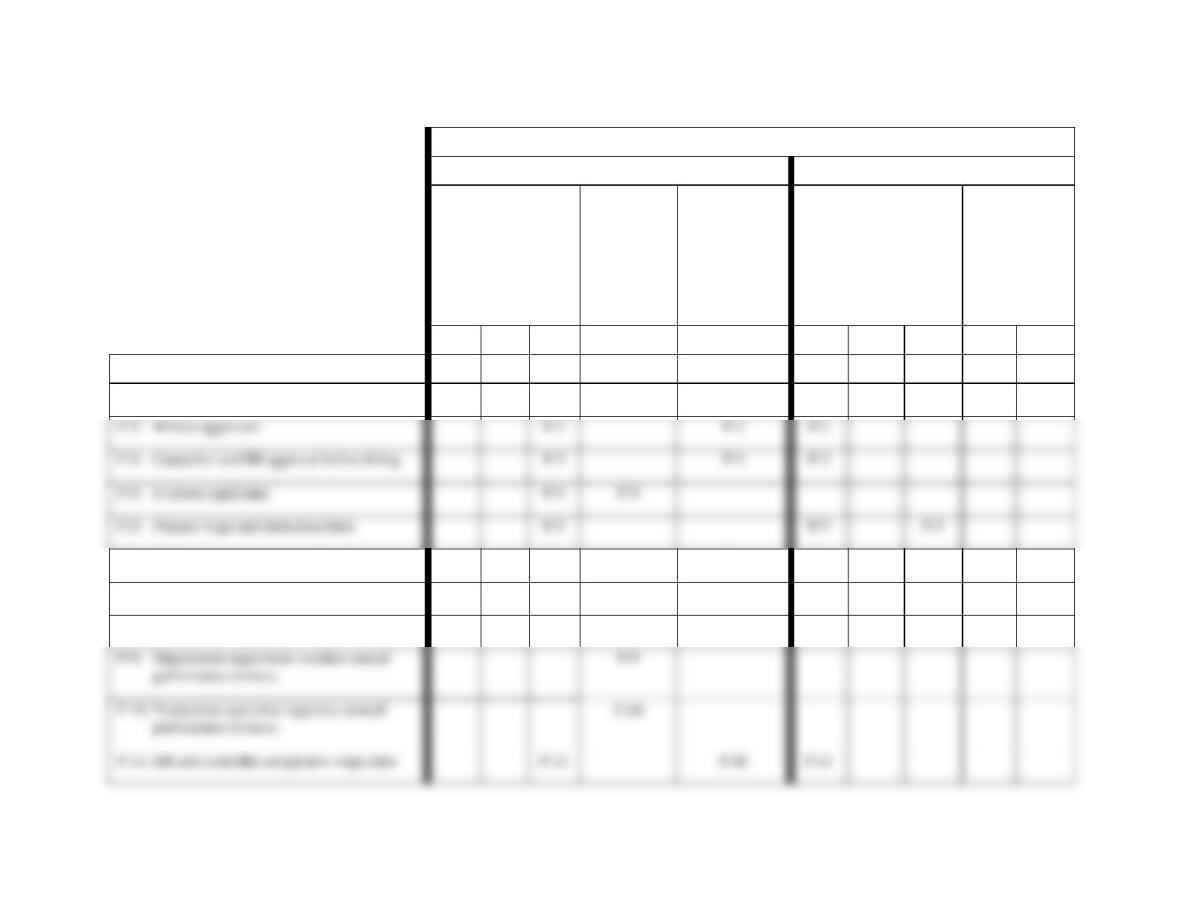
FIGURE SM-14.5 Problem 2, Part b Solution (Partial)—Control Matrix for Oxford Supplies
M-2
M-2
18 Solutions for Chapter 14
Exhibit SM-14.1 Problem 2, Part b Solution (Partial)—Explanation of Cell Entries for
Control Matrix in Figure SM-14.5
P-1: Document design.
P-2: Written approvals.
Effectiveness goal C: Written approvals for personnel and payroll actions improve
the likelihood that applicable personnel and tax laws and regulations will be
followed.
P-3: Controller and HR approval before hiring.
Effectiveness goal C, security of resources, input validity: Review and approval of
hiring by the controller and HR improves the likelihood that applicable personnel
and tax laws and regulations will be followed in setting the wage rate, reduces the
possibility of inappropriate personnel expenditures, and ensures that business
events are valid.
P-4: Evaluate applicants.
P-6: Written approvals for payroll action notices.
Effectiveness goal C, security of resources, input validity: All of the forms leading
up to payroll changes are approved and signed before being sent to the division
accountant. The accountant, in turn, uses these forms to prepare payroll action
Accounting Information Systems, 9e 19
P-7: Prepare miscellaneous reports.
Effectiveness goals B and C: Various reports are prepared to comply in a timely
manner with tax and other government regulations.
Employee/payroll master data, update completeness, update accuracy: The
reports are prepared from data in the employee file. The review process should
ensure that the data in the employee file is complete and accurate.
P-10: Production supervisor approves annual performance reviews.
Efficient employment of resources: The production supervisor approves the
performance reviews, which should ensure that Oxford continues to employ the
best people and assigns them to suitable jobs.
P-11: HR and controller assign new wage rates.
M-1: Reconcile attendance time cards and job time tickets.
Effectiveness goal A, efficient employment of resources, input validity, input
completeness, input accuracy: By reconciling these documents, we gain a degree
of assurance that we have a true (validity), accurate, and complete record of the
20 Solutions for Chapter 14
M-2: Independent paycheck distribution (direct deposit).
Effectiveness goal A: Direct deposit would ensure a more timely receipt of the
checks by employees.
Security of resources, input validity: This plan entails having paychecks
Note: Employee paychecks are distributed by the production supervisor. We
would prefer that an employee obtain a paycheck from someone who has not
participated in submitting payroll data and preparing paychecks. In this way, we
are assured that the employee actually exists (validity) and that the funds are not
being diverted.
Solution Note: Several controls not described in the preceding list could be
included in the solution to this problem, as present or missing, depending on
assumptions made. For example:
• At each data entry location, we could include preformatted screens, online
prompting, and confirm input acceptance.