CHAPTER 14
Financial Statement Analysis
LEARNING OBJECTIVES
1. APPLY HORIZONTAL AND VERTICAL ANALYSIS TO
FINANCIAL STATEMENTS.
2. ANALYZE A COMPANY’S PERFORMNCE USING
RATIO ANALYSIS.
CHAPTER REVIEW
Need for Comparative Analysis
1. (L.O. 1) Financial statement analysis enables the financial statement user to make informed
decisions about a company.
Tools of Financial Analysis
4. There are three basic tools of analysis: (a) horizontal, (b) vertical, and (c) ratio.
Horizontal Analysis
Vertical Analysis
Ratio Analysis
12. Inventory turnover measures the number of times, on average, the inventory is sold during the
period. It indicates the liquidity of the inventory. The formula for the ratio is:
15. Asset turnover measures how efficiently a company uses its assets to generate sales. The
resulting number shows the dollars of sales produced by each dollar invested in assets. The formula
for this ratio is:
17. Return on common stockholders’ equity measures profitability from the common stockholders’
viewpoint. The ratio shows the dollars of income earned for each dollar invested by the owners.
The formula is:
18. Earnings per share measures the amount of net income earned on each share of common stock.
The formula is:
19. The price-earnings ratio measures the ratio of market price per share of common stock to earnings
per share. It is an oft-quoted statistic that reflects investors’ assessments of a company’s future
earnings. The formula for the ratio is:
20. The payout ratio measures the percentage of earnings distributed in the form of cash dividends.
The formula is:
Total Assets
The adequacy of this ratio is often judged in the light of the company’s earnings. Companies with
relatively stable earnings, such as public utilities, have higher debt to assets ratios than cyclical
companies with widely fluctuating earnings, such as many high-tech companies.
Sustainable Income
24. (L.O. 3) Sustainable income is the most likely level of income to be obtained by a company in
the future. It does not include any unusual revenues, expenses, gains, or losses included in the
current period’s net income.
Discontinued Operations
Operations, which follows income from continuing operations.
Other Comprehensive Income
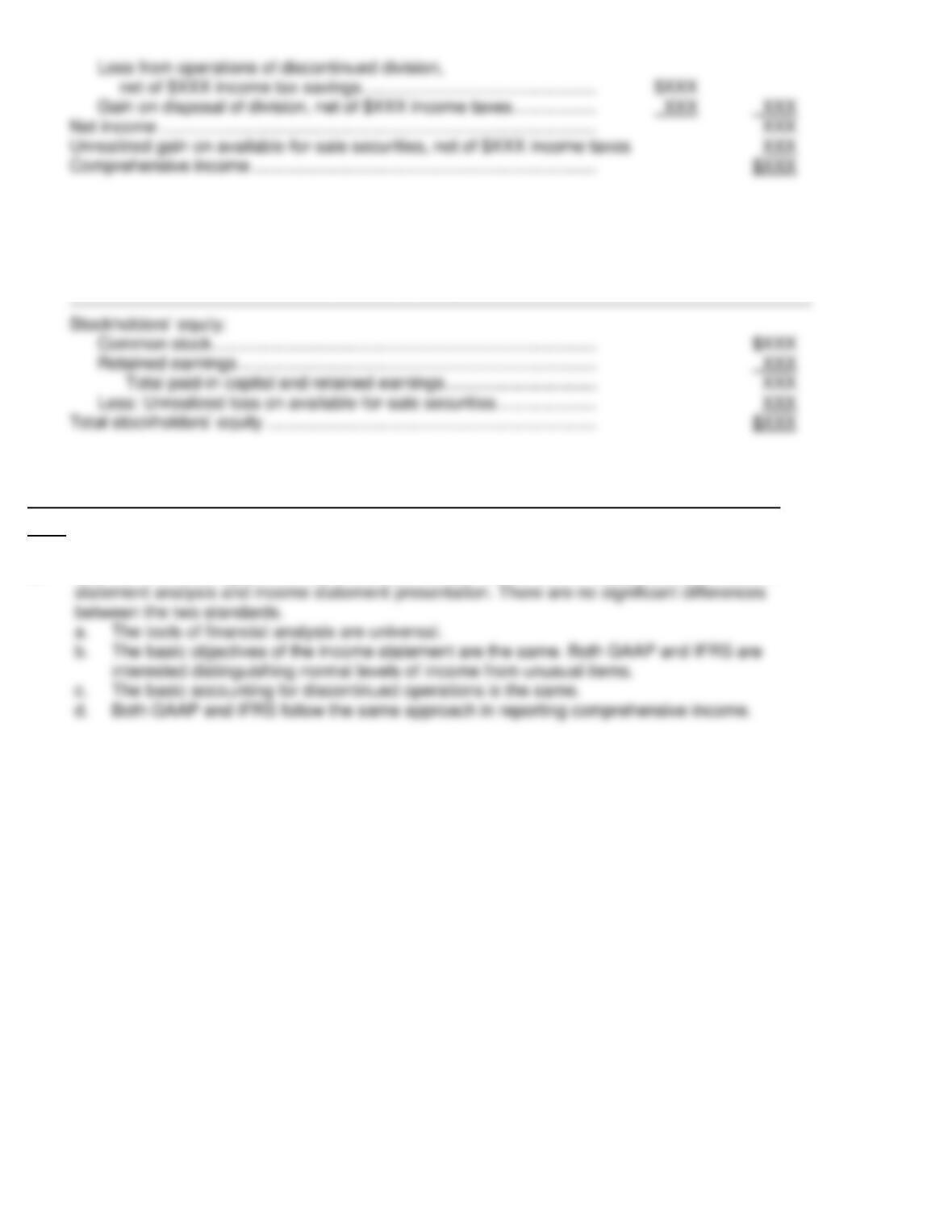
b. The other format used is to disclose any gain/loss from available-for-sale securities as a
separate component of stockholders’ equity. For example:
Balance Sheet (partial)
Compare Financial Statement Analysis and Income Statement Presentation under GAAP and
IFRS
27. (L.O. 4) The following are the key similarities between GAAP and IFRS as related to financial
LECTURE OUTLINE
A. Basics of Financial Statement Analysis.
1. Analyzing financial statements involves evaluating three characteristics:
a company’s liquidity, profitability, and solvency.
a. A short-term creditor (a bank) is primarily interested in liquidity—the
ability of the borrower to pay obligations when they come due.
2. Comparison of financial information can be made on a number of different
bases.
a. Intracompany basis: compares an item or financial relationship
within a company in the current year with the same item or
relationship in prior years.
B. Tools of Financial Statement Analysis.
2. Vertical analysis (common-size analysis) is a technique that expresses
each financial statement item as a percent of a base amount. A benefit
of vertical analysis is that it enables one to compare companies of
different sizes.
4. Ratios can be classified as follows:
a. Liquidity ratios: measure the short-term ability of the enterprise to
pay its maturing obligations and to meet unexpected needs for
cash.
5. Liquidity ratios.
INVESTOR INSIGHT
The apparent simplicity of the current ratio can have real-world
limitations because adding equal amounts to both the numerator
and the denominator causes the ratio to decrease. Conversely,
decreasing both the numerator and the denominator by equal
amounts causes the ratio to increase.
How might management influence a company’s current ratio?
6. Profitability ratios.
a. Profit margin is a measure of the percentage of each dollar of
sales that results in net income. It is computed by dividing net
income by net sales.
d. Return on common stockholders’ equity shows how many
dollars of net income the company earned for each dollar invested
by the owners. Companies compute it by dividing net income by
average common stockholders’ equity.
(1) When a company has preferred stock, it must deduct preferred
dividend requirements from net income to compute income
available to common stockholders.
e. Earnings per share is a measure of the net income earned on
each share of common stock. It is computed by dividing net income
by the number of weighted-average common shares outstanding
during the year.
7. Solvency ratios.
C. Sustainable Income.
Sustainable income is the most likely level of income to be obtained by a
company in the future. It does not include any unusual revenues, expenses,
gains, or losses included in the current period’s net income.
1. Discontinued operations refers to the disposal of a significant component
of a business. Examples involve stopping an entire activity or eliminating
a major class of customers.
2. Other comprehensive income includes all changes in stockholders’
equity during a period except those resulting from investments by
stockholders and distributions to stockholders.
b. A separate component of stockholders’ equity.
IFRS
KEY POINTS
The tools of financial statement analysis are the same throughout the world.
Vertical and horizontal analysis is the same under GAAP and IFRS. In addition,
20 MINUTE QUIZ
Circle the correct answer.
True/False
1. Intercompany comparison refers to comparison with other companies to provide insight
into competitive position.
True False
2. Vertical analysis determines the percentage increase or decrease that has taken place
over a period of time.
True False
3. A base year is determined when performing horizontal analysis.
True False
4. Liquidity ratios measure the ability of an enterprise to survive over a long period of time.
True False
5. Accounts receivable turnover, inventory turnover, and asset turnover are all common
measures of liquidity.
True False
6. Profit margin, return on assets, and return on common stockholders’ equity are profitability
ratios.
True False
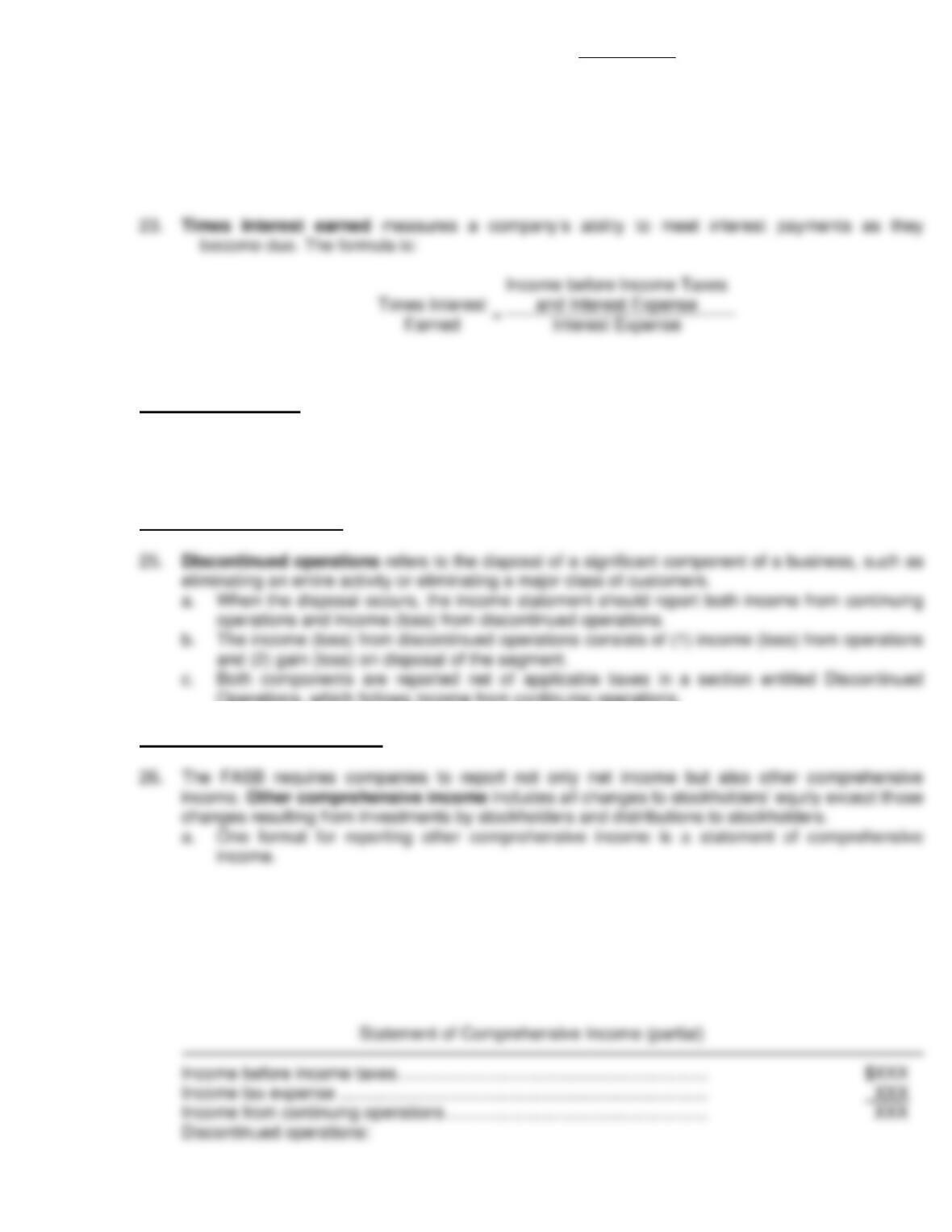
7. The formula for computing times interest earned is income before income taxes and
interest expense divided by interest expense.
True False
8. The debt to assets ratio measures the percentage of total assets provided by long-term
creditors.
True False
9. Discontinued operations should be disclosed in the income statement immediately below
income from continuing operations, net of taxes.
True False
10. Other comprehensive income is included in net income.
True False
Multiple Choice
1. Sales (in millions) for a three year period are: Year 1 $6, Year 2 $6.9, and Year 3 $7.5.
Using Year 1 as the base year the percentage increase in sales in Years 2 and 3 are,
respectively
a. 115% and 125%.
b. 115% and 109%.
c. 115% and 130%.
d. 87% and 80%.
2. An incorrect formula is
a. current ratio = current assets ÷ current liabilities.
b. accounts receivable turnover = net credit sales ÷ average net accounts receivable.
c. asset turnover = net income ÷ average assets.
d. payout ratio = cash dividends ÷ net income.
3. The acid-test ratio
a. is a solvency ratio.
b. measures immediate short-term liquidity.
c. includes inventory in the numerator of the formula.
d. includes total liabilities in the denominator of the formula.
4. The ratio that measures the overall profitability of assets is
a. profit margin.
b. asset turnover.
c. return on common stockholders’ equity.
d. return on assets.
5. Which of the following may be reported as a component of stockholders’ equity?
a. Unrealized gain or loss on discontinued operations.
b. Unrealized gain or loss on disposal of plant assets.
c. Unrealized gain or loss on available-for-sale securities.
d. Unrealized gain or loss on trading securities.

ANSWERS TO QUIZ
True/False
Multiple Choice