EXERCISE 14-8 (Continued)
(c)
Carrying amount of bonds on June 30, 2012 ……………….
$562,500
Effective-interest rate for the period from June 30
to October 31, 2012 (.10 X 4/12) ………………………………..
EXERCISE 14-9 (20–30 minutes)
(a)
1.
June 30, 2012
Cash ……………………………………………………….
5,376,150.00
Bonds Payable …………………………..
5,000,000.00
Premium on Bonds Payable …………………………..
376,150.00
2.
December 31, 2012
Interest Expense
($5,376,150.00 X 12% X 6/12) …………………………..
322,569.00
Premium on Bonds Payable …………………………..
Cash
($5,000,000 X 13% X 6/12) …………………………..
325,000.00
3.
June 30, 2013
Interest Expense
[($5,376,150.00 – $2,431.00)
X 12% X 6/12] …………………………..
322,423.14
Premium on Bonds Payable …………………………..
2,576.86
Cash ……………………………………………………….
325,000.00
4.
December 31, 2013
Interest Expense
[($5,376,150.00 – $2,431.00 –
$2,576.86) X 12% X 6/12] …………………………..
322,268.53
Premium on Bonds Payable …………………………..
Cash ……………………………………………………….
325,000.00
EXERCISE 14-9 (Continued)
(b)
Long-term Liabilities:
Bonds payable, 13% (due on June 30, 2032) ……………..
$5,000,000.00
Premium on Bonds Payable* …………………………..
368,410.67
Book value of bonds payable …………………………..
$5,368,410.67
*($376,150) – ($2,431.00 + $2,576.86 + $2,731.47) = $368,410.67
(c)
Interest expense for the period from
January 1 to June 30, 2013 from (a) 3. ……………………
Interest expense for the period from
July 1 to December 31, 2013 from (a) 4. ………………….
Amount of bond interest expense
reported for 2013 ………………………………………………….
2.
The amount of bond interest expense reported in 2013 will be
greater than the amount that would be reported if the straight-line
method of amortization were used. Under the straight-line method,
3.
Total interest to be paid for the bond
($5,000,000 X 13% X 20) …………………………..
$13,000,000
Less: Premium……………………………………………………….
376,150
Total cost of borrowing over the life
of the bond ……………………………………………………….
They will be the same.
14–23
EXERCISE 14-10 (15–20 minutes)
(a)
January 1, 2012
Cash ……………………………………………………….
860,651.79
Premium on Bonds Payable …………………………..
60,651.79
Bonds Payable ……………………………………………….
800,000.00
(b) Schedule of Interest Expense and Bond Premium Amortization
Effective-Interest Method
12% Bonds Sold to Yield 10%
(c)
Interest Expense …………………………………………………….
Premium on Bonds Payable …………………………..
Cash ……………………………………………………….
(d)
Interest Expense …………………………………………………….
Premium on Bonds Payable …………………………..
Cash ……………………………………………………….
96,000.00
14–24
EXERCISE 14-11 (20–30 minutes)
Unsecured
Bonds
Zero-Coupon
Bonds
Mortgage
Bonds
(1)
Maturity value
$10,000,000
$25,000,000
$15,000,000
(2)
Number of interest
40
10
10
periods
(6)
Present value
$10,577,900(c)
$8,049,250(d)
$13,304,880(e)
(a)$10,000,000 X 13% X 1/4 = $325,000
(b)$15,000,000 X 10% = $1,500,000
(d)Present value of $25,000,000 discounted
at 12% for 10 periods
($25,000,000 X .32197) = ………………………………………….
$ 8,049,250
(3)
Stated rate per period
(4)
Effective rate per period
EXERCISE 14-12 (15–20 minutes)
Reacquisition price ($1,000,000 X 101%) …………………..
$1,010,000
Less: Net carrying amount of bonds redeemed:
Par value ………………………………………………………
$1,000,000
Unamortized discount ……………………………………
(15,000)
Unamortized bond issue costs ………………………
(8,000)
977,000
Calculation of unamortized discount—
Original amount of discount:
$1,000,000 X 3% = $30,000
$30,000/10 = $3,000 amortization per year
Amount of discount unamortized:
$3,000 X 5 = $15,000
Calculation of unamortized issue costs—
Original amount of costs:
$24,000 X $1,000,000/$1,500,000 = $16,000
$16,000/10 = $1,600 amortization per year
Amount of costs unamortized:
$1,600 X 5 = $8,000
January 2, 2012
Bonds Payable ……………………………………………………….
1,000,000
Loss on Redemption of Bonds …………………………..
33,000
Unamortized Bond Issue Costs ………………
8,000
Discount on Bonds Payable …………………………..
15,000
Cash ……………………………………………………….
1,010,000
EXERCISE 14-13 (15–20 minutes)
Cash ($7,000,000 X 98%) ………………………………………….
Discount on Bonds Payable (.02 X $7,000,000) ………….
Bonds Payable ……………………………………………….
(To record issuance of 10% bonds)
14–26
EXERCISE 14-13 (Continued)
Bonds Payable ……………………………………………………….
5,000,000
Loss on Redemption of Bonds …………………………..
250,000
Cash ($5,000,000 X 1.02) …………………………..
5,100,000
Discount on Bonds Payable …………………………..
120,000
Unamortized Bond Issue Costs ………………………..
30,000
(To record retirement of 11% bonds)
Reacquisition price …………………………………………………
Less: Net carrying amount of bonds redeemed:
Par value ………………………………………………………
Unamortized bond discount …………………………..
Unamortized bond issue costs ………………………
EXERCISE 14-14 (12–16 minutes)
(a)
June 30, 2013
Bonds Payable ……………………………………………………….
600,000
Loss on Redemption of Bonds …………………………..
30,600
Discount on Bonds Payable …………………………..
6,600
Cash ……………………………………………………….
624,000
Reacquisition price ($600,000 X 104%) ……………………..
Net carrying amount of bonds redeemed:
Par value ……………………………………………………….
(.02 X $600,000 X 11/20)
Cash ($800,000 X 102%) …………………………………………..
816,000
Premium on Bonds Payable …………………………..
Bonds Payable ……………………………………………….
800,000
(b)
December 31, 2013
Interest Expense …………………………………………………….
39,600
Premium on Bonds Payable …………………………..
400*
Cash ……………………………………………………….
40,000**
**(.05 X $800,000 = $40,000)
14–27
EXERCISE 14-15 (10–15 minutes)
Reacquisition price ($500,000 X 104%) ……………………..
$520,000
Less: Net carrying amount of bonds redeemed:
Par value ………………………………………………………
$500,000
Unamortized discount …………………………………..
(10,000)
490,000
Loss on redemption of bonds …………………………..
$ 30,000
EXERCISE 14-16 (15–20 minutes)
(a)
1.
January 1, 2013
Land ……………………………………………………….
300,000.00
Discount on Notes Payable …………………………..
205,518.00
Notes Payable…………………………………………………
(The $300,000 capitalized land
cost represents the present
value of the note discounted
for five years at 11%.)
2.
Equipment……………………………………………………….
297,078.88
Discount on Notes Payable …………………………..
Notes Payable…………………………………………………
Bonds Payable ……………………………………………………….
Loss on Redemption of Bonds …………………………..
(To record redemption of bonds
payable)
Cash ………………………………………………………………………
Unamortized Bond Issue Costs…………………………..
(To record issuance of new bonds)
EXERCISE 14-16 (Continued)
*Computation of the discount on
notes payable:
Maturity value …………………………..
$400,000.00
Present value of $400,000 due in
8 years at 11%—$400,000
X .43393 ……………………………………………………….
Present value of $24,000
payable annually for 8 years
at 11% annually—$24,000
X 5.14612 ……………………………………………………..
Present value of the note …………………………..
Discount ……………………………………………………….
(b)
1.
Interest Expense ……………………………………………………..
33,000.00
Discount on Notes Payable
($300,000 X .11) …………………………..
33,000.00
2.
Interest Expense
($297,078.88 X .11) …………………………..
Discount on Notes Payable …………………………..
Cash ($400,000 X .06) …………………………..
EXERCISE 14-17 (15–20 minutes)
(a)
Face value of the zero-interest-bearing note……………….
$600,000
Discounting factor (12% for 3 periods) ……………………….
X .71178
Amount to be recorded for the land at January 1, 2013 ….
$427,068
Carrying value of the note at January 1, 2013 ……………..
$427,068
Applicable interest rate (12%) ……………………………………
Interest expense to be reported in 2013 ……………………..
$ 51,248
(b)
Cash ……………………………………………………….
Discount on Notes Payable …………………………..
Notes Payable…………………………………………………
Unearned Sales Revenue …………………………..
*$4,000,000 – ($4,000,000 X .68301) = $1,267,960
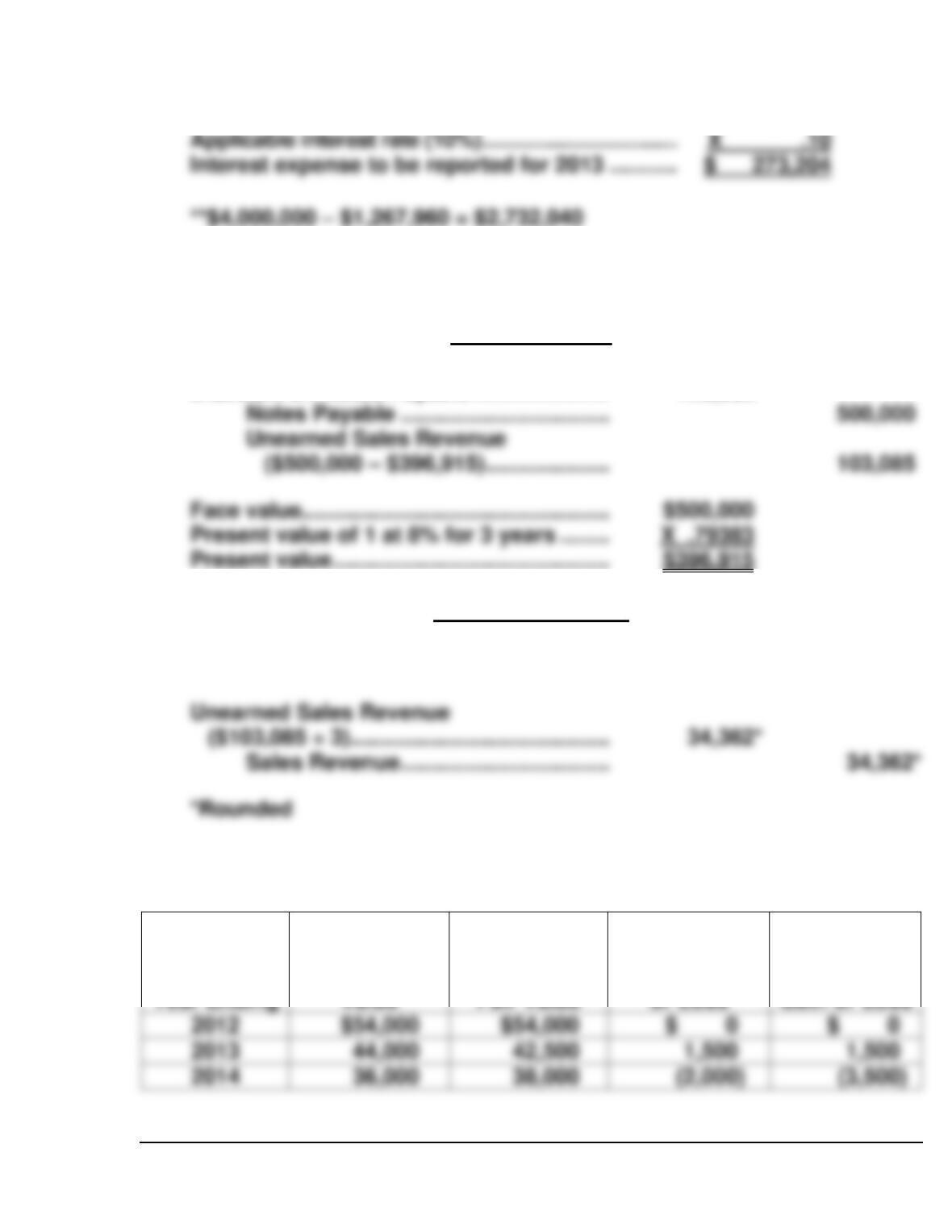
14–29
EXERCISE 14-17 (Continued)
Carrying value of the note at January 1, 2013……………
$2,732,040**
EXERCISE 14-18 (15–20 minutes)
January 1, 2012
(a)
Cash ……………………………………………………….
500,000
Discount on Notes Payable …………………………..
103,085
Notes Payable ………………………………………………..
($500,000 – $396,915) …………………………..
Face value……………………………………………………….
Present value of 1 at 8% for 3 years …………………………
December 31, 2012
(b)
Interest Expense ($396,915 X 8%) …………………………..
31,753*
Discount on Notes Payable …………………………..
31,753*
Sales Revenue ………………………………………………..
34,362*
EXERCISE 14-19 (10–15 minutes)
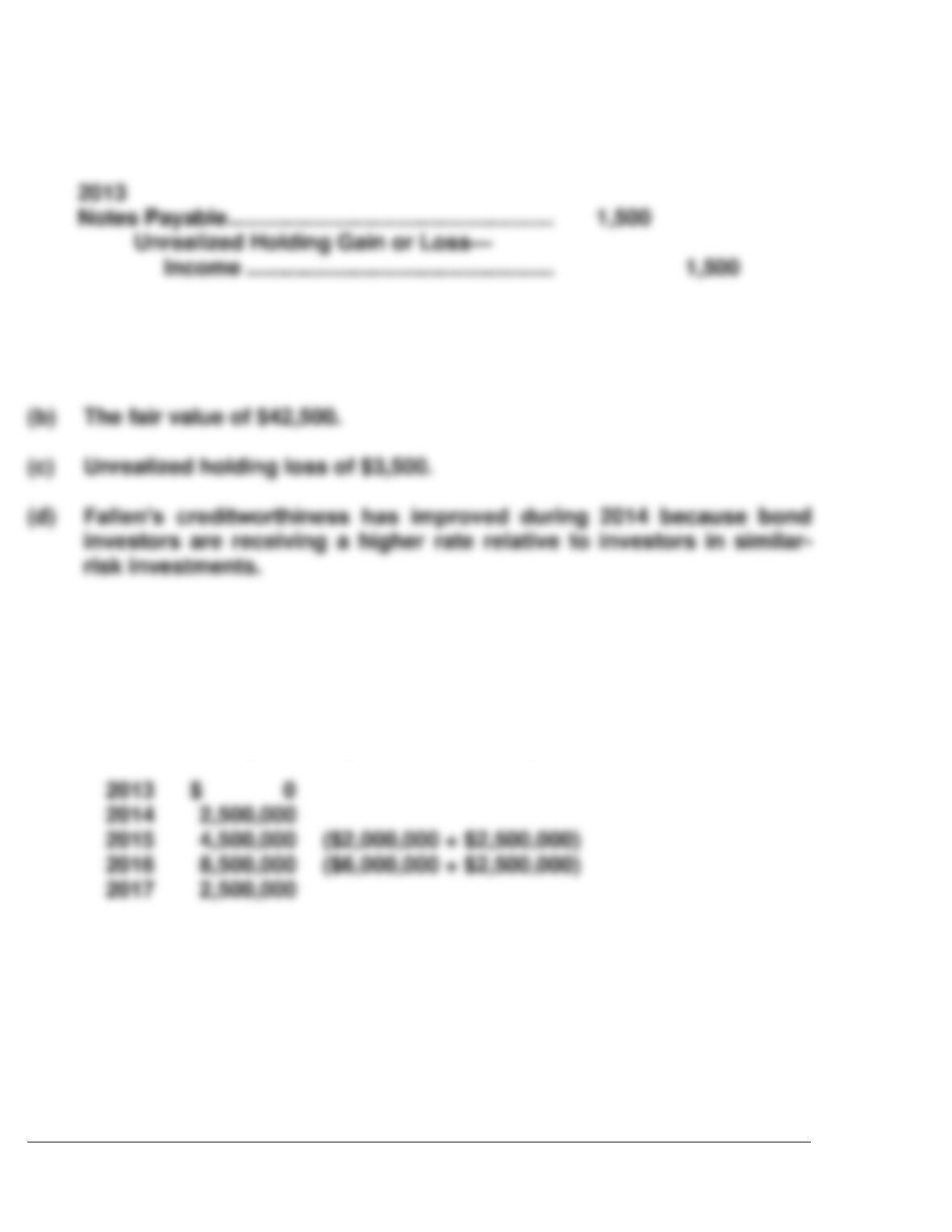
(3,500)
Carrying
Unrealized
Holding Gain
Change in
Unrealized
Holding
Applicable interest rate (10%) …………………………………………
**$4,000,000 – $1,267,960 = $2,732,040
14–30
EXERCISE 14-19 (Continued)
(a)
2012
No Entry (Carrying value = Fair Value
2014
Unrealized Holding Gain or Loss—Inc. ……………………..
3,500
Notes Payable……………………………………..
3,500
EXERCISE 14-20 (10–15 minutes)
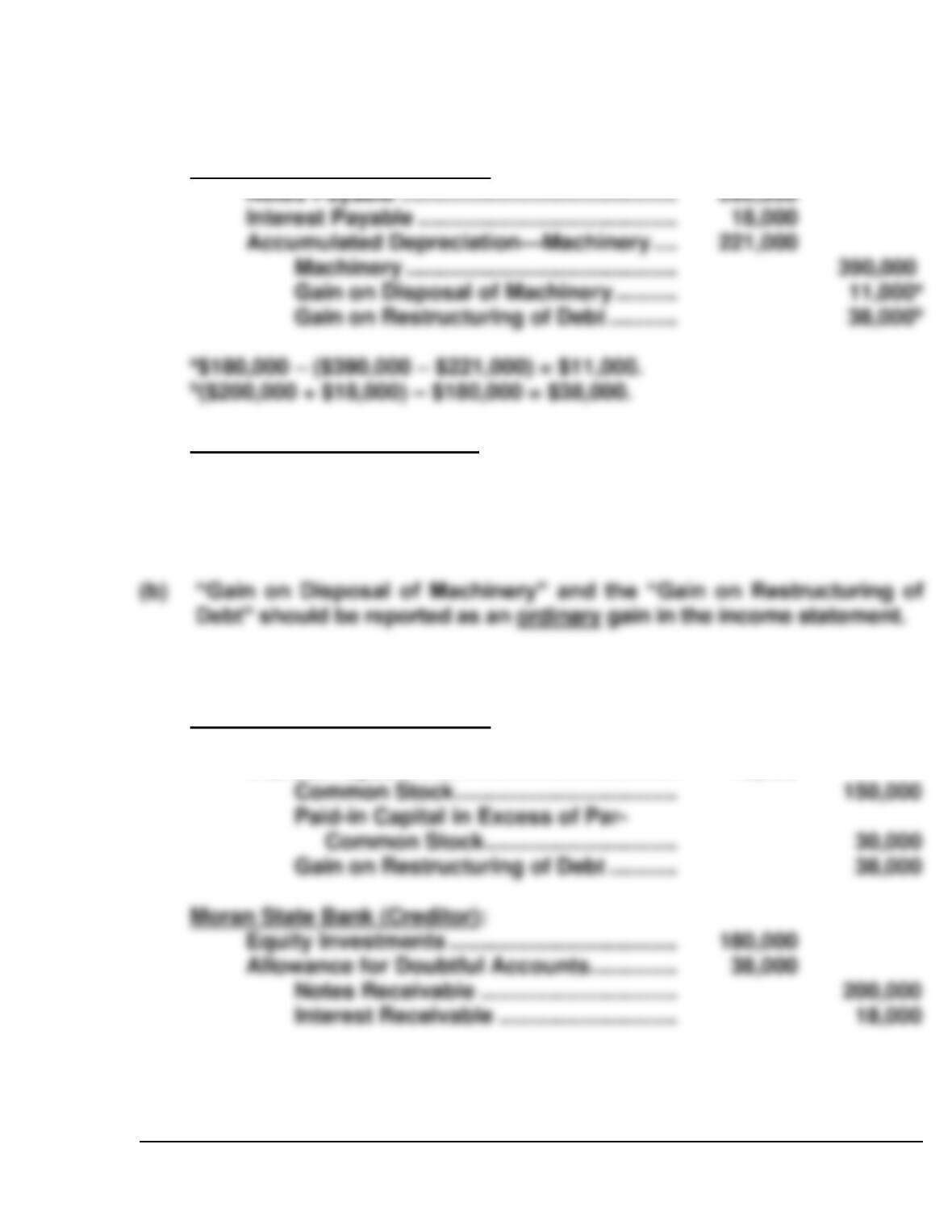
At December 31, 2012, disclosures would be as follows:
Maturities and sinking fund requirements on long-term debt are as follows:
$ 0
2015
($2,000,000 + $2,500,000)
($6,000,000 + $2,500,000)
Notes Payable ……………………………………………………….
1,500
14–31
*EXERCISE 14-21 (15–20 minutes)
(a)
Transfer of property on December 31, 2012:
Strickland Company (Debtor):
Moran State Bank (Creditor):
Machinery ………………………………………………………
180,000
Allowance for Doubtful Accounts …………………….
38,000
Notes Receivable …………………………………….
200,000
Interest Receivable …………………………..
18,000
(c)
Granting of equity interest on December 31, 2012:
Strickland Company (Debtor):
Notes Payable ………………………………………………..
200,000
Interest Payable ……………………………………………..
18,000
Common Stock ………………………………………..
Gain on Restructuring of Debt ………………….
Moran State Bank (Creditor):
Equity Investments …………………………………………
180,000
Allowance for Doubtful Accounts …………………….
38,000
Notes Receivable …………………………………….
Interest Receivable …………………………..
Notes Payable ………………………………………………..
200,000
Interest Payable ……………………………………………..
18,000
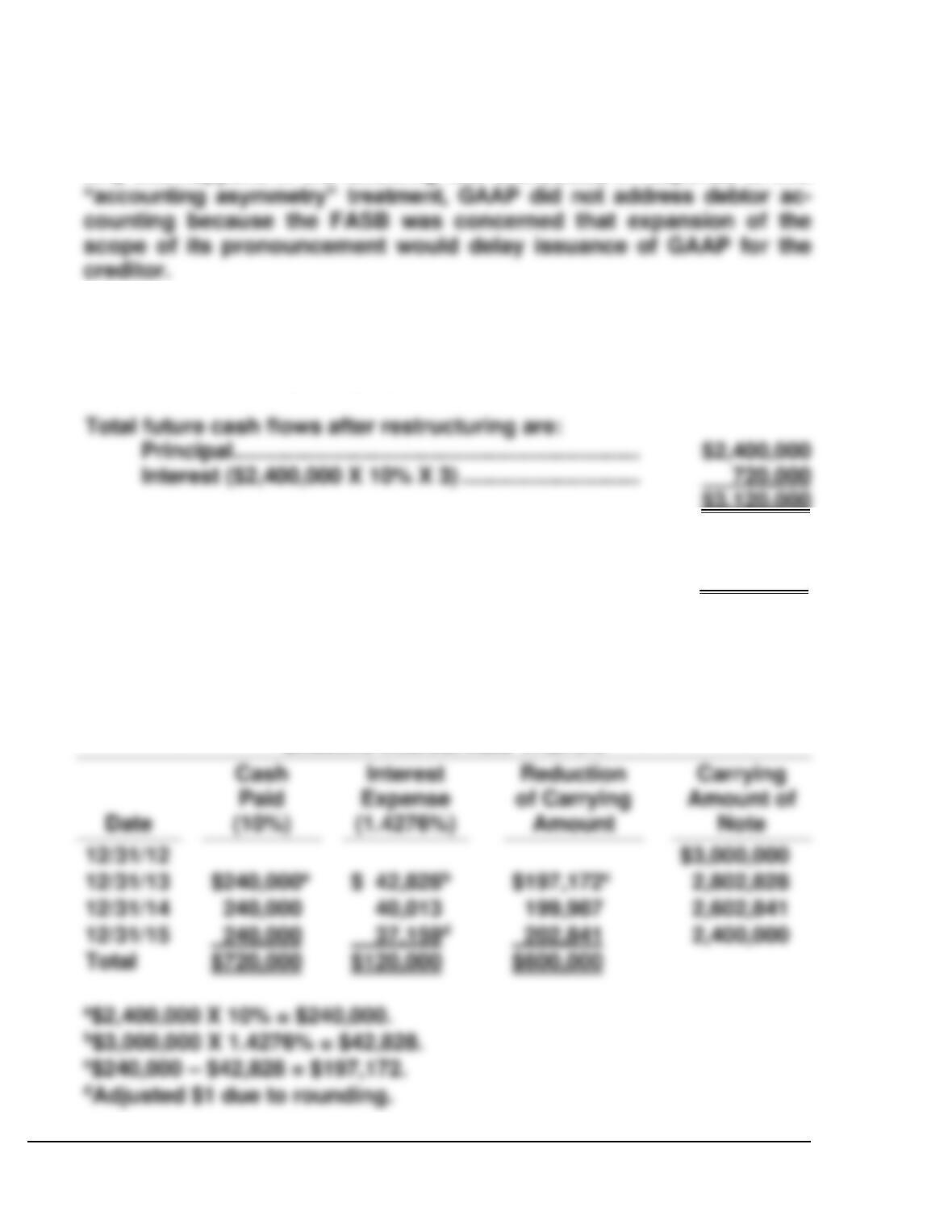
Accumulated Depreciation—Machinery ……………
221,000
Machinery ……………………………………………….
390,000
Gain on Disposal of Machinery …………………
Gain on Restructuring of Debt ………………….
14–32
*EXERCISE 14-22 (20–30 minutes)
(a) No. The gain recorded by Barkley is not equal to the loss recorded by
American Bank under the debt restructuring agreement. (You will see
why this happens in the following four exercises.) In response to this
(b) No. There is no gain under the modified terms because the total future
cash flows after restructuring exceed the total pre-restructuring carrying
amount of the note (principal):
$3,120,000
Total pre-restructuring carrying amount of note
(principal): …………………………………………………………..
$3,000,000
(c) The interest payment schedule is prepared as follows:
BARKLEY COMPANY
Interest Payment Schedule After Debt Restructuring
Effective-Interest Rate 1.4276%
Total
$720,000
$120,000
$600,000
14–33
*EXERCISE 14-22 (Continued)
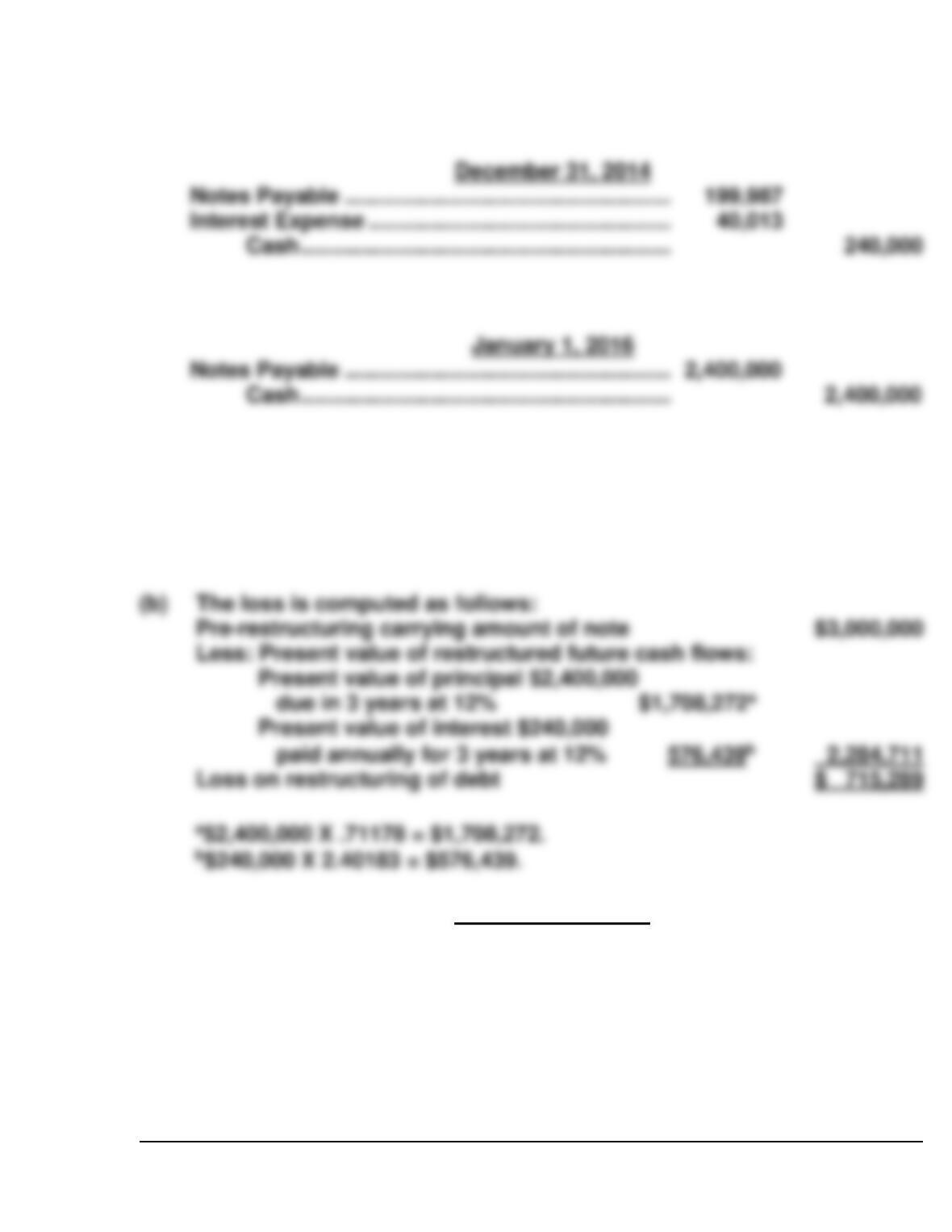
(d)
Interest payment entry for Barkley Company is:
(e)
The payment entry at maturity is:
Notes Payable ……………………………………………………….
Cash ……………………………………………………….
*EXERCISE 14-23 (25–30 minutes)
(a) The American Bank should use the historical interest rate of 12% to
calculate the loss.
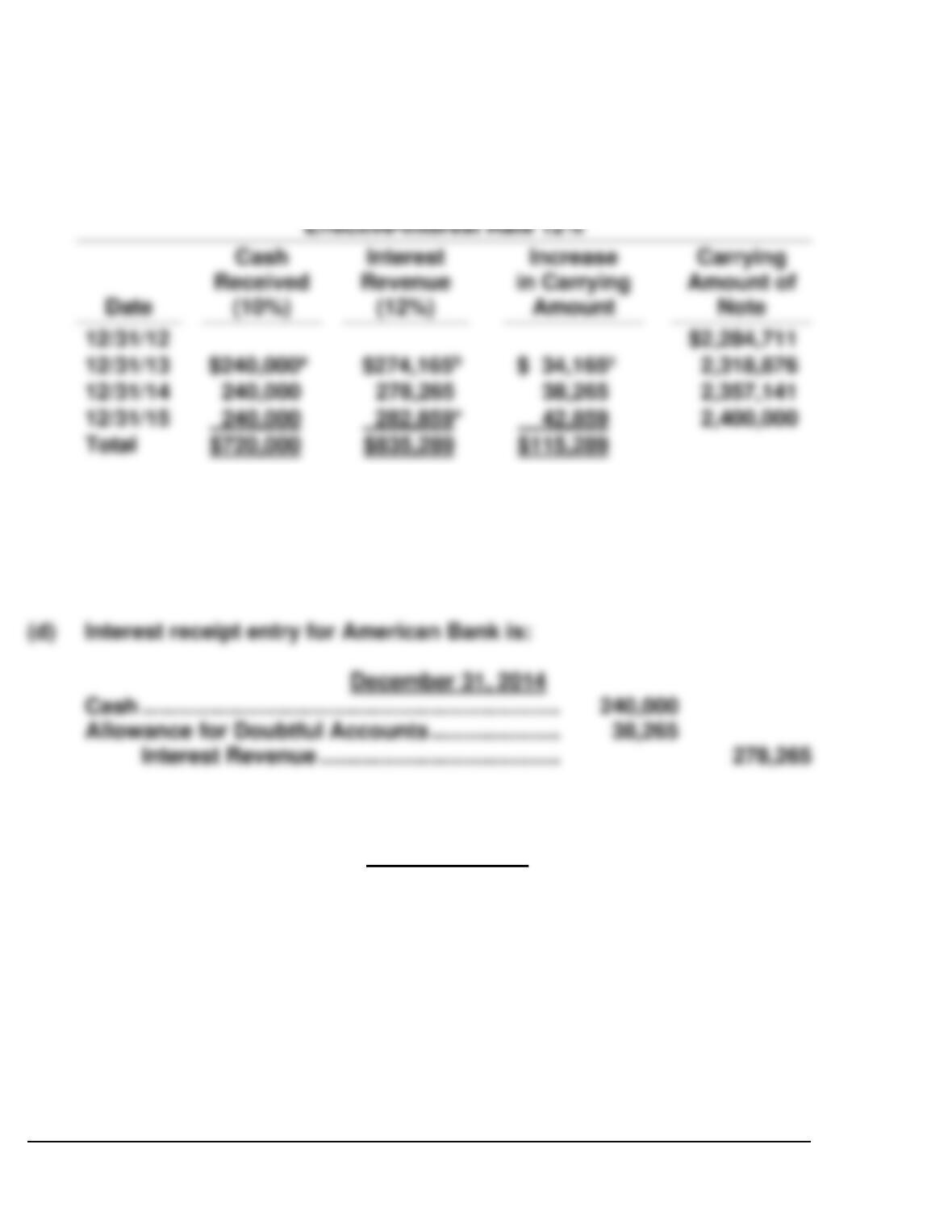
(b)
The loss is computed as follows:
Pre-restructuring carrying amount of note
Less: Present value of restructured future cash flows:
Present value of principal $2,400,000
due in 3 years at 12%
paid annually for 3 years at 12%
December 31, 2012
Bad Debt Expense …………………………………………………..
715,289
Allowance for Doubtful Accounts …………………….
715,289
December 31, 2014
Notes Payable ……………………………………………………….
Interest Expense …………………………………………………….
Cash ……………………………………………………….
14–34
*EXERCISE 14-23 (Continued)
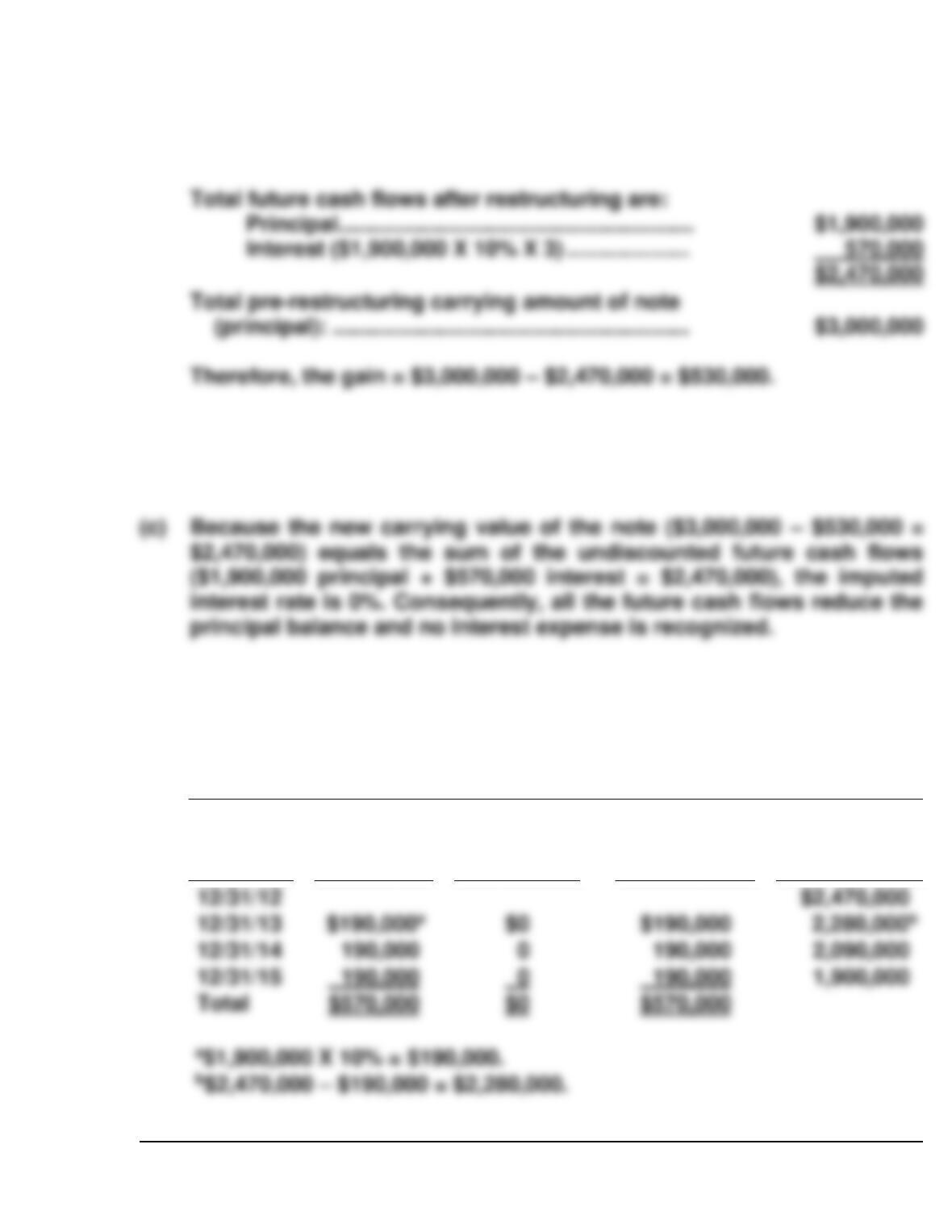
(c) The interest receipt schedule is prepared as follows:
AMERICAN BANK
Interest Receipt Schedule After Debt Restructuring
a$2,400,000 X 10% = $240,000.
b$2,284,711 X 12% = $274,165.
c$274,165 – $240,000 = $34,165.
*Rounded $2
(d)
Interest receipt entry for American Bank is:
Cash ………………………………………………………………………
Allowance for Doubtful Accounts …………………………..
Interest Revenue …………………………………………….
(e)
The receipt entry at maturity is:
January 1, 2016
Cash ………………………………………………………………………
2,400,000
Allowance for Doubtful Accounts …………………………..
600,000
Notes Receivable …………………………..……………….
3,000,000
14–35
*EXERCISE 14-24 (25–30 minutes)
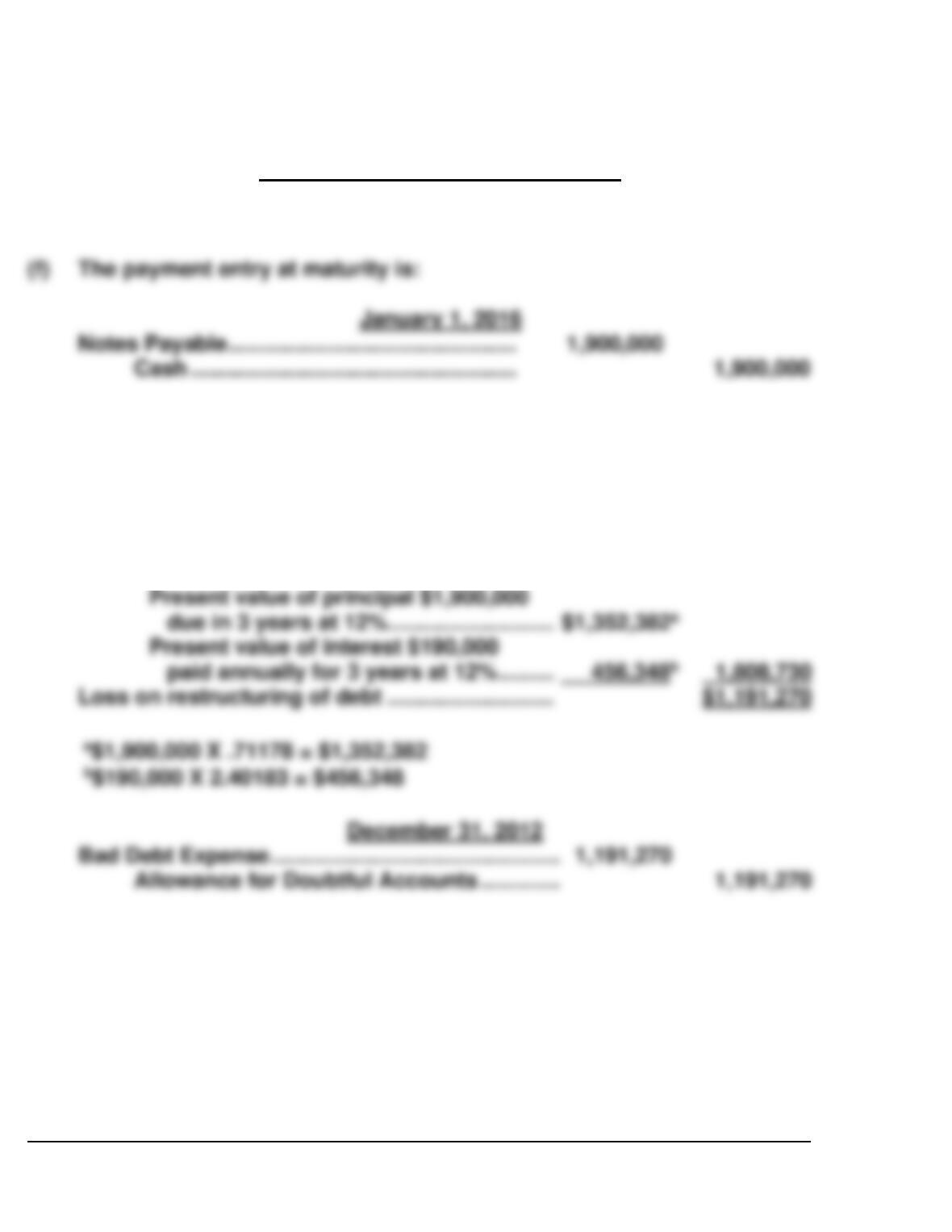
(a) Yes. Barkley Company can record a gain under this term modification.
The gain is calculated as follows:
(b)
The entry to record the gain on December 31, 2012:
Notes Payable ………………………………………………..
530,000
Gain on Restructuring of Debt ………………….
530,000
(d) The interest payment schedule is prepared as follows:
BARKLEY COMPANY
Interest Payment Schedule After Debt Restructuring
Effective-Interest Rate 0%
Date
Cash
Paid
(10%)
Interest
Expense
(0%)
Reduction
of Carrying
Amount
Carrying
Amount of
Note
Total future cash flows after restructuring are:
Principal ……………………………………………………….
Interest ($1,900,000 X 10% X 3) ………………..
Therefore, the gain = $3,000,000 – $2,470,000 = $530,000.
14–36
*EXERCISE 14-24 (Continued)
(e)
Cash interest payment entries for Barkley Company are:
December 31, 2013, 2014, and 2015
Notes Payable ……………………………………………………….
190,000
Cash ……………………………………………………….
190,000
*EXERCISE 14-25 (20–30 minutes)
(a)
The loss can be calculated as follows:
Pre-restructuring carrying amount of note ……………….
$3,000,000
Less: Present value of restructured future
cash flows:
Present value of principal $1,900,000
due in 3 years at 12% …………………………..
Present value of interest $190,000
paid annually for 3 years at 12% ………………….
Bad Debt Expense …………………………………………………..
Allowance for Doubtful Accounts …………………….
The payment entry at maturity is:
Notes Payable ……………………………………………………….
Cash ……………………………………………………….
14–37
*EXERCISE 14-25 (Continued)
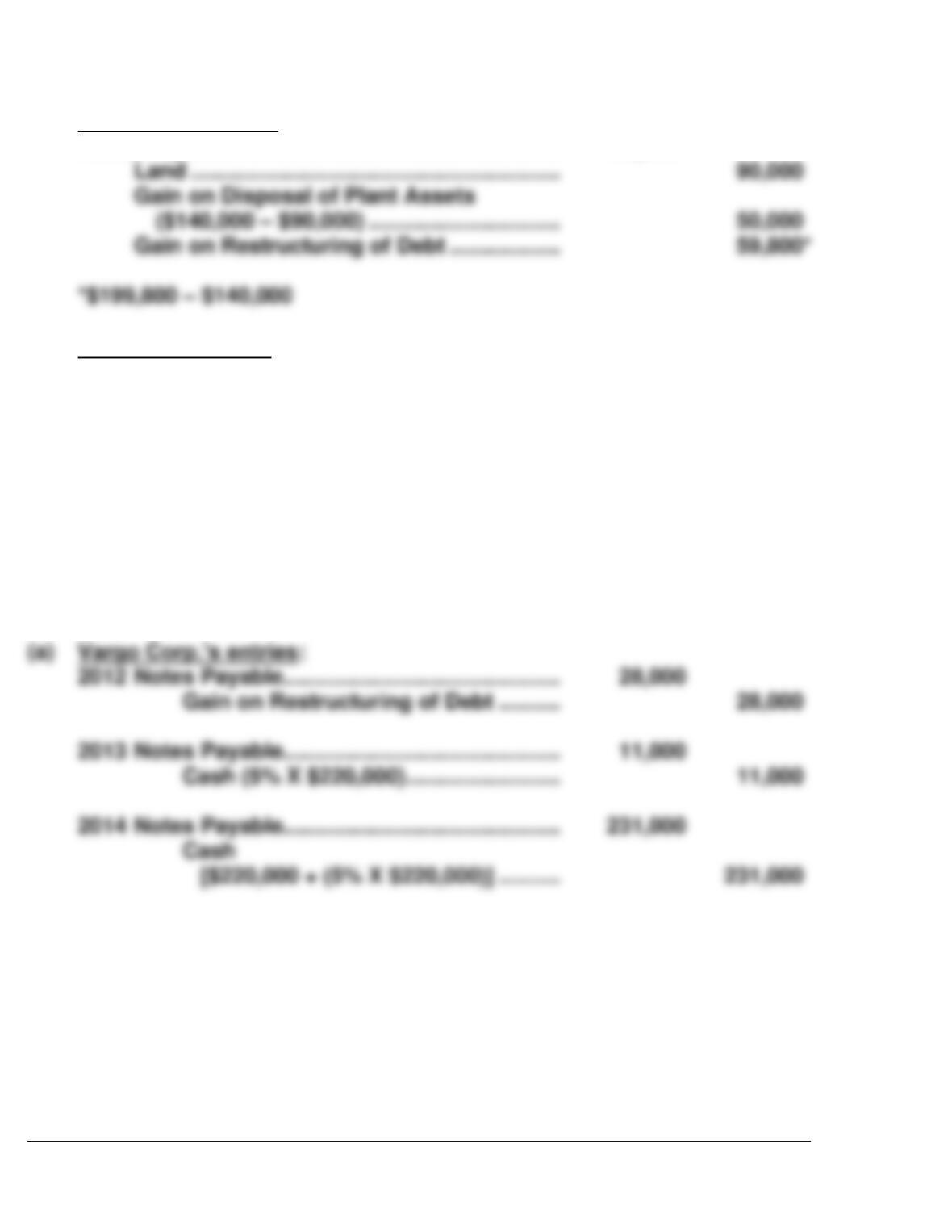
(b) The interest receipt schedule is prepared as follows:
AMERICAN BANK
Interest Receipt Schedule After Debt Restructuring
Effective-Interest Rate 12%
Date
Cash
Received
(10%)
Interest
Revenue
(12%)
Increase
in Carrying
Amount
Carrying
Amount of
Note
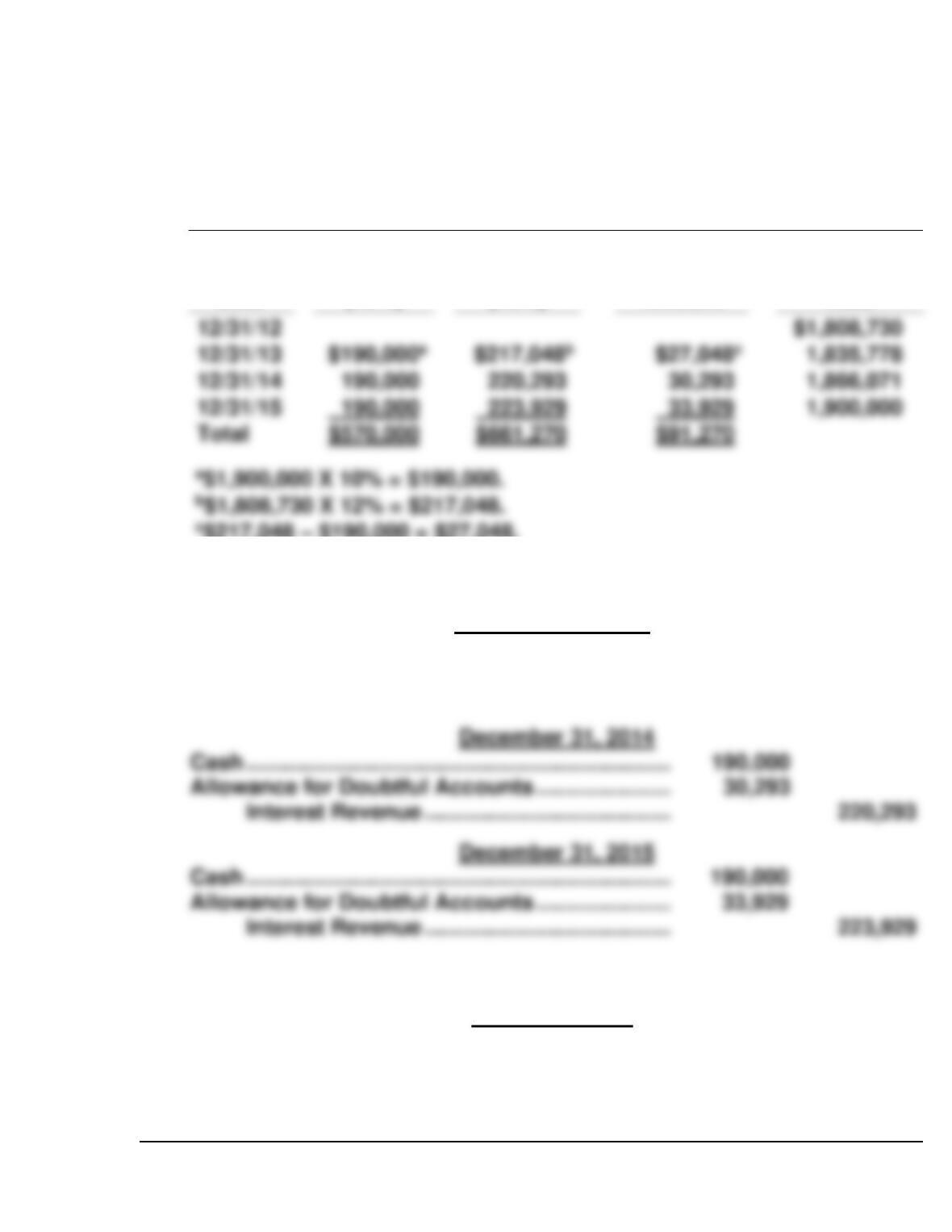
c$217,048 – $190,000 = $27,048.
(c)
Interest receipt entries for American Bank are:
December 31, 2013
Cash ………………………………………………………………………
190,000
Allowance for Doubtful Accounts …………………………..
27,048
Interest Revenue …………………………………………….
217,048
Cash ………………………………………………………………………
Allowance for Doubtful Accounts …………………………..
Interest Revenue …………………………………………….
Cash ………………………………………………………………………
Interest Revenue …………………………………………….
223,929
(d)
The receipt entry at maturity is:
January 1, 2016
Cash ………………………………………………………………………
1,900,000
Allowance for Doubtful Accounts …………………………..
1,100,000
Notes Receivable ……………………………………………
3,000,000
14–38
*EXERCISE 14-26 (15–20 minutes)
(a)
Gottlieb Co.’s entry:
Notes Payable ……………………………………………………….
199,800
(b)
Ceballos Inc. entry:
Land ………………………………………………………………………
140,000
Allowance for Doubtful Accounts …………………………..
59,800
Notes Receivable …………………………..……………….
199,800
*EXERCISE 14-27 (20–25 minutes)
Because the carrying amount of the debt, $270,000 exceeds the total future
cash flows $242,000 [$220,000 + ($11,000 X 2)], a gain and a loss are
recognized and no interest is recorded by the debtor.
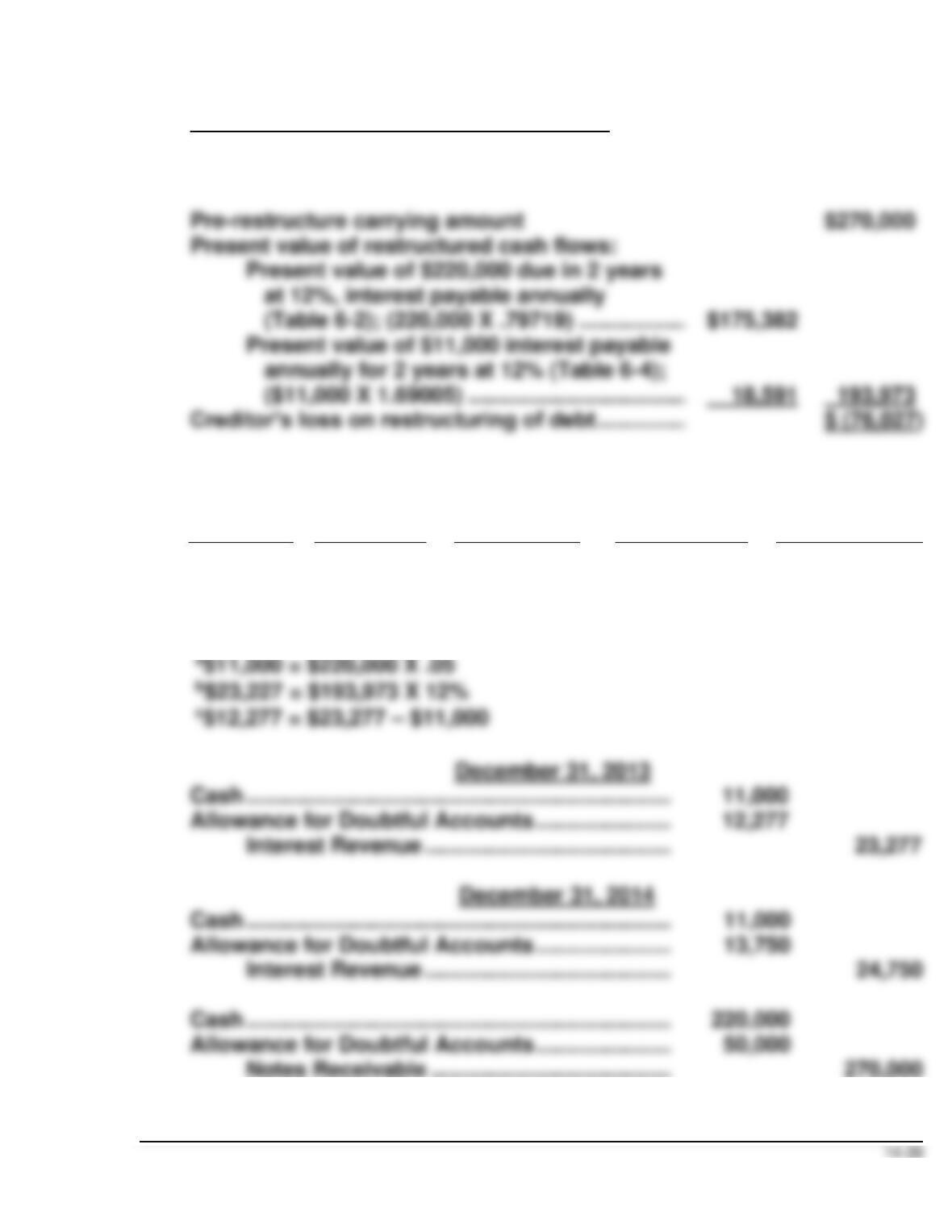
(a)
Gain on Restructuring of Debt ………………….
Cash (5% X $220,000) …………………………..
Cash
[$220,000 + (5% X $220,000)] ………………….
Land ……………………………………………………….
Gain on Disposal of Plant Assets
($140,000 – $90,000) …………………………..
Gain on Restructuring of Debt …………………………
*$199,800 – $140,000
*EXERCISE 14-27 (Continued)
(b)
First Trust’s entry on December 31, 2012:
Bad Debt Expense …………………………………………………..
76,027
Allowance for Doubtful Accounts …………………….
76,027
Pre-restructure carrying amount
Present value of restructured cash flows:
at 12%, interest payable annually
(Table 6-2); (220,000 X .79719) ………………………
annually for 2 years at 12% (Table 6-4);
($11,000 X 1.69005) ………………………………………
Date
Cash
Interest
Effective-
Interest
Increase
in Carrying
Amount
Carrying
Amount of
Note
12/31/12
$193,973
12/31/13
$11,000a
$23,277b
$12,277c
206,250
12/31/14
11,000
24,750
13,750
220,000
Cash ………………………………………………………………………
11,000
Interest Revenue …………………………………………….
Cash ………………………………………………………………………
Allowance for Doubtful Accounts …………………………..
Cash ………………………………………………………………………

14–40
TIME AND PURPOSE OF PROBLEMS
Problem 14-1 (Time 15–20 minutes)
Purpose—to provide the student with the opportunity to interpret a bond amortization schedule. This
problem requires both an understanding of the function of such a schedule and the relevance of each of
the individual numbers. The student is to prepare journal entries to reflect the information given in the
bond amortization schedule.
Problem 14-2 (Time 25–30 minutes)
Purpose—to provide the student with an understanding of how to make the journal entry to record the
issuance of bonds. In addition, a portion of the bonds are retired and therefore a bond amortization
schedule has to be prepared.
Problem 14-3 (Time 20–30 minutes)
Purpose—to provide the student with an understanding of how interest rates can be used to deceive
a customer. The problem is challenging because for the first year of this transaction, negative amortization
results.
Problem 14-4 (Time 15–20 minutes)
Purpose—to provide the student with an understanding of the relevant journal entries which are necessi–
tated when there is a bond issuance and bond retirement. This problem also provides an opportunity for
the student to learn the income statement treatment of the loss from retirement and the footnote disclosure
required.
Problem 14-5 (Time 50–65 minutes)
Purpose—to provide the student with an understanding of the relevant journal entries which are neces–
sitated for a bond issuance. This problem involves two independent bond issuances with the assumption
that one is sold at a discount and the other at a premium, both utilizing the effective-interest method.
This comprehensive problem requires preparing journal entries for the issuance of bonds, related
interest payments and amortization (with the construction of amortization tables where applicable), and
the retirement of part of the bonds.
Problem 14-6 (Time 20–25 minutes)
Purpose—to provide the student with an understanding of the relevant journal entries which are
necessitated when there is a bond issuance and bond retirement. This problem requires preparing
journal entries, assuming the straight-line method, for the issuance of bonds, related interest payments
and amortization, and the retirement of part of the bonds.
Problem 14-7 (Time 20–25 minutes)
Purpose—to provide the student with a series of transactions from bond issuance, payment of bond
interest, accrual of bond interest, amortization of bond discount, and bond retirement. Journal entries
are required for each of these transactions.
Problem 14-8 (Time 15–25 minutes)
Purpose—to provide the student with an opportunity to become familiar with the application of GAAP,
involving the exchange of notes for cash or property, goods, or services. This problem requires the
preparation of the necessary journal entries concerning the exchange of a zero-interest-bearing long-
term note for a computer, and the necessary adjusting entries relative to depreciation and amortization.
The student should construct the relevant Schedule of Note Discount Amortization to support the
respective entries.