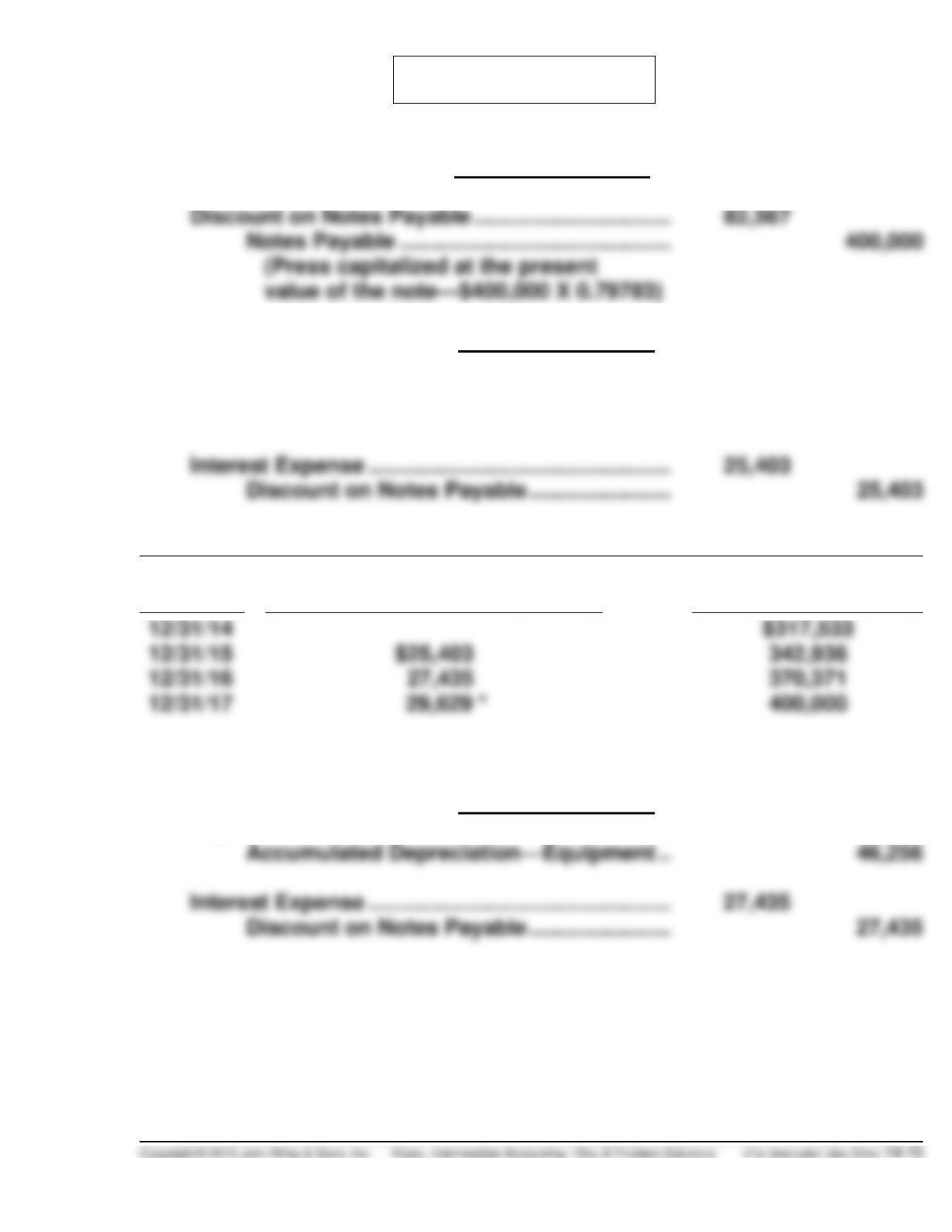
PROBLEM 14-8B
(a)
December 31, 2014
Equipment ……………………………………………………….
317,533
Discount on Notes Payable …………………………..
82,567
Notes Payable ………………………………………………..
(Press capitalized at the present
value of the note—$400,000 X 0.79783)
(b)
December 31, 2015
Depreciation Expense ……………………………………………..
46,256
Accumulated Depreciation—Equipment
[($317,533 – $40,000) ÷ 6] …………………………..
46,256
Interest Expense …………………………………………………….
Discount on Notes Payable …………………………..
25,403
Schedule of Note Discount Amortization
Date
Debit, Interest Expense Credit,
Discount on Notes Payable
Carrying Amount
of Note
12/31/15
12/31/16
12/31/17
*$1 adjustment due to rounding.
(c)
December 31, 2016
Depreciation Expense ……………………………………………..
46,256
Accumulated Depreciation—Equipment …………..
46,256
Discount on Notes Payable …………………………..
27,435
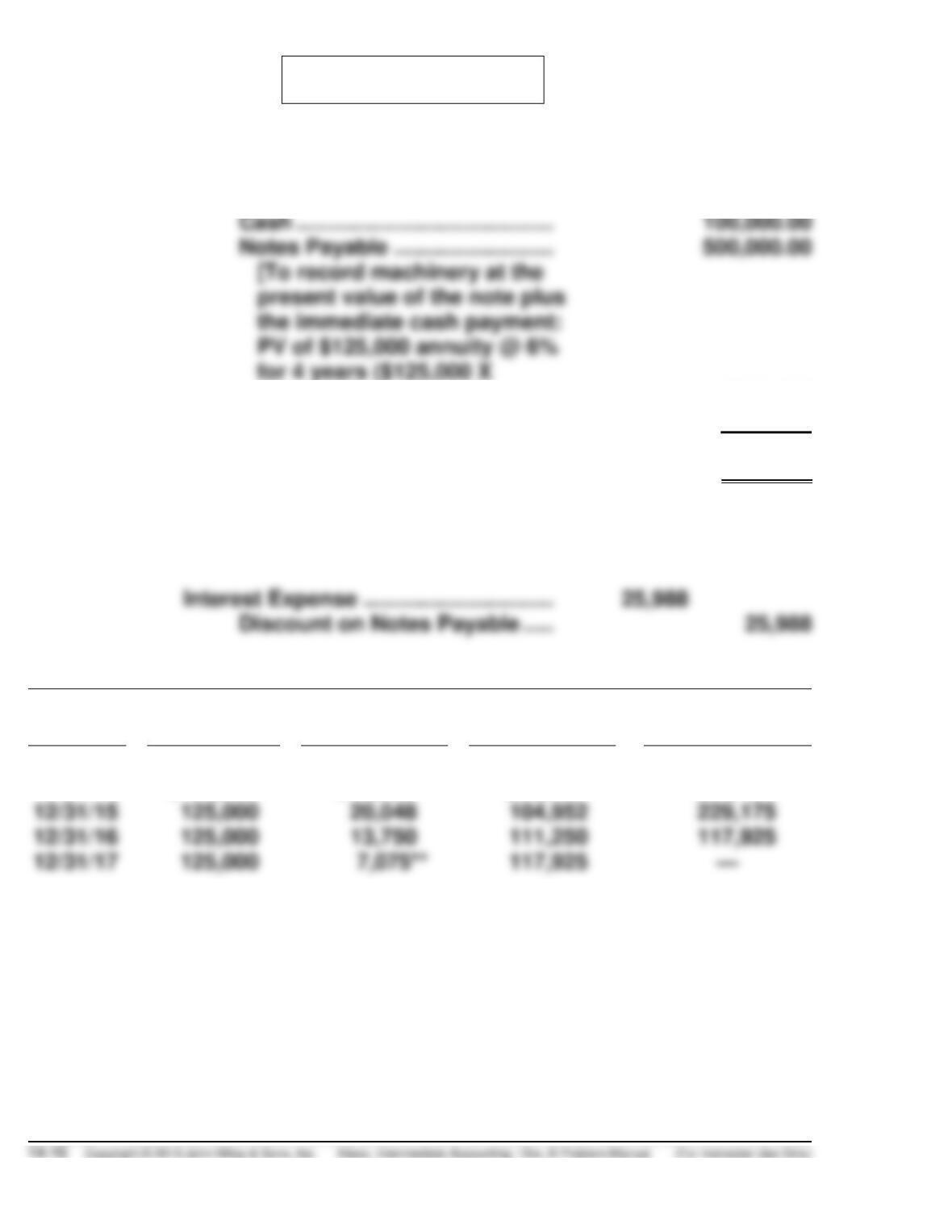
PROBLEM 14-9B
(a)
12/31/13
Machinery ……………………………………………………….
533,139
Discount on Notes Payable …………………………..
66,861
Cash ……………………………………………………….
100,000.00
Notes Payable …………………………..
[To record machinery at the
present value of the note plus
the immediate cash payment:
PV of $125,000 annuity @ 6%
for 4 years ($125,000 X
3.46511)] ………………………………………………………
$433,139
Down payment…………………………..
100,000
Capitalized value of
Machinery …………………………..
$533,139
(b)
12/31/14
Notes Payable ……………………………………………………….
125,000.00
Cash ……………………………………………………….
125,000.00
Interest Expense …………………………..
25,988
Discount on Notes Payable …………………………..
Schedule of Note Discount Amortization
Date
Cash Paid
Interest
Expense
Amortization
Carrying
Amount of Note
12/31/13
$433,139
12/31/14
$125,000
$25,988
$99,012
334,127
12/31/15
12/31/16
12/31/17
*$1 adjustment due to rounding.
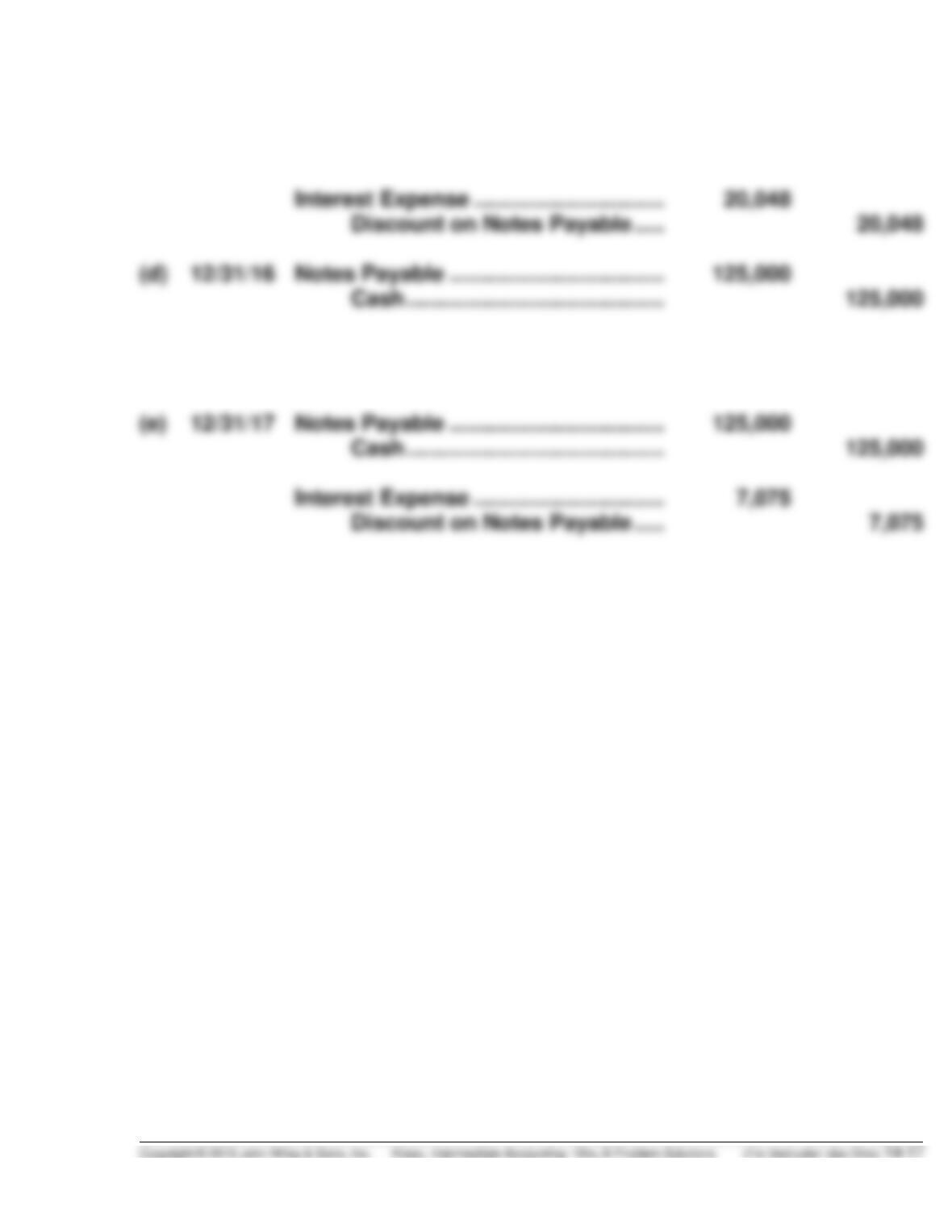
PROBLEM 14-9B (Continued)
(c)
12/31/15
Notes Payable ……………………………………………………….
125,000
Cash ……………………………………………………….
125,000
Interest Expense …………………………..
20,048
Discount on Notes Payable …………………………..
20,048
(d)
Notes Payable ……………………………………………………….
125,000
Cash ……………………………………………………….
125,000
Interest Expense …………………………..
13,750
Discount on Notes Payable …………………………..
13,750
(e)
12/31/17
Notes Payable ……………………………………………………….
125,000
Cash ……………………………………………………….
125,000
Interest Expense …………………………..
Discount on Notes Payable …………………………..
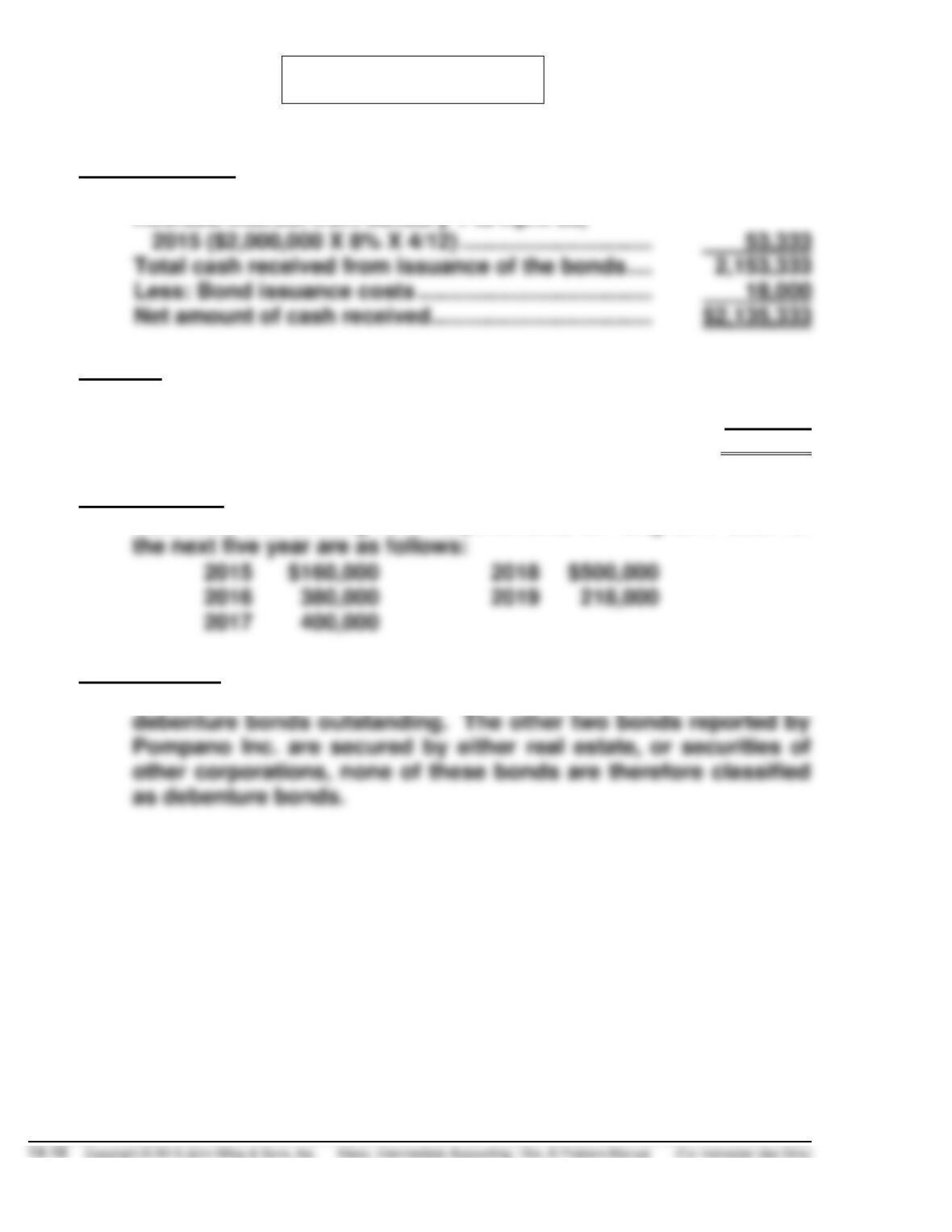
PROBLEM 14-10B
(a)
Lauderdale Co.
Selling price of the bonds ($2,000,000 X 105%) ……
$2,100,000
Accrued interest from January 1 to April 30,
2015 ($2,000,000 X 8% X 4/12) ………………………….
Total cash received from issuance of the bonds ….
Less: Bond issuance costs ………………………………..
Net amount of cash received ………………………………
(b)
Fort Co.
Carrying amount of the bonds on 1/1/14 ……………..
$692,639
Effective-interest rate (8%) …………………………………
X 0.08
Interest expense to be reported for 2014 …………….
$ 55,411
(c)
Lauderhill Co.
Maturities and sinking fund requirements on long-term debt for
(d)
Pompano Inc.
Only the $4,000,000 in unsecured serial bonds are reported as
PROBLEM 14-11B
Dear Alicia,
When a bond is issued at face value, the annual interest expense and the
interest payout equals the face value of the bond times the interest rate
stated on its face. However, if the bond is issued to yield a higher or lower
amortization.
One method of amortization is the straight–line method whereby the amount of
the premium or discount is divided by the number of interest periods in the
bond’s life. The result is an even amount of amortization for every period.
However, a better way of recording interest expense in the period during
which it is incurred is the effective–interest method. Assume a discount: the
To amortize the discount applying this method to the data provided, you
must know the bond’s face amount, its stated rate of interest, its effective
rate of interest, and its premium.
1. Multiply the stated rate times the face amount. This is the interest
payout.
PROBLEM 14-11B (Continued)
3. Subtract the amount calculated in #1 from that found in #2. This is the
amount to be amortized for the period.
4. Add the difference computed in #3 to the carrying amount. The
process begins all over when you apply the effective rate to this new
carrying amount for the following period.
The schedule below illustrates this calculation. The face value ($5,000,000)
is multiplied by the stated rate of 8 percent, while the carrying amount
($4,613,913) is multiplied by the effective rate of 10 percent. Because this
Attachment to letter
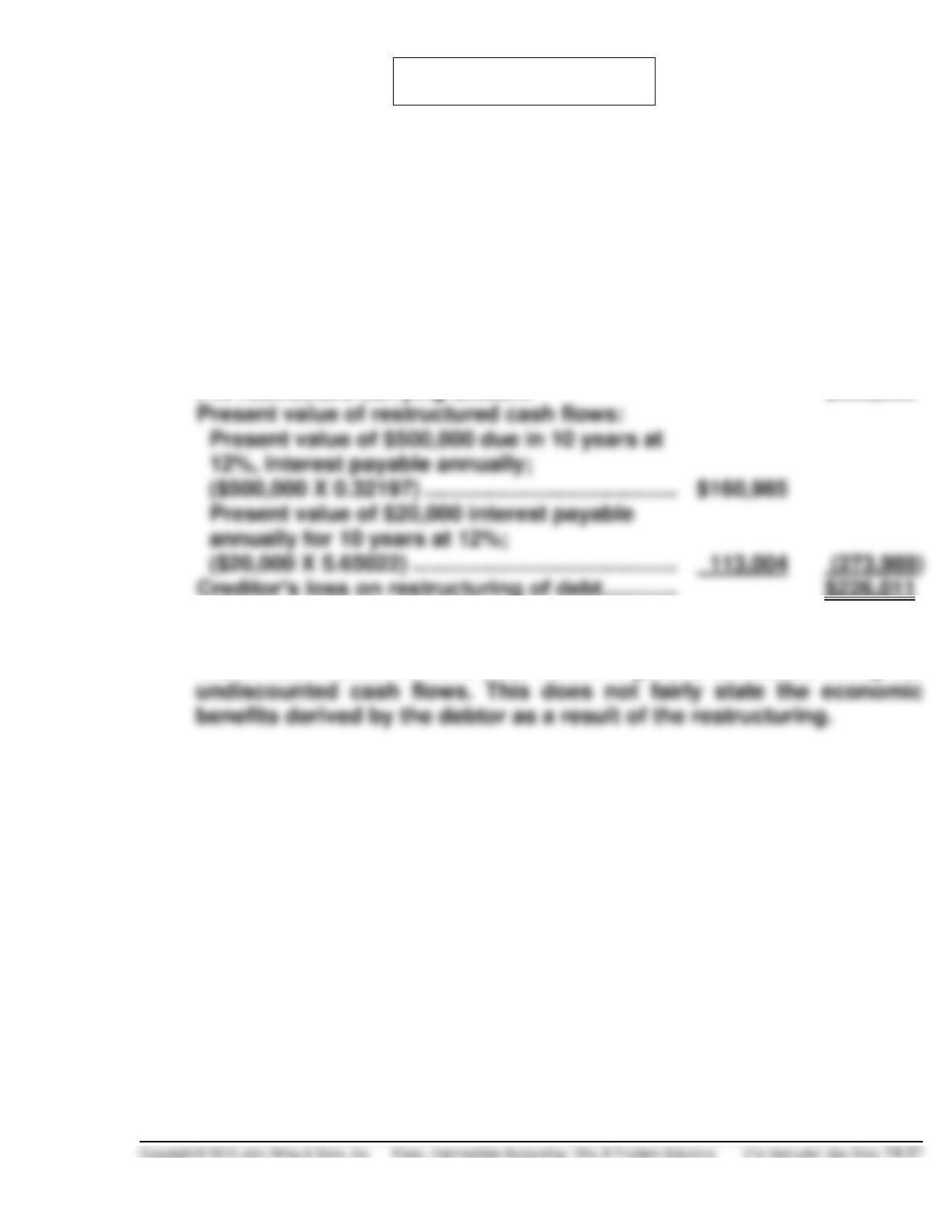
SCRIBNER COMPANY
Interest and Discount Amortization Schedule
8% Bond Issued to Yield 10%
Date
Cash
Paid
(8%)
Interest
Expense
(10%)
Premium
Amortized
Carrying
Amount of
Bond
6/30/14
$4,613,913
12/31/14
$200,000
$230,696
$30,696
4,644,609
*PROBLEM 14-12B
(a) It is a troubled debt restructuring.
(b)
1. No entry.
2. Bad Debt Expense …………………………..……………..
226,011*
Allowance for Doubtful Accounts ……………..
226,011
*Calculation of loss.
Pre-restructure carrying amount
$500,000
Present value of restructured cash flows:
Creditor’s loss on restructuring of debt ……………………
$226,011
(c) Losses are calculated based upon the discounted present value of
future cash flows. However, the debtor’s gain is calculated using the
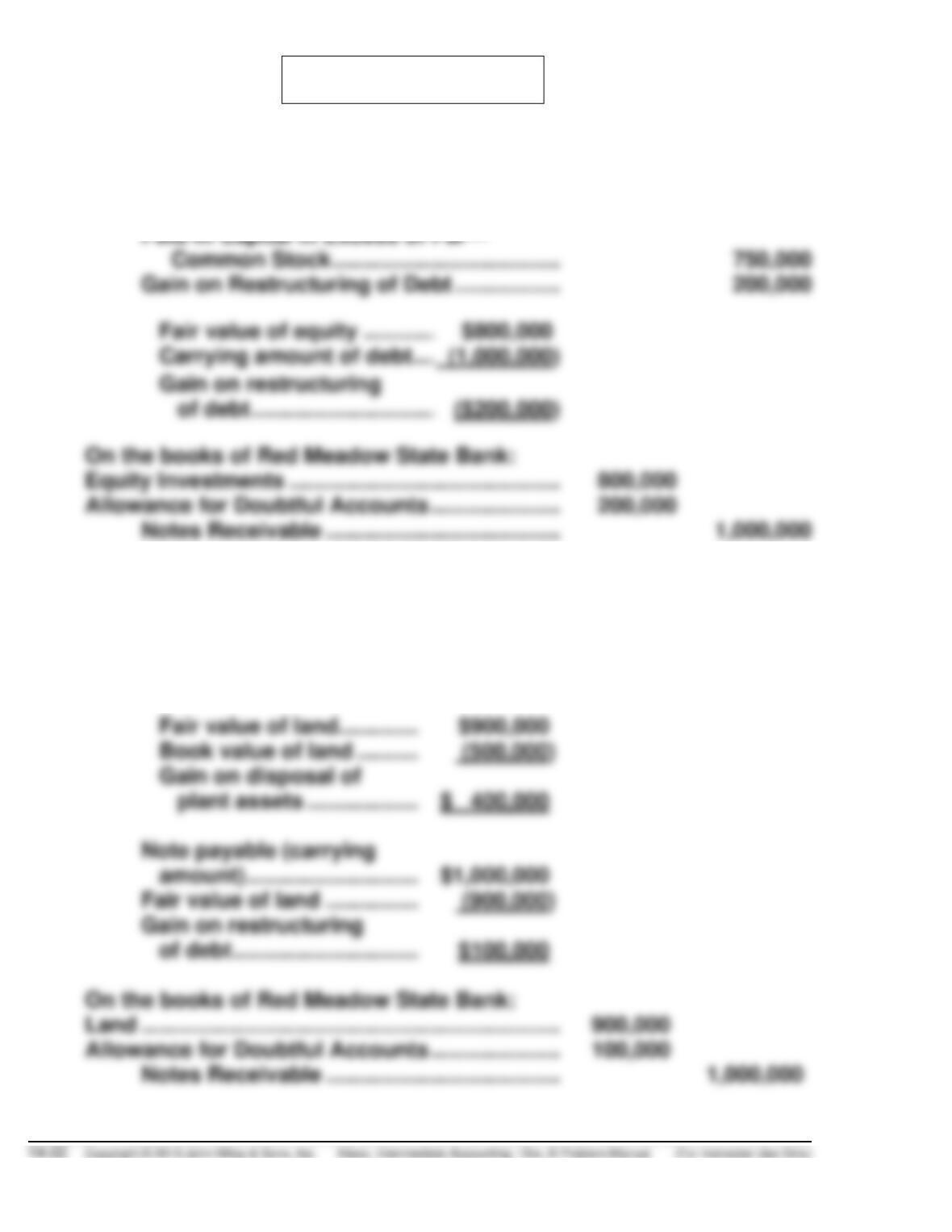
*PROBLEM 14-13B
(a)
On the books of Pinker Corporation:
Notes payable …………………………..…………………………..
1,000,000
Common Stock …………………………..…………………..
50,000
Gain on Restructuring of Debt …………………………
200,000
Fair value of equity …………………………..
Gain on restructuring
On the books of Red Meadow State Bank:
Equity Investments …………………………………………………
Allowance for Doubtful Accounts …………………………..
Notes Receivable ……………………………………………
(b)
On the books of Pinker:
Notes Payable ……………………………………………………….
1,000,000
Land ……………………………………………………….
500,000
Gain on Disposal of Plant Assets …………………….
400,000
Gain on Restructuring of Debt …………………………
100,000
Fair value of land …………………………..
Book value of land …………………………..
Gain on disposal of
Note payable (carrying
amount) …………………………..
Gain on restructuring
On the books of Red Meadow State Bank:
Land ………………………………………………………………………
Allowance for Doubtful Accounts …………………………..
*PROBLEM 14-13B (Continued)
(c)
On the books of Pinker:
No entry is needed because aggregate cash flows equal
the carrying amount.
Aggregate cash flows—principal ……………………..
$1,000,000
Carrying amount …………………………………………….
$1,000,000
Bad Debt Expense ………………………………………………….
*Calculation of loss:
Present value of $1,000,000 due in
(d)
On the books of Pinker:
No entry is needed because aggregate cash flows
exceed the carrying amount.
Principal ……………………………………………………….
$875,000
Aggregate cash flows
Carrying amount
$1,000,000
Allowance for Doubtful Accounts …………………….
*PROBLEM 14-13B (Continued)
*Calculation of loss:
Pre-restructure carrying amount …………………………..
$1,000,000
Present value of restructured cash flows:
Present value of $875,000 due in
2 years at 15%, interest payable
(Table 6-2);
Annually; ($875,000 X 0.75614) ……………………..
Present value of $131,250 interest
payment at end of year 2 at 15%;
($131,250 X 0.75614) …………………………..
*PROBLEM 14-14B
Carrying amount of the debt at date of restructure, $400,000 + $32,000 =
$432,000. Total future cash flow, $350,000 + ($350,000 X 0.10 X 4) =
$490,000. Because the future cash flow exceeds the carrying amount of the
debt, no gain is recognized at the date of restructure.
(a) The effective-interest rate subsequent to restructure is computed by
trial and error using present value tables based on the present value
of $350,000 (new principal) plus $35,000 (interest per year) for four
years to equal $432,000.
(b) SCHEDULE OF DEBT REDUCTION
AND INTEREST EXPENSE AMORTIZATION
Date
Cash
Paid
Interest
Expense
Premium
Amortized
Carrying
Amount of
Note
12/31/14
$432,000
12/31/17
*PROBLEM 14-14B (Continued)
(c)
Calculation of loss:
Pre-restructure carrying amount …………………………..
$432,000
Present value of restructured cash flows:
Present value of $350,000 due in 4 years
at 10% , interest payable annually;
($350,000 X 0.68301) …………………………………….
Present value of $35,000 interest payable
annually for 4 years at 10% ;
($35,000 X 3.16987) ………………………………………
*Although the sum of the present value amounts is $340,999, the true
present value of a 10% note discounted at 10% is face value, or
$350,000. The $1 difference is due to rounding.
Date
Cash
Received
Interest
Revenue
Change in
Carrying
Amount
Carrying
Amount of
Note
12/31/14
$350,000
12/31/15
$ 35,000a
$35,000b
$ 0
350,000c
12/31/16
12/31/17
0
12/31/18
0
12/31/18
(d)
Skilhill Corp. entries:
December 31, 2014
Interest Payable ………………………………………………………
32,000
Notes Payable ………………………………………………..
32,000
December 31, 2015
Interest Expense …………………………………………………….
Notes Payable ……………………………………………………….
Cash ……………………………………………………….
35,000
*PROBLEM 14-14B (Continued)
December 31, 2016
Interest Expense …………………………………………………….
14,959
Notes Payable ……………………………………………………….
20,041
Cash ……………………………………………………….
305,000
December 31, 2014
(e)
Bad Debt Expense ………………………………………………….
Allowance for Doubtful Accounts …………………….
Cash ………………………………………………………………………
Interest Revenue …………………………………………….