PROBLEM 14.1
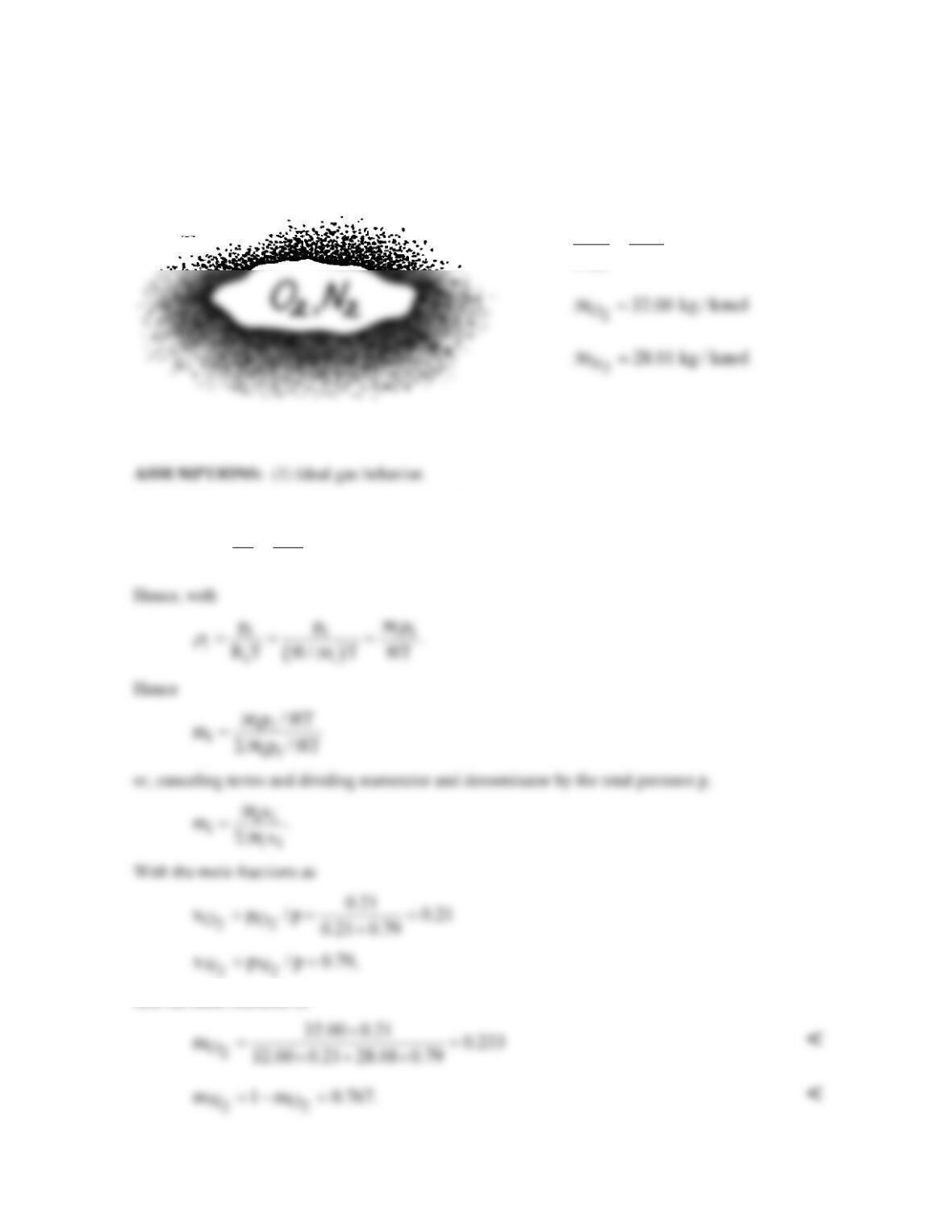
KNOWN: Mixture of O2 and N2 with partial pressures in the ratio 0.21 to 0.79.
FIND: Mass fraction of each species in the mixture.
SCHEMATIC:
2
O
N2
p0.21
p 0.79
=
ANALYSIS: From the definition of the mass fraction,
ii
ii
m
ρρ
ρρ
= = Σ
find the mass fractions as
PROBLEM 14.2
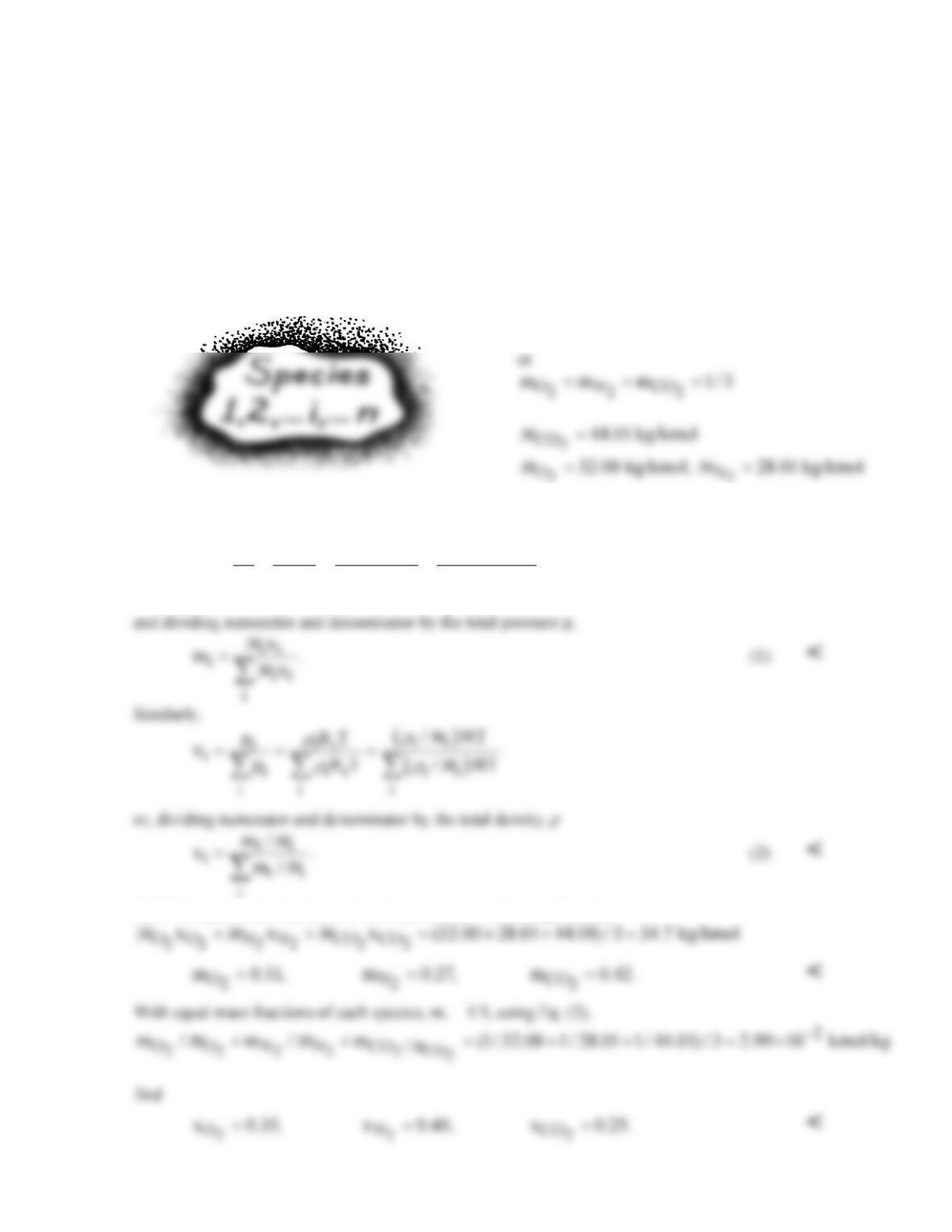
KNOWN: Mole fraction (or mass fraction) and molecular weight of each species in a mixture of n
species. Equal mole fractions (or mass fractions) of O2, N2 and CO2 in a mixture.
FIND: (a) Equation for determining mass fraction of species i from knowledge of mole fraction and
molecular weight of each of n species. Equation for determining mole fraction of species i from
knowledge of mass fraction and molecular weight of each of n species. (b) For mixture containing
equal mole fractions of O2, N2, and CO2, find mass fraction of each species. For mixture containing
equal mass fractions of O2, N2, and CO2, find mole fraction of each species.
SCHEMATIC:
22 2
O N CO
x x x 1/3= = =
ASSUMPTIONS: (1) Ideal gas behavior.
ANALYSIS: (a) With
i i i i ii
ii i i ii
ii i
p /R T p / T
mp /R T p / T
ℜ
= = = = ℜ
∑∑ ∑
M
M
ρρ
ρρ
(b) With equal mole fractions of each species, xi = 1/3, using Eq. (1),
PROBLEM 14.3
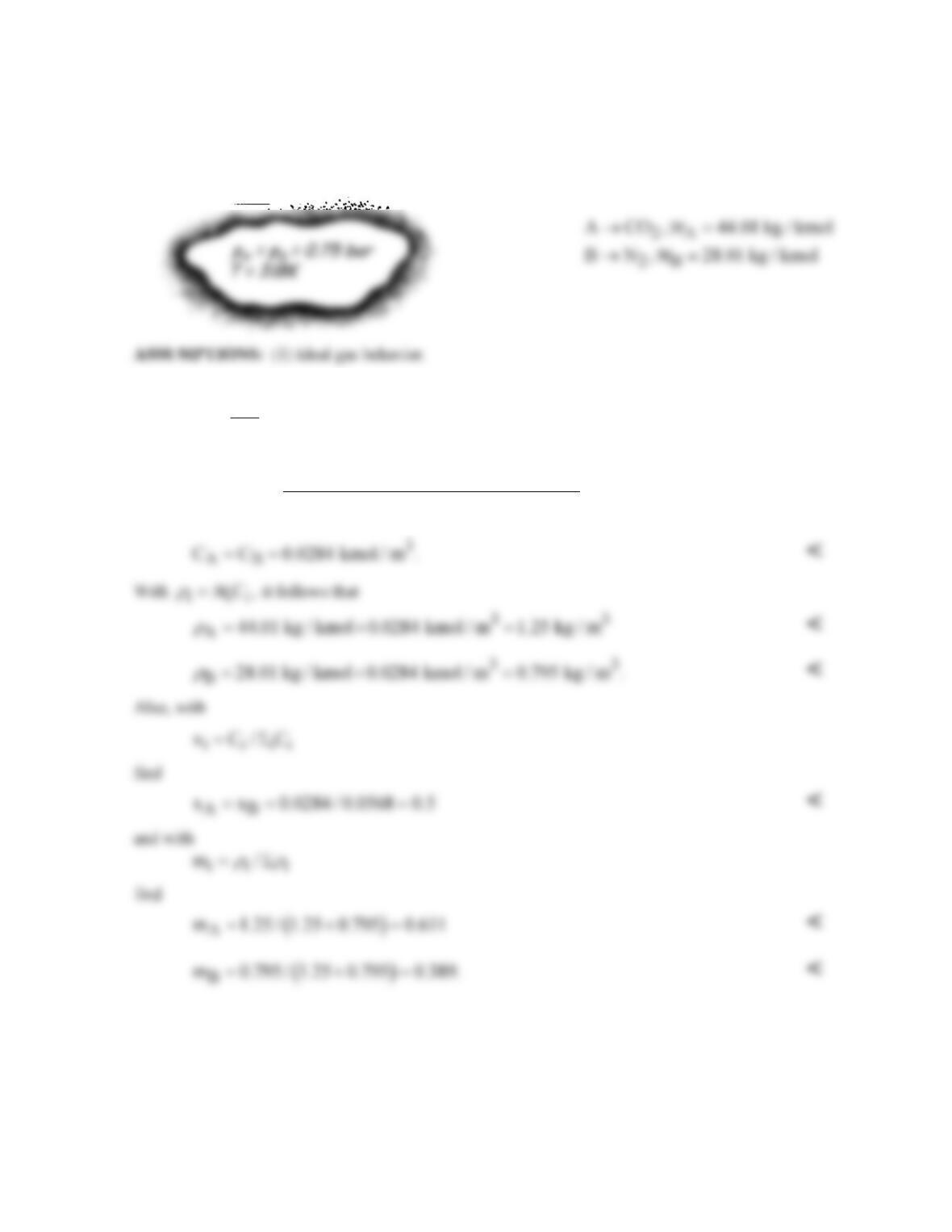
KNOWN: Partial pressures and temperature for a mixture of CO2 and N2.
FIND: Molar concentration, mass density, mole fraction and mass fraction of each species.
SCHEMATIC:
ANALYSIS: From the equation of state for an ideal gas,
i
i
p
C.
T
=ℜ
Hence, with pA = pB,
AB 23
0.75 bar
CC
8.314 10 m bar / kmol K 318 K
−
= = × ⋅ ⋅×
PROBLEM 14.4
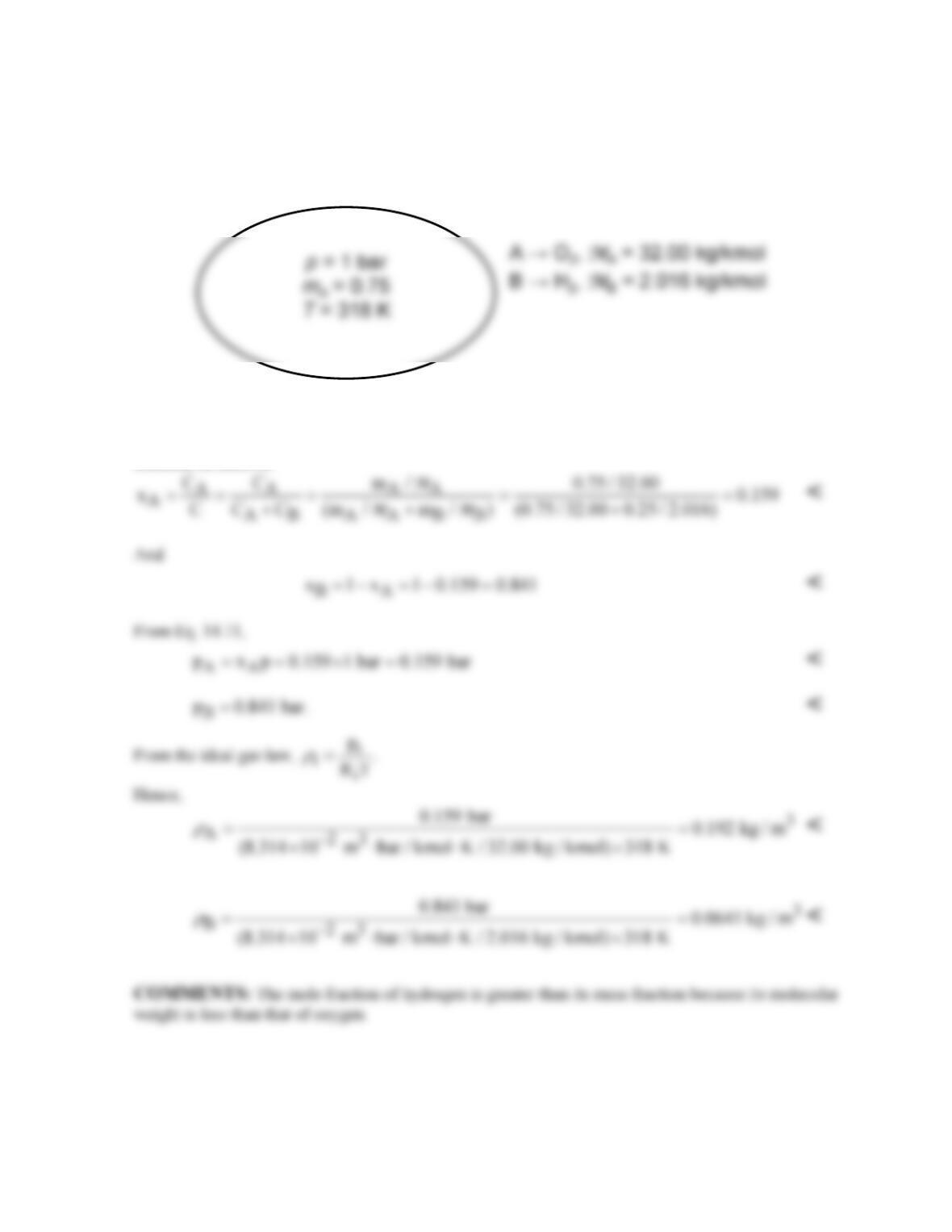
KNOWN: Mass fraction of O2, temperature, and pressure for a mixture of O2 and H2.
FIND: Mass density, mole fraction, and partial pressure of each species.
SCHEMATIC:
ASSUMPTIONS: (1) Ideal gas behavior.
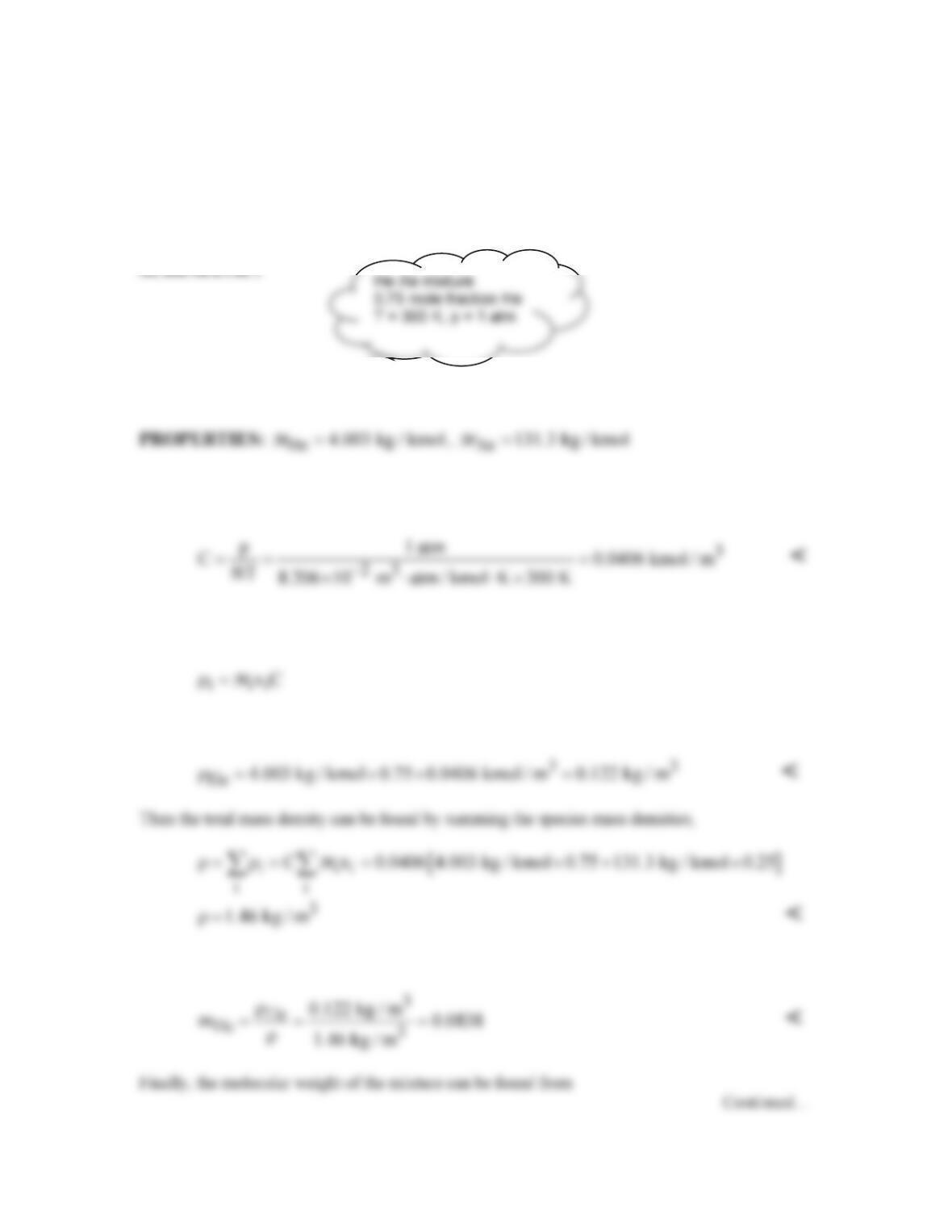
ANALYSIS: Since mA = 0.75, mB = 1 – mA = 0.25. The mole fractions can be related to mass
fractions as follows:
PROBLEM 14.5
KNOWN: He-Xe mixture containing 0.75 mole fraction of He at 300 K and 1 atm.
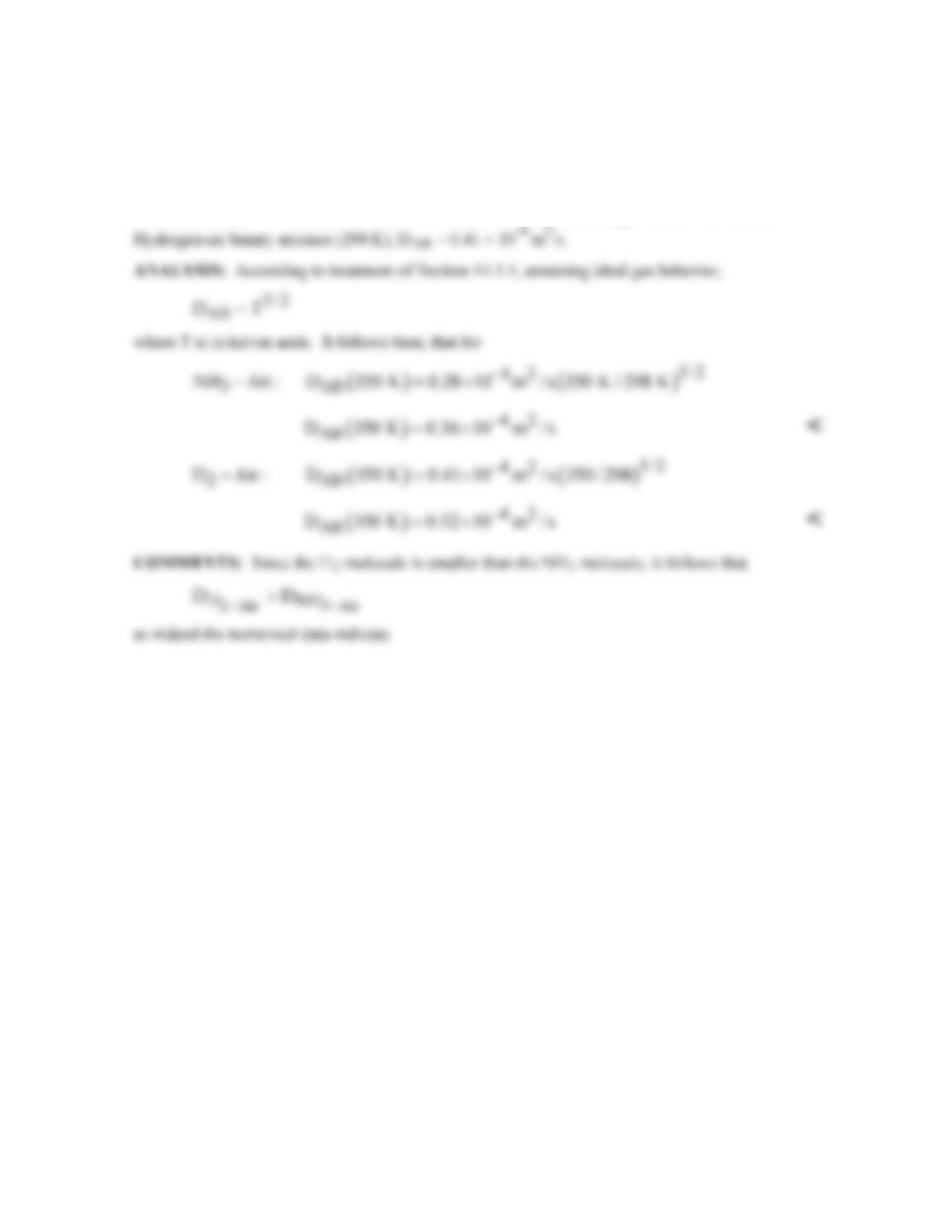
FIND: Mass fraction of He and mixture mass density, molar concentration, and molecular
weight. Mass of coolant in 10 liters.
ASSUMPTIONS: Ideal gas mixture.
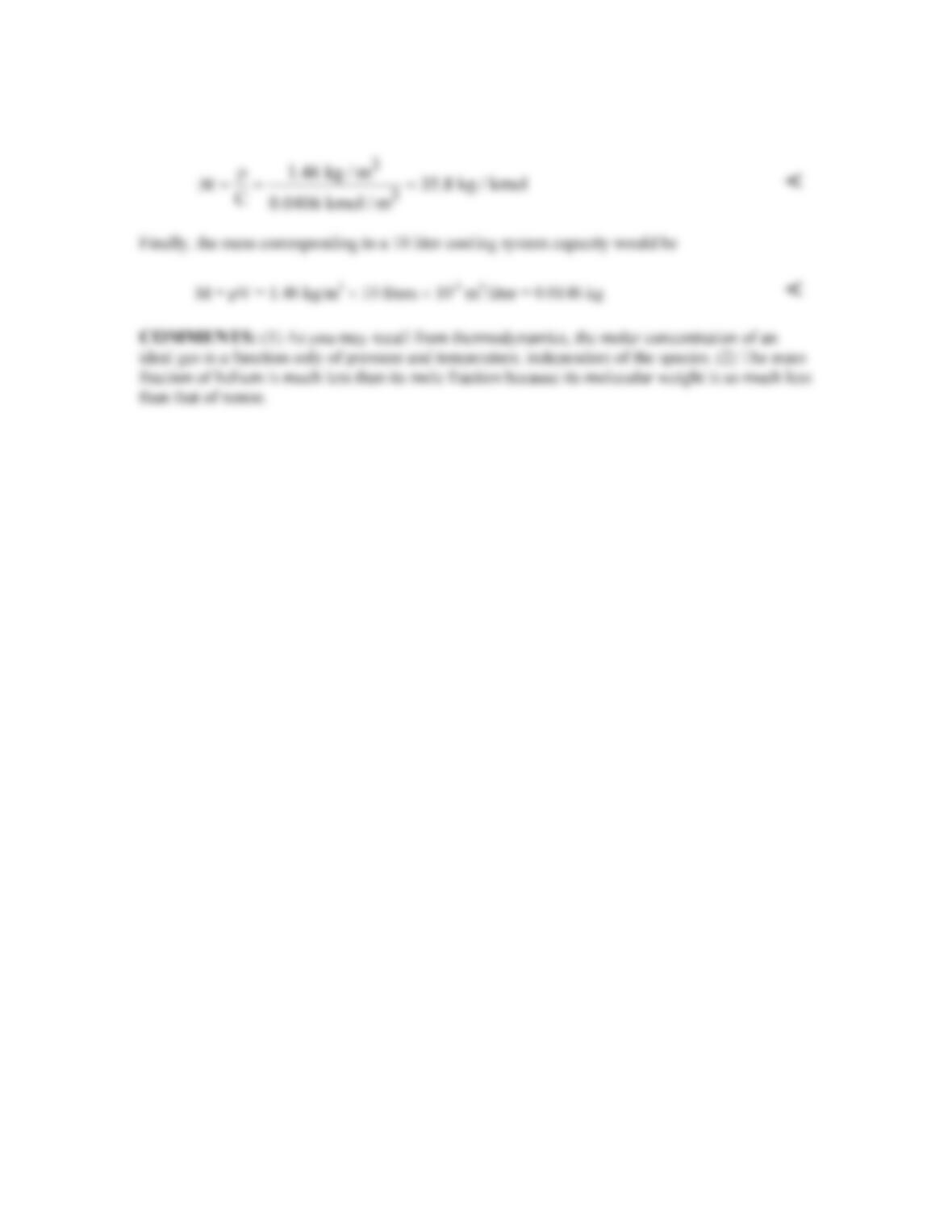
ANALYSIS: The molar concentration of the mixture can be found directly from the ideal gas
law, in the form
The mass density of one component in a mixture can be related to the mole fraction by combining
Eqs. 14.11 and 14.1 to yield
For He this results in
Thus the helium mass fraction is
PROBLEM 14.5 (Cont.)
PROBLEM 14.6
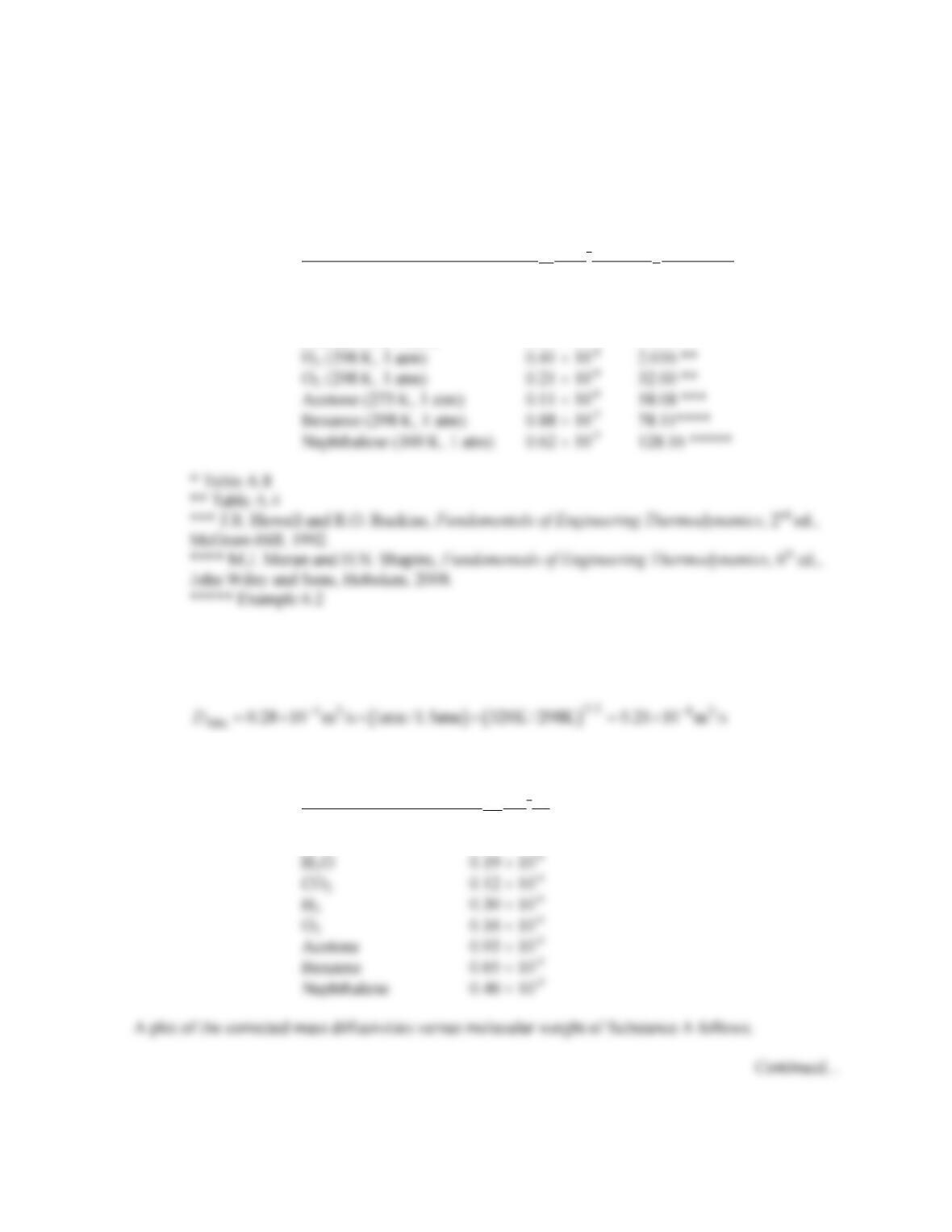
KNOWN: Mass diffusion coefficients of two binary mixtures at a given temperature, 298 K.
FIND: Mass diffusion coefficients at a different temperature, T = 350 K.
ASSUMPTIONS: (a) Ideal gas behavior, (b) Mixtures at 1 atm total pressure.
PROPERTIES: Table A-8, Ammonia-air binary mixture (298 K), DAB = 0.28 × 10⁻⁴ m2/s;
PROBLEM 14.7
KNOWN: Pressure and temperature. Substance A and Substance B.
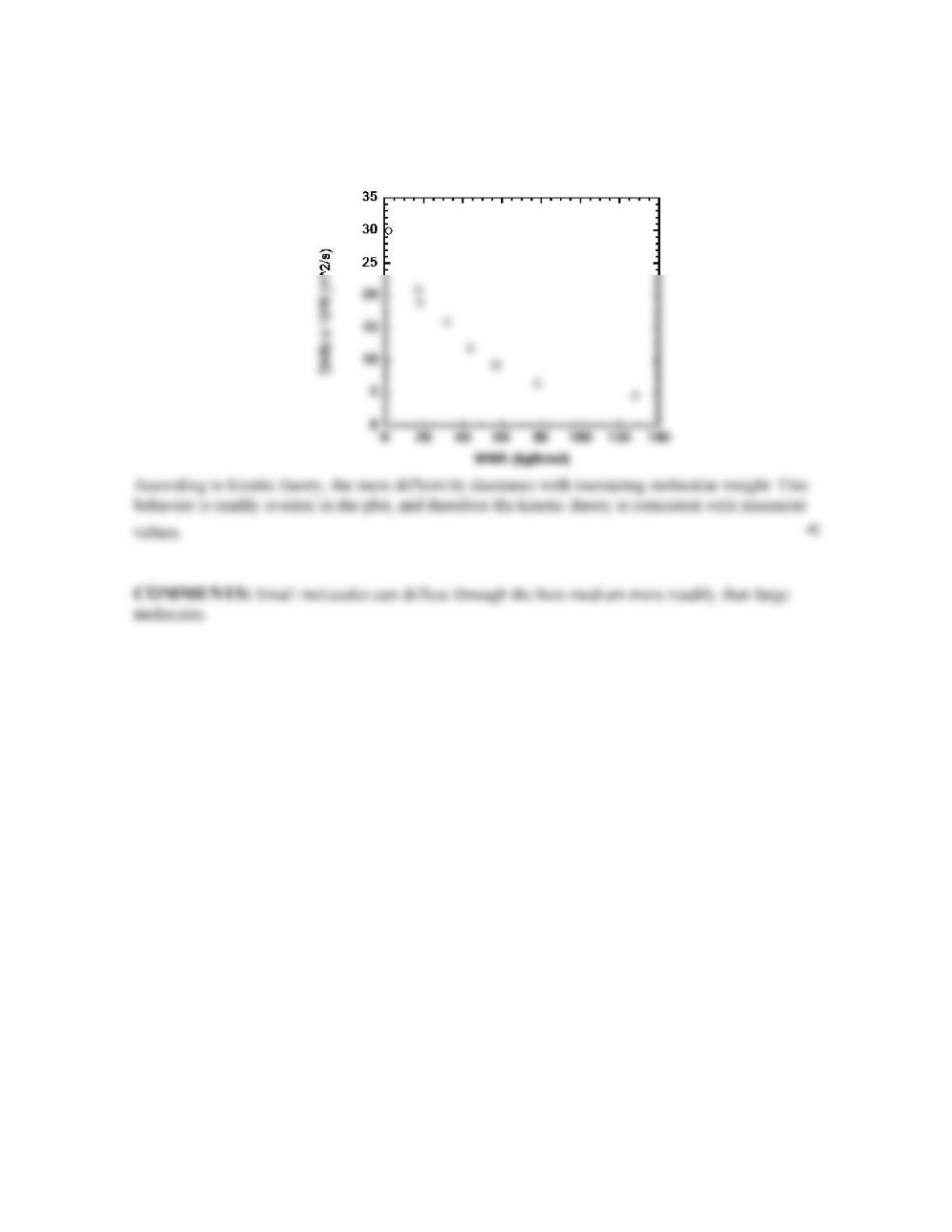
FIND: Plot of DAB versus MA for NH3, H2O, CO2, H2, O2, acetone, benzene and naphthalene in air.
ASSUMPTIONS: Ideal gas behavior.
PROPERTIES: Substance A (T, p) DAB* (m2/s) MA (kg/kmol)
NH3 (298 K, 1 atm) 0.28 × 10⁻⁴ 17.03 **
H2O (298 K, 1 atm) 0.26 × 10⁻⁴ 18.02 **
CO2 (298 K, 1 atm) 0.16 × 10⁻⁴ 44.01 **
ANALYSIS: The mass diffusivity values must be corrected to account for the temperature and
pressure dependence. From Table A.8,
1 3/2
AB
D pT
−
∝
and the corrected mass diffusivity for NH3 is
Repeating the calculation for the other substances yields the following.
Substance A DABc (m2/s)
NH3 0.21 × 10⁻⁴
PROBLEM 14.7 (Cont.)
PROBLEM 14.8
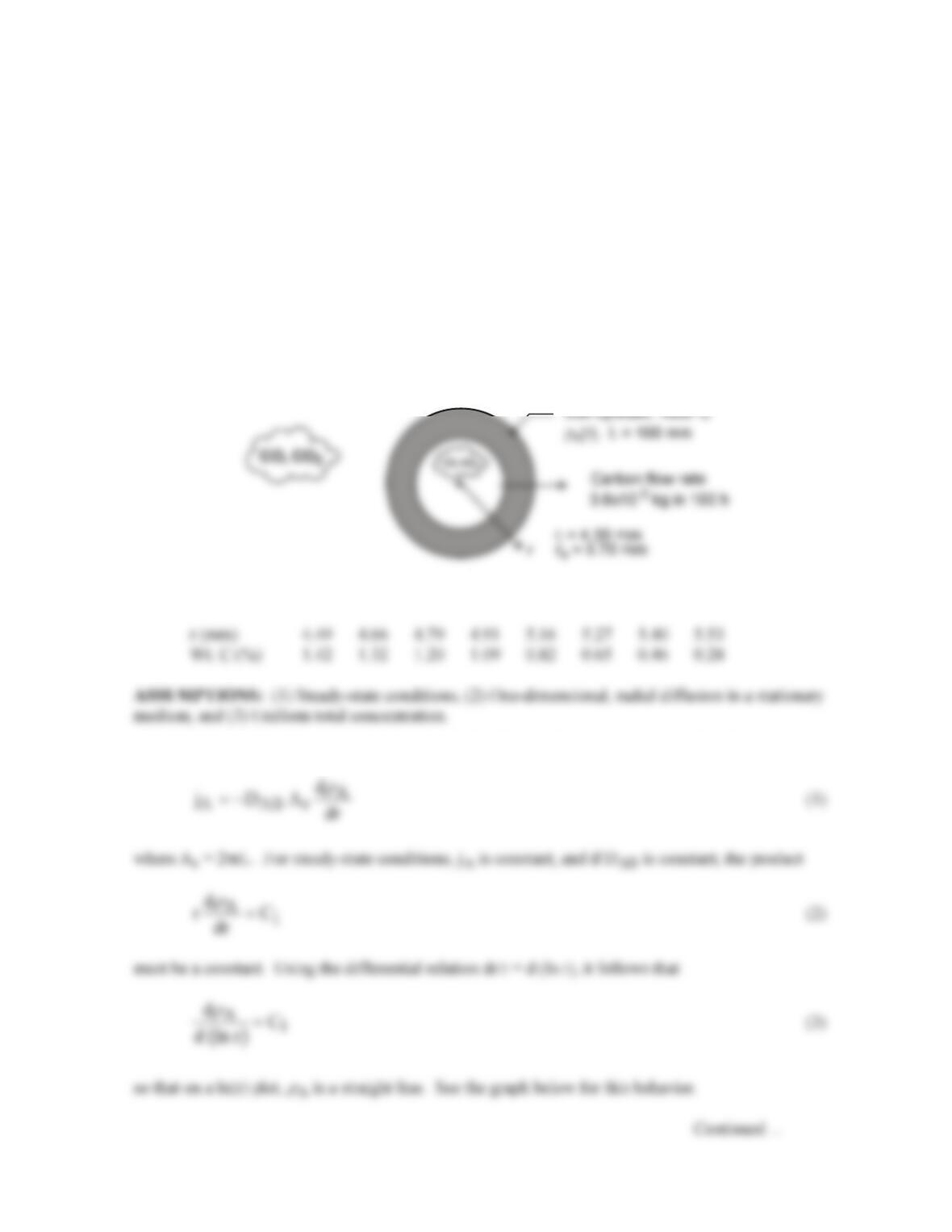
KNOWN: The inner and outer surfaces of an iron cylinder of 100-mm length are exposed to a
carburizing gas (mixtures of CO and CO2). Observed experimental data on the variation of the
carbon composition (weight carbon, %) in the iron at 1000°C as a function of radius. Carbon flow
rate under steady–state conditions.
FIND: (a) Beginning with Fick’s law, show that
d d n r
c
ρ
/bg
ch
is a constant if the diffusion
coefficient, DC-Fe, is a constant; sketch of the carbon mass density,
ρ
c(r), as function of ln(r) for such
a diffusion process; (b) Create a graph for the experimental data and determine whether DC-Fe for this
diffusion process is constant, increases or decreases with increasing mass density; and (c) Using the
experimental data, calculate and tabulate DC-Fe for selected carbon compositions over the range of the
experiment.
SCHEMATIC:
o
PROPERTIES: Iron (1000°C).
ρ
= 7730 kg/m3.Experimental observations of carbon composition
ANALYSIS: (a) For the one-dimensional, radial (cylindrical) coordinate system, Fick’s law is
PROBLEM 14.8 (Cont.)
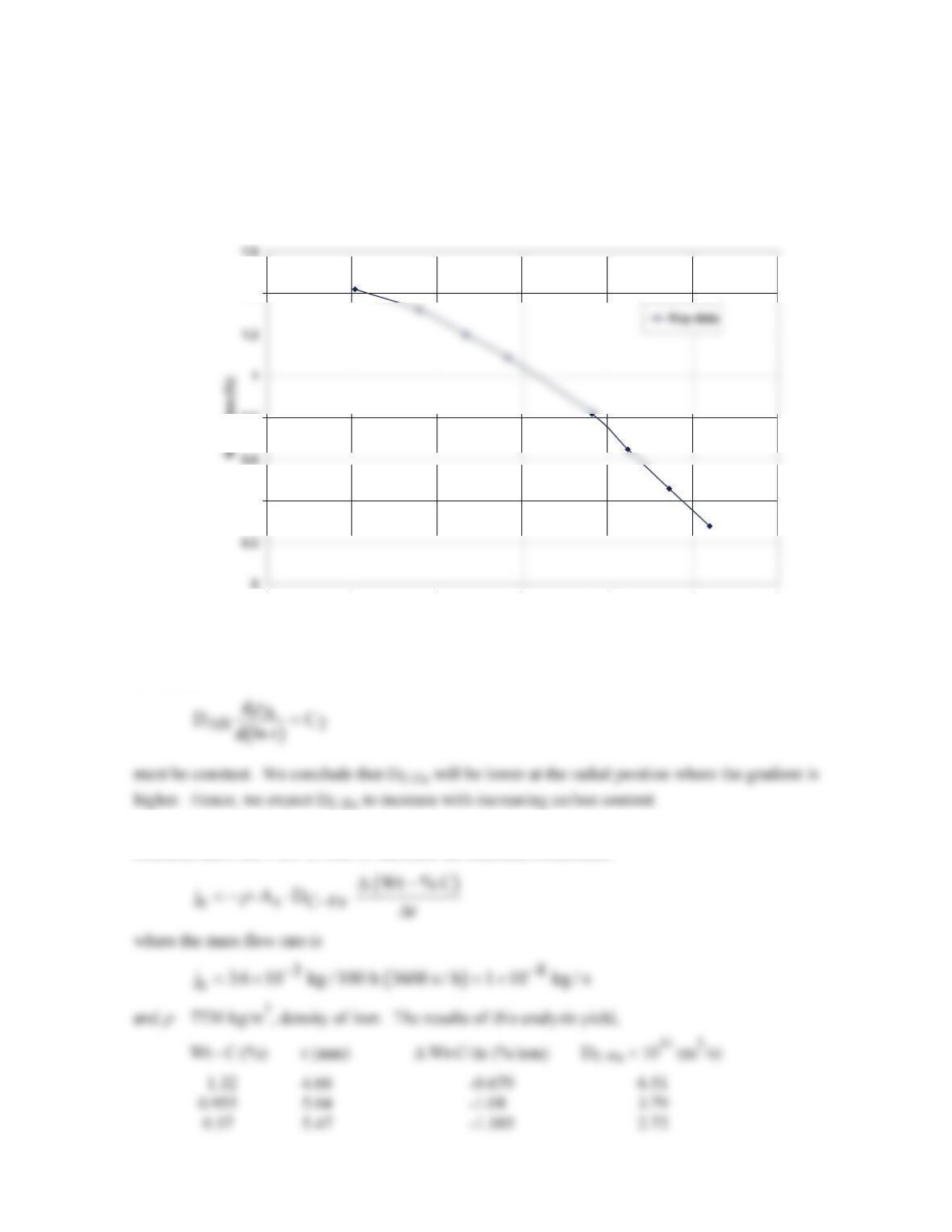
(b) To determine whether DC-Fe is a constant for the experimental diffusion process, the data are
represented on a ln(r) coordinate.
Since the plot is not linear, DC-Fe is not a constant. From the treatment of part (a), if DAB is not a
constant, then
(c) From a plot of Wt – %C vs. r (not shown), the mass fraction gradient is determined at three
locations and Fick’s law is used to calculate the diffusion coefficient,
Wt. carbon distribution – experimental observations
0.4
0.8
1.4
1.45 1.5 1.55 1.6 1.65 1.7 1.75
ln (r, mm)
PROBLEM 14.9
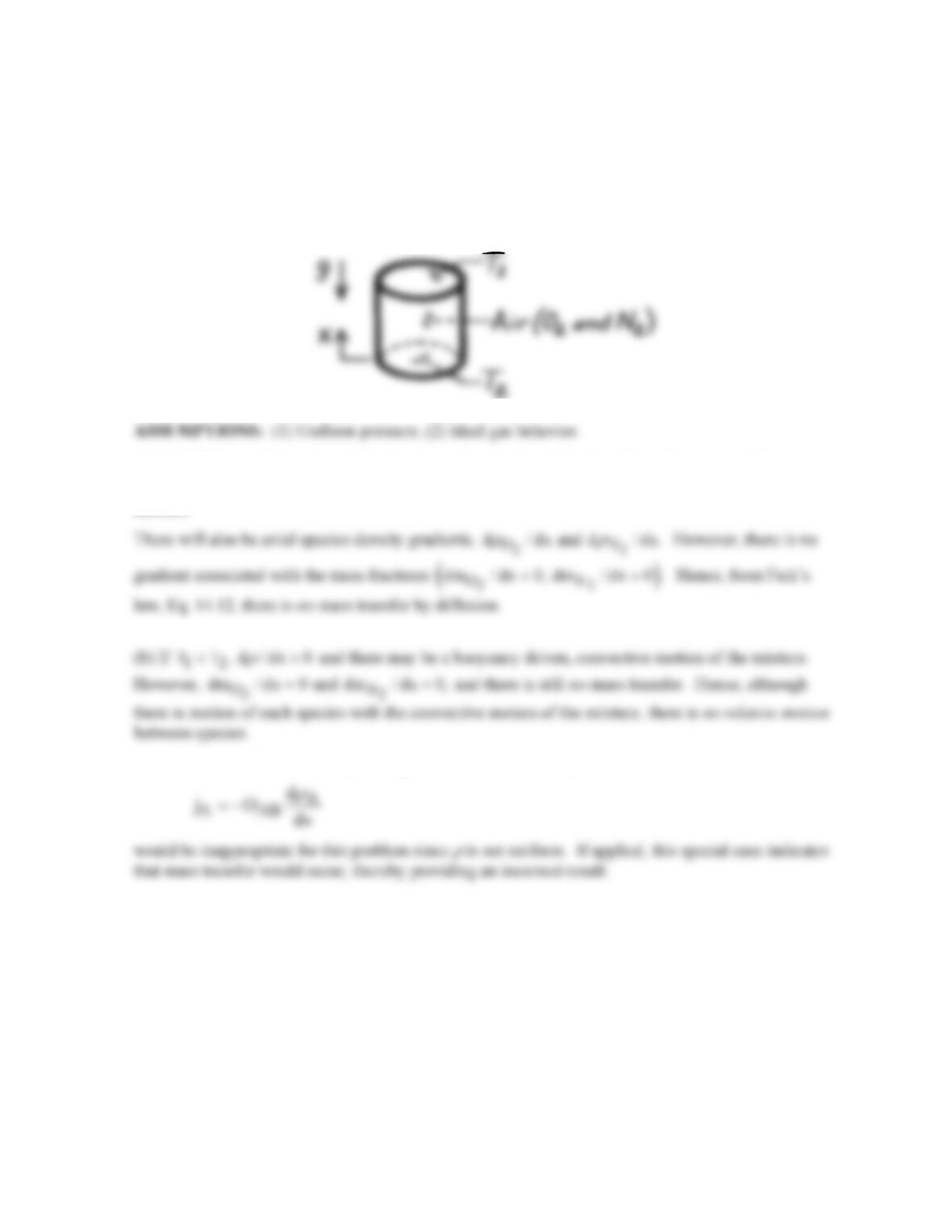
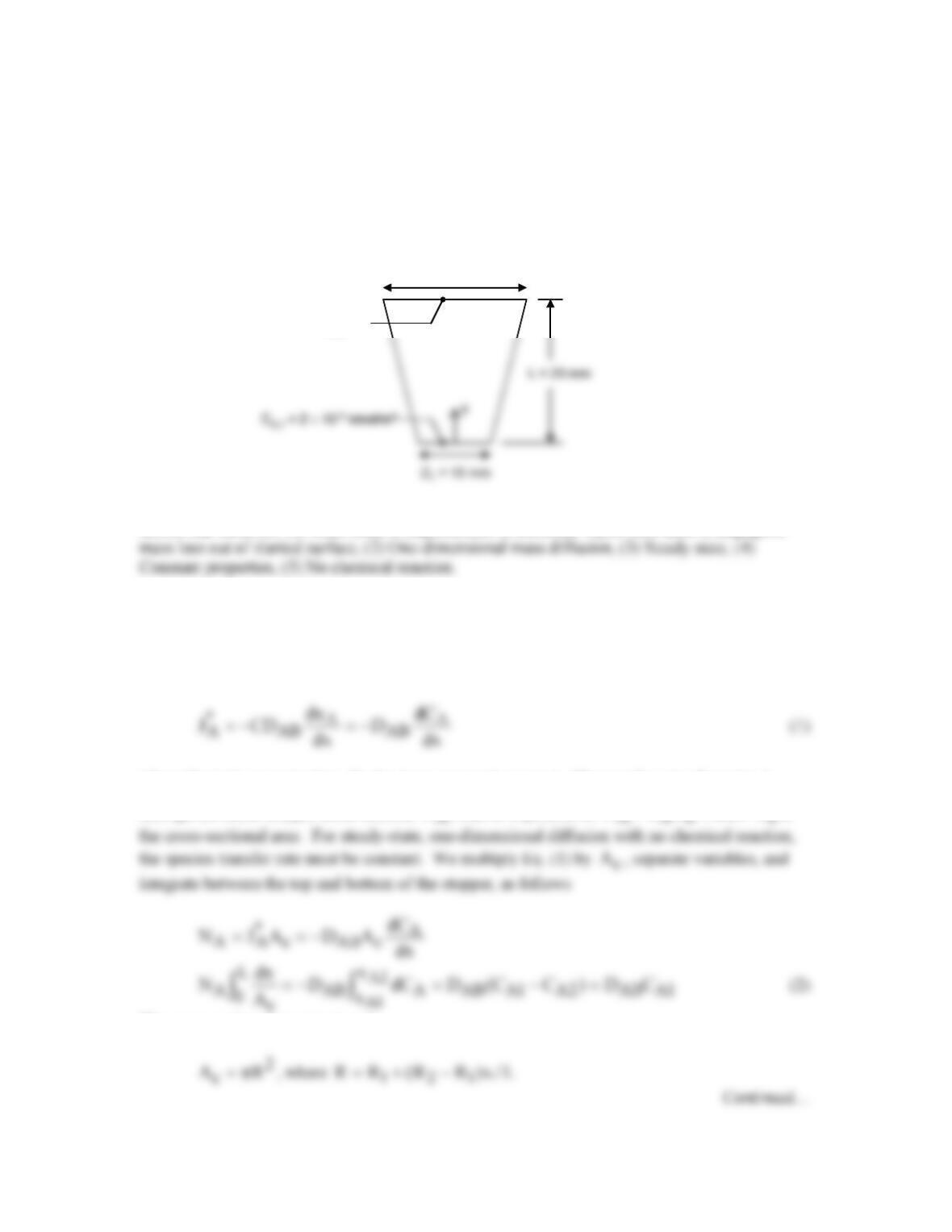
KNOWN: Air is enclosed at uniform pressure in a vertical, cylindrical container whose top and
bottom surfaces are maintained at different temperatures.
FIND: (a) Conditions in air when bottom surface is colder than top surface, (b) Conditions when
bottom surface is hotter than top surface.
SCHEMATIC:
ANALYSIS: (a) If T1 > T2, the axial temperature gradient (dT/dx) will result in an axial density
gradient. However, since dρ/dx < 0 there will be no buoyancy driven, convective motion of the
mixture.
COMMENTS: The commonly used special case of Fick’s law,
PROBLEM 14.10
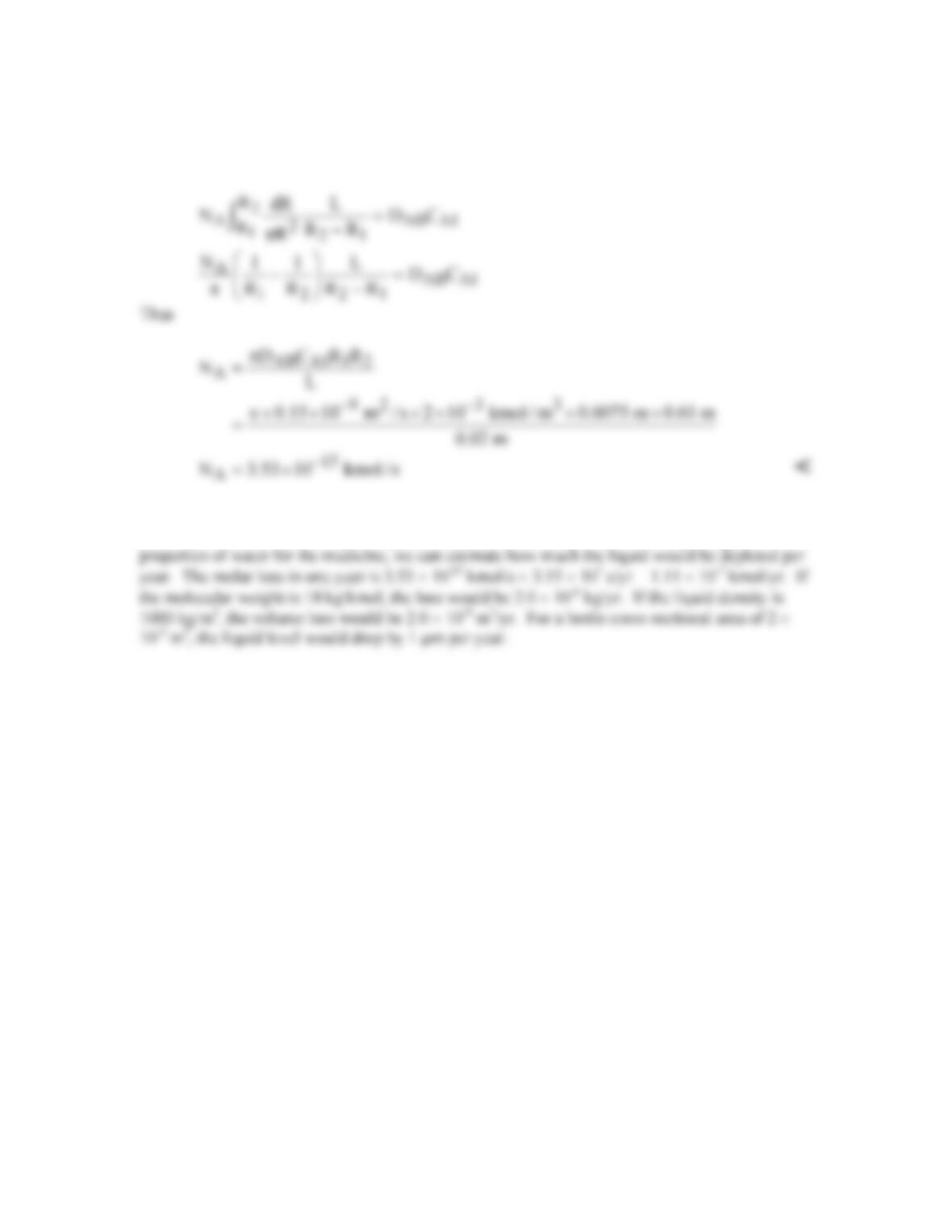
KNOWN: Dimensions of rubber stopper in medicine jar. Molar concentration of medicine
vapor at top and bottom surfaces. Mass diffusivity of medicine vapor in rubber.
FIND: Rate at which medicine vapor exits through the stopper.
SCHEMATIC:
ASSUMPTIONS: (1) Glass neck is impermeable to medicine vapor, thus there is negligible
PROPERTIES: Medicine vapor-rubber (given): DAB = 0.15 × 10⁻⁹ m2/s.
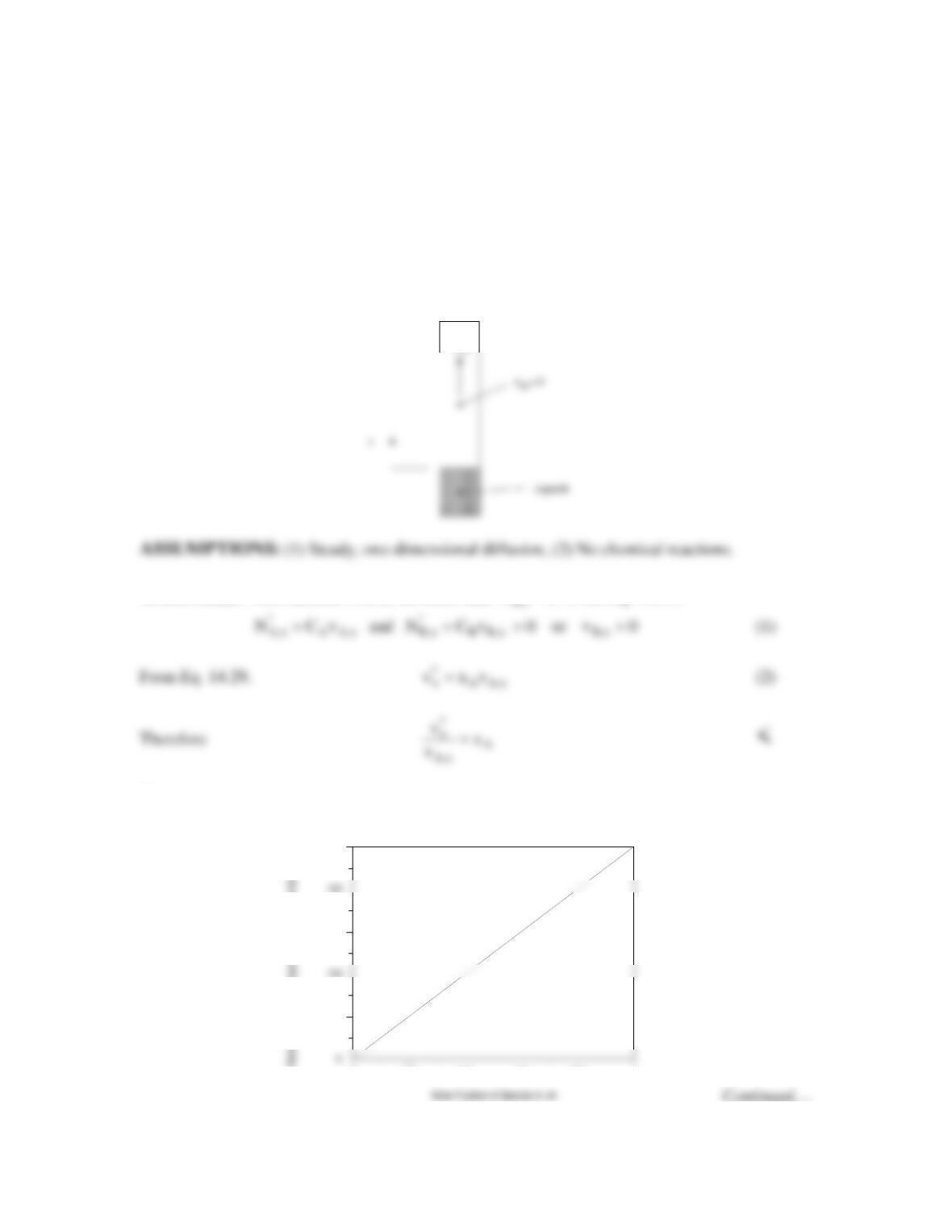
ANALYSIS: The analysis follows the “alternative conduction analysis” approach. For one-
dimensional diffusion in the x-direction, Fick’s Law in molar form, Eq. 14.13, reduces to
where the total concentration,
C
, has been assumed constant. The transfer rate of species A
through the entire stopper cross-section,
A
N
, can be expressed as
*
N JA=
, where
A
is
The cross-sectional area is given by
D
2
= 20 mm
C
A,2
= 0
D
2
= 20 mm
C
A,2
= 0
D
2
= 20 mm
C
A,2
= 0
PROBLEM 14.10 (Cont.)
Thus dx = LdR/(R2 – R1), and Eq. (2) becomes
COMMENTS: (1) The assumption of constant concentration, C, is excellent because the
“mixture” of rubber and medicine vapor would be dominated by the rubber. (2) Using the
PROBLEM 14.11
KNOWN: Evaporation of liquid A into a column containing vapor A and B. Species B cannot
be absorbed in liquid A.
FIND: The relationship between the ratio of the molar-average velocity to the species velocity of
species A to the mole fraction of species A.
SCHEMATIC:
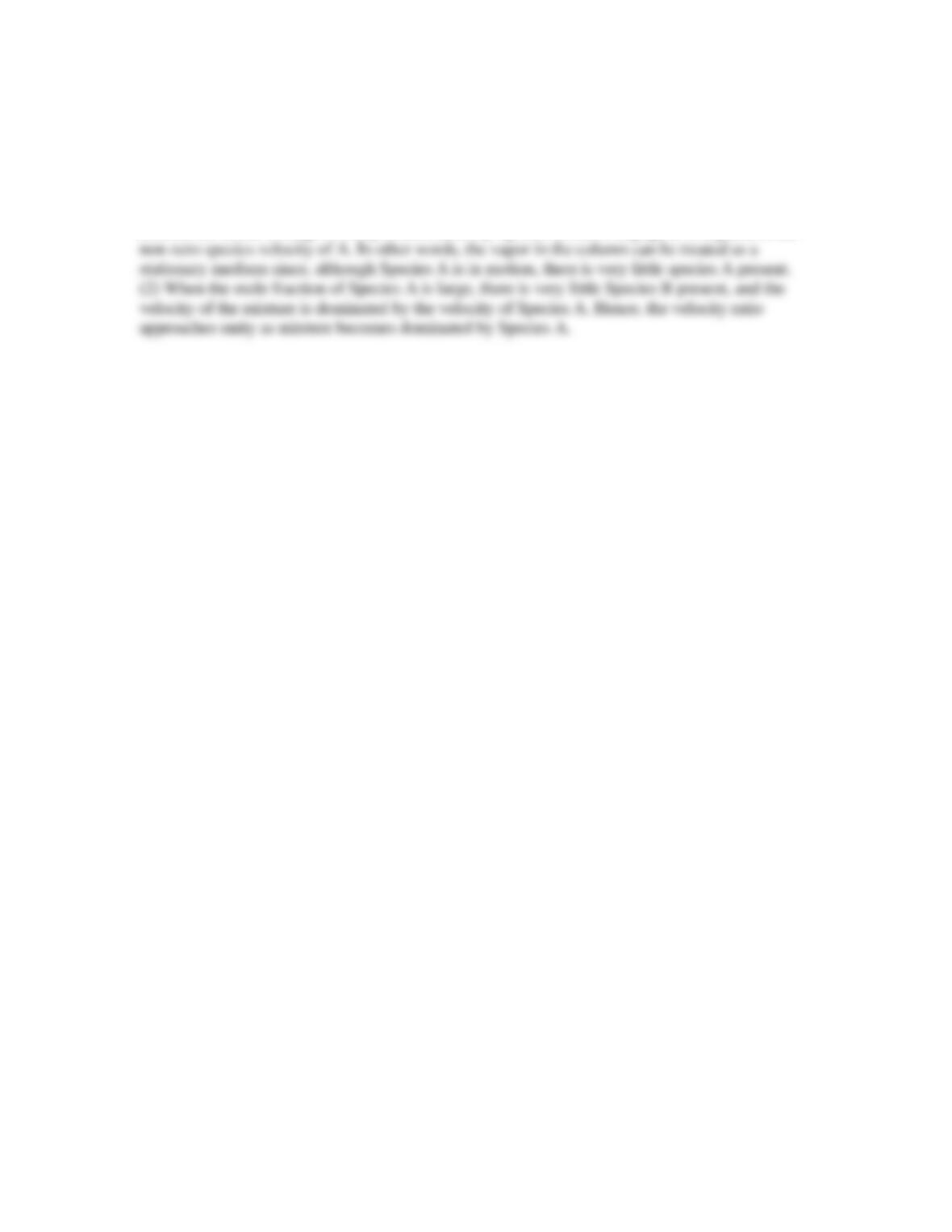
ANALYSIS: From Section 14.2.2, we know that “
N0=. From Eq. 14.27,
The relationship is shown in the graph below.
00.2 0.4 0.6 0.8 1
0.2
0.6
1
Binary gas mixture, A + B
N”
A,x
Binary gas mixture, A + B
N”
A,x
PROBLEM 14.11 (Cont.)
COMMENTS: (1) When the mole fraction of Species A is small and Species B is not in
motion, the molar-average velocity is dominated by Species B and is negligible compared to the
PROBLEM 14.12
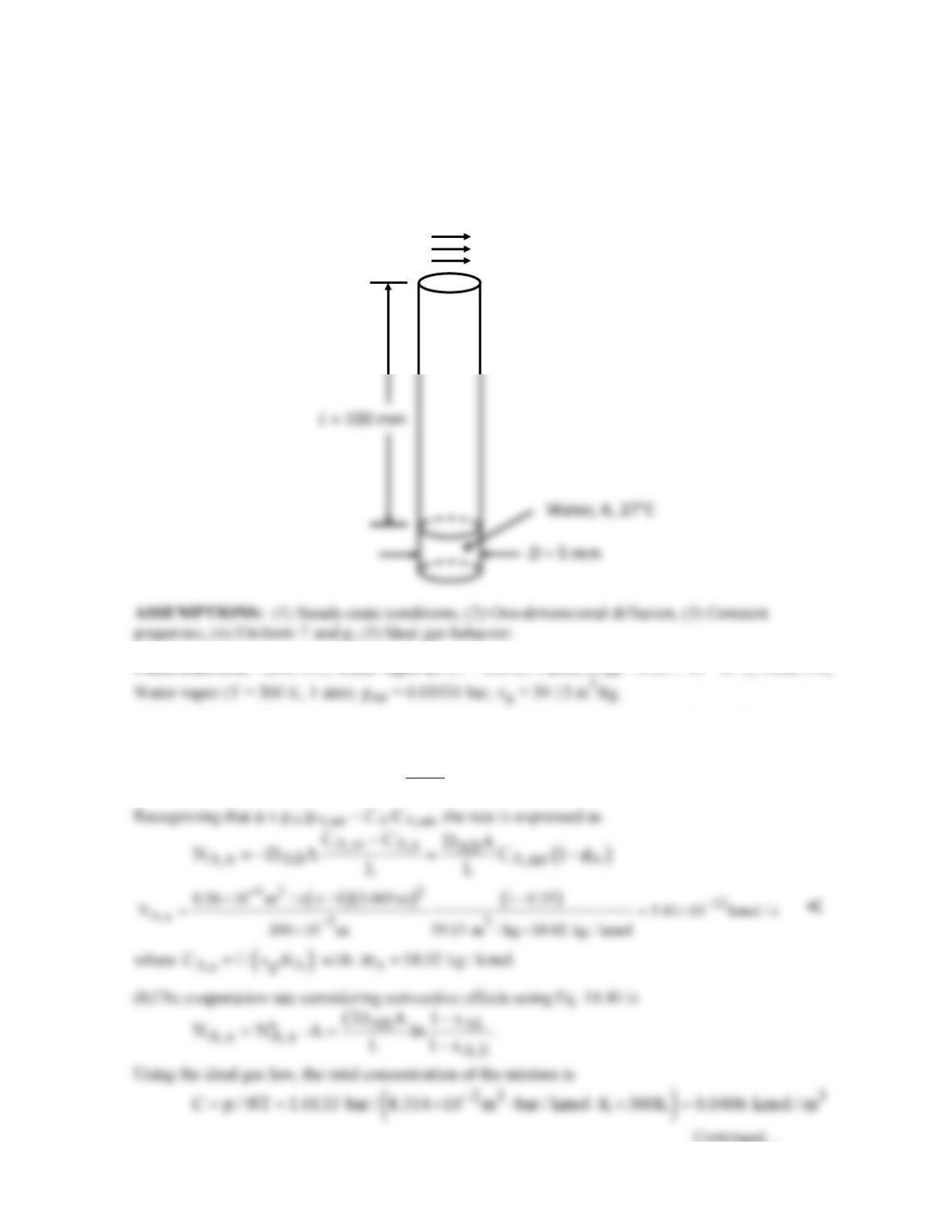
KNOWN: Water in an open pan exposed to prescribed ambient conditions.
FIND: Evaporation rate considering (a) diffusion only and (b) convective effects.
SCHEMATIC:
Air, B,
φ
∞
= 0.25, T
∞
= 27°C, p= 1 atm
ANALYSIS: (a) The evaporation rate considering only diffusion follows from Eq. 14.32 simplified
for a stationary medium. That is,
A
A,x A,x AB
dC
N N A DA .
dx
′′
= ⋅=−
Continued…
PROBLEM 14.12 (Cont.)
PROBLEM 14.13
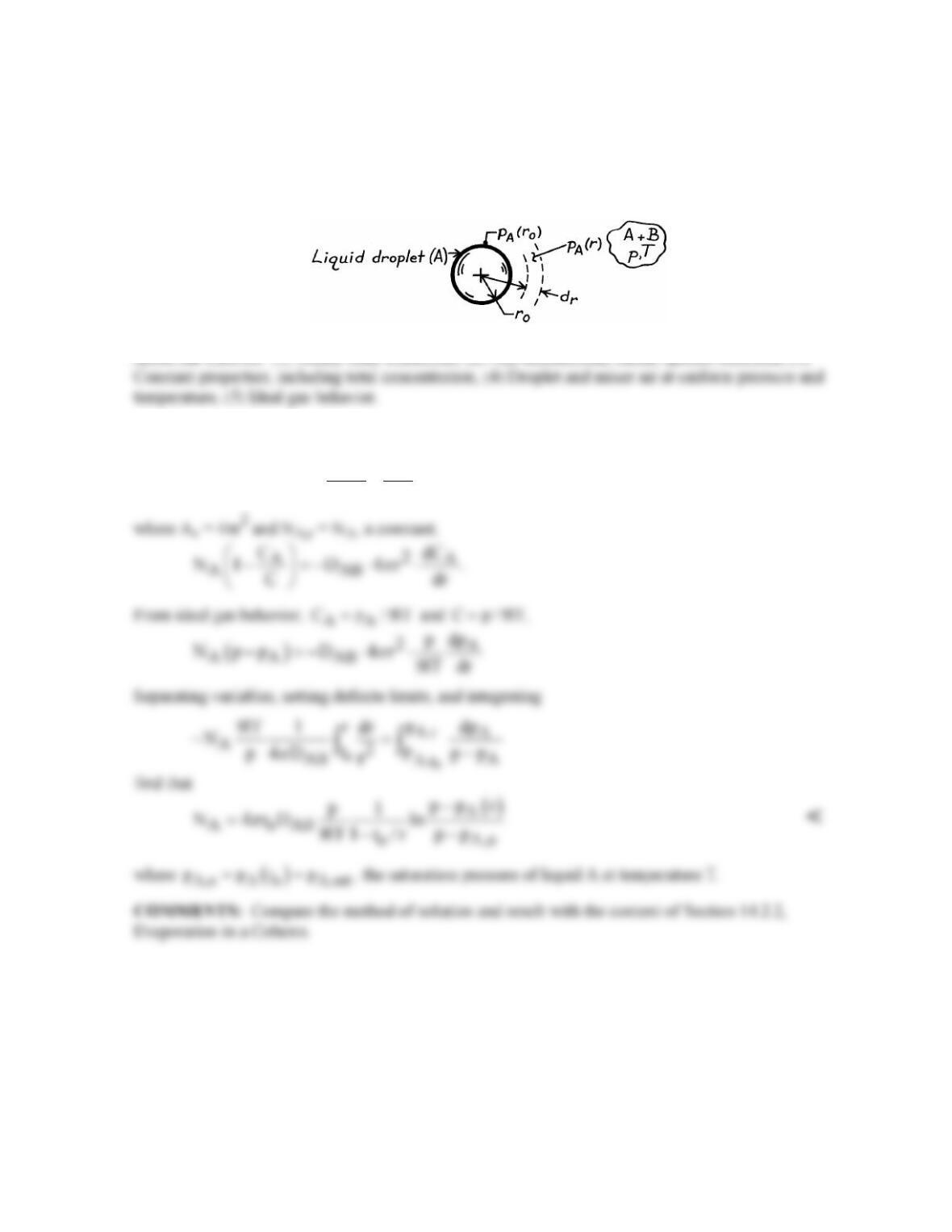
KNOWN: Spherical droplet of liquid A and radius ro evaporating into stagnant gas B.
FIND: Evaporation rate of species A in terms of pA,sat, partial pressure pA(r), the total pressure p
and other pertinent parameters.
SCHEMATIC:
ASSUMPTIONS: (1) Steady-state conditions, (2) One-dimensional, radial, species diffusion, (3)
ANALYSIS: From Eq. 14.32 for a radial spherical coordinate system, the evaporation rate of liquid
A into a binary gas mixture A + B is
AA
A,r AB r A,r
dC C
N DA N
dr C
=−+
PROBLEM 14.14
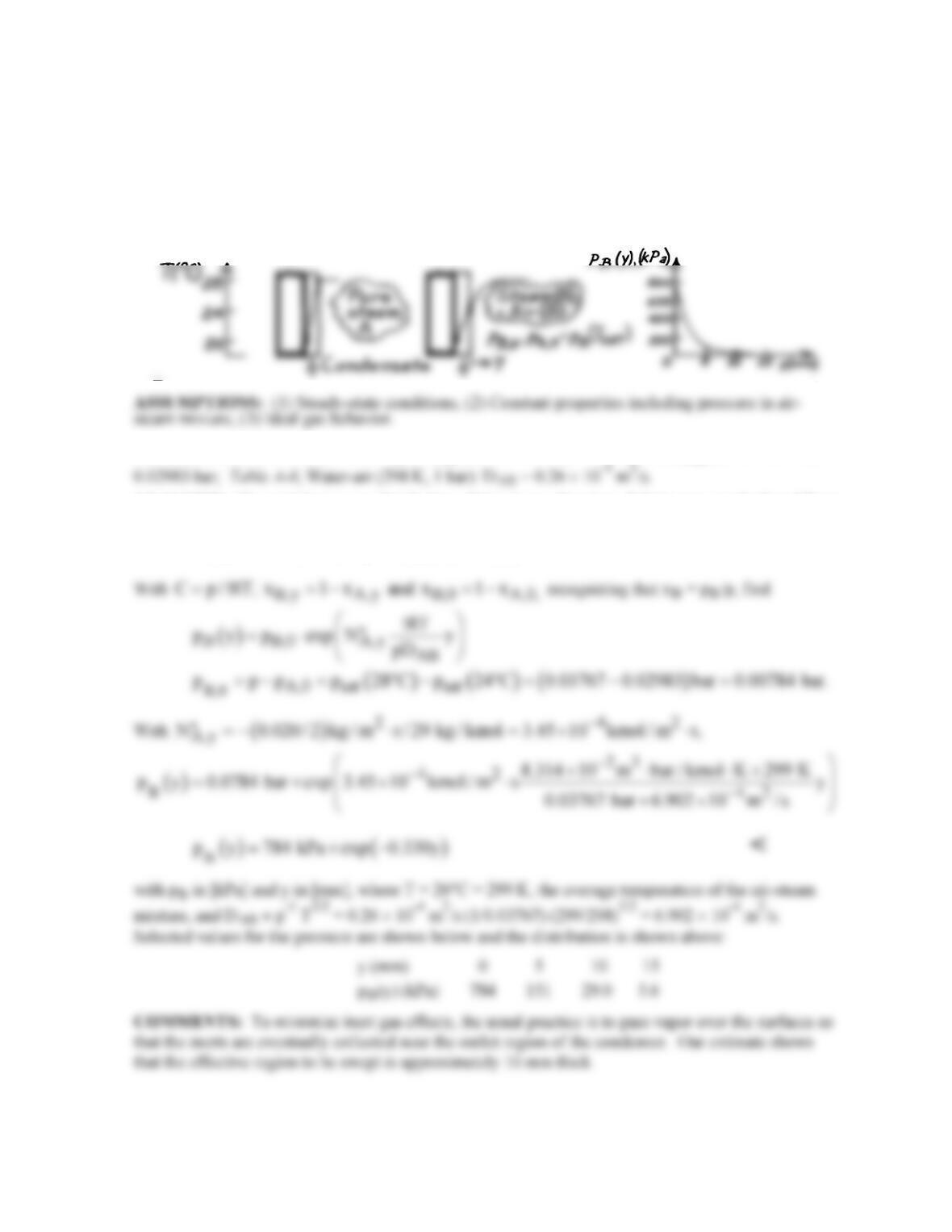
KNOWN: Clean surface with pure steam has condensate rate of 0.020 kg/m2⋅s for the prescribed
conditions. With the presence of stagnant air in the steam, the condensate surface drops from 28°C to
24°C and the condensate rate is halved.
FIND: Partial pressure of air in the air–steam mixture as a function of distance from the condensate
film.
SCHEMATIC:
PROPERTIES: Table A-6, Water vapor: psat (28°C = 301 K) = 0.03767 bar; psat (24°C = 297 K) =
ANALYSIS: The partial pressure distribution of the air as a function of distance y can be found from
the species (A) rate expression, Eq. 14.40,
( )
( )
( )
A,y AB A,y A,0
N CD /yln1x /1x .
′′ = −−