PROBLEM 13-7
(a)
(1)
Cash ……………………………………………………….
4,440,000
Sales Revenue (600 X $7,400) …………………………..
4,440,000
(2)
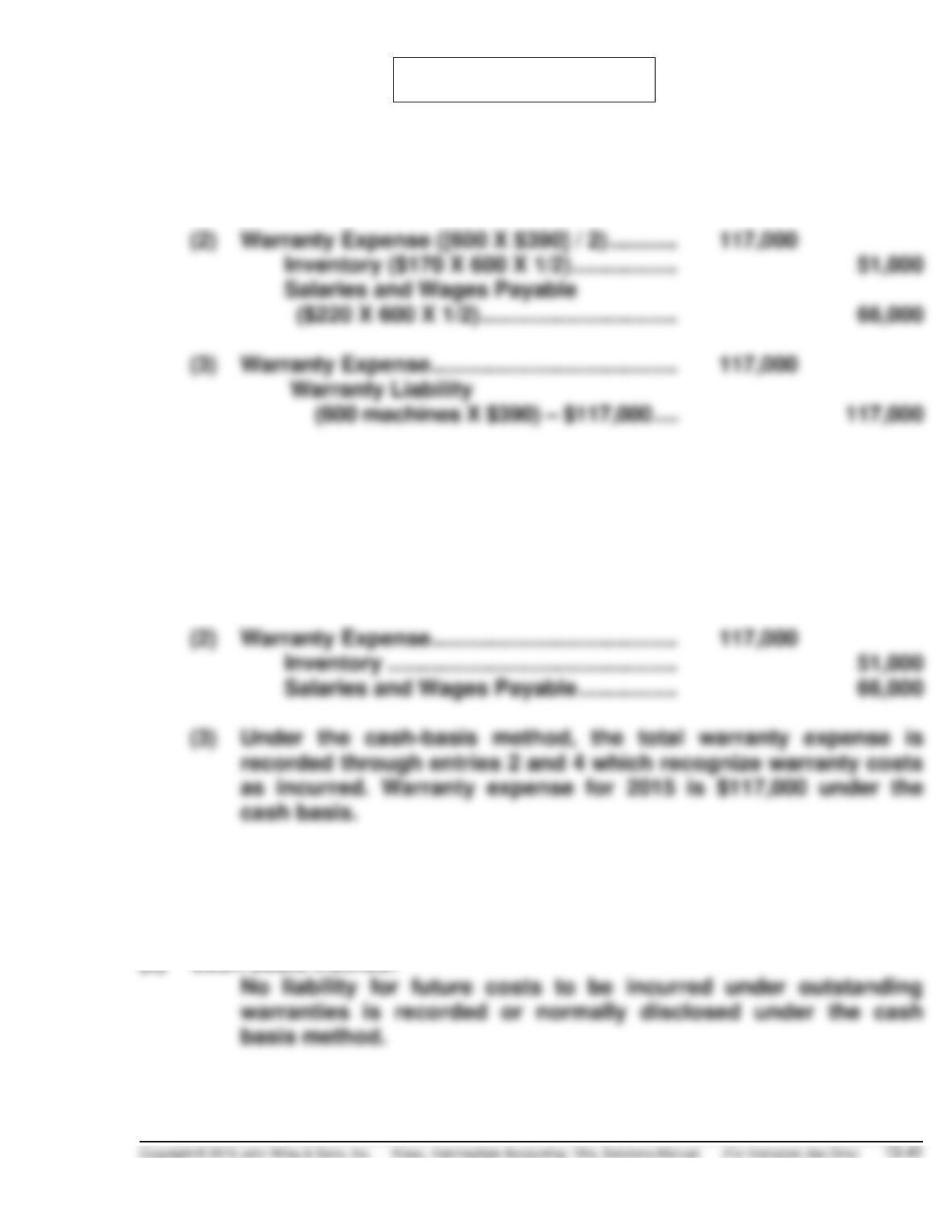
Warranty Expense ([600 X $390] / 2) ………………………….
117,000
Inventory ($170 X 600 X 1/2) …………………………..
51,000
(3)
Warranty Expense ……………………………………………………
Warranty Liability
(600 machines X $390) – $117,000 …………………….
(4)
Warranty Liability …………………………………………………….
117,000
Inventory ……………………………………………………….
51,000
Salaries and Wages Payable …………………………..
66,000
(b)
(1)
Cash ……………………………………………………….
4,440,000
Sales Revenue ………………………………………………….
4,440,000
(2)
Warranty Expense ……………………………………………………
117,000
Inventory ……………………………………………………….
51,000
Salaries and Wages Payable …………………………..
66,000
(4)
Warranty Expense ……………………………………………………
117,000
Inventory ……………………………………………………….
51,000
Salaries and Wages Payable …………………………..
66,000
(c)
Cash-basis method:
PROBLEM 13-7 (Continued)
Expense warranty accrual method:
As of 12/31/14 the balance sheet would disclose a current liability
in the amount of $117,000 for Warranty Liability.
(d)
In the case of Alvarado Company, the expense warranty accrual method
reflects properly the income resulting from operations in 2014 and 2015
PROBLEM 13-8
Inventory of Premiums ……………………………………………
60,000
Cash ………………………………………………………………
60,000
(To record purchase of 40,000 puppets at
$1.50 each)
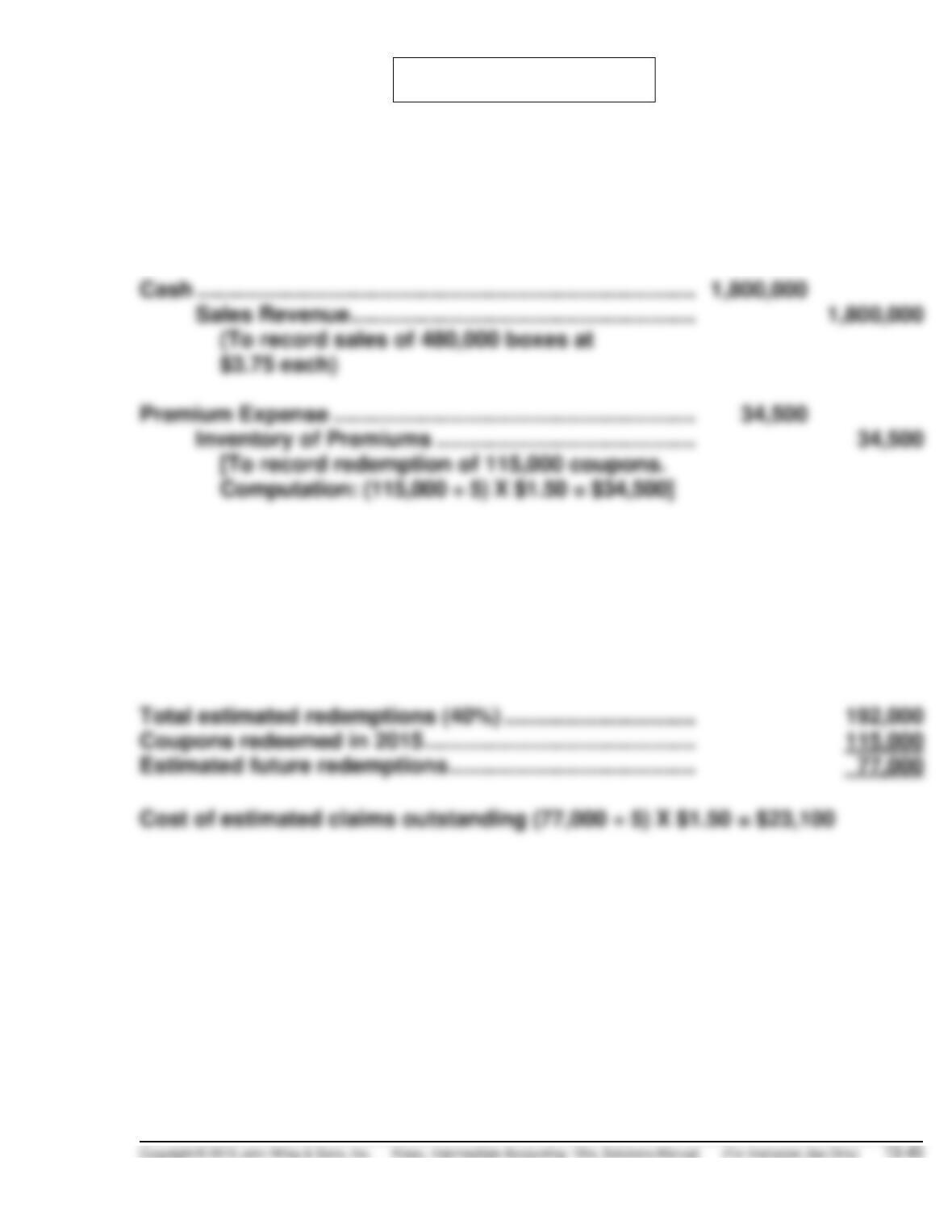
Cash …………………………..………………………………………….
Sales Revenue ………………………………………………..
(To record sales of 480,000 boxes at
$3.75 each)
Premium Expense …………………………………………………..
34,500
Inventory of Premiums ……………………………………
[To record redemption of 115,000 coupons.
Computation: (115,000 ÷ 5) X $1.50 = $34,500]
Premium Expense …………………………………………………..
23,100
Premium Liability ……………………………………………
23,100
[To record estimated liability for premium
claims outstanding at December 31, 2015.]
Computation: Total coupons issued in 2015……………..
480,000
Total estimated redemptions (40%) ………………………….
Coupons redeemed in 2015 ……………………………………..
Estimated future redemptions …………………………..……..
Cost of estimated claims outstanding (77,000 ÷ 5) X $1.50 = $23,100
PROBLEM 13-9
(a) 2014
Inventory of Premiums …………………………..………………..
562,500
Cash ………………………………………………………………
562,500
(To record the purchase of 250,000
MP3 downloads at $2.25 each)
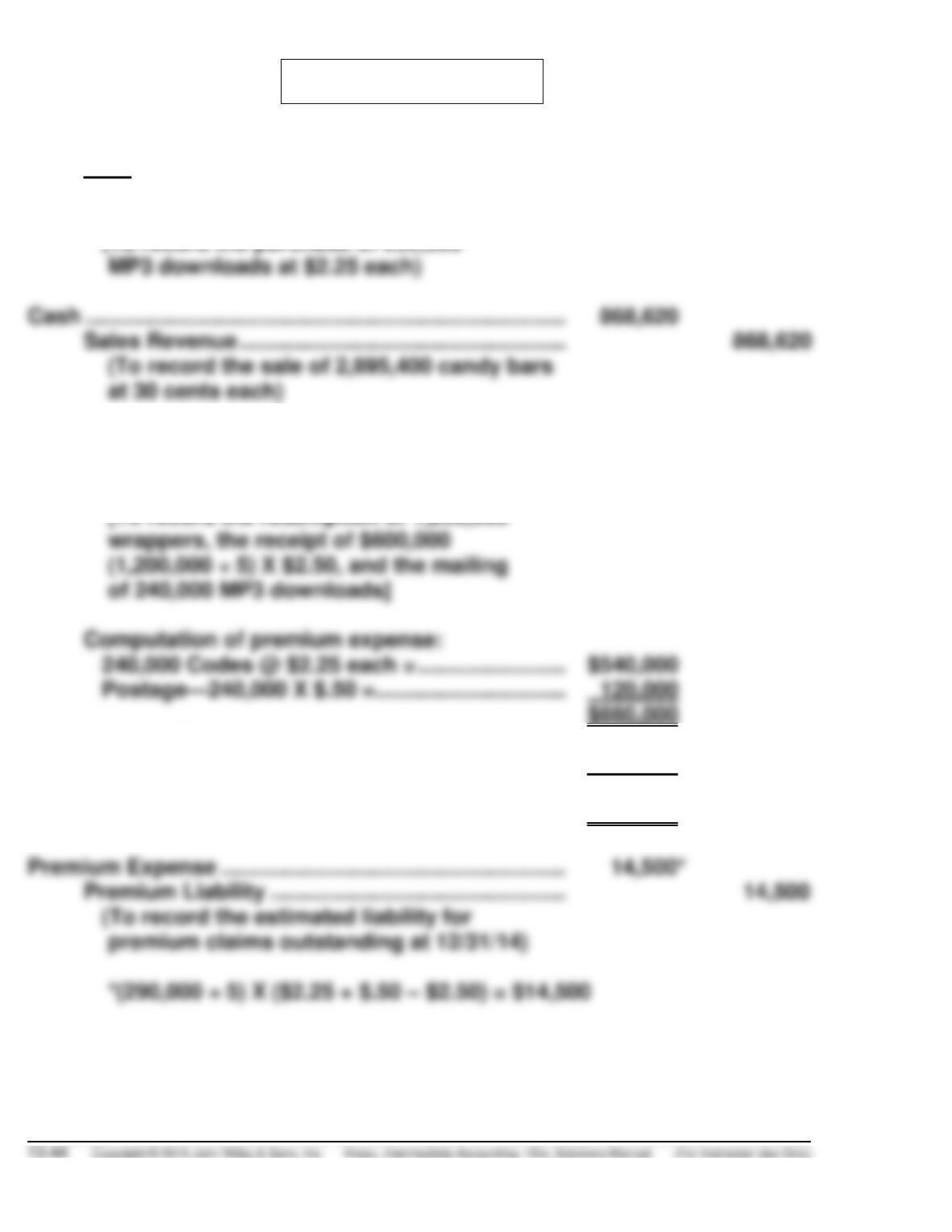
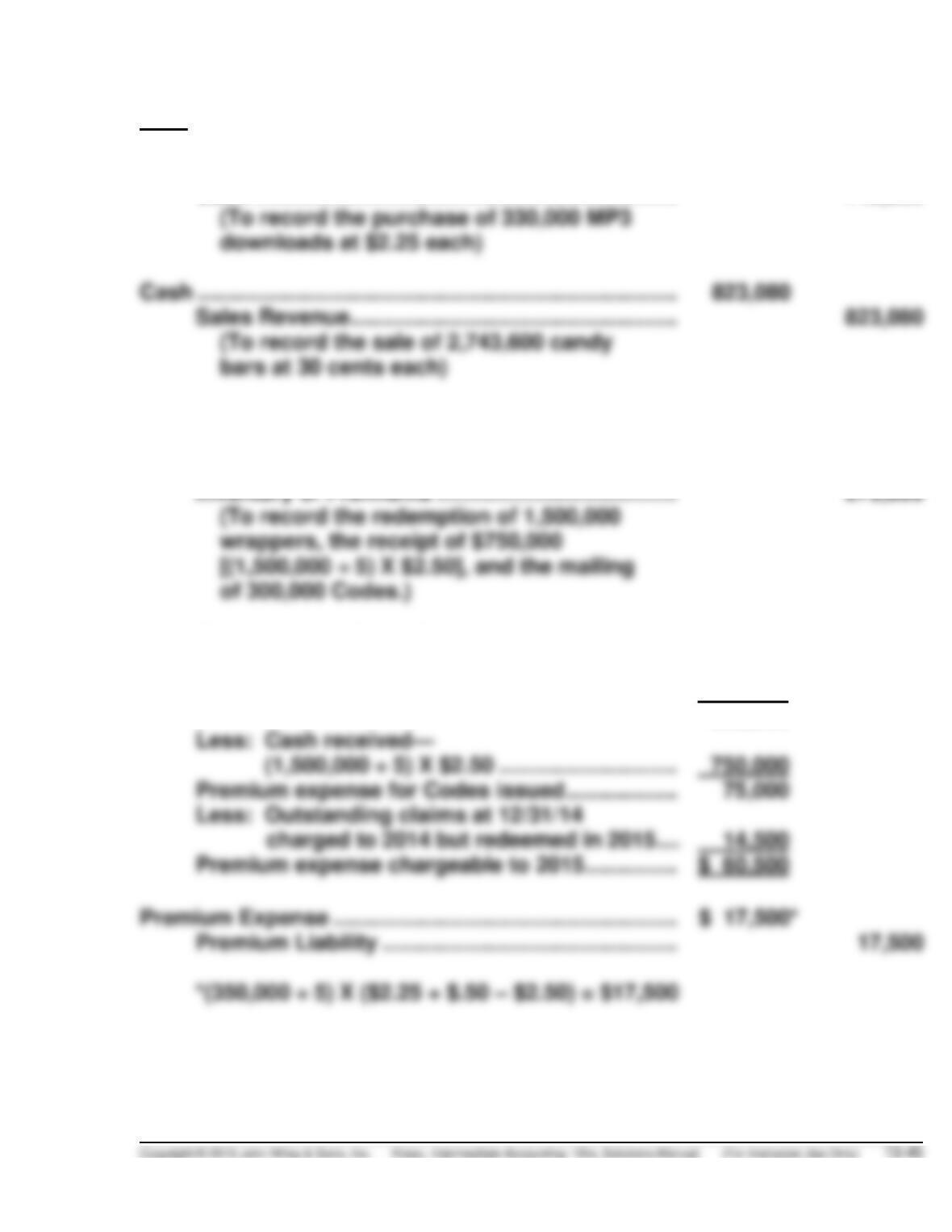
Cash ………………………………………………………………………
868,620
Sales Revenue ………………………………………………..
868,620
(To record the sale of 2,895,400 candy bars
at 30 cents each)
Cash [$600,000 – (240,000 X $.50)] …………………………..
480,000
Premium Expense …………………………………………………..
60,000
Inventory of Premiums …………………………………….
540,000
[To record the redemption of 1,200,000
wrappers, the receipt of $600,000
(1,200,000 ÷ 5) X $2.50, and the mailing
of 240,000 MP3 downloads]
240,000 Codes @ $2.25 each = ………………………
Postage—240,000 X $.50 = …………………………..
120,000
Less: Cash received—
240,000 X $2.50 …………………………………
600,000
Premium expense for MP3 downloads
issued ………………………………………………………
$ 60,000
Premium Expense …………………………………………………..
Premium Liability …………………………..……………….
(To record the estimated liability for
premium claims outstanding at 12/31/14)
PROBLEM 13-9 (Continued)
2015
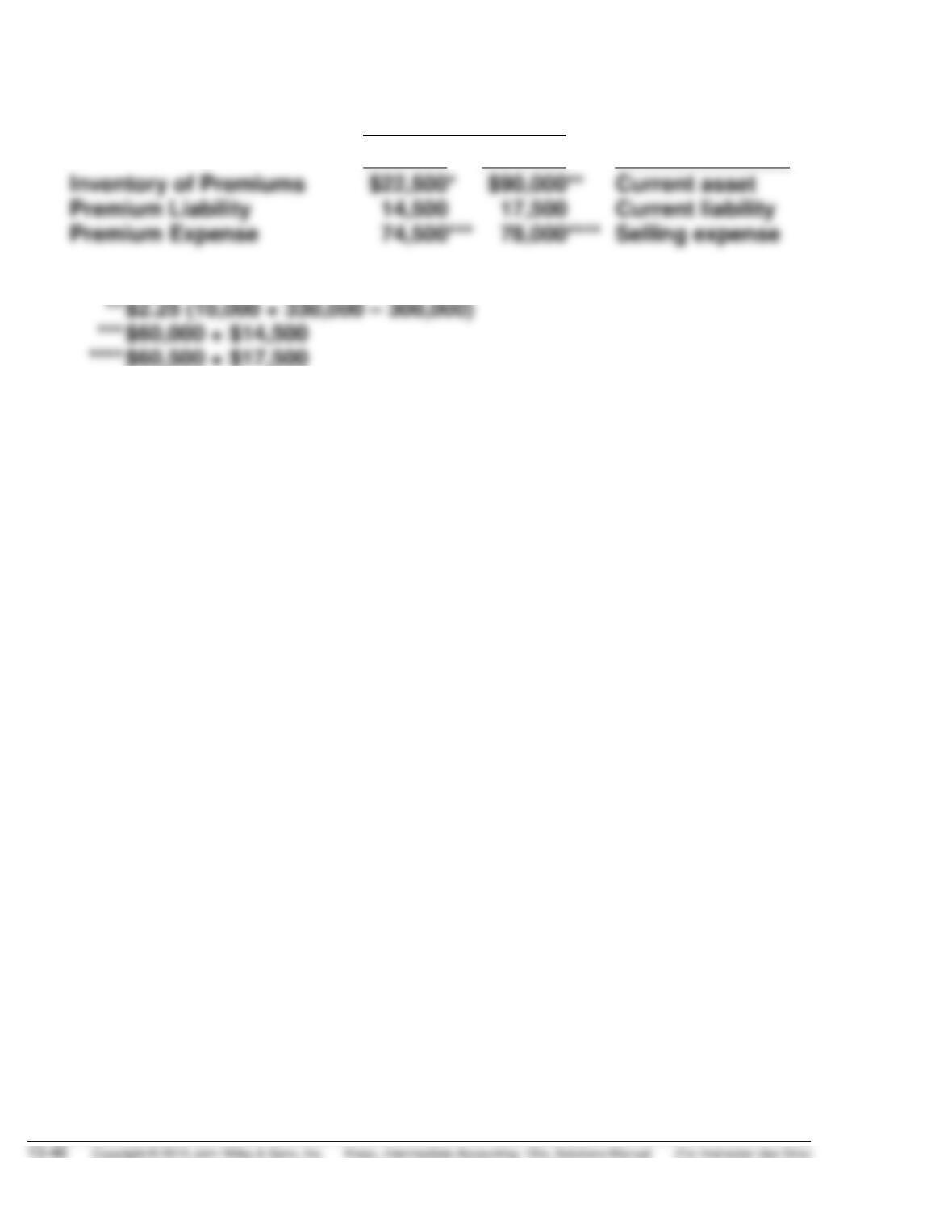
Inventory of Premiums ……………………………………………
742,500
Cash ………………………………………………………………
742,500
Cash …………………………..………………………………………….
823,080
Sales Revenue ………………………………………………..
(To record the sale of 2,743,600 candy
bars at 30 cents each)
Cash ($750,000 – $150,000) ……………………………………..
600,000
Premium Liability ……………………………………………………
14,500
Premium Expense …………………………………………………..
60,500
Inventory of Premiums ……………………………………
675,000
(To record the redemption of 1,500,000
wrappers, the receipt of $750,000
[(1,500,000 ÷ 5) X $2.50], and the mailing
of 300,000 Codes.)
Computation of premium expense:
300,000 Codes @ $2.25 = ………………………………
$675,000
Postage—300,000 @ $.50 = …………………………
150,000
825,000
Less: Cash received—
(1,500,000 ÷ 5) X $2.50 …………………………..
750,000
Premium expense for Codes issued …………………
75,000
Less: Outstanding claims at 12/31/14
charged to 2014 but redeemed in 2015 …….
Premium Expense …………………………………………………..
$ 17,500*
Premium Liability ……………………………………………
PROBLEM 13-9 (Continued)
(b)
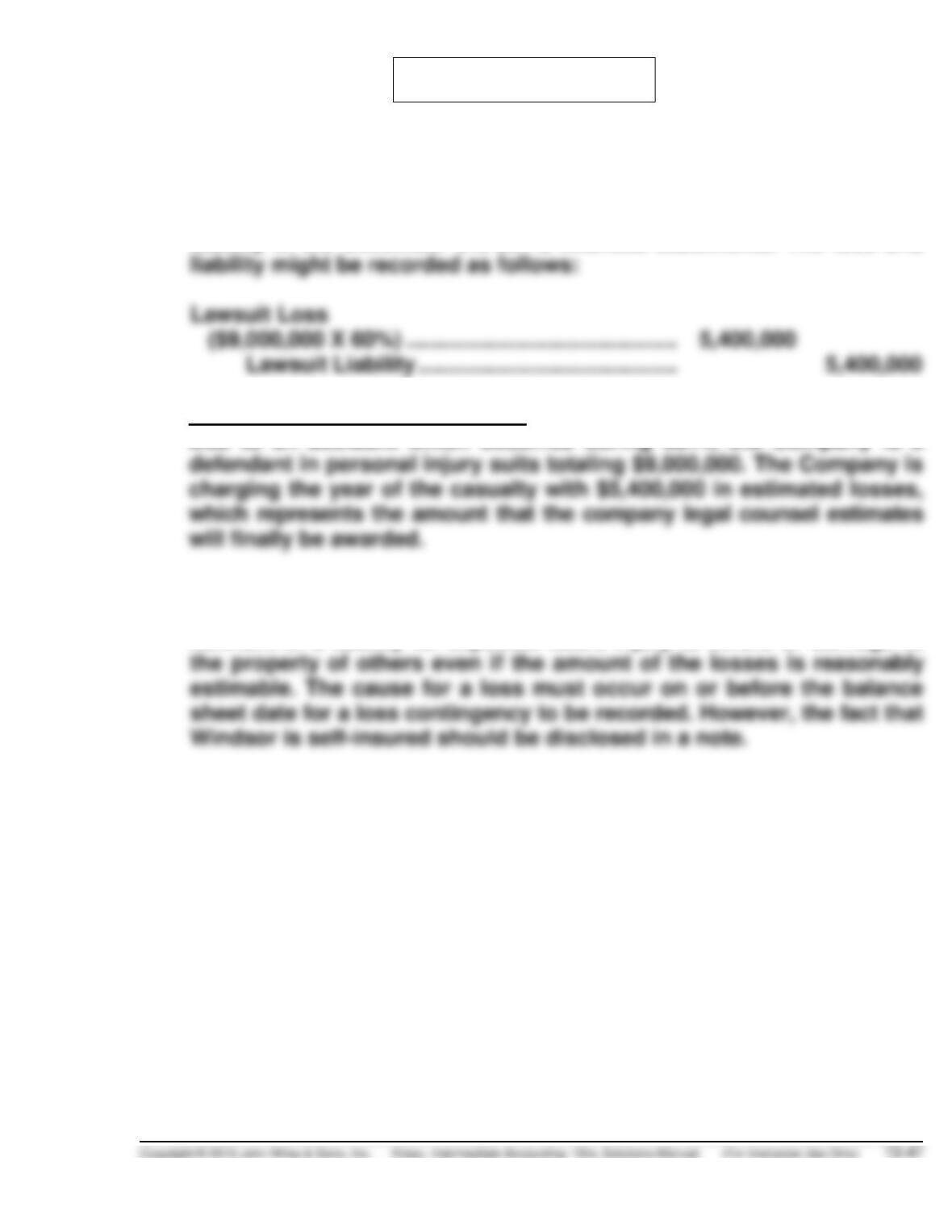
Amount
Account
2014
2015
Classification
Inventory of Premiums
*
Current asset
Premium Liability
Current liability
*
$2.25 (250,000 – 240,000)
$60,500 + $17,500
PROBLEM 13-10
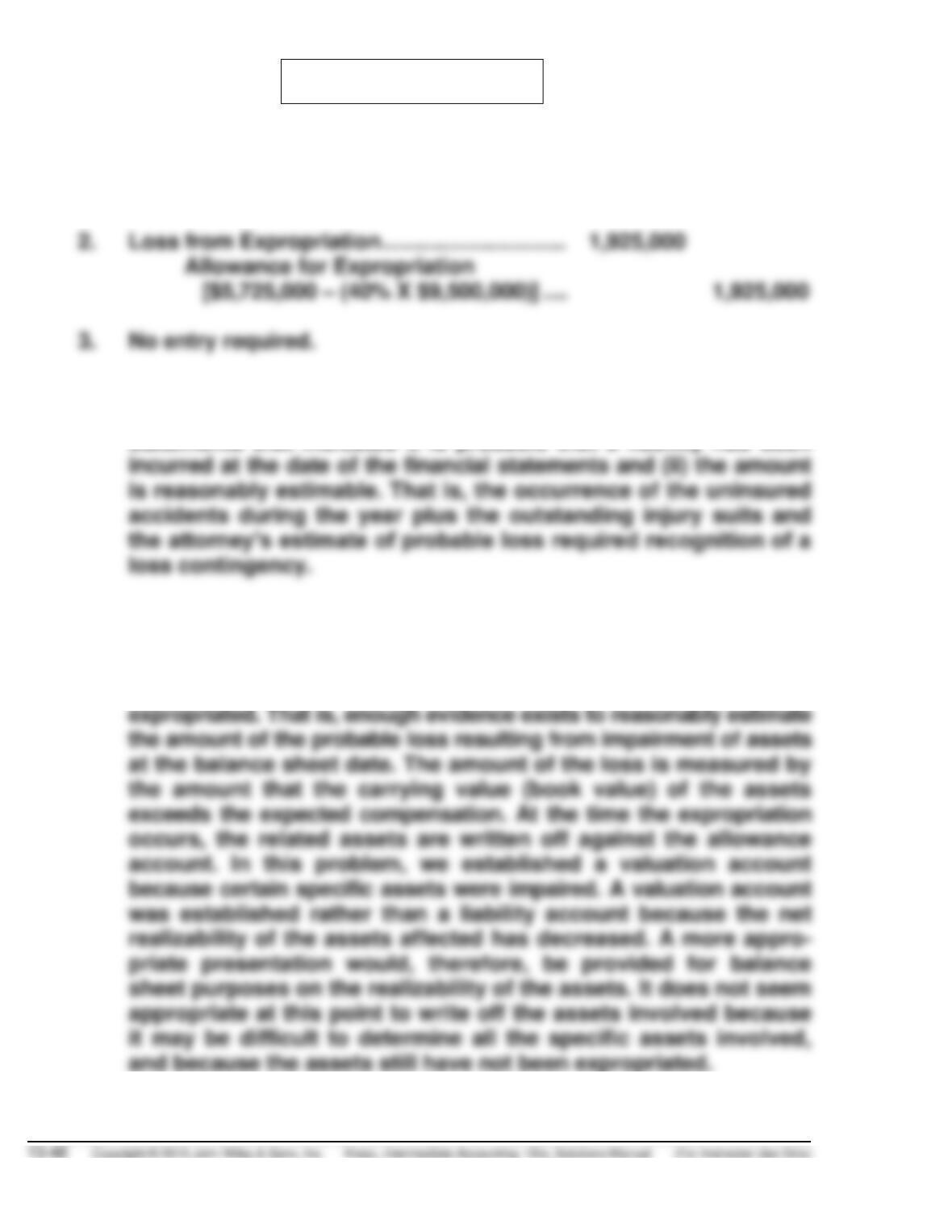
(a) Because the cause for litigation occurred before the date of the finan–
cial statements and because an unfavorable outcome is probable and
reasonably estimable, Windsor Airlines should report a loss and a
liability in the December 31, 2014, financial statements. The loss and
Note to the Financial Statements
Due to an accident which occurred during 2014, the Company is a
(b) Windsor Airlines need not establish a liability for risk of loss from lack
of insurance coverage itself. GAAP does not require or allow the estab-
lishment of a liability for expected future injury to others or damage to
PROBLEM 13-11
(a)
1.
Lawsuit Loss ……………………………………………………….
250,000
Lawsuit Liability ……………………………………………..
250,000
2.
Loss from Expropriation …………………………..
Allowance for Expropriation
No entry required.
(b)
1.
A loss and a liability have been recorded in the first case because
(i) information is available prior to the issuance of the financial
statements that indicates it is probable that a liability had been
2.
An entry to record a loss and establish an allowance due to threat
of expropriation is necessary because the expropriation is imminent
as evidenced by the foreign government’s communicated intent
to expropriate and the prior settlements for properties already
PROBLEM 13-11 (Continued)
3.
Even though Polska’s chemical product division is uninsurable
due to high risk and has sustained repeated losses in the past, as
of the balance sheet date no assets have been impaired or liabili–
ties incurred nor is an amount reasonably estimable. Therefore,
this situation does not satisfy the criteria for recognition of a loss
PROBLEM 13-12
(a)
Sales of musical instruments and sound equipment ……….
$5,700,000
Estimated warranty cost ………………………………………………..
X .02
Warranty expense for 2014 …………………………………….
$ 114,000
(b)
Estimated liability for warranties—1/1/14 ………………………..
$ 136,000
114,000
Subtotal ………………………………………………………………..
Actual warranty costs during 2014 …………………………………
Estimated liability from warranties—12/31/14 ………………….
$ 86,000
(c)
Coupons issued (1 coupon/$1 sale) ……………………………….
1,500,000
Estimated redemption rate …………………………………………….
.60
Estimated number of coupons to be redeemed ……………….
Exchange rate (200 coupons for a player) ……………………….
÷ 200
Estimated number of premium players
to be issued ……………………………………………………………….
Net cost of players ($32 – $20) ……………………………………….
X 12
Premium expense for 2014 …………………………………….
$ 54,000
(d)
Inventory of premium players—1/1/14 …………………………..
$ 37,600
Premium players purchased during 2014
(6,500 X $32) ………………………………………………………………
208,000
Premium players available …………………………………………….
Premium players exchanged for coupons
192,000
Inventory of premium players—12/31/14 …………………………
$ 53,600
(e)
Estimated liability for premiums—1/1/14 …………………………
$ 44,800
2014 premium expense (Requirement 3) …………………………
54,000
Subtotal ………………………………………………………………..
Actual redemptions during 2014
[1,200,000/200 X ($32 – $20)] ……………………………………….
72,000
Estimated liability for premiums—12/31/14 ……………………..
$ 26,800
PROBLEM 13-13
1. Memo prepared by:
Date:
Millay Corporation
December 31, 2014
Recognition of Warranty Expense
During June of this year, the client began the manufacture and sale of a
new line of dishwasher. Sales of 120,000 dishwashers during this period
amounted to $60,000,000. These dishwashers were sold under a one-year
warranty, and the client estimates warranty costs to be $25 per appliance.
Because Millay accounts for warranties on the accrual basis, it must recog-
nize the entire $3,000,000 as warranty expense in the year of sale. The client
should have made the following journal entries:
(a) Cash ………………………………………………………….. 60,000,000
Sales Revenue (120,000 X $500) ………….. 60,000,000
(To record sale of 120,000 dishwashers)
2. Memo prepared by:
Date:
Millay Corporation
December 31, 2014
Loss Contingency from Violation
Of EPA Regulations
I contacted the client’s counsel via a routine attorney letter, asking for
Although the litigation is pending, Sondgeroth believes that the suit will
probably be lost. A reasonable estimate of clean up costs and fines is
$2,750,000. The client neither disclosed nor accrued this loss in the finan–
cial statements.
3. Memo prepared by:
Date:
Millay Corporation
December 31, 2014
Loss Contingency on
Patent Infringement Litigation
In answer to my attorney letter requesting information about any possible
litigation associated with the client, Morgan Sondgeroth informed me that
the client is in the middle of a patent infringement suit with Megan Drabek
PROBLEM 13-14
1. Estimated warranty costs:
On 2013 sales $ 800,000 X .10 …………………………..
$ 80,000
On 2014 sales $1,100,000 X .10 …………………………..
110,000
On 2015 sales $1,200,000 X .10 …………………………..
Total estimated costs …………………………………
310,000
Total warranty expenditures ……………………….
85,700*
2.
Computation of liability for premium claims outstanding:
Unredeemed coupons for 2014
($9,000 – $8,000) ……………………………………………..
($30,000 X .40) ………………………………………………..
TIME AND PURPOSE OF CONCEPTS FOR ANALYSIS
CA 13-1 (Time 20–25 minutes)
Purpose—to provide the student with the opportunity to define a liability, to distinguish between current
and long-term liabilities, and to explain accrued liabilities. The student must also describe how liabilities
are valued, explain why notes payable are usually reported first in the current liabilities section, and to
indicate the items that may comprise “compensation to employees.”
CA 13-2 (Time 15–20 minutes)
CA 13-3 (Time 30–40 minutes)
Purpose—to provide the student with a comprehensive case covering refinancing of short-term debt.
CA 13-4 (Time 15–20 minutes)
Purpose—to provide the student with an opportunity to comment on the proper treatment in the
CA 13-5 (Time 15–20 minutes)
Purpose—to provide the student with an opportunity to specify the conditions by which a loss
CA 13-6 (Time 15–20 minutes)
Purpose—to provide the student with an opportunity to discuss how product warranty costs and the fact
that a company is being sued should be reported.
CA 13-7 (Time 20–25 minutes)
SOLUTIONS TO CONCEPTS FOR ANALYSIS
CA 13-1
(a) A liability is defined as “probable future sacrifices of economic benefits arising from present
obligations of a particular entity to transfer assets or provide services to other entities in the future
as a result of past transactions or events.” In other words, it is an obligation to transfer some type
of resource in the future as a result of a past transaction.
(d) Theoretically, liabilities should be measured by the present value of the future outlay of cash
required to liquidate them. But in practice, current liabilities are usually recorded in accounting
records and reported in financial statements at their maturity value. Because of the short time
periods involved—frequently less than one year—the difference between the present value of a
current liability and the maturity value is not large. The slight overstatement of liabilities that results
from carrying current liabilities at maturity value is accepted on the grounds it is immaterial.
CA 13-2
1. Since the notes payable are due in less than one year from the balance sheet date, they would
generally be reported as a current liability. The only situation in which this short-term obligation
could possibly be excluded from current liabilities is if Rodriguez Corp. intends to refinance it. For
those notes to qualify for exclusion from current liabilities, the company must meet the following
criteria:
(1) It must intend to refinance the obligation on a long-term basis, and
CA 13-2 (Continued)
2. Generally, deposits from customers would be classified as a current liability. However, the
classification of deposits as current or noncurrent depends on the time involved between the date
3. Salaries and wages payable is an accrued liability which in almost all circumstances would be
reported as a current liability (could not be excluded).
CA 13-3
(This case requires some research of FASB Codification.)
(a) No. GAAP indicates that refinancing a short-term obligation on a long-term basis means either replacing
it with a long-term obligation or with equity securities, or renewing, extending, or replacing it with
(b) Yes. The events described will have an impact on the financial statements. Since Dumars Corpo-
ration refinanced the long-term debt maturing in March 2015 in a manner that meets the conditions
set forth in GAAP that obligation should be excluded from current liabilities. The $10,000,000
(c) No. since Dumars Corporation refinanced the long-term debt maturing in March 2015 in a manner
that meets the conditions set forth in GAAP that obligation should be excluded from current liabilities.
(d) (1) No. The $10,000,000 should be shown under the caption of either “Long–Term Debt,” “Interim
Debt,” “Short–Term Debt Expected to Be Refinanced,” or “Intermediate Debt.”
CA 13-4
Because the casualty occurred subsequent to the balance sheet date, it does not meet the criteria of a
loss contingency; that is, an asset had not been impaired or a liability incurred at the date of the
balance sheet. Therefore, a loss contingency should not be accrued by a charge to expense due to the
CA 13-5
(a) Two conditions must exist before a loss contingency is recorded:
1. Information available prior to the issuance of the financial statements indicates that it is
probable that a liability has been incurred at the date of the financial statements.
2. The amount of the loss can be reasonably estimated.
(b) When some amount within the range appears at the time to be a better estimate than any other
CA 13-6
Part 1. For Product Grey, the estimated product warranty costs should be accrued by a charge to
expense and a credit to a liability because both of the following conditions were met:
1. It is probable that a liability has been incurred based on past experience.
2. The amount of the loss can be reasonably estimated as 1% of sales.
Part 2. The probable judgment ($1,000,000) should be accrued by a charge to expense and a credit to
a liability because both of the following conditions were met:
1. It is probable that a liability has been incurred because Constantine’s lawyer states that it is
probable that Constantine will lose the suit.
CA 13-6 (Continued)
Constantine should disclose in its financial statements or notes the following:
CA 13-7
(a) No, Hamilton should not follow his owner’s directive if his (Hamilton’s) original estimates are
reasonable.
(b) Rich Clothing Store benefits in lower rental expense. The Dotson Company is harmed because the
FINANCIAL REPORTING PROBLEM
(a) P&G’s short-term borrowings were $9,981 at June 30, 2011. (in
$ millions)
SHORT-TERM DEBT
(In millions)
2011
Commercial paper
Total short-term debt
(b) 1. Working capital = Current assets less current liabilities.
($5,323) = ($21,970 – $27,293)
While P&G’s current and acid-test ratios are below one, this may not
indicate a weak liquidity position. Many large companies carry relatively