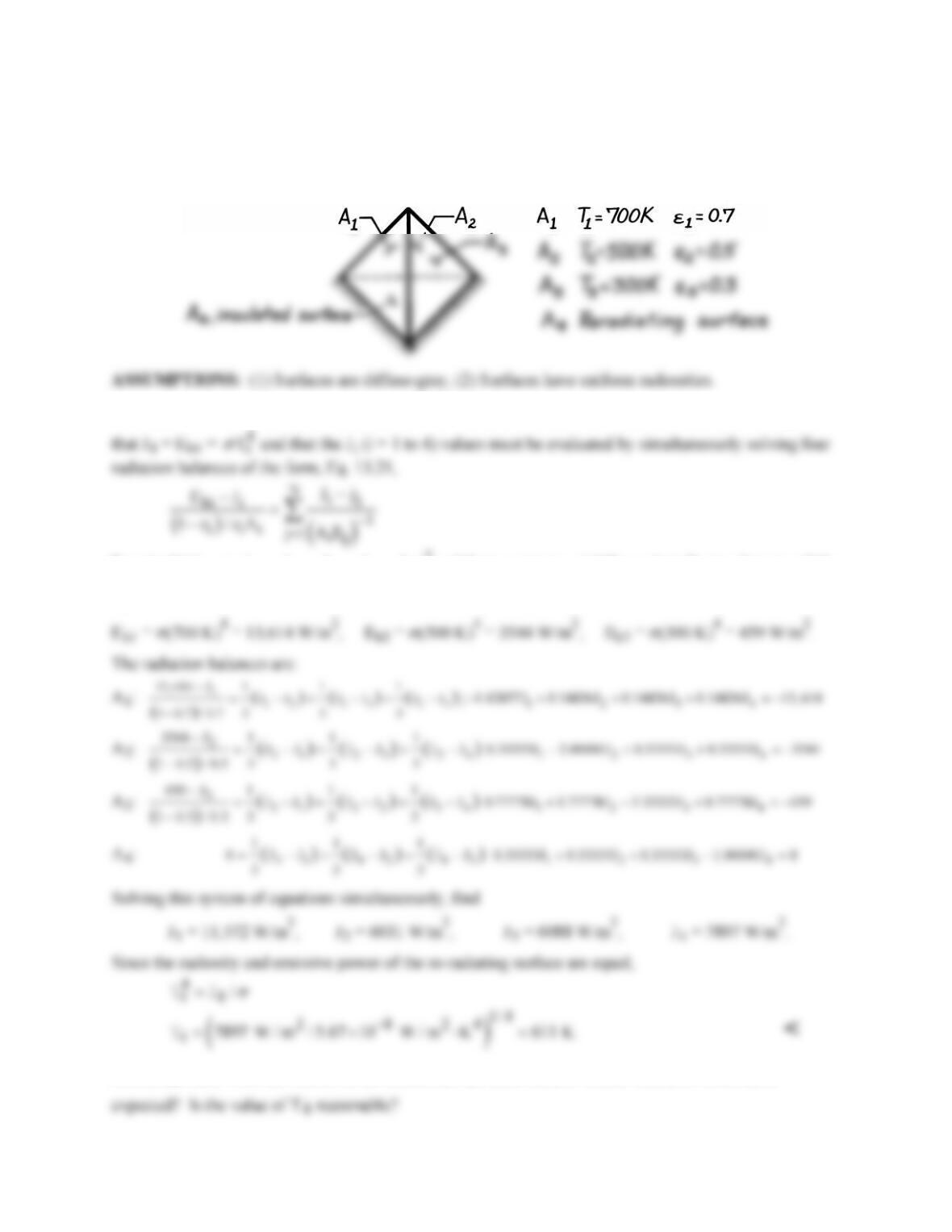
PROBLEM 13.66
KNOWN: Four surface enclosure with all sides of equal area; temperatures of three surfaces are
specified while the fourth is re-radiating.
FIND: Temperature of the re–radiating surface A4.
SCHEMATIC:
ANALYSIS: To determine the temperature of the re–radiating surface A4, it is necessary to recognize
For simplicity, set A1 = A2 = A3 = A4 = 1 m2 and from symmetry, it follows that all view factors will be
Fij = 1/3. The necessary emissive powers are of the form Ebi =
4
1
T.
σ
COMMENTS: Note the values of the radiosities; are their relative values what you would have
PROBLEM 13.67
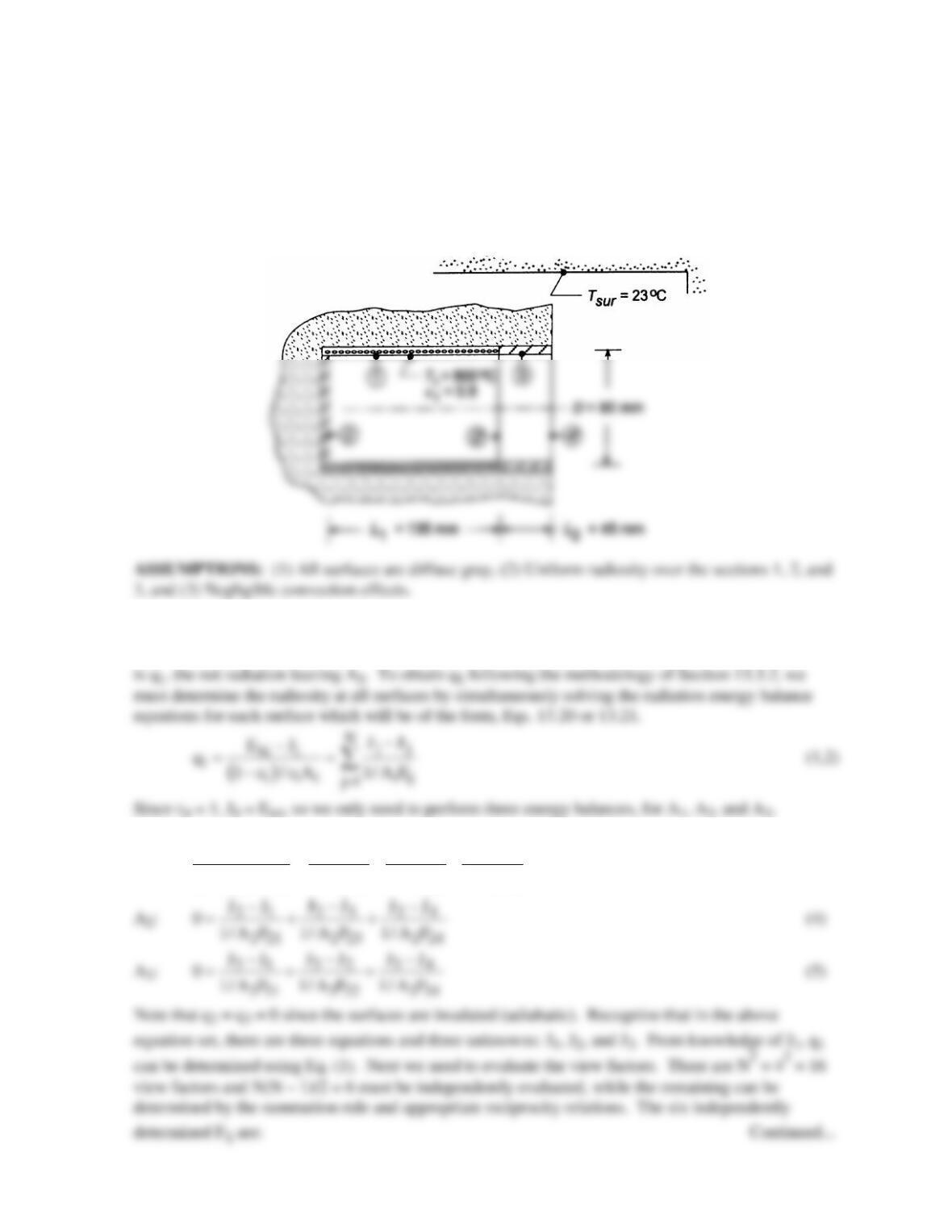
KNOWN: Cylindrical furnace of diameter D = 90 mm and overall length L = 180 mm. Heating
elements maintain the refractory liming (ε = 0.8) of section (1), L1 = 135 mm, at T1 = 800°C. The
bottom (2) and upper (3) sections are refractory lined, but are insulated. Furnace operates in a
spacecraft environment.
FIND: Power required to maintain the furnace operating conditions with the surroundings at 23°C.
SCHEMATIC:
ANALYSIS: By defining the furnace opening as the hypothetical area A4, the furnace can be
represented as a four–surface enclosure as illustrated above. The power required to maintain A1 at T1
respectively
A1:
( )
b1 1 1 3
12 14
1 1 1 1 12 1 13 1 14
E J JJ
JJ JJ
1 / A 1/ A F 1/ A F 1/ A F
εε
−−
−−
=++
−
(3)
PROBLEM 13.67 (Cont.)
(3)
( )
1/2
2
2
24
F 0.5 18 18 4 1 0.05573= −− =
(4) F21 = 1 – F22’ = 1 – 0.09167 = 0.9083
(5) F11 = 1 – F12 – F12′ = 1 – 0.1514 – 0.1514 = 0.6972
(6) F43 = 1 – F42′ – F44 = 1 – 0.3820 – 0 = 0.6180
where F44 = 0 and using the coaxial parallel disk relation from Table 13.5, with R4 = r4/L2 = 45/45 =
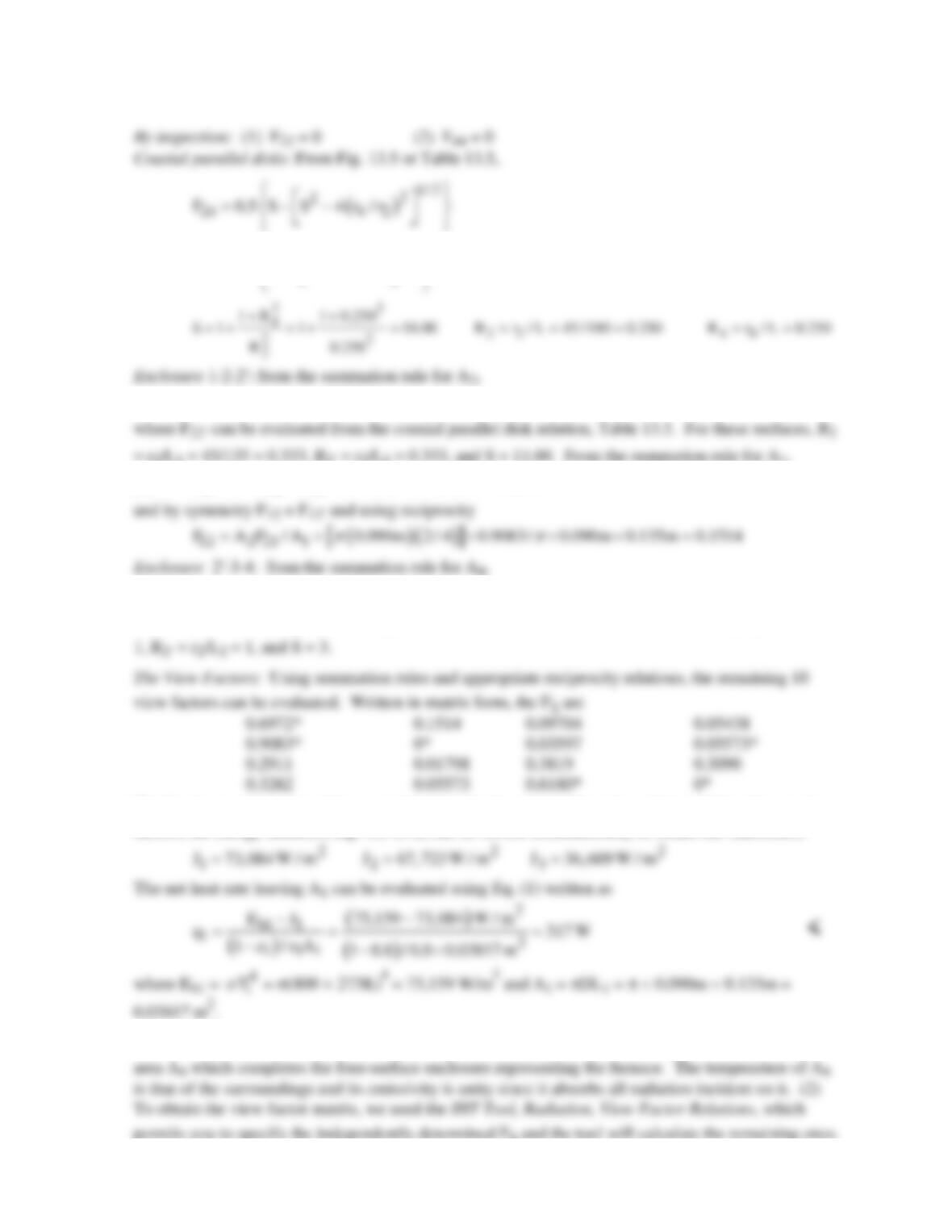
The Fij shown with an asterisk were independently determined. From knowledge of the relevant view
factors, the energy balances, Eqs. (3, 4, 5), can be solved simultaneously to obtain the radiosities,
COMMENTS: (1) Recognize the importance of defining the furnace opening as the hypothetical
PROBLEM 13.68
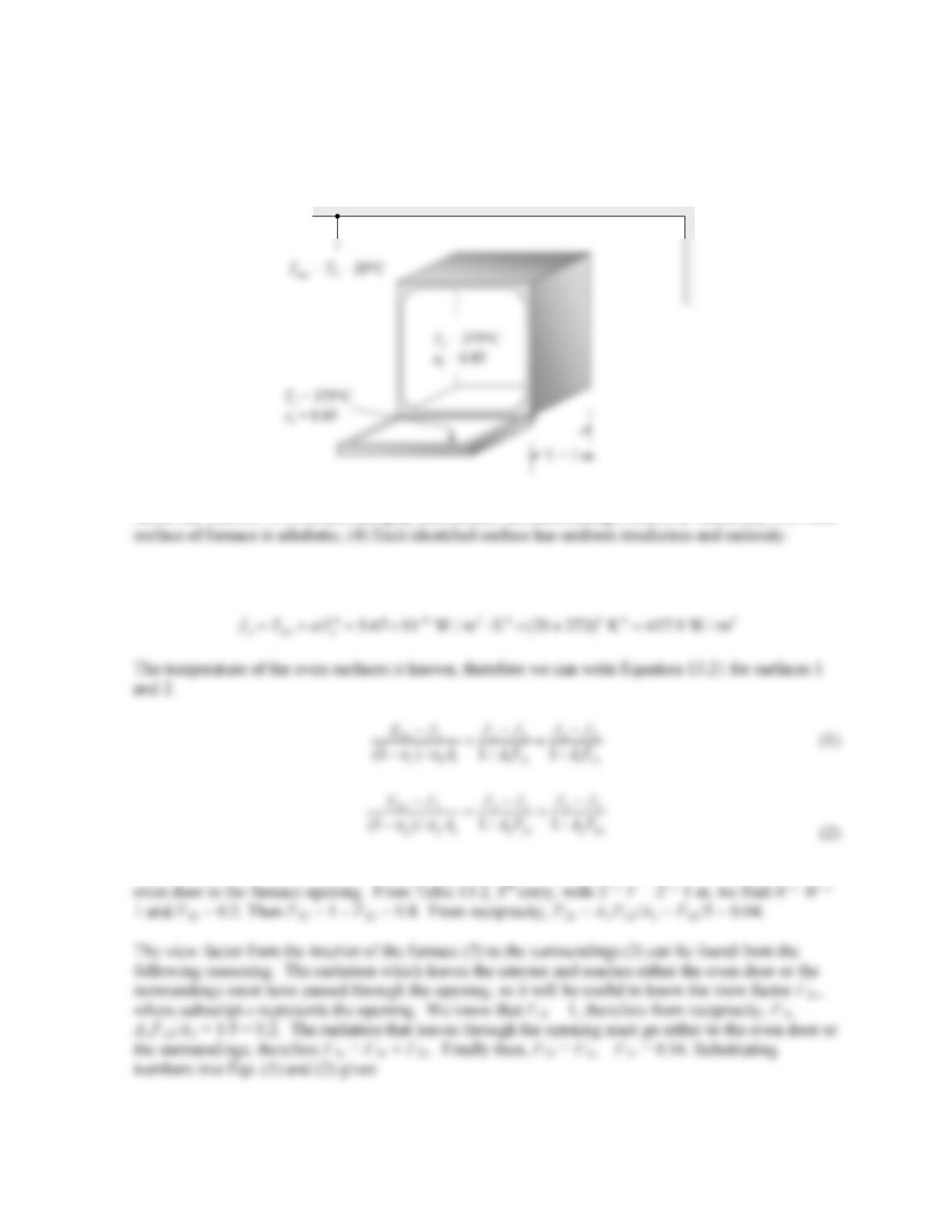
KNOWN: Dimensions of furnace. Emissivity of surfaces. Temperatures of furnace walls and
surroundings.
FIND: Rate of radiation heat transfer to surroundings.
SCHEMATIC:
ASSUMPTIONS: (1) Surfaces are gray and diffuse, (2) Surroundings behave as blackbody, (3) Outer
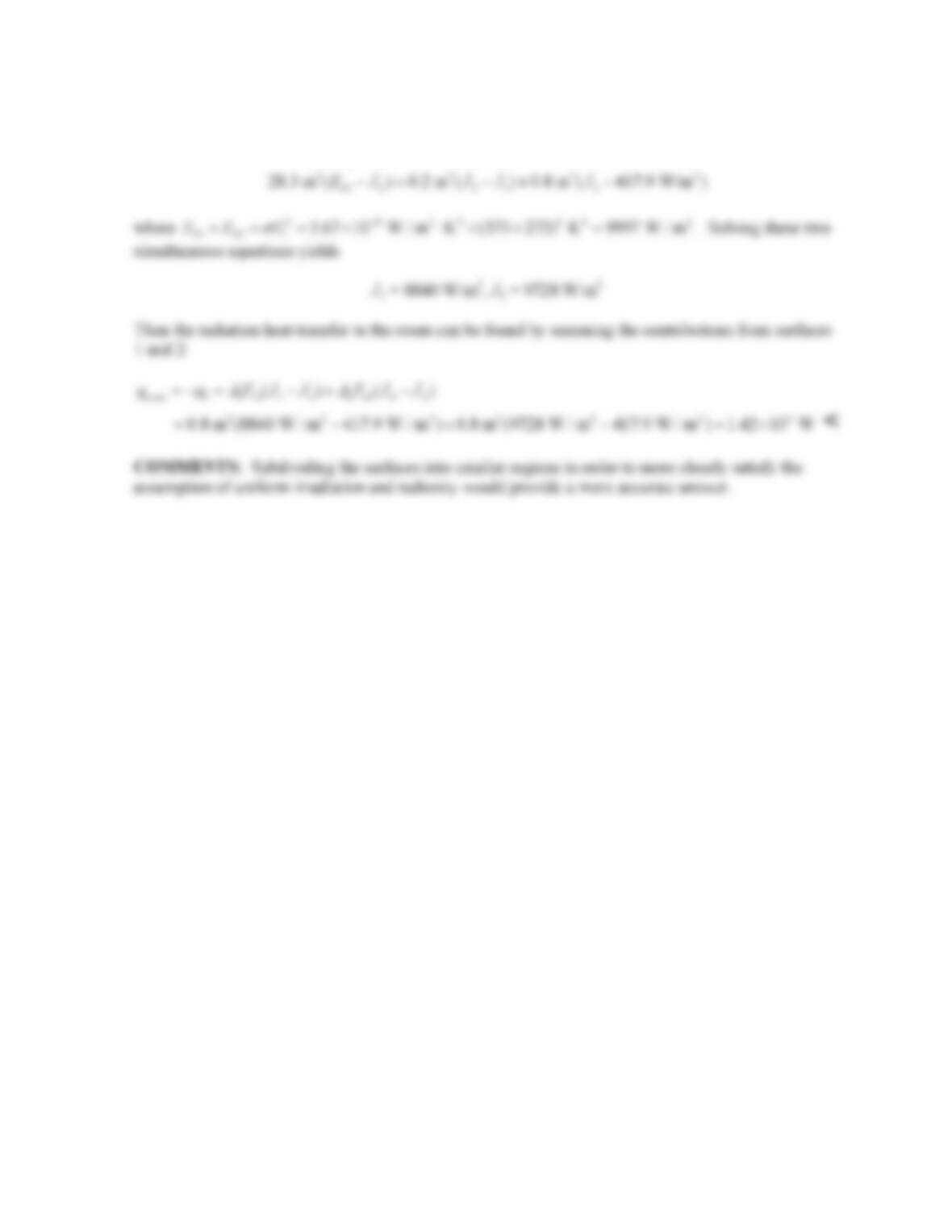
ANALYSIS: The surrounding room is assumed to be large enough to behave as a blackbody,
therefore:
The view factor from the oven door (1) to the interior walls of the furnace (2) is the same as from the
Continued…
PROBLEM 13.68 (Cont.)
2 222
11 12 1
5.67 m ( ) 0.2 m ( ) 0.8 m ( 417.9 W/m )
b
E J JJ J
−= −+ −
PROBLEM 13.69
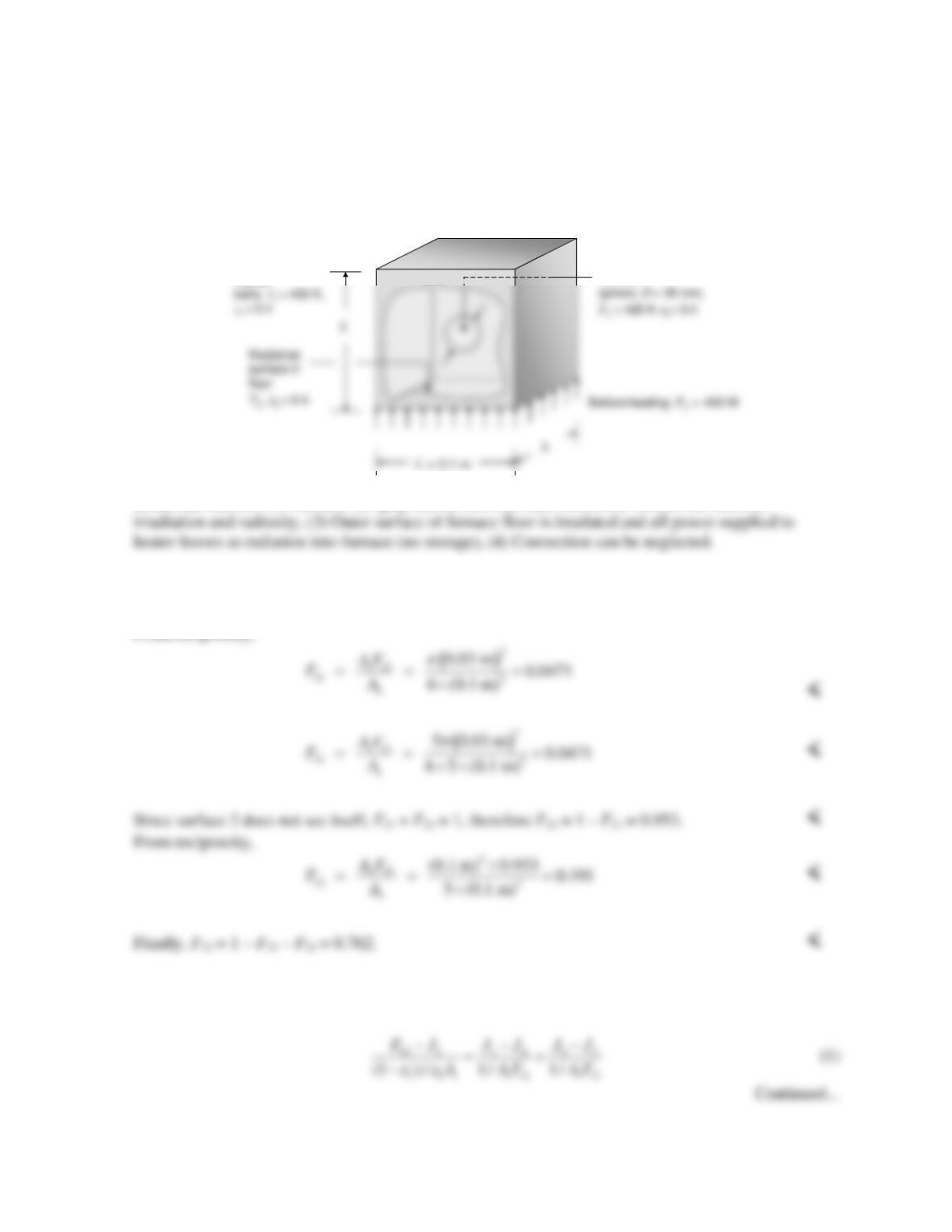
KNOWN: Dimensions of furnace and sphere. Emissivity of surfaces. Power supplied to floor of
furnace. Temperature of other five walls. Sphere temperature.
FIND: (a) View factors F12, F13, F21, F31, F23, F32, and F33. (b) Temperature of floor. Net rate of
radiation heat transfer leaving sphere. Whether the sphere is under steady–state conditions.
SCHEMATIC:
Radiation
surface 3:
remaining
interior
Radiation
surface 1:
ASSUMPTIONS: (1) Surfaces are gray and diffuse, (2) Each identified surface has uniform
ANALYSIS: (a) Due to symmetry, the view factor from the sphere to each of the six furnace walls
must be equal, therefore F12 = 1/6 and F13 = 5/6. <
From reciprocity,
(b) Equation 13.21 can be written at surfaces 1 and 3 where temperature is known:
PROBLEM 13.69 (Cont.)
The power is known at surface 2, q2 = P = 400 W, so we write Equation 13.22:
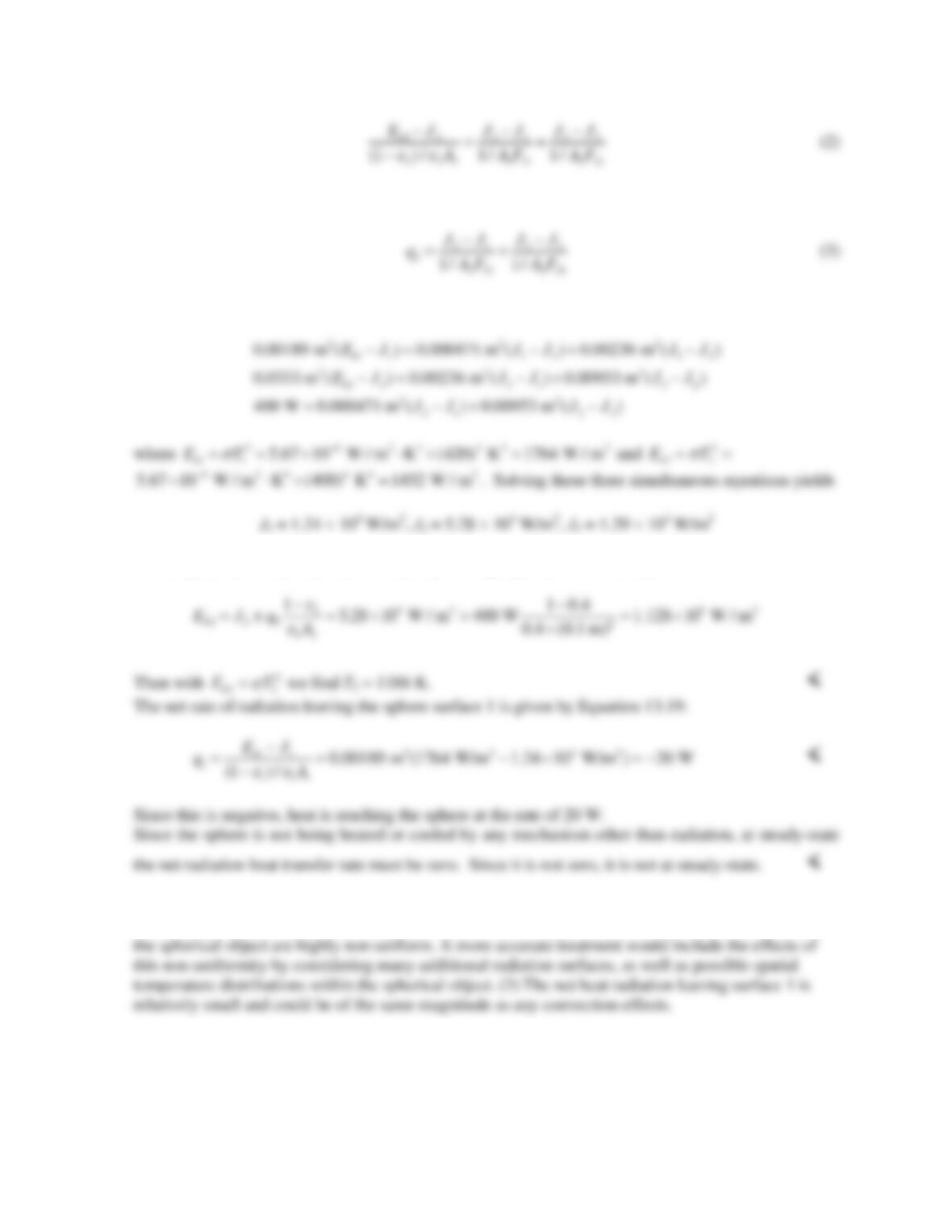
Substituting numbers into Eqs. (1) – (3) gives
The temperature of the floor can be found by solving Equation 13.19 for Eb2:
COMMENTS: (1) The bottom surface is very hot. (2) The irradiation and radiosity distributions on
PROBLEM 13.70
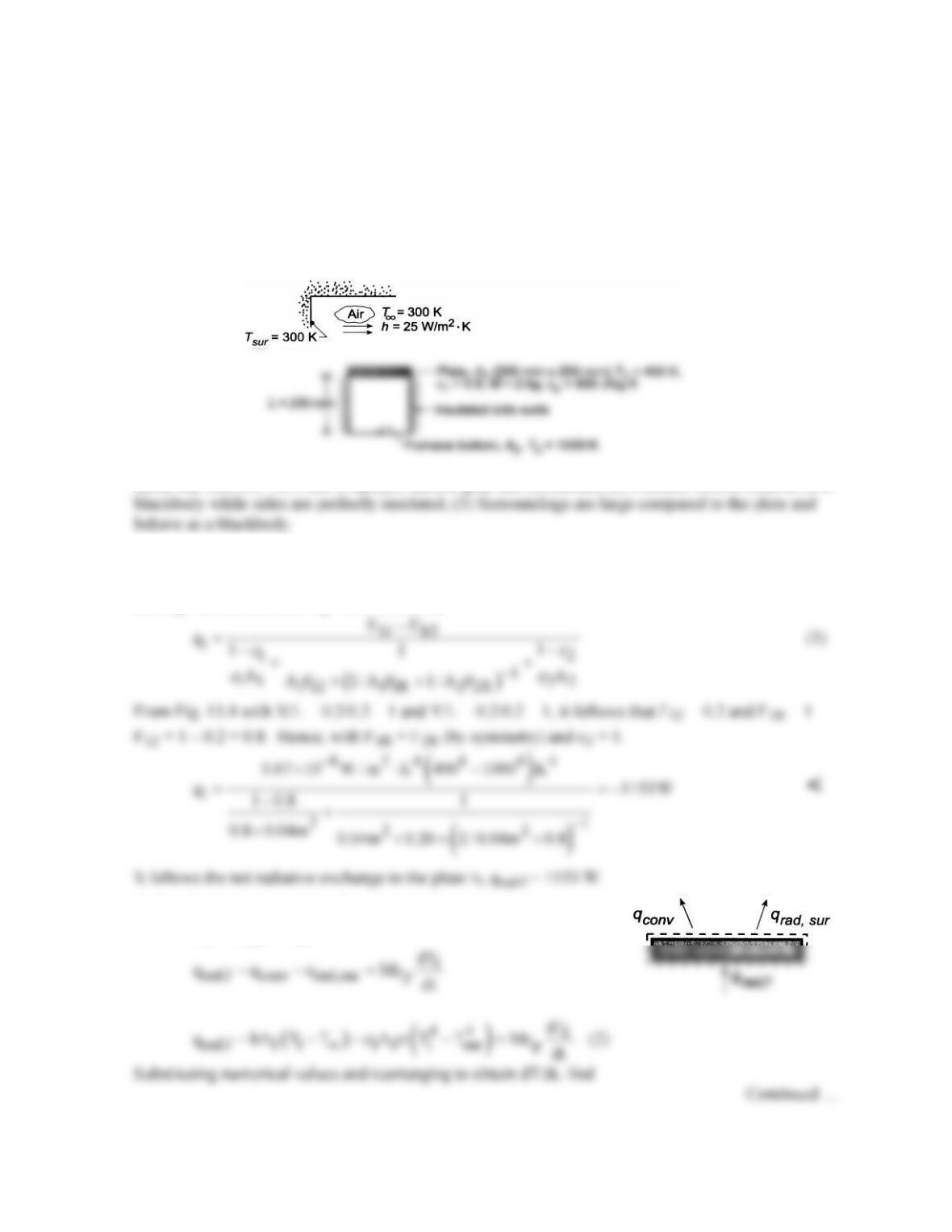
KNOWN: Opaque, diffuse-gray plate with ε1 = 0.8 is at T1 = 400 K at a particular instant. The
bottom surface of the plate is subjected to radiative exchange with a furnace. The top surface is
subjected to ambient air and large surroundings.
FIND: (a) Net radiative heat transfer rate to the bottom surface of the plate for T1 = 400 K, (b)
Change in temperature of the plate with time, dT1/dt, and (c) Compute and plot dT1/dt as a function
of T1 for the range 350 ≤ T1 ≤ 900 K; determine the steady–state temperature of the plate.
SCHEMATIC:
ASSUMPTIONS: (1) Plate is opaque, diffuse-gray and isothermal, (2) Furnace bottom behaves as a
ANALYSIS: (a) Recognize that the plate (A1), furnace bottom (A2) and furnace side walls (AR)
form a three–surface enclosure with one surface being re–radiating. The net radiative heat transfer
leaving A1 follows from Eq. 13.30 written as
(b) Perform now an energy balance on the plate written as
in out st
EE E−=
PROBLEM 13.70 (Cont.)
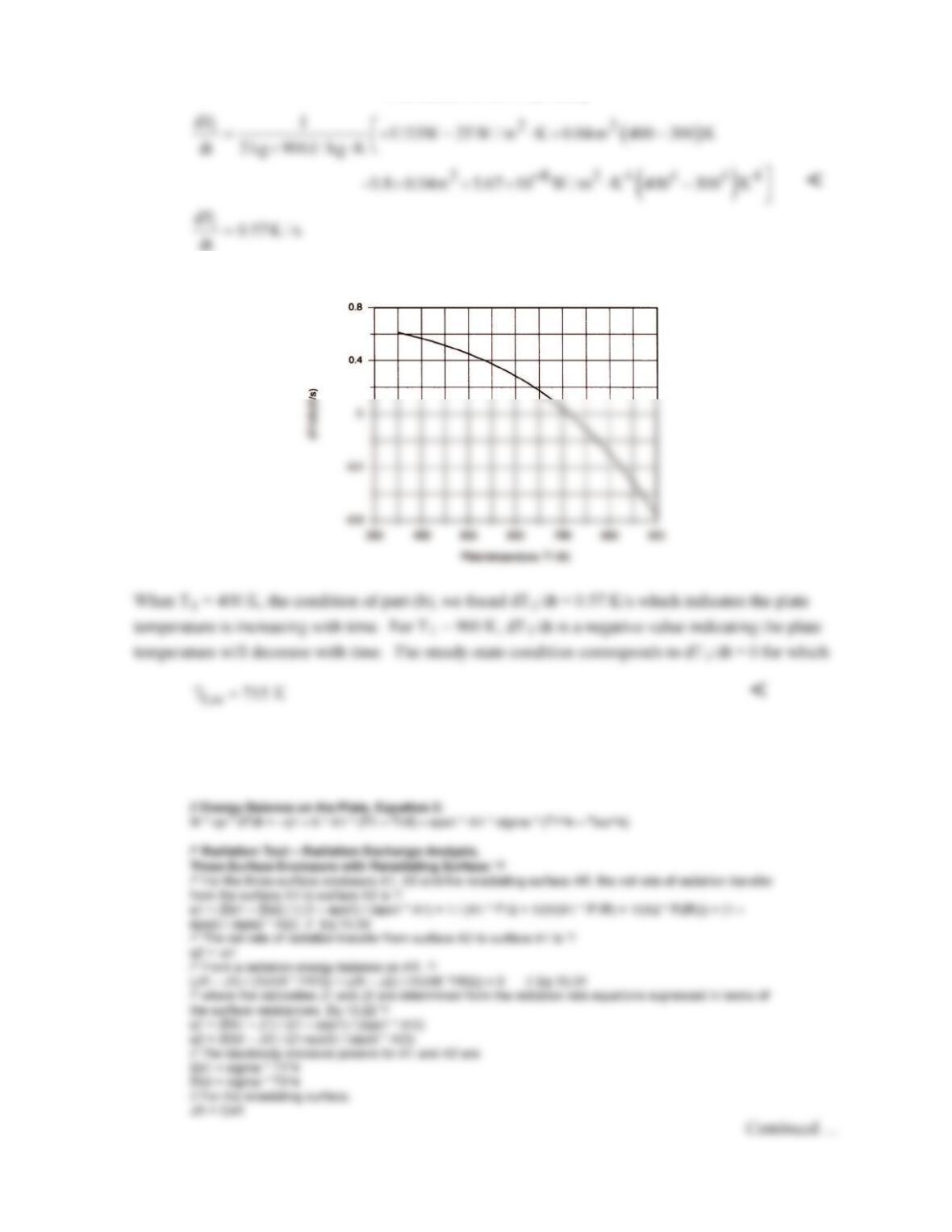
(c) With Eqs. (1) and (2) in the IHT workspace, dT1/dt was computed and plotted as a function of T1.
COMMENTS: Using the IHT Radiation Tools – Radiation Exchange Analysis, Three Surface
Enclosure with Re-radiating Surface and View Factors, Aligned Parallel Rectangle – the above
analysis can be performed. A copy of the workspace follows:

PROBLEM 13.70 (Cont.)
EbR = sigma *TR^4
sigma = 5.67E-8 // Stefan–Boltzmann constant, W/m^2⋅K^4
// Radiation Tool – View Factor:
// View Factors Relations:
// Assigned Variables:
T1 = 400 // Plate temperature, K
eps1 = 0.8 // Plate emissivity
PROBLEM 13.71
KNOWN: Dimensions and temperatures of rotating and stationary disks, air gap spacing between
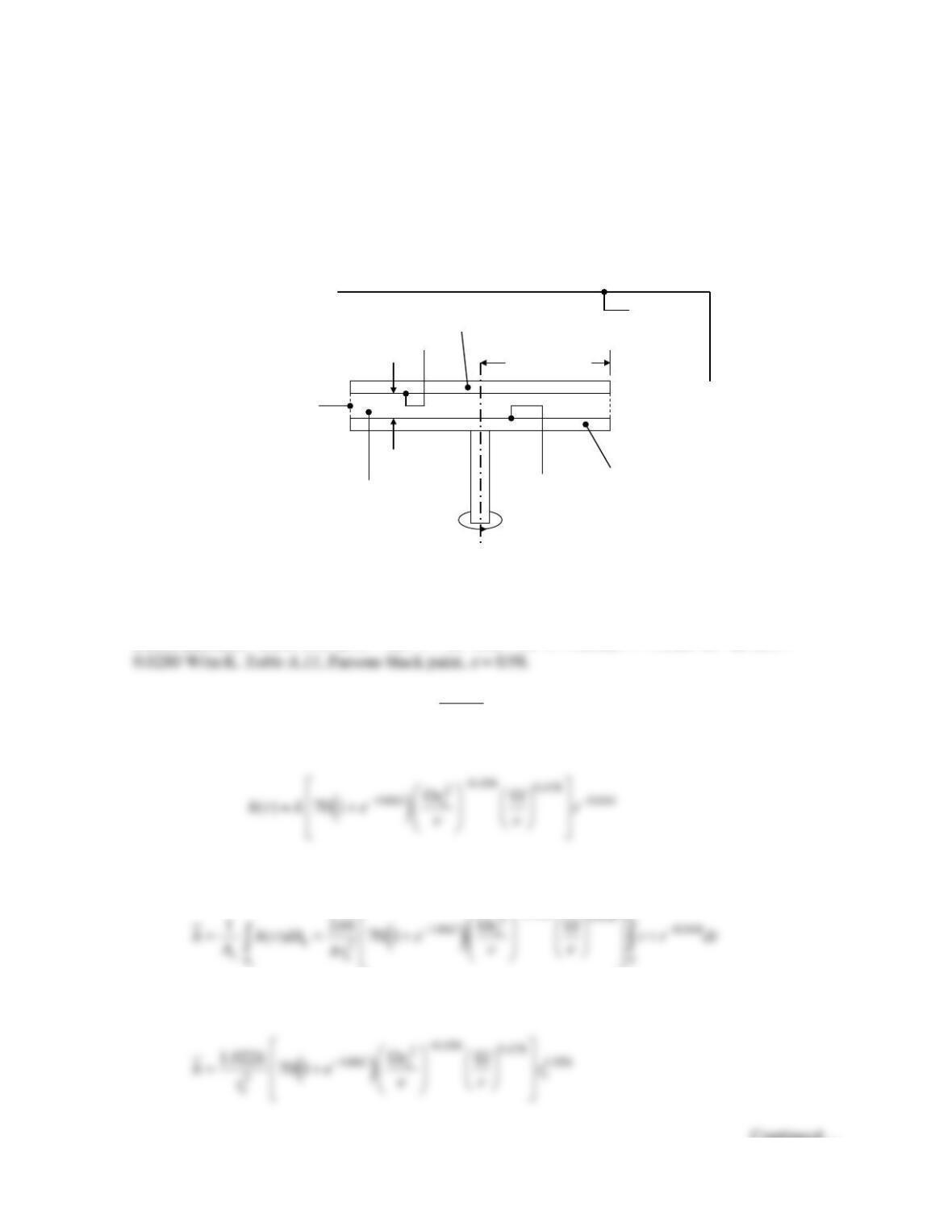
disks, rotational speed. Ambient and surroundings temperatures. Correlation for the local Nusselt
number. Initial painted surfaces and emissivity of exposed base metal on the rotating disk.
FIND: Total power dissipated from the top surface of the rotating disk for painted and unpainted
conditions.
SCHEMATIC:
g= 2 mm
Rotating disk
T
s
= 80°C
r
o
= 100 mm
Stationary plate, T
d
= 20°C
Air
Air
T
∞
= 20°C
Ω= 150 rad/s
Surface 1
ε
1
= 0.98, 0.10
Surface
3
Surface 2
ε
2
= 0.98
T
sur
= 20°C
ASSUMPTIONS: (1) Steady–state conditions, (2) Constant properties, (3) Diffuse-gray surfaces with
uniform radiosity and irradiation distributions, (4) Large surroundings.
PROPERTIES: Table A.4, air (T = (80°C + 20°C)/2 = 50°C ≈ 323K):
ν
= 18.20×10⁻⁶ m2/s, k =
ANALYSIS: From Problem 6.14,
( )
140 0.456 0.478
() 70 1
o
G
o
r rr
hrr
Nu e Re Re
k
−−
= = +
.
Since
2/
r
Re r
ν
= Ω
, the local heat transfer coefficient is
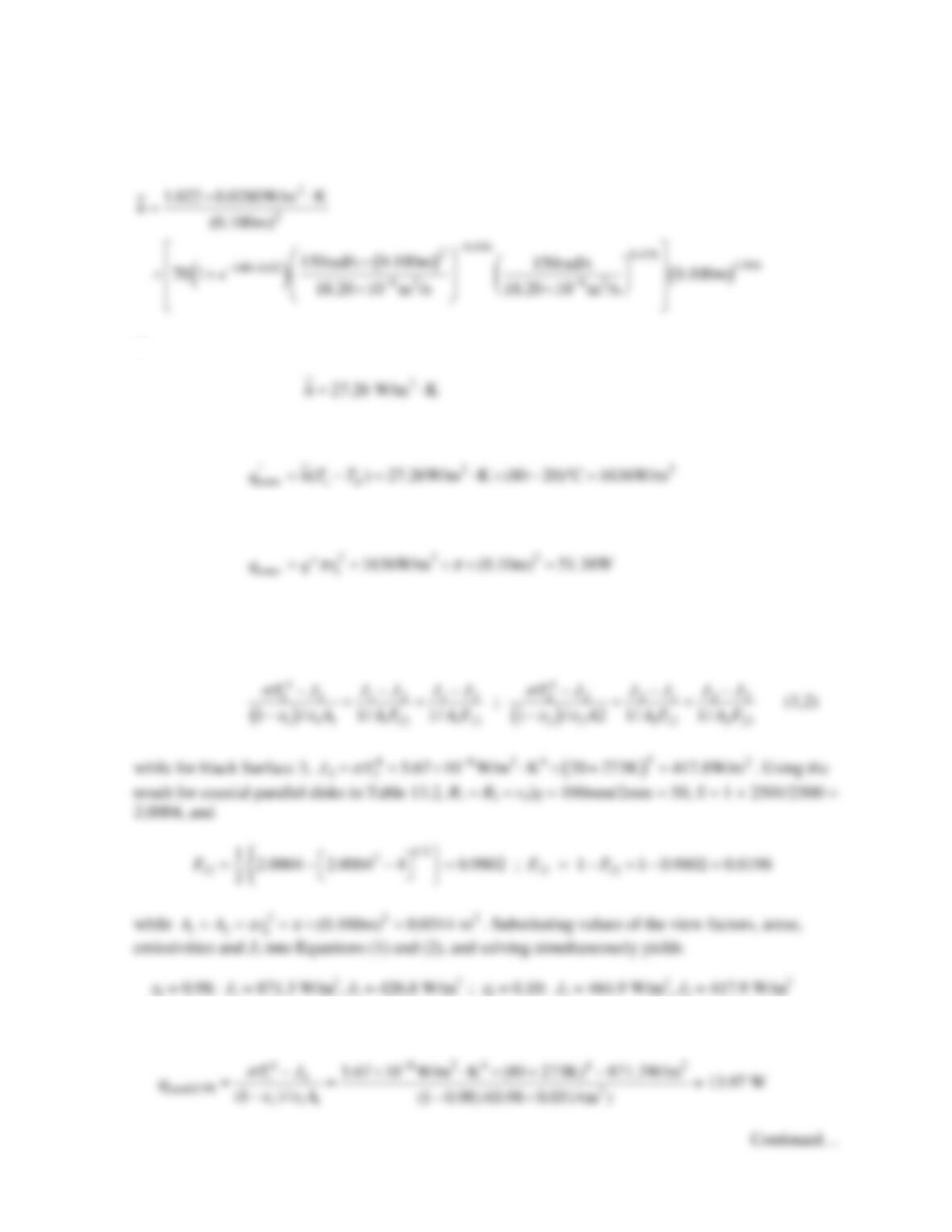
The average heat transfer coefficient may be evaluated from
0.456 0.478
−
or
Continued…
PROBLEM 13.71 (Cont.)
Substituting values,
or
The convective heat flux from the top surface of the disk is
and the convective heat rate is
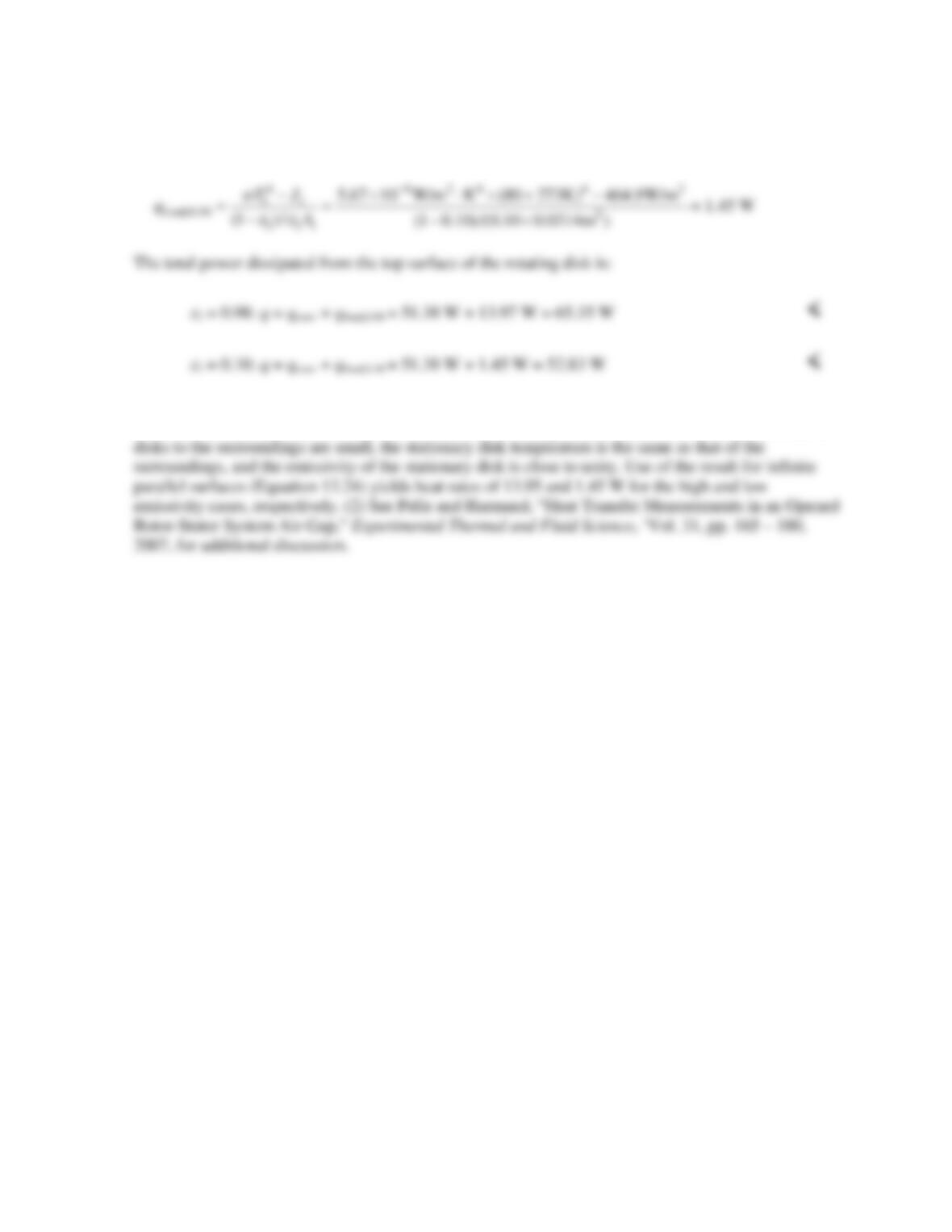
The radiation heat transfer from the rotating disk may be determined by use of Eq. 13.21.
Surfaces 1 and 2:
From Eq. 13.19,
PROBLEM 13.71 (Cont.)
and
COMMENTS: (1) The influence of the black surroundings is small since the view factors from the
PROBLEM 13.72
KNOWN: Ice rink with prescribed ice, rink air, wall, ceiling and outdoor air conditions.
FIND: (a) Temperature of the ceiling, Tc, having an emissivity of 0.05 (highly reflective panels) or
0.94 (painted panels); determine whether condensation will occur for either or both ceiling panel
types if the relative humidity of the rink air is 70%, and (b) Calculate and plot the ceiling temperature
as a function of ceiling insulation thickness for 0.1 ≤ t ≤ 1 m, identify conditions for which
condensation will occur on the ceiling.
SCHEMATIC:
Ceiling (c), T , = 0.05 or 0.94
c ε
Insulation, k = 0.035 W/m-K, thickness t = 0.3m
T = -5 C
,o o
o
o
ASSUMPTIONS: (1) Rink comprised of the ice, walls and ceiling approximates a three–surface,
PROPERTIES: Psychrometric chart (Atmospheric pressure; dry bulb temperature, Tdb = T∞,i =
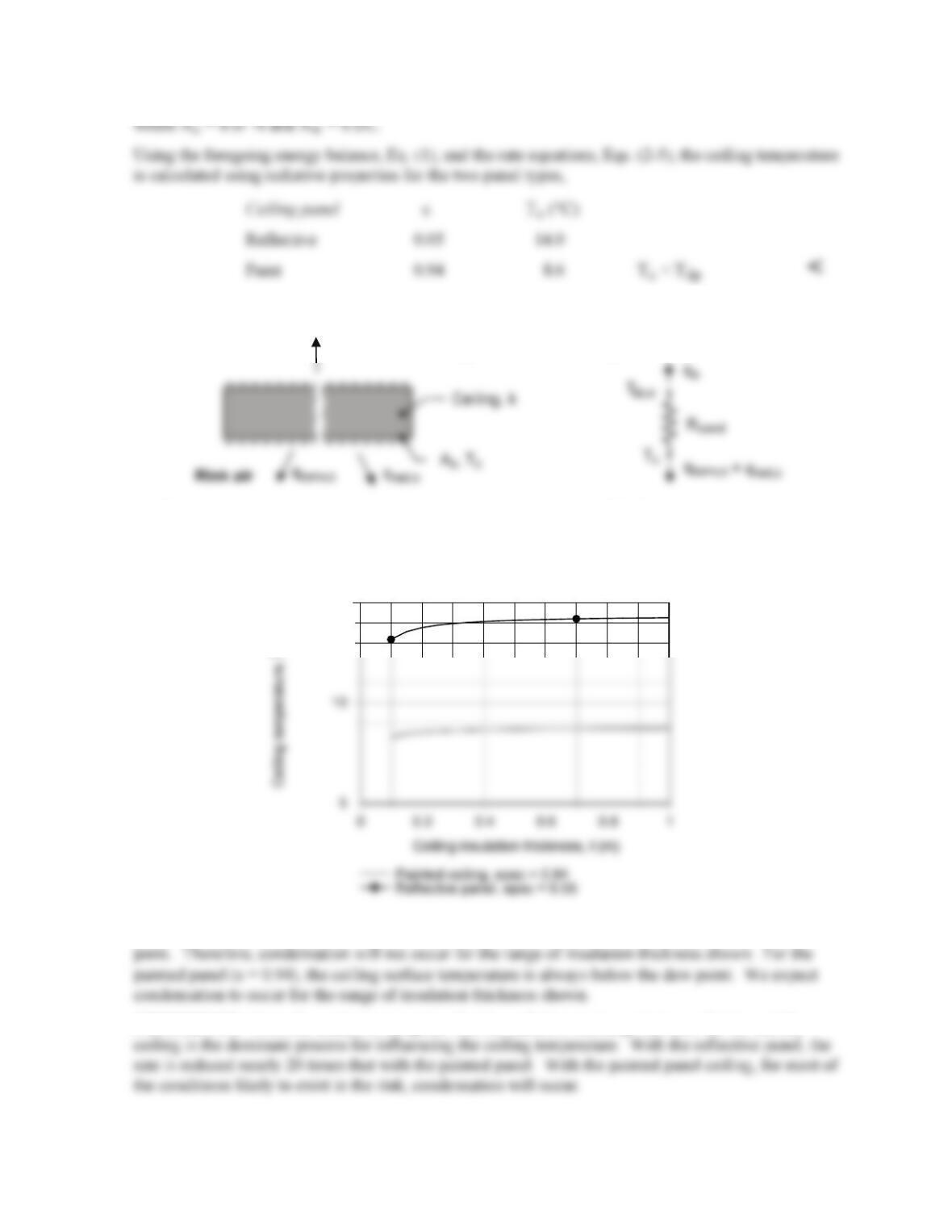
ANALYSIS: The energy balance on the ceiling illustrated in the schematic below has the form
PROBLEM 13.72 (Cont.)
Condensation will occur on the painted panel since Tc < Tdp.
q
o
Energy balance on ceiling
Outdoors
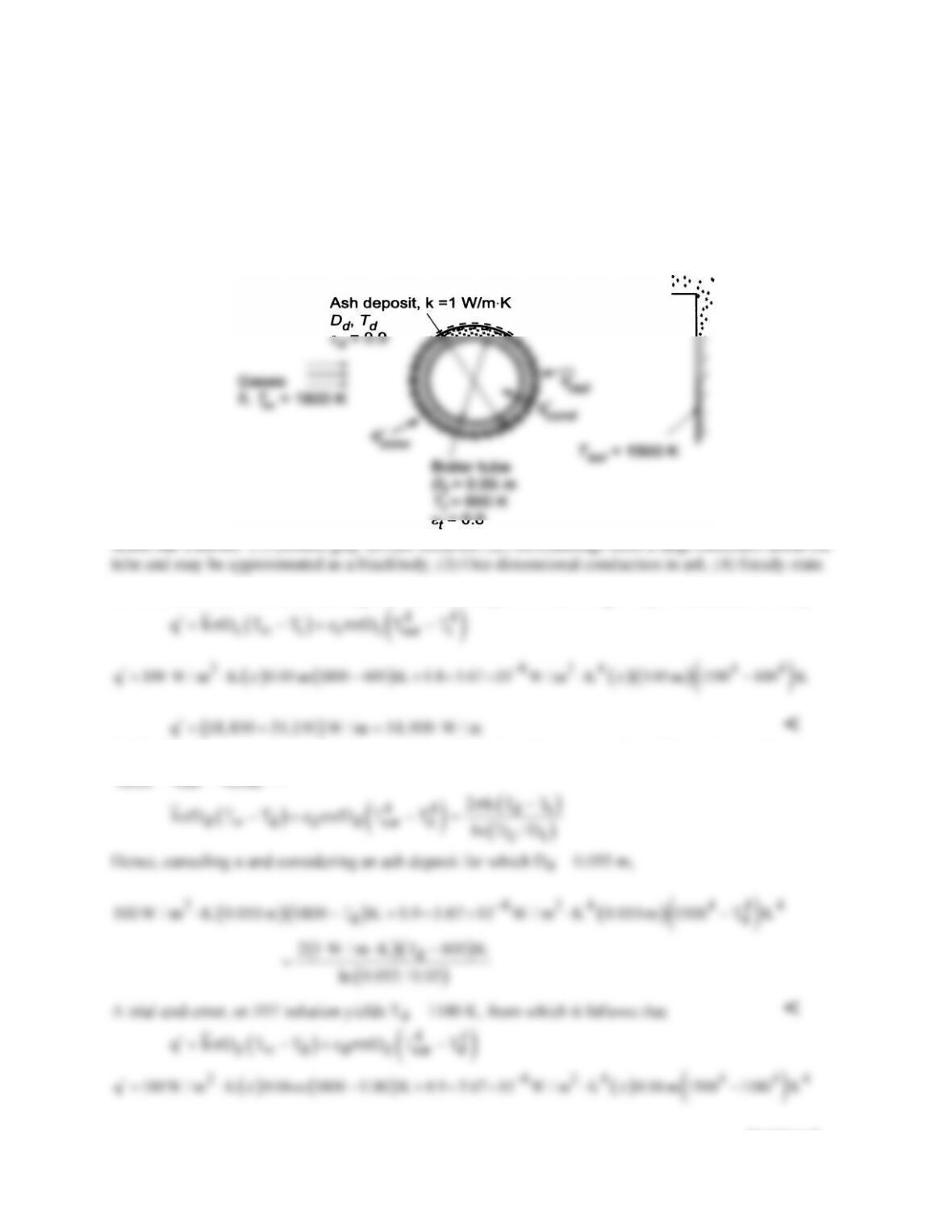
(b) The equations required of the analysis above were solved using IHT. The analysis is extended to
calculate the ceiling temperatures for a range of insulation thickness and the results plotted below.
15
For the reflective panel (ε = 0.05), the ceiling surface temperature is considerably above the dew
COMMENTS: From the analysis, recognize that the radiative exchange between the ice and the
PROBLEM 13.73
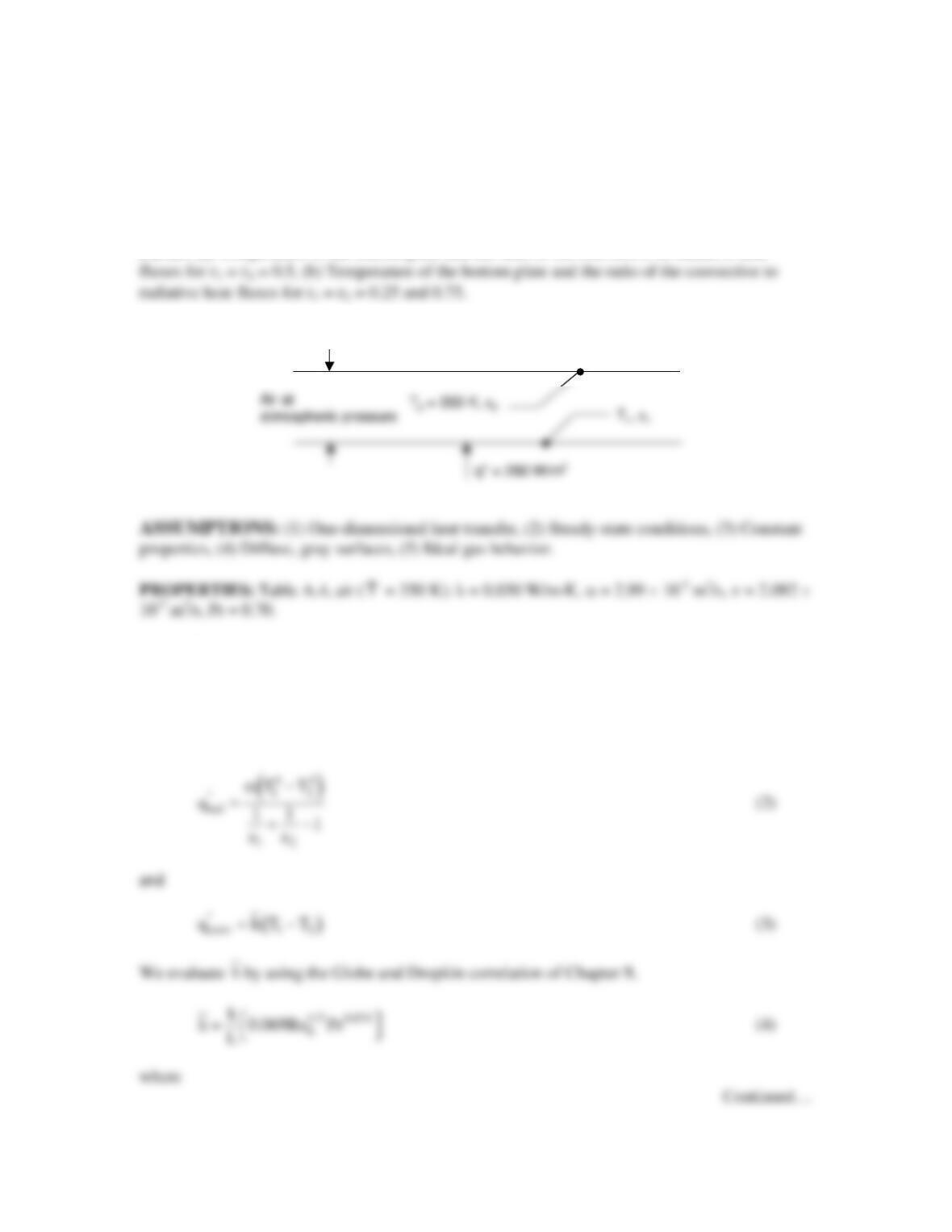
KNOWN: Diameter, temperature and emissivity of boiler tube. Thermal conductivity and emissivity of
ash deposit. Convection coefficient and temperature of gas flow over the tube. Temperature of
surroundings.
FIND: (a) Rate of heat transfer to tube without ash deposit, (b) Rate of heat transfer with an ash deposit
of diameter Dd = 0.055 m, (c) Effect of deposit diameter on deposit surface temperature, heat rate, and
contributions due to convection and radiation.
SCHEMATIC:
ANALYSIS: (a) Without an ash deposit, the heat rate per unit tube length may be calculated directly.
(b) Performing an energy balance for a control surface about the outer surface of the ash deposit,
q q q,
′ ′′
+=
or
Continued …
PROBLEM 13.73 (Cont.)
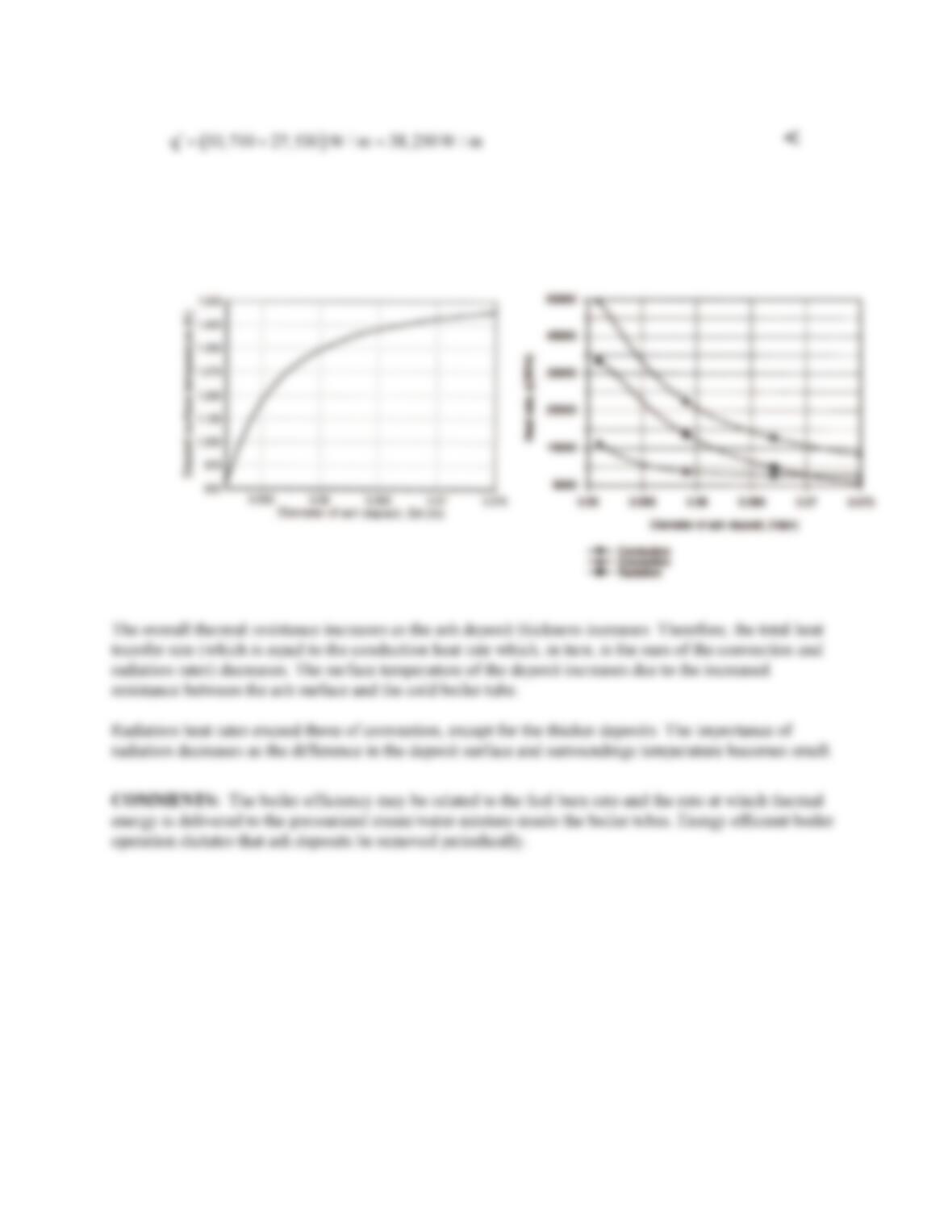
(c) The foregoing energy balance was entered into the IHT workspace and parametric calculations were
performed to explore the effect of Dd on the ash deposit surface temperature and heat rates.
PROBLEM 13.74
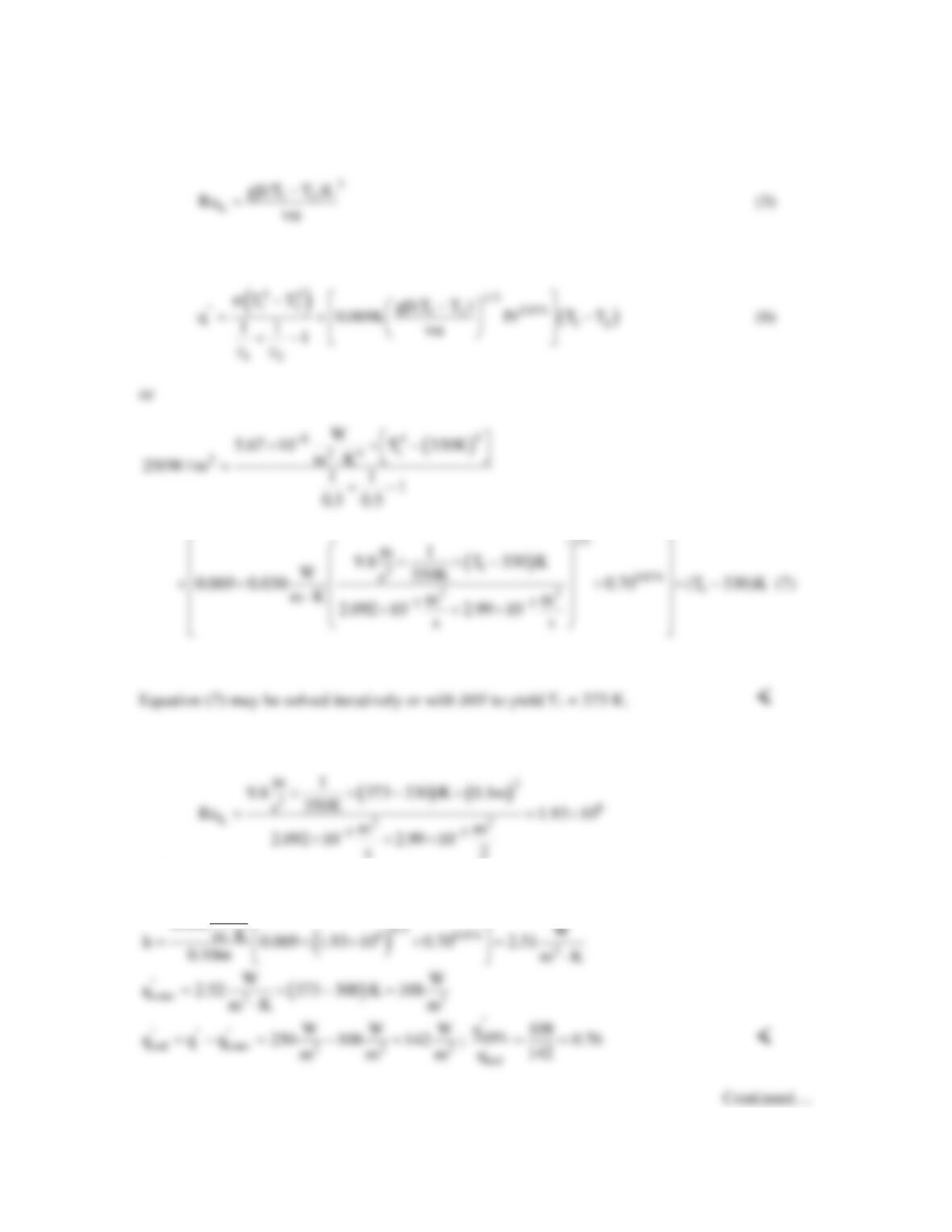
KNOWN: Two large parallel plates, separation distance and temperature of top plate. Gap
between plates is filled with atmospheric pressure air, and heat flux from the bottom plate.
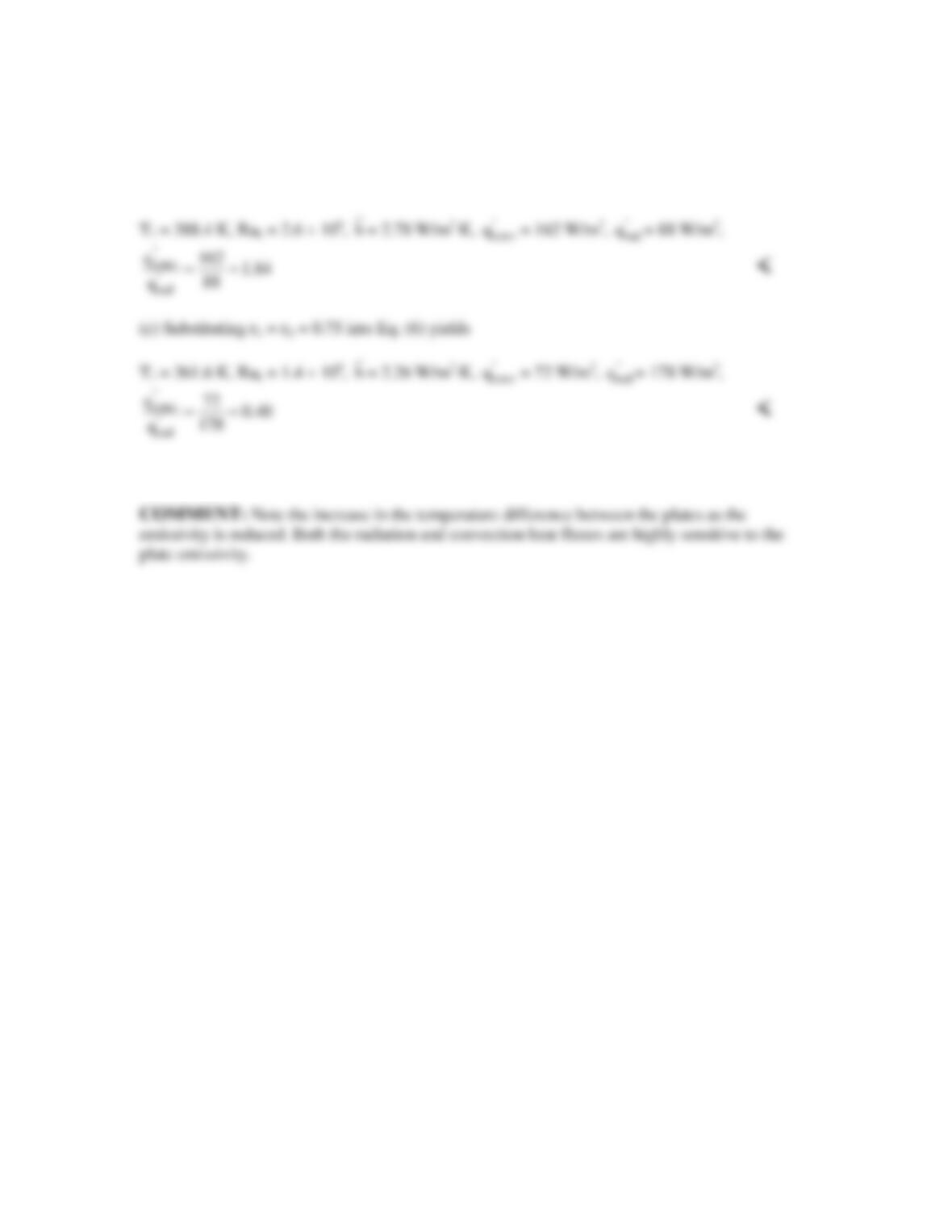
FIND: (a) Temperature of the bottom plate and the ratio of the convective to radiative heat
SCHEMATIC:
ANALYSIS: (a) The heat flux is composed of radiation and convection components,
“” “
rad conv
qq q= +
(1)
where
L
L
PROBLEM 13.74 (Cont.)
Combining Eqs. (1) through (5) yields
In addition,
and
W
PROBLEM 13.74 (Cont.)
(b) Substituting ε1 = ε2 = 0.25 into Eq. (6) yields