Advanced Topics in Shear Strength of Soils and Rocks Chapter 13
CHAPTER 13
ADVANCED TOPICS IN SHEAR STRENGTH OF SOILS
AND ROCKS
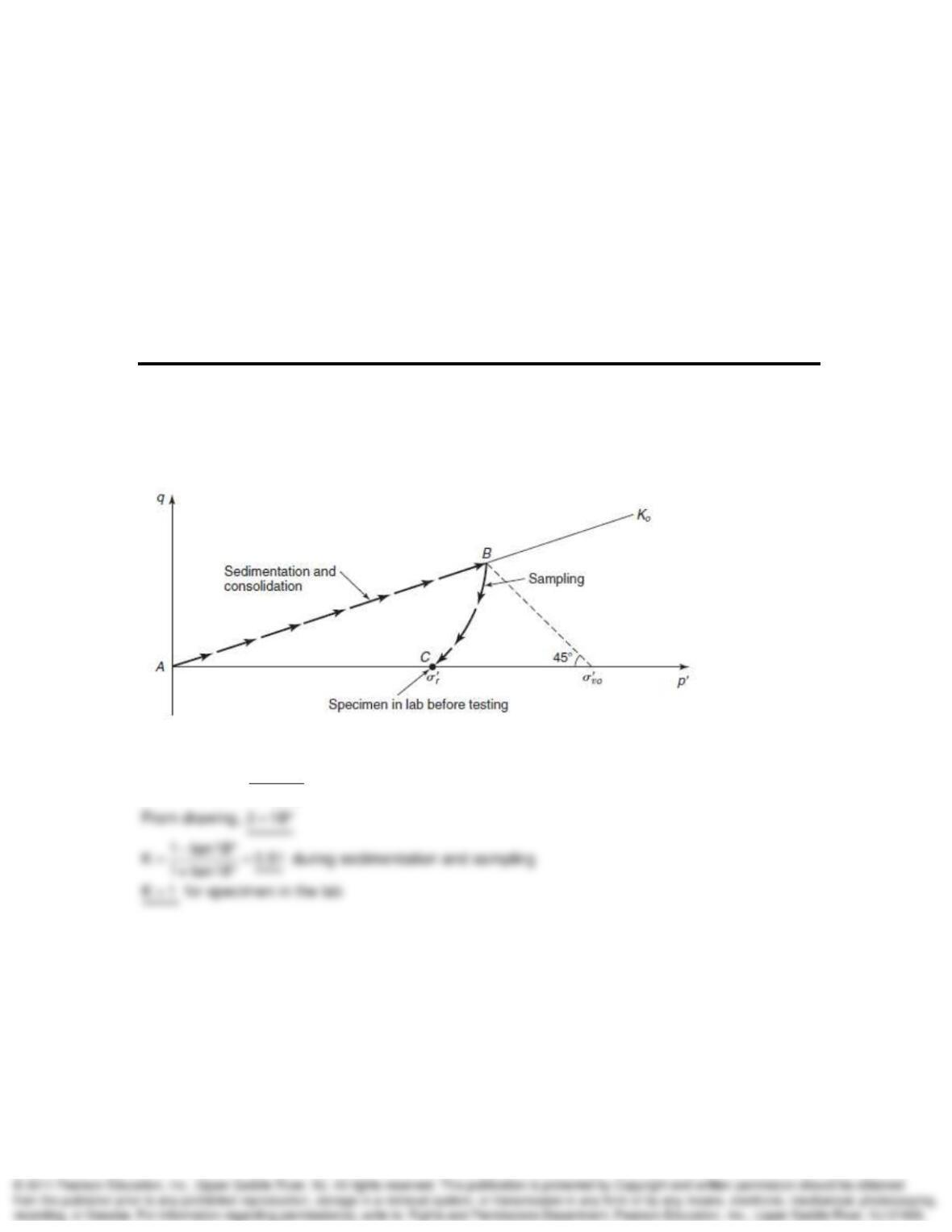
13-1. Evaluate the and for the conditions shown in Fig. 13.6.
SOLUTION:
1tan
(Eq. 13.4) K 1tan
Advanced Topics in Shear Strength of Soils and Rocks Chapter 13
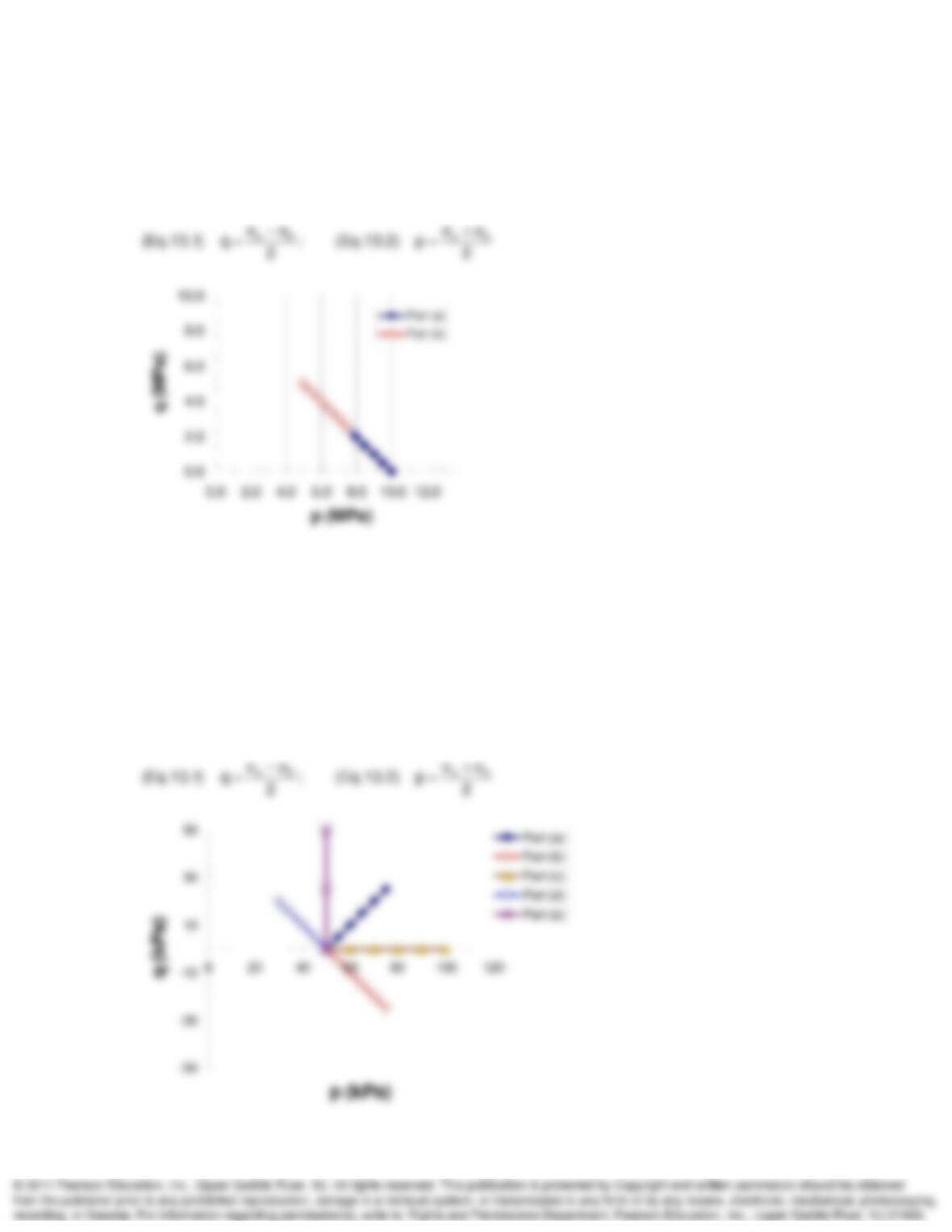
13-2. The initial stress conditions in a soil sample are
v = 10 MPa and
h = 5 MPa, draw stress
paths for
v being held constant while (a)
h increases to 10 MPa and (b)
h decreases to 0.
SOLUTION:
vh
Initial conditions : 10 MPa and 5 MPa
13-6. A soil sample is subjected to an initial equal-all-around hydrostatic state of stress of 50
kPa. Sketch the stress paths for the loading conditions when (a)
h remains constant and
v
increases to 100 kPa; (b)
v is held constant while
h increases to 100 kPa; (c) both
h and
v are
increased to 100 kPa; (d)
v remains constant while
h decreases to 10 kPa; and (e)
v is
increased by 25 kPa at the same time that
h is decreased by 25 kPa.
SOLUTION:
vh
Initial conditions : 50 kPa (hydrostatic)
Advanced Topics in Shear Strength of Soils and Rocks Chapter 13
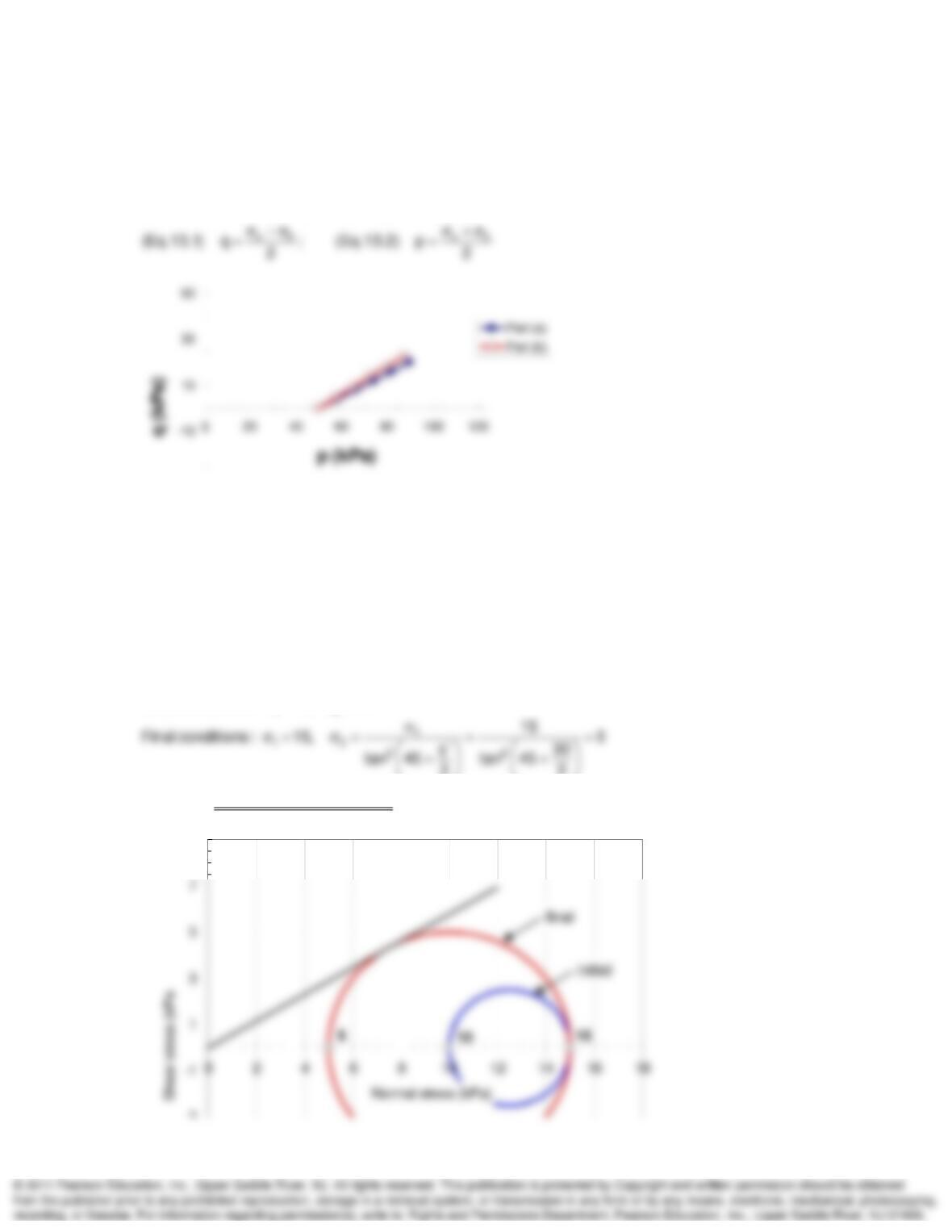
13-7. Given the same initial conditions as for Problem 13.6, draw the stress paths for loading
when (a)
h =
v/3 and (b)
h =
v/4.
SOLUTION:
vh
Initial conditions : 50 kPa (hydrostatic)
13-8. A triaxial sample of loose sand is tested in lateral extension (LE) (see Fig. 13.7). The
sample is first consolidated nonhydrostatically, with
1 = 15 kPa and
3 = 10 kPa. The sample is
then failed in LE, and the angle of internal friction is 30°, c = 0. (a) Draw the Mohr circles for both
initial and “at failure” conditions. (b) What will be the major and minor principal stresses at failure?
SOLUTION:
h3 v1
13
1f 3 f
For lateral extension: ( ) decreases, and ( ) remains constant
Initial conditions: 15, 10
22
At failue : 15 kPa, 5 kPa
9
Advanced Topics in Shear Strength of Soils and Rocks Chapter 13
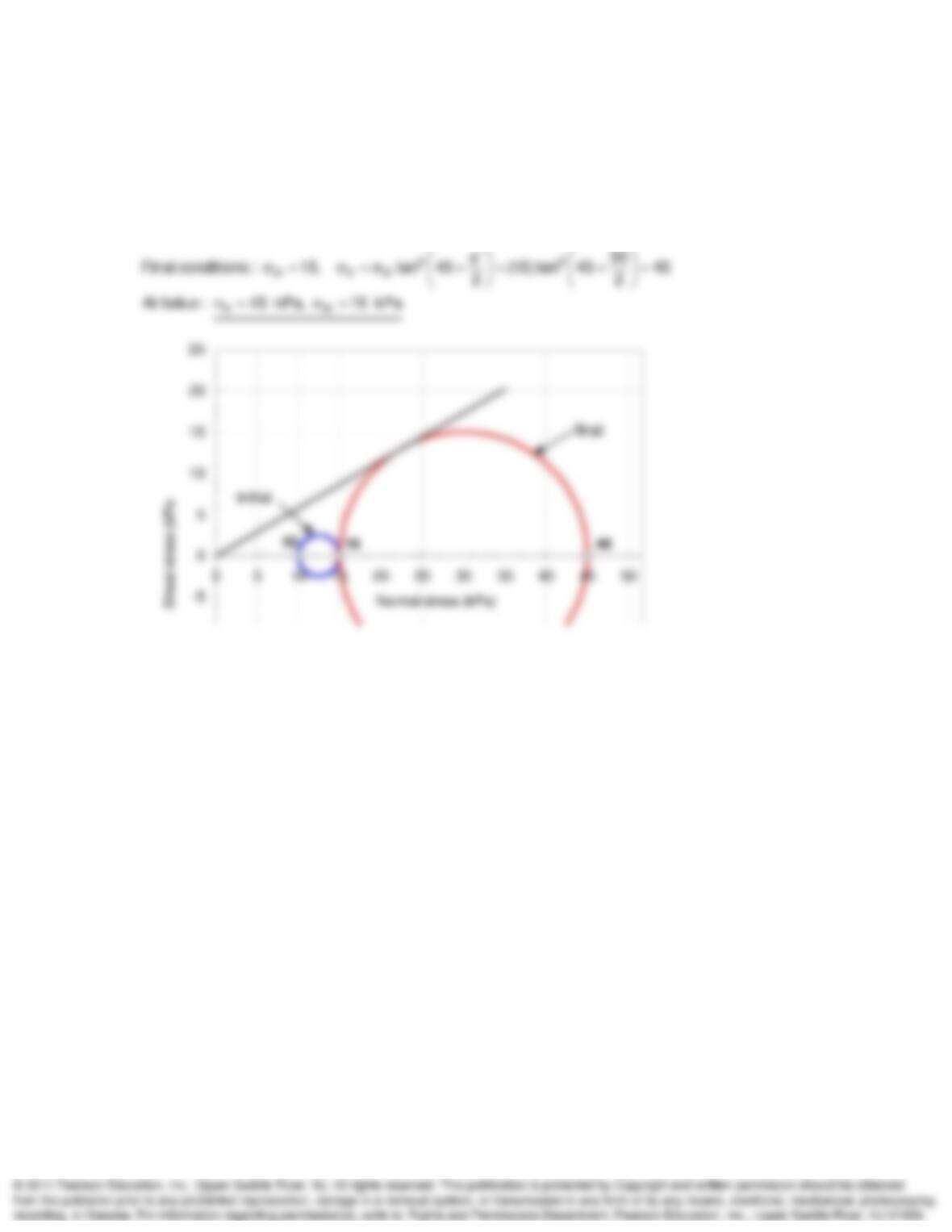
13-9. Another sample of the same sand tested in Problem 13.8 is tested in lateral compression
(LC). Complete parts (a) and (b) requested in Problem 13.8 for this test.
SOLUTION:
hv
13
For lateral compression; increases, and remains constant.
Initial conditions: 15, 10
Advanced Topics in Shear Strength of Soils and Rocks Chapter 13
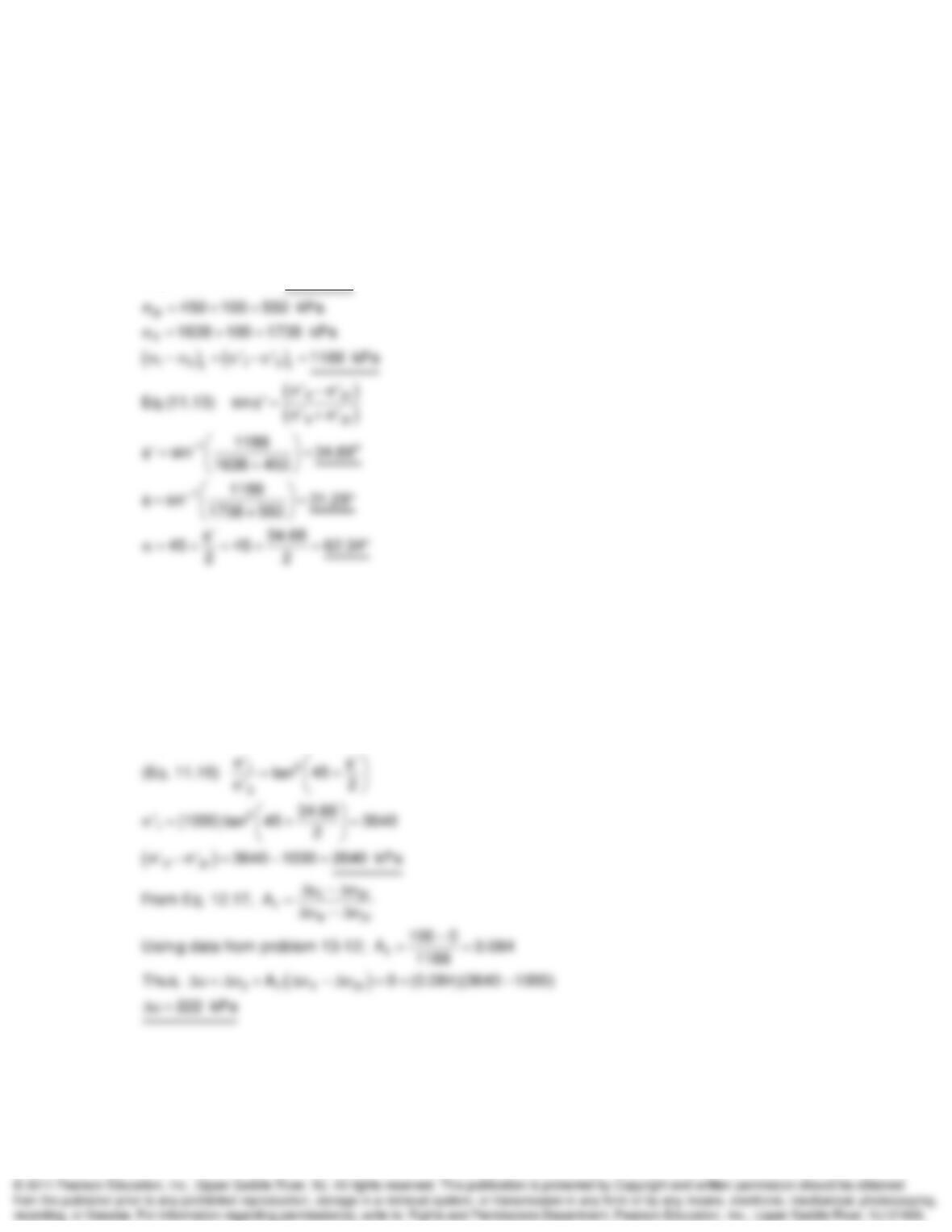
13-12. The test of Problem 12.22 is conducted undrained. An undrained triaxial test is performed
on a sand with
’3c=
’3f = 450 kPa. At failure,
max = 594 kPa. Find (
1 –
3)f,,
’,
total, and the
angle of the failure plane in the specimen.
uf = 100 kPa.
SOLUTION:
max 3f
1f
radius 594, ‘ 450
center 450 594 1044
‘ 450 2(594) 1638 kPa
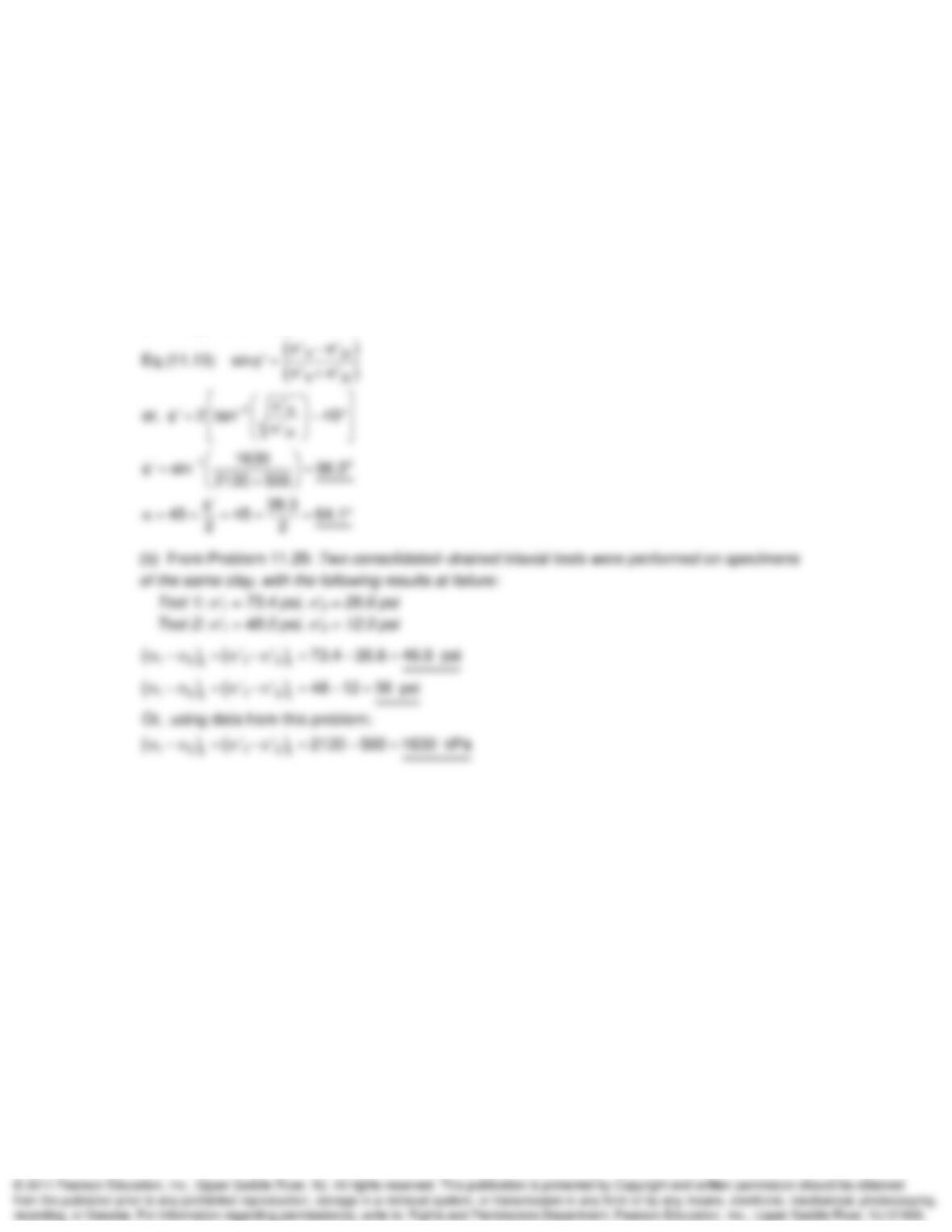
13-13. If the test of Problem 13.12 were conducted at an initial confining pressure of 1000 kPa,
estimate the principal stress difference and the induced pore water pressure at failure.
SOLUTION:
o
3f
‘ 1000 kPa, ‘ 34.68
Advanced Topics in Shear Strength of Soils and Rocks Chapter 13
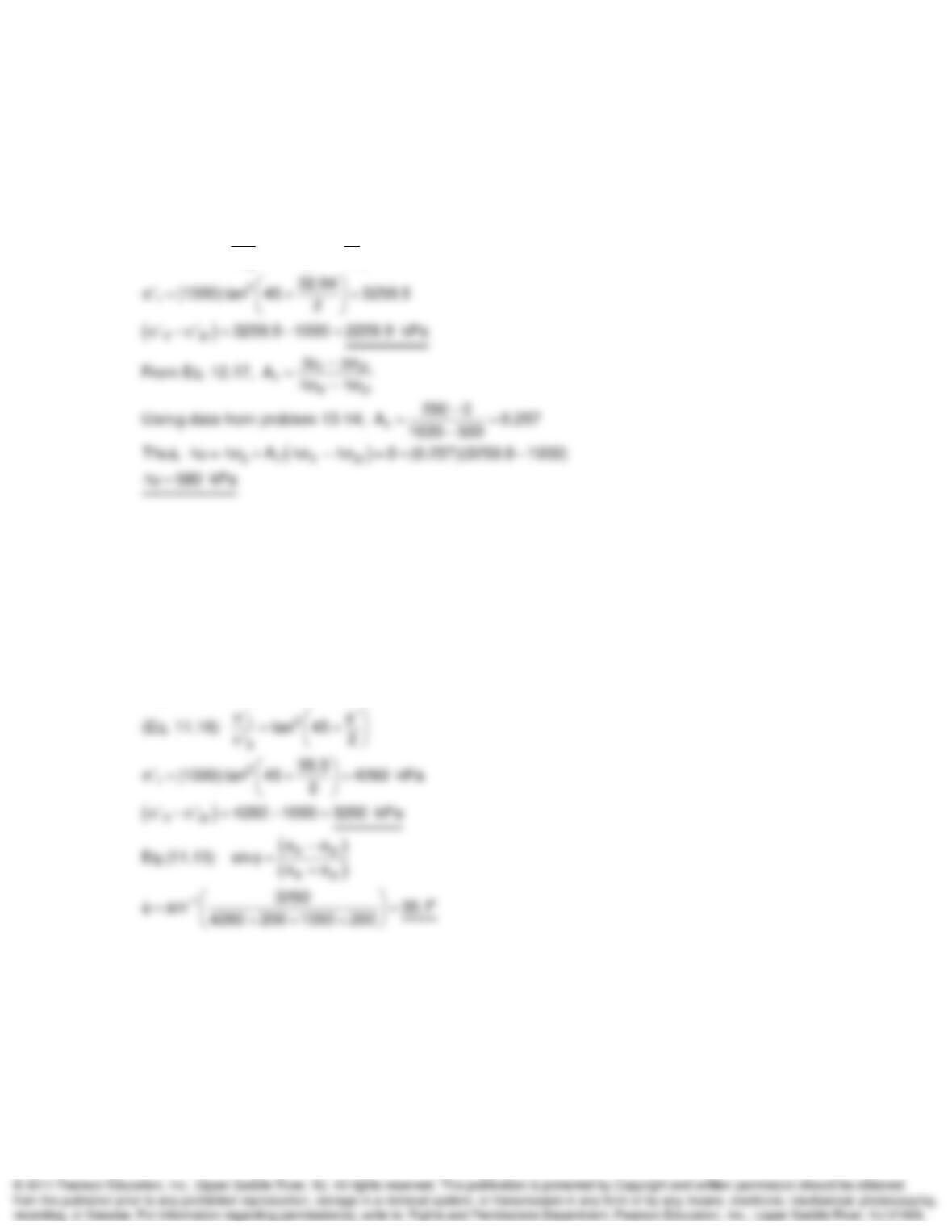
13-14. A silty sand is tested consolidated-drained in a triaxial cell where both principal stresses
at the start of the test were 500 kPa. If the total axial stress at failure is 1.63 MPa while the
horizontal pressure remains constant, compute the angle of shearing resistance and the
theoretical orientation of the failure plane with respect to the horizontal. The silty sand of Problem
11.29 was inadvertently tested consolidated-undrained, but the laboratory technician noticed that
the pore pressure at failure was 290 kPa. What was the principal stress difference at failure?
SOLUTION:
3f 1f
13 1 3
ff
(a) ‘ 500, ‘ 1630 500 2130
‘ ‘ 2130 500 1630
Advanced Topics in Shear Strength of Soils and Rocks Chapter 13
13-15. If the consolidation pressure in the CU test of Problem 13.14 were 1000 kPa instead of
500 kPa, estimate the pore pressure at failure.
SOLUTION:
o
3f
2
1
3
‘ 1000 kPa, ‘ 32.04
‘‘
(Eq. 11.16) tan 45
‘2
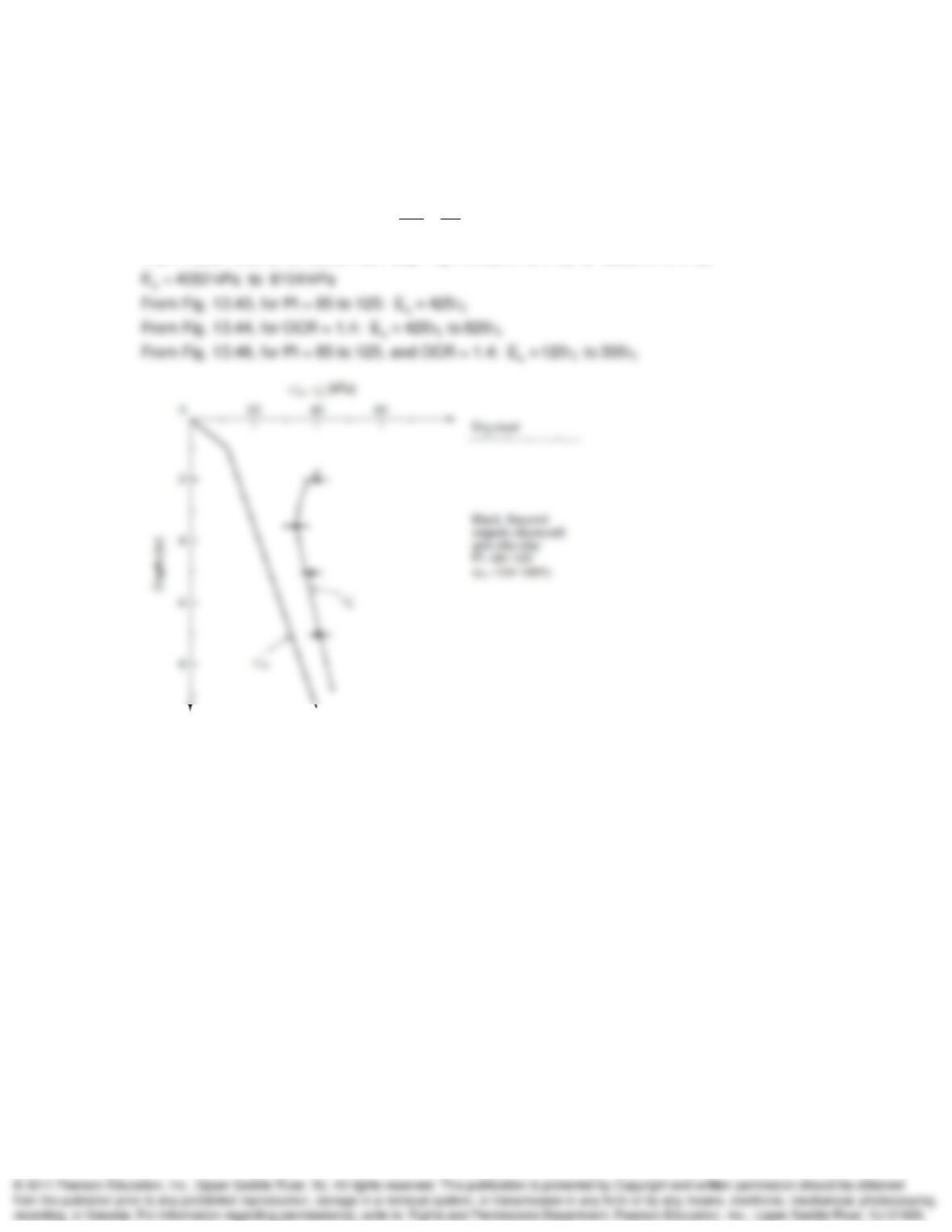
13-16. If the sample of Problem 13.15 were sheared undrained and the induced pore pressure at
failure were 200 kPa, estimate the principal stress difference at failure. What would be the angle
of shearing resistance in terms of total stresses?
SOLUTION:
o
3f f
‘ 1000 kPa, ‘ 38.3 , u 200 kPa
Advanced Topics in Shear Strength of Soils and Rocks Chapter 13
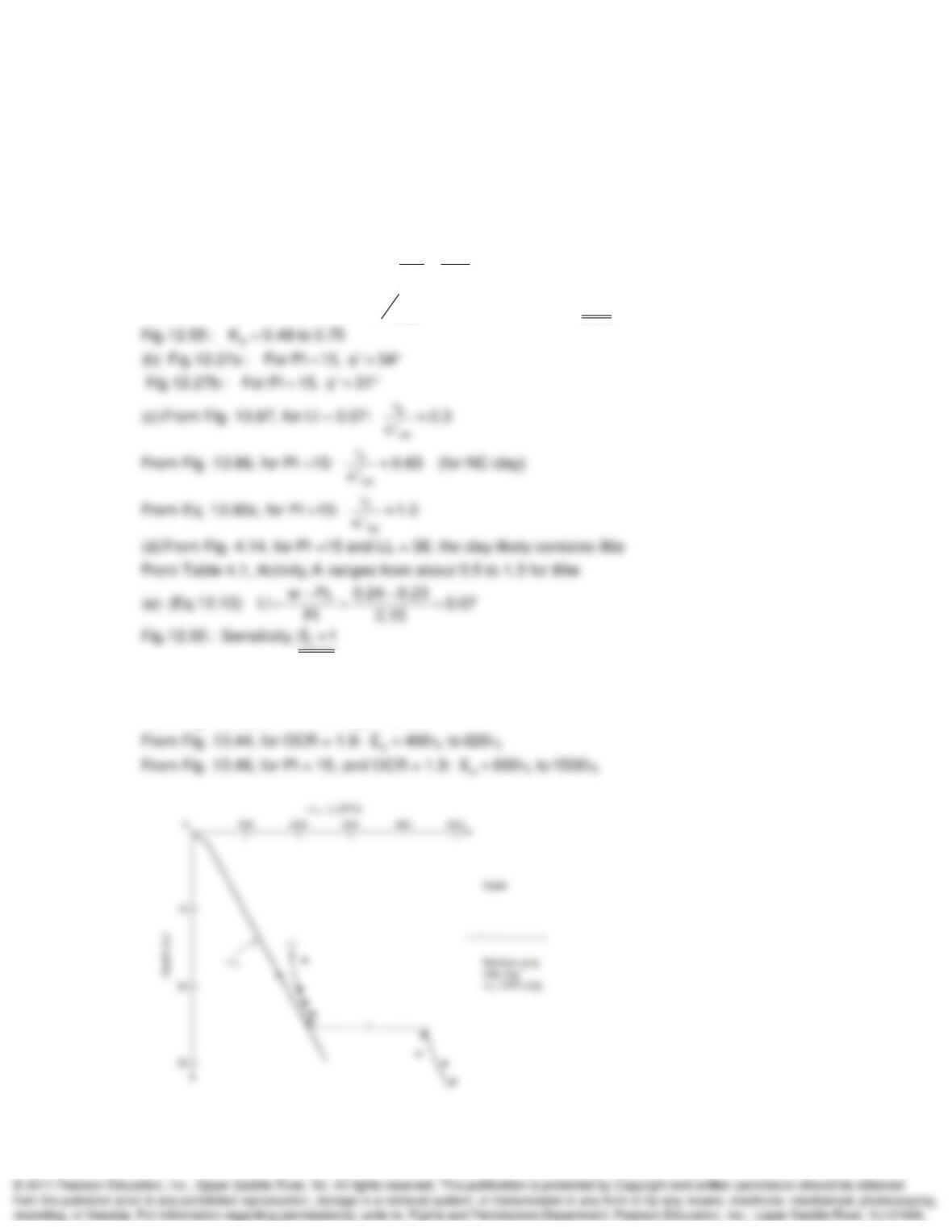
13-19. The data presented in Fig. 8.20(b) are for a black fissured organic silty clay or clayey silt.
At a depth of 6 m, estimate the expected value or range of values of the undrained modulus.
SOLUTION:
p
v
‘39
The soil is overconsolidated: OCR 1.4
‘28
From Table 13.3, for a medium-stiff clay: E (40)(101.3 kPa) to (80)(101.3 kPa)
Advanced Topics in Shear Strength of Soils and Rocks Chapter 13
13-20. The medium gray silty clay of Fig. 8.23(b) at a depth of 20 m had an LL of 38 and a PL of
23. Estimate the following parameters for this soil: (a) coefficient of earth pressure at rest; (b)
effective angle of internal friction; (c) ratio of
f/
’vo; (d) activity; (e) sensitivity; and (f) the
undrained Young’s modulus.
SOLUTION:
p
v
o
‘450
The soil is overconsolidated: OCR 1.9, PI 38 23 15
‘240
PI
(a) (Eq.12.13) K 0.44 0.42 0.44 (0.42)(0.15) 0.50
100
u
(f) From Table 13.3, for a medium-stiff clay: E (40)(101
u
uf
.3 kPa) to (80)(101.3 kPa)
E 4052 kPa to 8104 kPa
From Fig. 13.43, for PI = 15: E 1200
Advanced Topics in Shear Strength of Soils and Rocks Chapter 13
13-23. Suppose an identical specimen of the same clay as in Problem 12.38 was sheared
undrained, and the induced pore pressure at failure was 85 kPa. Determine the principal stress
difference, total and effective principal stress ratios,
’,
total, Af, and
f for this test.
SOLUTION:
f
22
1
From Problem 12.38
‘
54 45 ‘ 18
2
‘‘18
tan 45 tan 45 1.89
Advanced Topics in Shear Strength of Soils and Rocks Chapter 13
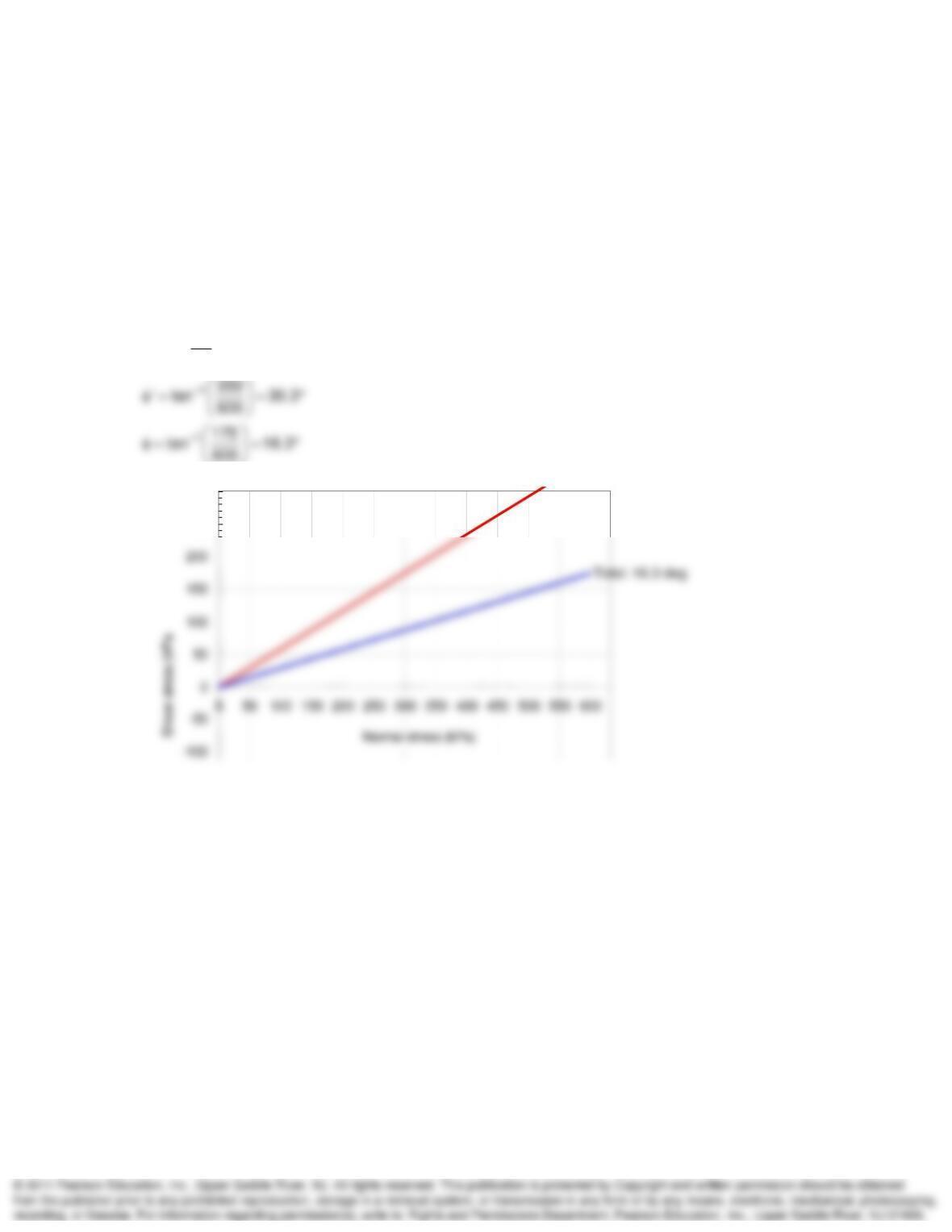
13-24. A series of drained direct shear tests were performed on a saturated clay. The results,
when plotted on a Mohr diagram, gave c’ = 10 kPa and tan
’ = 0.5. Another specimen of this clay
was consolidated to an effective pressure of 100 kPa. An undrained direct shear test was
performed, and the measured value of
ff was 60 kPa. What was the pore water pressure at
failure? Was the specimen normally consolidated? Why?
SOLUTION:
3
From M-C plot, ‘ 62.92 kPa for the drained test
Advanced Topics in Shear Strength of Soils and Rocks Chapter 13
13-25. The following information was obtained from laboratory tests on specimens from a
completely saturated sample of clay: (a) The sample had in the past been precompressed to at
least 200 kPa. (b) A specimen tested in direct shear under a normal stress of 600 kPa, with
complete drainage allowed, showed a shearing strength of 350 kPa. (c) A specimen which was
first consolidated to 600 kPa, and then subjected to a direct shear test in which no drainage
occurred, showed a shearing strength of 175 kPa. Compute
’ and
T for the undrained case.
Sketch the Mohr envelopes which you would expect to obtain from a series of undrained and
drained tests on this clay. (After Taylor, 1948.)
SOLUTION:
ff
ff
tan
250
300
Effective: 30.3 deg
Advanced Topics in Shear Strength of Soils and Rocks Chapter 13
13-26. Triaxial tests were performed on undisturbed samples from the same depth of organic
clay whose preconsolidation load, determined from consolidation tests, was in the range 90 to
160 kPa. The principal stresses at failure of two CD tests were Data from one CU test on the
same clay are shown below. The effective consolidation pressure was 330 kPa and the specimen
was loaded in axial compression. Test No. 1:
3 = 200 kPa,
1 = 704 kPa, Test No. 2:
3 = 278
kPa,
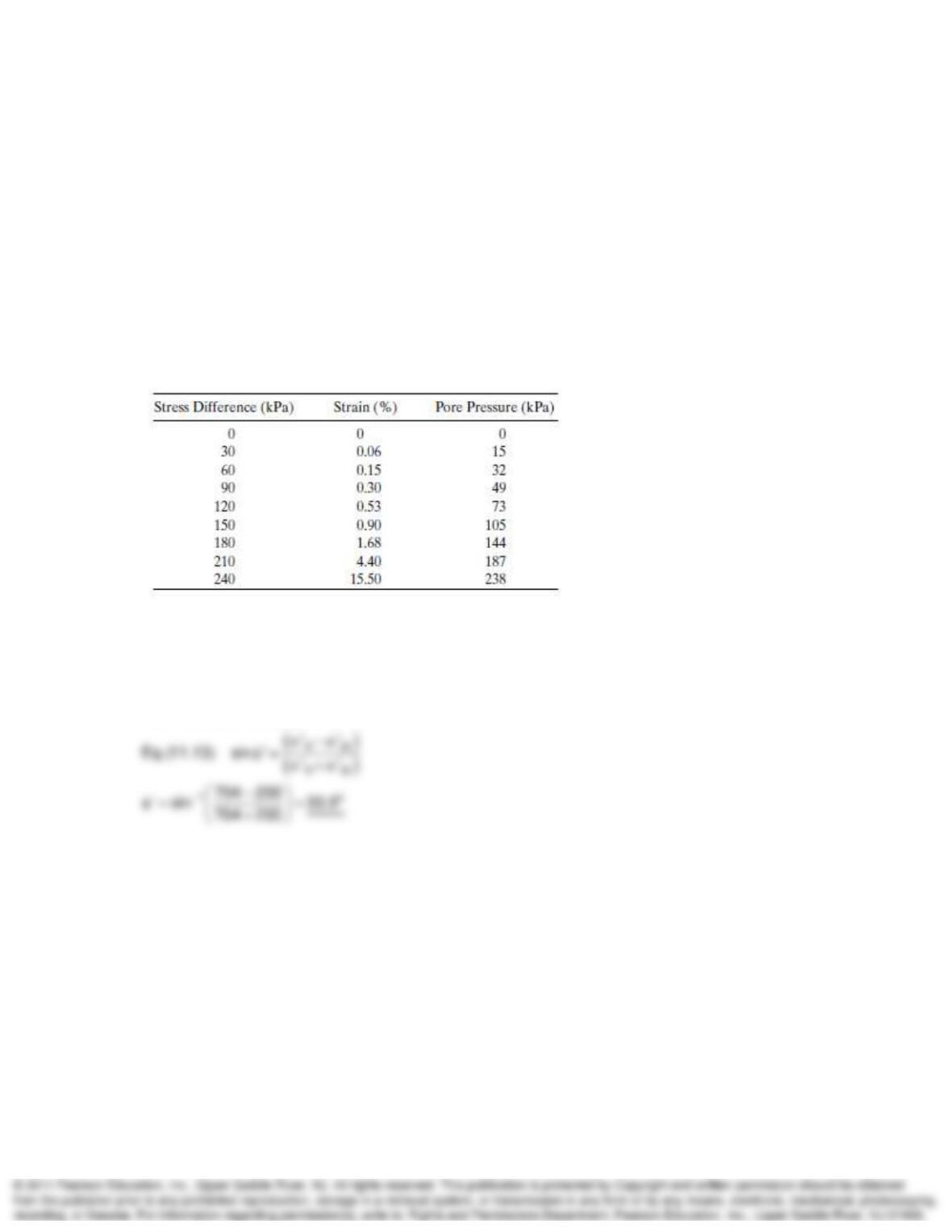
1 = 979 kPa Stress Difference (kPa) Strain (%) Pore Pressure (kPa) (a) Plot the Mohr
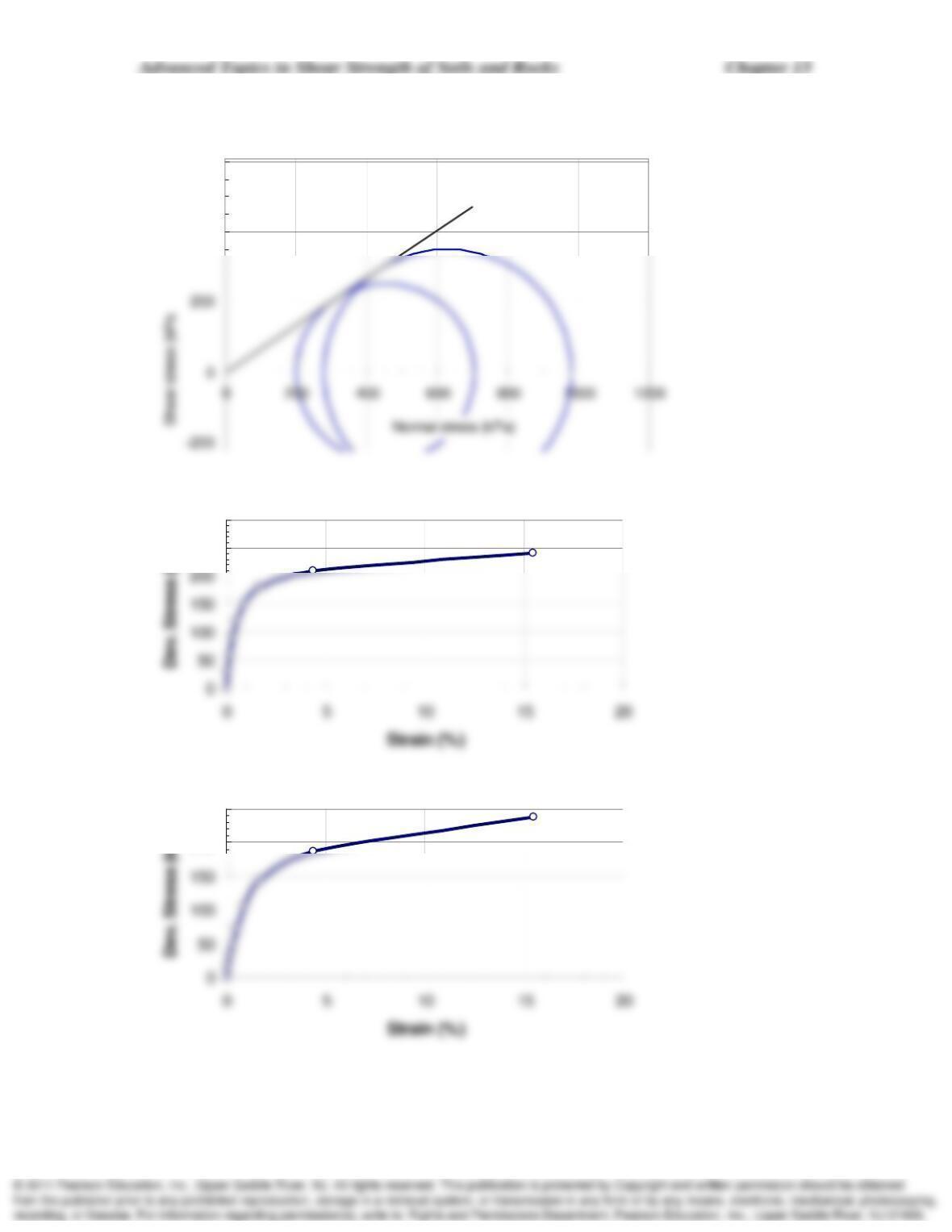
circles at failure and determine
’ from the CD tests for the normally consolidated portion of the
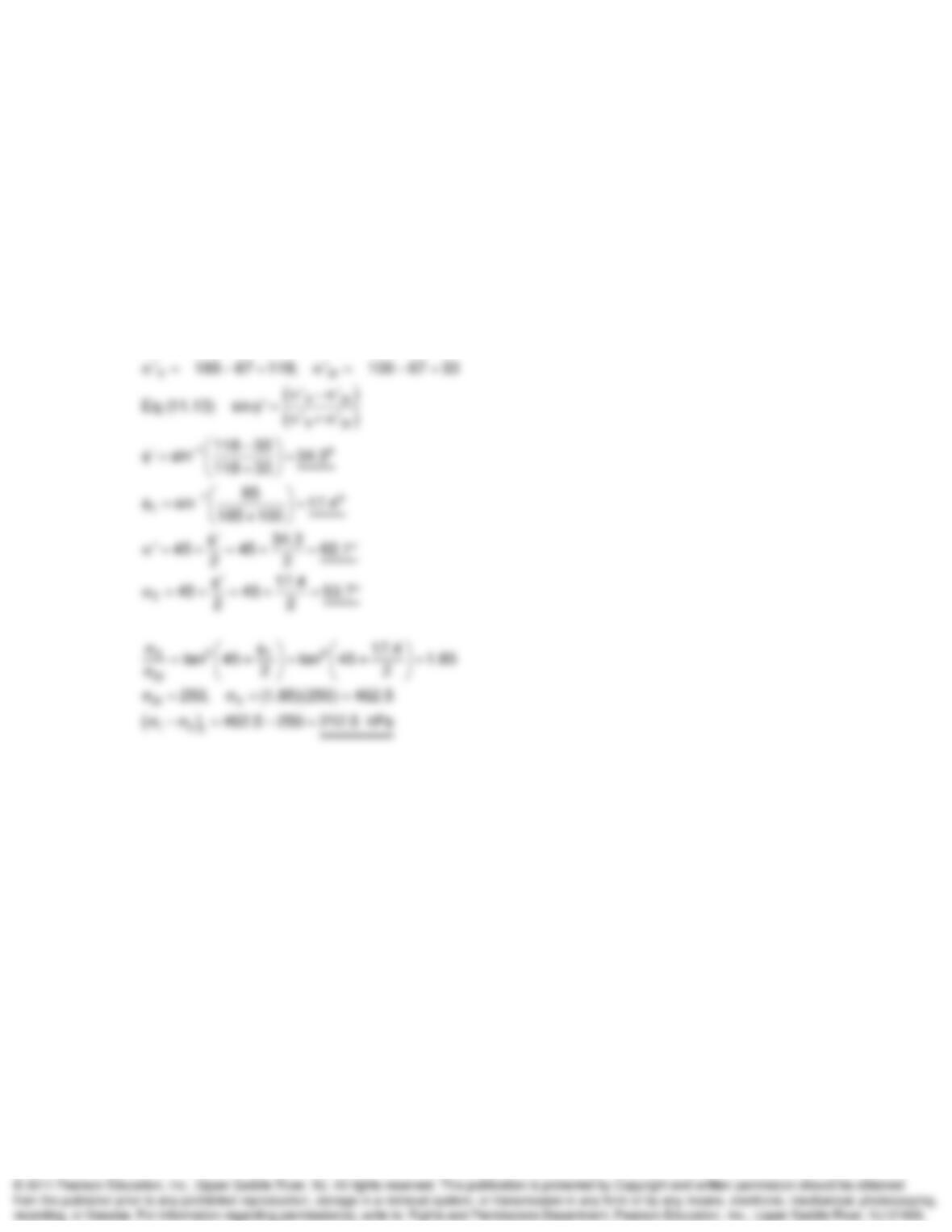
failure envelope. (b) For the CU test, plot curves of principal stress difference and pore pressure
versus strain. (c) Assuming that the single CU test for which data are given is representative for
CU tests run at pressures well above the preconsolidation stress: (a) What is
in terms of total
stresses above the effects of preconsolidation? (b) What is
’ determined by the CU test above
the effects of preconsolidation? (After A. Casagrande.)
SOLUTION:
From the Mohr circles, c’ = 0.
Continued on next page.
Problem 13-26 continued.
400
600
250
300
)
200
250
)
33.9 deg
Advanced Topics in Shear Strength of Soils and Rocks Chapter 13
13-27. An undrained triaxial compression test was performed on a saturated sample of normally
consolidated clay. The consolidation pressure was 100 kPa. The specimen failed when the
principal stress difference was 85 kPa and the induced pore water pressure was 67 kPa. A
companion undrained test was performed on an identical sample of the same clay, but at a
consolidation pressure of 250 kPa. What maximum principal stress difference would you expect
at failure for this second test specimen? What are
and
T? Predict the angle of the failure
planes for the two undrained tests.
SOLUTION:
c31313 f
ff
1f
Test #1: ‘ 100 ; ‘ ‘ 85; u 67
85 100 185
Advanced Topics in Shear Strength of Soils and Rocks Chapter 13
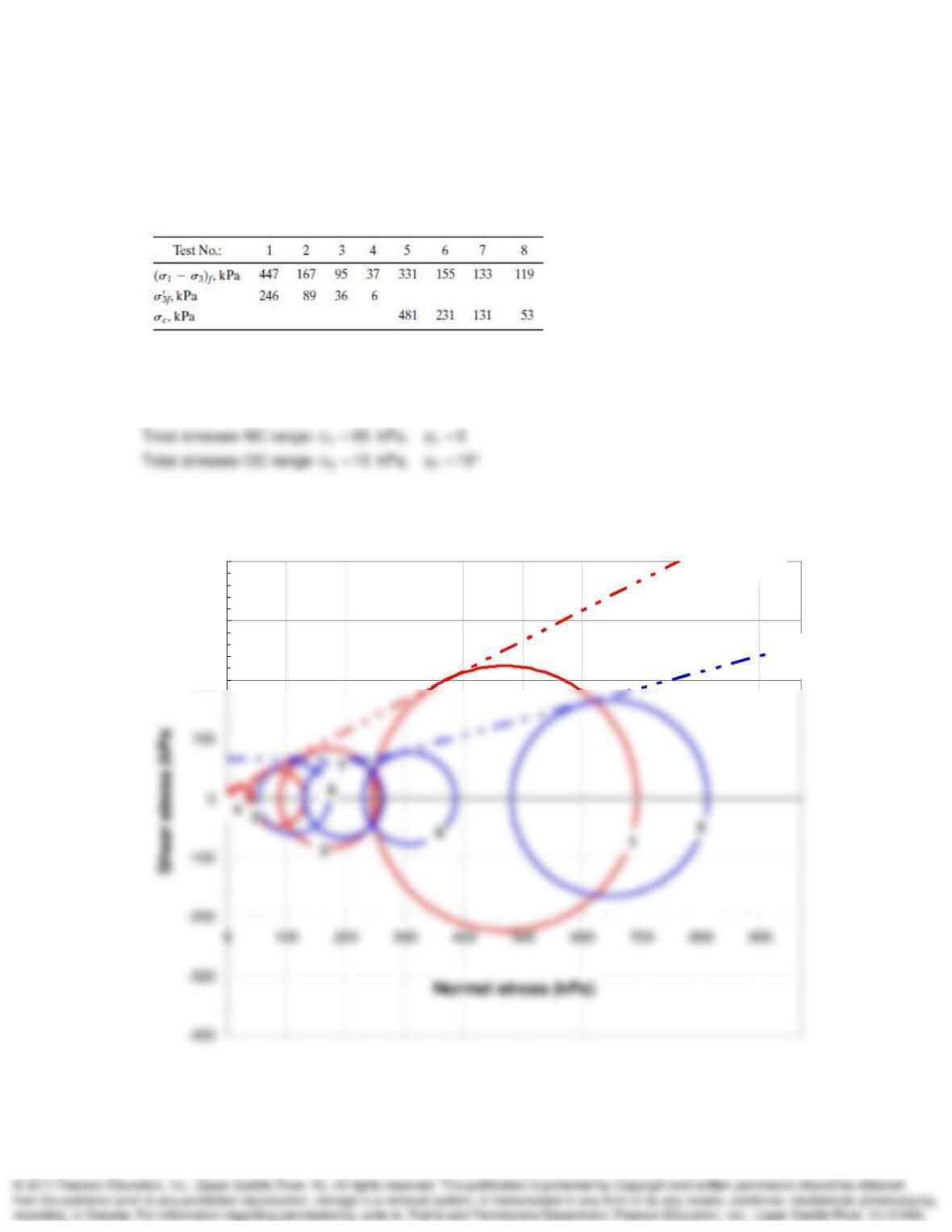
13-28. Triaxial compression tests were run on specimens from a large undisturbed block sample
of clay. Data are given below. Tests 1 through 4 were run so slowly that complete drainage may
be assumed. In tests 5 through 8, no drainage was permitted. Plot the Mohr failure envelopes for
this soil. Determine the Mohr–Coulomb strength parameters in terms of both total and effective
stresses. (After Taylor, 1948.)
SOLUTION:
Estimate strength parameters from the Mohr Circle diagrams shown below.
Effective stresses: ‘ 26.6 , c ‘ 10 kPa
200
300
400
15 deg
(
total
)
26.6 deg
(e
ff
ect
iv
e)
Advanced Topics in Shear Strength of Soils and Rocks Chapter 13
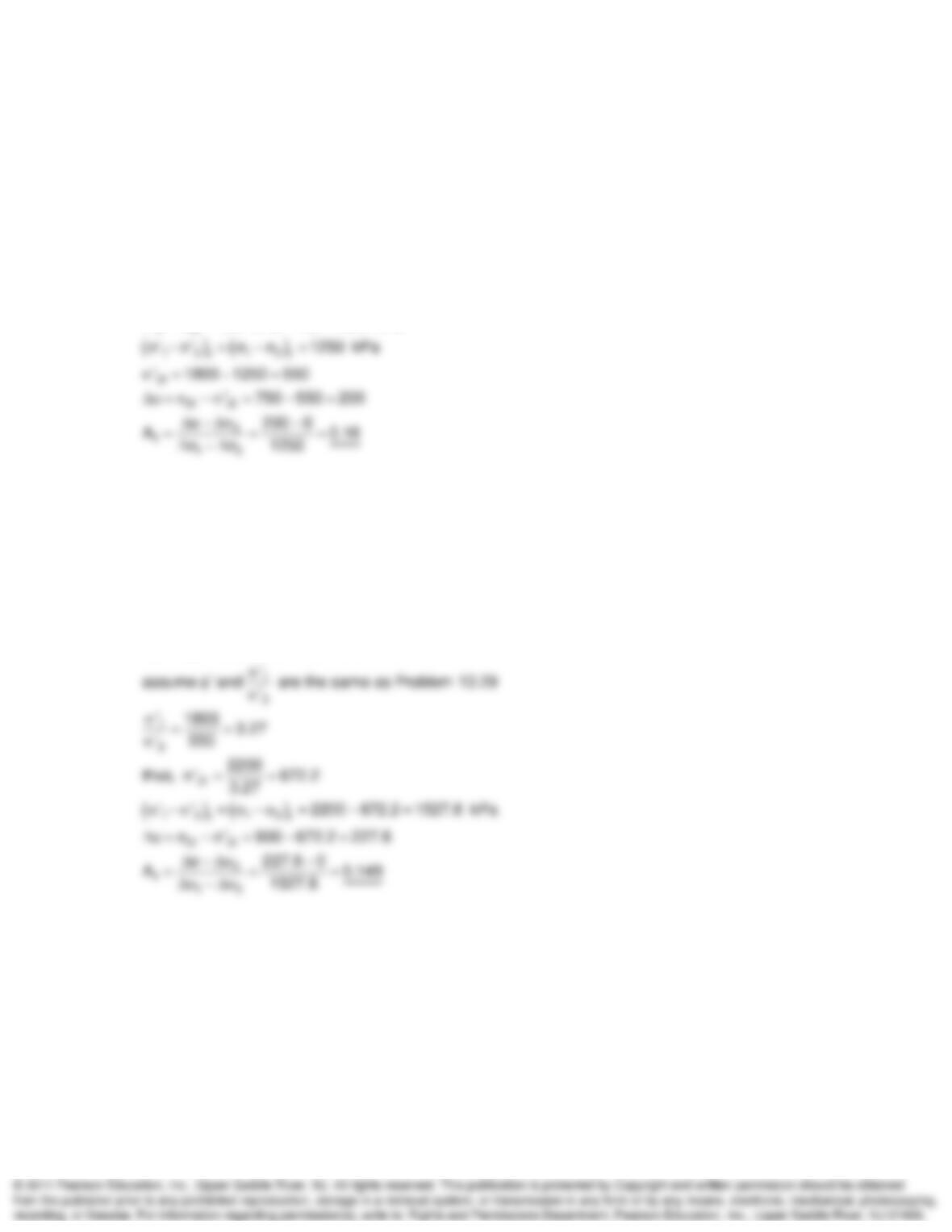
13-29. A CU triaxial test is performed on a cohesive soil. The effective consolidation stress was
750 kPa. At failure, the principal stress difference was 1250 kPa, and the major effective principal
stress was 1800 kPa. Compute Skempton’s pore pressure coefficient A at failure.
SOLUTION:
c3f 1
‘ 750 kPa, ‘ 1800 kPa
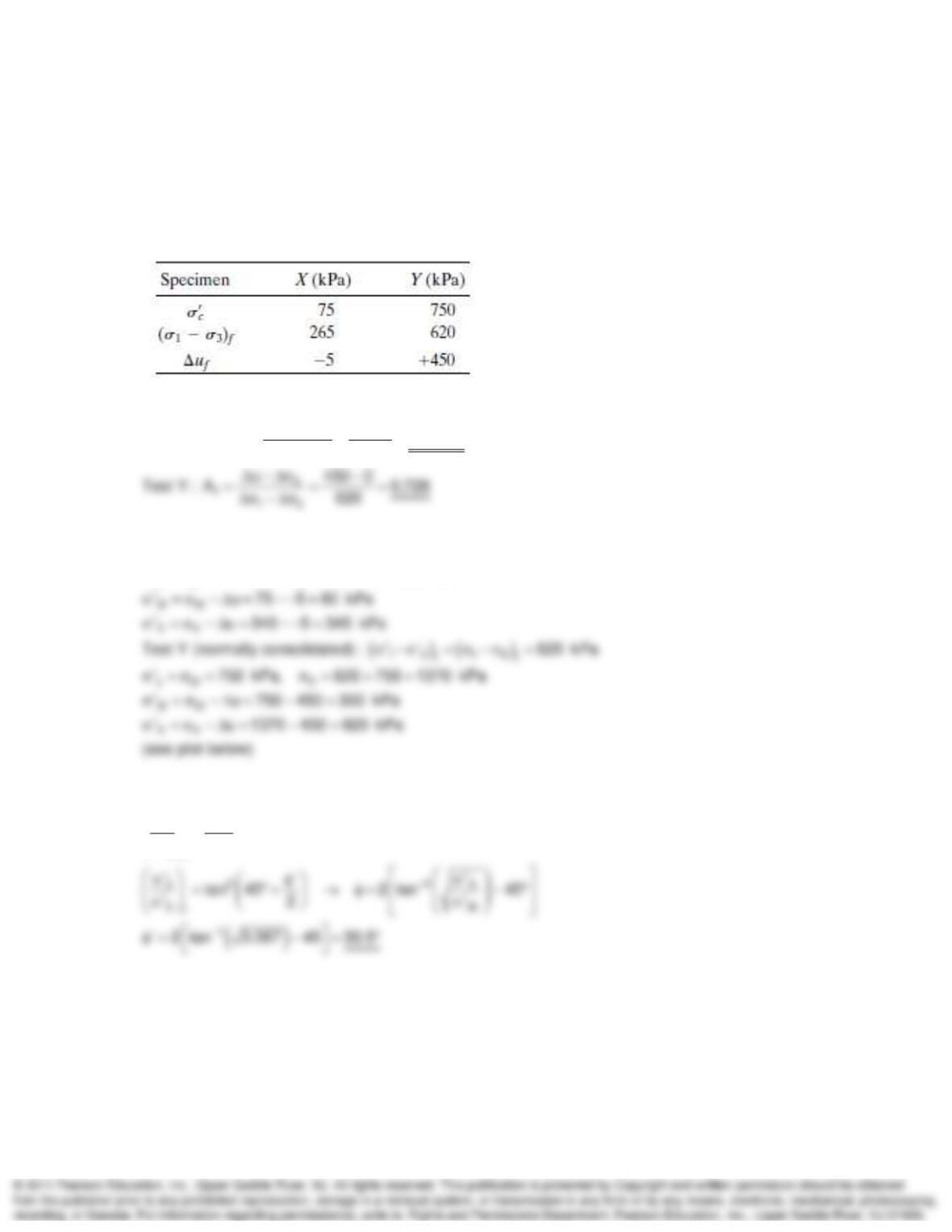
13-30. Suppose another specimen of the soil in the preceding problem developed a major
effective principal stress of 2200 kPa at failure. What would Skempton’s pore pressure coefficient
A at failure be, if
’c = 900 kPa?
SOLUTION”
c3f 1
‘ 900 kPa, ‘ 2200 kPa
Advanced Topics in Shear Strength of Soils and Rocks Chapter 13
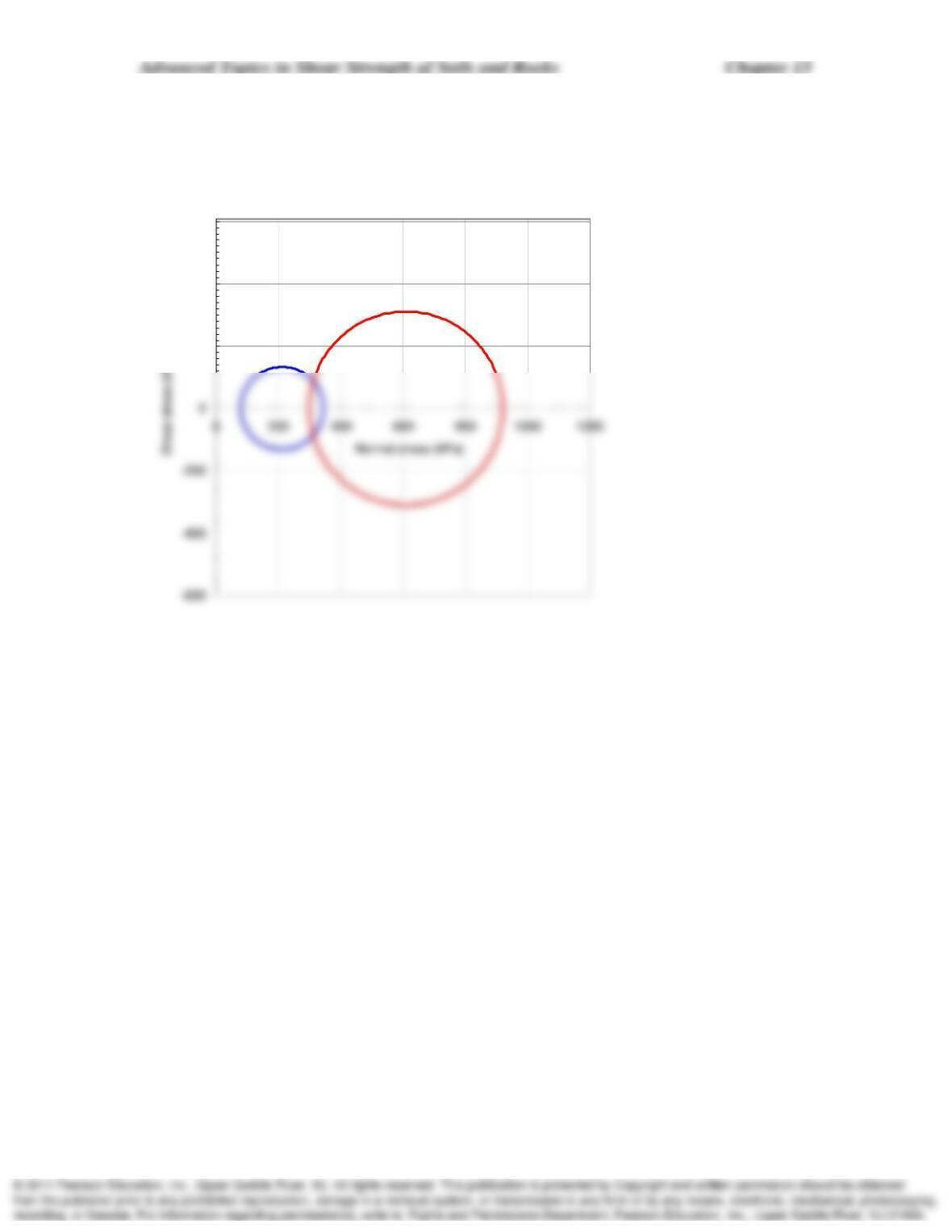
13-31. Two samples of a slightly overconsolidated clay were tested in triaxial compression, and
the following data at failure were obtained. The preconsolidation stress for the clay was estimated
from oedometer tests to be about 400 kPa. (a) Determine the Skempton pore pressure
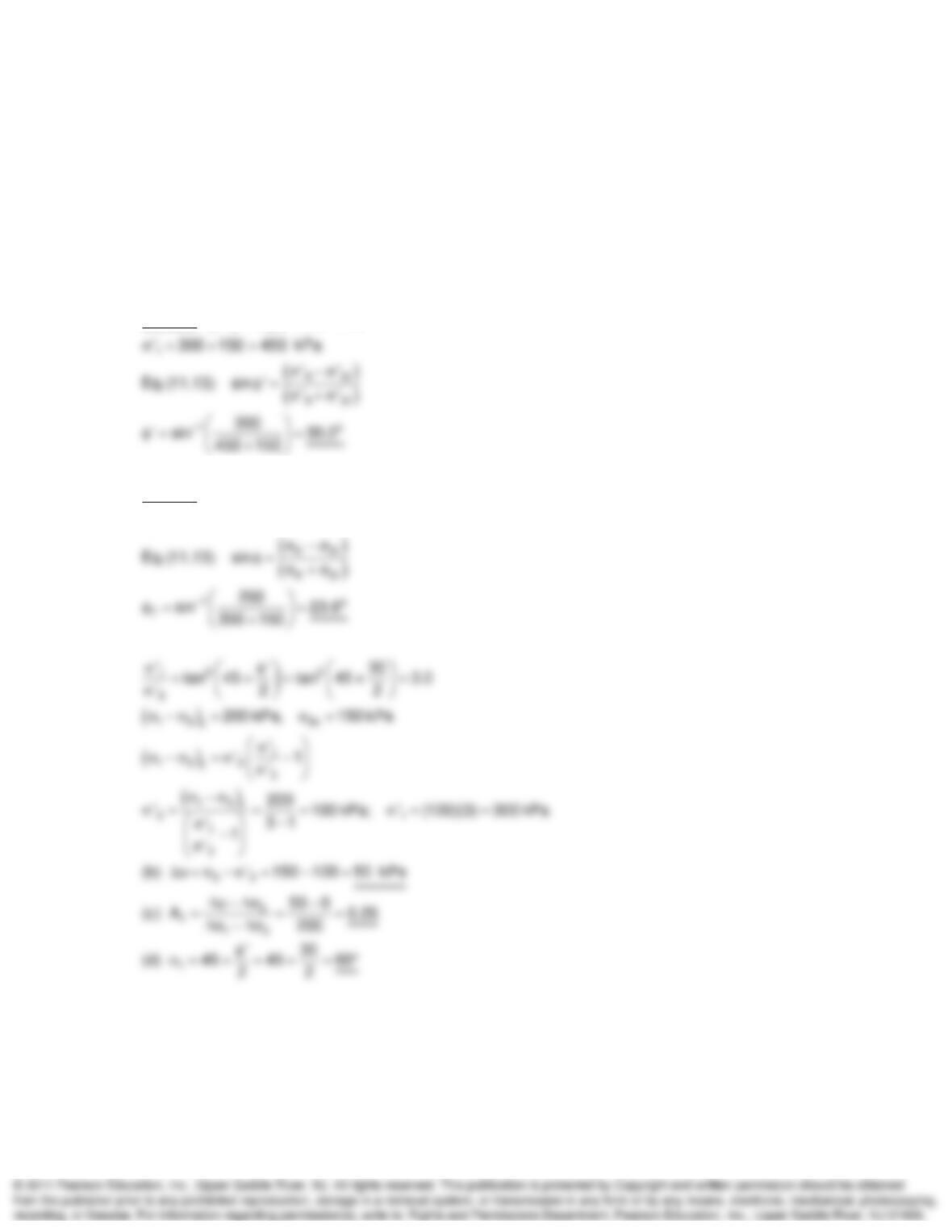
parameter A at failure for both tests. (b) Plot the Mohr circles at failure for both total and effective
stresses. (c) Estimate
’ in the normally consolidated range, and c’ and
’ for the
overconsolidated range of stresses.
SOLUTION:
3
f
13
13 13
ff
c3f 1f
u50
(a) Test X : A 0.0189
265
(b) Test X (overconsolidated): ‘ ‘ 265 kPa
‘ 75 kPa, 265 75 340 kPa
(c) For the normally consolidated rang
1
3f
e (Test Y):
‘920 3.067
‘300
Problem 13-31 continued.
200
400
600
Advanced Topics in Shear Strength of Soils and Rocks Chapter 13
13-32. Two identical specimens of soft saturated normally consolidated clay were consolidated to
150 kPa in a triaxial apparatus. One specimen was sheared drained, and the principal stress
difference at failure was 300 kPa. The other specimen was sheared undrained, and the principal
stress difference at failure was 200 kPa. Determine (a)
’ and
total; (b) uf in the undrained
specimen; (c) Af in the undrained specimen; and (d) the theoretical angle of failure planes for both
specimens.
SOLUTION:
c
1f 3 f
1f 3 f
1
‘ 150 kPa
CD test: ‘ ‘ 300 kPa
CU test: 200 kPa
200 150 350 kPa