13-1
CHAPTER 13
Stability of Earth Slopes
QUESTIONS AND PRACTICE PROBLEMS
Section 13.1 Terminology
13.1 Define, with the help of a sketch if appropriate, the following terms as related to slope
stability:
(a) Natural slope
(b) Cut slope
(c) Fill slope
(d) Top of slope
(e) Toe of slope
(f) Slope face
(g) Terrace
(h) Slope ratio
(i) Slope height
Solution
(a) A natural slope is part of the natural terrain where the ground surface is sloping
(see Figure 13.3 in text).
13-2 Stability of Earth Slopes Chap. 13
Section 13.2 Modes of Slope Instability
13.2 Define the following types of slope instability:
(a) Falls
(b) Topples
(c) Slides
(d) Spreads
(e) Flows
Solution
(a) Falls are slope failures consisting of soil or rock fragments that drop rapidly down
a slope, bouncing, rolling and even becoming airborne along the way.
13.3 Explain the difference between a flow and a slide. Which one often travels farther, and
thus can be a hazard to sites far from the slope?
Solution
According to Varnes’ classification system, a slide is a slope failure that consists of one
13.4 Cut slopes in bedded sedimentary rocks can be very problematic. What mode of failure
do you think would be most common in these rocks, and how could we evaluate the
potential for such a failure before construction?
Solution
Bedded sedimentary rocks, like many discontinuous rock masses, are much weaker along
Chap. 13 Stability of Earth Slopes 13-3
Section 13.4 Quantitative Analysis of Slides
13.5 Describe the limit equilibrium analysis method.
Solution
In a limited equilibrium analysis, we evaluate the slope as if it were about to fail by
13.6 Define the factor of safety as used in limit equilibrium-based slope stability analysis
methods.
Solution
The factor of safety is the ratio of the available shear strength to the equilibrium shear
Section 13.5 General Procedures in a Limit Equilibrium Analysis of a Slide
13.7 Most limit equilibrium analysis methods include one or more simplifying assumptions.
Why are these assumptions necessary? Give an example of one of the methods and its
assumptions.
Solution
Most slope stability problems are statically indeterminate. The simplifying assumptions
13.8 You are writing a computer program to perform slope stability computations. This
program will consider only circular failure surfaces. What procedure might you use to
locate the critical failure surface? Provide a detailed explanation.
Solution
There are several ways to do this, including the following:
13-4 Stability of Earth Slopes Chap. 13
Section 13.6 Planar Failure Analysis
13.9 State the assumptions in the planar failure analysis.
Solution
The slide body slides on a planar failure surface.
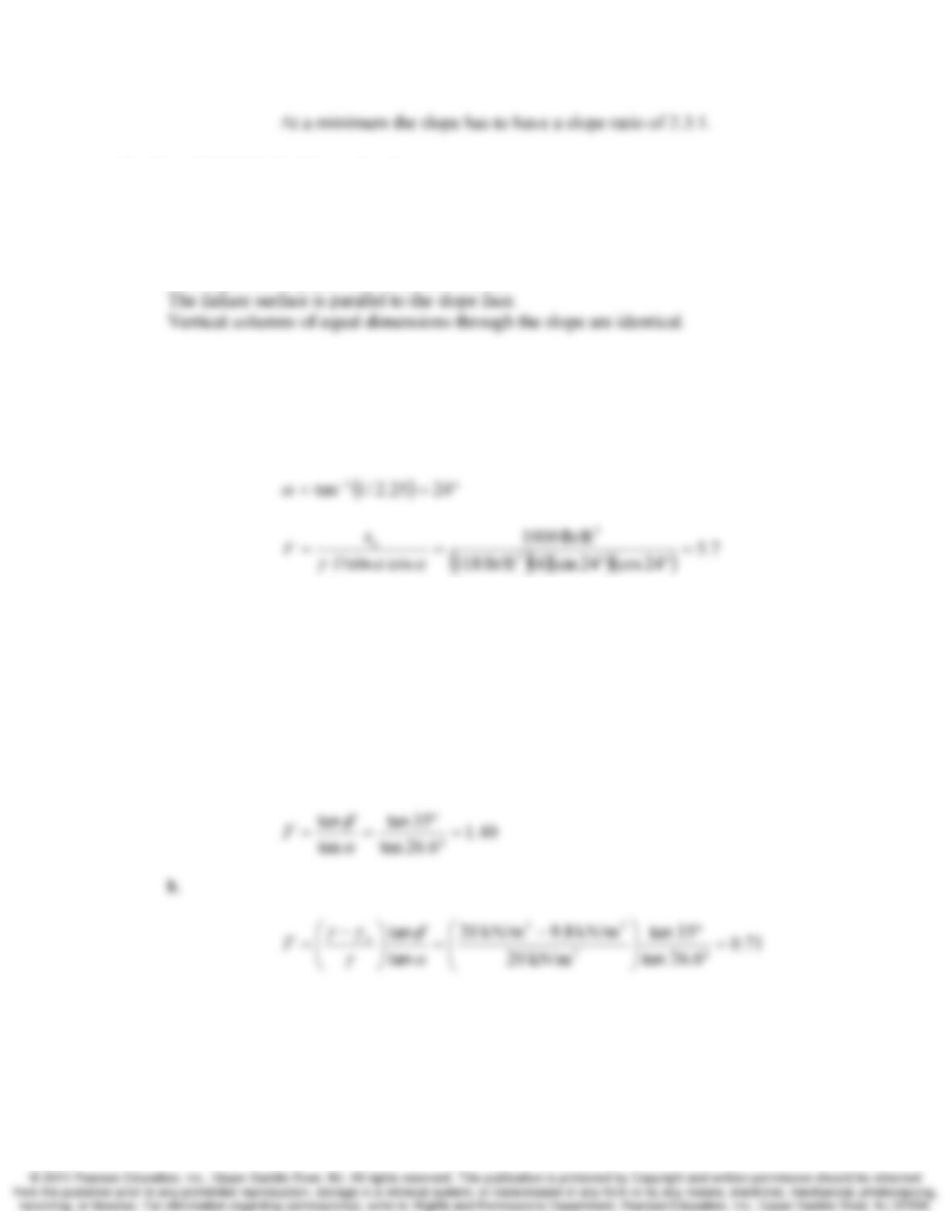
13.10 The proposed slope in Example 13.1 had an unacceptable factor of safety. We plan to
remedy this situation by using a flatter slope. What slope ratio would be required to
produce a factor of safety of 1.5?
Solution
kPa 29=u
Chap. 13 Stability of Earth Slopes 13-5
Section 13.7 Infinite Slope Analysis
13.11 State the assumptions in the infinite slope analysis.
Solution
The slope face is planar and of infinite extent.
13.12 A 2.25:1 natural slope is underlain by a residual soil derived from the underlying gneiss.
Compute the factor of safety for a failure surface 4 ft below the ground surface using a
total stress infinite slope analysis with su = 1000 lb/ft2,
φ
T = 0, and γ = 118 lb/ft3.
Solution
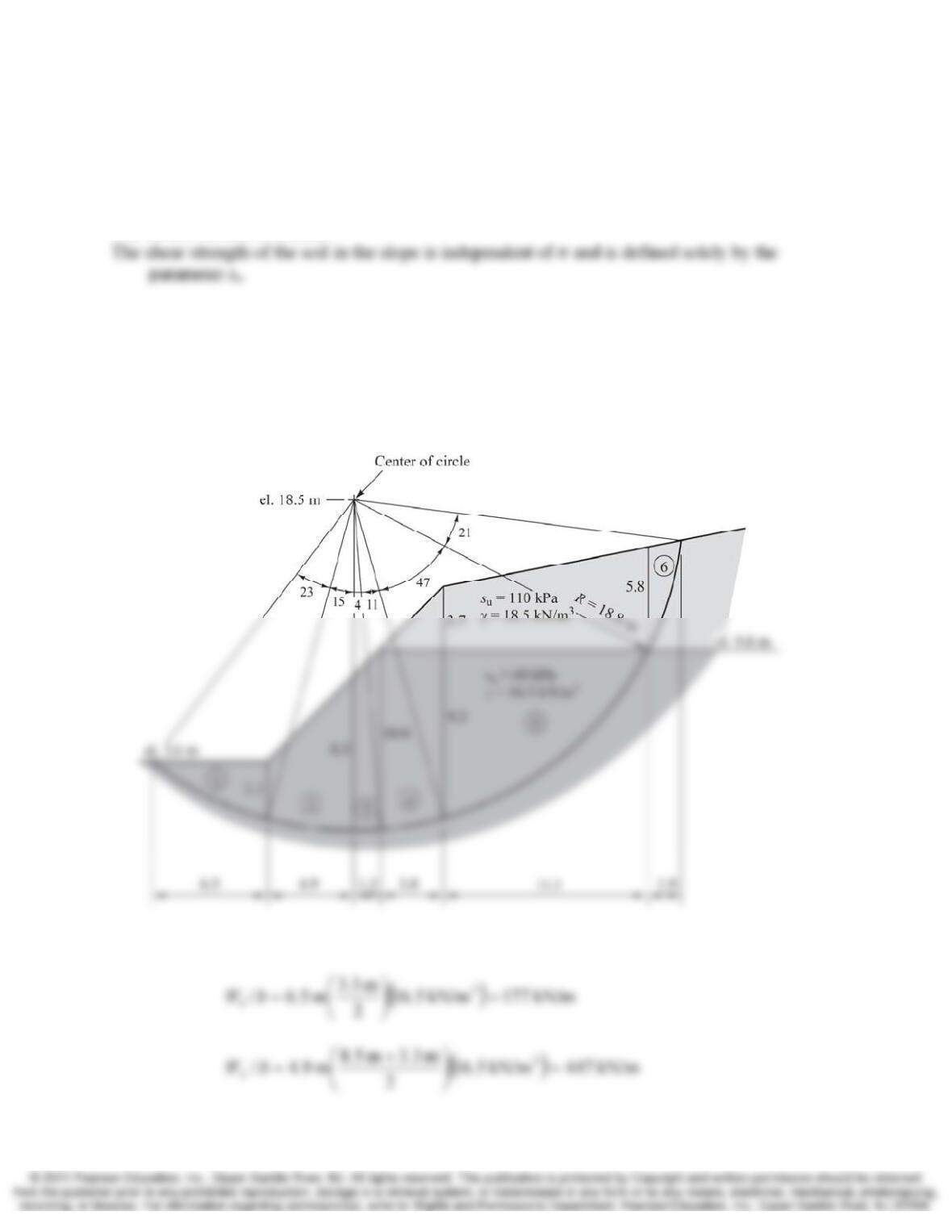
13.13 A 2:1 natural slope is underlain by a 3-m-thick (measured vertically) soil cover over
bedrock. Compute the factor of safety using an effective stress infinite slope analysis
with c′ = 0 and
φ′
= 35° for the soil, assuming the following:
(a) The soil cover is totally dry and γ = 18 kN/m3.
(b) The soil cover is totally saturated and γ = 20 kN/m3.
Solution
a.
13-6 Stability of Earth Slopes Chap. 13
Section 13.8 Swedish Slip Circle Method
13.14 State the assumptions in the Swedish slip circle method.
Solution
The failure surface is circular.
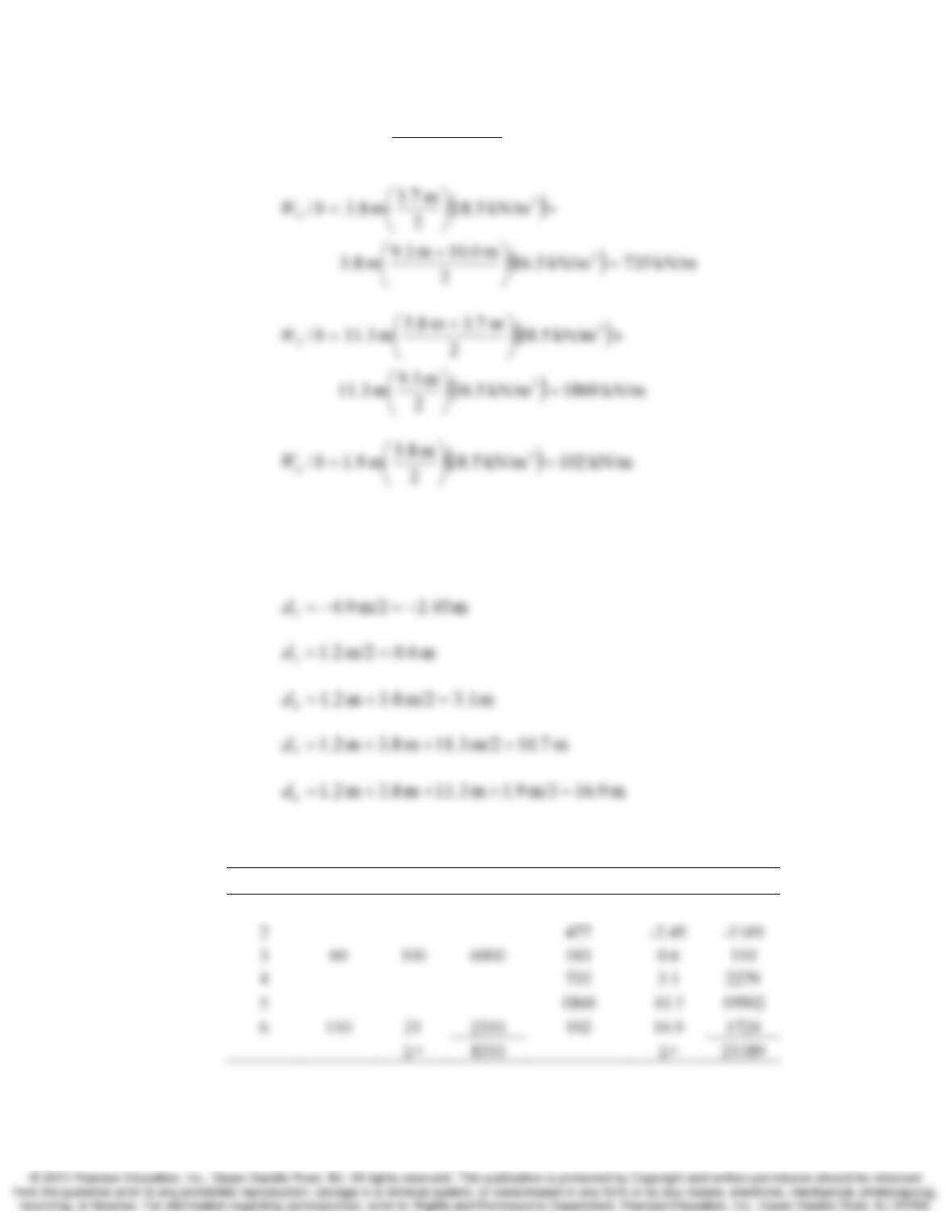
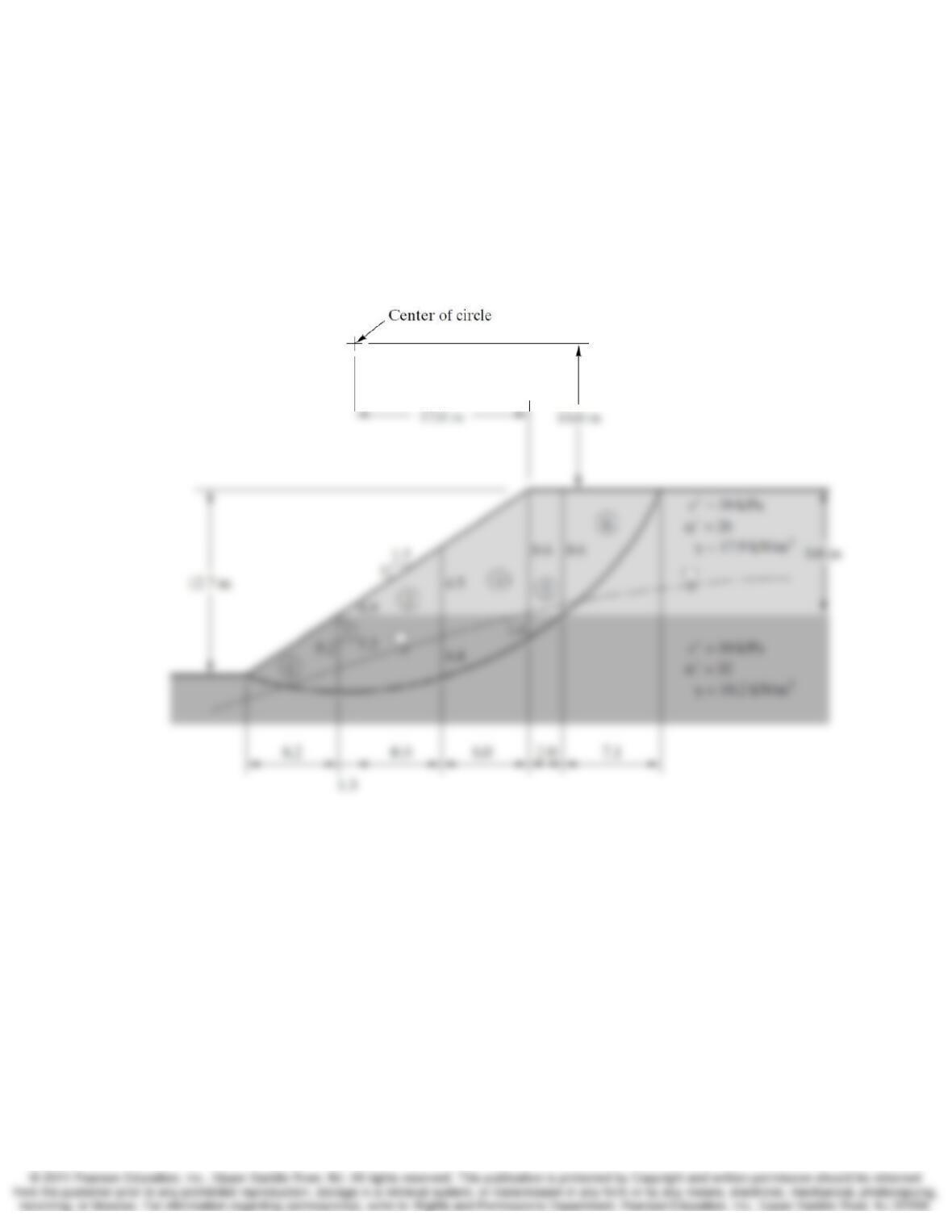
13.15 Prepare a spreadsheet to implement the Swedish slip circle method and use it to compute
the factor of safety for the failure surface shown in Figure 13.51.
Solution
1. Divide into slices
2. Compute weights
Chap. 13 Stability of Earth Slopes 13-7
()
kN/m 183kN/m 16.5
2
m 8.5m 10.0
m 1.2/ 3
3=
⎟
⎠
⎞
⎜
⎝
⎛+
=bW
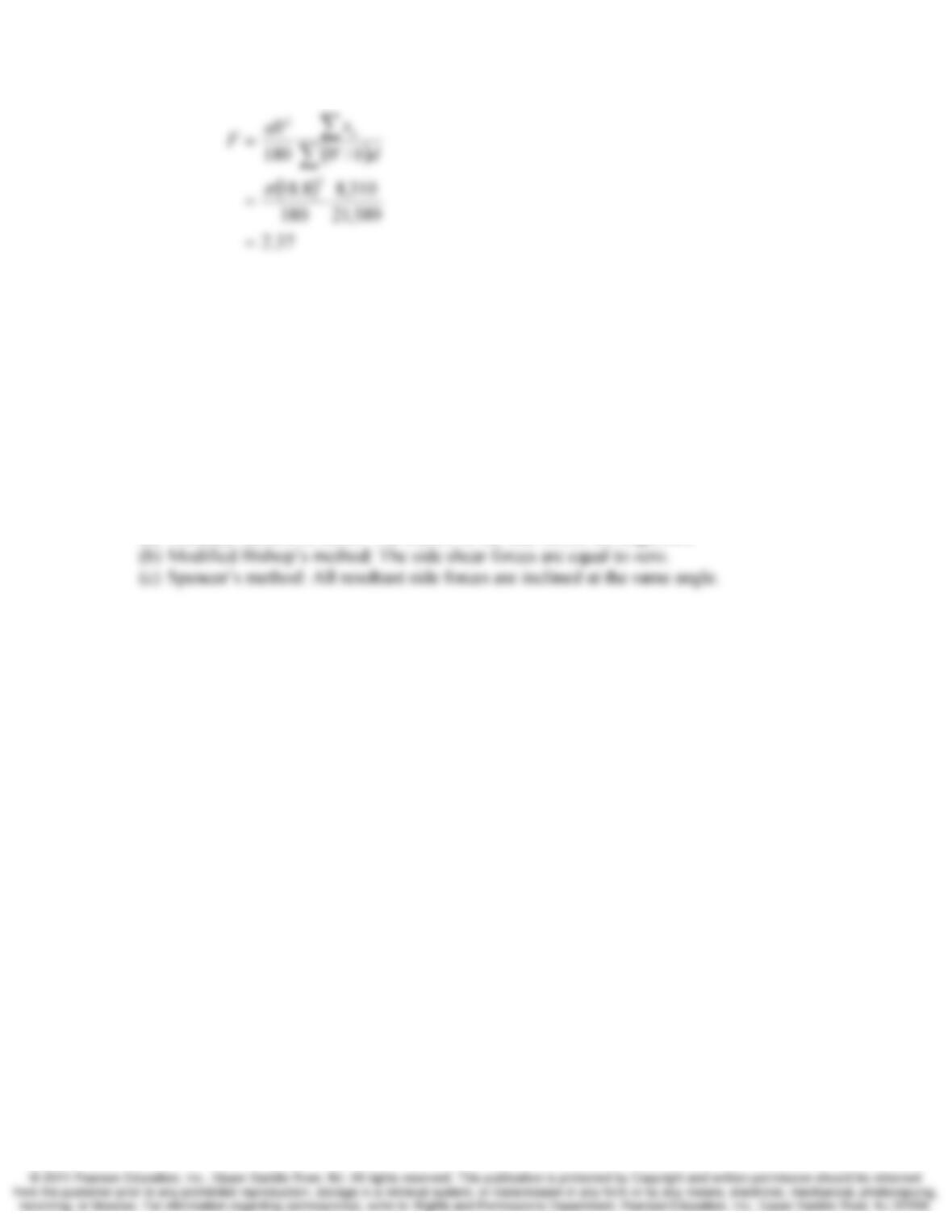
3. Compute moment arms
m 7.1m/3 6.5m 4.9
1
−
=
−−=d
−
=
=
4. Combine data and solve using Equation 13.20 and spreadsheet below
Slice su (kPa) θ (deg) suθ W/b (kN/m) d (m) (W/b)d
1
177 -7.1 -1257
13-8 Stability of Earth Slopes Chap. 13
Section 13.9 Method of Slices
13.16 State the assumption on the side forces on slices in the following methods of slices:
(a) Ordinary method of slices
(b) Modified Bishop’s method
(c) Spencer’s method
Solution
(a) Ordinary method of slices: The effects of the side forces are neglected.
Chap. 13 Stability of Earth Slopes 13-9
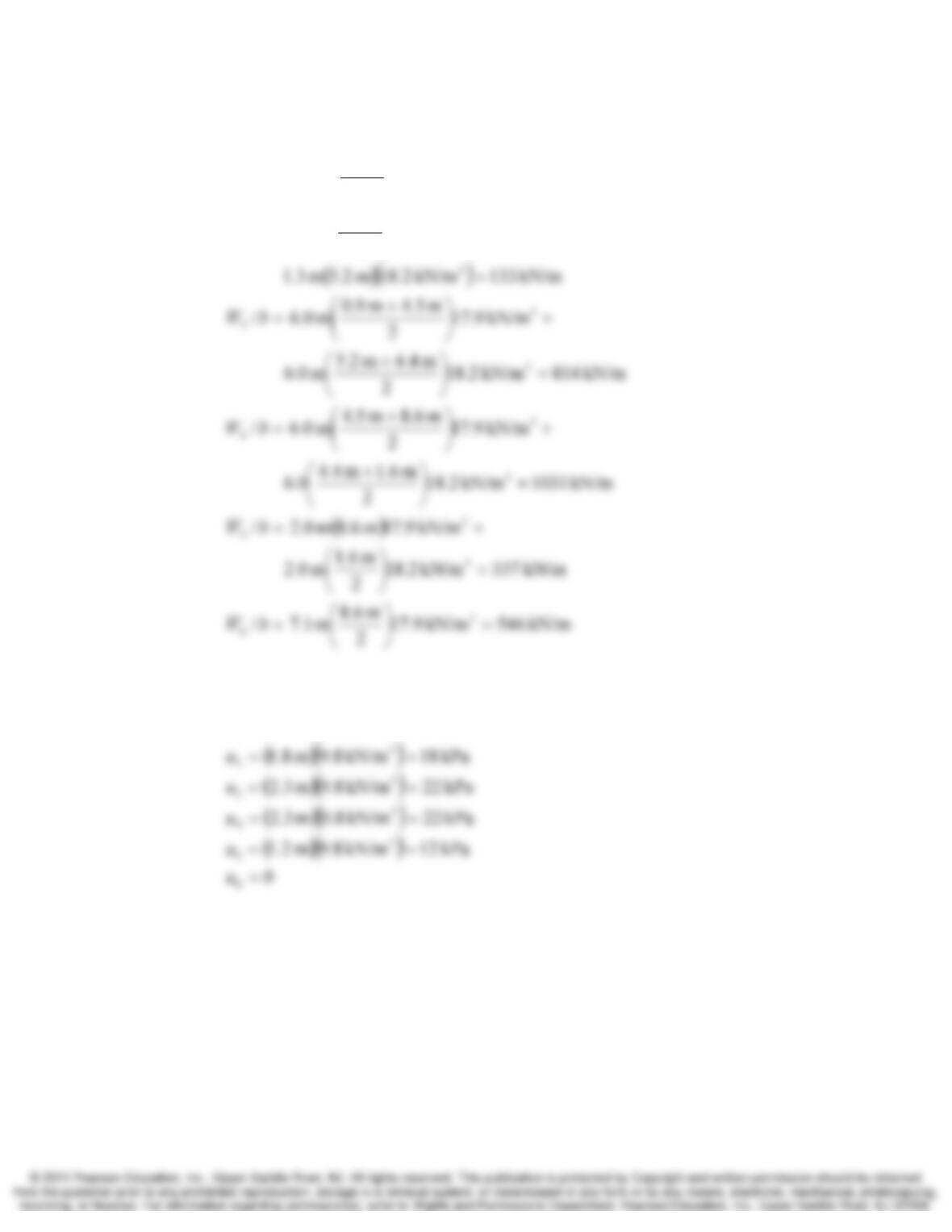
13.17 Prepare a spreadsheet to implement the ordinary method of slices and use it to compute
the factor of safety for the failure surface shown in Figure 13.52.
Solution
1. Divide into slices
13-10 Stability of Earth Slopes Chap. 13
2. Compute weights
kN/m 17.9
2
m 0.9
m 1.3/
kN/m 293kN/m 18.2
2
m 5.2
m 6.2/
3
2
3
1
+
⎟
⎠
⎞
⎜
⎝
⎛
=
=
⎟
⎠
⎞
⎜
⎝
⎛
=
bW
bW
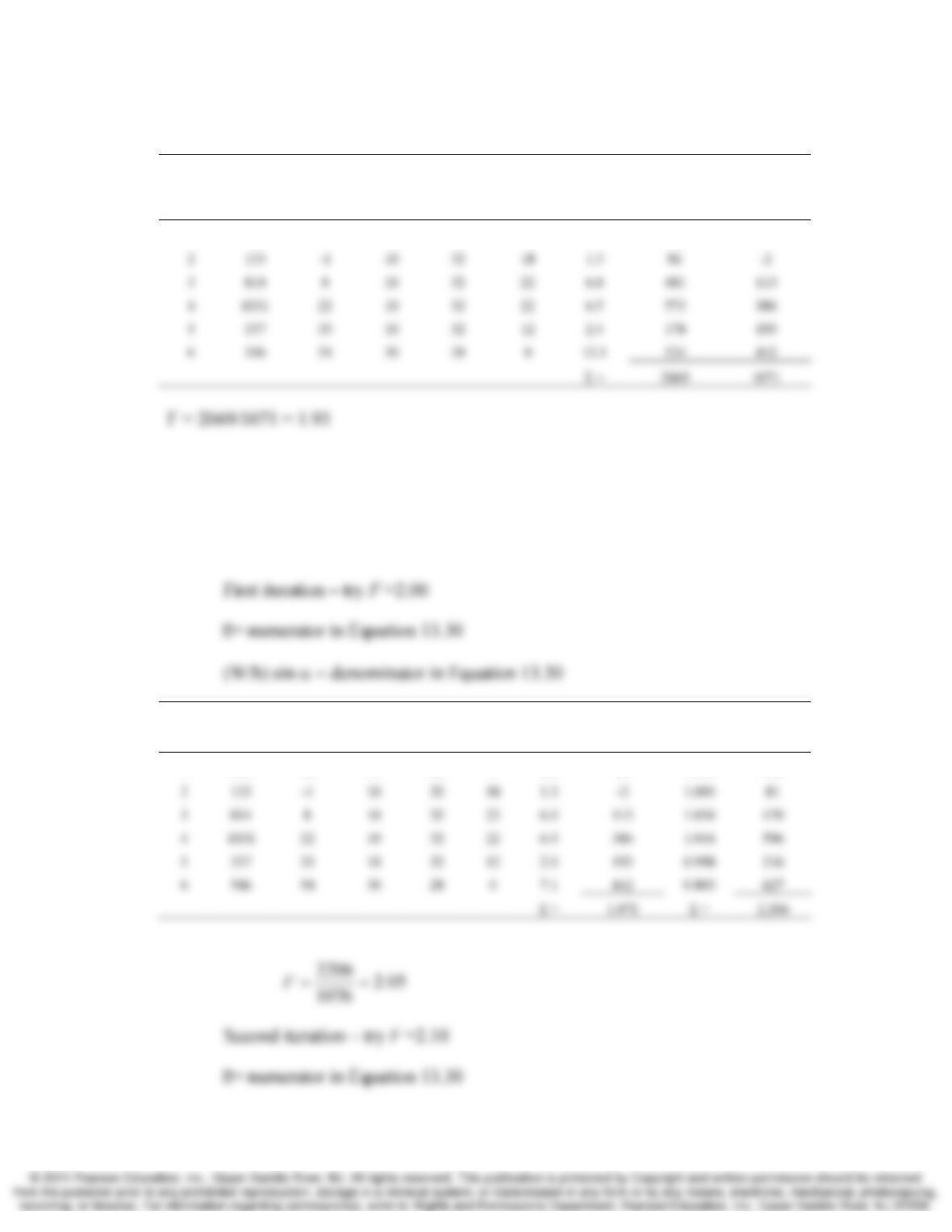
3. Compute average pore water pressure at base of each slice
()
(
)
kPa 5kN/m 9.8m 0.5
3
1
==
u
Chap. 13 Stability of Earth Slopes 13-11
4. Solve using Equation 13.28 and spreadsheet below
Slice
W/b
(kN/m) α (Deg)
c
′
(kPa)
φ′
(Deg)
u (kPa) l (m)
c’ l +
[(W/b)cos α
– ul]tan φ‘ (W/b) sinα
1 293 -12 10 32 5 6.3 222 -61
13.18 Prepare a spreadsheet to implement the modified Bishop’s method and use it to compute
the factor of safety for the failure surface shown in Figure 13.52.
Solution
Use slices, weight, and pore water pressures from Problem 13.17 and spreadsheet below:
Slice
W/b α c′
φ
‘
(Deg)
u m
(W/b) sinα
Try F = 2.00
(kN/m) (Deg) (kPa) (kPa) (m) ψ
1 293 -12 10 32 5 6.2 -61 1.043 216