AirWrap Packaging, Inc.
Teaching Commentary
OVERVIEW
This is a very challenging case that gives students practice in customer value analysis, product costing, full cost
versus marginal cost analysis, “capacity costing,” and product line profitability. For students who are up to the
challenge, it makes an excellent end–of-term review case or final exam. I have used it successfully in both contexts
ANSWERS TO ASSIGNMENT QUESTIONS
Questions 1 and 2 deal with profitability analysis for the base product (Air Seal), with accounting for
excess capacity thrown in. Question 3 covers the break–even point and the issue of “operating leverage.” Questions 4
through 7 deal with LCC for four different product situations drawn from the four cells in the LCC matrix in the
Question 1
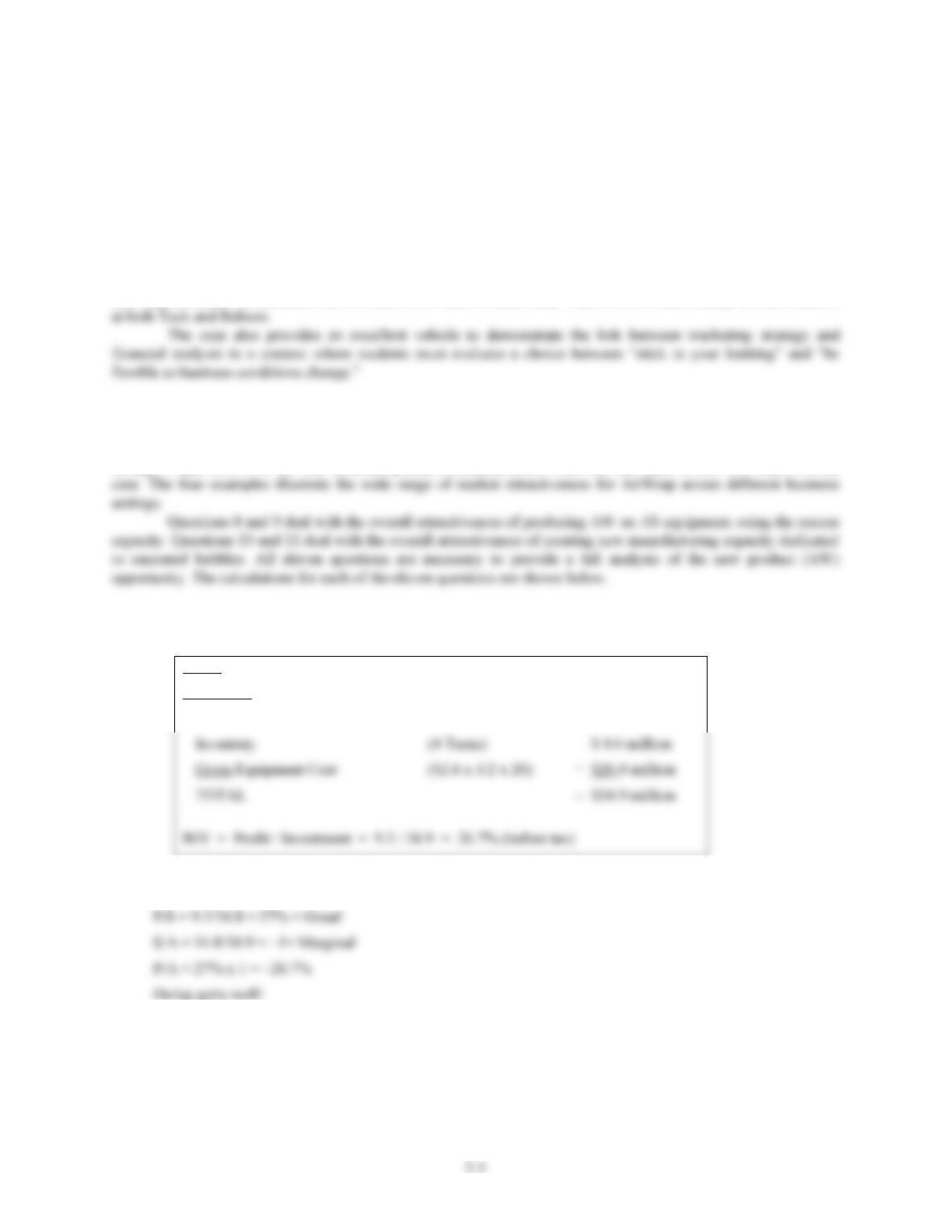
(a) What is the Return on Investment (ROI) for AirSeal for 1985?
Profit = $9.3 million, per Exhibit 1 in the case
Investment
A/R
(45 DSO)
= $ 4.3 million
(4 Turns)
= $ 4.6 million
Gross Equipment Cost
($2.6 x 1/2 x 20)
ROI = Profit / Investment = 9.3 / 34.9 = 26.7% (before tax)
(b) How is the AirSeal product line doing, using the “DuPont formula?”
2-2
Question 2
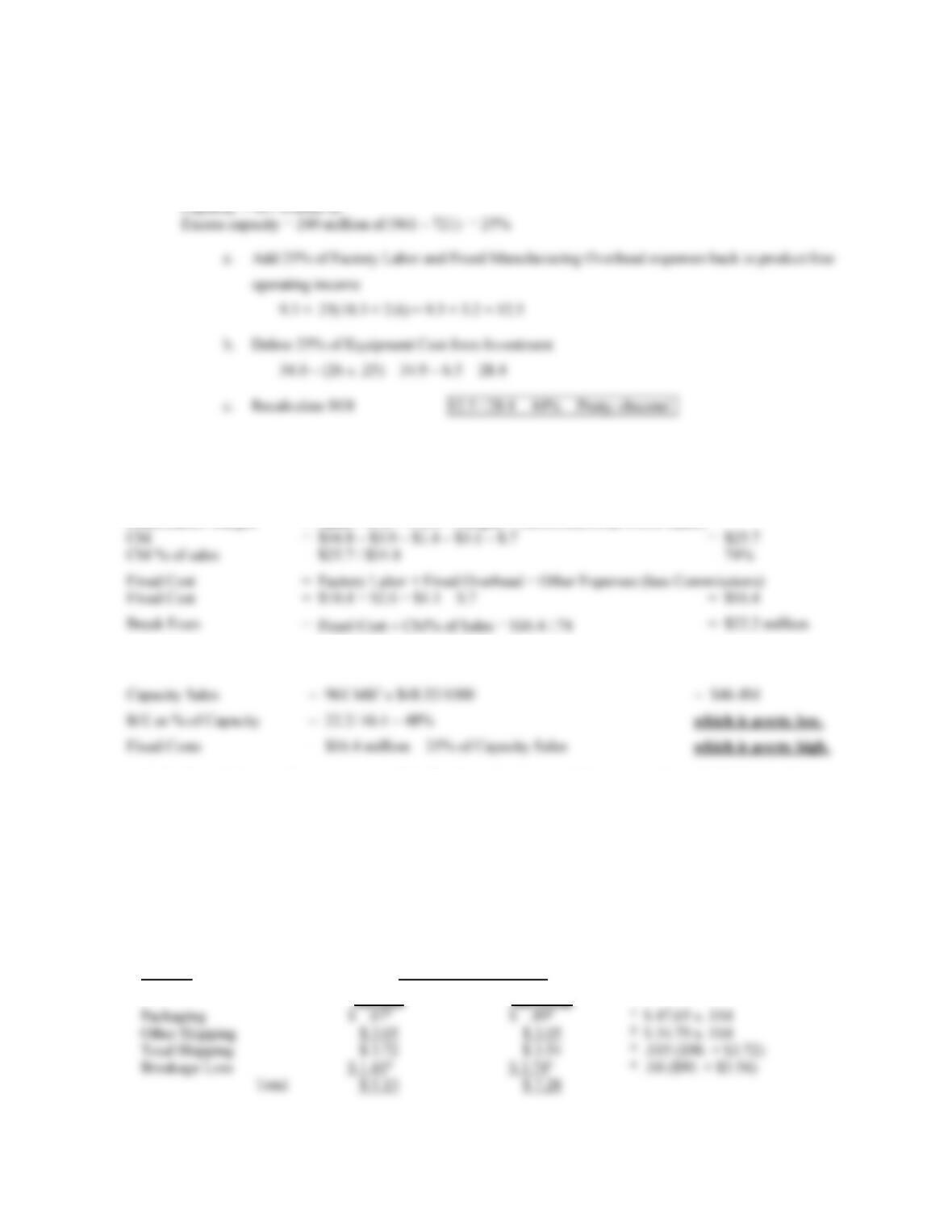
How would the ROI change if excess capacity (Fixed Manufacturing Overhead, Factory Labor, and
Manufacturing Equipment) were not charged to the product line?
1985 volume = 721 million sf
Question 3
(a) Calculate the break-even sales volume in dollars for AirSeal in 1985.
Contribution Margin
= Sales – RM – VOH – Freight – Commissions (at 2% of Sales)
= $34.8 – $3.9 – $1.4 – $3.1 – $.7
= $25.7
Fixed Cost
= Factory Labor + Fixed Overhead + Other Expenses (less Commissions)
Fixed Cost
= $10.4 + $2.6 + $4.1 – $.7
= $16.4
= Fixed Cost CM% of Sales = $16.4 /.74
B/E as % of Capacity
= 22.2/ 46.4 = 48%
which is pretty low.
Fixed Costs
= $16.4 million = 35% of Capacity Sales
(b) Discuss the “Operating Leverage.”
AirSeal is a high contribution margin, high fixed cost business, which means it has a high degree of
operating leverage.
Question 4
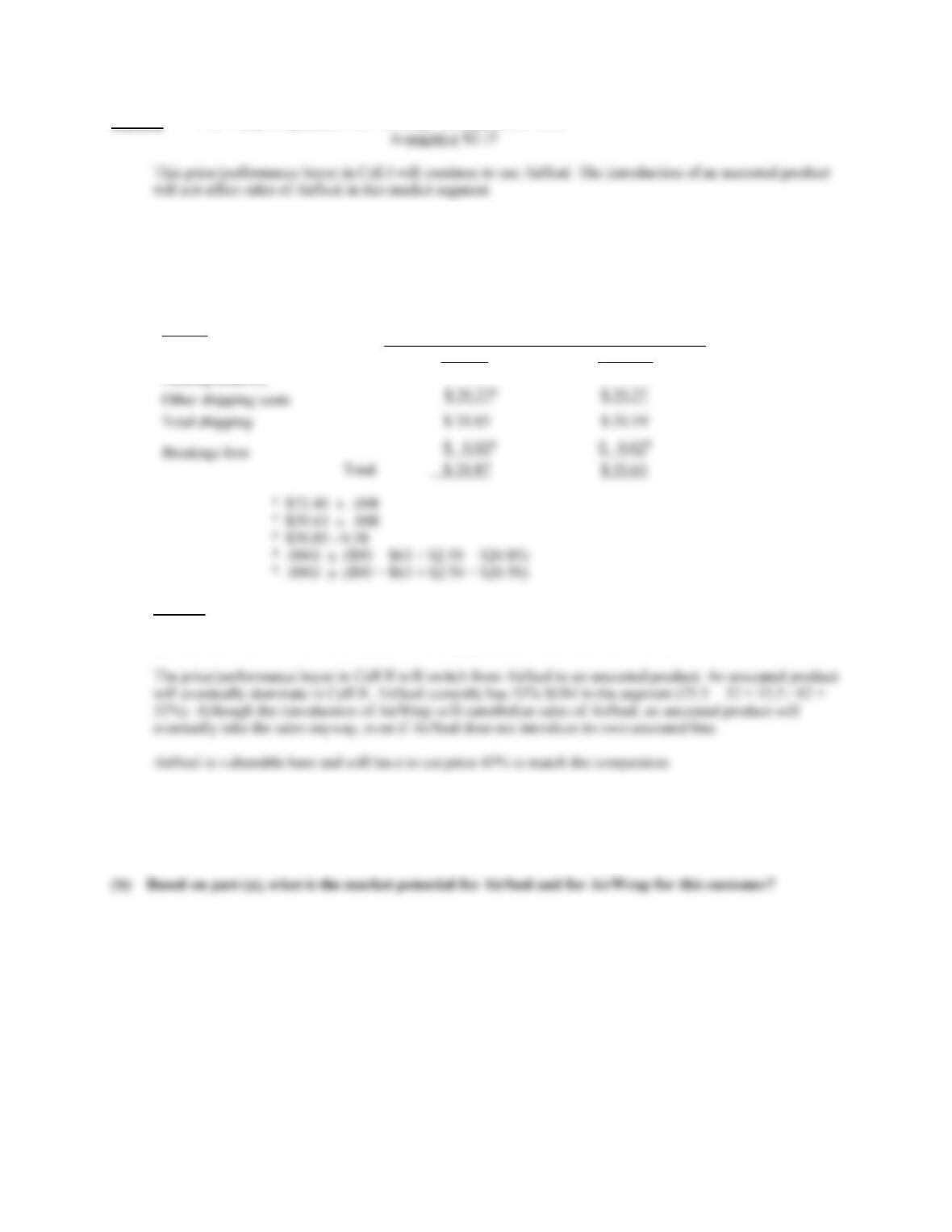
(a) Calculate the LCC to Noritake per shipment for AirSeal and AirWrap.
(b) Based on part (a), what is the market potential of AirWrap for this customer?
Part (a)
Life Cycle Cost (LCC)
AirSeal
AirWrap
Other Shipping
Total Shipping
2-3
Part (b) The “Value Proposition” for AirWrap (comparative LCC)
Question 5
(a) Calculate the LCC for NEW per-shipment for AirSeal and AirWrap.
(b) Based on part (a), what is the market potential for AirWrap for this customer?
Part (a)
Life Cycle Cost (LCC)
AirSeal
AirWrap
Packing material
$ 0.581
$ 0.322
Other shipping costs
Part (b)
The “Value Proposition” for AirWrap = $20.87 — $20.61 = $0.26.
An uncoated bubble is the better choice for this application, which falls into Cell II.
Question 6
(a) Calculate the LCC per shipment for FAP for Air Cap, AirWrap, and “Loose Peanuts,” using the data
from the case.
2-4
Part (a)
Life Cycle Cost (LCC)
“Loose Peanuts”
AirSeal
AirWrap
Product Carton
$ .37
$ .37
$ .37
Packing labor
$ .21
$ .13
$ .13
Part (b)
AirSeal should dominate “peanuts” ($3.17 vs. $3.31), but the Purchasing Agent looks only at packaging
materials cost and chooses “peanuts” ($ .45 vs. $ .65).
Question 7
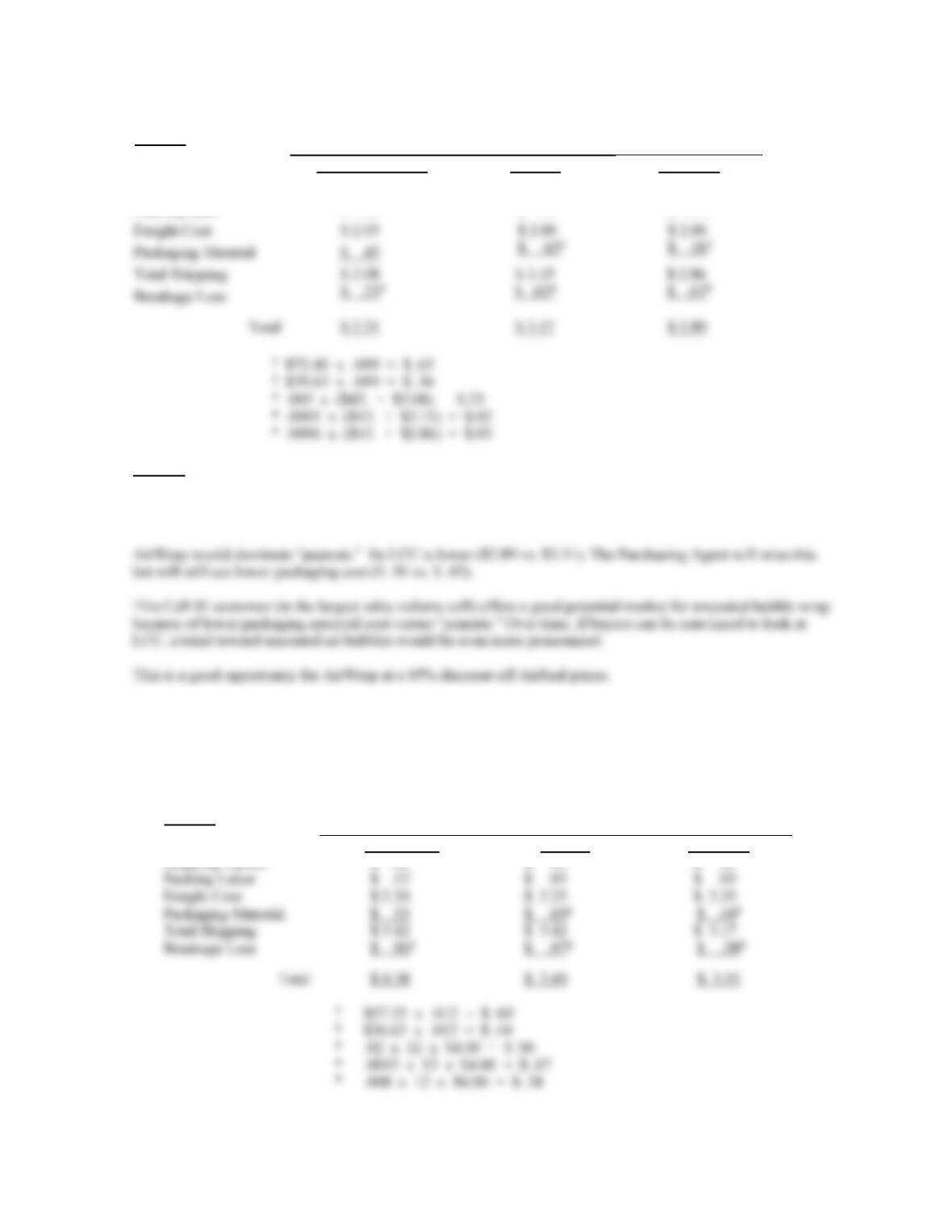
(a) Calculate the LCC per carton for College-Craft Glassware for AirSeal, AirWrap, and Cardboard.
(b) Based on part (a), what is the market potential for AirSeal and AirWrap for this customer?
Part (a)
Life Cycle Cost (LCC)
Cardboard
AirSeal
AirWrap
Shipping Carton
$ .45
$ .45
$ .45
Packing Labor
$ .12
$ .03
Freight Cost
$ 2.30
$ 2.25
$ 2.25
Packaging Material
$ .55
Total Shipping
$ 3.42
$ 3.42
$ 4.38
$ 3.49
Freight Cost
$ 2.05
$ 2.00
Packaging Material
$ .45
Total Shipping
$ 3.08
$ 2.86
$ 3.31
$ 2.89
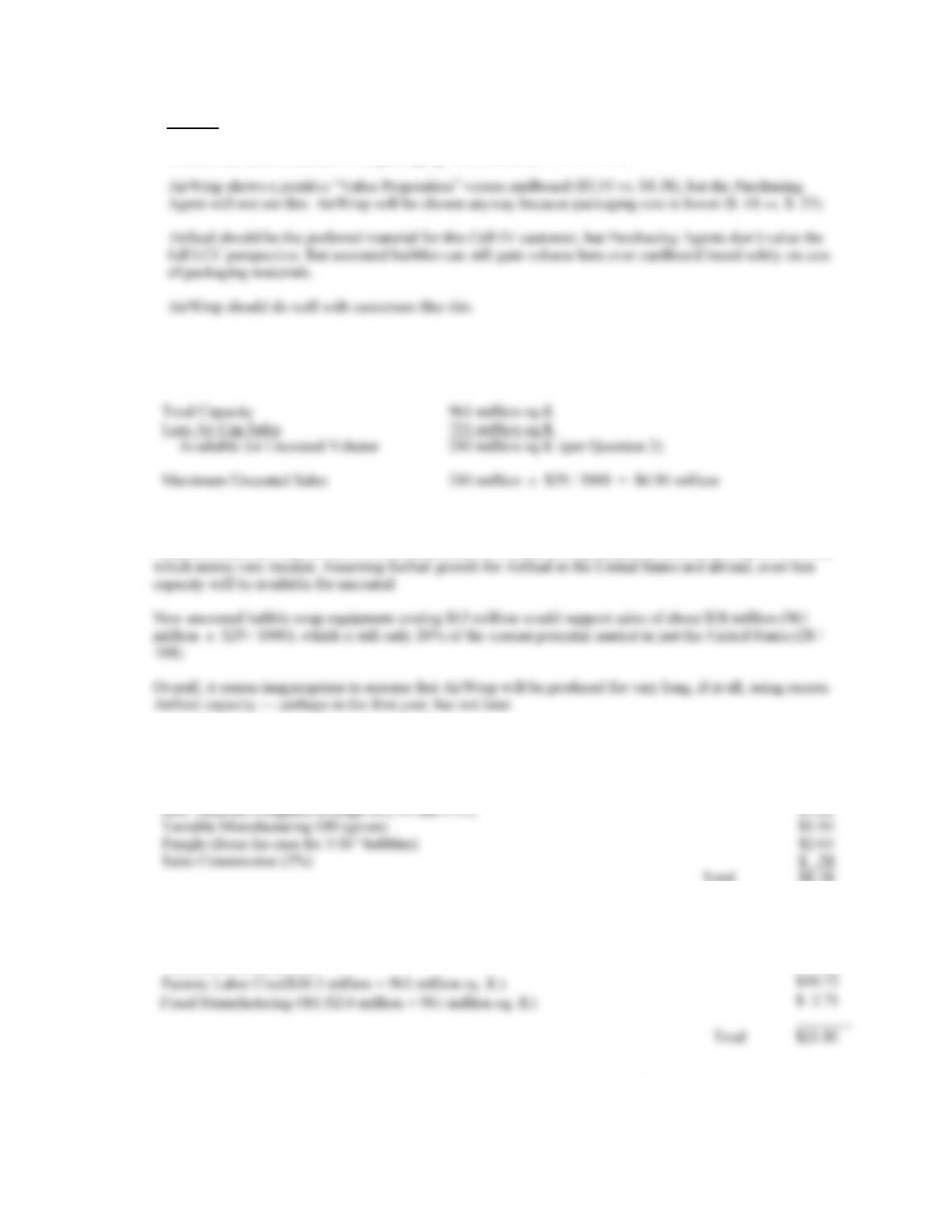
Total Capacity
961 million sq ft.
Less Air Cap Sales
721 million sq ft.
= Available for Uncoated Volume
240 million sq ft. (per Question 2)
Maximum Uncoated Sales
240 million x $29 / 1000 = $6.96 million
2-5
Part (b)
Although the “Value Proposition” for AirSeal is $ .89 per shipment ($3.49 vs. $4.38), the Purchasing Agent
chooses cardboard because of the packaging material cost ($ .55 vs. $.69).
Question 8
(a) What annual sales level for AirWrap can be supported using the excess capacity on the AirSeal
equipment as of 1985? Assume average price of $29 to distributors.
(b) So what?
Maximum sales are only about 6.5% of the potential U.S. bubble wrap market in Cells II, III, and IV (7/108),
Question 9
(a) Estimate the variable cost per 1,000 sq. ft., on average, to manufacture and ship AirWrap using the
AirSeal Equipment. (Assume the average bubble thickness is 3/16 inch.)
Raw Material (weighted average of 2.90 and 9.11)
$3.22
Variable Manufacturing OH (given)
$1.94
Freight (from the case for 3/16” bubbles)
$2.64
Sales Commission (2%)
$ .58
Total
$8.38
(b) Estimate the full cost per 1000 sq. ft., on average, to manufacture and ship AirWrap using the AirSeal
Equipment.
Variable Cost (as above)
$ 8.38
Factory Labor Cost($10.3 million 961 million sq. ft.)
Fixed Manufacturing OH ($2.6 million 961 million sq. ft.)
$21.81
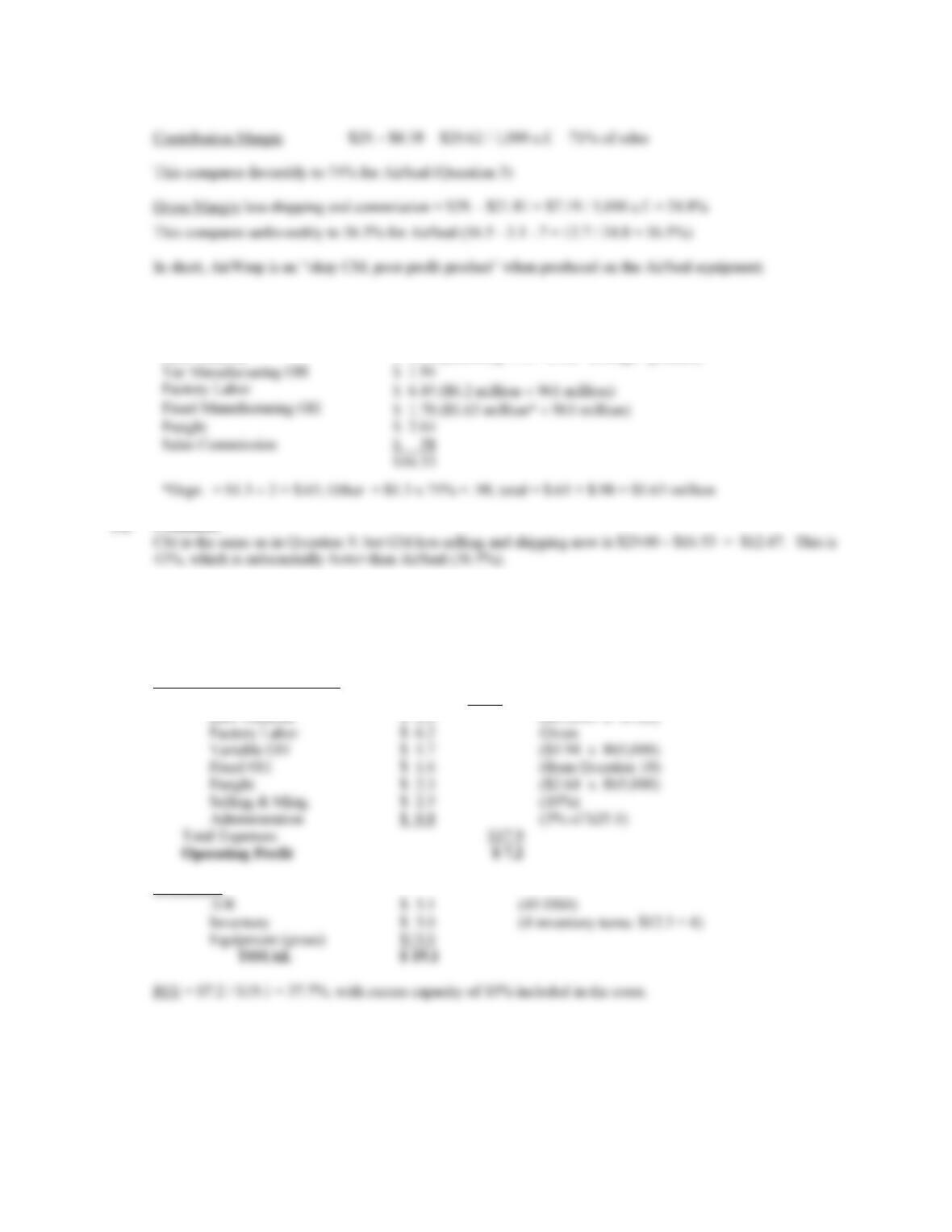
(c) Comment on the estimated contribution margin and gross margin of AirWrap when produced on
AirSeal machinery.
2-6
Question 10
(a) Estimate the full cost per 1000 sq. ft. to manufacture and ship AirWrap using its own equipment.
Raw Material
$ 3.22 (assuming 3/16” is the “average” product)
Var Manufacturing OH
$ 1.94
$ 6.45 ($6.2 million 961 million)
$ 1.70 ($1.63 million* 961 million)
Freight
$ 2.64
Sales Commission
$16.53
*Depr. = $1.3 2 = $.65; Other = $1.3 x 75% = .98; total = $.65 + $.98 = $1.63 million
(b) Comment
Question 11
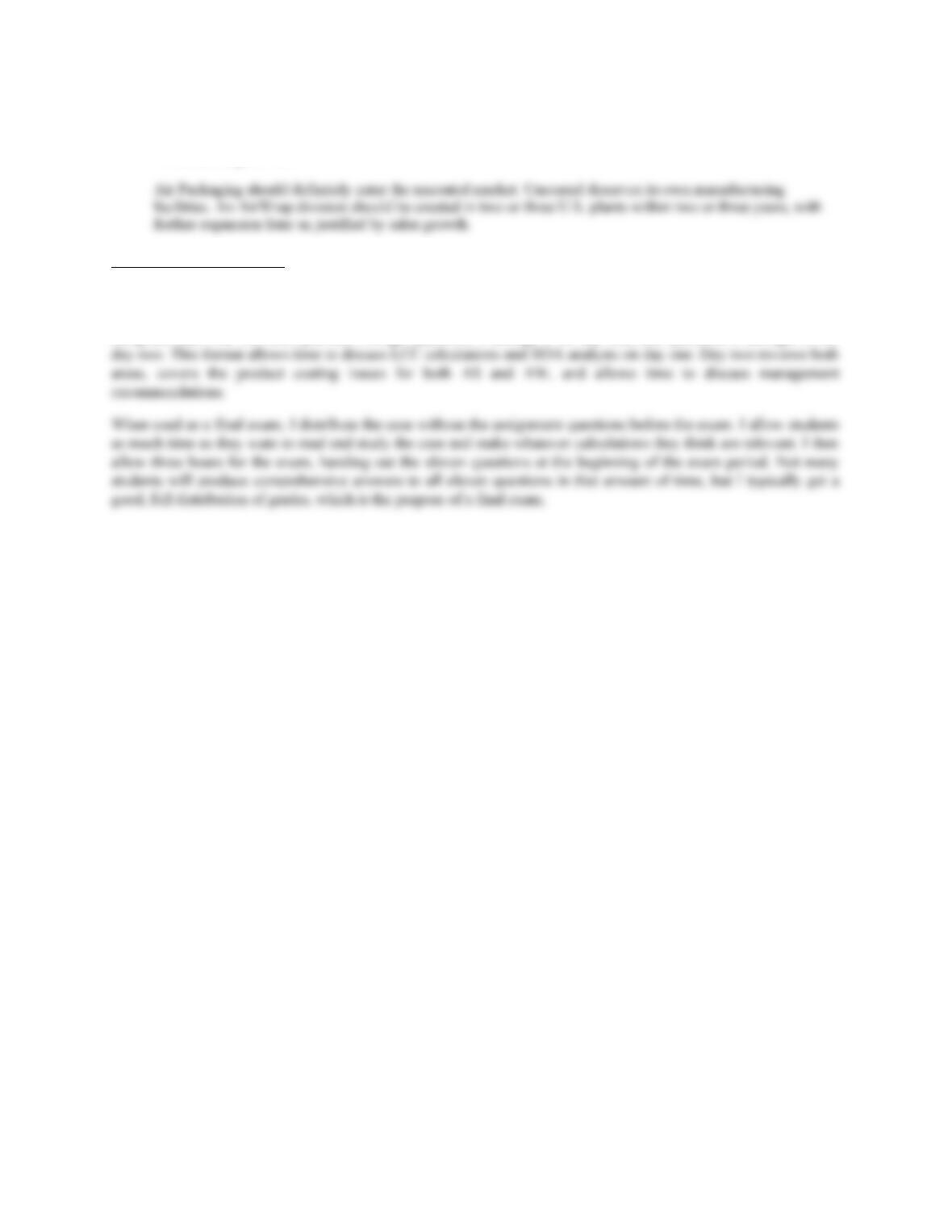
(a) Estimate the ROI for AirWrap if it could operate at 90% of capacity in its own manufacturing
facilities. Assume Selling and Marketing at 7% of Sales, R&D at zero, and Administrative cost at 3%
of Sales. Assume the $29 average selling price.
Income Statement (Millions$)
Sales
$25.1
(961,000 x .9 = 865,000 x $29.)
Raw Material
$ 2.8
(865,000 x $3.22)
$ 6.2
Given
$ 1.7
($1.94 x 865,000)
$ 1.6
(from Question 10)
Freight
$ 2.3
($2.64 x 865,000)
$ 2.5
(10%)
$ 0.8
(3% of $25.1)
Investment
$ 3.0
(4 inventory turns: $12.3 ÷ 4)
$13.0
ROI = $7.2 / $19.1 = 37.7%, with excess capacity of 10% included in the costs.
(b) Comment
2-7
This is better than AirSeal in 1985 (27%). This result is very good, for a mostly undifferentiated product.
With substantially higher volume over time, AirWrap might actually produce more total profit dollars than
AirSeal, at a good ROI.
TEACHING STRATEGY
The case will easily support two class periods of ninety minutes each. In fact, I don’t think it is fair to the students to
ask them to prepare the case in one three-hour block (normal preparation time for one ninety minute class). When
using the case over two class periods, I assign Questions 1 through 5 for day one, and Questions 6 through 11 for