FINANCIAL REPORTING PROBLEM (Continued)
(c) P&G provided the following discussion related to commitments and
contingencies:
Note 10: Commitments and Contingencies
Guarantees
In conjunction with certain transactions, primarily divestitures, we may
provide routine indemnifications (e.g., indemnification for representa–
tions and warranties and retention of previously existing environmental,
tax and employee liabilities) which terms range in duration and in
Off-Balance Sheet Arrangements
We do not have off-balance sheet financing arrangements, including
variable interest entities, that have a material impact on our financial
statements.
FINANCIAL REPORTING PROBLEM (Continued)
Purchase Commitments and Operating Leases
June 30
2012
2013
2014
2015
2016
Thereafter
Purchase obiligations
$1,351
$762
$368
$154
$104
$273
Such amounts represent future purchases in line with expected usage
to obtain favorable pricing. Approximately 26% of our purchase
commitments relate to service contracts for information technology,
June 30
2012
2013
2014
2015
2016
Thereafter
Operating leases
$264
$224
$192
$173
$141
$505
Litigation
We are subject to various legal proceedings and claims arising out of
our business which cover a wide range of matters such as
governmental regulations, antitrust and trade regulations, product
FINANCIAL REPORTING PROBLEM (Continued)
the Company is doing. Competition and antitrust law inquiries often
continue for several years and, if violations are found, can result in
substantial fines.
In response to the actions of the European Commission and national
authorities, the Company launched its own internal investigations into
potential violations of competition laws. The Company has identified
violations in certain European countries and appropriate actions were
taken.
Several regulatory authorities in Europe have issued separate
complaints pursuant to their investigations alleging that the
In accordance with U.S. GAAP, certain of the reserves included in this
amount represent the low end of a range of potential outcomes.
Accordingly, the ultimate resolution of these matters may result in
fines or costs in excess of the amounts reserved that could materially
impact our income statement and cash flows in the period in which
COMPARATIVE ANALYSIS CASE
(a) The working capital position of the two companies is as follows:
($ millions)
PepsiCo, Inc.
Current assets ……………………………….. $ 17,441
(b) The overall liquidity of both companies is good as indicated from the
ratio analysis provided below:
(all computations in millions)
PepsiCo, Inc.
Coca-Cola
Current cash debt
$8,944
= 0.53
$9,474
= 0.44
coverage
$18,154 + $15,892
$24,283 + $18,508
2
2
Cash debt
= 0.18
= 0.21
coverage
Current ratio
$17,441
$25,497
= 1.05
Acid-test
$4,067 + $358 + $6,912
= 0.62
$13,891 + $144 + $4,920
= 0.78
ratio
$18,154
$24,283
Accounts
$66,504
= 10.05
$46,542
= 9.96
receivable
$6,912 + $6,323
$4,920 + $4,430
turnover
2
2
COMPARATIVE ANALYSIS CASE (Continued)
(c) As indicated in the chapter, a company can exclude a short-term obli-
gation from current liabilities only if both of the following conditions
are met:
(d) Coca-Cola discusses its contingencies in the following note:
NOTE 1: SUMMARY OF SIGNIFICANT ACCOUNTING POLICIES
Contingencies
Our Company is involved in various legal proceedings and tax
NOTE 11: COMMITMENTS AND CONTINGENCIES
Guarantees
As of December 31, 2011, we were contingently liable for guarantees
of indebtedness owed by third parties of $654 million, of which $321
million was related to VIEs. Refer to Note 1 for additional information
related to the Company’s maximum exposure to loss due to our
COMPARATIVE ANALYSIS CASE (Continued)
Legal Contingencies
The Company is involved in various legal proceedings. We establish
reserves for specific legal proceedings when we determine that the
likelihood of an unfavorable outcome is probable and the amount of
During the period from 1970 to 1981, our Company owned Aqua–
Chem, Inc., now known as Cleaver-Brooks, Inc. (“Aqua-Chem”).
During that time, the Company purchased over $400 million of
insurance coverage, which also insures Aqua-Chem for some of its
prior and future costs for certain product liability and other claims. A
division of Aqua-Chem manufactured certain boilers that contained
gaskets that Aqua–Chem purchased from outside suppliers. Several
years after our Company sold this entity, Aqua-Chem received its
COMPARATIVE ANALYSIS CASE (Continued)
certain insurers of Aqua-Chem. In that case, five plaintiff insurance
companies filed a declaratory judgment action against Aqua-Chem,
the Company and 16 defendant insurance companies seeking a
determination of the parties’ rights and liabilities under policies
issued by the insurers and reimbursement for amounts paid by
triggered is jointly and severally liable for 100 percent of Aqua–
Chem’s losses up to policy limits. The court’s judgment concluded
the Wisconsin insurance coverage litigation. The Georgia litigation
remains subject to the stay agreement. The Company and Aqua-Chem
continued to negotiate with various insurers that were defendants in
and the Company prevail in the coverage-in-place settlement
litigation, these three insurance companies will remain subject to the
court’s judgment in the Wisconsin insurance coverage litigation.
The Company is unable to estimate at this time the amount or range
of reasonably possible loss it may ultimately incur as a result of
COMPARATIVE ANALYSIS CASE (Continued)
as during the past five years, and (b) the various insurers that cover
the asbestos-related claims against Aqua-Chem remain solvent,
regardless of the outcome of the coverage-in-place settlement
litigation, there will likely be little defense or indemnity costs that are
Indemnifications
At the time we acquire or divest our interest in an entity, we
sometimes agree to indemnify the seller or buyer for specific
Tax Audits
The Company is involved in various tax matters, with respect to some
Risk Management Programs
The Company has numerous global insurance programs in place to help
protect the Company from the risk of loss. In general, we are self-
COMPARATIVE ANALYSIS CASE (Continued)
Workforce (Unaudited)
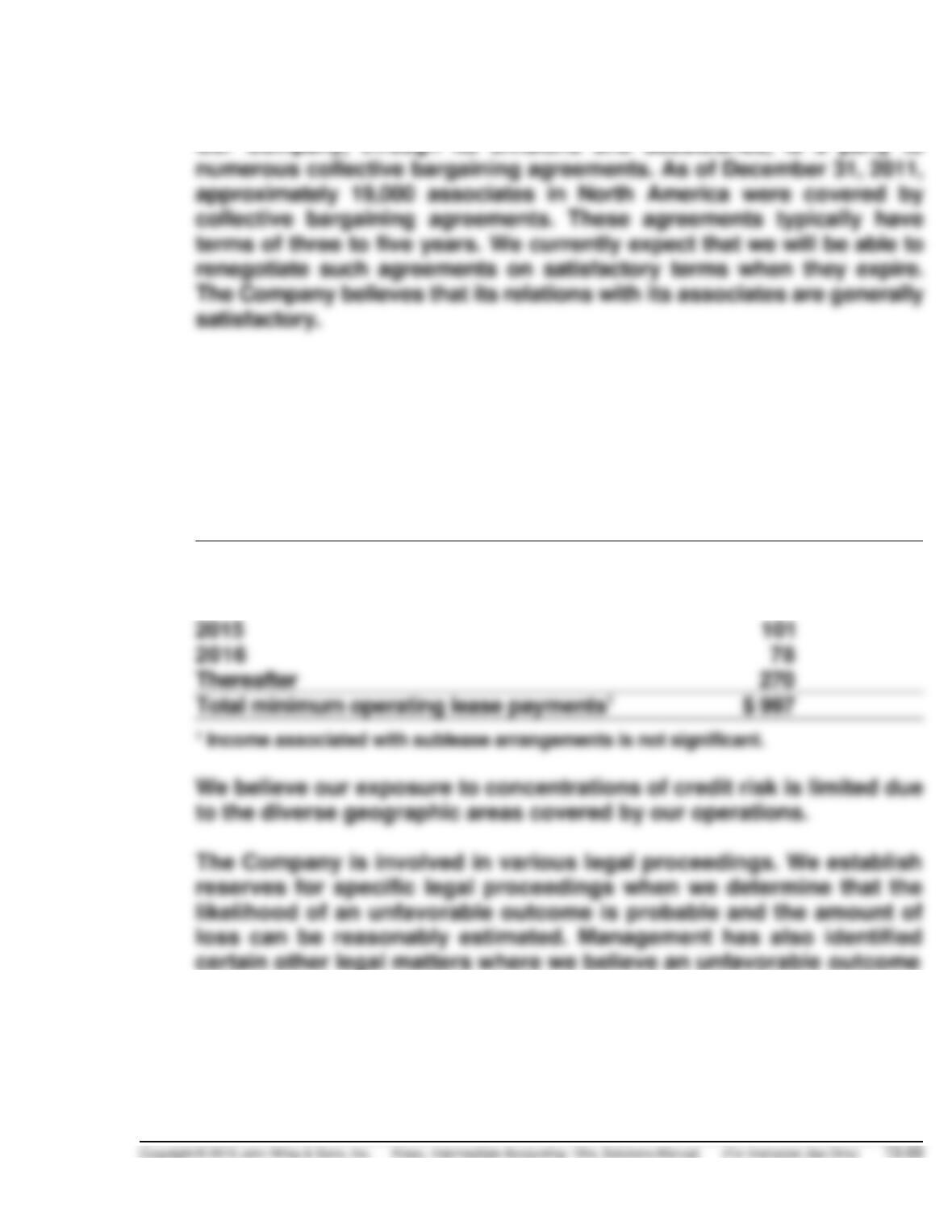
We refer to our employees as “associates.” As of December 31, 2011,
our Company had approximately 146,200 associates, of which
approximately 67,400 associates were located in the United States.
Operating Leases
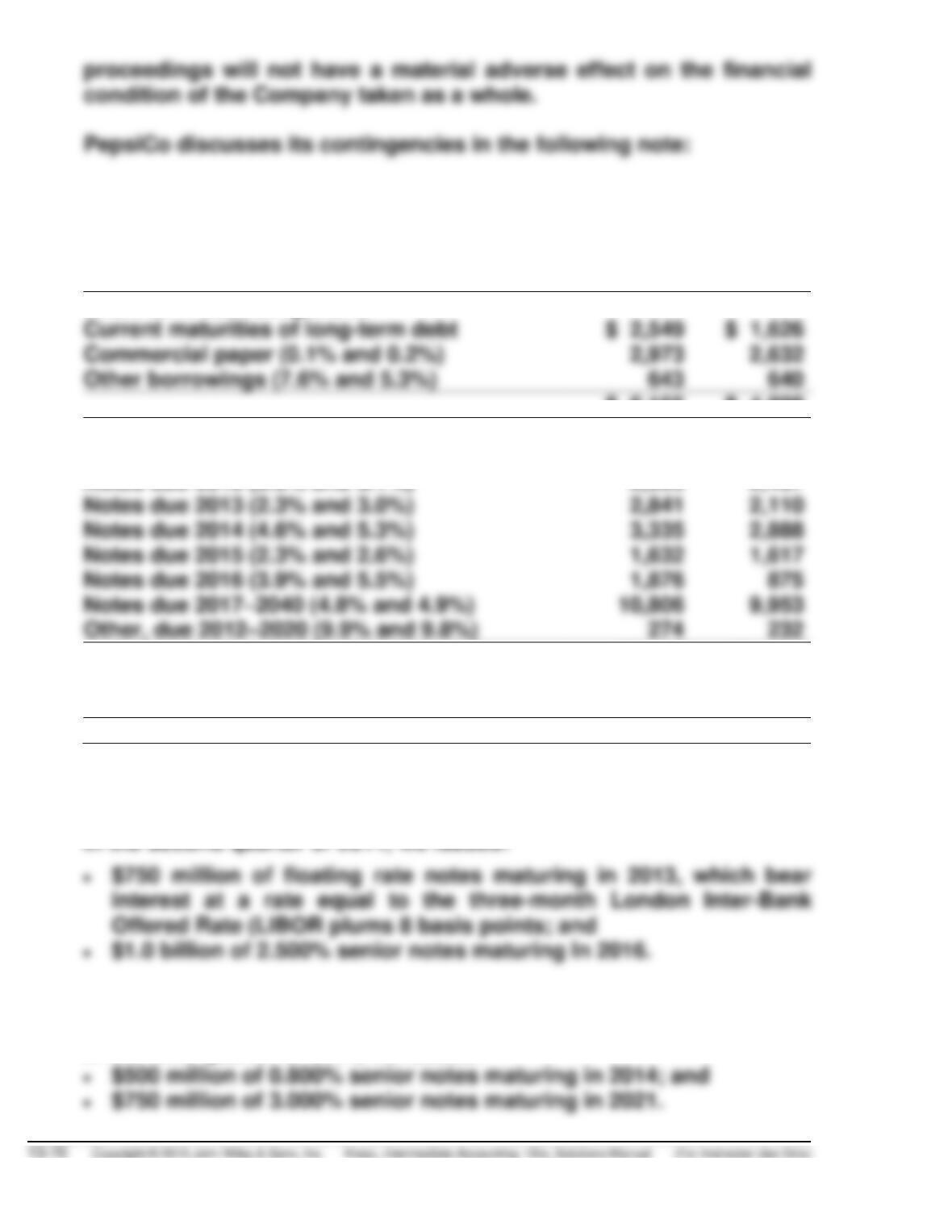
The following table summarizes our minimum lease payments under
noncancelable operating leases with Initial or remaining lease terms in
excess of one year as of December 31, 2011 (in millions):
Years Ending December 31,
Operating Lease
Payments
2012
$ 241
2013
174
2014
133
101
Thereafter
$ 997
COMPARATIVE ANALYSIS CASE (Continued)
is reasonably possible and/or for which no estimate of possible
losses can be made. Management believes that any liability to the
Company that may arise as a result of currently pending legal
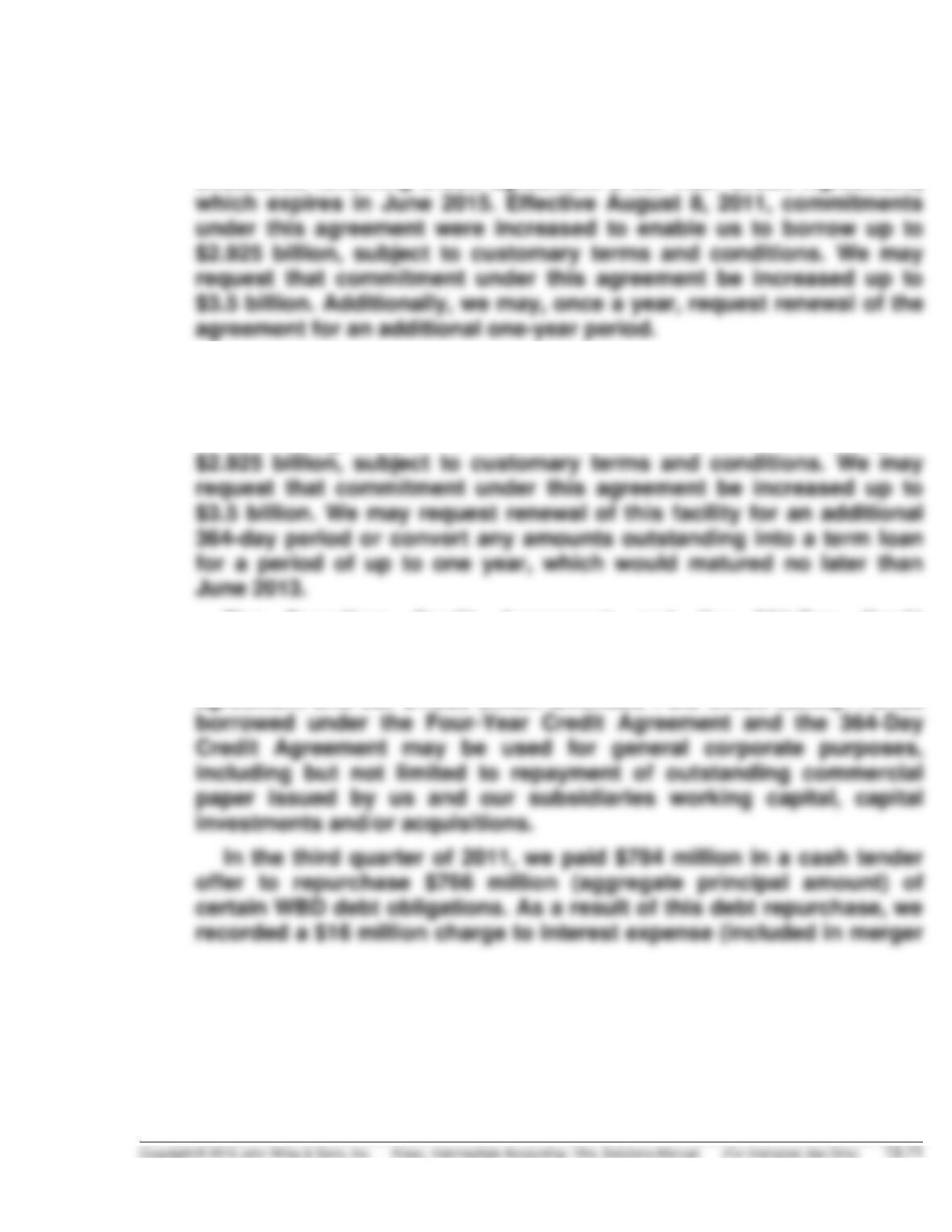
Note 9
Debt Obligations and Commitments
2011
2010
Short-term debt obligations
Current maturities of long-term debt
$ 2,549
$ 1,626
Commercial paper (0.1% and 0.2%)
2,973
2,632
$ 6,165
$ 4,898
Long-term debt obligations
Notes due 2011 (4.4%)
$ –
$ 1,513
Notes due 2012 (3.0% and 3.1%)
2,353
2,437
Notes due 2013 (2.3% and 3.0%)
Notes due 2014 (4.6% and 5.3%)
Notes due 2015 (2.3% and 2.6%)
1,632
Notes due 2016 (3.9% and 5.5%)
Notes due 2017–2040 (4.8% and 4.9%)
10,806
Other, due 2012–2020 (9.9% and 9.8%)
23,117
21,625
Less: current maturities of long-term debt
obligations
(2,549)
(1,626)
Total
$20,568
$19,999
The interest rates in the above table reflect weighted-average rates at
year-end.
COMPARATIVE ANALYSIS CASE (Continued)
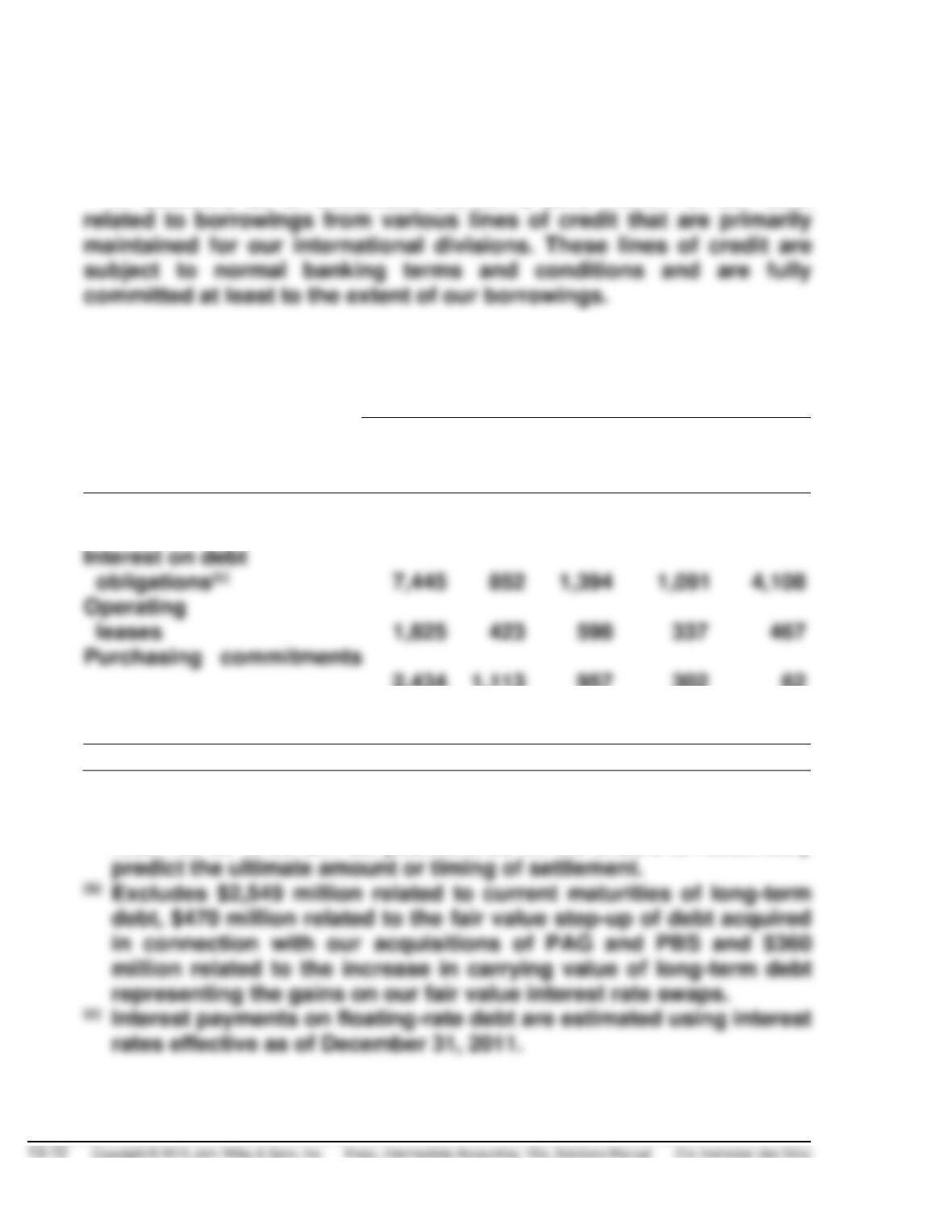
In the third quarter of 2011, we issued:
The net proceeds from the issuances of all the above notes were used
for general corporate purposes.
In the third quarter of 2011, we entered into a new four-year
unsecured revolving credit agreement (Four-Year Credit Agreement)
Also, In the third quarter of 2011, we entered into a new 364-day
unsecured revolving credit agreement (364-Day Credit Agreement)
which expires in June 2012. Effective August 8, 2011, commitments
under this agreement were increased to enable us to borrow up to
The Four-Year Credit Agreement and the 364-Day Credit
Agreement, together replaced our $2 billion unsecured revolving
credit agreement, our $2.575 billion 364-day unsecure revolving credit
agreement and our $1.080 billion amended PBG credit facility. Funds
COMPARATIVE ANALYSIS CASE (Continued)
and integration charges) in the third quarter, primarily representing
the premium paid in the tender offer.
In addition, as of December 31, 2011, $848 million of our debt
Long-Term Contractual Commitments(a)
Payments Due by Period
Total
2012
2013–
2014
2015–
2016
2017
and
beyond
Long-term debt
obligations(b)
$19,738
$ –
$6,084
$3,451
$10,203
Interest on debt
7,445
852
4,108
Operating
1,825
423
598
337
Purchasing commitments
2,434
1,113
957
302
62
Marketing commitments
2,519
240
589
535
1,155
$33,961
$2,628
$9,622
$5,716
$15,995
(a) Reflects non-cancelable commitments as of December 31, 2011,
based on year-end foreign exchange rates and excludes any
reserves for uncertain tax positions as we are unable to reasonably
COMPARATIVE ANALYSIS CASE (Continued)
Most long-term contractual commitments, except for our long term debt
obligations, are not recorded on our balance sheet. Non-cancelable
operating leases primarily represent building leases. Non-cancelable
purchasing commitments are primarily for sugar and other sweeteners,
packaging materials, oranges and orange juice. Non-cancelable marketing
Off-Balance-Sheet Arrangements
It is not our business practice to enter into off-balance-sheet arrangements,
other than in the normal course of business. See Note 8 regarding
FINANCIAL STATEMENT ANALYSIS CASE 1
NORTHLAND CRANBERRIES
(a) Working capital is calculated as current assets – current liabilities, while
the current ratio is calculated as current assets/current liabilities. For
Northland Cranberries these ratios are calculated as follows:
Current year
Prior year
Working capital
$6,745,759 – $10,168,685 = $–3,422,926
$5,598,054 – $4,484,687 = $1,113,367
Current ratio
($6,745,759/$10,168,685) = .66
($5,598,054/$4,484,687) = 1.25
Historically, it was generally believed that a company should maintain
a current ratio of at least 2.0. In recent years, because companies have
(b) This illustrates a potential problem with ratios like the current ratio,
that rely on balance sheet numbers that present a company’s finan–
cial position at a particular point in time. That point in time may not be
representative of the average position of the company during the course
FINANCIAL STATEMENT ANALYSIS CASE 2
MOHICAN COMPANY
(a) Under the cash basis, warranty costs are charged to expense as they
are incurred; in other words, warranty costs are charged in the period
in which the seller or manufacturer performs in compliance with the
warranty. No liability is recorded for future costs arising from warranties,
(b) When the warranty is sold separately from the product, the sales war–
ranty approach is employed. Revenue on the sale of the extended
warranty is deferred and is generally recognized on a straight-line basis
over the life of the contract. Revenue is deferred because the seller of
the warranty has an obligation to perform services over the life of the
contract.
(c) The general approach is to use the straight-line method to recognize
deferred revenue on warranty contracts. If historical evidence indicates
FINANCIAL STATEMENT ANALYSIS CASE 3
(a) BOP’s working capital and current ratio have declined in 2014 com-
pared to 2013. While this would appear to be bad news, the acid-test
ratio has improved. This is due to BOP carrying relatively more liquid
receivables in 2014 (receivable days has increased.) And while
(b) Answers will vary depending on the companies selected. This activity
is a great spreadsheet exercise. The analysis for Best Buy and Circuit
City for the years 2005 – 2007 is presented on the next page (just
before Circuit City went out of business).