FINANCIAL STATEMENT ANALYSIS CASE 3 (Continued)
Note to Instructor: Although the analysis below is for 2005 – 2007,
this analysis is particularly useful as Circuit City subsequently filed
for bankruptcy.
Best Buy (in millions)
Circuit City (in thousands)
2005
2006
2007
2005
2006
2007
Cash
$ 470
$748
1,205
879,660
315,970
141,141
Accounts Receivable
375
449
548
230,605
222,869
382,555
Inventory
2,851
4,028
Accounts Payable
2,824
3,934
635,674
850,359
922,205
Purchases
Cost of Goods Sold
Sales Revenue
Operating Cycle
Receivable Days
5.3
5.6
7.1
11.2
Inventory Days
52.7
54.1
71.2
62.9
Operating Cycle
58.0
59.7
78.3
74.1
Days to be Financed
13.67
Working Capital
Current Ratio
1.40
1.47
2.63
2.34
Acid-Test Ratio
0.37
0.45
0.63
0.57
ACCOUNTING, ANALYSIS, AND PRINCIPLES
Accounting
(1)
During 2014
Warranty Expense ……………………………………..
6,000
Cash …………………………………………………
12/31/14
Warranty Expense ……………………………………..
Warranty Payable …………………………..
(2)
2/28/14
Interest Expense ($5,000 X 2/3) …………………..
3,333
Interest Payable ($5,000 X 1/3) ……………………
1,667
Cash ($200,000 X 10% X 3/12) …………….
5,000
5/31/14
Interest Expense ……………………………………….
5,000
Cash ($200,000 X 10% X 3/12) …………….
5,000
8/31/14
Interest Expense ……………………………………….
5,000
Cash ($200,000 X 10% X 3/12) …………….
5,000
11/30/14
Interest Expense ……………………………………….
5,000
Cash ($200,000 X 10% X 3/12) …………….
5,000
12/31/14
Interest Expense ……………………………………….
1,667
Interest Payable ($5,000 X 1/3) ……………
1,667
(3)
1/1/14
Plant Assets ……………………………………………..
5,000,000
Cash …………………………………………………
5,000,000
1/1/14
Plant Assets ……………………………………………..
192,770
Asset Retirement Obligation ………………
12/31/14
Depreciation Expense …………………………..
519,277
Acc. Depr.—Plant Assets …………………..
($519,277 = [$5,000,000 + $192,770]/10)
12/31/14
Interest Expense ……………………………………….
Asset Retirement Obligation ………………
ACCOUNTING, ANALYSIS, AND PRINCIPLES (Continued)
Analysis
The warranty payable and the interest payable are current liabilities, so all
else equal, these will decrease both the current and acid-test ratios.
Because of the commitment letter from First Trust Corp., the $200,000 loan
Principles
According to FASB Concepts Statement No. 6, liabilities are probable
future sacrifices of economic benefits arising from present obligations of a
particular entity to transfer assets or provide services to other entities in
the future as a result of past transactions or events. With respect to the
new warranty plan, YellowCard would be currently obligated to provide
PROFESSIONAL RESEARCH
(a) FASB ASC 605-20-25 addresses how revenue and costs from a
separately priced extended warranty or product maintenance contract
should be recognized.
(b) An Extended Warranty is an agreement to provide warranty protection
Product Maintenance Contracts are agreements to perform certain
agreed-upon services to maintain a product for a specified period of
time. The terms of the contract may take different forms, such as an
agreement to periodically perform a particular service a specified
number of times over a specified period of time, or an agreement to
(c) Costs that are directly related to the acquisition of a contract and that
would have not been incurred but for the acquisition of that contract
(incremental direct acquisition costs) shall be deferred and charged to
PROFESSIONAL SIMULATION
Note: This assignment is available on the Kieso website.
Journal Entries
(a)
Unearned Sales Revenue ………………………………………..
400,000
Sales Revenue ……………………………………………….
400,000
(To record subscriptions earned
during 2014)
Adjusted balance
($600,000 + $500,000 + $800,000) …………………..
(b) No entry should be made to accrue for an expense, because the
absence of insurance coverage does not mean that an asset has been
impaired or a liability has been incurred as of the balance sheet date.
The company may, however, appropriate retained earnings for self–
Explanation
If a liability is scheduled to mature within one year after the date of an enter–
prise’s balance sheet or within an operating cycle that is longer than one
year, then the liability is classified as current (unless the liability will be
PROFESSIONAL SIMULATION (Continued)
Generally all three of these liabilities (accounts payable, notes payable,
bonds payable) would be classified as current liabilities on the company’s
balance sheet prepared as of December 31, 2014.
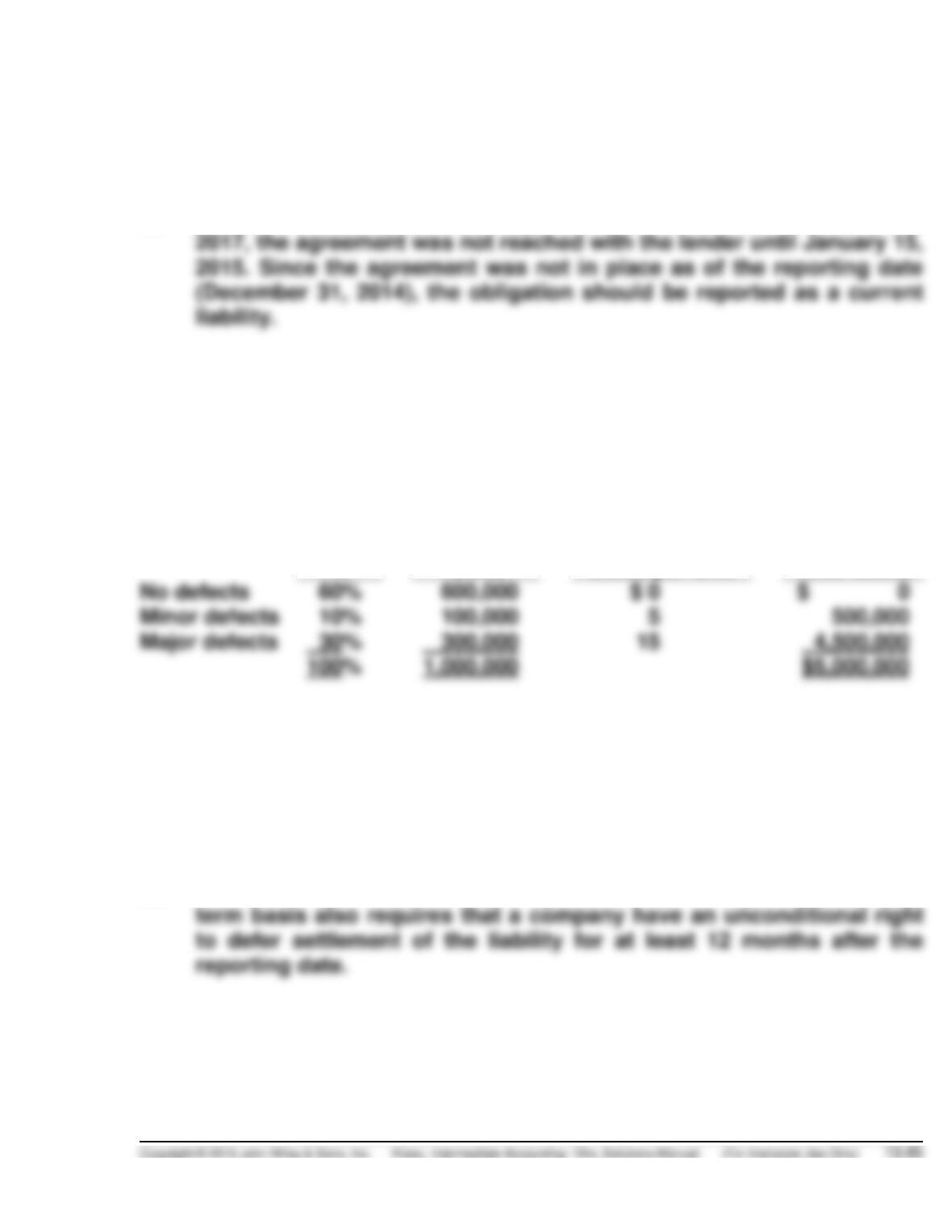
However, the bonds payable, and possibly the notes payable, could be clas-
sified as noncurrent liabilities if the company intends to refinance the obli–
gations on a long–term basis and the company’s intent to refinance the
IFRS CONCEPTS AND APPLICATION
IFRS13-1
A company should exclude a short-term obligation from current liabilities
IFRS13-2
The ability to defer settlement of short-term debt may be demonstrated by
IFRS13-3
A provision is defined as a liability of uncertain timing or amount and is
IFRS13-4
A provision should be recorded and a charge accrued to expense only if:
(a) the company has a present obligation (constructive or legal) as
a result of a past event,
IFRS13-5
A current liability such as accounts payable is susceptible to precise
measurement because the date of payment, the payee, and the amount of
IFRS13-6
Onerous contracts are ones in which the unavoidable costs of meeting the
obligations exceed the economic benefits expected to be received.
IFRS13-7
ALEXANDER COMPANY
Partial Statement of Financial Position
December 31, 2014
Current liabilities:
Notes payable (Note 1)……….……………….……………………………. $300,000
NOTE 1:
Short-term debt refinanced. As of December 31, 2014, the company had
IFRS13-8
(1) Mckee should classify $100,000 of the obligation as a current maturity
of long-term debt (current liability) and the $300,000 balance as a
noncurrent liability.
(2) While the maturity of the obligation was extended to February 15,
IFRS13-9
1.
Warranty Expense ……………………………………..
5,000,000*
Warranty Payable ………………………………
5,000,000
* Expected warranty costs:
%
Units
Costs per Unit
Total Costs
No defects
Minor defects
2.
Income Tax Expense ………………………………….
400,000
Income Taxes Payable ……………………….
400,000
IFRS13–10
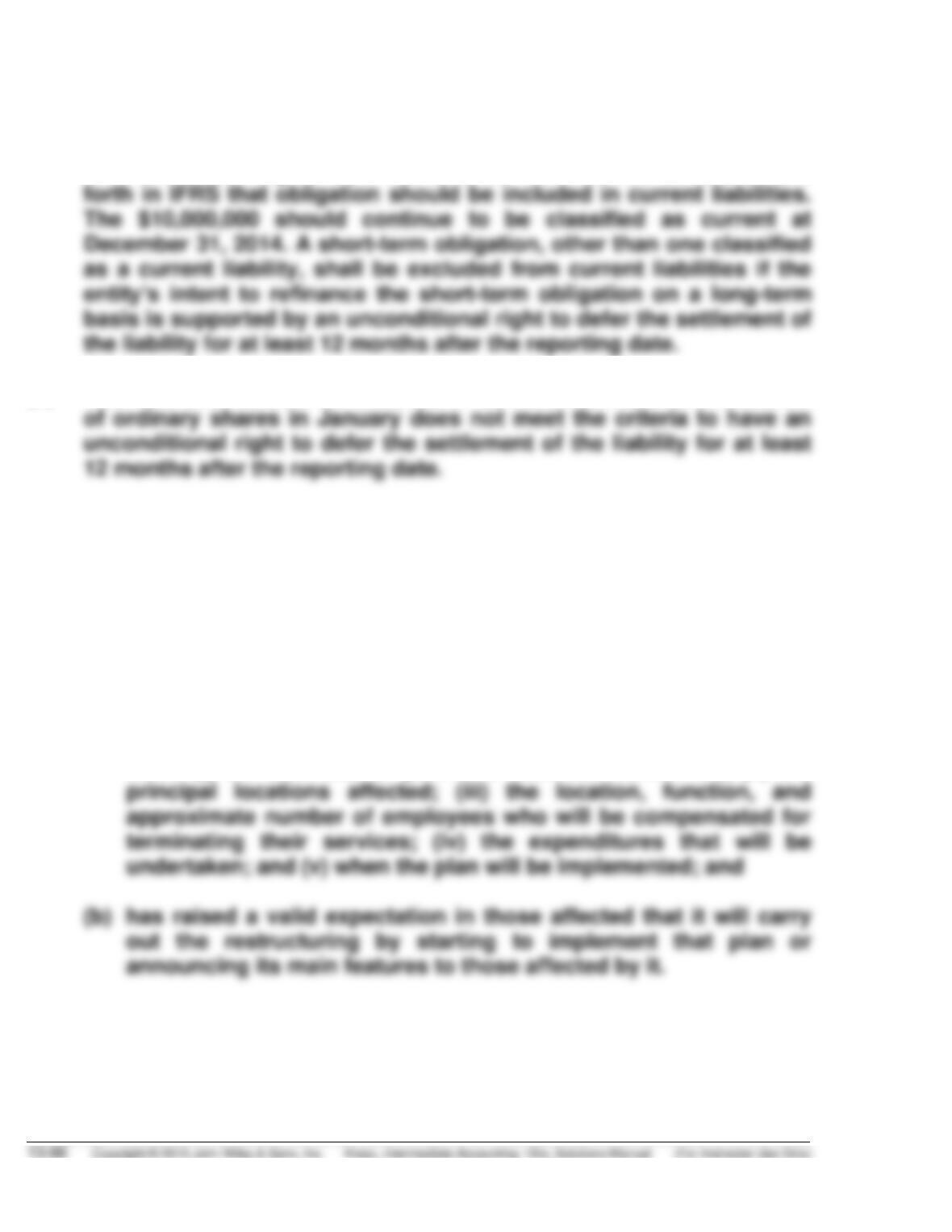
(a) No. IFRS indicate that refinancing a short-term obligation on a long-
IFRS13-10 (Continued)
(b) No. The events described will not have an impact on the financial
statements. Since Kobayashi Corporation’s refinancing of the long–
term debt maturing in March 2015 does not meet the conditions set
(c) Yes. The debt should be included in current liabilities. The issuance
IFRS13–11
(a) IAS 37, Provisions, Contingent Liabilities and Contingent Assets.
(b) Recognizing a liability from restructuring (IAS 37, 72 – 79).
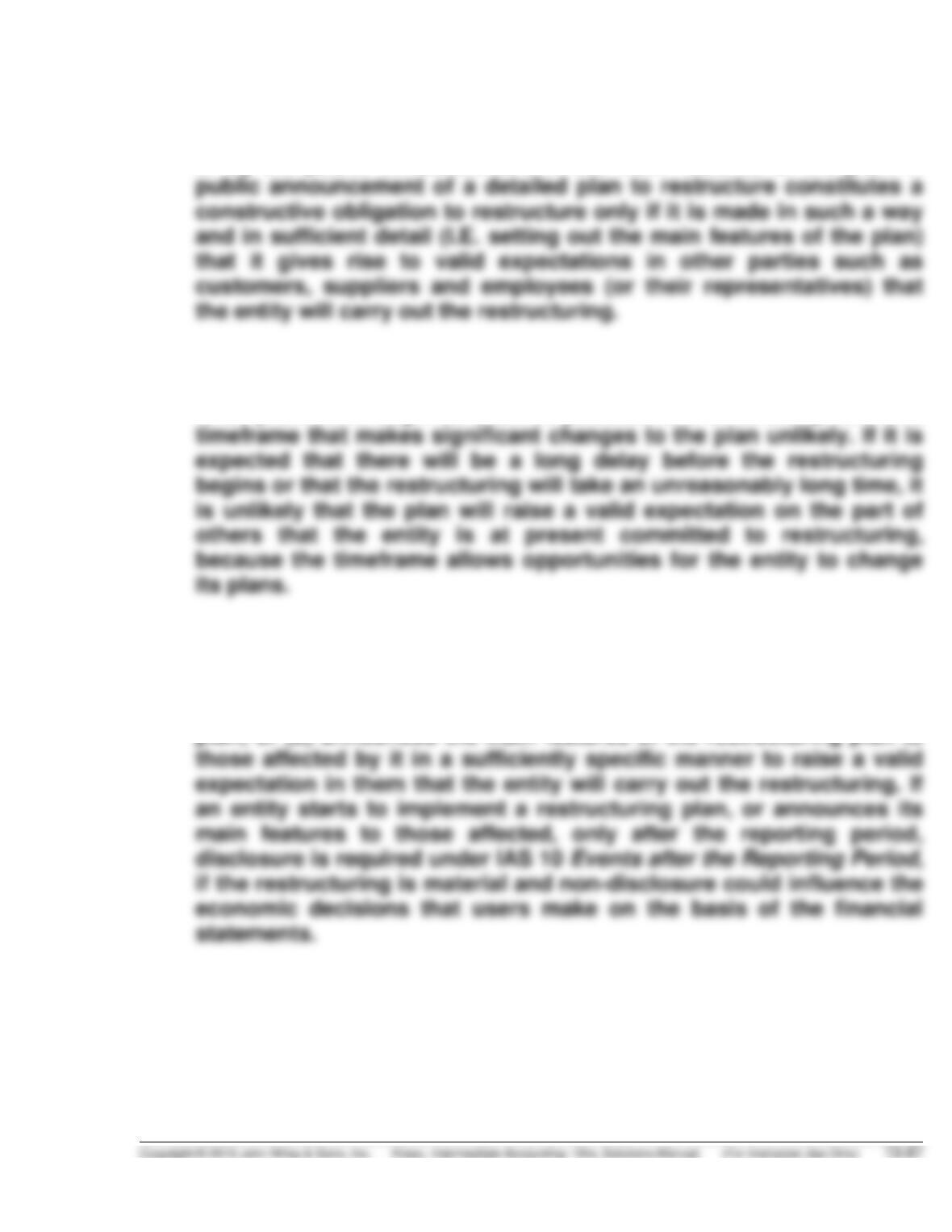
A constructive obligation to restructure arises only when an entity:
(a) has a detailed formal plan for the restructuring identifying at
least: (i) the business or part of a business concerned; (ii) the
IFRS13-11 (Continued)
Evidence that an entity has started to implement a restructuring plan
would be provided, for example, by dismantling plant or selling assets
or by the public announcement of the main features of the plan. A
For a plan to be sufficient to give rise to a constructive obligation
when communicated to those affected by it, its implementation needs
to be planned to begin as soon as possible and to be completed in a
A management or board decision to restructure taken before the end
of the reporting period does not give rise to a constructive obligation
at the end of the reporting period unless the entity has, before the end
of the reporting period: (a) started to implement the restructuring
plan; or (b) announced the main features of the restructuring plan to
IFRS13-11 (Continued)
Although a constructive obligation is not created solely by a manage-
ment decision, an obligation may result from other earlier events
together with such a decision. For example, negotiations with employee
In some countries, the ultimate authority is vested in a board whose
membership includes representatives of interests other than those of
management (e.g. employees) or notification to such representatives
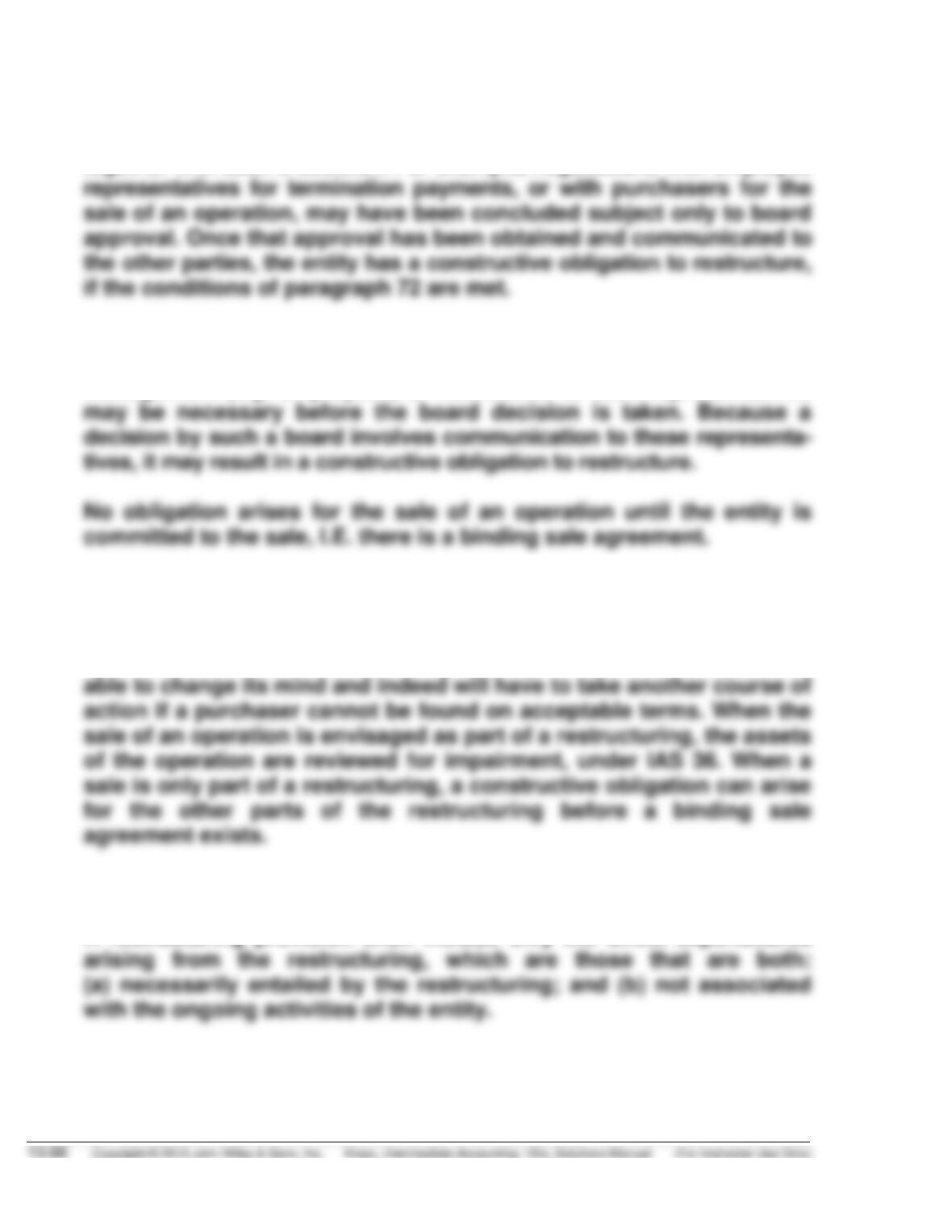
Even when an entity has taken a decision to sell an operation and
announced that decision publicly, it cannot be committed to the sale
until a purchaser has been identified and there is a binding sale
agreement. Until there is a binding sale agreement, the entity will be
Costs to include (IAS 37, 80)
A restructuring provision shall include only the direct expenditures
IFRS13-11 (Continued)
Costs to exclude (IAS 37, 81 – 82)
A restructuring provision does not include such costs as: (a) retraining
or relocating continuing staff; (b) marketing; or (c) investment in new
systems and distribution networks. These expenditures relate to the
As required by paragraph 51, gains on the expected disposal of assets
are not taken into account in measuring a restructuring provision,
even if the sale of assets is envisaged as part of the restructuring.
(c) The current warranty contract is considered an onerous contract. The
required accounting related to an onerous contract is in IAS 37, 81 – 82.
If an entity has a contract that is onerous, the present obligation
This Standard defines an onerous contract as a contract in which the
unavoidable costs of meeting the obligations under the contract
exceed the economic benefits expected to be received under it. The
IFRS13-11 (Continued)
Before a separate provision for an onerous contract is established, an
IFRS13–12
(a) M&S’s short-term borrowings were £327.7 million at 31 March, 2012.
SHORT-TERM DEBT
(In millions)
2012
Bank loans and overdrafts
£ 38.4
Medium term notes
Total short-term debt
(b) 1. Working capital = Current assets less current liabilities.
IFRS13-12 (Continued)
3.
Current ratio =
Current assets
Current liabilities
M&S’s acid-test ratio is at 0.54, and working capital and the current
ratio appear acceptable. The lower acid-test ratio may not be a
problem. Many large companies carry relatively high levels of
(c) M&S provided the following discussion related to commitments and
contingencies:
25 Contingencies and commitments
B. Other material contracts
In the event of a material change in the trading arrangements with
certain warehouse operators, the Group has a commitment to

IFRS13-12 (Continued)
C. Commitments under operating leases
The Group leases various stores, offices, warehouses and equipment
under non-cancellable operating lease agreements. The leases have
varying terms, escalation clauses and renewal rights
2012 2011
£m £m
Total future minimum rentals payable under
non-cancellable operating leases are as follows:
Within one year 257.8 242.6
The total future sublease payments to be received are £63.3m (last
year £65.8m)