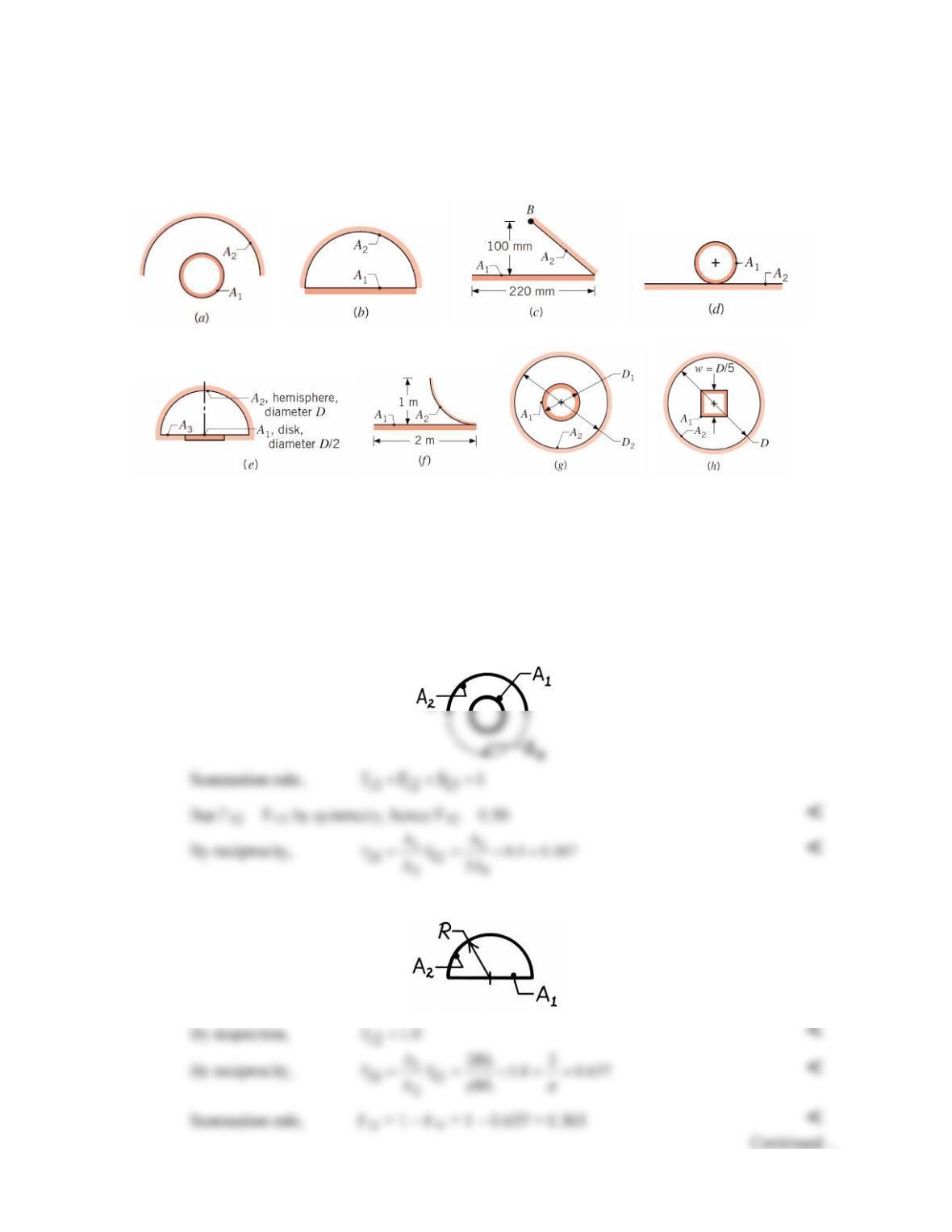
PROBLEM 13.1
KNOWN: Various geometric shapes involving two areas A1 and A2.
FIND: Shape factors, F12 and F21, for each configuration.
SCHEMATIC:
ASSUMPTIONS: (1) Surfaces are diffuse, (2) Length normal to the page is large compared to other
dimensions.
ANALYSIS: The analysis is not to make use of tables or charts. The approach involves use of the
reciprocity relation, Eq. 13.3, and summation rule, Eq. 13.4. Recognize that reciprocity applies to two
surfaces; summation applies to an enclosure. Certain shape factors can be identified by inspection.
Note that L is the length normal to page.
(a) Small sphere, A1, under concentric hemisphere, A2, where A2 = 3A1:
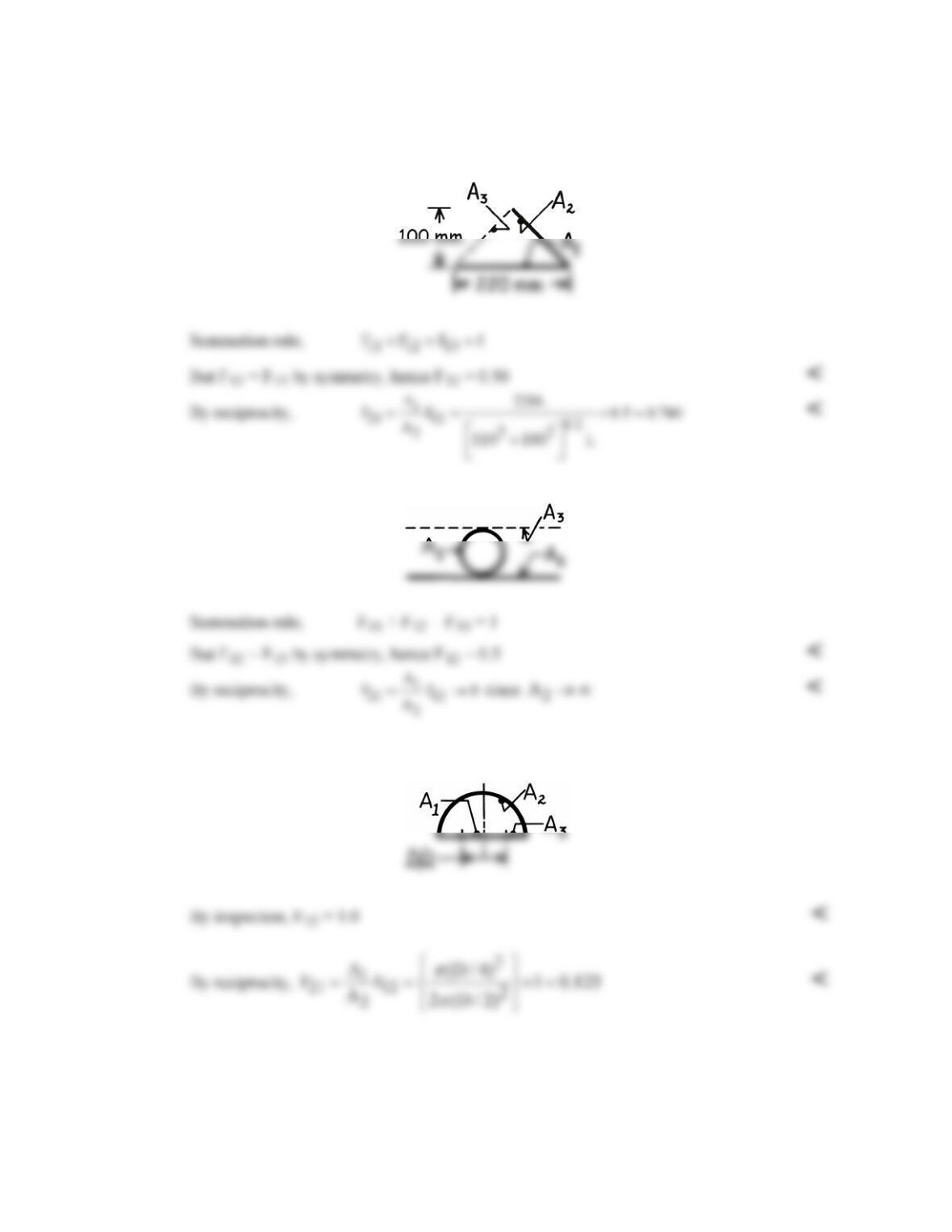
(b) Long duct:
PROBLEM 13.1 (Cont.)
(c) Long inclined plates (point B directly above center of A1):
(d) Long cylinder on infinite plate:
(e) Hemisphere–disk arrangement:
Continued…
PROBLEM 13.1 (Cont.)
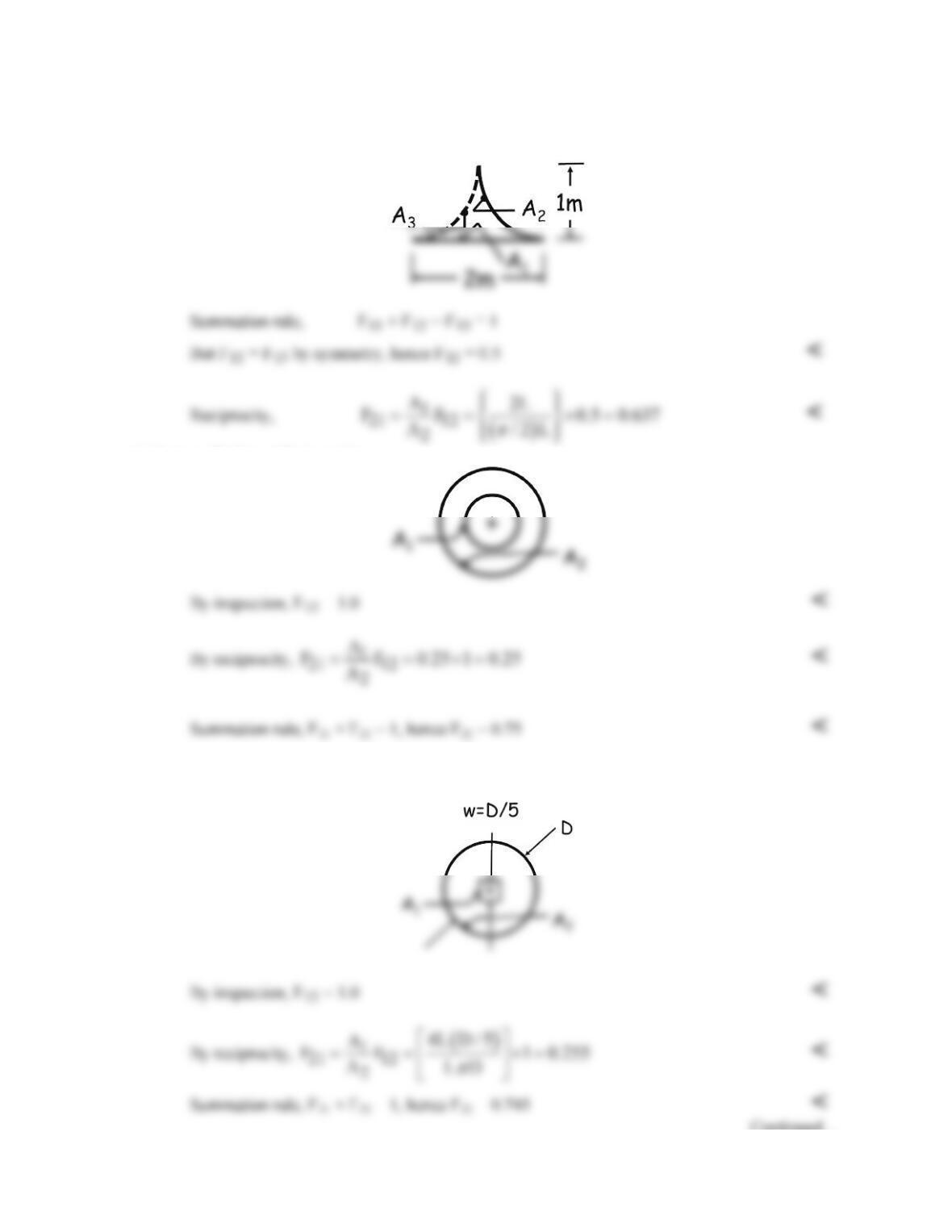
(f) Long, open channel:
(g) Long cylinders with A2 = 4A1,
(h) Long square rod in long cylinder:
Continued…

PROBLEM 13.1 (Cont.)
COMMENTS: (1) Note that the summation rule is applied to an enclosure. To complete the
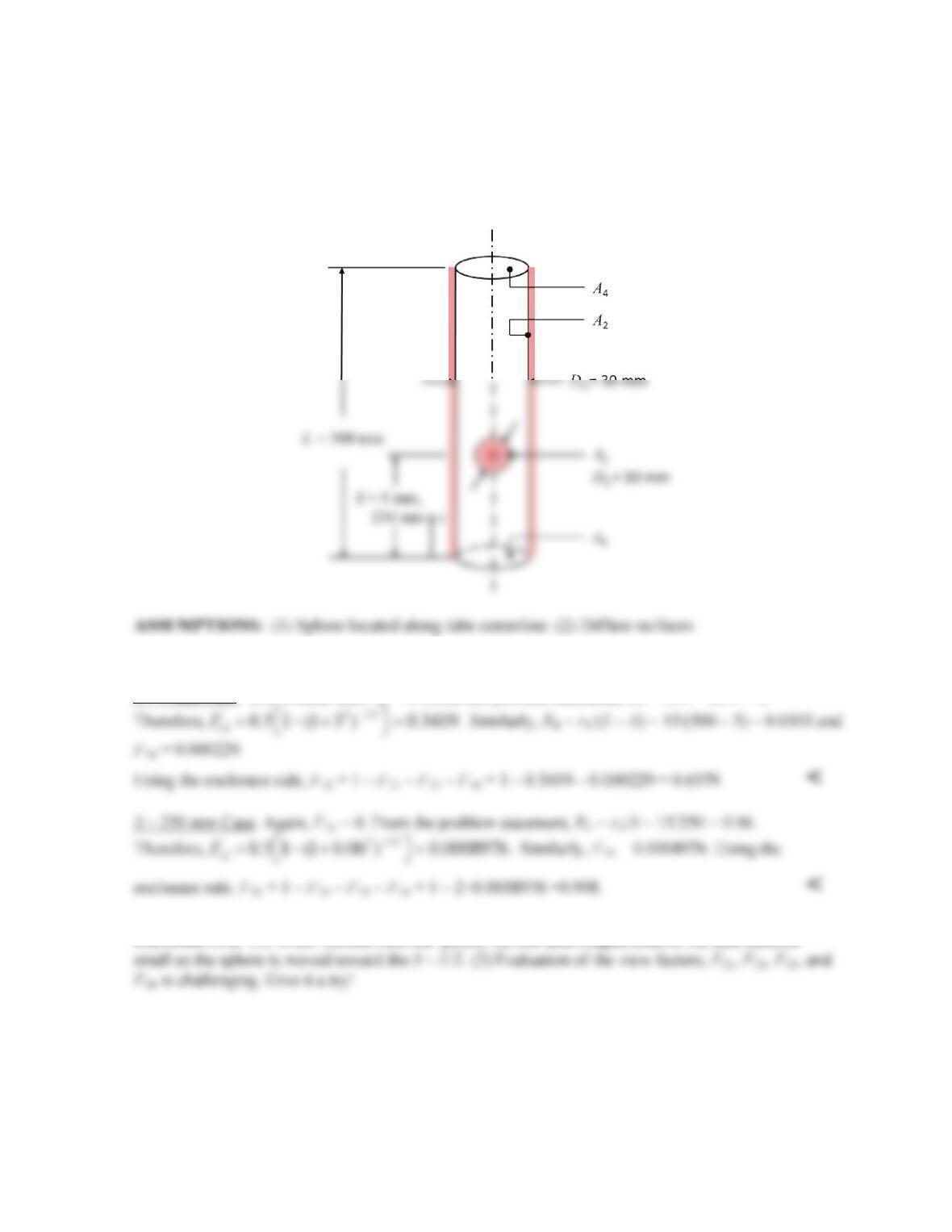
PROBLEM 13.2
KNOWN: Cylindrical tube radius, sphere radius and location in tube. Relationship for view factor
between sphere and bottom bottom end of tube.
FIND: View factors F11, F12, F13, and F14.
SCHEMATIC:
ANALYSIS:
S = 5 mm Case. It is evident that F11 = 0. From the problem statement, R3 = r3/S = 15/5 = 3.
PROBLEM 13.3
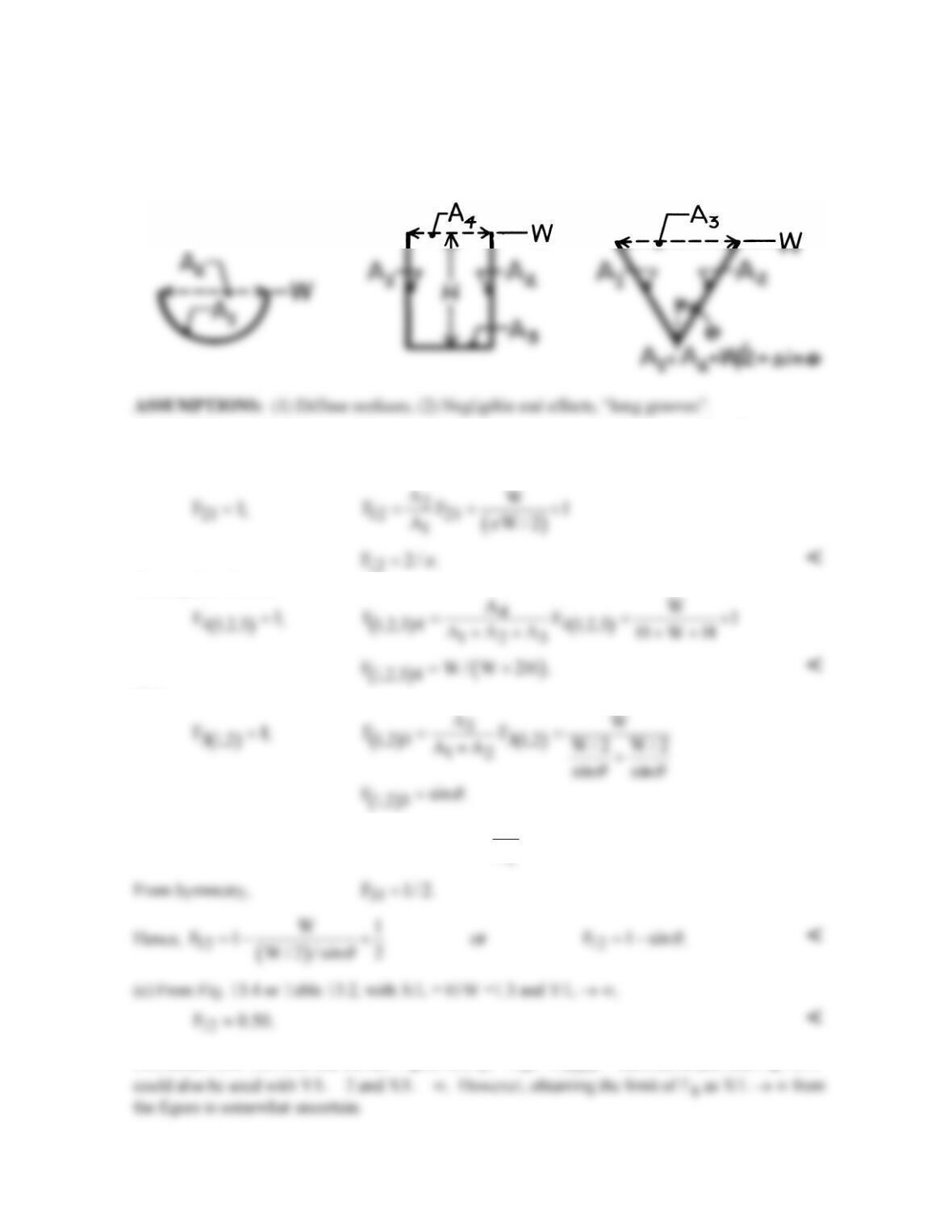
KNOWN: Geometry of semi–circular, rectangular and V grooves.
FIND: (a) View factors of grooves with respect to surroundings, (b) View factor for sides of V
groove, (c) View factor for sides of rectangular groove.
SCHEMATIC:
ANALYSIS: (a) Consider a unit length of each groove and represent the surroundings by a
hypothetical surface (dashed line).
Semi–Circular Groove:
Rectangular Groove:
V Groove:
(b) From Eqs. 13.3 and 13.4,
3
12 13 31
A
F 1F 1 F.
A
=−=−
COMMENTS: (1) Note that for the V groove, F13 = F23 = F(1,2)3 = sinθ, (2) In part (c), Fig. 13.4
PROBLEM 13.4
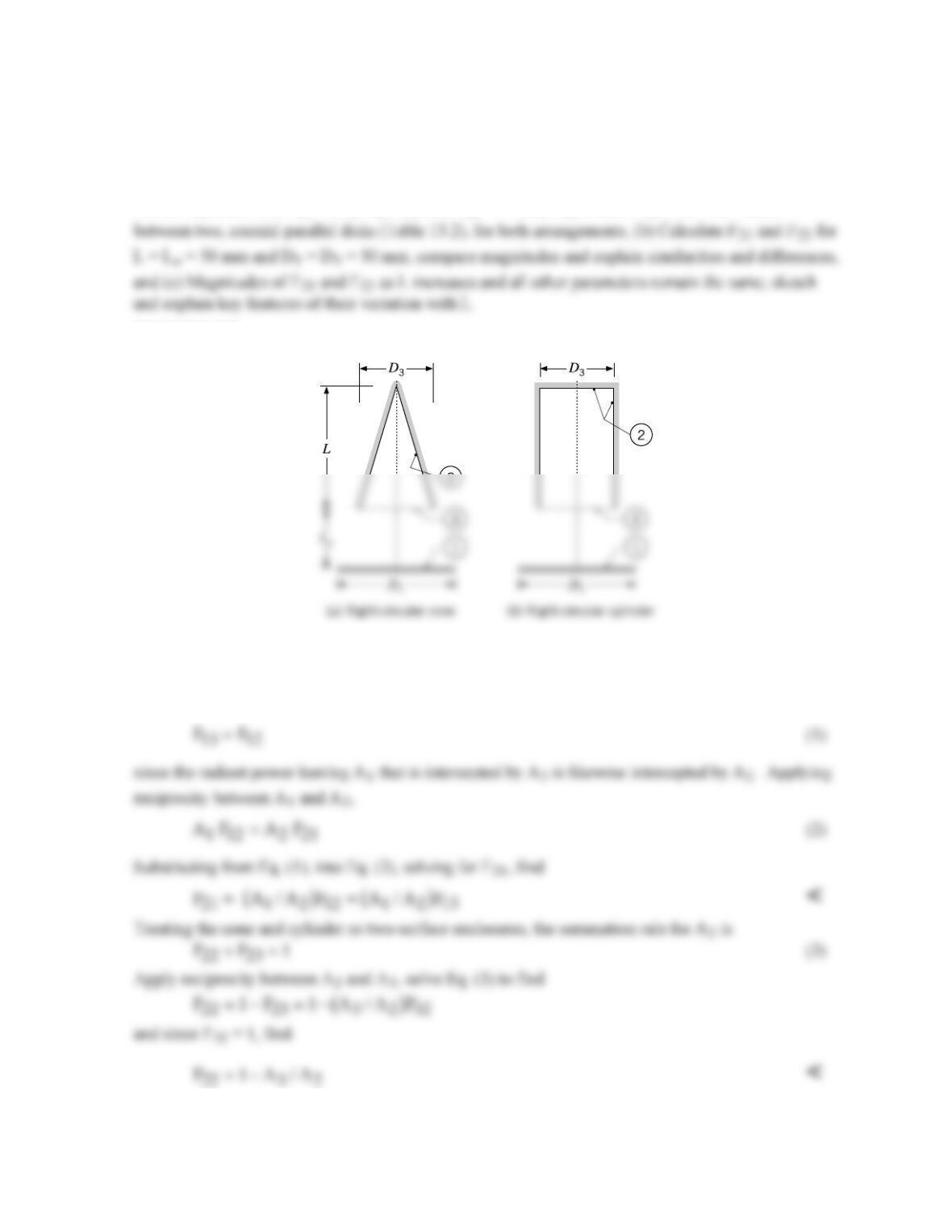
KNOWN: Right circular cone and right-circular cylinder of same diameter D and length L
positioned coaxially a distance Lo from the circular disk A1; hypothetical area corresponding to the
openings identified as A3.
FIND: (a) Show that F21 = (A1/A2) F13 and F22 = 1 – (A3/A2), where F13 is the view factor
SCHEMATIC:
ASSUMPTIONS: (1) Diffuse surfaces with uniform radiosities, and (2) Inner base and lateral
surfaces of the cylinder treated as a single surface, A2.
ANALYSIS: (a) For both configurations,
Continued …
PROBLEM 13.4 (Cont.)
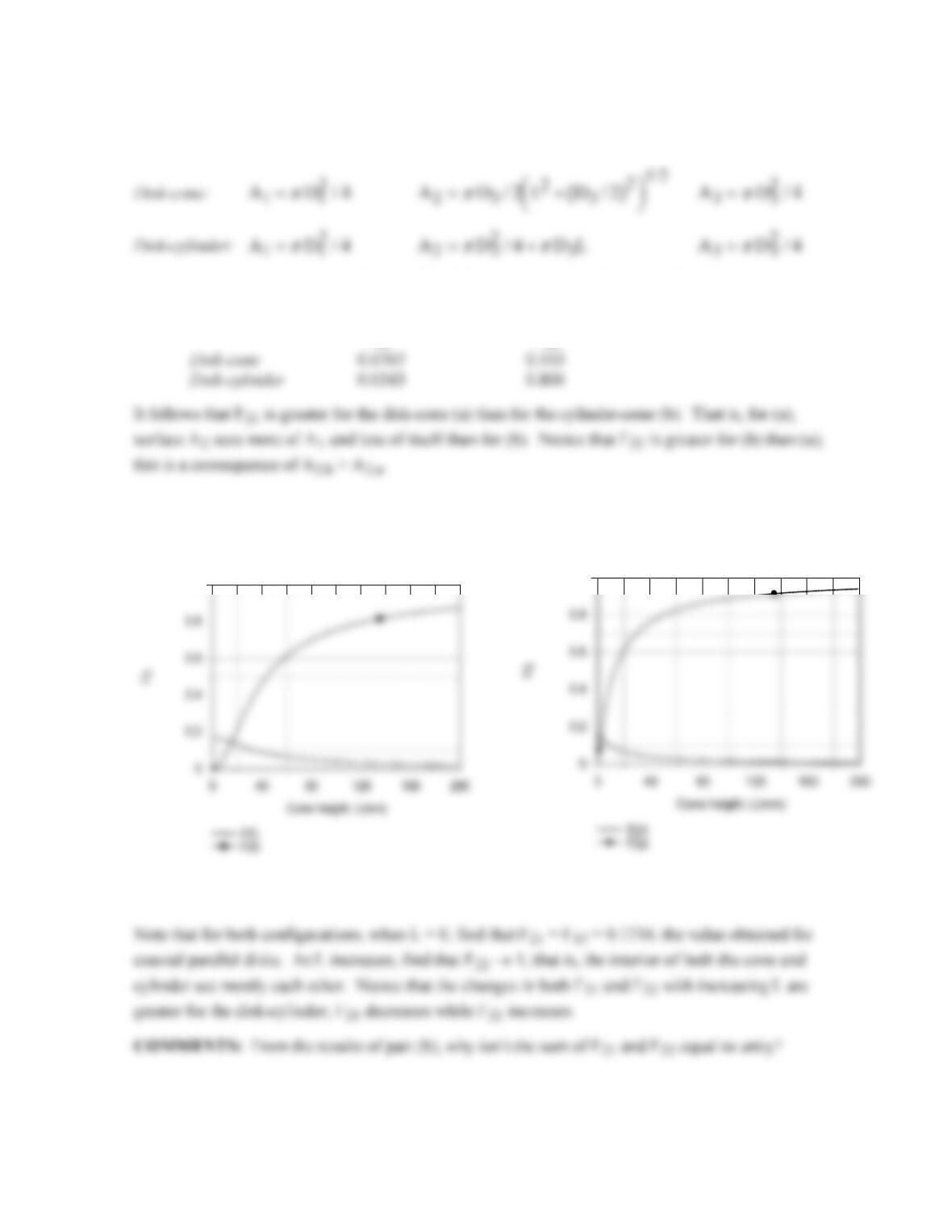
(b) For the specified values of L, Lo, D1 and D2, the view factors are calculated and tabulated below.
Relations for the areas are:
The view factor F13 is evaluated from Table 13.2, coaxial parallel disks (Fig. 13.5); find F13 =
0.1716.
F21 F22
(c) Using the foregoing equations in the IHT workspace, the variation of the view factors F21 and F22
with L were calculated and are graphed below.
Right-circular cone and disk
1
Right–circular cylinder and disk, Lo = D = 50 mm
1
PROBLEM 13.5
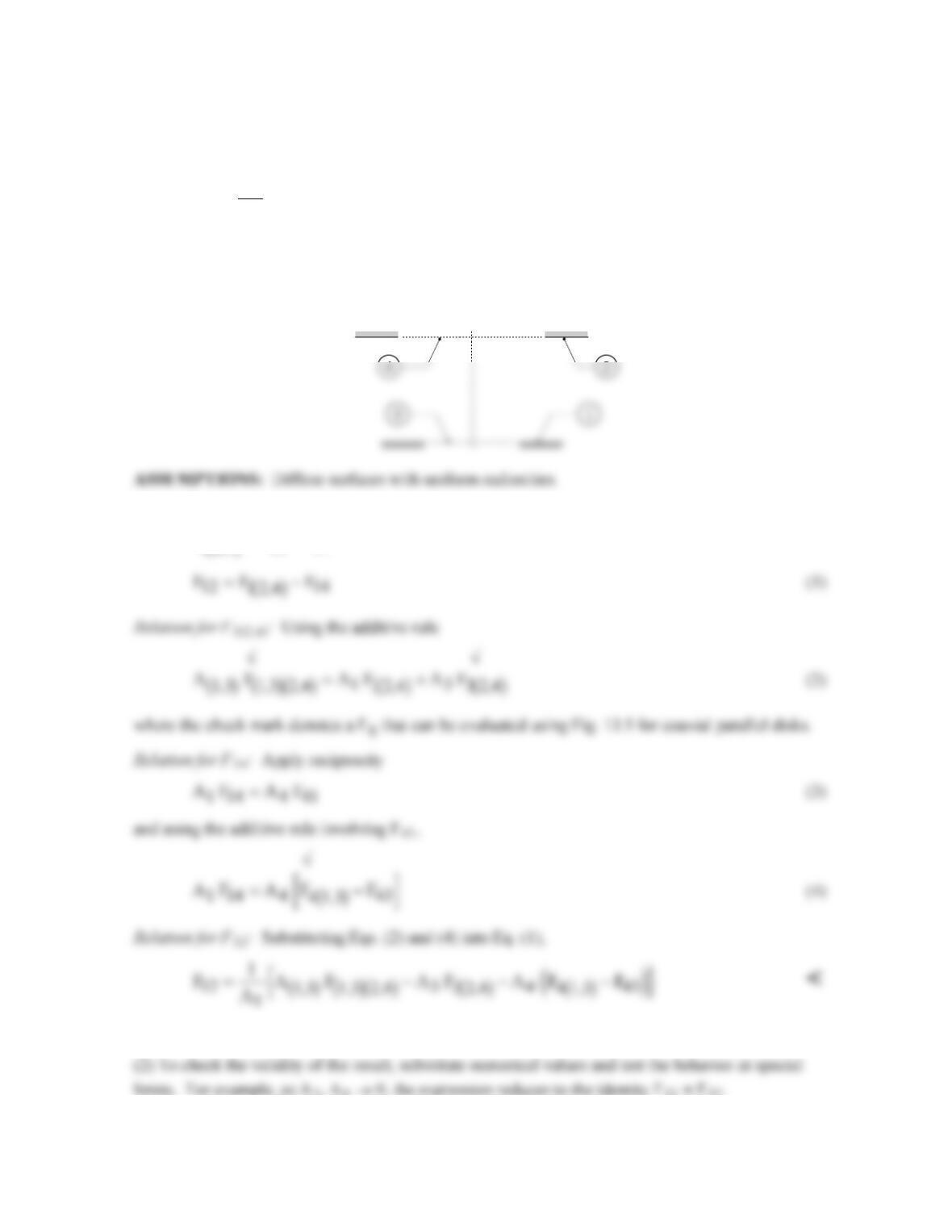
KNOWN: Two parallel, coaxial, ring-shaped disks.
FIND: Show that the view factor F12 can be expressed as
FAA F A F A F F
12 11,3 1,3 33 2,4 44 1,3 43
= − − −
1
2 4
b g b gb g b g b g
ej
{ }
,
where all the Fig on the right-hand side of the equation can be evaluated from Figure 13.5 (see Table
13.2) for coaxial parallel disks.
SCHEMATIC:
ANALYSIS: Using the additive rule, Eq. 13.5, where the parenthesis denote a composite surface,
F F F
1 2,4 12 14
b g = +
FAA F A F A F F
= − − −
1
COMMENTS: (1) The Fij on the right-hand side can be evaluated using Fig. 13.5.
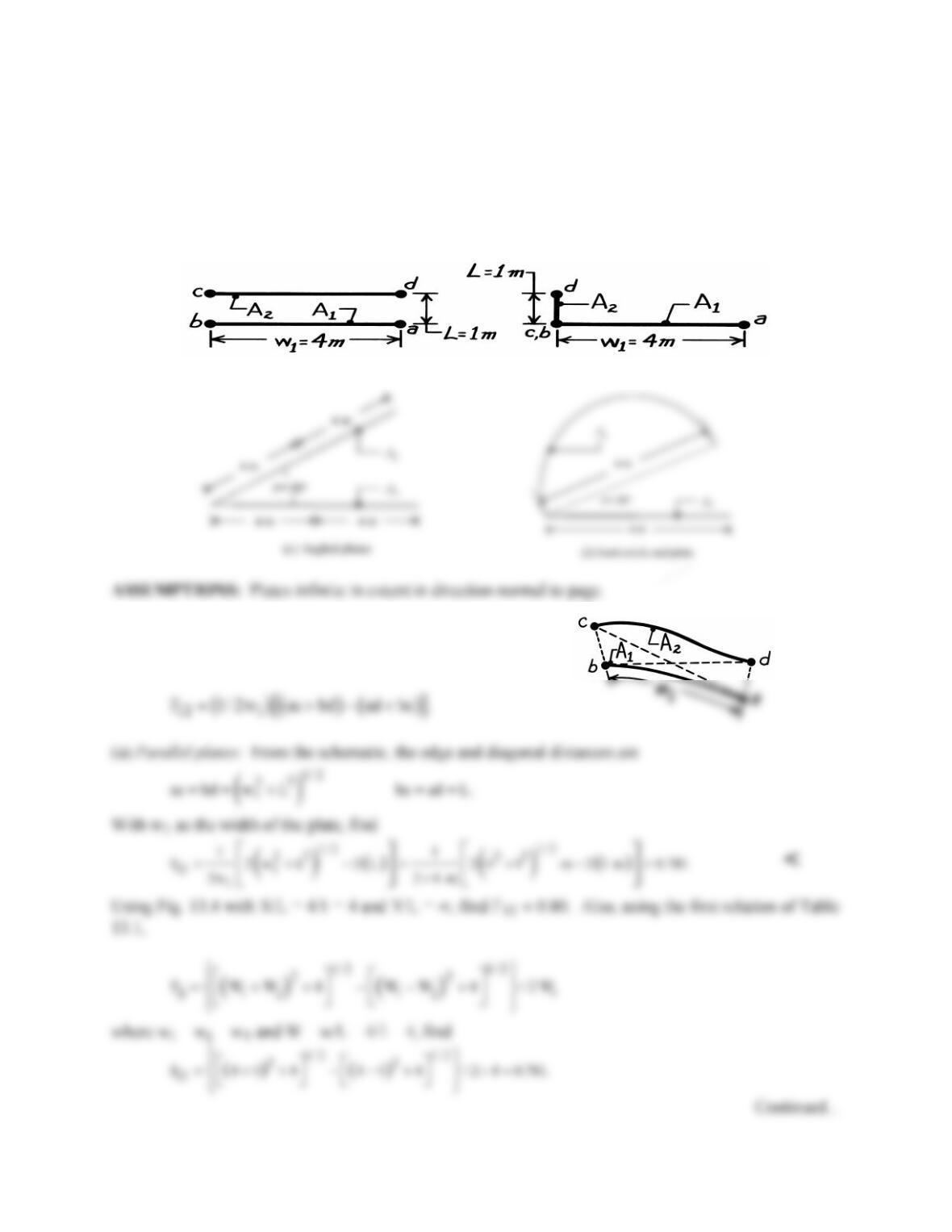
PROBLEM 13.6
KNOWN: Dimensions of four geometrical arrangements.
FIND: View factors using “crossed–strings” method; compare with appropriate graphs and analytical
expressions.
SCHEMATIC:
(a) Parallel plates (b) Perpendicular plates with common edge
ANALYSIS: The crossed–strings method is applicable to
surfaces of infinite extent in one direction having an
unobstructed view of one another.
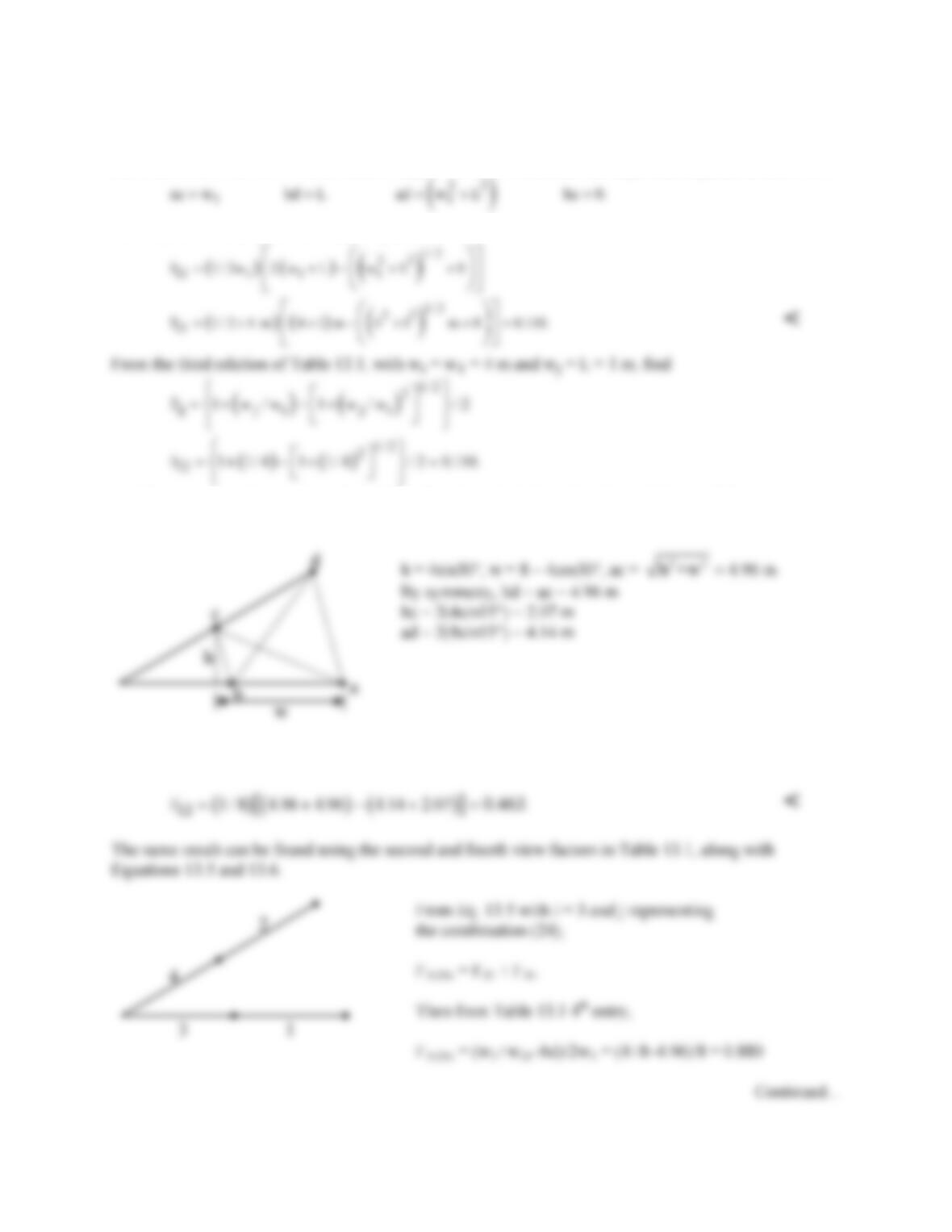
PROBLEM 13.6 (Cont.)
(b) Perpendicular plates with a common edge: From the schematic, the edge and diagonal distances are
With w1 as the width of the horizontal plates, find
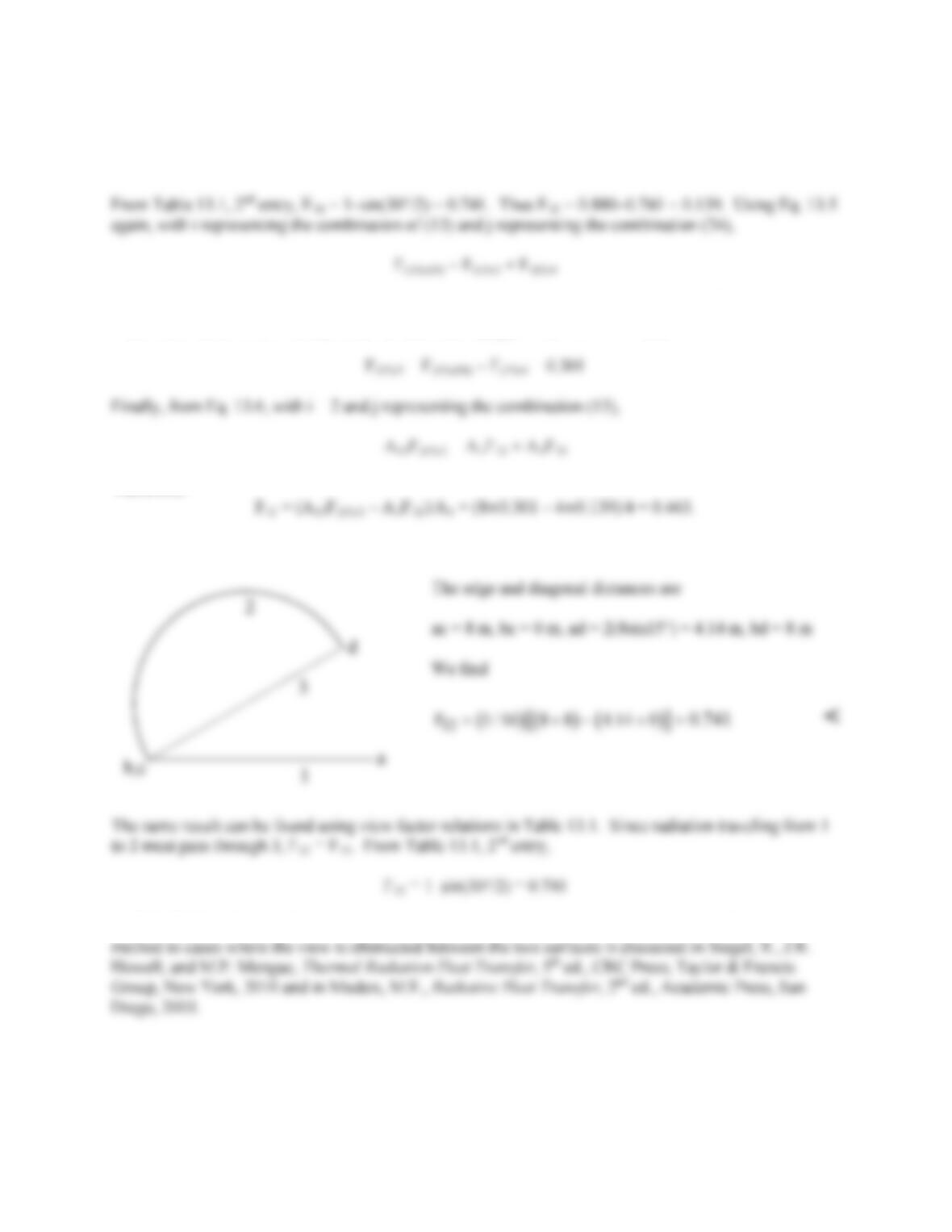
(c) Plates at an angle to one another. From the schematic below, the edge and diagonal distances can be
calculated as follows:
We find
PROBLEM 13.6 (Cont.)
F(13)-4 can be found using reciprocity, namely F(13)-4 = A4F4-(13)/A13 = A4F3-(24)/A13 = 0.5F3-(24) = 0.440.
Then from Table 13.1, 2nd entry, it can be seen that F(13)-(24) = F34 = 0.741. Thus,
Therefore,
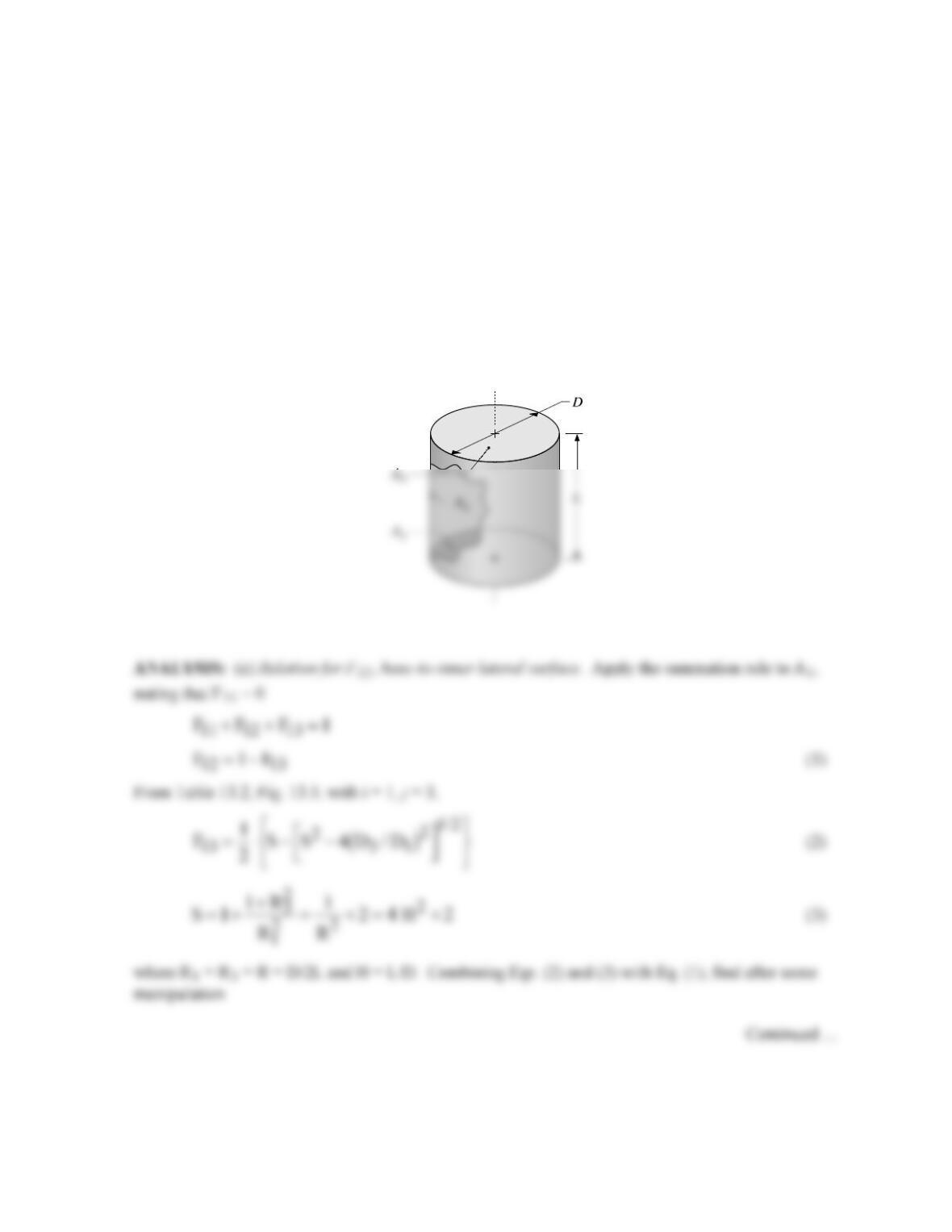
(d) Semi–circle and plate at angle to each other.
COMMENTS: (1) Hottel’s method can be a significant time–saver. (2) The application of Hottel’s
PROBLEM 13.7
KNOWN: Right–circular cylinder of diameter D, length L and the areas A1, A2, and A3 representing
the base, inner lateral and top surfaces, respectively.
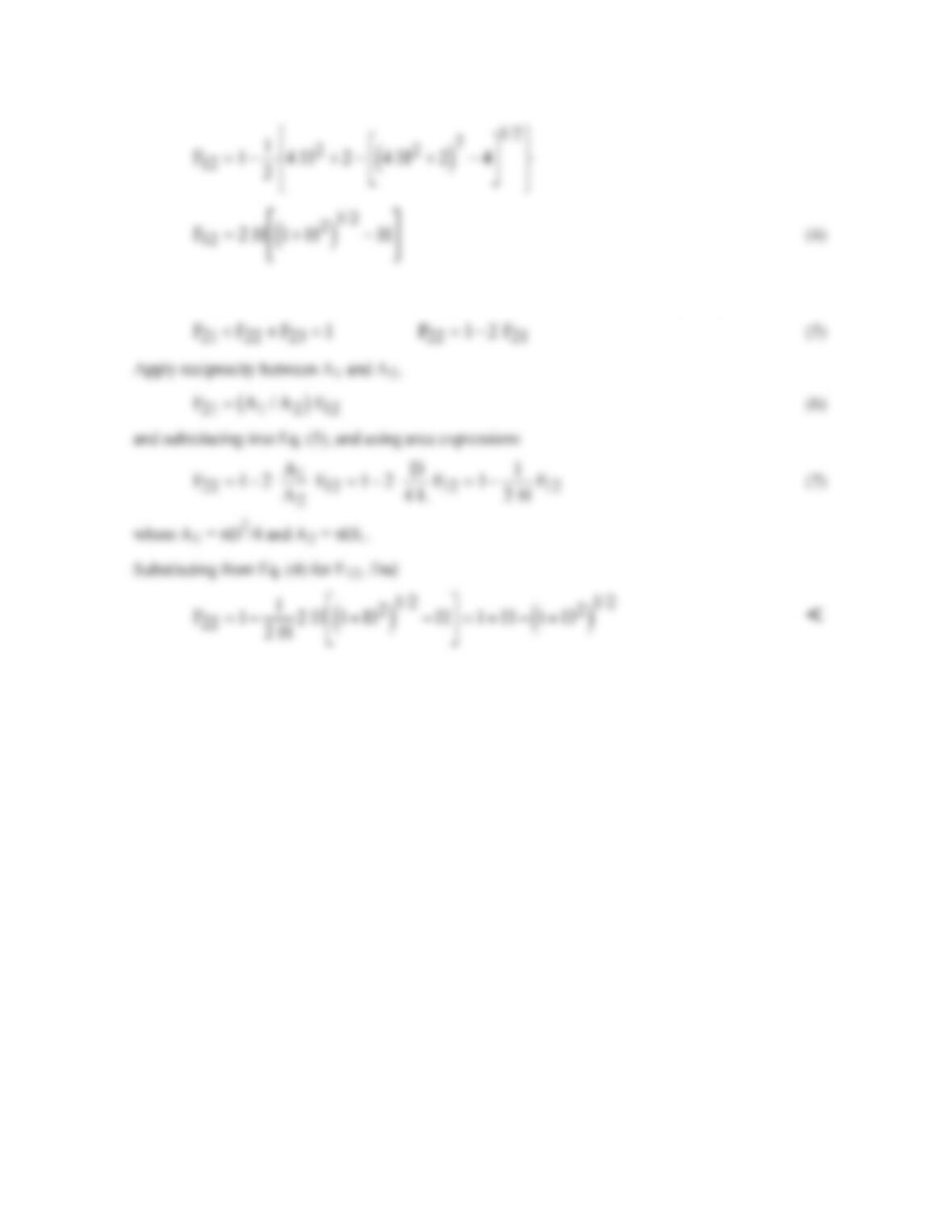
FIND: (a) Show that the view factor between the base of the cylinder and the inner lateral surface
has the form
F H 1 H H
12 2
= + −
L
N
=O
Q
P
2
1 2
ej
/
where H = L/D, and (b) Show that the view factor for the inner lateral surface to itself has the form
F 1 H 1 H
22 2
= + − +
ej
1 2/
SCHEMATIC:
ASSUMPTIONS: Diffuse surfaces with uniform radiosities.
PROBLEM 13.7 (Cont.)
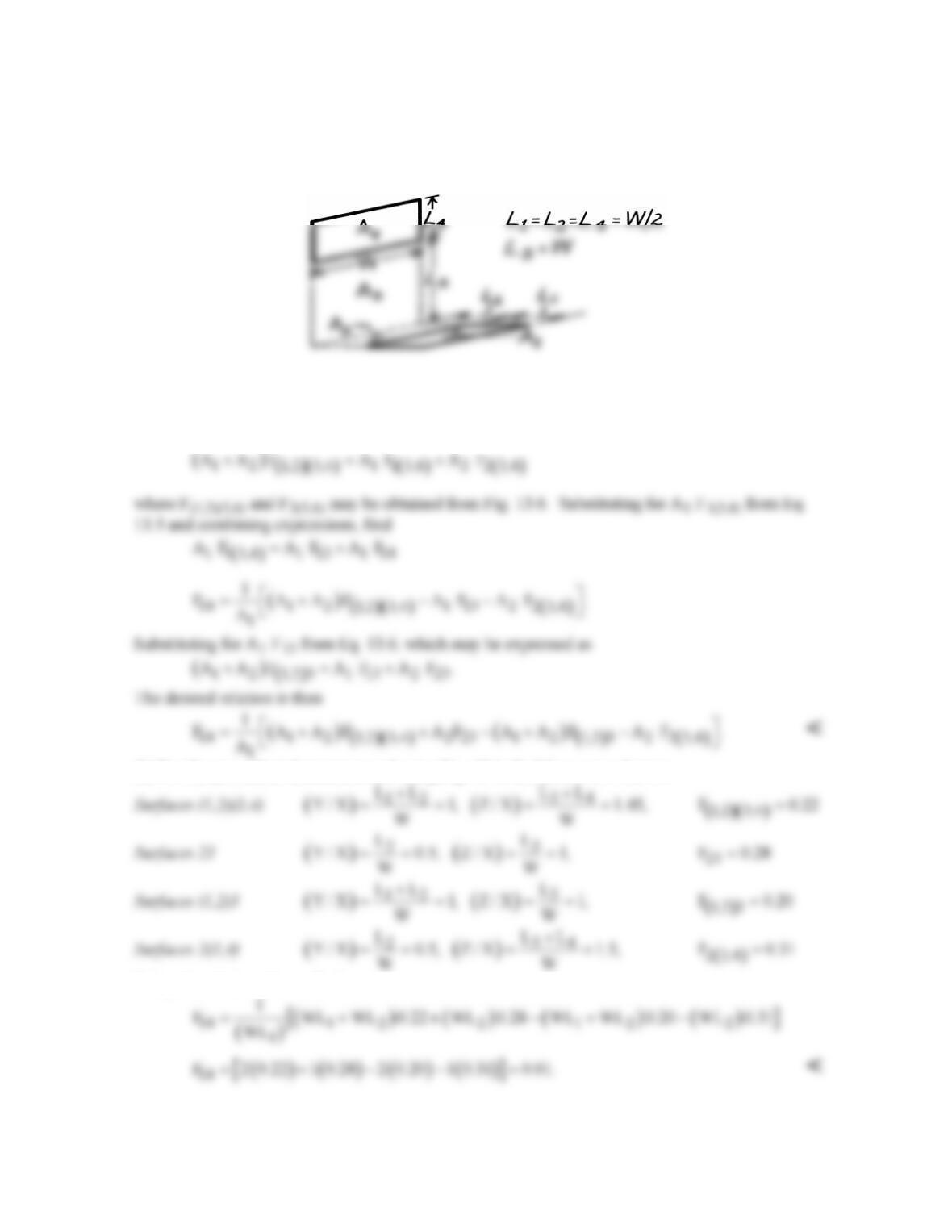
(b) Relation for F22, inner lateral surface. Apply summation rule on A2, recognizing that F23 = F21,
PROBLEM 13.8
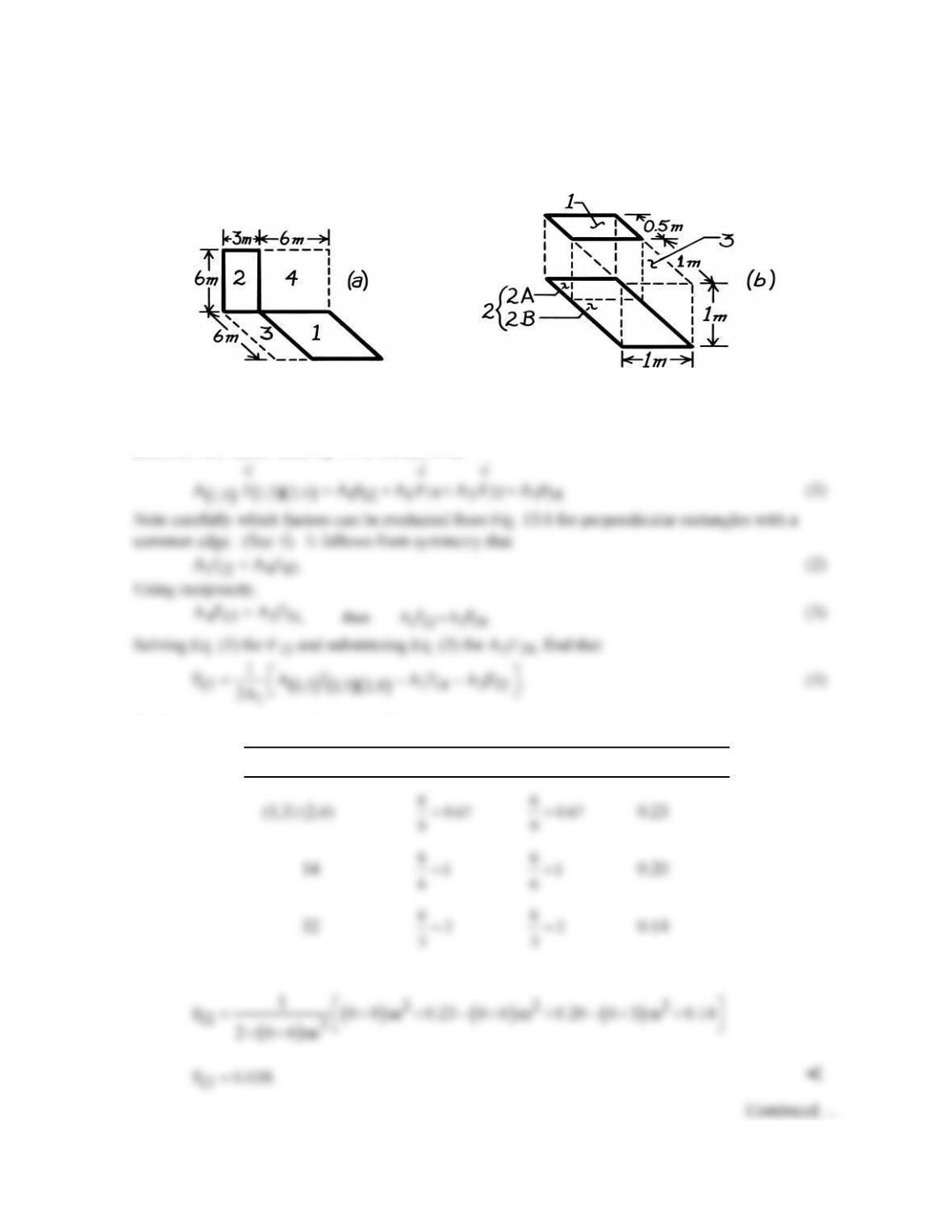
KNOWN: Arrangement of perpendicular surfaces without a common edge.
FIND: (a) A relation for the view factor F14 and (b) The value of F14 for prescribed dimensions.
SCHEMATIC:
ASSUMPTIONS: (1) Diffuse surfaces.
ANALYSIS: (a) To determine F14, it is convenient to define the hypothetical surfaces A2 and A3.
From Eq. 13.6,
(b) For the prescribed dimensions and using Fig. 13.6, find these view factors:
Using the relation above, find
PROBLEM 13.9
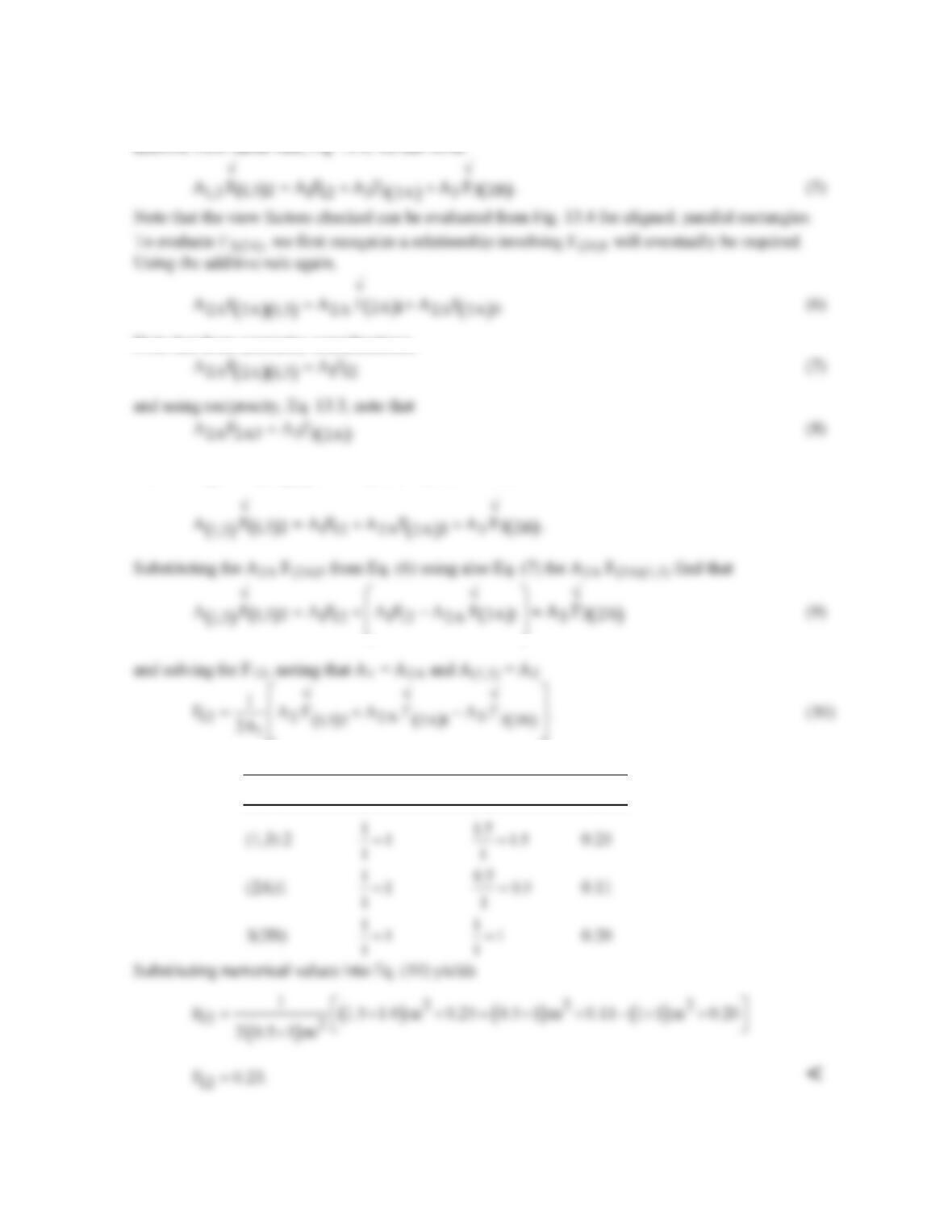
KNOWN: Arrangements of rectangles.
FIND: The shape factors, F12.
SCHEMATIC:
ASSUMPTIONS: (1) Diffuse surface behavior.
ANALYSIS: (a) Define the hypothetical surfaces shown in the sketch as A3 and A4. From the
additive view factor rule, Eq. 13.6, we can write
Evaluate the view factors from Fig. 13.6:
Fij Y/X Z/X Fij
Substituting numerical values into Eq. (4) yields
PROBLEM 13.9 (Cont.)
(b) Define the hypothetical surface A3 and divide A2 into two sections, A2A and A2B. From the
Note that from symmetry considerations,
Substituting for A3F3(2A) from Eq. (8), Eq. (5) becomes
Evaluate the view factors from Fig. 13.4:
Fij X/L Y/L Fij
PROBLEM 13.10
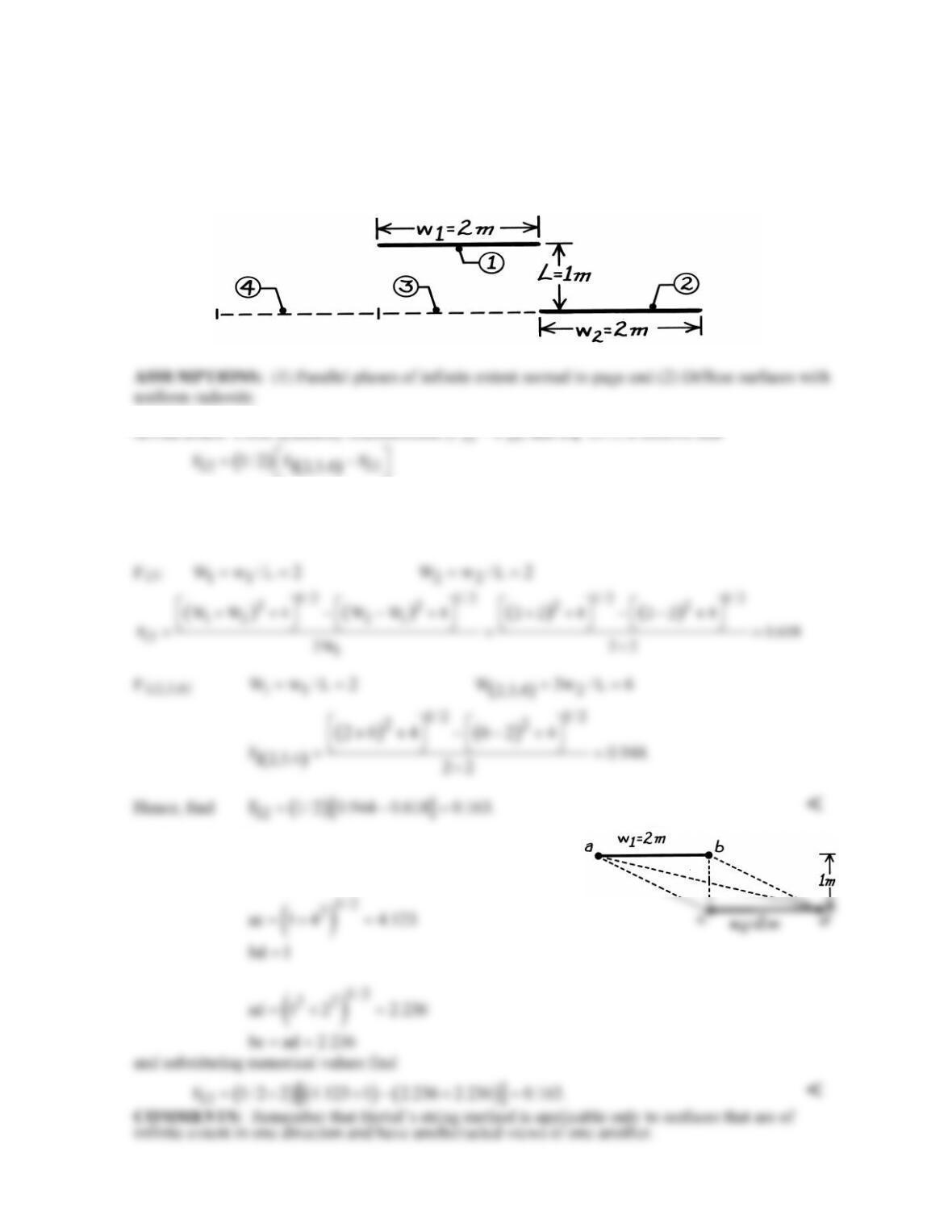
KNOWN: Parallel plates of infinite extent (1,2) having aligned opposite edges.
FIND: View factor F12 by using (a) appropriate view factor relations and results for opposing
parallel plates and (b) Hottel’s string method described in Problem 13.6.
SCHEMATIC:
ANALYSIS: From symmetry consideration (F12 = F14) and Eq. 13.5, it follows that
where A3 and A4 have been defined for convenience in the analysis. Each of these view factors can
be evaluated by the first relation of Table 13.1 for parallel plates with midlines connected
perpendicularly.
(b) Using Hottel’s string method,
( ) ( ) ( )
[ ]
12 1
F 1/ 2w ac bd ad bc= +−+
PROBLEM 13.11
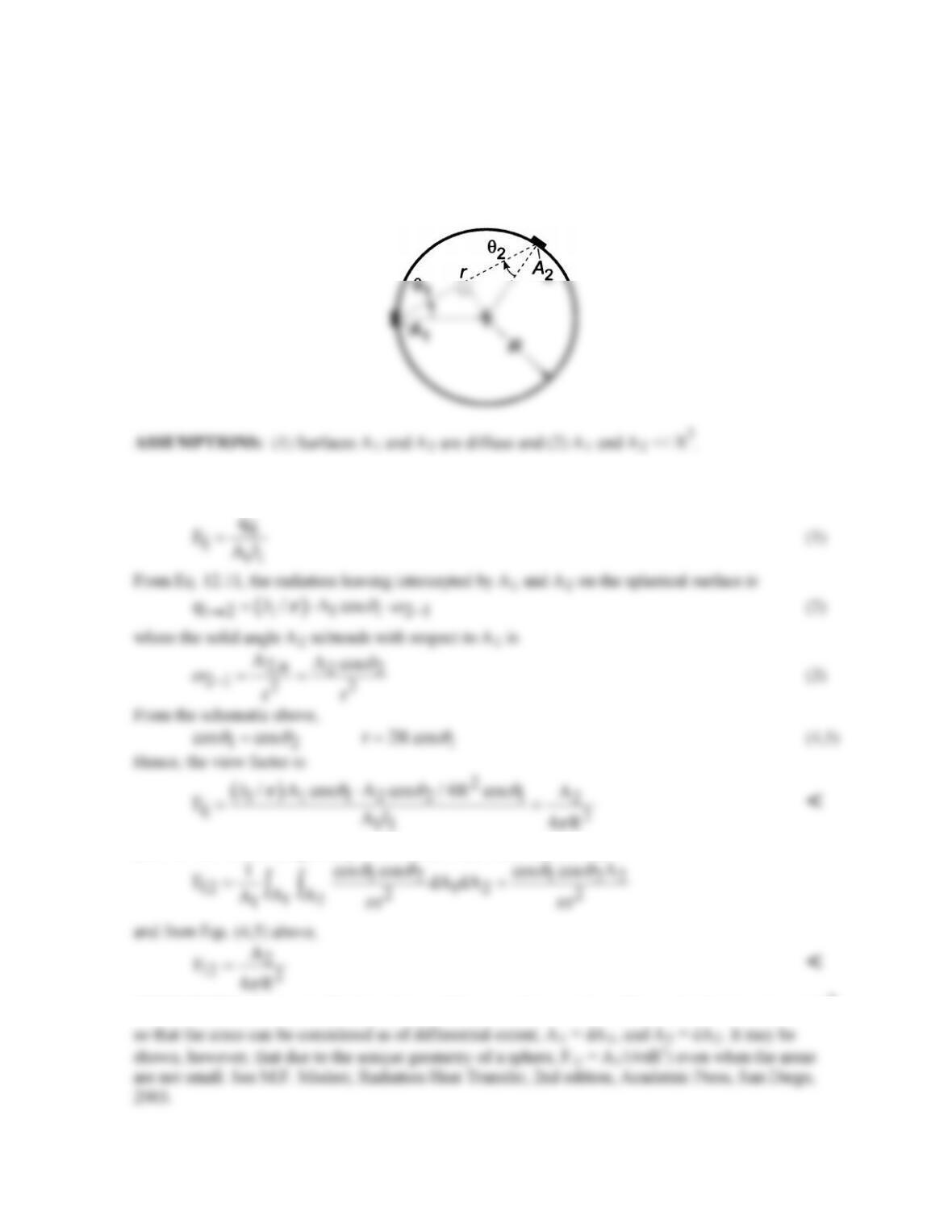
KNOWN: Two small diffuse surfaces, A1 and A2, on the inside of a spherical enclosure of radius R.
FIND: Expression for the view factor F12 in terms of A2 and R by two methods: (a) Beginning with
the expression Fij = qij/Ai Ji and (b) Using the view factor integral, Eq. 13.1.
SCHEMATIC:
ANALYSIS: (a) The view factor is defined as the fraction of radiation leaving Ai which is
intercepted by surface j and, from Section 13.1.1, can be expressed as
(b) The view factor integral, Eq. 13.1, for the small areas A1 and A2 is
COMMENTS: Recognize the importance of the second assumption. We require that A1, A2, << R2
PROBLEM 13.12
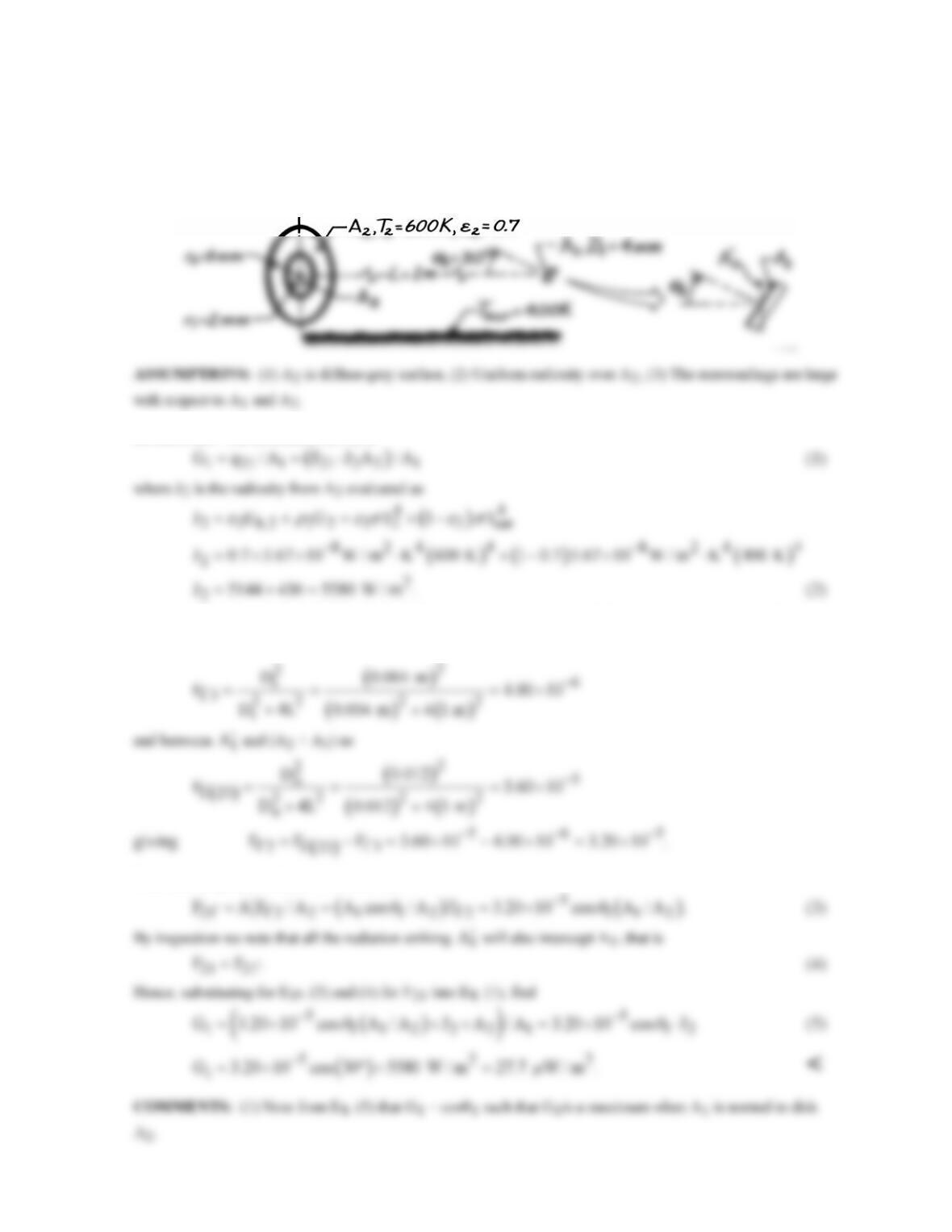
KNOWN: Disk A1, located coaxially, but tilted 30° of the normal, from the diffuse–gray, ring–shaped disk A2.
Surroundings at 400 K.
FIND: Irradiation on A1, G1, due to the radiation from A2.
SCHEMATIC:
ANALYSIS: The irradiation on A1 is
Using the view factor relation of Eq. 13.8, evaluate view factors between
1
A,
′
the normal projection of A1, and
A3 as
1
From the reciprocity relation it follows that
1