PROBLEM 13.75
KNOWN: Emissivity of glass sheets. Inside and outside temperatures and convection heat transfer
coefficients. Type of gas within gap.
FIND: Heat flux through the window for case 1:
ε
1 =
ε
2 = 0.95, case 2:
ε
1 =
ε
2 = 0.05, and case 3:
ε
1 =
0.05,
ε
2 = 0.95, with either air or argon between the glass sheets.
ASSUMPTIONS: (1) Diffuse-gray surfaces, (2) Infinite parallel glass surfaces, (3) Negligible
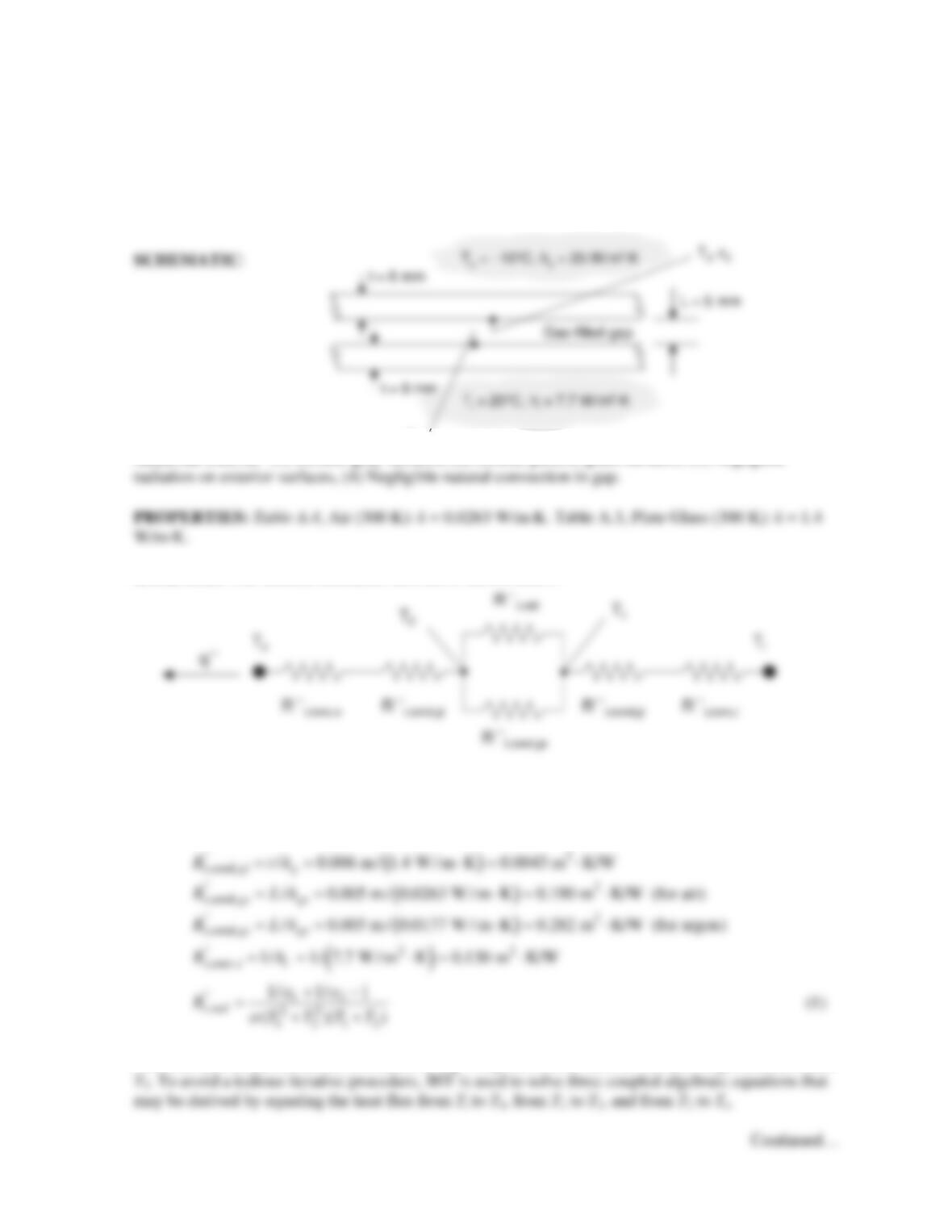
ANALYSIS: The thermal resistance network is shown below.
The thermal resistances are as follows.
(
)
“22
,conv, 1/ 1/ 25 W / m K 0.040 m K/W
to o
Rh== ⋅= ⋅
Note that the radiation thermal resistance of Eq. 1 depends on the interior surface temperatures, T1 and
T
1
, ε
1
PROBLEM 13.75 (Cont.)
From Ti to T1: “”
1,,,,
“( )/( )
i t conv i t cond gl
qTTR R=− + (2)
Gas
ε
1
ε
2 q (W/m2)
________________________________________________ <
air 0.95 0.95 106
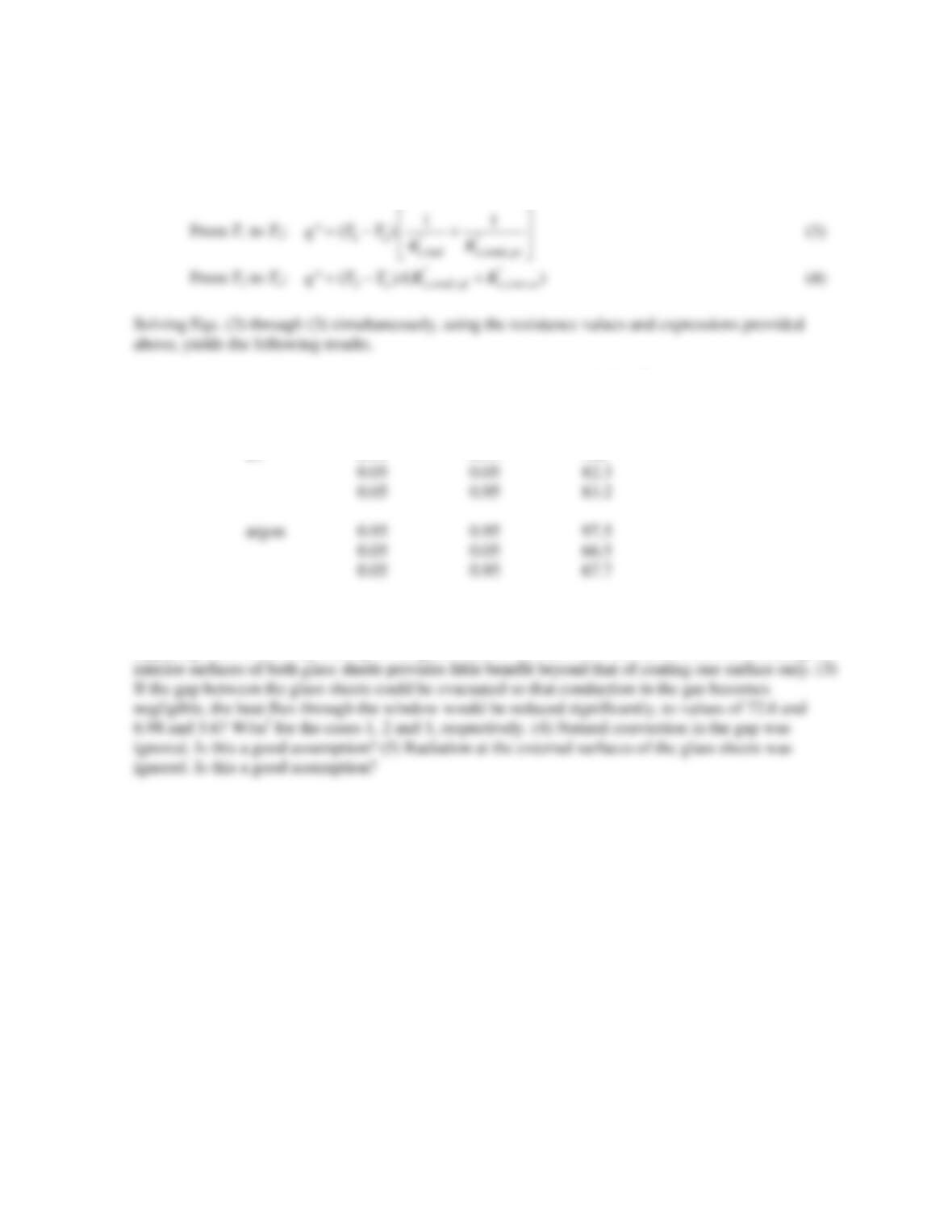
COMMENTS: (1) Switching the gas from air to argon reduces the heat flux in all cases. (2)
Applying a low-emissivity coating to the glass reduces the heat flux in all cases. However, coating the
PROBLEM 13.76
KNOWN: Surface temperature and spectral radiative properties. Temperature of ambient air. Solar
irradiation or temperature of shield.
FIND: (a) Convection heat transfer coefficient when surface is exposed to solar radiation, (b)
Temperature of shield needed to maintain prescribed surface temperature.
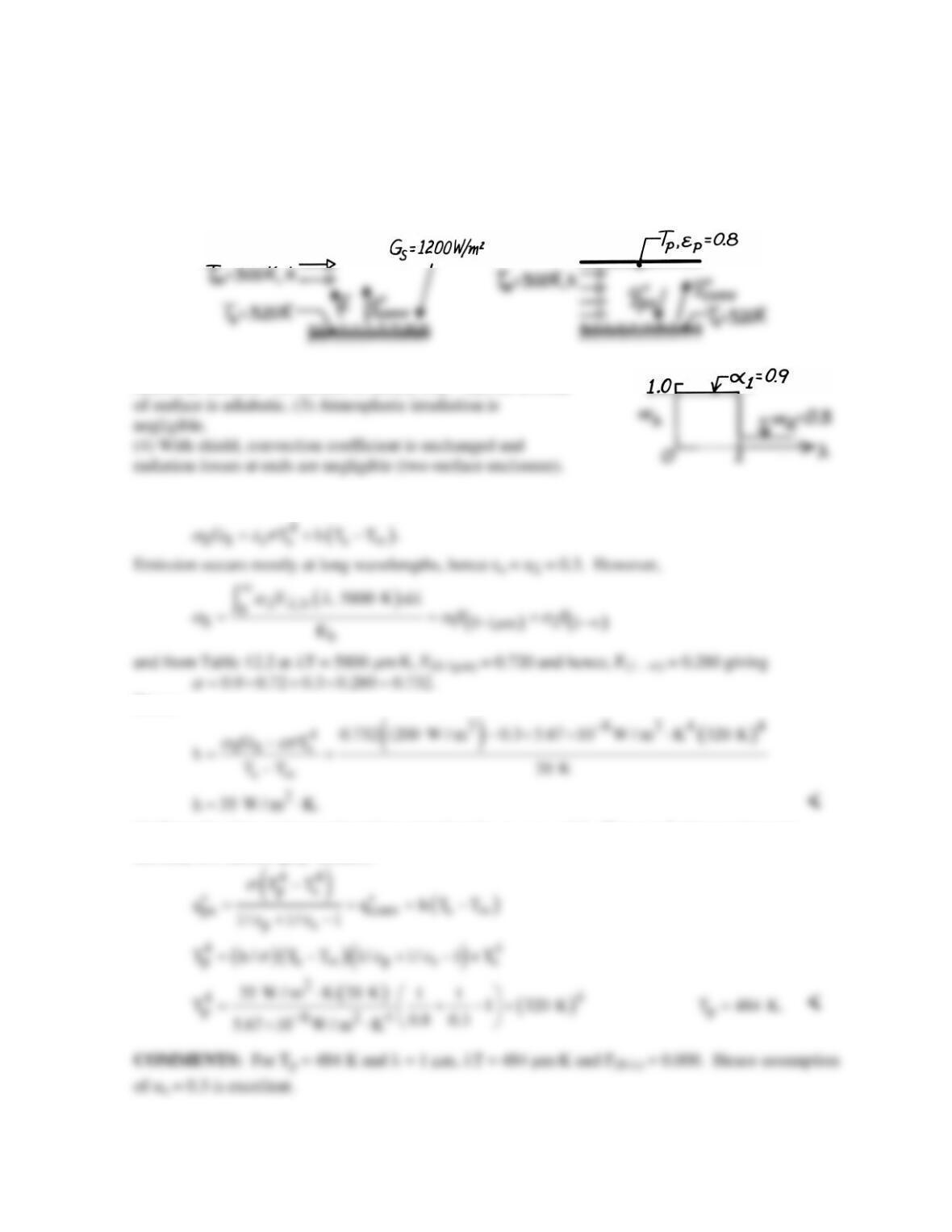
SCHEMATIC:
ASSUMPTIONS: (1) Surface is diffuse (aλ = ελ), (2) Bottom
ANALYSIS: (a) From a surface energy balance,
Hence
(b) Since the plate emits mostly at long wavelengths, as = εs = 0.3. Hence radiation exchange is
between two diffuse-gray surfaces.
PROBLEM 13.77
KNOWN: Long uniform rod with volumetric energy generation positioned coaxially within a larger circular tube
maintained at 500°C.
FIND: (a) Center T1(0) and surface T1s temperatures of the rod for evacuated space, (b) T1(0) and T1s for
airspace, (c) Effect of tube diameter and emissivity on T1(0) and T1s.
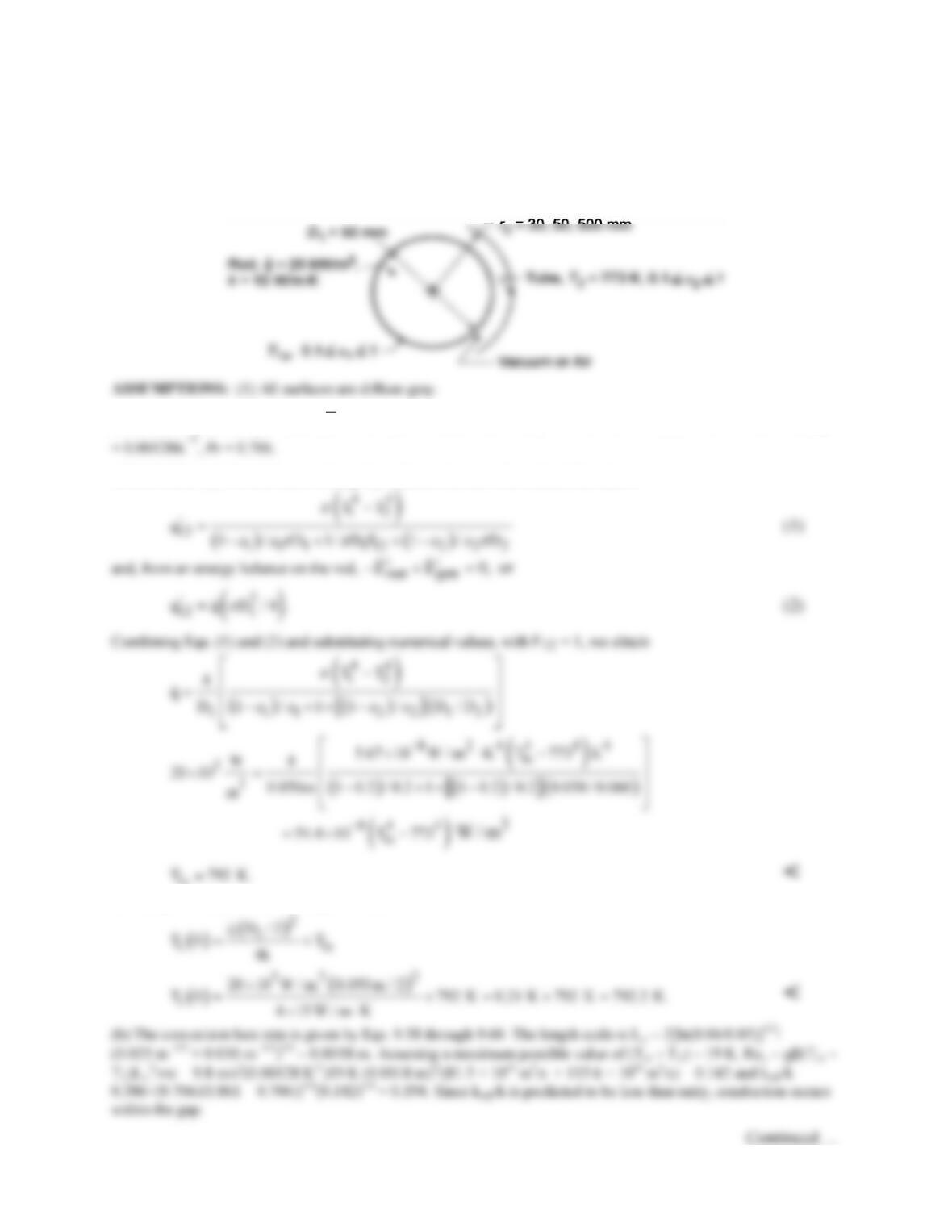
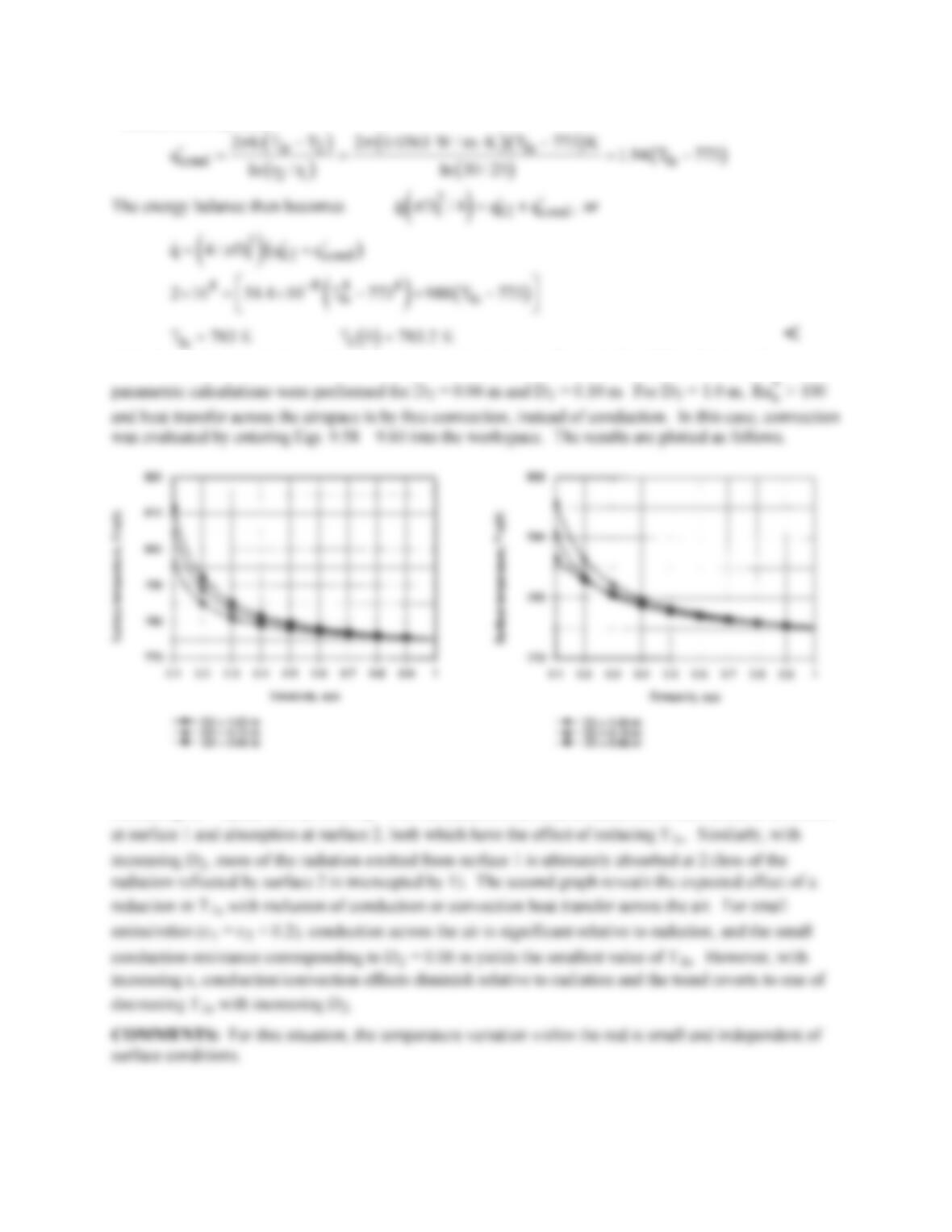
SCHEMATIC:
PROPERTIES: Table A-4, Air (
T
= 780 K): ν = 81.5 × 10⁻⁶ m2/s, k = 0.0563 W/m⋅K, a = 115.6 × 10⁻⁶ m2/s, β
ANALYSIS: (a) The net heat exchange by radiation between the rod and the tube is
From Eq. 3.53, the rod center temperature is
PROBLEM 13.77 (Cont.)
Hence, from Eq. 3.32,
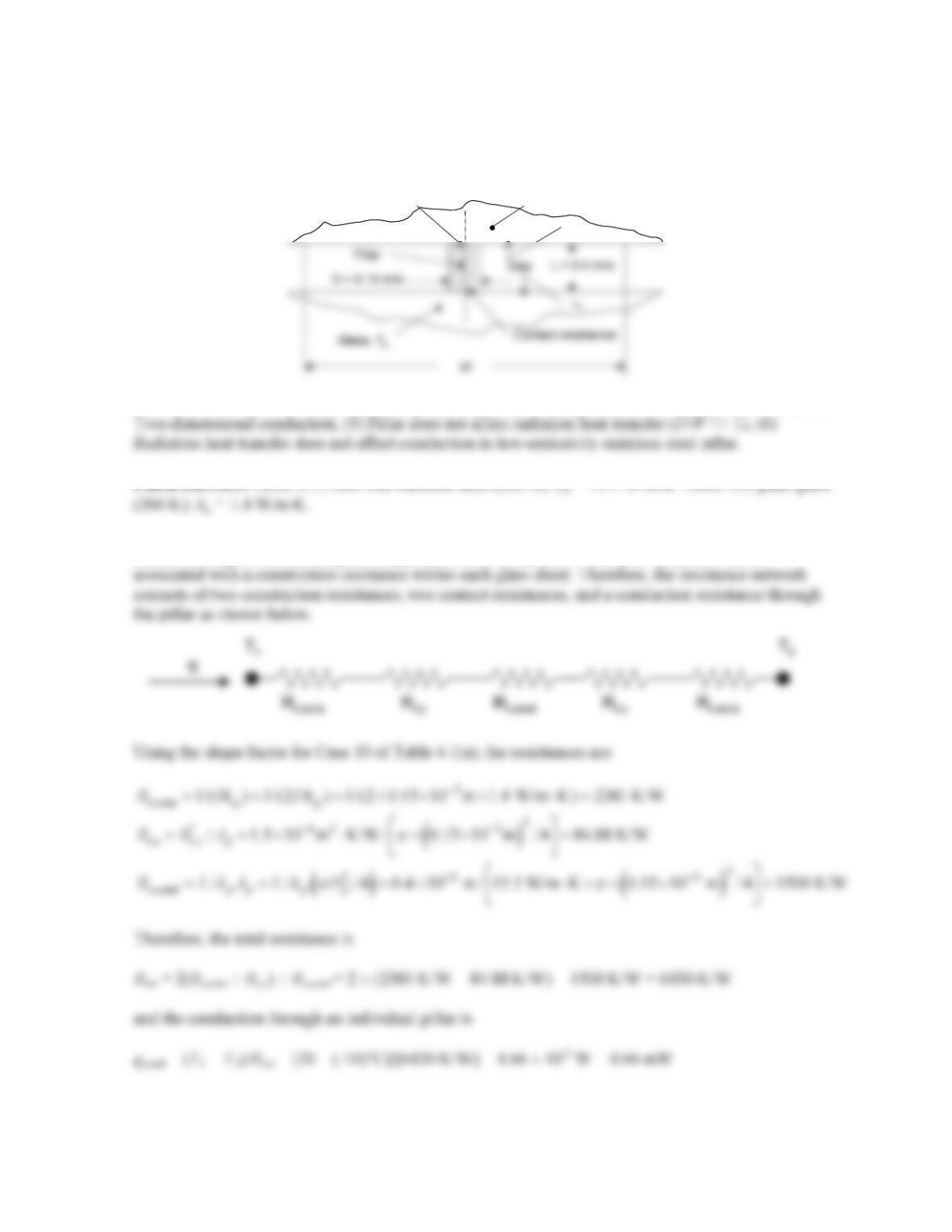
(c) Entering the foregoing model and the prescribed properties of air into the IHT workspace, the
The first graph corresponds to the evacuated space, and the surface temperature decreases with
increasing ε1 = ε2, as well as with D2. The increased emissivities enhance the effectiveness of emission
PROBLEM 13.78
KNOWN: Dimensions of stainless steel pillar and nominal glass temperatures. Contact resistance
between pillar and glass. Emissivity of inner glass surfaces. Unit area dimensions.
FIND: Ratio of conduction to radiation heat transfer through a unit area.
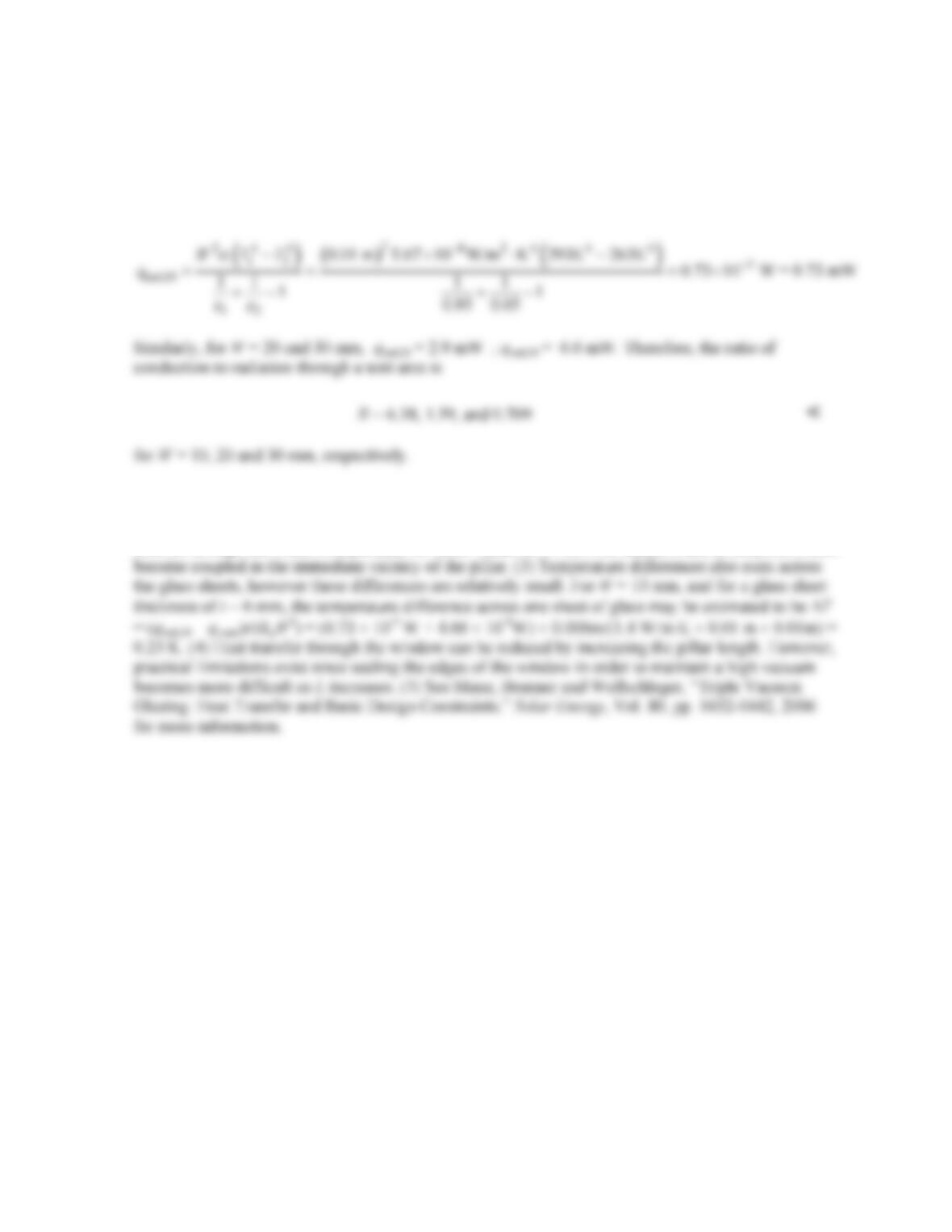
SCHEMATIC:
ASSUMPTIONS: (1) Steady-state conditions, (2) Constant properties, (3) Diffuse–gray surfaces, (4)
ANALYSIS: The conduction and radiation processes are decoupled. Conduction through the pillar
results in a depression of the glass temperature in the immediate vicinity of the pillar. This is
Continued…
Glass, T
1
Contact resistance
ε
2
PROBLEM 13.78 (Cont.)
For W = 10 mm, net radiation heat rate between the glass sheets through the unit area is
COMMENTS: (1) Although the pillars are small, they account for a large amount of the total heat
transfer through the window, especially for small values of W. (2) The radiation and conduction effects
PROBLEM 13.79
KNOWN: Two large parallel plates, temperature of each plate. Bare plate and paint
emissivities, thickness of paint layers.
FIND: (a) Radiation heat flux across the gap for ε1 = ε2 = εs = 0.85, (b) Radiation heat flux
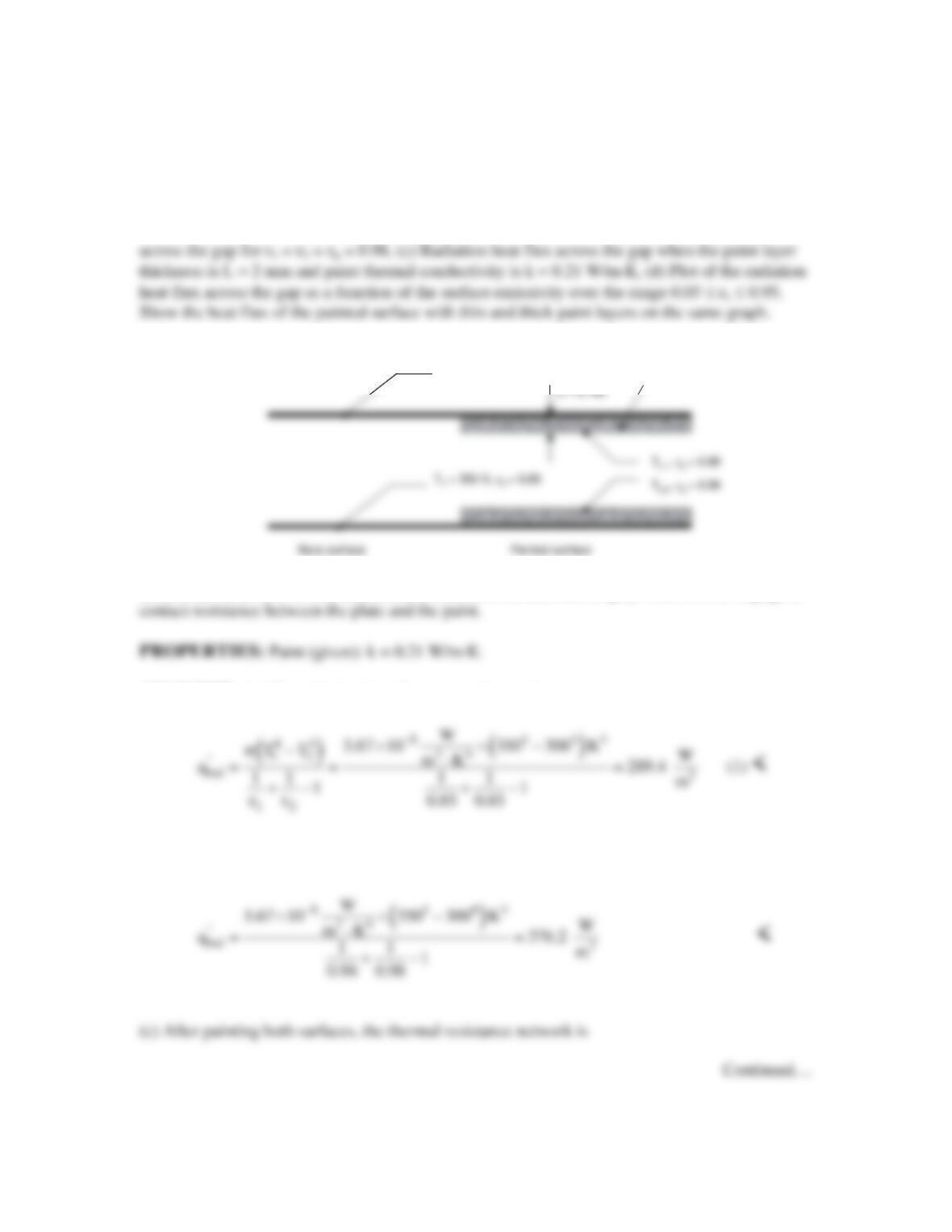
SCHEMATIC:
ASSUMPTIONS: (1) One-dimensional heat transfer, (2) Diffuse, gray surfaces, (3) Negligible
ANALYSIS: (a) The radiation heat flux across the gap is
(b) With ε1 = ε2 = εp = 0.98,
T
1
= 350 K, ε
s
= 0.85
Paint, k = 0.21 W/m·K
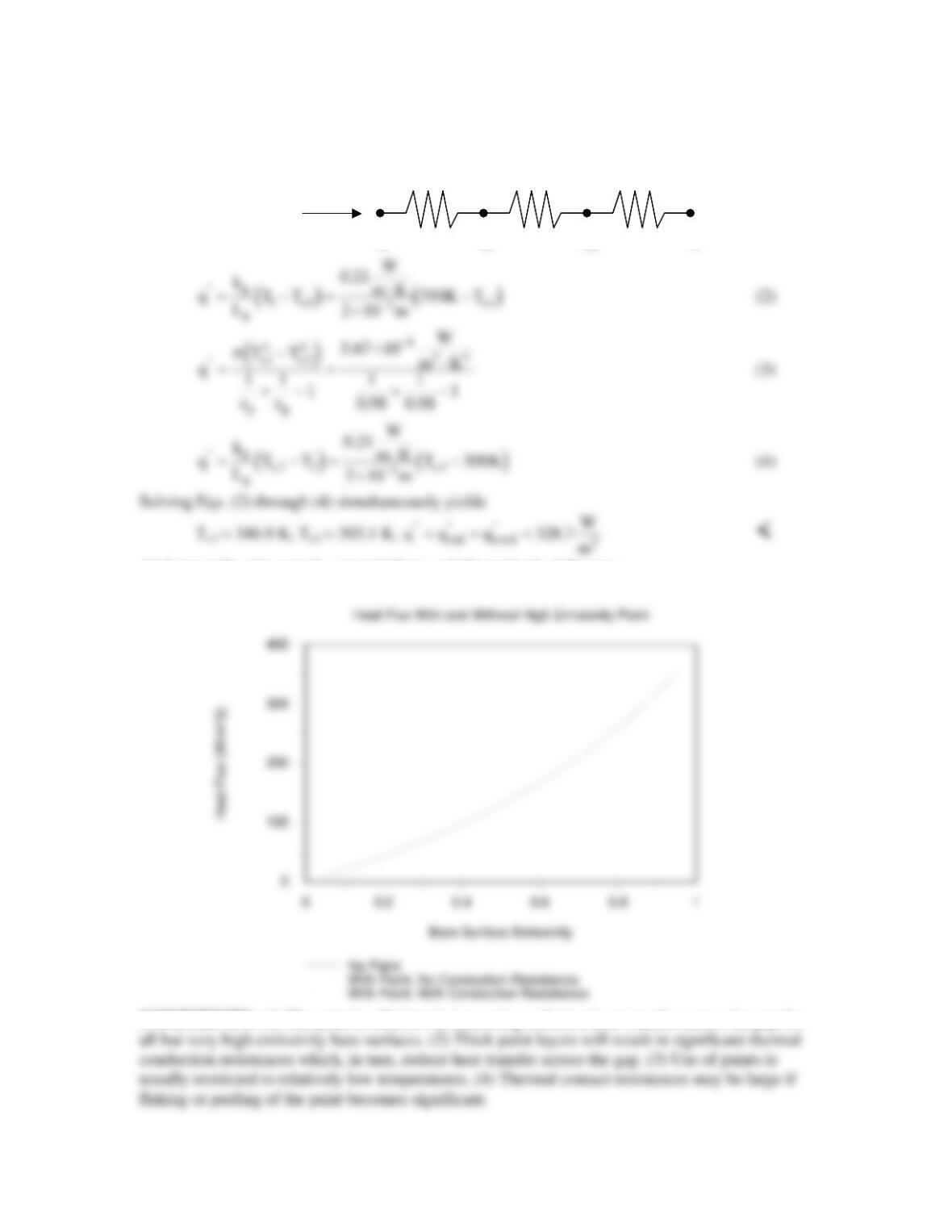
PROBLEM 13.79 (Cont.)
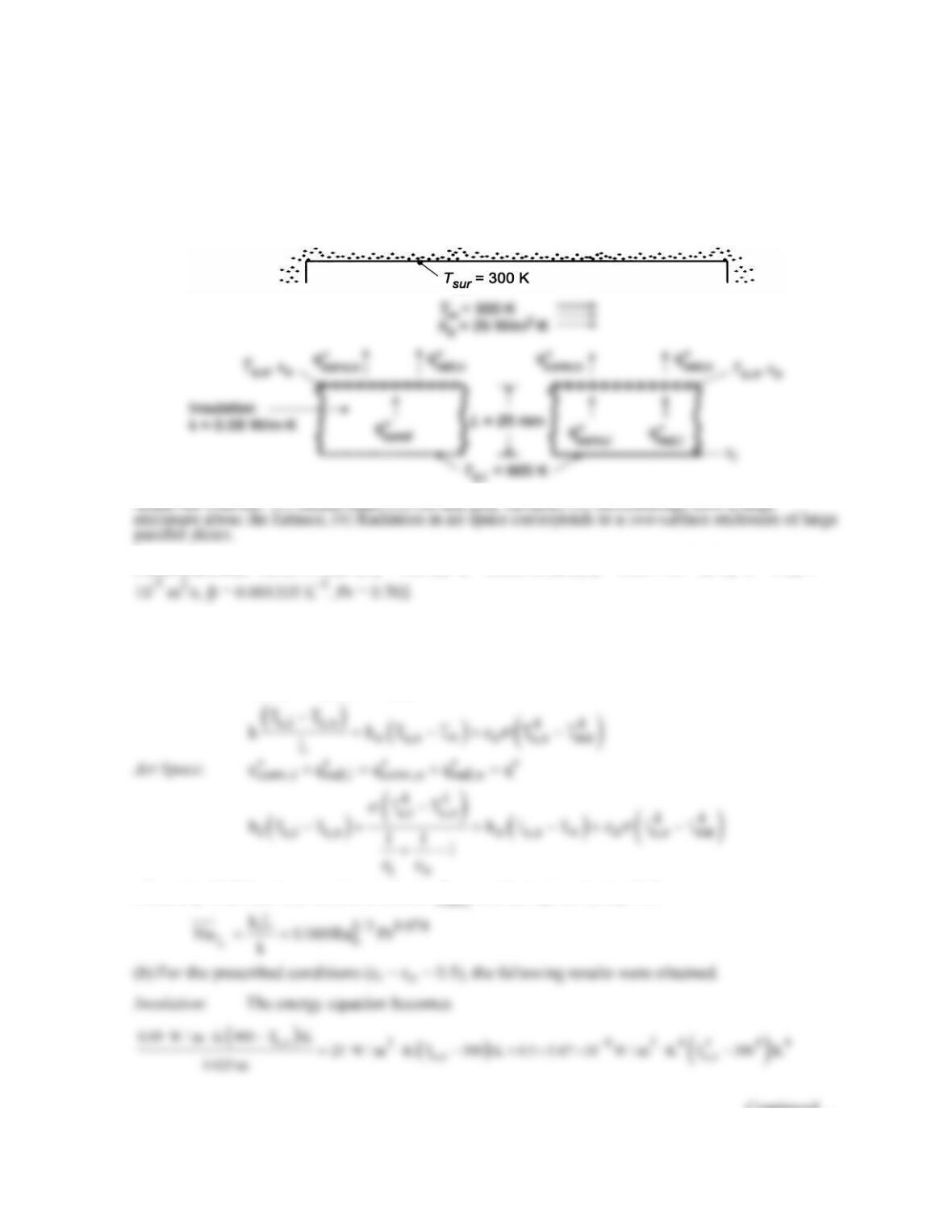
(d) Solving Eq. (1) over the range 0.05 ε 0.95 yields the following.
COMMENTS: (1) The paint is effective in increasing radiation heat transfer across the gap for
q”
T
T
s,1
T
s,2
T
2
R
t,cond
R
t,rad
R
t,cond
q”
T
T
s,1
T
s,2
T
2
R
t,cond
R
t,rad
R
t,cond
PROBLEM 13.80
KNOWN: Ceiling temperature of furnace. Thickness, thermal conductivity, and/or emissivities of
alternative thermal insulation systems. Convection coefficient at outer surface and temperature of
surroundings.
FIND: (a) Mathematical model for each system, (b) Temperature of outer surface Ts,o and heat flux
q′′
for each system and prescribed conditions, (c) Effect of emissivity on Ts,o and
q.
′′
SCHEMATIC:
PROPERTIES: Table A-4, air (Tf = 730 K): k = 0.055 W/m⋅K, a = 1.09 × 10⁻⁴ m2/s, ν = 7.62 ×
ANALYSIS: (a) To obtain Ts,o and
q,
′′
an energy balance must be performed at the outer surface of
the shield.
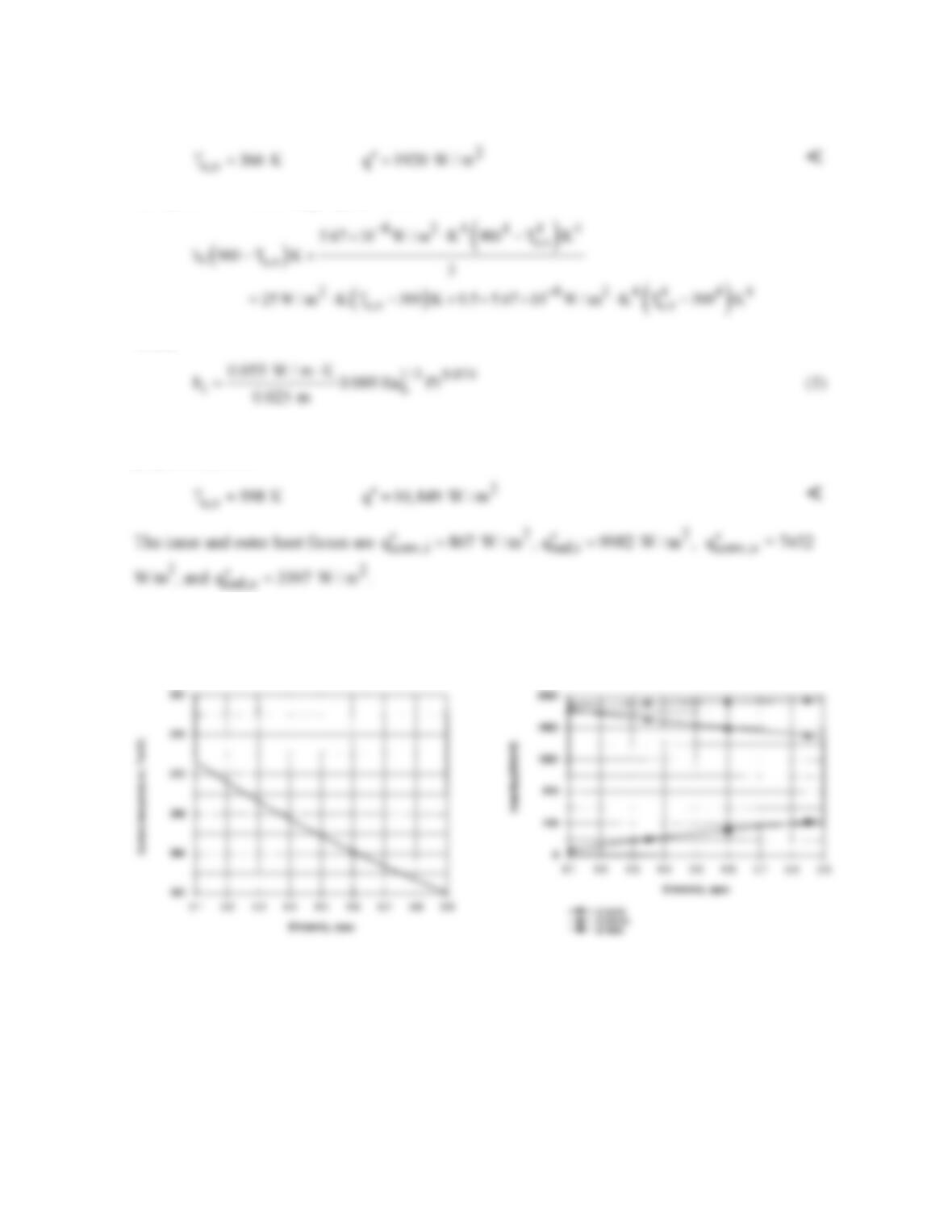
Insulation:
cond conv,o rad,o
qq q q
′′ ′′ ′′ ′′
= +=
where Eq. 13.24 has been used to evaluate
rad,i
q′′
and hi is given by Eq. 9.49
Continued …
PROBLEM 13.80 (Cont.)
and a trial-and-error solution yields
Air-Space: The energy equation becomes
where
and RaL = gβ(Ts,i – Ts,o)L3/aν. A trial–and-error solution, which includes reevaluation of the air
properties, yields
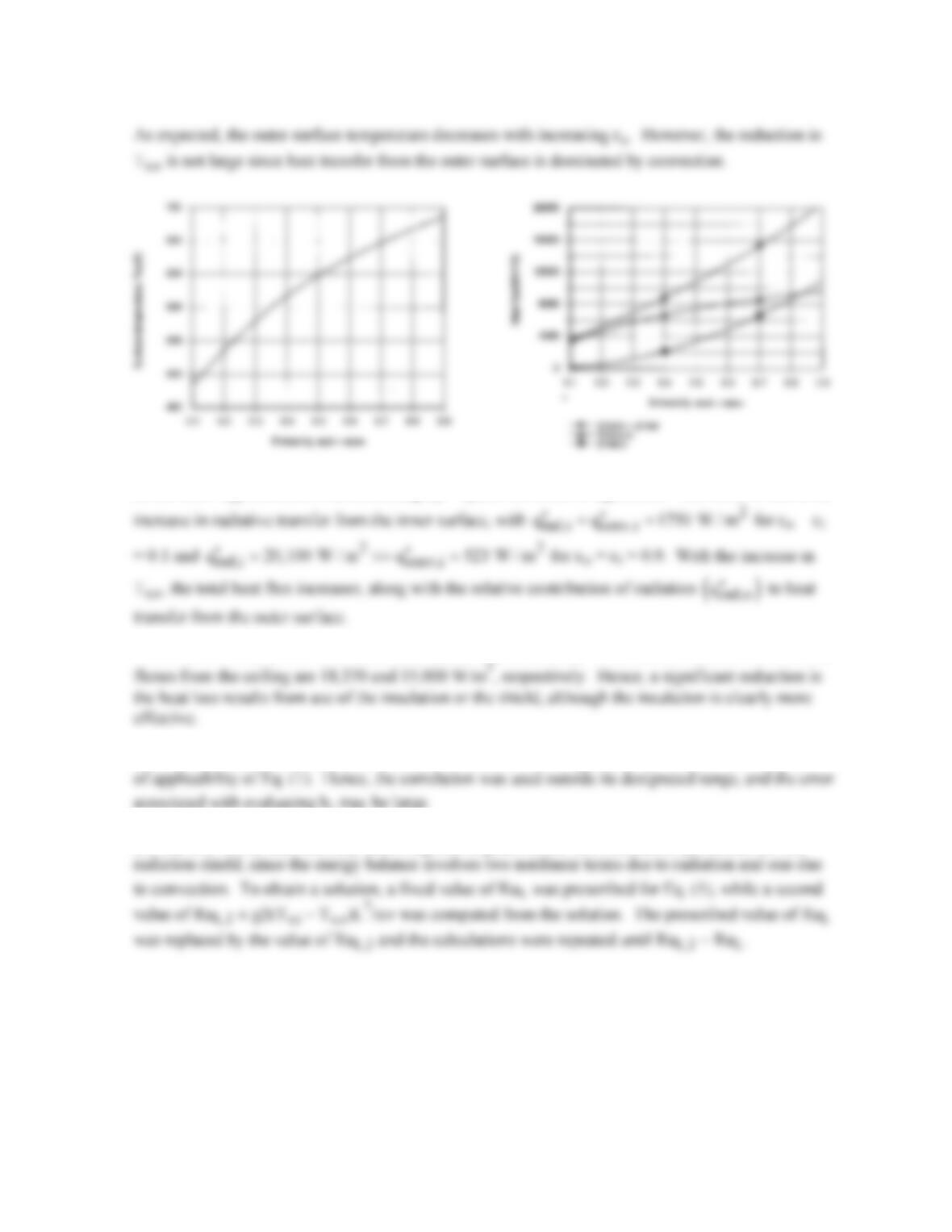
(c) Entering the foregoing models into the IHT workspace, the following results were generated.
Insulation:
Continued …
PROBLEM 13.80 (Cont.)
In this case Ts,o increases with increasing εo = εi and the effect is significant. The effect is due to an
COMMENTS: (1) With no insulation or radiation shield and εi = 0.5, radiation and convection heat
(2) Rayleigh numbers associated with free convection in the air space are well below the lower limit
(3) The IHT solver had difficulty achieving convergence in the first calculation performed for the
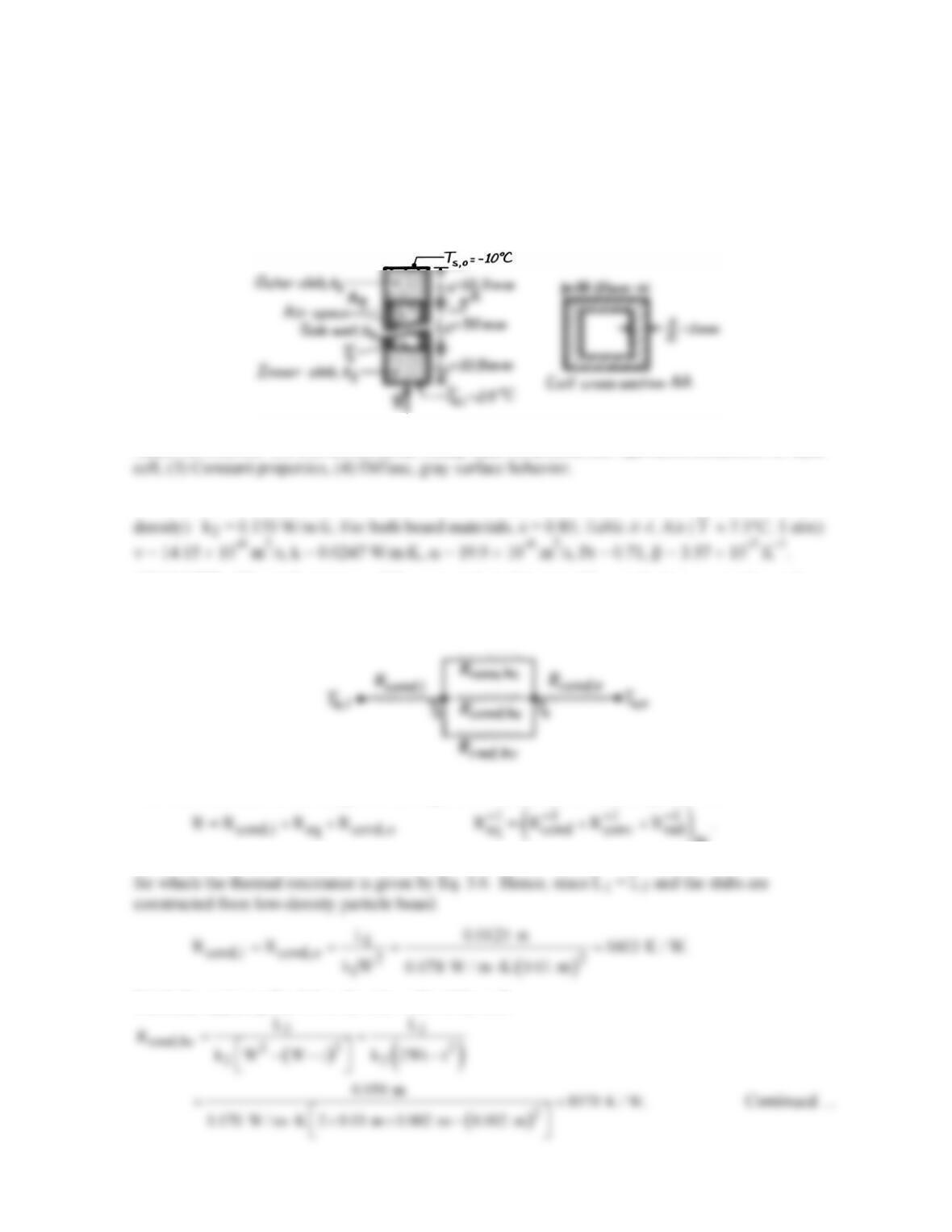
PROBLEM 13.81
KNOWN: Dimensions of a composite insulation consisting of honeycomb core sandwiched between
solid slabs.
FIND: Total thermal resistance.
SCHEMATIC: Because of the repetitive nature of the honeycomb core, the cell sidewalls will be
adiabatic. That is, there is no lateral heat transfer from cell to cell, and it suffices to consider the heat
transfer across a single cell.
ASSUMPTIONS: (1) One-dimensional, steady-state conditions, (2) Equivalent conditions for each
PROPERTIES: Table A-3, Particle board (low density): k1 = 0.078 W/m⋅K; Particle board (high
ANALYSIS: The total resistance of the composite is determined by conduction, convection and
radiation processes occurring within the honeycomb and by conduction across the inner and outer
slabs. The corresponding thermal circuit is shown.
The total resistance of the composite and equivalent resistance for the honeycomb are
The component resistances may be evaluated as follows. The inner and outer slabs are plane walls,
Similarly, applying Eq. 3.6 to the side walls of the cell
PROBLEM 13.81 (Cont.)
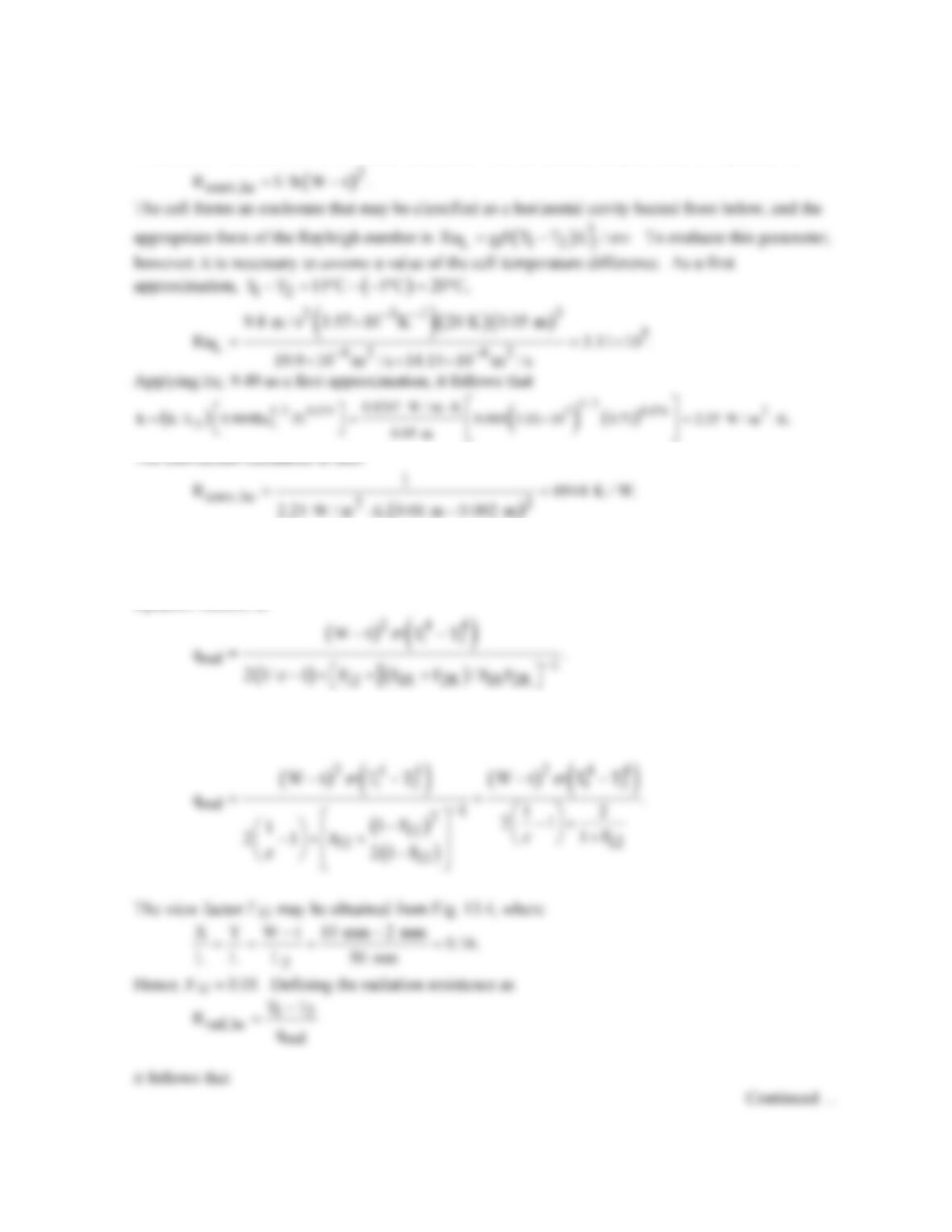
From Eq. 3.9 the convection resistance associated with the cellular airspace may be expressed as
The resistance to heat transfer by radiation may be obtained by first noting that the cell forms a three–
surface enclosure for which the sidewalls are reradiating. The net radiation heat transfer between the
end surfaces of the cell is then given by Eq. 13.30. With ε1 = ε2 = ε and A1 = A2 = (W – t)2, the
equation reduces to
However, with F1R = F2R = (1 – F12), it follows that
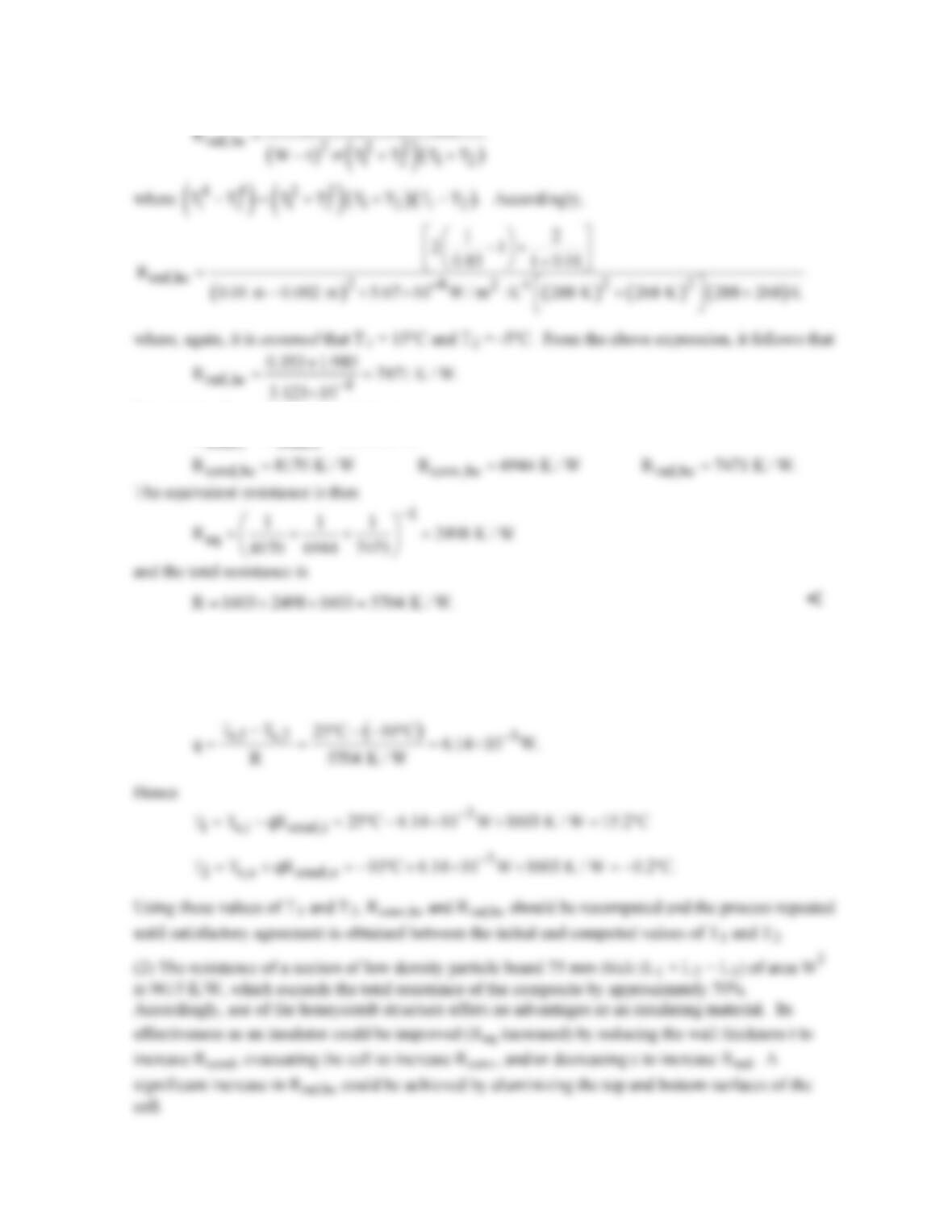
PROBLEM 13.81 (Cont.)
( ) ( )
12
2 1/ 1 2/ 1 F
ε
−+ +
In summary the component resistances are
cond,i cond,o
R R 1603 K / W= =
COMMENTS: (1) The solution is iterative, since values of T1 and T2 were assumed to calculate
Rconv,hc and Rrad,hc. To check the validity of the assumed values, we first obtain the heat transfer
rate q from the expression
PROBLEM 13.82
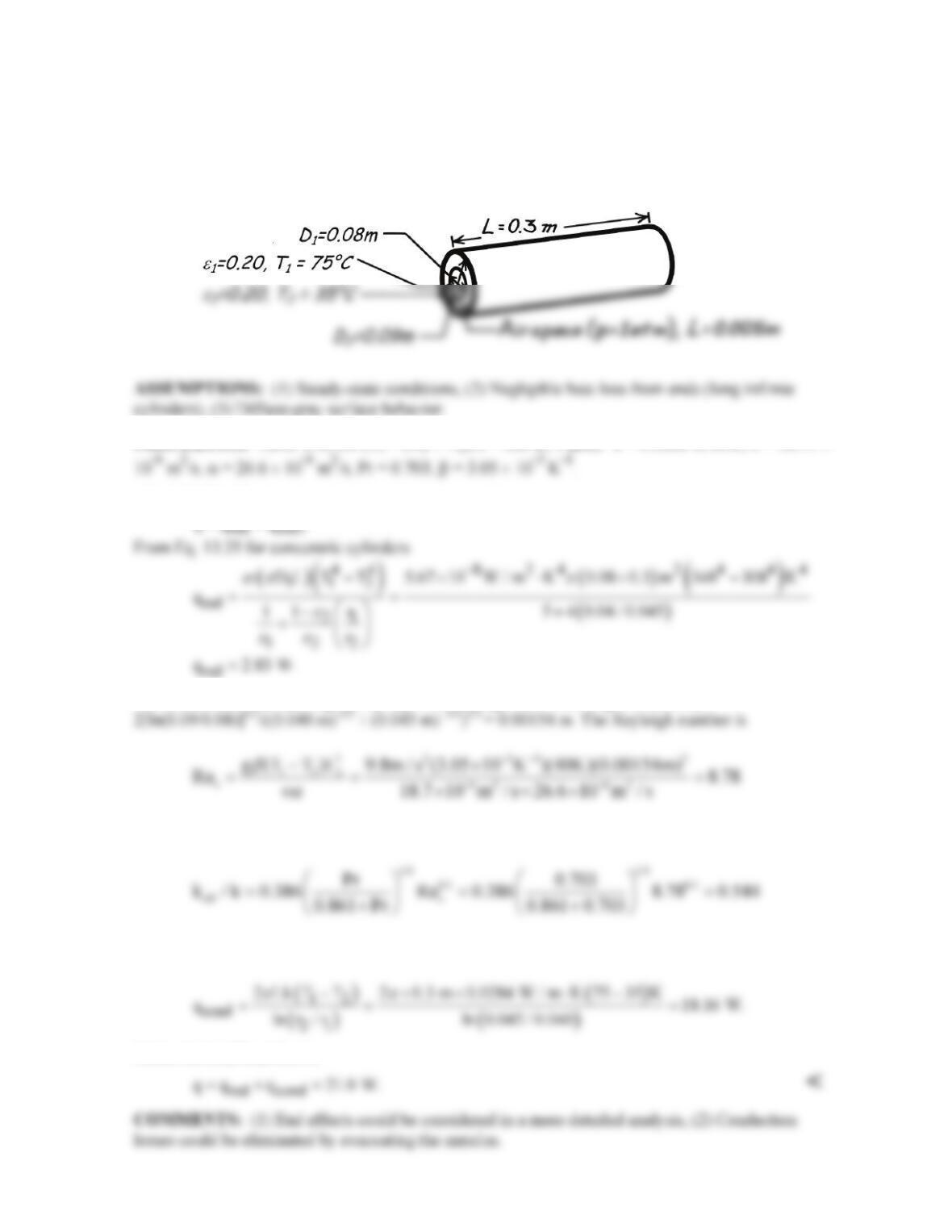
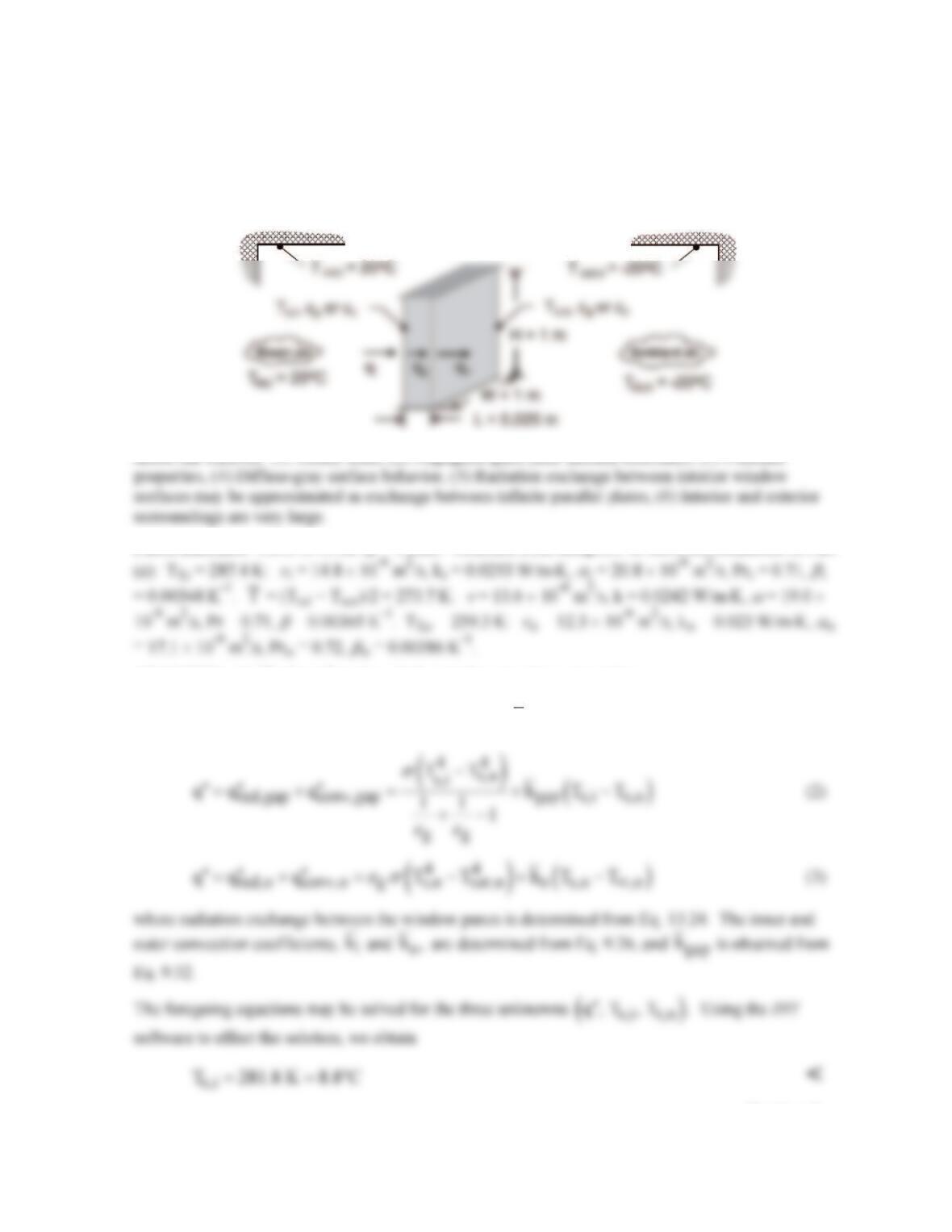
KNOWN: Dimensions and surface conditions of a cylindrical thermos bottle filled with hot coffee
and lying horizontally.
FIND: Heat loss.
SCHEMATIC:
PROPERTIES: Table A-4, Air (Tf = (T1 + T2)/2 = 328 K, 1 atm): k = 0.0284 W/m⋅K, ν = 18.71 ×
ANALYSIS: The heat transfer across the air space is
qq q .= +
The convection heat rate is given by Eqs. 9.58 through 9.60. The length scale is Lc =
From Eq. 9.59,
Since keff/k is predicted to be less than unity, conduction occurs in the gap. From Eq. 3.32
Hence the total heat loss is
PROBLEM 13.83
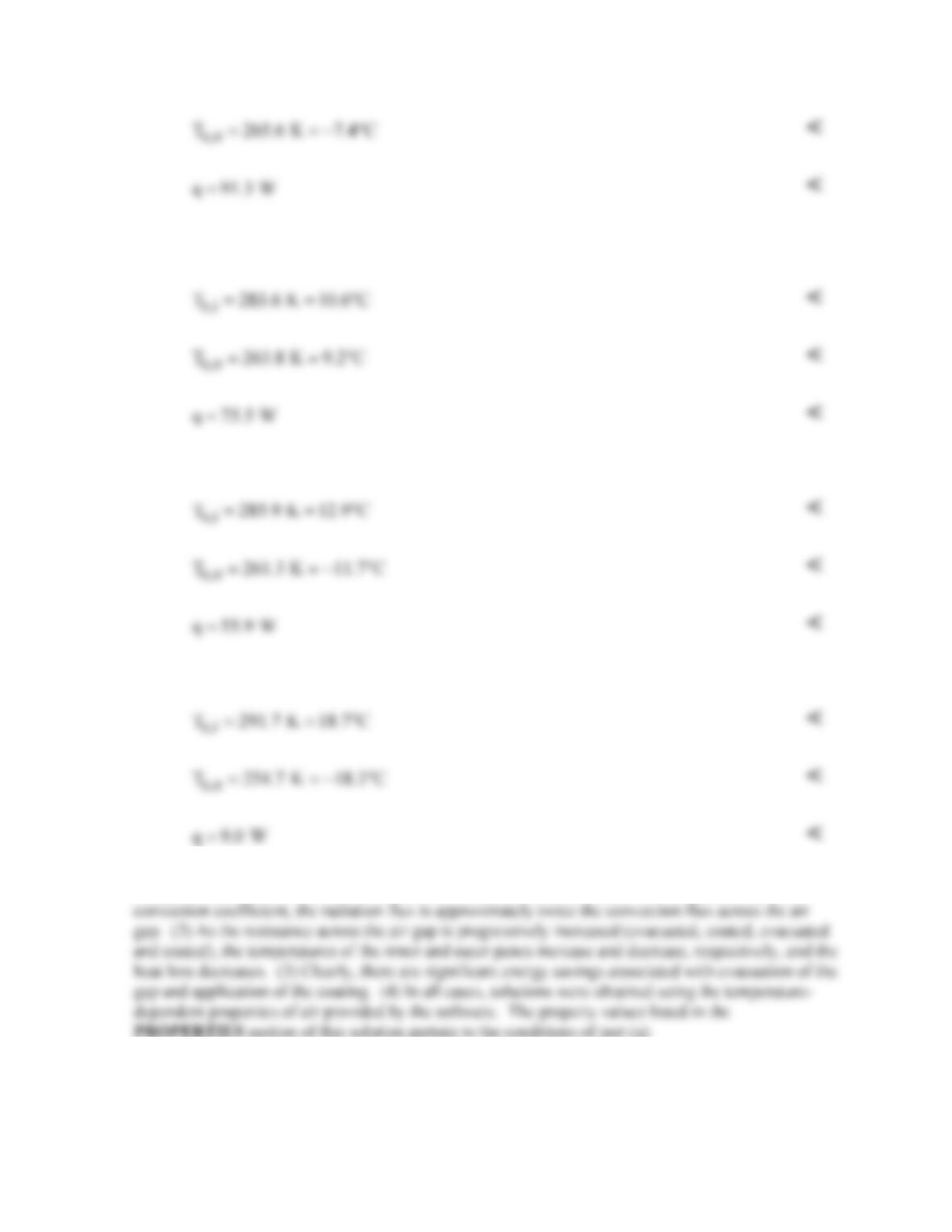
KNOWN: Dimensions and emissivity of double pane window. Thickness of air gap. Temperatures
of room and ambient air and the related surroundings.
FIND: (a) Temperatures of glass panes and rate of heat transfer through window, (b) Heat rate if gap
is evacuated. Heat rate if special coating is applied to window.
SCHEMATIC:
ASSUMPTIONS: (1) Steady-state, (2) Negligible glass pane thermal resistance, (3) Constant
PROPERTIES: Table A-4, Air (p = 1 atm). Obtained from using IHT to solve for conditions of Part
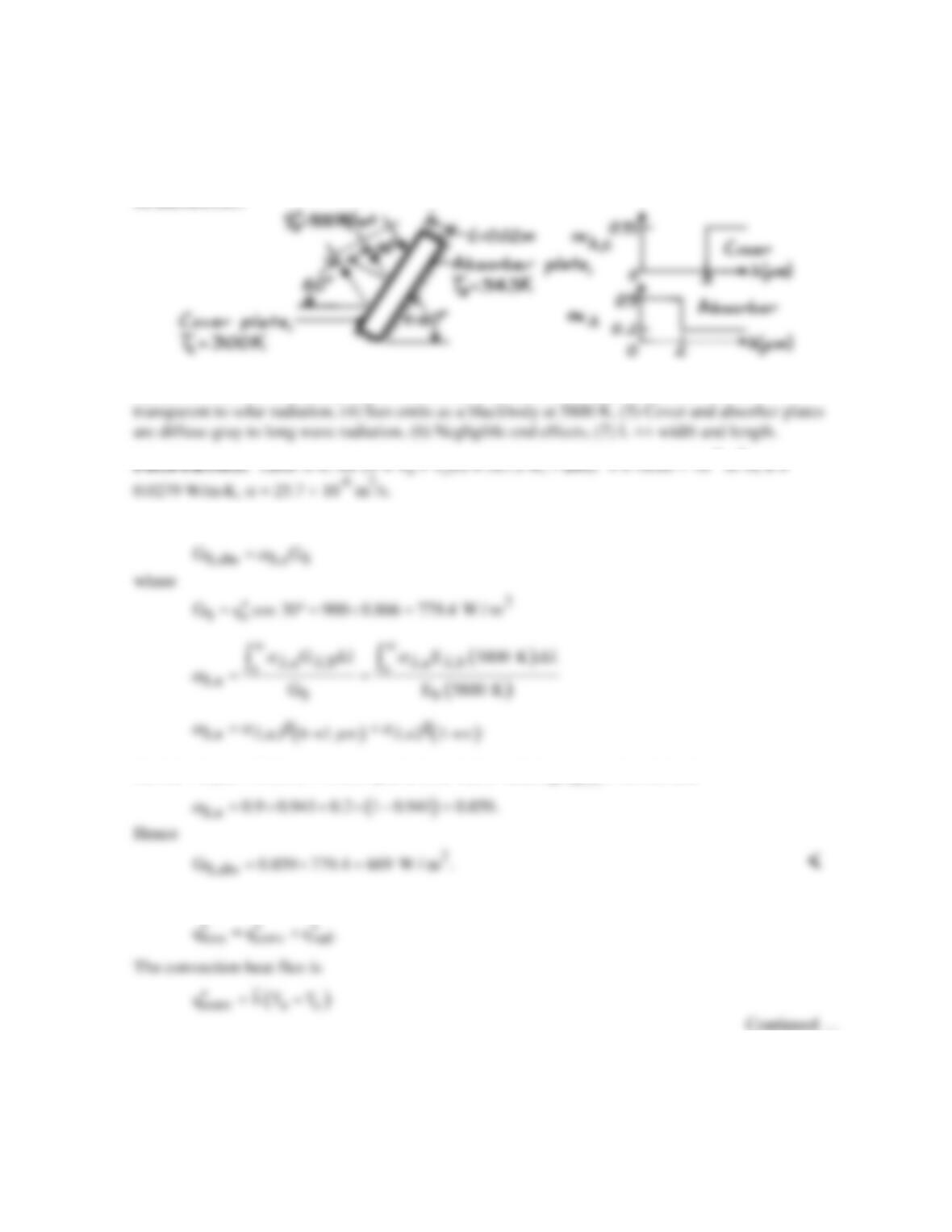
ANALYSIS: (a) The heat flux through the window may be expressed as
()
( )
44
rad,i conv,i g i ,i s,i
sur,i s,i
q q q T T hT T
εσ
∞
′′ ′′ ′′
= + = −+ −
(1)
Continued …
PROBLEM 13.83 (Cont.)
(b) If the air space is evacuated
( )
g
h 0,=
we obtain
If the space is not evacuated but the coating is applied to inner surfaces of the window panes,
If the space is evacuated and the coating is applied,
COMMENTS: (1) For the conditions of part (a), the convection and radiation heat fluxes are
comparable at the inner and outer surfaces of the window, but because of the comparatively small
PROBLEM 13.84
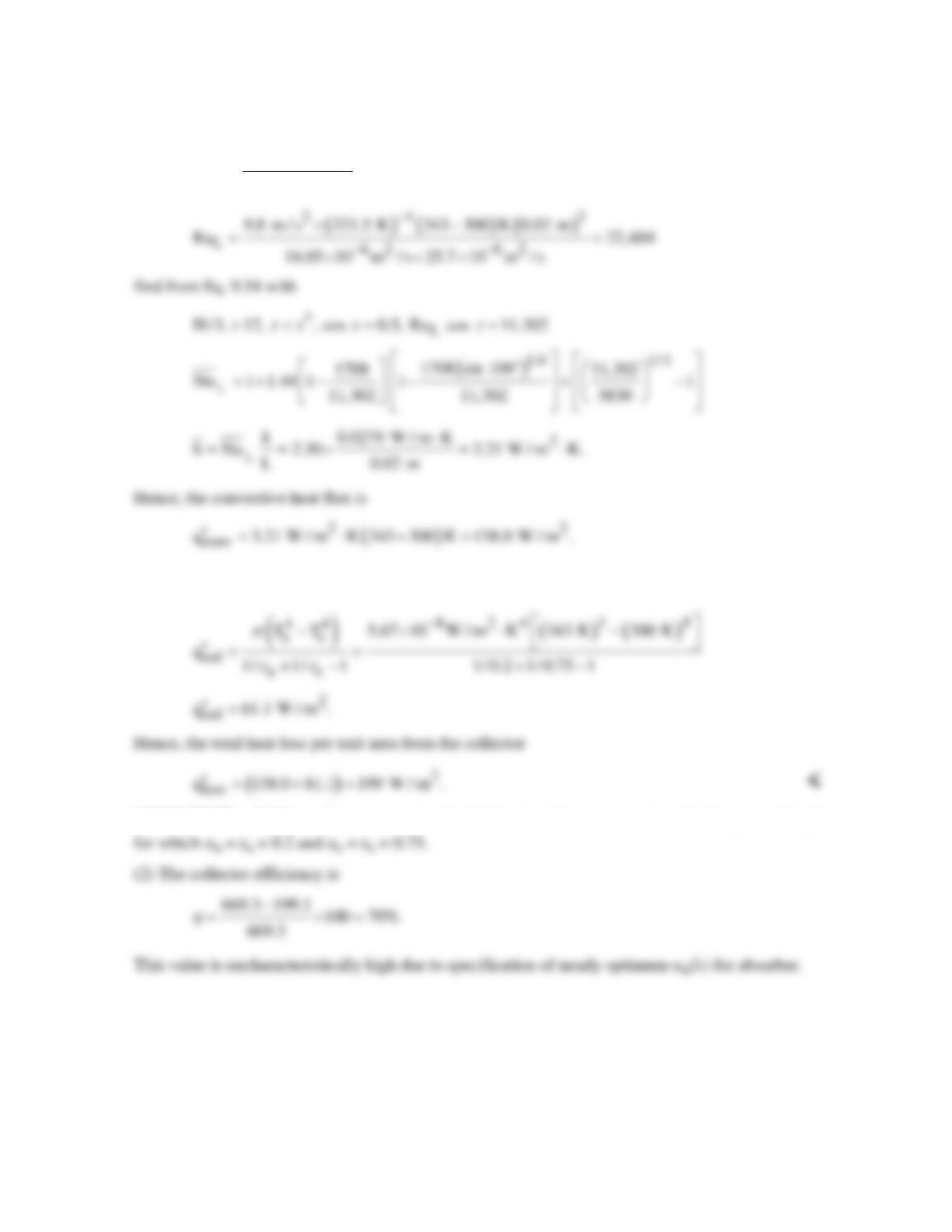
KNOWN: Absorber and cover plate temperatures and spectral absorptivities for a flat plate solar
collector. Collector orientation and solar flux.
FIND: (a) Rate of solar radiation absorption per unit area, (b) Heat loss per unit area.
SCHEMATIC:
ASSUMPTIONS: (1) Steady-state conditions, (2) Adiabatic sides and bottom, (3) Cover is
ANALYSIS: (a) The absorbed solar irradiation is
For λT = 2 mm × 5800 K = 11,600 mm⋅K from Table 12.2, F(0→2λT) = 0.941, find
(b) The heat loss per unit area from the collector is
PROBLEM 13.84 (Cont.)
and with
( )
3
ac
L
g T TL
Ra
β
aν
−
=
The radiative exchange can be determined from Eq. 13.24 treating the cover and absorber plates as a
two–surface enclosure,
COMMENTS: (1) Non-solar components of radiation transfer are concentrated at long wavelength