13.68: PROBLEM DEFINITION
Situation: Water exits an upper reservoir across a rectangular weir (L/HR=3,P/H
R=
2) and then into a lower reservoir. The water exits the lower reservoir through a 60o
triangular weir.
Find: Ratio of head for the rectangular weir to head for the triangular weir: HR/HT
Assumptions:Steadyflow.
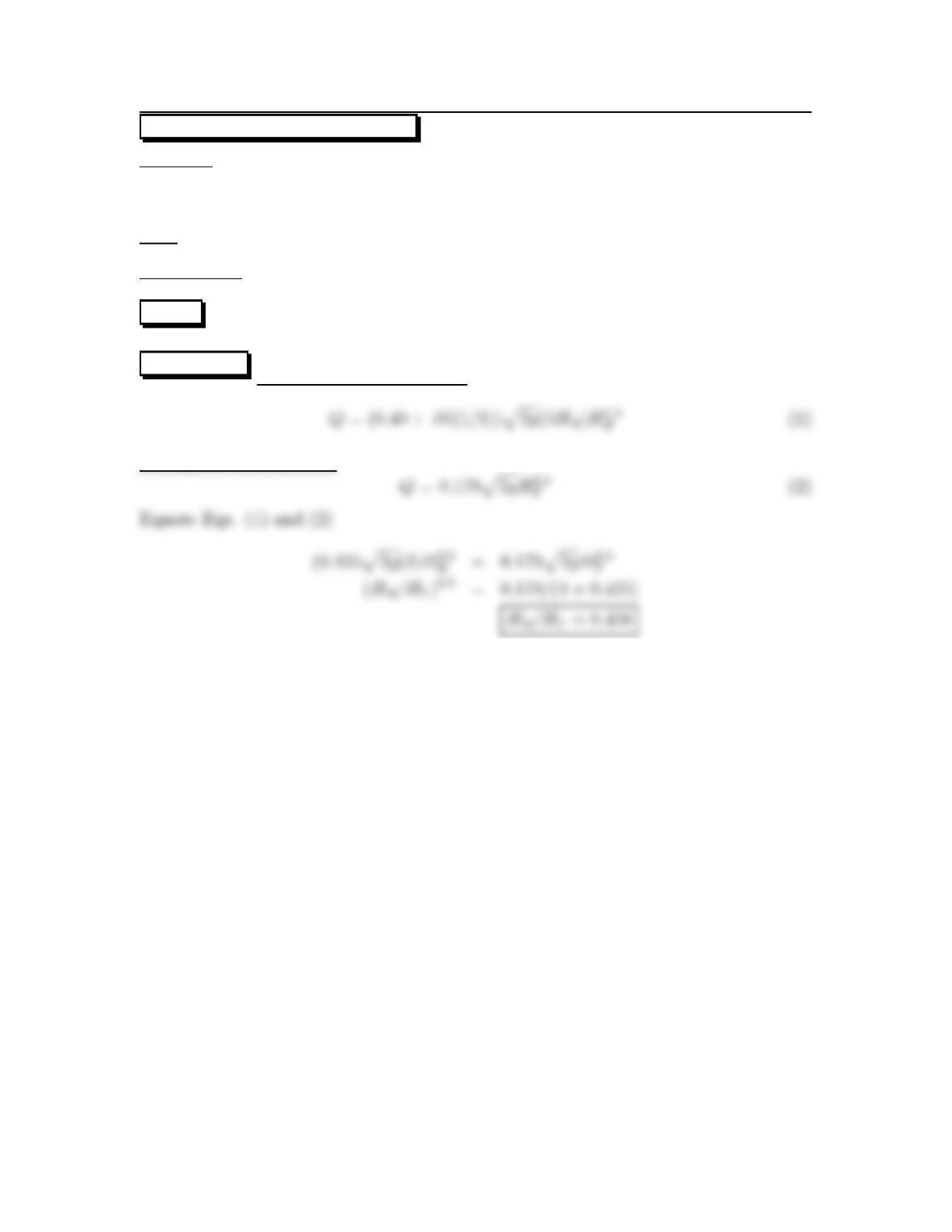
PLAN Apply continuity principle by equating the discharge in the two weirs.
SOLUTION Rectangular weir equation
Triangular weir equation
77
13.69: PROBLEM DEFINITION
Situation: For Problem 13.68 (EFM 10e), the flow entering the upper reservoir is
increased by 50%.
Find: Describe what will happen, both qualitatively and quantitatively.
PLAN Apply the rectangular and triangular weir equations.
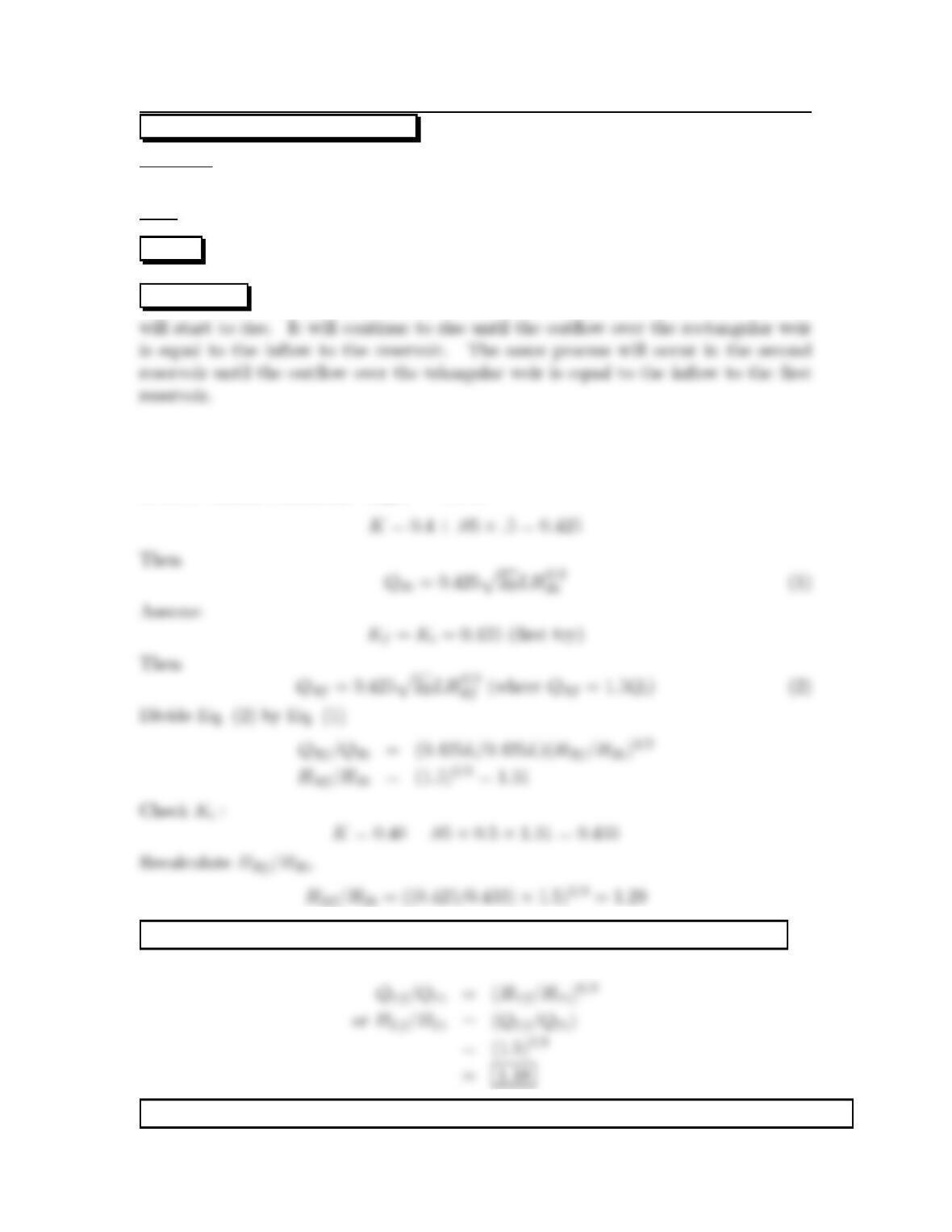
SOLUTION As soon as the flow is increased, the water level in the first reservoir
Calculations
Determine the increase in head on the rectangular weir with an increase in discharge
of 50%. Initial conditions: HR/P =0.5so
The final head on the rectangular weir will be 29% greater than the initial head .Now
determine the increase in head on the triangular weir with a 50% increase in discharge.
The head on the triangular weir will be 18% greater with the 50% increase in discharge.
78

13.70: PROBLEM DEFINITION
Situation:
Water flows over a 60otriangular weir.
H=1.8ft.
Find: Discharge (in cfs).
PLAN Apply the triangular weir equation.
SOLUTION
79

13.71: PROBLEM DEFINITION
Situation:Waterflows over a 45otriangular weir. Q=6cfm Cd=0.6.
Find:Headontheweir:H
SOLUTION
80
13.72: PROBLEM DEFINITION
Situation:
A pump transports water from a well to a tank.
The tank empties through a 60otriangular weir.
Additional details are provided in the problem statement.
Find:Waterlevelinthetank:h
Assumptions:f=0.02
PLAN
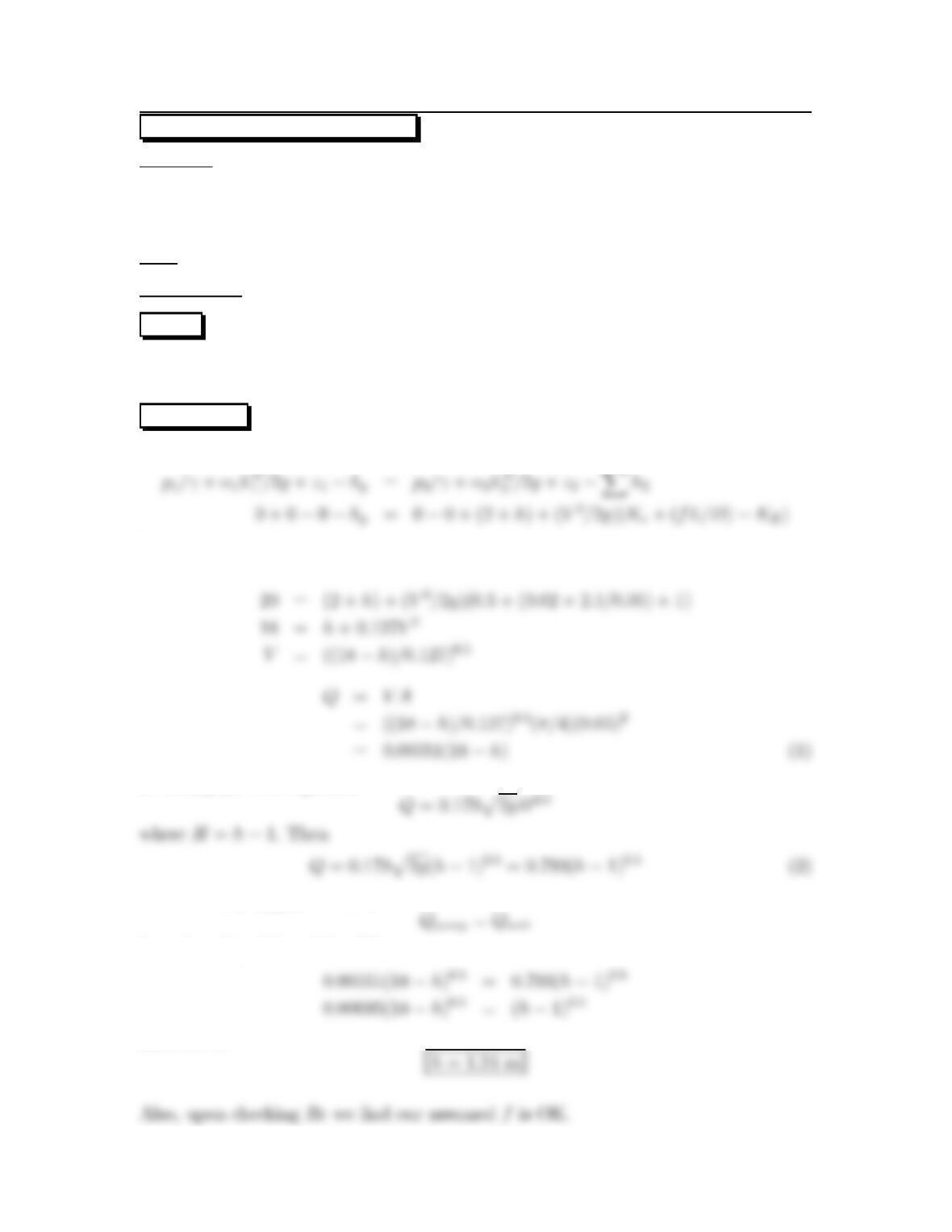
Apply the triangular weir equation to calculate h.Applytheflow rate equation and
the energy equation from well water surface to tank water surface to relate Qand h.
SOLUTION
1. Energy equation
Inserting parameter values
2. Triangular weir equation
3. Continuity (apply to tank)
Introduce Eq. (1) and Eq. (2)
Solve for h:
81
13.73: PROBLEM DEFINITION
Situation: A Pitot tube is used to record data in subsonic flow. pt=140kPa,
p=100kPa, Tt=300K.
Find:(a)Machnumber:M
(b) Velocity: V
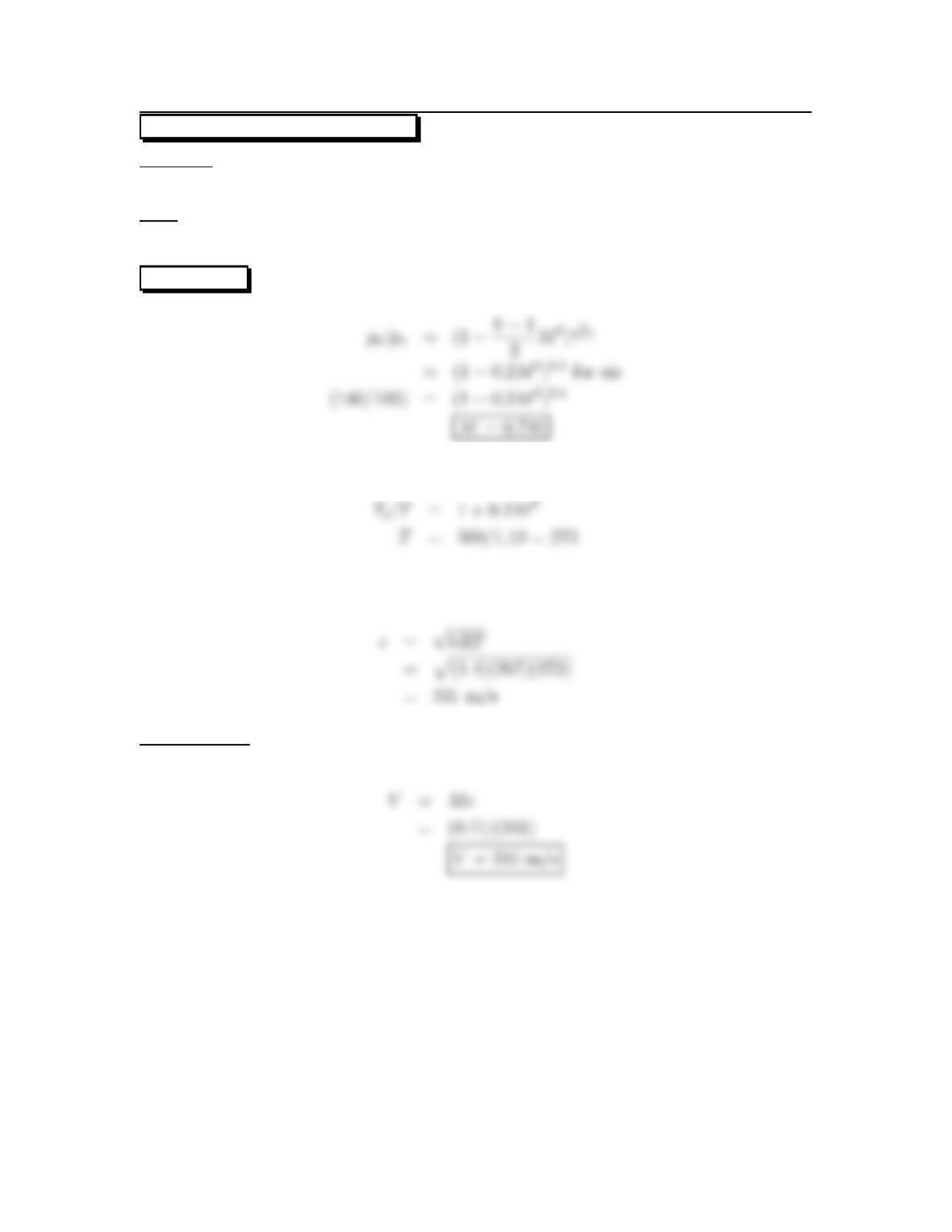
SOLUTION Use total pressure to find the Mach number
Total temperature
Speed of sound
Mach number
82
13.74: PROBLEM DEFINITION
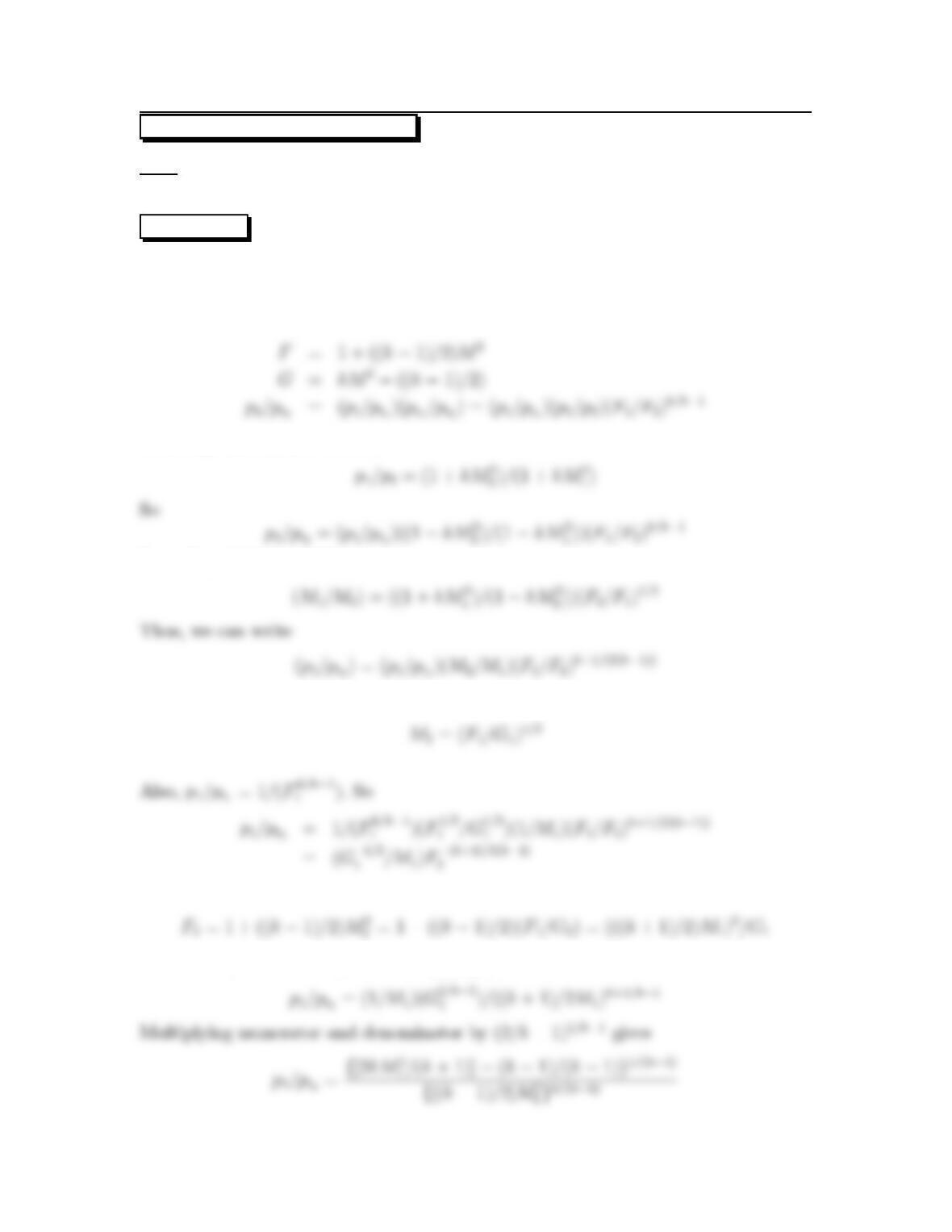
Find: Use the normal shock wave relationships from Chapter 12 to derive the Rayleigh
supersonic Pitot formula.
SOLUTION
The purpose of the algebraic manipulation is to express p1/pt2as a function of M1
only.
For convenience, express the group of variables below as
From Eq. (12.37) in EFM10e,
From Eq. (12.39) in EFM10e
But, from Eq. (12.40) in EFM10e
However,
Substituting for F2in expression for p1/pt2gives
83
13.75: PROBLEM DEFINITION
Situation: A Pitot tube is used in supersonic airflow. p=54kPa, pt=200kPa,
Tt=350K.
Find:(a)Machnumber:M1
(b) Velocity: V1
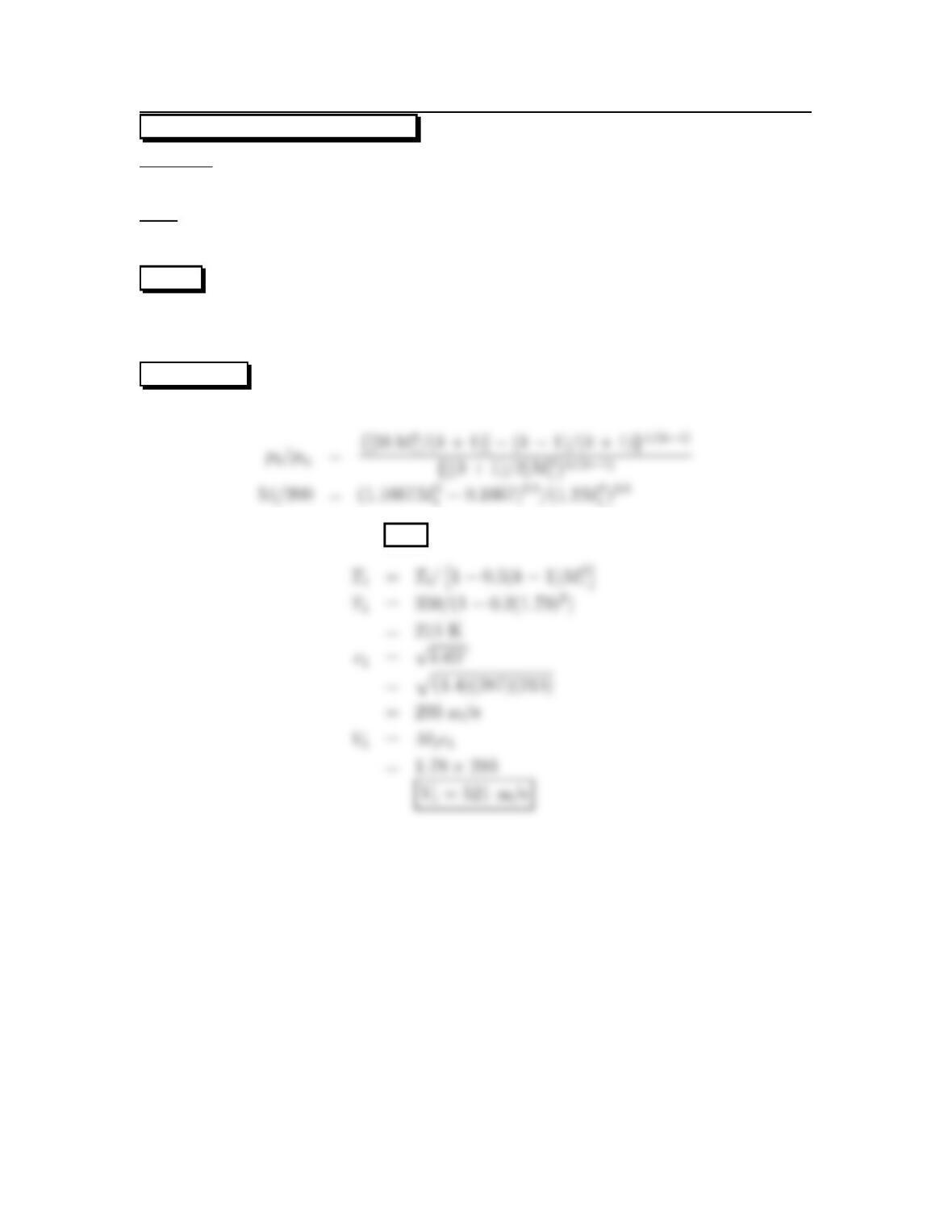
PLAN Apply the Rayleigh Pitot tube formula to calculate the Mach number. Then
apply the Mach number equation and the total temperature equation to calculate the
velocity.
SOLUTION
and solving for M1gives M1=1.79
84
13.76: PROBLEM DEFINITION
Situation: A venturi meter is used to measure flow of helium–additional details are
provided in the problem statement.
p1=120kPa p2=80kPa k=1.66 D2/D1=0.5,T1=17
◦CR=2077J/kg·K.
Find:Massflow rate: ˙m
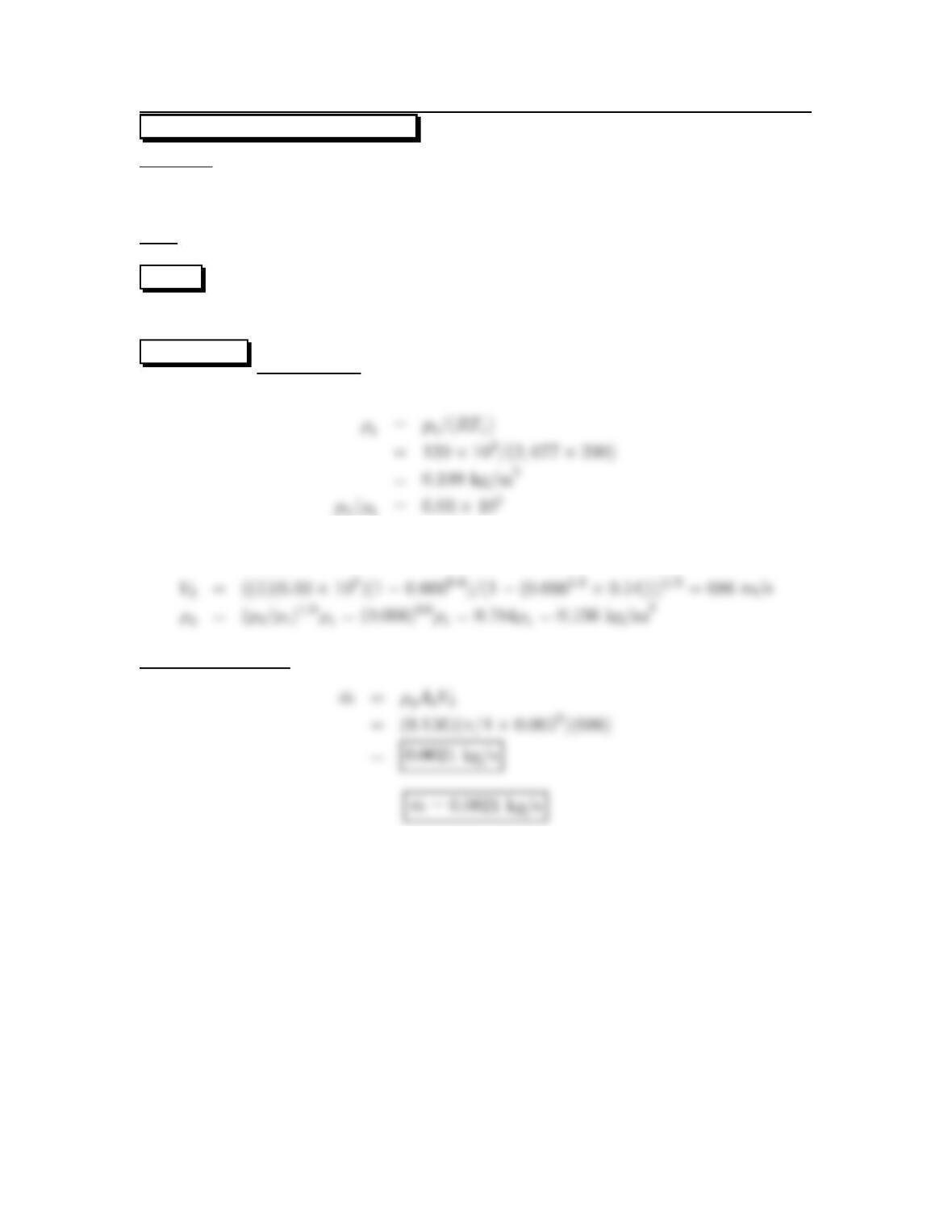
PLAN Apply the ideal gas law and Eq. 13.23 in EFM10e to solve for the density
and velocity at section 2. Then find mass flow rate ˙m=ρ2A2V2.
SOLUTION Ideal gas law
Eq. (13.23) in EFM10e
Flow rate equation
85
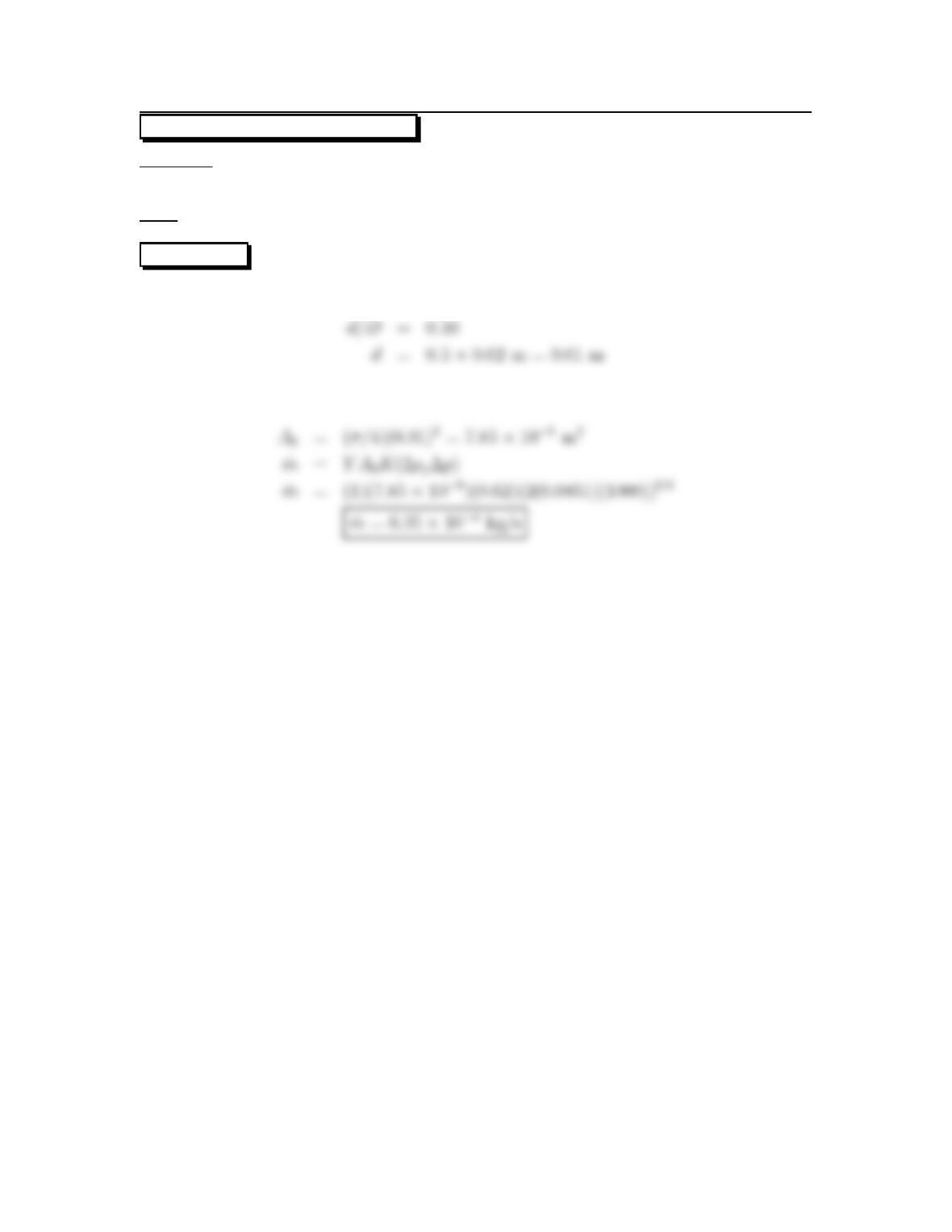
13.77: PROBLEM DEFINITION
Situation:Hydrogen(100kPa,15
oC) flows through an orifice (d/D =0.5,K=0.62)
in a 2 cm pipe. The pressure drop across the orifice is 1 kPa.
Find:Massflow rate
SOLUTION
From Table A.2 for hydrogen (T=15
◦C= 288K):k=1.41,and ρ=0.0851 kg/m3.
86
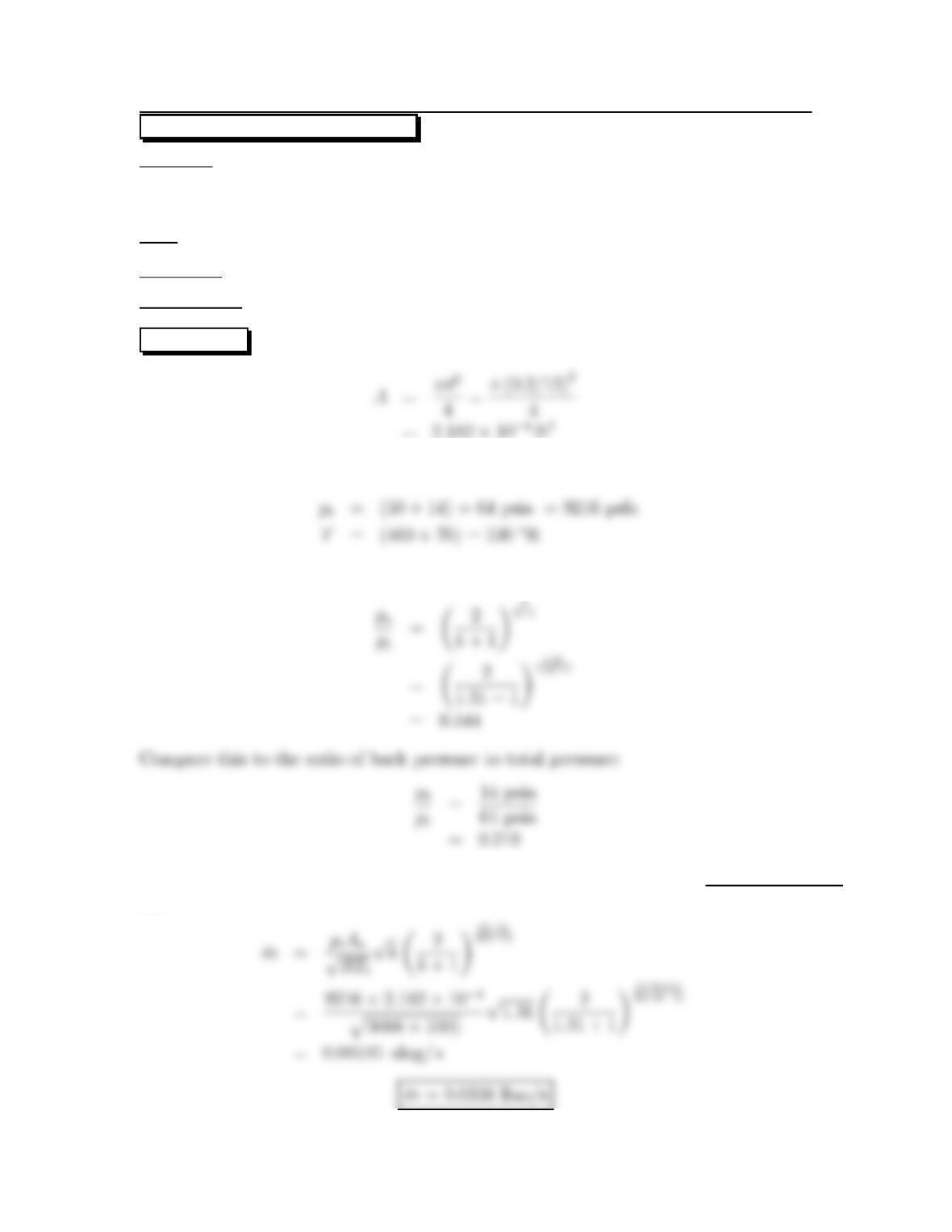
13.78: PROBLEM DEFINITION
Situation: Natural gas (50 psig, 70 oF) flows in a pipe.
Ahole(d=0.2 in) leaks gas.
patm =14psia
Find:Rateofmassflow out of the leak: ˙m
Properties:Fornaturalgas:k=1.31,R=3098ft-lbf/slug ◦R.
Assumptions:Theholeshapeislikeatruncatednozzle
SOLUTION Hole area
Pressure and temperature conversions.
To determine if the flow is sonic or subsonic, calculate the critical pressure ratio
Since, pb/pt<p
∗/pt,theexitflow must be sonic (choked). Calculate the critical mass flow
rate.
87
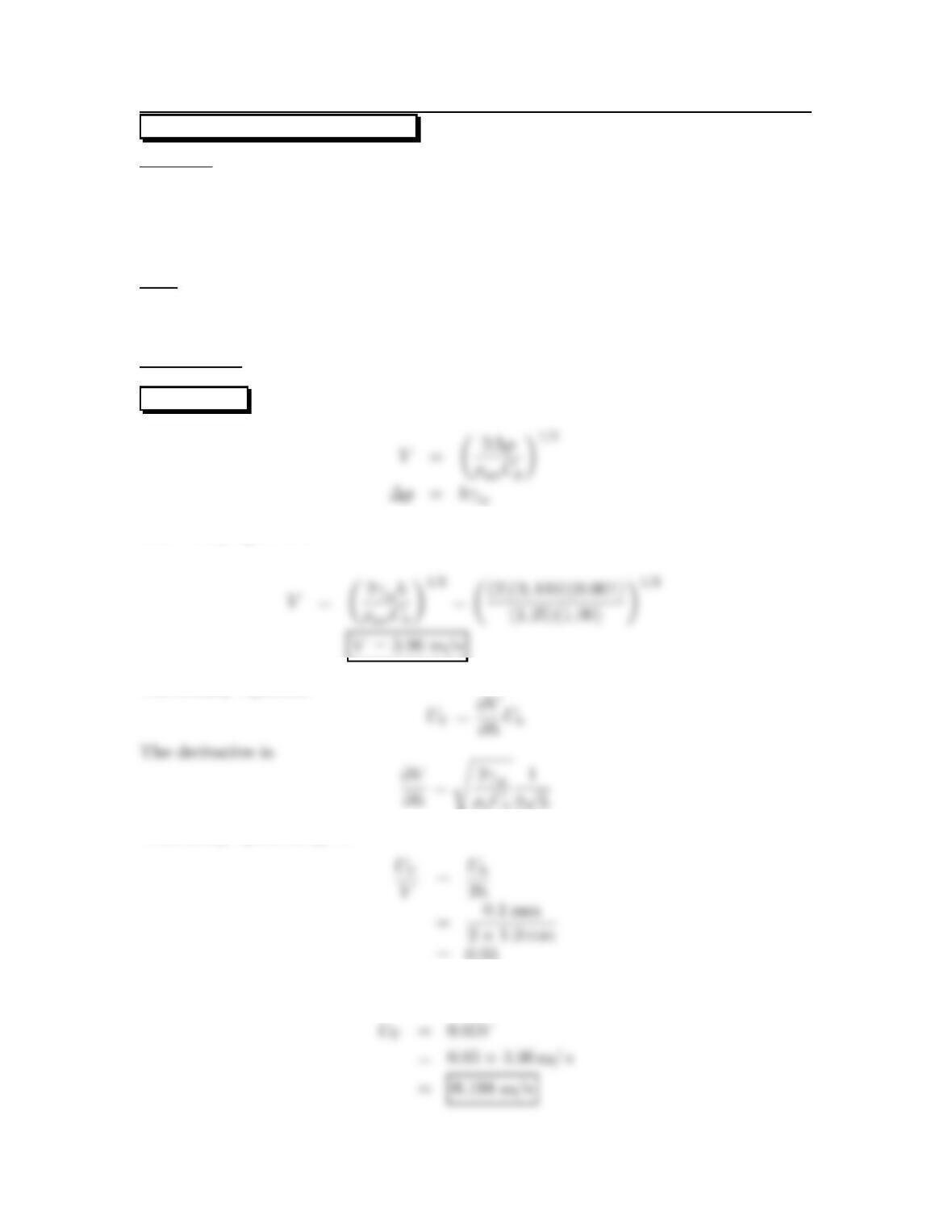
13.79: PROBLEM DEFINITION
Situation:
A stagnation tube is used to measure air speed
ρair =1.25 kg/m3,d=2mm, Cp=1.00
Deflection on an air-water manometer, h=1mm.
The only uncertainty in the manometer reading is Uh=0.1mm.
Find:
(a) Air Speed: V
(b) Uncertainty in air speed: UV
Assumptions: Neglect viscous effects (Cp=1)
SOLUTION
Combining equations
Uncertainty equation
Combining equations gives
=0.05
So
88
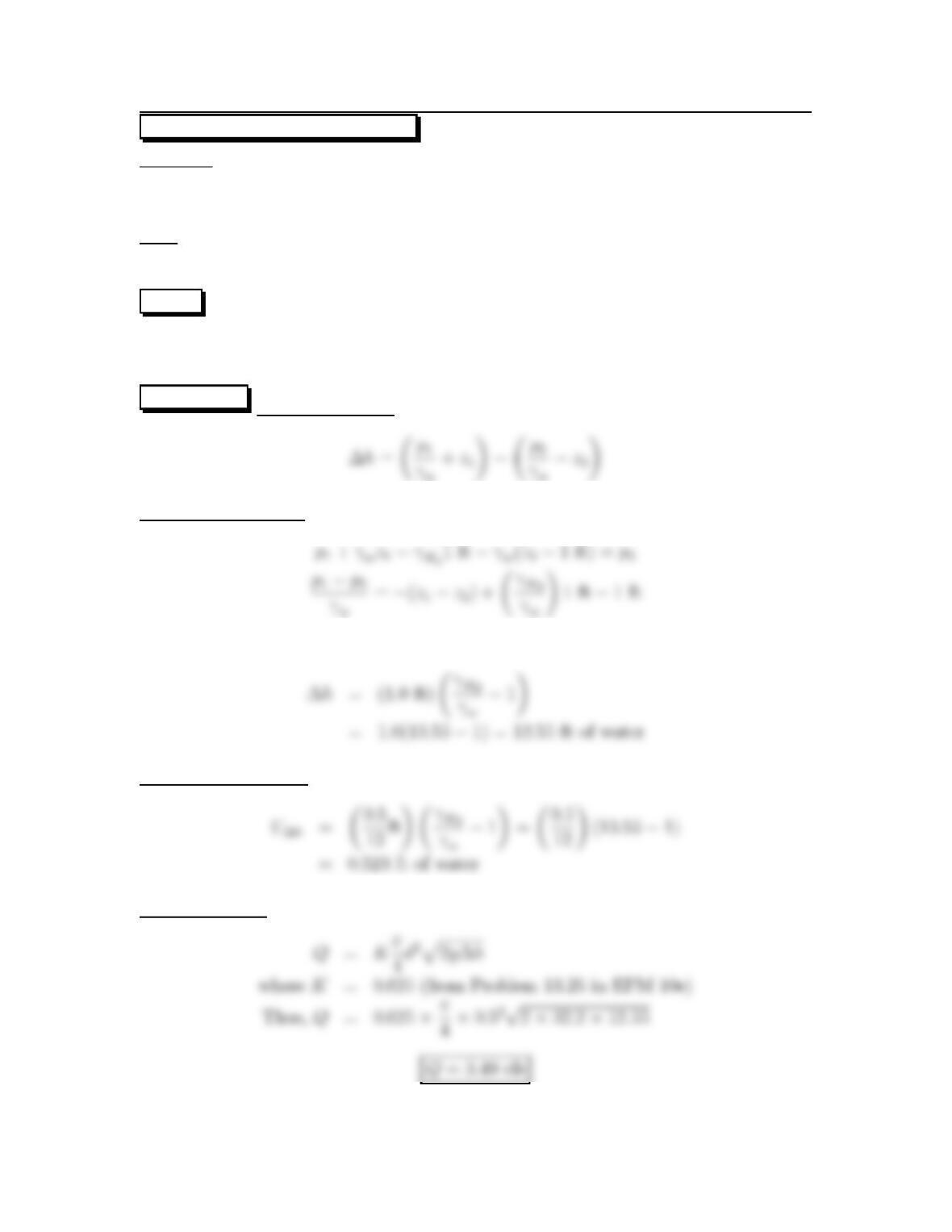
13.80: PROBLEM DEFINITION
Situation:Waterflows through a 6 in. orifice situated in a 12 in. pipe. On a mercury
manometer, ∆h=1ft-Hg. The uncertainty values are UK=0.03,U
H=0.5in.-Hg,
Ud=0.05 in.
Find: (a) Discharge: Q
(b)Uncertainty in discharge: UQ
PLAN Calculate discharge by first calculating ∆h(apply piezometric head and
manometer equation) and to apply the orifice equation. Then apply the uncertainty
equation.
SOLUTION Piezometric head
Manometer equation
Combining equations
Uncertainty equation for ∆h
Orifice equation
89
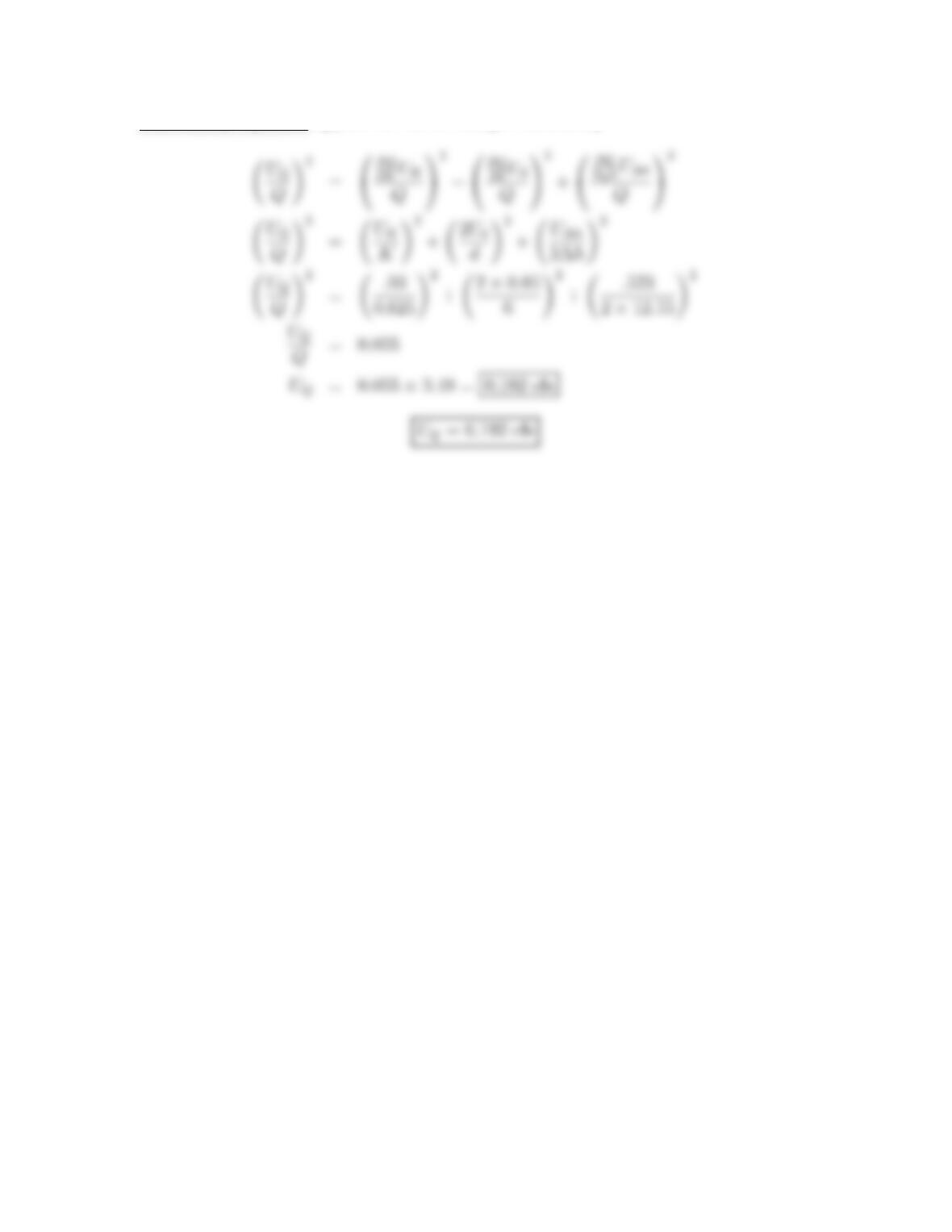
Uncertainty equation applied to the discharge relationship
90
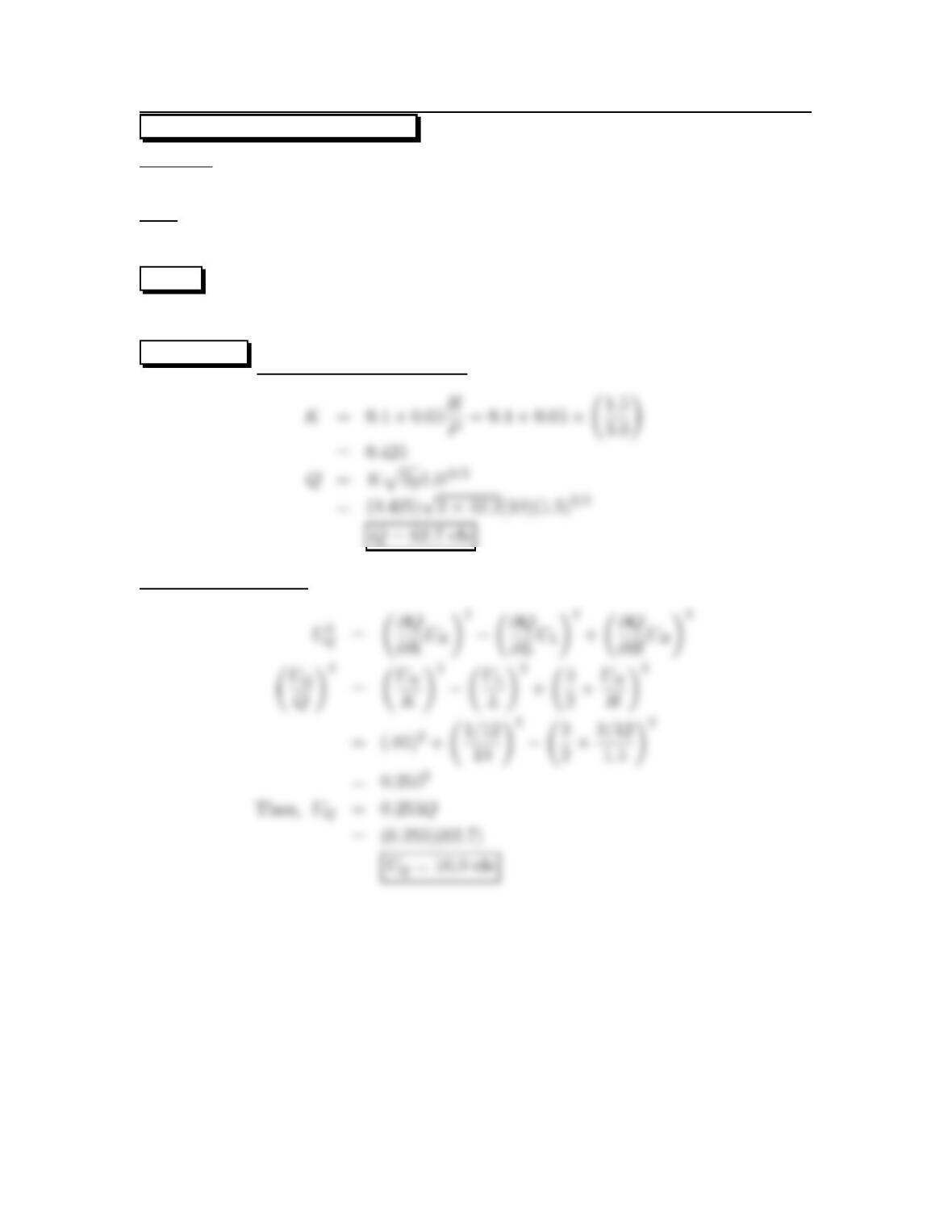
13.81: PROBLEM DEFINITION
Situation: A rectangular weir (L=10ft, P=3ft, H=1.5ft) is used to measure
discharge. The uncertainties are UK=5%,U
H=3in., UL=1in.
Find: (a) Discharge: Q
(b) Uncertainty in discharge: UQ
PLAN Calculate Kand apply the rectangular weir equation to find discharge. Then
apply the uncertainty equation.
SOLUTION Rectangular weir equation
Uncertainty equation
91