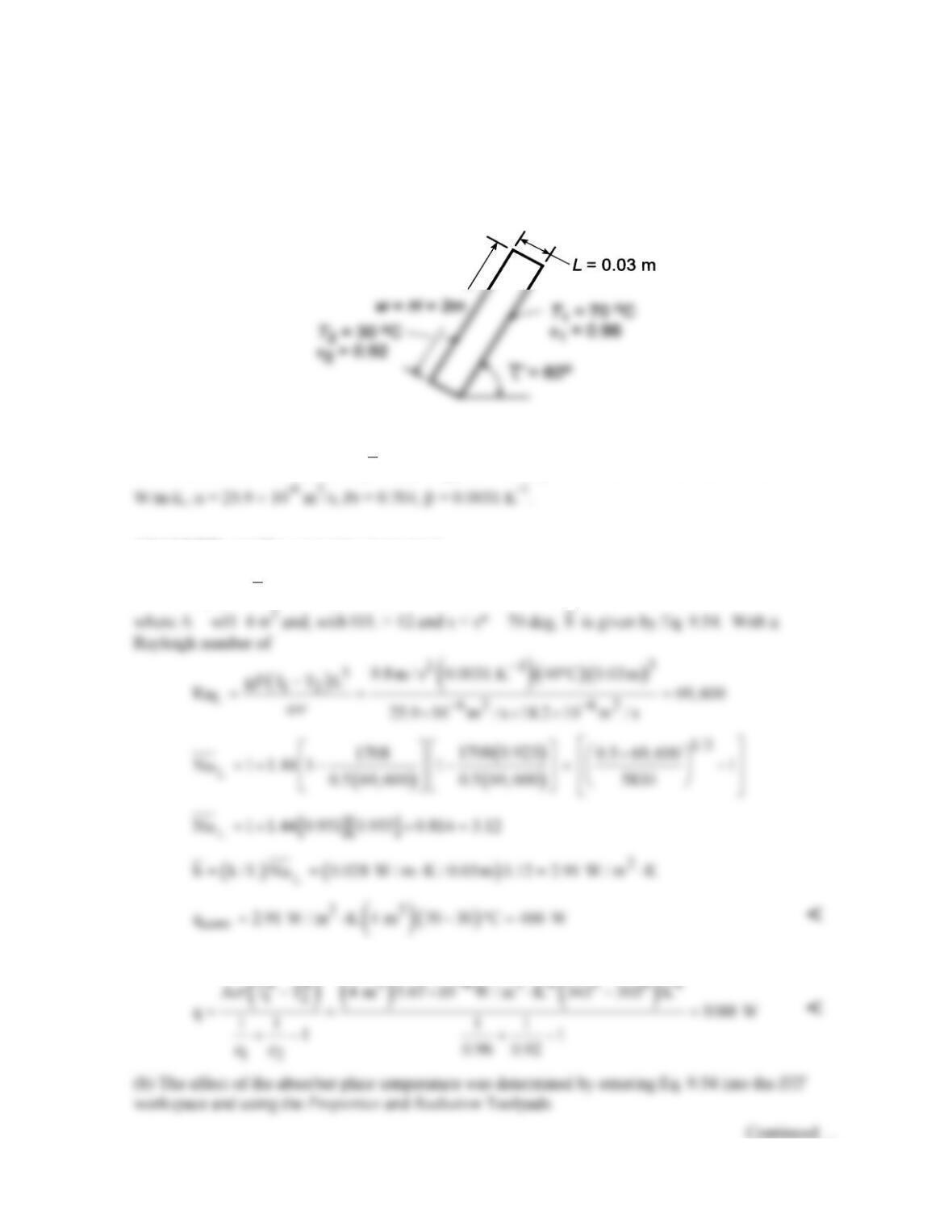
PROBLEM 13.85
KNOWN: Dimensions and inclination angle of a flat–plate solar collector. Absorber and cover plate
temperatures and emissivities.
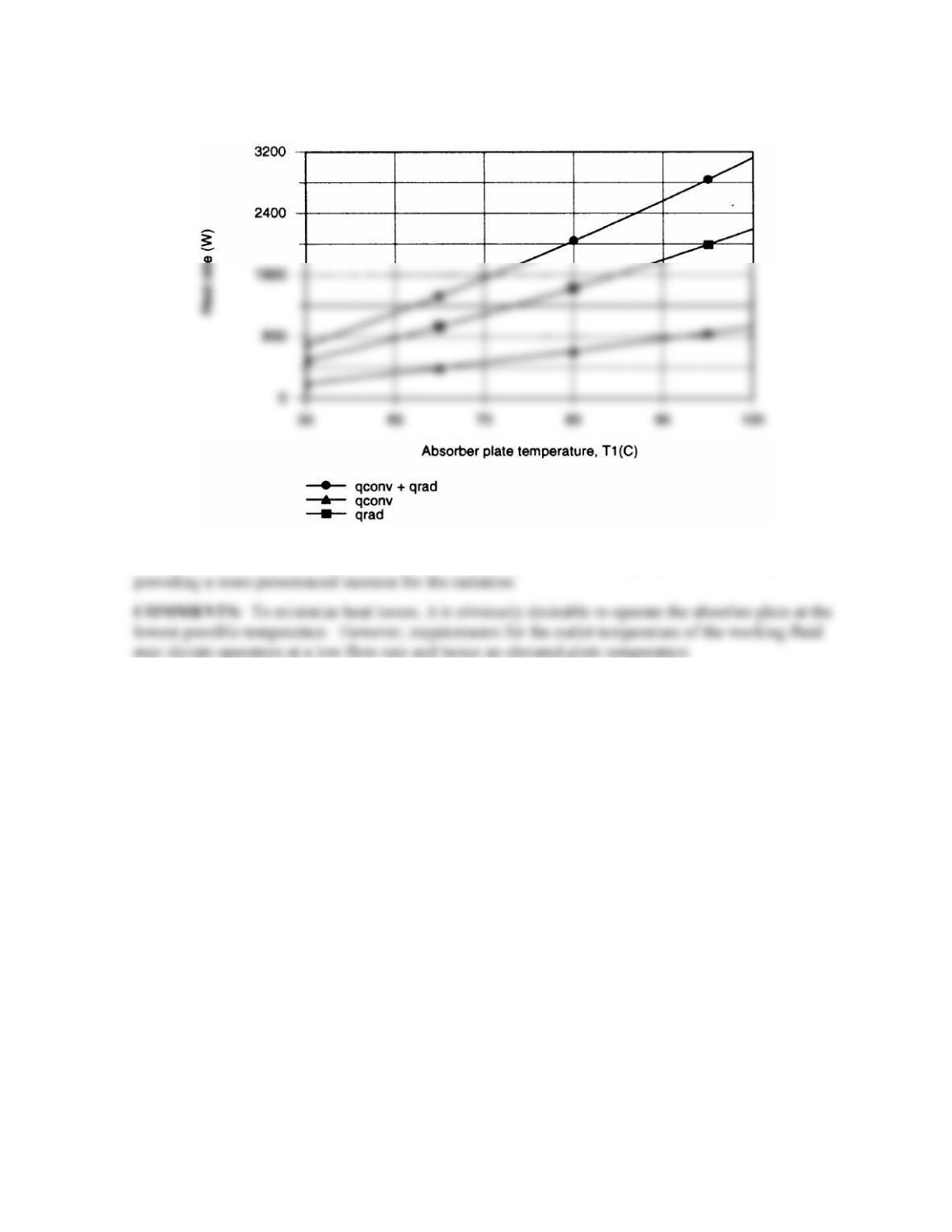
FIND: (a) Rate of heat transfer by free convection and radiation, (b) Effect of the absorber plate
temperature on the heat rates.
SCHEMATIC:
ASSUMPTIONS: (1) Diffuse–gray, opaque surface behavior.
PROPERTIES: Table A-4, air
( )
( )
12
T T T / 2 323 K :=+=
ν = 18.2 × 10⁻⁶ m2/s, k = 0.028
ANALYSIS: (a) The convection heat rate is
( )
conv 1 2
q hA T T= −
The net rate of radiation exchange is given by Eq. 13.24.
PROBLEM 13.85 (Cont.)
As expected, the convection and radiation losses increase with increasing Ti, with the T4 dependence
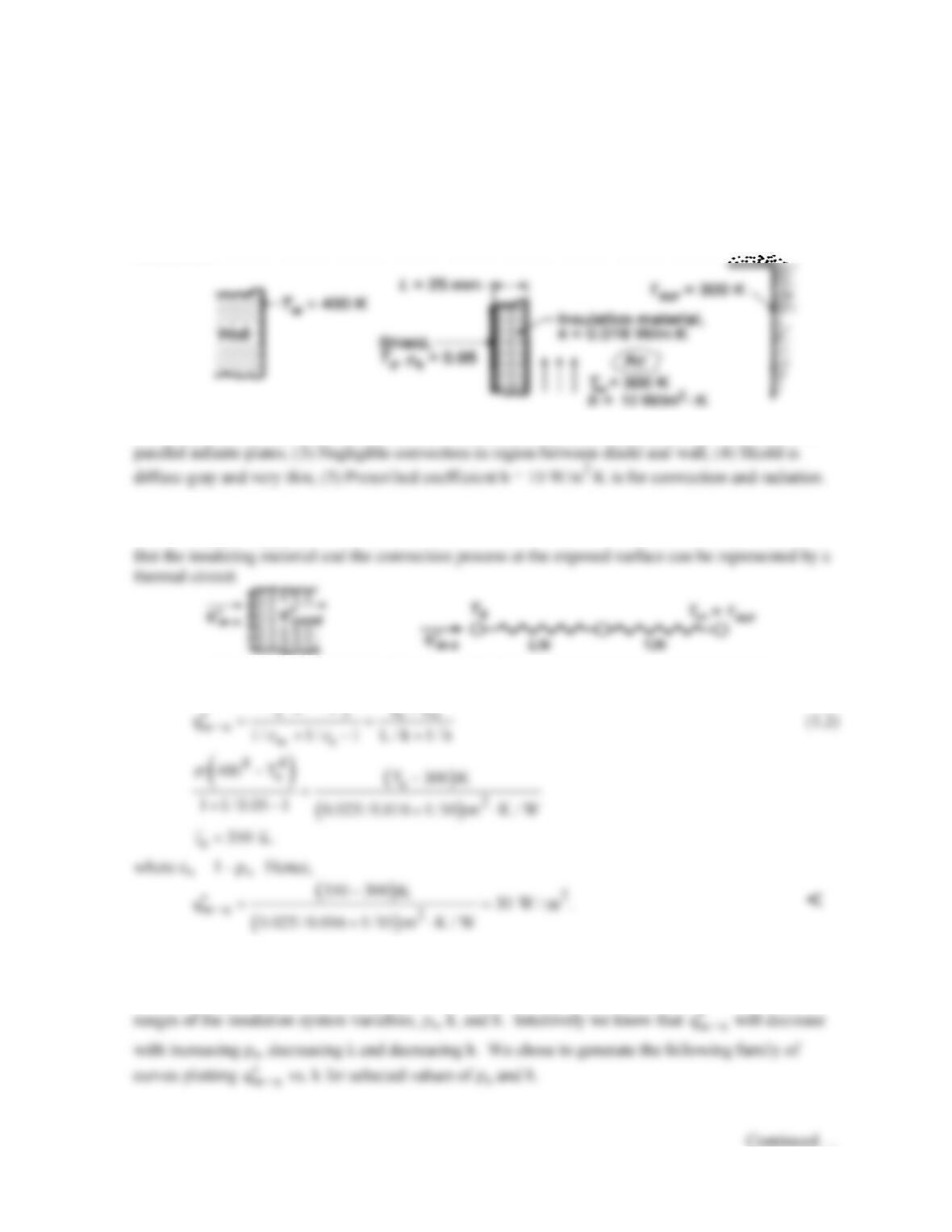
PROBLEM 13.86
KNOWN: Radiation shield facing hot wall at Tw = 400 K is backed by an insulating material of
known thermal conductivity and thickness which is exposed to ambient air and surroundings at 300 K.
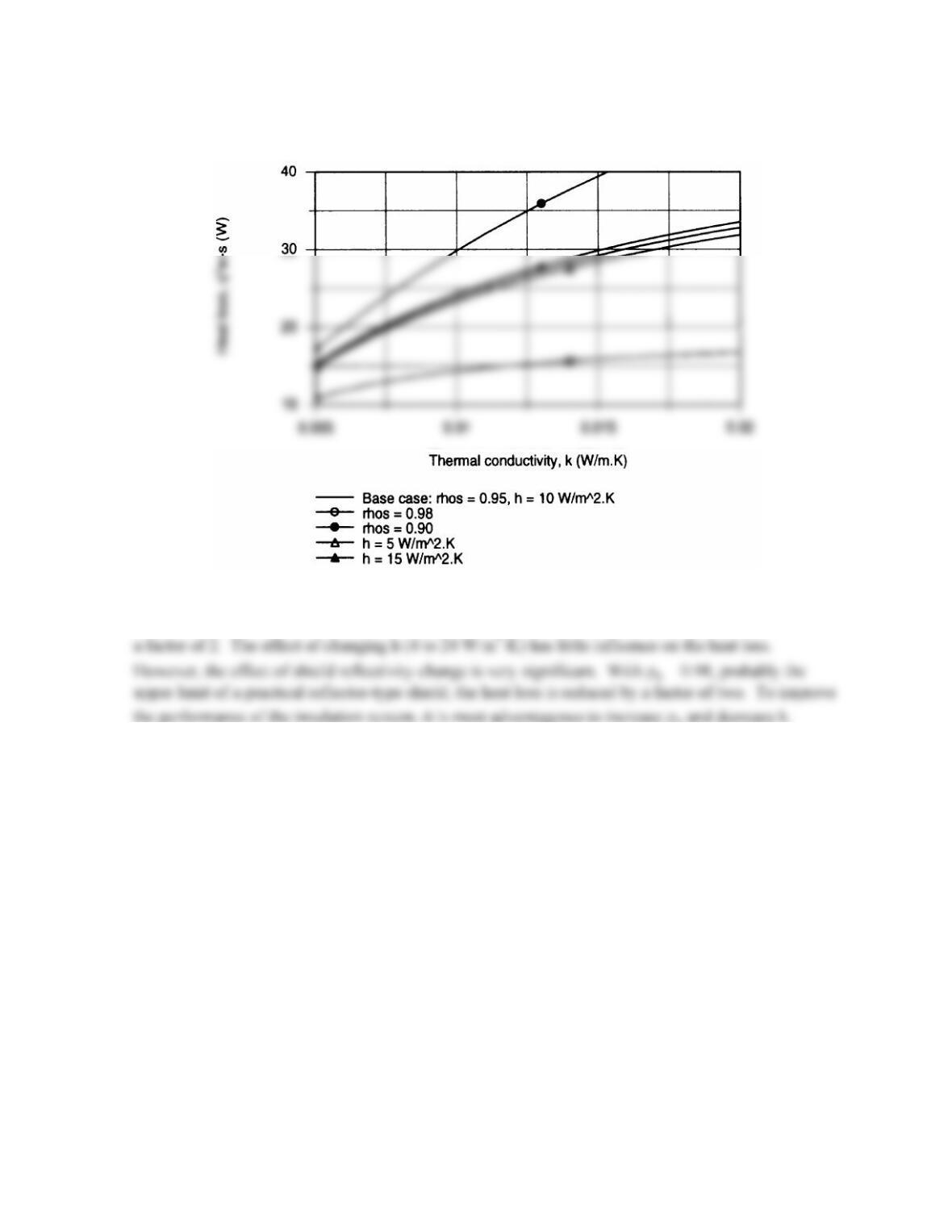
FIND: (a) Heat flux from the hot wall, (b) Radiosity of the shield, and (c) Perform a parameter
sensitivity analysis on the insulation system considering effects of shield reflectivity ρs, insulation
thermal conductivity k, overall coefficient h, on the heat loss from the hot wall.
SCHEMATIC:
ASSUMPTIONS: (1) Wall is black surface of uniform temperature, (2) Shield and wall behave as
ANALYSIS: (a) Perform an energy balance on the shield to obtain
w s cond
qq
−
′′ ′′
=
In equation form, using Eq.13.24 for the wall and shield,
()
44
ws s
TT TT
s
−−
(b) Using the Eqs. (1) and (2) in the IHT workspace,
ws
q−
′′
can be computed and plotted for selected
ws
q−
′′
PROBLEM 13.86 (Cont.)
Considering the base condition with variable k, reducing k by a factor of 3, the heat loss is reduced by
PROBLEM 13.87
KNOWN: Diameter and surface temperature of a fire tube. Gas low rate and temperature.
Emissivity of tube and partition.
FIND: (a) Heat transfer rate per unit tube length,
q,
′
without the partition, (b) Partition temperature,
Tp, and heat rate with the partition, (c) Effect of flow rate and emissivity on
q′
and Tp. Effect of
emissivity on radiative and convective contributions to
q.
′
SCHEMATIC:
ASSUMPTIONS: (1) Fully–developed flow in duct, (2) Diffuse/gray surface behavior, (3)
PROPERTIES: Table A-4, air (Tm,g = 900 K): m = 398 × 10-7 N⋅s/m2, k = 0.062 W/m⋅K, Pr = 0.72;
ANALYSIS: (a) Without the partition, heat transfer to the tube wall is only by convection. With
mg
= 0.05 kg/s and ReD = 4
( ) ( )
72
g
m / D 4 0.05 kg / s / 0.07 m 398 10 N s / m 22,850,
πm π
−
= × ⋅=
the flow is turbulent. From Eq. 8.61,
(b) The temperature of the partition is determined from an energy balance which equates net radiation
exchange with the tube wall to convection from the gas. Hence,
rad conv
q q,
′′ ′′
=
where from Eq. 13.23,
()
44
ps
TT
s
−
Continued …
PROBLEM 13.87 (Cont.)
Hence, with εs = εp = 0.5 and
( )
conv m,g
q hT T ,
p
′′ = −
The heat rate to one-half of the tube is then
The heat rate for the entire tube is
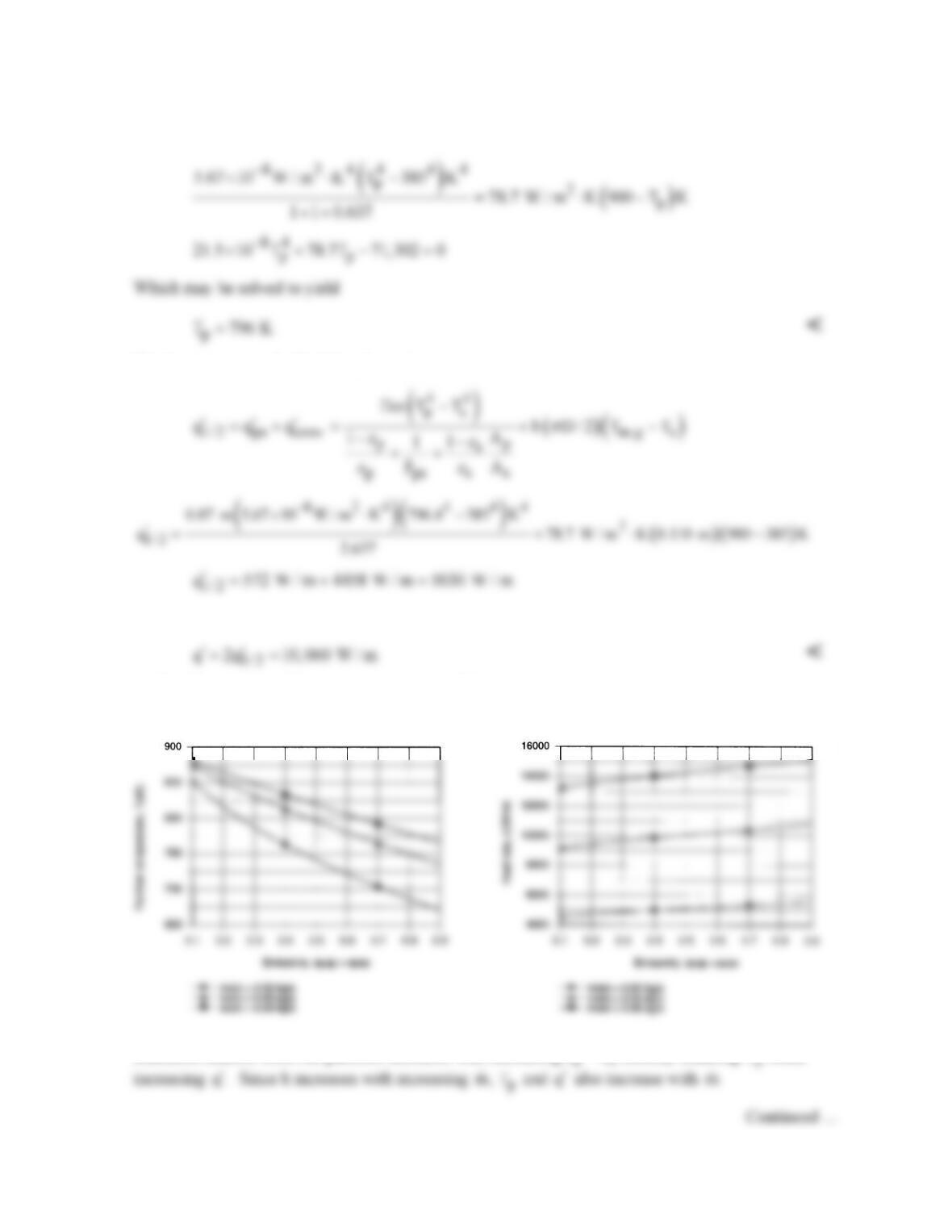
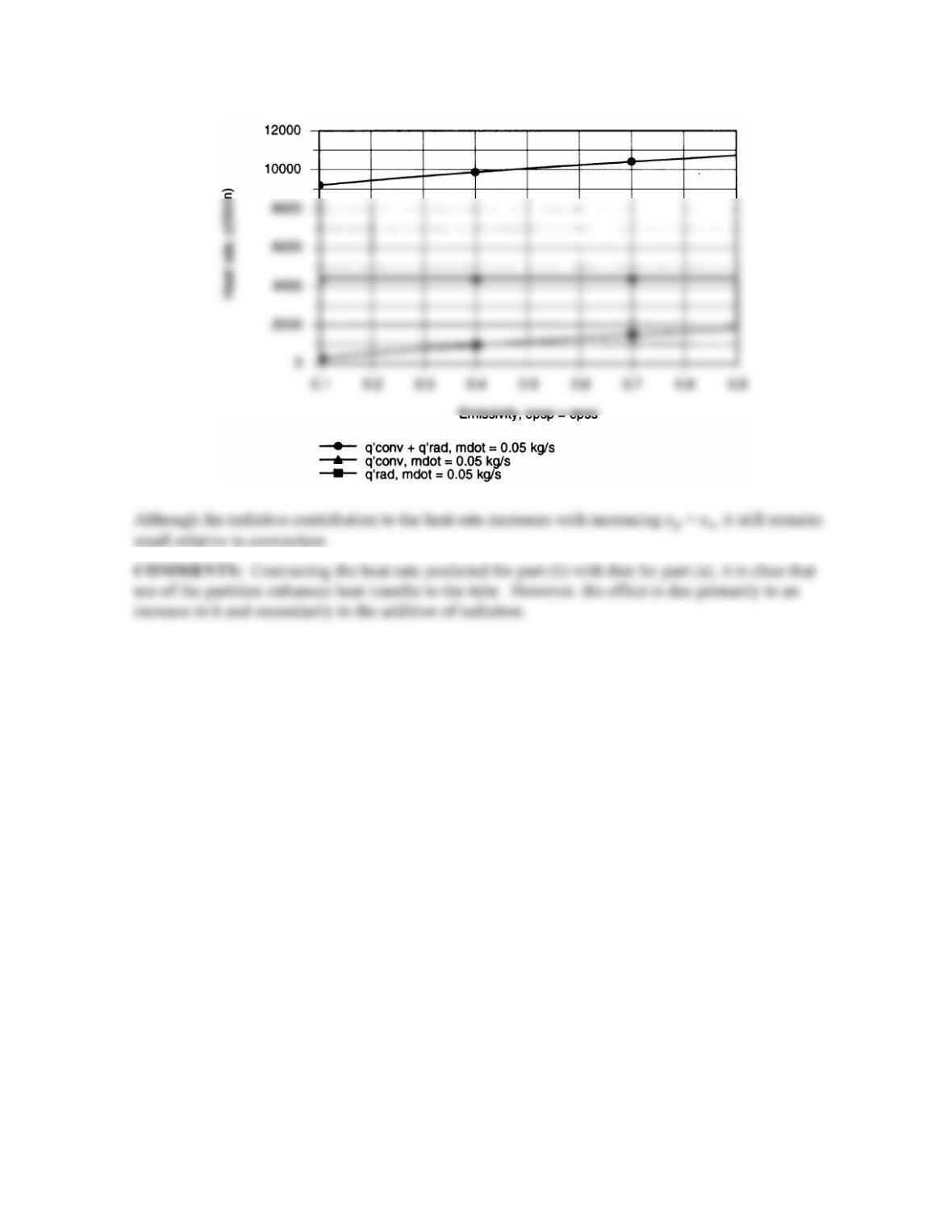
(c) The foregoing model was entered into the IHT workspace, and parametric calculations were
performed to obtain the following results.
Radiation transfer from the partition increases with increasing εp = εs, thereby reducing Tp while
PROBLEM 13.87 (Cont.)
PROBLEM 13.88
KNOWN: Dimensions of horizontal air space separating plates of known temperature.
Emissivity of end plates and interleaving aluminum sheets.
FIND: (a) Neglecting conduction or convection in the air , determine the heat flux through the
system, (b) Neglecting convection and radiation, determine the heat flux through the system, (c)
Heat flux through the system accounting for conduction and radiation, (d) Determine whether
natural convection is negligible in part (c).
SCHEMATIC:
ASSUMPTIONS: (1) One–dimensional heat transfer, (2) Diffuse, gray surfaces, (3) Constant
ANALYSIS: (a) The radiation heat flux across each of the five gaps is
( )
( )
4
84
44 2
24
12
“
W
5.67 10 473K T
TT mK
−
×−
s−
⋅
6
T6= 50°C, ε6= 0.85
6
T6= 50°C, ε6= 0.85
PROBLEM 13.88 (Cont.)
( )
8 44
44 45
24
45
“
rad,4 5
W
5.67 10 T T
TT mK
q11 1 1
−
−
×−
s−
⋅
= =
(4)
where
Solving Eqns. (1) through (6) simultaneously yields
(b) The conduction heat flux across each of the five gaps is
where kA is the thermal conductivity of air evaluated at
A 12
T (T T ) / 2= +
. Likewise,
( )
[ ]
( )
“B
cond,2 3 2 3 B air 2 3
k
q T T ; k k T T /2
L
−=−=+
(8)
PROBLEM 13.88 (Cont.)
Solving Eqns. (7) through (12) simultaneously and using IHT to evaluate kA, kB, kC, kD and kE
yields
(c) For each gap,
“” “
cond rad
qq q= +
. Hence,
“” “
12 rad,12 cond,12
qq q
−− −
= +
(13)
(d) The Rayleigh number for gap A is
( )
3
12
L,A
g T TL
Ra β−
=να
“

PROBLEM 13.88 (Cont.)
Repeating the calculation for the remaining gaps yields
RaL,B = 463, RaL,C = 690, RaL,D = 1104, RaL,E = 1747.
The largest Rayleigh number is slightly higher than the critical value of 1703. Therefore, natural
convection in the gaps is negligible. <
COMMENTS: (1) Ignoring the presence of the air will result in an estimated heat flux that is
only 16% of the actual value. One must carefully account for conduction or convection effects in
radiation problems, in particular when the radiation occurs in conjunction with low emissivity
surfaces. (2) The heat flux for combined radiation and conduction exceeds the sum of the
individual components acting alone. This is due to the non-linear effects brought about by the
fourth-power dependence of the radiation heat flux upon temperature and property variations. (3)
The foil temperatures vary for the three simulations. Can you explain why different temperatures
exist for the three cases?
IHT code for solution of part (c) is shown below.
T1 = 200 + 273
T6 = 50 + 273
emiss1 = 0.85
k12 = k_T(“Air”,T12) // Thermal conductivity, W/m·K
k23 = k_T(“Air”,T23) // Thermal conductivity, W/m·K
L = 0.01
//March through the gaps
qrad12 = sigma*(T1^4–T2^4)/(1/emiss1+1/emiss2–1)
Continued…

PROBLEM 13.88 (Cont.)
qrad34 = sigma*(T3^4–T4^4)/(1/emiss3+1/emiss4–1)
qcon34 = k34*(T3–T4)/L
qtot = qrad34+qcon34
PROBLEM 13.89
KNOWN: Dimensions, emissivity and upper temperature limit of coated panel. Arrangement and
power dissipation of a radiant heater. Temperature of surroundings.
FIND: (a) Minimum panel-heater separation, neglecting convection, (b) Minimum panel-heater
separation, including convection.
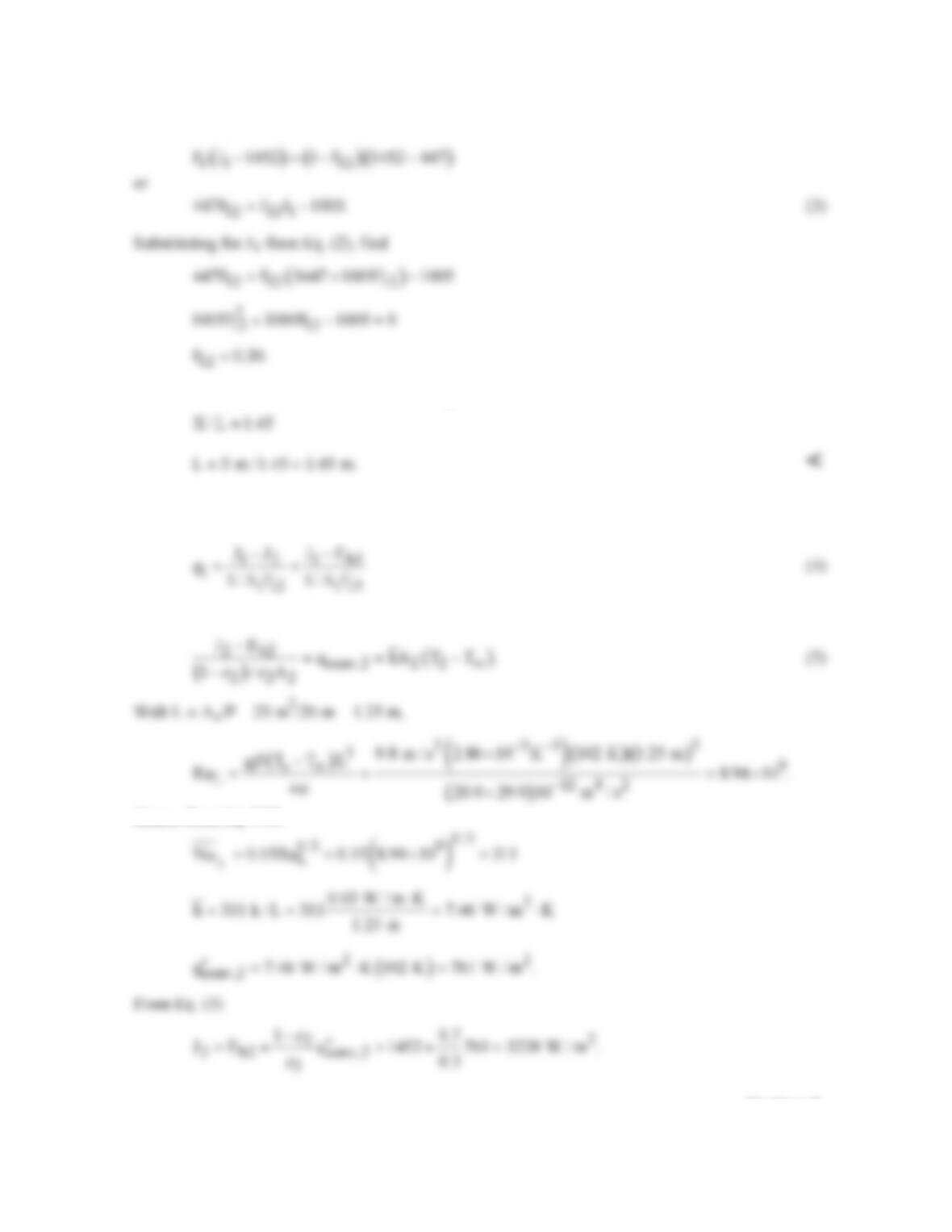
SCHEMATIC:
ASSUMPTIONS: (1) Top and bottom surfaces of heater and panel, respectively, are adiabatic, (2)
PROPERTIES: Table A-4, Air (Tf = (400 + 298)/2 ≈ 350 K, 1 atm): ν = 20.9 × 10⁻⁶ m2/s, k = 0.03
ANALYSIS: (a) Neglecting convection effects, the panel constitutes a floating potential for which
the net radiative transfer must be zero. That is, the panel behaves as a re–radiating surface for which
Eb2 = J2. Hence
and evaluating terms
( )
4
4 8 24 2
b2 2
E T 5.67 10 W / m K 400 K 1452 W / m
s
−
==×⋅ =
find that
( )
11
212 12
75, 000 W J 1452 J 447
1/F 1/ 1 F
25 m
−−
= + −
PROBLEM 13.89 (Cont.)
With A1 = A2 and F23 = 1 – F12
Hence from Fig. 13.4, with X/L = Y/L and Fij = 0.3,
(b) Accounting for convection from the panel, the net radiation transfer is no longer zero at this
surface and Eb2 ≠ J2. It then follows that
where, from an energy balance on the panel,
Hence, from Eq. 9.31
Continued …
PROBLEM 13.89 (Cont.)
From Eq. (4),
( )
11
75, 000 J 3228 J 447
25 1/ F 1/ 1 F
−−
= + −
From an energy balance on the panel,
( )
b3 2 2 b2
12 conv,2
1 12 2 23 2 2 2
E J JE
JJ q
1/A F 1/A F 1 / A
εε
−−
−+= =
−
Substituting from Eq. (6),
( )
12 12 12
F 3447 2781F 447F 3542+ −=
Hence from Fig. 13.4, with X/L = Y/L and Fij = 0.71,
COMMENTS: (1) The results are independent of the heater surface radiative properties. (2)
PROBLEM 13.90
KNOWN: Diameter and emissivity of rod heater. Diameter and position of reflector. Width,
emissivity, temperature and position of coated panel. Temperature of air and large surroundings.
FIND: (a) Equivalent thermal circuit, (b) System of equations for determining heater and reflector
temperatures. Values of temperatures for prescribed conditions, (c) Electrical power needed to
operate heater.
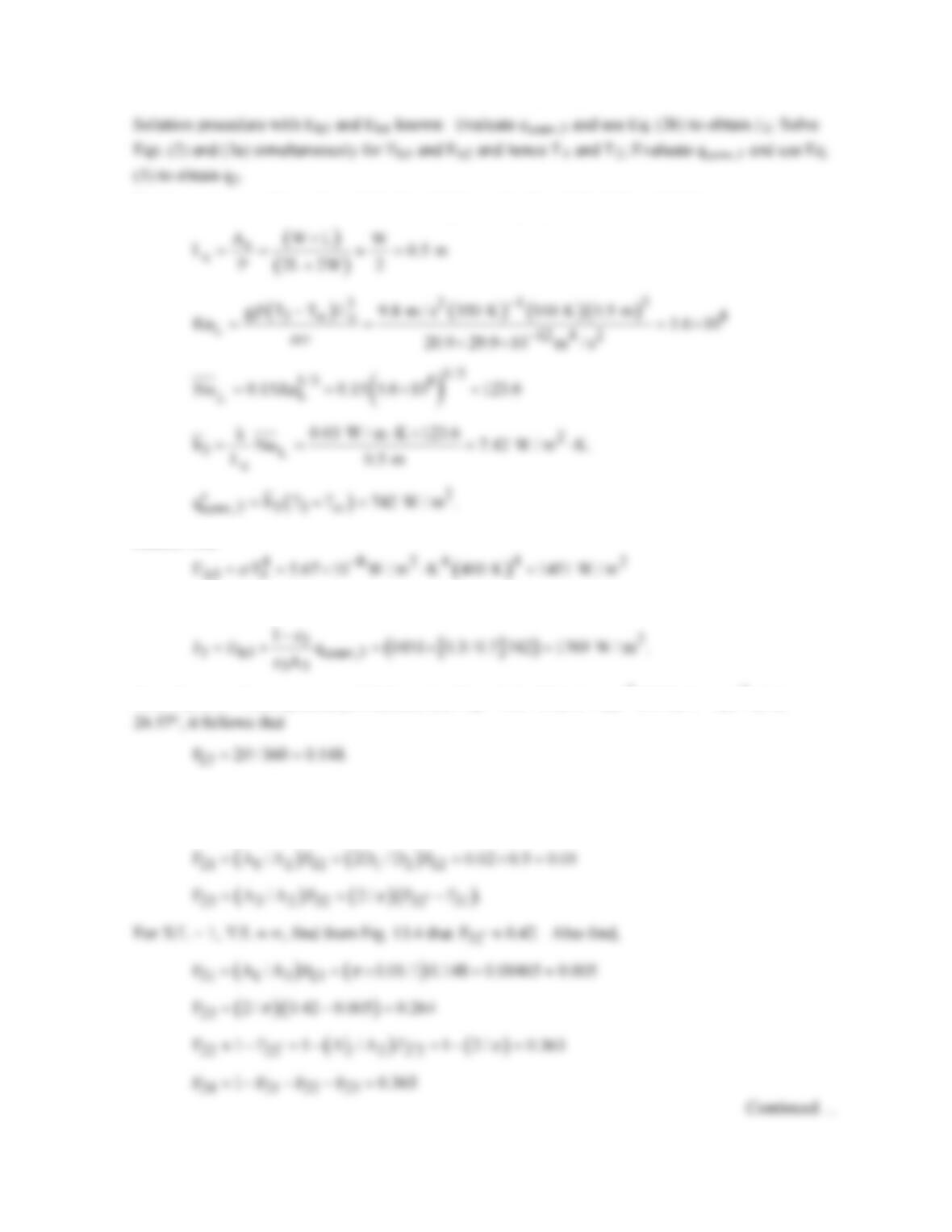
SCHEMATIC:
ASSUMPTIONS: (1) Steady-state conditions, (2) Diffuse-gray surfaces, (3) Large surroundings act
PROPERTIES: Table A-4, Air (Tf = 350 K, 1 atm): k = 0.03 W/m⋅K, ν = 20.9 × 10⁻⁶ m2/s, α =
ANALYSIS: (a) We have assumed blackbody behavior for A1 and A4; hence, J = Eb. Also, A2 is
(b) Performing surface energy balances at 1, 2 and 3:
b1 b2 b1 3 b1 b 4
EE EJEE
qq 1/A F 1/A F 1/ A F
− −−
−= + +
(1)
PROBLEM 13.90 (Cont.)
For free convection from a heated, horizontal plate using Eqs. 9.29, 9.25, and 9.31:
Hence, with
using Eq. (3b) find
View Factors: From symmetry, it follows that F12 = 0.5. With θ = tan-1 (W/2)/H = tan-1 (0.5) =
From summation and reciprocity relations,
14 12 13
F 1 F F 0.352=−−=
PROBLEM 13.90 (Cont.)
31 32
F 0.005, F 0.415= =
(5)
Hence, manipulating Eqs. (4) and (5), find
(c) With T1 = 1295 K, then Tf = (1295 + 300)/2 ≈ 800 K, and using Eq. 9.33
D
The convection heat flux is
COMMENTS: Although convection represents less than 8% of the net radiant transfer from the
PROBLEM 13.91
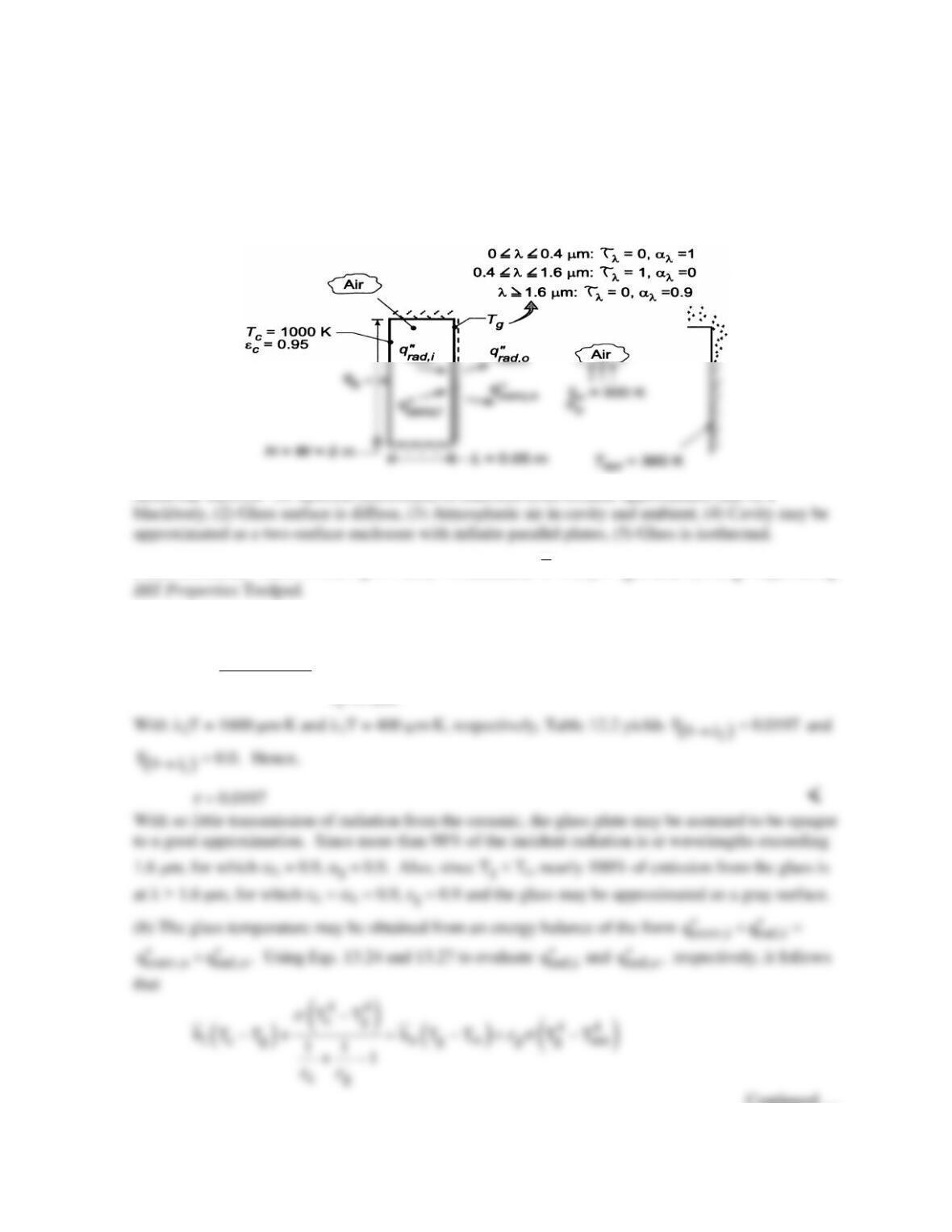
KNOWN: Temperature and emissivity of ceramic plate which is separated from a glass plate of
equivalent height and width by an air space. Temperature of air and surroundings on opposite side of
glass. Spectral radiative properties of glass.
FIND: (a) Transmissivity of glass, (b) Glass temperature Tg and total heat rate qh, (c) Effect of
external forced convection on Tg and qh.
SCHEMATIC:
ASSUMPTIONS: (1) Spectral distribution of emission from ceramic approximates that of a
PROPERTIES: Table A-4, air (p = 1 atm): Evaluated at
T
= (Tc + Tg)/2 and Tf = (Tg +T∞)/2 using
ANALYSIS: (a) The total transmissivity of the glass is
( )
( ) ( )
2
21
1.6 m
b
o,b b 00
b0.4 m
Ed
E /E d F F
E
λm
λλ
λλλ
λm
τλ
τλ
∞=
→→
=
= = = −
∫∫
Continued …