PROBLEM 13.13
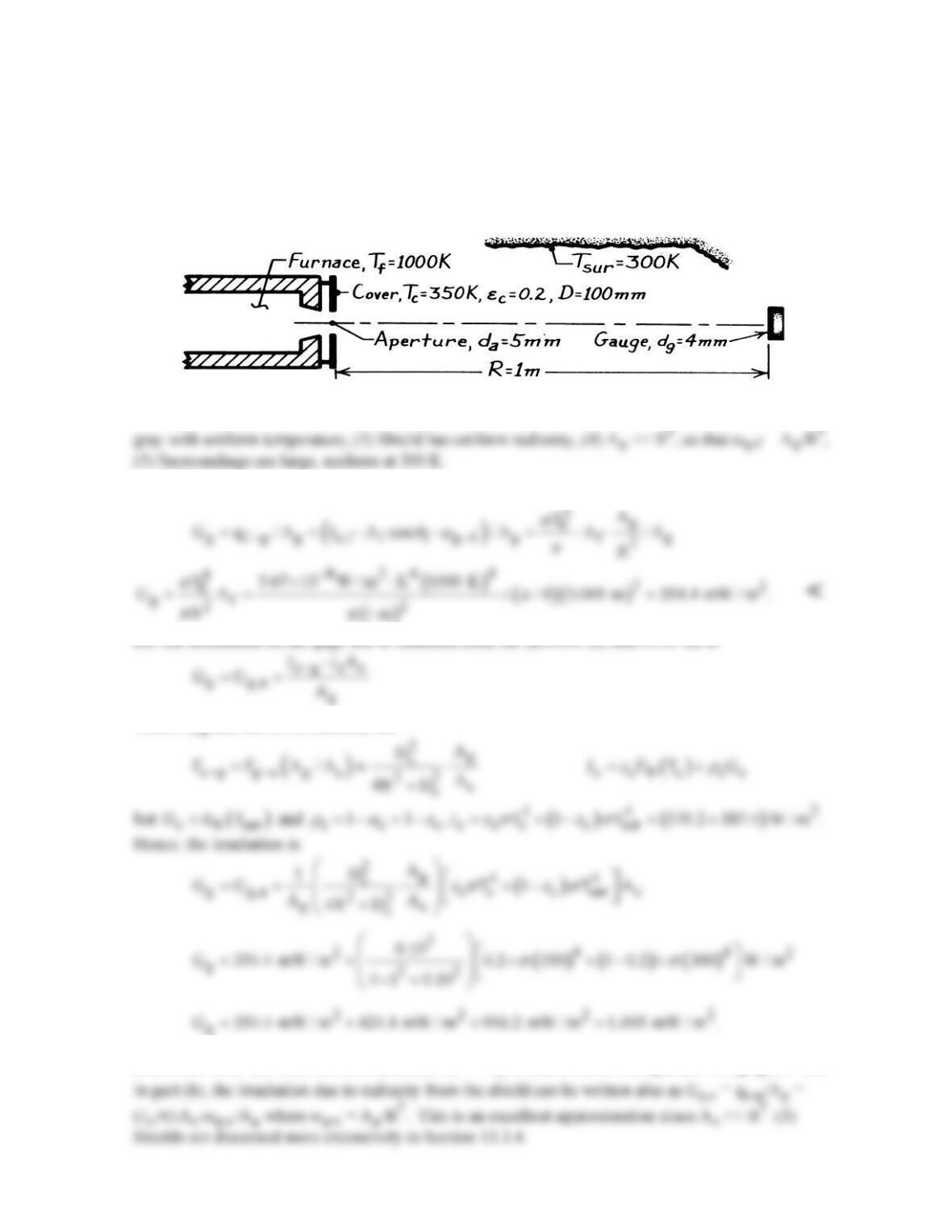
KNOWN: Heat flux gage positioned normal to a blackbody furnace. Cover of furnace is at 350 K
while surroundings are at 300 K.
FIND: (a) Irradiation on gage, Gg, considering only emission from the furnace aperture and (b)
Irradiation considering radiation from the cover and aperture.
SCHEMATIC:
ASSUMPTIONS: (1) Furnace aperture approximates blackbody, (2) Shield is opaque, diffuse and
ANALYSIS: (a) The irradiation on the gage due only to aperture emission is
where Fc-g and the cover radiosity are
COMMENTS: (1) Note we have assumed Af << Ac so that effect of the aperture is negligible. (2)
PROBLEM 13.14
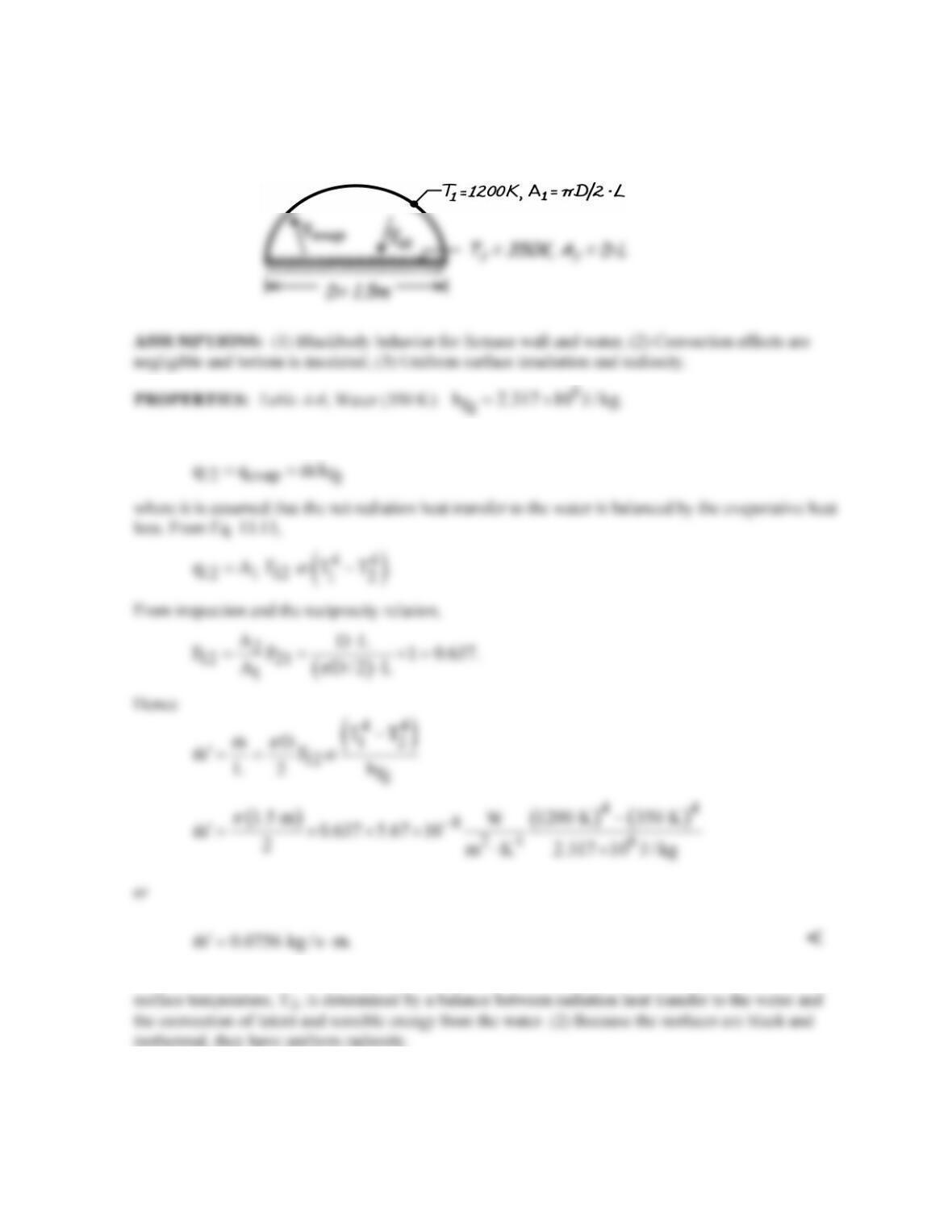
KNOWN: Surface temperature of a semi-circular drying oven.
FIND: Drying rate per unit length of oven.
SCHEMATIC:
ANALYSIS: Applying a surface energy balance,
COMMENTS: (1) Air flow through the oven is needed to remove the water vapor. The water
PROBLEM 13.15
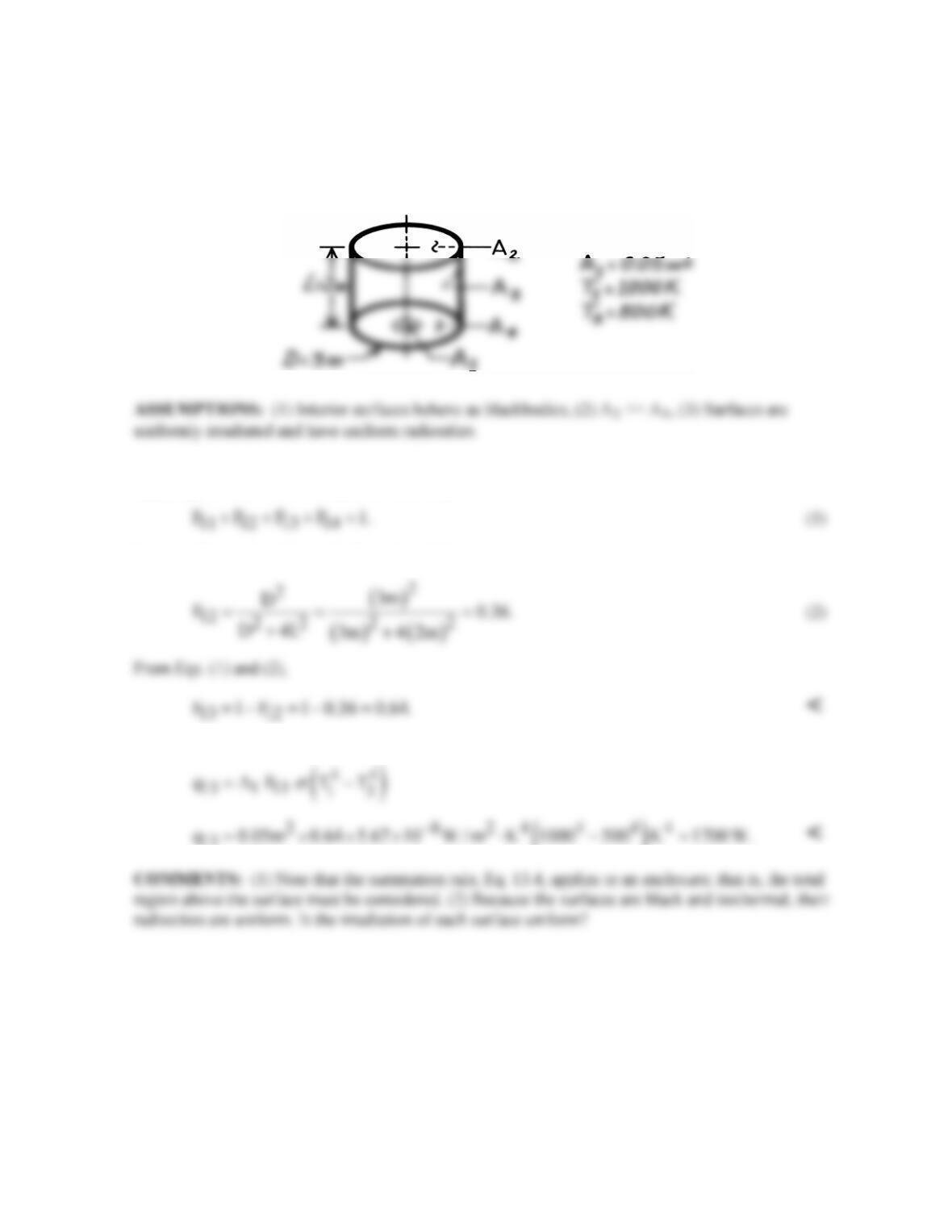
KNOWN: Arrangement of three black surfaces with prescribed geometries and surface temperatures.
FIND: (a) View factor F13, (b) Net radiation heat transfer from A1 to A3.
SCHEMATIC:
ANALYSIS: (a) Define the enclosure as the interior of the cylindrical form and identify A4.
Applying the view factor summation rule, Eq. 13.4,
Note that F11 = 0 and F14 = 0. From Eq. 13.8,
(b) From Eq. 13.13,
()
13
PROBLEM 13.16
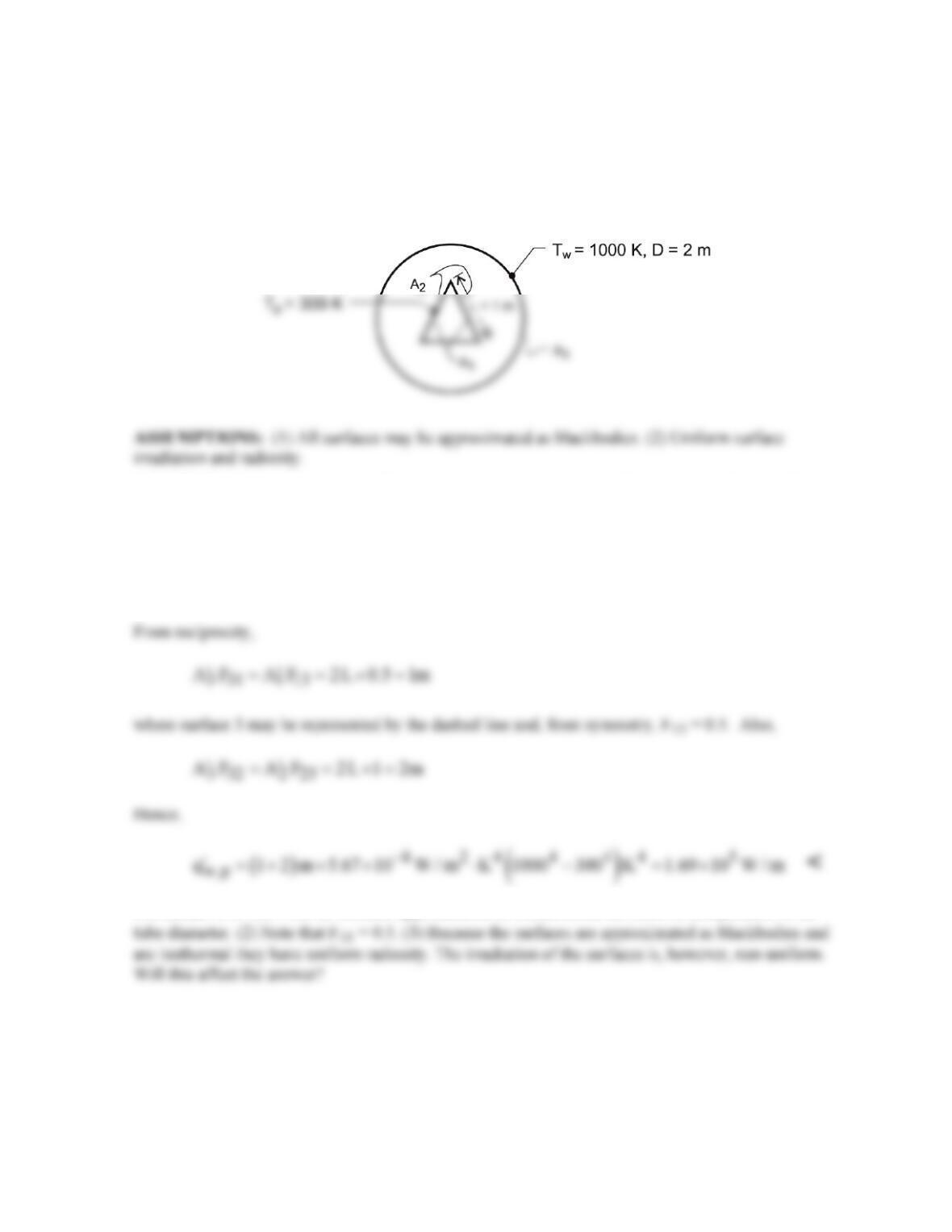
KNOWN: Furnace diameter and temperature. Dimensions and temperature of suspended part.
FIND: Net rate of radiation transfer per unit length to the part.
SCHEMATIC:
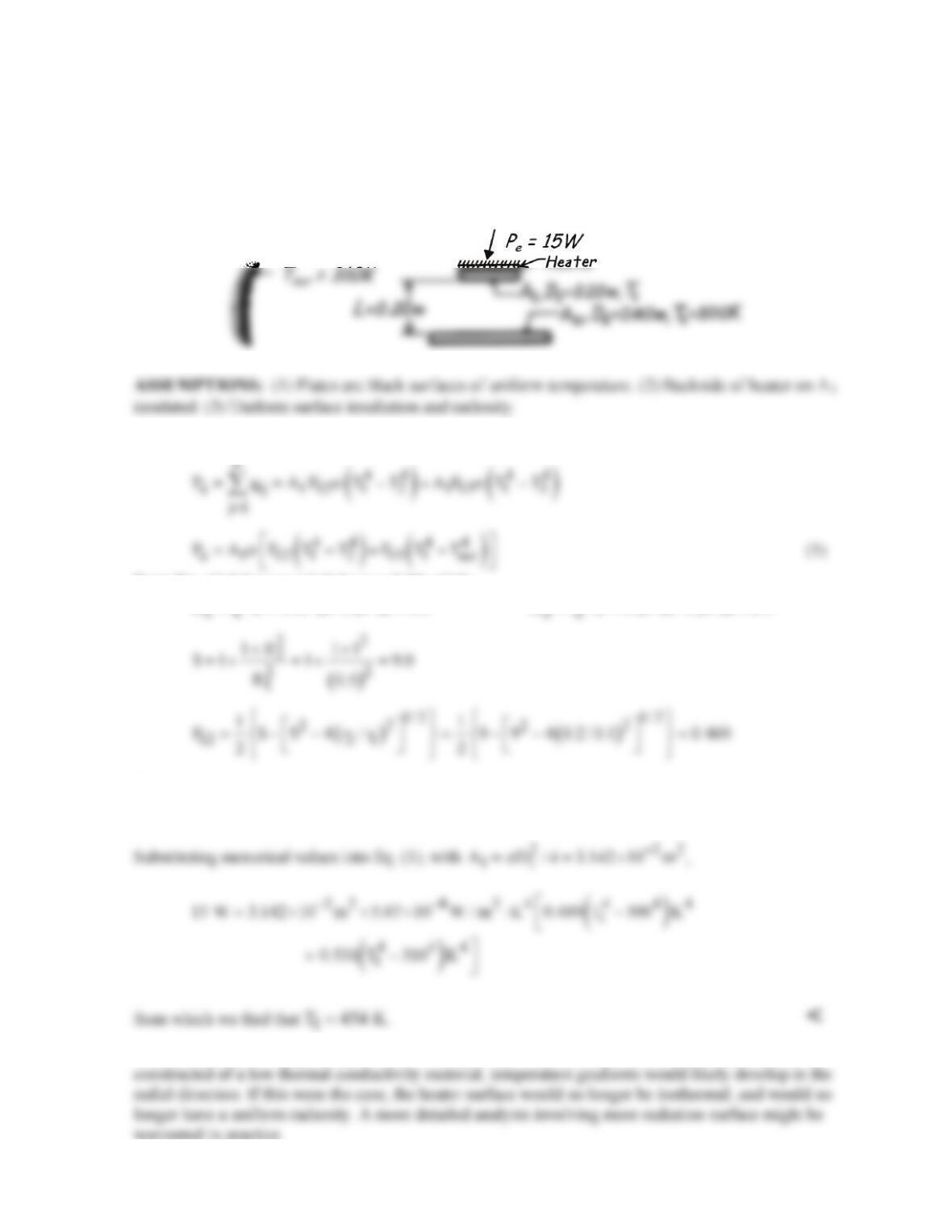
ANALYSIS: From symmetry considerations, it is convenient to treat the system as a three–surface
enclosure consisting of the inner surfaces of the vee (1), the outer surfaces of the vee (2) and the
furnace wall (3). The net rate of radiation heat transfer to the part is then
()()
44 44
w,p 3 31 w p 3 32 w p
q AF T T AF T T
′′ ′
= −+ −
σσ
COMMENTS: (1) With all surfaces approximated as blackbodies, the result is independent of the
PROBLEM 13.17
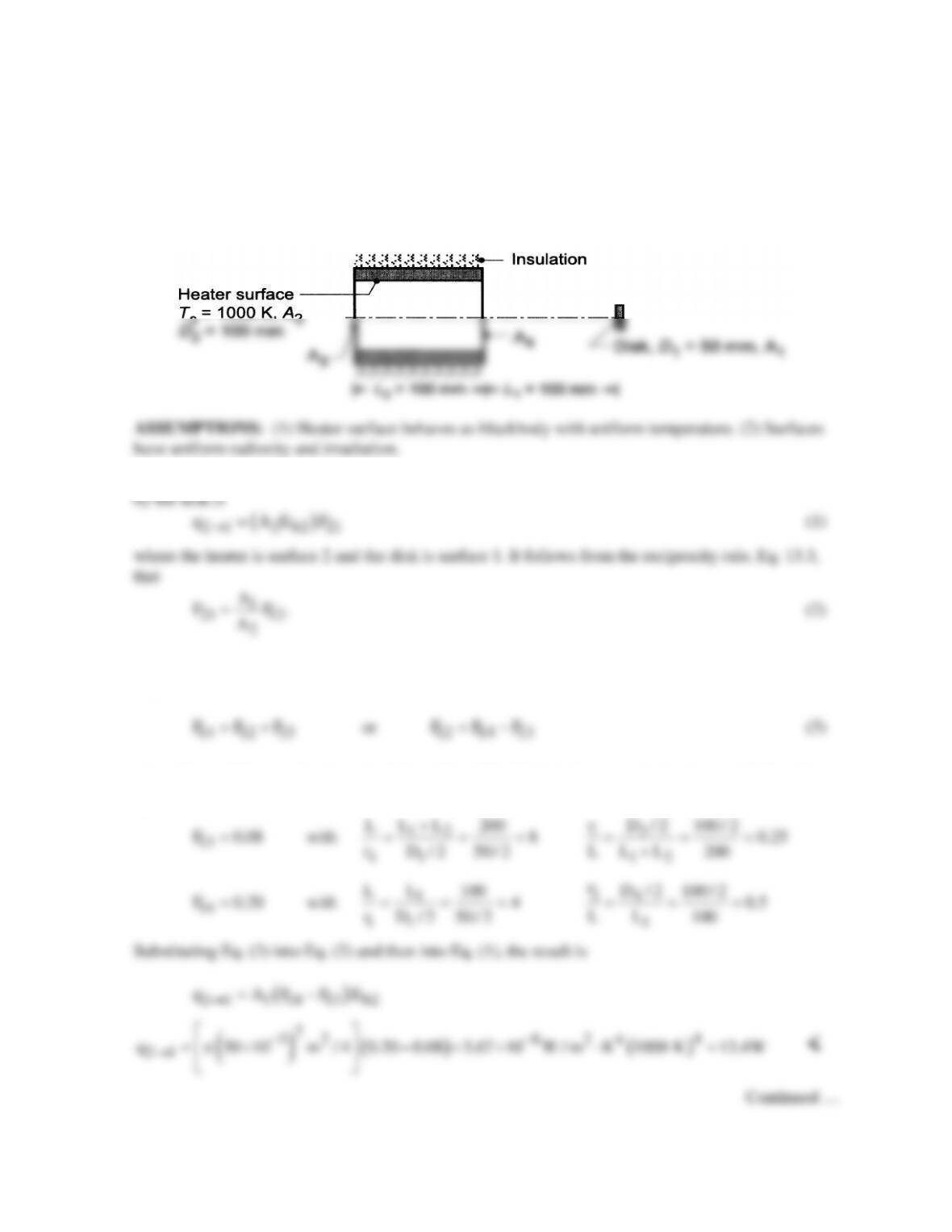
KNOWN: Coaxial, parallel black plates with surroundings. Lower plate (A2) maintained at
prescribed temperature T2 while electrical power is supplied to upper plate (A1).
FIND: Temperature of the upper plate T1.
SCHEMATIC:
ANALYSIS: The net radiation heat rate leaving Ai is
From Fig. 13.5 for coaxial disks (see Table 13.2),
R r / L 0.10 m / 0.20 m 0.5 R r / L 0.20 m / 0.20 m 1.0= = = = = =
From the summation rule for the enclosure A1, A2 and A3 where the last area represents the
surroundings with T3 = Tsur,
12 13 13 12
F F 1 and F 1 F 1 0.469 0.531.+= =−=− =
COMMENTS: Would you expect the surfaces to experience uniform irradiation? If the heater were
PROBLEM 13.18
KNOWN: Tubular heater radiates like blackbody at 1000 K.
FIND: (a) Radiant power from the heater surface, As, intercepted by a disc, A1, at a prescribed
location qs→1; irradiation on the disk, G1; and (b) Compute and plot qs→1 and G1 as a function of the
separation distance L1 for the range 0 ≤ L1 ≤ 200 mm for disk diameters D1 = 25, and 50 and 100 mm.
SCHEMATIC:
ANALYSIS: (a) The radiant power leaving the inner surface of the tubular heater that is intercepted
Define now the hypothetical disks, A3 and A4, located at the ends of the tubular heater. By
inspection, it follows that
where F14 and F13 may be determined from Fig. 13.5. Substituting numerical values, with D3 = D4 =
D2,
PROBLEM 13.18 (Cont.)
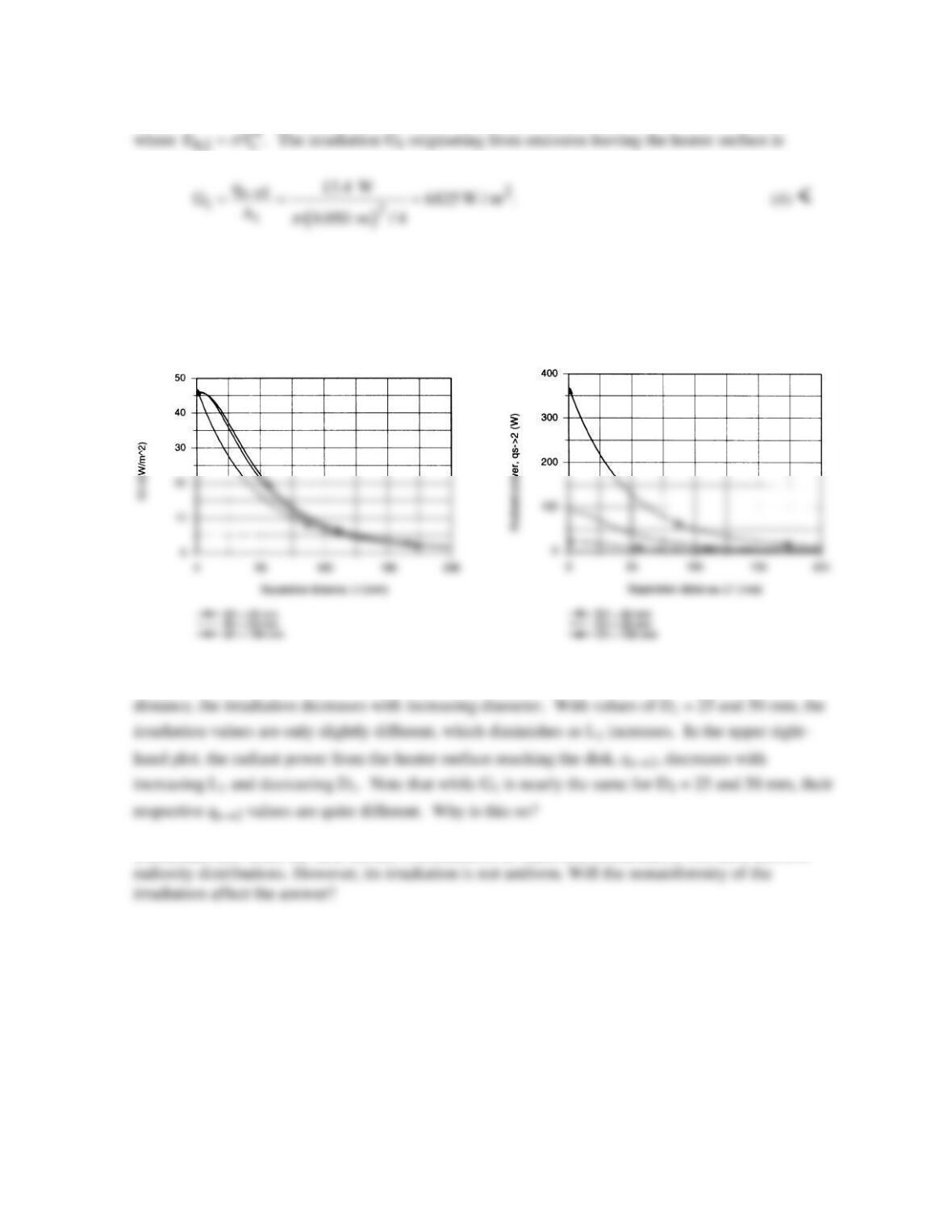
(b) Using the foregoing equations in IHT along with the Radiation Tool-View Factors for Coaxial
Parallel Disks, G1 and qs→1 were computed as a function of L1 for selected values of D1. The results
are plotted below.
In the upper left-hand plot, G1 decreases with increasing separation distance. For a given separation
COMMENTS: Since the tube surface is assumed to be black and isothermal, it will have uniform
PROBLEM 13.19
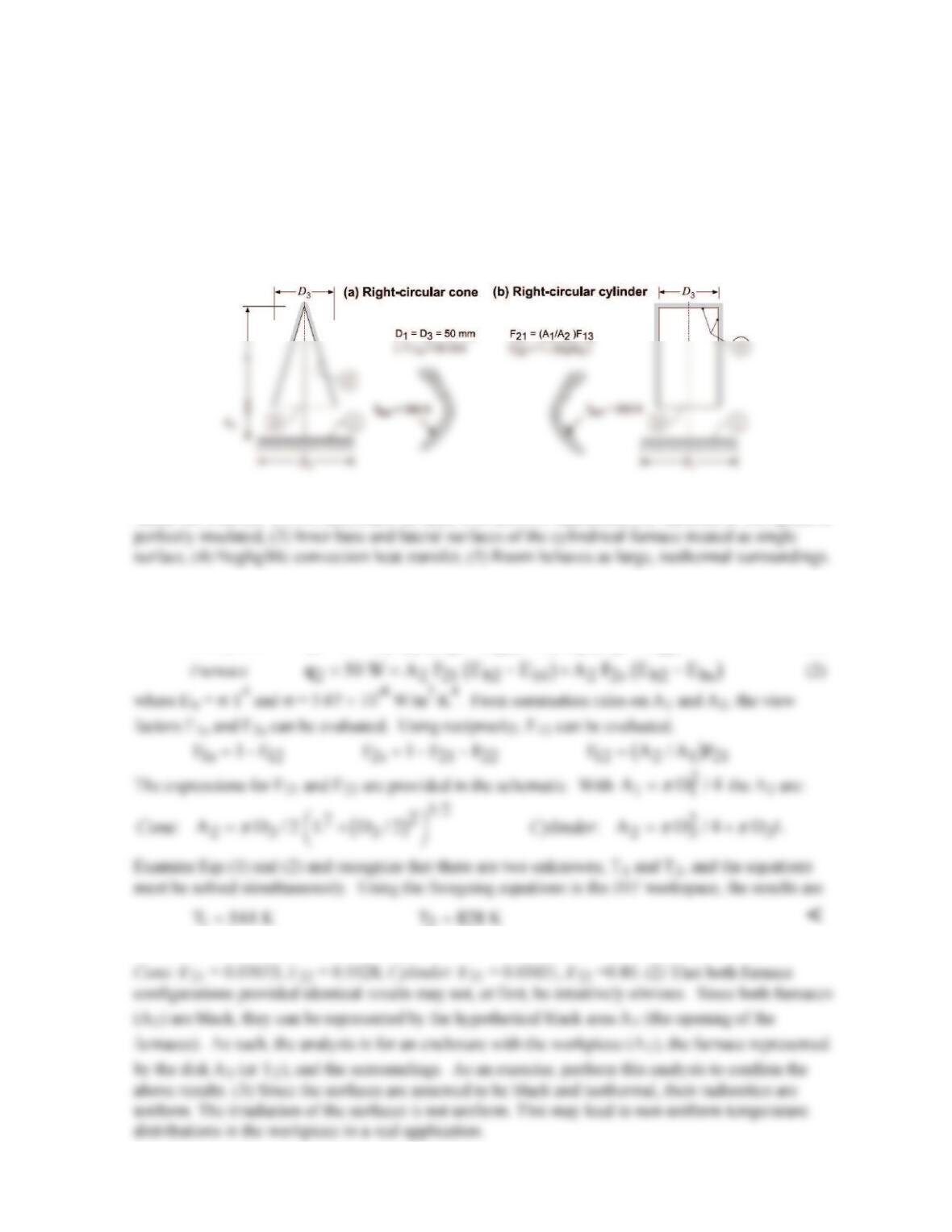
KNOWN: Conical and cylindrical furnaces (A2) as illustrated and dimensioned in Problem 13.4
supplied with power of 50 W. Workpiece (A1) with insulated backside located in large room at 300
K.
FIND: Temperature of the workpiece, T1, and the temperature of the inner surfaces of the furnaces,
T2. Use expressions for the view factors F21 and F22 given in the statement for Problem 13.4.
SCHEMATIC:
ASSUMPTIONS: (1) Diffuse, black surfaces with uniform radiosities, (2) Backside of workpiece is
ANALYSIS: Considering the furnace surface (A2), the workpiece (A1) and the surroundings (As) as
an enclosure, the net radiation transfer from A1 and A2 follows from Eq. 13.13,
Workpiece
q A F E E A F E E
1 1 12 b1 b2 1 1s b1 bs
= = − + −0
bgbg
(1)
1 2
COMMENTS: (1) From the IHT analysis, the relevant view factors are: F12 = 0.1716; F1s = 0.8284;
PROBLEM 13.20
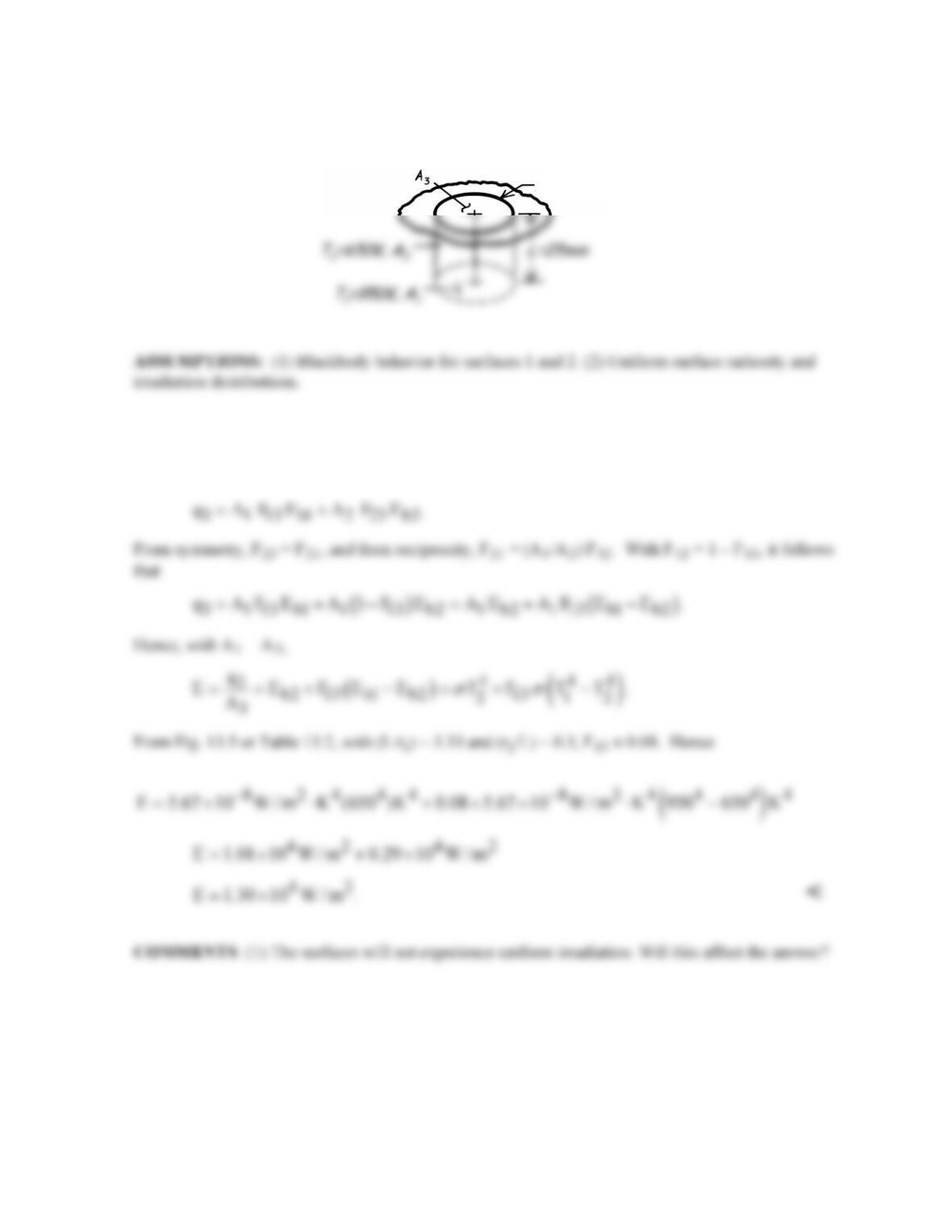
KNOWN: Dimensions and temperature of a rectangular fin array radiating to deep space.
FIND: Expression for rate of radiation transfer per unit length from a unit section of the array.
SCHEMATIC:
ASSUMPTIONS: (1) Surfaces may be approximated as blackbodies, (2) Surfaces are isothermal, (3)
ANALYSIS: Deep space may be represented by the hypothetical surface
3
A,
′
which acts as a
COMMENTS: (1) The foregoing result should come as no surprise since the surfaces of the unit
section form an isothermal blackbody cavity for which emission is proportional to the area of the
PROBLEM 13.21
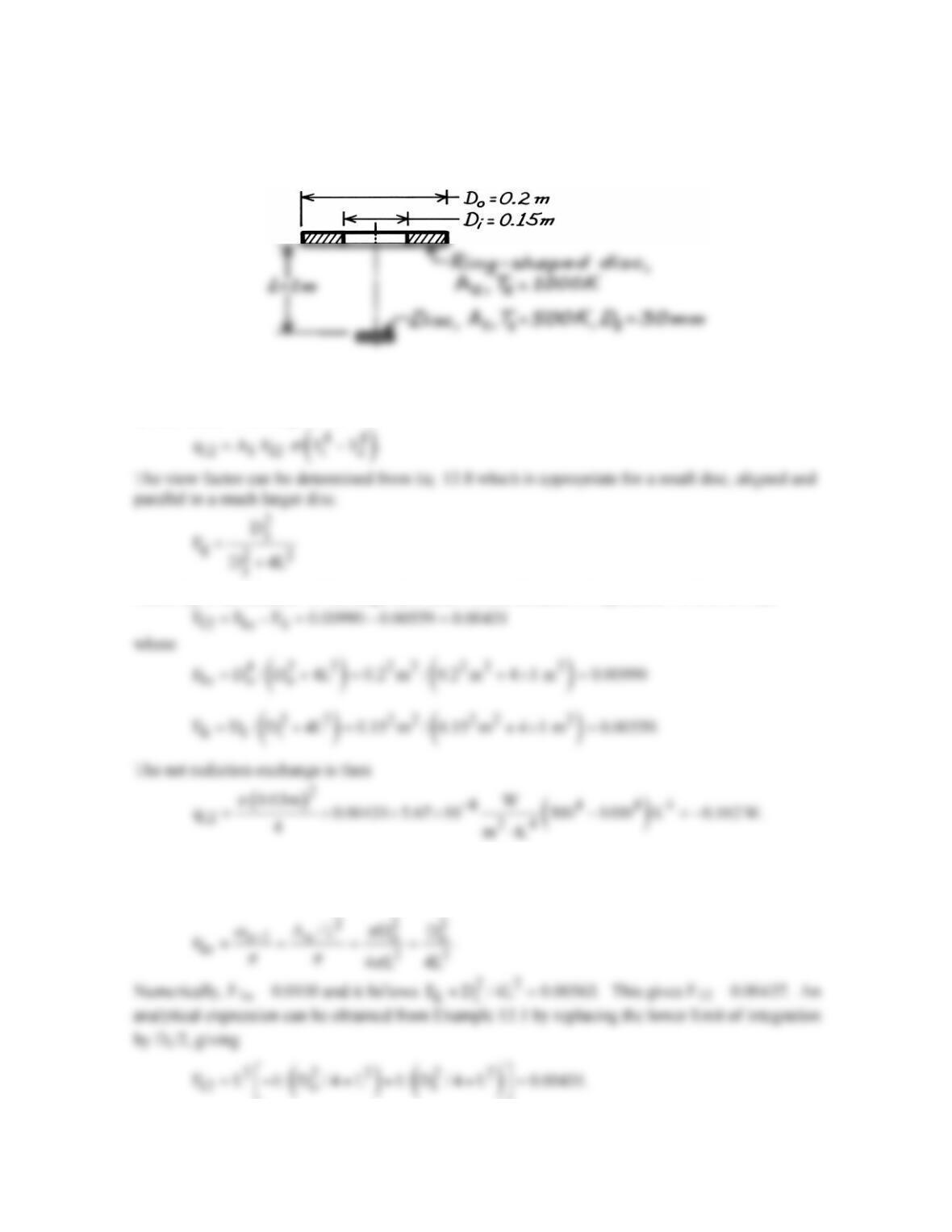
KNOWN: Dimensions and temperatures of side and bottom walls in a cylindrical cavity.
FIND: Emissive power of the cavity.
SCHEMATIC:
ANALYSIS: The emissive power is defined as
33
E q /A=
where
D=15mm
PROBLEM 13.22
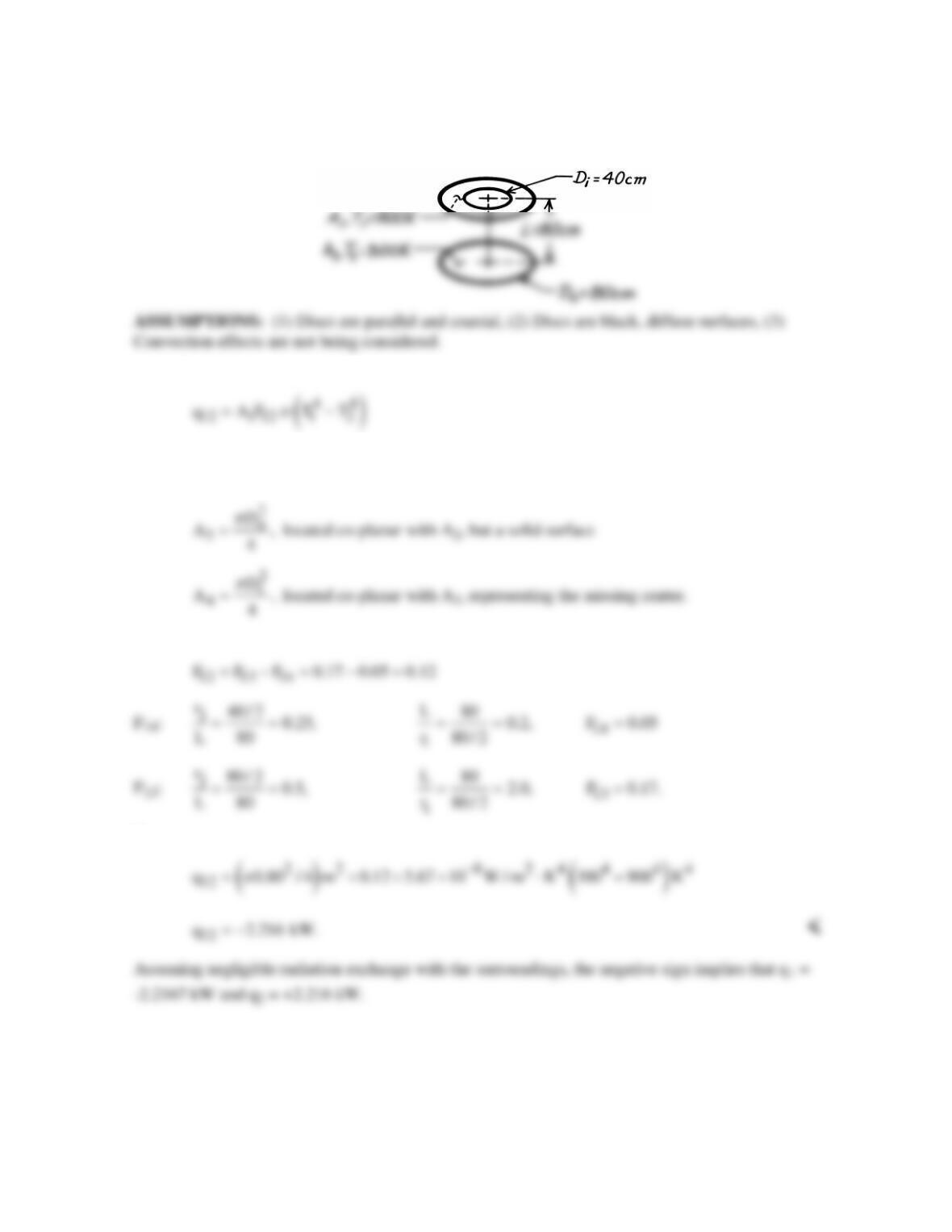
KNOWN: Aligned, parallel discs with prescribed geometry and orientation.
FIND: Net radiative heat exchange between the discs.
SCHEMATIC:
ASSUMPTIONS: (1) Surfaces behave as blackbodies, (2) A1 << A2.
ANALYSIS: From Eq. 13.13
where Dj is the diameter of the larger disk and L is the distance of separation. It follows that
COMMENTS: F12 can be approximated using solid angle concepts if Do << L. That is, the view
factor for A1 to Ao (whose diameter is Do) is
PROBLEM 13.23
KNOWN: Two black, plane discs, one being solid, the other ring-shaped.
FIND: Net radiative heat exchange between the two surfaces.
SCHEMATIC:
ANALYSIS: From Eq. 13.13
The view factor F12 can be determined from Fig. 13.5 after some manipulation. Define these two
hypothetical surfaces;
From view factor relations and Fig. 13.5, it follows that
Hence
PROBLEM 13.24
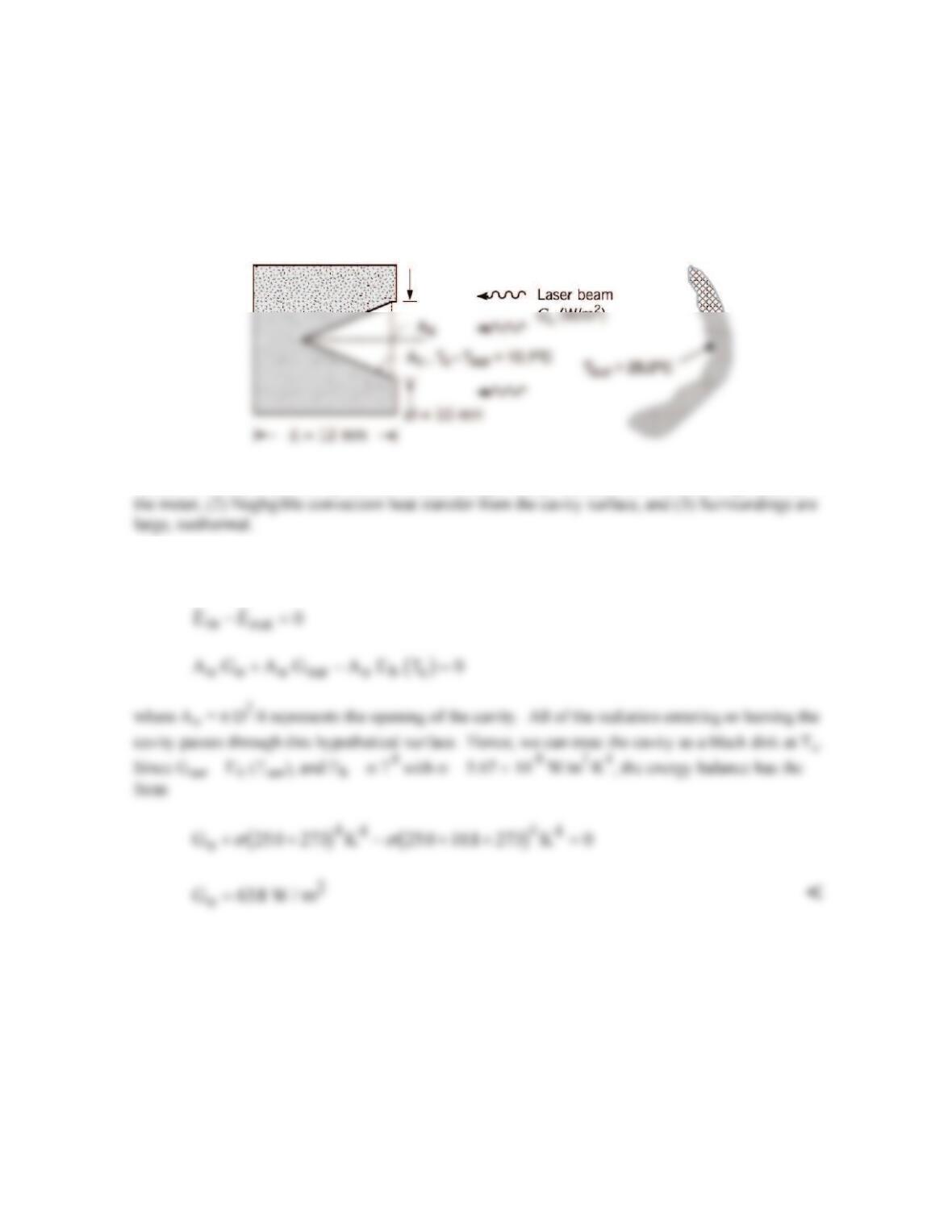
KNOWN: Thin-walled, black conical cavity with opening D = 10 mm and depth of L = 12 mm that
is well insulated from its surroundings. Temperature of meter housing and surroundings is 25.0°C.
FIND: Radiant flux of laser beam, Go (W/m2), incident on the cavity when the fine-wire
thermocouple indicates a temperature rise of 10.1°C.
SCHEMATIC:
ASSUMPTIONS: (1) Cavity surface is black and perfectly insulated from its mounting material in
ANALYSIS: Perform an energy balance on the walls of the cavity considering absorption of the
laser irradiation, absorption from the surroundings and emission.
PROBLEM 13.25
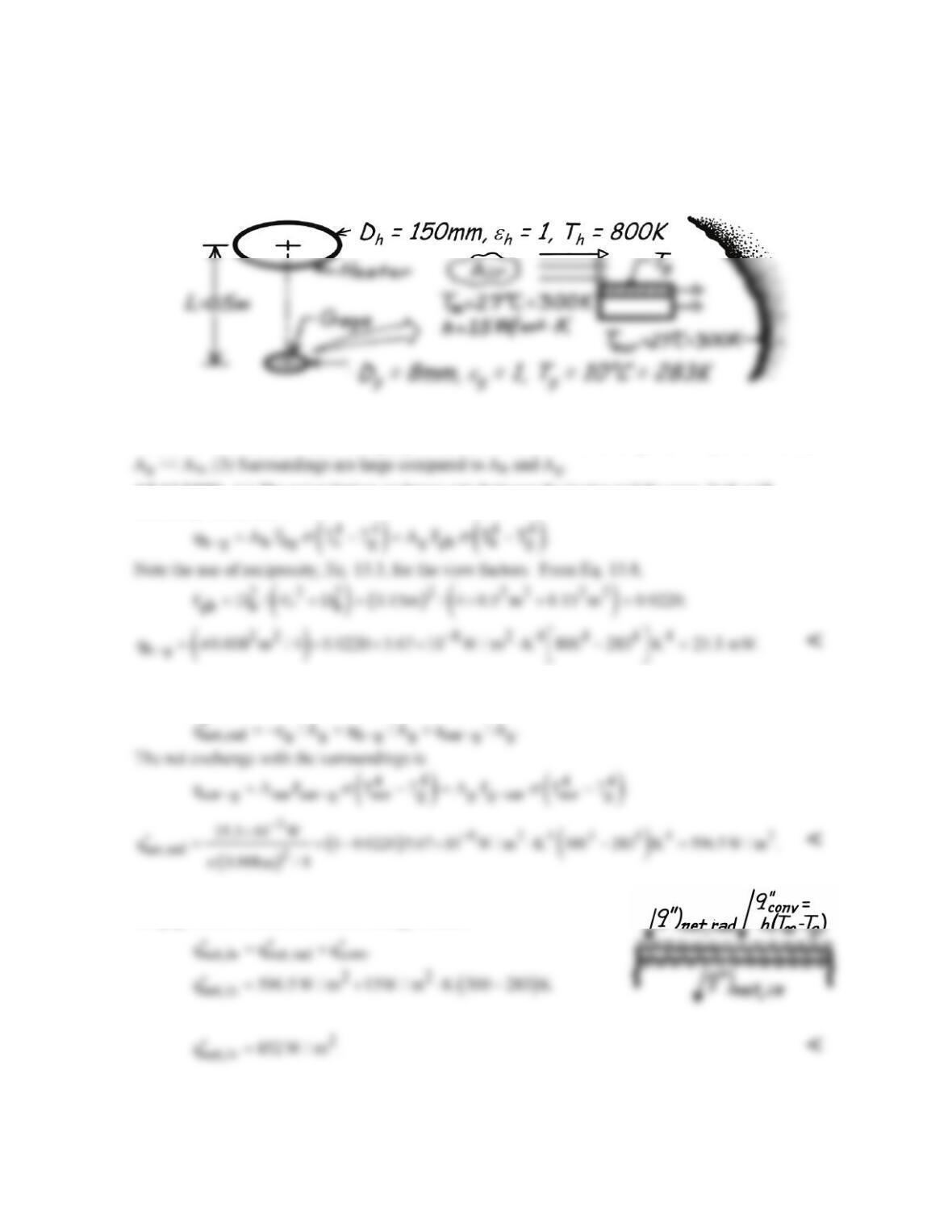
KNOWN: Water-cooled heat flux gage exposed to radiant source, convection process and
surroundings.
FIND: (a) Net radiation exchange rate between heater and gage, (b) Net rate of transfer of radiation
to the gauge per unit area of the gage, (c) Net rate of heat transfer to the gage per unit area of gage.
SCHEMATIC:
ASSUMPTIONS: (1) Heater and gauge are parallel, coaxial discs having blackbody behavior, (2)
ANALYSIS: (a) The net radiation exchange rate between the heater and the gage, both with
blackbody behavior, is
(b) The net radiation heat flux to the gage per unit area will involve exchange with the heater and the
surroundings.
(c) The net heat transfer rate to the gage per unit area of
the gage follows from the surface energy balance
PROBLEM 13.26
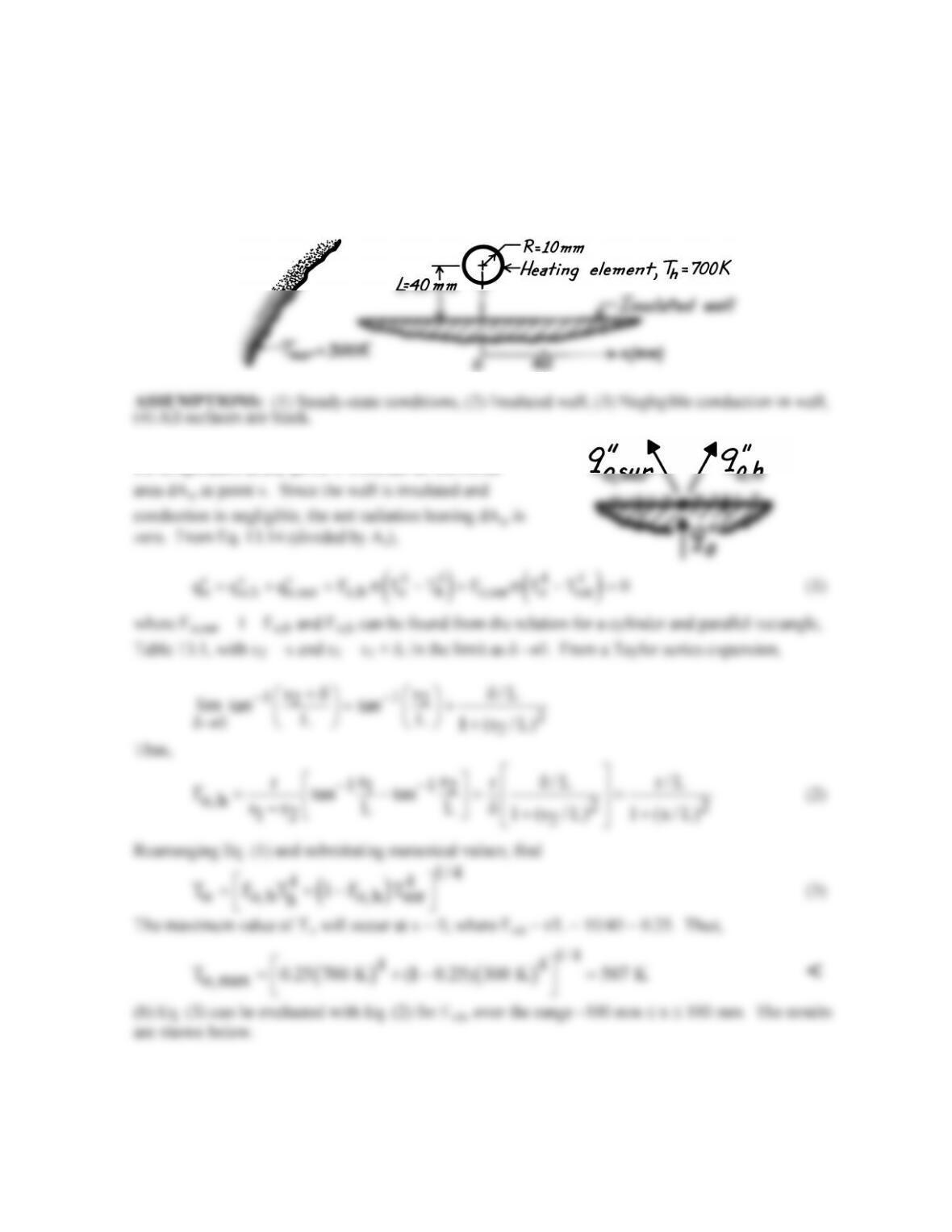
KNOWN: Long cylindrical heating element located a given distance above an insulated wall
exposed to cool surroundings. Diameter and temperature of heating element. Surroundings
temperature.
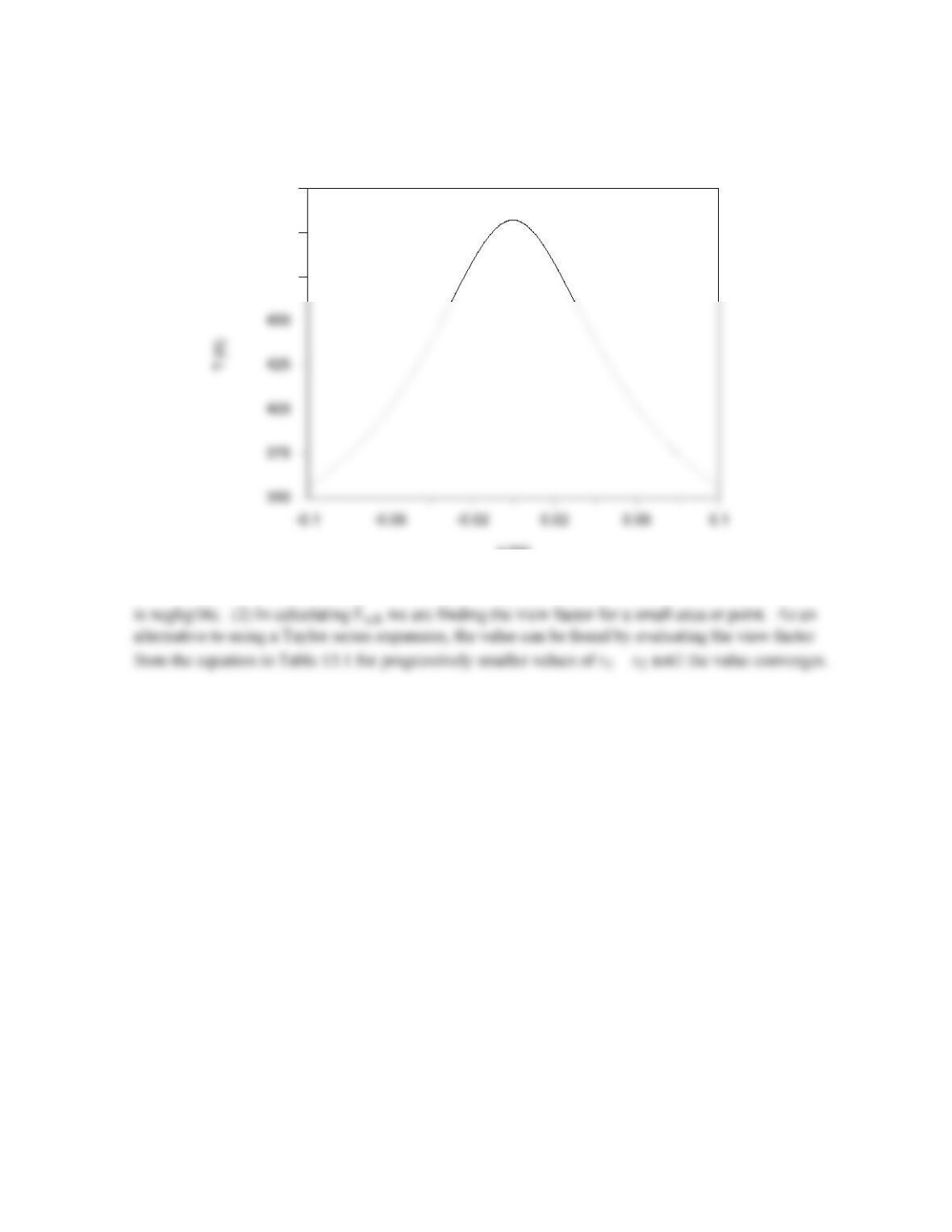
FIND: (a) Maximum temperature attained by wall. (b) Plot the wall temperature over the range –100
mm ≤ x ≤ 100 mm.
SCHEMATIC:
ANALYSIS: (a) We begin with a general analysis for
the temperature at any point x. Consider an elemental
Continued…
PROBLEM 13.26 (Cont.)
Surface Temperature vs. Horizontal Distance
x (m)
475
500
525
COMMENTS: (1) Note the importance of the assumptions that the wall is insulated and conduction
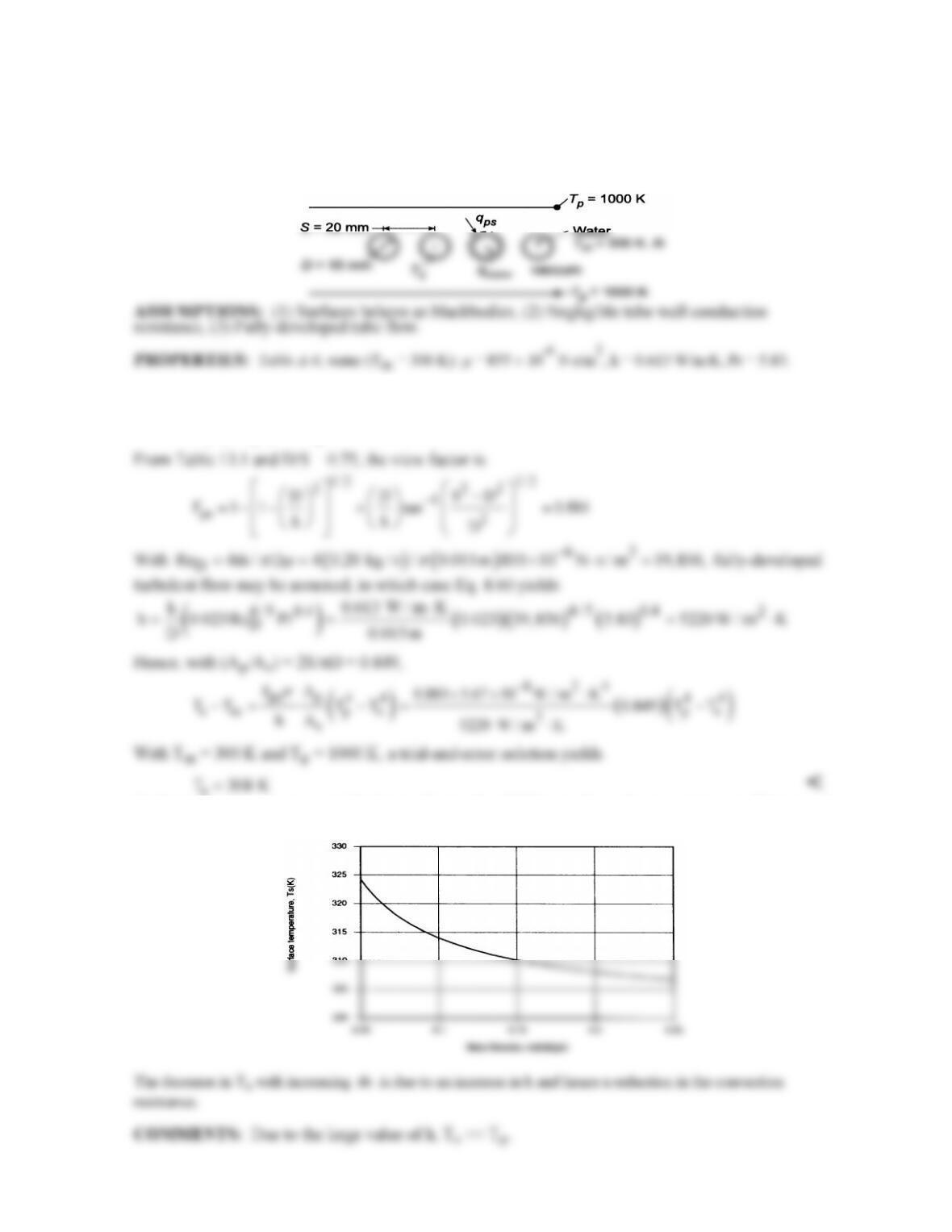
PROBLEM 13.27
KNOWN: Diameter and pitch of in-line tubes occupying evacuated space between parallel plates of
prescribed temperature. Temperature and flowrate
m
of water through the tubes.
FIND: (a) Tube surface temperature Ts for
m
= 0.20 kg/s, (b) Effect of
m
on Ts.
SCHEMATIC:
ANALYSIS: (a) Performing an energy balance on a single tube, it follows that qps = qconv, or
()
( )
44
p ps p s s s m
A F T T hA T T
σ
−= −
s
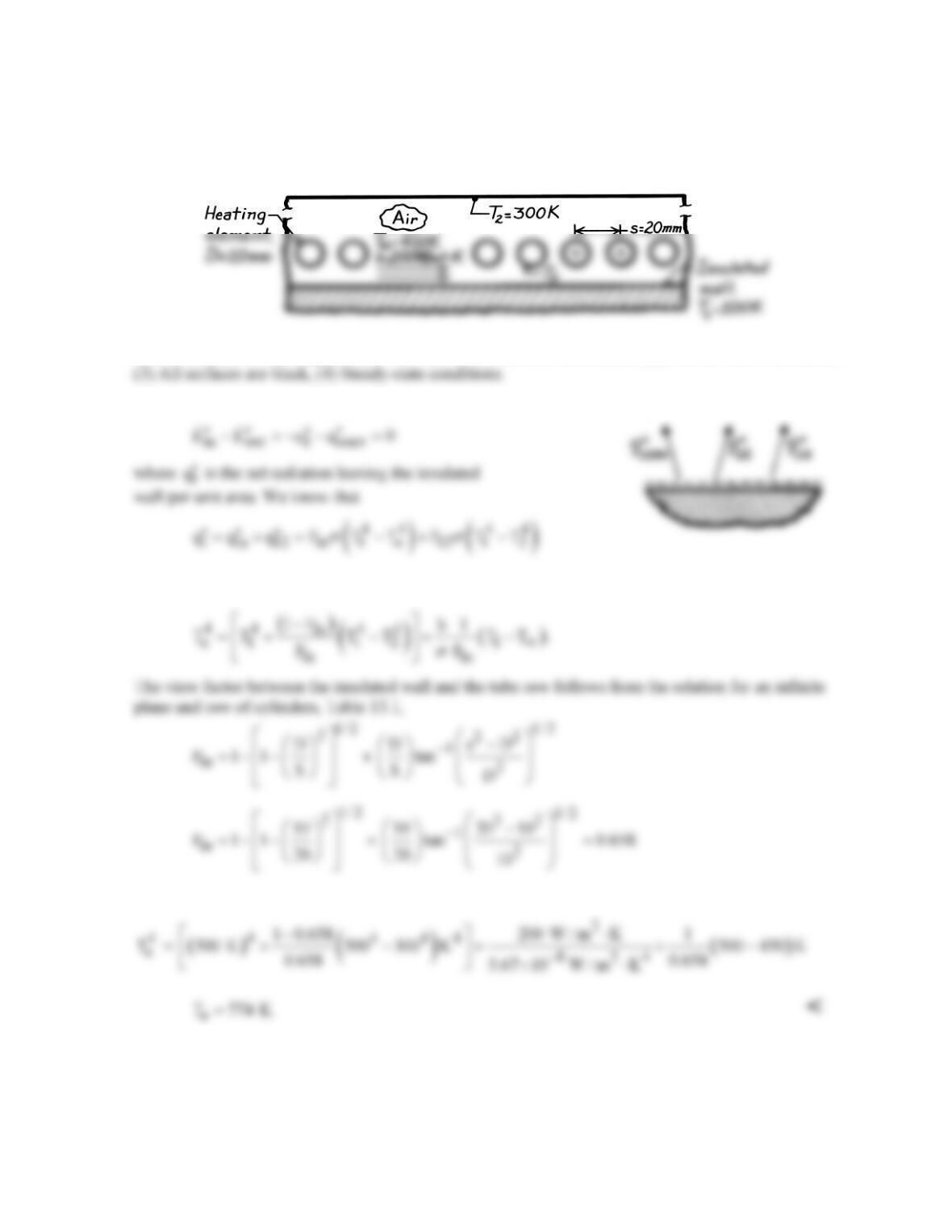
(b) Using the Correlations and Radiation Toolpads of IHT to evaluate the convection coefficient and
view factor, respectively, the following results were obtained.
PROBLEM 13.28
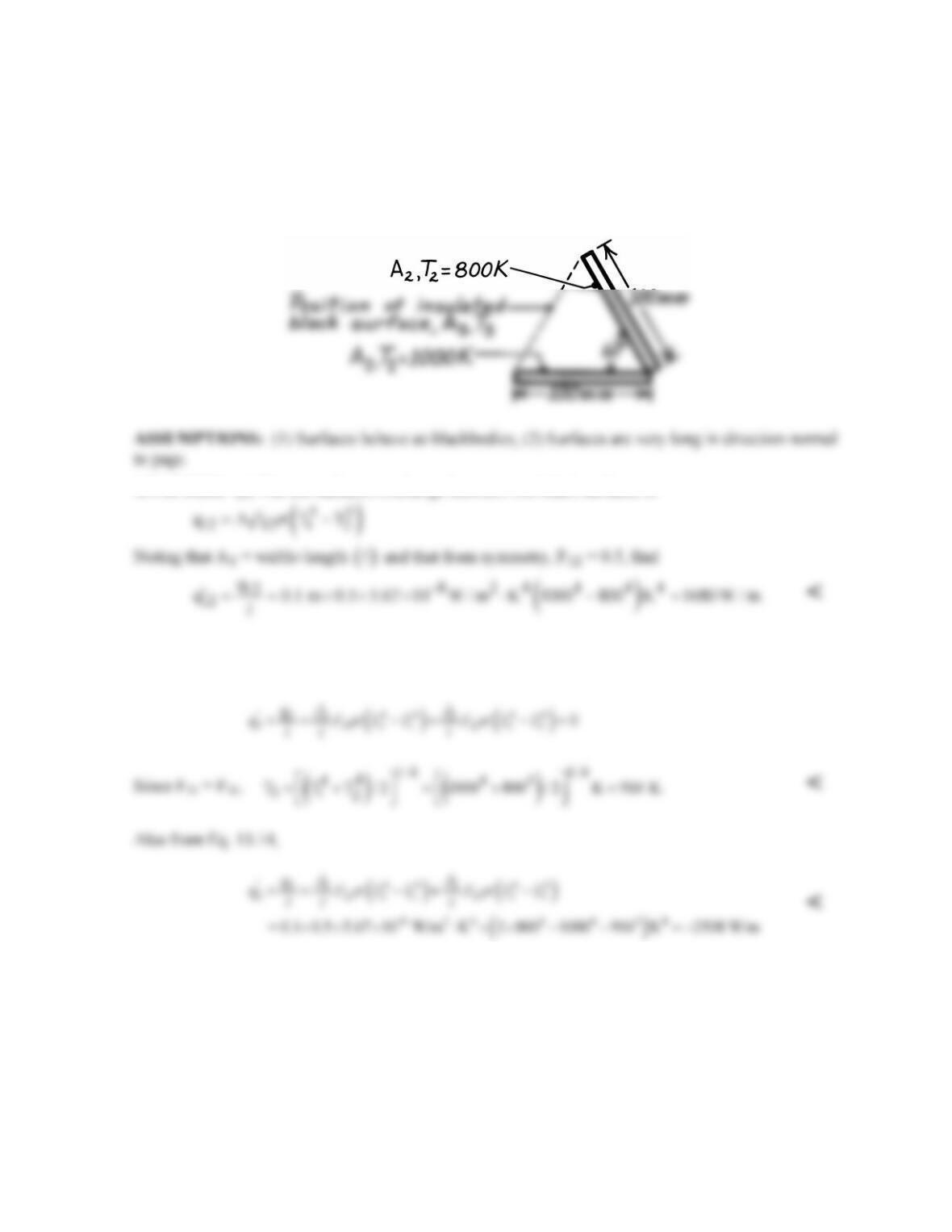
KNOWN: Insulated wall exposed to a row of regularly spaced cylindrical heating elements.
FIND: Required operating temperature of the heating elements for the prescribed conditions.
SCHEMATIC:
ASSUMPTIONS: (1) Upper and lower walls are isothermal and infinite, (2) Lower wall is insulated,
ANALYSIS: Perform an energy balance on the insulated wall considering convection and radiation.
where F12 = 1 – F1e. Using Newton’s law of cooling for
conv
q′′
solve for Te,
Substituting numerical values, find
COMMENTS: Always express temperatures in kelvins when considering convection and radiation
terms in an energy balance. Why is F1e independent of the distance between the row of tubes and the
wall?
PROBLEM 13.29
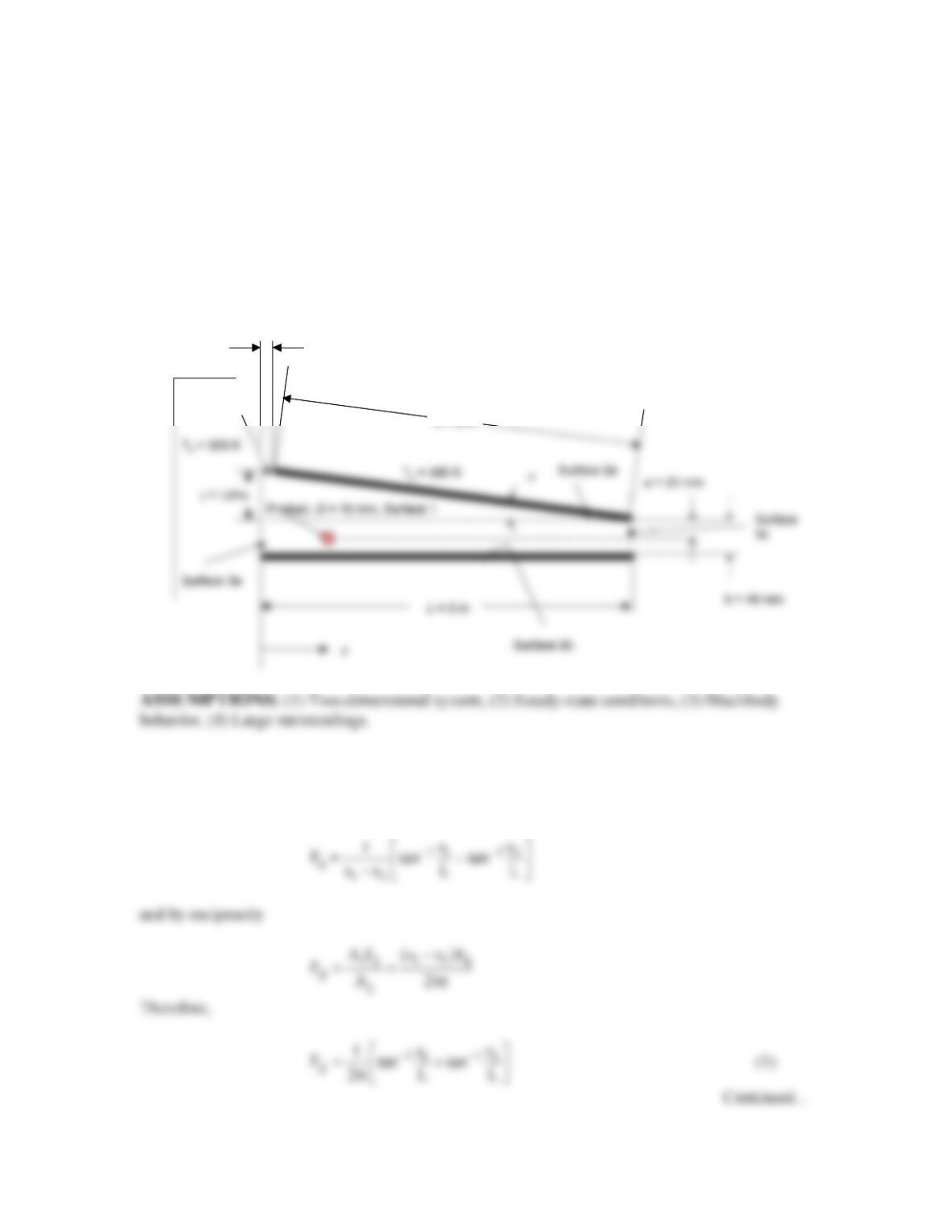
KNOWN: Long, inclined black surfaces maintained at prescribed temperatures.
FIND: (a) Net radiation exchange between the two surfaces per unit length, (b) Net radiation transfer
to surface A2 with black, insulated surface positioned as shown below; determine temperature of this
surface.
SCHEMATIC:
ANALYSIS: (a) The net radiation exchange between two black surfaces is
(b) From Eq. 13.14,
PROBLEM 13.30
KNOWN: Position of long cylindrical-shaped product conveyed in an oven with non-uniform
wall temperatures. Product diameter, temperature of surroundings and panel heaters.
FIND: (a) Radiation incident upon the product, per unit length at product locations x = 0.5 m
and x = 1.0 m for α = 0, (b) Radiation incident upon the product, per unit length, at product
locations of x = 0.5 m and x = 1.0 m for α = π/15.
SCHEMATIC:
ANALYSIS:
Consider the cylinder and parallel rectangle arrangement of Table 13.1. We note that
L= 2 m
Surface 3b
b= L(1–cosα)
Surface 3b
b= L(1–cosα)