177
IV. Activities
the focus should remain on delivering a full state budget rather than a temporary
fix. “If we do a stopgap, then that minimizes the pressure, if you will, of having to
make the hard decisions to redirect this ship known as Pennsylvania to go in the
June 30. The two sides have been negotiating since then but both have said an
agreement is still far away.
The plan advanced by Senate leaders Wednesday uses that vetoed
spending plan as its starting point, and would provide about $11 billion—or
approximately four months—of funds. “Let’s get this money out to the schools,
C: NEW YORK COMPTROLLER CLASHES
WITH MAYOR DE BLASIO OVER
SHELTER CONTRACTS
Nikita Stewart, New York Times , September 11, 2015
The office of Mayor Bill de Blasio said the city comptroller, Scott M. Stringer, had
exceeded his authority by holding up shelter payments over what Mr. Stringer
called safety issues.
Millions of dollars in payments to dozens of nonprofits that shelter homeless
people in New York are being held up by the city comptroller, who said the city
178 Public Financial Management
CHAPTER 13
The rejections alone affect nonprofits providing 1,923 beds for single adults
and another 875 units that house families, according to estimates from city
officials.
The contract rejections are the latest source of friction between the de Blasio
administration and Mr. Stringer, who has criticized the city in audits, and has
drawn attention for independently reachingfinancial settlementswith people
wrongfully convicted of crimes and the families of victims of abuse in the criminal
justice system.
“The bottom line is I am not approving contracts that place families in rat-
infested hovels or fire violations,” said Mr. Stringer, who, like Mr. de Blasio, is a
So far, the nonprofits have not closed their doors; they believe the city will
eventually pay them, and the city has temporarily issued bridge loans in lieu of
payments. The city has issued about $14 million in such loans to homeless service
providers, according to the Mayor’s Office of Contract Services.
On Thursday, city officials did not have a specific amount of money that was
owed to vendors, but it is in the tens of millions—a debt that has come under
closer scrutiny as Mr. de Blasiois under increasing pressure to shelter homeless
people.
Shelters are being forced to make choices between filling vacancies and
“We rely on our contracts to do this work,” Mr. Apple said in a statement,
“and the fact is that tens of millions in city funding is not available to us, limiting
our ability to provide these critical services.”
Providers, particularly nonprofits running shelters, said they were reluctant
to expand services or add beds, as needed by the city, because of the nonpayment.
Anthony E. Shorris, the first deputy mayor, and Gilbert Taylor, the
commissioner of homeless services, said they were indebted to the nonprofits for
179
IV. Activities
Mr. Stringer said he was not impeding services to the homeless; he was just
trying to ensure that facilities are safe. Though more than 50 contracts have not
been registered, his office has approved 176 contracts to shelter providers in the
past 20 months. He pointed to his cooperation in other ways, like approving
threeemergency requests in Augustfor about $57 million to provide 1,421 beds
for single adults and another 780 units for families with children. That emergency
process bypasses monthslong procedures to free up money to negotiate contracts.
But Mr. Stringer said his office would not approve the registration of
He said the city put itself in this position when the Department of
Investigation, led by Mark Peters, a commissioner Mr. de Blasio appointed,
releaseda scathing report in Marchon filthy and unsafe conditions in shelters
and what are known as cluster sites.
“It wasn’t my report,” Mr. Stringer said. “We have looked at these shelters
through the lens of the report.”
The report reviewed 25 sites and issued 621 health and safety violations,
such as mice and rat infestations and a rusted staircase that could create a
dangerous situation should people need to evacuate the building. According to the
report, the Department of Homeless Services should have developed mechanisms,
like withholding payments, to get vendors in compliance.
That is where Mr. Stringer has stepped in. “I think it’s fair to say that this
administration does not get the details,” he said. “Having us take an extra look is
probably in the interest of New York City.”
Mr. Shorris said, “This is the same drama played out on a different stage.”
“He’s perfectly entitled to have his own opinion on all these matters,”
180 Public Financial Management
CHAPTER 13
D: THREE ARTICLES
Article 1: When Citizens Decide How Public
Money Is Spent
John M. Kamensky, Governing , September 15, 2014
A few American communities are experimenting with participatory budgeting
at the neighborhood level. Their experiences can help guide others interested in
giving the idea a try.
John M. Kamensky is a senior fellow with the IBM Center for the Business of
Government.
Inspired by successful efforts in Brazil and other countries, several American
communities have undertaken pilot efforts to allow citizens to directly decide
IBM Center for the Business of Government.
The report’s author, Dr. Victoria Gordon of Western Kentucky University,
interviewed organizers of and participants in participatory-budgeting initiatives
in Boston, Chicago and St. Louis, as well as leaders of nonprofit advocacy groups
such as the Participatory Budgeting Project. She offers some insights and actions
that community leaders might take if they want to bring participatory budgeting
to their own communities.
Originally developed more than two decades ago in Porto Alegre, Brazil, this
approach to community-building has been replicated in more than a thousand
A lot of the residents of Chicago’s 49th Ward would be likely to agree with
Bunting. The ward, with a highly diverse population of about 57,000, is believed
to be the first political jurisdiction in the US to adopt participatory budgeting.
Alderman Joe Moore, who allows residents’ votes to decide how to spend his
entire discretionary capital-improvements budget of $1.3 million, says he decided
181
IV. Activities
Governing ’s Tod Newcombe examined the Chicago initiative a couple of
years ago: “Not surprisingly,” he wrote, residents first used the capital funds
“to repair the sidewalks, and then they used what was left over to install new
streetlights, community gardens and some public murals.”
The springtime voting attracts an ever-increasing number of citizens, from
Gordon has some recommendations for community leaders who want to
promote effective participatory budgeting:
First, she writes, they should establish policies and infrastructure for
communications, building on “existing and active social media platforms that
citizens in the community are currently using” as a way to increase citizen
participation. She emphasizes, however, that social media should not be the
primary emphasis but rather should complement other forms of communication.
And she recommends that communities learn from each other. “Communities
The White House not only sponsored a forum this summer to bring
pioneering communities and advocacy groups together, but it sees participatory
budgeting as one way “to solve the problems of our time ... by involving the
American people in shaping the policies that affect their lives.”
Article 2: Introduction to the 49th Ward
Participatory Budgeting Initiative
Project from Alderman Joe Moore, April 2015
Dear Neighbor,
Around the United States and here in Chicago, cityleaders are increasingly asking
residents for suggestions about budget spending. Here in the 49th Ward, we’re
182 Public Financial Management
CHAPTER 13
Each alderman in Chicago gets over $1 million a year to allocate for various
infrastructure improvements in his or her ward. This so-called “menu money”
goes to resurface streets and alleys, repair sidewalks and curbs and gutters, put
in new streetlights, and the like. I’ve also used the money to subsidize special
infrastructure projects, such as the Harold Washington Playlot and the Willye
White Community Center. This menu money is spentat the totaldiscretion of
each alderman.
model.
Participatory budgeting is a process of democratic deliberation and decision-
making in which ordinary residents decide how to allocate part of a municipal
budget. In essence, how it works is that the municipal authorities turn over
a portion of their budget to community residentswho decide the spending
priorities.
Tolearnmore about participatory budgeting and its implementation
worldwide, visit the website of the Particpatory Budgeting Project: http://www.
participatorybudgeting.org
In April 2009, I brought together leaders ofover 50civic, religious and
After several months of meetings, the Steering Committee
developedaprocess and timetable thatculminated in a ward-wideelectionin
April, 2010,when over 1,600 49th Ward residentsvoted on the 49th Ward
infrastructure spending priorities for 2010.
The 2015–16 PB49 processwill begin with a format thattracks closely
183
IV. Activities
Step 1—Neighborhood Assembly Meetings(November,2015)
A series of“neighborhood assemblies” are held throughout the ward, including
aSpanish language assembly. The neighborhood assembliesare open to any
49thWard resident. At eachneighborhood assembly,the attendees will be
Step 2—Community Representative Meetings
(December, 2015–March, 2016)
Thecommunity representativeswill meet to develop proposals for use of the
assembly meetings tosolicit additional suggestions and bounce off ideas.
Step 3—Final Round ofNeighborhood Assembly
Meetings to Present Project Proposals to the
Community (March–April, 2016)
The community representatives will present their preliminaryproposals for the
2016 Aldermanic Menu at two Neighborhood Assemblies held in the north
Step 4—Election to Determine the 2016 Infrastructure
Spending Priorities (April, 2016)
In the final step of the process, community residents willgather at a ward-wide
assembly to deliberate and vote on the 2016 infrastructure spending priorities for
the 49th Ward.
184 Public Financial Management
CHAPTER 13
Article 3. Participatory Budgeting in the 49th Ward
of Chicago
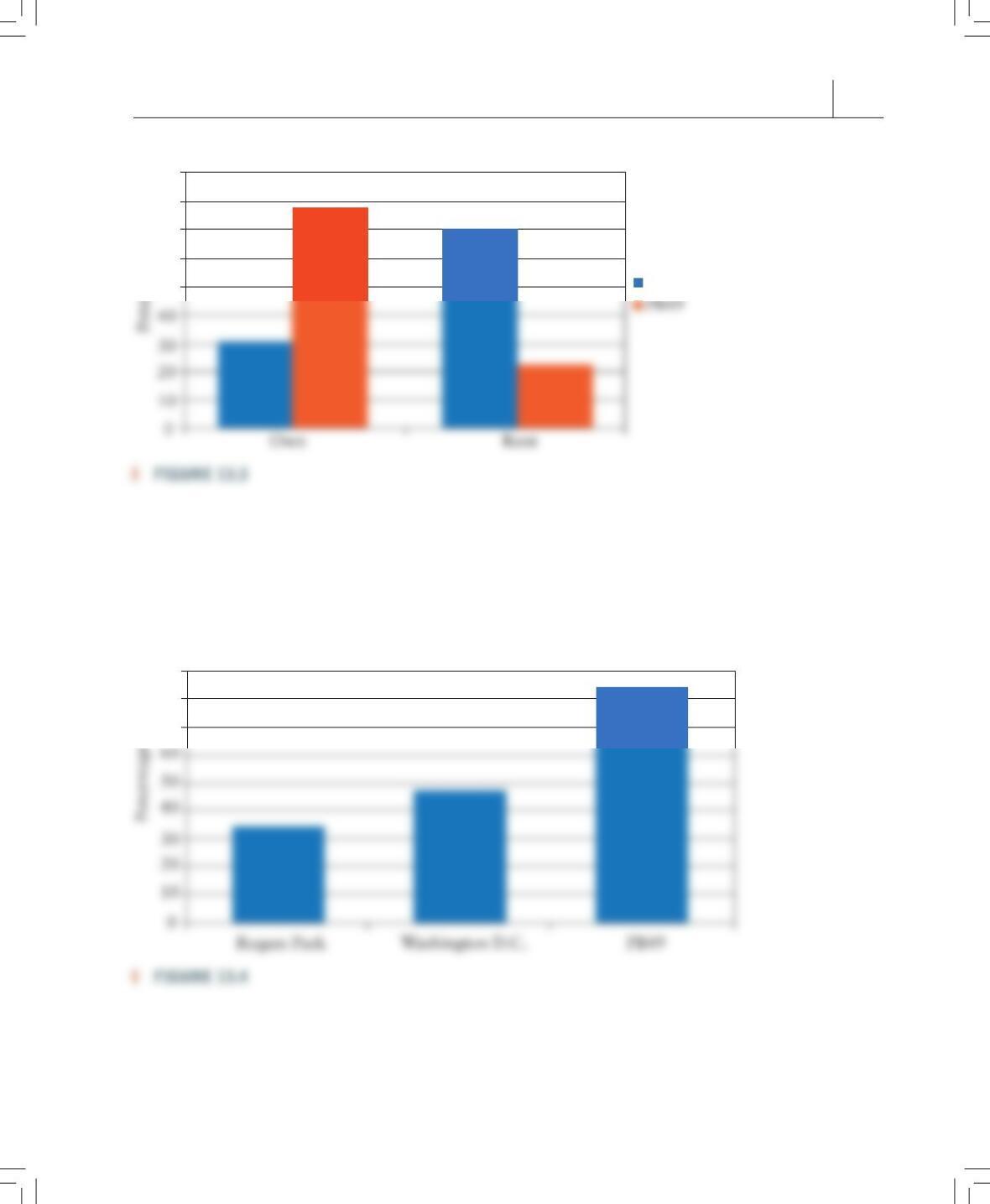
Race
80
70
60
FIGURE 13.2
Our Mission
The first thing one needs to know about Participatory Budgeting in the 49th
Ward is that it’s not participatory. Take a quick look at some basic statistics. In
the 49th Ward:
Q White people make up just 39 percent of the population, but 75 percent of PB
49 voters are white.
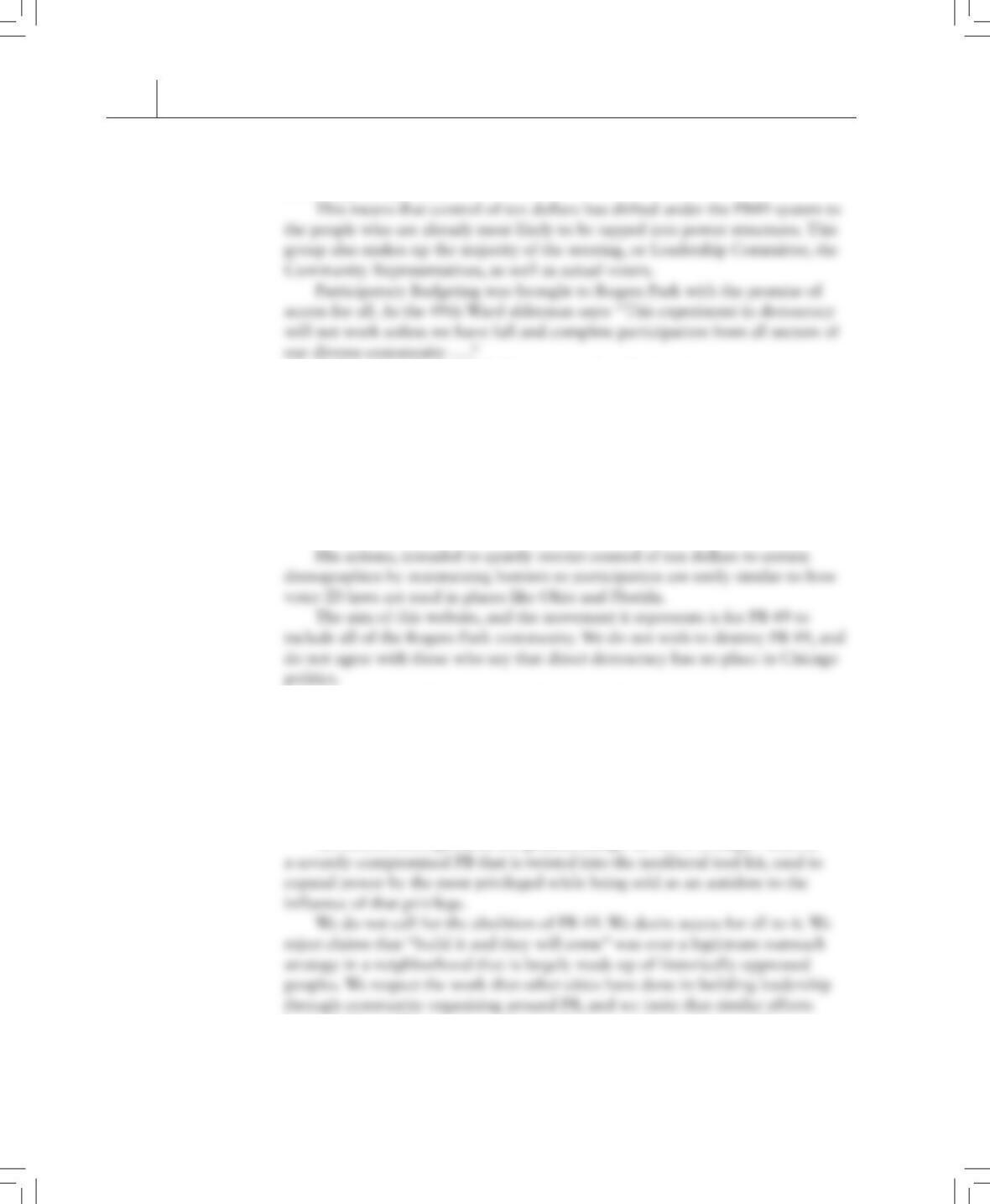
Q 77 percent of PB 49 voters own their homes, but only 30 percent of 49th ward
residents own theirs.
185
IV. Activities
College Educated
80
90
70
Q Almost 83 percent of PB 49 voters have at least a four-year college degree.
No city in America comes anywhere near that rate, which is just 31 percent
nationally.
Home Ownership
Rogers Park
80
90
70
60
50
Participation remains a challenge as well, with 1650 people voting in 2010,
987 in 2011, to 1350 in 2012. Regardless of how many vote, however the
percentages of who votes remains about the same.Last year, rather than change
186 Public Financial Management
CHAPTER 13
the process the alderman’s office stopped surveying early voters so they could
claim the incomplete numbers prove greater diversity, despite previous year’s data
indicating the opposite.
By his own definition, PB 49 is not working. Rather than empower a
neighborhood, foster coalitions, and use public dollars to achieve a shared vision,
PB 49 has transferred control of tax dollars from an official elected by the entire
ward to the most privileged demographic in the community.
This was known three years ago, after the first PB 49 election in 2010. With
funding withheld after that year for real outreach and organizing efforts, future
exclusion of most ward residents was nearly certain. Volunteer efforts to obtain
funds and do outreach to diversify PB were unsupported, and in some cases
deliberately thwarted by the alderman.
Corruption in Chicago is legendary. It has led the nation in foreclosures,
gas prices, bed bug infestations, and homicides. There are active assaults
in place upon public schools and mental health services, both “justified”
by disproven reasoning. Pressure is building, however for real answers to
the challenges this City faces, and PB can either be a path to power for
communities, or used by politicians as a new way to reward those that already
hold the most influence.
We believe this represents the greatest danger to PB in Chicago—that is,
be funded here. We regard any election that is completely dominated by a
constituency that comprises less than 30 percent of our community as deeply
flawed and a call to immediate action.
187
V. Web Based Resources
In its current form, PB 49 is a system of structural oppression. This campaign
goes beyond the politician who built that system. We will follow through on the
promise of a more just people’s budget that is our right through Participatory
Budgeting.
Join us.
V. WEB BASED RESOURCES
Congressional Budget Office (CBO)
www.cbo.gov
The CBO plays a major role in calculating the budgetary and fiscal projections that inform
Federal Reserve System
www.federalreserve.gov
The major organ of monetary policy in the United States maintains a Web site that gives
Government Finance Officers Association (GFOA)
www.gfoa.org
The purpose of GFOA Web site is to promote the professional management of governments
National Association of State Budget Officers (NASBO)
www.nasbo.org
NASBO serves as the professional organization for all state budget officers. The site allows
US Office of Management and Budget
www.whitehouse.gov/omb
For anything you want to find about how the President’s executive budget—this site has the
US census—Government Finance Statistics
https://www.census.gov/govs/
For any data on US federal, state, and local finances, employment, payroll, and even pensions—
188 Public Financial Management
CHAPTER 13
Tax Foundation
www.taxfoundation.org
While the tax foundation has its interests, there’s no denying the quality of their research
Congressional Research Service (CRS)
www.loc.gov/crsinfo/
The gold standard for budgeting studies and more on all issues involving the federal gov-
ernment. This arm of the Library of Congress produces some of the best introductory and
ABFM
abfm.org
While the website is a bit sparse, ABFM publishes the premier general journal in the field