Problem 13-18 (30 minutes)
1. The formula for the project profitability index is:
Net present value
Project profitability index = Investment required
2. a., b., and c.
Project
3. Which ranking is best depends on Yancey Company’s opportunities for
reinvesting funds as they are released from a project. The internal rate
of return method assumes that released funds are reinvested at the
internal rate of return. For example, funds released from project D
would have to be reinvested in another project yielding a rate of return
of 22%. It might be difficult to find another project yielding such a high
rate of return.
Problem 13-19 (30 minutes)
1. The annual net cost savings is computed as follows:
Reduction in labor costs ………………………………..
$240,000
Reduction in material costs …………………………...
Total cost reductions ……………………………………
Less increased maintenance costs ($4,250 × 12) .
Annual net cost savings ………………………………..
2. Using this cost savings figure, and other data provided in the text, the
net present value analysis is:
Year(s)
Amount of
Cash
Flows
18%
Factor
Present
Value of
Cash Flows
Cost of the machine …………
Now
$(900,000)
1.000
$ (900,000)
Installation and software …..
Now
$(650,000)
1.000
(650,000)
Salvage of the old machine ..
Now
$70,000
1.000
70,000
Annual cost savings ………….
4.494
0.191
40,110
Net present value …………….
3. The intangible benefits would have to be worth at least $42,813 per
year as shown below:
Required increase in net present value $192,400
= = $42,813
Factor for 10 years 4.494
Problem 13-20 (30 minutes)
1. The income statement would be:
Sales revenue (72,000 loaves × $1.25 per loaf) …
$90,000
Less cost of ingredients ($90,000 × 40%) ………..
36,000
Contribution margin……………………………………..
54,000
Total selling and administrative expenses ………….
2. The formula for the simple rate of return is:
Annual incremental net operating income
Simple rate of return = Initial investment
3. The formula for the payback period is:
Initial investment
Payback period = Net annual cash inflow
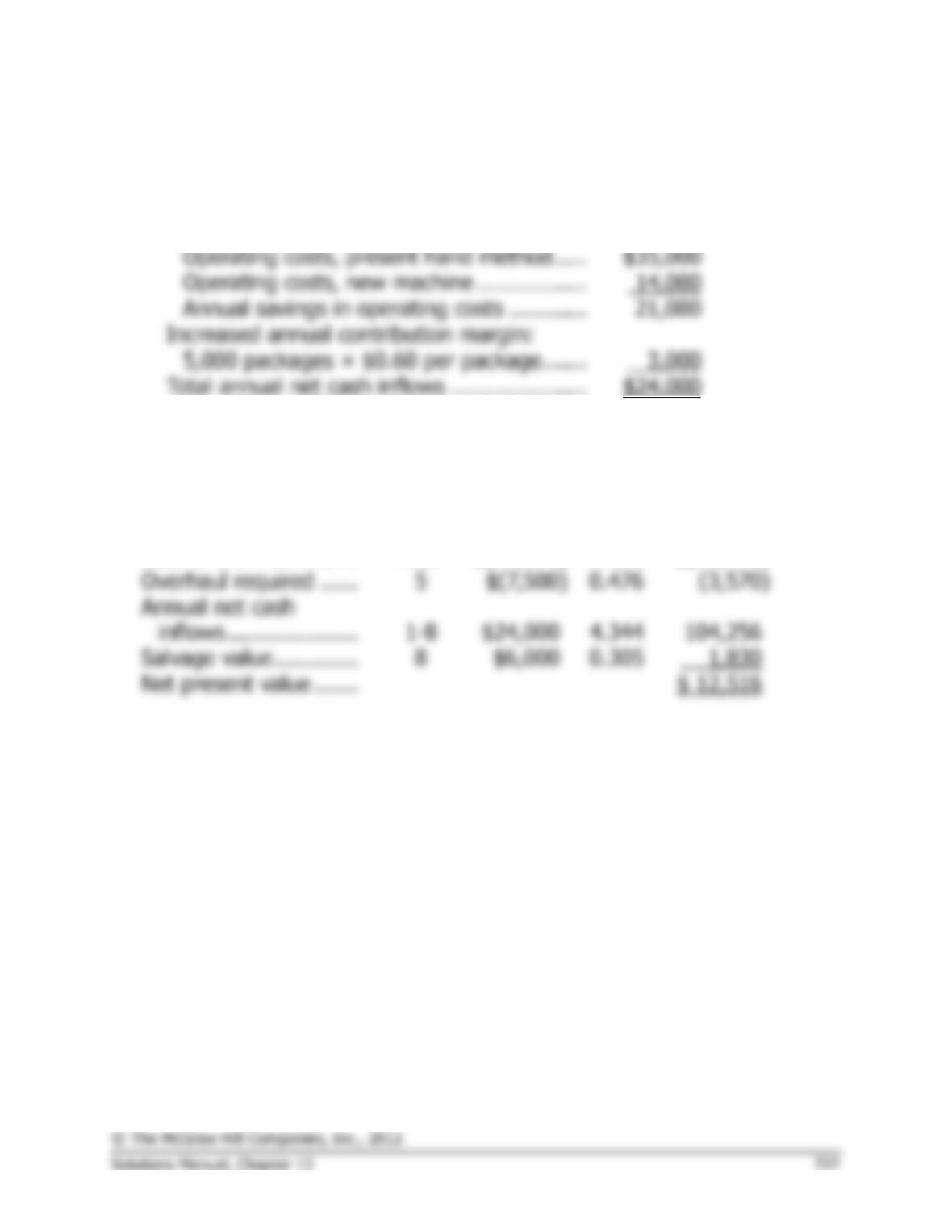
Problem 13-21 (20 minutes)
1. The annual net cash inflows would be:
Reduction in annual operating costs:
$35,000
Total annual net cash inflows …………………
$24,000
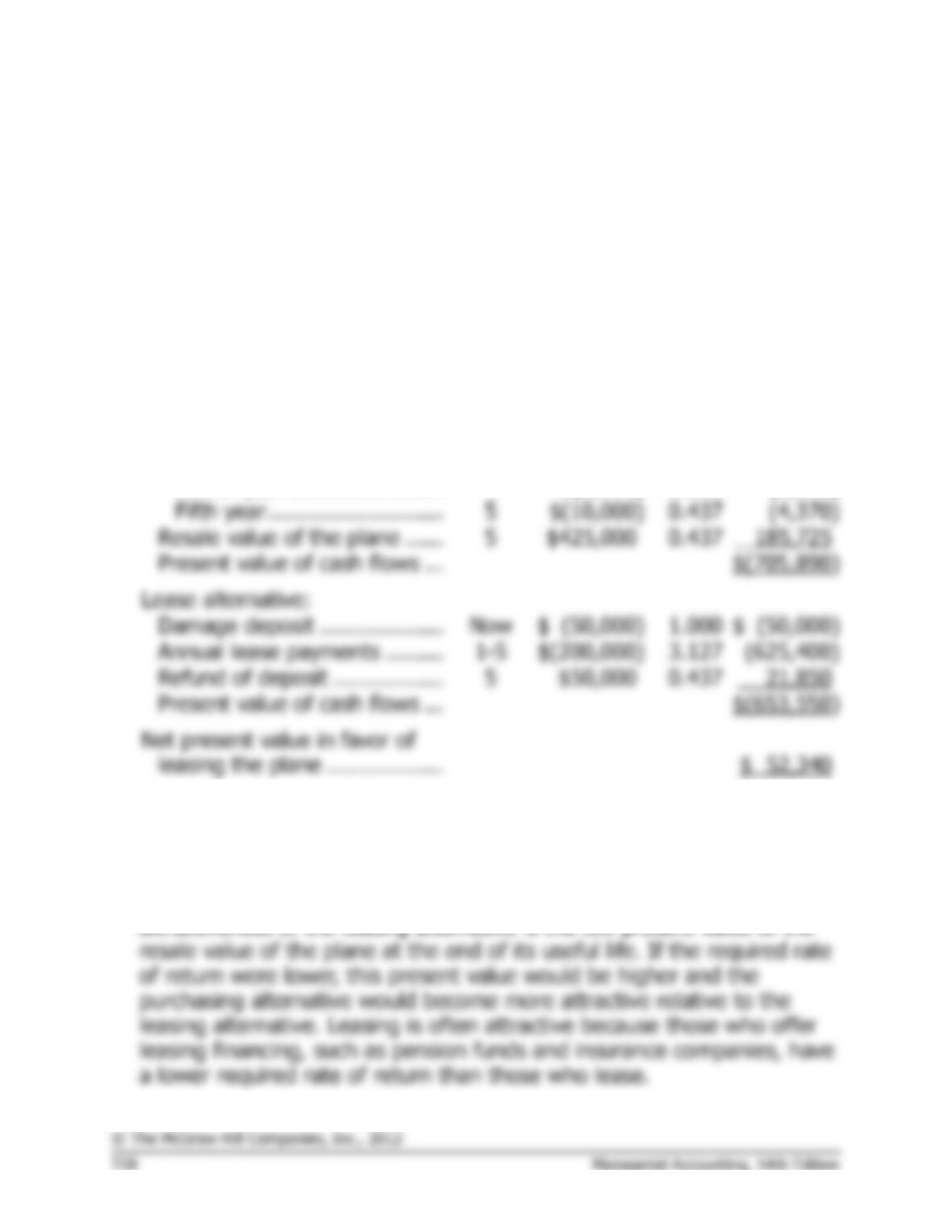
2.
Item
Year(s)
Amount
of Cash
Flows
16%
Factor
Present
Value of
Cash
Flows
Cost of the machine …
Now
$(90,000)
1.000
$(90,000)
Salvage value ………….
0.305
1,830
Net present value …….
Problem 13-22 (30 minutes)
1. The present value of cash flows would be:
Item
Year(s)
Amount
of Cash
Flows
18%
Factor
Present
Value of
Cash
Flows
Purchase alternative:
Purchase cost of the plane ….
Now
$(850,000)
1.000
$(850,000)
Annual cost of servicing, etc. .
1-5
$(9,000)
3.127
(28,143)
Repairs:
First three years ……………..
1-3
$(3,000)
2.174
(6,522)
Fourth year ……………………
4
$(5,000)
0.516
(2,580)
Fifth year ………………………
5
0.437
(4,370)
5
0.437
Present value of cash flows …
Damage deposit ……………….
1.000
1-5
3.127
5
$50,000
0.437
2. The company should accept the leasing alternative. Even though the
total cash flows for leasing exceed the total cash flows for purchasing,
the leasing alternative is attractive because of the company’s high
required rate of return. One of the principal reasons for the
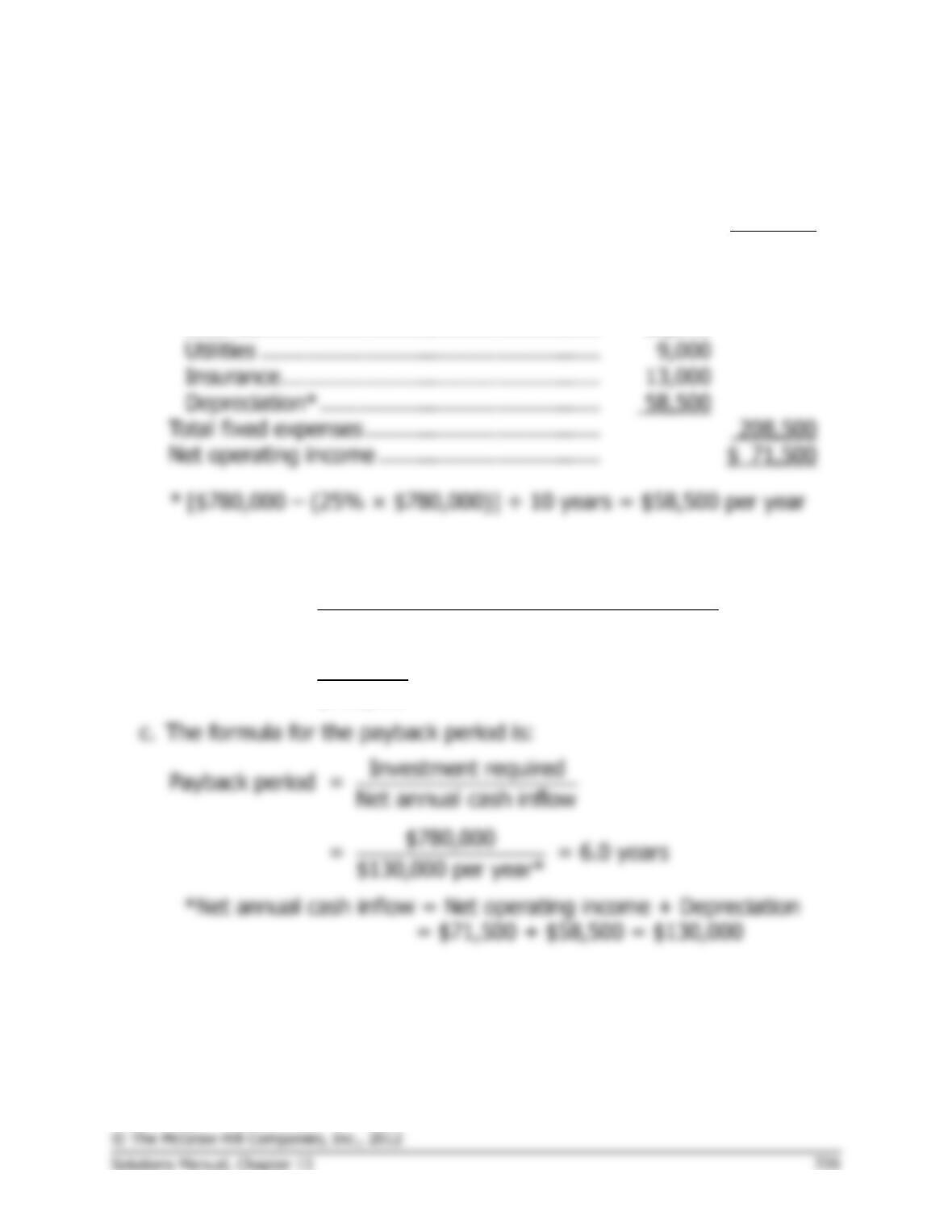
Problem 13-23 (60 minutes)
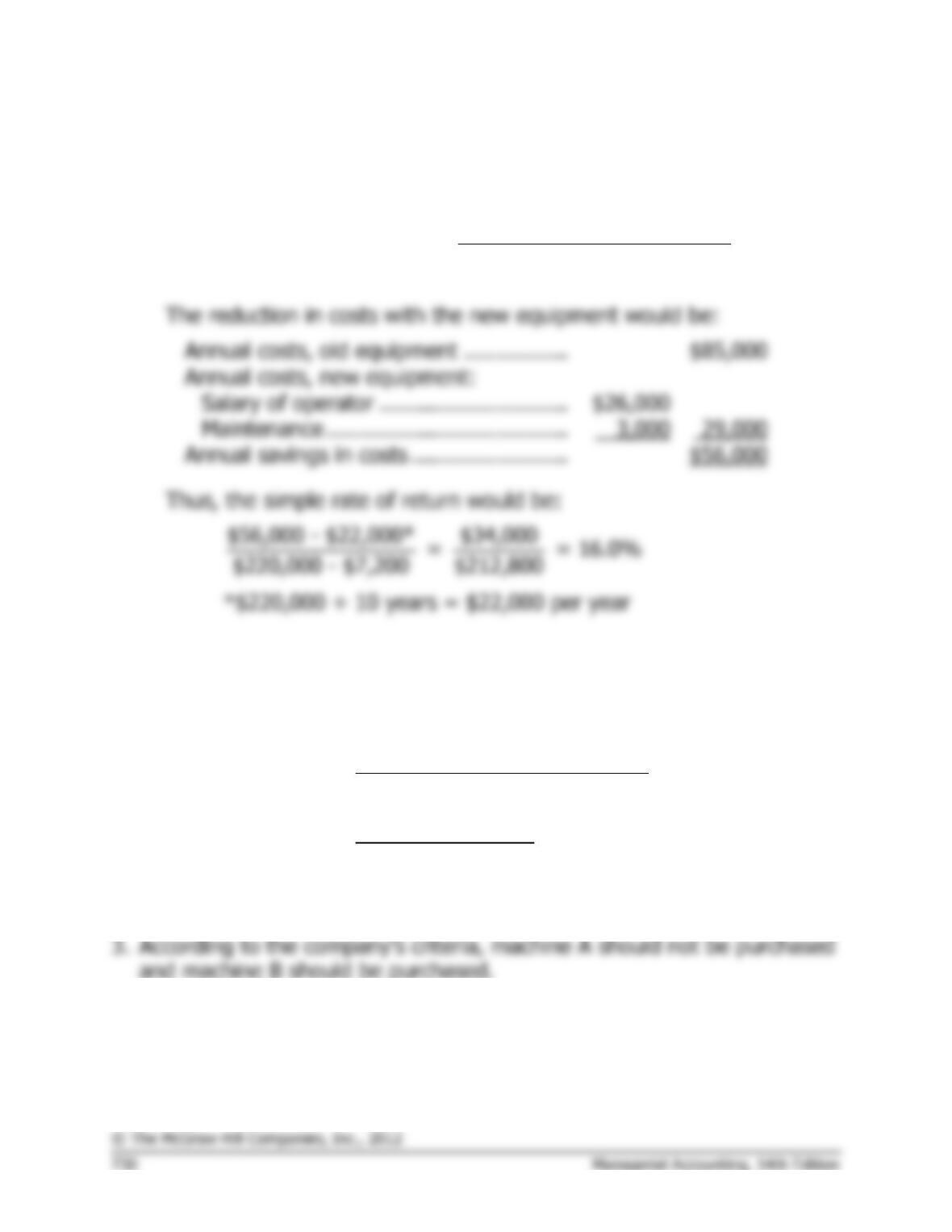
1.
a.
Sales revenue ………………………………………
$350,000
Variable production expenses (@ 20%) ……..
70,000
Contribution margin ………………………………
280,000
Fixed expenses:
Advertising ………………………………………..
$42,000
Salaries …………………………………………….
86,000
Utilities …………………………………………….
Insurance ………………………………………….
13,000
Total fixed expenses ………………………………
Net operating income …………………………….
$ 71,500
b. The formula for the simple rate of return is:
Annual incremental net operating income
Simple rate =
of return Initial investment
$71,500
= = 9.2%
$780,000
Problem 13-23 (continued)
2. a. A cost reduction project is involved here, so the formula for the
simple rate of return would be:
Cost savings – Depreciation
Simple rate of return = Initial Salvage from
–
investment old equipment
b. The formula for the payback period remains the same as in Part (1),
except we must reduce the investment required by the salvage from
sale of the old equipment:
Investment Salvage from
–
required old equipment
Payback period = Net annual cash inflow
$220,000 – $7,200
= = 3.8 years
$56,000 per year*
*See Part (2a) above.
Problem 13-24 (30 minutes)
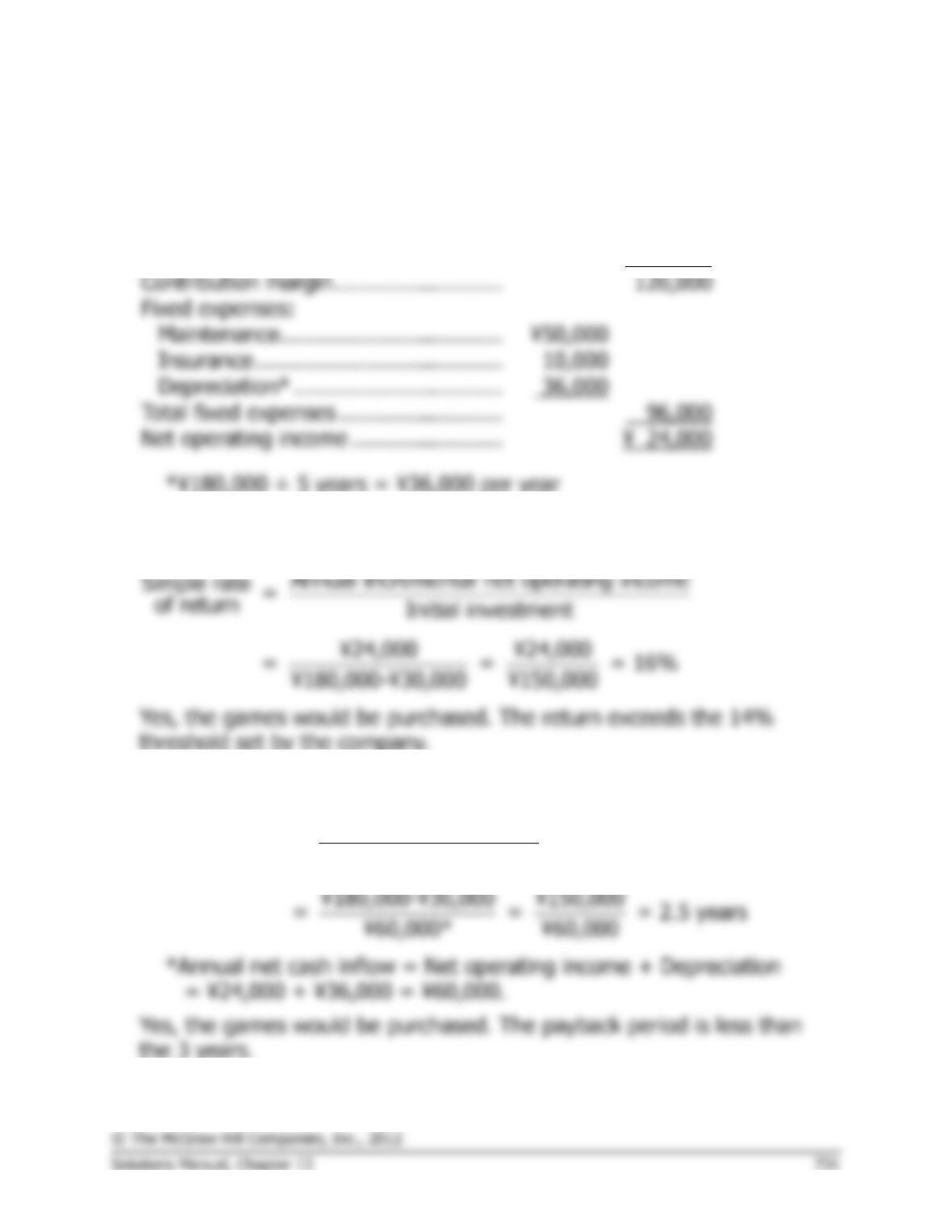
1. The income statement is:
Sales revenue …………………………….
¥200,000
Commissions (40% × ¥200,000) …….
80,000
Contribution margin ……………………..
Total fixed expenses …………………….
96,000
Net operating income …………………..
¥ 24,000
2. The initial investment in the simple rate of return calculations is net of
the salvage value of the old equipment as shown below:
3. The payback period is:
Invesment required
Payback period = Net annual cash inflow
Problem 13-25 (30 minutes)
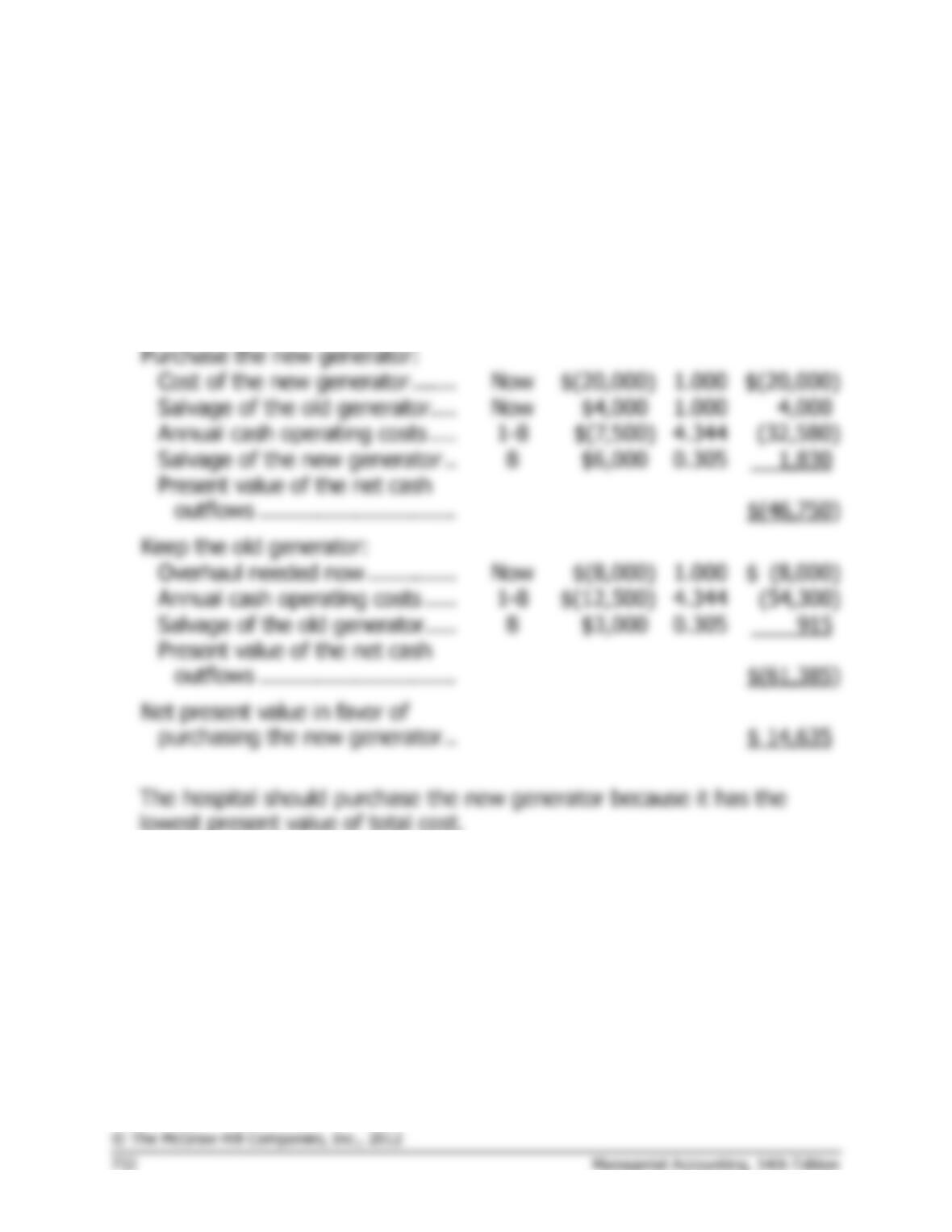
1. The total-cost approach:
Year(s)
Amount
of Cash
Flows
16%
Factor
Present
Value of
Cash
Flows
Purchase the new generator:
Keep the old generator:
Problem 13-25 (continued)
2.
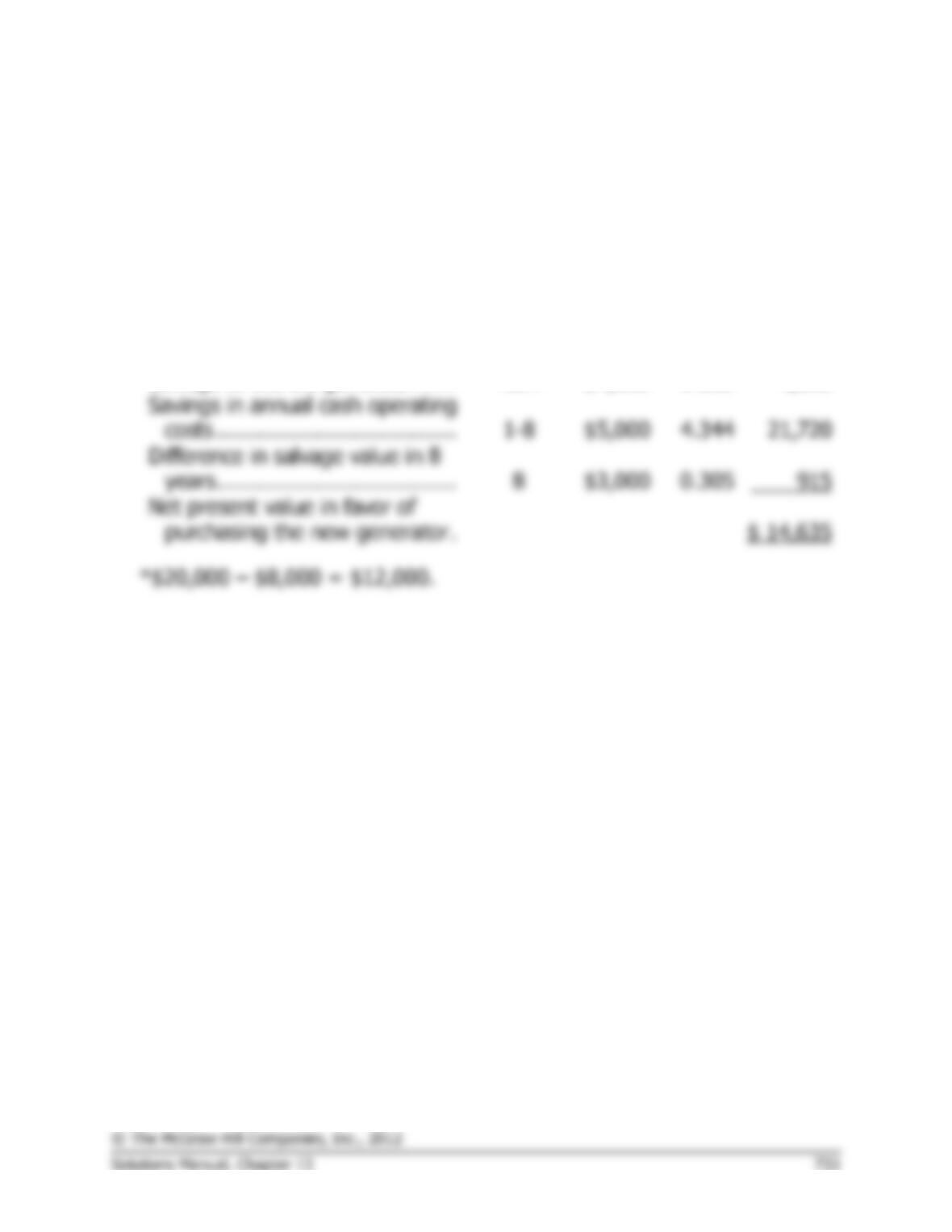
The incremental-cost approach:
Year(s)
Amount
of Cash
Flows
16%
Factor
Present
Value of
Cash
Flows
Incremental investment—new
generator* ………………………..
Now
$(12,000)
1.000
$(12,000)
Salvage of the old generator ……
Now
$4,000
1.000
4,000
Difference in salvage value in 8
Problem 13-26 (45 minutes)
1.
Labor savings …………………………………
€190,000
Ground mulch savings ……………………..
10,000
€200,000
Less out–of-pocket costs:
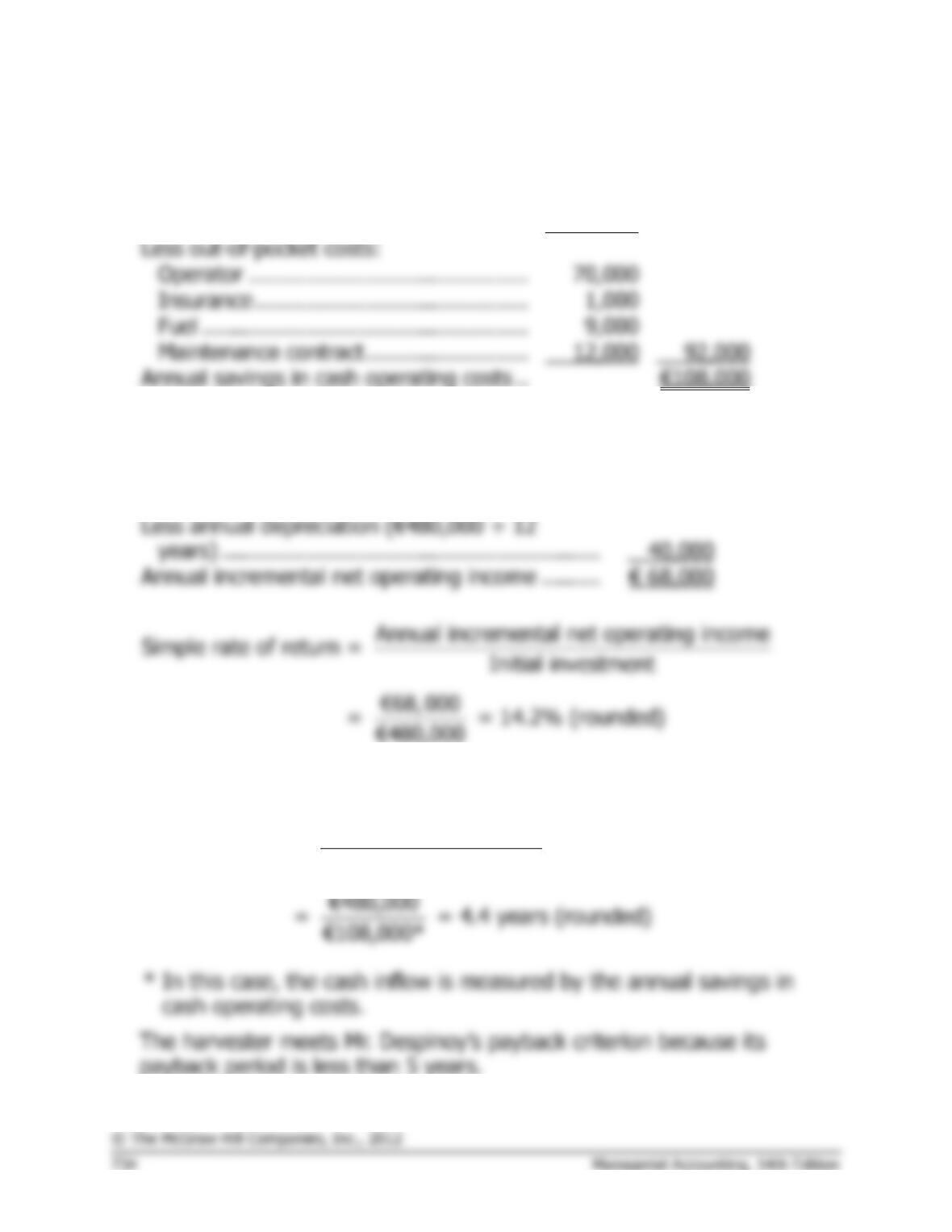
2. The first step is to determine the annual incremental net operating
income:
Annual savings in cash operating costs ………….
€108,000
Annual incremental net operating income ………
3. The formula for the payback period is:
Investment required
Payback period = Net annual cash inflow
Problem 13-26 (continued)
4. The formula for the internal rate of return is:
Investment required
Factor of the internal =
rate of return Net annual cash inflow
€480,000
= = 4.4 (rounded)
€108,000
Problem 13-27 (60 minutes)
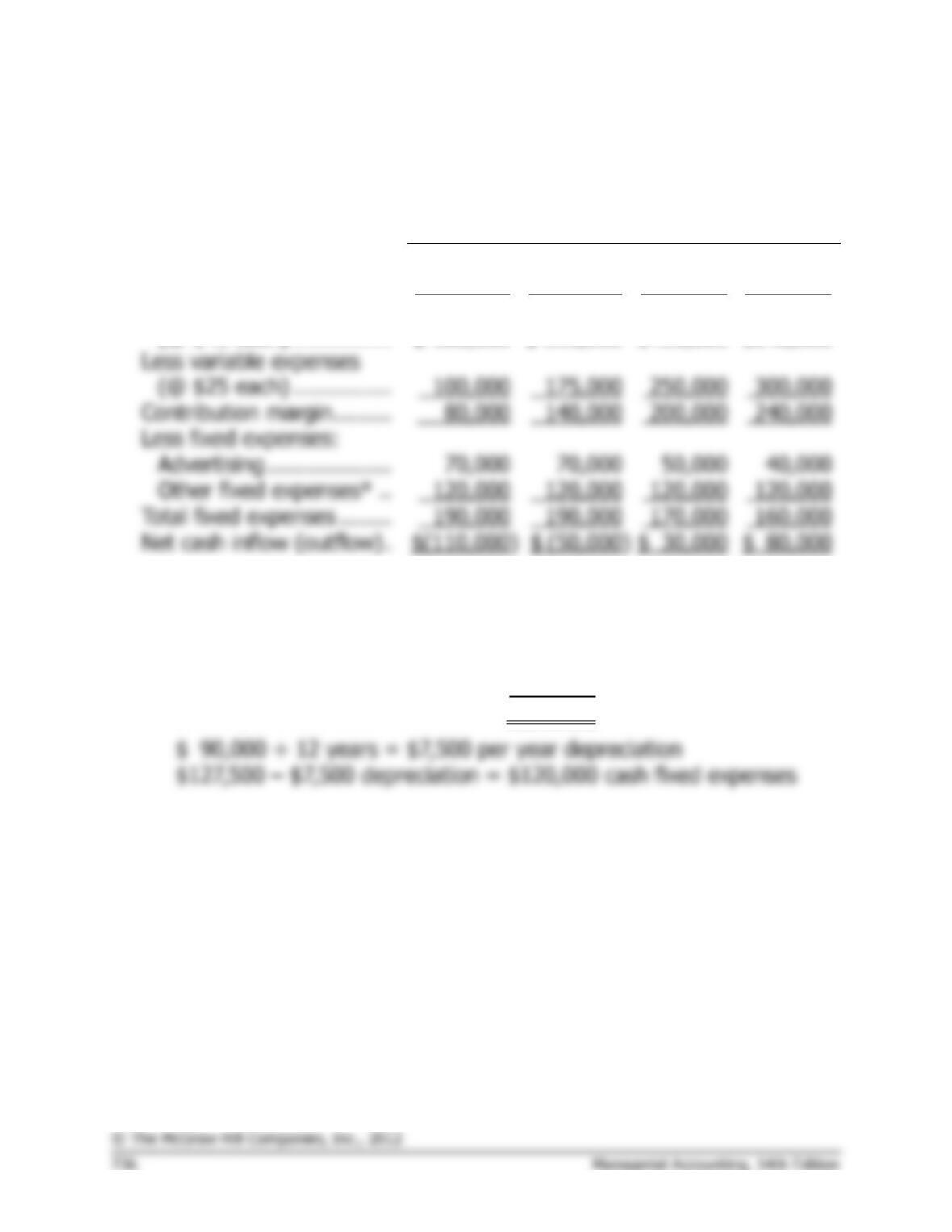
1. The net cash inflow from sales of the detectors for each year would be:
Year
1
2
3
4-12
Sales in units ………………
4,000
7,000
10,000
12,000
Sales in dollars
(@ $45 each) ……………
$ 180,000
$ 315,000
$450,000
$540,000
Contribution margin ………
80,000
Less fixed expenses:
Total fixed expenses ……..
Net cash inflow (outflow) .
*
Depreciation is not a cash outflow and therefore must be
eliminated when determining the net cash flow. The analysis is:
Cost of the equipment …………
$100,000
Less salvage value (10%) …….
10,000
Net depreciable cost ……………
$ 90,000
$ 90,000 ÷ 12 years = $7,500 per year depreciation
Problem 13-27 (continued)
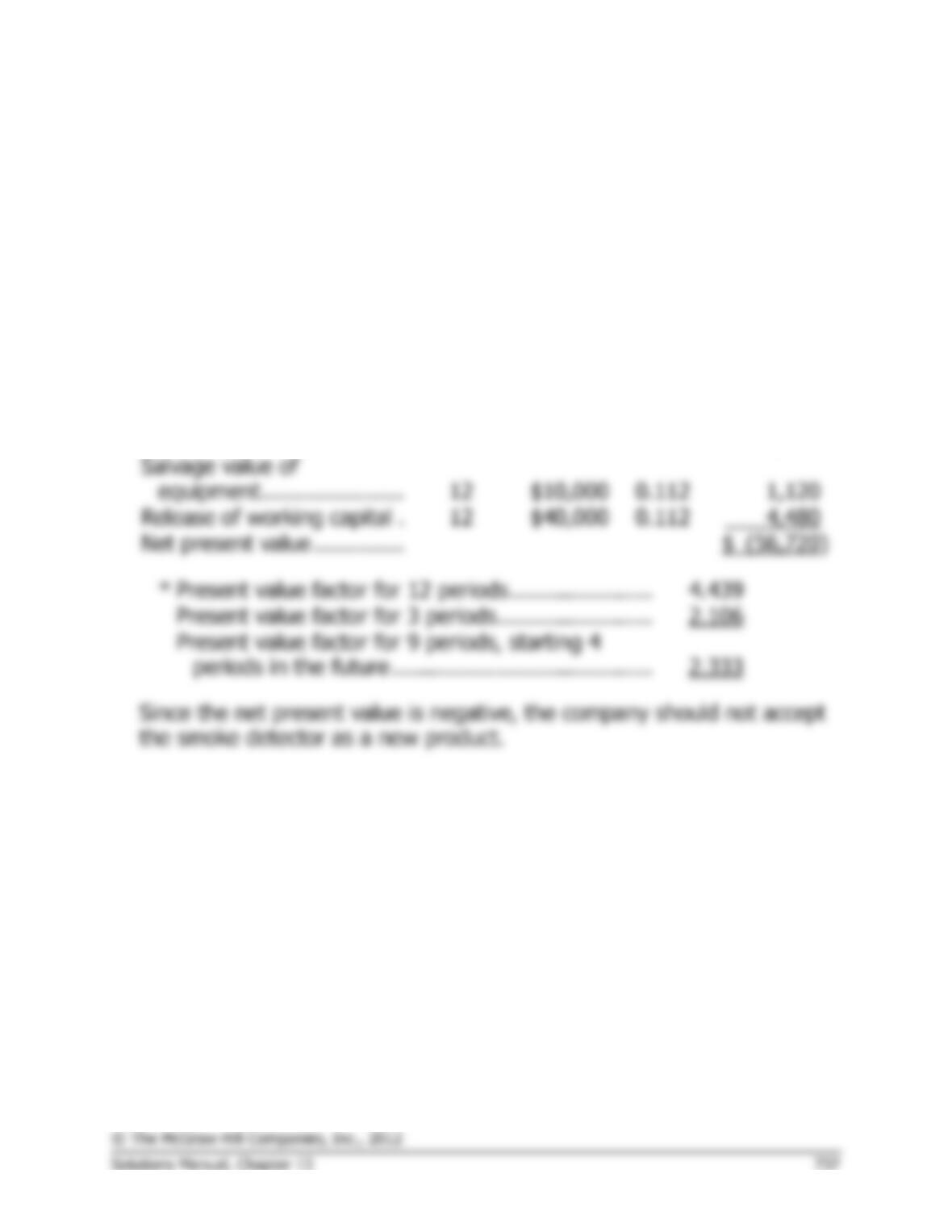
2. The net present value of the proposed investment would be:
Item
Year(s)
Amount of
Cash
Flows
20%
Factor
Present
Value of
Cash
Flows
Investment in equipment …
Now
$(100,000)
1.000
$(100,000)
Working capital investment
Now
$(40,000)
1.000
(40,000)
Yearly cash flows ……………
1
$(110,000)
0.833
(91,630)
” ” ” …………….
2
$(50,000)
0.694
(34,700)
” ” ” …………….
3
$30,000
0.579
17,370
” ” ” …………….
4-12
$80,000
2.333
*
186,640
0.112
Release of working capital .
$40,000
0.112
Net present value …………..
$ (56,720)
*
Present value factor for 12 periods ………………….
Present value factor for 3 periods ……………………
Problem 13-28 (90 minutes)
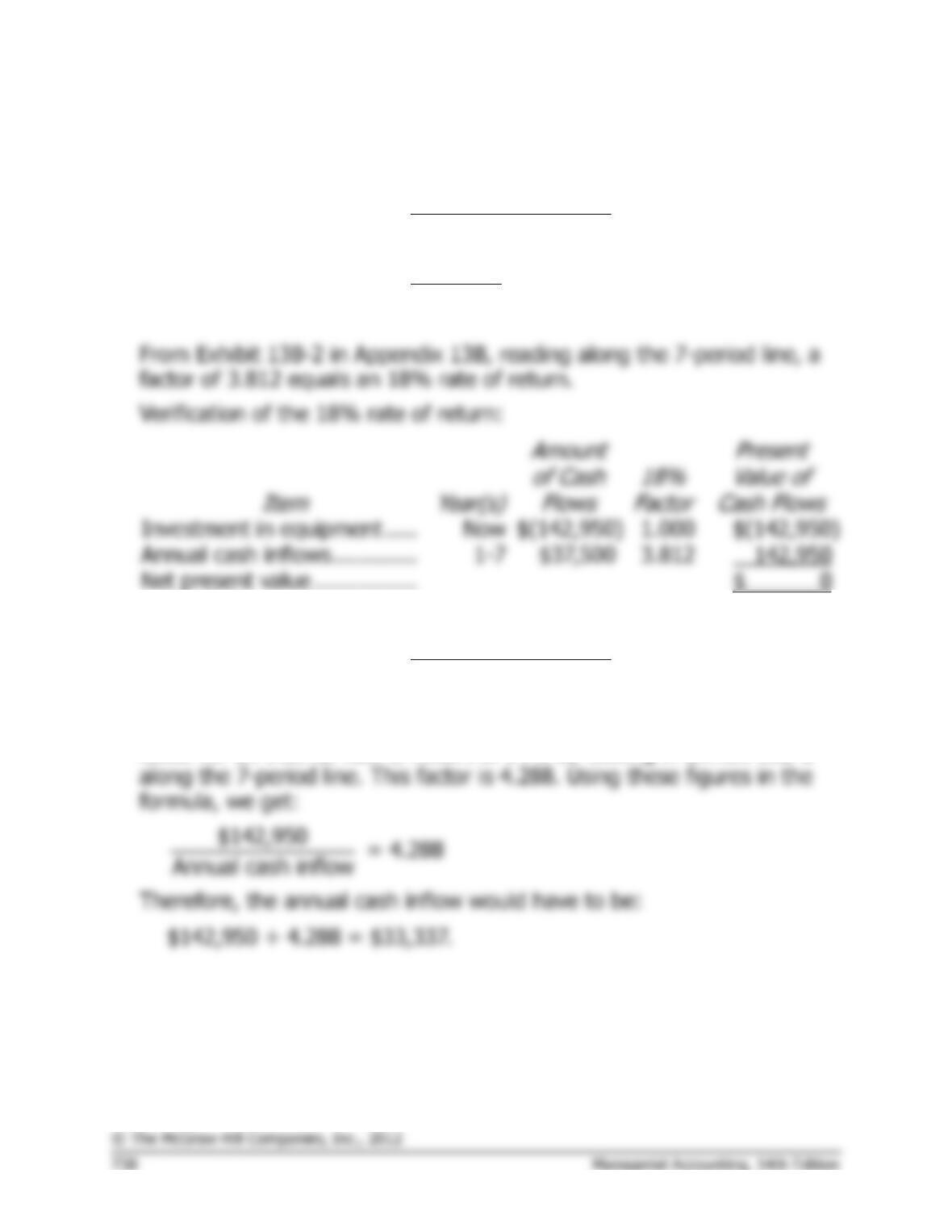
1.
Required investment
Factor of the internal =
rate of return Annual cash inflow
$142,950
= = 3.812
$37,500
2.
Required investment
Factor of the internal =
rate of return Annual cash inflow
We know that the investment is $142,950, and we can determine the
factor for an internal rate of return of 14% by looking in Exhibit 13B–2
Problem 13-28 (continued)
3. a. 5-year life for the equipment:
The factor for the internal rate of return would still be 3.812 [as
computed in (1) above]. From Exhibit 13B-2, reading this time along
the 5-period line, a factor of 3.812 is closest to 3.791, the factor for
10%. Thus, to the nearest whole percent, the internal rate of return
is 10%.
b. 9-year life for the equipment:
The factor of the internal rate of return would again be 3.812. From
Exhibit 13B-2, reading along the 9-period line, a factor of 3.812 is
closest to 3.786, the factor for 22%. Thus, to the nearest whole
percent, the internal rate of return is 22%.
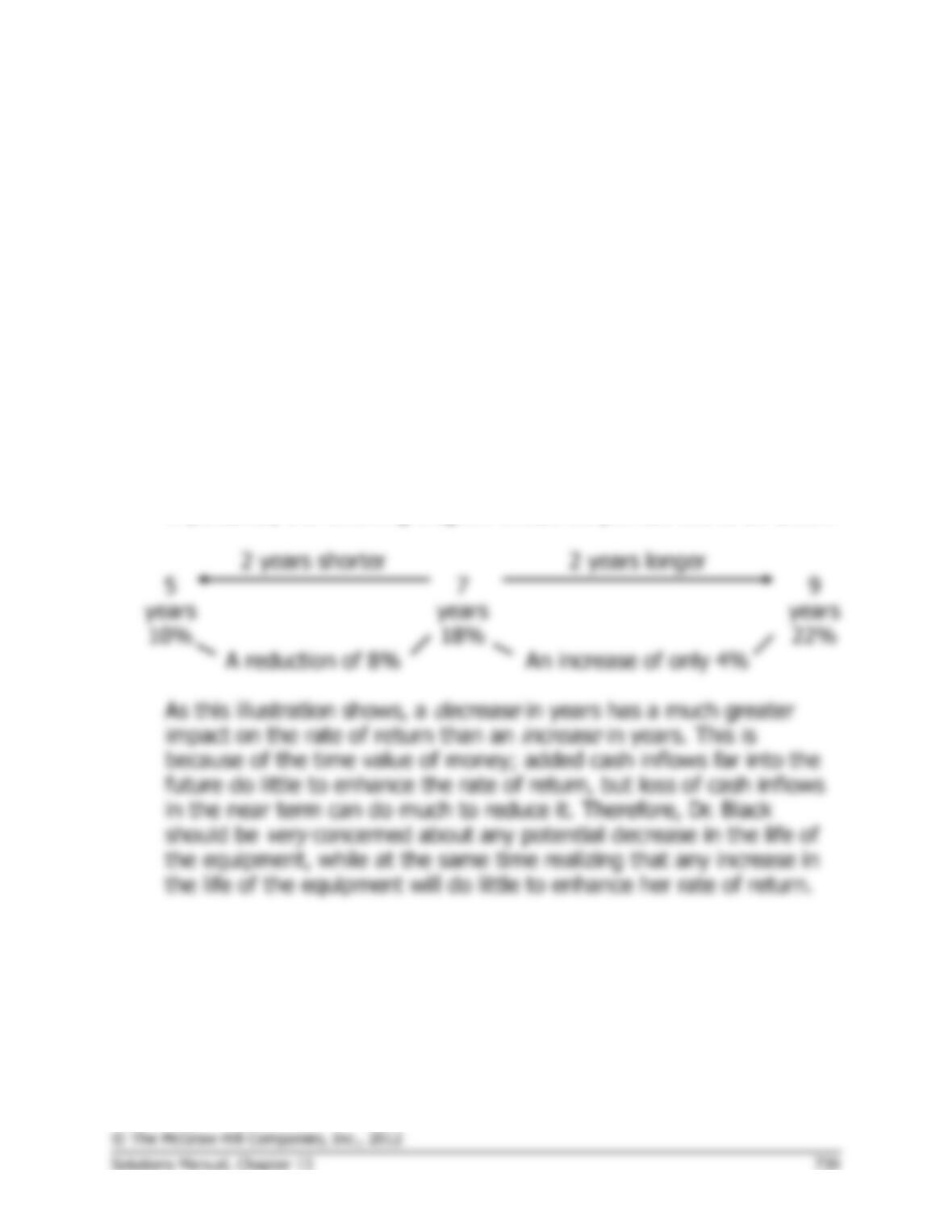
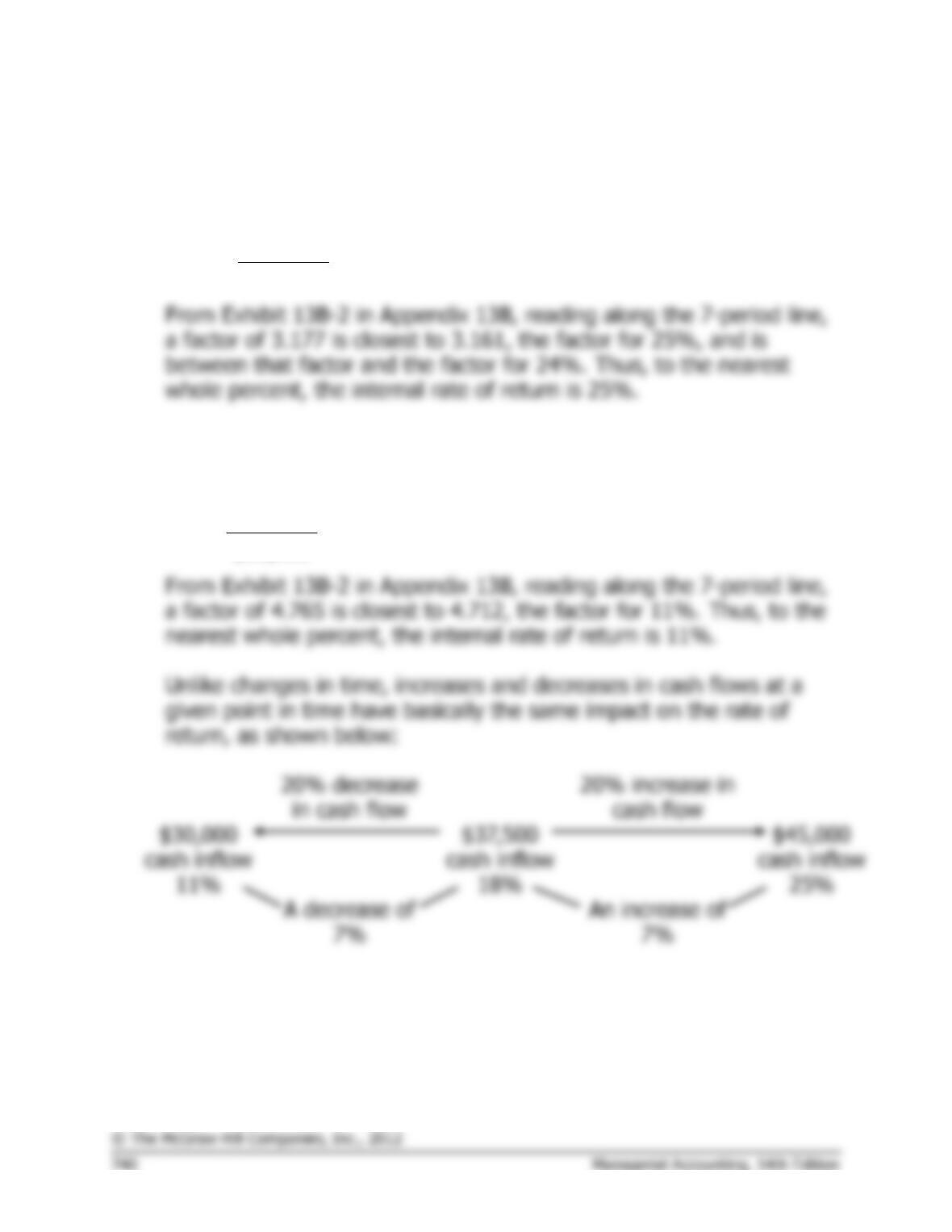
The 10% return in part (a) is less than the 14% minimum return that
Dr. Black wants to earn on the project. Of equal or even greater
importance, the following diagram should be pointed out to Dr. Black:
Problem 13-28 (continued)
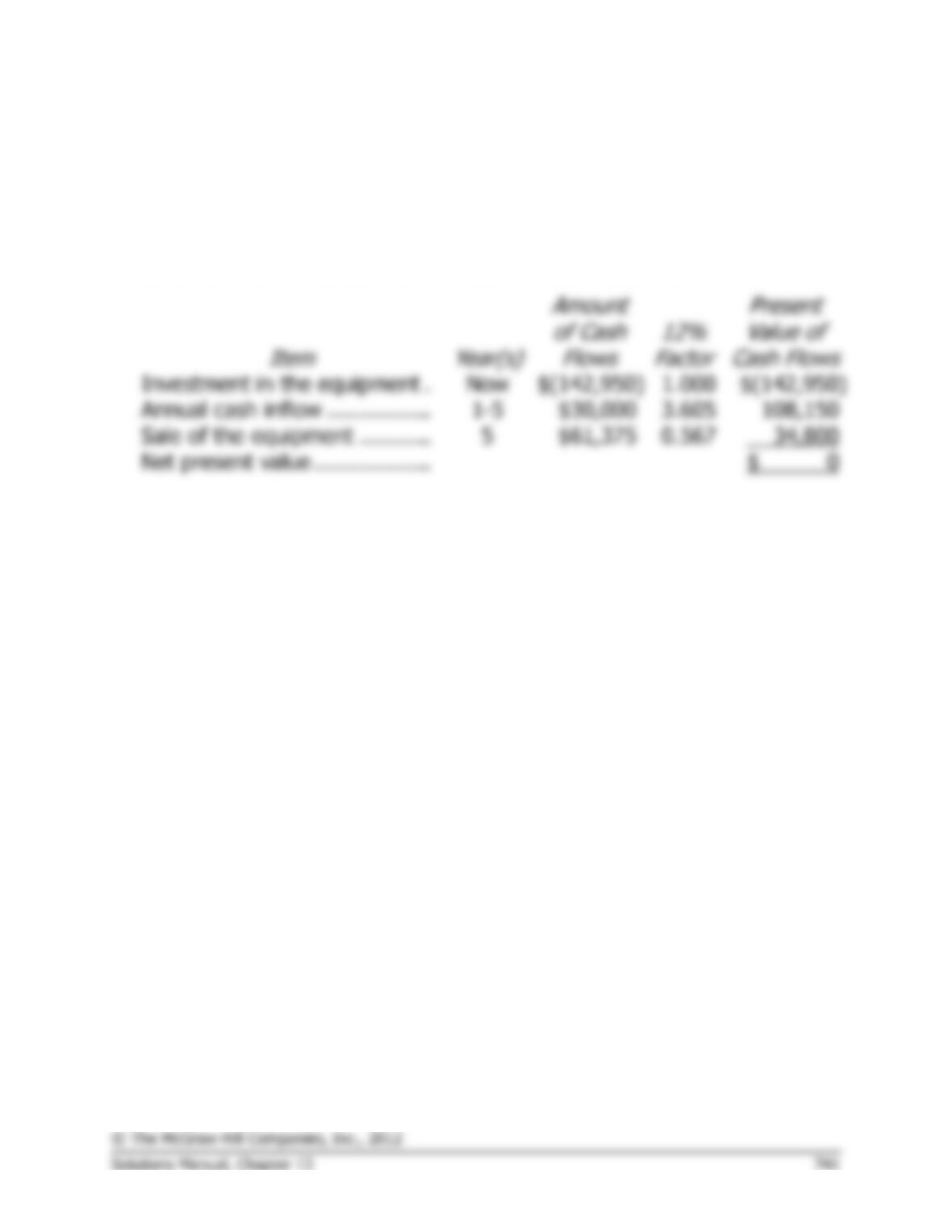
4. a. The expected annual cash inflow would be:
$37,500 × 120% = $45,000
$142,950 = 3.177
$45,000
b. The expected annual cash inflow would be:
$37,500 × 80% = $30,000
$142,950 = 4.765
$30,000
Problem 13-28 (continued)
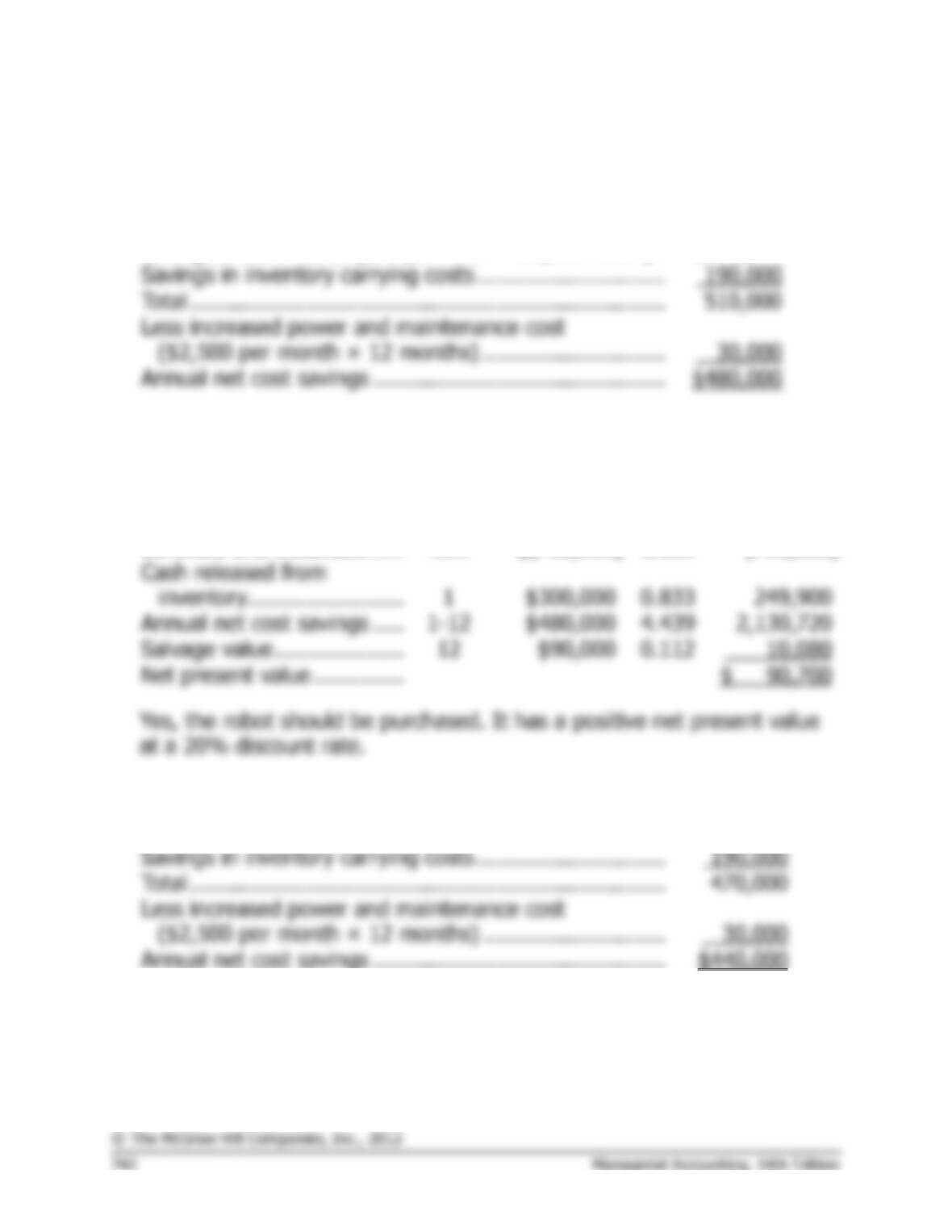
5. The cash flows are not even over the five-year period (there is an extra
$61,375 cash inflow from sale of the equipment at the end of the fifth
year), so the formula method cannot be used to compute the internal
rate of return. Using trial-and-error or more sophisticated methods, it
turns out that the actual internal rate of return will be 12%:
Problem 13-29 (60 minutes)
1. Computation of the annual net cost savings:
Savings in labor costs ($16 per hour × 20,000 hours) ..
$320,000
Savings in inventory carrying costs ………………………..
190,000
Total ……………………………………………………………….
2.
Year(s)
Amount of
Cash Flows
20%
Factor
Present
Value of
Cash Flows
Cost of the robot ……………
Now
$(1,600,000)
1.000
$(1,600,000)
Software and installation….
Now
$(700,000)
1.000
(700,000)
Annual net cost savings …..
Salvage value ………………..
0.112
Net present value …………..
3. Recomputation of the annual net cost savings:
Savings in labor costs ($16 per hour × 17,500 hours) ..
$280,000
Savings in inventory carrying costs ………………………..
Total ……………………………………………………………….
Annual net cost savings ………………………………………
$440,000