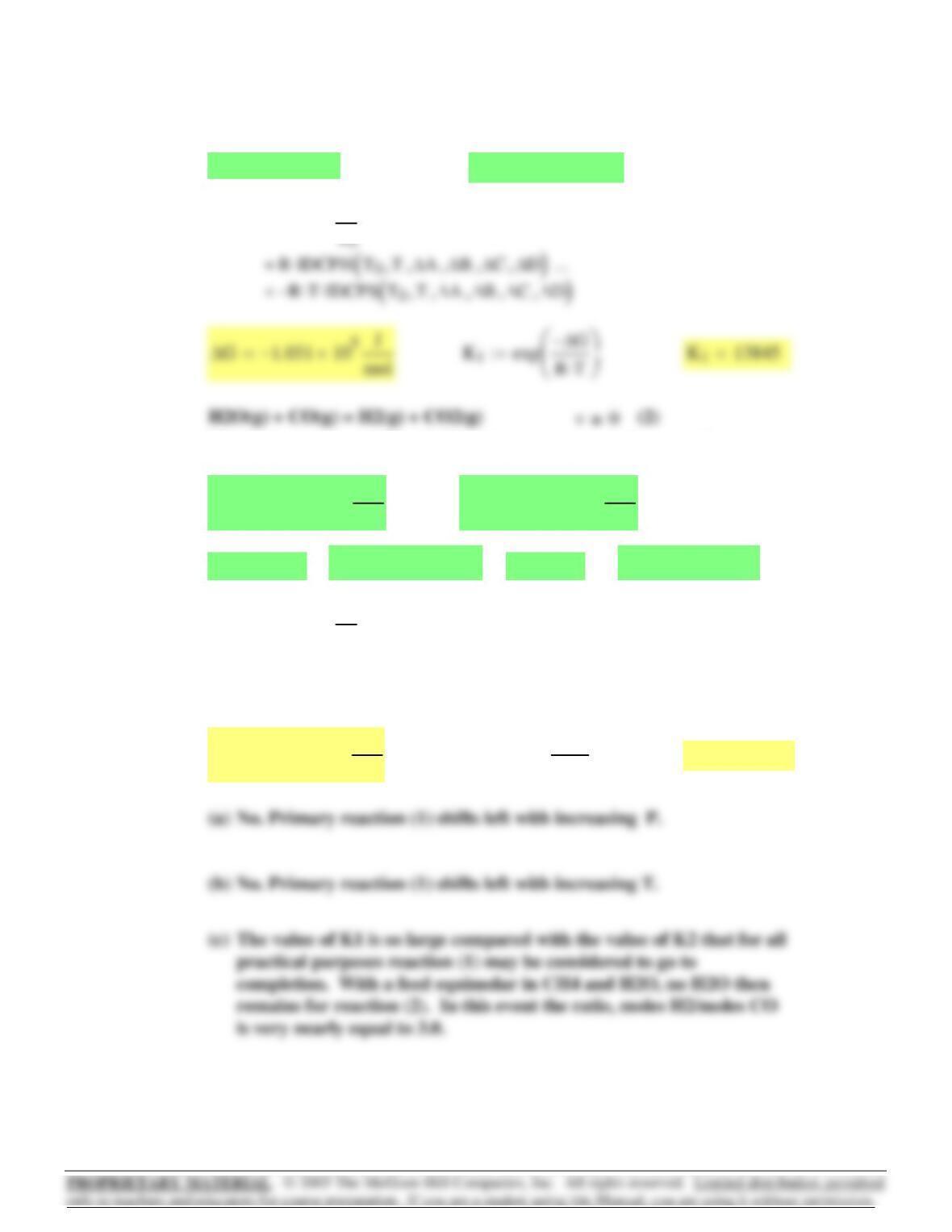
K20.5798=K2exp ∆G−
RT⋅
⎛
⎜
⎝
⎞
⎠
:=∆G 5.892 103
×J
mol
=
∆G∆H298
T
T0
∆H298 ∆G298
−
()
⋅−
R IDCPH T0T,∆A,∆B,∆C,∆D,
()
⋅+
…
R−T⋅IDCPS T0T,∆A,∆B,∆C,∆D,
()
⋅+
…
:=
∆D 1.164−105
⋅:=∆C 0.0:=∆B 0.540−10 3−
⋅:=∆A 1.860:=
∆G298 28618−J
mol
⋅:=∆H298 41166−J
mol
⋅:=
This is the reaction of Pb. 13.32, where parameter values are given:
⎜
∆G∆H298
T
∆H298 ∆G298
−
()
⋅−
…
:=
T0298.15 kelvin⋅:=T 1300 kelvin⋅:=
521
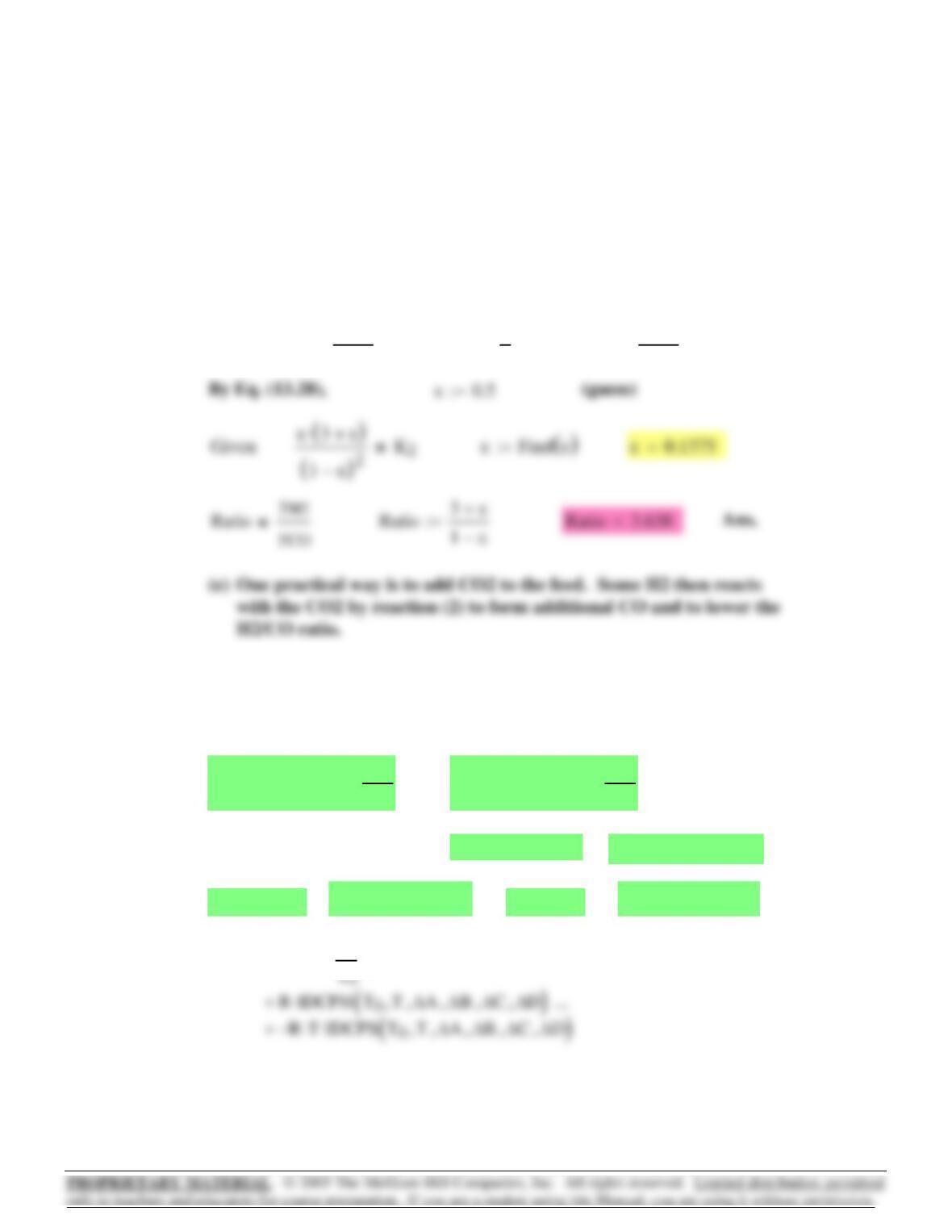
(f) 2CO(g) = CO2(g) + C(s) ν1−=(gases)
This reaction is considered in the preceding problem, Part (d), from
which we get the necessary parameter values:
∆H298 172459−J
mol
⋅:= ∆G298 120021−J
mol
⋅:=
For T = 1300 K, T 1300 kelvin⋅:= T0298.15 kelvin⋅:=
∆A 0.476:= ∆B 0.702 10 3−
⋅:= ∆C 0.0:= ∆D 1.962−105
⋅:=
∆G∆H298
T
∆H298 ∆G298
−
()
⋅−
…
:=
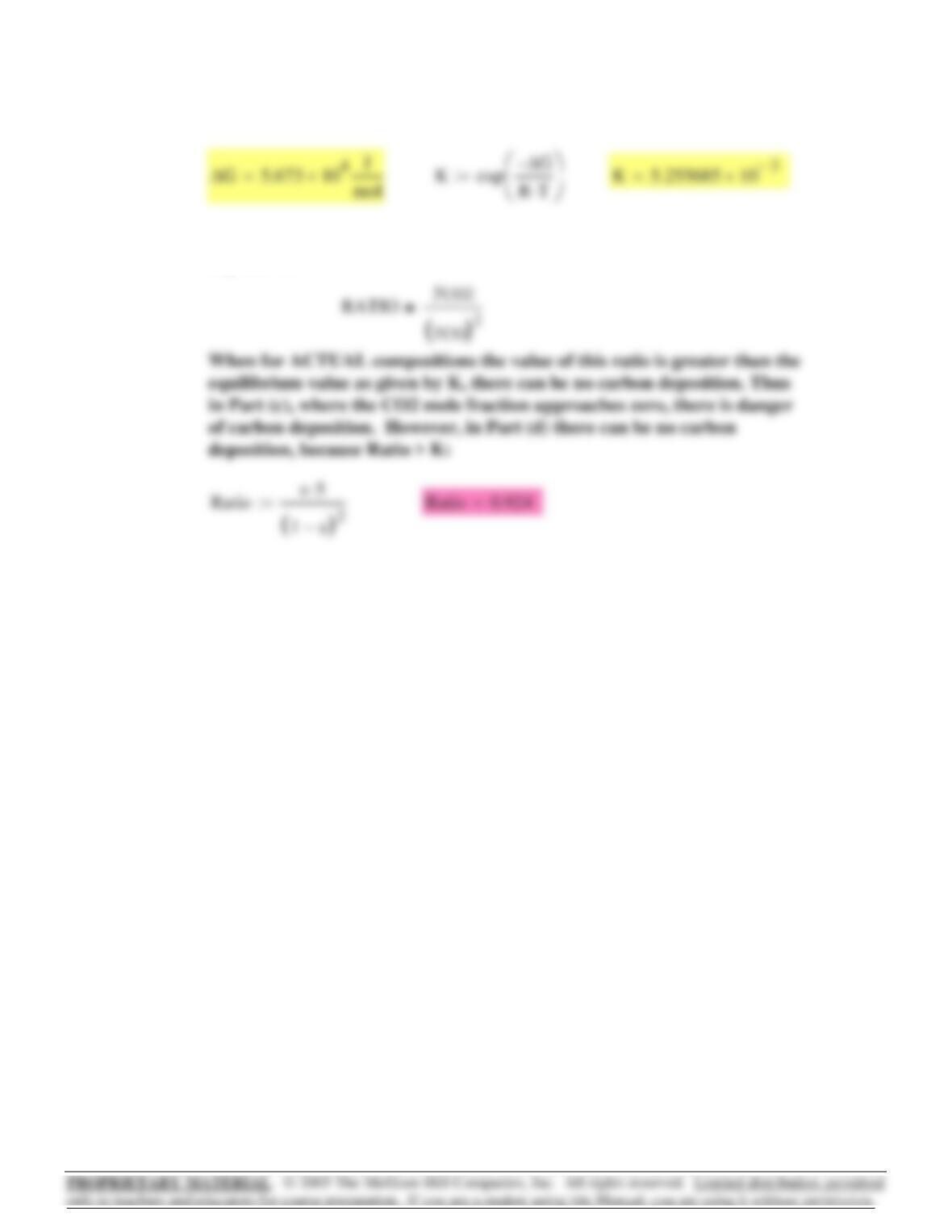
(d) With H2O present in an amount greater than the stoichiometric
ratio, reaction (2) becomes important. However, reaction (1) for all
practical purposes still goes to completion, and may be considered
to provide the feed for reaction (2). On the basis of 1 mol CH4 and
2 mol H2O initially, what is left as feed for reaction (2) is: 1 mol
H2O, 1 mol CO, and 3 mol H2; n0 = 5. Thus, for reaction (2) at
equilibrium by Eq. (13.5):
yCO yH2O
=
1ε−
5
=yCO2
ε
5
=yH2
3ε+
5
=
522
2
0
3
1
0
1
1
-1
-1
-1
-1
0
1
2
j
_________________________________________________
νj
i = CH4 H2O CO CO2 H2
νi.j
Stoichiometric numbers,
There are alternative equivalent pairs, but for these:
CO + H2O = CO2 + H2 (2)
As explained in Problem 13.32(d), the question of carbon deposition
depends on:
13.37 Formation reactions:
C + 2H2 = CH4
H2 + (1/2)O2 = H2O
C + (1/2)O2 = CO
C + O2 = CO2
Elimination first of C and then of O2 leads to a pair of reactions:
CH4 + H2O = CO + 3H2 (1)
523
ε1ε2
−
()
3ε1
⋅ε
2
+
()
3
⋅
2ε1
−
()
3ε1
−ε
2
−
()
⋅52ε1
⋅+
()
2
⋅
K1
=
Given
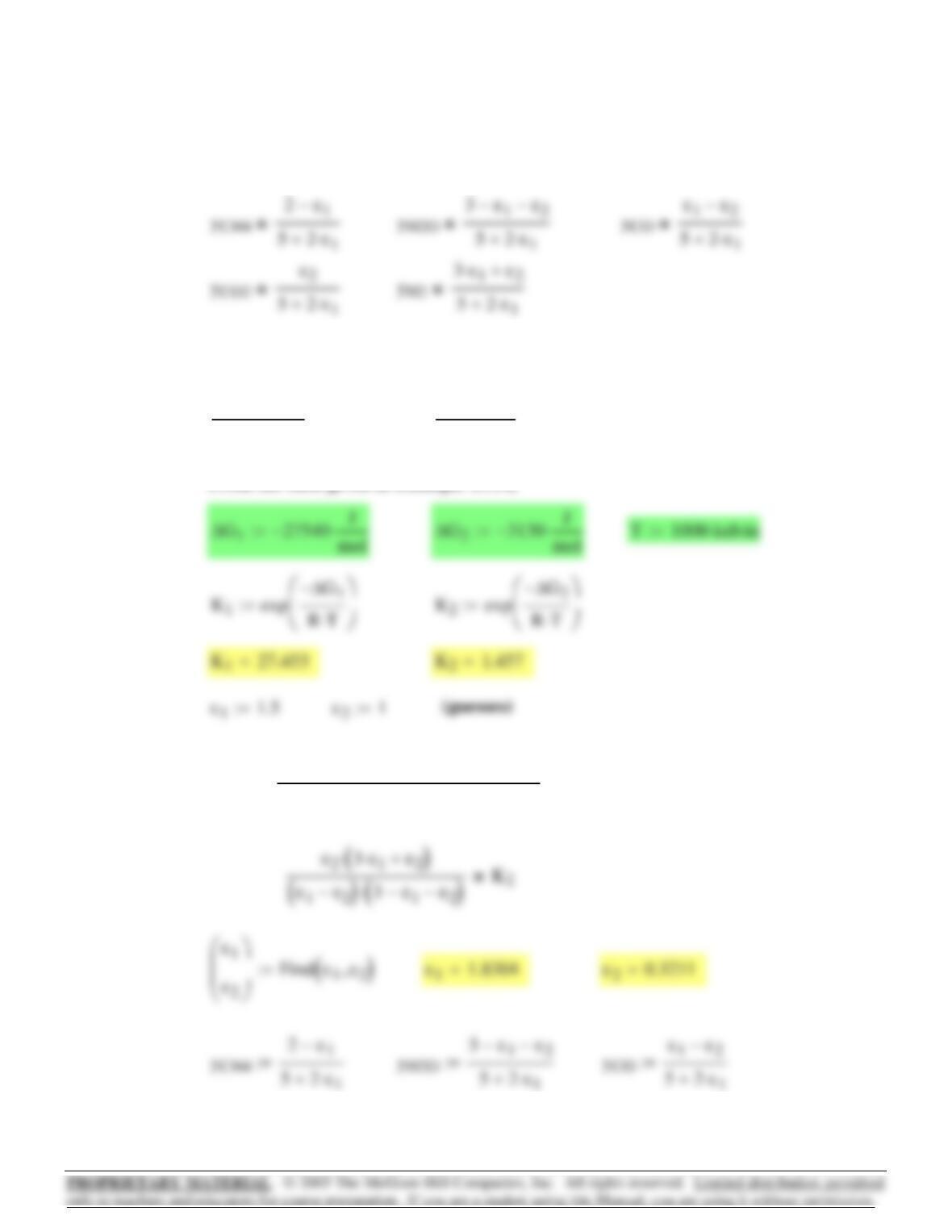
From the data given in Example 13.14,
yCO2 yH2
⋅
yCO yH2O
⋅k2
=
yCO yH2
()
3
⋅
yCH4 yH2O
⋅k1
=
By Eq. (13.40), with P = P0 = 1 bar
For initial amounts: 2 mol CH4 and 3 mol H2O, n0 = 5, and by Eq. (13.7):
524
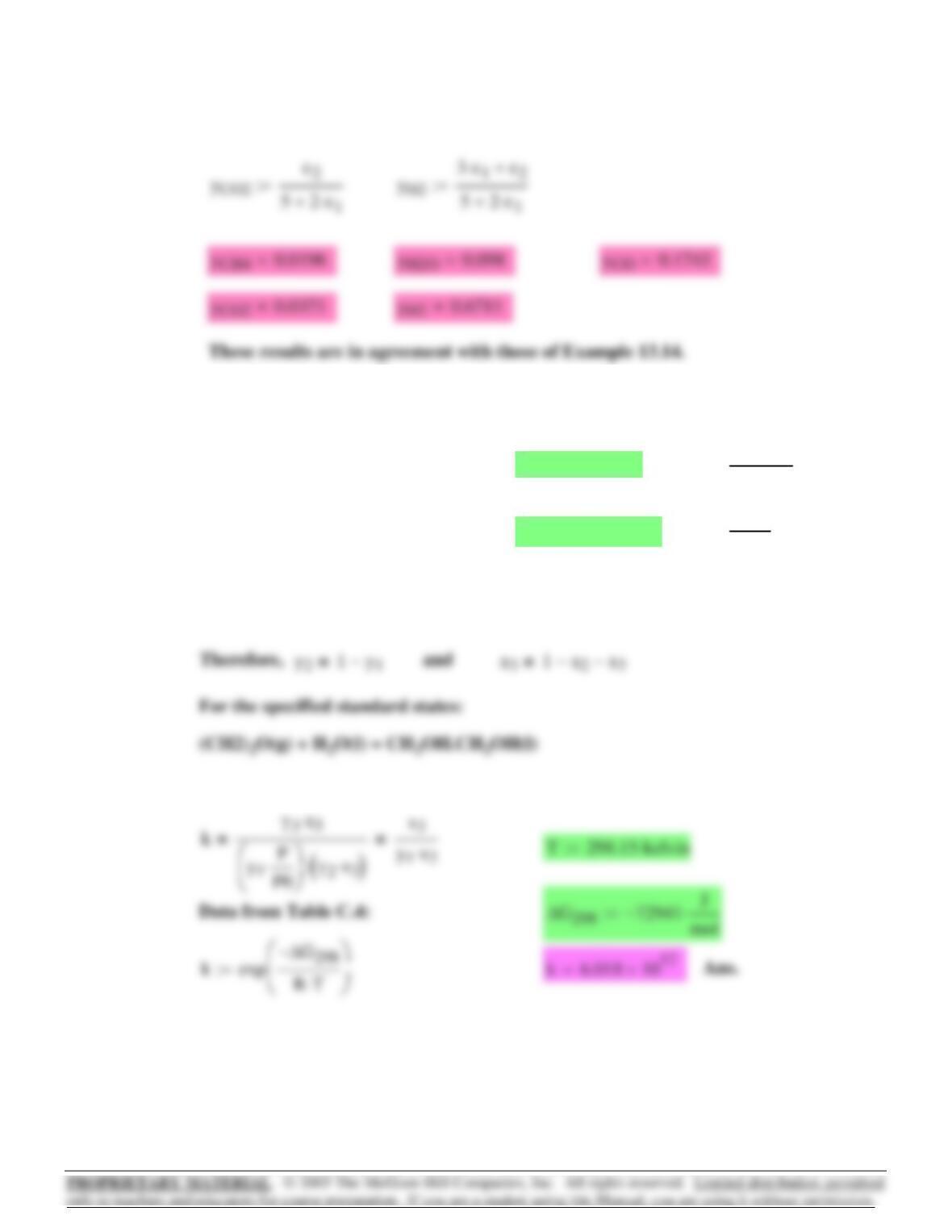
x2
y2P⋅
Psat2
=
(steam tables)
Ethylene glycol(3): Psat30.0=y30.0=
By Eq. (13.40) and the stated assumptions,
13.39 Phase-equilibrium equations:
Ethylene oxide(1): p1y1P⋅=415 x1
⋅=P 101.33 kPa⋅:= x1
y1P⋅
415 kPa⋅
=
Water(2): x2Psat2
⋅y2P⋅=Psat23.166 kPa⋅:=
525
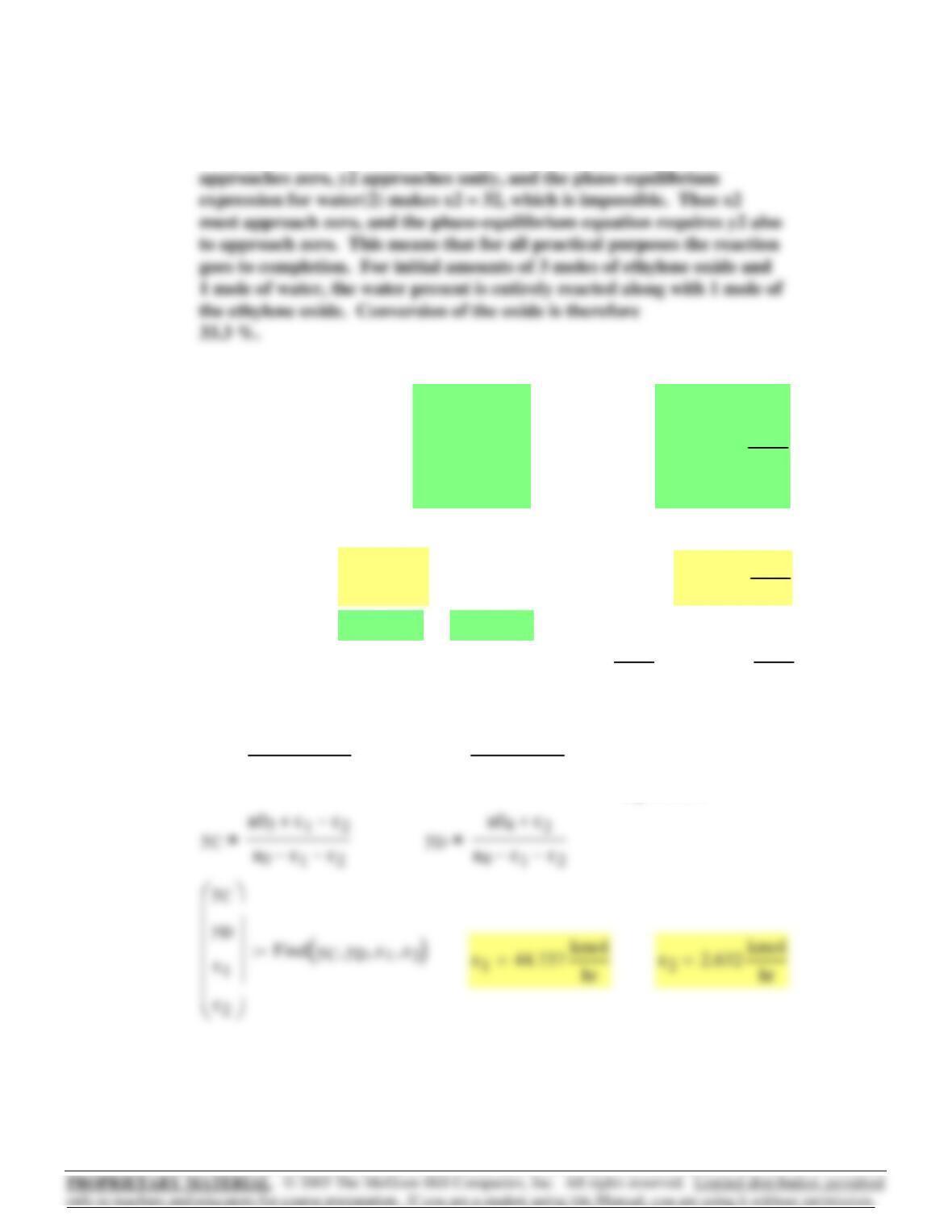
yA0.05:= yB0.10:=
Guess: yC0.4:= yD0.4:= ε11kmol
hr
:= ε21kmol
hr
:=
Given
yA
n01ε1
−ε
2
−
n0ε1
−ε
2
−
=yB
n02ε1
−
n0ε1
−ε
2
−
=
Eqn. (13.7)
So large a value of k requires either y1 or x2 to approach zero. If y1
13.41 Initial
numbers of
moles
a) Stoichiometric coefficients:ν
1−
1−
1
0
1−
0
1−
1
⎛
⎜
⎜
⎜
⎜
⎝
⎞
⎟
⎟
⎠
:= n0
50
50
0
0
⎛
⎜
⎜
⎜
⎜
⎝
⎞
⎟
⎟
⎠
kmol
hr
:=
Number of components: i14..:= Number of reactions: j12..:=
vj
i
νij,
∑
:= v1−
1−
⎛
⎜
⎝
⎞
⎠
=n0
i
n0i
∑
:= n0100 kmol
hr
=
Given values:
526
⎜
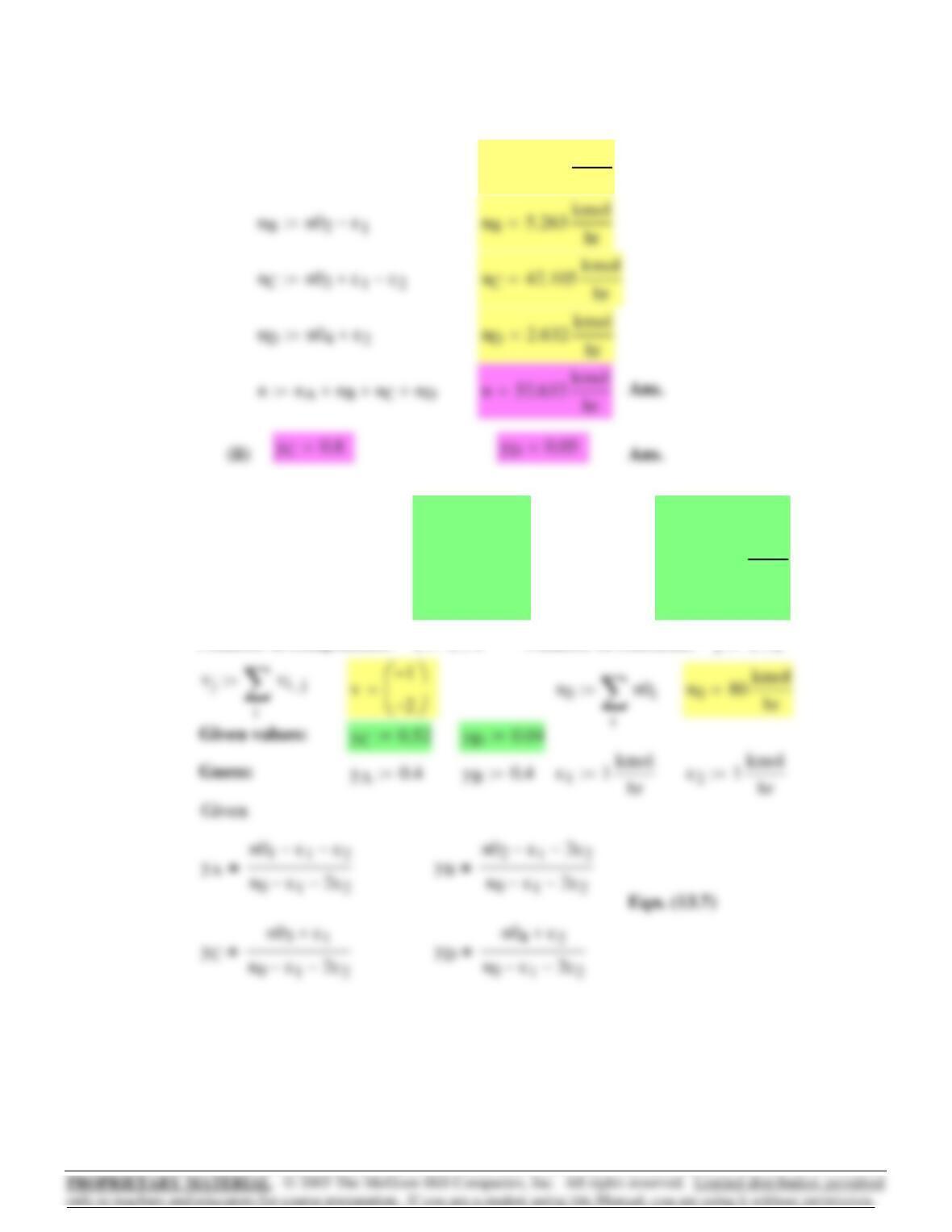
i14..:= Number of reactions: j12..:=
(i) nAn01ε1
−ε
2
−:= nA2.632 kmol
hr
=
Initial
numbers of
moles
b)Stoichiometric coefficients:ν
1−
1−
1
0
1−
2−
0
1
⎛
⎜
⎜
⎜
⎜
⎝
⎞
⎟
⎟
⎠
:= n0
40
40
0
0
⎛
⎜
⎜
⎜
⎜
⎝
⎞
⎟
⎟
⎠
kmol
hr
:=
Number of components:
527

Number of reactions: j12..:=
vj
i
νij,
∑
:= v1
1−
⎛
⎜
⎝
⎞
⎠
=n0
i
n0i
∑
:= n0100 kmol
hr
=
Given values: yC0.3:= yD0.1:=
Guess: yA0.4:= yB0.4:= ε11kmol
hr
:= ε21kmol
hr
:=
Given
yA
n01ε1
−ε
2
−
n0ε1
+ε
2
−
=0=yB
n02ε1
+ε
2
−
n0ε1
+ε
2
−
=
Eqn. (13.7)
yC
n03ε1
+
n0ε1
+ε
2
−
=yD
n04ε2
+
n0ε1
+ε
2
−
=
yA
yB
ε1
ε2
⎛
⎜
⎜
⎜
⎜
⎜
⎝
⎞
⎟
⎟
⎟
⎠
Find yAyB
,ε
1
,ε
2
,
()
:= ε126 kmol
hr
= ε22kmol
hr
=
yA0.24=yB0.2=
Initial
numbers of
moles
c) Stoichiometric coefficients:ν
1−
1
1
0
1−
1−
0
1
⎛
⎜
⎜
⎜
⎜
⎝
⎞
⎟
⎟
⎠
:= n0
100
0
0
0
⎛
⎜
⎜
⎜
⎜
⎝
⎞
⎟
⎟
⎠
kmol
hr
:=
Number of components: i14..:=
528
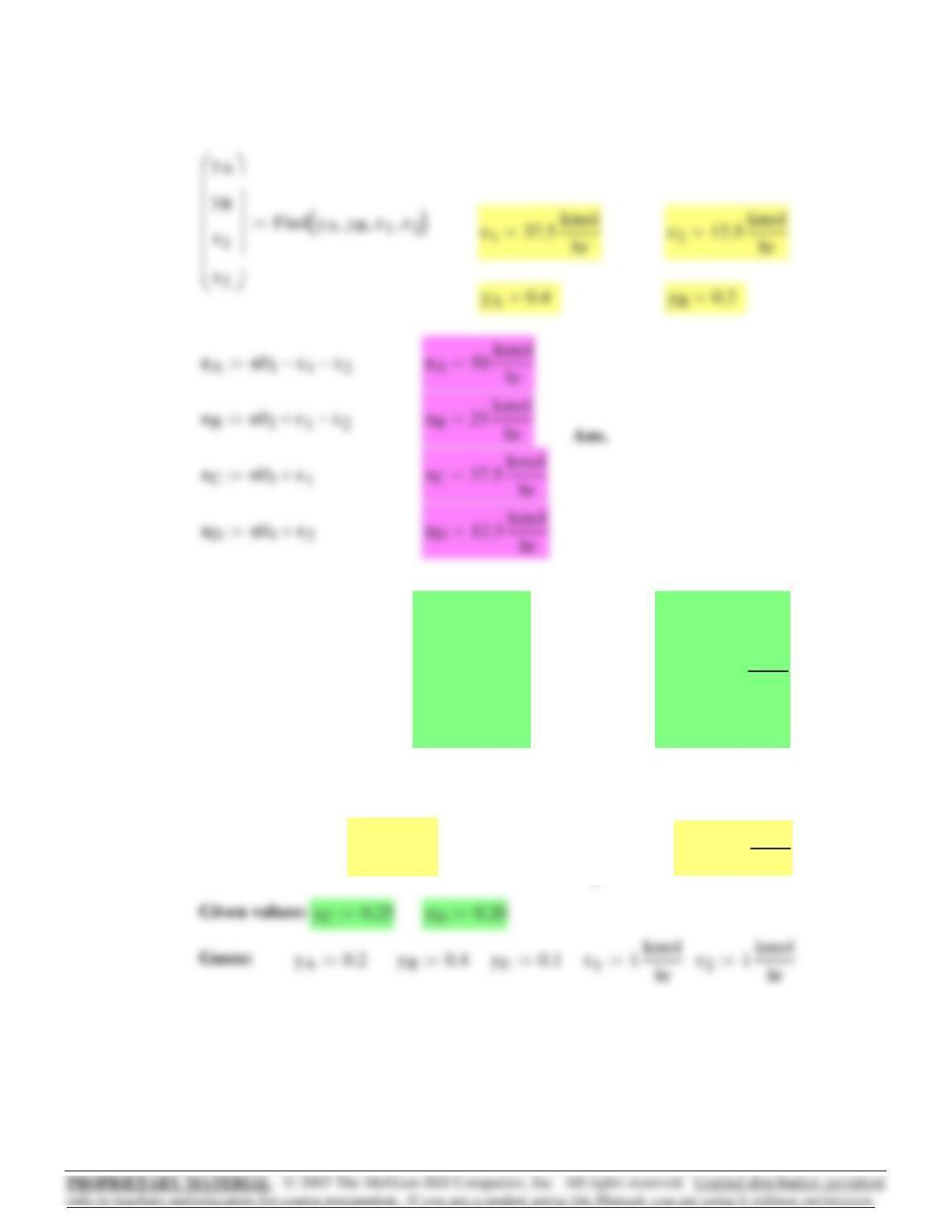
n0
40
60
0
0
0
⎛
⎜
⎜
⎜
⎜
⎜
⎝
⎞
⎟
⎟
⎟
⎠
kmol
hr
:=
Number of components: i15..:= Number of reactions: j12..:=
vj
i
νij,
∑
:= v1−
0
⎛
⎜
⎝
⎞
⎠
=n0
n0i
∑
:= n0100 kmol
hr
=
⎜
Initial
numbers of
moles
d)Stoichiometric coefficients:ν
1−
1−
1
0
0
1−
1−
0
1
1
⎛
⎜
⎜
⎜
⎜
⎜
⎝
⎞
⎟
⎟
⎟
⎠
:=
529
13.45 C2H4(g) + H2O(g) -> C2H5OH(g)
T0 298.15kelvin:= P0 1bar:= T 400kelvin:= P 2bar:=
1 = C2H4(g) ∆H0f1 52500 J
mol
:= ∆G0f1 68460 J
mol
:=
Given
yA
n01ε1
−ε
2
−
n0ε1
−
=yB
n02ε1
−ε
2
−
n0ε1
−
=Eqn. (13.7)
yC
n03ε1
+
n0ε1
−
=yD
n04ε2
+
n0ε1
−
=yE
n05ε2
+
n0ε1
−
=
530
K1exp ∆H0
RT0⋅1T0
T
−
⎛
⎜
⎝
⎞
⎠
⋅
⎡
⎢
⎣
⎤
⎥
⎦
:= Eqn. (13.22) K19.07 10 3−
×=
c) Assume as a basis there is initially 1 mol of C2H4 and 1 mol of H2O
y1
1εe
−
2εe
−
=y2
1εe
−
2εe
−
=y3
εe
2εe
−
=
Assuming ideal gas behavior y3
y1y2
⋅KP
P0
⋅=
Substituting results in the following expression:
εe
2εe
−
1εe
−
2εe
−
1εe
−
2εe
−
⋅
K400
P
P0
⋅=
∆H0 ∆H0f1
−∆H0f2
−∆H0f3
+:= ∆H0 45.782−kJ
mol
=
∆G0 ∆G0f1
−∆G0f2
−∆G0f3
+:= ∆G0 8.378−kJ
mol
=
∆A 1.424()−3.470()−3.518()+:= ∆A 1.376−=
⎜
b)
531
⎜
S0O2 205.152 J
mol kelvin⋅
:=S0H2 130.680 J
mol kelvin⋅
:=
P 1bar:=T 298.15kelvin:=∆H0fH2O2 136.1064−kJ
mol
:=
H2(g) + O2(g) -> H2O2(g)13.46
Since ν = −1 < 0, a decrease in pressure will cause a shift on the reaction
to the left and the mole fraction of ethanol will decrease.
d)
εe0.191=εeFind εe
()
:=
εe
2εe
−
1εe
−
2εe
−
1εe
−
2εe
−
⋅
K400
P
P0
⋅=Given
εe0.5:=
Guess:Solve for εe using a Mathcad solve block.
532
∆H0I ∆H0f1
−∆H0f2
+∆H0f3
+:= ∆H0I 124.39 kJ
mol
=
∆G0I ∆G0f1
−∆G0f2
+∆G0f3
+:= ∆G0I 86.495 kJ
mol
=
∆AI 1.213()−1.637()+3.249()+:= ∆AI 3.673=
∆BI 28.785()−22.706()+0.422()+[]10
3−
⋅:= ∆BI 5.657−10 3−
×=
∆CI 8.824−()−6.915−()+0()+[]10
6−
⋅:= ∆CI 1.909 10 6−
×=
∆DI 0()−0()+0.083()+[]10
5
⋅:= ∆DI 8.3 103
×=
13.48 C3H8(g) -> C3H6(g) + H2(g) (I)
C3H8(g) -> C2H4(g) + CH4(g) (II)
T0 298.15kelvin:= P0 1bar:= T 750kelvin:= P 1.2bar:=
1 = C3H8 (g) ∆H0f1 104680−J
mol
:= ∆G0f1 24290−J
mol
:=
2 = C3H6 (g) ∆H0f2 19710 J
mol
:= ∆G0f2 62205 J
mol
:=
Calculate equilibrium constant for reaction I:
533
Assume an ideal gas and 1 mol of C3H8 initially.
y1
1εI
−ε
II
−
1εI
+ε
II
+
=y2
εI
1εI
+ε
II
+
=y3
εI
1εI
+ε
II
+
=
The equilibrium relationships are:
Calculate equilibrium constant for reaction II:
∆H0II ∆H0f1
−∆H0f4
+∆H0f5
+:= ∆H0II 82.67 kJ
mol
=
∆G0II ∆G0f1
−∆G0f4
+∆G0f5
+:= ∆G0II 42.29 kJ
mol
=
∆AII 1.213()−1.424()+1.702()+:= ∆AII 1.913=
∆BII 28.785()−14.394()+9.081()+[]10
3−
⋅:= ∆BII 5.31−10 3−
×=
534
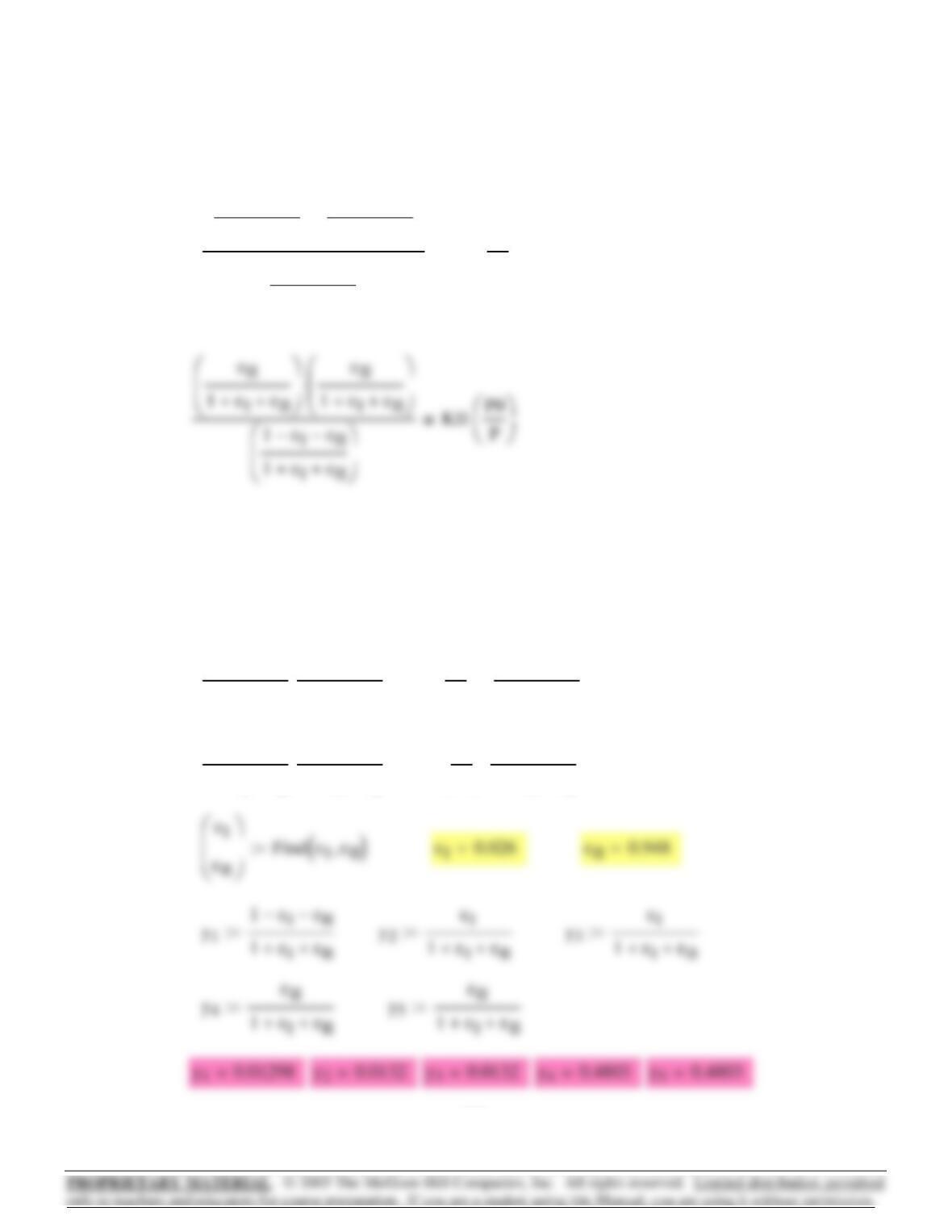
εII
1εI
+ε
II
+
εII
1εI
+ε
II
+
⋅KII P0
P
⎛
⎜
⎝
⎞
⎠
⋅1εI
−ε
II
−
1εI
+ε
II
+
⋅=
εI
1εI
+ε
II
+
εI
1εI
+ε
II
+
⋅KI P0
P
⎛
⎜
⎝
⎞
⎠
⋅1εI
−ε
II
−
1εI
+ε
II
+
⎛
⎜
⎝
⎞
⎠
⋅=
Given
εII 0.5:=εI0.5:=
Guess:
Use a Mathcad solve block to solve these two equations for εI and εII. Note
that the equations have been rearranged to facilitate the numerical
solution.
⎜
⎜
⎜
⎜
εI
1εI
+ε
II
+
⎛
⎜
⎝
⎞
⎠
εI
1εI
+ε
II
+
⎛
⎜
⎝
⎞
⎠
⋅
1εI
−ε
II
−
1εI
+ε
II
+
⎛
⎜
⎝
⎞
⎠
KI P0
P
⎛
⎜
⎝
⎞
⎠
⋅=
Substitution yields the following equations:
535
∆A 0.258−=
⎜
b) K1exp ∆H0
RT0⋅1T0
T
−
⎛
⎜
⎝
⎞
⎠
⋅
⎡
⎢
⎣
⎤
⎥
⎦
:= Eqn. (13.22) K10.364=
⎜
A summary of the values for the other temperatures is given in the table below.
T = 750 K 1000 K 1250 K
y1 0.0130 0.00047 0.00006
y2 0.0132 0.034 0.0593
y3 0.0132 0.034 0.0593
y4 0.4803 0.4658 0.4407
y5 0.4803 0.4658 0.4407
13.49 n-C4H10(g) -> iso-C4H10(g)
T0 298.15kelvin:= P0 1bar:= T 425kelvin:= P 15bar:=
1 = n-C4H10(g) ∆H0f1 125790−J
mol
:= ∆G0f1 16570−J
mol
:=
2 = iso-C4H10(g) ∆H0f2 134180−J
mol
:= ∆G0f2 20760−J
mol
:=
∆H0 ∆H0f1
−∆H0f2
+:= ∆H0 8.39−kJ
mol
=
∆G0 ∆G0f1
−∆G0f2
+:= ∆G0 4.19−kJ
mol
=
∆A 1.935()−1.677()+:=
536
Substituting for yi yields: 1εe
−
()
φ2
⋅
εeφ1
⋅K=
This can be solved analytically for εe to get: εe
φ2
φ2Keφ1
⋅+
=
Calculate φi for each pure component using the PHIB function.
For n-C4H10:ω10.200:= Tc1 425.1kelvin:= Pc1 37.96bar:=
a) Assuming ideal gas behavior y2
y1
Ke
=
b) Assume the gas is an ideal solution. In this case Eqn. (13.27) applies.
i
yiφi
⋅
()
P
P0
⎛
⎜
⎝
⎞
⎠
ν−
K⋅=
⎡
⎢
⎣
⎤
⎥
⎦
∏Eqn. (13.27)
537
538