Accounting Information Systems, 10e 35
P-7: Follow up on open POs and receiving reports at BEPMIS.
Effectiveness goal A, vendor invoice input completeness, and vendor invoice
P-8: Select invoices for payment based on due dates.
Effectiveness goal A: Ensures that payments are made in a timely manner, not too
early and not too late (i.e., to optimize cash discounts).
P-9: Pay only open invoices and close invoices upon payment (independent
authorization to make payment) at BEPMIS.
Security of resources: Because cash cannot be expended in the absence of a
P-10: Follow up on open invoices at BEPMIS.
Effectiveness goal A, payment input completeness, and payment update
completeness: By following up on open invoices (i.e., those due for payment), we
can ensure that payments are made in time to take advantage of discounts (goal A)
and are input in a timely manner (input completeness). We assume that the AP
master data is updated simultaneously with the input of the payment data.
P-11: Digitally sign electronic payments.
Security of resources, payment input validity, payment input completeness,
payment input accuracy, payment update completeness, and payment update
36 Solutions for Chapter 13
P-12: Follow up on open invoices (at IPP).
Effectiveness goal A, payment input completeness, and payment update
P-13: CO and DO approval required for payment.
Security of resources, payment input validity, and payment input accuracy: A
contracting officer and a disbursing officer review each PIF to ensure that each
payment is authorized (validity), accurate, and is not a misuse of resources.
M-1: Independent validation of vendor invoices at IPP does not include a match to the
receiving report.
M-2: Reconcile batch totals for invoices and invoice changes.
Efficient employment of resources: Using batch totals to reconcile the invoice data
is more efficient than reviewing each invoice.
Security of resources and vendor invoice input validity: Determining that invoice
M-3: Programmed edits for formatted and translated invoice data.
Vendor invoice input accuracy and vendor invoice update accuracy: Edits at
M-4: Programmed edits for formatted and translated payment data.
Accounting Information Systems, 10e 37
M-5: Reconcile payments made by BEPMIS to PIF totals.
Efficient employment of resources: Using batch totals to reconcile the payment
data is more efficient than reviewing each payment.
M-6: Reconcile approved payments to PIF totals.
Efficient employment of resources: Using batch totals to reconcile the payment
data is more efficient than reviewing each payment.
M-7: Reconcile ACH totals to PIF totals and approved PIF totals.
Efficient employment of resources: Using batch totals to reconcile the payment
data is more efficient than reviewing each payment.
M-8: Reconcile payment made by ACH to ACH file (and PIF totals and BEPMIS
payment totals).
38 Solutions for Chapter 13
Efficient employment of resources: Using batch totals to reconcile the payment
data is more efficient than reviewing each payment.
Solution Note: Several controls not described in the previous list could be
included in the solution to this problem, as present or missing, depending on
assumptions made. For example:
• At each data entry location, we could include automated data entry,
preformatted screens, online prompting, and confirm input acceptance.
• As data is entered into the system, we might find programmed edit checks,
populate input screens with master data, and compare input data with master
data.
Accounting Information Systems, 10e 39
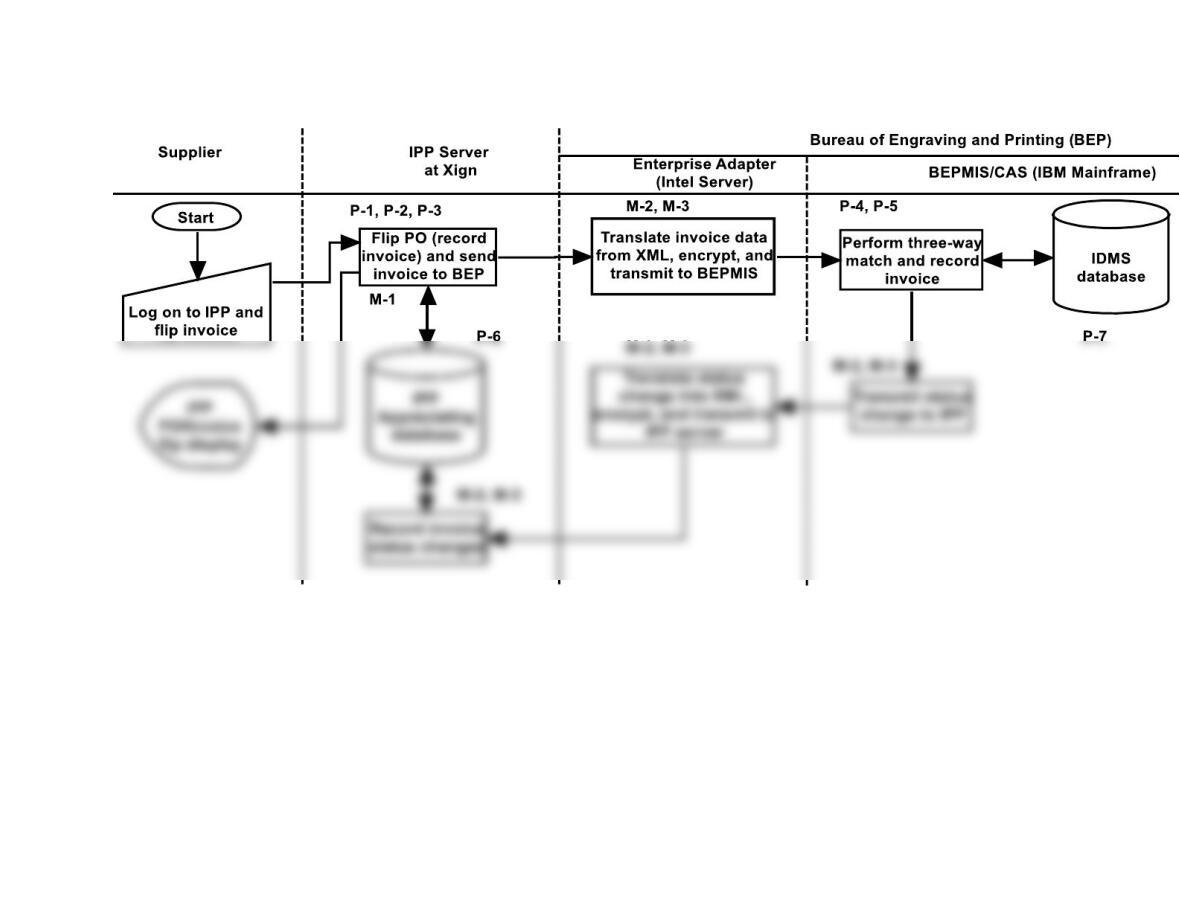
FIGURE SM-13.12 Problem 2, Part c Solution—Annotated Systems Flowchart for Internet Payment Platform
(Accounts Payable and Cash Disbursements Processes)
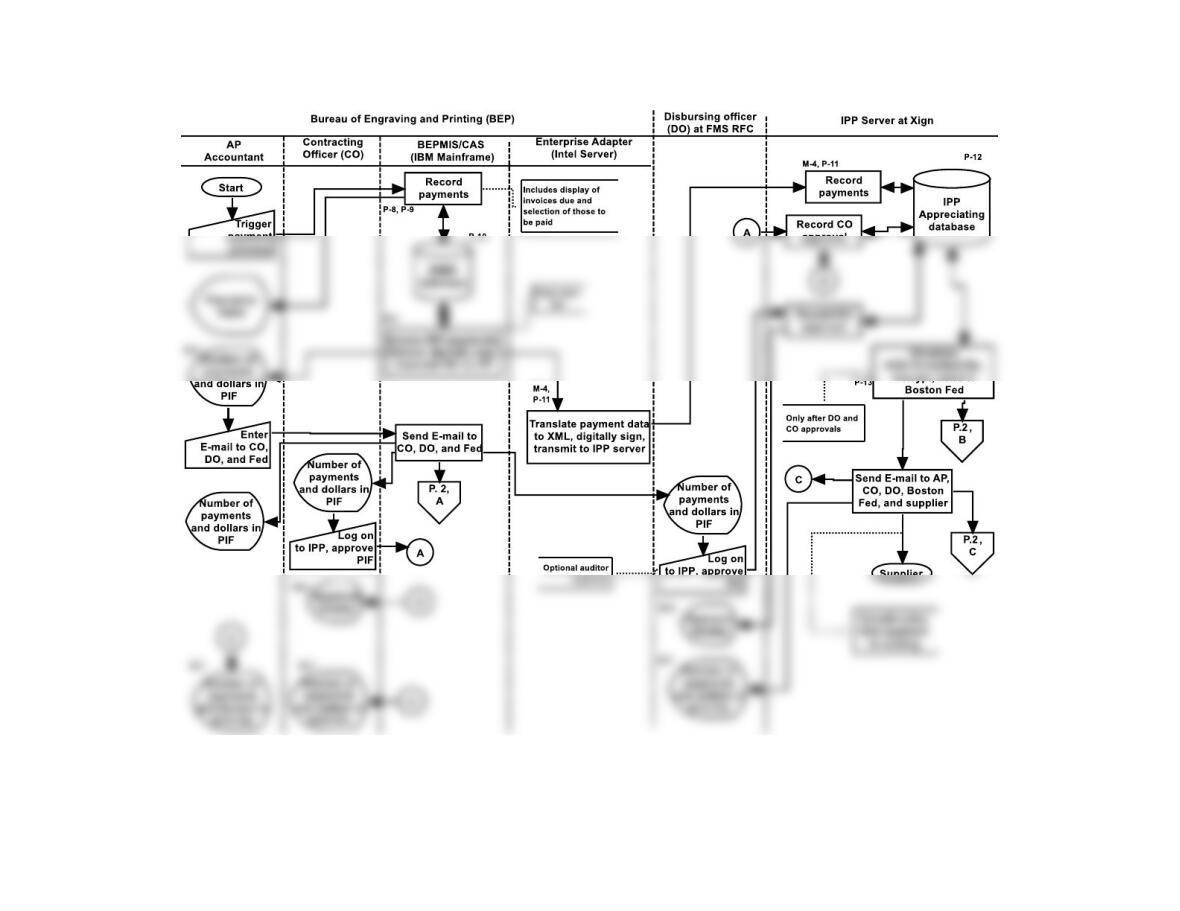
40 Solutions for Chapter 13
FIGURE SM-13.12 Problem 2, Part c Solution—Annotated Systems Flowchart (continued)
Accounting Information Systems, 10e 41
Supplier‘s Bank
Federal Reserve Bank
FedACH System
Federal Reserve Bank of Boston
P. 1,
C
P. 1,
B
Read e–mail
Number of
payments
and dollars
in ACH file
ACH–Form atted
file
P. 1,
A
Read e–mail
Number of
payments
and dollars
in PIF M-7
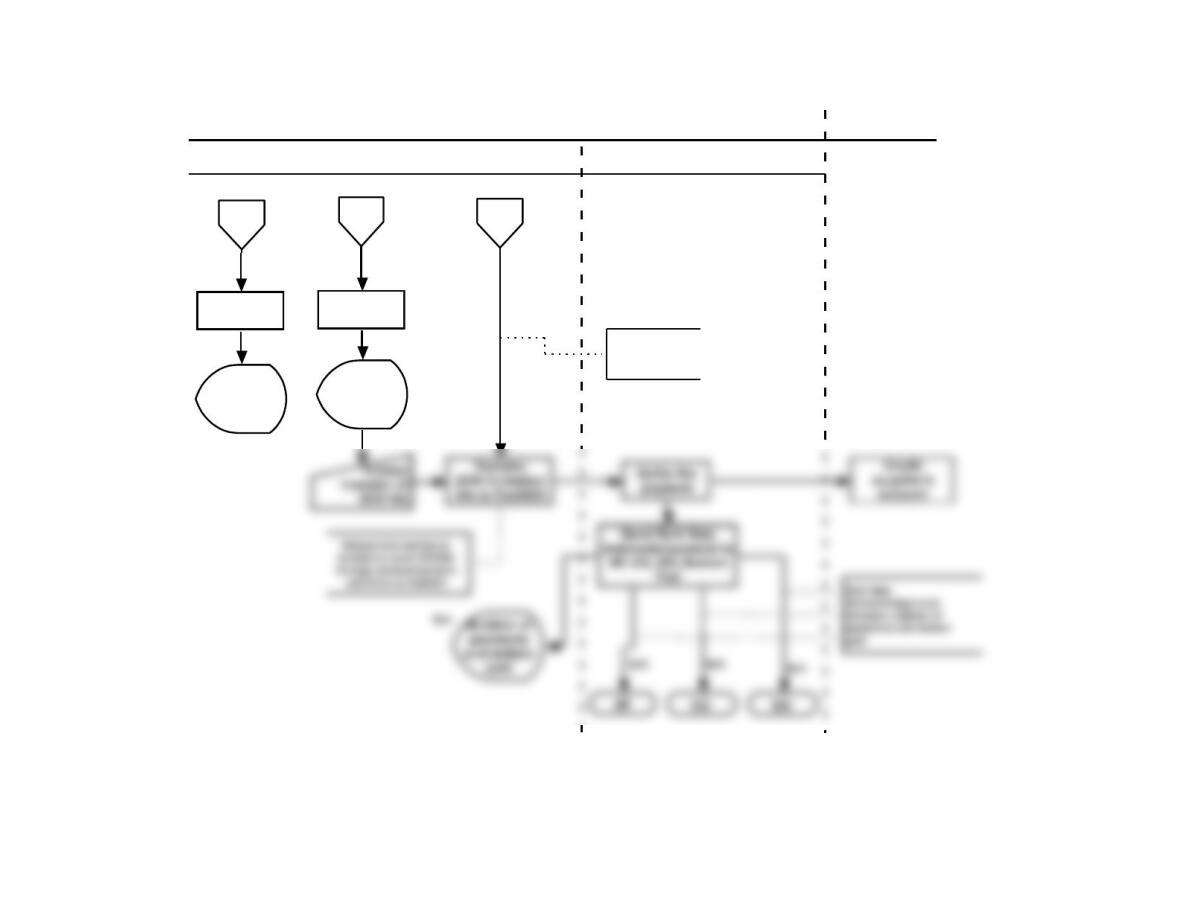
FIGURE SM-13.12 Problem 2, Part c Solution—Annotated Systems Flowchart (continued)
42 Solutions for Chapter 13
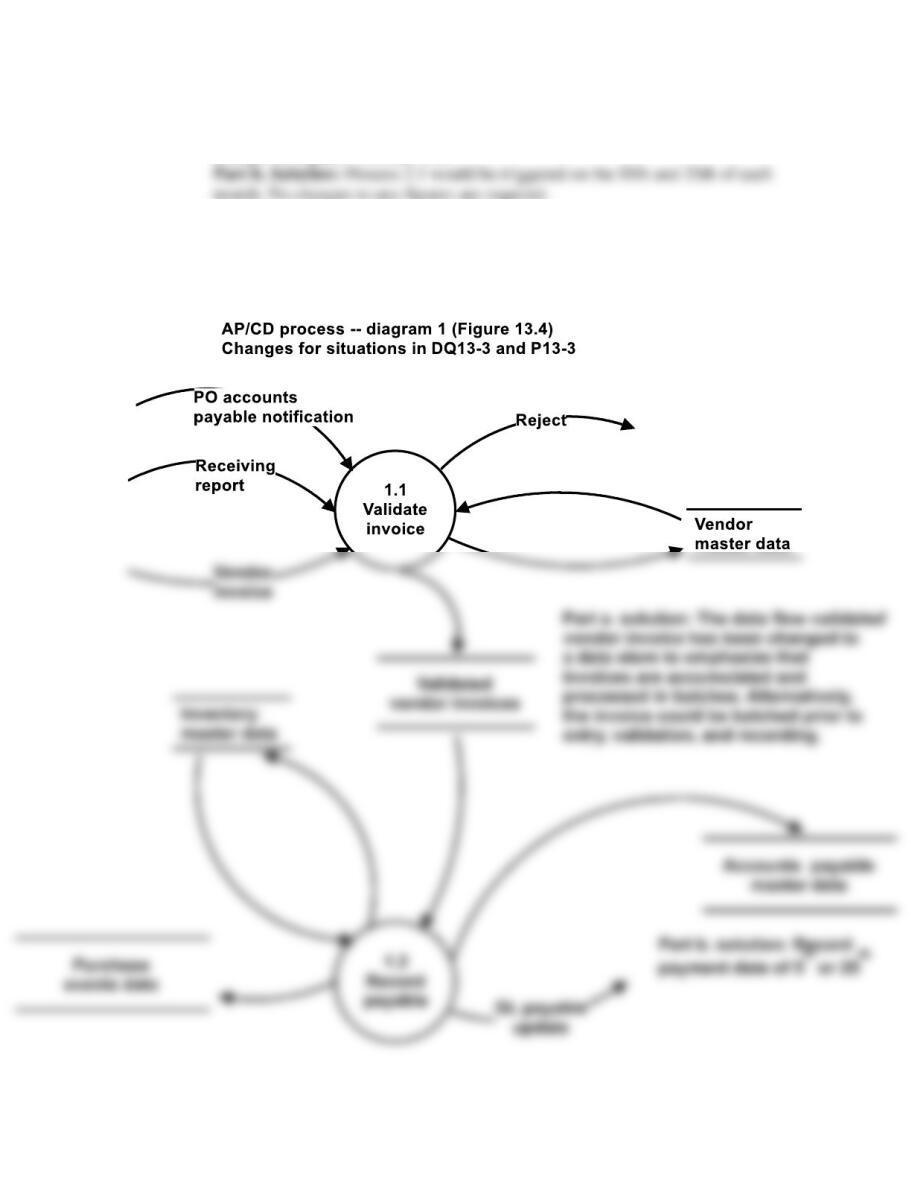
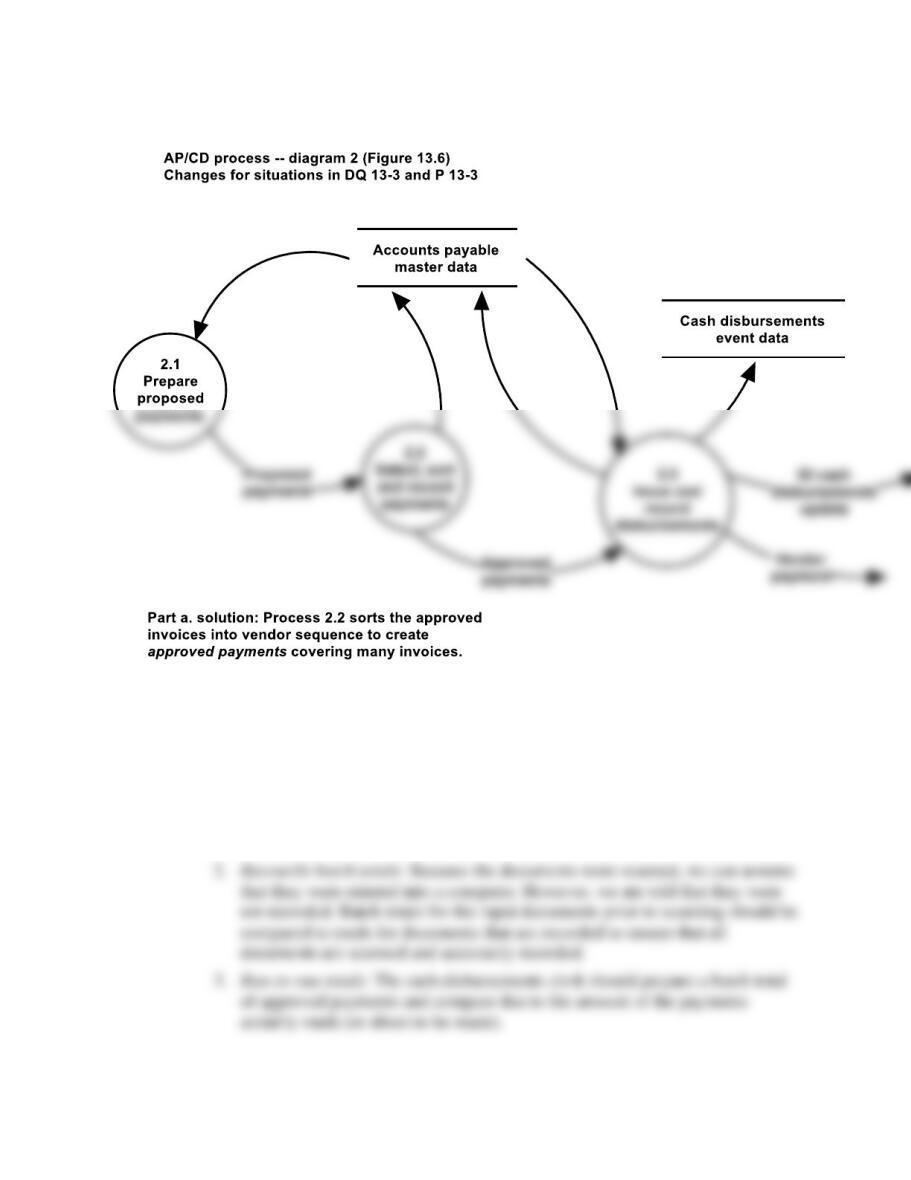
P 13-3 ANS. Part a. Solution: There are no changes to Figure 13.3. See Figure SM-13.13 for
changes to Figures 13.4 and 13.6.
Accounting Information Systems, 10e 43
FIGURE SM-13.13 Problem 3 Solution
FIGURE SM-13.13 Problem 3 Solution (continued)
P 13-4 ANS. 1. Check digit (a programmed edit): This control will detect most keying errors
(such as transpositions) as the number is input. It is best suited to numbers
such as credit card numbers, customer numbers, and vendor numbers where
the check digit is calculated, appended to the account numbers, and used each
time the account number is entered to ensure that the number has been
accurately entered.
44 Solutions for Chapter 13
4. Cash planning report: An aging of open accounts payable should be produced
on a regular basis and reviewed by the treasurer to ensure that sufficient funds
are available to pay obligations in a timely manner.
7. Match invoice with PO: Accounts payable should not create a payable without
an open PO. When the PO is used to validate the invoice, it should then be
marked as closed (or linked to the invoice) so that it cannot be used again. If
this process is followed, the second or duplicate invoice would have been
discovered because no PO would match to the invoice.
8. Reconcile run-to-run totals: If the GL is updated as a batch, then a
reconciliation of batch totals, or run-to-run totals, would detect any errors.
P 13-5 ANS. A. GL inventory received update
NOTE : Situations 3–5 do not apply to this flow.
1. Merchandise is purchased, and a periodic inventory process is used.
No entry is made (Note A)
Accounting Information Systems, 10e 45
2.Merchandise is purchased, and a perpetual inventory process is used.
Dr. Clearing account (Note A)
Cr. Accounts payable
Cr. Accounts payable
C. GL cash disbursement update
NOTE: The same entry applies to all five situations
Dr. Accounts payable
Cr. Cash (Note C)
Notes: A. In a periodic inventory system, inventory balances are only calculated
and recorded at the end of each accounting period. However, under a perpetual
system, inventory is recorded as received. Because the vendor invoice is often
46 Solutions for Chapter 13
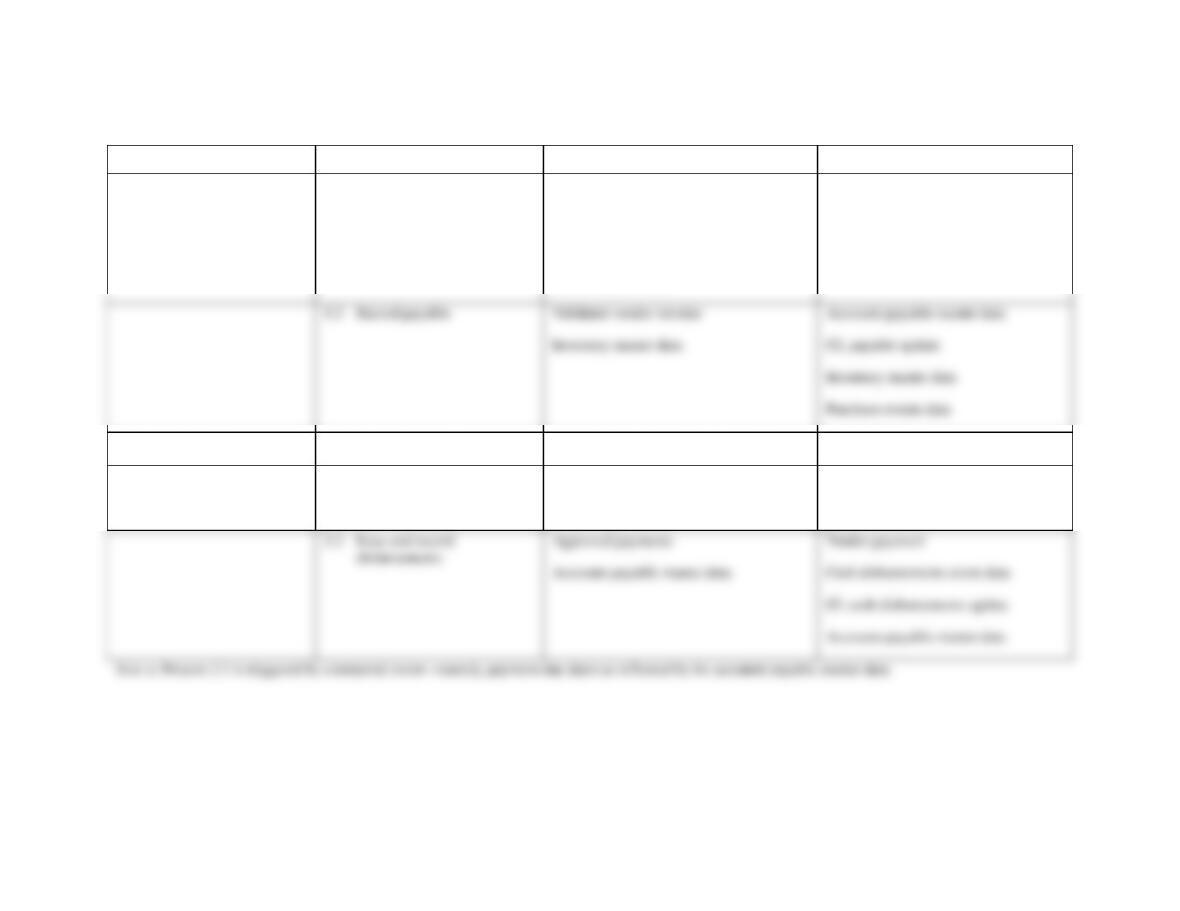
TABLE SM-13.1 Problem 6 Solution—Summary of AP/CD Process’s Processes, Inputs, Outputs, and Data
Process
Subsidiary Functions
Inputs
Outputs
1.0 Establish payable
1.1 Validate invoice
PO accounts payable notification
Receiving report
Vendor invoice
Vendor master data
Validated vendor invoice
Vendor master data
2.0 Make payment
2.1 Prepare proposed payments
Accounts payable master data (Note a)
Proposed payments
2.2 Select and record payments
Proposed payments
Accounts payable master data
Approved payments
Accounts payable master data
Accounting Information Systems, 10e 47
P 13-7 ANS.
1. J 6. I
P 13-8
ANS. Solutions will vary according to the tables selected. However, the following guidelines
should be helpful for grading the solutions:
1. From the file, ensure that the tables are linked in relationships with cardinalities.
2. For the Visio/documentation software diagram, ensure that the symbols used are correct
and the cardinalities are shown.