13–61
FINANCIAL REPORTING PROBLEM (Continued)
Purchase Commitments
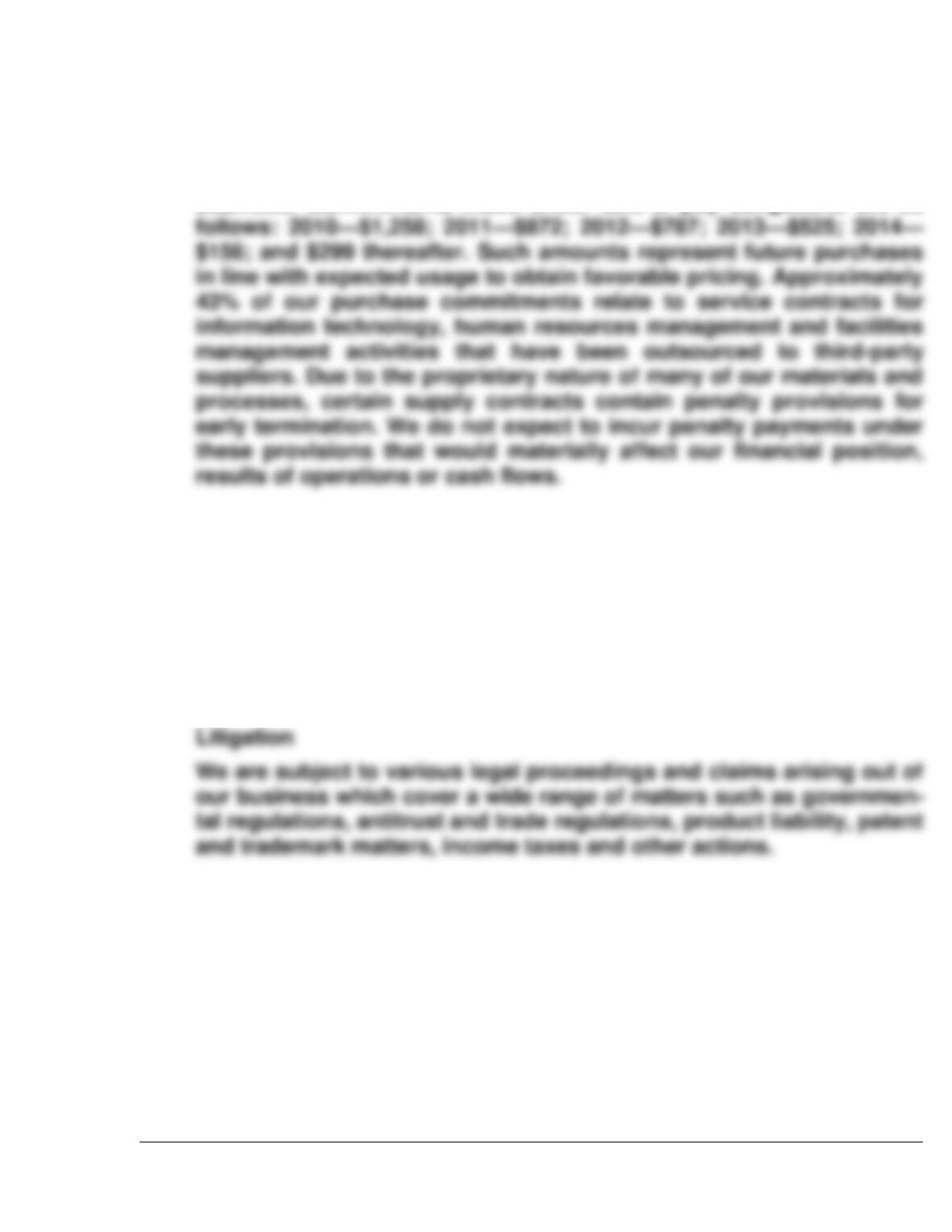
We have purchase commitments for materials, supplies, services and
property, plant and equipment as part of the normal course of
business. Commitments made under take-or-pay obligations are as
Operating Leases
We lease certain property and equipment for varying periods. Future
minimum rental commitments under noncancelable operating leases
are as follows: 2010—$305; 2011—$272; 2012—$223; 2013—$202;
2014—$176; and $442 thereafter. Operating lease obligations are shown
net of guaranteed sublease income.
13–62
FINANCIAL REPORTING PROBLEM (Continued)
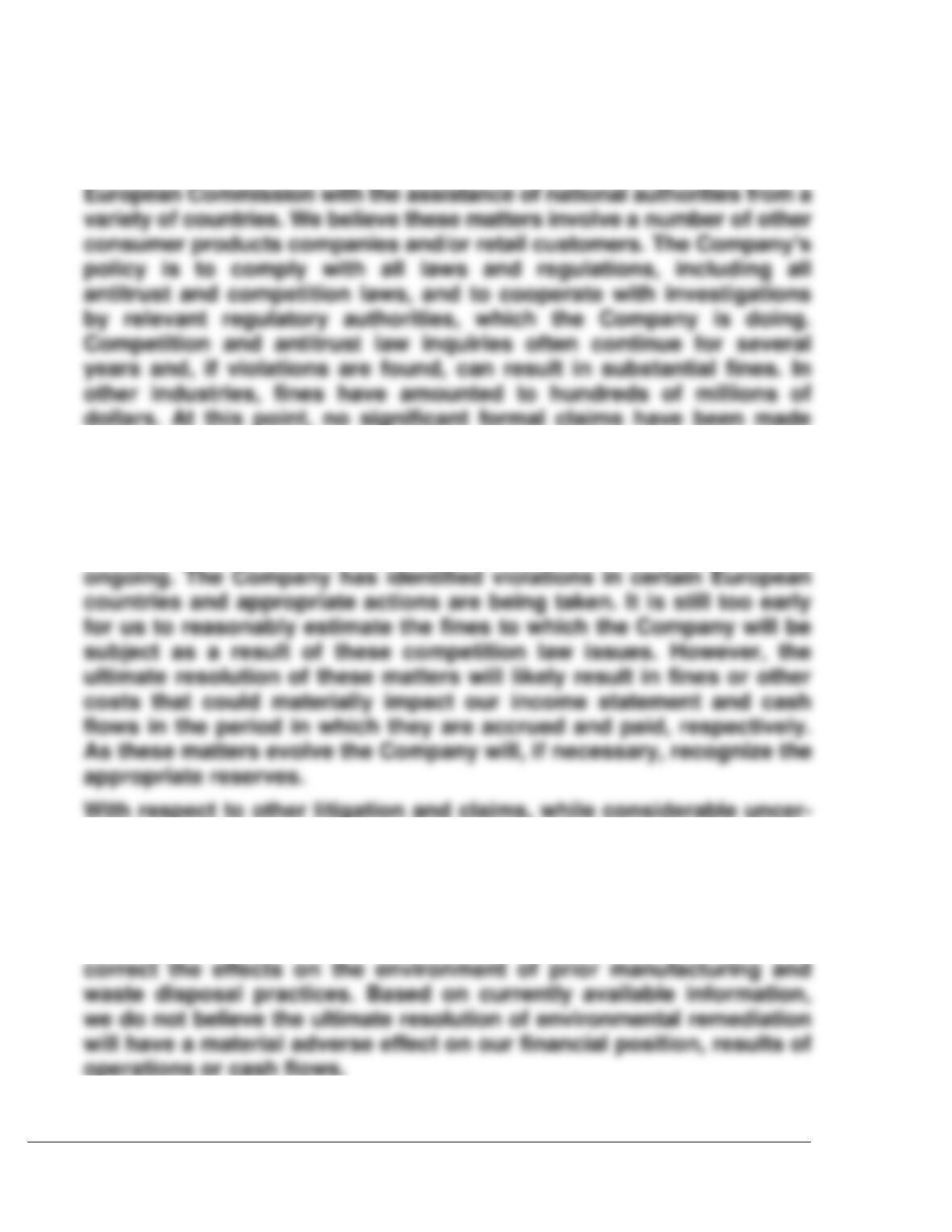
As previously disclosed, the Company is subject to a variety of inves–
tigations into potential competition law violations in Europe, including
investigations initiated in the fourth quarter of fiscal 2008 by the
against the Company or any of our subsidiaries in connection with
any of the above inquiries.
In response to the actions of the European Commission and national
authorities, the Company has launched its own internal investigations
into potential violations of competition laws, some of which are
tainty exists, in the opinion of management and our counsel, the
ultimate resolution of the various lawsuits and claims will not materially
affect our financial position, results of operations or cash flows.
We are also subject to contingencies pursuant to environmental laws
and regulations that in the future may require us to take action to
13–63
COMPARATIVE ANALYSIS CASE
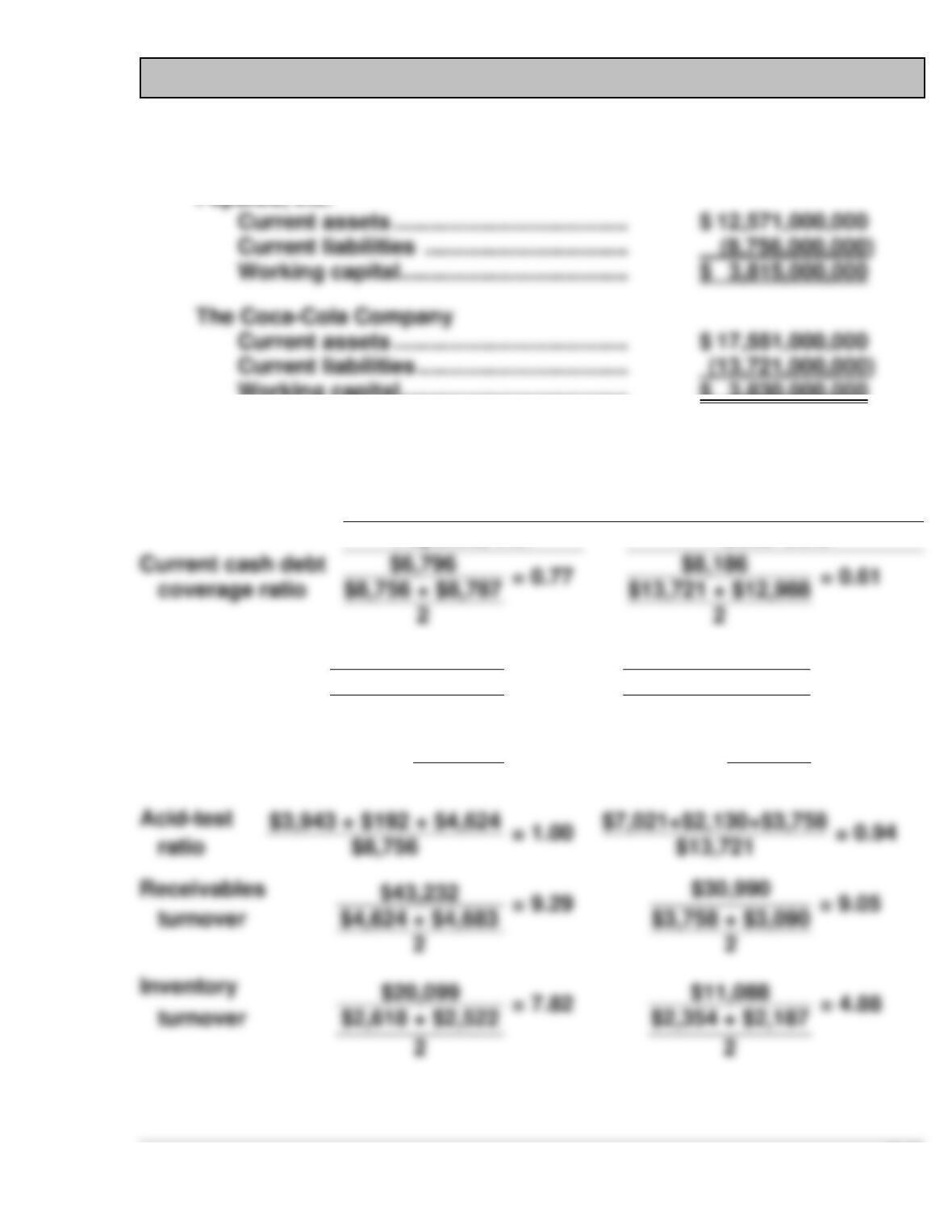
(a) The working capital position of the two companies is as follows:
PepsiCo, Inc.
Working capital ………………………………. $ 3,830,000,000
(b) The overall liquidity of both companies is good as indicated from the
ratio analysis provided below:
(all computations in millions)
PepsiCo, Inc.
Coca-Cola
Current cash debt
= 0.77
$8,186
= 0.61
coverage ratio
$8,756 + $8,787
$13,721 + $12,988
Cash debt
$6,796
= 0.30
$8,186
= 0.38
coverage ratio
$22,406+$23,412
$23,325 + $19,657
2
2
Current ratio
$12,751
= 1.46
$17,551
= 1.28
$8,756
$13,721
Acid-test
turnover
$3,758 + $3,090
13–64
COMPARATIVE ANALYSIS CASE (Continued)
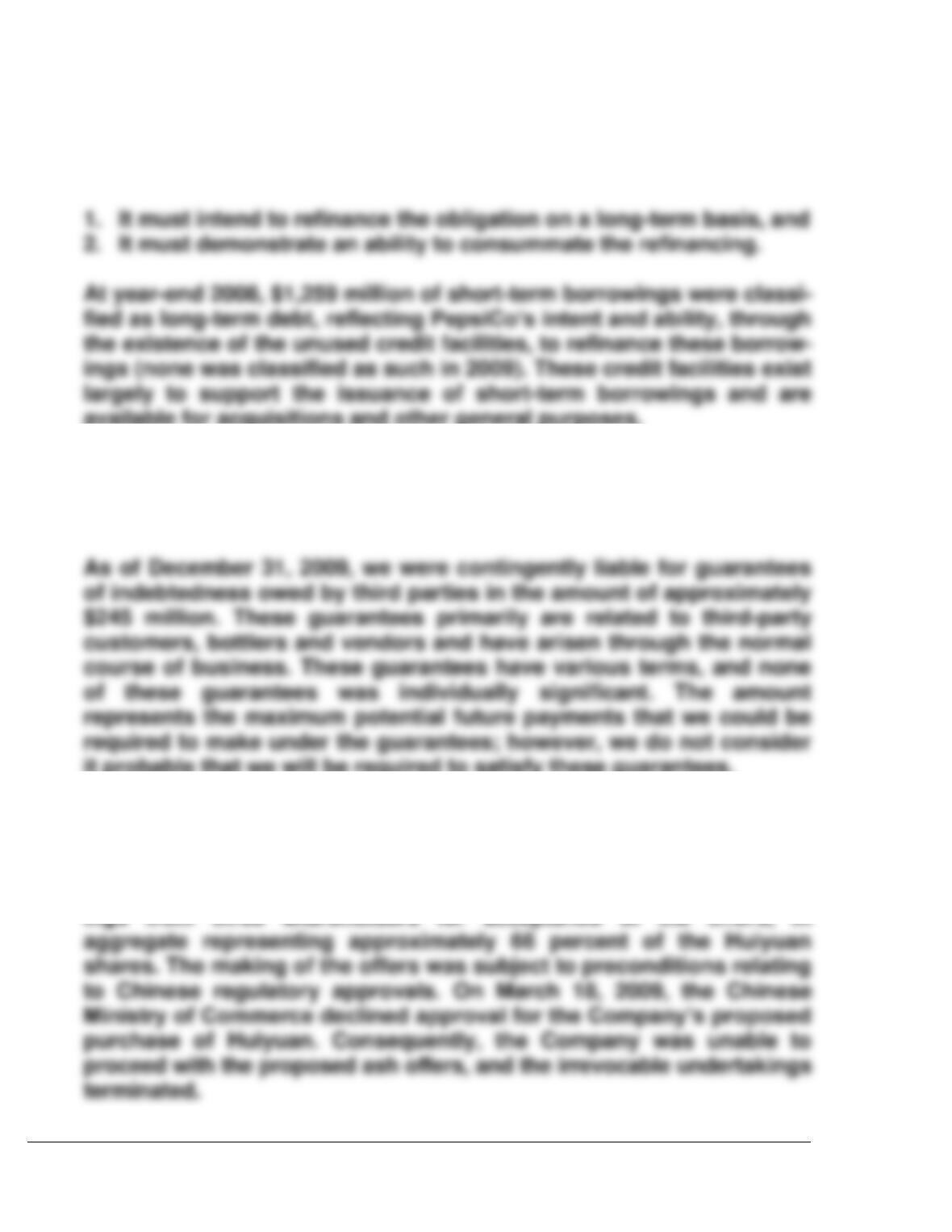
(c) As indicated in the chapter, a company can exclude a short-term obli-
gation from current liabilities only if both of the following conditions
are met:
available for acquisitions and other general purposes.
(d) Coca-Cola discusses its contingencies in the following note:
Note 8: COMMITMENTS AND CONTINGENCIES (in part)
it probable that we will be required to satisfy these guarantees.
On September 3, 2008, we announced our intention to make cash
offers to purchase China Huiyuan Juice Group Limited, a Hong Kong
listed company which owns the Huiyuan juice business throughout
China (‘‘Huiyuan’’). The Company had accepted irrevocable undertak–
13–65
COMPARATIVE ANALYSIS CASE (Continued)
We believe our exposure to concentrations of credit risk is limited due
to the diverse geographic areas covered by our operations.
The Company is involved in various legal proceedings. We establish
NOTE 2: COMMITMENTS AND CONTINGENCIES
We are subject to various claims and contingencies related to lawsuits,
taxes and environmental matters, as well as commitments under con-
tractual and other commercial obligations. We recognize liabilities for
contingencies and commitments when a loss is probable and estimable.
For additional information on our commitments, see Note 9.
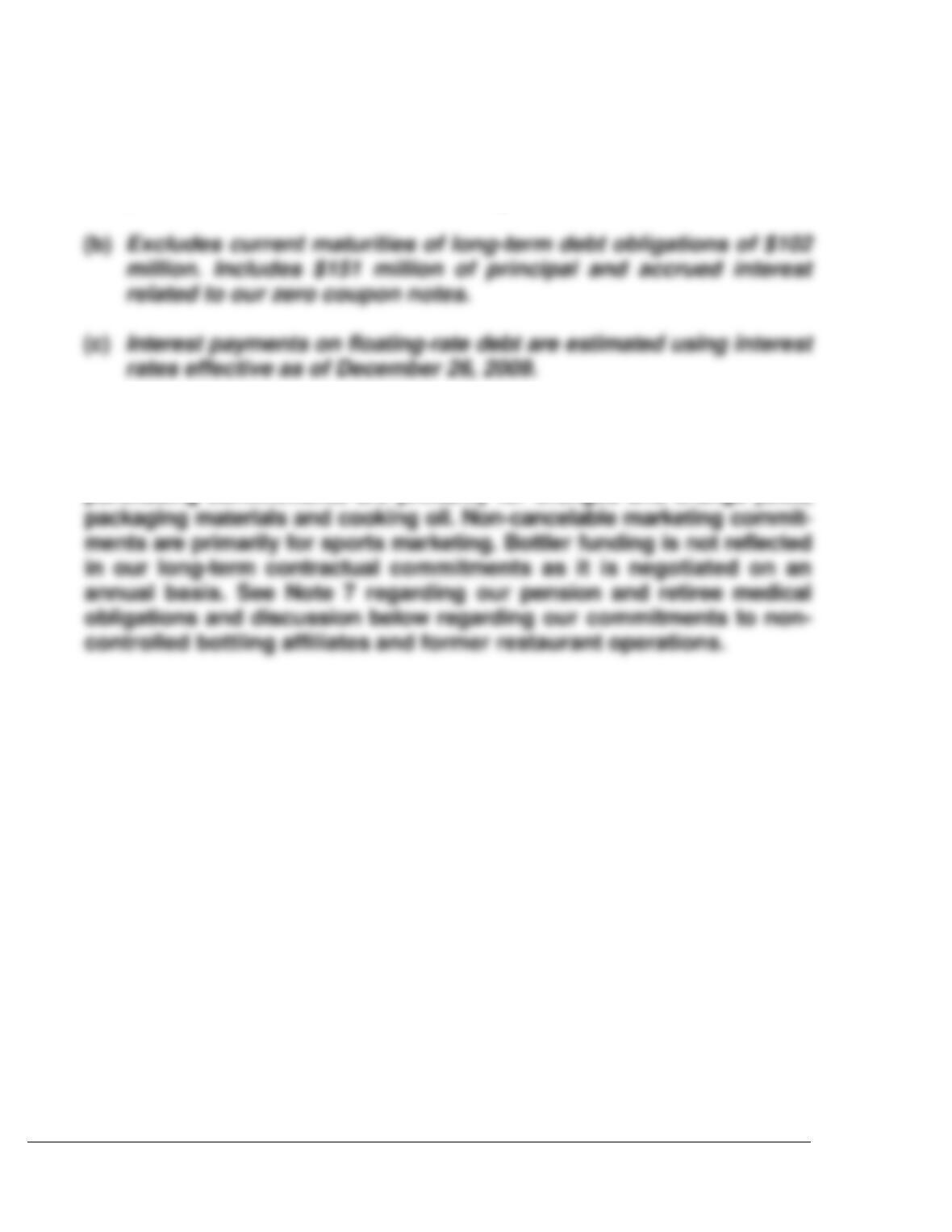
NOTE 9—DEBT OBLIGATIONS AND COMMITMENTS (in part)
Long-Term Contractual
Commitments(a)
Payments Due by period
Purchasing commitments
Marketing commitments
2011–
2013–
2015
and
13–66
COMPARATIVE ANALYSIS CASE (Continued)
(a) Reflects non-cancelable commitments as of December 26, 2009
based on year-end foreign exchange rates and excludes any
reserves for uncertain tax positions as we are unable to reasonably
predict the ultimate amount or timing of settlement.
Most long-term contractual commitments, except for our long-term
debt obligations, are not recorded on our balance sheet. Non-cancelable
operating leases primarily represent building leases. Non-cancelable
purchasing commitments are primarily for oranges and orange juice,
FINANCIAL STATEMENT ANALYSIS CASE 1
NORTHLAND CRANBERRIES
(a) Working capital is calculated as current assets – current liabilities, while
the current ratio is calculated as current assets/current liabilities. For
Northland Cranberries these ratios are calculated as follows:
the next discussion point, there may well be a reasonable explanation.
(b) This illustrates a potential problem with ratios like the current ratio,
that rely on balance sheet numbers that present a company’s finan–
cial position at a particular point in time. That point in time may not be
representative of the average position of the company during the course
13–68
FINANCIAL STATEMENT ANALYSIS CASE 2
MOHICAN COMPANY
(a) Under the cash basis, warranty costs are charged to expense as they
are incurred; in other words, warranty costs are charged in the period
in which the seller or manufacturer performs in compliance with the
warranty. No liability is recorded for future costs arising from warranties,
nor is the period in which the sale is recorded necessarily charged
with the costs of making good on outstanding warranties.
(b) When the warranty is sold separately from the product, the sales war–
ranty approach is employed. Revenue on the sale of the extended
warranty is deferred and is generally recognized on a straight-line basis
over the life of the contract. Revenue is deferred because the seller of
the warranty has an obligation to perform services over the life of the
contract.
13–69
FINANCIAL STATEMENT ANALYSIS CASE 3
(a) BOP’s working capital and current ratio have declined in 2012 com–
pared to 2011. While this would appear to be bad news, the acid test
ratio has improved. This is due to BOP carrying relatively more liquid
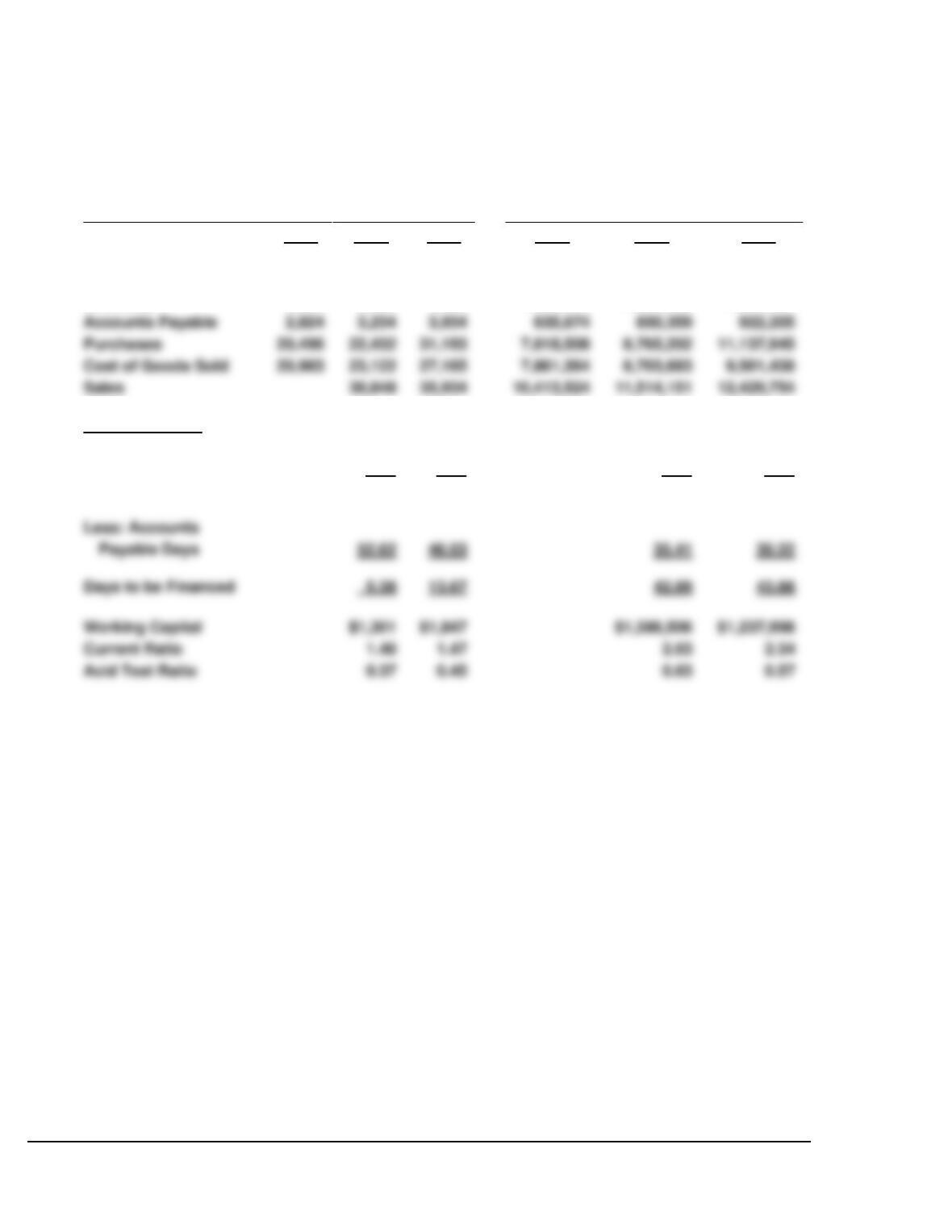
(b) Answers will vary depending on the companies selected. This activity
is a great spreadsheet exercise. The analysis for Best Buy and Circuit
City for the years 2005 – 2007 is presented below.
13–70
FINANCIAL STATEMENT ANALYSIS CASE 3 (Continued)
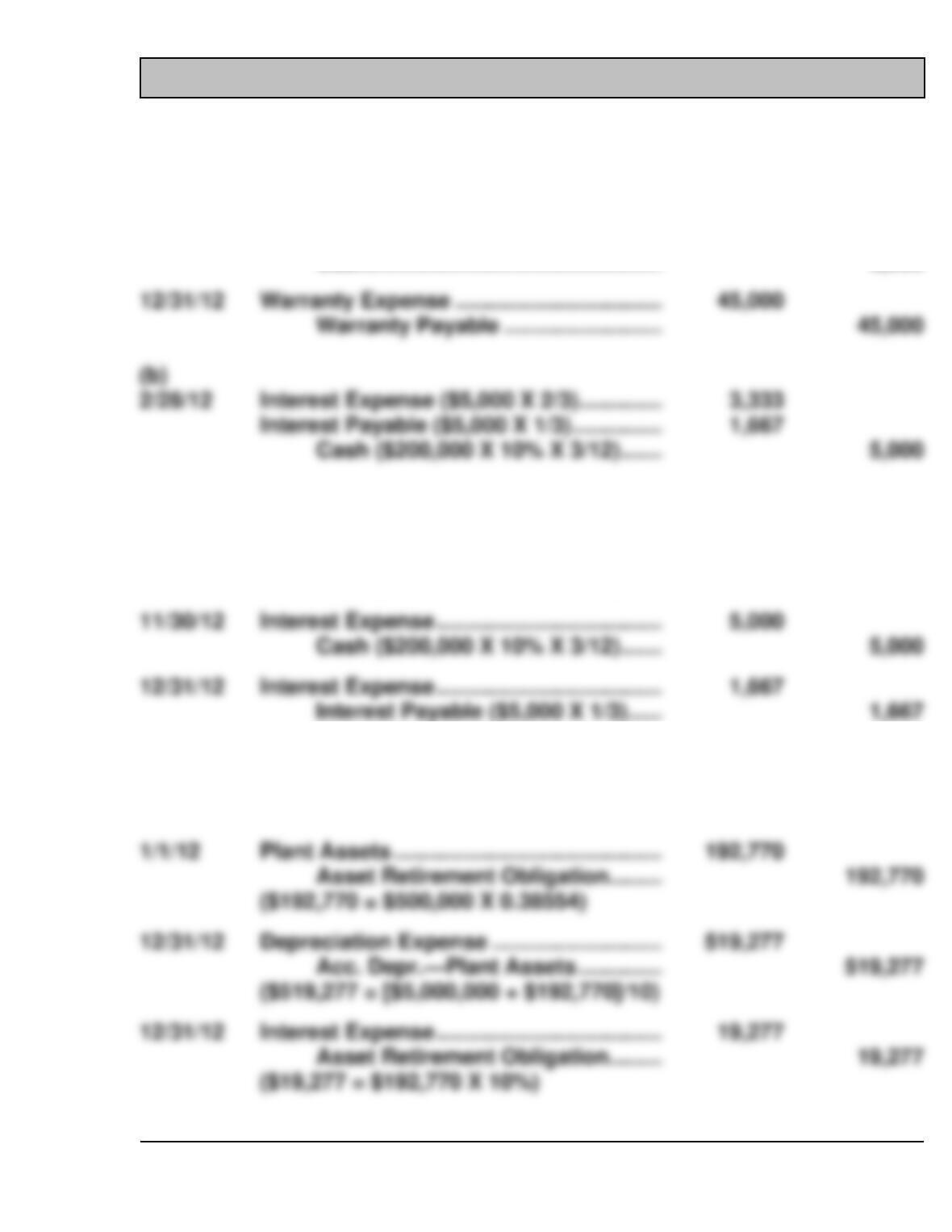
Note to Instructor: Although the analysis above is for 2005 – 2007,
this analysis is particularly useful as Circuit City subsequently filed
for bankruptcy.
Best Buy (in millions)
Circuit City (in thousands)
2005
2006
2007
2005
2006
2007
Cash
$ 470
$748
1,205
879,660
315,970
141,141
Accounts Receivable
375
449
548
230,605
222,869
382,555
Inventory
2,851
3,338
4,028
1,455,170
1,698,026
1,636,507
Operating Cycle
Receivable Days
5.3
5.6
7.1
11.2
Inventory Days
52.7
54.1
71.2
62.9
Operating Cycle
58.0
59.7
78.3
74.1
Days to be Financed
13.67
Working Capital
$1,301
Current Ratio
1.40
1.47
2.63
2.34
Acid Test Ratio
0.37
0.45
0.63
0.57
Accounts Payable
2,824
3,234
3,934
850,359
922,205
Purchases
22,432
7,618,508
8,765,202
Cost of Goods Sold
23,122
7,861,364
8,703,683
9,501,438
Sales
30,848
13–71
ACCOUNTING, ANALYSIS, AND PRINCIPLES
Accounting
(a)
During 2012
Warranty Expense …………………………………….
6,000
Cash…………………………………………………
6,000
5/31/12
Interest Expense ……………………………………….
5,000
Cash ($200,000 X 10% X 3/12) …………….
5,000
8/31/12
Interest Expense ……………………………………….
5,000
Cash ($200,000 X 10% X 3/12) …………….
5,000
11/30/12
Interest Expense ……………………………………….
5,000
Cash ($200,000 X 10% X 3/12) …………….
5,000
12/31/12
Interest Expense ……………………………………….
1,667
Interest Payable ($5,000 X 1/3) ……………
1,667
(c)
1/1/12
Plant Assets ……………………………………………..
5,000,000
Cash…………………………………………………
5,000,000
1/1/12
Plant Assets ……………………………………………..
Asset Retirement Obligation ………………
12/31/12
Depreciation Expense …………………………..
519,277
Acc. Depr.—Plant Assets …………………..
($519,277 = [$5,000,000 + $192,770]/10)
12/31/12
Interest Expense ……………………………………….
Asset Retirement Obligation ………………
12/31/12
Warranty Expense …………………………………….
Warranty Payable …………………………..
(b)
2/28/12
Interest Expense ($5,000 X 2/3) …………………..
Interest Payable ($5,000 X 1/3) ……………………
1,667
Cash ($200,000 X 10% X 3/12) …………….
5,000
13–72
ACCOUNTING, ANALYSIS, AND PRINCIPLES (Continued)
Analysis
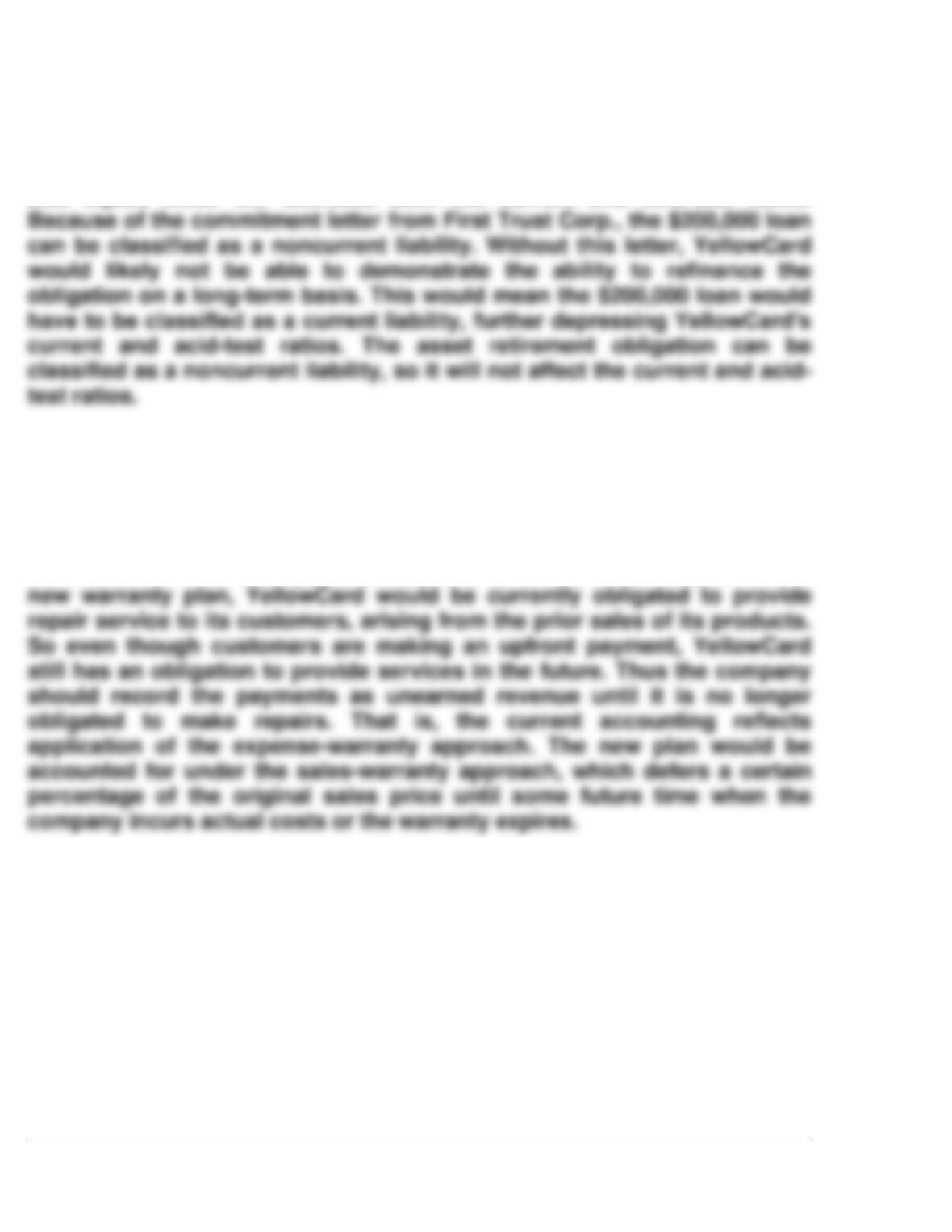
The warranty liability and the interest payable are current liabilities, so all
else equal, these will decrease both the current and acid-test ratios.
Principles
According to FASB Concepts Statement No. 6, liabilities are probable
future sacrifices of economic benefits arising from present obligations of a
particular entity to transfer assets or provide services to other entities in
the future as a result of past transactions or events. With respect to the
PROFESSIONAL RESEARCH
(a) FASB ASC 605-20-25 addresses how revenue and costs from a
separately priced extended warranty or product maintenance contract
should be recognized.
contract.
Separately Priced Contracts are agreements under which the customer
has the option to purchase an extended warranty or a product
maintenance contract for an expressly stated amount separate from
the price of the product.
FASB ASC 605-20–20-20 (Glossary)