Case 13-35 (45 minutes)
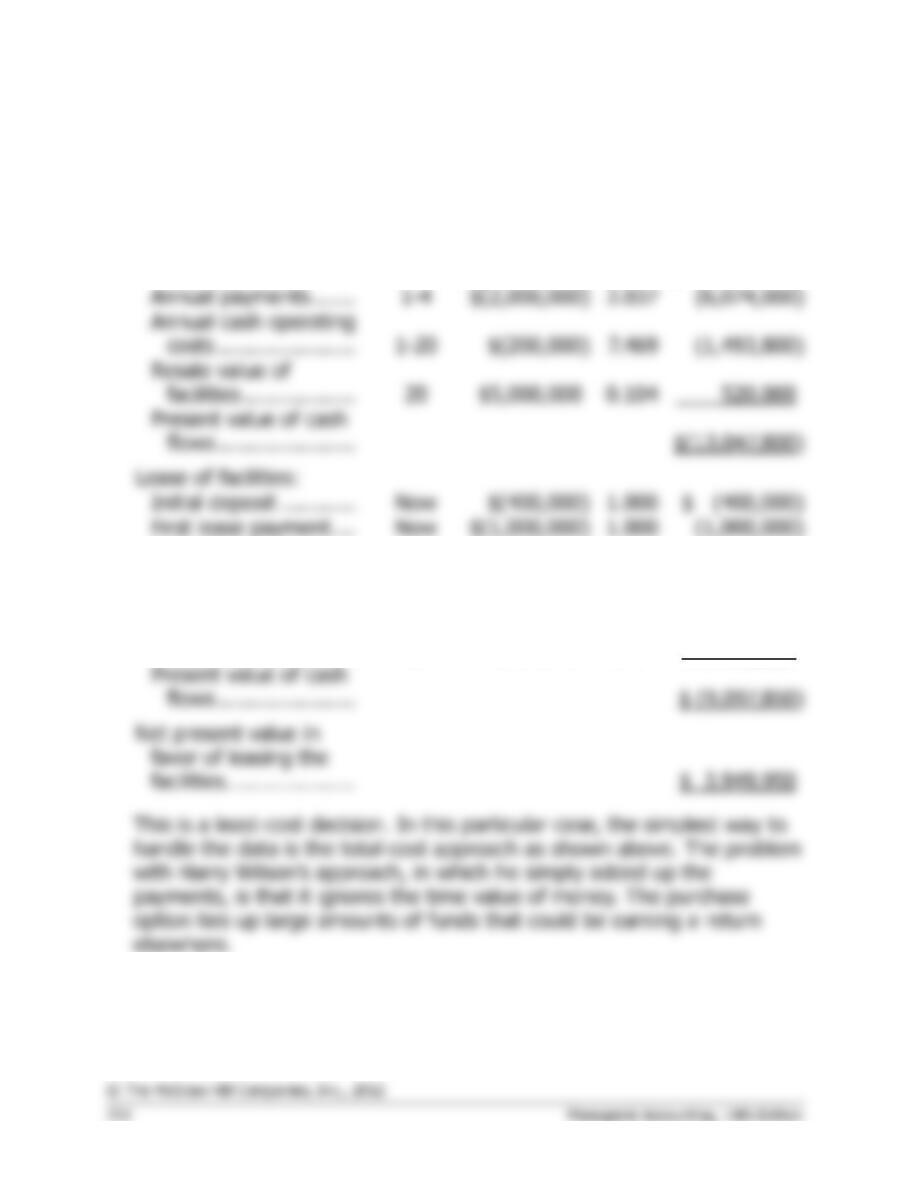
1. Perhaps the clearest approach to a solution is as follows:
Item
Year(s)
Amount of
Cash Flows
12%
Factor
Present Value
of Cash Flows
Purchase of facilities:
Initial payment ……….
Now
$(6,000,000)
1.000
$ (6,000,000)
Annual payments …….
$(2,000,000)
3.037
20
0.104
Lease of facilities:
First lease payment ….
Now
$(1,000,000)
1.000
Remaining lease
payments ……………
1-19
$(1,000,000)
7.366
(7,366,000)
Annual repair and
maintenance ………..
1-20
$(50,000)
7.469
(373,450)
Return of deposit …….
20
$400,000
0.104
41,600
Case 13-35 (continued)
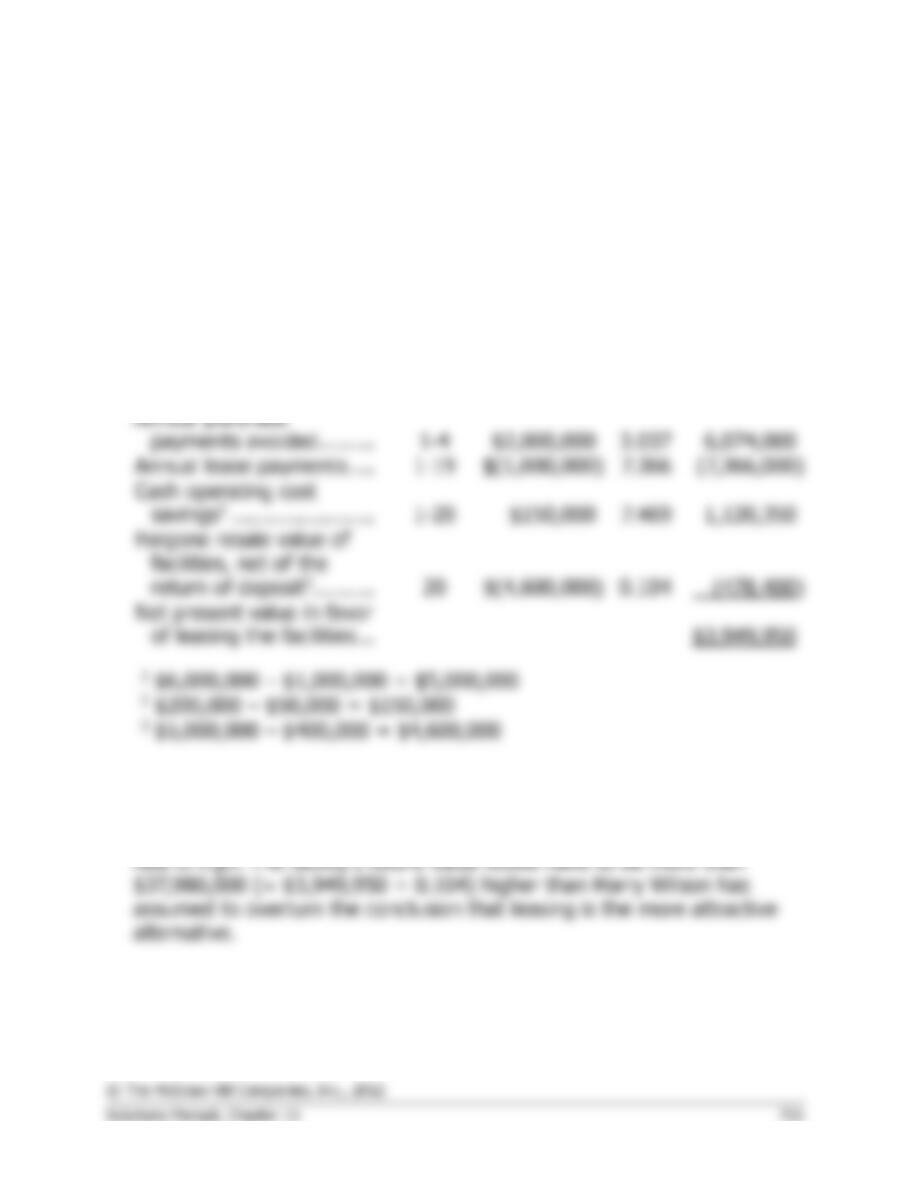
The incremental-cost approach is another way to organize the data,
although it is harder to follow and would not be as clear in a
presentation to the executive committee. The data could be arranged as
follows:
Lease rather than buy:
Item
Year(s)
Amount of
Cash Flows
12%
Factor
Present
Value of
Cash Flows
Initial payment avoided1 ..
Now
$5,000,000
1.000
$5,000,000
Deposit ………………………
Now
$(400,000)
1.000
(400,000)
0.104
(478,400)
$6,000,000 – $1,000,000 = $5,000,000
2. The present value of $5 million in 20 years is only $520,000 if the
company can invest its funds at 12%. Money to be received far into the
future is worth very little in terms of present value when the discount
Appendix 13A
The Concept of Present Value
Exercise 13A-1 (10 minutes)
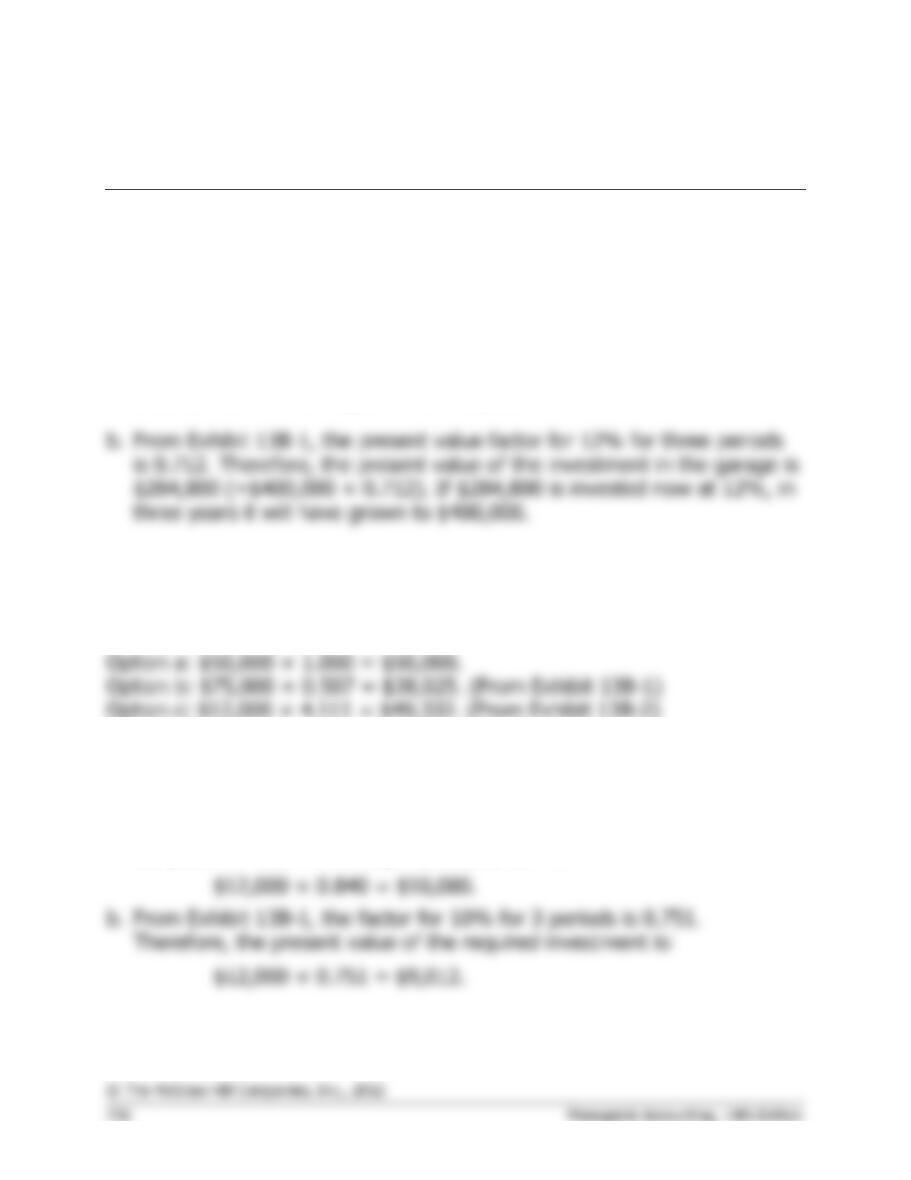
a. From Exhibit 13B-1, the present value factor for 8% for three periods is
0.794. Therefore, the present value of the investment in the garage is
$317,600 (=$400,000 × 0.794). If $317,600 is invested now at 8%, in
three years it will have grown to $400,000.
Exercise 13A-2 (10 minutes)
You should prefer option (a) because its present value is the largest:
Exercise 13A-3 (10 minutes)
a. From Exhibit 13B-1, the factor for 6% for 3 periods is 0.840. Therefore,
the present value of the required investment is:
Exercise 13A-4 (10 minutes)
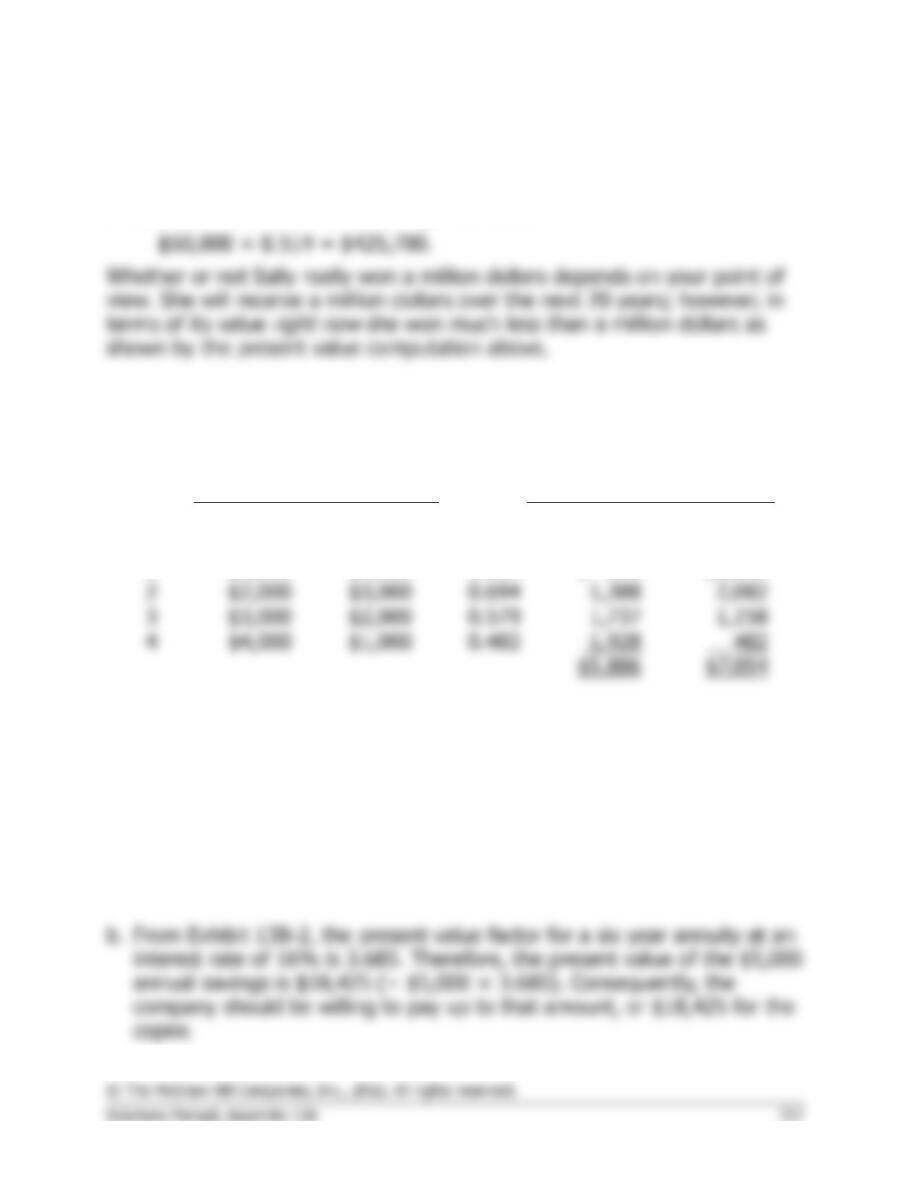
Looking in Exhibit 13B-2, the factor for 10% for 20 years is 8.514. Thus,
the present value of Sally’s winnings would be:
Exercise 13A-5 (10 minutes)
Amount of Cash Flows
Present Value of Cash
Flows
Year
Investment
X
Investment
Y
20%
Factor
Investment
X
Investment
Y
1
$1,000
$4,000
0.833
$ 833
$3,332
Exercise 13A-6 (10 minutes)
a. From Exhibit 13B-2, the present value factor for a six year annuity at an
interest rate of 10% is 4.355. Therefore, the present value of the $5,000
annual savings is $21,775 (= $5,000 × 4.355). Consequently, the
company should be willing to pay up to that amount, or $21,775 for the
copier.
Appendix 13C
Income Taxes in Capital Budgeting Decisions
Exercise 13C-1 (20 minutes)
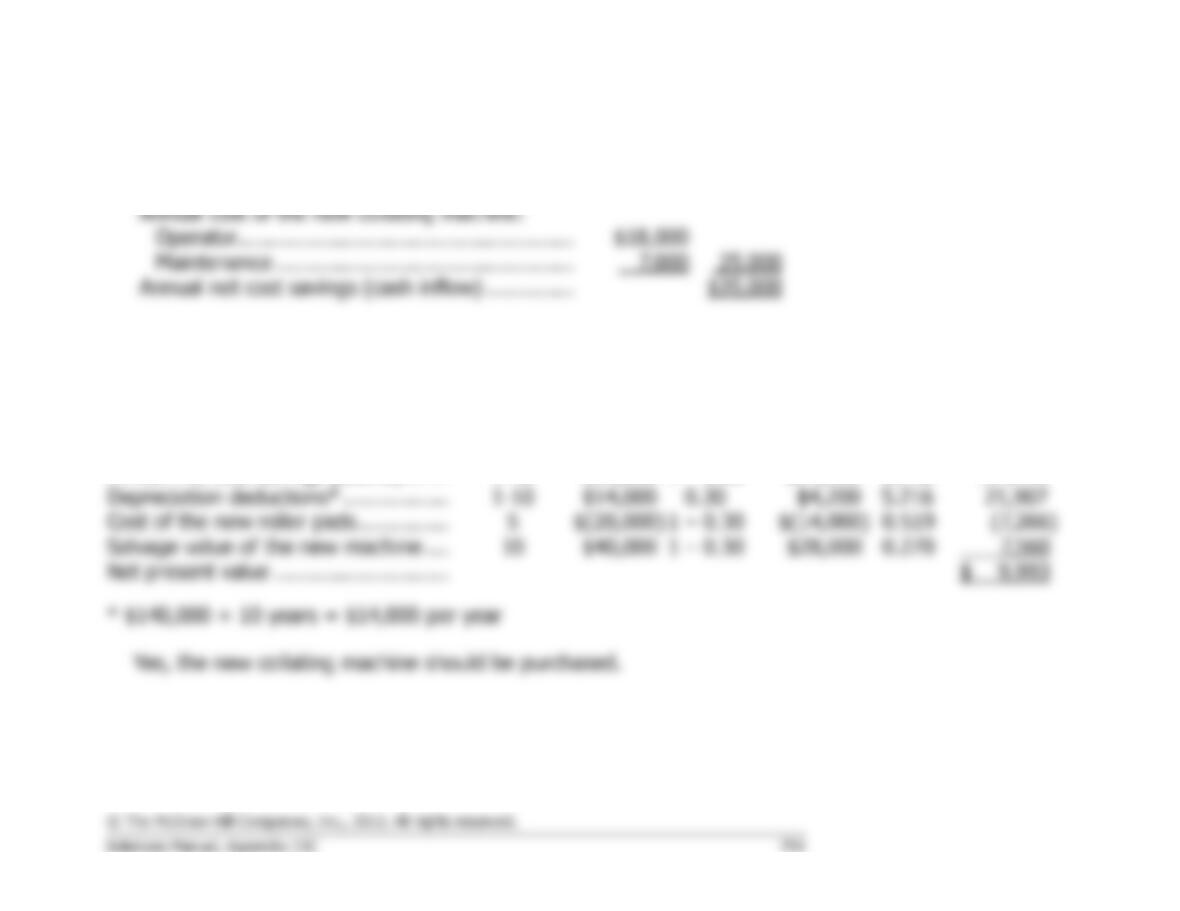
Items and Computations
Year(s)
(1)
Amount
(2)
Tax
Effect
(1) × (2)
After–Tax
Cash
Flows
10%
Factor
Present
Value of
Cash
Flows
Project A:
Investment in photocopier ………….
Now
$(50,000)
—
$(50,000)
1.000
$(50,000)
Annual net cash inflows ……………..
1-8
$9,000
1 – 0.30
$6,300
5.335
33,611
Net present value ……………………..
Project B:
Investment in working capital ……..
Now
$(50,000)
$(50,000)
1.000
$(50,000)
Annual net cash inflows ……………..
5.335
Release of working capital ………….
0.467
Exercise 13C-2 (20 minutes)
1.
Annual cost of student help in collating …………
$60,000
Annual cost of the new collating machine:
Annual net cost savings (cash inflow) …………..
$35,000
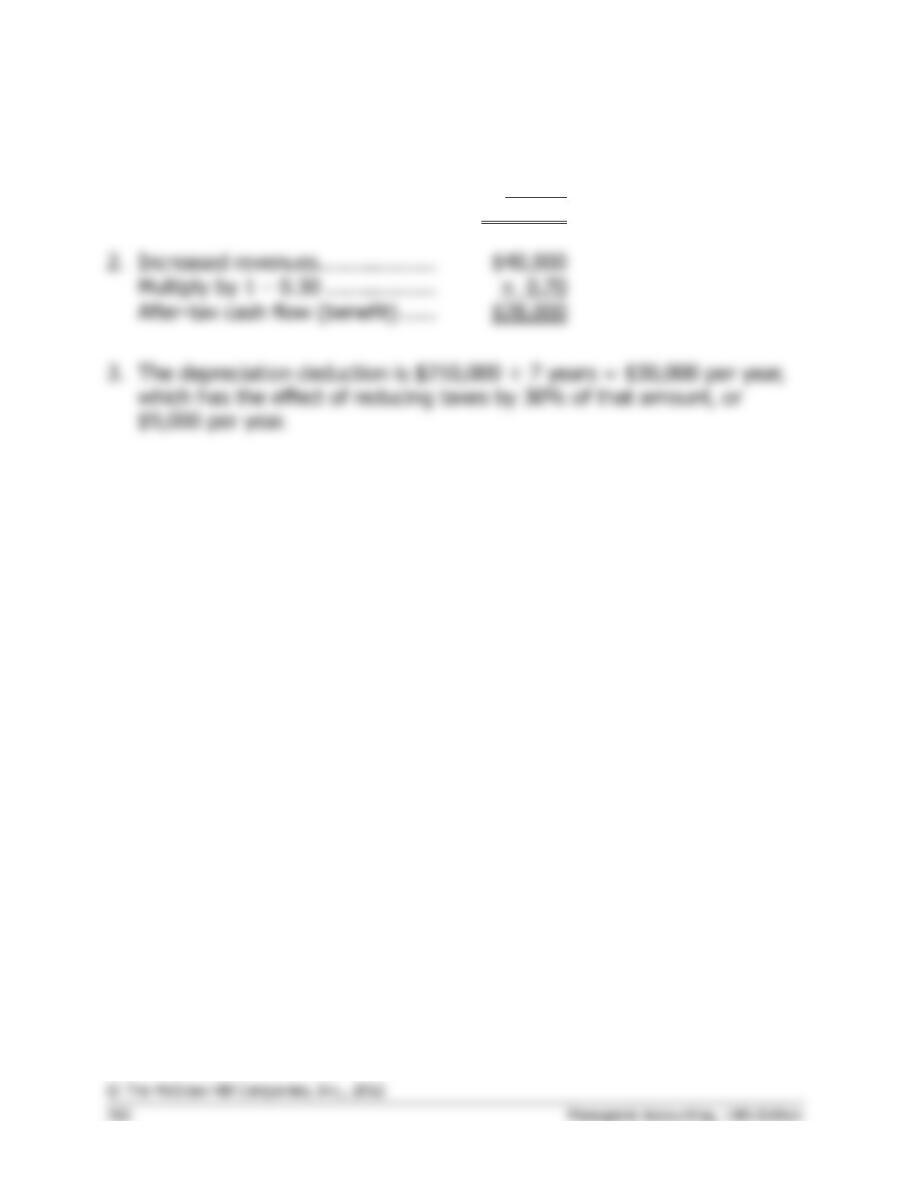
2. The net present value analysis follows:
Items and Computations
Year(s)
(1)
Amount
(2)
Tax
Effect
(1) × (2)
After–Tax
Cash Flows
14%
Factor
Present
Value of
Cash Flows
Cost of the new collating machine ….
Now
$(140,000)
$(140,000)
1.000
$(140,000)
Annual net cost savings (above) …….
1-10
$35,000
1 – 0.30
$24,500
5.216
127,792
Depreciation deductions* ……………..
5.216
Cost of the new roller pads ……………
0.519
Salvage value of the new machine ….
0.270
Net present value ……………………….
Exercise 13C-3 (10 minutes)
1.
Management consulting fee …….
$100,000
Multiply by 1 – 0.30 ………………
× 0.70
After-tax cost ……………………….
$ 70,000
After-tax cash flow (benefit) ……
Problem 13C-4 (20 minutes)
Items and Computations
Year(s)
(1)
Amount
(2)
Tax
Effect
(1) × (2)
After–Tax
Cash Flows
12%
Factor
Present
Value of
Cash Flows
Investment in new trucks ……………..
Now
$(450,000)
$(450,000)
1.000
$(450,000)
Salvage from sale of the old trucks …
Now
$30,000
1 – 0.30
$21,000
1.000
21,000
Overhaul of motors ……………………..
1 – 0.30
$(31,500)
0.567
Salvage from the new trucks …………
$20,000
1 – 0.30
0.404
Net present value ……………………….
Problem 13C-5 (45 minutes)
Items and Computations
Year(s)
(1)
Amount
(2)
Tax
Effect
(1) × (2)
After–Tax
Cash Flows
8%
Factor
Present Value
of Cash Flows
Alternative 1:
Investment in the bonds ……….
Now
$(200,000)
$(200,000)
1.000
$(200,000)
Maturity of the bonds …………..
$200,000
0.397
Net present value ………………..
*
Problem 13C-5 (continued)
Items and Computations
Year(s)
(1)
Amount
(2)
Tax
Effect
(1) × (2)
After–Tax
Cash Flows
8%
Factor
Present
Value of
Cash Flows
Alternative 2:
Investment in the business ……………
Now
$(200,000)
—
$(200,000)
1.000
$(200,000)
Annual net cash receipts
($400,000 – $370,000 = $30,000) ..
1-12
$30,000
1 – 0.40
$18,000
7.536
135,648
Depreciation deductions:
Year 1: 14.3% of $80,000 …………..
1
$11,440
0.40
$4,576
0.926
4,237
Year 2: 24.5% of $80,000 …………..
2
$19,600
0.40
$7,840
0.857
6,719
Year 3: 17.5% of $80,000 …………..
3
$14,000
0.40
$5,600
0.794
4,446
$10,000
0.735
Year 6: 8.9% of $80,000 …………..
6
0.40
$2,848
0.630
1,794
Year 7: 8.9% of $80,000 …………..
7
0.40
$2,848
0.583
1,660
Year 8: 4.5% of $80,000 …………..
8
0.40
$1,440
0.540
Recovery of working capital
($200,000 – $80,000 = $120,000) ..
Net present value ………………………..
Problem 13C-6 (30 minutes)
1. The net present value analysis would be:
Items and Computations
Year(s)
(1)
Amount
(2)
Tax
Effect
(1) × (2)
After–Tax
Cash Flows
10%
Factor
Present
Value of
Cash Flows
Investment in equipment ………….
Now
$(600,000)
$(600,000)
1.000
$(600,000)
Depreciation deductions ……………
6.145
Cost of restoring land ………………..
0.386
Salvage value of the equipment* …
0.386
Working capital released …………..
0.386
2. No, the investment project should not be undertaken. It has a negative net present value.