13–21
EXERCISE 13-7 (5–7 minutes)
June 30
EXERCISE 13-8 (10–15 minutes)
Salaries and Wages Expense …………………………………..
480,000
Withholding Taxes Payable ……………………………..
80,000
FICA Taxes Payable* ……………………………………….
28,040
Union Dues Payable ………………………………………..
Cash ………………………………………………………………
*[($480,000 – $140,000) X 7.65% = $26,010]
$140,000 X 1.45% = $2,030; $26,010 + $2,030 = $28,040
Payroll Tax Expense ……………………………………………….
FICA Taxes Payable ………………………………………..
28,040
(See previous computation.)
FUTA Taxes Payable
[($480,000 – $410,000) X .8%) ………………………..
SUTA Taxes Payable
[$70,000 X (3.5% – 2.3%)] ………………………………
EXERCISE 13-9 (15–20 minutes)
(a)
Computation of taxes
Salaries and wages
Social security taxes (FICA)
(7.65% X $140,000)
Federal unemployment taxes (FUTA)
(.8% X $40,000)
State unemployment taxes (SUTA)
(2.5% X $40,000)
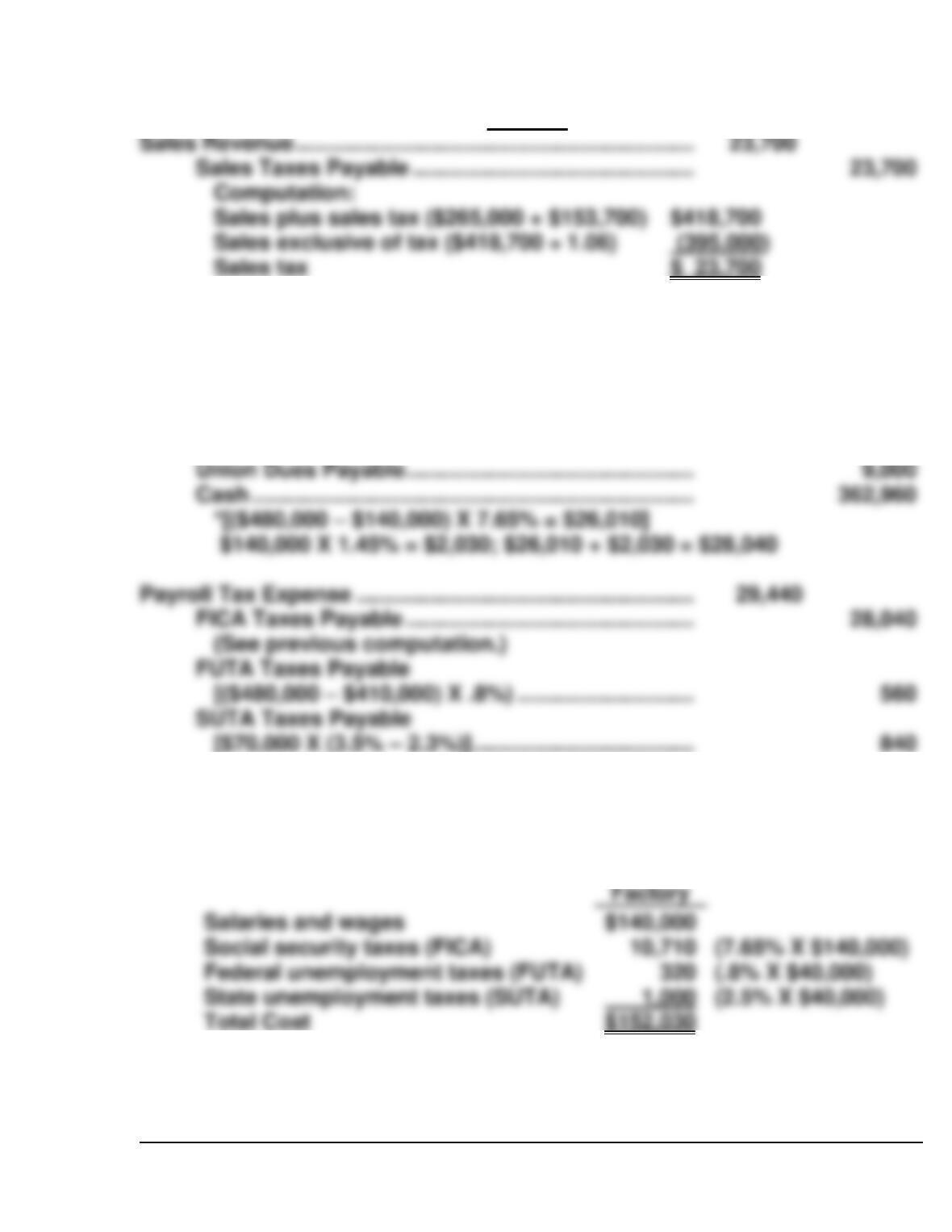
Sales Revenue ………………………………………………………..
Sales Taxes Payable ……………………………………….
23,700
Computation:
Sales plus sales tax ($265,000 + $153,700)
Sales exclusive of tax ($418,700 ÷ 1.06)
EXERCISE 13-9 (Continued)
Sales
Salaries and wages
$32,000
Social security taxes (FICA)
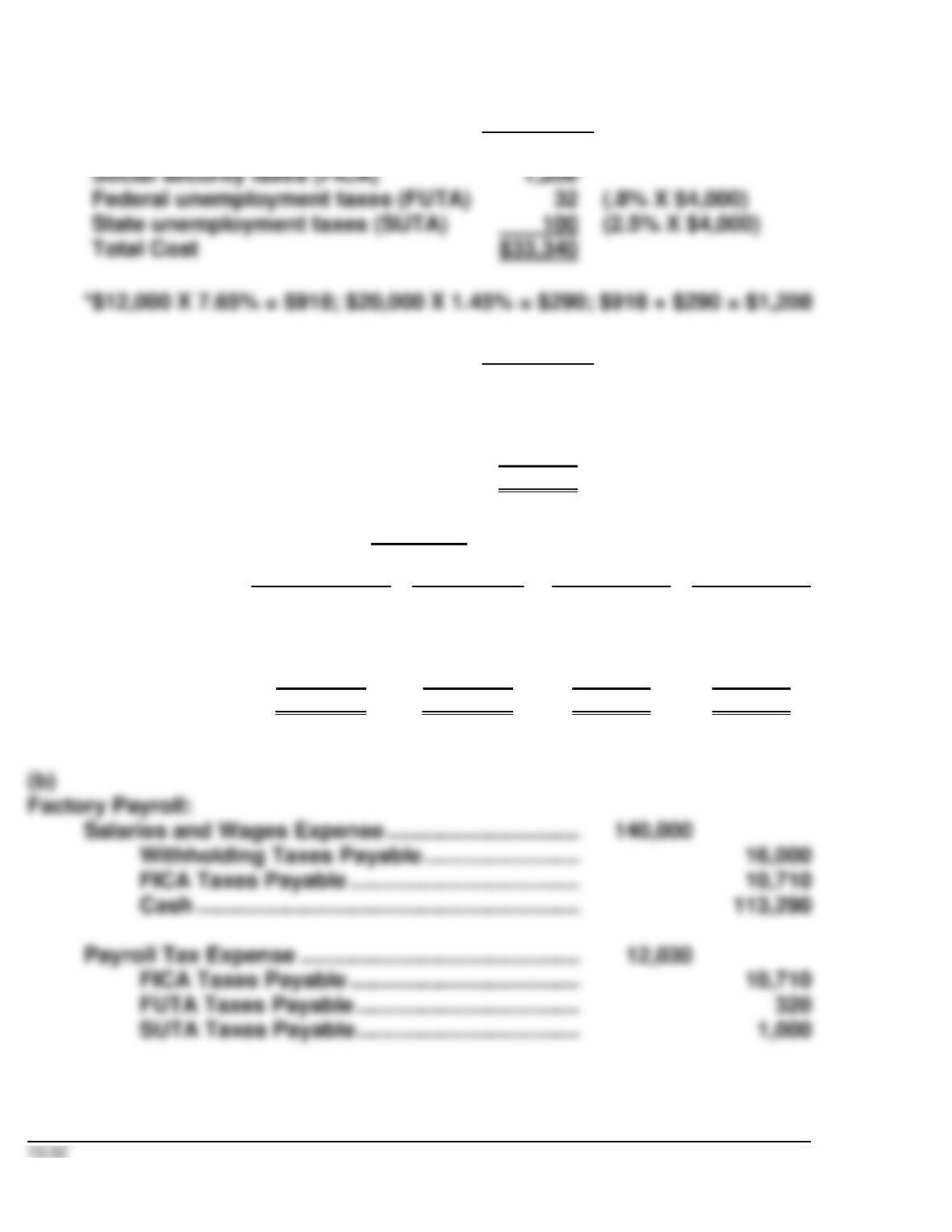
1,208*
Federal unemployment taxes (FUTA)
32
(.8% X $4,000)
State unemployment taxes (SUTA)
100
(2.5% X $4,000)
Total Cost
Admin.
Salaries and Wages
$36,000
Social security taxes (FICA)
2,754
(7.65% X $36,000)
Federal unemployment taxes (FUTA)
–0–
State unemployment taxes (SUTA)
–0–
Total Cost
$38,754
Schedule
Total
Factory
Sales
Admin.
Salaries and Wages
$208,000
$140,000
$32,000
$36,000
FICA Taxes
14,672
10,710
1,208
2,754
FUTA Taxes
352
320
32
–0–
SUTA Taxes
1,100
1,000
100
–0–
Total Cost
$224,124
$152,030
$33,340
$38,754
Salaries and Wages Expense …………………………..
Withholding Taxes Payable ……………………..
FICA Taxes Payable ………………………………..
Cash ………………………………………………………
Payroll Tax Expense ……………………………………….
FICA Taxes Payable ………………………………..
FUTA Taxes Payable ……………………………….
SUTA Taxes Payable ……………………………….
13–23
EXERCISE 13-9 (Continued)
Sales Payroll:
Salaries and Wages Expense …………………………..
32,000
Withholding Taxes Payable ……………………..
7,000
EXERCISE 13-10 (10–15 minutes)
(a)
Cash (150 X $4,000) …………………………………………………
600,000
Sales Revenue ………………………………………………..
600,000
Warranty Expense …………………………..………………………
Inventory ……………………………………………………….
Warranty Expense ($45,000* – $17,000) …………………….
Warranty Liability ……………………………………………
(b)
Cash ………………………………………………………………………
Sales Revenue ………………………………………………..
600,000
Warranty Expense …………………………..………………………
17,000
Inventory ……………………………………………………….
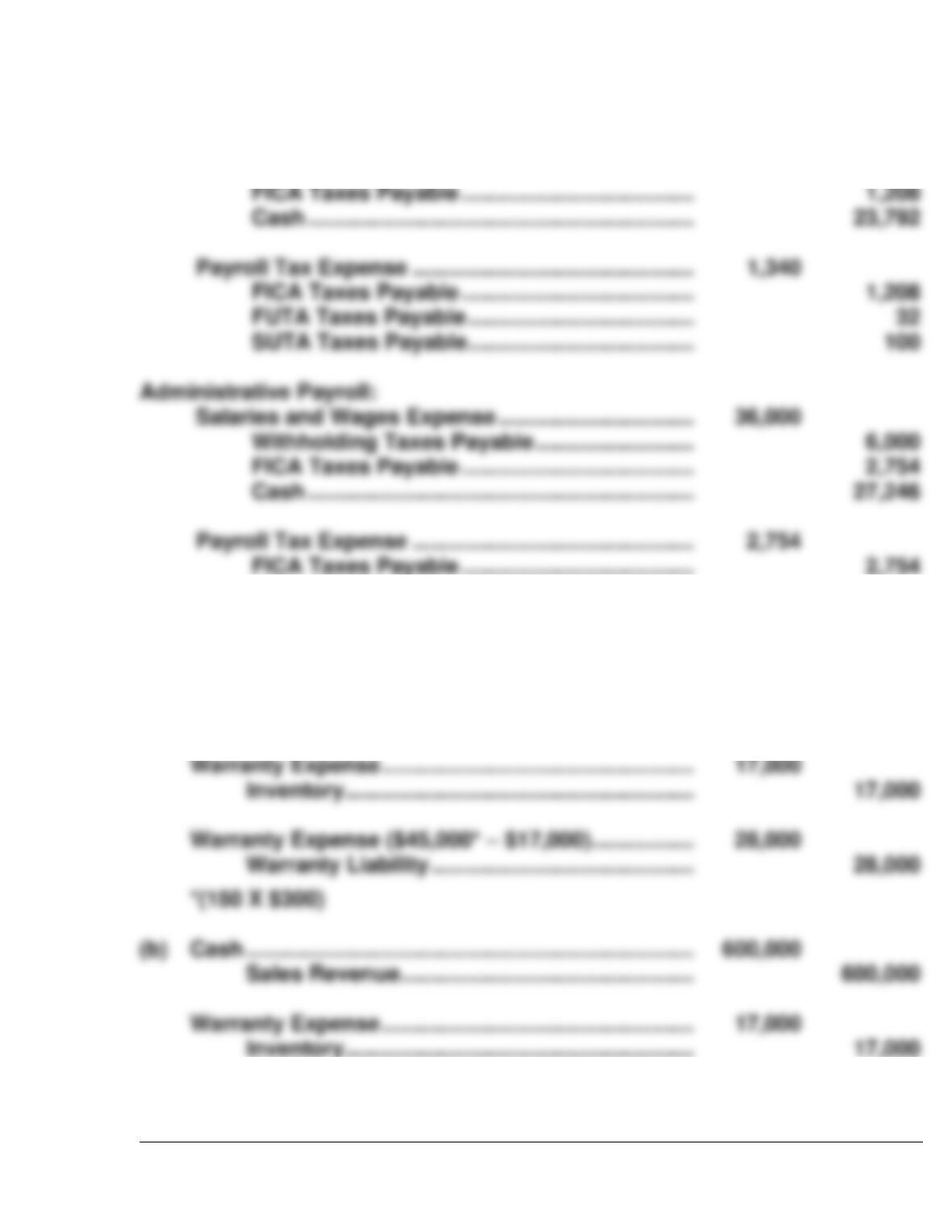
FICA Taxes Payable ………………………………..
Cash ………………………………………………………
Payroll Tax Expense ……………………………………….
FICA Taxes Payable ………………………………..
FUTA Taxes Payable ……………………………….
SUTA Taxes Payable ……………………………….
Administrative Payroll:
Salaries and Wages Expense …………………………..
36,000
Withholding Taxes Payable ……………………..
FICA Taxes Payable ………………………………..
2,754
Cash ………………………………………………………
Payroll Tax Expense ……………………………………….
FICA Taxes Payable ………………………………..
EXERCISE 13-11 (15–20 minutes)
(a)
Cash ………………………………………………………………………
3,000,000
Sales Revenue (500 X $6,000) ………………………….
3,000,000
Warranty Expense …………………………………………………..
30,000
Inventory ……………………………………………………….
Warranty Expense …………………………………………………..
90,000
Warranty Liability
($120,000 – $30,000) ……………………………………..
(b)
Cash ………………………………………………………………………
Sales Revenue ………………………………………………..
Unearned Warranty Revenue …………………………..
Warranty Expense …………………………………………………..
30,000
Inventory ……………………………………………………….
Unearned Warranty Revenue …………………………..
40,000
Warranty Revenue
[$160,000 X ($30,000/$120,000)] …………………….
EXERCISE 13-12 (15–20 minutes)
Inventory of Premiums (8,800 X $.90) ……………………….
7,920
Cash ………………………………………………………………
7,920
Cash (120,000 X $3.30) …………………………………………….
396,000
Sales Revenue ………………………………………………..
396,000
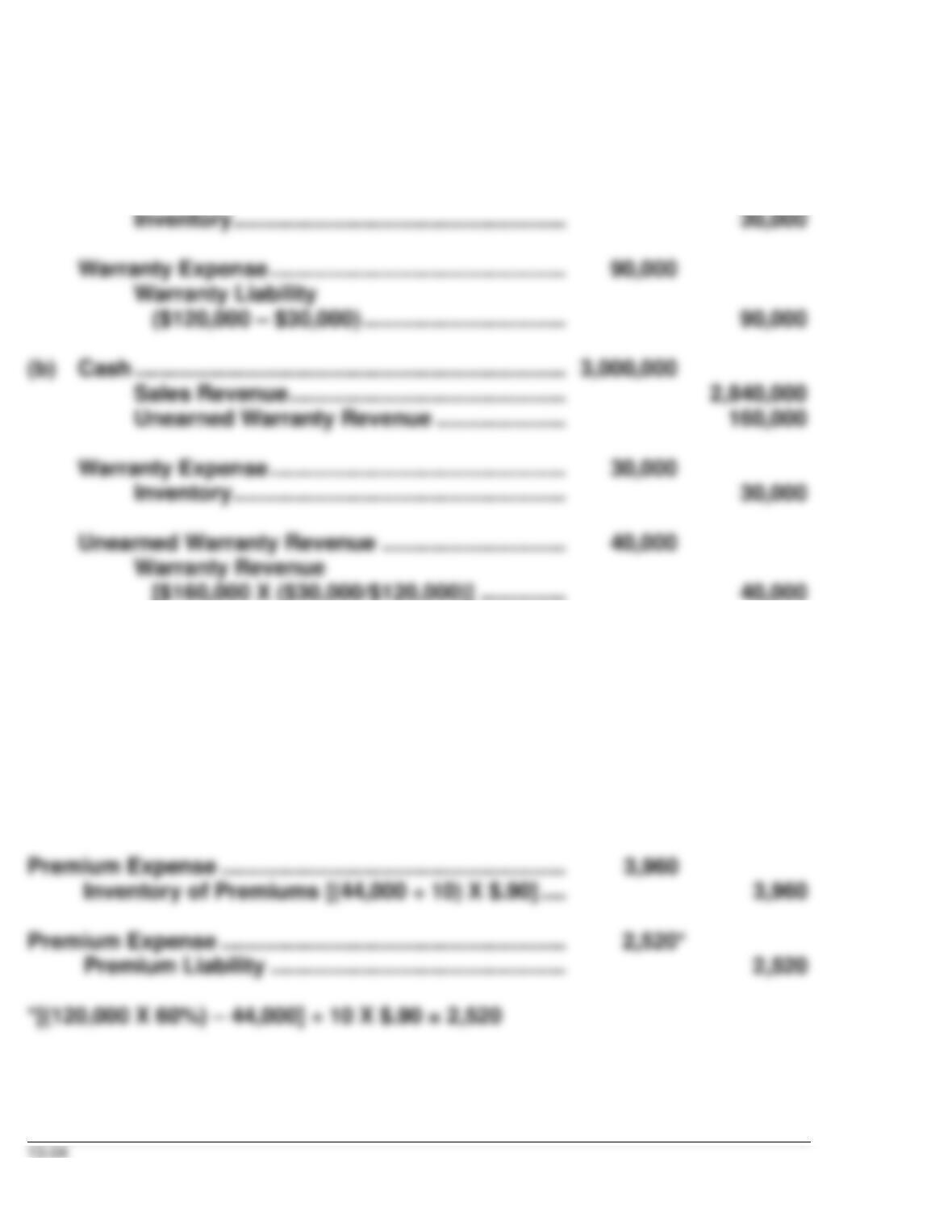
Premium Expense …………………………………………………..
3,960
Inventory of Premiums [(44,000 ÷ 10) X $.90] …….
3,960
Premium Expense …………………………………………………..
Premium Liability …………………………..……………….
2,520
*[(120,000 X 60%) – 44,000] ÷ 10 X $.90 = 2,520
EXERCISE 13-13 (20–30 minutes)
(1) The FASB requires that, when some amount within the range of ex–
pected loss appears at the time to be a better estimate than any other
(2) The loss should be accrued for $6,000,000. The potential insurance
recovery is a gain contingency—it is not recorded until received.
According to FASB ASC 410–30–35-8, claims for recoveries may be
recorded if the recovery is deemed probable.
(3) This is a gain contingency because the amount to be received will be
EXERCISE 13-14 (25–30 minutes)
(a)
Plant Assets ……………………………………………………….
600,000
Cash ……………………………………………………….
600,000
Plant Assets ……………………………………………………….
39,087
Asset Retirement Obligation …………………………..
39,087
(b)
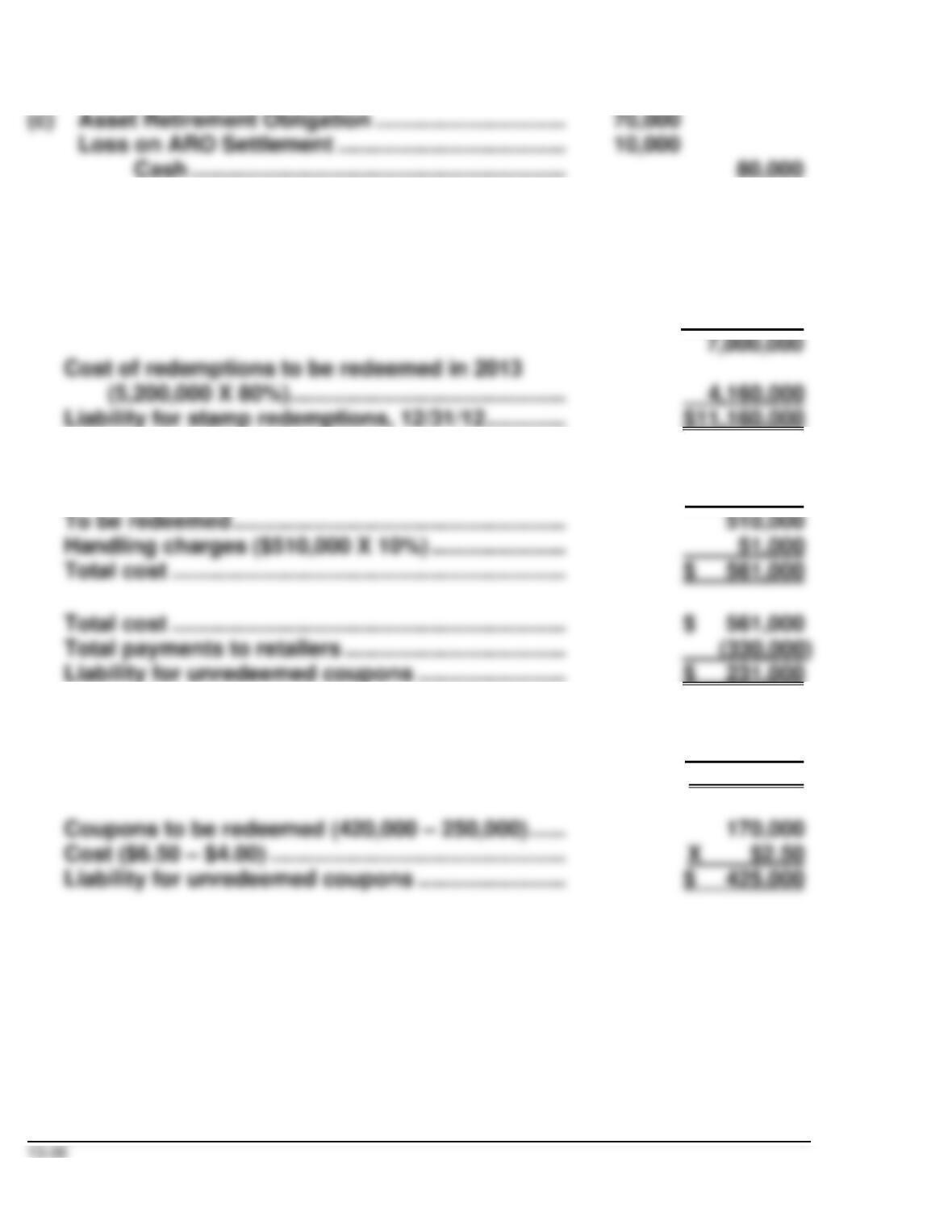
Depreciation Expense ……………………………………………..
Depreciation Expense ……………………………………………..
Interest Expense …………………………………………………….
EXERCISE 13-14 (Continued)
Loss on ARO Settlement …………………………………………
Cash ……………………………………………………….
EXERCISE 13-15 (20–30 minutes)
1.
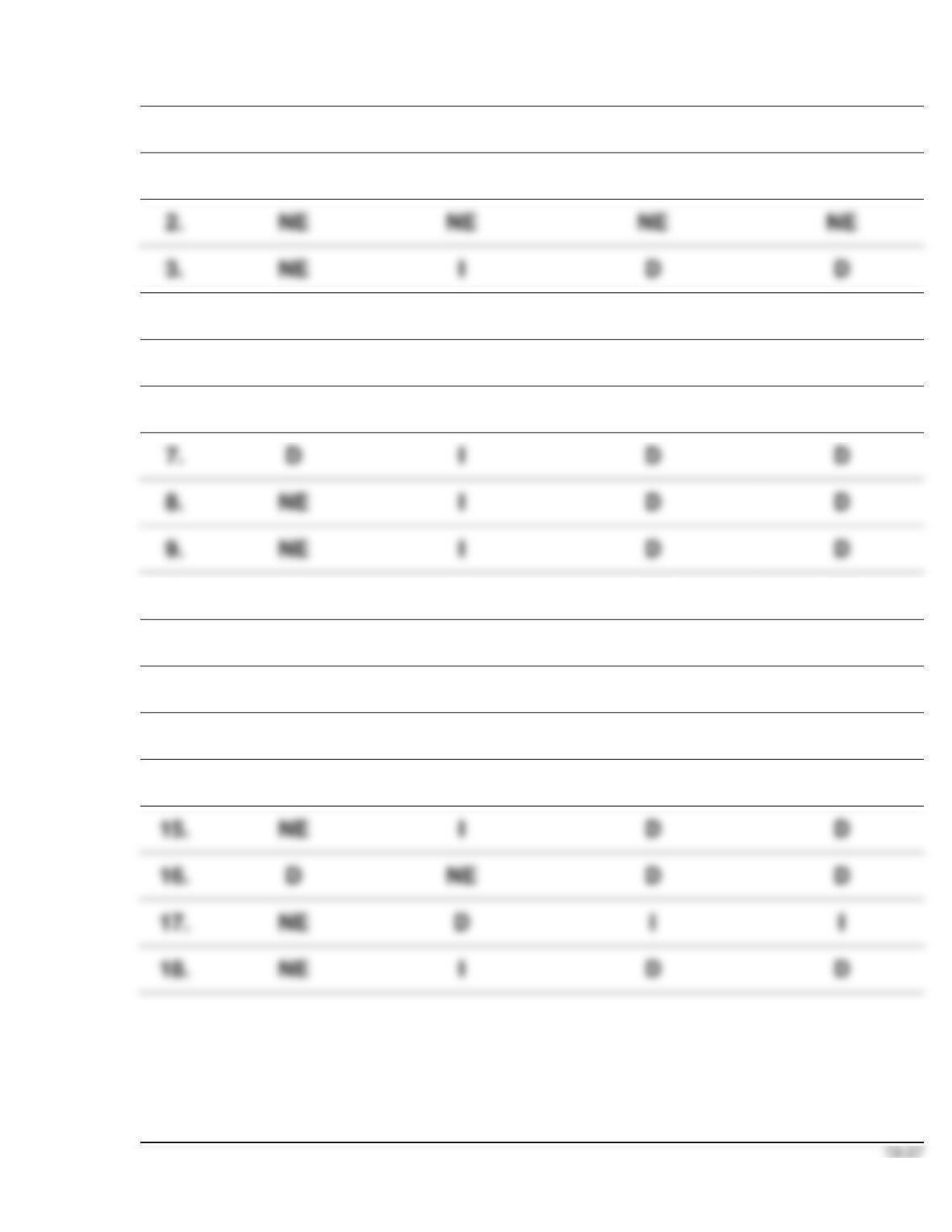
Liability for stamp redemptions, 12/31/11 ……………………
$13,000,000
Cost of redemptions redeemed in 2012 ………………………
(6,000,000)
7,000,000
Liability for stamp redemptions, 12/31/12 ……………………
2.
Total coupons issued ………………………………………………..
$ 850,000
Redemption rate ……………………………………………………….
X 60%
To be redeemed ……………………………………………………….
510,000
Handling charges ($510,000 X 10%) …………………………..
51,000
Total cost ……………………………………………………….
Total cost ……………………………………………………….
Total payments to retailers ………………………………………..
Liability for unredeemed coupons …………………………..
3.
Boxes ………………………………………………………………………
600,000
Redemption rate ……………………………………………………….
X 70%
Total redeemable ………………………………………………………
420,000
Coupons to be redeemed (420,000 – 250,000) ……………..
170,000
Cost ($6.50 – $4.00) …………………………………………………..
Liability for unredeemed coupons …………………………..
EXERCISE 13-16 (20–25 minutes)
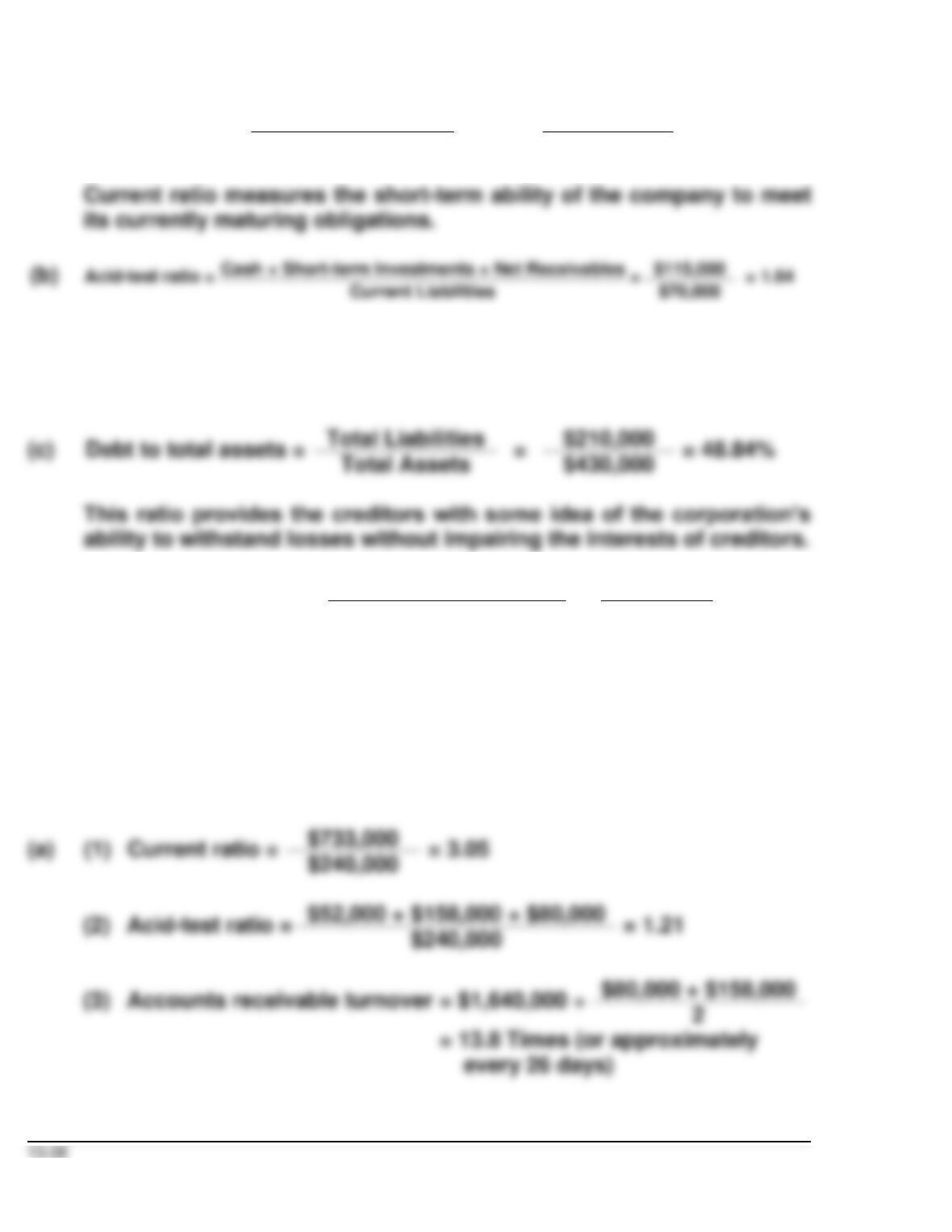
#
Assets
Liabilities
Owners’ Equity
Net Income
1.
I
I
NE
NE
2.
NE
NE
NE
NE
3.
NE
I
D
D
4.
I
I
NE
NE
5.
NE
I
D
D
6.
I
I
I
I
7.
D
I
D
D
8.
NE
I
D
D
9.
NE
I
D
D
10.
I
I
NE
NE
11.
NE
I
D
D
12.
I
I
I
I
13.
NE
I
D
D
14.
D
D
NE
NE
15.
NE
I
D
D
16.
D
NE
D
D
17.
NE
D
I
I
18.
NE
I
D
D
EXERCISE 13-17 (10–15 minutes)
(a)
Current ratio =
Current Assets
=
$210,000
= 3.00
Current Liabilities
$70,000
Acid-test ratio also measures the short-term ability of the company to
meet its currently maturing obligations. However, it eliminates assets
that might be slow moving, such as inventories and prepaid expenses.
(c)
Debt to total assets =
= 48.84%
Total Assets
(d)
Rate of return on assets =
Net Income
=
$25,000
= 5.81%
Average Total Assets
$430,000
This ratio measures the return the company is earning on its average
total assets and provides one indication related to the profitability of
the enterprise.
EXERCISE 13-18 (20–25 minutes)
(a)
Current ratio =
= 3.05
Acid-test ratio =
= 1.21
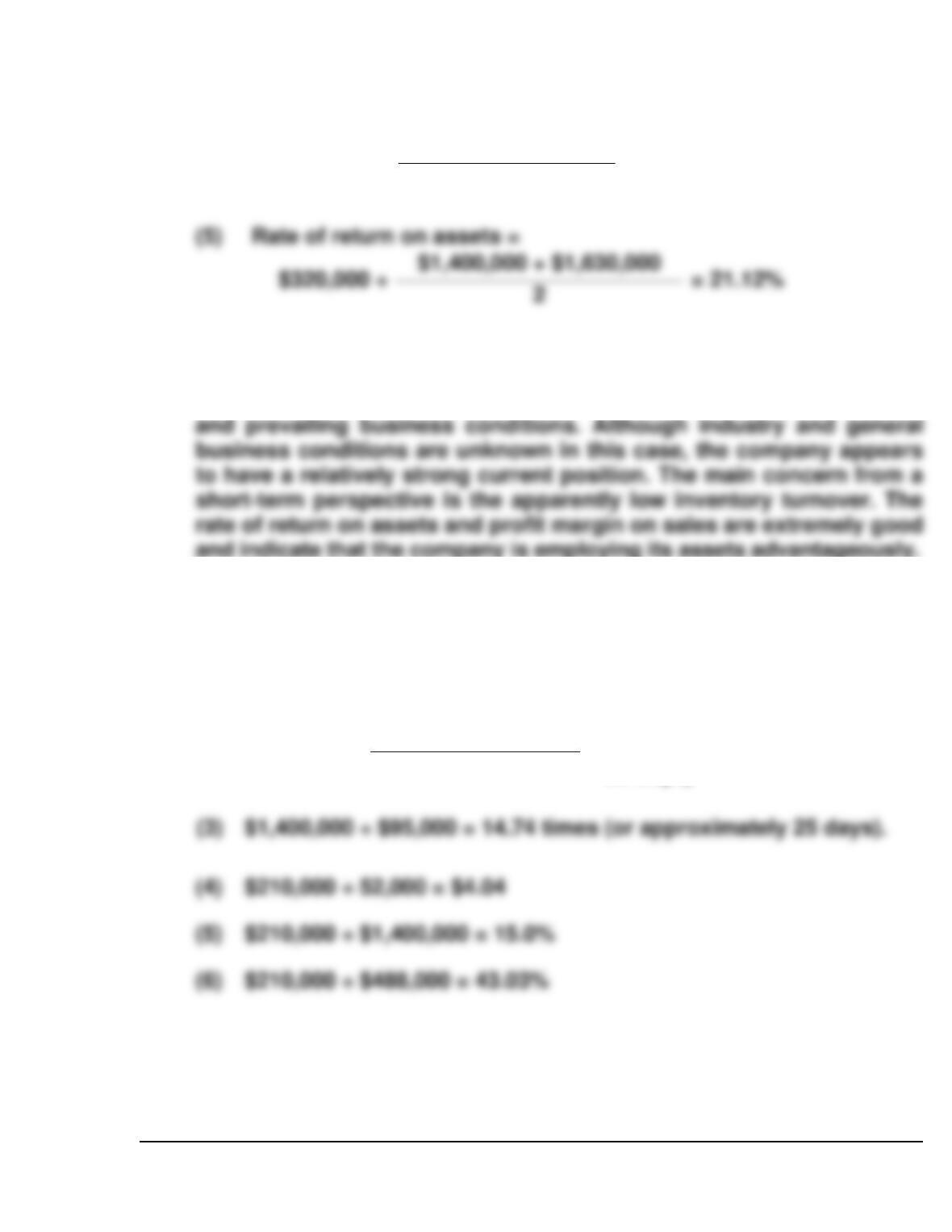
Accounts receivable turnover = $1,640,000 ÷
13–29
EXERCISE 13-18 (Continued)
(4) Inventory turnover =
$800,000 ÷
$360,000 + $440,000
= 2 times (or approximately
every 183 days)
2
(6) Profit margin on sales = $320,000 ÷ $1,640,000 = 19.51%
(b) Financial ratios should be evaluated in terms of industry peculiarities
EXERCISE 13-19 (15–25 minutes)
(a)
(1)
$318,000 ÷ $87,000 = 3.66 times
(2)
$820,000 ÷
$200,000 + $170,000
= 4.43 times (or approximately
82 days).
2
(3)
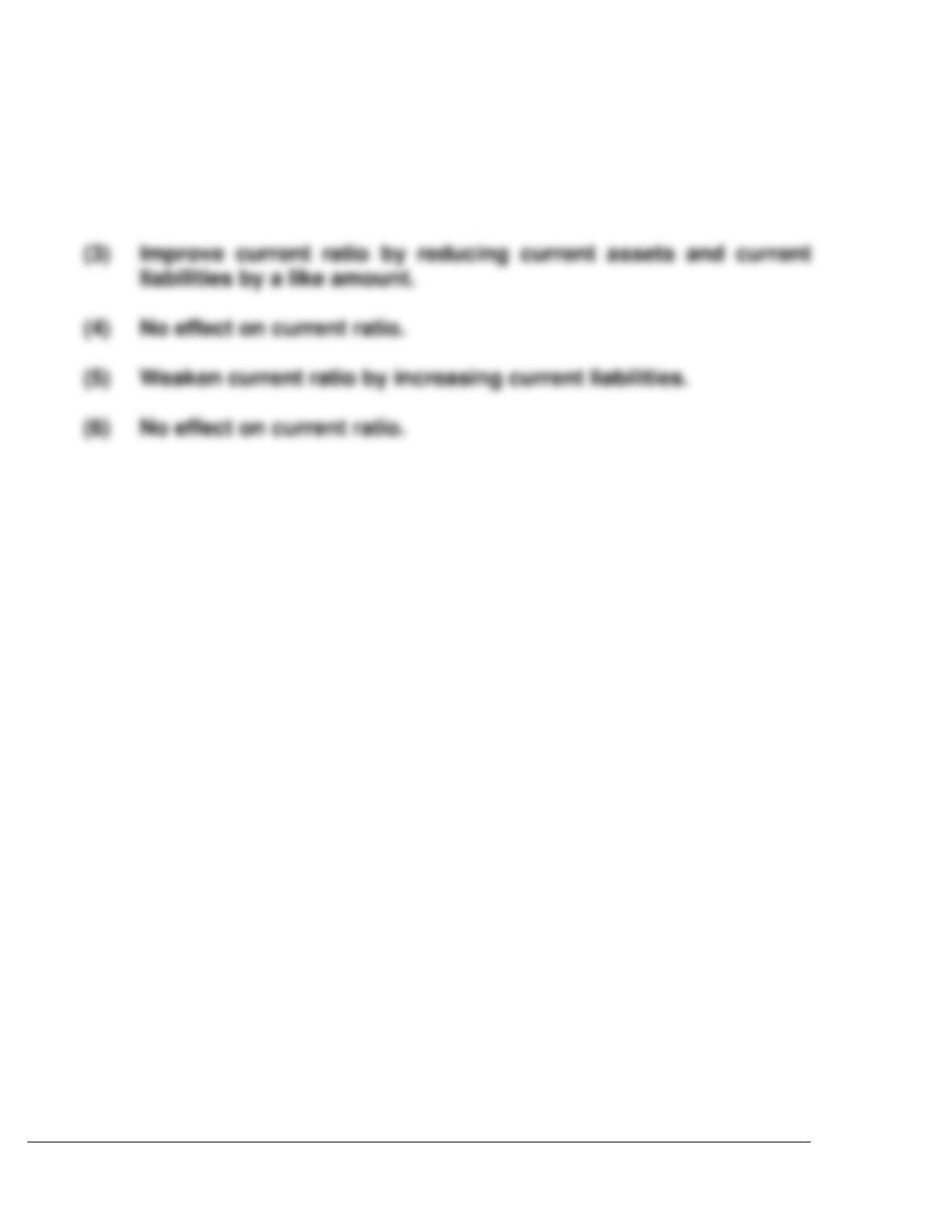
$1,400,000 ÷ $95,000 = 14.74 times (or approximately 25 days).
13–30
EXERCISE 13-19 (Continued)
(b) (1) No effect on current ratio, if already included in the allowance
for doubtful accounts.
(2) Weaken current ratio by reducing current assets.

13–31
TIME AND PURPOSE OF PROBLEMS
Problem 13-1 (Time 25–30 minutes)
Purpose—to present the student with an opportunity to prepare journal entries for a variety of situations
related to liabilities. The situations presented are basic ones including purchases and payments on
account, and borrowing funds by giving a zero-interest-bearing note. The student is also required to
prepare year-end adjusting entries.
Problem 13-2 (Time 25–35 minutes)
Purpose—to present the student with the opportunity to prepare journal entries for several different
situations related to liabilities. The situations presented include accruals and payments related to sales,
use, and asset retirement obligations. Year-end adjusting entries are also required.
Problem 13-3 (Time 20–30 minutes)
Purpose—to present the student with an opportunity to prepare journal entries for four weekly payrolls.
The student must compute income tax to be withheld, FICA tax, and state and federal unemployment
compensation taxes. The student must realize the fact that in the fourth week only a portion of one
employee’s payroll is subject to unemployment tax.
Problem 13-4 (Time 20–25 minutes)
Purpose—to provide the student with the opportunity to prepare journal entries for a monthly payroll.
The student must compute income tax to be withheld, FICA tax, and state and federal unemployment
compensation taxes. The student must be aware that the unemployment taxes do not apply to three
employees as their earnings exceed the statutory maximum subject to the taxes.
Problem 13-5 (Time 15–20 minutes)
Purpose—to provide the student with an opportunity to prepare journal entries and balance sheet
presentations for warranty costs under the cash-basis and the expense warranty accrual methods.
Entries in the sales year and one subsequent year are required. The problem highlights the differences
between the two methods in the accounts and on the balance sheet.
Problem 13-6 (Time 10–20 minutes)
Purpose—to provide the student with a basic problem covering the sales-warranty method. The student
is required to prepare journal entries in the year of sale and in subsequent years when warranty costs
are incurred. Also required are balance sheet presentations for the year of sale and one subsequent
year. While the problem is basic in nature it does test the student’s ability to understand and apply the
sales warranty method.
Problem 13-7 (Time 25–35 minutes)
Purpose—to provide the student with an opportunity to prepare journal entries for warranty costs under
the expense warranty method and the cash-basis method. The student is also required to indicate the
proper balance sheet disclosures under each method for the year of sale. Finally, the student is
required to comment on the effect on net income of applying each method. The problem highlights the
differences between the two methods in the accounts and on the balance sheet.
Problem 13-8 (Time 15–25 minutes)
Purpose—to provide the student with a basic problem in accounting for premium offers. The student is
required to prepare journal entries relating to sales, the purchase of the premium inventory, and the
redemption of coupons. The student must also prepare the year-end adjusting entry reflecting the esti-
mated liability for premium claims outstanding. A very basic problem.

13–32
Time and Purpose of Problems (Continued)
Problem 13-9 (Time 30–45 minutes)
Purpose—to present the student with a slightly complicated problem related to accounting for premium
offers. The problem is more complicated in that coupons redeemed are accompanied by cash payments,
and in addition to the cost of the premium item postage costs are also incurred. The student is required
to prepare journal entries for various transactions including sales, purchase of the premium inventory,
and redemption of coupons for two years. The second year’s entries are more complicated due to the
existence of the liability for claims outstanding. Finally the student is required to indicate the amounts
related to the premium offer that would be included in the financial statements for each of two years.
This very realistic problem challenges the student’s ability to account for all transactions related to
premium offers.
Problem 13-10 (Time 25–30 minutes)
Purpose—to present the student with the problem of determining the proper amount of and disclosure
for a contingent loss due to lawsuits. The student is required to prepare a journal entry and a footnote.
The student is also required to discuss any liability incurred by a company due to the risk of loss from
lack of insurance coverage. A straightforward problem dealing with contingent losses.
Problem 13-11 (Time 35–45 minutes)
Purpose—to provide the student with a comprehensive problem dealing with contingent losses. The
student is required to prepare journal entries for each of three independent situations. For each situation
the student must also discuss the appropriate disclosure in the financial statements. The situations pre–
sented include a lawsuit, an expropriation, and a self-insurance situation. This problem challenges the
student not only to apply the guidelines set forth in GAAP, but also to develop reasoning as to how
the guidelines relate to each situation.
Problem 13-12 (Time 20–30 minutes)
Purpose—to provide the student with a problem to calculate warranty expense, estimated warranty
liability, premium expense, inventory of premiums, and premium liability.
Problem 13-13 (Time 25–35 minutes)
Purpose—to present the student a comprehensive problem in determining various liabilities and present
findings in writing. Issues addressed relate to contingencies, warranties, and litigation.
Problem 13-14 (Time 20–25 minutes)
Purpose—to present the student with a comprehensive problem in determining the amounts of various
liabilities. The student must calculate (for independent situations) the estimated liability for warranties,
and an estimated liability for premium claims outstanding. Journal entries are not required. This problem
should challenge the better students.
SOLUTIONS TO PROBLEMS
PROBLEM 13-1
(a) February 2
Purchases ($70,000 X 98%) ……………………………..
68,600
Accounts Payable ………………………………….
68,600
Accounts Payable …………………………………………..
Purchase Discounts Lost ………………………………..
Cash …………………………..…………………………
April 1
Trucks …………………………..……………………………….
50,000
Cash …………………………..…………………………
4,000
Notes Payable ………………………………………..
46,000
Cash ………………………………………………………………
83,000
Discount on Notes Payable ……………………………..
Notes Payable ………………………………………..
Retained Earnings (Dividends) ………………………..
Dividends Payable ………………………………….
September 10
Dividends Payable ………………………………………….
300,000
Cash …………………………..…………………………
300,000
(b) December 31
1. No adjustment necessary
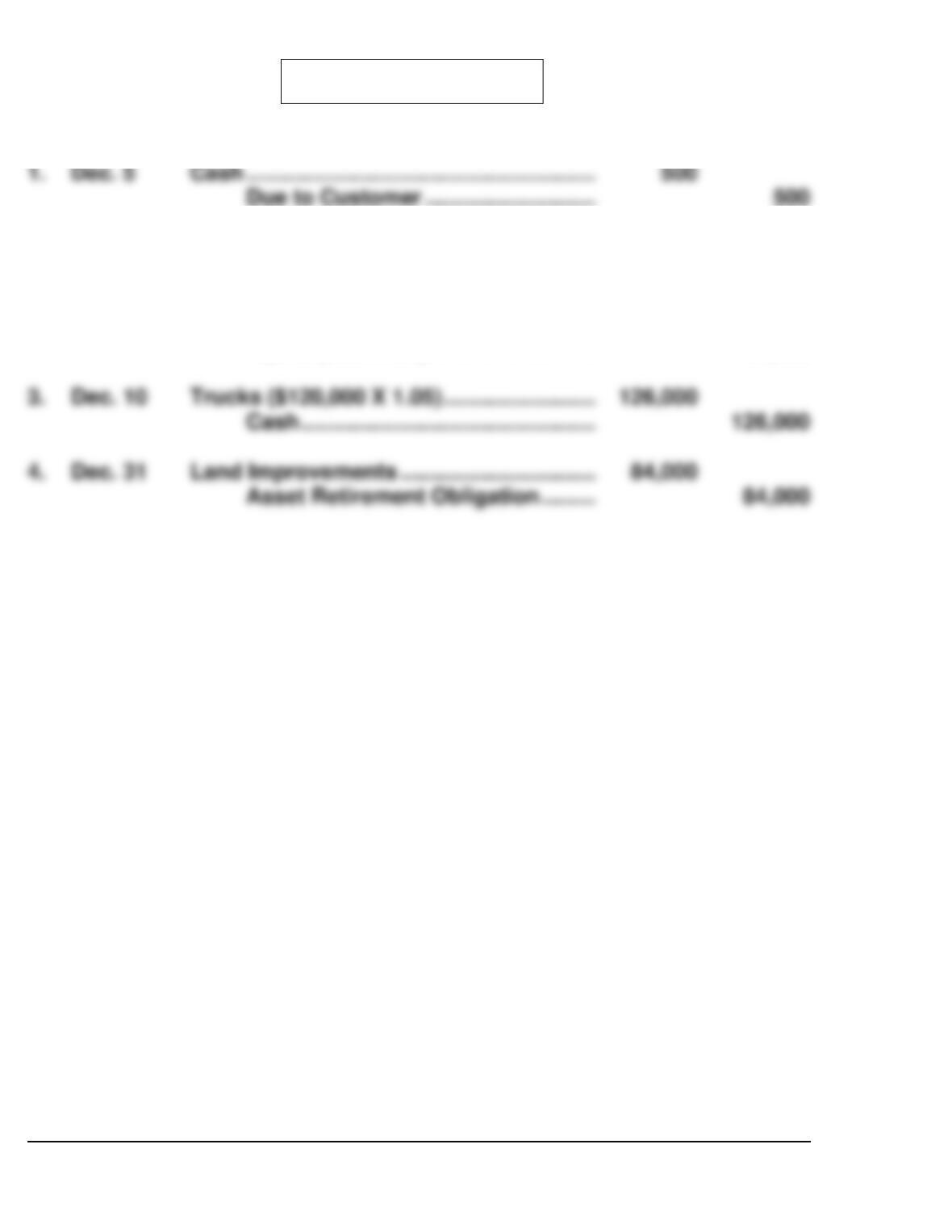
2. Interest Expense ($46,000 X 12% X 9/12) ………
Interest Payable ……………………………………..
3. Interest Expense ($9,000 X 8/12) ………………….
Discount on Notes Payable …………………….
13–34
PROBLEM 13-2
2.
Dec. 1-31
Cash ……………………………………………………….
798,000
Sales Revenue
($798,000 ÷ 1.05) …………………………..
760,000
Sales Taxes Payable
($760,000 X .05) …………………………..
38,000
3.
Dec. 10
Trucks ($120,000 X 1.05) …………………………..
126,000
Cash ……………………………………………………….
4.
Dec. 31
Land Improvements …………………………..
Asset Retirement Obligation …………………………..
84,000
1.
Dec. 5
Cash ……………………………………………………….
Due to Customer …………………………..
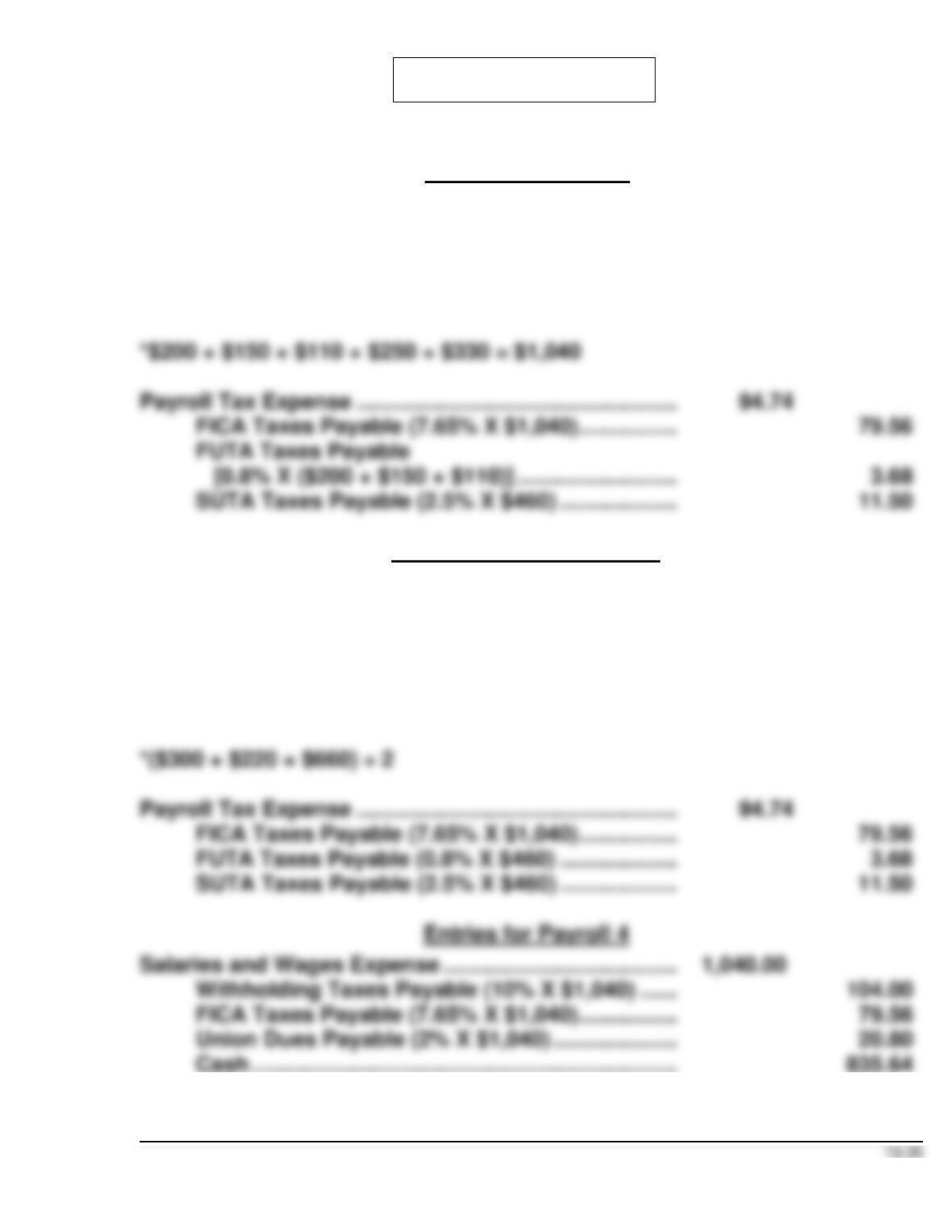
PROBLEM 13-3
Entries for Payroll 1
Salaries and Wages Expense …………………………………..
1,040.00*
Withholding Taxes Payable (10% X $1,040)* ……..
104.00
FICA Taxes Payable (7.65% X $1,040) ……………….
79.56
Union Dues Payable (2% X $1,040) …………………..
20.80
Cash ………………………………………………………………
835.64
*$200 + $150 + $110 + $250 + $330 = $1,040
Payroll Tax Expense ……………………………………………….
FICA Taxes Payable (7.65% X $1,040) ……………….
79.56
FUTA Taxes Payable
[0.8% X ($200 + $150 + $110)] ………………………..
SUTA Taxes Payable (2.5% X $460) ………………….
11.50
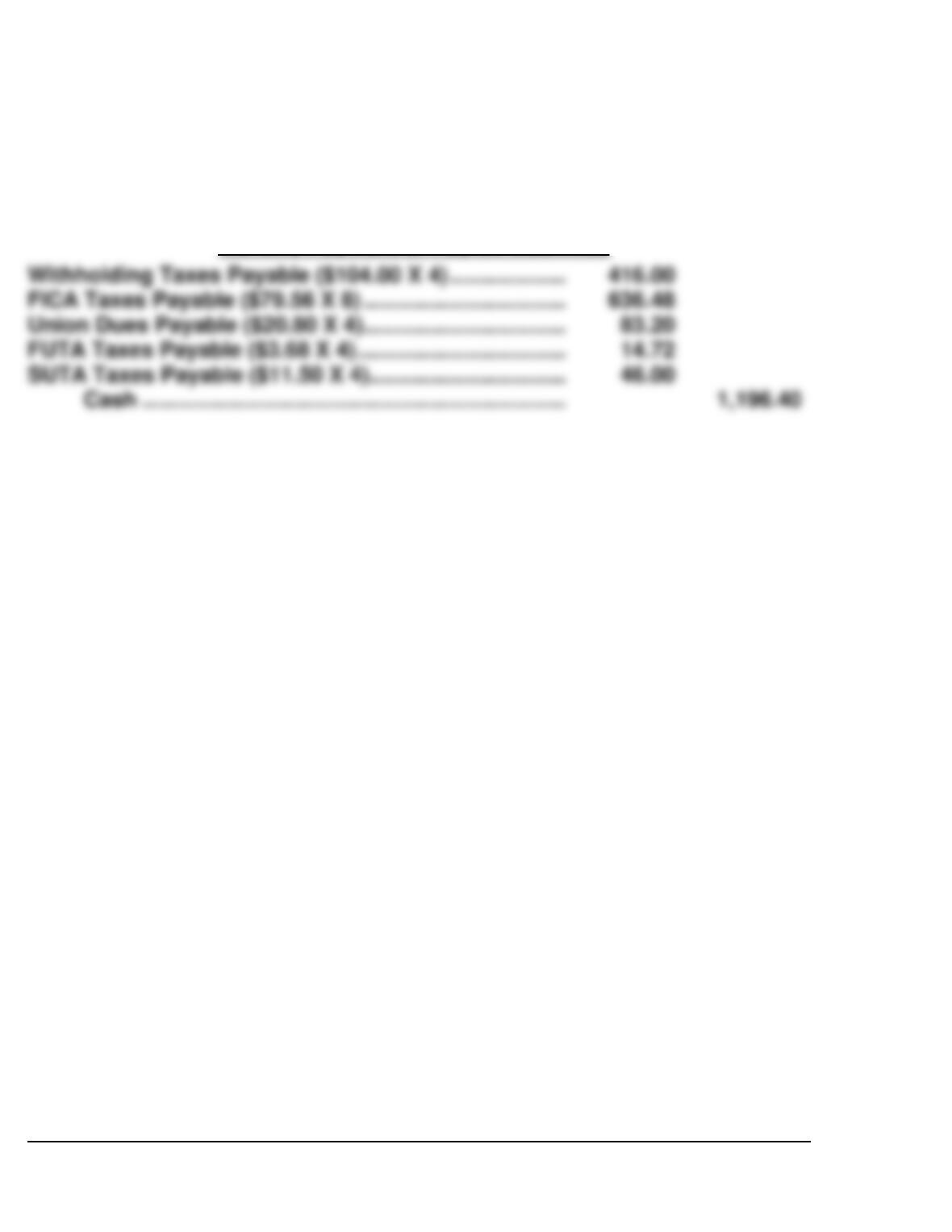
Entries for Payroll 2 and 3
Salaries and Wages Payable (Vacation) ……………………
590.00*
Salaries and Wages Expense …………………………………..
450.00
Withholding Taxes Payable (10% X $1,040) ………
104.00
FICA Taxes Payable (7.65% X $1,040) ……………….
79.56
Union Dues Payable (2% X $1,040) …………………..
20.80
Cash ………………………………………………………………
835.64
*($300 + $220 + $660) ÷ 2
Payroll Tax Expense ……………………………………………….
FICA Taxes Payable (7.65% X $1,040) ……………….
79.56
FUTA Taxes Payable (0.8% X $460) ………………….
SUTA Taxes Payable (2.5% X $460) ………………….
11.50
Salaries and Wages Expense …………………………………..
Withholding Taxes Payable (10% X $1,040) ………
FICA Taxes Payable (7.65% X $1,040) ……………….
Union Dues Payable (2% X $1,040) …………………..
13–36
PROBLEM 13-3 (Continued)
Payroll Tax Expense …………………………..……………………
94.74
FICA Taxes Payable (7.65% X $1,040) ……………….
79.56
FUTA Taxes Payable (0.8% X $460)…………………..
3.68
SUTA Taxes Payable (2.5% X $460) ………………….
11.50
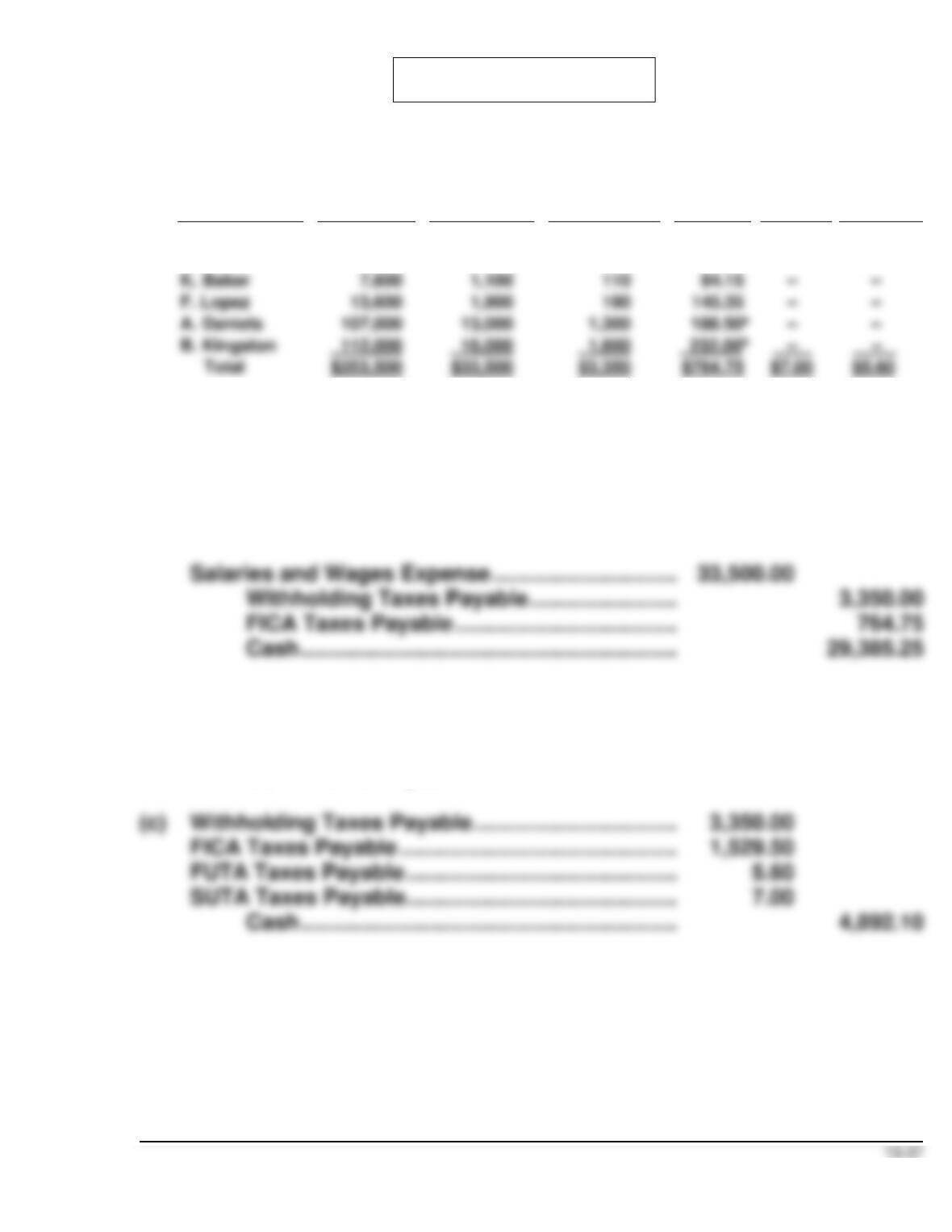
Monthly Payment of Payroll Liabilities
Withholding Taxes Payable ($104.00 X 4) ………………….
FICA Taxes Payable ($79.56 X 8) ………………………………
Union Dues Payable ($20.80 X 4) ………………………………
FUTA Taxes Payable ($3.68 X 4) ……………………………….
SUTA Taxes Payable ($11.50 X 4) …………………………..
Cash ………………………………………………………………
PROBLEM 13-4
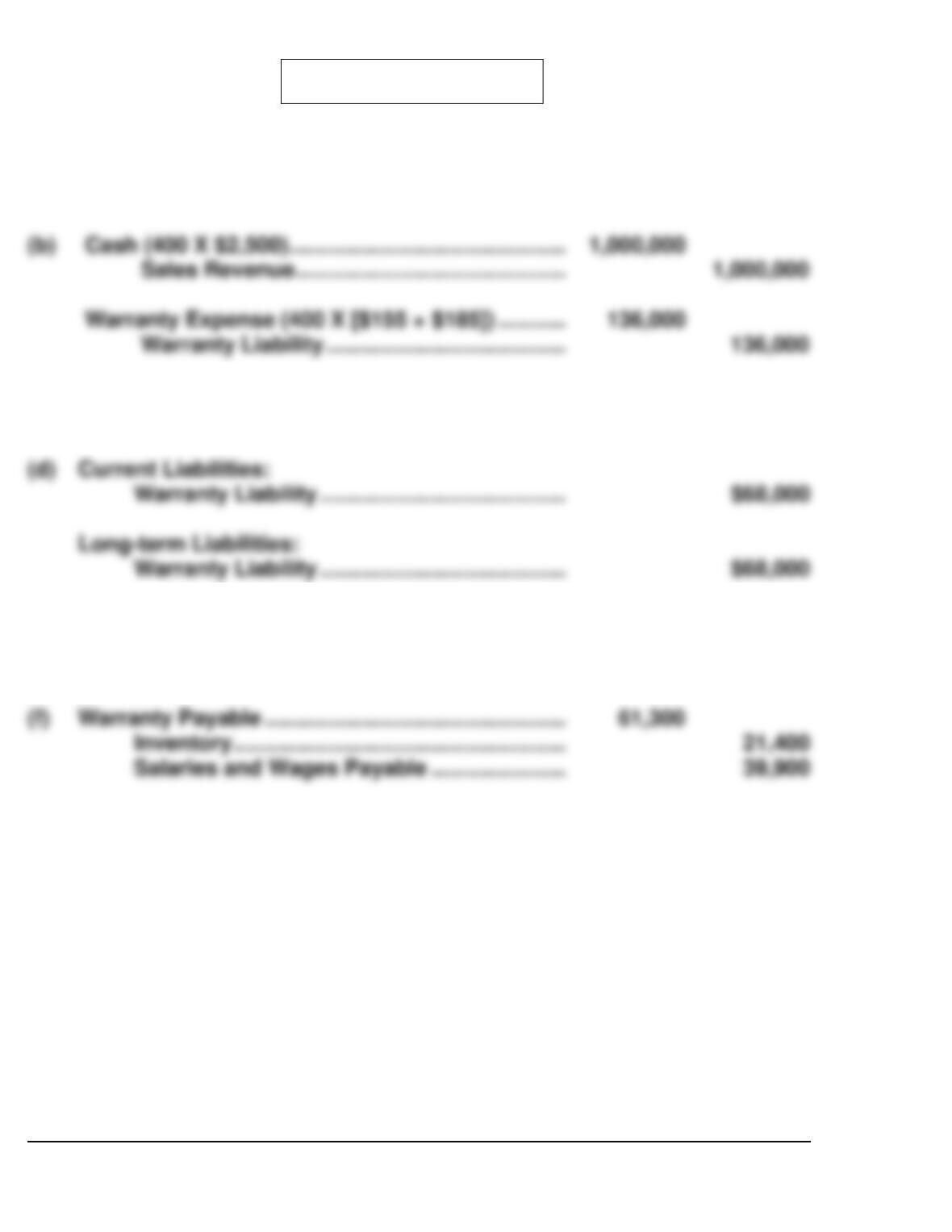
(a)
Name
Earnings
to Aug. 31
September
Earnings
Income Tax
Withholding
FICA
FUTA
SUTA
B. D. Williams
$ 6,800
$ 800
$ 80
$ 61.20
$2.00*
$1.60**
D. Raye
6,500
700
70
53.55
5.00***
4.00****
K. Baker
7,600
1,100
110
84.15
F. Lopez
13,600
1,900
190
A. Daniels
B. Kingston
–
–
*($7,000 – $6,800) X 1% = $2.00 a$13,000 X 1.45% = $188.50
**($7,000 – $6,800) X .8% = $1.60 b$16,000 X 1.45% = $232.00
***($7,000 – $6,500) X 1% = $5.00
****($7,000 – $6,500) X .8% = $4.00
Salaries and Wages Expense …………………………..
Withholding Taxes Payable …………………………..
FICA Taxes Payable ………………………………………..
764.75
Cash ……………………………………………………….
(b)
Payroll Tax Expense ……………………………………………….
777.35
FICA Taxes Payable ………………………………………..
764.75
FUTA Taxes Payable ……………………………………….
5.60
SUTA Taxes Payable……………………………………….
7.00
(c)
Withholding Taxes Payable ……………………………………..
FICA Taxes Payable ………………………………………………..
FUTA Taxes Payable ……………………………………………….
SUTA Taxes Payable ……………………………………………….
Cash ……………………………………………………….
13–38
PROBLEM 13-5
(a)
Cash (400 X $2,500) …………………………………………………
1,000,000
Sales Revenue …………………………..……………………
1,000,000
(c) No liability would be disclosed under the cash-basis method relative
to future costs due to warranties on past sales.
(d)
Current Liabilities:
Warranty Liability ……………………………………………
Long-term Liabilities:
Warranty Liability ……………………………………………
(e)
Warranty Expense …………………………………………………..
61,300
Inventory ……………………………………………………….
21,400
Salaries and Wages Payable …………………………..
39,900
Warranty Payable ……………………………………………………
Inventory ……………………………………………………….
21,400
Salaries and Wages Payable …………………………..
(b)
Cash (400 X $2,500) …………………………………………………
1,000,000
Sales Revenue …………………………..……………………
1,000,000
Warranty Expense (400 X [$155 + $185]) …………………..
Warranty Liability ……………………………………………
PROBLEM 13-6
(a)
Cash ………………………………………………………………………
294,300
Sales Revenue (300 X $900) …………………………..
270,000
Unearned Warranty Revenue (270 X $90) …………….
24,300
(b)
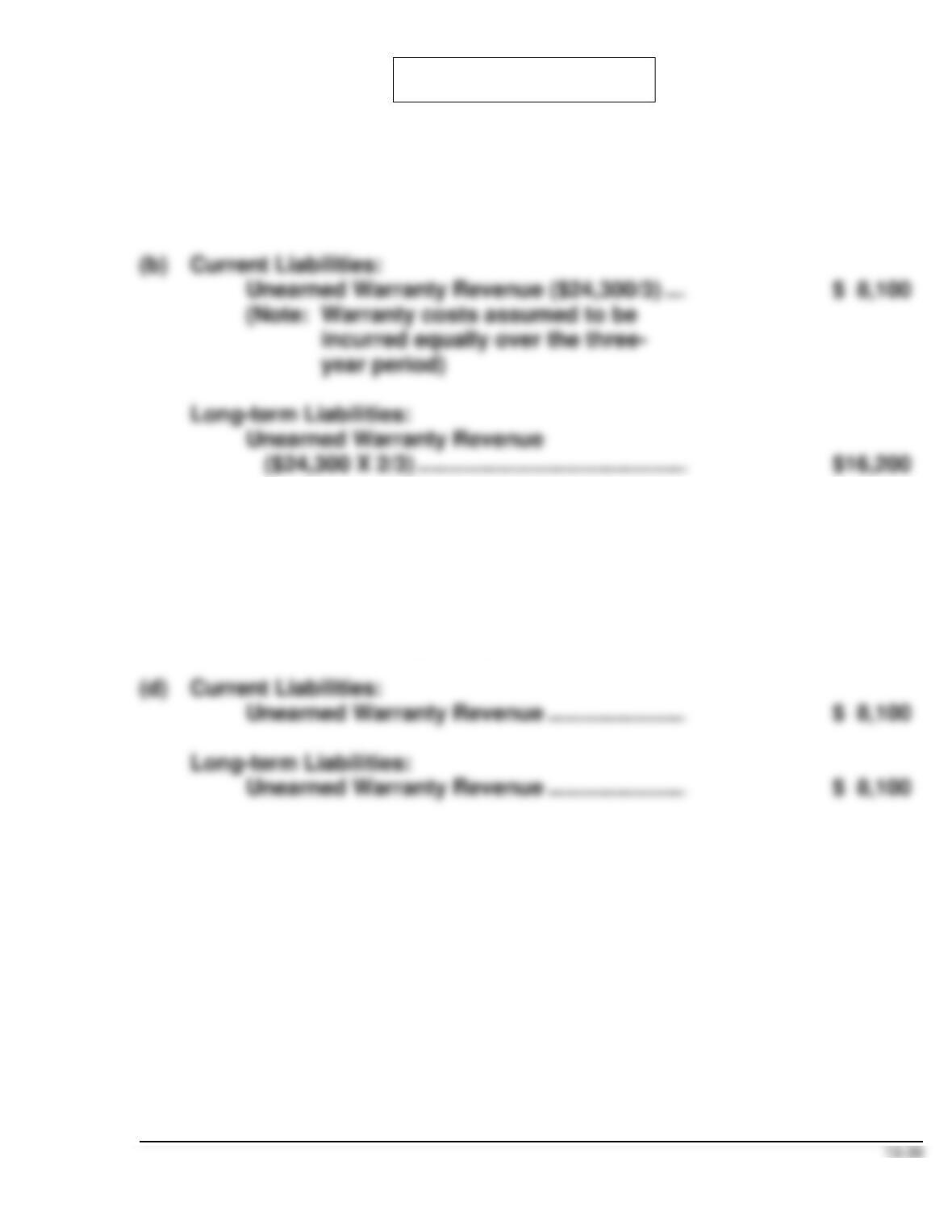
Current Liabilities:
Unearned Warranty Revenue ($24,300/3) ………….
(Note: Warranty costs assumed to be
Long-term Liabilities:
(c)
Unearned Warranty Revenue …………………………..
8,100
Warranty Revenue ………………………………………….
8,100
Warranty Expense …………………………..………………………
6,000
Inventory ……………………………………………………….
2,000
Salaries and Wages Payable …………………………..
4,000
(d)
Current Liabilities:
Unearned Warranty Revenue …………………………..
$ 8,100
Long-term Liabilities:
Unearned Warranty Revenue …………………………..
$ 8,100
PROBLEM 13-7
(a)
(1)
Cash ……………………………………………………….
4,440,000
Sales Revenue (600 X $7,400) …………………………..
4,440,000
(2)
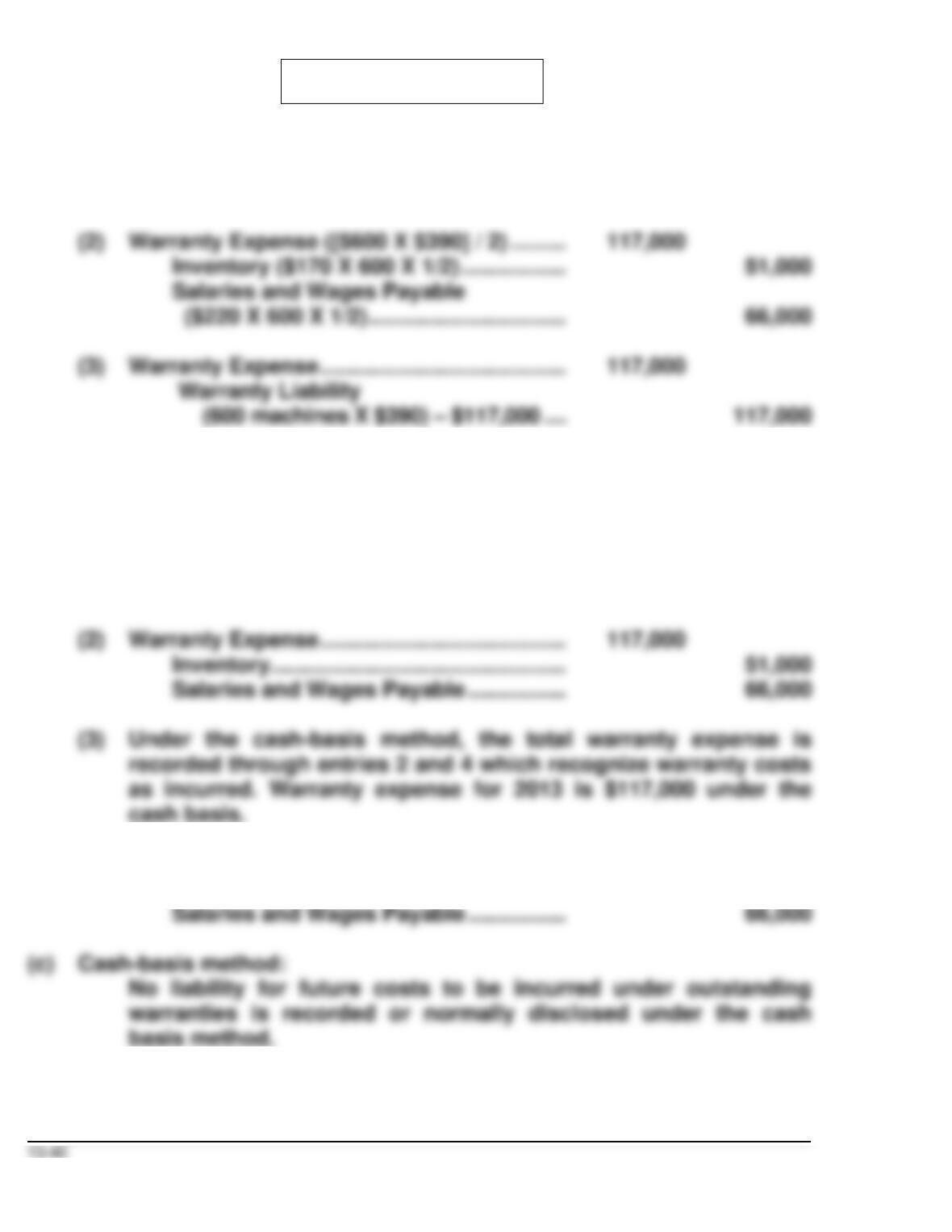
Warranty Expense ([$600 X $390] / 2) ……………………….
117,000
Inventory ($170 X 600 X 1/2) …………………………..
51,000
(3)
Warranty Expense …………………………..………………………
117,000
Warranty Liability
(600 machines X $390) – $117,000 …………………….
(4)
Warranty Liability ……………………………………………………
117,000
Inventory …………………………..…………………………..
51,000
Salaries and Wages Payable …………………………..
66,000
(b)
(1)
Cash ……………………………………………………….
4,440,000
Sales Revenue ………………………………………………….
4,440,000
Inventory …………………………..…………………………..
51,000
Salaries and Wages Payable …………………………..
66,000
(4)
Warranty Expense …………………………..………………………
117,000
Inventory …………………………..…………………………..
51,000
Salaries and Wages Payable …………………………..
66,000
(c)
Cash-basis method: