Chapter 13
Stockholders’ Equity
Review Questions
1. What is a corporation?
A corporation is a business organized under state law that is a separate legal entity.
2. List three characteristics of a corporation.
Characteristics of a corporation are the following(students are required to list three):
a. Is a separate legal entity
3. How does authorized stock differ from outstanding stock?
4. What are the four basic rights of stockholders?
The four basic rights of a stockholder are to do the following:
5. How does preferred stock differ from common stock?
6. What is par value?
Par value is an arbitrary amount assigned by a company to a share of its stock.
7. What are the two basic sources of stockholders’ equity? Describe each source.
8. What account is used to record the premium when issuing common stock? What type of account is
this?
The account used to record the premium when issuing common stock is the Paid-In Capital in
Excess of Par—Common. It is an equity account.
9. If stock is issued for assets other than cash, describe the recording of this transaction.
10. What is treasury stock? What type of account is Treasury Stock, and what is the account’s normal
balance?
Treasury stock is a corporation’s own stock that it has previously issued and later reacquired. Its
normal balance is a debit. Treasury stock is a contra-equity account.
11. Where and how is treasury stock reported on the balance sheet?
12. What is the effect on the accounting equation when cash dividends are declared? What is the effect
on the accounting equation when cash dividends are paid?
When cash dividends are declared, a current liability increases (Dividends Payable is credited) and
13. What are the three relevant dates involving cash dividends? Describe each.
The three relevant dates involving cash dividends are the declaration date, date of record, and
payment date.
14. How does cumulative preferred stock differ from noncumulative preferred stock?
15. What is a stock dividend?
A stock dividend is a distribution of a corporation’s own stock to its stockholders.
16. What is the effect on the accounting equation when a stock dividend is declared? What is the effect
on the accounting equation when a stock dividend is distributed?
When a stock dividend is declared, there is no change to the accounting equation because it does not
17. What are some reasons corporations issue stock dividends?
A company issues stock dividends for several reasons:
18. What is a stock split?
19. What does the statement of retained earnings report?
20. What is a prior-period adjustment?
A prior-period adjustment is a correction to retained earnings for an error in an earlier period.
21. What does the statement of stockholders’ equity report? How does the statement of stockholders’
equity differ from the statement of retained earnings?
The statement of stockholders’ equity is another option for reporting the changes in stockholders’
22. What does earnings per share report, and how is it calculated?
Earnings per share reports the amount of net income (loss) for each share of the company’s
23. What is the price/earnings ratio, and how is it calculated?
24. What does the rate of return on common stock show, and how is it calculated?
The rate of return on common stock shows the relationship between net income available to common
Short Exercises
S13-1 Describing corporation characteristics
Learning Objective 1
Due to recent beef recalls, Southwest Steakhouse is considering incorporating. Bob, the owner, wants to
protect his personal assets in the event the restaurant is sued.
Requirements
1. Which advantage of incorporating is most applicable? What are other advantages of organizing as a
corporate entity?
2. What are some disadvantages of organizing as a corporation?
SOLUTION
Requirement 1
Stockholders are not personally liable for the debts of the corporation. Other advantages of the corporate
Requirement 2
Some disadvantages of organizing as a corporation are:
S13-2 Journalizing issuance of stock—at par and at a premium
Learning Objective 2
Coastal Corporation has two classes of stock: common, $4 par value; and preferred, $5 par value.
Requirements
1. Journalize Coastal’s issuance of 5,500 shares of common stock for $10 per share.
2. Journalize Coastal’s issuance of 5,500 shares of preferred stock for a total of $27,500.
SOLUTION
Requirement 1
Date
Accounts and Explanation
Debit
Credit
Cash ($10 per share × 5,500 shares)
55,000
22,000
33,000
Issued common stock at a premium.
Requirement 2
Date
Accounts and Explanation
Debit
Credit
Cash
27,500
27,500
Issued preferred stock at par.
S13-3 Journalizing issuance of stock—no-par
Learning Objective 2
Ashford Corporation issued 10,000 shares of no-par common stock for $5 per share on March 13.
Record the stock issuance.
SOLUTION
Date
Accounts and Explanation
Debit
Credit
Mar. 13
Cash
50,000
50,000
Issued no-par common stock.
S13-4 Journalizing issuance of stock—stated value
Learning Objective 2
Turner Corporation issued 6,500 shares of $3 stated value common stock for $11 per share on July 7.
Record the stock issuance.
SOLUTION
Date
Accounts and Explanation
Debit
Credit
July 7
Cash ($11 per share × 6,500 shares)
71,500
19,500
S13-5 Journalizing issuance of stock for assets other than cash
Learning Objective 2
Miller Corporation issued 30,000 shares of $1 par value common stock in exchange for a building with a
market value of $160,000. Record the stock issuance.
SOLUTION
Date
Accounts and Explanation
Debit
Credit
Building
160,000
30,000
130,000
S13-6 Accounting for the purchase and sale of treasury stock
Learning Objective 3
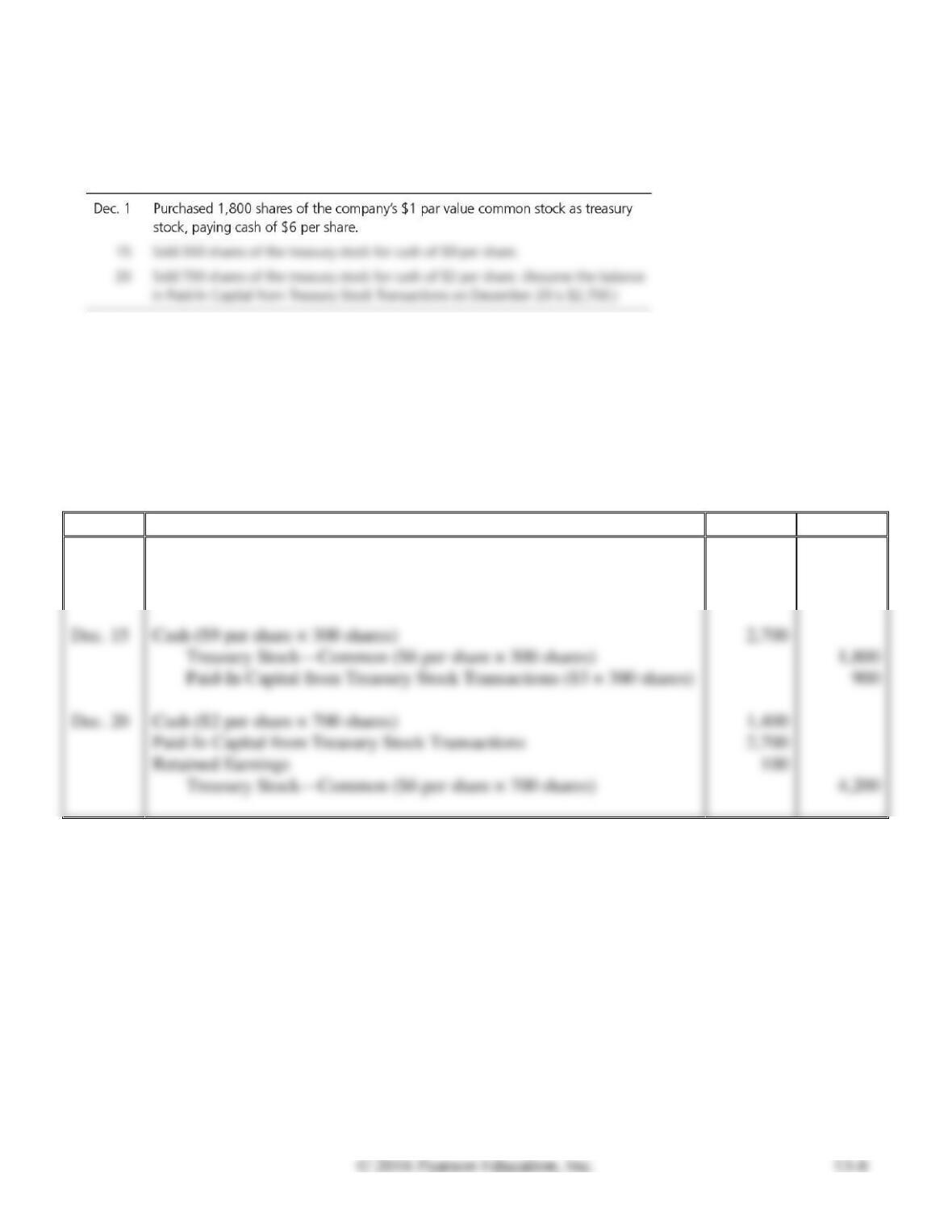
Bottom Dollar Furniture, Inc. completed the following treasury stock transactions in 2016:
Requirements
1. Journalize these transactions. Explanations are not required.
2. How will Bottom Dollar Furniture, Inc. report treasury stock on its balance sheet as of December 31,
2016?
SOLUTION
Requirement 1
Date
Accounts and Explanation
Debit
Credit
2016
Dec. 1
Treasury Stock—Common ($6 per share × 1,800 shares)
10,800
Cash
10,800
Dec. 15
Cash ($9 per share × 300 shares)
Treasury Stock—Common ($6 per share × 300 shares)
Paid-In Capital from Treasury Stock Transactions ($3 × 300 shares)
Dec. 20
Cash ($2 per share × 700 shares)
Paid-In Capital from Treasury Stock Transactions
Retained Earnings
Treasury Stock—Common ($6 per share × 700 shares)
Requirement 2
Bottom Dollar Furniture, Inc. will report treasury stock beneath retained earnings on the balance sheet as
a reduction to total stockholders’ equity.
S13-7 Accounting for cash dividends
Learning Objective 4
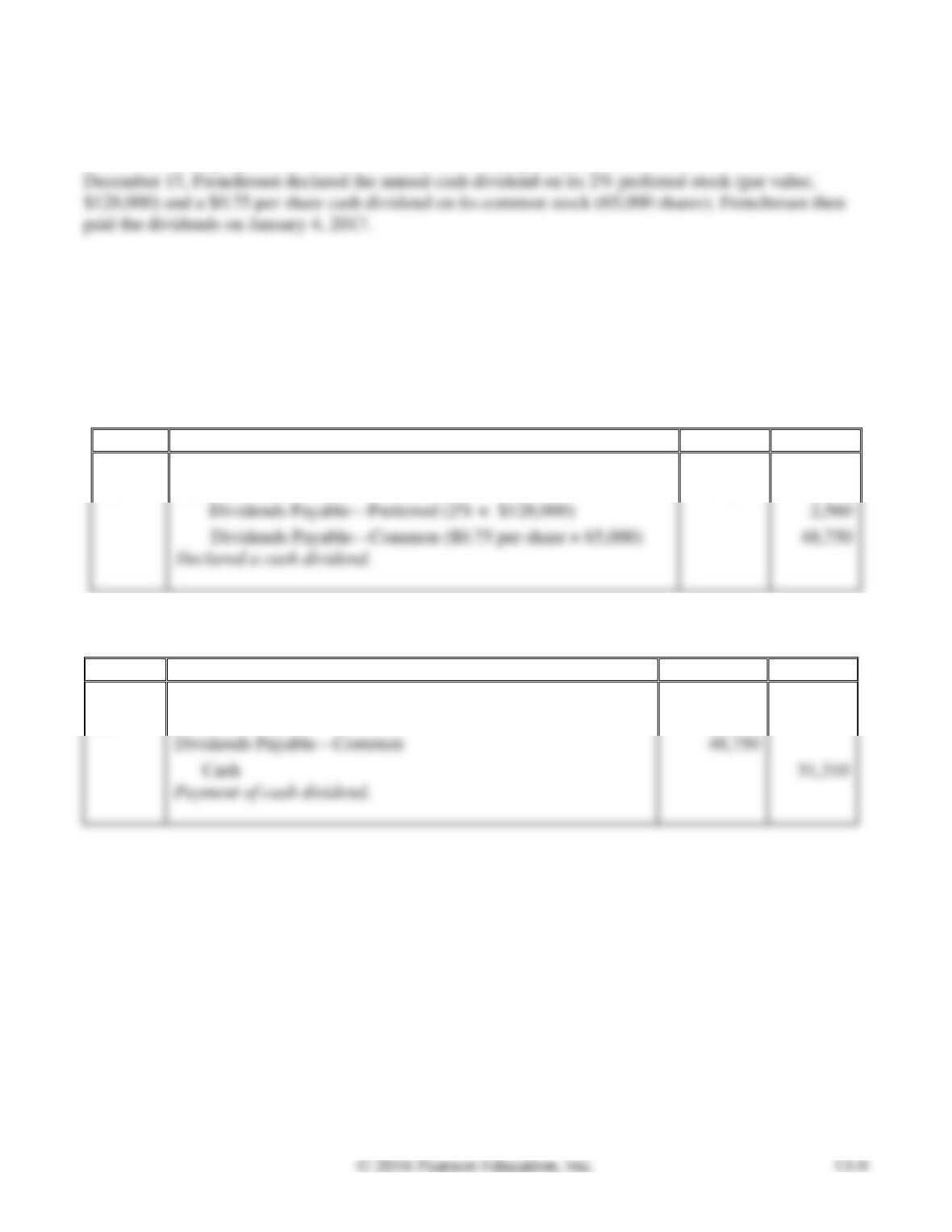
Frenchroast Company earned net income of $95,000 during the year ended December 31, 2016. On
Requirements
1. Journalize for Frenchroast the entry declaring the cash dividends on December 15, 2016.
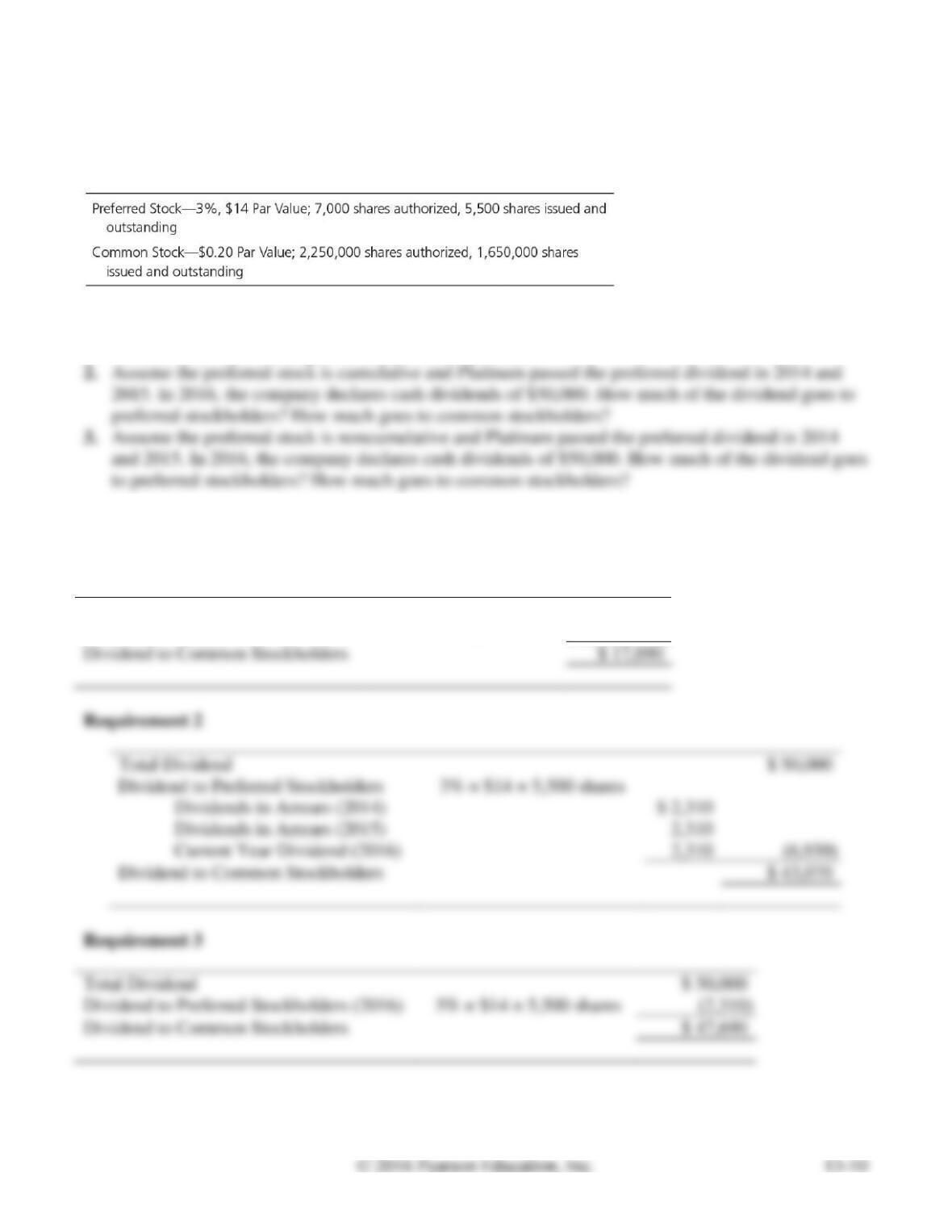
2. Journalize for Frenchroast the entry paying the cash dividends on January 4, 2017.
SOLUTION
Requirement 1
Date
Accounts and Explanation
Debit
Credit
2016
Dec. 15
Cash Dividends ($2,560 + $48,750)
51,310
48,750
Requirement 2
Date
Accounts and Explanation
Debit
Credit
2017
Jan. 4
Dividends Payable—Preferred
2,560
Dividends Payable—Common
S13-8 Dividing cash dividends between preferred and common stock
Learning Objective 4
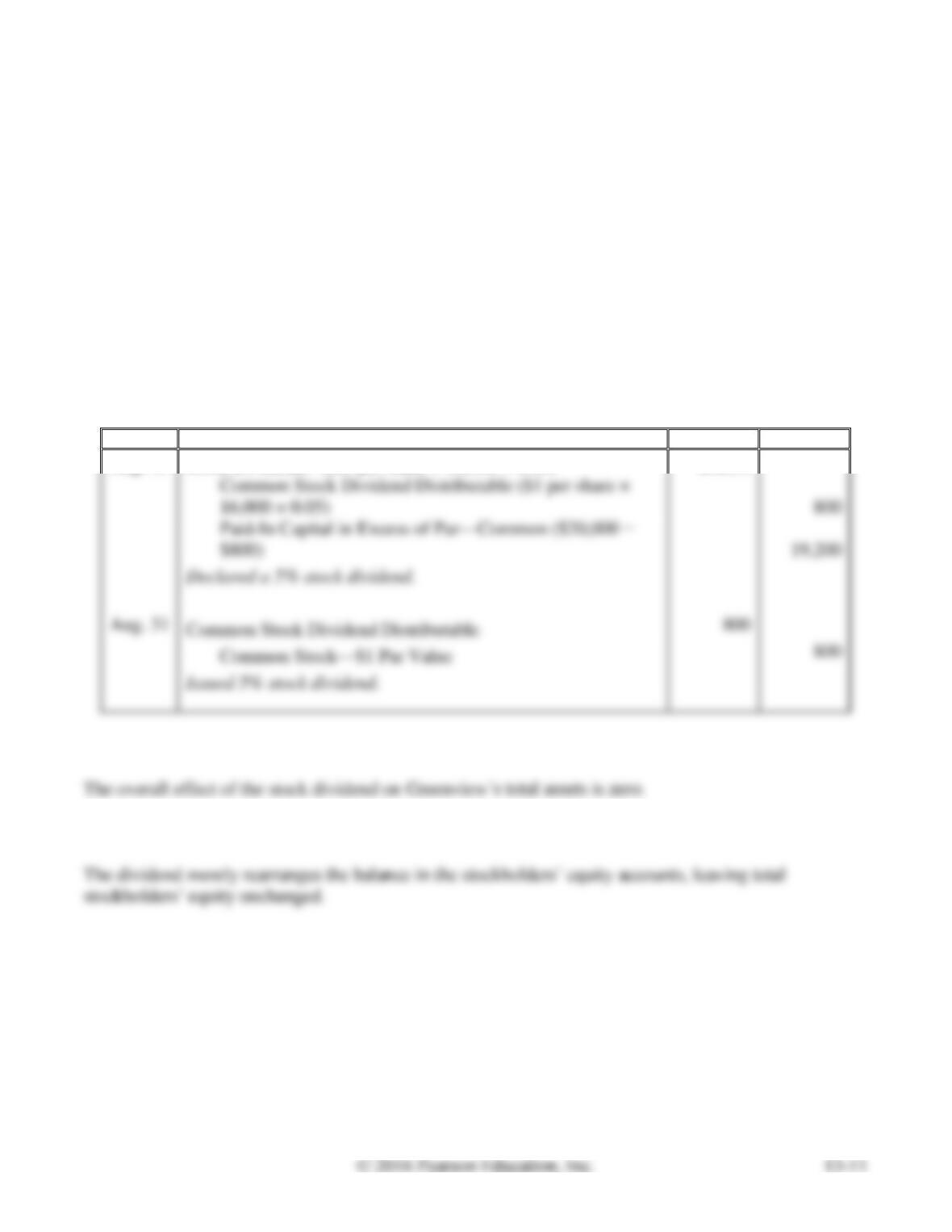
Platinum Trust has the following classes of stock:
Requirements
1. Platinum declares cash dividends of $20,000 for 2016. How much of the dividends goes to preferred
stockholders? How much goes to common stockholders?
SOLUTION
Requirement 1
Total Dividend
$ 20,000
Dividend to Preferred Stockholders
3% × $14 × 5,500 shares
(2,310)
Dividend to Common Stockholders
$ 17,690
Total Dividend
Dividend to Preferred Stockholders
Dividend to Common Stockholders
Total Dividend
Dividend to Preferred Stockholders (2016)
Dividend to Common Stockholders
S13-9 Journalizing a small stock dividend
Learning Objective 4
Greenview Water Sports has 16,000 shares of $1 par value common stock outstanding. Greenview
distributes a 5% stock dividend when the market value of its stock is $25 per share.
Requirements
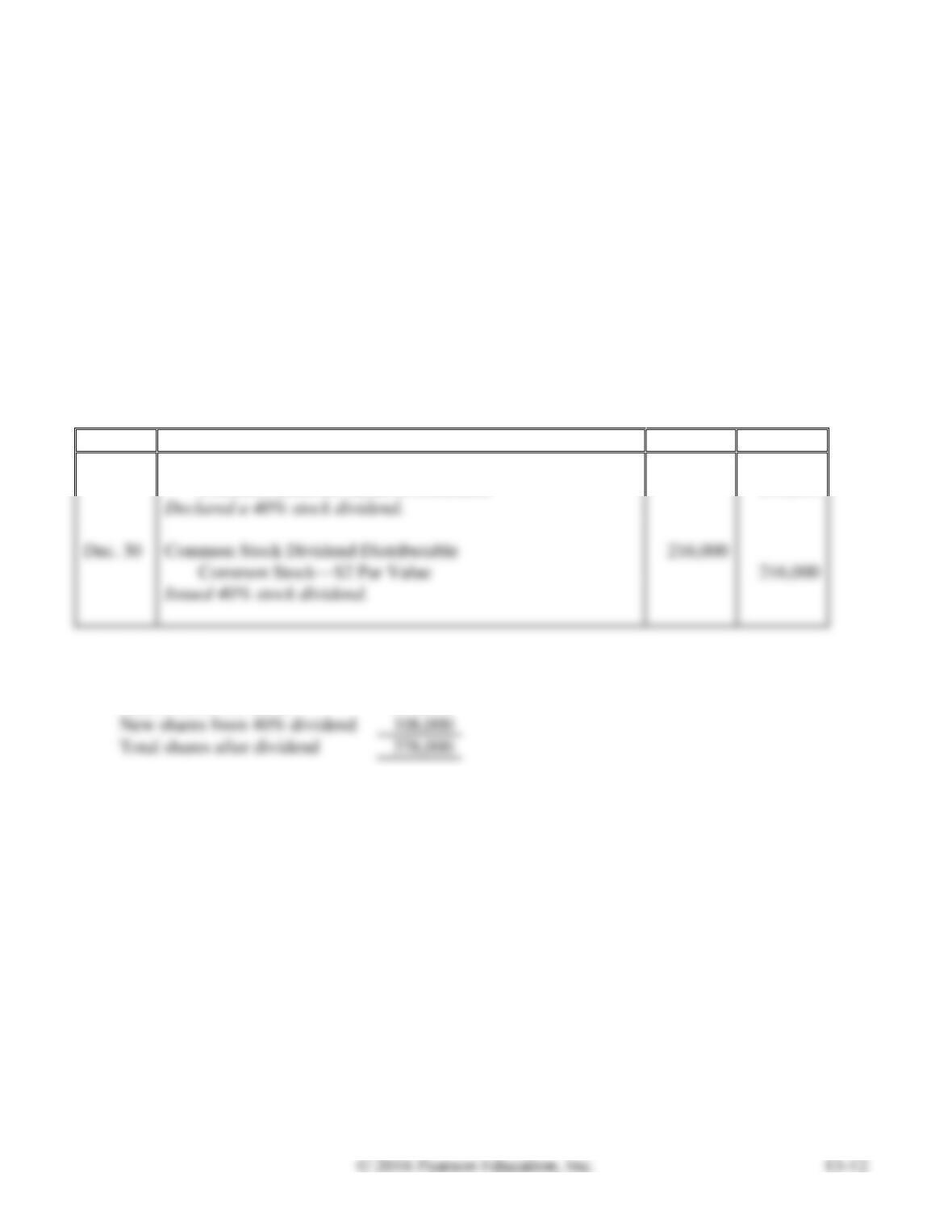
1. Journalize Greenview’s declaration of the stock dividend on August 15 and distribution on August
31.
2. What is the overall effect of the stock dividend on Greenview’s total assets?
3. What is the overall effect on total stockholders’ equity?
SOLUTION
Requirement 1
Date
Accounts and Explanation
Debit
Credit
Aug. 15
Stock Dividends ($25 per share × 16,000 × 0.05)
20,000
19,200
Common Stock Dividend Distributable
Requirement 2
Requirement 3
S13-10 Journalizing a large stock dividend
Learning Objective 4
Billy, Inc. had 270,000 shares of $2 par value common stock issued and outstanding as of December 15,
2016. The company is authorized to issue 1,500,000 common shares. On December 15, 2016, Billy
declared a 40% stock dividend when the market value for Billy’s common stock was $7 per share. The
stock was issued on Dec. 30.
Requirements
1. Journalize the declaration and distribution of the stock dividend.
2. How many shares of common stock are outstanding after the dividend?
SOLUTION
Requirement 1
Date
Accounts and Explanation
Debit
Credit
Dec. 15
Stock Dividends ($2 per share × 270,000 shares × 0.40)
216,000
Common Stock Dividend Distributable
216,000
Dec. 30
Common Stock Dividend Distributable
216,000
Common Stock—$2 Par Value
216,000
Requirement 2
Shares before dividend
270,000
New shares from 40% dividend
108,000
Total shares after dividend
378,000
S13-11 Accounting for a stock split
Learning Objective 4
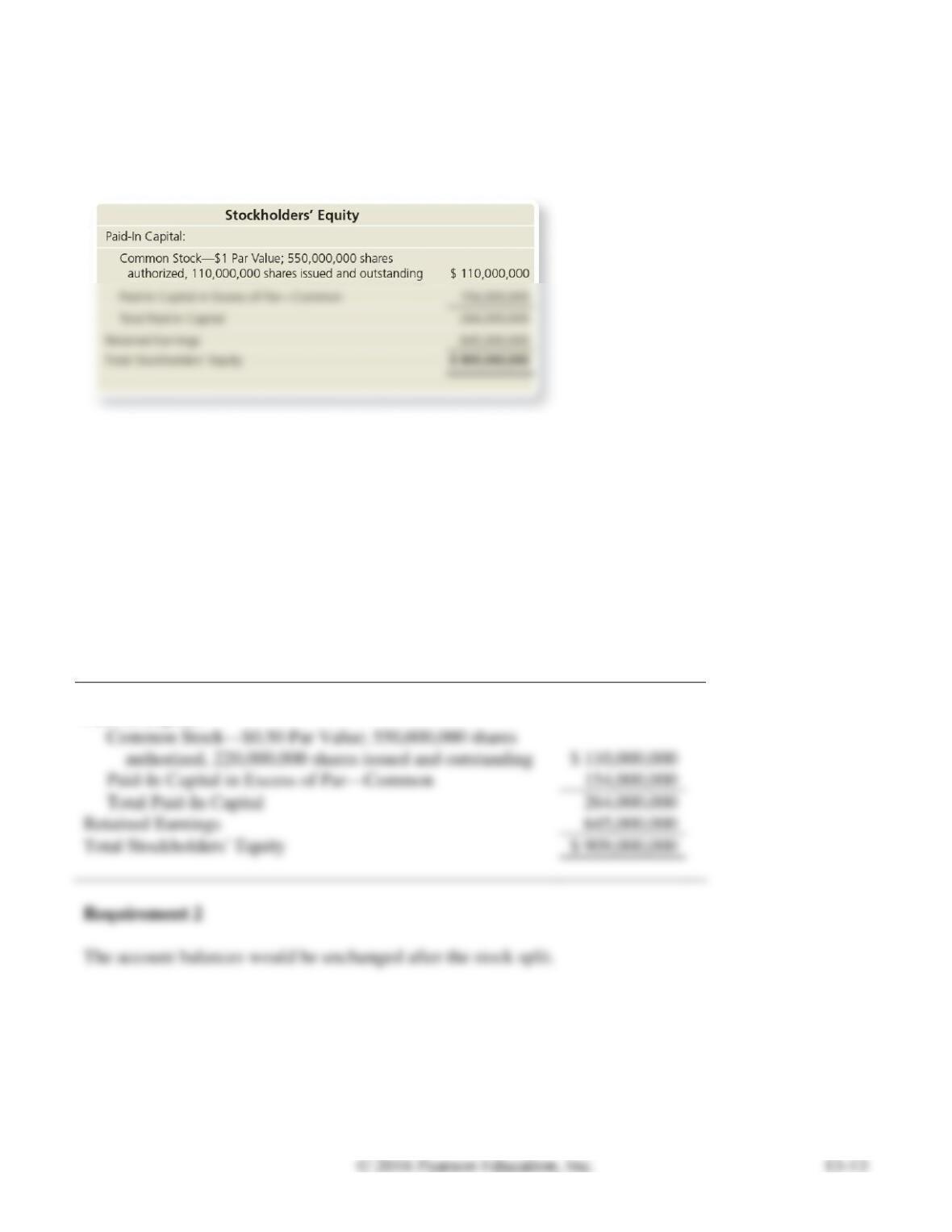
Decor Plus Imports recently reported the following stockholders’ equity:
Suppose Decor Plus split its common stock 2-for-1 in order to decrease the market price per share of its
stock. The company’s stock was trading at $21 per share immediately before the split.
Requirements
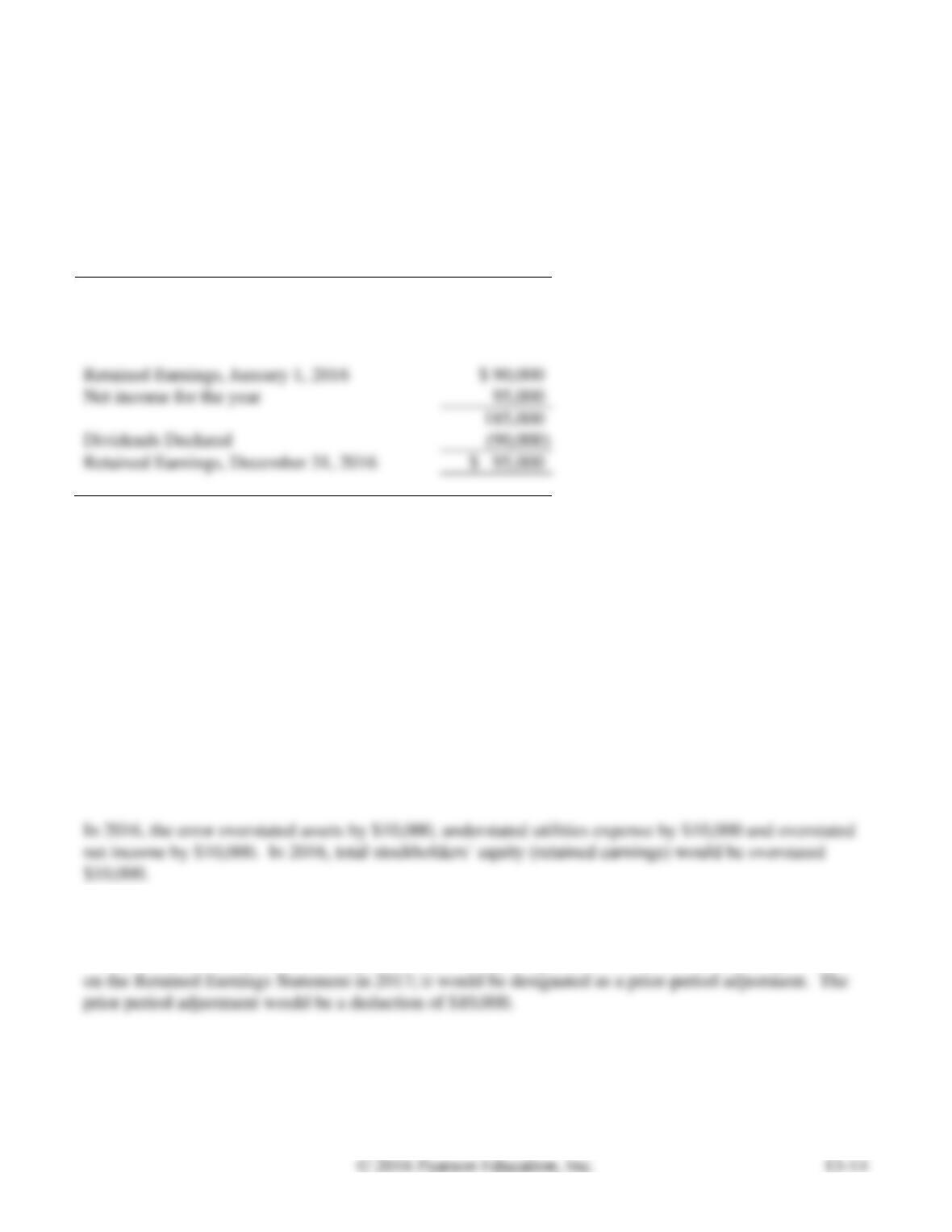
1. Prepare the stockholders’ equity section of the Decor Plus Imports balance sheet after the stock split.
2. Were the account balances changed or unchanged after the stock split?
SOLUTION
Requirement 1
Stockholders’ Equity
Paid-In Capital:
$ 110,000,000
Paid-In Capital in Excess of Par—Common
Total Paid-In Capital
Retained Earnings
Total Stockholders’ Equity
$ 909,000,000
S13-12 Preparing a statement of retained earnings
Learning Objective 5
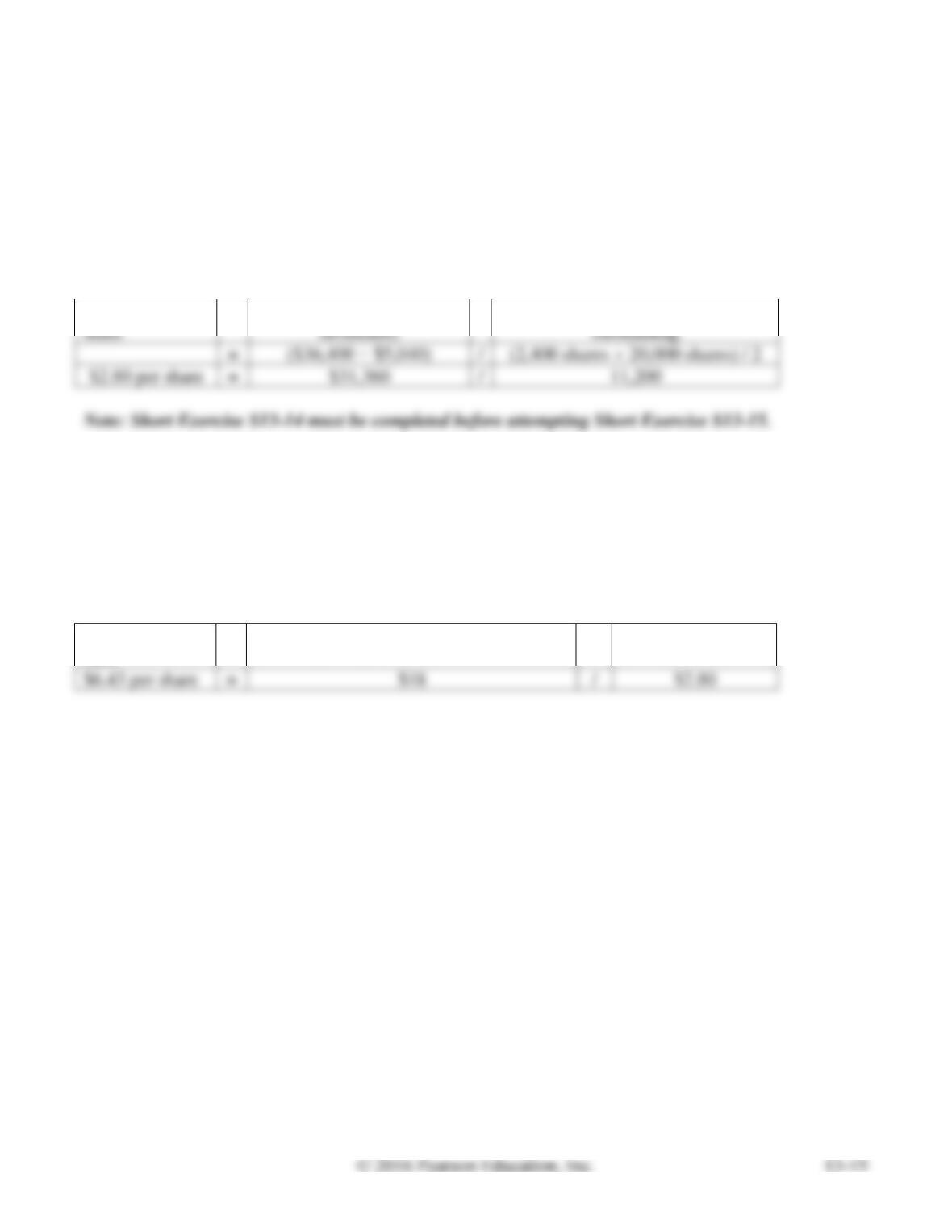
Tinder, Inc. had beginning retained earnings of $90,000 on January 1, 2016. During the year, Tinder
declared and paid $90,000 of cash dividends and earned $95,000 of net income. Prepare a statement of
retained earnings for Tinder, Inc. for the year ending December 31, 2016.
SOLUTION
TINDER, INC.
Statement of Retained Earnings
Year Ended December 31, 2016
Retained Earnings, January 1, 2016
Net income for the year
Dividends Declared
Retained Earnings, December 31, 2016
S13-13 Analyzing the effect of prior-period adjustments
Learning Objective 5
Taylor Corporation discovered in 2017 that it had incorrectly recorded in 2016 a cash payment of
$50,000 for utilities expense. The correct amount of the utilities expense was $60,000.
Requirements
1. Determine the effect of the error on the accounting equation in 2016.
2. How should this error be reported in the 2017 financial statements?
SOLUTION
Requirement 1
Requirement 2
The error would be reported as an adjustment to the beginning balance in the retained earnings account
S13-14 Computing earnings per share
Learning Objective 6
RUT Corporation had net income for 2016 of $36,400. RUT had 2,400 shares of common stock
outstanding at the beginning of the year and 20,000 shares of common stock outstanding as of December
31, 2016. During the year, RUT declared and paid preferred dividends of $5,040. Compute RUT’s
earnings per share.
SOLUTION
Earnings per
=
(Net income − Preferred
/
Average number of common shares
S13-15 Computing price/earnings ratio
Learning Objective 6
Refer to the RUT data in Short Exercise S13-14. Assume the market price of RUT’s common stock is
$18 per share. Compute RUT’s price/earnings ratio.
SOLUTION
Price/earnings
ratio
=
Market price per share of common stock
/
Earnings per share
S13-16 Computing rate of return on common stockholders’ equity
Learning Objective 6
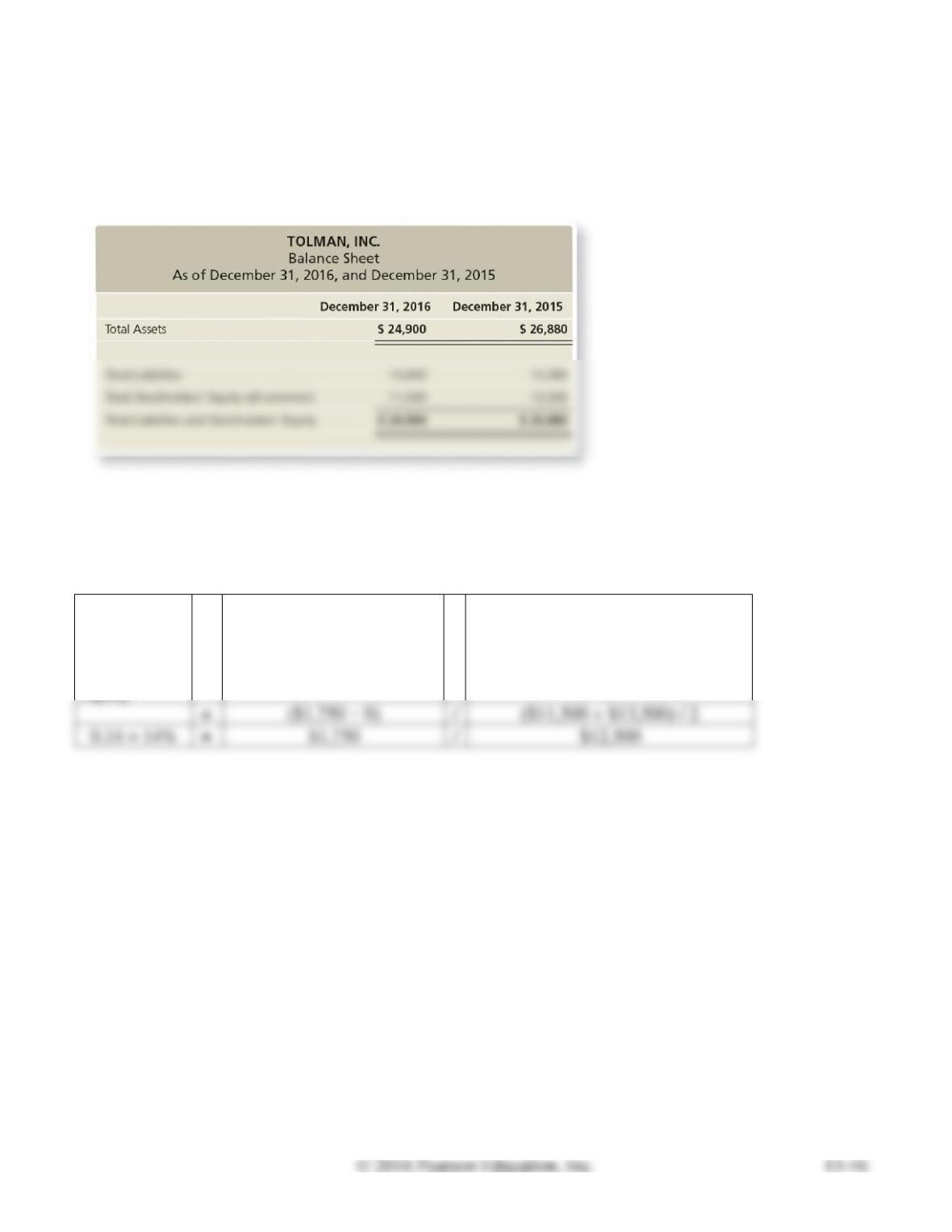
Tolman, Inc.’s 2016 balance sheet reported the following items—with 2015 figures given for
comparison:
Net income for 2016 was $1,750. Compute Tolman’s rate of return on common stockholders’ equity for
2016.
SOLUTION
Rate of
return on
common
stockholders’
equity
=
(Net income − Preferred
dividends)
/
Average common stockholders’
equity
Exercises
E13-17 Identifying advantages and disadvantages of a corporation
Learning Objective 1
Following is a list of advantages and disadvantages of the corporate form of business. Identify each
quality as either an advantage or a disadvantage.
a. Ownership and management are separated.
b. Entity has continuous life.
c. Transfer of ownership is easy.
d. Stockholders’ liability is limited.
e. Exposure to double taxation is evident.
f. Entity can raise more money than a partnership or sole proprietorship.
g. Government regulation is expensive.
SOLUTION
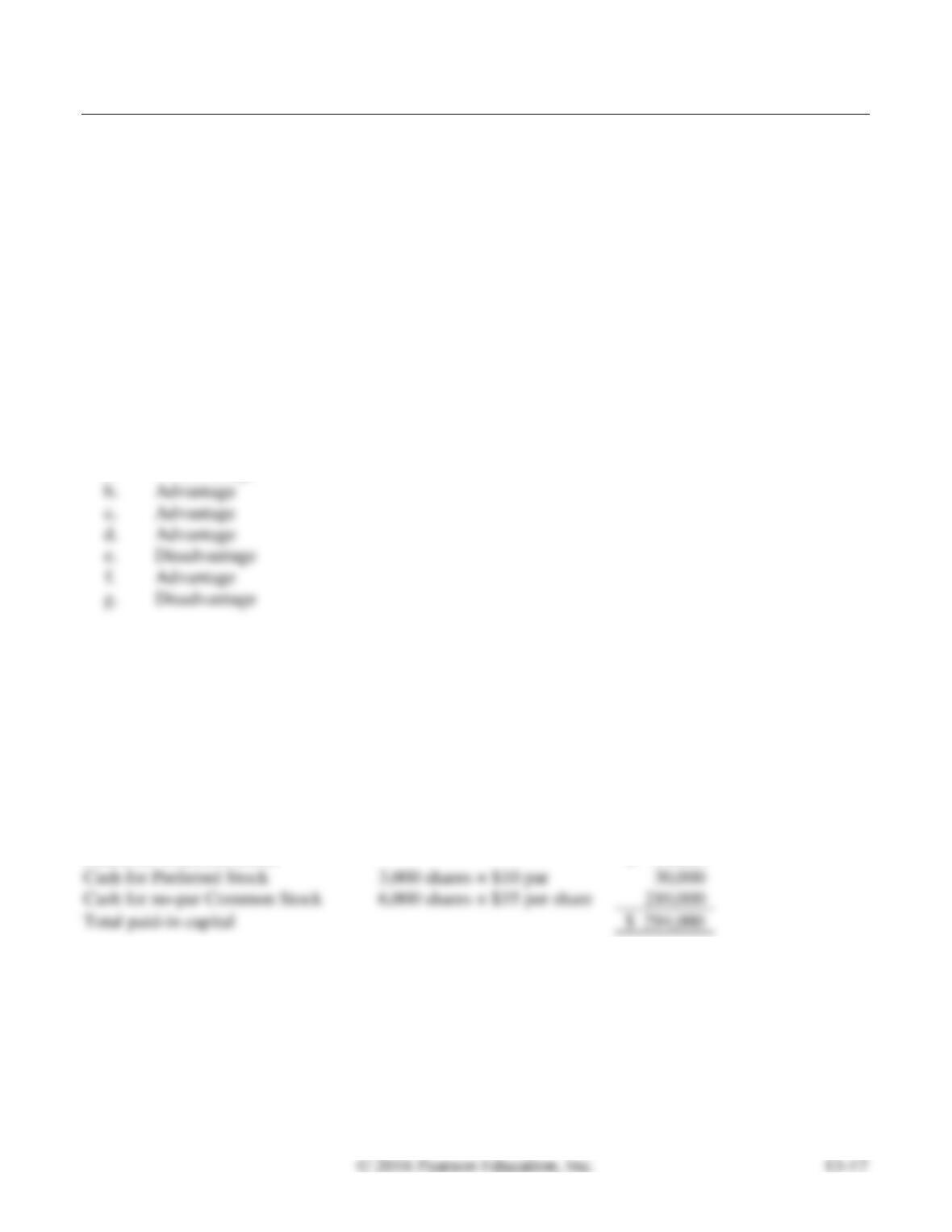
a.
Disadvantage
b.
Advantage
c.
Advantage
d.
Advantage
e.
Disadvantage
Advantage
g.
Disadvantage
E13-18 Determining paid-in capital for a corporation
Learning Objective 2
Arilla Corporation recently organized. The company issued common stock to an inventor in exchange
for a patent with a market value of $54,000. In addition, Arilla received cash for 3,000 shares of its $10
par preferred stock at par value and 6,000 shares of its no-par common stock at $35 per share. Without
making journal entries, determine the total paid-in capital created by these transactions.
SOLUTION
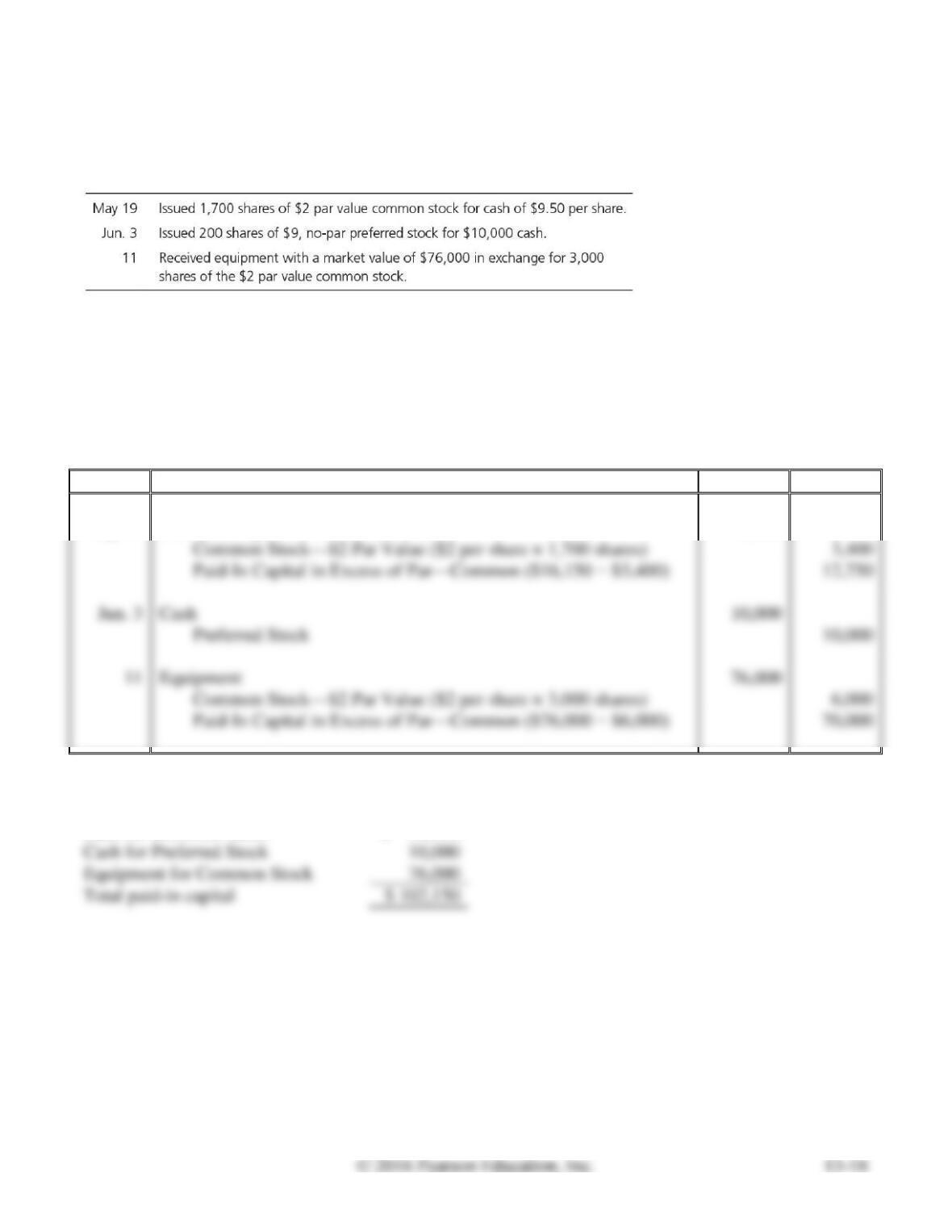
Patent for Common Stock
$ 54,000
Cash for Preferred Stock
3,000 shares × $10 par
Cash for no-par Common Stock
6,000 shares × $35 per share
210,000
Total paid-in capital
$ 294,000
E13-19 Journaling issuance of stock
Learning Objective 2
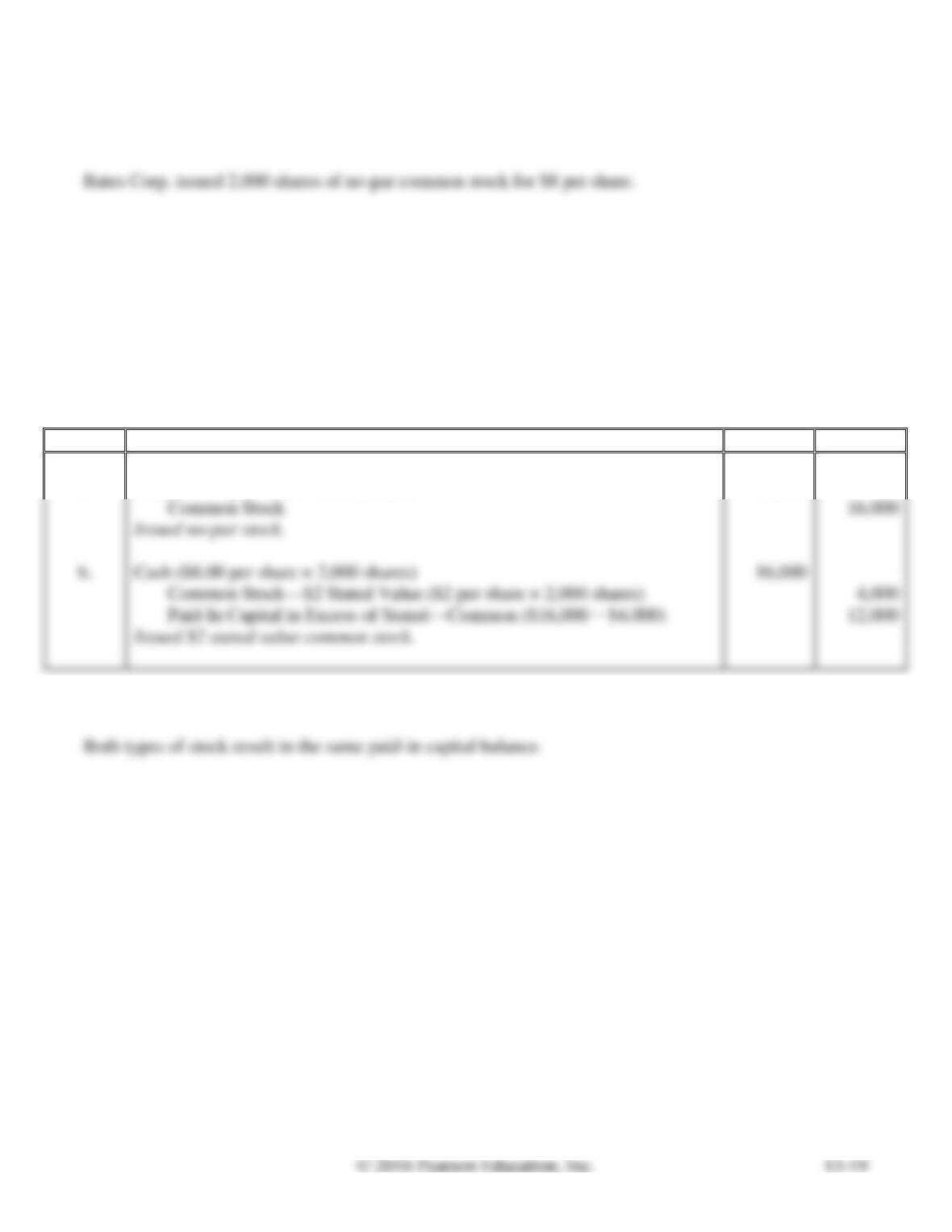
Skylar Systems completed the following stock issuance transactions:
Requirements
1. Journalize the transactions. Explanations are not required.
2. How much paid-in capital did these transactions generate for Skylar Systems?
SOLUTION
Requirement 1
Date
Accounts and Explanation
Debit
Credit
May 19
Cash ($9.50 per share × 1,700 shares)
16,150
12,750
Cash
10,000
10,000
Equipment
76,000
70,000
Requirement 2
Cash for Common Stock
$ 16,150
Cash for Preferred Stock
Equipment for Common Stock
Total paid-in capital
$ 102,150
E13-20 Journalizing issuance of no-par stock
Learning Objective 2
1. a. Cash $16,000
Requirements
1. Record issuance of the stock if the stock:
a. is true no-par stock.
b. has stated value of $2 per share.
2. Which type of stock results in more total paid-in capital?
SOLUTION
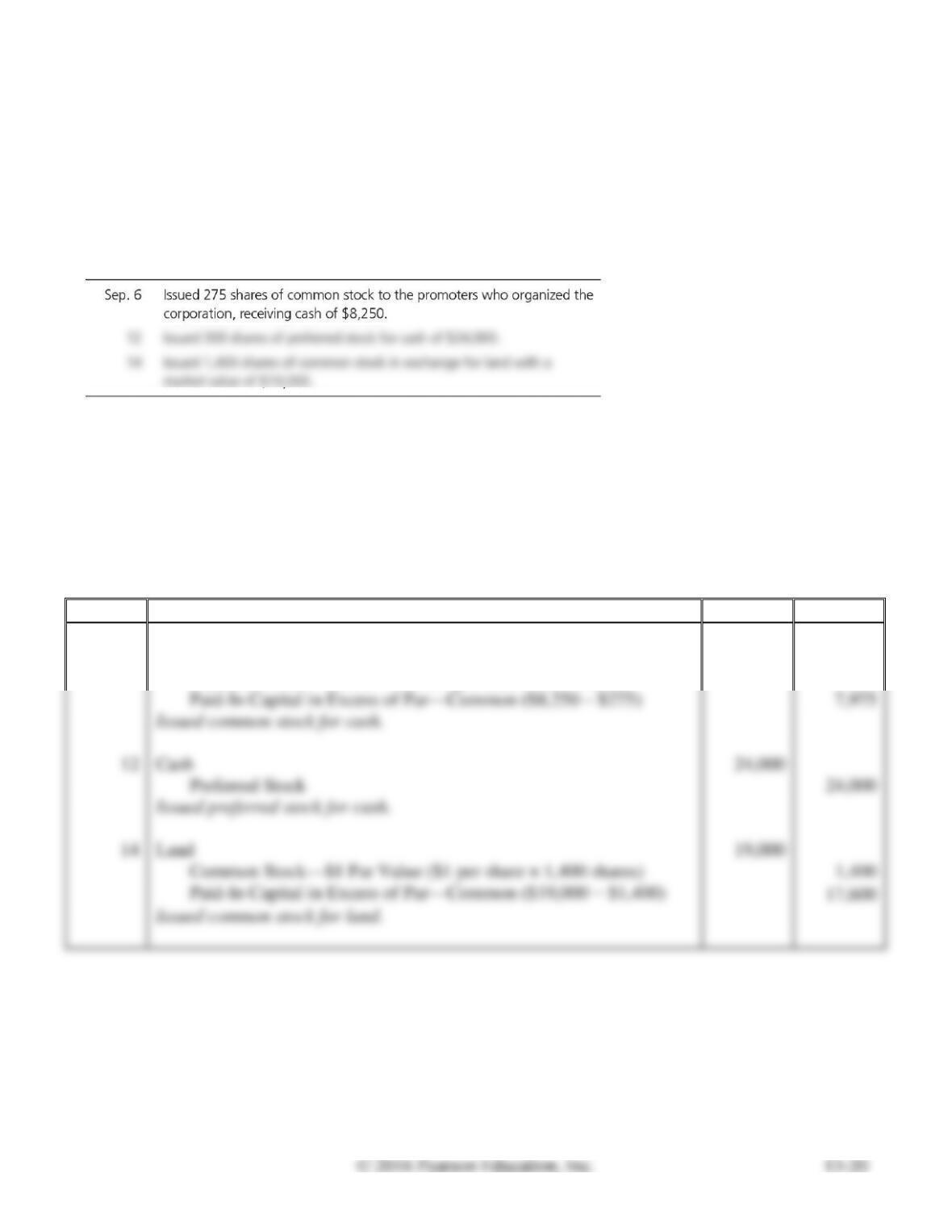
Requirement 1
Date
Accounts and Explanation
Debit
Credit
a.
Cash ($8.00 per share × 2,000 shares)
16,000
16,000
Cash ($8.00 per share × 2,000 shares)
16,000
12,000
Requirement 2
E13-21 Journalizing issuance of stock and preparing the stockholders’ equity section of the
balance sheet
Learning Objective 2
2. Total Stockholders’ Equity $88,250
The charter for WCAP-TV, Inc. authorizes the company to issue 100,000 shares of $2, no-par preferred
stock and 500,000 shares of common stock with $1 par value. During its start-up phase, WCAP
completed the following transactions:
Requirements
1. Record the transactions in the general journal.
2. Prepare the stockholders’ equity section of the WCAP-TV balance sheet at September 30, 2016,
assuming WCAP-TV, Inc. had net income of $37,000 for the month.
SOLUTION
Requirement 1
Date
Accounts and Explanation
Debit
Credit
Sep. 6
Cash
8,250
Common Stock—$1 Par Value ($1 per share × 275 shares)
275
Paid-In Capital in Excess of Par—Common ($8,250 – $275)
7,975
12
Cash
Preferred Stock
14
Land
Common Stock—$1 Par Value ($1 per share × 1,400 shares)
1,400