Problem 13-29 (continued)
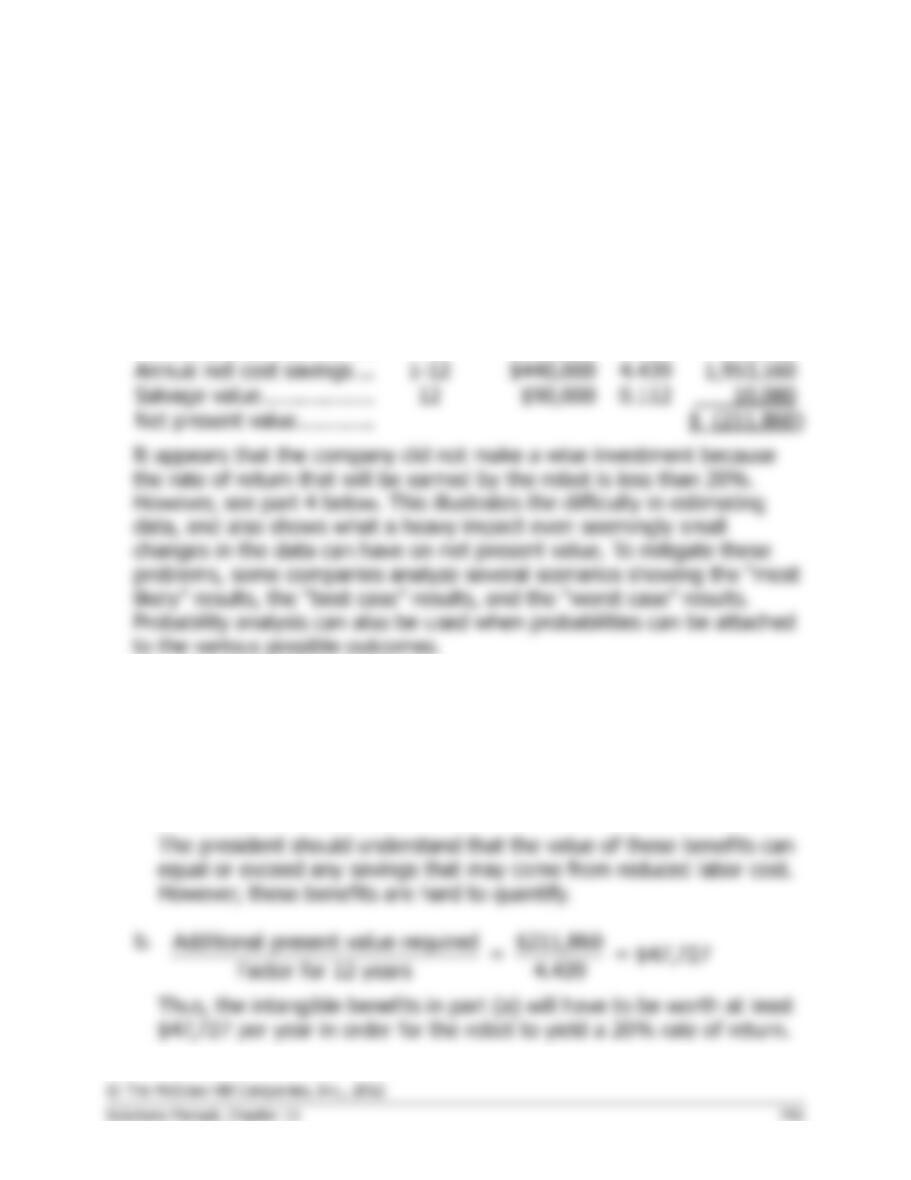
Recomputation of the net present value of the project:
Year(s)
Amount of
Cash Flows
20%
Factor
Present
Value of
Cash Flows
Cost of the robot ………….
Now
$(1,600,000)
1.000
$(1,600,000)
Software and installation..
Now
$(825,000)
1.000
(825,000)
Cash released from
inventory ………………….
1
$300,000
0.833
249,900
Annual net cost savings …
$440,000
Salvage value ………………
0.112
Net present value …………
4. a. Several intangible benefits are usually associated with investments in
automated equipment. These intangible benefits include:
◼ Greater throughput.
◼ Greater variety of products.
◼ Higher quality.
◼ Reduction in inventories.
Problem 13-30 (30 minutes)
1. Average weekly use of the washers and dryers would be:
$1,800
Washers: = 1,200 uses
$1.50 per use
$1,125
Dryers: = 1,500 uses
$0.75 per use
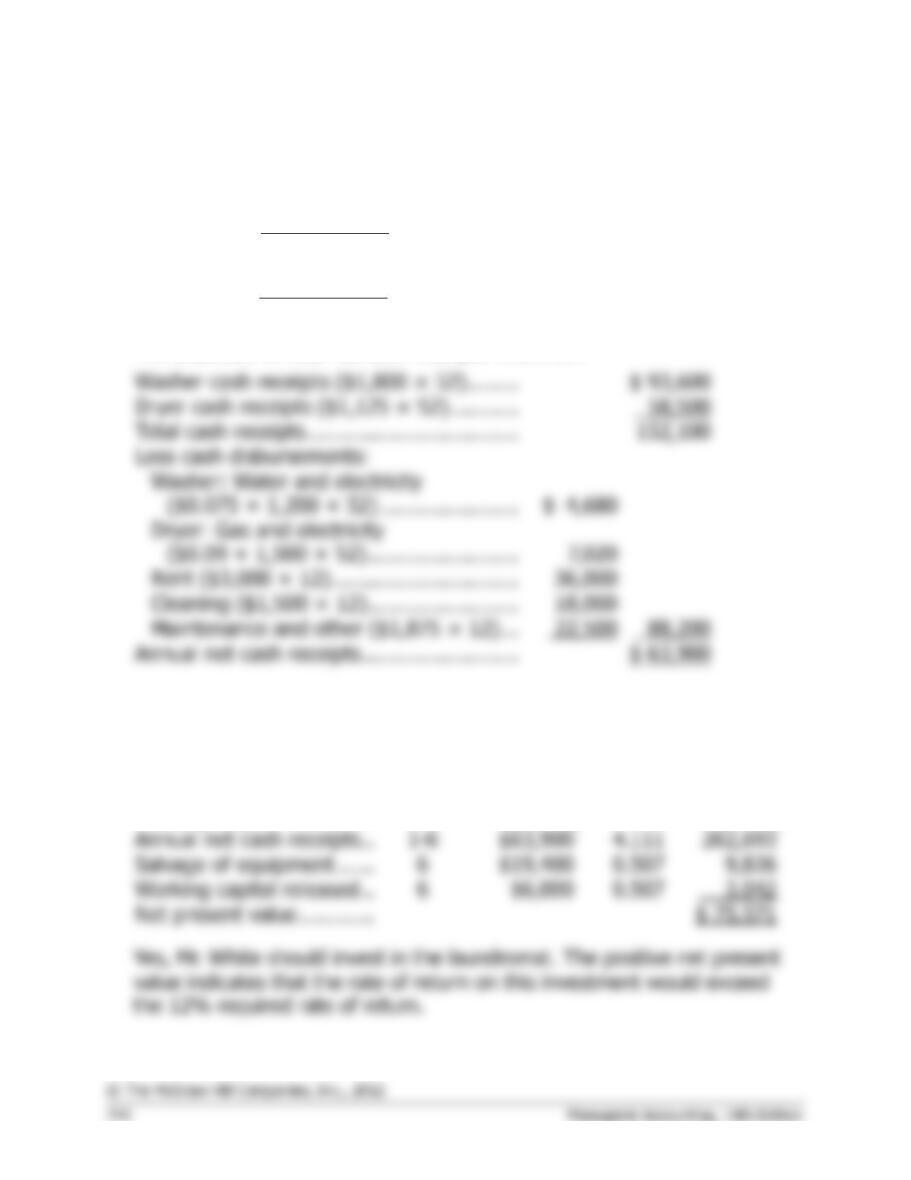
The expected annual net cash receipts would be:
Washer cash receipts ($1,800 × 52) ……..
Dryer cash receipts ($1,125 × 52) ………..
Total cash receipts …………………………….
Less cash disbursements:
Rent ($3,000 × 12) …………………………
36,000
18,000
Annual net cash receipts …………………….
2.
Item
Year(s)
Amount of
Cash Flows
12%
Factor
Present
Value of
Cash Flows
Cost of equipment ………..
Now
$(194,000)
1.000
$(194,000)
Working capital invested ..
Now
$(6,000)
1.000
(6,000)
Annual net cash receipts ..
4.111
Working capital released ..
0.507
Net present value …………
Problem 13-31 (45 minutes)
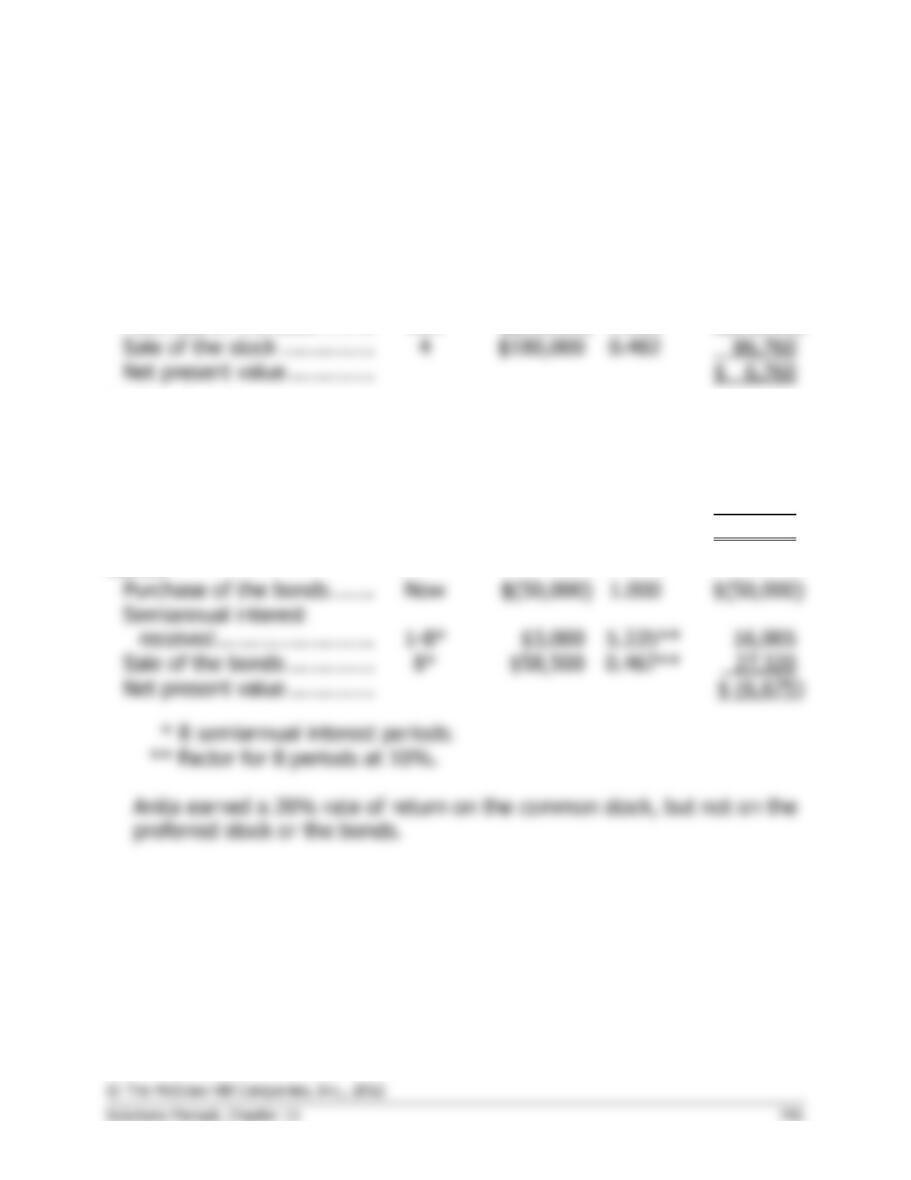
1. A net present value computation for each investment follows:
Item
Year(s)
Amount of
Cash Flows
20%
Factor
Present
Value of
Cash Flows
Common stock:
Purchase of the stock ……..
Now
$(80,000)
1.000
$(80,000)
Sale of the stock ……………
4
0.482
Net present value …………..
Preferred stock:
Purchase of the stock ……..
Now
$(30,000)
1.000
$(30,000)
Annual cash dividend
(6%)…………………………
1-4
$1,800
2.589
4,660
Sale of the stock ……………
4
$24,000
0.482
11,568
Net present value …………..
$(13,772)
Bonds:
Purchase of the bonds …….
Now
$(50,000)
1.000
$(50,000)
$3,000
Sale of the bonds …………..
$58,500
Net present value …………..
Factor for 8 periods at 10%.
Problem 13-31 (continued)
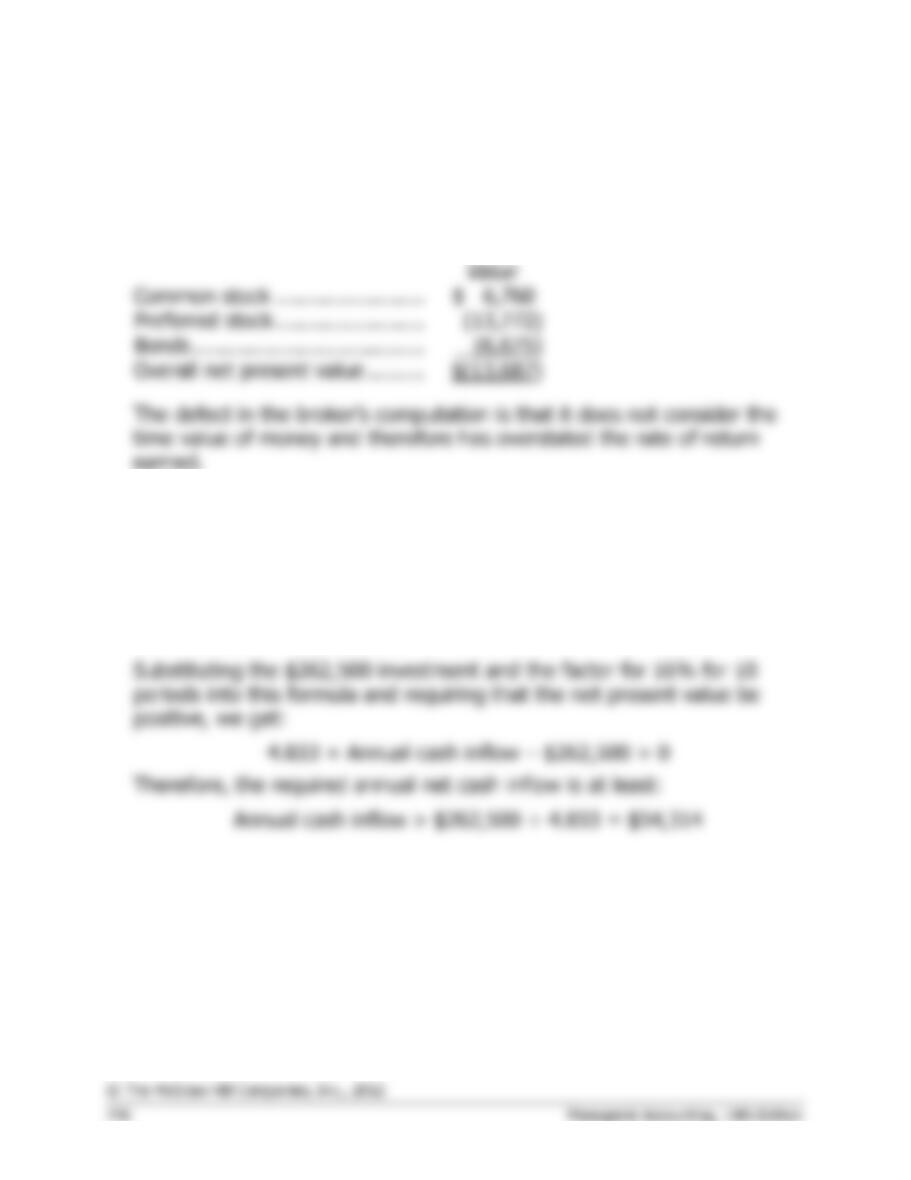
2. Considering all three investments together, Anita did not earn a 20%
rate of return. The computation is:
Net
Present
3.
Because the assumption is that the project will yield the same annual
cash inflow every year, the formula for the net present value of the
project is:
Net present Present value Annual Investment
value of = factor for × cash – required
the project an annuity inflow
Problem 13-32 (45 minutes)
The annual net cash inflow from rental of the property would be:
Net operating income ……….
$30,100
Add back depreciation ………
17,800
Annual net cash inflow ……..
$47,900
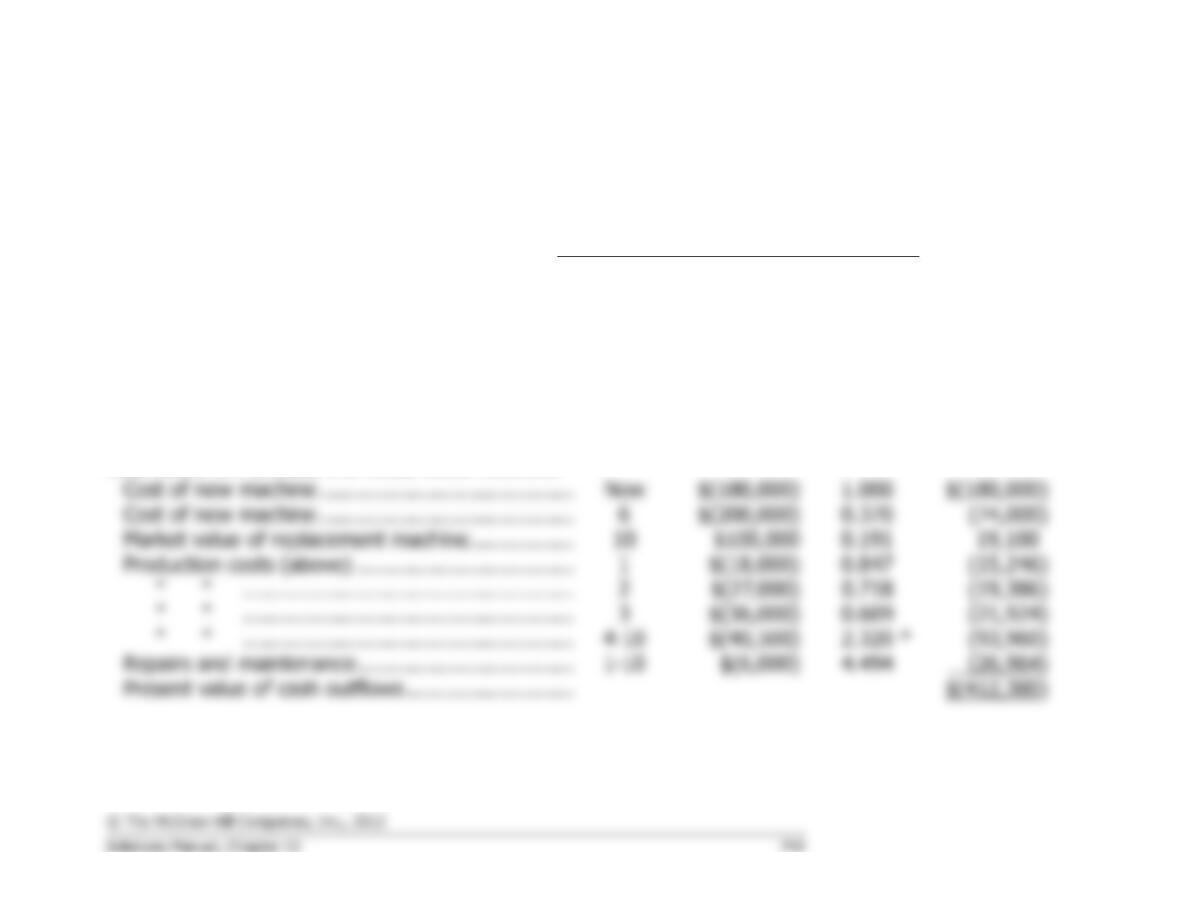
Given this figure, the present value analysis would be as follows:
Item
Year(s)
Amount
of Cash
Flows
14%
Factor
Present
Value of
Cash
Flows
Keep the property:
Annual loan payment ……
1-10
$(12,600)
5.216
$ (65,722)
Annual net cash inflow ….
1-16
$47,900
6.265
300,094
Resale value of the
property ………………….
16
$139,600
*
0.123
17,171
$251,543
Sell the property:
Payoff of mortgage ………
Now
$(71,000)
1.000
$ (71,000)
Down payment received ..
Now
$150,000
1.000
150,000
Annual payments
1-16
6.265
$223,095
$ 28,448
Present value of cash
*Land: $52,000 × 2.5 = $130,000; Building: $9,600; Total: $139,600.
Thus, Professor Ryatt should be advised to keep the property. Note that
even if the property were worth nothing at the end of 16 years, it would

Case 13-33 (90 minutes)
1. This is a least-cost problem; it can be worked either by the total-cost approach or by the incremental-
cost approach. Regardless of which approach is used, we must first compute the annual production
costs that would result from each of the machines. The computations are:
Year
1
2
3
4-10
Units produced …………………………………….
20,000
30,000
40,000
45,000
Model 2600: Total cost at $0.90 per unit ……
$18,000
$27,000
$36,000
$40,500
Model 5200: Total cost at $0.70 per unit ……
$14,000
$21,000
$28,000
$31,500
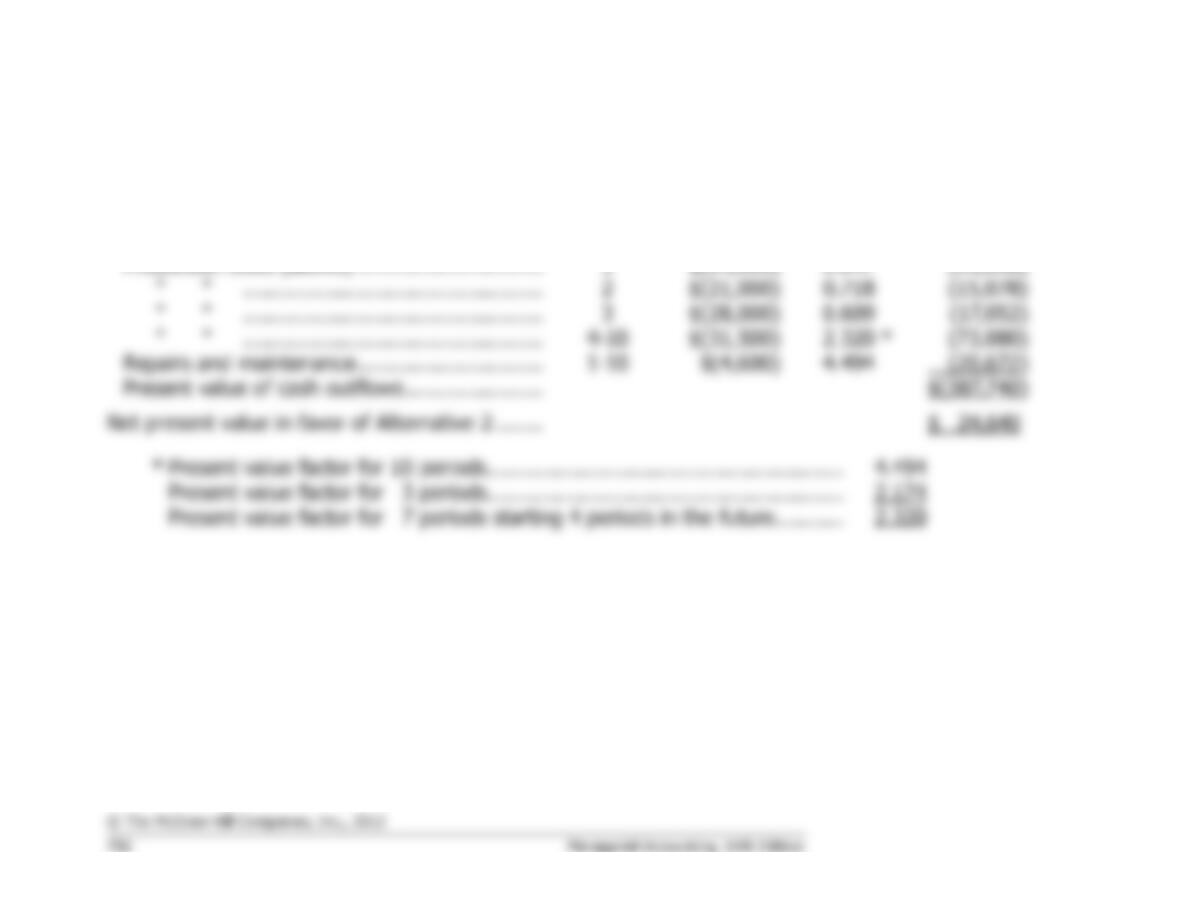
Using these data, the solution by the total-cost approach would be:
Item
Year(s)
Amount of
Cash Flows
18%
Factor
Present Value
of Cash Flows
Alternative 1: Purchase the model 2600 machine:
Cost of new machine …………………………………..
Market value of replacement machine……………..
Production costs (above) ……………………………..
$(18,000)
” ” …………………………..…………………
” ” …………………………..…………………
” ” …………………………..…………………
*
Present value of cash outflows ………………………
Case 13-33 (continued)
Item
Year(s)
Amount of
Cash Flows
18%
Factor
Present Value
of Cash Flows
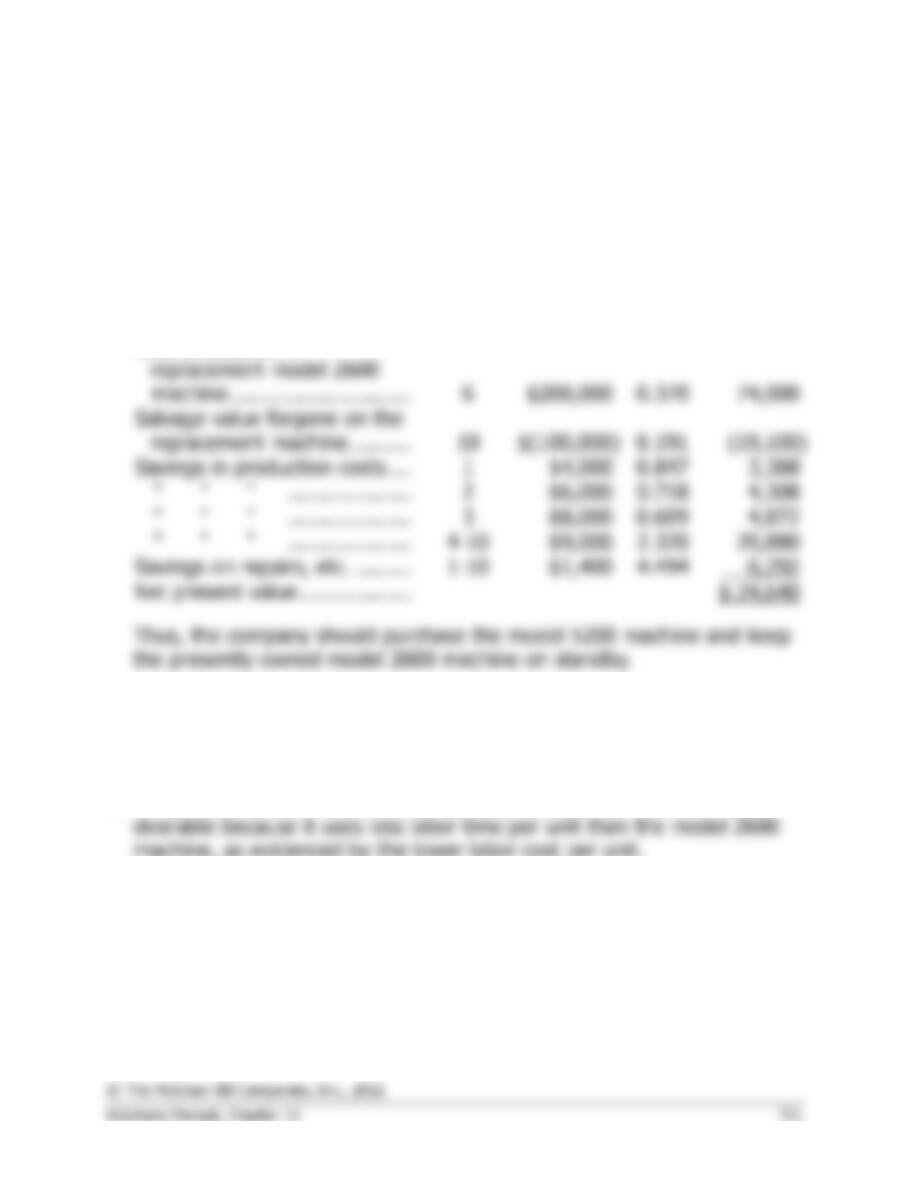
Alternative 2: Purchase the model 5200 machine:
Cost of new machine ………………………………
Now
$(250,000)
1.000
$(250,000)
Production costs (above) …………………………
1
$(14,000)
0.847
(11,858)
” ” …………………………..…………….
” ” …………………………..…………….
” ” …………………………..…………….
*
Present value of cash outflows ………………….
*
Present value factor for 10 periods …………………………………………………
Case 13-33 (continued)
The solution by the incremental-cost approach would be:
Item
Year(s)
Amount
of Cash
Flows
18%
Factor
Present
Value of
Cash
Flows
Incremental cost of the
model 5200 machine ………..
Now
$(70,000)
1.000
$(70,000)
0.370
Salvage value forgone on the
0.609
2.320
Cost avoided on a
2. An increase in materials cost would make the model 5200 machine less
desirable because it uses more material per unit than the model 2600
machine, as evidenced by the greater material cost per unit.
3. An increase in labor cost would make the model 5200 machine more
Case 13-34 (45 minutes)
1. As a member of the division budget committee that is conducting the
postaudit review, Amy Kimbell will be implicitly lending her credibility to
any report that is forwarded to the board of directors. If she were to
implicitly accept the review by failing to call attention to its
shortcomings, she would be violating the credibility standard of the
Code of Conduct adopted by the Institute of Management Accountants,
which states “Communicate information fairly and objectively. Disclose
fully all relevant information that could reasonably be expected to
influence an intended user’s understanding of the reports, comments,
and recommendations presented.” The intent of the current postaudit
review is clearly to justify the earlier decision to invest in the high-tech
operation, rather than to present a fair and balanced view. Unfavorable
information has been suppressed.
Case 13-34 (continued)
2. Unfortunately, the situation that Amy faces is all too common. Rather
than acknowledge mistakes and cut losses, managers (and people in
general) too often remain committed to their failing courses of action.
This commitment leads people into self-delusion, self-justification, and