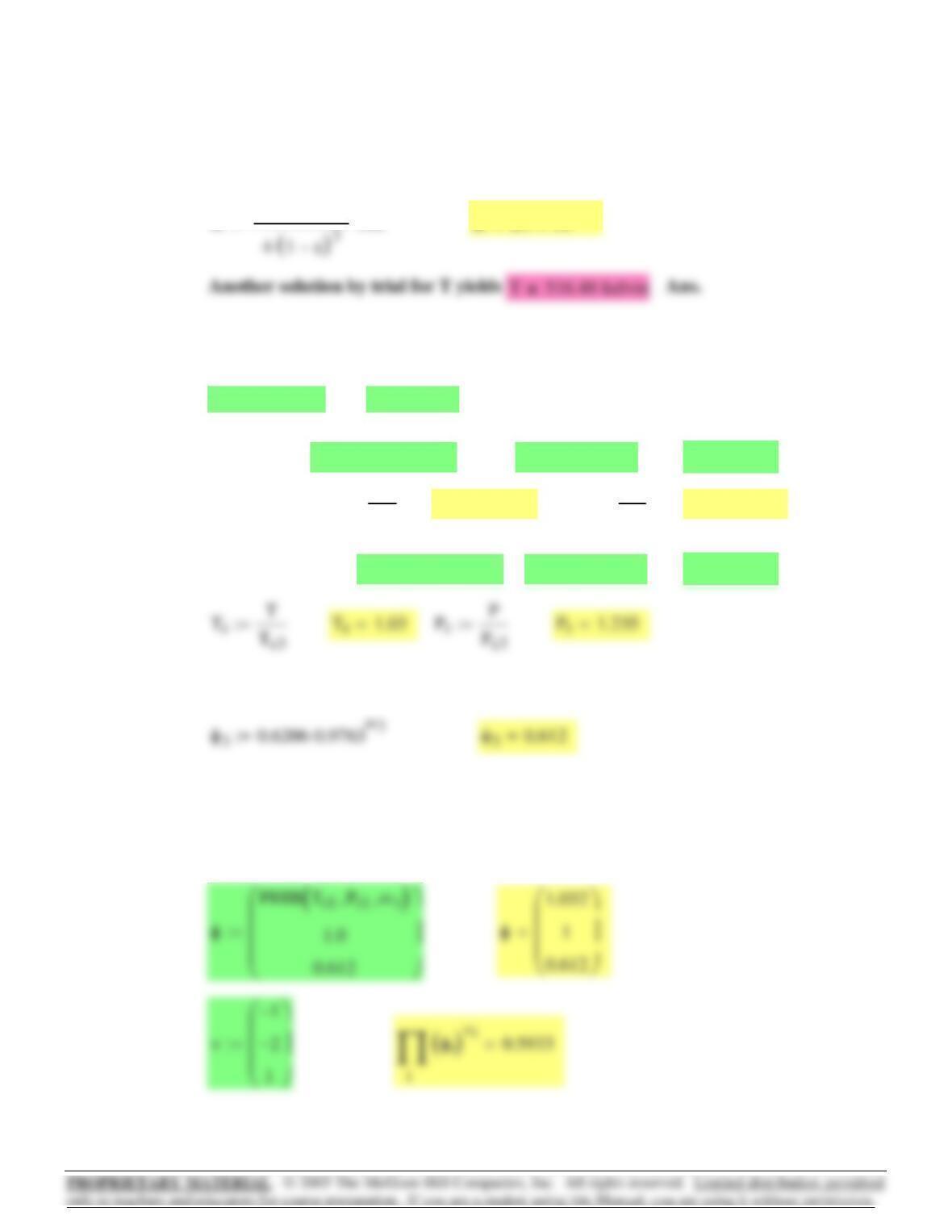
For CH3OH(3): Tc3 512.6kelvin:= Pc3 80.97bar:= ω30.564:=
By Eq. (11.67) and data from Tables E.15 & E.16.
For H2(2), the reduced temperature is so large that it may be
assumed ideal: φ = 1.
Therefore: i13..:=
(c) For P = 100 bar, the preceding equation becomes
Kε32ε⋅−
()
2
⋅
100 2−
⋅:= K 2.7 10 3−
×=
(d) Eq. (13.27) applies, and requires fugacity coefficients. Since iteration
will be necessary, assume a starting T of 528 K, for which:
T 528kelvin:= P 100bar:=
For CO(1): Tc1 132.9kelvin:= Pc1 34.99bar:= ω10.048:=
Tr1
T
Tc1
:= Tr1 3.973=Pr1
P
Pc1
:= Pr1 2.858=
503
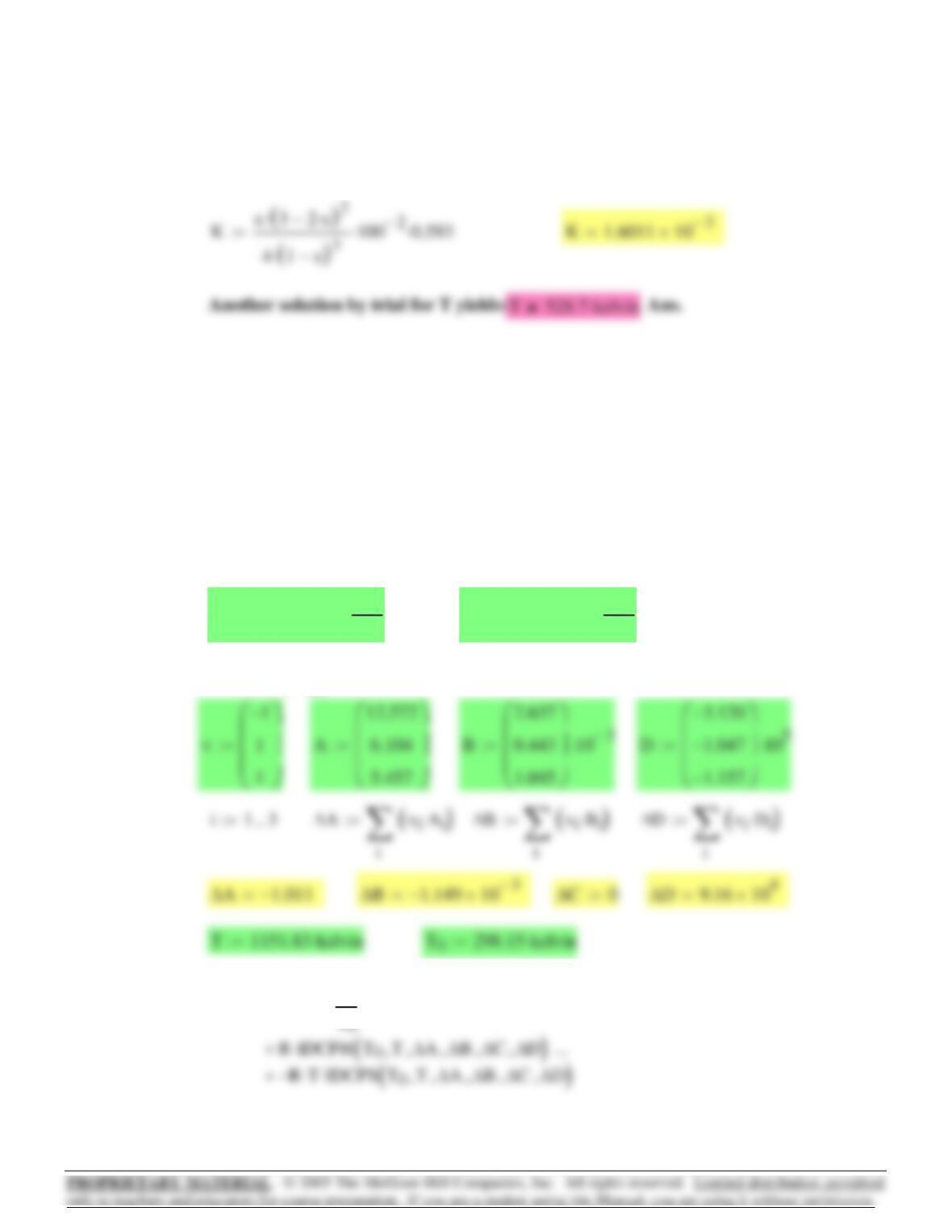
∆G∆H298
T
T0
∆H298 ∆G298
−
()
⋅−
…
:=
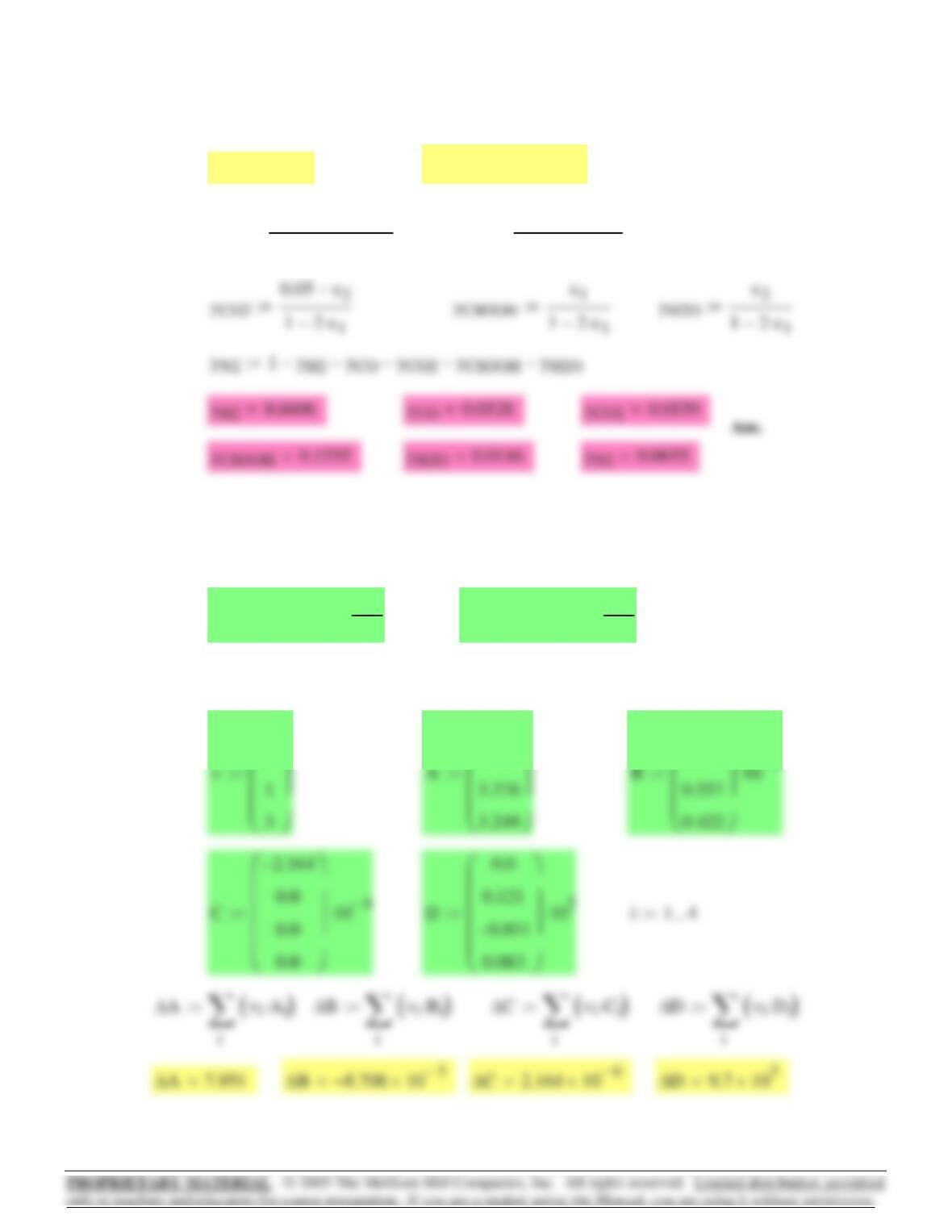
The following vectors represent the species of the reaction in the order in
which they appear:
∆G298 130401 J
mol
⋅:=∆H298 178321 J
mol
⋅:=
From the data of Table C.4,
Each species exists PURE as an individual phase, for which the activity is
f/f0. For the two species existing as solid phases, f and f0 are for practical
purposes the same, and the activity is unity. If the pure CO2 is assumed
an ideal gas at 1(atm), then for CO2 the activity is f/f0 = P/P0 = P (in bar).
As a result, Eq. (13.10) becomes K = P = 1.0133, and we must find the T
for which K has this value.
CaCO3(s) = CaO(s) + CO2(g)13.22
The expression used for K in Part (c) now becomes:
504
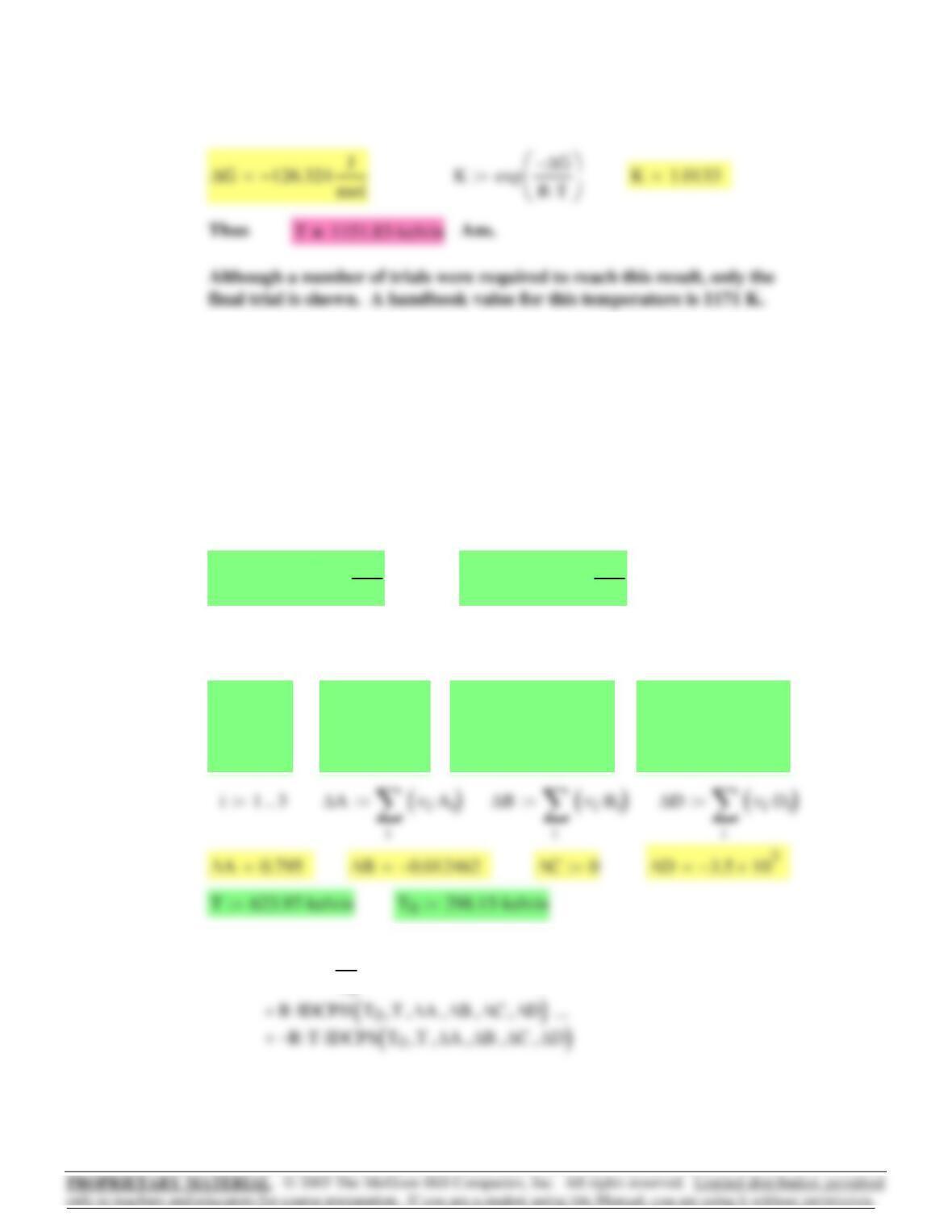
∆G∆H298
T
T0
∆H298 ∆G298
−
()
⋅−
…
:=
D
0.0
0.186−
0.151
⎛
⎜
⎜
⎜
⎝
⎞
⎟
⎠
105
⋅:=
B
16.105
3.020
0.623
⎛
⎜
⎜
⎜
⎝
⎞
⎟
⎠
10 3−
⋅:=
A
5.939
3.578
3.156
⎛
⎜
⎜
⎜
⎝
⎞
⎟
⎠
:=
ν
1−
1
1
⎛
⎜
⎜
⎜
⎝
⎞
⎟
⎠
:=
The following vectors represent the species of the reaction in the order in
which they appear:
∆G298 91121 J
mol
⋅:=∆H298 176013 J
mol
⋅:=
From the given data and the data of Table C.4,
The NH4Cl exists PURE as a solid phase, for which the activity is f/f0.
Since f and f0 are for practical purposes the same, the activity is unity. If
the equimolar mixture of NH3 and HCl is assumed an ideal gas mixture at
1.5 bar, then with f0 = 1 bar the activity of each gas species is its partial
pressure, (0.5)(1.5) = 0.75. As a result, Eq. (13.10) becomes K =
(0.75)(0.75) = 0.5625 , and we must find the T for which K has this value.
NH4Cl(s) = NH3(g) + HCl(g)13.23
505
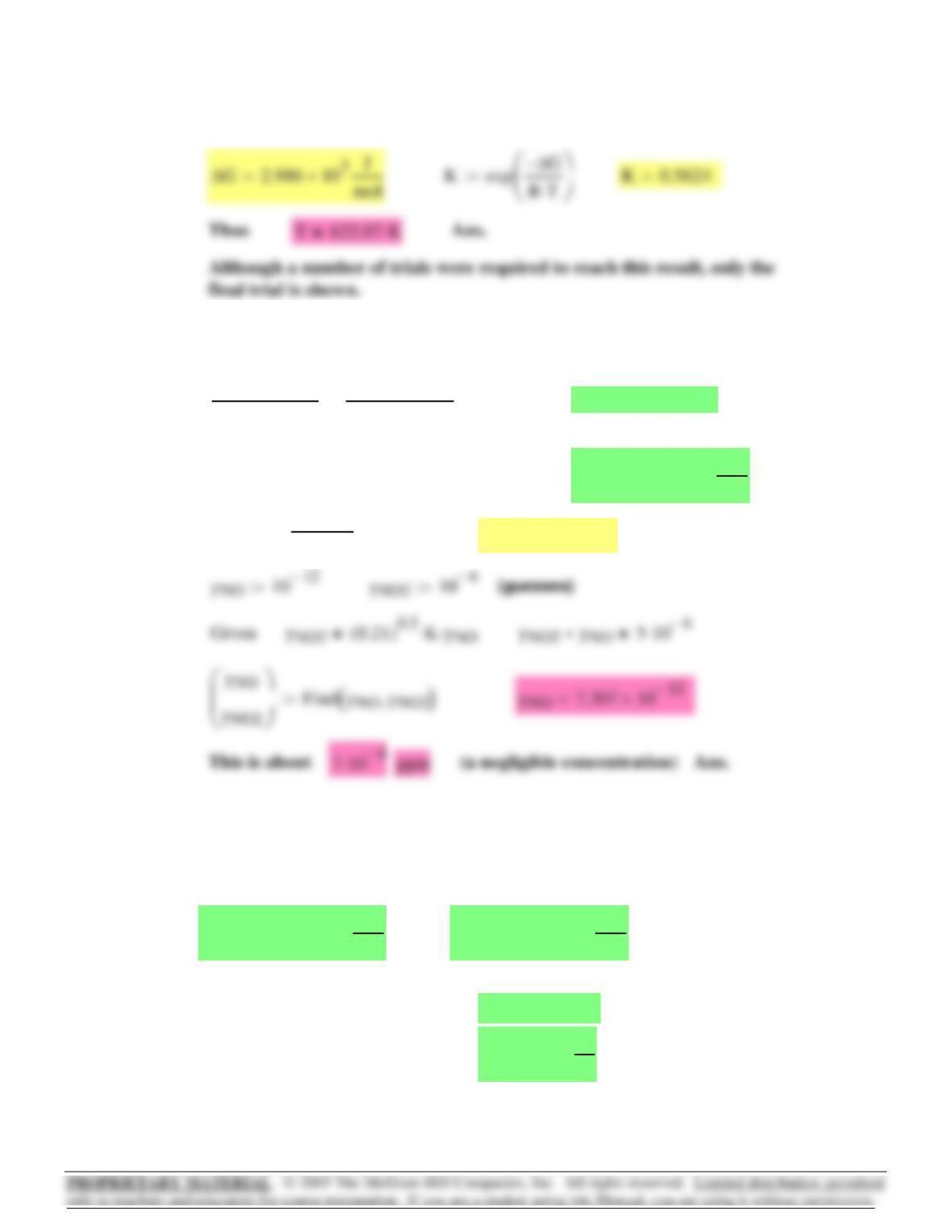
13.26 C2H4(g) + (1/2)O2(g) = <(CH2)2>O(g) ν0.5−=
See Example 13.9, Pg. 508-510 From Table C.4,
∆H298 105140−J
mol
⋅:= ∆G298 81470−J
mol
⋅:=
Basis: 1 mol C2H4 entering reactor.
Moles O2 entering: nO2 1.25 0.5⋅:=
Moles N2 entering: nN2 nO2
79
21
⋅:=
13.25 NO(g) + (1/2)O2(g) = NO2(g) ν0.5−=
yNO2
yNO yO2
()
0.5
⋅
yNO2
yNO 0.21()
0.5
⋅
=K=T 298.15 kelvin⋅:=
From the data of Table C.4, ∆G298 35240−J
mol
⋅:=
K exp
∆G298
−
RT⋅
⎛
⎜
⎝
⎞
⎠
:= K 1.493 106
×=
506

The three equations together provide the energy balance.
For the second term, we combine Eqs. (4.3) & (4.7).
∆H298 ∆HP
+0=
The energy balance for the adiabatic reactor is:
Kε
()
15.947=Kε
()
i
yε
()
i
()
νi
∏
:=
yε
()
nε
()
n00.5 ε⋅−
:=
Dε
()
i
nε
()
iDi
⋅
()
∑
:=
Cε
()
i
nε
()
iCi
⋅
()
∑
:=
Bε
()
i
nε
()
iBi
⋅
()
∑
:=
Aε
()
i
nε
()
iAi
⋅
()
∑
:=
i14..:=
ν
1−
0.5−
1
0
⎛
⎜
⎜
⎜
⎜
⎝
⎞
⎟
⎟
⎠
:=
D
0.0
0.227−
0.0
0.040
⎛
⎜
⎜
⎜
⎜
⎝
⎞
⎟
⎟
⎠
105
⋅kelvin2
⋅:=
C
4.392−
0.0
9.296−
0.0
⎛
⎜
⎜
⎜
⎜
⎝
⎞
⎟
⎟
⎠
10 6−
kelvin2
⋅:=
B
14.394
0.506
23.463
0.593
⎛
⎜
⎜
⎜
⎜
⎝
⎞
⎟
⎟
⎠
10 3−
kelvin
⋅:=A
1.424
3.639
0.385−
3.280
⎛
⎜
⎜
⎜
⎜
⎝
⎞
⎟
⎟
⎠
:=
nε
()
1ε−
nO2 0.5 ε⋅−
ε
nN2
⎛
⎜
⎜
⎜
⎜
⎝
⎞
⎟
⎟
⎠
:=
ε0.8:=
Guess:
For the product stream, data from Table C.1:
The numbers of moles in the product stream are given by Eq. (13.5).
Index the product species with the numbers:
1 = ethylene
2 = oxygen
3 = ethylene oxide
4 = nitrogen
n03.976=n01n
O2
+nN2
+:=
507
∆H298
−RAε
()
T0
⋅τ1−
()
⋅Bε
()
2T02
⋅τ
21−
()
⋅+
Cε
()
3T03
⋅τ
31−
()
⋅Dε
()
T0
τ1−
τ
⎛
⎜
⎝
⎞
⎠
⋅++
…
⎡
⎢
⎢
⎢
⎣
⎤
⎥
⎥
⎥
⎦
⋅=
Given
⎢
⎢
⎥
⎥
⎢
⎥
⎜
⎢
⎢
⎥
⎥
τ3:=
Guess:
T0298.15 kelvin⋅:=∆D 0.114 105
⋅kelvin2
⋅:=
∆C 4.904−10 6−
kelvin2
⋅:=∆B 8.816 10 3−
kelvin
⋅:=∆A 3.629−:=
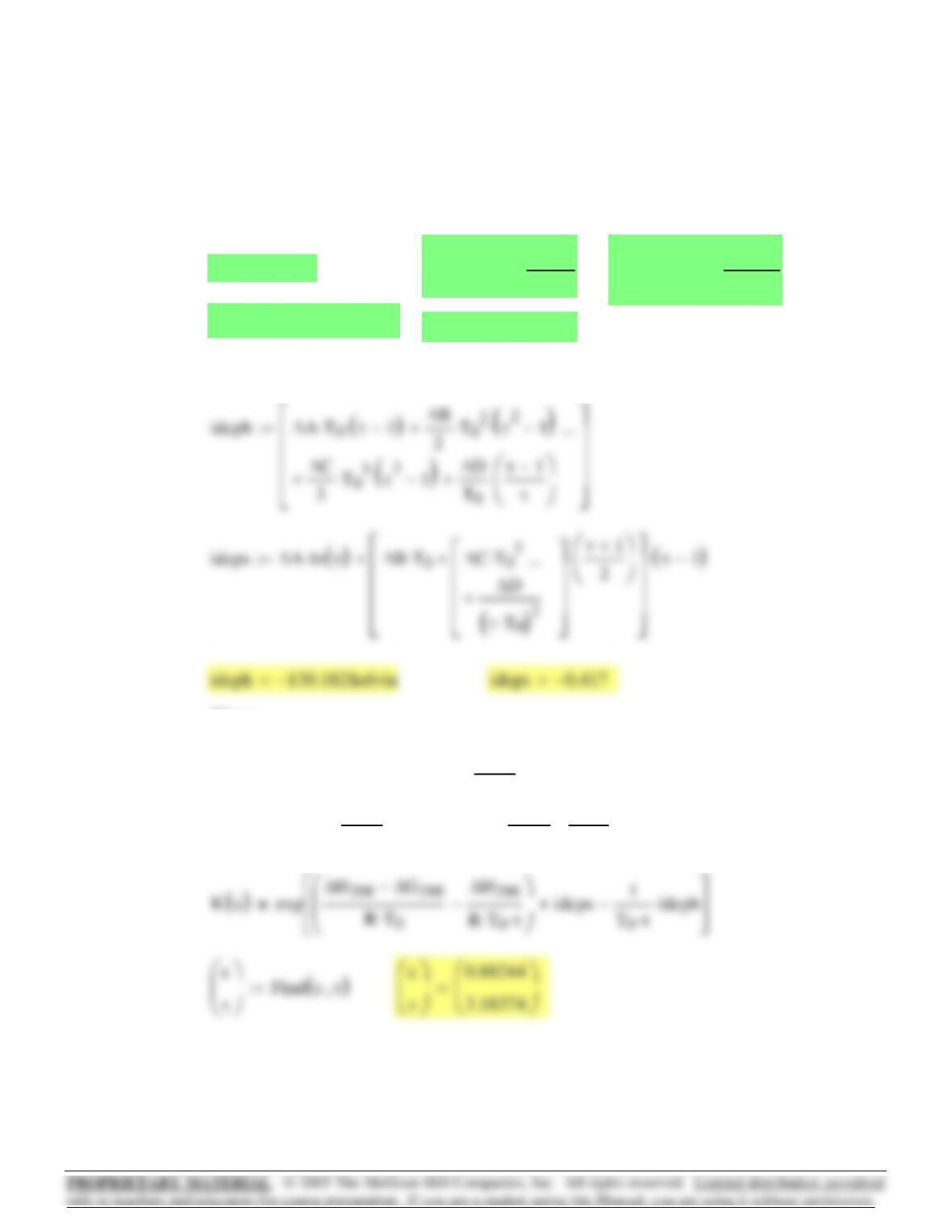
For the equilibrium state, apply a combination of Eqs. (13.11a) &
(13.18).The reaction considered here is that of Pb. 4.21(g), for which the
following values are given in Pb. 4.23(g):
508
B
9.081
0.771
0.422
⎛
⎜
⎜
⎜
⎝
⎞
⎟
⎠
10 3−
⋅:=
A
1.702
1.771
3.249
⎛
⎜
⎜
⎜
⎝
⎞
⎟
⎠
:=
ν
1−
1
2
⎛
⎜
⎜
⎜
⎝
⎞
⎟
⎠
:=
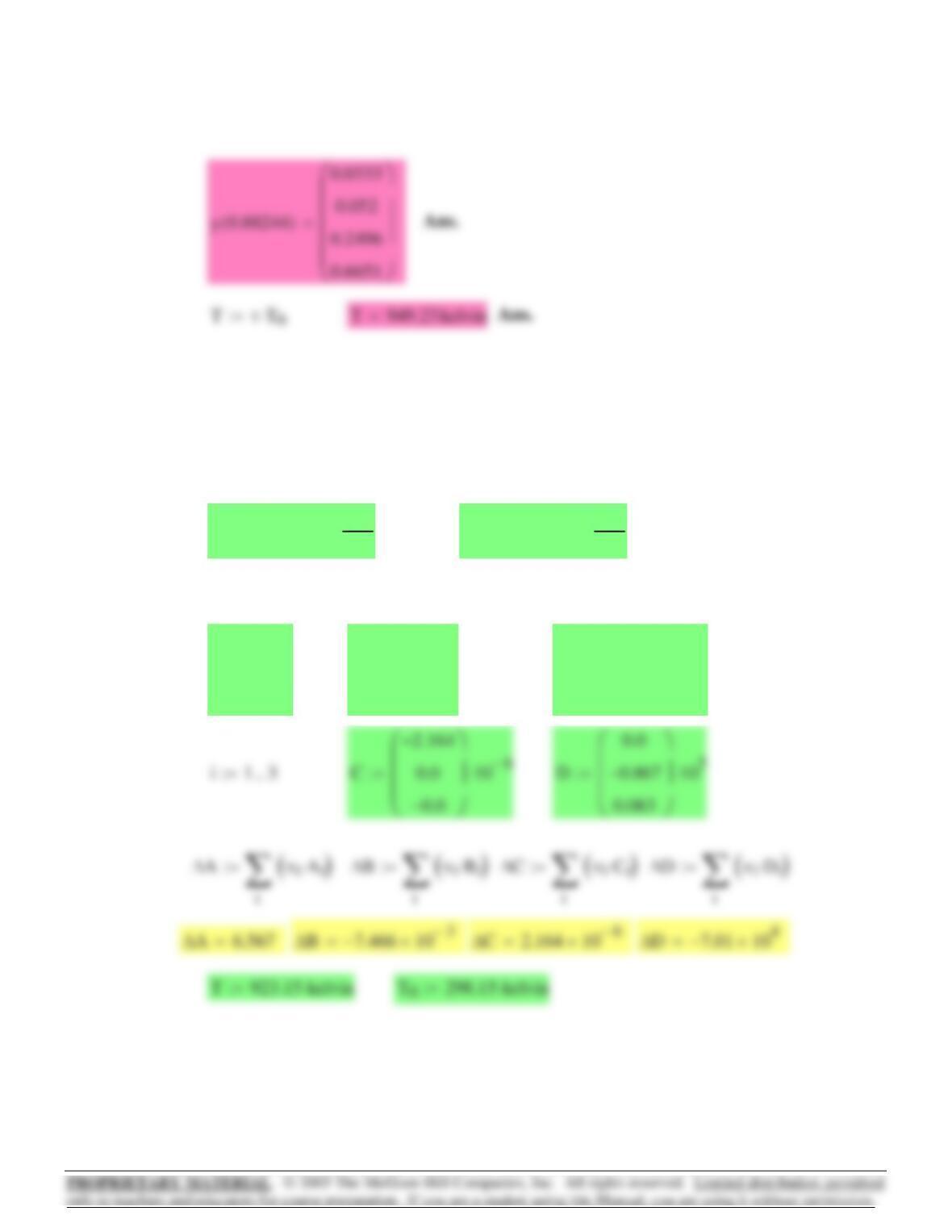
The following vectors represent the species of the reaction in the order in
which they appear:
∆G298 50460 J
mol
⋅:=∆H298 74520 J
mol
⋅:=
From the data of Table C.4,
The carbon exists PURE as an individual phase, for which the activity is
unity. Thus we leave it out of consideration.
(gases only)
ν1=
CH4(g) = C(s) + 2H2(g)13.27
⎜
509
⎜
⎜
⎜
⎜
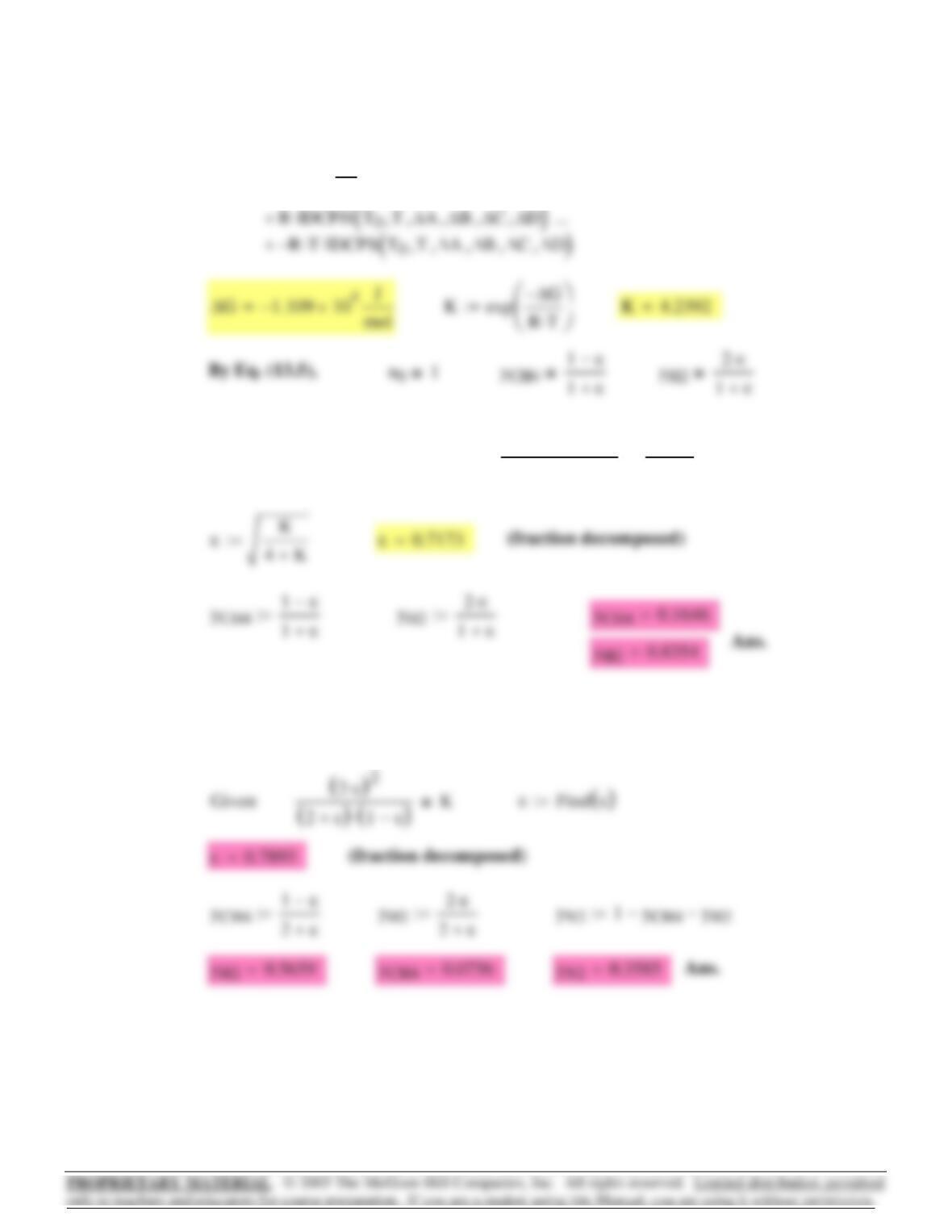
(b) For a feed of 1 mol CH4 and 1 mol N2, n02=
By Eq. (13.28), ε.8:= (guess)
∆G∆H298
T
T0
∆H298 ∆G298
−
()
⋅−
…
:=
(a) By Eq. (13.28), 2ε⋅
()
2
1ε+
()
1ε−
()
⋅
4ε2
⋅
1ε2
−
=K=
510
From the data of Table C.4,
∆H298 33180 J
mol
⋅:= ∆G298 51310 J
mol
⋅:=
The following vectors represent the species of the reaction in the order in
which they appear:
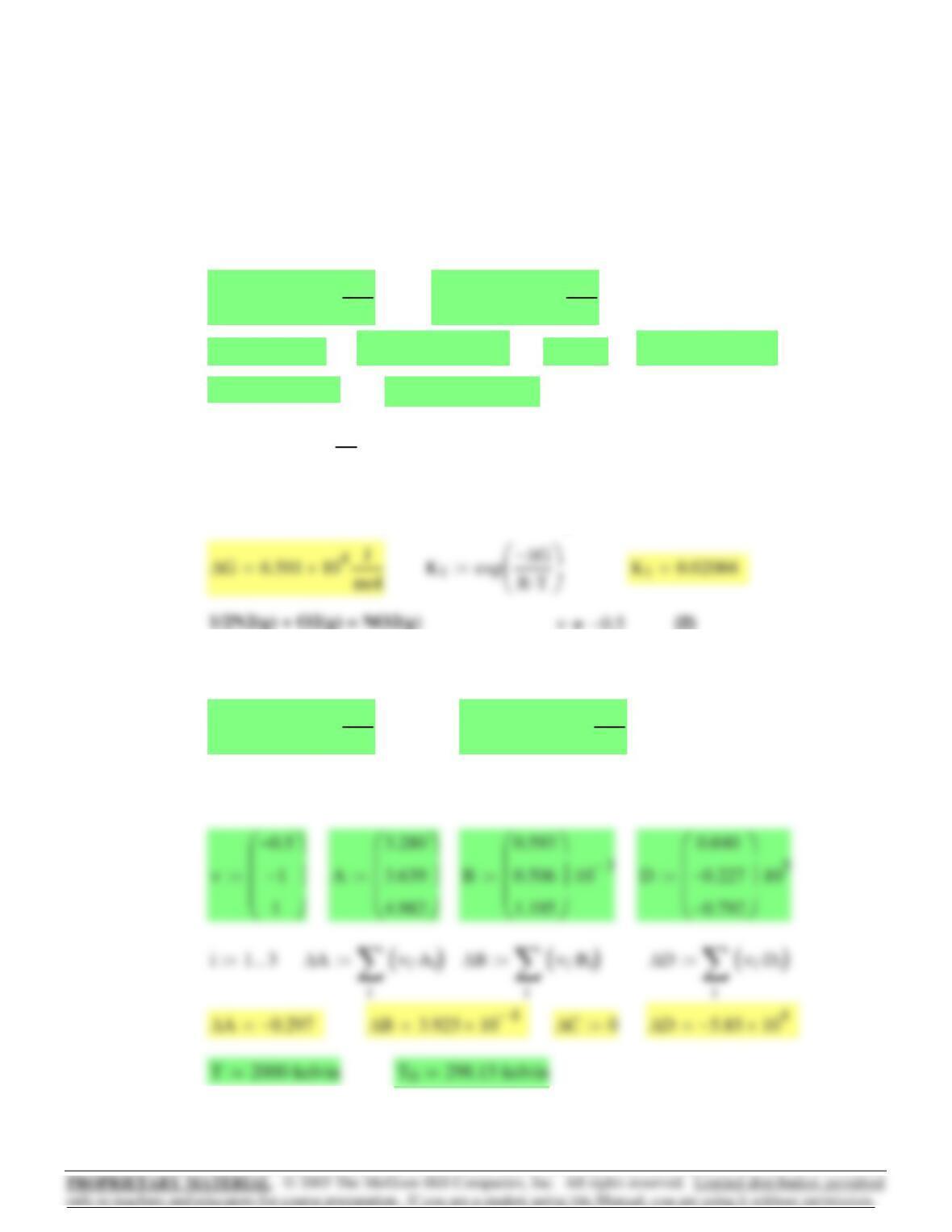
13.28 1/2N2(g) + 1/2O2(g) = NO(g) ν0=(1)
This is the reaction of Pb. 4.21(n) with all stoichiometric coefficients
divided by two. From the answers to Pbs. 4.21(n), 4.22(n), and 13.7(n) ALL
DIVIDED BY 2, find the following values:
∆H298 90250 J
mol
⋅:= ∆G298 86550 J
mol
⋅:=
∆A 0.0725−:= ∆B 0.0795 10 3−
⋅:= ∆C0:= ∆D 0.1075 105
⋅:=
T 2000 kelvin⋅:= T0298.15 kelvin⋅:=
∆G∆H298
T
T0
∆H298 ∆G298
−
()
⋅−
R IDCPH T0T,∆A,∆B,∆C,∆D,
()
⋅+
…
R−T⋅IDCPS T0T,∆A,∆B,∆C,∆D,
()
⋅+
…
:=
511
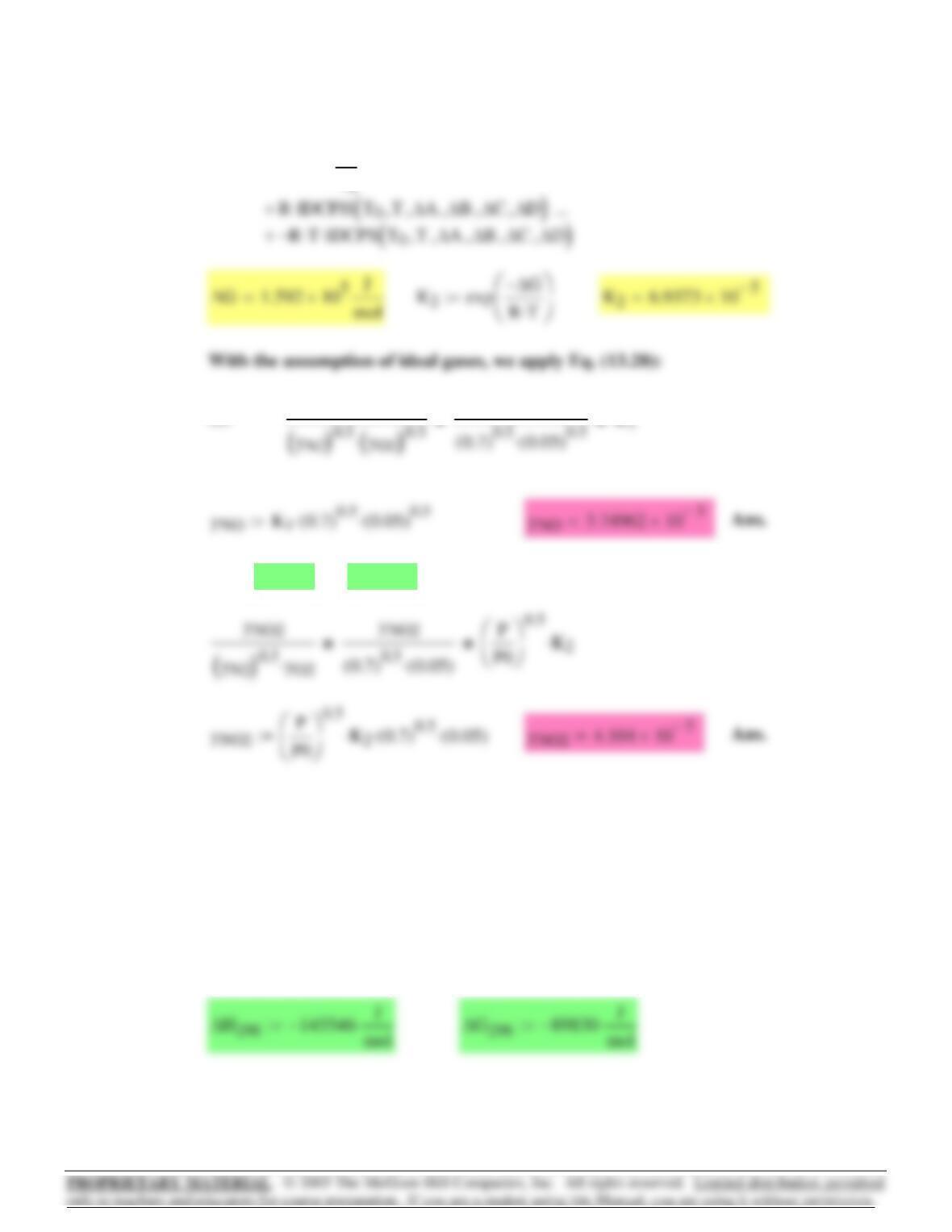
From the given data and the data of Table C.4,
ν1−=
The sulfur exists PURE as a solid phase, for which the activity is f/f0. Since
f and f0 are for practical purposes the same, the activity is unity, and it is
omitted from the equilibrium equation. Thus for the gases only,
2H2S(g) + SO2(g) = 3S(s) + 2H2O(g)13.29
P 200:=P0 1:=
(2)
yNO
yNO
=K1
=
(1)
∆G∆H298
T
T0
∆H298 ∆G298
−
()
⋅−
…
:=
512
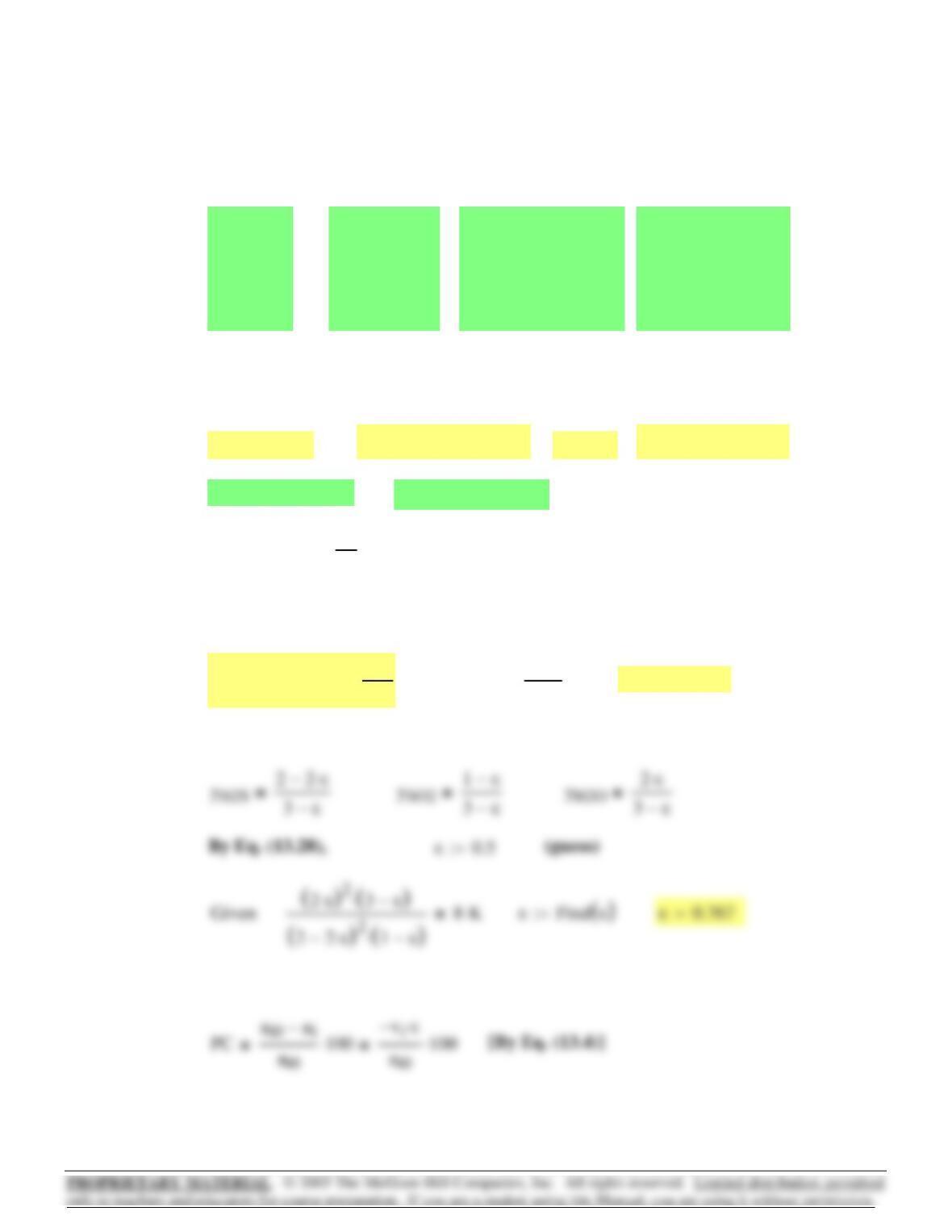
K 12.9169=
By Eq. (13.5), gases only: n03=(basis)
Percent conversion of reactants = PC
The following vectors represent the species of the reaction in the order in
which they appear:
ν
2−
1−
3
2
⎛
⎜
⎜
⎜
⎜
⎝
⎞
⎟
⎟
⎠
:= A
3.931
5.699
4.114
3.470
⎛
⎜
⎜
⎜
⎜
⎝
⎞
⎟
⎟
⎠
:= B
1.490
0.801
1.728−
1.450
⎛
⎜
⎜
⎜
⎜
⎝
⎞
⎟
⎟
⎠
10 3−
⋅:= D
0.232−
1.015−
0.783−
0.121
⎛
⎜
⎜
⎜
⎜
⎝
⎞
⎟
⎟
⎠
105
⋅:=
i14..:= ∆A
i
νiAi
⋅
()
∑
:= ∆B
i
νiBi
⋅
()
∑
:= ∆D
i
νiDi
⋅
()
∑
:=
∆A 5.721= ∆B 6.065−10 3−
×= ∆C0:= ∆D 6.28−104
×=
T 723.15 kelvin⋅:= T0298.15 kelvin⋅:=
∆G∆H298
T
T0
∆H298 ∆G298
−
()
⋅−
R IDCPH T0T,∆A,∆B,∆C,∆D,
()
⋅+
…
R−T⋅IDCPS T0T,∆A,∆B,∆C,∆D,
()
⋅+
…
:=
∆G 1.538−104
×J
mol
=K exp ∆G−
RT⋅
⎛
⎜
⎝
⎞
⎠
:=
513
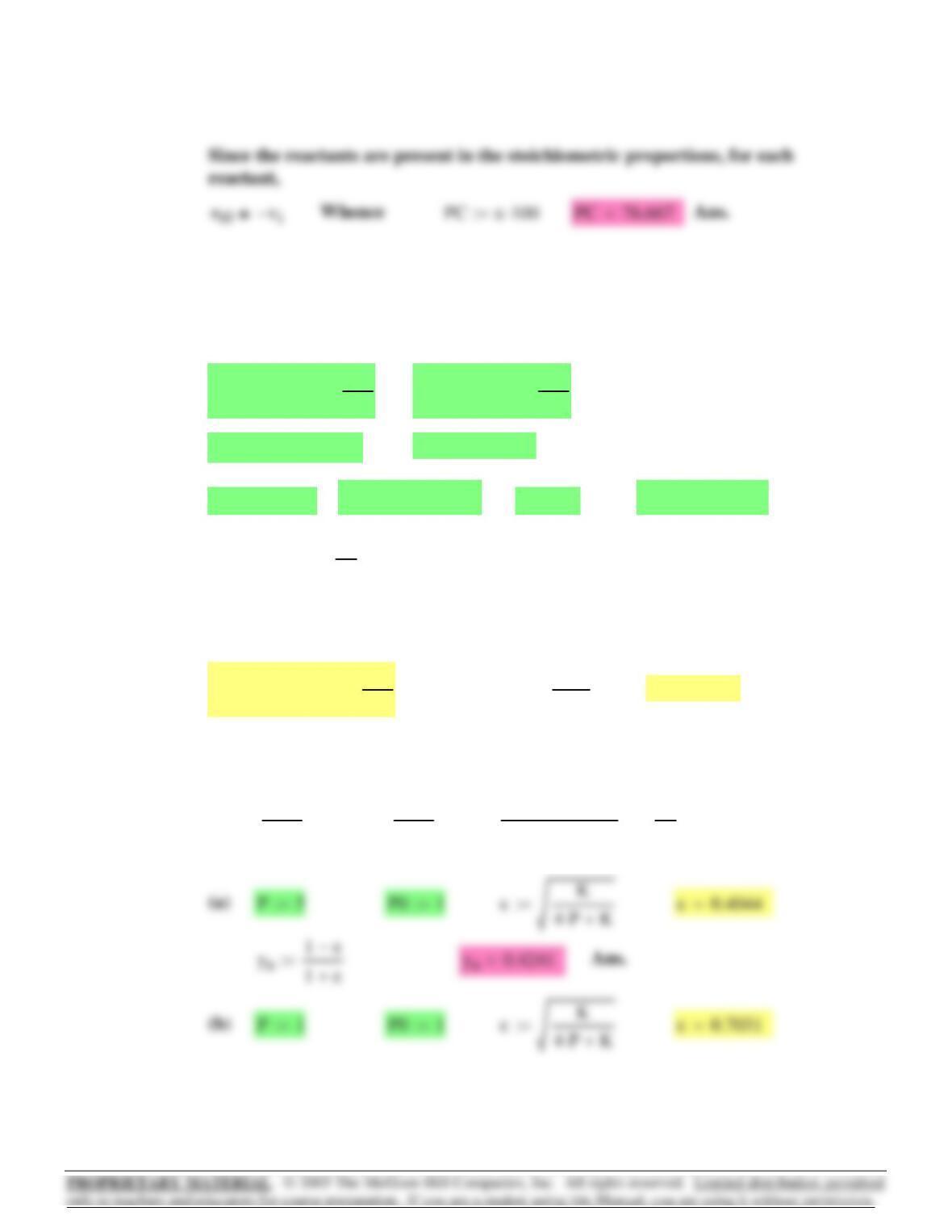
K exp ∆G−
RT⋅
⎛
⎜
⎝
⎞
⎠
:= K 3.911=
Basis: 1 mol species (a) initially. Then
ya
1ε−
1ε+
=yb
2ε⋅
1ε+
=2ε⋅
()
2
1ε−
()
1ε+
()
⋅
P
P0
⎛
⎜
⎝
⎞
⎠
1−
K⋅=
13.30 N2O4(g) = 2NO2(g)
(a) (b) ν1=
Data from Tables C.4 and C.1 provide the following values:
∆H298 57200 J
mol
⋅:= ∆G298 5080 J
mol
⋅:=
T0298.15 kelvin⋅:= T 350 kelvin⋅:=
∆A 1.696−:= ∆B 0.133 10 3−
⋅:= ∆C0:= ∆D 1.203 105
⋅:=
∆G∆H298
T
T0
∆H298 ∆G298
−
()
⋅−
R IDCPH T0T,∆A,∆B,∆C,∆D,
()
⋅+
…
R−T⋅IDCPS T0T,∆A,∆B,∆C,∆D,
()
⋅+
…
:=
∆G 3.968−103
×J
mol
=
514
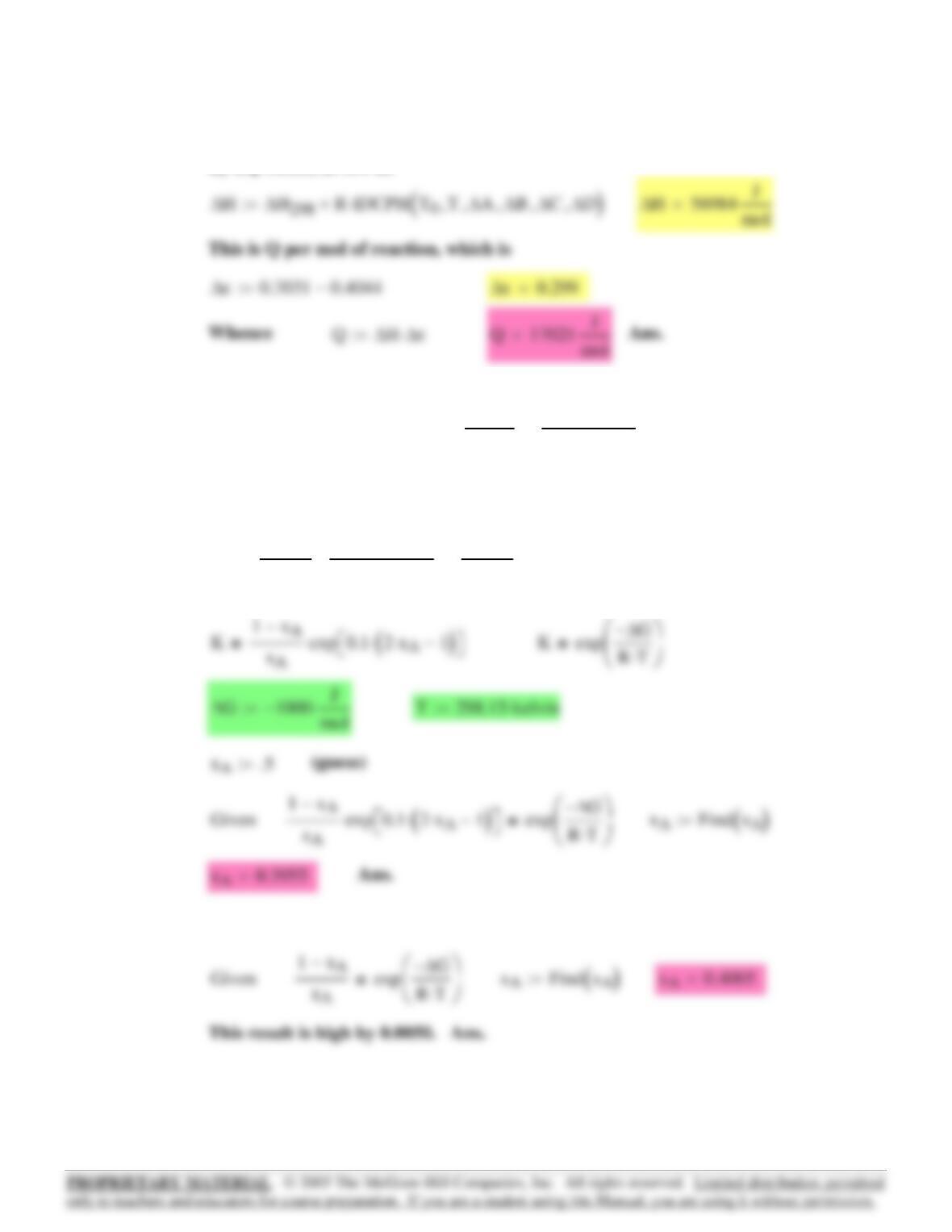
For an ideal solution, the exponential term is unity:
⎜
By Eq. (4.18), at 350 K:
13.31 By Eq. (13.32), K
xBγB
⋅
xAγA
⋅
=1x
A
−
()
γB
⋅
xAγA
⋅
=
ln γa
()
0.1 xB2
⋅=ln γb
()
0.1 xA2
⋅=Whence
K1x
A
−
xA
⎛
⎜
⎝
⎞
⎠
exp 0.1 xA2
⋅
()
exp 0.1 xB2
⋅
()
⋅=1x
A
−
xA
exp 0.1 xA2xB2
−
()
⋅
⎡
⎣
⎤
⎦
⋅=
515
⎣
⎦
⎜
⎣
⎦
⎜
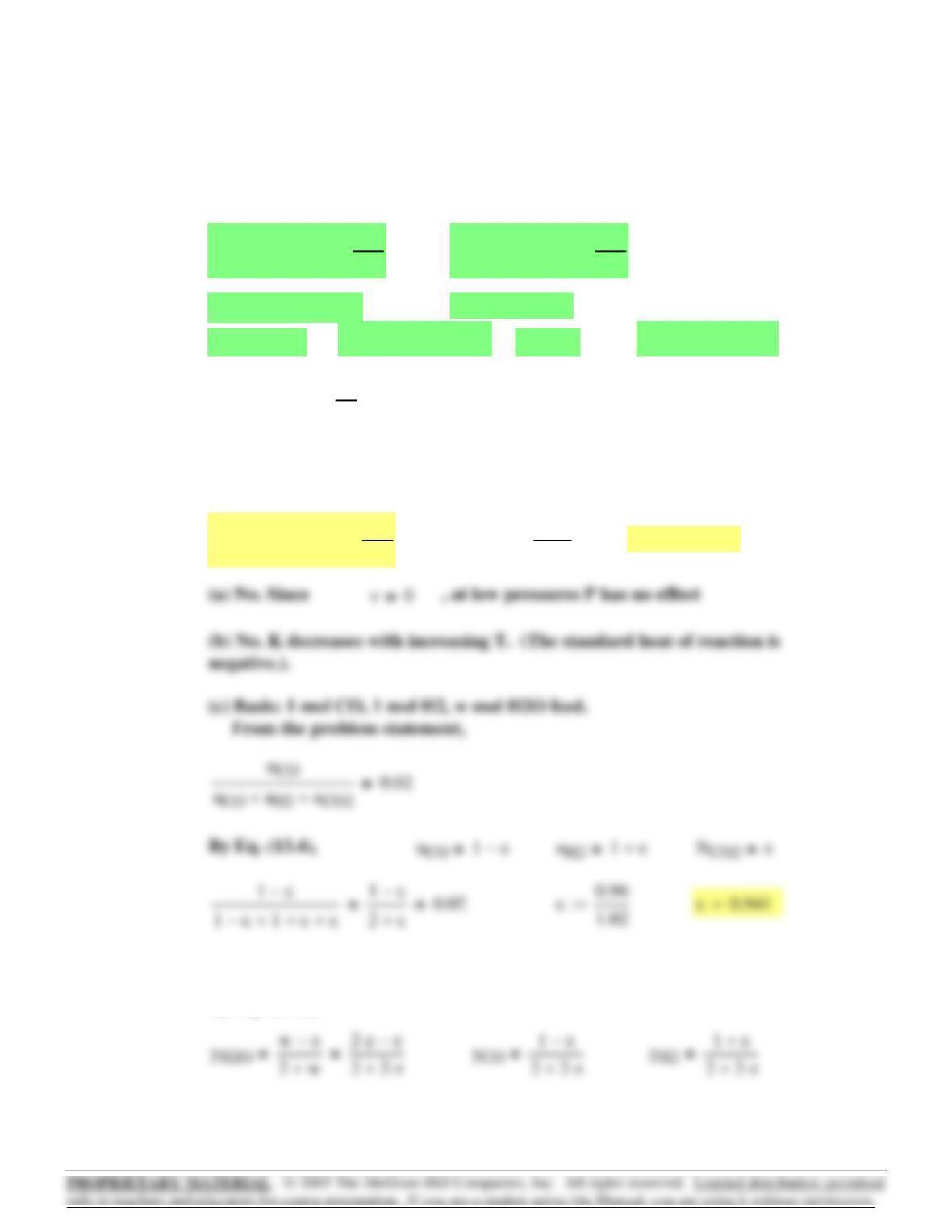
Let z = w/2 = moles H2O/mole “Water gas”.
By Eq. (13.5),
13.32 H2O(g) + CO(g) = H2(g) + CO2(g) ν0=
From the the data of Table C.4,
∆H298 41166−J
mol
⋅:= ∆G298 28618−J
mol
⋅:=
T0298.15 kelvin⋅:= T 800 kelvin⋅:=
∆A 1.860:= ∆B 0.540−10 3−
⋅:= ∆C0:= ∆D 1.164−105
⋅:=
∆G∆H298
T
T0
∆H298 ∆G298
−
()
⋅−
R IDCPH T0T,∆A,∆B,∆C,∆D,
()
⋅+
…
R−T⋅IDCPS T0T,∆A,∆B,∆C,∆D,
()
⋅+
…
:=
∆G 9.668−103
×J
mol
=K exp ∆G−
RT⋅
⎛
⎜
⎝
⎞
⎠
:= K 4.27837=
516
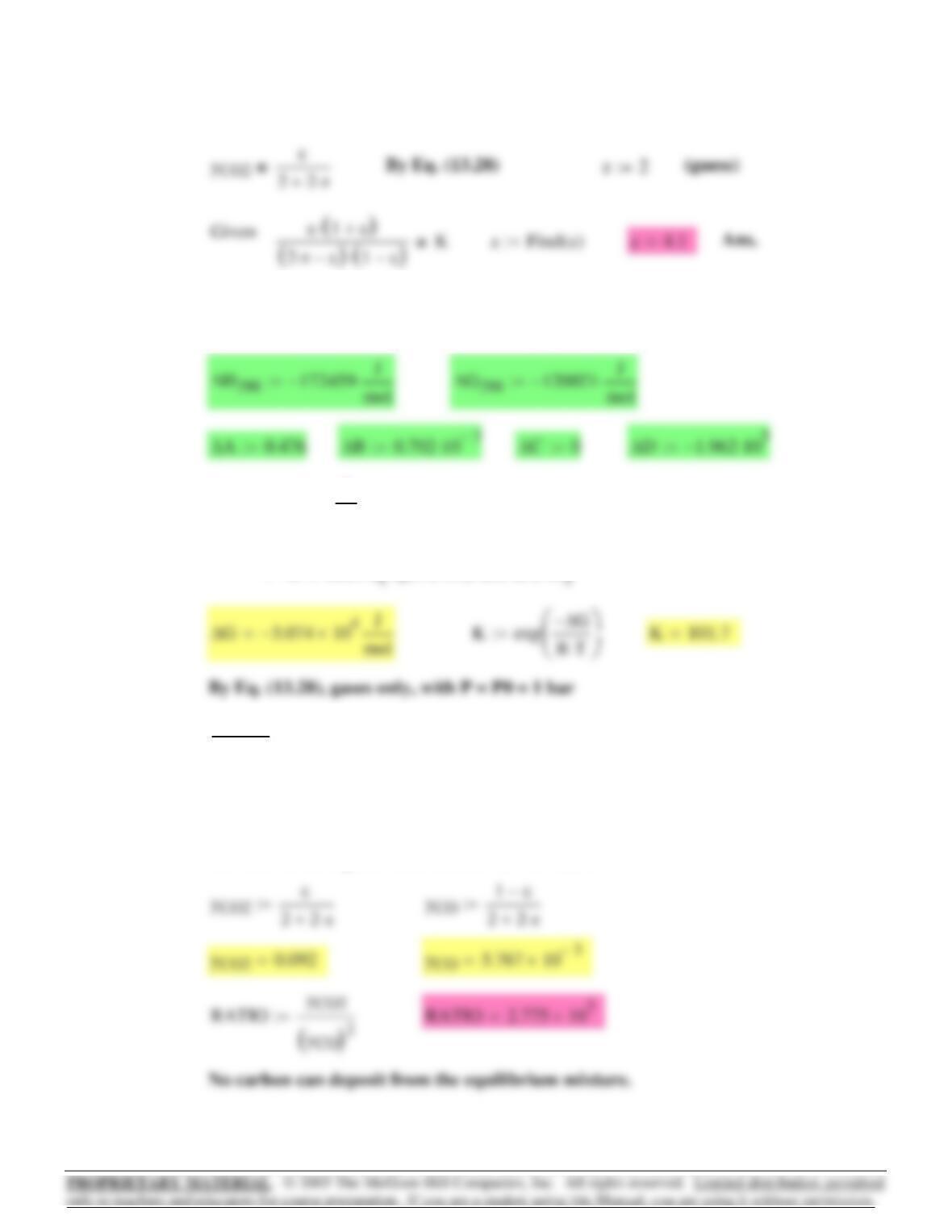
∆G∆H298
T
T0
∆H298 ∆G298
−
()
⋅−
R IDCPH T0T,∆A,∆B,∆C,∆D,
()
⋅+
…
R−T⋅IDCPS T0T,∆A,∆B,∆C,∆D,
()
⋅+
…
:=
yCO2
yCO
()
2K=101.7=for the reaction AT EQUILIBRIUM.
If the ACTUAL value of this ratio is GREATER than this value, the
reaction tries to shift left to reduce the ratio. But if no carbon is present, no
reaction is possible, and certainly no carbon is formed. The actual value of
the ratio in the equilibrium mixture of Part (c) is
(d) 2CO(g) = CO2(g) + C(s) ν1−=(gases)
Data from Tables C.4 and C.1:
517
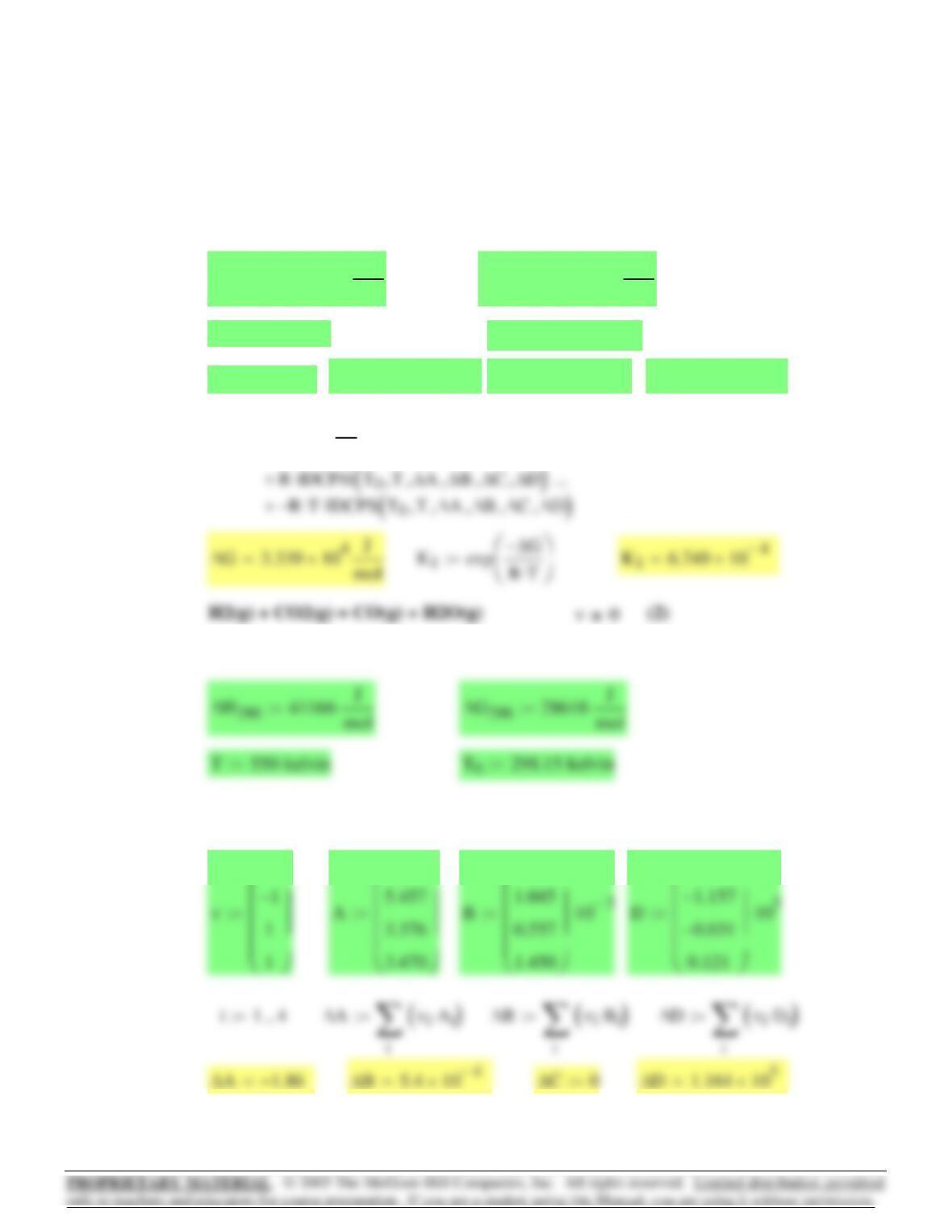
From the the data of Table C.4,
The following vectors represent the species of the reaction in the order in
which they appear:
1−
⎛
⎞
3.249
⎛
⎞
0.422
⎛
⎞
0.083
⎛
⎞
13.33 CO(g) + 2H2(g) = CH3OH(g) ν2−=(1)
This is the reaction of Pb. 13.21, where the following parameter values are
given:
∆H298 90135−J
mol
⋅:= ∆G298 24791−J
mol
⋅:=
T 550 kelvin⋅:= T0298.15 kelvin⋅:=
∆A 7.663−:= ∆B 10.815 10 3−
⋅:= ∆C 3.45−10 6−
⋅:= ∆D 0.135−105
⋅:=
∆G∆H298
T
T0
∆H298 ∆G298
−
()
⋅−
…
:=
518
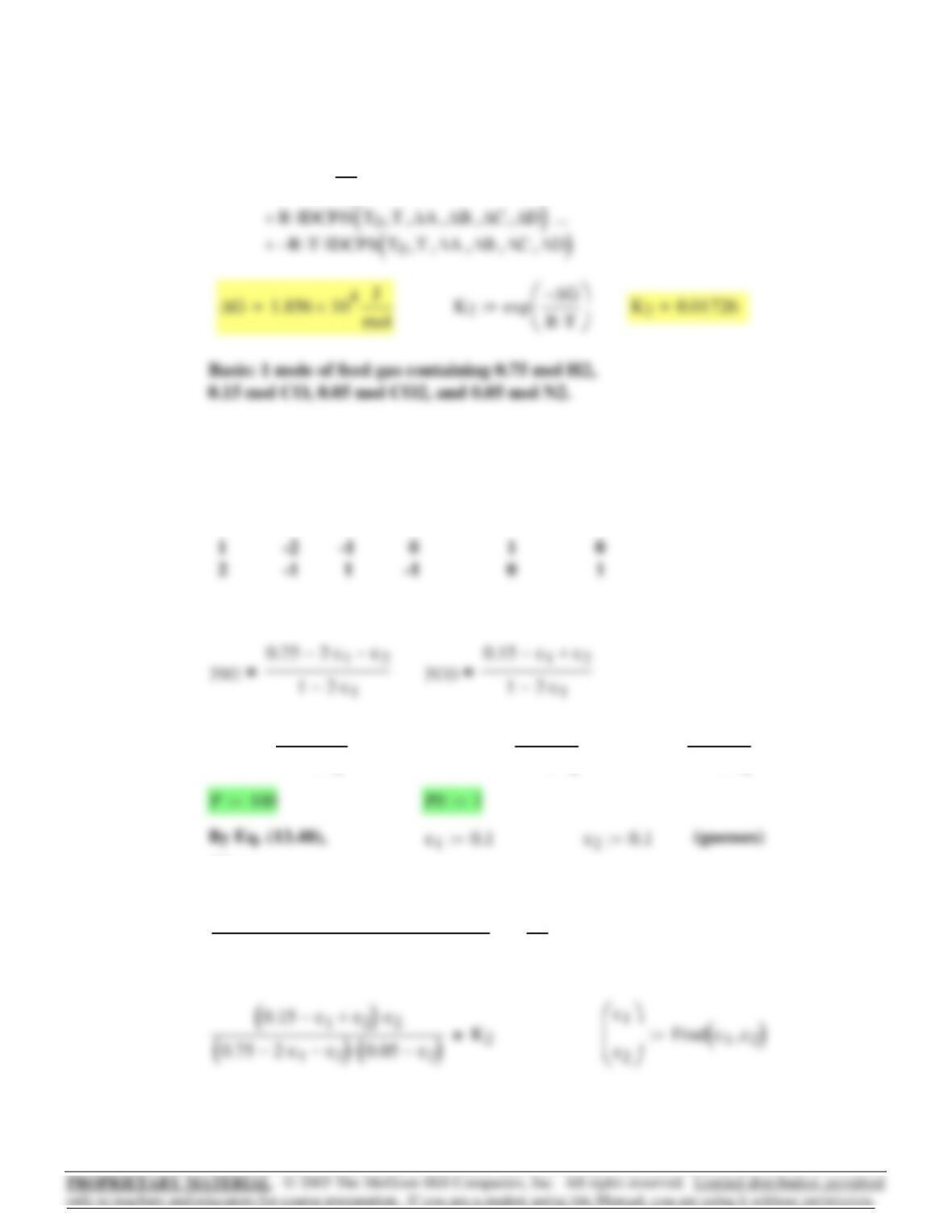
By Eq. (13.7)
yCO2
0.05 ε2
−
12ε1
⋅−
=yCH3OH
ε1
12ε1
⋅−
=yH2O
ε2
12ε1
⋅−
=
Given
ε112ε1
⋅−
()
2
⋅
0.75 2 ε1
⋅−ε
2
−
()
20.15 ε1
−ε
2
+
()
⋅
P
P0
⎛
⎜
⎝
⎞
⎠
2
K1
⋅=
∆G∆H298
T
T0
∆H298 ∆G298
−
()
⋅−
⎜
…
:=
Stoichiometric numbers, νi.j
i = H2 CO CO2 CH3OH H2O
_______________________________________________
j
519
From the the data of Table C.4,
∆H298 205813 J
mol
⋅:= ∆G298 141863 J
mol
⋅:=
The following vectors represent the species of the reaction in the order in
which they appear:
1−
1−
⎛
⎜
⎞
1.702
3.470
⎛
⎜
⎞
9.081
1.450
⎛
⎜
⎞
ε10.1186= ε28.8812 10 3−
×=
yH2
0.75 2 ε1
⋅−ε
2
−
12ε1
⋅−
:= yCO
0.15 ε1
−ε
2
+
12ε1
⋅−
:=
13.34 CH4(g) + H2O(g) = CO(g) + 3H2(g) ν2=(1)
520
⎜
⎜