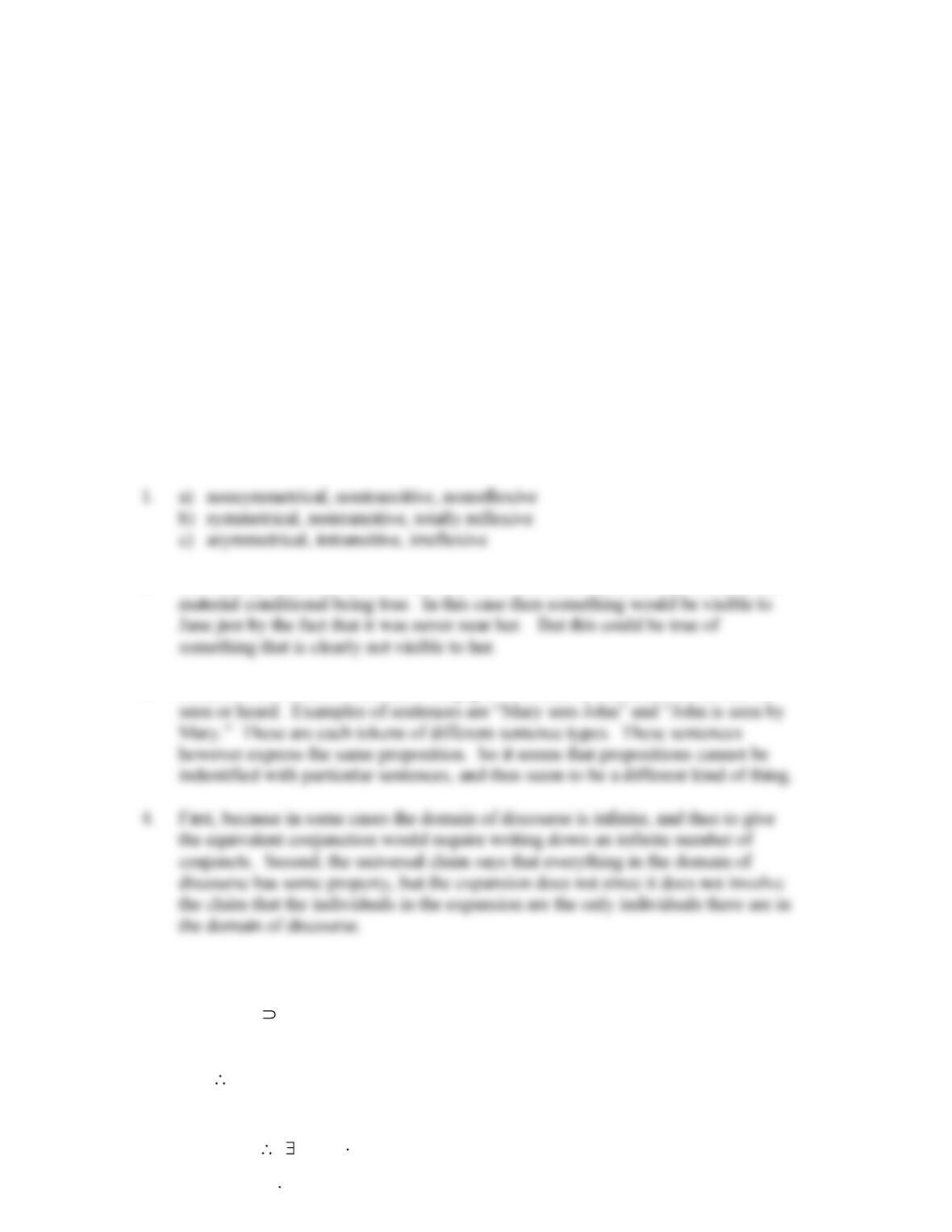
2. Explain why translating “sis visible to Jane” as a material conditional, such as “if
s is near Jane (and the line of sight is unobstructed, etc.) then it will be seen by
her,” seems to be inadequate.
3. Use an example to explain the distinction that is made between sentences and
propositions.
4. Give two reasons why some think that universal statements cannot be adequately
expressed as conjunctions.
A. Answers
2. The main problem stems from the fact that a false antecedent is sufficient for the
3. Sentences are series of ink marks on paper or sounds in that air, and thus can be
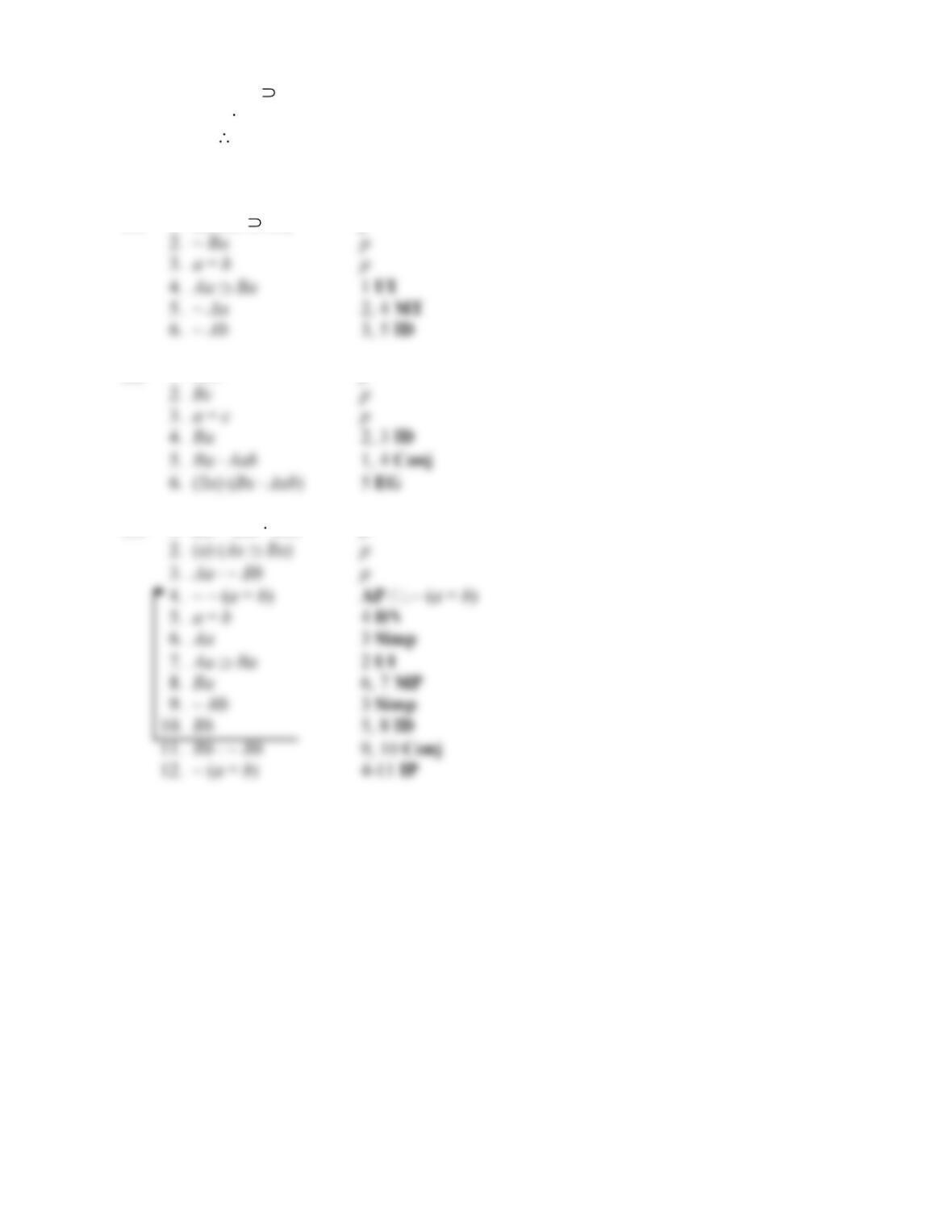
B. Proofs with identity. Prove the validity of the following arguments:
(1) 1. (x) (Ax Bx)
2. ~ Ba
3. a=b
/ ~ Ab
(2) 1. Aab
2. Bc
3. a=c/ ( x) (Bx Axb)
(3) 1. (x) ~ (Ax Bx)
XIII. CHAPTER THIRTEEN: IDENTITY
A. General Theory
1. Determine the status of the following relations with respect to symmetry,
transitivity, and reflexivity:
a) ______________ respects _ _ _ _ _ _ _ _ _
b) ______________ resembles _ _ _ _ _ _ _ _ _
c) ______________ is a child of _ _ _ _ _ _ _ _ _
B. Answers
(1) 1. (x) (Ax Bx) p
(2) 1. Aab p
(3) 1. (x) ~ (Ax Bx) p
C. Symbolize, using the indicated letters:
1. Something that is heavier than everything else is still not heavier than itself. (Hxy
=“x is heavier than y“.)
2. Anything that is heavier than itself is heavier than something else.
3. Any sinner who sins against someone else sins against everyone else. (Sx =“x is a
sinner”; Sxy =“x sins against y”.)
4. The sinner who sins against every sinner sins against himself.
5. All sinners who sin against everyone else, sin against themselves.
6. One and only one sinner sins against all sinners.
2. (x) (Ax Bx)
3. Aa ~ Bb
/ ~ (a=b)
47
7. Not all sinners are sinned against by other sinners.
8. No sinner is sinned against by all other sinners.
9. At most one sinner sins against everyone else who is a sinner. (Quite difficult)
10. If some sinners are not sinned against by others, then for any nonsinners, they
aren’t sinned against by any sinners.
11. The largest Great Lake is Lake Superior (Gx = “xis a Great Lake”; Lxy = “xis
larger than y”; s= “Lake Superior”)
12. The capitol of Ohio is a river town. (Cxy = “xis a capitol of y”; Rx = “xis a river
town”; o= “Ohio”)
13. The capitol of Ohio is Columbus. (c= “Columbus”)
14. The capitol of Ohio is not the largest city in Ohio. (Ixy = “xis a city in y”)
15. Every state has exactly two senators. (Sx = “xis a state”; Sxy = “xis a senator
from y”)
C. Answers
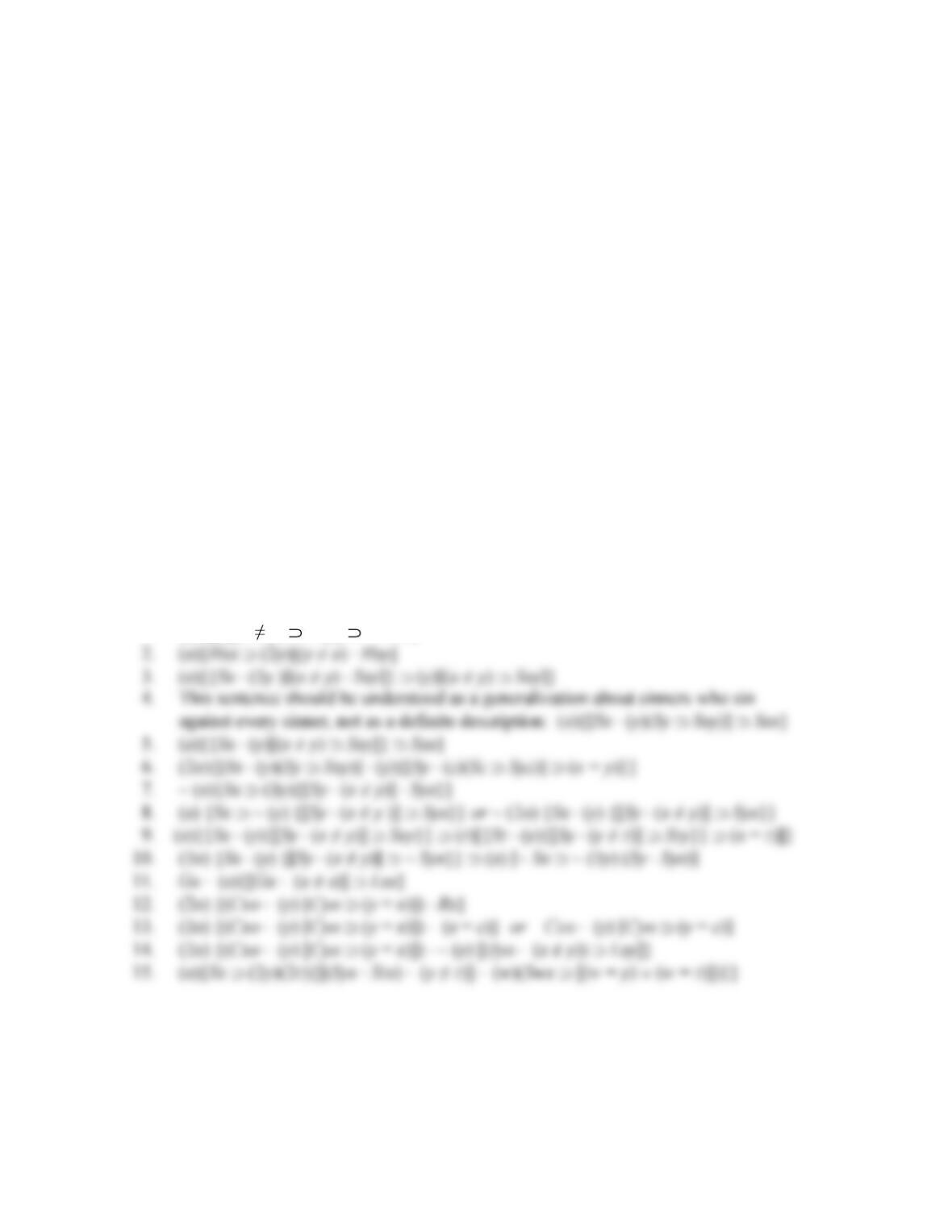
1. (x){(y)[(x y)Hxy] ~ Hxx}