13–74
PROFESSIONAL SIMULATION
Journal Entries
(a)
Unearned Sales Revenue ………………………………………..
400,000
Sales Revenue ………………………………………………..
400,000
(To record subscriptions earned
during 2012)
(b) No entry should be made to accrue for an expense, because the
absence of insurance coverage does not mean that an asset has been
impaired or a liability has been incurred as of the balance sheet date.
The company may, however, appropriate retained earnings for self-
insurance as long as actual costs or losses are not charged to the
appropriation of retained earnings and no part of the appropriation
is transferred to income. Appropriation of retained earnings and/or
disclosure in the notes to the financial statements are not required,
but are recommended.
Adjusted balance
($600,000 + $500,000 + $800,000) …………………..
13–75
PROFESSIONAL SIMULATION (Continued)
Generally all three of these liabilities (accounts payable, notes payable,
bonds payable) would be classified as current liabilities on the company’s
balance sheet prepared as of December 31, 2012.
13–76
IFRS CONCEPTS AND APPLICATION
IFRS13-1
A company should exclude a short-term obligation from current liabilities
only if (1) it intends to refinance the obligation on a long-term basis, and
(2) it has an unconditional right to defer settlement of the liability for at
least twelve months after the reporting date.
IFRS13-2
IFRS13-3
A provision is defined as a liability of uncertain timing or amount and is
sometimes referred to as an estimated liability. Common types of provisions
are obligations related to litigation, warranties, product guarantees, business
restructurings, and environmental damage.
IFRS13-4
IFRS13-5
and (2) the amount of the obligation.
A provision is a liability of uncertain timing or amount and has greater
uncertainty about the timing or amount of the future expenditure required
to settle the obligation.
IFRS13-6
IFRS13-7
ALEXANDER COMPANY
Partial Statement of Financial Position
December 31, 2012
Current liabilities:
Notes payable (Note 1)…..……………..……………….…………………. $300,000
13–78
IFRS13-8
(1) Mckee should classify $100,000 of the obligation as a current maturity
of long-term debt (current liability) and the $300,000 balance as a
noncurrent liability.
IFRS13-9
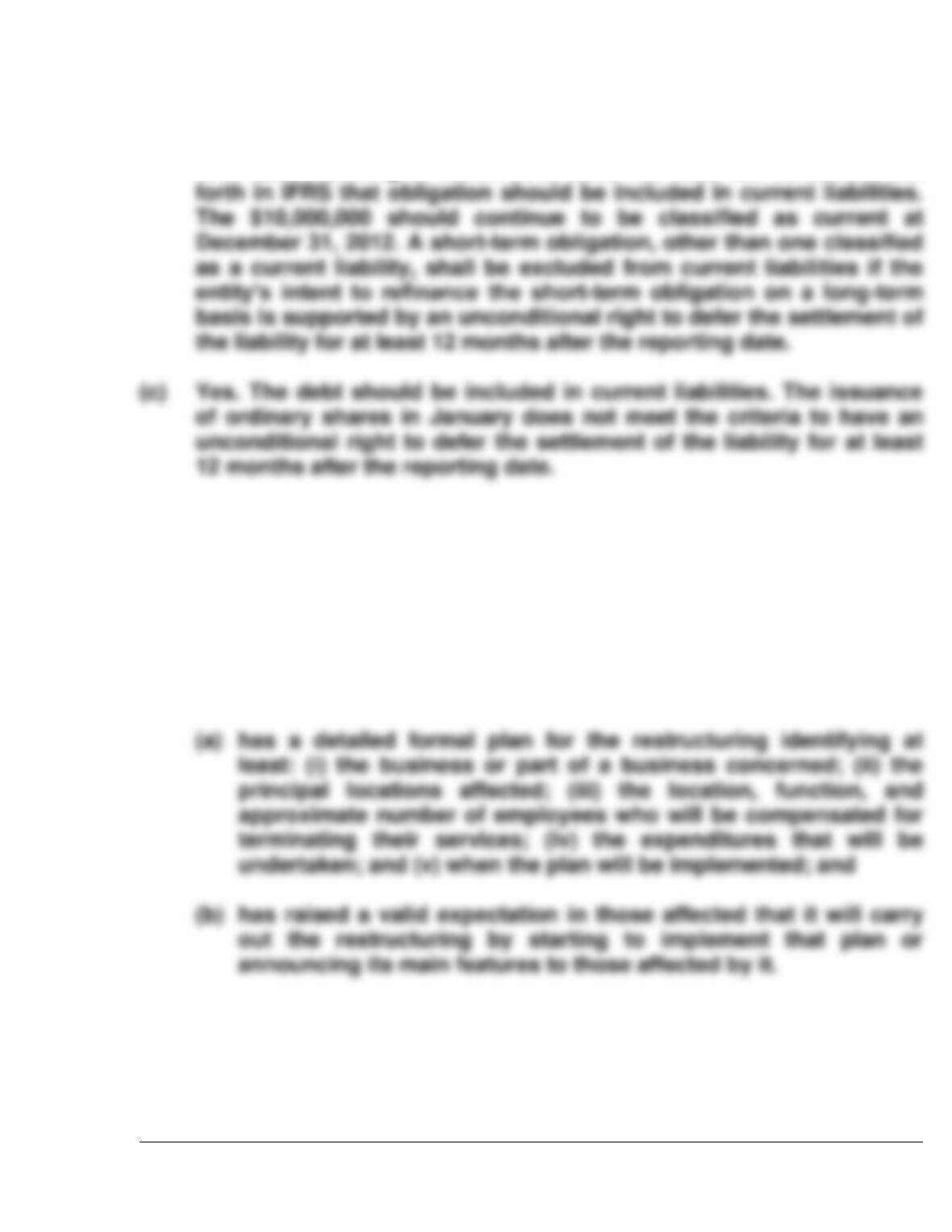
1.
Warranty Expense ……………………………………..
5,000,000*
Warranty Payable ………………………………
5,000,000
* Expected warranty costs:
No defects
Minor defects
2.
Income Taxes Expense ………………………………
400,000
Income Taxes Payable ……………………….
400,000
IFRS13-10
13–79
IFRS13-10 (Continued)
(b) No. The events described will not have an impact on the financial
statements. Since Kobayashi Corporation’s refinancing of the long–
term debt maturing in March 2013 does not meet the conditions set
IFRS13-11
(a) IAS 37, Provisions, Contingent Liabilities and Contingent Assets.
(b) Recognizing a liability from restructuring (IAS 37, 72 – 79).
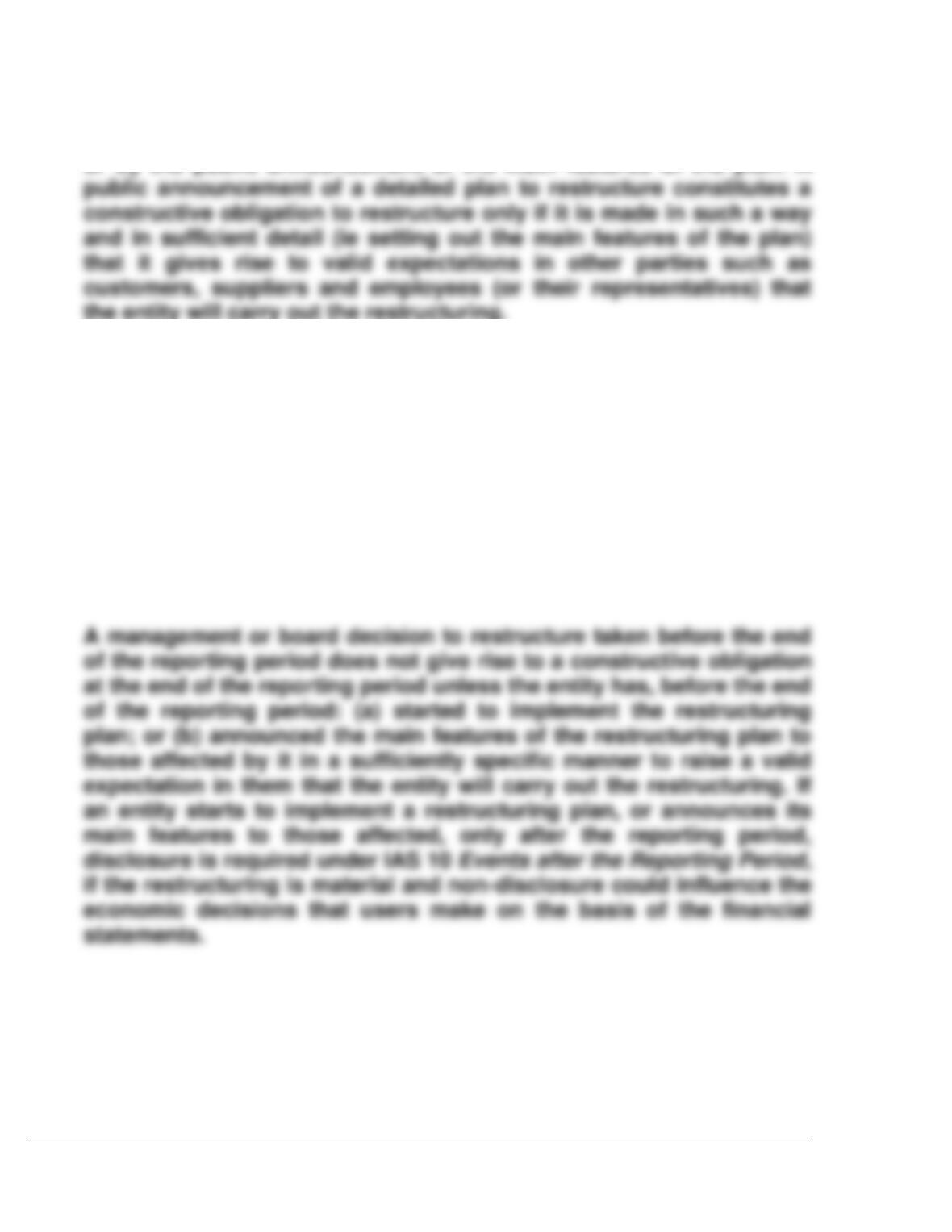
A constructive obligation to restructure arises only when an entity:
13–80
IFRS13-11 (Continued)
Evidence that an entity has started to implement a restructuring plan
would be provided, for example, by dismantling plant or selling assets
or by the public announcement of the main features of the plan. A
the entity will carry out the restructuring.
For a plan to be sufficient to give rise to a constructive obligation
when communicated to those affected by it, its implementation needs
to be planned to begin as soon as possible and to be completed in a
timeframe that makes significant changes to the plan unlikely. If it is
expected that there will be a long delay before the restructuring
begins or that the restructuring will take an unreasonably long time, it
is unlikely that the plan will raise a valid expectation on the part of
others that the entity is at present committed to restructuring,
because the timeframe allows opportunities for the entity to change
its plans.
13–81
IFRS13-11 (Continued)
Although a constructive obligation is not created solely by a manage–
ment decision, an obligation may result from other earlier events
together with such a decision. For example, negotiations with employee
tives, it may result in a constructive obligation to restructure.
No obligation arises for the sale of an operation until the entity is
committed to the sale, ie there is a binding sale agreement.
Even when an entity has taken a decision to sell an operation and
announced that decision publicly, it cannot be committed to the sale
13–82
IFRS13-11 (Continued)
Costs to exclude (IAS 37, 81 – 82)
A restructuring provision does not include such costs as: (a) retraining
or relocating continuing staff; (b) marketing; or (c) investment in new
(c) The current warranty contract is considered an onerous contract. The
required accounting related to an onerous contract is in IAS 37, 81 – 82.
If an entity has a contract that is onerous, the present obligation
under the contract shall be recognised and measured as a provision.
Many contracts (for example, some routine purchase orders) can be
13–83
IFRS13-11 (Continued)
Before a separate provision for an onerous contract is established, an
entity recognises any impairment loss that has occurred on assets
dedicated to that contract (see IAS 36).
IFRS13-12
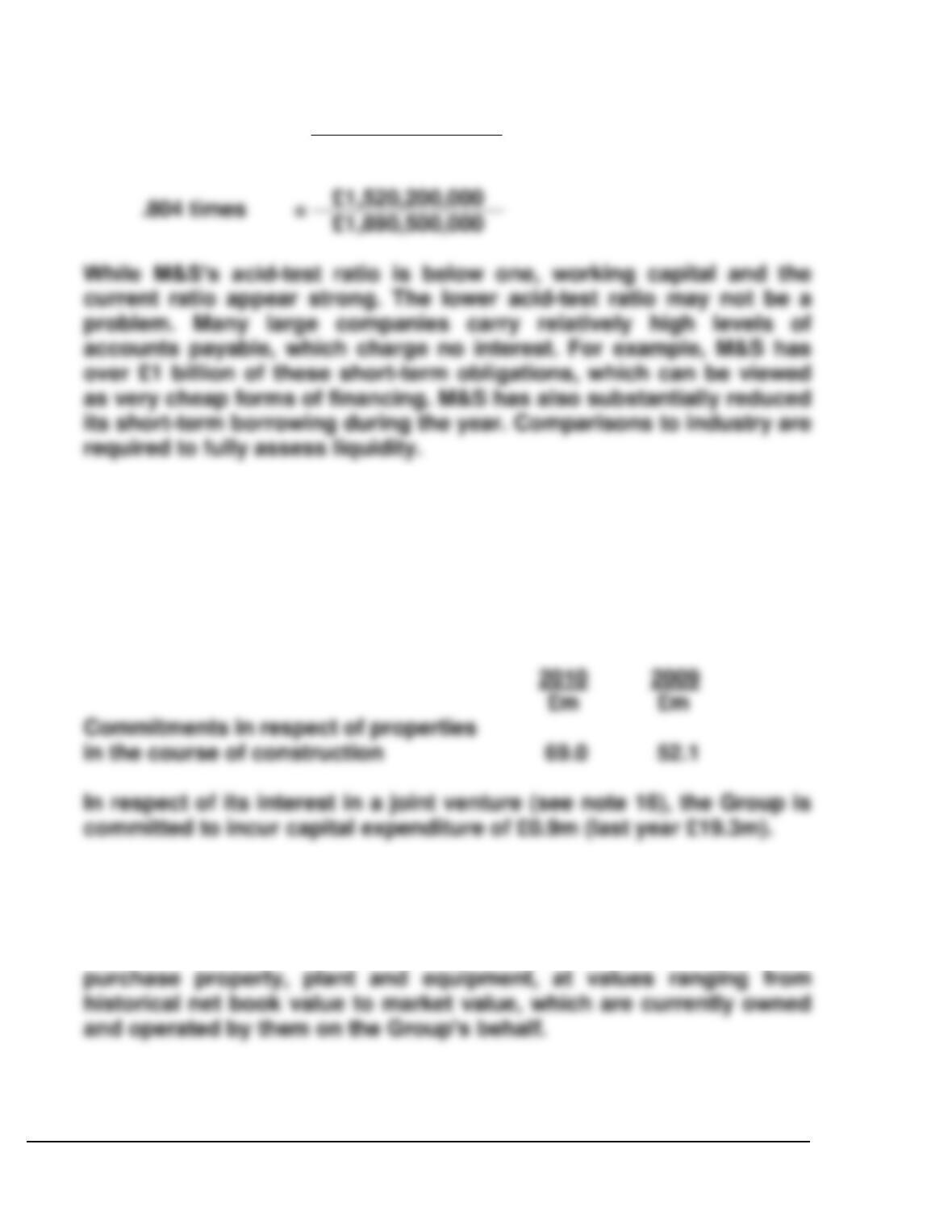
(a) M&S’s short-term borrowings were £554.8 million at April 3, 2010.
SHORT-TERM DEBT
(In millions)
2010
Bank loans and overdrafts
£249.5
Syndicated bank factility
219.8
Finance lease liabilties
13.6
Total short-term debt
UK Pension Scheme
Total short-term debt
lease liabilities (4.7%).
(b) 1. Working capital = Current assets less current liabilities.
(£370,300,000) = (£1,520,200,000 – £1,890,500,000)
13–84
IFRS13-12 (Continued)
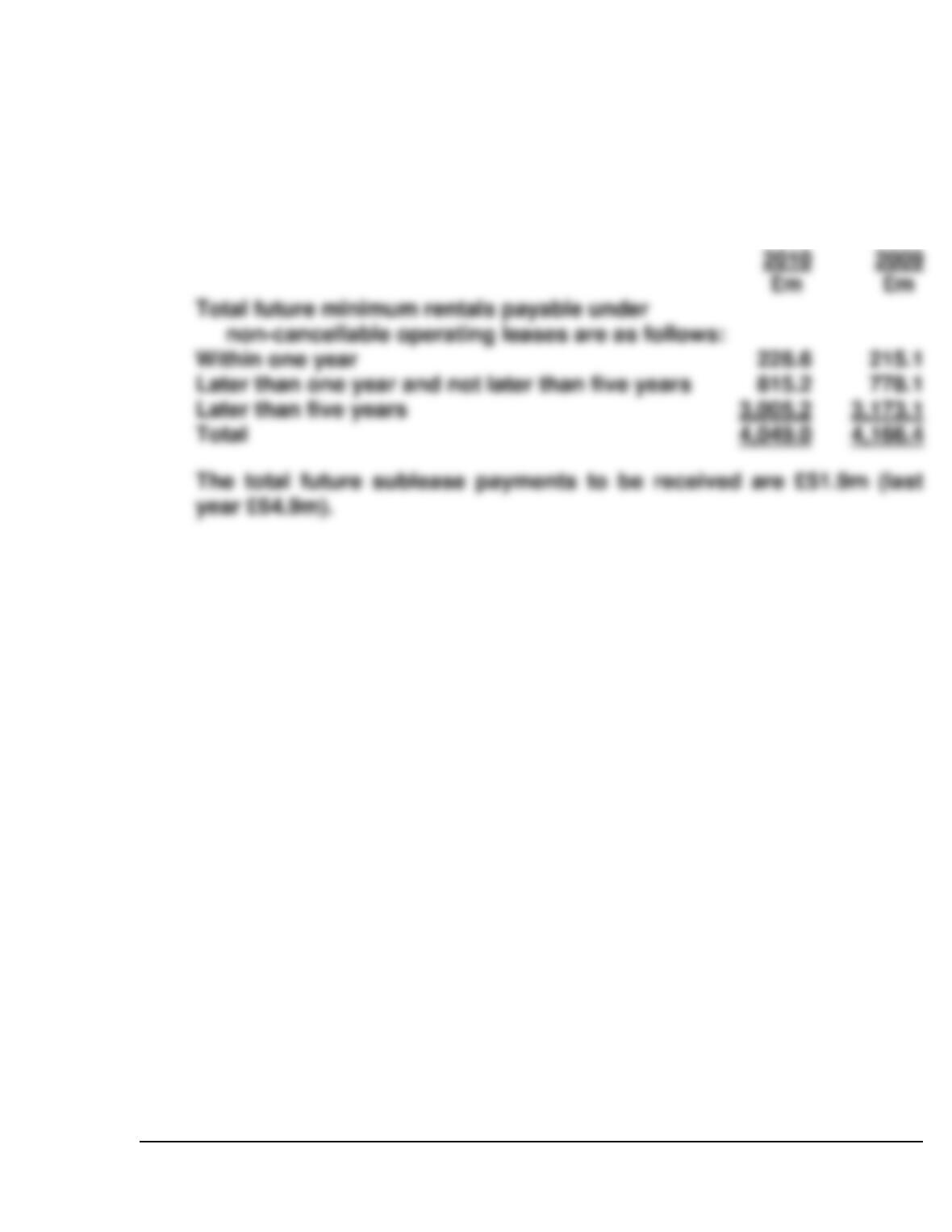
3.
Current ratio =
Current assets
Current liabilities
(c) M&S provided the following discussion related to commitments and
contingencies:
Note 27: Contingencies and Commitments
A. Capital commitments
B. Other material contracts
In the event of a material change in the trading arrangements with
certain warehouse operators, the Group has a commitment to
.804 times =
£1,520,200,000
13–85
IFRS13-12 (Continued)
C. Commitments under operating leases
The Group leases various stores, offices, warehouses and equipment
under non-cancellable operating lease agreements. The leases have
varying terms, escalation clauses and renewal rights.