CHAPTER 13
STEPHENSON REAL ESTATE
RECAPITALIZATION
1. If Stephenson wishes to maximize the overall value of the firm, it should use debt to finance the $50
million purchase. Since interest payments are tax deductible, debt in the firm’s capital structure will
decrease the firm’s taxable income, creating a tax shield that will increase the overall value of the firm.
Market value balance sheet
Assets
$382,500,000
Equity
$382,500,000
Total assets
$382,500,000
Debt & Equity
$382,500,000
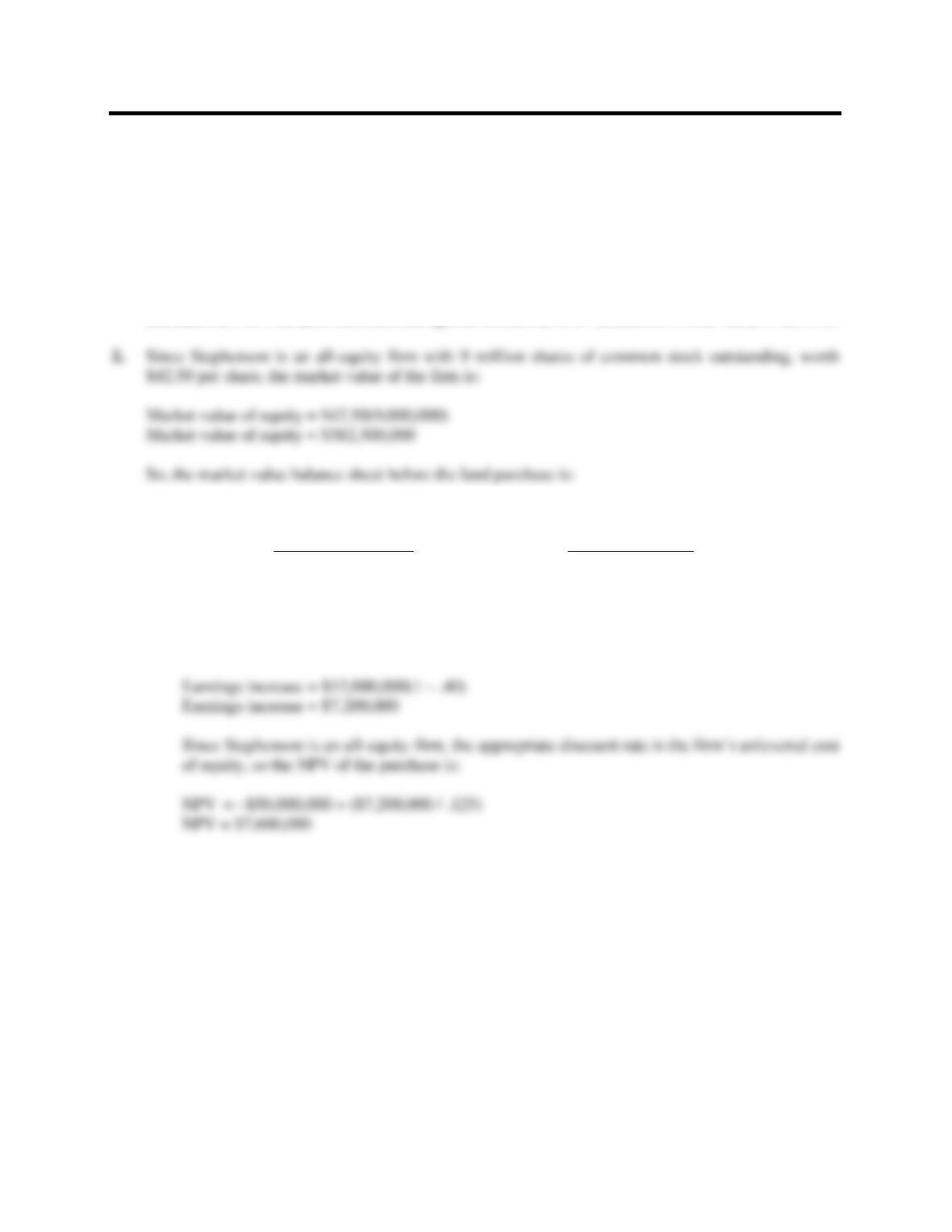
3. a. As a result of the purchase, the firm’s pre-tax earnings will increase by $12 million per year in
perpetuity. These earnings are taxed at a rate of 40 percent. Therefore, after taxes, the purchase
increases the annual expected earnings of the firm by:
b. After the announcement, the value of Stephenson will increase by $7.6 million, the net present
value of the purchase. Under the efficient-market hypothesis, the market value of the firm’s
equity will immediately rise to reflect the NPV of the project. Therefore, the market value of
Stephenson’s equity after the announcement will be:
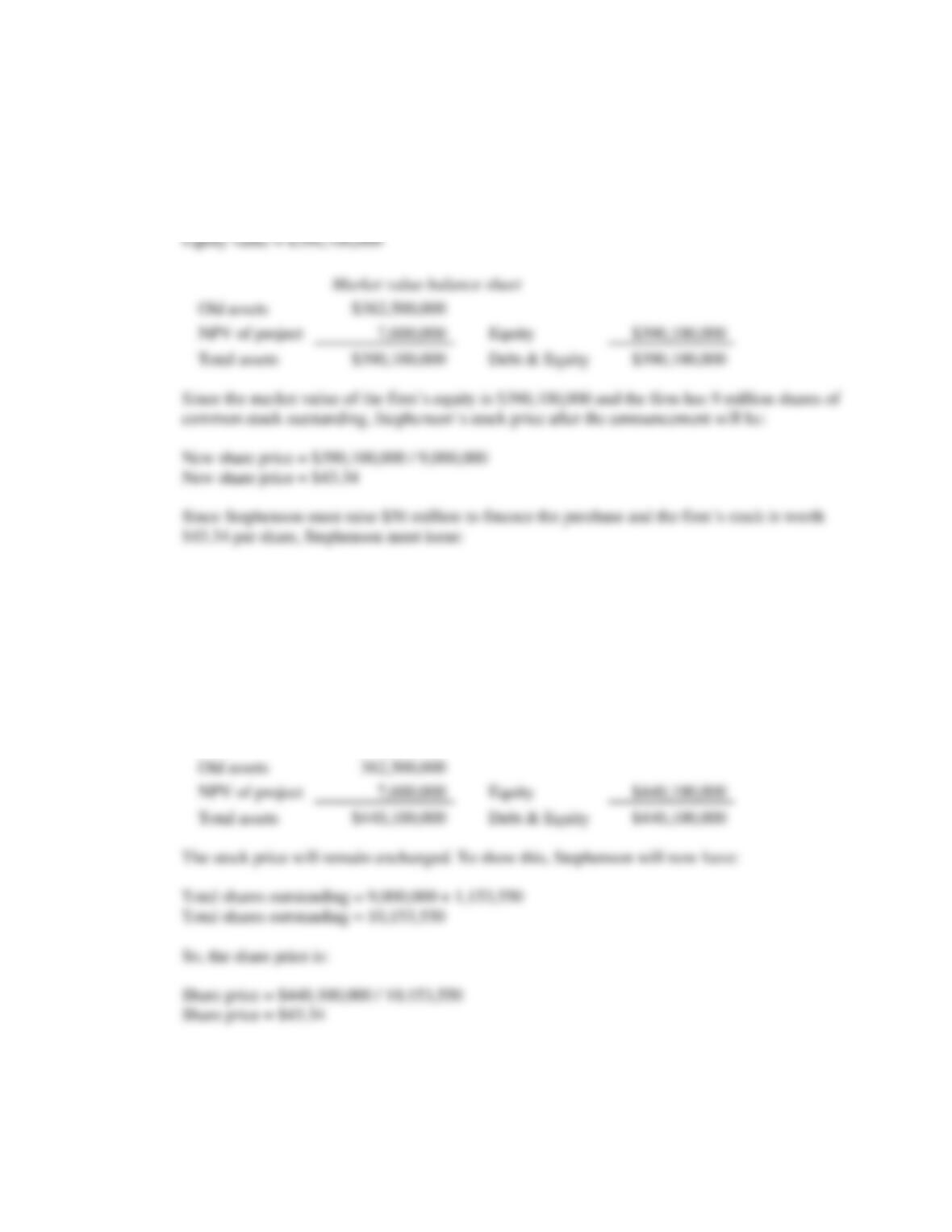
Equity value = $382,500,000 + 7,600,000
Shares to issue = $50,000,000 / $43.34
Shares to issue = 1,153,550
c. Stephenson will receive $50 million in cash as a result of the equity issue. This will increase the
firm’s assets and equity by $50 million. So, the new market value balance sheet after the stock
issue will be:
Market value balance sheet
Cash
$ 50,000,000
Old assets
Total assets
$440,100,000
Debt & Equity
Market value balance sheet
NPV of project
Equity
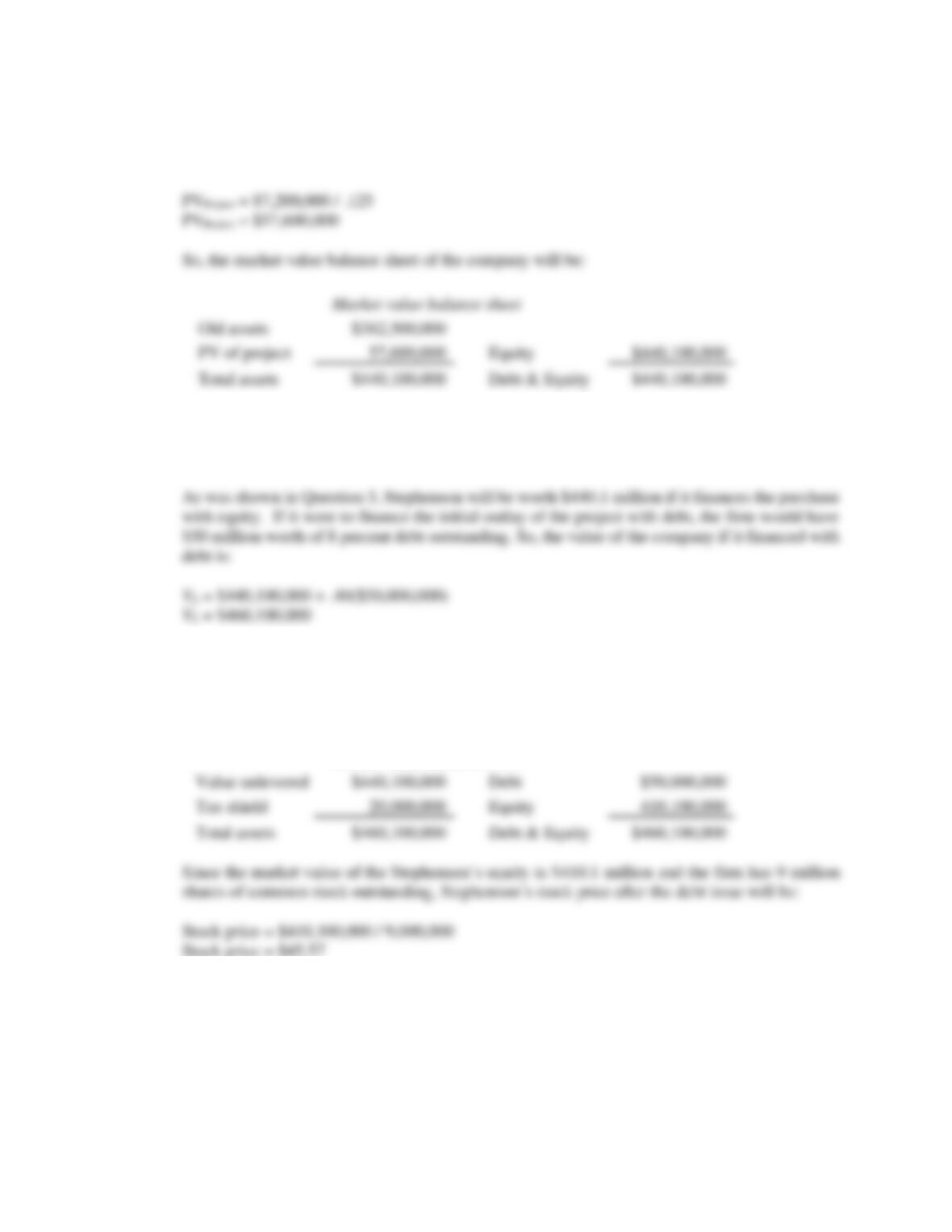
d. The project will generate $12 million of additional annual pretax earnings forever. These earnings
will be taxed at a rate of 40 percent. Therefore, after taxes, the project increases the annual
earnings of the firm by $7.2 million. So, the aftertax present value of the earnings increase is:
4. a. Modigliani-Miller Proposition I states that in a world with corporate taxes:
VL = VU + TCD
b. After the announcement, the value of Stephenson will immediately rise by the present value of
the project. Since the market value of the firm’s debt is $50 million and the value of the firm is
$460.1 million, we can calculate the market value of Stephenson’s equity. Stephenson’s market–
value balance sheet after the debt issue will be:
Market value balance sheet
Stock price = $45.57
5. If Stephenson uses equity in order to finance the project, the firm’s stock price will remain at $43.34
per share. If the firm uses debt in order to finance the project, the firm’s stock price will rise to $45.57
per share. Therefore, debt financing maximizes the per share stock price of the firm’s equity.