CHAPTER 12 – 1
CHAPTER 13
LEVERAGE AND CAPITAL STRUCTURE
Answers to Concepts Review and Critical Thinking Questions
1. Business risk is the equity risk arising from the nature of the firm’s operating activity, and is directly
related to the systematic risk of the firm’s assets. Financial risk is the equity risk that is due entirely to
the firm’s chosen capital structure. As financial leverage, or the use of debt financing, increases, so
does financial risk and hence the overall risk of the equity. Thus, Firm B could have a higher cost of
equity if it uses greater leverage.
4. The more capital intensive industries, such as airlines, cable television, and electric utilities, tend to
use greater financial leverage. Also, industries with less predictable future earnings, such as computers
or drugs, tend to use less. Such industries also have a higher concentration of growth and startup firms.
Overall, the general tendency is for firms with identifiable, tangible assets and relatively more
predictable future earnings to use more debt financing. These are typically the firms with the greatest
need for external financing and the greatest likelihood of benefiting from the interest tax shelter.
5. It’s called leverage (or “gearing” in the UK) because it magnifies gains or losses.
CHAPTER 12 – 2
9. One side is that Continental was going to go bankrupt because its costs made it uncompetitive. The
bankruptcy filing enabled Continental to restructure and keep flying. The other side is that Continental
abused the bankruptcy code. Rather than renegotiate labor agreements, Continental simply abrogated
them to the detriment of its employees. It is important thing to keep in mind that the bankruptcy code
capital structure with the lowest cost of capital.
Solutions to Questions and Problems
NOTE: All end-of-chapter problems were solved using a spreadsheet. Many problems require multiple
steps. Due to space and readability constraints, when these intermediate steps are included in this solutions
manual, rounding may appear to have occurred. However, the final answer for each problem is found
without rounding during any step in the problem.
Basic
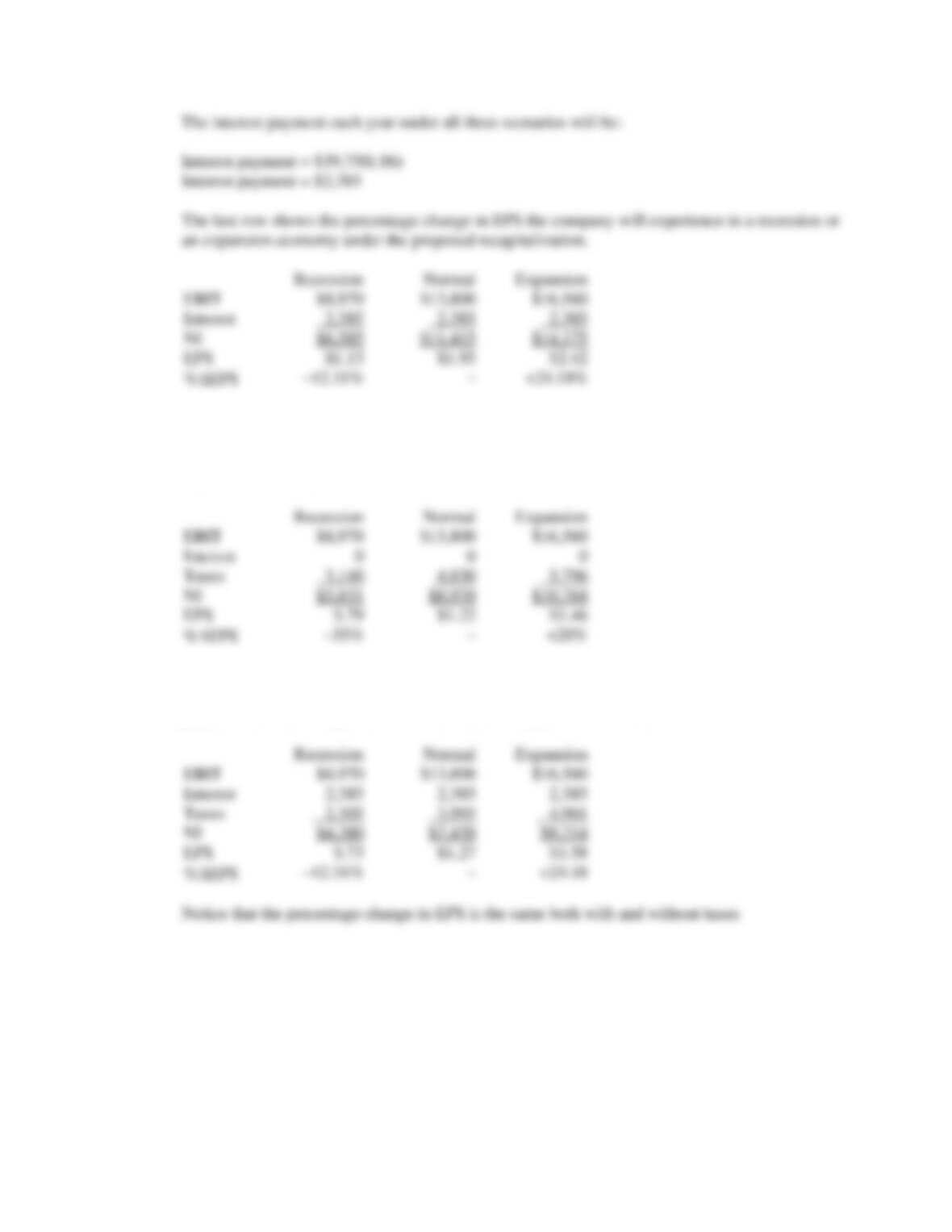
1. a. A table outlining the income statement for the three possible states of the economy is shown
below. The EPS is the net income divided by the 7,350 shares outstanding. The last row shows
the percentage change in EPS the company will experience in a recession or an expansion
economy.
b. If the company undergoes the proposed recapitalization, it will repurchase:
Share price = Equity / Shares outstanding
Share price = $194,775 / 7,350
Share price = $26.50
CHAPTER 12 – 3
2. a. A table outlining the income statement with taxes for the three possible states of the economy is
shown below. The share price is still $26.50, and there are still 7,350 shares outstanding. The last
row shows the percentage change in EPS the company will experience in a recession or an
expansion economy.
b. A table outlining the income statement with taxes for the three possible states of the economy
and assuming the company undertakes the proposed capitalization is shown below. The interest
payment and shares repurchased are the same as in part b of Problem 1.
CHAPTER 12 – 4
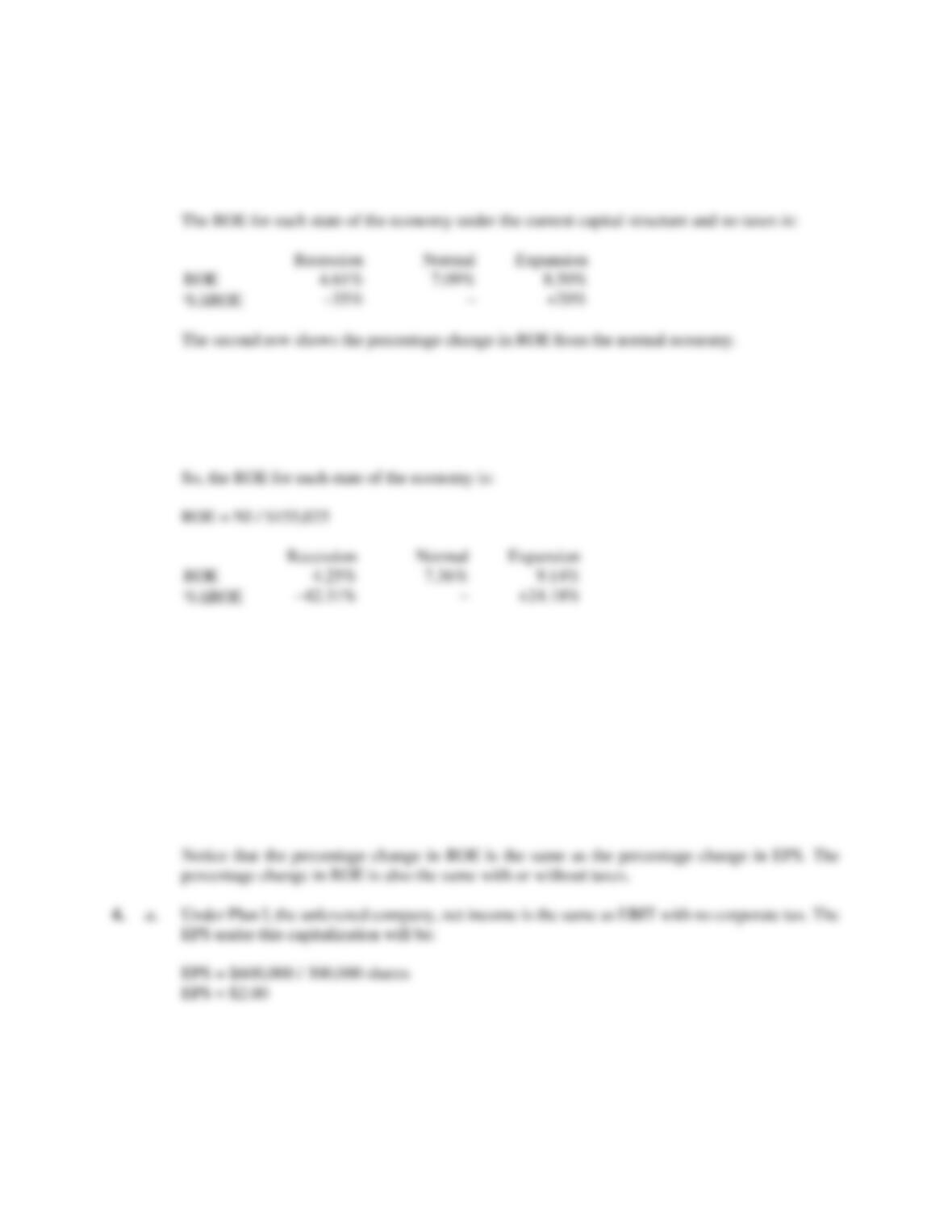
3. a. Since the company has a market-to-book ratio of 1.0, the total equity of the firm is equal to the
market value of equity. Using the equation for ROE:
ROE = NI / $194,775
ROE
4.25%
7.36%
9.14%
%ROE
–42.31%
–
+24.18%
b. If the company undertakes the proposed recapitalization, the new equity value will be:
Equity = $194,775 – 39,750
Equity = $155,025
c. If there are corporate taxes and the company maintains its current capital structure, the ROE is:
ROE
2.99%
4.61%
5.53%
%ROE
–35%
–
+20%
If the company undertakes the proposed recapitalization, and there are corporate taxes, the ROE
for each state of the economy is:
ROE
2.76%
4.79%
5.94%
%ROE
–42.31%
–
+24.18%
ROE
4.61%
7.09%
8.50%
%ROE
–
+20%
CHAPTER 12 – 5
Under Plan II, the levered company, net income will be reduced by the interest payment. The
interest payment is the amount of debt times the interest rate, so:
b. Under Plan I, the net income is $900,000 and the EPS is:
EPS = $900,000 / 300,000 shares
EPS = $3.00
Under Plan II, the net income is:
NI = $900,000 – .10($2,367,000)
NI = $663,300
c. To find the breakeven EBIT for two different capital structures, we simply set the equations for
EPS equal to each other and solve for EBIT. The breakeven EBIT is:
EBIT / 300,000 = [EBIT – .10($2,367,000)] / 210,000
EBIT = $789,000
5. We can find the price per share by dividing the amount of debt used to repurchase shares by the number
of shares repurchased. Doing so, we find the share price is:
CHAPTER 12 – 6
And the value of the company under the levered plan is:
V = $26.30(210,000 shares) + $2,367,000 debt
V = $7,890,000
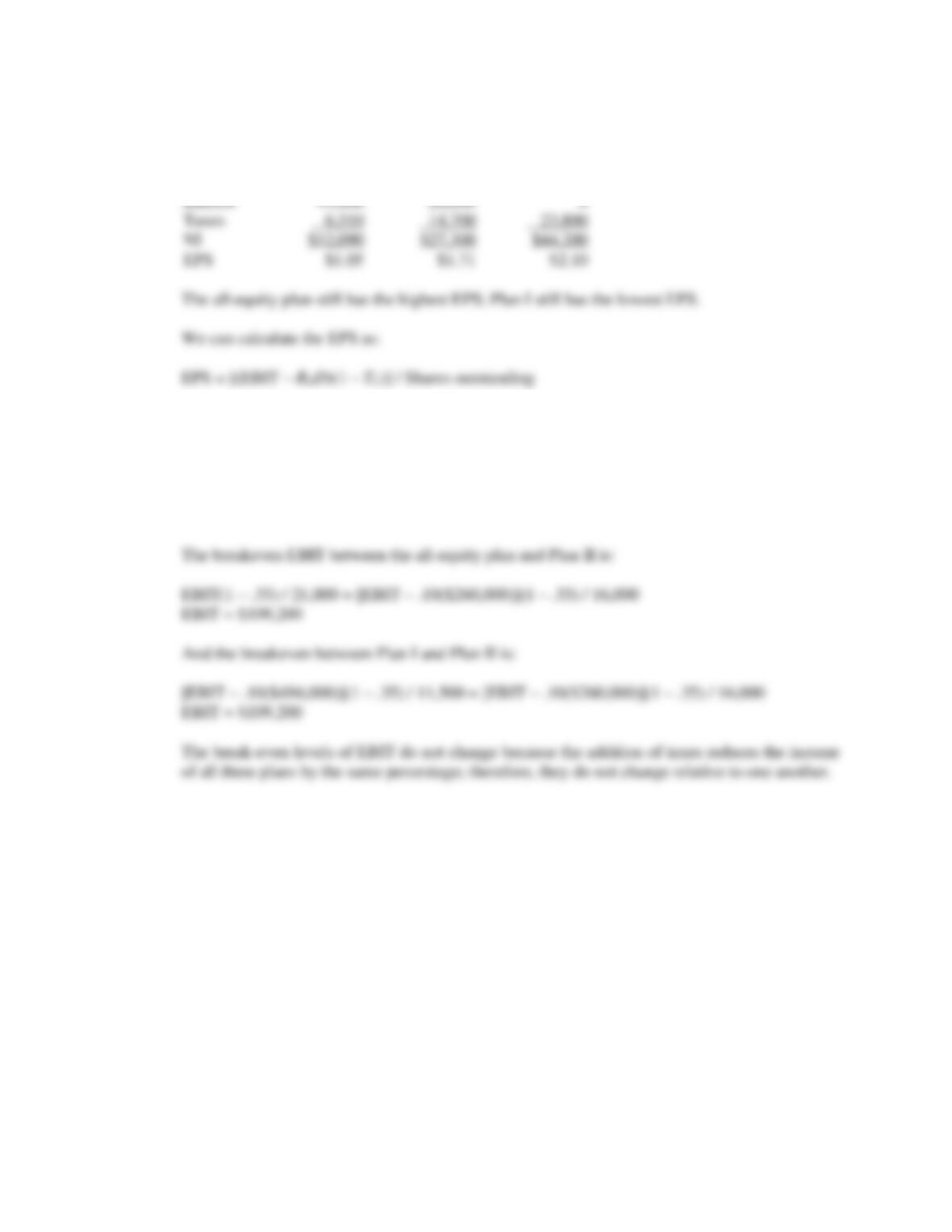
6. a. The income statement for each capitalization plan is:
I
II
All-equity
EBIT
$68,000
$68,000
$68,000
b. The breakeven level of EBIT occurs when the capitalization plans result in the same EPS. The
EPS is calculated as:
EPS = (EBIT – RDD) / Shares outstanding
c. Setting the equations for EPS from Plan I and Plan II equal to each other and solving for EBIT,
we get:
[EBIT – .10($494,000)] / 11,500 = [EBIT – .10($260,000)] / 16,000
EBIT = $109,200
Interest
CHAPTER 12 – 7
d. The income statement for each capitalization plan with corporate income taxes is:
I
II
All-equity
EBIT
$68,000
$68,000
$68,000
This is similar to the equation we used before, except now we need to account for taxes. Again,
the interest expense term is zero in the all-equity capital structure. So, the breakeven EBIT
between the all-equity plan and Plan I is:
EBIT(1 – .35) / 21,000 = [EBIT – .10($494,000)](1 – .35) / 11,500
EBIT = $109,200
7. To find the value per share of the stock under each capitalization plan, we can calculate the price as
the value of shares repurchased divided by the number of shares repurchased. So, under Plan I, the
value per share is:
P = $494,000 / (21,000 shares – 11,500 shares)
P = $52 per share
NI
$12,090
$27,300
$44,200
8. a. The earnings per share are:
EPS = $19,300 / 6,400 shares
EPS = $3.02
b. To determine the cash flow to the shareholder, we need to determine the EPS of the firm under
the proposed capital structure. The market value of the firm is:
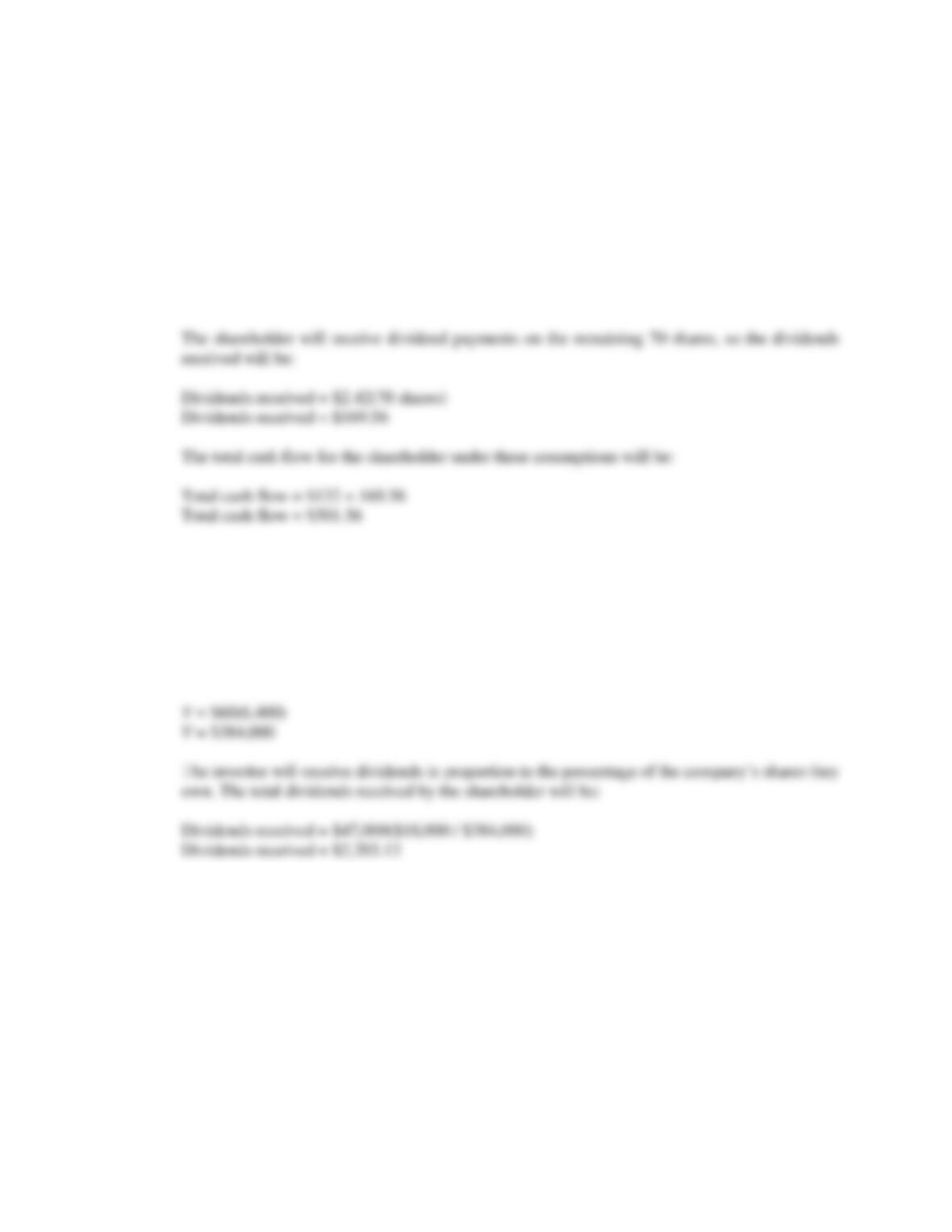
Under the new capital structure, the company will have to make an interest payment on the new
debt. The net income with the interest payment will be:
NI = $19,300 – .08($105,600)
NI = $10,852
CHAPTER 12 – 9
Since all earnings are paid as dividends, the shareholder will receive:
Shareholder cash flow = $2.42(100 shares)
Shareholder cash flow = $242.23
c. To replicate the original capital structure, the shareholder should sell 30 percent of her shares, or
30 shares, and lend the proceeds at 8 percent. The shareholder will have an interest cash flow of:
Interest cash flow = 30($55)(.08)
Interest cash flow = $132.00
This is the same cash flow we calculated in part a.
d. The capital structure is irrelevant because shareholders can create their own leverage or unlever
the stock to create the payoff they desire, regardless of the capital structure the firm actually
chooses.
9. a. The total value of the company is the share price times the number of shares, so:
b. Under the proposed capital structure, the firm will raise new debt in the amount of:
D = .25($384,000)
D = $96,000
CHAPTER 12 – 10
This means the number of shares repurchased will be:
Shares repurchased = $96,000 / $60
Shares repurchased = 1,600
The number of shares owned by the shareholder is the dollar amount invested divided by the
share price, so:
Shares owned = $18,000 / $60
Shares owned = 300
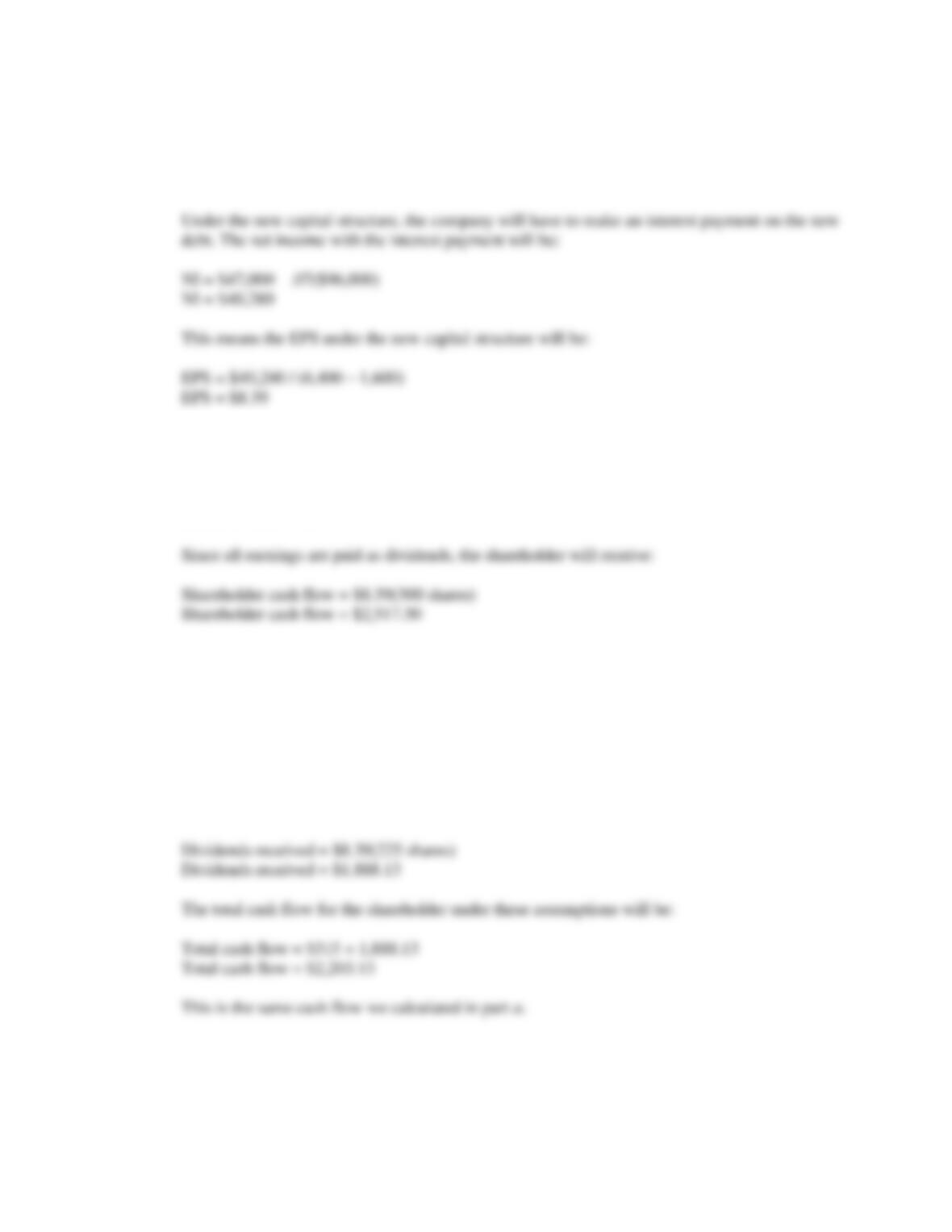
c. To replicate the proposed capital structure, the shareholder should sell 25 percent of their shares,
or 75 shares, and lend the proceeds at 7 percent. The shareholder will have an interest cash flow
of:
Interest cash flow = 75($60)(.07)
Interest cash flow = $315
The shareholder will receive dividend payments on the remaining 225 shares, so the dividends
received will be:
CHAPTER 12 – 11
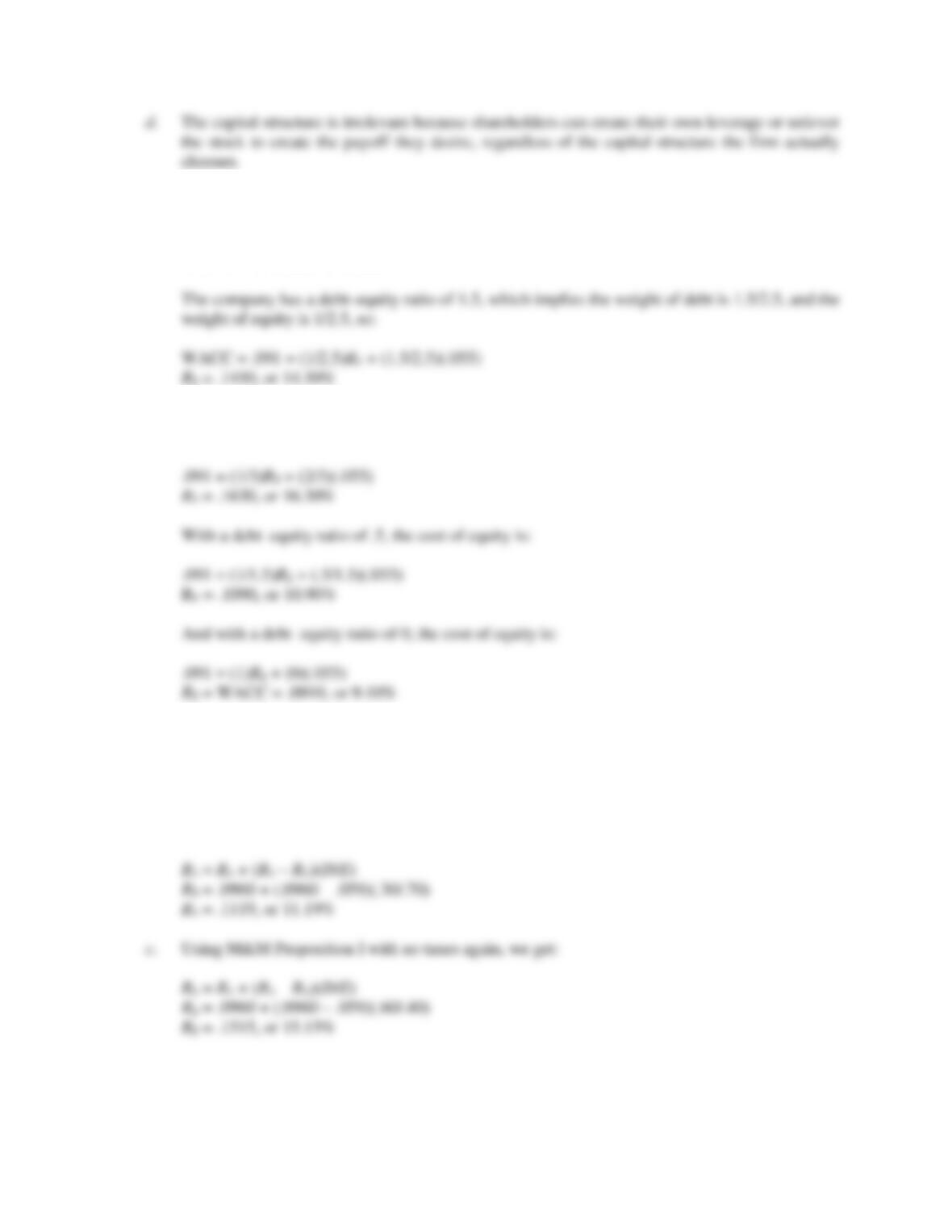
10. a. With the information provided, we can use the equation for calculating WACC to find the cost
of equity. The equation for WACC (assuming no taxes) is:
WACC = (E/V)RE + (D/V)RD
b. To find the cost of equity under different capital structures, we can again use the WACC equation.
With a debt–equity ratio of 2, the cost of equity is:
11. a. For an all-equity financed company:
WACC = RE = .0960, or 9.60%
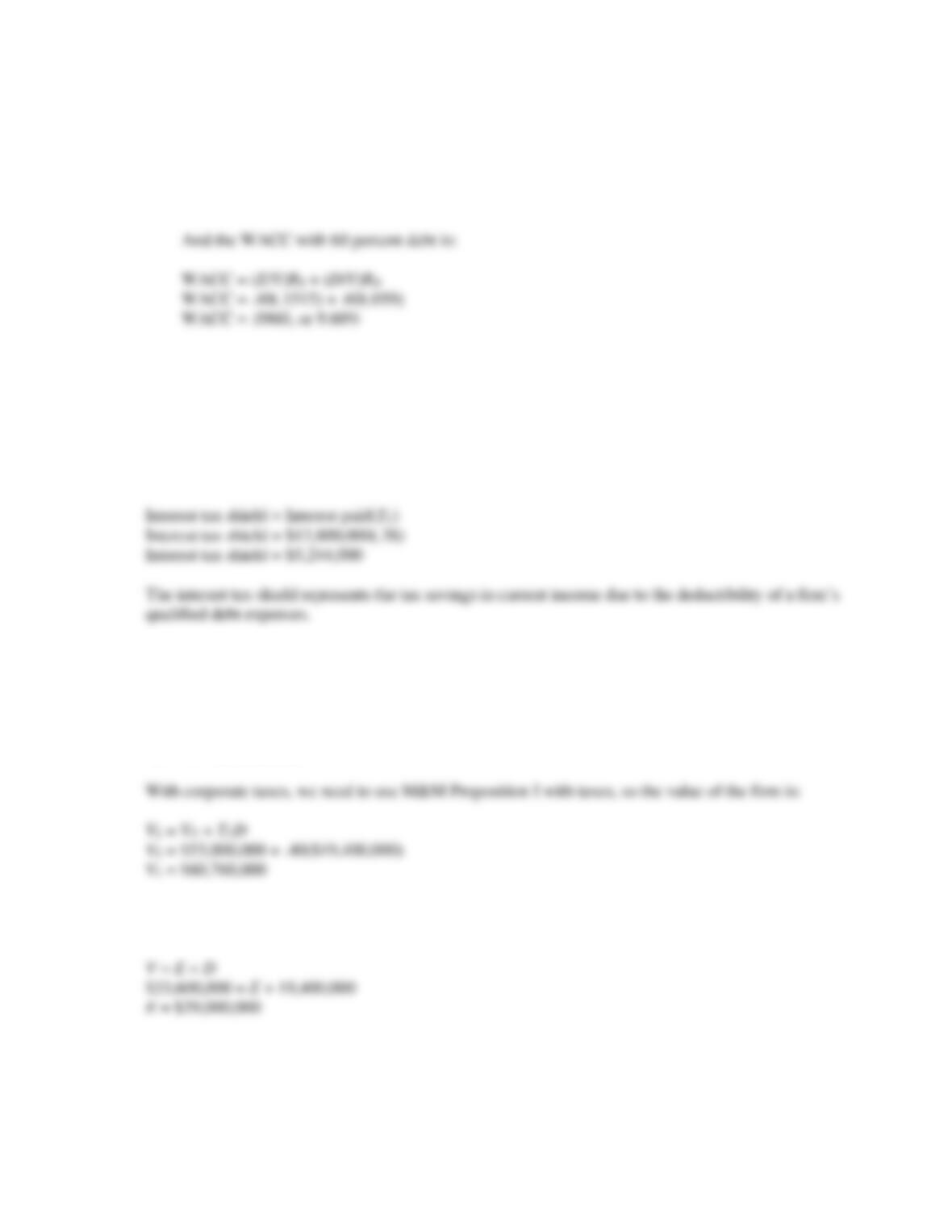
b. To find the cost of equity for the company with leverage, we need to use M&M Proposition I
with no taxes, so:
CHAPTER 12 – 12
d. The WACC with 30 percent debt is:
WACC = (E/V)RE + (D/V)RD
WACC = .70(.1119) + .30(.059)
WACC = .0960, or 9.60%
12. Using M&M Proposition I with taxes, the value of the levered firm is:
VL = VU + TCD
VL = $595,000 + .35($310,000)
VL = $703,500
13. The interest tax shield is the total interest paid times the tax rate, so:
Intermediate
14. M&M Proposition I with no taxes states the value of the levered firm is equal to the value of the
unlevered firm. So, with no taxes, the value of the firm if it issues debt is:
VU = VL = $53,000,000
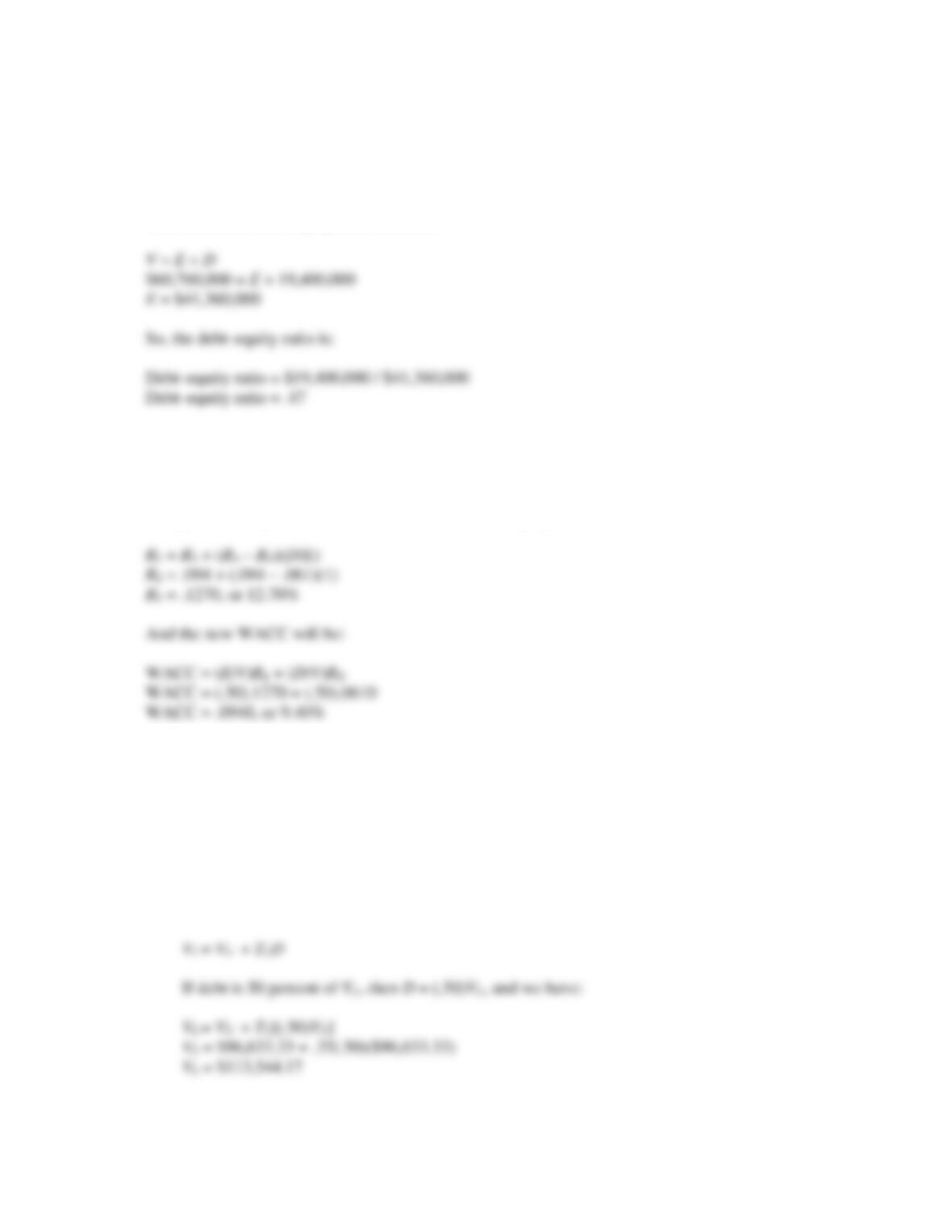
15. The value of the firm is the value of the debt plus the value of the equity. We can use this relationship
to find the value of equity in each case. So, the debt–equity ratio with no taxes is:
CHAPTER 12 – 13
So, the debt–equity ratio is:
Debt–equity ratio = $19,400,000 / $33,600,000
Debt–equity ratio = .58
With taxes, the debt–equity ratio becomes:
16. When the company is all-equity financed, the cost of equity is:
WACC = RE = .0940, or 9.40%
Using M&M Proposition I with no taxes, the cost of equity will be:
Challenge
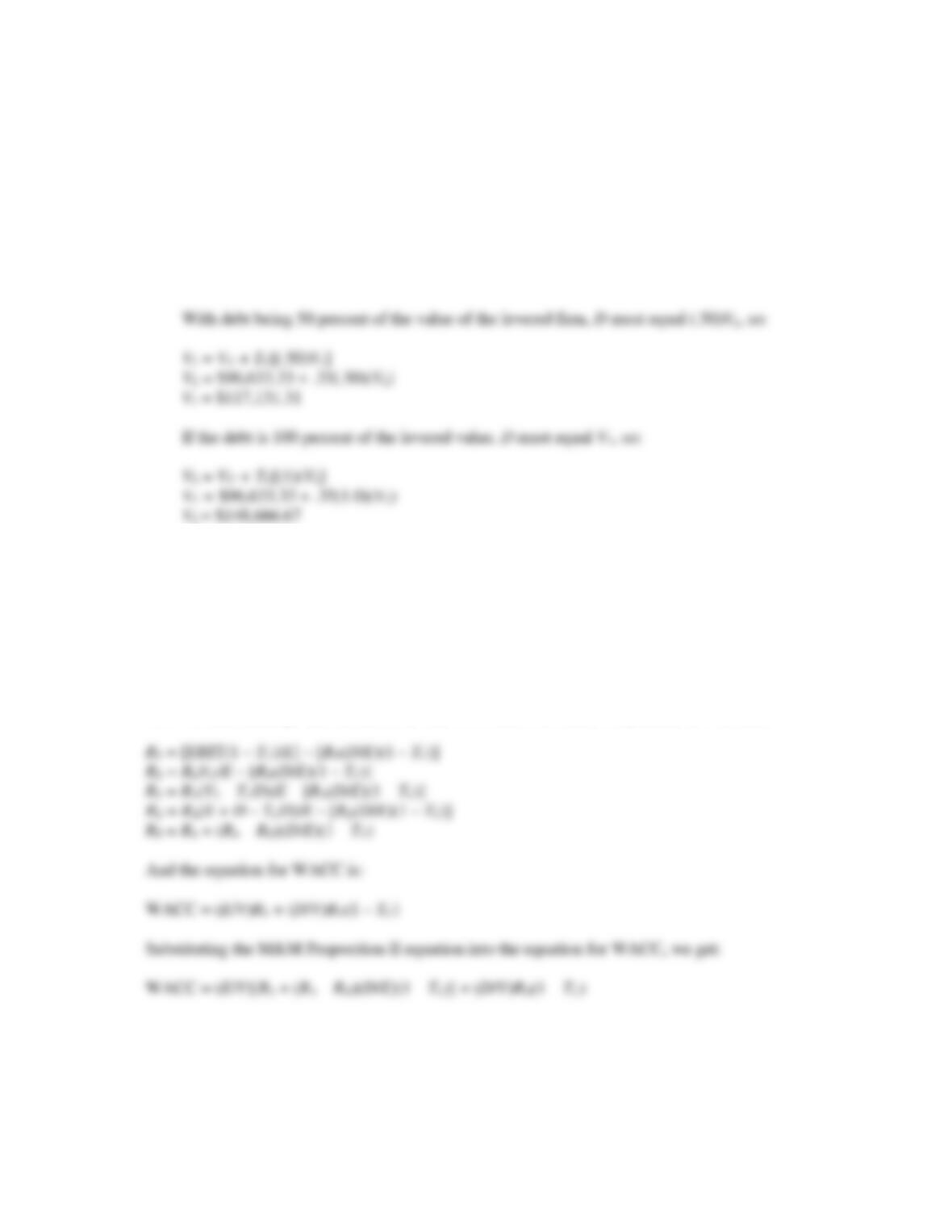
17. a. With no debt, we are finding the value of an unlevered firm, so:
VU = EBIT(1 – TC) / RA
VU = $22,300(1 – .35) / .15
VU = $96,633.33
b. The general expression for the value of a leveraged firm is:
CHAPTER 12 – 14
And if debt is 100 percent of VU, then D = (1)VU, and we have:
VL = VU + TC[(1)VU]
VL = $96,633.33 + .35(1.0)($96,633.33)
VL = $130,455.00
c. According to M&M Proposition I with taxes:
VL = VU + TCD
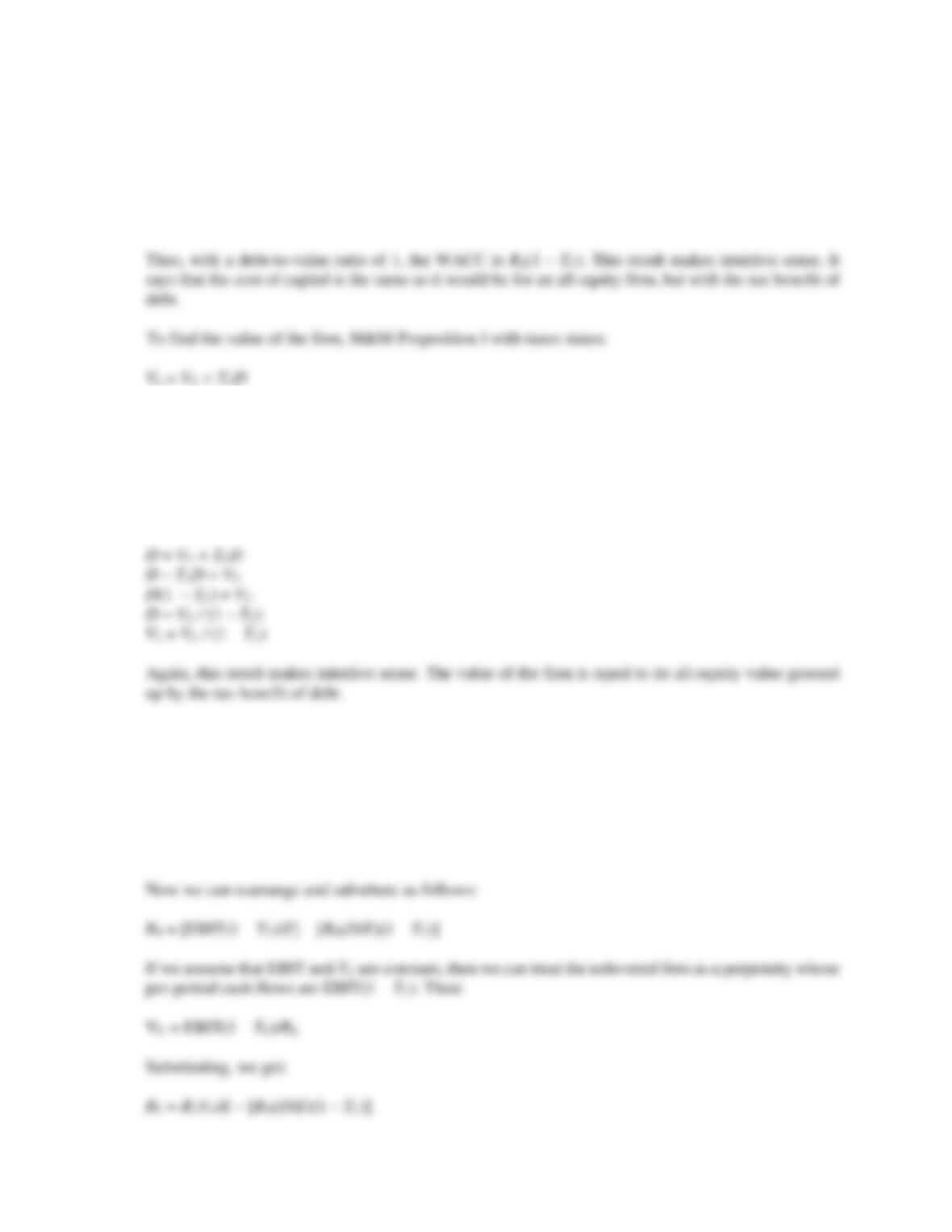
18. The return on equity is net income divided by equity. Net income can be expressed as:
NI = (EBIT – RDD)(1 – TC)
So, ROE is:
RE = (EBIT – RDD)(1 – TC)/E
Now we can rearrange and substitute as follows to arrive at M&M Proposition II with taxes:
CHAPTER 12 – 15
Rearranging and reducing the equation, we get:
WACC = RA[(E/V) + (E/V)(D/E)(1 – TC)] + RD(1 – TC)[(D/V) – (E/V)(D/E)]
WACC = RA[(E/V) + (D/V)(1 – TC)]
WACC = RA[{(E + D)/V} – TC(D/V)]
WACC = RA[1 – TC(D/V)]
Since the firm is entirely financed by debt, the value of the firm must be equal to the amount of debt,
so:
VL = D
Substituting, we get:
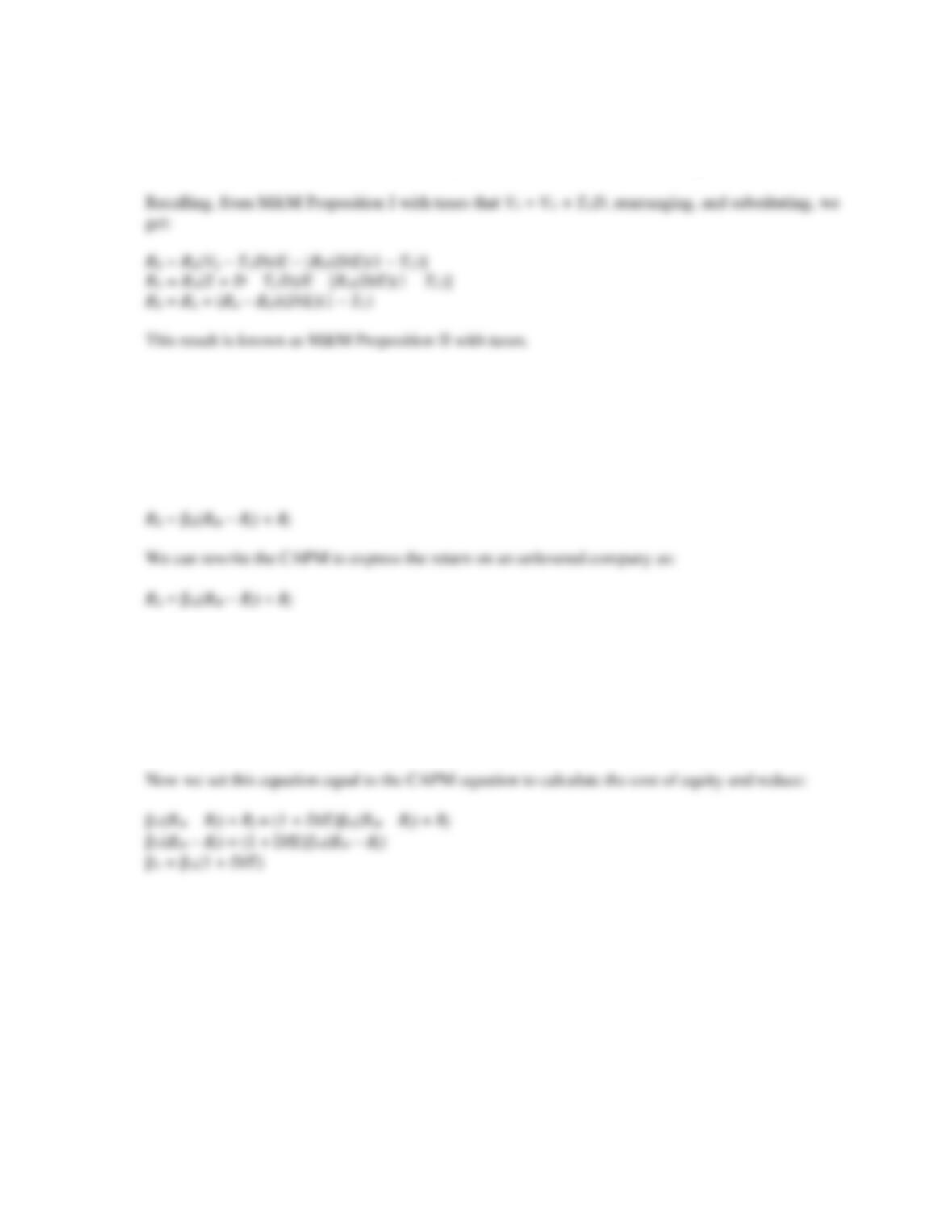
19. The return on equity is net income divided by equity. Net income can be expressed as:
NI = (EBIT – RDD)(1 – TC)
So, ROE is:
RE = (EBIT – RDD)(1 – TC)/E
CHAPTER 12 – 16
Note that we’ve implicitly assumed, with M&M, that RA is independent of capital structure, so that RA
of the unlevered firm can be treated as the required return on assets of the leveraged firm.
20. M&M Proposition II, with no taxes is:
RE = RA + (RA – Rf)(D/E)
Note that we assumed the return on debt was the risk-free rate. This is an important assumption of
M&M Proposition II. The CAPM to calculate the cost of equity is expressed as:
We can now substitute the CAPM for an unlevered company into M&M Proposition II. Doing so and
rearranging the terms we get:
RE = A(RM – Rf) + Rf + [A(RM – Rf) + Rf – Rf](D/E)
RE = A(RM – Rf) + Rf + [A(RM – Rf)](D/E)
RE = (1 + D/E)A(RM – Rf) + Rf