Accounting Information Systems, 10e 1
SOLUTIONS FOR CHAPTER 13
Each end-of-chapter question in the Solutions Manual is tagged to correspond with AACSB, AICPA
and CISA standards, allowing professors to more easily manage the task of reporting outcomes to these
professional and accrediting bodies. Please see the corresponding spreadsheet file for the tagging
information.
Discussion Questions
DQ 13-1 Refer to effectiveness goals A and B shown in the control matrix in Figure 13.11.
For each activity (accounts payable and cash disbursements), describe goals
other than the one discussed in the chapter.
ANS. Possible accounts payable effectiveness goals:
• (Contained in Figure 13.11.) Optimize cash discounts.
DQ 13-2 Explain why ambiguities and conflicts exist among operations process
(effectiveness) goals, and discuss potential ambiguities and conflicts relative to
the goals you described in DQ 13-1.
2 Solutions for Chapter 13
ANS. Conflicts exist because each organizational unit wants to do its best (or at least be
seen as doing its best). However, many (perhaps any) individual units cannot
possibly perform at their best because trade-offs must be made so that the
organization as a whole can do its best.
receiving and invoice verification processes may be sacrificed.
DQ 13-3 Without redrawing the figures, discuss how Figures 13.3, 13.4, and 13.6 would
change as a result of the following independent situations (be specific in
describing the changes):
a. Employing a voucher system that involved, among other things, establishing
vouchers payable that covered several vendor invoices.
ANS. In Figure 13.4, bubble 1.2, individual invoices would not be received from bubble
1.1 and the accounts payable master data would not be updated for individual
invoices. Rather, batches of invoices sorted by vendor identification code would
be accumulated between bubbles 1.1 and 1.2 and used by bubble 1.2 to update the
accounts payable master data.
Accounting Information Systems, 10e 3
ANS. In Figure 13.6, bubble 2.1 would be triggered on the fifth and the 25th of each
month. All discount dates reached between the last payment date and the current
payment date are considered available.
DQ 13-4 In terms of effectiveness and efficiency of operations, as well as of meeting the
generic information system control goals of validity, completeness, and accuracy,
what are the arguments for and against each of the following?
a. Sending a copy of the vendor invoice to the purchasing department for
approval of payment.
ANS. ● Purchasing personnel can review the invoice to ensure validity and accuracy
of the invoice (i.e., the items were ordered, price, terms, etc.).
ANS. ● Without the PO, the requisitioning department personnel cannot know what
was actually ordered on the PO versus what was requested on the purchase
requisition.
4 Solutions for Chapter 13
DQ 13-5 An electronic data interchange (EDI) system may present an organization with
opportunities and risks.
a. What opportunities might an EDI system present? Discuss your answer.
ANS. EDI facilitates the timely and efficient flow of data between trading partners. For
example, by enabling a just-in-time process, EDI can reduce the carrying costs of
ANS. Failure of the communications link threatens the ongoing operation of EDI. To
prevent this, the contract with the VAN should address the availability of the
communications link. An organization may contract with alternative VANs to be
used in the event of one VAN’s failure. Communication via the Internet might
DQ 13-6 In the physical implementation depicted in Figure 13.10, the payment order and
the RA were sent together through the banking system. We also described an
option of sending the RA directly to the vendor. Which is better? Discuss fully.
ANS. Each approach may have advantages. If the two items are sent together,
identification and validation of the payment may be more efficient. However, if
DQ 13-7 In the “Fraud and the Accounts Payable Function” section, we described a fraud
committed by Stanley and Phoebe and another by Veronica. For each fraud,
describe controls and technology that could reduce the risk of those frauds
occurring.
Accounting Information Systems, 10e 5
ANS. Controls and technology that might have reduced the risk of the fraud perpetrated
by Stanley and Phoebe include the following:
• Before opening the business account, the bank might have asked for
documentation regarding SRJ Enterprises.
Controls and technology that might have reduced the risk of the fraud perpetrated
by Veronica include the following:
• When the vendor invoice is entered, the invoice number should also be
entered, and the computer should be programmed to detect and preclude entry
of duplicate invoice numbers.
Short Problems
SP 13-1 ANS. We can discuss two categories of procedures and controls: business
process/application controls and entity-level/pervasive/IT general controls.
Business process/application controls:
6 Solutions for Chapter 13
Entity-level/pervasive/IT general controls:
SP 13-2 ANS. We can discuss two categories of procedures and controls: business
process/application controls and entity-level/pervasive/IT general controls.
Business process/application controls:
• The VAN or EDI translator should determine that the order was received from
a legitimate customer and not from an unauthorized source. A secure mailbox
Entity-level/pervasive/IT general controls:
• Physical and logical access controls should prevent unauthorized alteration of
the customer, sales order, and accounts receivable data—the data used to
validate the customer and perform the credit check.
• Program change controls must prevent unauthorized alteration of the program
that performs the validation and credit check.
Accounting Information Systems, 10e 7
SP 13-3 ANS. 1. B: Before invoices are accepted and recorded, Pownal Company must
validate the invoice by comparing it to the related purchase order and a
receiving report to ensure that the invoice is for items that were ordered and
received.
SP 13-4 ANS. 1. E: Samuel Company should compare incoming invoices to vendor master
data to determine that the invoices are from authorized vendors. The
invoices should also be compared to the related purchase order and
receiving report to reduce the possibility that the invoice is fraudulent.
2. D: Because the invoices are entered in batches, there is an opportunity for
personnel in the AP department to reconcile batch totals to ensure that all of
the invoices are recorded correctly.
8 Solutions for Chapter 13
SP 13-5 ANS.
Function
Risks
Controls and Technology
Finance
Nonoptimal cash balances (too
much, too little).
• Cash planning (from before or at the same time
that POs are issued). Requires that POs be
recorded so that we can plan for eventual
payments.
• Purchasing budgets.
Cash is lost.
• Electronic payments.
• Segregate controller and treasurer.
Inaccurate invoice (e.g.,
incorrect vendor, invoice
number, amount).
• Edit on input.
• Compare to vendor record, PO, and receiving
report.
Incomplete invoices.
Periodically examine open POs and open receiving
reports for invoices not received and/or not recorded
(tickler file).
Accounting Information Systems, 10e 9
Function
Risks
Controls and Technology
Discounts taken
(credit)
Inaccurate payment (e.g., wrong
vendor, wrong amount is paid).
• Electronic payments with digital signatures.
• Populate payment with vendor and invoice data.
• Match each payment with unpaid invoice.
(GR/IR).”
SP 13-6 ANS. While sometimes we think that the hand delivered signature is optimal, one has
to realize how easy it is to copy. No two signatures of an individual are identical. This can cause
a risk of error when verifying the signature. Because of the speed at which checks are processed,
it is nearly impossible to even do a cursory check for validity. From the other perspective,
Problems
Problems 1 and 2
Note: In the pages that follow, we provide solutions for problems 1 and 2 for both of the Case
Studies (Cases A and B) as applicable. Although the solution for each case study comprises
several pages, it is not necessarily comprehensive, nor does it represent the only acceptable
10 Solutions for Chapter 13
PureProducts Company (Accounts Payable and Cash Disbursements Processes) Solutions
(see the Note on pg. 9)
P 13-1 ANS. a. Table of Entities and Activities for PureProducts Company (Accounts Payable
and Cash Disbursements Processes)
Entities
Para
Activities
Accounts payable (AP)
2
1. Receive invoice from vendor.
2
2. Key PO number into computer.
Vendor
2
3
9. Read and display open invoices.
Accounts payable
3
10. Review open invoices.
3
11. Select invoices that should be paid.
Computer
3
12. Print checks, and update AP and general ledger master data.
Accounts payable
3
13. Mail check to vendor.
FIGURE SM-13.1 Problem 1, Part b Solution⎯Context Diagram for PureProducts Company
(Accounts Payable and Cash Disbursements Processes)
Computer
2
3. Display PO data.
AP
2
4. Key invoice data.
Computer
2
5. Match invoice with PO data.
2
6. If price or quantity variances exist, route to purchasing.
Purchasing
2
7. Approve variances.
Accounting Information Systems, 10e 11
1.0
Accounts
payable
2.0
Enterprise
PO data
PO
number
Invoice data
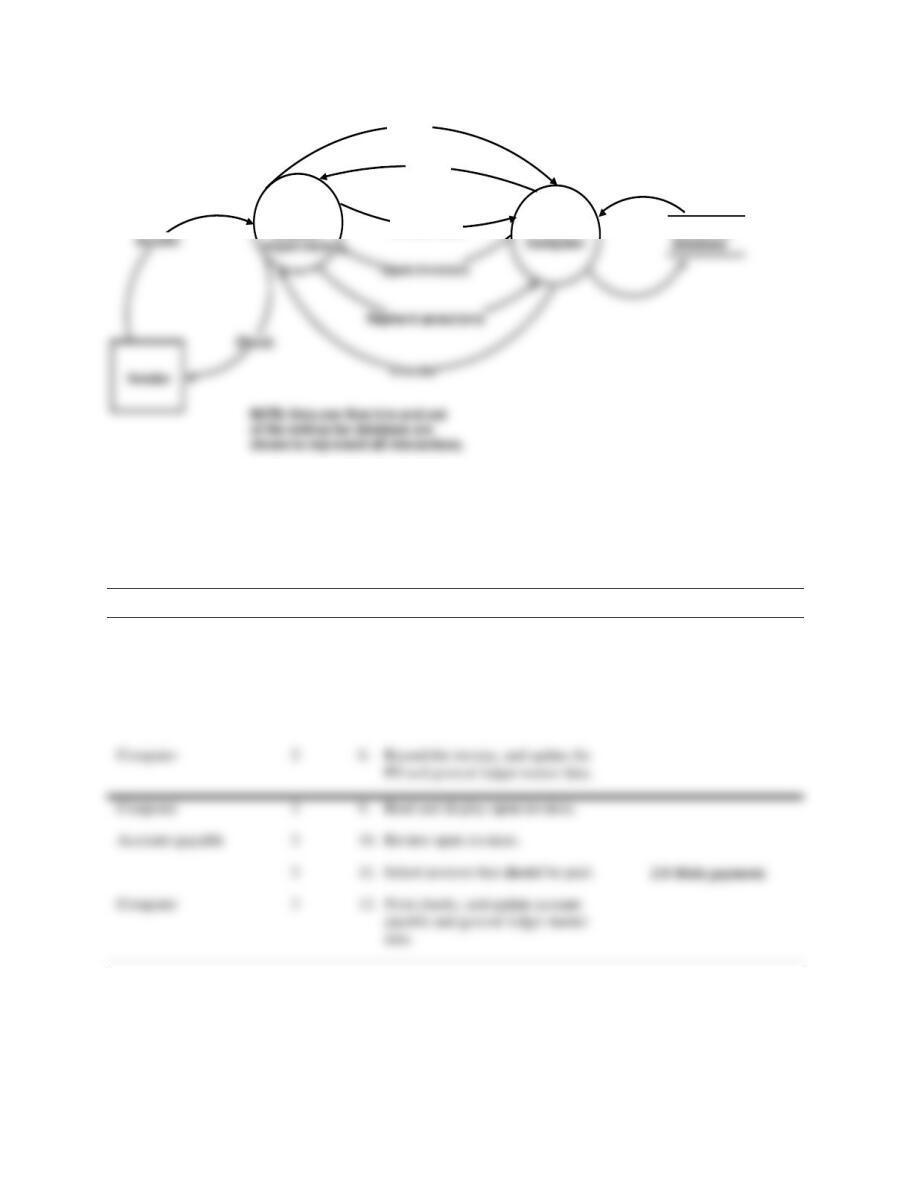
FIGURE SM-13.2 Problem 1, Part c Solution—Physical DFD for PureProducts Company
(Accounts Payable and Cash Disbursements Processes)
P 13-1 ANS. d. Table of Entities and Activities (Annotated) for PureProducts Company
(Accounts Payable and Cash Disbursements Processes)
Entities
Para
Activities
Process
Accounts payable (AP)
2
2. Key PO number into computer.
1.0 Record accounts
payable.
Computer
2
3. Display PO data.
AP
2
4. Key invoice data.
Computer
2
5. Match invoice with PO data.
Computer
3
9. Read and display open invoices.
3
10. Review open invoices.
3
11. Select invoices that should be paid.
12 Solutions for Chapter 13
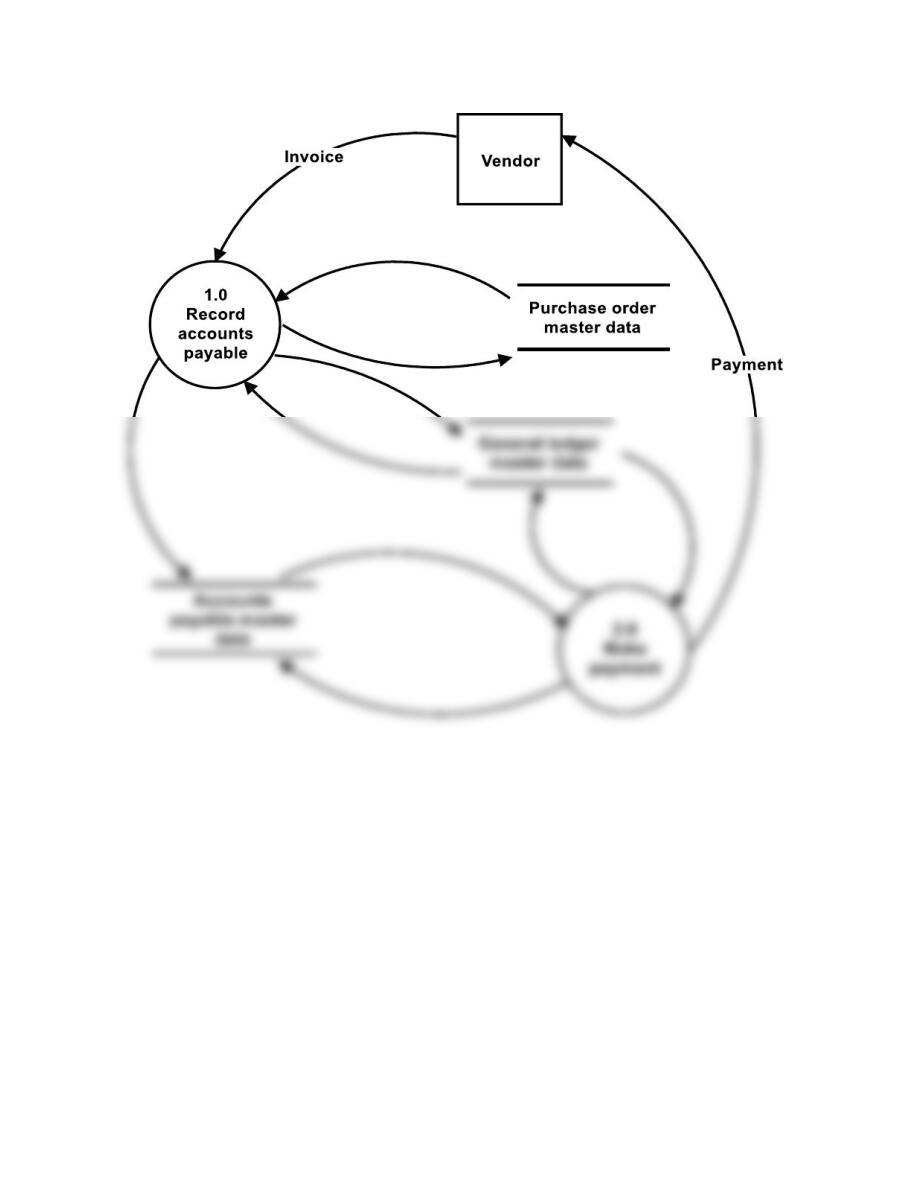
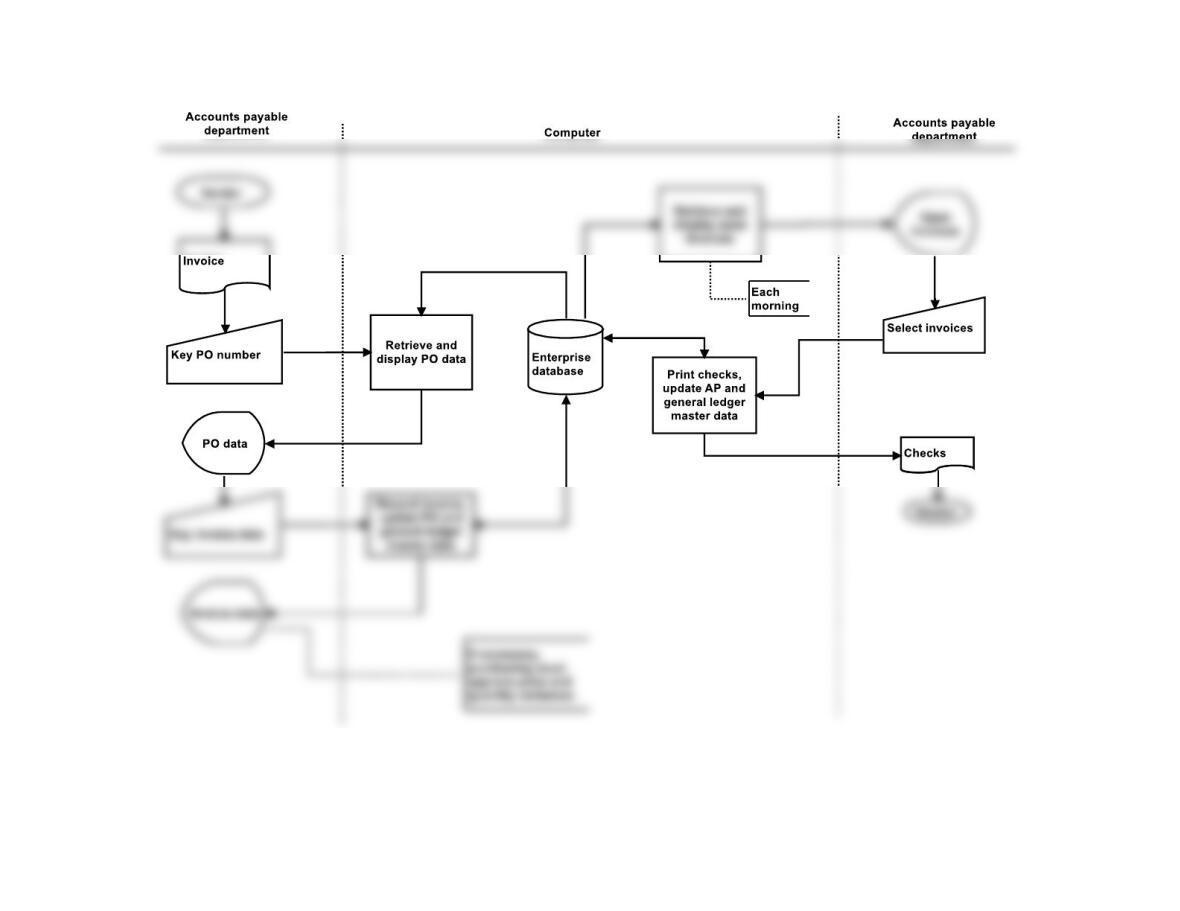
FIGURE SM-13.3 Problem 1, Part e Solution—Logical DFD for PureProducts Company
(Accounts Payable and Cash Disbursements Processes)
Accounting Information Systems, 10e 13
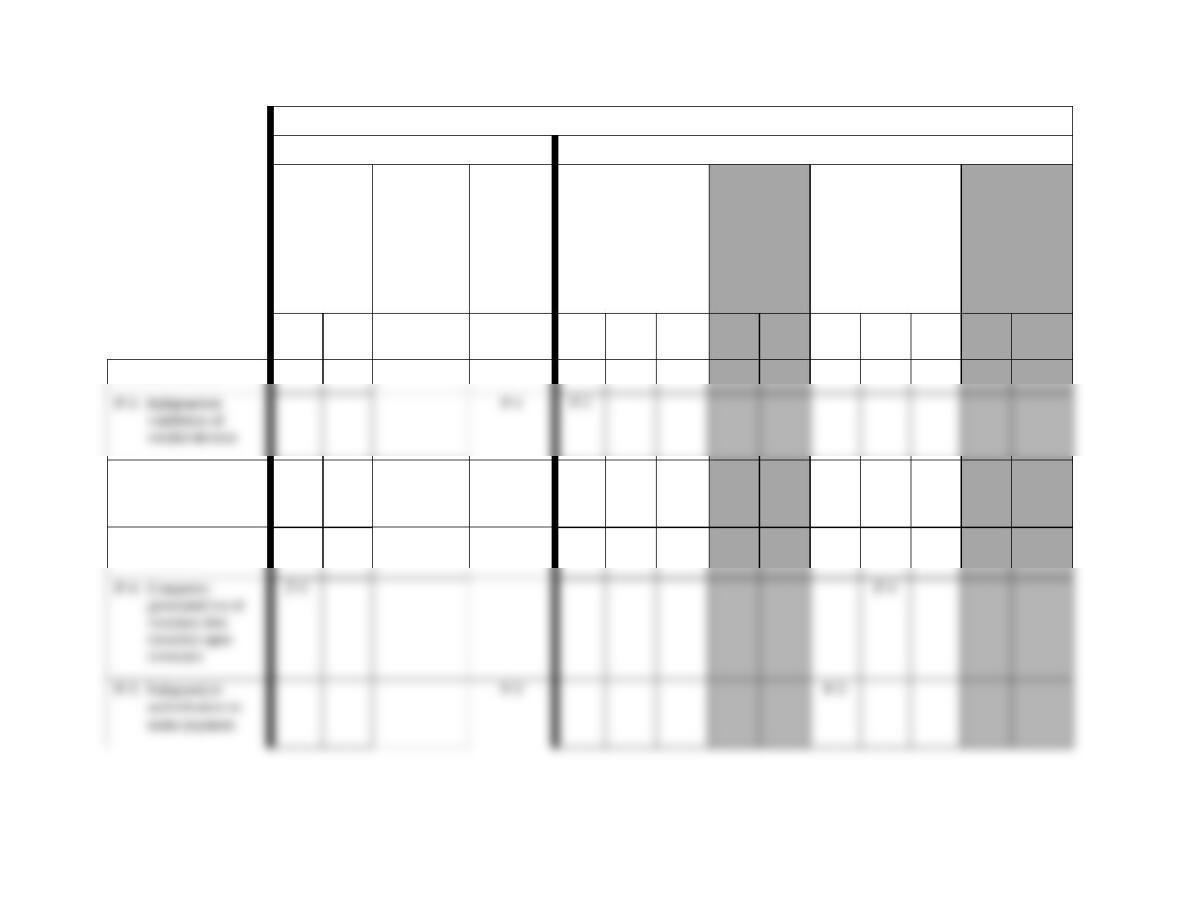
FIGURE SM-13.4 Problem 2, Part a Solution—Systems Flowchart for PureProducts Company
(Accounts Payable and Cash Disbursements Processes)
14 Solutions for Chapter 13
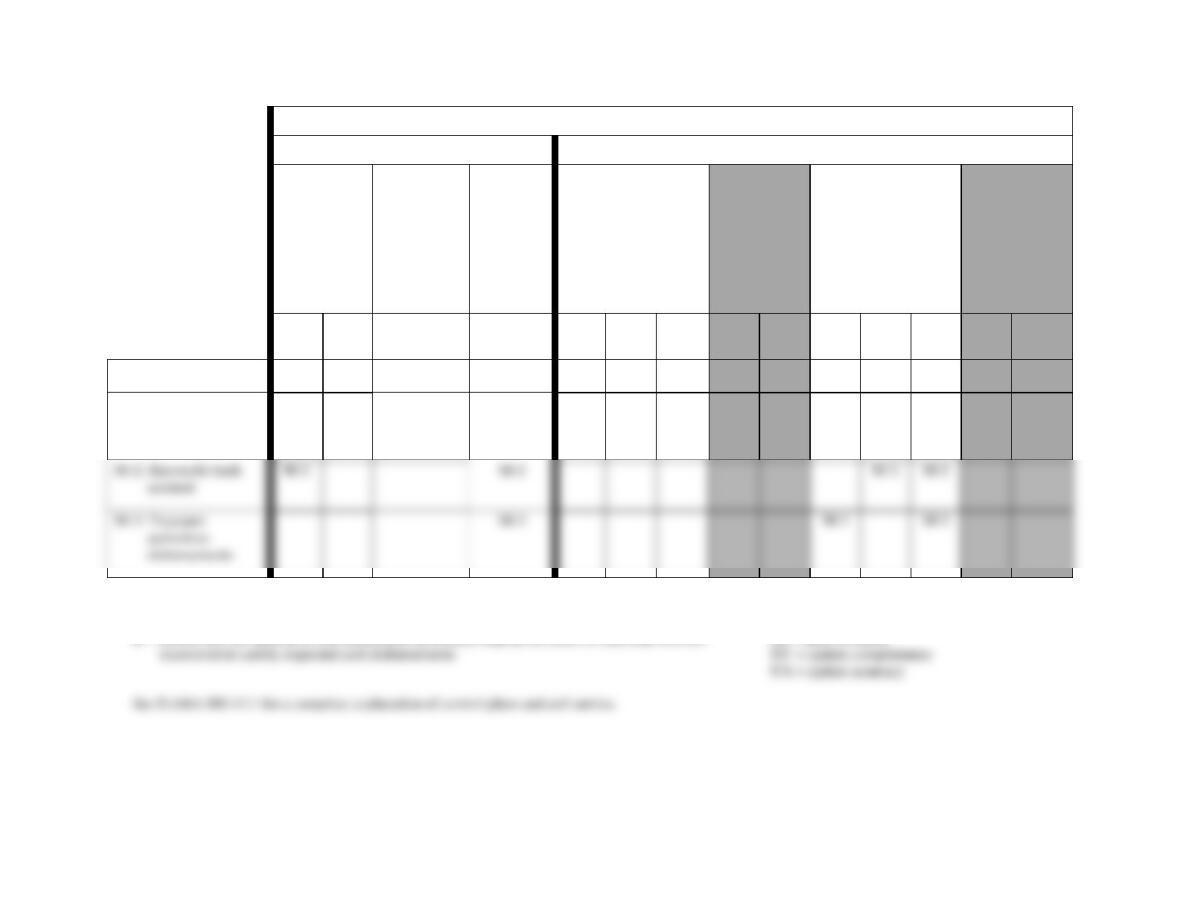
Control Goals of the PureProducts Company Accounts Payable and Cash Disbursements Business Processes
Control Goals of the Operations Process
Control Goals of the Information Process
Ensure
effectiveness
of operations
Ensure
efficient
employment
of resources
(people and
computers)
Ensure
security of
resources
(cash,
accounts
payable
master
data)
For vendor invoice
inputs, ensure:
For accounts
payable
master data,
ensure:
For payment
voucher inputs,
ensure:
For accounts
payable
master data,
ensure:
Recommended control
plans
A
B
IV
IC
IA
UC
UA
IV
IC
IA
UC
UA
Present controls
P-2: Match invoice to
PO and receiving
report
P-2
P-2
P-2
P-3: Authorize
variances
P-3
P-3
Accounting Information Systems, 10e 15
Control Goals of the PureProducts Company Accounts Payable and Cash Disbursements Business Processes
Control Goals of the Operations Process
Control Goals of the Information Process
Ensure
effectiveness
of operations
Ensure
efficient
employment
of resources
(people and
computers)
Ensure
security of
resources
(cash,
accounts
payable
master
data)
For vendor invoice
inputs, ensure:
For accounts
payable
master data,
ensure:
For payment
voucher inputs,
ensure:
For accounts
payable
master data,
ensure:
Recommended control
plans
A
B
IV
IC
IA
UC
UA
IV
IC
IA
UC
UA
Missing controls
M-1: Monitor open POs
and receiving
reports
M-1
M-1
Possible effectiveness goals include the following:
A – Optimize cash discounts
B – Ensure that the amount of cash maintained in demand deposit accounts is sufficient (but not
IV = input validity
IC = input completeness
IA = input accuracy
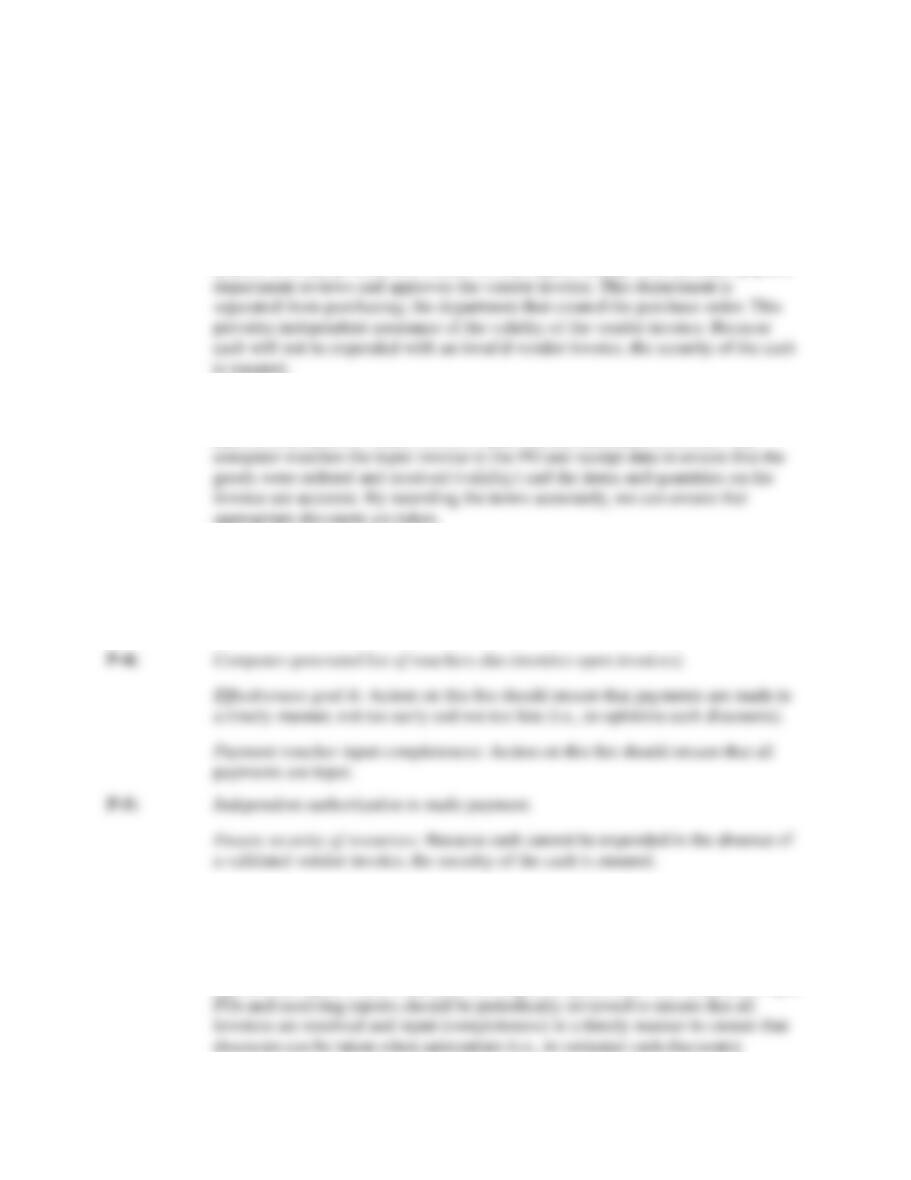
FIGURE SM-13.5 Problem 2, Part b Solution (Partial)—Control Matrix for PureProducts Company
(Accounts Payable and Cash Disbursements Processes)
M-3: Treasurer
authorizes
disbursements
16 Solutions for Chapter 13
Exhibit SM-13.1 Problem 2, Part b Solution (Partial)—explanation of cell entries for
control Matrix in Figure SM-13.5
Note: Vendor invoice and payment voucher inputs result in immediate updates to accounts
payable master data. Therefore, we do not show entries for UC or UA.
P-1: Independent validation of vendor invoice.
Ensure security of resources, vendor invoice input validity: The accounts payable
P-2: Match invoice with PO and receiving report.
Effectiveness goal A, vendor invoice input validity, and input accuracy: The
P-3: Authorize variances.
Vendor invoice input validity and input accuracy: Purchasing reviews the input
quantities and prices to determine that they are valid and accurate (within limits
prescribed by management).
Payment voucher input validity: The open invoice record is used to authorize
execution of a payment.
M-1: Monitor open POs and receiving reports.
Effectiveness goal A and vendor invoice input completeness: The database of open
M-2: Reconcile bank account.
Effectiveness goal A, security of resources, payment voucher input completeness,
M-3: Treasurer authorizes disbursements.
Security of resources, payment voucher input validity, and input accuracy:
Someone other than accounts payable, such as the treasurer, should authorize the
disbursements by comparing the disbursement to the invoice, PO, and receiving
report so that only authorized disbursements are made (security, validity), and that
all disbursements are accurate (accuracy).
• When there are programmed edit checks, manual comparisons, and
reconciliation of batch totals, we might find procedures for rejected inputs.
• Where paper documents are employed, we might find document design,
written approvals, and turnaround documents.
18 Solutions for Chapter 13
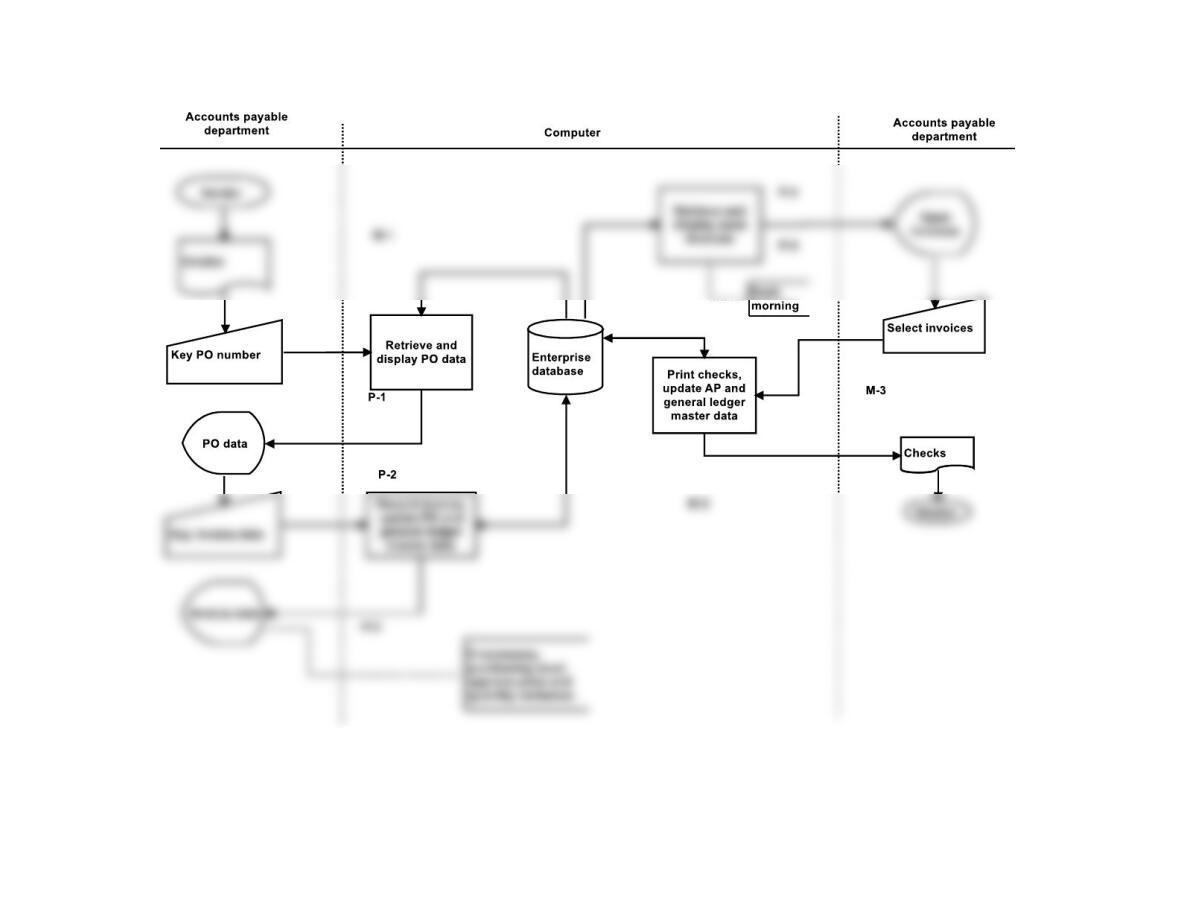
FIGURE SM-13.6 Problem 2, Part c Solution—Annotated Systems Flowchart for PureProducts Company
(Accounts Payable and Cash Disbursements Processes)
Accounting Information Systems, 10e 19
Internet Payment Platform (Accounts Payable and Cash Disbursements Processes)
Solutions (see the Note on pg. 9)
P 13-1 ANS. a. Table of Entities and Activities for Internet Payment Platform (Accounts
Payable and Cash Disbursements Processes)
Entities
Para
Activities
Supplier
2
1. Log on to IPP.
2
2. Flip PO to invoice.
BEPMIS
2
8. Post invoices to accounts payable database.
3
9. Perform three-way match of invoice, PO, receipt.
3
10. Extract and format invoice changes.
3
11. Send invoice changes to enterprise adapter.
Enterprise adapter
3
12. Convert changes from IDMS to XML.
3
13. Encrypt invoice changes.
3
14. Transmit invoice changes to IPP server.
IPP server
3
15. Post invoice changes to appreciating database.
Accounts payable accountant
4
16. Trigger payment process.
BEPMIS
4
17. Read and display invoices due for payment (assumed).
Accounts payable accountant
4
18. Review invoices.
4
19. Select invoices for payment.
BEPMIS
4
20. Extract and format payments.
4
21. Generate PIF file.
4
22. Transmit PIF to enterprise adapter.
4
24. E-mail CO, DO, and Boston Fed with PIF totals.
Enterprise adapter
4
25. Convert PIF from IDMS to XML.
IPP server
2
3. Post invoice to appreciating database.
2
4. Encrypt invoices.
2
5. Send invoices to the enterprise adapter.
Enterprise adapter
2
6. Translate invoices into XML.
2
7. Send translated invoices to BEPMIS (assumed).
20 Solutions for Chapter 13
Entities
Para
Activities
4
27. Transmit PIF to IPP server.
Disbursing officer (DO)
4
31. Log on to IPP.
4
32. Approve PIF.
IPP server
5
33. Generate ACH-formatted file from PIF.
5
34. Encrypt ACH-formatted file.
5
35. Send ACH-formatted file to Boston Fed.
5
37. E-mail supplier that a payment is coming.
Boston Fed
5
38. Transfer ACH file to FedACH system.
FedACH system
5
39. Settle payment (debit Treasury’s account and credit supplier’s
bank’s account).
5
40. Notify supplier’s bank of credits.
5
IPP server
4
28. Post PIF to appreciating database.
4
29. Log on to IPP.
4