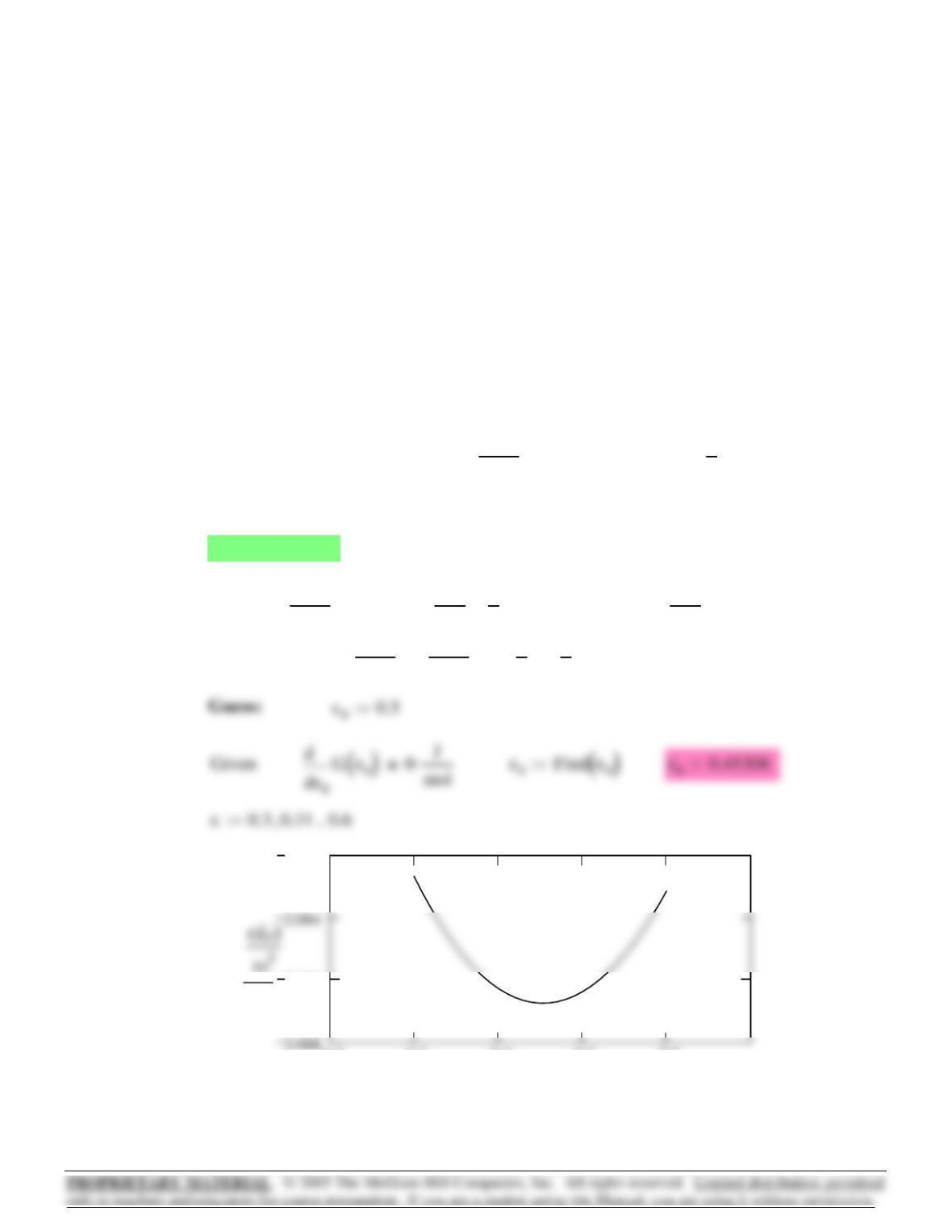
0.2 0.3 0.4 0.5 0.6
2.086
2.082
ε
Gε
()
1ε−
2
⎛
⎜
⎝
⎞
⎠395790−()⋅J
mol
⋅ε
2192420−200240−()⋅J
mol
⋅+
RT⋅21ε−
2
⋅ln 1ε−
2
⎛
⎜
⎝
⎞
⎠
⋅2ε
2
⋅ln ε
2
⎛
⎜
⎝
⎞
⎠
⋅+
⎛
⎜
⎝
⎞
⎠
⋅+
…:=
T 1000 kelvin⋅:=
By Eq. (A) and with data from Example 13.13 at 1000 K:
yH2O yCO
=ε
2
=yH2yCO2
=1ε−
2
=
By Eq. (13.5).
n011+=2=ν
i
νi
∑
=1−1−1+1+=0=
H2(g) + CO2(g) = H2O(g) + CO(g)13.4
Note: For the following problems the variable kelvin is used for the SI
unit of absolute temperature so as not to conflict with the variable K
used for the equilibrium constant
Chapter 13 – Section A – Mathcad Solutions
483
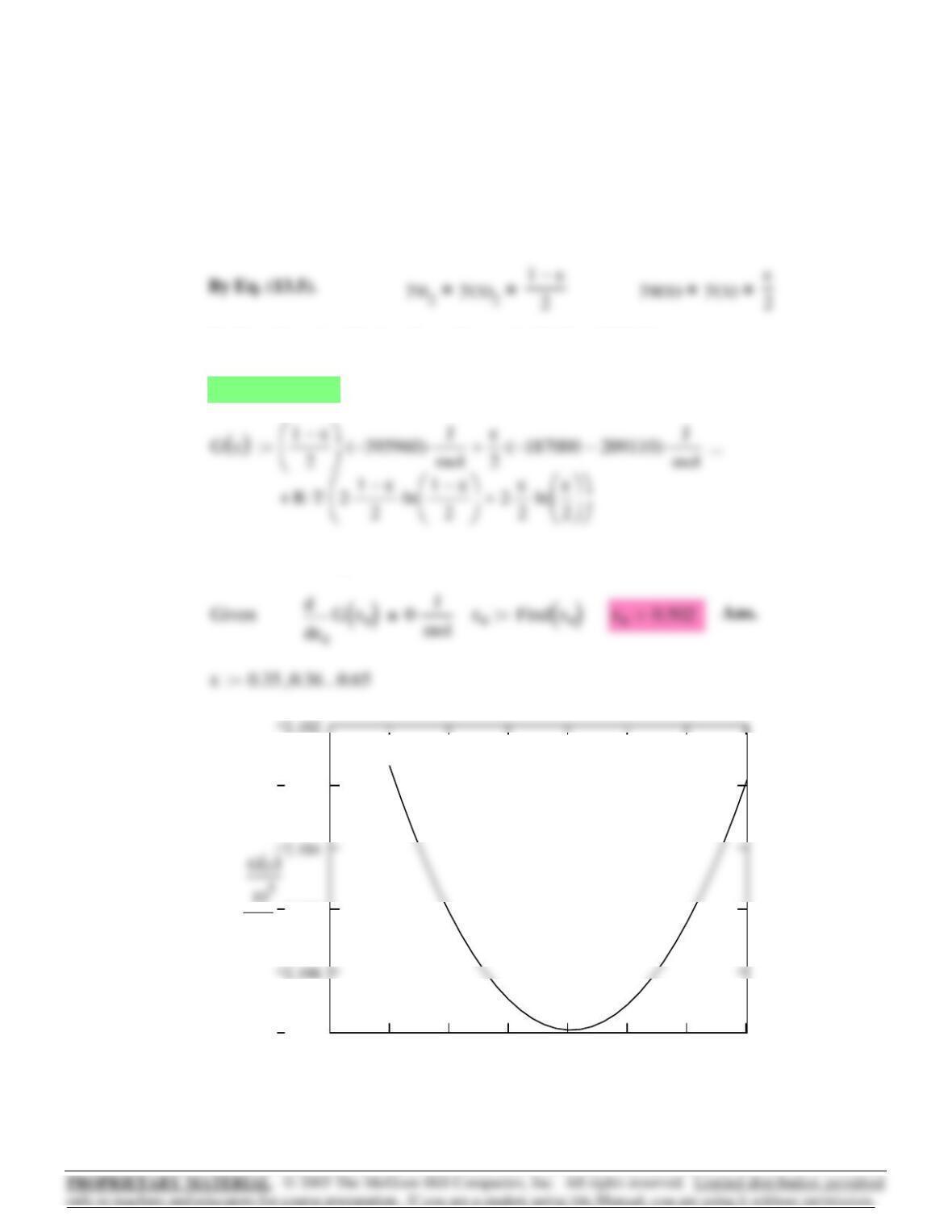
0.3 0.35 0.4 0.45 0.5 0.55 0.6 0.65
2.107
2.105
2.103
ε
εe0.5:=
Guess:
T 1100 kelvin⋅:=
By Eq. (A) and with data from Example 13.13 at 1100 K:
n011+=2=ν
i
νi
∑
=1−1−1+1+=0=
H2(g) + CO2(g) = H2O(g) + CO(g)(a)13.5
484
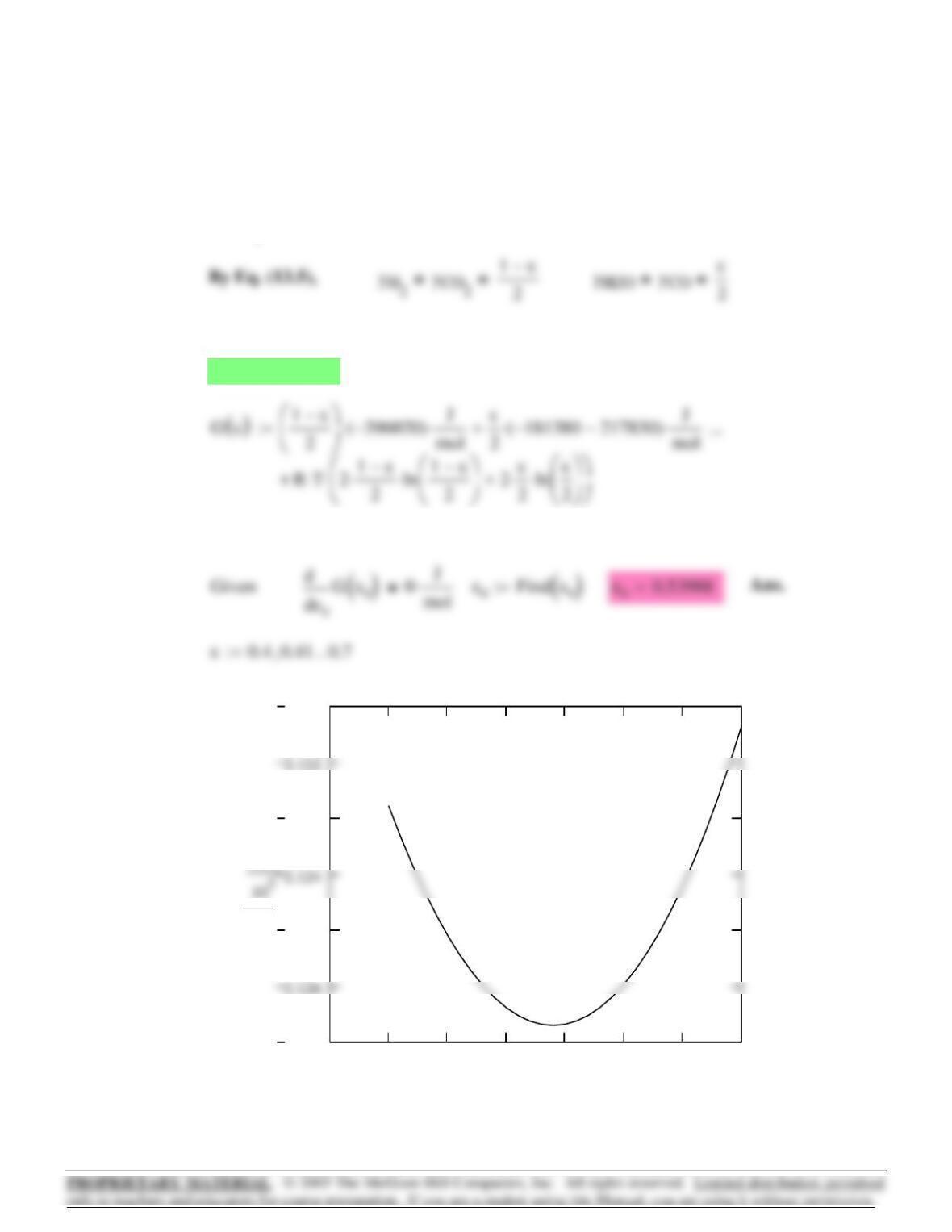
0.35 0.4 0.45 0.5 0.55 0.6 0.65 0.7
2.127
2.125
2.123
2.121
Gε
()
ε
εe0.1:=
Guess:
T 1200 kelvin⋅:=
By Eq. (A) and with data from Example 13.13 at 1200 K:
n011+=2=ν
i
νi
∑
=1−1−1+1+=0=
H2(g) + CO2(g) = H2O(g) + CO(g)(b)
485
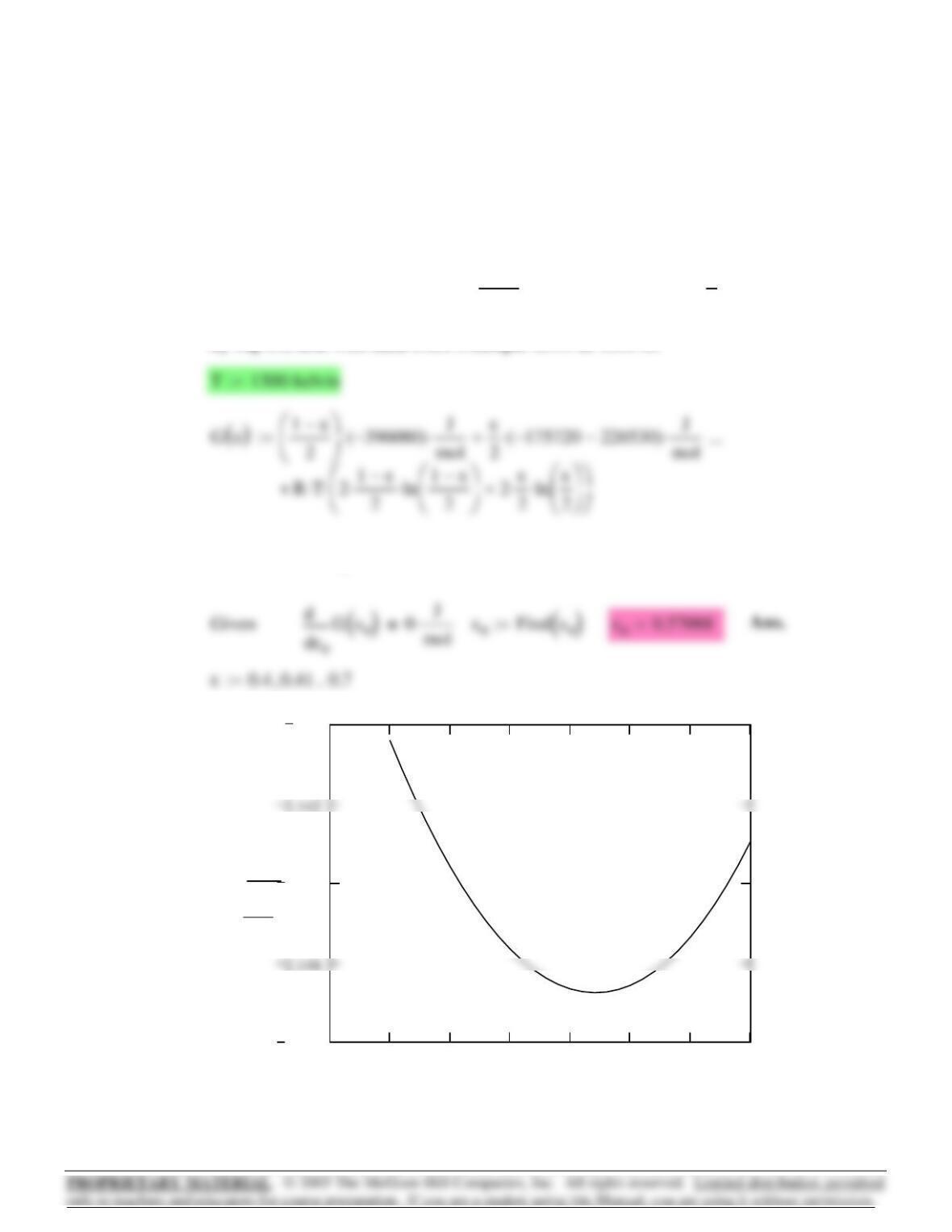
0.35 0.4 0.45 0.5 0.55 0.6 0.65 0.7
2.148
2.144
2.14
Gε
()
105
ε
εe0.6:=
Guess:
By Eq. (A) and with data from Example 13.13 at 1300 K:
yH2O yCO
=ε
2
=yH2yCO2
=1ε−
2
=
By Eq, (13.5),
n011+=2=ν
i
νi
∑
=1−1−1+1+=0=
H2(g) + CO2(g) = H2O(g) + CO(g) (c)
486
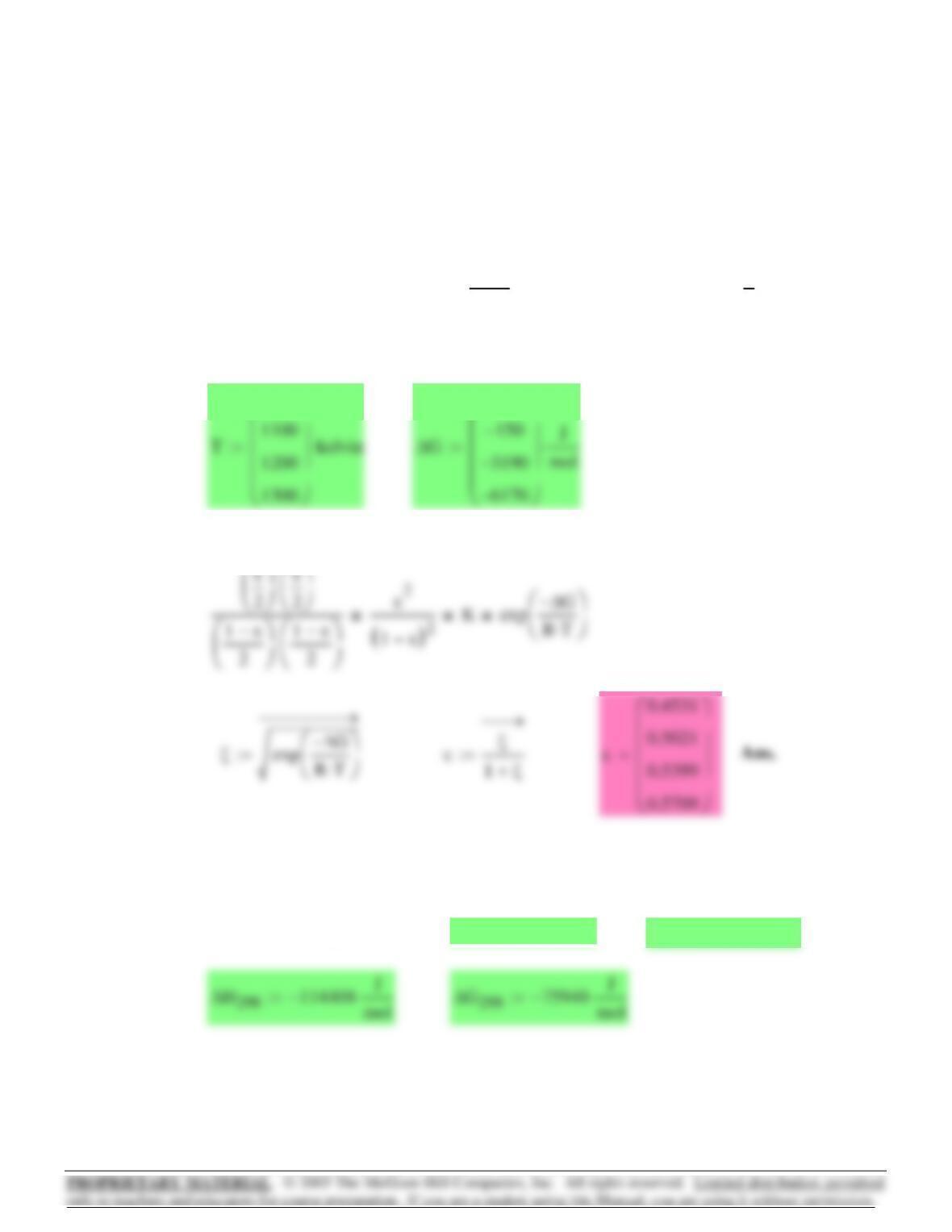
T0298.15 kelvin⋅:=T 773.15 kelvin⋅:=n06=ν1−=
4HCl(g) + O2(g) = 2H2O(g) + 2Cl(g)13.11
Combining Eqs. (13.5), (13.11a), and (13.28) gives
3130
⎛
⎞
1000
⎛
⎞
With data from Example 13.13, the following vectors represent values for
Parts (a) through (d):
yH2O yCO
=ε
2
=yH2yCO2
=1ε−
2
=
By Eq, (13.5),
n011+=2=ν
i
νi
∑
=1−1−1+1+=0=
H2(g) + CO2(g) = H2O(g) + CO(g)13.6
487
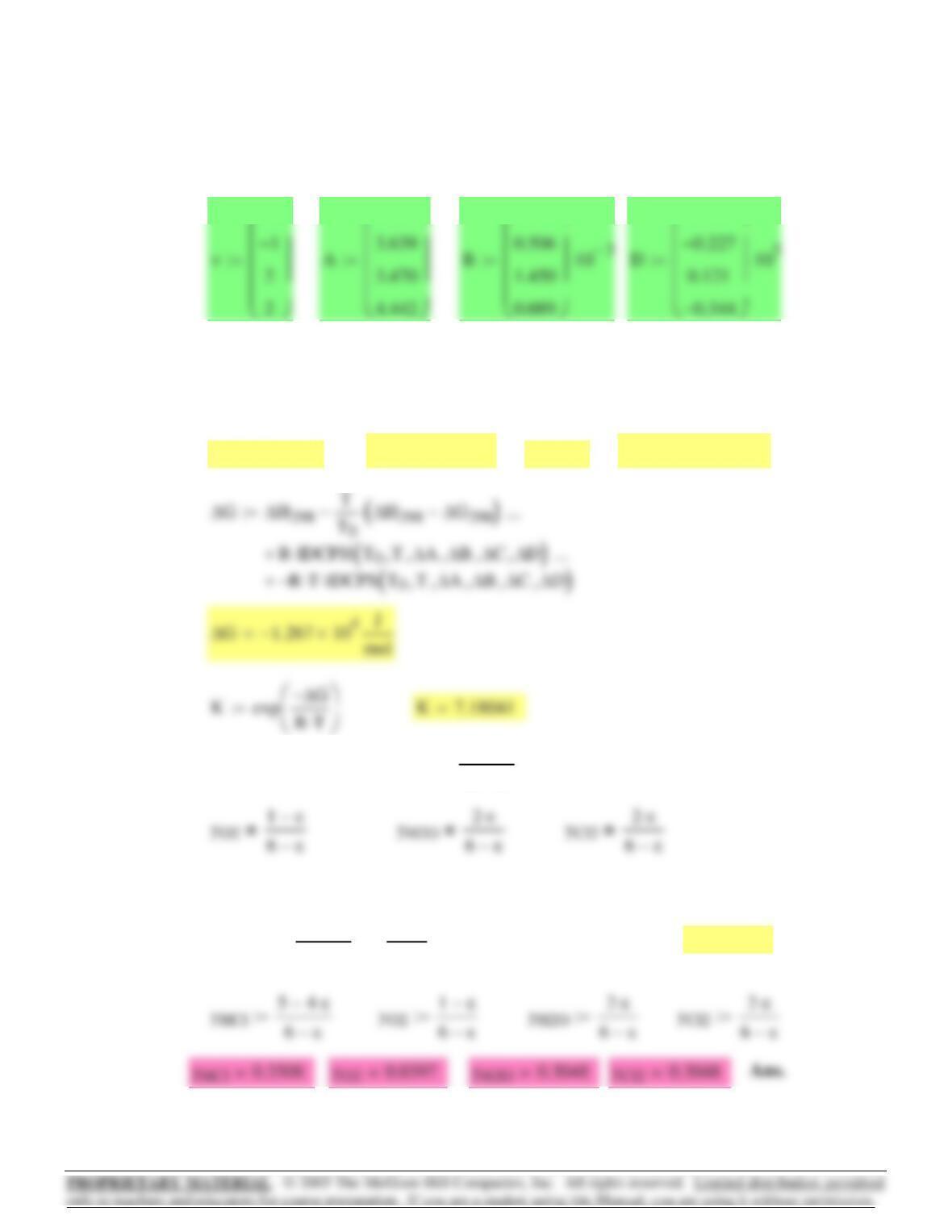
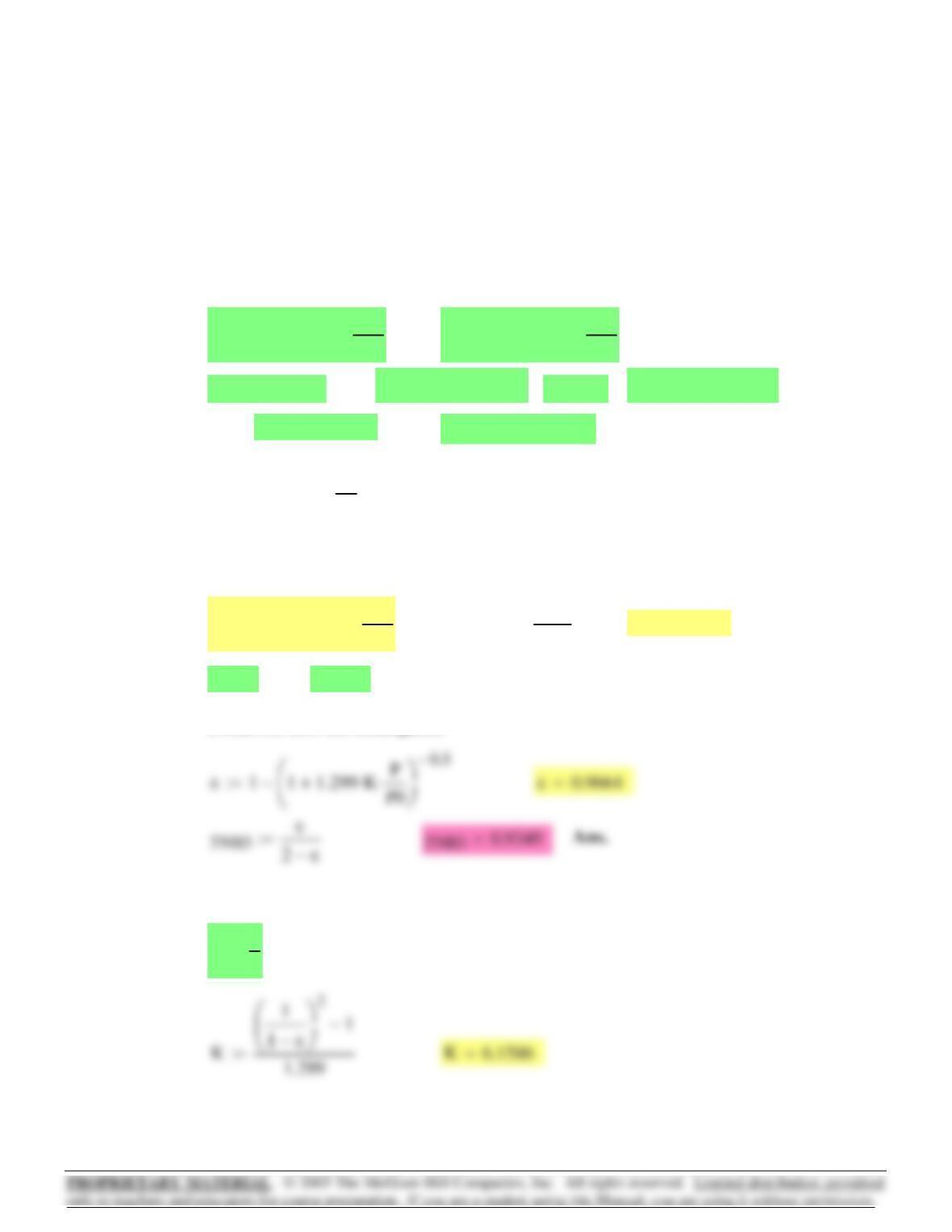
Apply Eq. (13.28); ε0.5:= (guess)
Given 2ε⋅
54ε⋅−
⎛
⎜
⎝
⎞
⎠
46ε−
1ε−
⎛
⎜
⎝
⎞
⎠
⋅2K⋅=εFind ε
()
:= ε 0.793=
The following vectors represent the species of the reaction in the order in
which they appear:
⎜
⎜
⎜
⎜
4−
⎛
⎞
3.156
⎛
⎞
0.623
⎛
⎞
0.151
⎛
⎞
end rows A():= i 1 end..:=
∆A
i
νiAi
⋅
()
∑
:= ∆B
i
νiBi
⋅
()
∑
:= ∆D
i
νiDi
⋅
()
∑
:=
∆A 0.439−= ∆B810
5−
×= ∆C0:= ∆D 8.23−104
×=
By Eq. (13.5) yHCl
54ε⋅−
6ε−
=
488
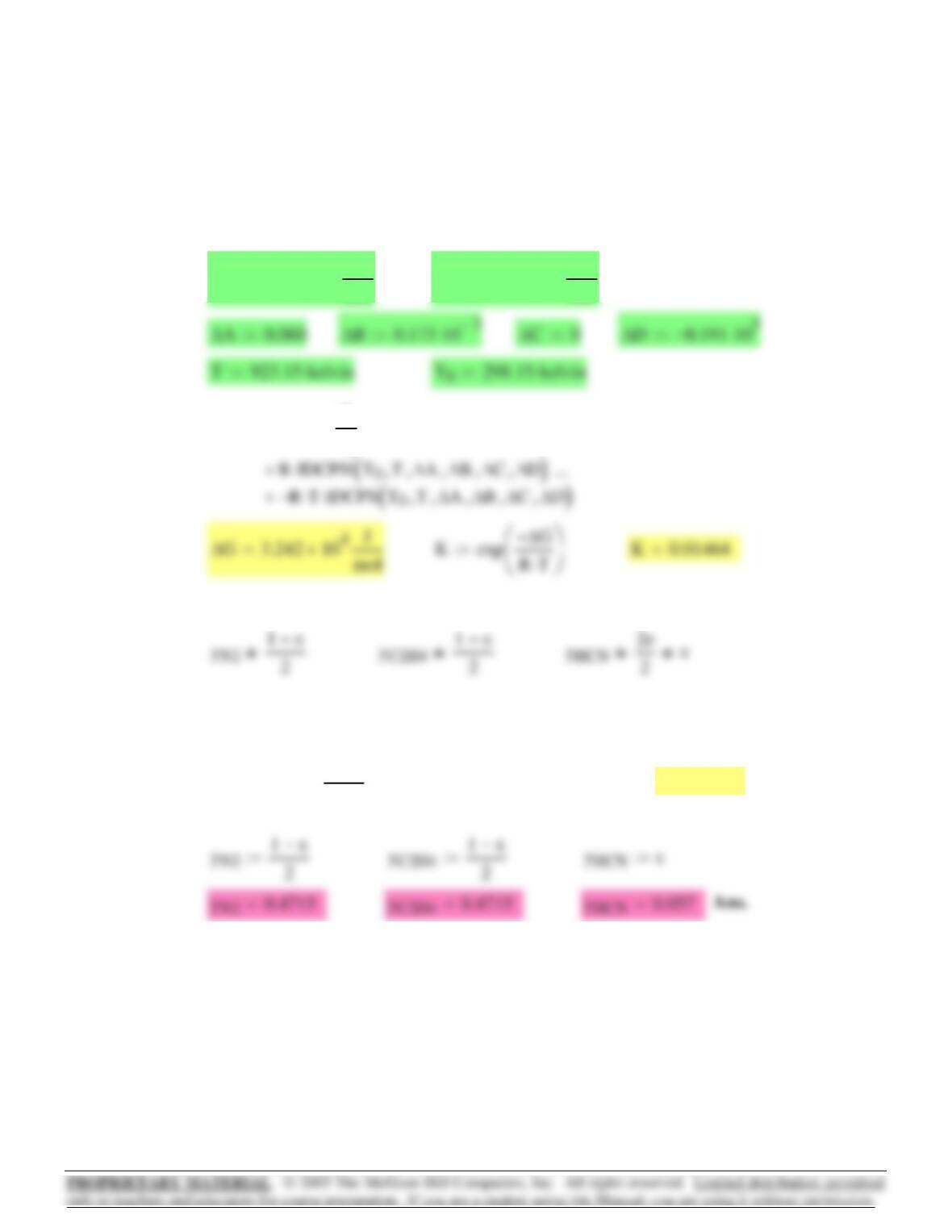
By Eq. (13.28), ε0.5:= (guess)
Given 2ε⋅
1ε−
⎛
⎜
⎝
⎞
⎠
2
K=εFind ε
()
:= ε 0.057=
Given the assumption of ideal gases, P has no effect on the equilibrium
composition.
13.12 N2(g) + C2H2(g) = 2HCN(g) ν0=n02=
This is the reaction of Pb. 4.21(x). From the answers for Pbs. 4.21(x),
4.22(x), and 13.7(x), find the following values:
∆H298 42720 J
mol
⋅:= ∆G298 39430 J
mol
⋅:=
∆G∆H298
T
T0
∆H298 ∆G298
−
()
⋅−
…
:=
By Eq. (13.5),
489
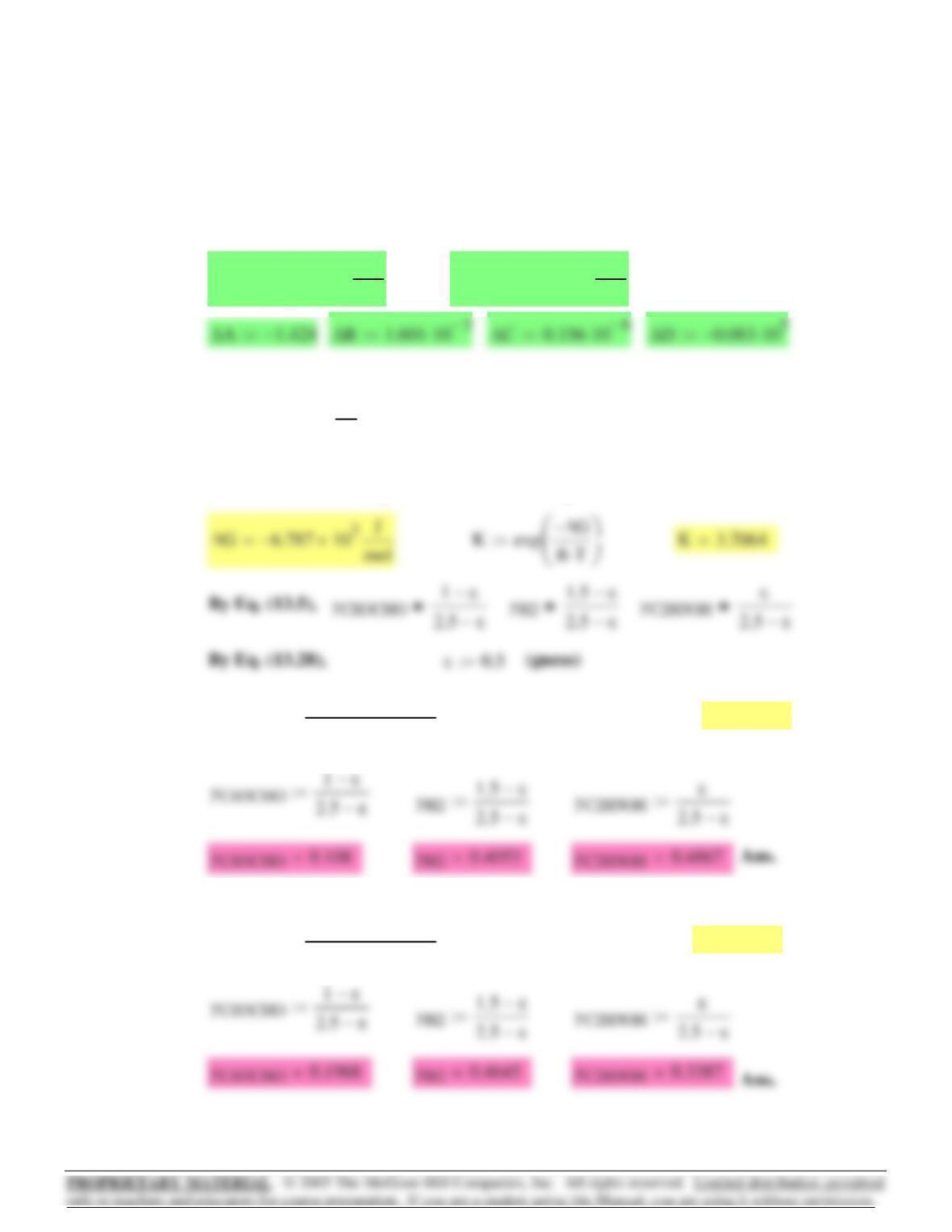
Given ε2.5 ε−
()
⋅
1ε−
()
1.5 ε−
()
⋅3K⋅=εFind ε
()
:= ε 0.818=
If the pressure is reduced to 1 bar,
Given ε2.5 ε−
()
⋅
1ε−
()
1.5 ε−
()
⋅1K⋅=εFind ε
()
:= ε 0.633=
13.13 CH3CHO(g) + H2(g) = C2H5OH(g) ν1−=n02.5=
This is the reaction of Pb. 4.21(r). From the answers for Pbs. 4.21(r),
4.22(r), and 13.7(r), find the following values:
∆H298 68910−J
mol
⋅:= ∆G298 39630−J
mol
⋅:=
T 623.15 kelvin⋅:= T0298.15 kelvin⋅:=
∆G∆H298
T
T0
∆H298 ∆G298
−
()
⋅−
R IDCPH T0T,∆A,∆B,∆C,∆D,
()
⋅+
…
R−T⋅IDCPS T0T,∆A,∆B,∆C,∆D,
()
⋅+
…
:=
490
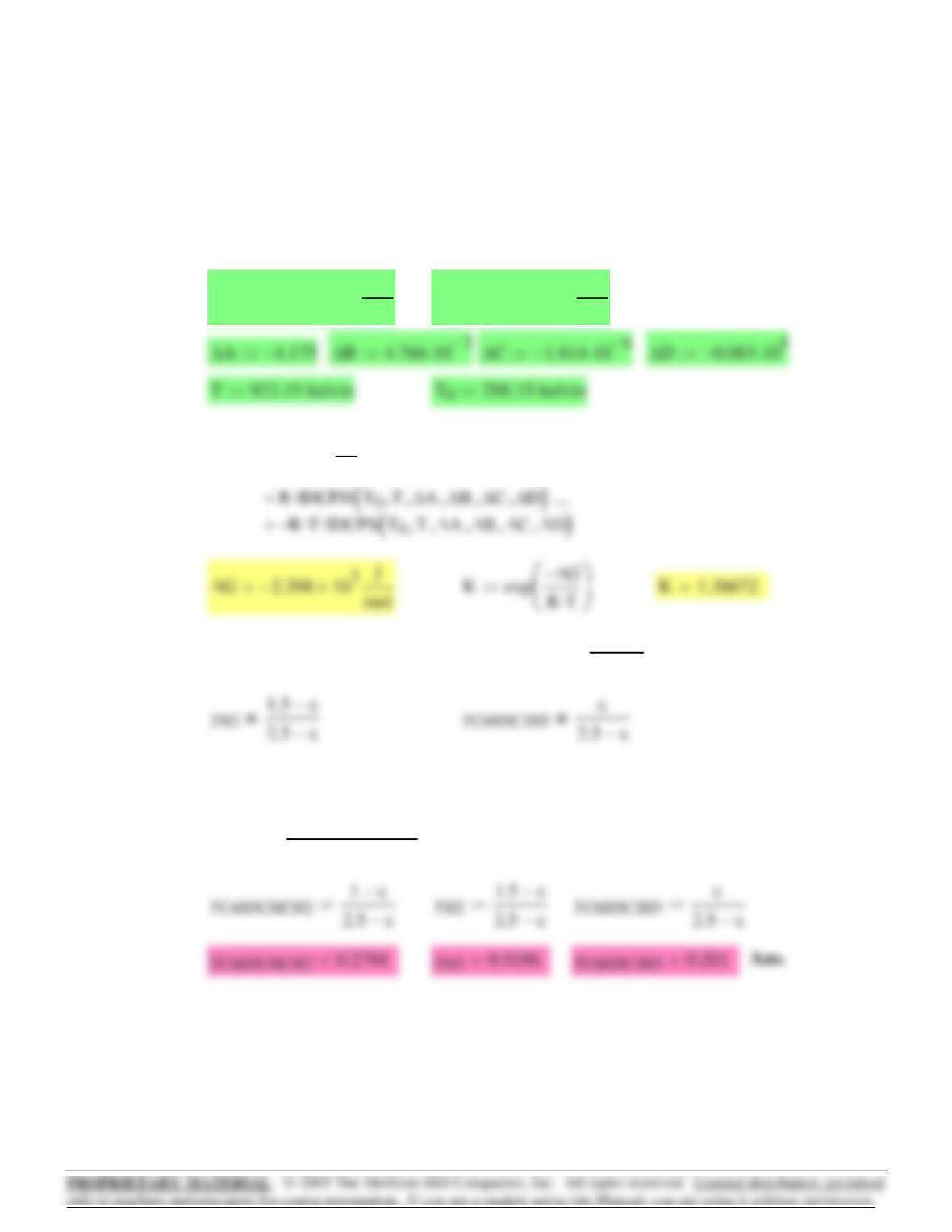
yC6H5CHCH2
1ε−
2.5 ε−
=
By Eq. (13.28), ε0.5:= (guess)
Given ε2.5 ε−
()
⋅
1ε−
()
1.5 ε−
()
⋅1.0133 K⋅=εFind ε
()
:= ε 0.418=
13.14 C6H5CH:CH2(g) + H2(g) = C6H5.C2H5(g) ν1−=n02.5=
This is the REVERSE reaction of Pb. 4.21(y). From the answers for Pbs.
4.21(y), 4.22(y), and 13.7(y) WITH OPPOSITE SIGNS, find the following
values:
∆H298 117440−J
mol
⋅:= ∆G298 83010−J
mol
⋅:=
∆G∆H298
T
T0
∆H298 ∆G298
−
()
⋅−
…
:=
By Eq. (13.5),
491
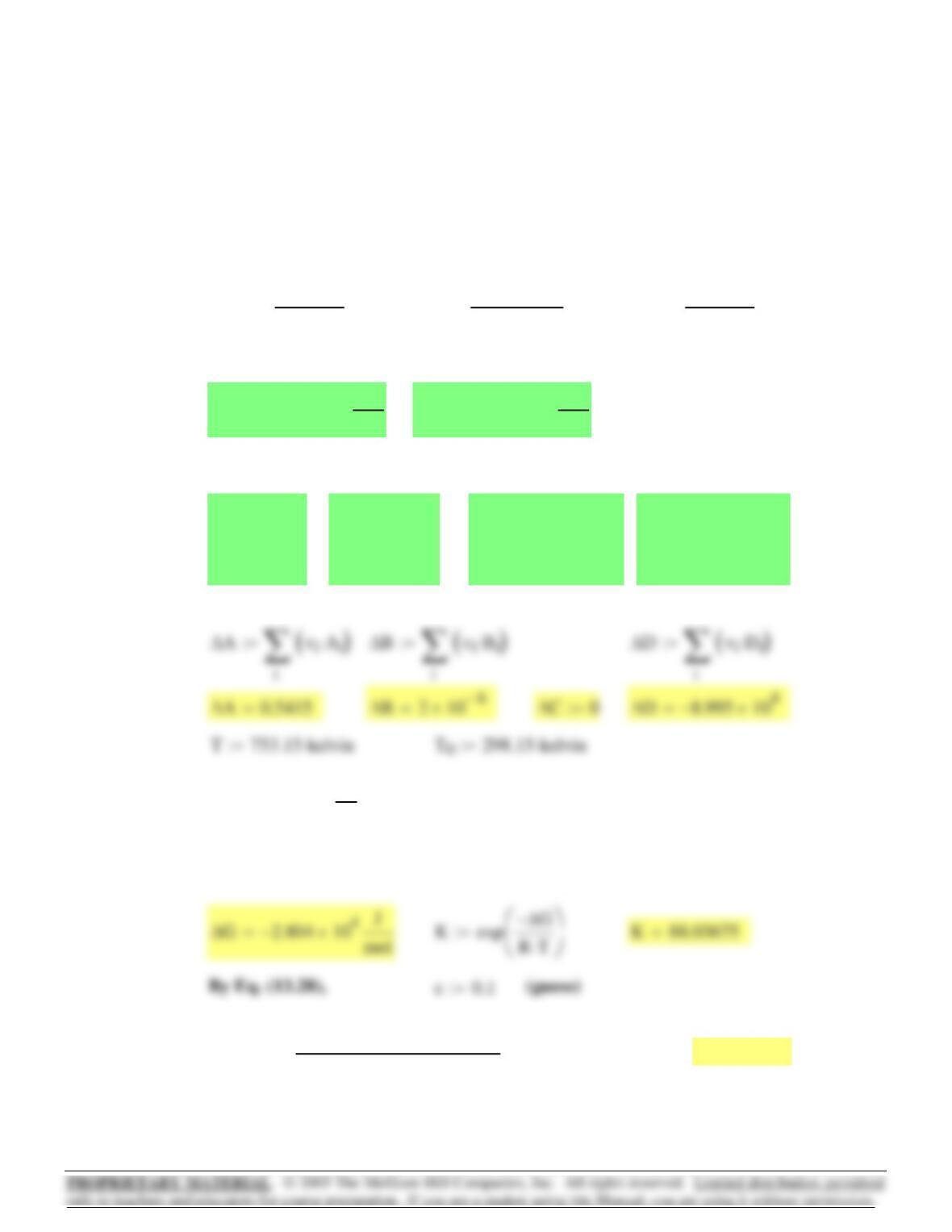
∆G∆H298
T
T0
∆H298 ∆G298
−
()
⋅−
R IDCPH T0T,∆A,∆B,∆C,∆D,
()
⋅+
…
R−T⋅IDCPS T0T,∆A,∆B,∆C,∆D,
()
⋅+
…
:=
Given ε1 0.5 ε⋅−
()
0.5
⋅
0.15 ε−
()
0.2 0.5 ε⋅−
()
0.5
⋅
K=εFind ε
()
:= ε 0.1455=
13.15 Basis: 1 mole of gas entering, containing 0.15 mol SO2, 0.20 mol O2,
and 0.65 mol N2.
SO2 + 0.5O2 = SO3 ν0.5−=n01=
By Eq. (13.5),
ySO2
0.15 ε−
1 0.5 ε⋅−
=yO2
0.20 0.5 ε⋅−
1 0.5 ε⋅−
=ySO3
ε
1 0.5 ε⋅−
=
From data in Table C.4,
∆H298 98890−J
mol
⋅:= ∆G298 70866−J
mol
⋅:=
The following vectors represent the species of the reaction in the order
in which they appear:
ν
1−
0.5−
1
⎛
⎜
⎜
⎜
⎝
⎞
⎟
⎠
:= A
5.699
3.639
8.060
⎛
⎜
⎜
⎜
⎝
⎞
⎟
⎠
:= B
0.801
0.506
1.056
⎛
⎜
⎜
⎜
⎝
⎞
⎟
⎠
10 3−
⋅:= D
1.015−
0.227−
2.028−
⎛
⎜
⎜
⎜
⎝
⎞
⎟
⎠
105
⋅:=
end rows A():= i 1 end..:=
492
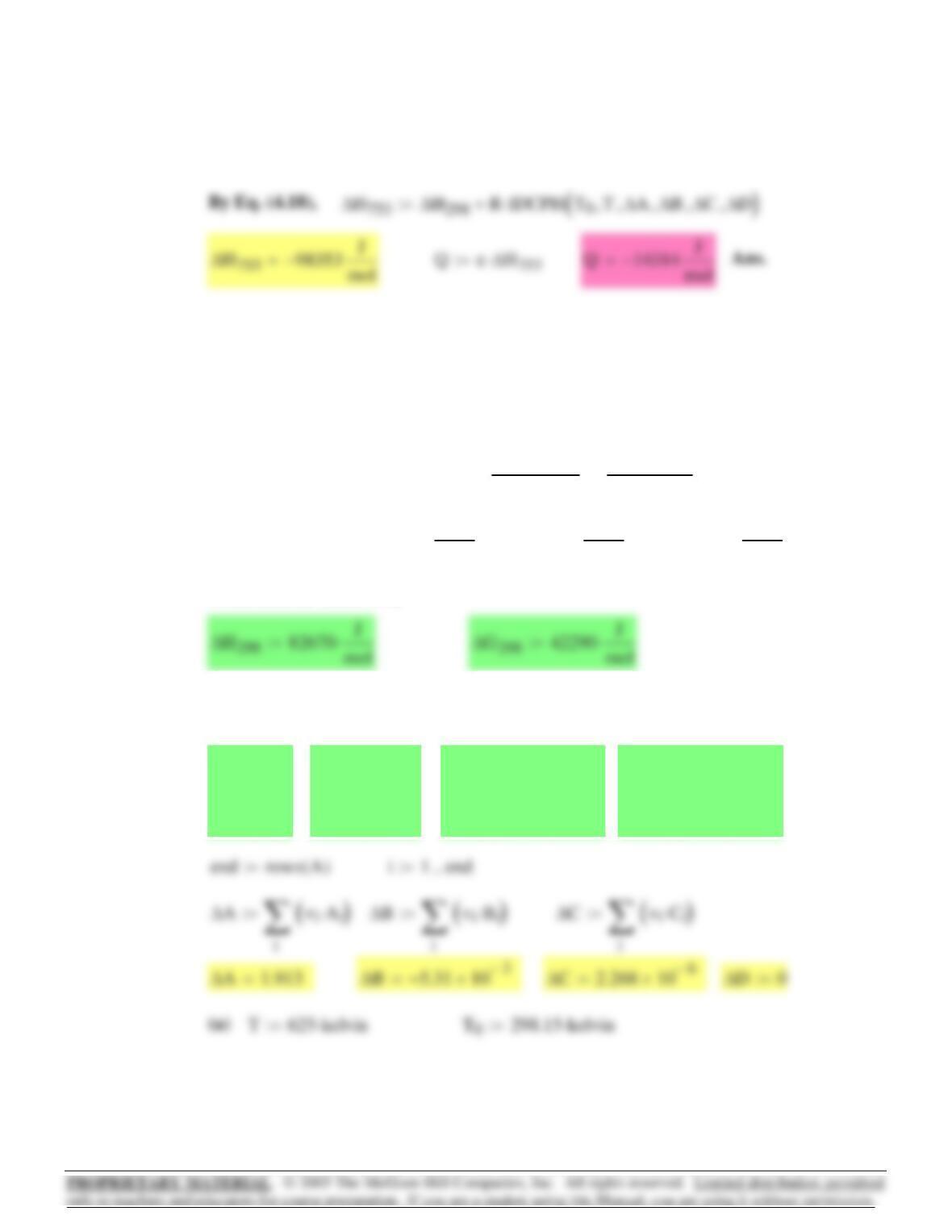
From data in Table C.4,
The following vectors represent the species of the reaction in the order
in which they appear:
ν
1−
1
1
⎛
⎜
⎜
⎜
⎝
⎞
⎟
⎠
:= A
1.213
1.424
1.702
⎛
⎜
⎜
⎜
⎝
⎞
⎟
⎠
:= B
28.785
14.394
9.081
⎛
⎜
⎜
⎜
⎝
⎞
⎟
⎠
10 3−
⋅:= C
8.824−
4.392−
2.164−
⎛
⎜
⎜
⎜
⎝
⎞
⎟
⎠
10 6−
⋅:=
By Eq. (13.4), nSO3 ε=0.1455=
13.16 C3H8(g) = C2H4(g) + CH4(g) ν1=
Basis: 1 mole C3H8 feed. By Eq. (13.4) nC3H8 1ε−=
Fractional conversion of C3H8 = n0nC3H8
−
n0
11ε−
()
−
1
=ε=
By Eq. (13.5), yC3H8
1ε−
1ε+
=yC2H4
ε
1ε+
=yCH4
ε
1ε+
=
493
13.17 C2H6(g) = H2(g) + C2H4(g) ν1=
Basis: 1 mole entering C2H6 + 0.5 mol H2O.
n01.5=By Eq. (13.5),
yC2H6
1ε−
1.5 ε+
=yH
ε
1.5 ε+
=yC2H4
ε
1.5 ε+
=
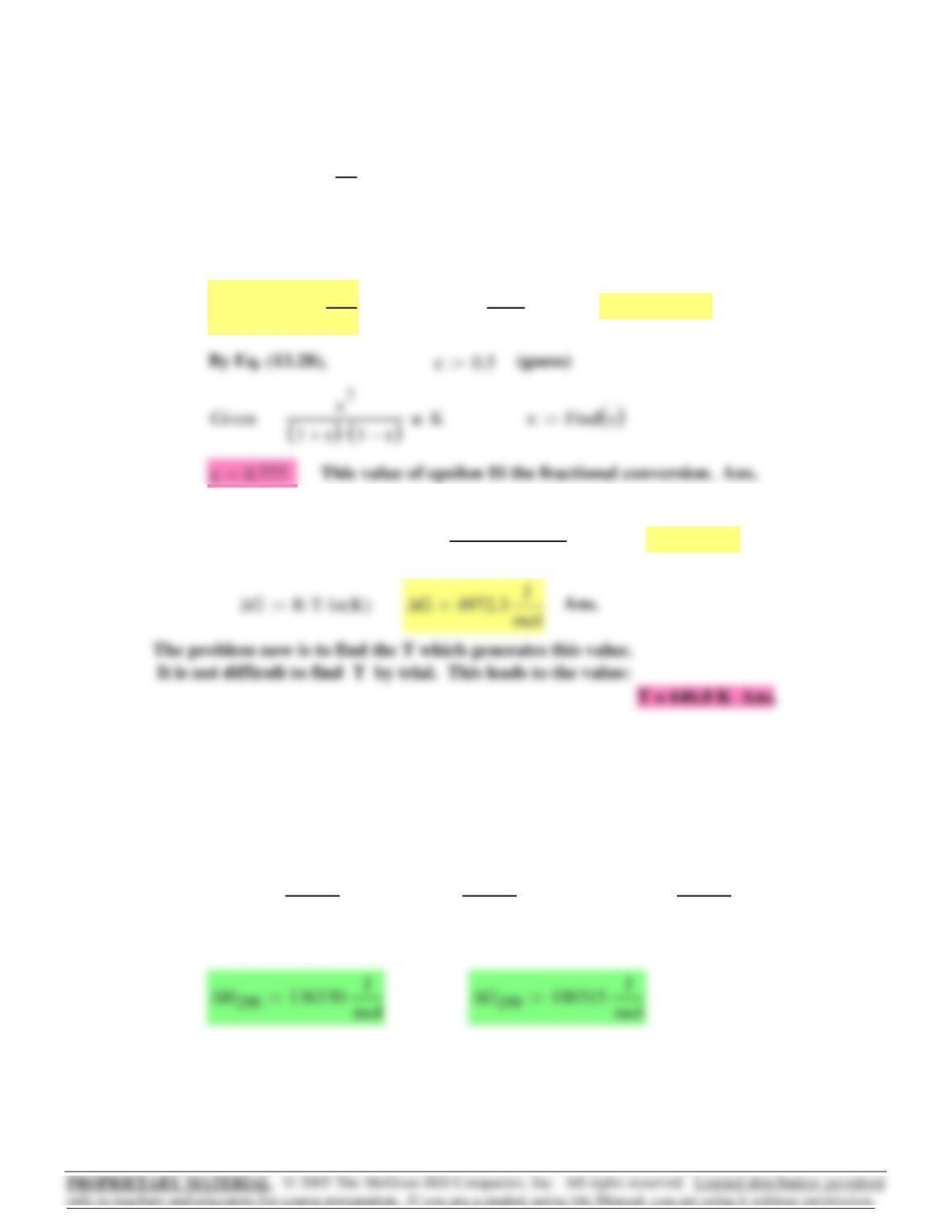
From data in Table C.4,
The following vectors represent the species of the reaction in the order in
which they appear:
∆G∆H298
T
T0
∆H298 ∆G298
−
()
⋅−
R IDCPH T0T,∆A,∆B,∆C,∆D,
()
⋅+
…
R−T⋅IDCPS T0T,∆A,∆B,∆C,∆D,
()
⋅+
…
:=
∆G 2187.9−J
mol
=K exp ∆G−
RT⋅
⎛
⎜
⎝
⎞
⎠
:= K 1.52356=
(b) ε0.85:= Kε2
1ε+
()
1ε−
()
⋅
:= K 2.604=
494
By Eq. (13.28), ε0.5:= (guess)
Given ε2
1.5 ε+
()
1ε−
()
⋅K=εFind ε
()
:= ε 0.83505=
ν
1−
1
1
⎛
⎜
⎜
⎜
⎝
⎞
⎟
⎠
:= A
1.131
3.249
1.424
⎛
⎜
⎜
⎜
⎝
⎞
⎟
⎠
:= B
19.225
0.422
14.394
⎛
⎜
⎜
⎜
⎝
⎞
⎟
⎠
10 3−
⋅:=
C
5.561−
0.0
4.392−
⎛
⎜
⎜
⎜
⎝
⎞
⎟
⎠
10 6−
⋅:= D
0.0
0.083
0.0
⎛
⎜
⎜
⎜
⎝
⎞
⎟
⎠
105
⋅:=
end rows A():= i 1 end..:=
∆A
i
νiAi
⋅
()
∑
:= ∆B
i
νiBi
⋅
()
∑
:= ∆C
i
νiCi
⋅
()
∑
:= ∆D
i
νiDi
⋅
()
∑
:=
∆A 3.542= ∆B 4.409−10 3−
×= ∆C 1.169 10 6−
×= ∆D 8.3 103
×=
T 1100 kelvin⋅:= T0298.15 kelvin⋅:=
495
∆D
i
νiDi
⋅
()
∑
:=
∆C
i
νiCi
⋅
()
∑
:=
∆B
i
νiBi
⋅
()
∑
:=
∆A
i
νiAi
⋅
()
∑
:=
i 1 end..:=end rows A():=
⎜
⎜
⎜
⎜
B
31.630
26.786
0.422
⎛
⎜
⎜
⎜
⎝
⎞
⎟
⎠
10 3−
⋅:=
A
1.967
2.734
3.249
⎛
⎜
⎜
⎜
⎝
⎞
⎟
⎠
:=
ν
1−
1
1
⎛
⎜
⎜
⎜
⎝
⎞
⎟
⎠
:=
The following vectors represent the species of the reaction in the
order in which they appear:
From data in Table C.4,
y2y3
=ε
1x+ε+
=0.10=y1
1ε−
1x+ε+
=
By Eq. (13.5),
n01x+=
Number the species as shown. Basis is 1 mol species 1 + x mol steam.
ν1=
C2H5CH:CH2(g) = CH2:CHCH:CH2(g) + H2(g)
(1) (2) (3)
13.18
496
13.19 C4H10(g) = CH2:CHCH:CH2(g) + 2H2(g)
(1) (2) (3) ν2=
Number the species as shown. Basis is
1 mol species 1 + x mol steam entering. n01x+=
y32y
2
⋅=0.24=
From data in Table C.4,
The following vectors represent the species of the reaction in the order in
which they appear:
∆G 4.896 103
×J
mol
=K exp ∆G−
RT⋅
⎛
⎜
⎝
⎞
⎠
:= K 0.53802=
(a) y1
1ε−
1x+ε+
:= yH2O 1 0.2−y1
−:=
497
Because 0.12 1 x+2ε⋅+
()
⋅ε=εK
K 0.24()
2
+
:=
xε
0.12 1−2ε⋅−:= x 4.3151= ε 0.839=
C
8.882−
0.0
⎛
⎜
⎜
⎜
⎝
⎞
⎟
⎠
10 6−
⋅:= D
0.0
0.083
⎛
⎜
⎜
⎜
⎝
⎞
⎟
⎠
105
⋅:=
end rows A():= i 1 end..:=
∆A
i
νiAi
⋅
()
∑
:= ∆B
i
νiBi
⋅
()
∑
:= ∆C
i
νiCi
⋅
()
∑
:= ∆D
i
νiDi
⋅
()
∑
:=
∆A 7.297= ∆B 9.285−10 3−
×= ∆C 2.52 10 6−
×= ∆D 1.66 104
×=
T 925 kelvin⋅:= T0298.15 kelvin⋅:=
∆G∆H298
T
T0
∆H298 ∆G298
−
()
⋅−
R IDCPH T0T,∆A,∆B,∆C,∆D,
()
⋅+
…
R−T⋅IDCPS T0T,∆A,∆B,∆C,∆D,
()
⋅+
…
:=
498
K 679.57=
P1:= P0 1:=
From Pb. 13.9 for ideal gases:
(b) For yNH3 0.5=by the preceding equation
ε2
3
:= Solving the next-to-last equation for K with P = P0 gives:
⎜
13.20 1/2N2(g) + 3/2H2(g) = NH3(g) ν1−=
Basis: 1/2 mol N2, 3/2 mol H2 feed n02=
This is the reaction of Pb. 4.21(a) with all stoichiometric coefficients divided
by two. From the answers to Pbs. 4.21(a), 4.22(a), and 13.7(a) ALL
DIVIDED BY 2, find the following values:
∆H298 46110−J
mol
⋅:= ∆G298 16450−J
mol
⋅:=
∆A 2.9355−:= ∆B 2.0905 10 3−
⋅:= ∆C0:= ∆D 0.3305−105
⋅:=
(a) T 300 kelvin⋅:= T0298.15 kelvin⋅:=
∆G∆H298
T
T0
∆H298 ∆G298
−
()
⋅−
R IDCPH T0T,∆A,∆B,∆C,∆D,
()
⋅+
…
R−T⋅IDCPS T0T,∆A,∆B,∆C,∆D,
()
⋅+
…
:=
∆G 1.627−104
×J
mol
=K exp ∆G−
RT⋅
⎛
⎜
⎝
⎞
⎠
:=
499
⎜
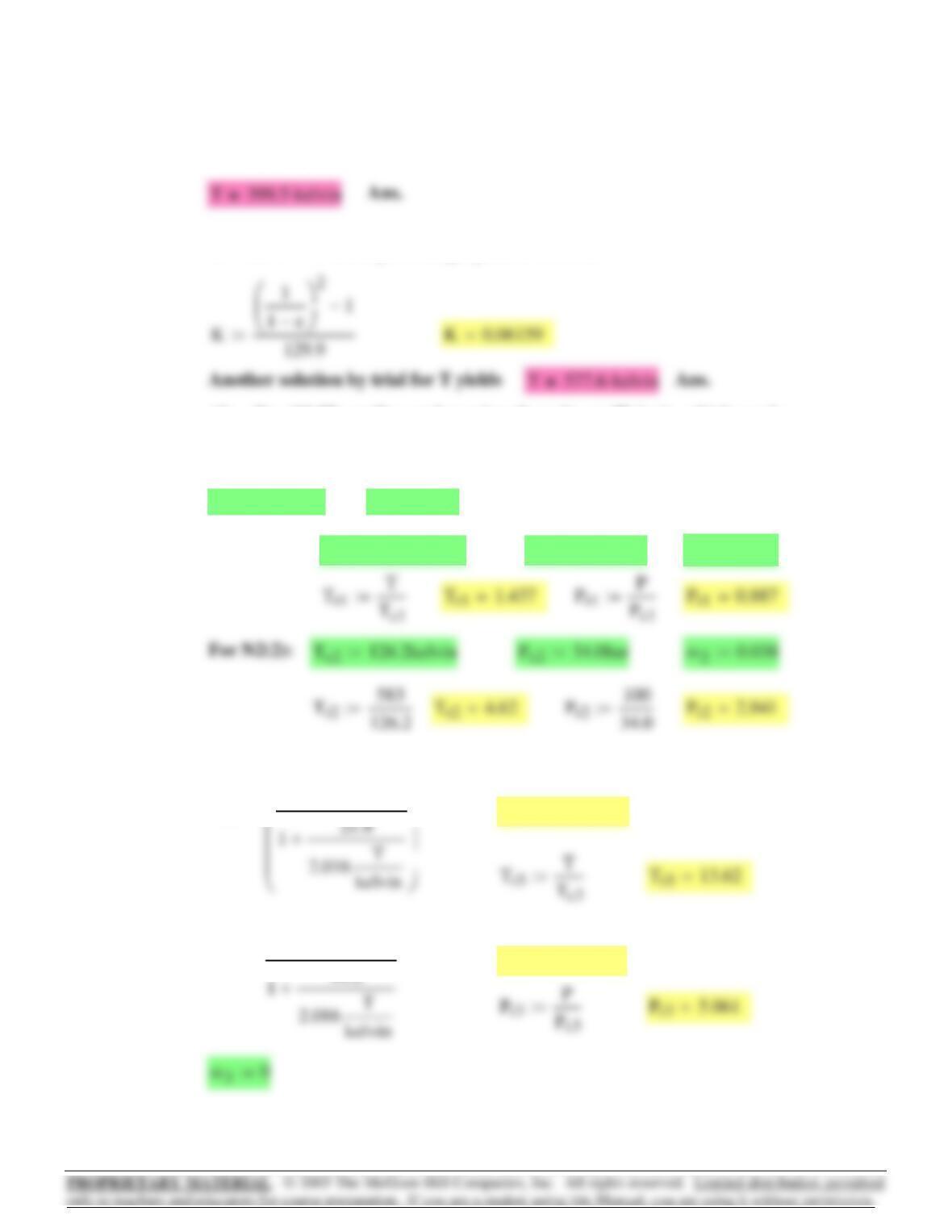
For H2(3), estimate critical constants using Eqns. (3.58) and (3.59)
Tc3
43.6
⎛
⎜
⎞
kelvin:= Tc3 42.806 K=
Pc3
20.5
bar⋅:= Pc3 19.757 bar=
Find by trial the value of T for which this is correct. It turns out to be
(c) For P = 100, the preceding equation becomes
(d) Eq. (13.27) applies, and requires fugacity coefficients, which can be
evaluated by the generalized second-virial correlation. Since iteration
will be necessary, we assume a starting T of 583 K for which:
T 583kelvin:= P 100bar:=
For NH3(1): Tc1 405.7kelvin:= Pc1 112.8bar:= ω10.253:=
500
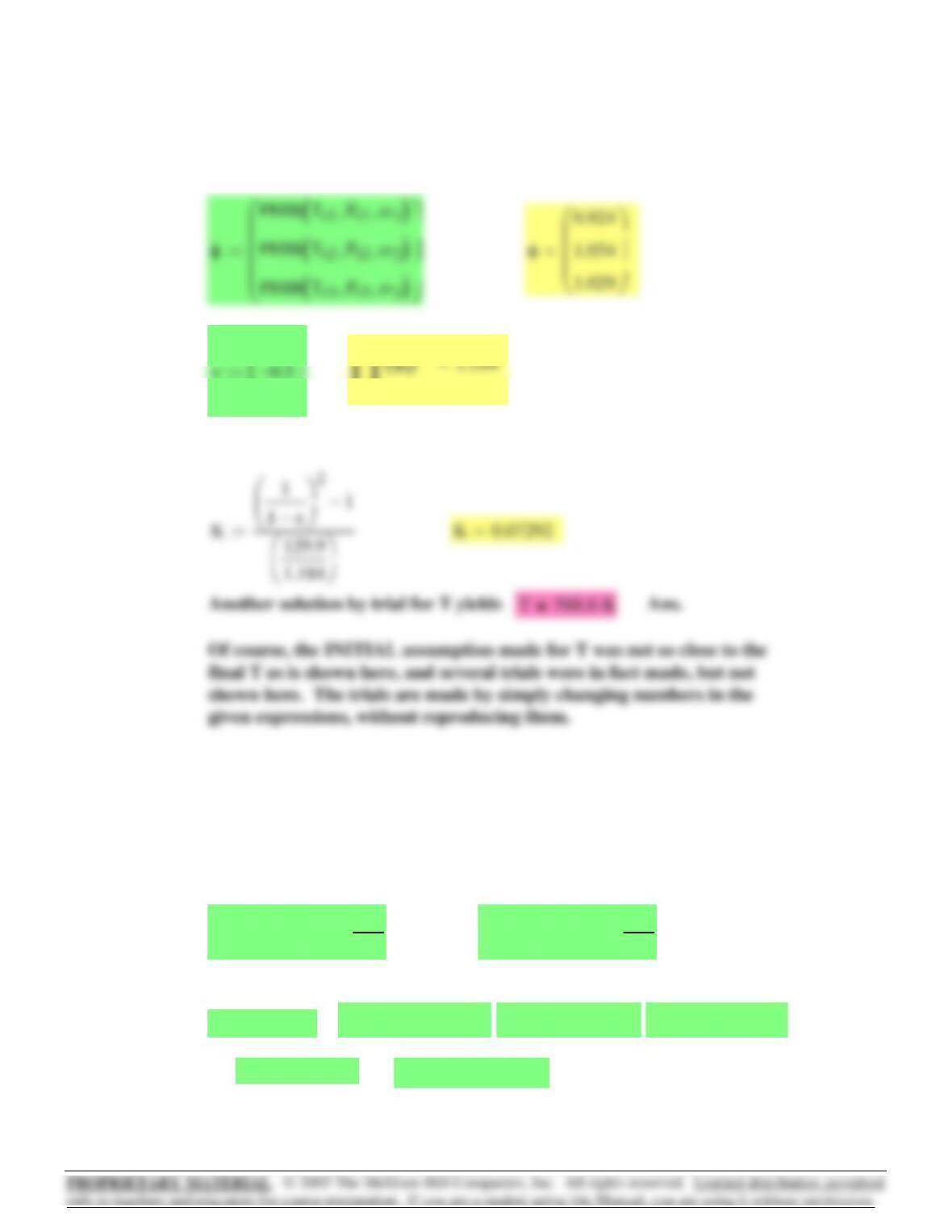
T0298.15 kelvin⋅:=T 300 kelvin⋅:=
(a)
∆D 0.135−105
⋅:=∆C 3.45−10 6−
⋅:=∆B 10.815 10 3−
⋅:=∆A 7.663−:=
This is the reaction of Ex. 4.6, Pg. 142 from which:
∆G298 24791−J
mol
⋅:=∆H298 90135−J
mol
⋅:=
From the data of Table C.4,
n03=
Basis: 1 mol CO, 2 mol H2 feed
ν2−=
CO(g) + 2H2(g) = CH3OH(g)13.21
The expression used for K in Part (c) now becomes:
1
1.5−
⎛
⎜
⎜
⎜
⎝
⎞
⎟
⎠
i
νi
⎜
⎜
⎜
i13..:=
Therefore,
501
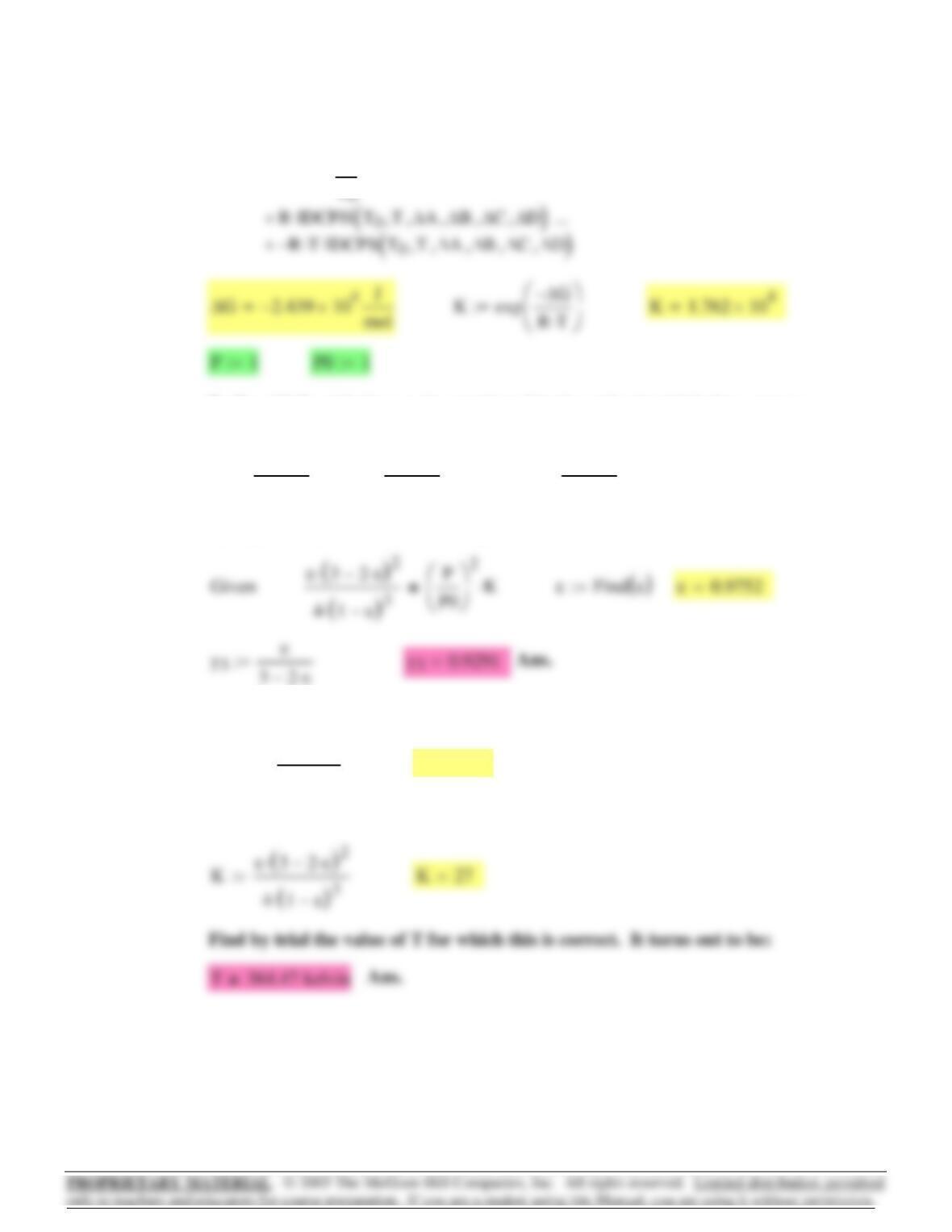
Solution of the equilibrium equation for K gives
ε0.75=ε 3y
3
⋅
2y
3
⋅1+
:=
By the preceding equation
y30.5:=
(b)
∆G∆H298
T
T0
∆H298 ∆G298
−
()
⋅−
…
:=
By Eq. (13.5), with the species numbered in the order in which they appear
in the reaction,
y1
1ε−
32ε⋅−
=y2
22ε⋅−
32ε⋅−
=y3
ε
32ε⋅−
=
By Eq. (13.28), ε0.8:= (guess)
502