PROBLEM 13.56
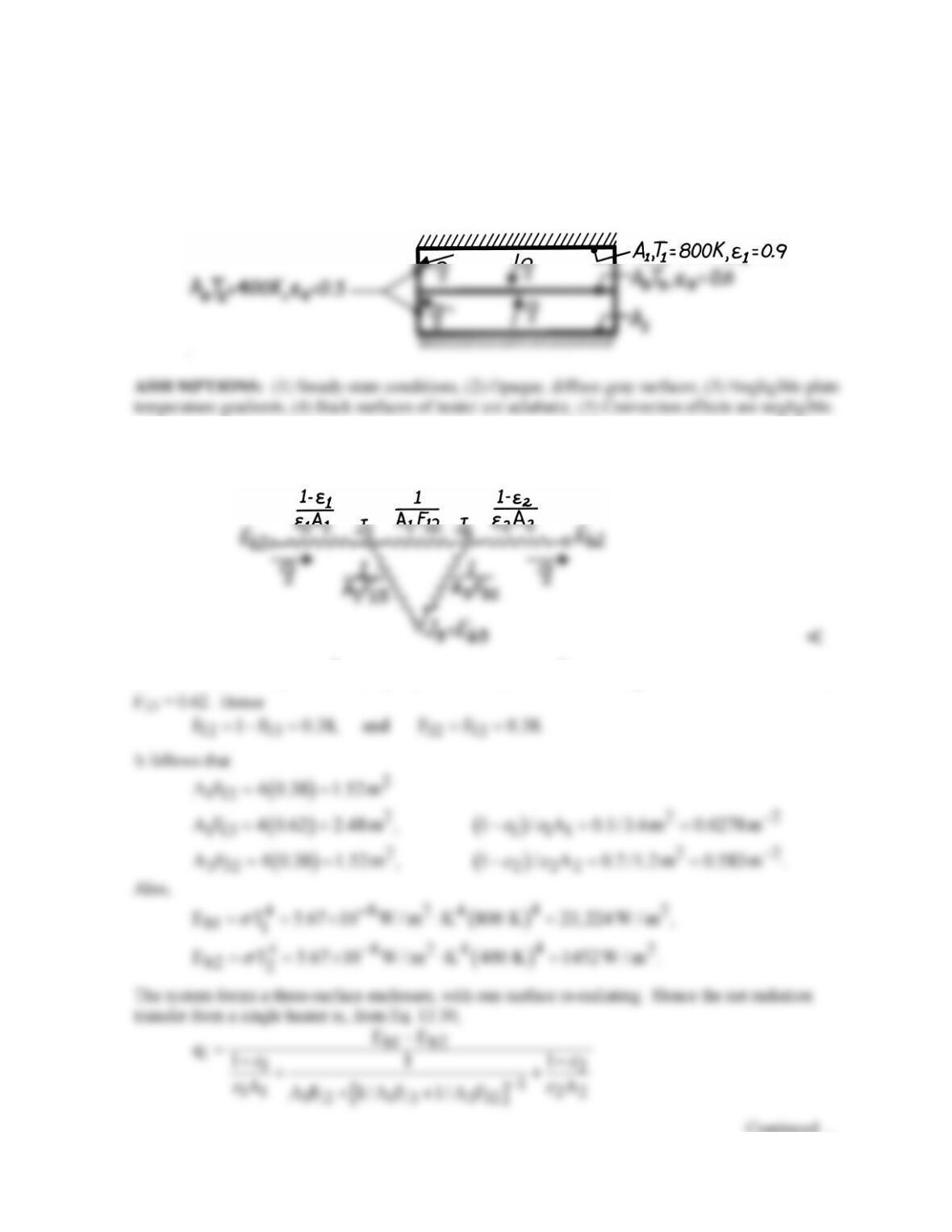
KNOWN: Dimensions, surface radiative properties, and operating conditions of an electrical
furnace.
FIND: (a) Equivalent radiation circuit, (b) Furnace power requirement and temperature of a heated
plate.
SCHEMATIC:
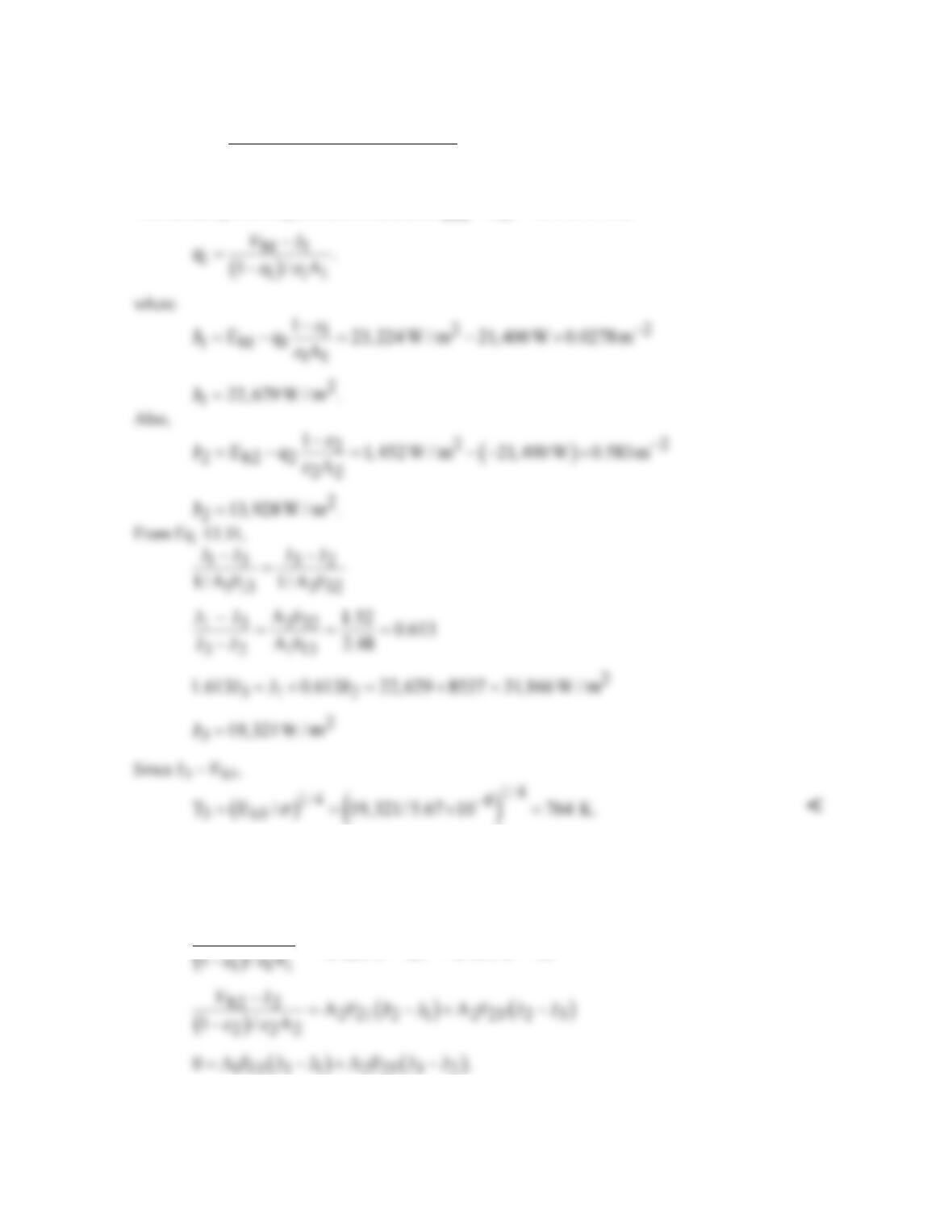
ANALYSIS: (a) Since there is symmetry about the plate, only one-half (top or bottom) of the system
need be considered. Moreover, the plate must be adiabatic, thereby playing the role of a re–radiating
surface.
(b) Note that A1 = A3 = 4 m2 and A2 = (0.5 m × 2 m)4 = 4 m2. From Fig. 13.4, with X/L = Y/L = 4,
Continued …
PROBLEM 13.56 (Cont.)
( )
( )
2
12
23, 224 1452 W / m
q 21.4 kW.
0.0278 0.4061 0.583 m
−
−
= =
++
The furnace power requirement is therefore qelec = 2q1 = 43.8 kW, with <
COMMENTS: (1) To reduce qelec, the sidewall temperature T2, should be increased by insulating it
from the surroundings. (2) The problem must be solved by simultaneously determining J1, J2 and J3
from the radiation balances of the form
b1 1 1 12 1 2 1 13 1 3
EJ AF J J AF J J
−= −+ −
PROBLEM 13.57
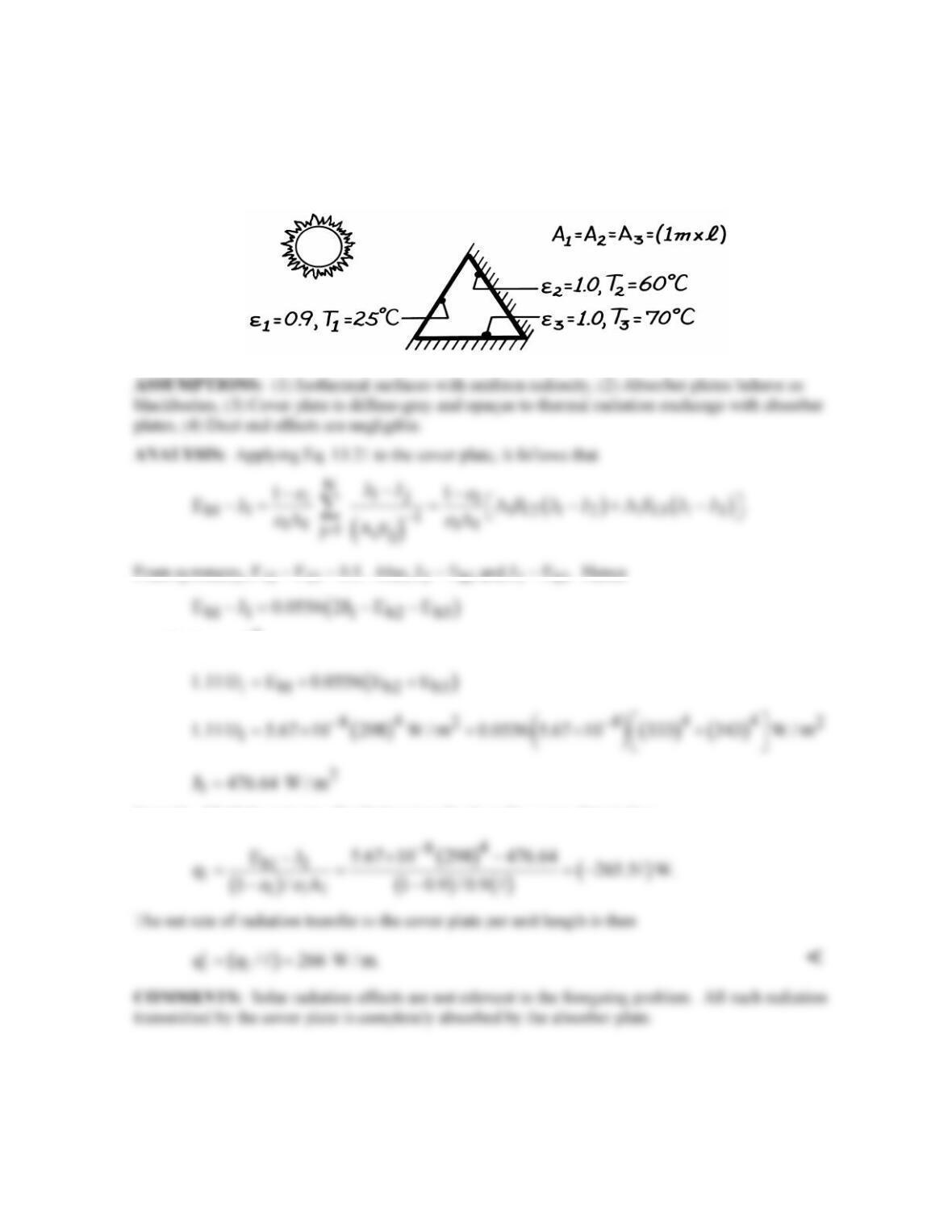
KNOWN: Geometry and surface temperatures and emissivities of a solar collector.
FIND: Net rate of radiation transfer to cover plate due to exchange with the absorber plates.
SCHEMATIC:
or with
4
b
E T,
σ
=
From Eq. 13.19 the net rate of radiation transfer from the cover plate is then
PROBLEM 13.58
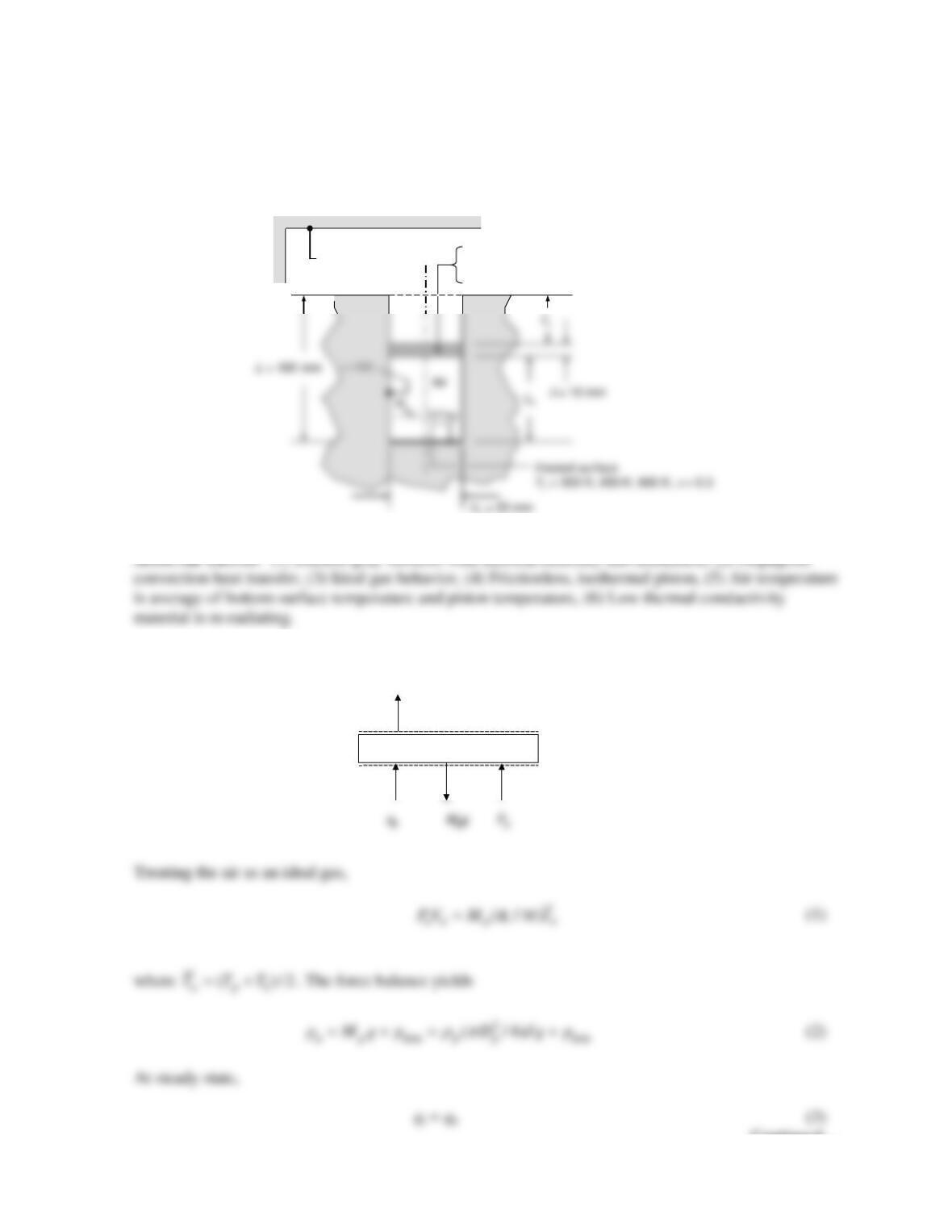
KNOWN: Dimensions of cylinder and piston, mass of air contained in the cylinder, emissivity of
surfaces, bottom surface temperature and surroundings temperature, density of piston material.
FIND: Distance between bottom of piston and bottom of cylinder and temperature of the piston for T1
= 300, 450 and 600 K.
SCHEMATIC:
Tsur = 300 K Piston
Tp,
r
p= 8000 kg/m3,
e
=0.3
ANALYSIS: The position and temperature of the piston are governed by energy and force balances
that are applied to a control volume surrounding the piston.
Continued…
q
t
q
t
PROBLEM 13.58 (Cont.)
where the heat rates are determined by evaluating the radiation heat transfer in two enclosures; one
enclosure formed by three surfaces below the piston (bottom of cylinder, bottom of piston and
reradiating side wall) and the second enclosure formed by three surfaces above the piston (top of
piston, hypothetical surface at the top of the cylinder and reradiating side wall).
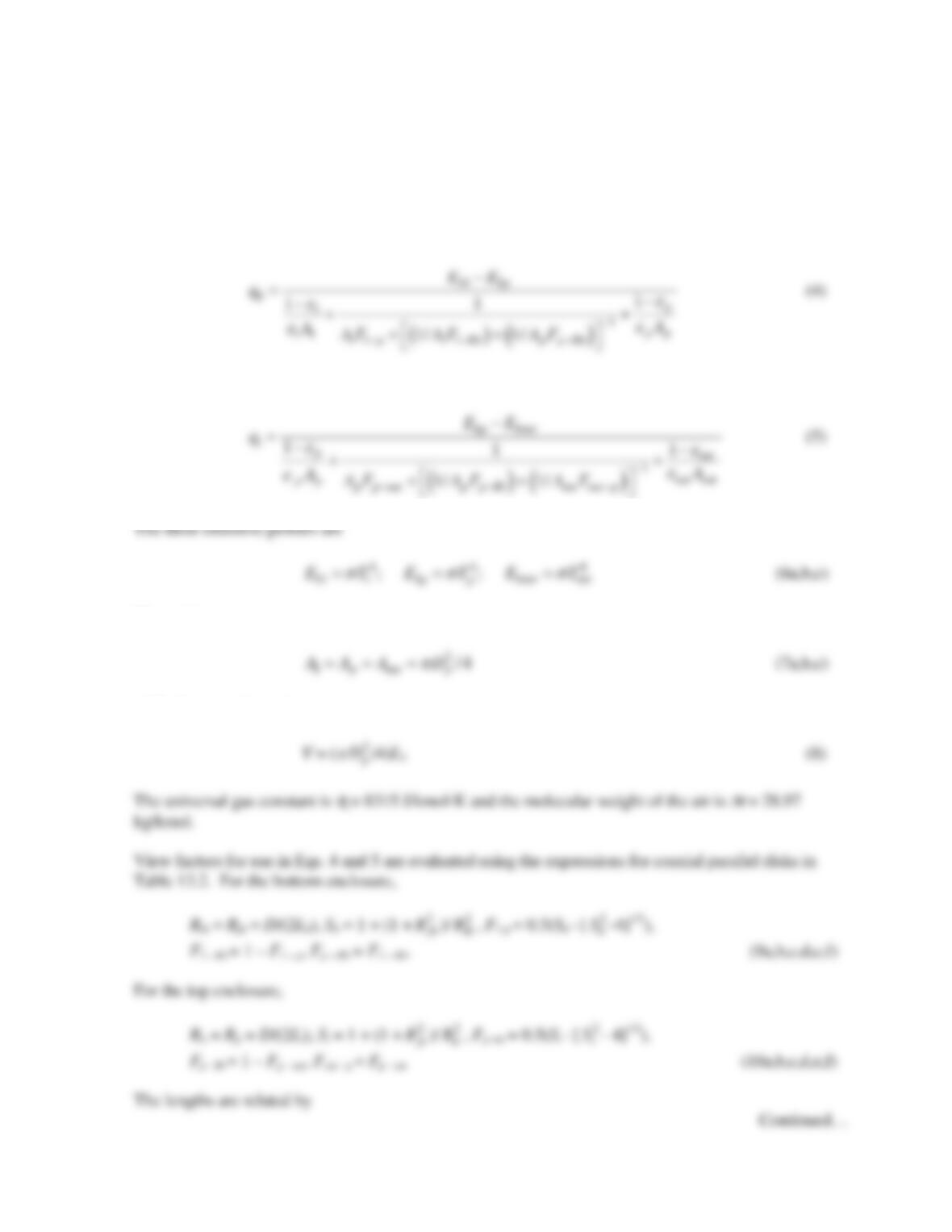
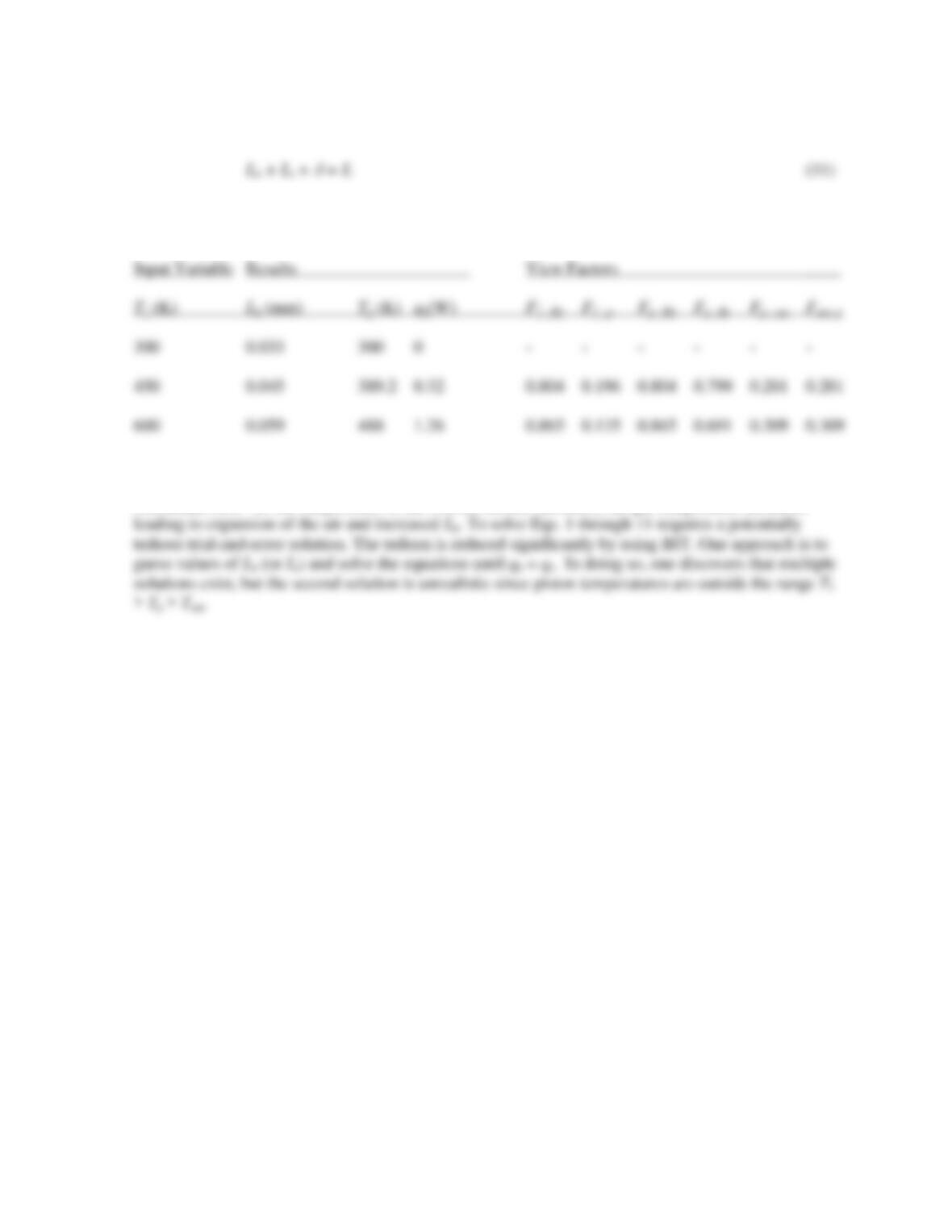
Using Eq. 13.30 for the bottom enclosure,
while for the top enclosure,
The surface areas are
while the gas volume is
PROBLEM 13.58 (Cont.)
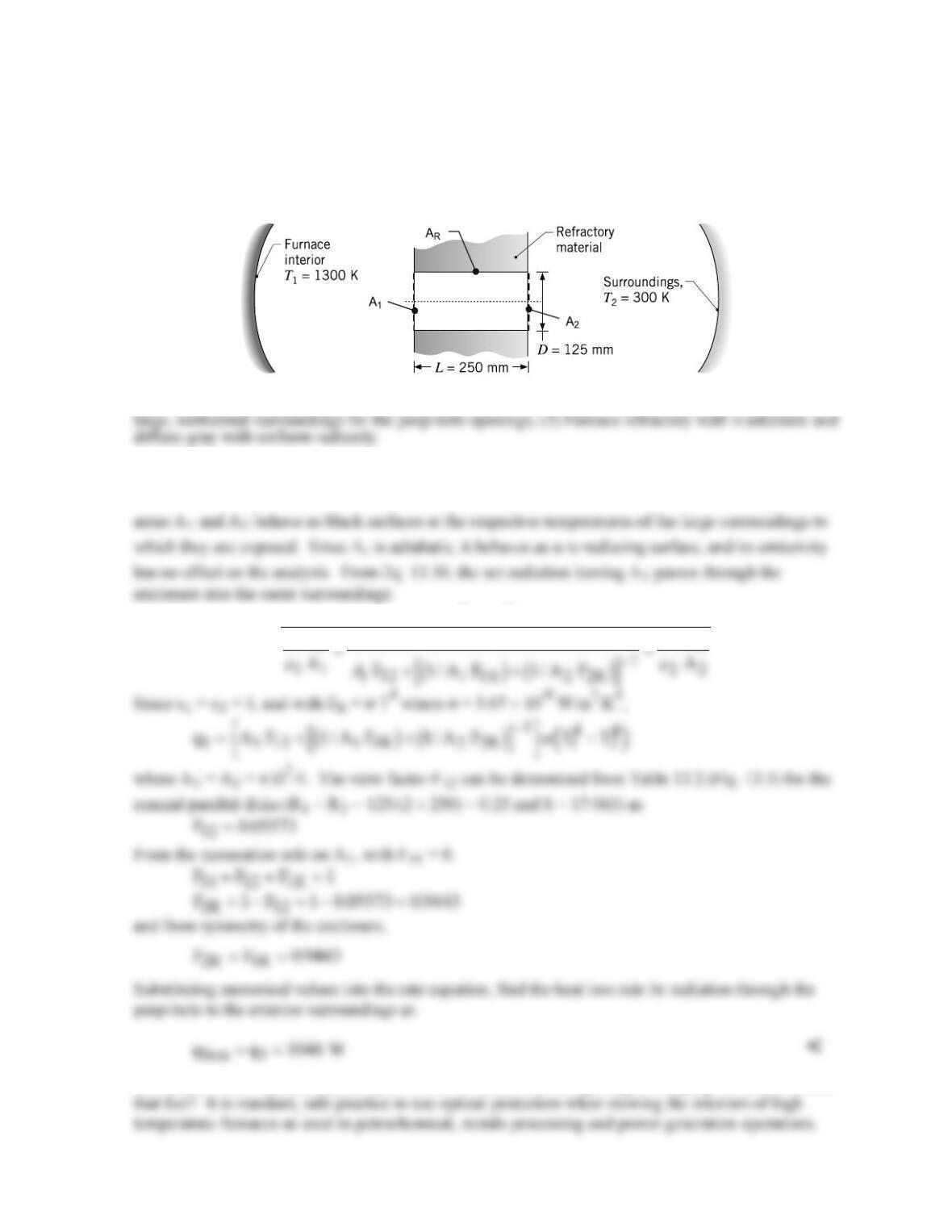
Simultaneous solution of Eqs. 1 through 11 yields the following results, presented in tabular form.
COMMENTS: As the temperature of the bottom surface increases, the gas temperature increases
PROBLEM 13.59
KNOWN: Cylindrical peep–hole of diameter D through a furnace wall of thickness L. Temperatures
prescribed for the furnace interior and surroundings outside the furnace.
FIND: Rate of heat loss by radiation through the peep-hole.
SCHEMATIC:
ASSUMPTIONS: (1) Steady-state conditions, (2) Furnace interior and exterior surroundings are
ANALYSIS: The open-ends of the cylindrical peep–hole (A1 and A2) and the cylindrical lateral
surface of the refractory material (AR) form a diffuse–gray, three–surface enclosure. The hypothetical
q q E E
1–
1 2 b1 b2
1
= − =
−
e
e
1
1
2
COMMENTS: If you held your hand 50 mm from the exterior opening of the peep-hole, how would
PROBLEM 13.60
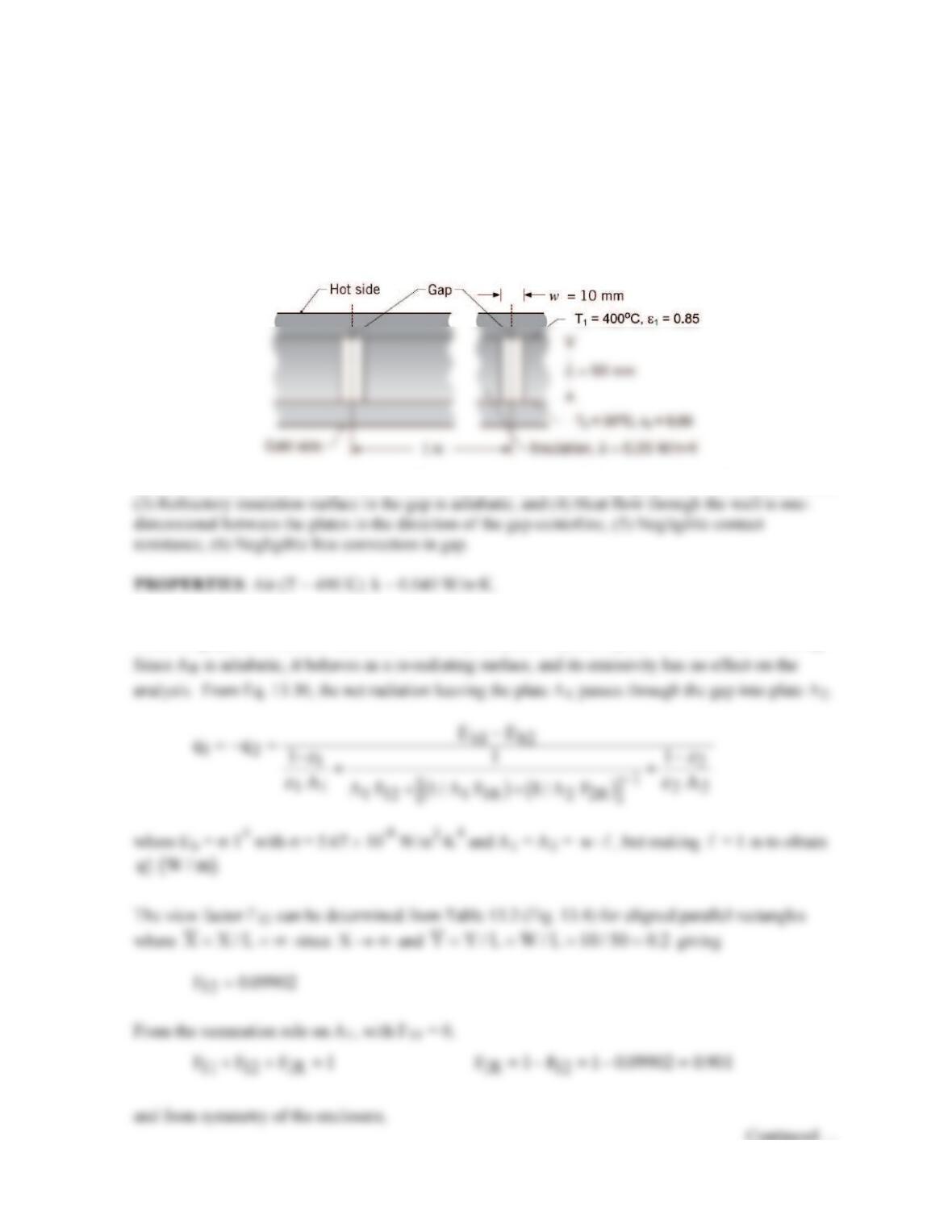
KNOWN: Composite wall comprised of two large plates separated by sheets of refractory insulation
of thermal conductivity k = 0.05 W/m⋅K; gaps between the sheets of width w = 10 mm, located at 1 –
m spacing, allow radiation transfer between the plates.
FIND: (a) Rate of heat loss by radiation through the gap per unit length of the composite wall
(normal to the page), and (b) fraction of the total heat loss through the wall that is due to radiation
transfer through the gap.
SCHEMATIC:
ASSUMPTIONS: (1) Steady-state conditions, (2) Surfaces are diffuse–gray with uniform radiosities,
ANALYSIS: (a) The gap of thickness w and infinite extent normal to the page can be represented by
a diffuse-gray, three–surface enclosure formed by the plates A1 and A2 and the refractory walls, AR.
Continued …
PROBLEM 13.60 (Cont.)
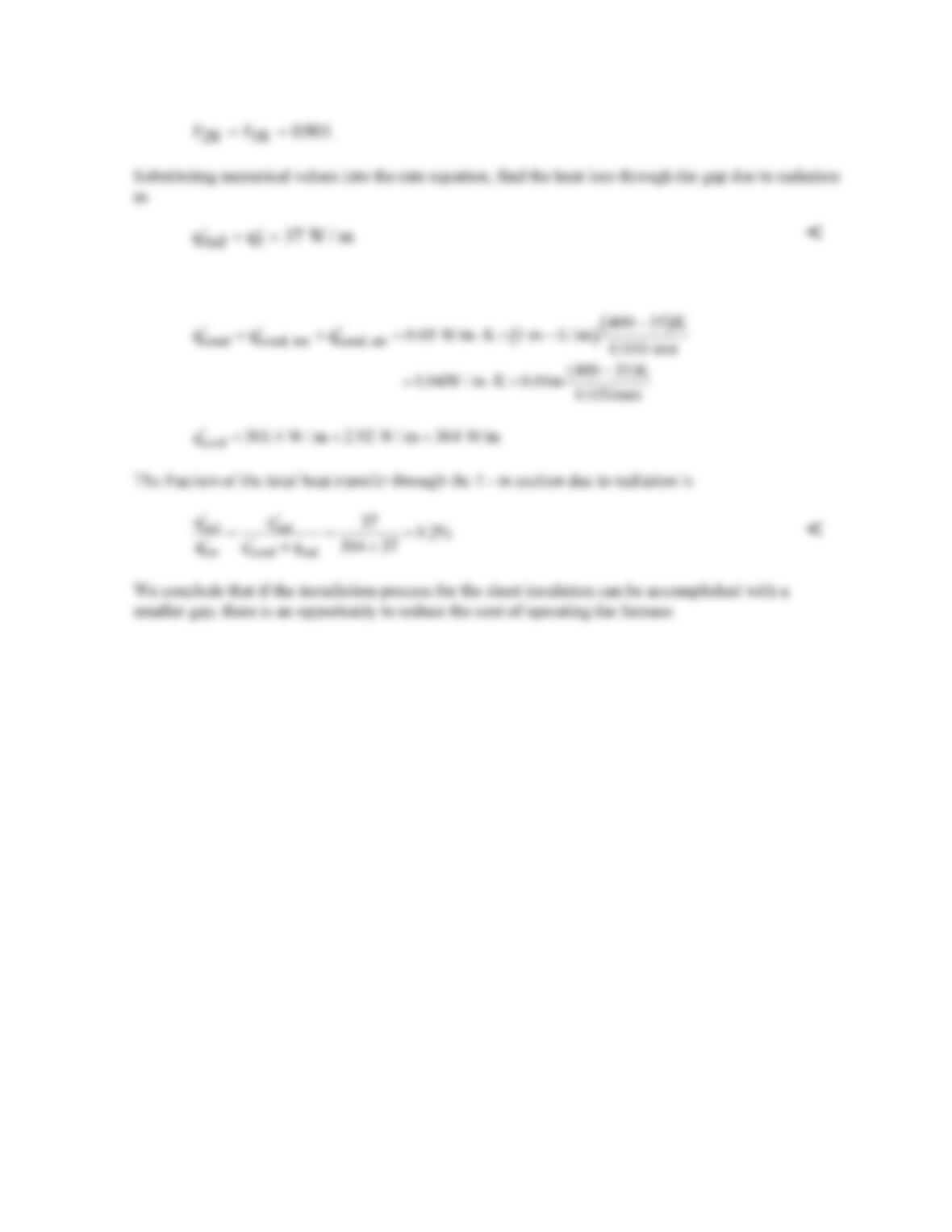
(b) The conduction heat rate per unit length (normal to the page) for a 1 – m section is
PROBLEM 13.61
KNOWN: Diameter, temperature and emissivity of a heated disk. Diameter and emissivity of a
hemispherical radiation shield. View factor of shield with respect to a coaxial disk of prescribed
diameter, emissivity and temperature.
FIND: (a) Equivalent circuit, (b) Net heat rate from the hot disk.
SCHEMATIC:
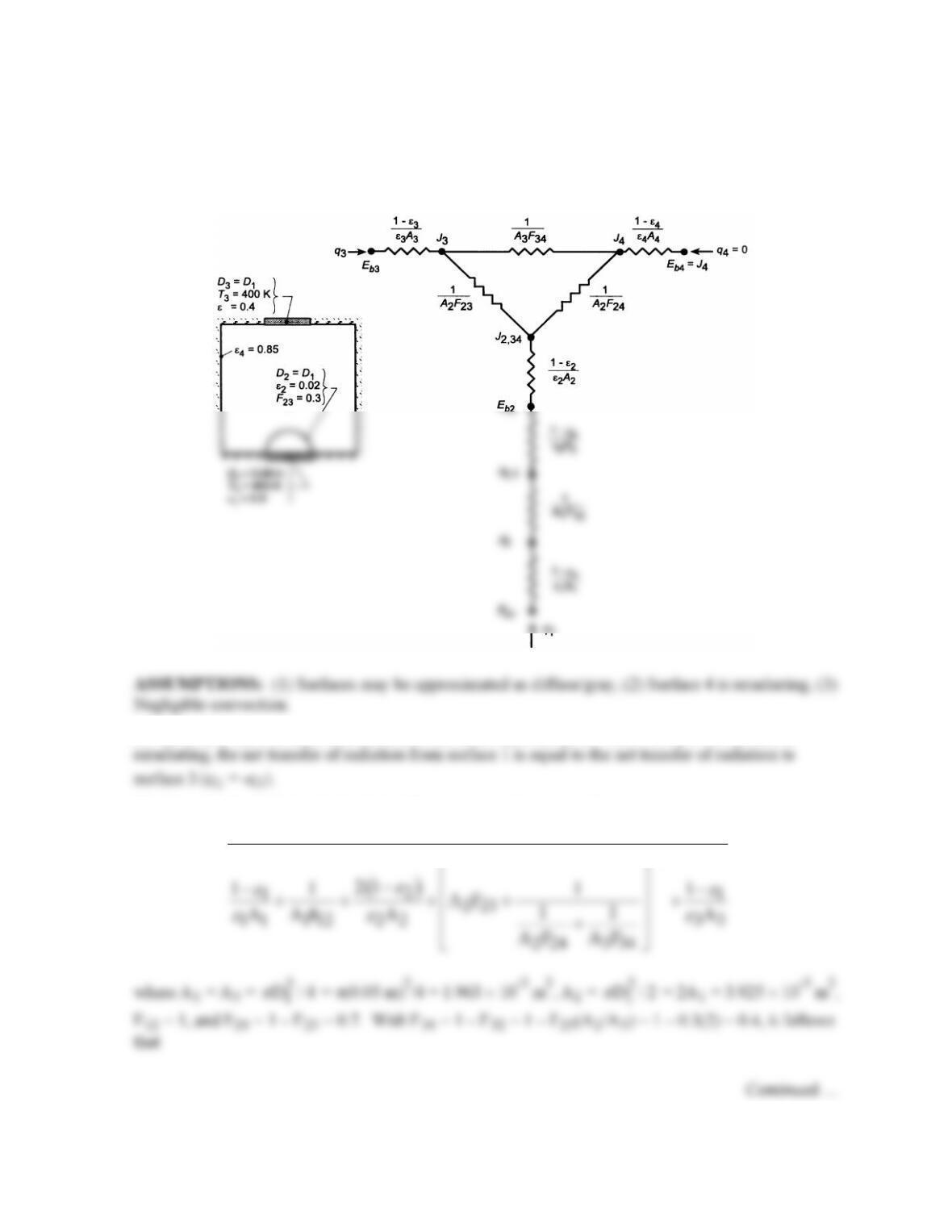
ANALYSIS: (a) The equivalent circuit is shown in the schematic. Since surface 4 is treated as
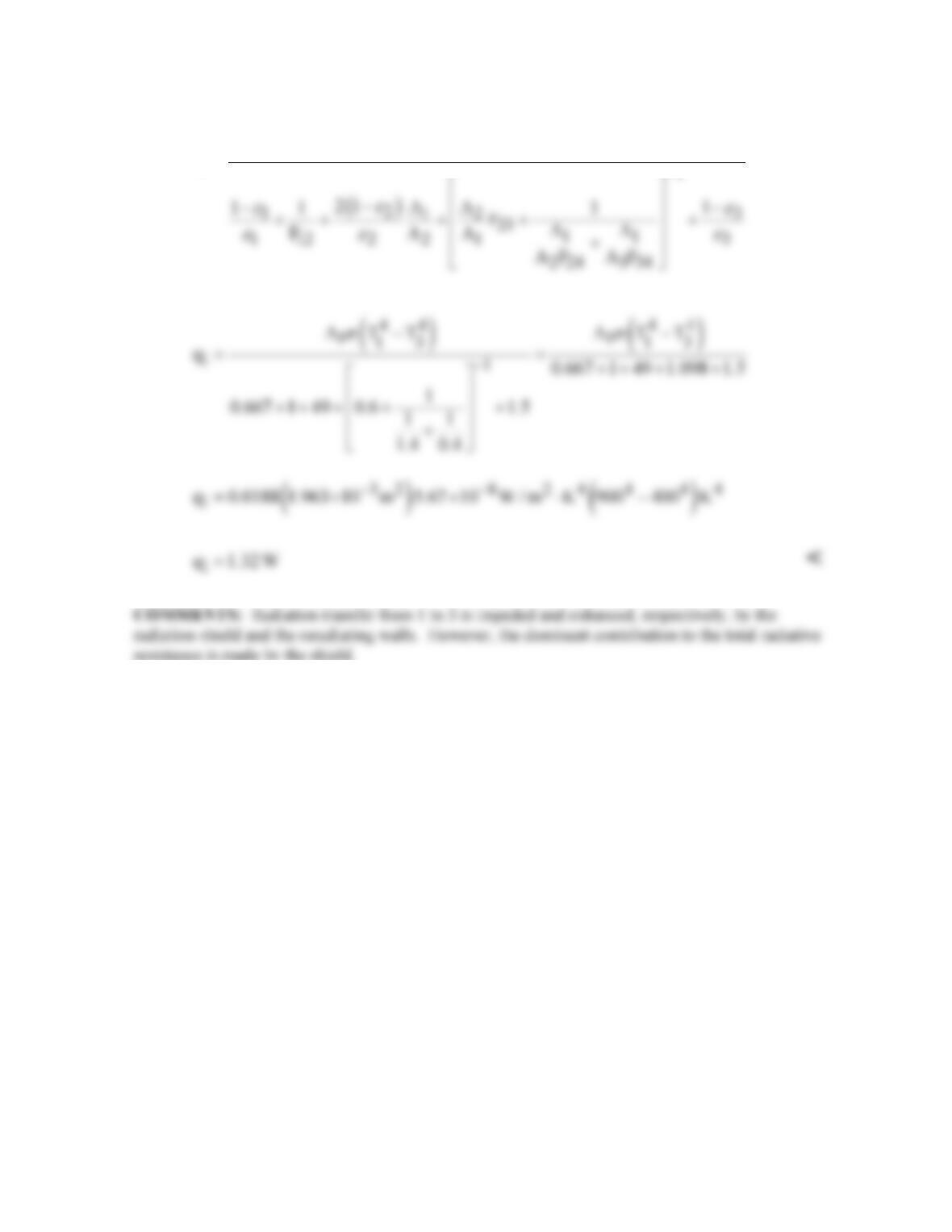
(b) From the thermal circuit, the desired heat rate may be expressed as
b1 b3
11
EE
q
−
−
=
33
PROBLEM 13.61 (Cont.)
()
44
113
11
ATT
q
−
=
σ
PROBLEM 13.62
KNOWN: Cylindrical cavity with prescribed geometry, wall emissivity, and temperature. Temperature
of surroundings.
FIND: (a) Net radiation heat transfer rate from the cavity treating the bottom and sidewall as one
surface. (b) Net radiation heat transfer rate from the cavity treating the bottom and sidewall as two
separate surfaces.
SCHEMATIC:
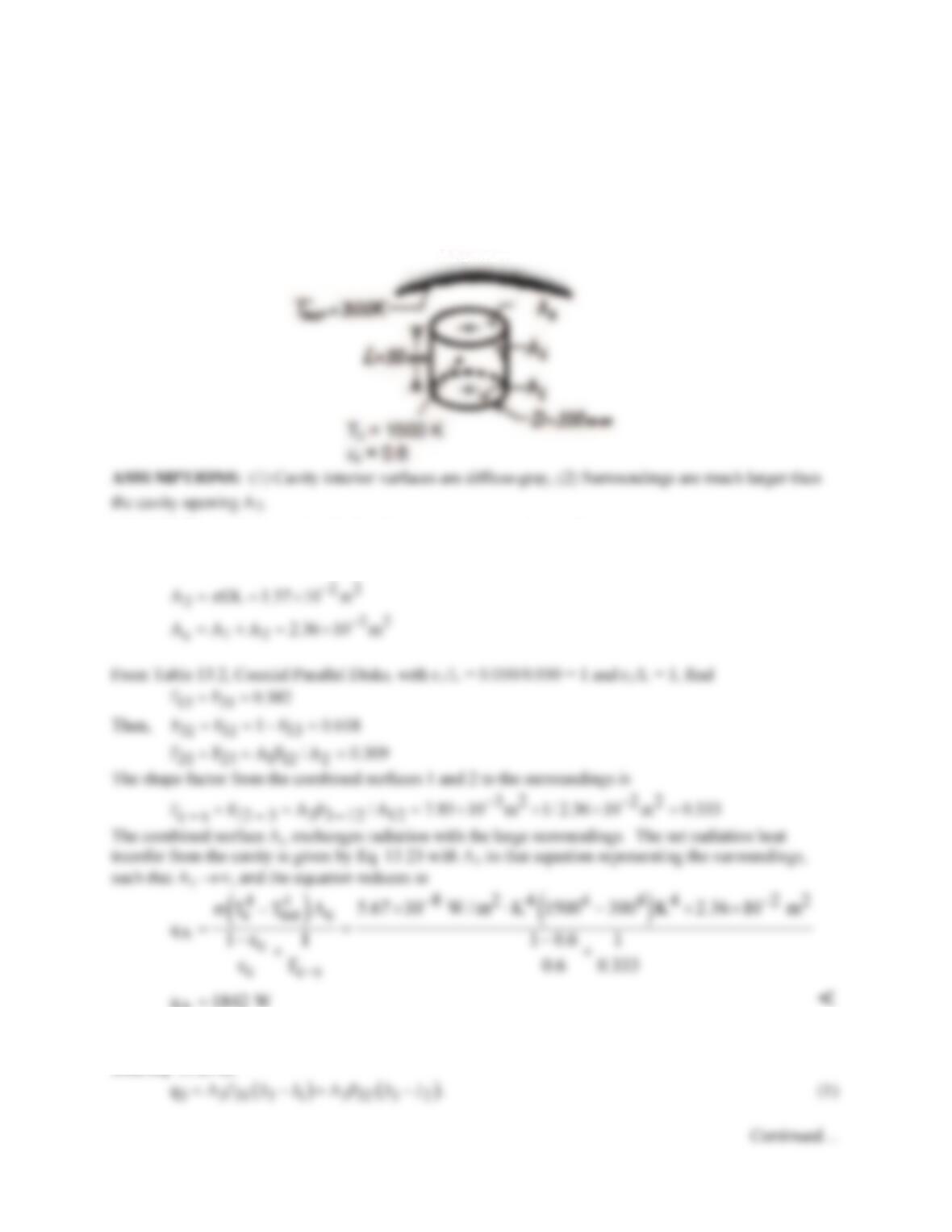
ANALYSIS: (a) We begin by finding the relevant areas and view factors.
32
12
A A D 7.85 10 m
3/4 −
= = ×=
π
qA1842 W=
<
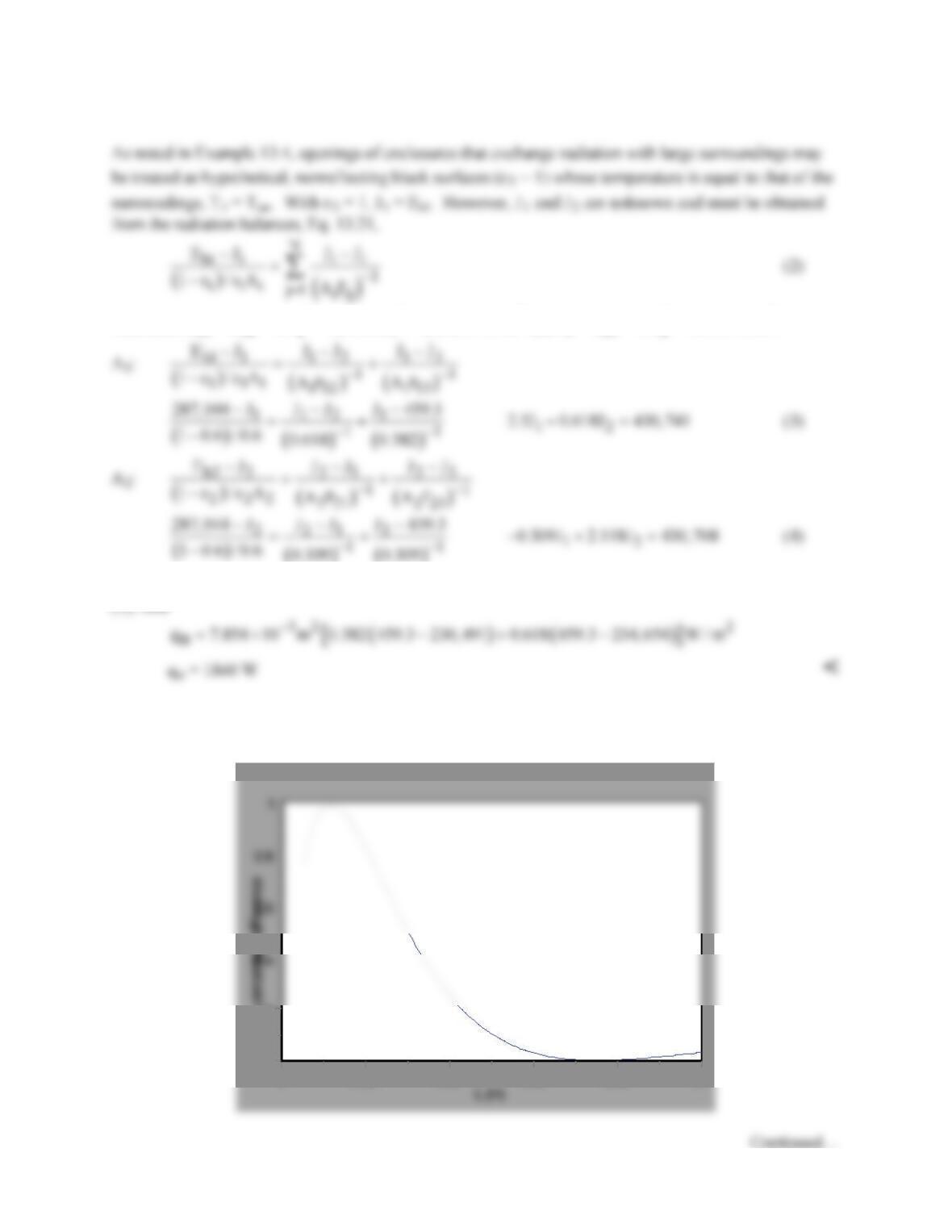
(b) Considering surfaces 1 and 2 separately, the heat transfer from the cavity to the surroundings can be
found as the heat transfer reaching hypothetical surface 3 (the cavity opening), that is, qB = –q3, which
from Eq. 13.20 is,
PROBLEM 13.62 (Cont.)
Note also, Eb1 = Eb2 =
4
T
σ
= σ(1500K)4 = 287,044 W/m2 and J3 = Eb3 =
4
T
σ
= 459.3 W/m2.
Solving Eqs. (3) and (4) simultaneously, find J1 = 230,491 W/m2 and J2 = 234,654 W/m2, and from Eq.
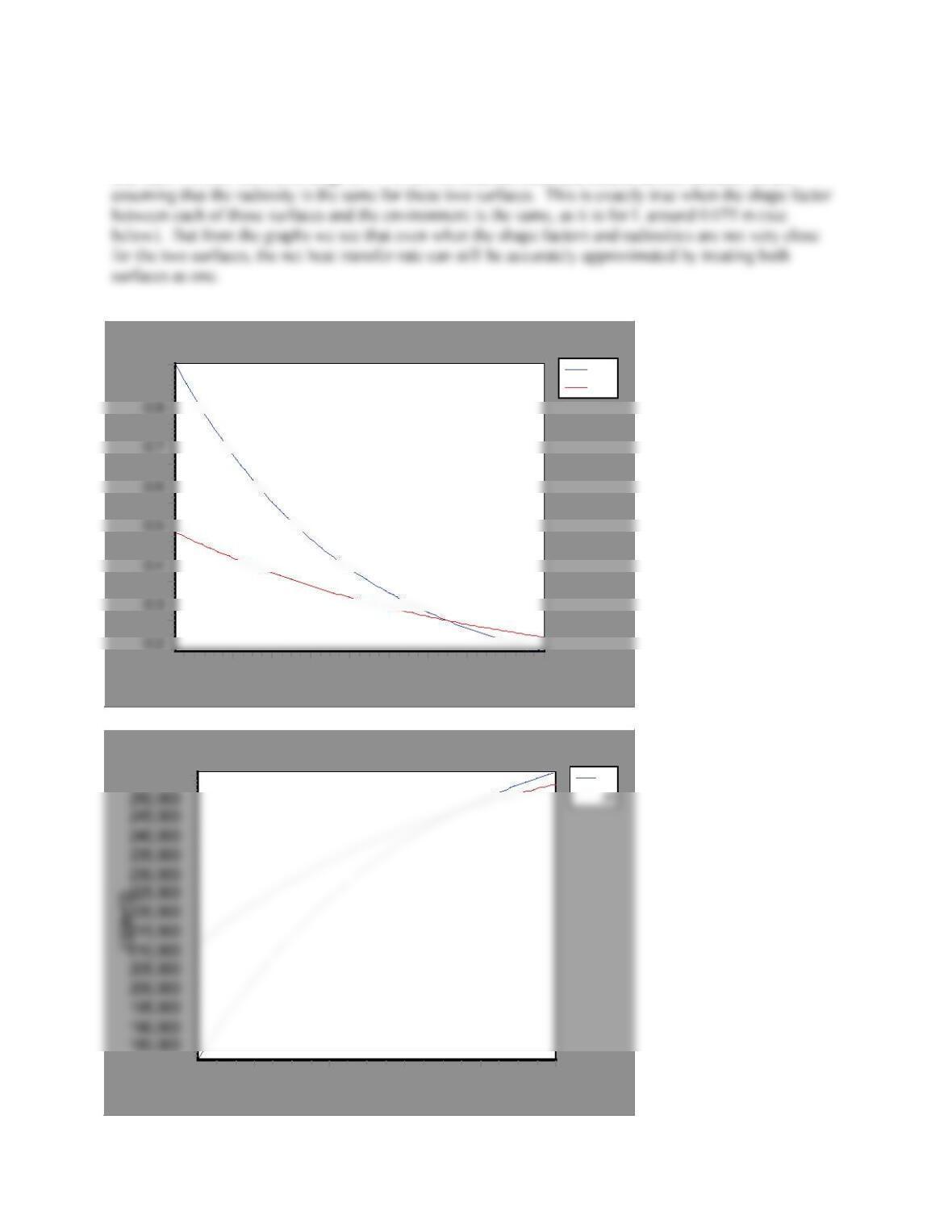
(c) The equations for shape factors were entered into the IHT workspace, along with Eqs. (1), (3), and
(4). The resulting plot is shown below.
0.10.080.060.040.020
0.2
0
PROBLEM 13.62 (Cont.)
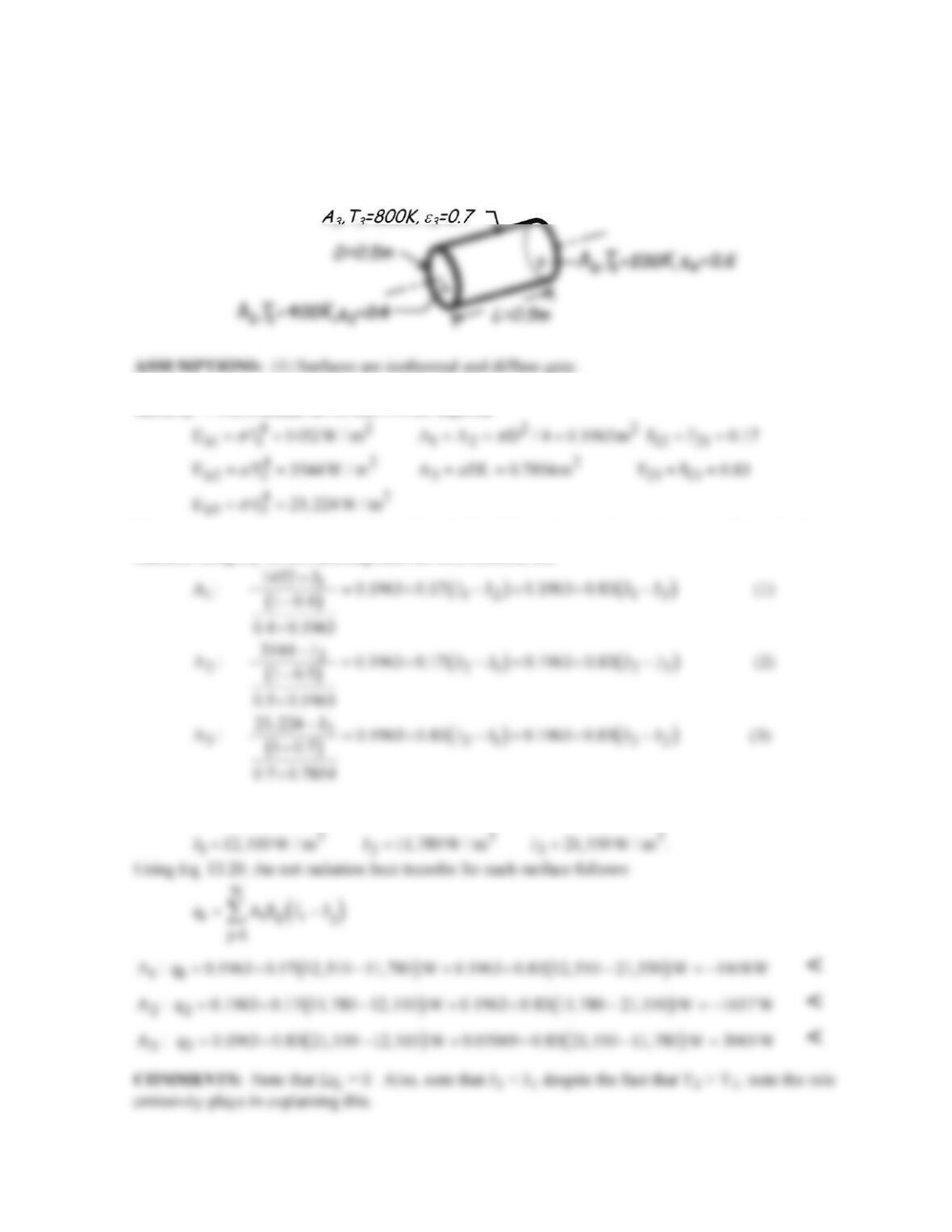
COMMENTS: The difference between the two different methods for calculating heat transfer rates is
less than 1% over the entire range of L. When we treat the sides and bottom as one surface, we are
F13
F23
L (m)
0.10.090.080.070.060.050.040.030.020.01
F
0.9
0.85
0.75
0.65
0.55
0.45
0.35
0.25
J1
L (m)
0.10.080.060.040.02
255,000
PROBLEM 13.63
KNOWN: Circular furnace with prescribed temperatures and emissivities of the lateral and end
surfaces.
FIND: Net rate of radiative heat transfer from each surface.
SCHEMATIC:
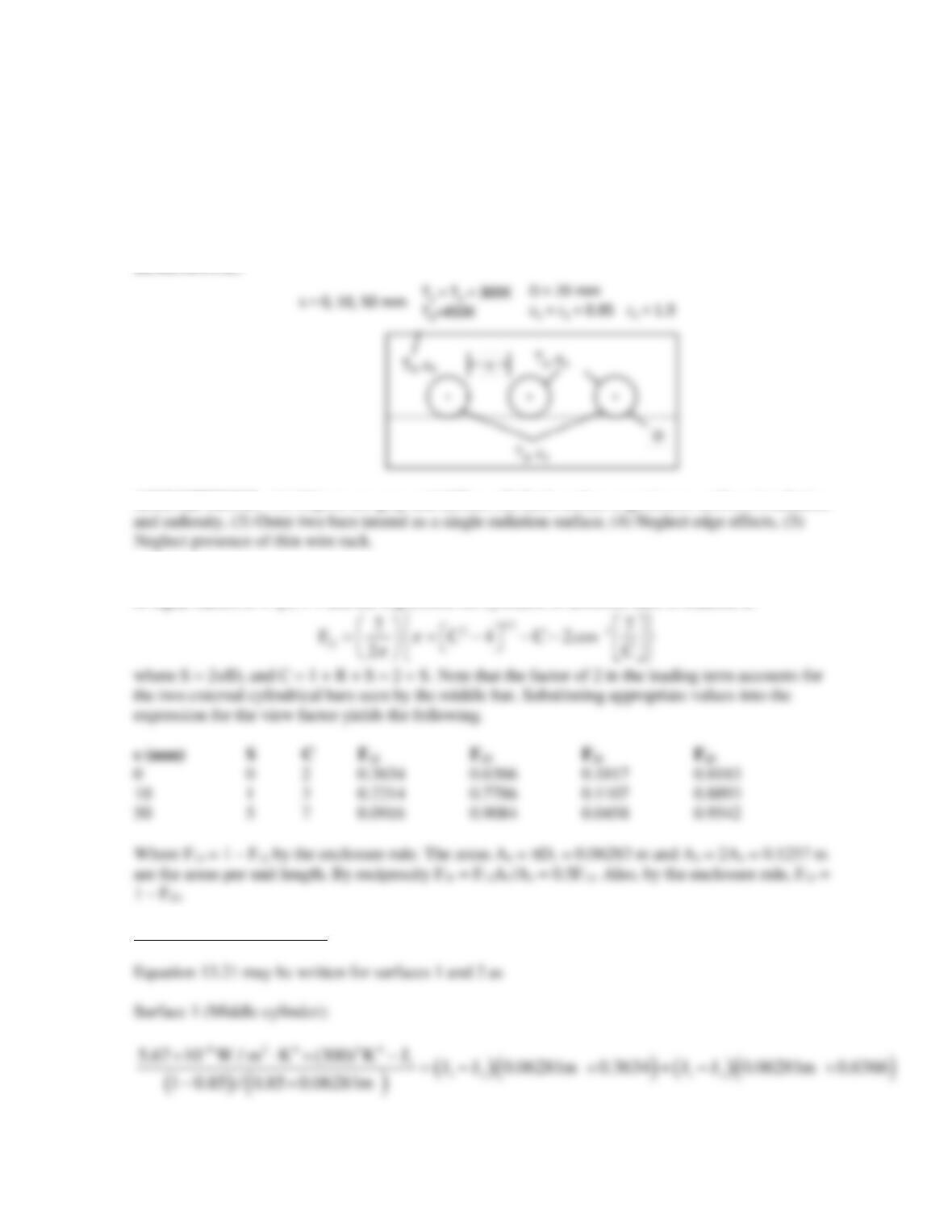
ANALYSIS: To calculate the net radiation heat transfer from each surface, we need to determine its
radiosity. First, evaluate terms that will be required.
The view factor F12 results from Fig. 13.5 or Table 13.2 with L/ri = 2 and rj/L = 0.5. The radiation
balances using Eq. 13.21, omitting units for convenience, are:
Solving Eqs. (1) – (3) simultaneously, find
PROBLEM 13.64
KNOWN: Diameter and initial temperature of cylindrical bars, temperature of oven walls.
Emissivity of bars and oven walls; separation distance between bars.
FIND: Initial radiation heat rate per unit length of each of the bars. Separation distance providing the
maximize the heating rate, and for which bar(s) the rate is maximized. Separation distance providing
the minimum heating rate, and for which bar(s) the rate is minimized. Plot of the initial heating rate
per unit length to the middle bar, and to an exterior bar for 0 ≤ s ≤ 1 m.
SCHEMATIC:
ASSUMPTIONS: (1) Objects are gray and diffuse, (2) Each surface experiences uniform irradiation
ANALYSIS: Determine the view factor F12 from Table 13.1 for long parallel cylinders. For cylinders
of equal radius, R = rj/ri = 1 and the expression for cylinders of different radii is reduced to
Consider the s = 0 mm case.
Continued…
PROBLEM 13.64 (Cont.)
Surface 2 (Both outer cylinders):
The oven walls behave as a blackbody, therefore:
The heat rates for the cylinders may be calculated from Equation 13.22.
Surface 1 (Middle Cylinder):
Surface 2 (Outer Cylinders):
Repeating the calculations for s = 10 and 50 mm yields:
PROBLEM 13.64 (Cont.)
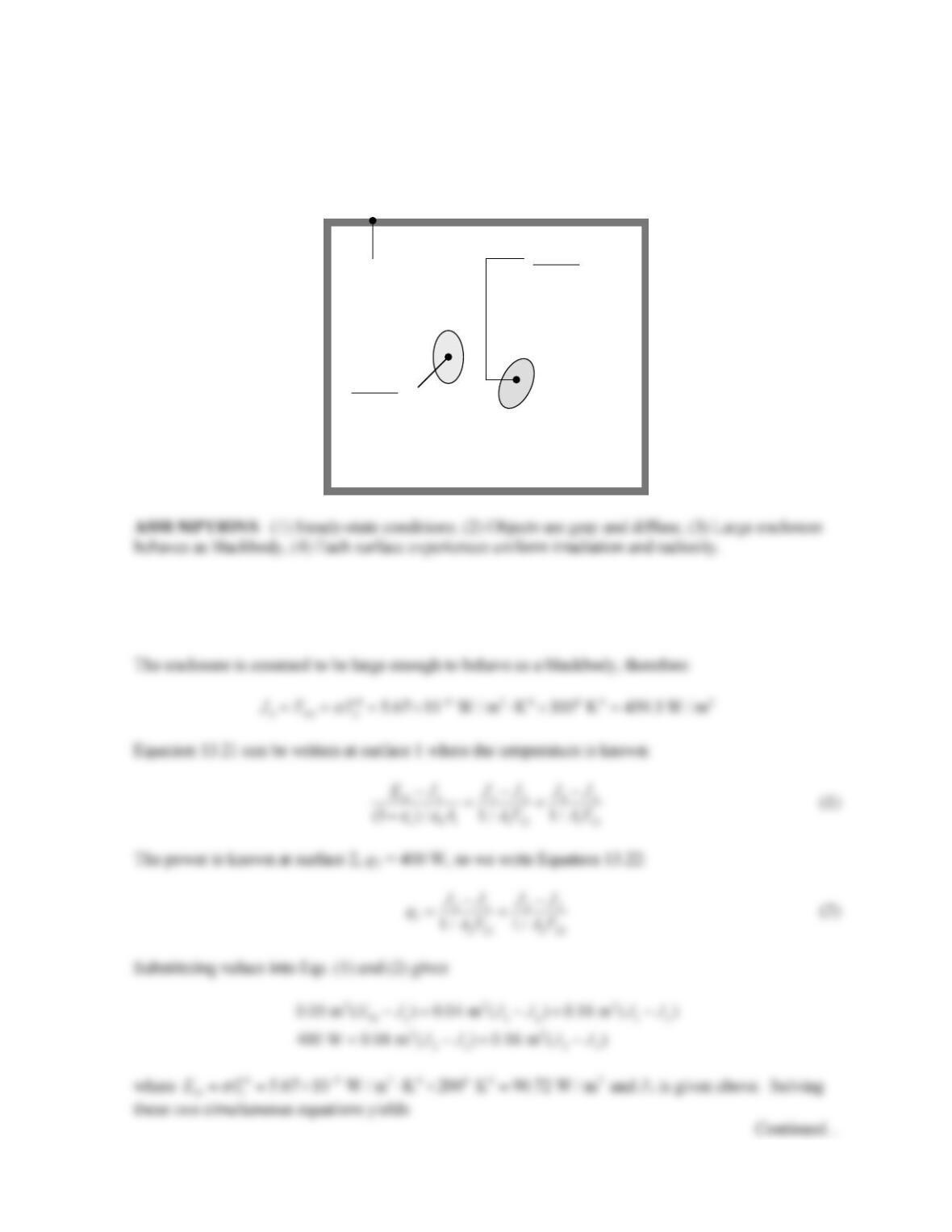
A plot of the initial heating rates per unit length of the middle and an outer bar is shown below. As
PROBLEM 13.65
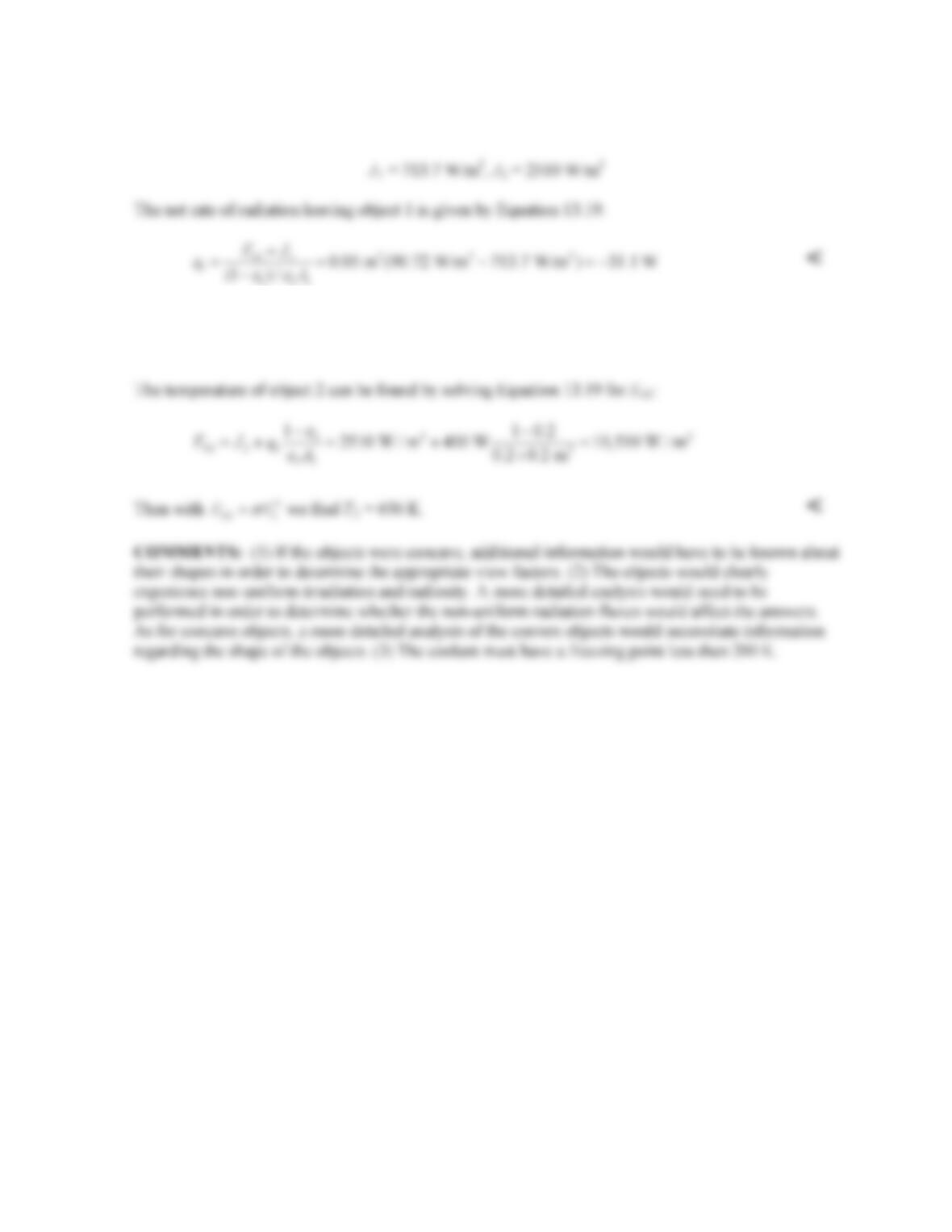
KNOWN: Temperature of large enclosure. Areas and emissivity of two convex objects in enclosure,
and view factor between them. Power supplied to object 2. Temperature of object 1.
FIND: Heating or cooling rate for object 1. Temperature of object 2.
SCHEMATIC:
T3= 300 K
Object 1
cooled by circulating fluid
A1= 0.2 m2
e
1= 0.2
T1= 200 K
q1= ?
Object 2
heated electrically
A2= 0.2 m2
e
2= 0.2
q2= 400 W
T2= ?
ANALYSIS: We are given F12 = 0.2. Since object 1 is convex, it does not see itself, and F13 = 1 –
F12 = 0.8. The areas of the two objects are the same, therefore from reciprocity F21 = F12 = 0.2.
Finally, since object 2 is convex, F23 = 1 – F21 = 0.8.
PROBLEM 13.65 (Cont.)
There is a net rate of radiation heat transfer to object 1 of 31.1 W, which must be removed from object
1 by the coolant. <