1
ANSWERS TO CHAPTER 13 QUESTIONS
ANSWER 13.1
One way to accomplish this important product development task
is to separate the mechanical aspects from the styling/design
aspects of the product. The practice of General Motors is
noteworthy; they do the following:
A. Build assembly plants for Buicks at four different global
locations close to the intended markets (e.g., Shanghai, Warsaw,
Rio de Janeiro, etc.)
ANSWER 13.2
Toyota sees the emergence of developing countries such as
China, India and others as the biggest driving factor for
manufacturing improvements. China is already the largest producer
of home appliances and consumer electronics. It is just a matter
of time before China also becomes the world’s largest maker of
cars.
ANSWER 13.3
Countries which practice democracy and capitalism engage
social programs to counteract inequality which is inherent in a
capitalist society. Examples of such social programs funded by
However, as the burdens of these social programs continue to
escalate over time, more tax revenues are needed and less
investment will be available to finance the educational systems.
Increasing corporate tax burdens may drive industries and
employment abroad. Lower investments in educational systems
could make US workers less competitive in world markets.
Globalization tends to make the problem of inequality in
capitalist societies more severe than before. This could be a
serious economic and political problem the US will face in the
21st century.
ANSWER 13.4
From a cultural standpoint, several trends are noticeable in
the world today. People in business speak English, dress for
success, welcome people with a strong handshake, look people in
the eye, think in cost/benefit terms, make rational decisions,
work for short-term goals, seek instant gratification, favor
certain common lifestyle preferences, personal values and tastes,
exhibit a materialistic orientation, and act in “standard” ways
to engage in international business. There is tension between
these business elites and other non-elites who resent their ways
of life.
On yet another front, American rock music, hamburgers,
sitcoms, movies, and others are overwhelming the rest of the
world, touting the values associated with them. Still others
claim that evangelical Protestantism is spreading widely, like a
ANSWER 13.5
The United Nations was brought into being after World War II
to resolve political conflicts (e.g., Bosnia, Rwanda, and
others), settle trade disputes, combat epidemics (e.g., AIDS in
Africa and SARS in Asia), foster cultural exchanges, enhance
basic education, promote democracy and human rights, impose trade
4
freedom, law and order, environmental regulations, health
practices, social policies, and other progressive policies. As
people become increasingly ready to practice democracy, political
reforms are surely to follow. A second point of view is that
due to globalization become sustainable.
Should political reform be ahead of economic reform or vice
versa? India practices democracy in the British style. Its
difficulty of governing the country in which so many independent
political parties are active is well known. The government is so
ineffective that its economic growth is still lagging behind very
badly in comparison to China and other countries. At one time,
Taiwan was governed by the only party, the Nationalist Party. It
pursued a liberal economic policy by allowing open trade with the
These cases indicate that to achieve worldwide economic
prosperity, it is stability, not the form of government, which
matters. A practical strategy for the United Nations would be to
promote economic prosperity by globalization and then to
gradually shift the form of the government involved to democracy.
Political reform is a complex issue. Globalization creates
economical benefits for some; for others it creates dislocations
and concerns regarding to the environment, human rights and labor
5
Studies suggest that not all people in developing countries
are in favor of democracy as practiced in the United States,
England, India and other countries. Not all people can handle
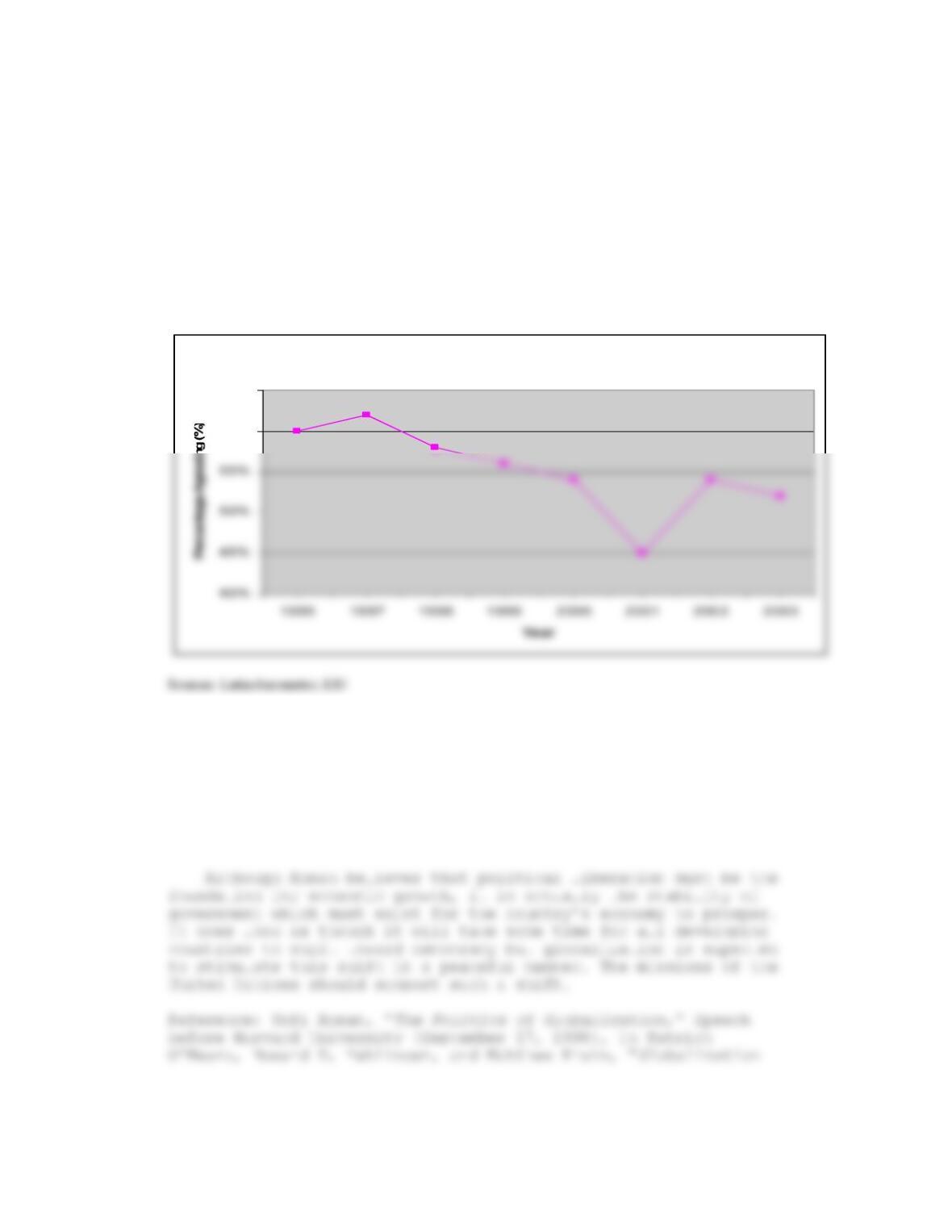
democracy well enough for it to add value. Figure 13-11 presents
FIGURE 13.11 OPINIONS REGARDING DEMOCRACY
Democracy Preferre d by Latin Americans
60%
65%
the survey results of people in 17 Latin American countries
regarding their preference of democracy as a form of government.
Steering people in developing countries toward a specific
government favored by other developed countries may not be the
right thing for the United Nations to do. The United Nations
should first listen to the people involved and then help them to
achieve their respective goals.

6