
13-12 Stability of Earth Slopes Chap. 13
(W/b) sin α = denominator in Equation 13.30
Slice
W/b α c′
φ
‘
(Deg)
u m
(W/b) sinα
Try F = 2.10
(kN/m) (Deg) (kPa) (kPa) (m) ψ
1 293 -12 10 32 5 6.2 -61 1.040 217
Σ = 1,071 Σ = 2,221
Section 13.10 Chart Solutions
13.19 An 8.5-m-tall, 2:1 fill slope is to be made of soil with c′ = 35 kPa,
φ′
= 23°, and
γ = 19.5 kN/m3. The groundwater table will be well below the toe of this slope. Using
Cousins’ chart, compute the factor of safety. Does this slope meet normal stability
standards?
Solution
()
(
)
2.0
kP
a
35
tan23m 8.5kN/m 19.5tan 3
=
°
== c
H
c
φγ
λ
φ
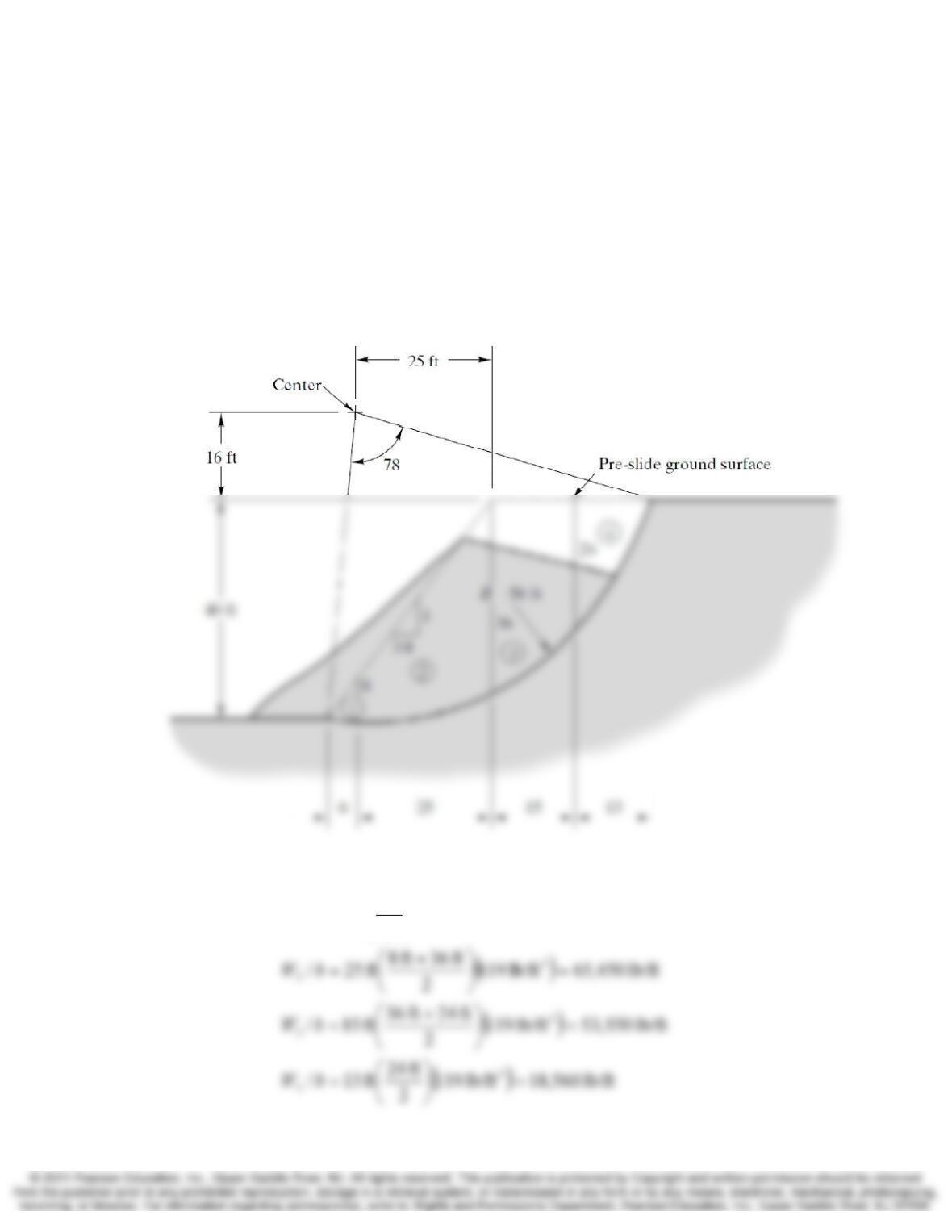
Chap. 13 Stability of Earth Slopes 13-13
Section 13.11 Miscellaneous Issues
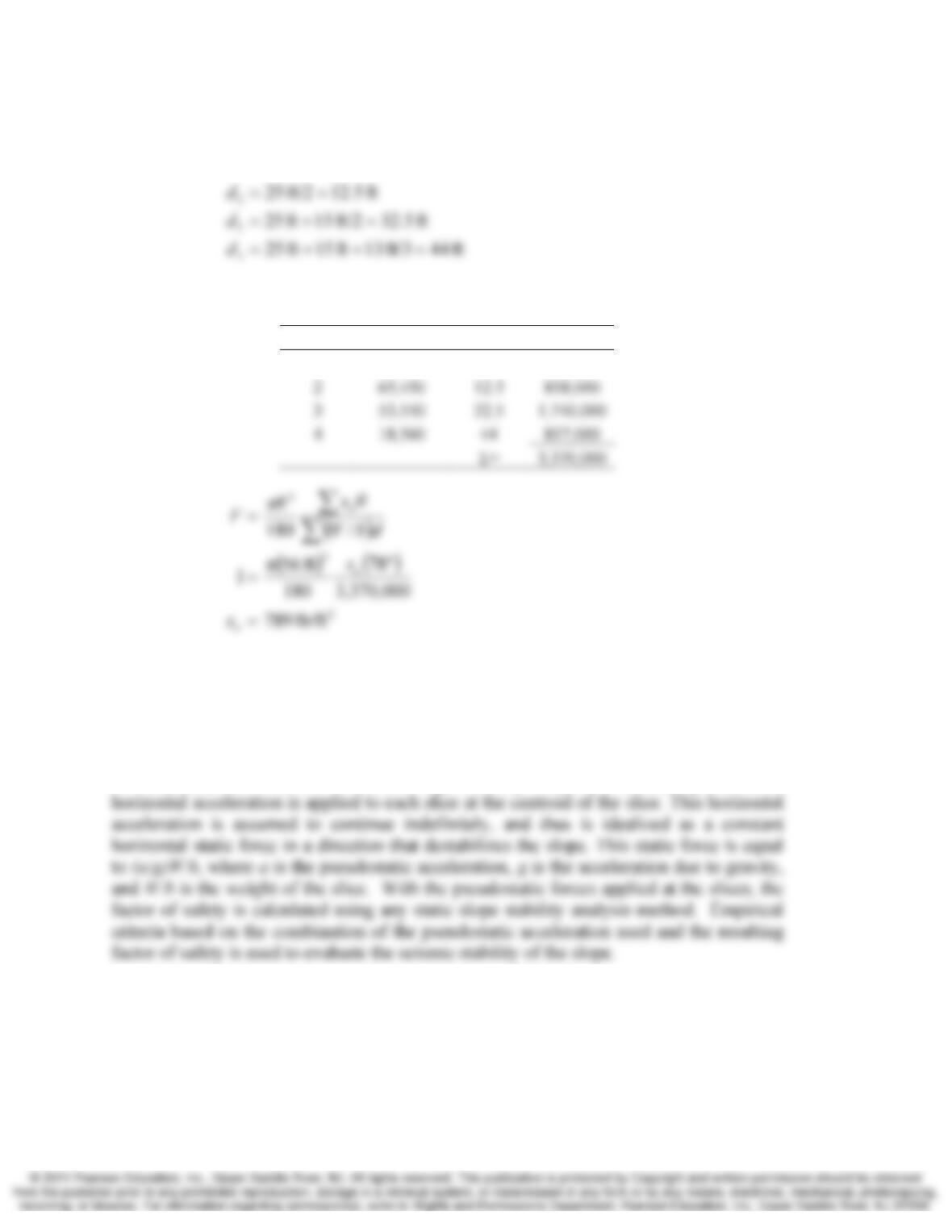
13.20 The slope shown in Figure 13.53 has recently failed. A geotechnical investigation
indicates the failure surface was as shown. Assuming the failure occurred while
undrained conditions prevailed in the slope, back-calculate the value of su. Use the
Swedish slip circle method with the cross-section that existed immediately before it failed.
Use γ = 119 lb/ft3.
Solution
1. Divide into slices
2. Compute weights
()
lb/ft 2860lb/ft 119
2
ft 8
ft 6/
3
1
=
⎟
⎠
⎞
⎜
⎝
⎛
=
bW
13-14 Stability of Earth Slopes Chap. 13
3. Compute moment arms
ft 2ft/3 6
1
−=−=
d
4. Combine data and solve using Equation 13.20
Slice W/b (lb/ft) d (ft) (W/b) d
1 2,860 -2 -5,000
Section 13.12 Seismic Stability
13.21 Describe the pseudostatic method used to evaluate the seismic stability of a slope.
Solution
In the pseudostatic method of seismic slope stability analysis, a constant pseudostatic
13.22 Describe the Newmark’s method used to estimate permanent slope displacements caused
by an earthquake.
Chap. 13 Stability of Earth Slopes 13-15
Solution
The Newmark’s method first establishes the yield acceleration, ay, that corresponds to
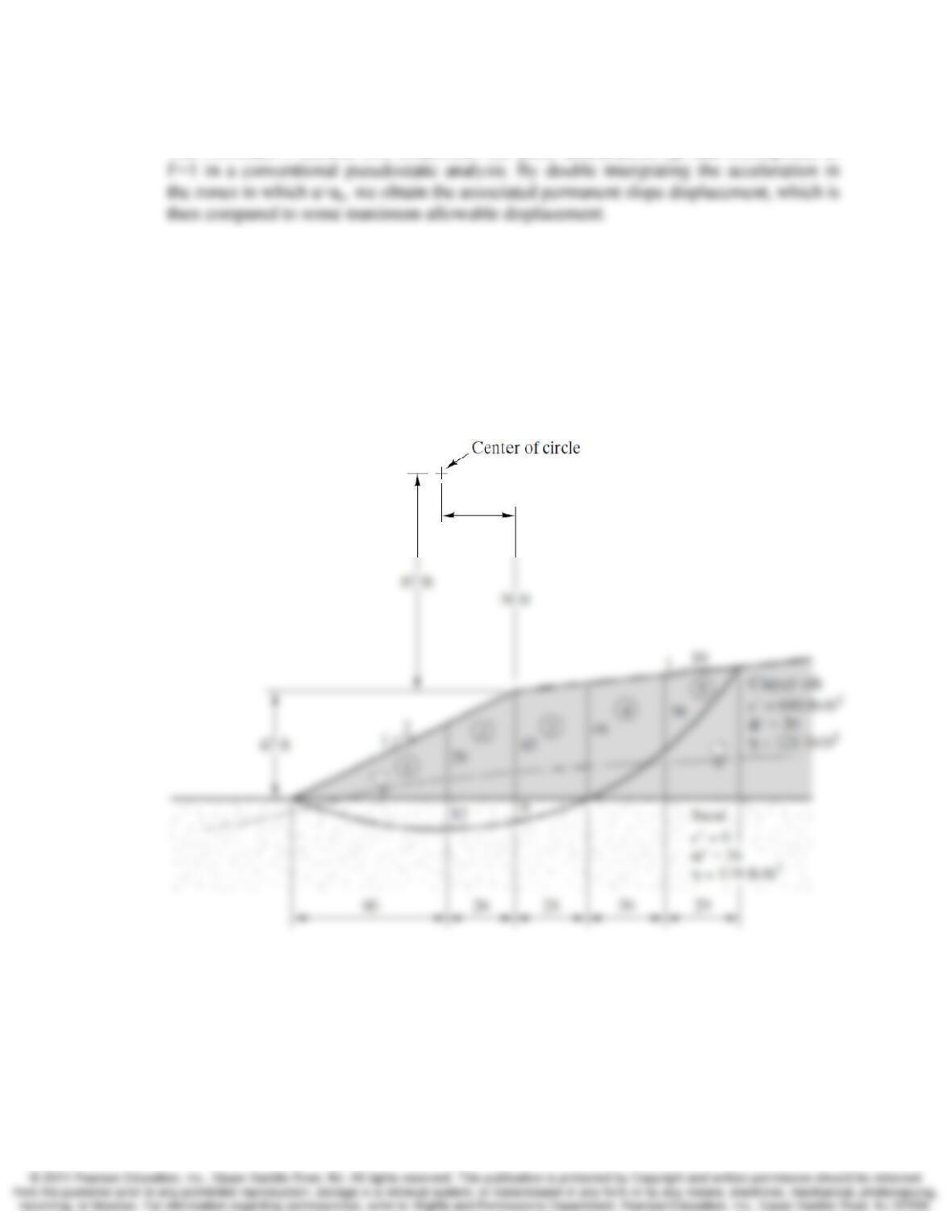
13.23 Using the ordinary method of slices, compute the factor of safety for the failure surface
shown in Figure 13.54. Then, assume an earthquake occurs and the sand stratum
liquefies and loses nearly all its strength. Assume further that the shear strength of the
liquefied sand is zero (c′ = 0 and
φ′
= 0). Compute a new factor of safety for the same
failure surface. According to this analysis, will the slope survive the earthquake?
Solution
Divide into slices

13-16 Stability of Earth Slopes Chap. 13
Compute weights
lb/ft 148,110lb/ft 119
2
ft 12
ft 60
lb/ft 121
2
ft 29
ft 60/
33
1
=
⎟
⎠
⎞
⎜
⎝
⎛
+
⎟
⎠
⎞
⎜
⎝
⎛
=
bW
Compute average pore water pressure at base of each slice
()
(
)
lb/ft 811lb/ft 62.4ft 13
5
23
1
=
==
u
Solve Equation 13.28 – Initial conditions
Slice
W/b
(lb/ft) α (Deg)
c’
(lb/ft2) φ‘ (Deg)
u
(lb/ft2) l (m)
c’l+((W/b)cosα
-ul)tanφ‘
(W/b)sin
α
1 148,100 -11 0 36 811 61 69,688 -28,260
Solve Equation 13.28 – Liquefied conditions

Chap. 13 Stability of Earth Slopes 13-17
Slice
W/b
(lb/ft) α (Deg)
c’
(lb/ft2) φ‘ (Deg) u (lb/ft2) l (m)
c’l+((W/b)cosα
-ul)tanφ‘
(W/b)sin
α
1 148,100 –11 0 0 – 61 0 -28,260
Section 13.13 Stabilization Measures
13.24 A certain slope has a factor of safety of 1.15 according to a Swedish slip circle analysis.
To increase F to 1.50, you are considering the possibility of removing the upper portion
of this slope, then rebuilding it to the original grades using a lightweight fill. Assuming
the critical failure surface remains in the same location, how much must the weight of the
potential slide body be reduced to produce the required factor of safety? Assume su along
the failure surface remains unchanged. Express your answer as a percentage of the
existing weight.
Note: In reality, the critical failure surface would probably shift to a new location,
so this preliminary analysis would need to be followed by another search for the critical
surface.
Solution
According to Equation 13.20, the factor of safety is inversely proportional to W/b.
Therefore:

13-18 Stability of Earth Slopes Chap. 13
13.25 The hydraulic conductivity of a buttress fill is sometimes smaller than that of the adjacent
natural ground. This is especially common when the natural ground is stratified, and
water seeps along the more pervious strata. Could this difference in hydraulic
conductivity cause any problems? Explain. If so, what might be done to remedy these
problems?
Solution
This condition could produce an accumulation of groundwater in the natural soils
13.26 The soil beneath a slope consists of alternating layers of sand and clay. These layers are
nearly horizontal, but vary in thickness such that no two boring logs found these layers at
the same elevations. This slope is to be stabilized by installing a series of horizontal
drains that are intended to lower the groundwater table. The drains will be drilled at 20 ft
intervals near the toe of the slope, and each one will be drilled at the same angle and to
the same length. Would you expect the same flow rate from each drain? Why or why
not?
Solution
The axes of the drains are approximately parallel to the strata boundaries. Therefore,
Section 13.14 Instrumentation
13.27 In 1962, a developer purchased 100 acres of hilly land and subdivided it for use as a
housing tract. The subsequent construction included extensive cuts and fills to create
level building pads separated by 1.5:1 cut and fill slopes. Unfortunately, the building
codes in that county were much more lax than they are today, so the quality of the
earthwork was not as high as would now be required. As a result, some of the slopes in
this tract have experienced slides, especially during years with heavier-than-normal
rainfall.
One of the slopes is showing some signs of possible instability (i.e., tension
cracks, some surface evidence of small movements, etc.), so the current owner wishes to
stabilize it. You have designed a stabilization scheme that includes dewatering and
construction of a buttress fill. You also need to install appropriate instrumentation to
monitor the slope and thus determine if the stabilization is working. What type or types
of instrumentation would be appropriate and where should it be installed?
Solution

Chap. 13 Stability of Earth Slopes 13-19
Inclinometers would be the best type of instrumentation because they detect movement at
Comprehensive
13.28 Some slides are large enough and move far enough to completely block a canyon or
valley and thus form a new lake. The Thistle slide in Figure 13.1 is an example. Why
are these slides especially dangerous, and what can be done to alleviate this danger once
the slide has occurred?
Solution
The primary problem with this scenario is that a lake will form behind the slide. Since
this lake has no outlet, the water level will continue to rise until it overtops the slide, thus
13.29 A national park visitor’s center has unfortunately been built on soils deposited by a series
of earth flows. The building is located near the base of a canyon where it meets a larger
valley. Ten years after construction, another earth flow occurred and deposited up to 3 ft
of mud and debris around the visitor’s center. Although the building was not seriously
damaged, it was expensive and time consuming to clean up the mess. Everyone now
recognizes that this building should have been constructed somewhere else, but there is
no funding available to move it or replace it. Suggest one or two ways of protecting the
building from future earth flows.
Solution
One solution would be to install surface drainage control devices, such as concrete-lined

13-20 Stability of Earth Slopes Chap. 13
13.30 A preliminary grading plan for a proposed highway shows a 50-ft-tall, 2:1 cut slope
ascending from each side of the highway with level land above both slopes. Following a
geotechnical study, it became necessary to change these slope ratios to 3:1. Assuming
the existing right-of-way barely accommodates the 2:1 slopes, how much additional
right-of-way must now be purchased because of this change?
Solution
Changing from a 2:1 slope to a 3:1 slope would require an additional 50 ft right-of-way
13.31 The more rigorous limit equilibrium analysis methods, such as the modified Bishop’s and
Spencer’s methods, produce factors of safety that are within about 5% of the “true” value.
How does this error compare to the uncertainty in the soil properties (c′,
φ′
and γ) and the
uncertainty in the design soil profile? In light of these other sources of uncertainty, is a
±5% error tolerable? Explain.
Solution
Most soil property data and most design soil profiles contain wide ranges of uncertainty,
13.32 A compacted fill slope is to be made of a soil with c′ = 200 lb/ft2,
φ′
= 30° and γ = 122
lb/ft3. Using an infinite slope analysis and assuming a failure surface 4.0 ft below the
ground surface and a groundwater table 1.0 ft below the ground surface, determine the
steepest allowable slope ratio that will maintain a factor of safety of at least 1.5.
Note: This analysis considers only surficial stability. A separate analysis would
need to be conducted to evaluate the potential for a deep-seated slide in the fill.
Solution

Chap. 13 Stability of Earth Slopes 13-21
13.33 A 4-inch perforated pipe drain has been installed as part of a subsurface drainage system.
The pipe has been surrounded with a poorly-graded 1.5 inch gravel. The adjacent soils
are sandy silts. What is missing from this design? What mode of failure is likely to
occur? What should be done to improve this design?
Solution
This design will almost certainly have problems with soil migration. The sandy silts are