PROBLEM 12.46
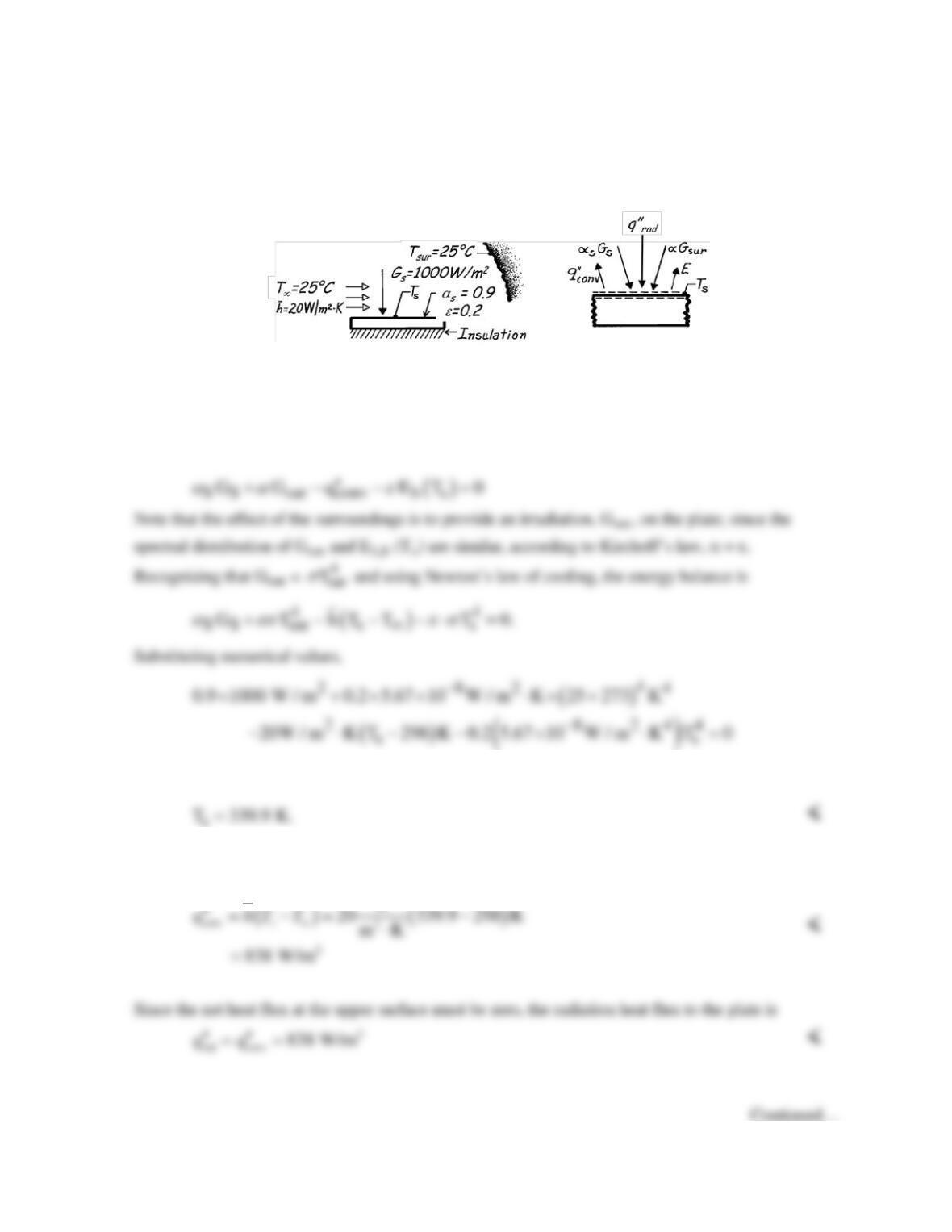
KNOWN: Plate exposed to solar flux with prescribed solar absorptivity and emissivity; convection
and surrounding conditions also prescribed.
FIND: Steady–state temperature of the plate, convection and radiation fluxes at plate surface.
SCHEMATIC:
ASSUMPTIONS: (1) Steady-state conditions, (2) Plate is small compared to surroundings, (3)
Backside of plate is perfectly insulated, (4) Diffuse behavior.
ANALYSIS: Perform a surface energy balance on the top surface of the plate.
in out
EE 0−=
Solving,
The convection heat flux from the plate is
W
PROBLEM 12.46 (Cont.)
(2) Note that
rad
q′′
may be expressed as
()()
44
rad S S sur s
q G TT
α εs
′′ =+−
PROBLEM 12.47
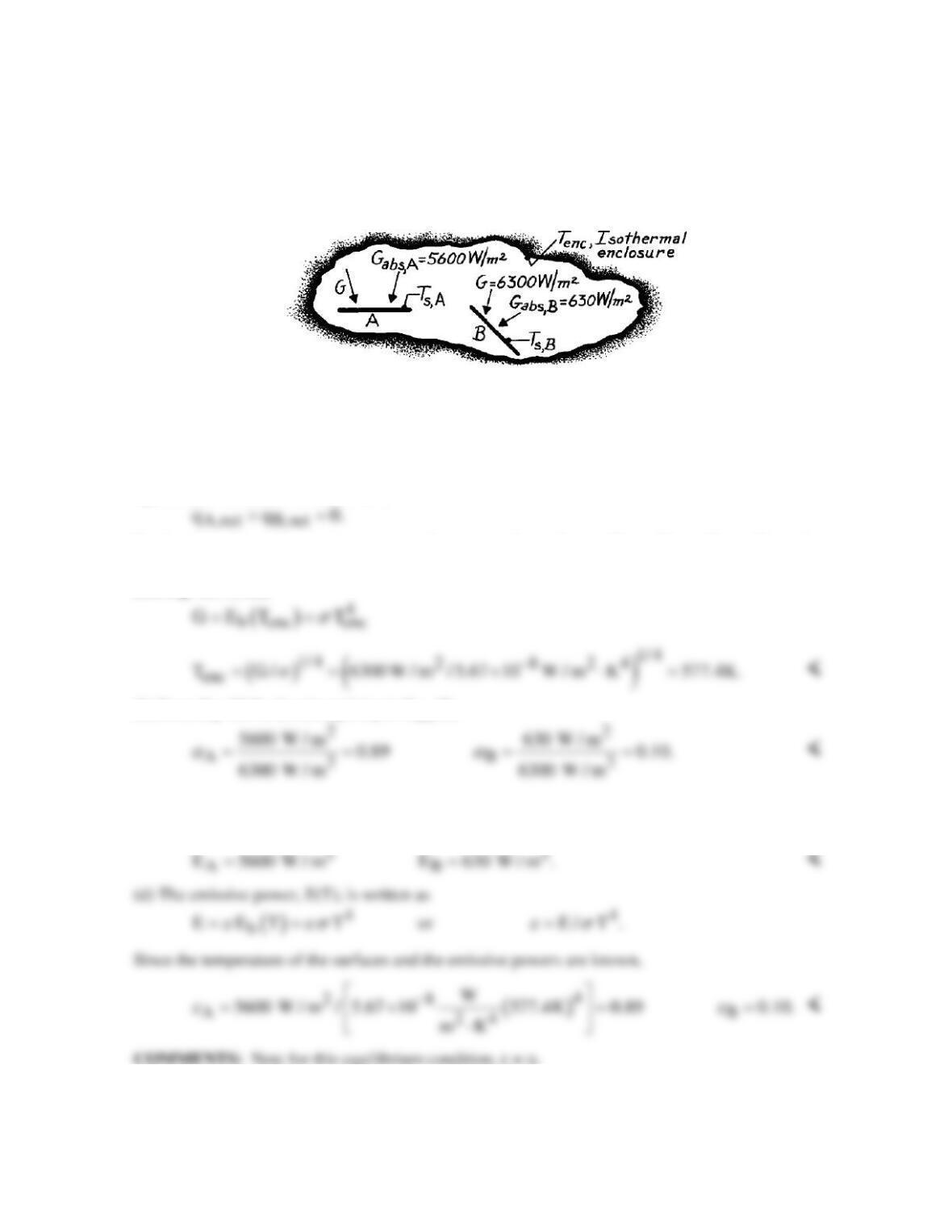
KNOWN: Isothermal enclosure at a uniform temperature provides a known irradiation on two small
surfaces whose absorption rates have been measured.
FIND: (a) Net heat transfer rates and temperatures of the two surfaces, (b) Absorptivity of the
surfaces, (c) Emissive power of the surfaces, (d) Emissivity of the surfaces.
SCHEMATIC:
ASSUMPTIONS: (1) Enclosure is at a uniform temperature and large compared to surfaces A and
B, (2) Surfaces A and B have been in the enclosure a long time, (3) Irradiation to both surfaces is the
same.
ANALYSIS: (a) Since the surfaces A and B have been within the enclosure a long time, thermal
equilibrium conditions exist. That is,
Furthermore, the surface temperatures are the same as the enclosure, Ts,A = Ts,B = Tenc. Since the
enclosure is at a uniform temperature, it follows that blackbody radiation exists within the enclosure
(see Fig. 12.11) and
(b) From Eq. 12.51, the absorptivity is Gabs/G,
(c) Since the surfaces experience zero net heat transfer, the energy balance is Gabs = E. That is, the
absorbed irradiation is equal to the emissive power,
PROBLEM 12.48
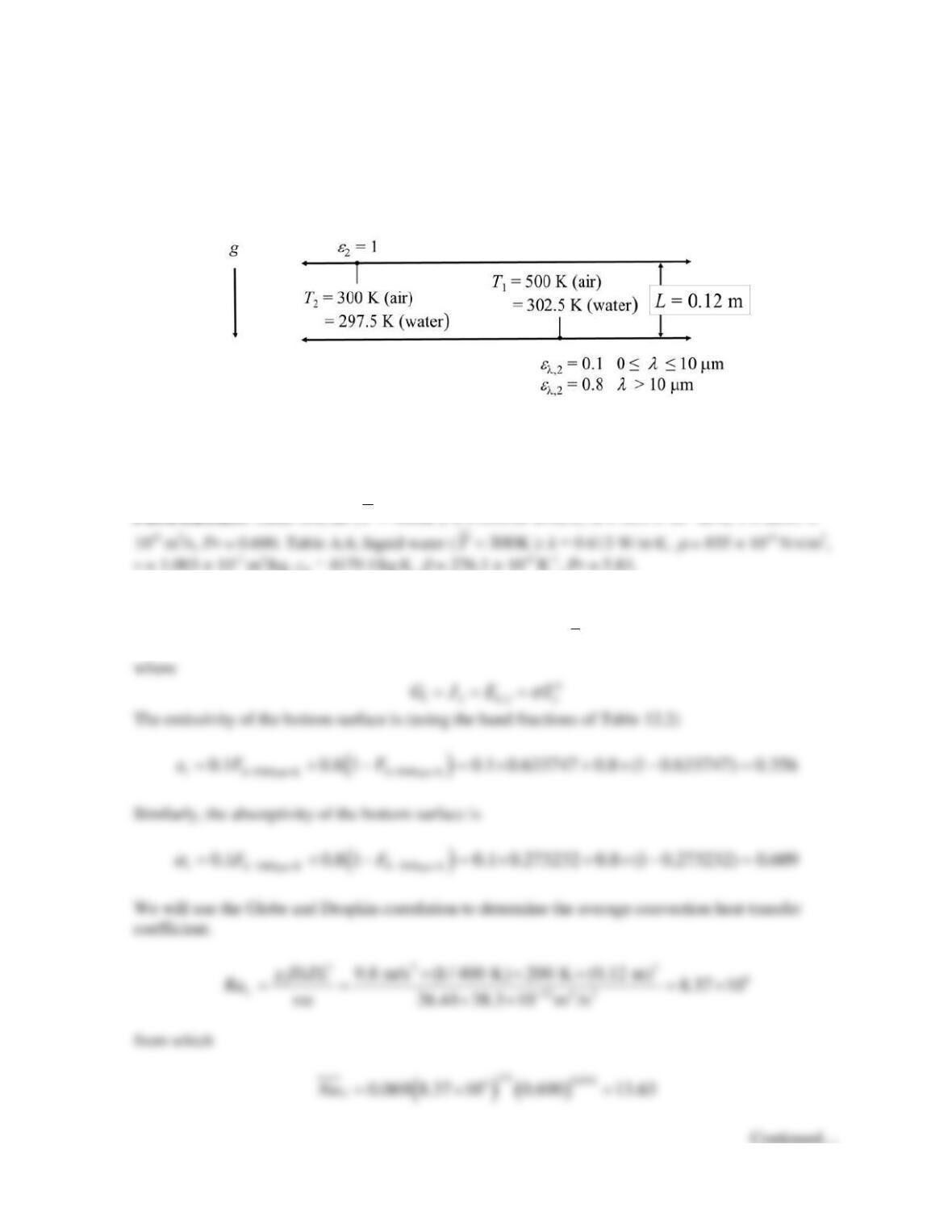
KNOWN: Temperatures and emissivities of horizontal, parallel, opaque surfaces. Type of fluid
between the two plates.
FIND: (a) Heat flux between plates when the fluid is air at atmospheric pressure, (b) heat flux
between plates when the fluid is liquid water.
SCHEMATIC:
ASSUMPTIONS: (1) Steady-state conditions, (2) Constant properties, ideal gas, (3) Diffuse
surfaces.
PROPERTIES: Table A.4, air (
400KT=
): k = 0.0338 W/m∙K,
α
= 38.3 × 10⁻⁶ m2/s,
ν
= 26.41 ×
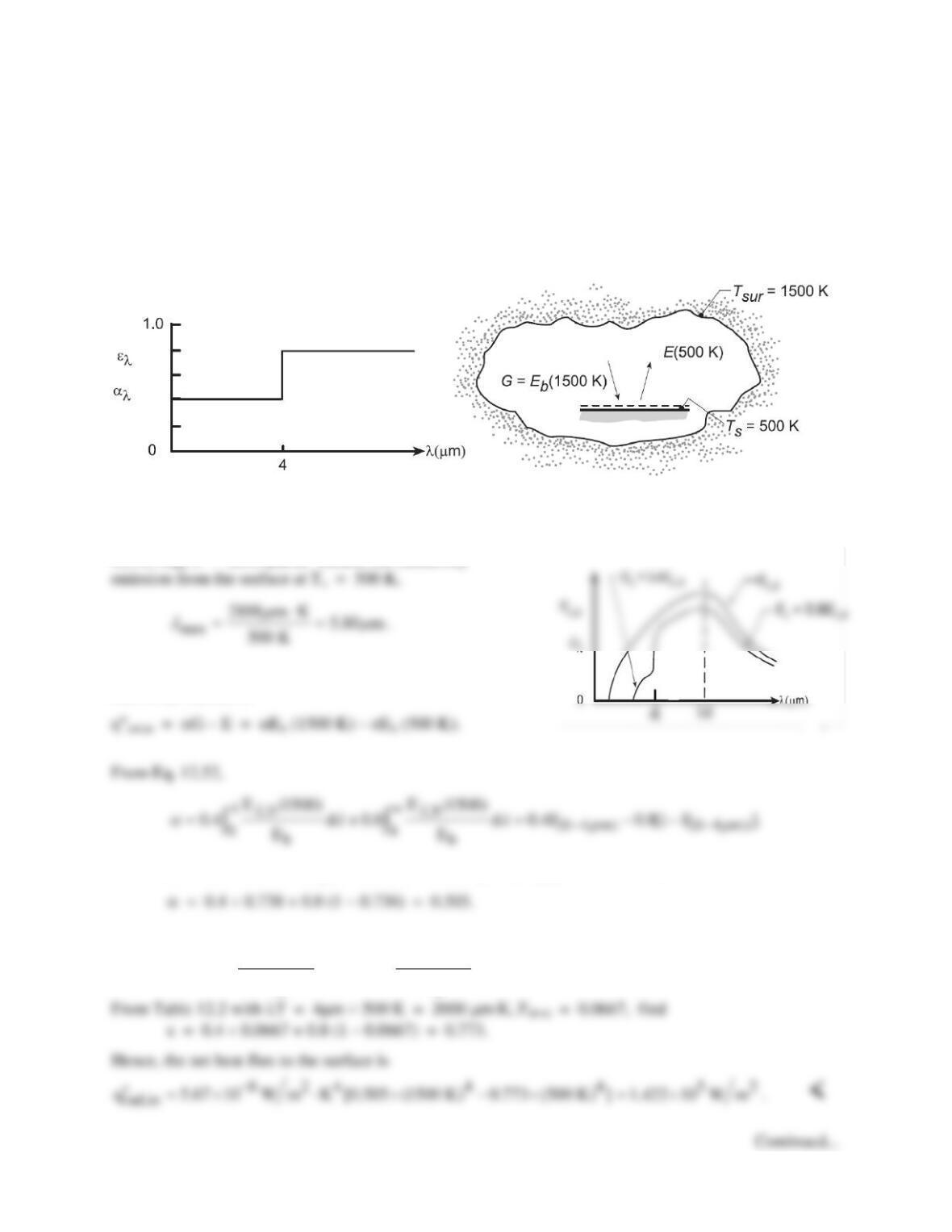
ANALYSIS: (a) An energy balance on the bottom surface yields
( )
4
rad conv 1 1 1 1 1 2
q q q T G hT T
εs α
′′ ′′ ′′
=+= −+−
or
0.12 m
Therefore,
44
( )
( )
L
or
0.12 m
Therefore,
COMMENTS: (1) For the air case, the radiation and convection fluxes are of the same order of
PROBLEM 12.49
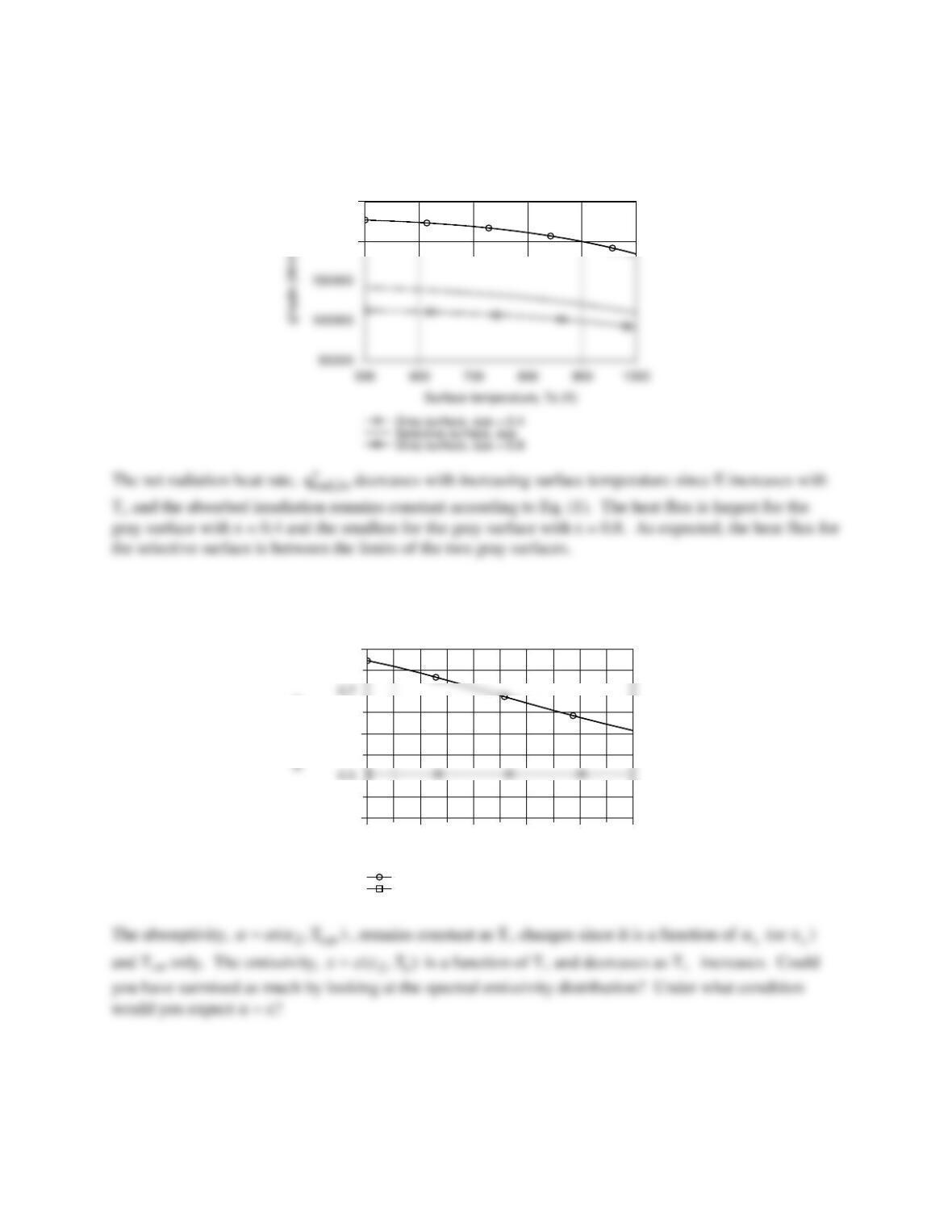
KNOWN: Temperature and spectral characteristics of a diffuse surface at Ts = 500 K situated in a large
enclosure with uniform temperature, Tsur = 1500 K.
FIND: (a) Sketch of spectral distribution of
Eλ
and
Ebλ,
for the surface, (b) Net heat flux to the
surface, q″rad,in (c) Compute and plot q″rad,in as a function of Ts for the range 500 ≤ Ts ≤ 1000 K; also plot
the heat flux for a diffuse, gray surface with total emissivities of 0.4 and 0.8; and (d) Compute and plot
ε and α as a function of the surface temperature for the range 500 ≤ Ts ≤ 1000 K.
SCHEMATIC:
ASSUMPTIONS: (1) Surface is diffuse, (2) Convective effects are negligible, (3) Surface irradiation
corresponds to blackbody emission at 1500 K.
ANALYSIS: (a) From Wien’s displacement law, Eq.
12.31, λmax T = 2898 µm⋅K. Hence, for blackbody
(b) From an energy balance on the surface, the net heat
flux to the surface is
From Table 12.2 with λT = 4µm × 1500 K = 6000 µm⋅K, F(0-4) = 0.738, find
From Eq. 12.43
4,b ,b
(0 4 m) (0 4 m)
04
bb
E (500) E (500)
0.4 d 0.8 d 0.4F 0.8[1 F ]
EE
∞−−
= + = +−
∫∫
λλ µµ
ελλ
.
PROBLEM 12.49 (Cont.)
(c) Using the foregoing equations in the IHT workspace along with the IHT Radiation Tool, Band
Emission Factor,
rad,in
q′′
was computed and plotted as a function of Ts.
200000
250000
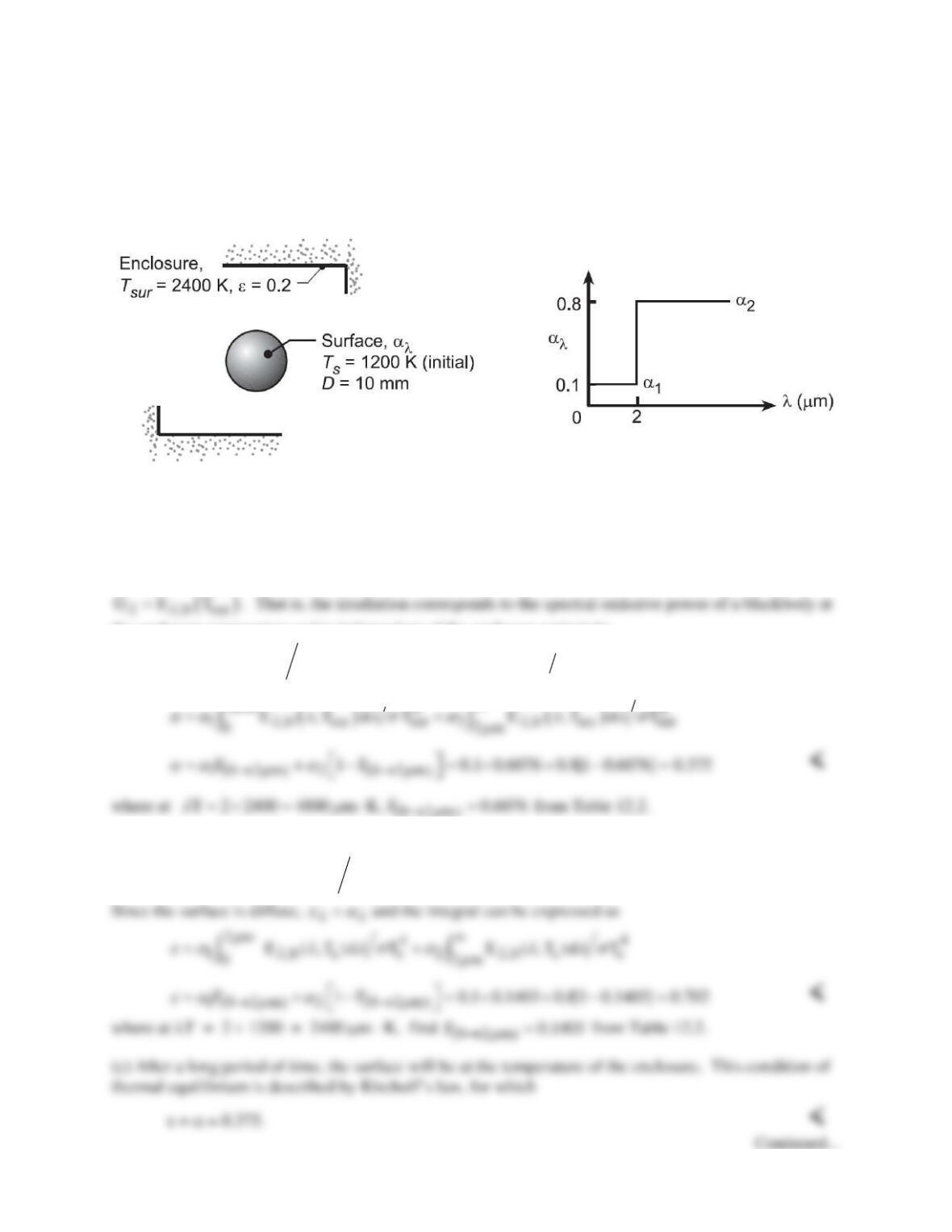
(d) Using the IHT model of part (c), the emissivity and absorptivity of the surface are computed and
plotted below.
500 600 700 800 900 1000
Surface temperature, Ts (K)
0.4
0.6
0.8
Emissivity, eps
Absorptivity, alpha
PROBLEM 12.50
KNOWN: Small, opaque surface initially at 1200 K with prescribed
αλ
distribution placed in a large
enclosure at 2400 K.
FIND: (a) Total, hemispherical absorptivity of the sample surface, (b) Total, hemispherical emissivity,
(c) α and ε after long time has elapsed, (d) Variation of sample temperature with time.
SCHEMATIC:
ASSUMPTIONS: (1) Surface is diffusely radiated. (2) Enclosure is much larger than surface and at a
uniform temperature.
PROPERTIES: Table A.1, Tungsten (T ≈ 1800 K): ρ = 19,300 kg/m3, cp = 163 J/kg⋅K, k ≈ 102
W/m⋅K.
ANALYSIS: (a) The total, hemispherical absorptivity follows from Eq. 12.52, where
the enclosure temperature and is independent of the enclosure emissivity.
( ) ( )
,b sur b sur
0 00
Gd Gd E ,T d E T
λλ λ λλ
αα λ λα λ λ
∞ ∞∞
= =
∫ ∫∫
2m 44
µλλ
∞
(b) The total, hemispherical emissivity follows from Eq. 12.43,
,b s ,b s
00
E ( ,T )d E ( ,T )d
λλ λ
ε ε λλ λλ
∞∞
=∫∫
.
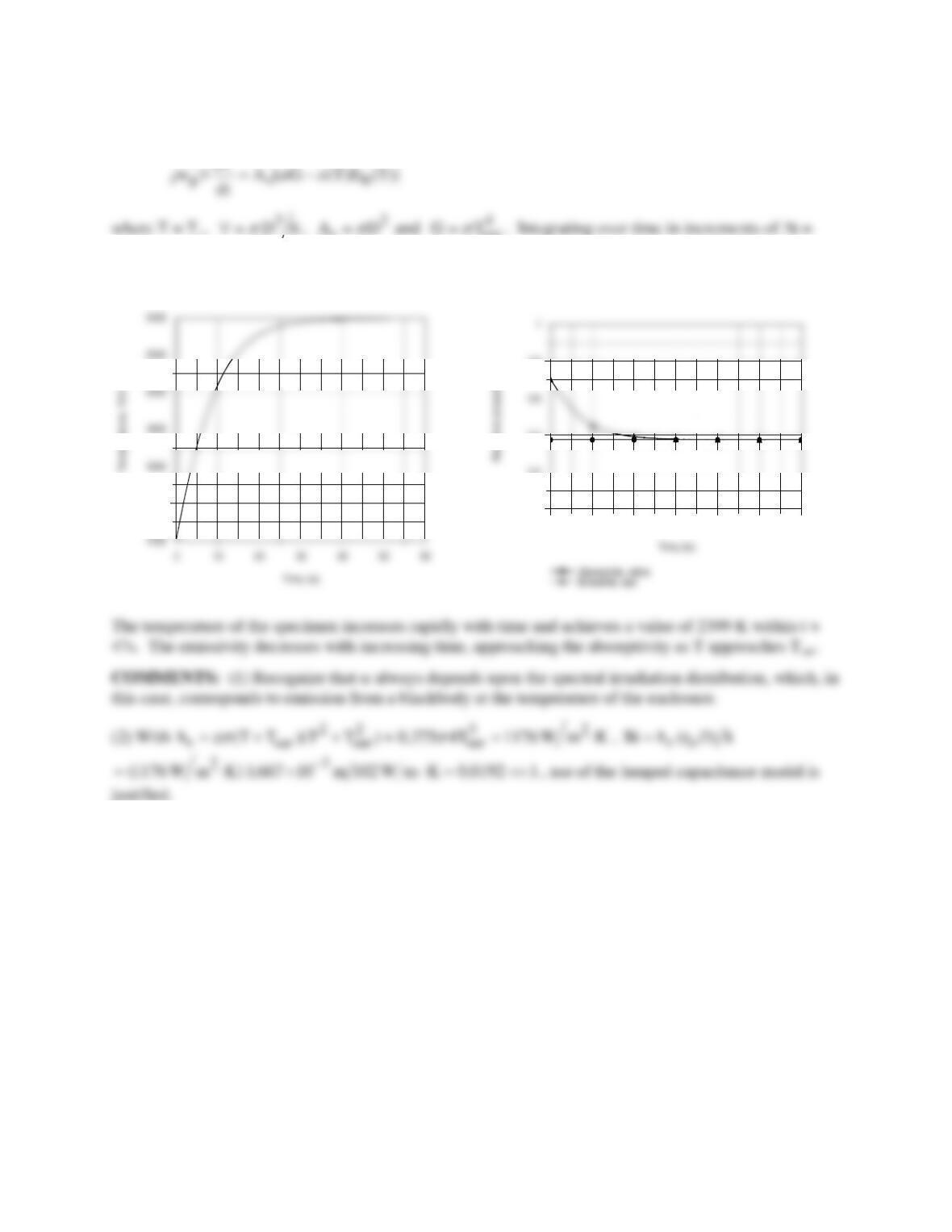
PROBLEM 12.50 (Cont.)
(d) Using the IHT Lumped Capacitance Model, the energy balance relation is of the form
s
sur
0.5s and using the Radiation Toolpad to determine ε(t),
the following results are obtained.
1400
010 20 30 40 50 60
0
0.2
0.4
0.8
PROBLEM 12.51
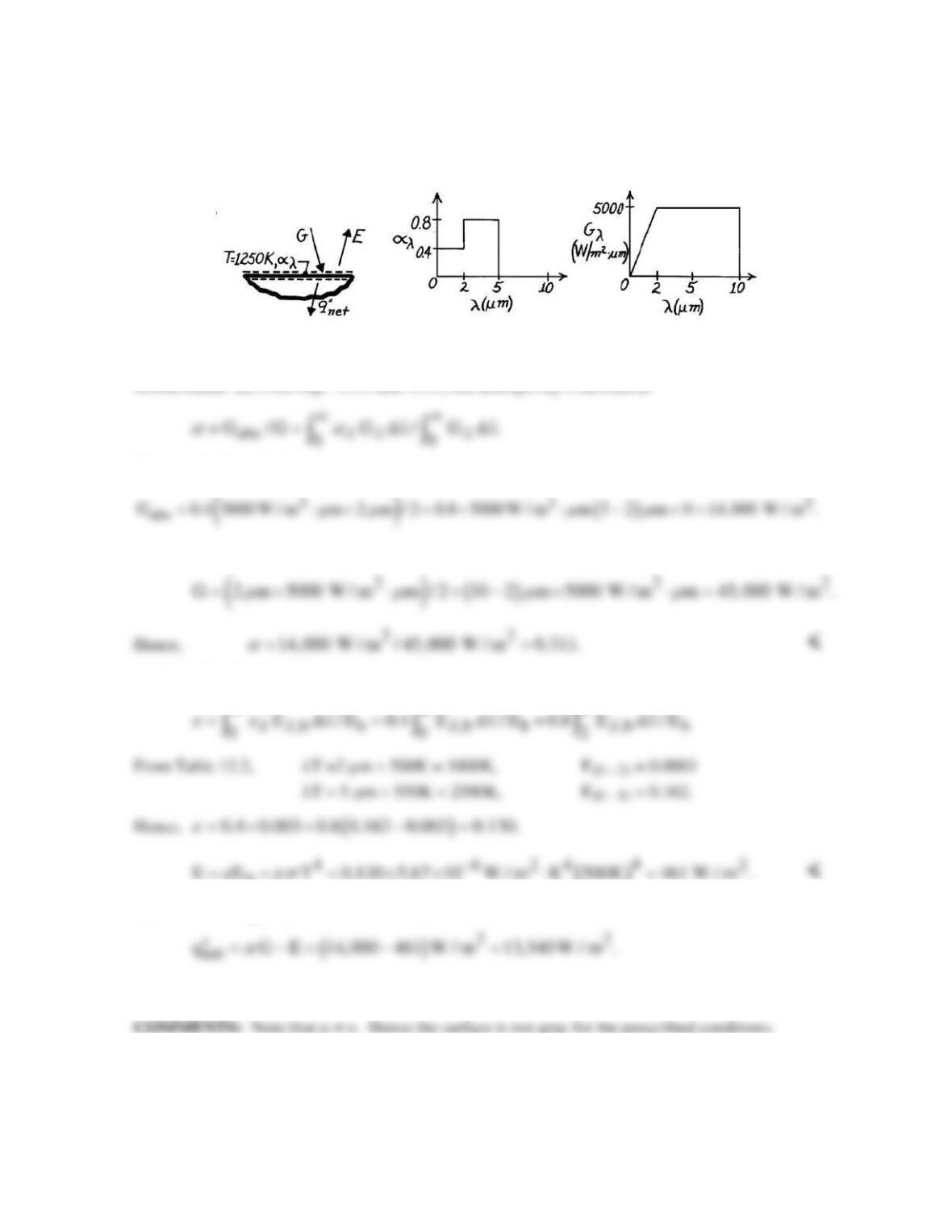
KNOWN: Opaque, diffuse surface with prescribed spectral reflectivity and at a temperature of 750K
is subjected to a prescribed spectral irradiation, Gλ.
FIND: (a) Total absorptivity, α, (b) Total emissivity, ε, (c) Net radiative heat flux to the surface.
SCHEMATIC:
ASSUMPTIONS: (1) Opaque and diffuse surface, (2) Backside insulated.
ANALYSIS: (a) The total absorptivity is determined from Eq. 12.52 and 12.62,
Evaluating by separate integrals over various wavelength intervals.
( ) ( ) ( )
368
,1 ,2 ,2
1 3 6 abs
368
1 Gd 1 Gd 1 Gd G
G
λλλλλλ
ρ λρ λρ λ
α
− +− +−
= =
∫∫∫
(b) The total emissivity of the surface is determined from Eq. 12.43 and 12.62,
and, hence 1 .
λλ λ λ
εα ε ρ
= = −
(3,4)
The total emissivity can then be expressed as
( ) ( ) ( ) ( ) ( )
,b s b s ,b s b s
00
E ,T d /E T 1 E ,T d /E T
λλ λ λ
ε ε λλ ρ λλ
∞∞
= = −
∫∫
3
∞
rad
q 0.720 2500 W / m
′′ = ×
( )
PROBLEM 12.52
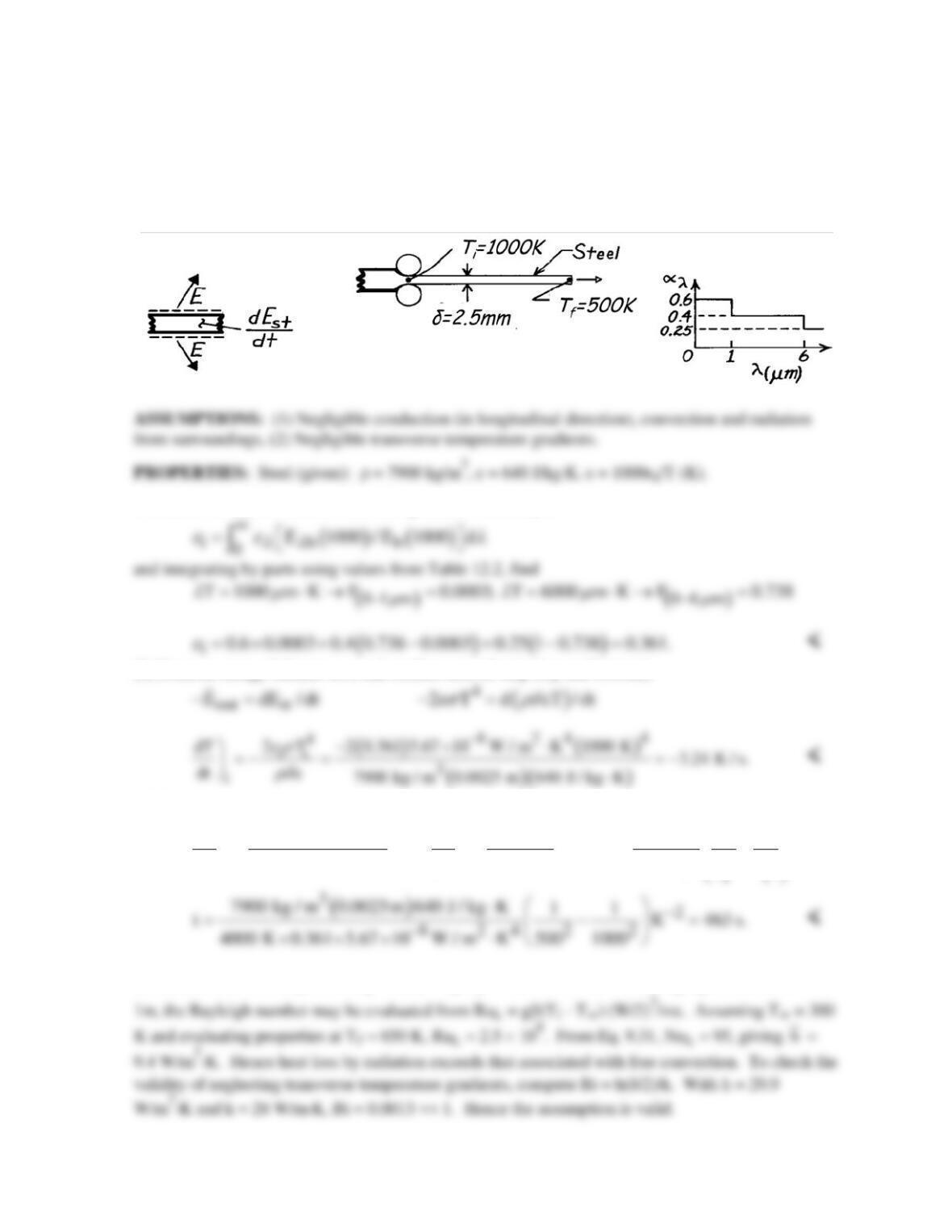
KNOWN: Spectral distribution of surface absorptivity and irradiation. Surface temperature.
FIND: (a) Total absorptivity, (b) Emissive power, (c) Nature of surface temperature change.
SCHEMATIC:
ASSUMPTIONS: (1) Opaque, diffuse surface behavior, (2) Convection effects are negligible.
The absorbed irradiation is,
The irradiation is,
(b) From Eq. 12.43, the emissivity is
( )
b
(c) From an energy balance on the surface, the net heat flux to the surface is
Hence the temperature of the surface is increasing. <
PROBLEM 12.53
KNOWN: Temperature, thickness and spectral emissivity of steel strip emerging from a hot roller.
Temperature dependence of total, hemispherical emissivity.
FIND: (a) Initial total, hemispherical emissivity, (b) Initial cooling rate, (c) Time to cool to
prescribed final temperature.
SCHEMATIC:
ANALYSIS: (a) The initial total hemispherical emissivity is
(b) From an energy balance on a unit surface area of strip (top and bottom),
(c) From the energy balance,
( )
f
i
4Tt
ii
3 22
T0
ifi
2 1000 / T T
dT dT 2000 c 1 1
, dt, t
dt c c 4000
T TT
εs ε s ρd
ρd ρd ε s
=− =−=−
∫∫
COMMENTS: Initially, from Eq. 1.9, hr ≈
3
ii
T
εs
= 20.5 W/m2⋅K. Assuming a plate width of W =
PROBLEM 12.54
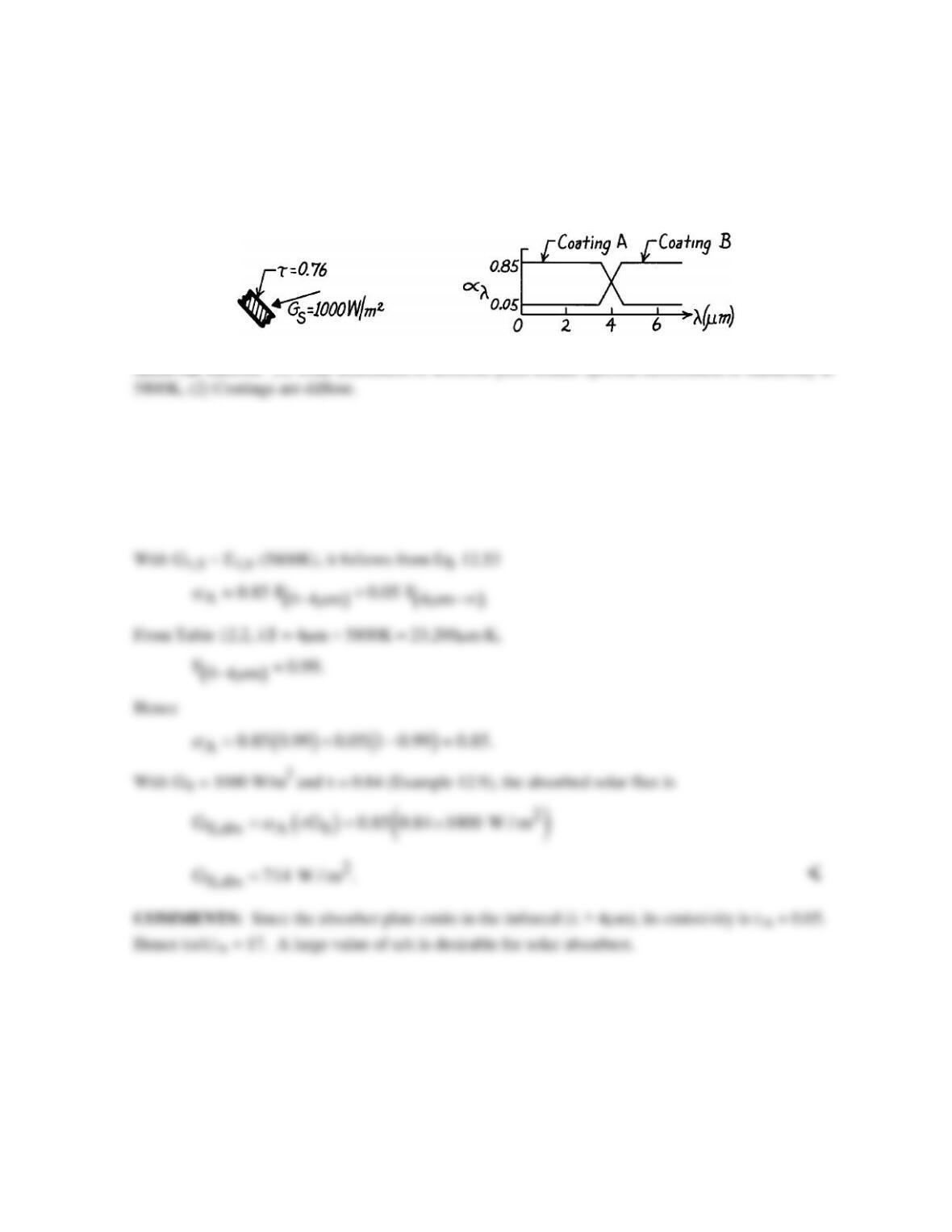
KNOWN: Transmissivity of cover plate and spectral absorptivity of absorber plate for a solar
collector.
FIND: Absorption rate for prescribed solar flux and preferred absorber plate coating.
SCHEMATIC:
ANALYSIS: At the absorber plate we wish to maximize solar radiation absorption and minimize
losses due to emission. The solar radiation is concentrated in the spectral region λ < 4µm, and for a
representative plate temperature of T ≤ 350K, emission from the plate is concentrated in the spectral
region λ > 4µm. Hence,
Coating A is vastly superior. <
PROBLEM 12.55
KNOWN: Material with prescribed radiative properties covering the peep hole of a furnace and
exposed to surroundings on the outer surface.
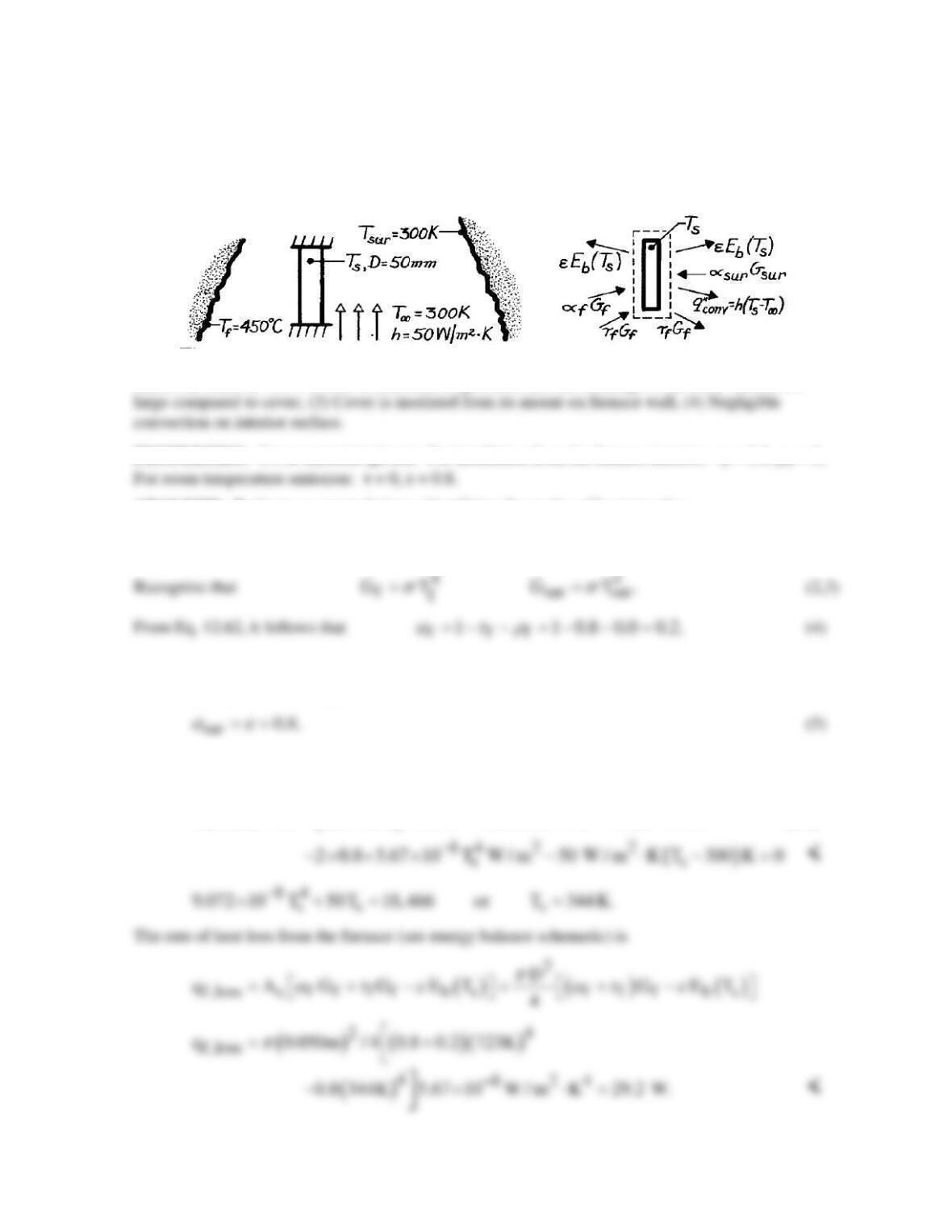
FIND: Steady–state temperature of the cover, Ts; rate of heat loss from furnace.
SCHEMATIC:
ASSUMPTIONS: (1) Cover is isothermal, no gradient, (2) Surroundings of the outer surface are
PROPERTIES: Cover material (given): For irradiation from the furnace interior: τf = 0.8, ρf = 0;
ANALYSIS: Perform an energy balance identifying the modes of heat transfer,
( ) ( )
in out f f sur sur b s s
E E 0 G G 2 E T h T T 0.
αα ε
∞
− = + − − −=
(1)
Since the irradiation Gsur will have nearly the same spectral distribution as the emissive power of the
cover, Eb (Ts), and since Gsur is diffuse irradiation,
This reasoning follows from Eqs. 12.69 and 12.70. Substituting Eqs. (2-5) into Eq. (1) and using
numerical values,
( )
4
8 2 84 2
0.2 5.67 10 450 273 W / m 0.8 5.67 10 300 W / m
−−
×× + +×× ×
(2-5)
PROBLEM 12.56
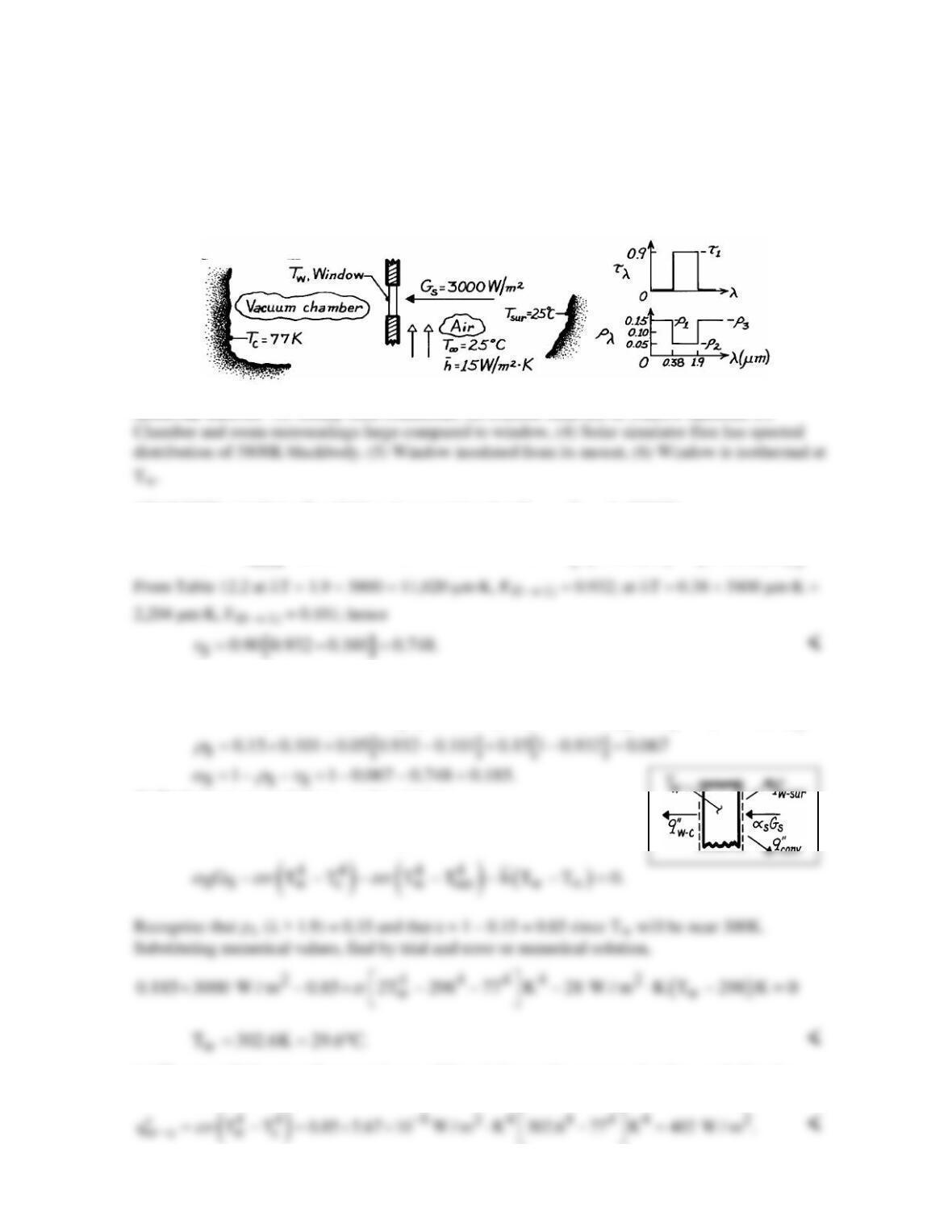
KNOWN: Window with prescribed τλ and ρλ mounted on cooled vacuum chamber passing
radiation from a solar simulator.
FIND: (a) Solar transmissivity of the window material, (b) State–state temperature reached by
window with simulator operating, (c) Net radiation heat transfer to chamber.
SCHEMATIC:
ASSUMPTIONS: (1) Steady-state conditions, (2) Diffuse behavior of window material, (3)
ANALYSIS: (a) Using Eq. 12.61 and recognizing that Gλ,S ~ Eb,λ (λ, 5800K),
( ) ( )
( ) ( )
1.9
S 1 ,b b 1 0 1.9 m 0 0.38 m
λµµ
ττ λ λ τ
→→
= = −
∫
Recognizing that later we’ll need αS, use Eq. 12.58 to find ρS
( ) ( ) ( ) ( )
S1 2 3
0 0.38 m 0 1.9 m 0 0.38 m 0 1.9 m
F F F 1F
µ µµ µ
ρρ ρ ρ
→ →→ →
= + − +−
(b) Perform an energy balance on the window.
S S w c w sur conv
Gq q q 0
α
−−
′′ ′′ ′′
−− −=
(c) The net radiation transfer per unit area of the window to the vacuum chamber, excluding the
transmitted simulated solar flux is
PROBLEM 12.57
KNOWN: Reading and emissivity of a thermocouple (TC) located in a large duct to measure gas stream
temperature. Duct wall temperature and emissivity; convection coefficient.
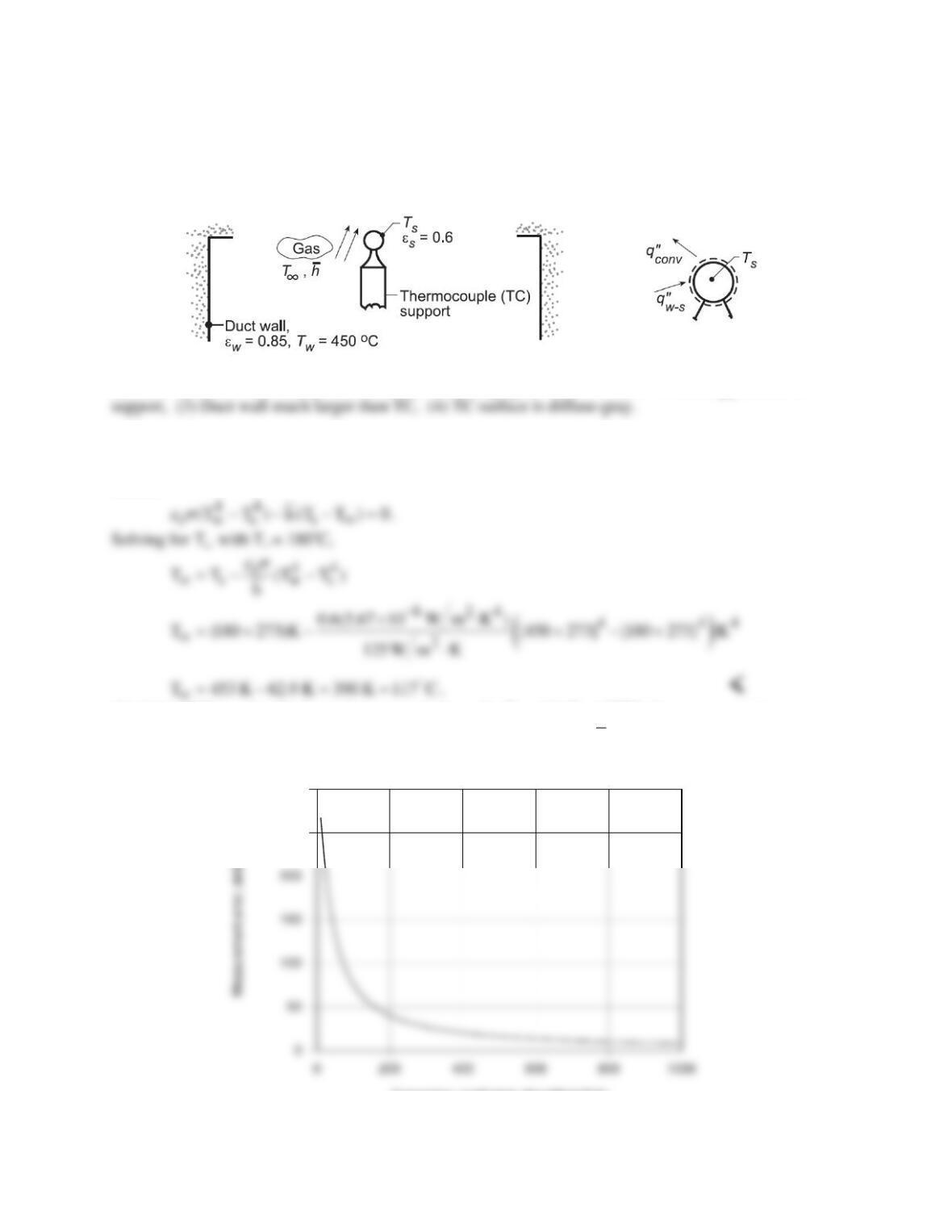
FIND: (a) Gas temperature,
T∞
, (b) Effect of convection coefficient on measurement error.
SCHEMATIC:
ASSUMPTIONS: (1) Steady-state conditions, (2) Negligible heat loss from TC sensing junction to
ANALYSIS: (a) Performing an energy balance on the thermocouple, it follows that
w s conv
qq 0
−
′′ ′′
−=
.
Hence,
(b) Using IHT to solve the foregoing energy balance for Ts, with
T
∞
= 125oC, the measurement error,
defined as ∆T = Ts −
T
∞
, is determined and is plotted as a function of
h
.
Convection coefficient, hbar(W/m^2.K)
250
300
Continued…

PROBLEM 12.57 (Cont.)
The measurement error is enormous (∆T ≈ 270oC) for
h
= 10 W/m2⋅K, but decreases with increasing
h
.
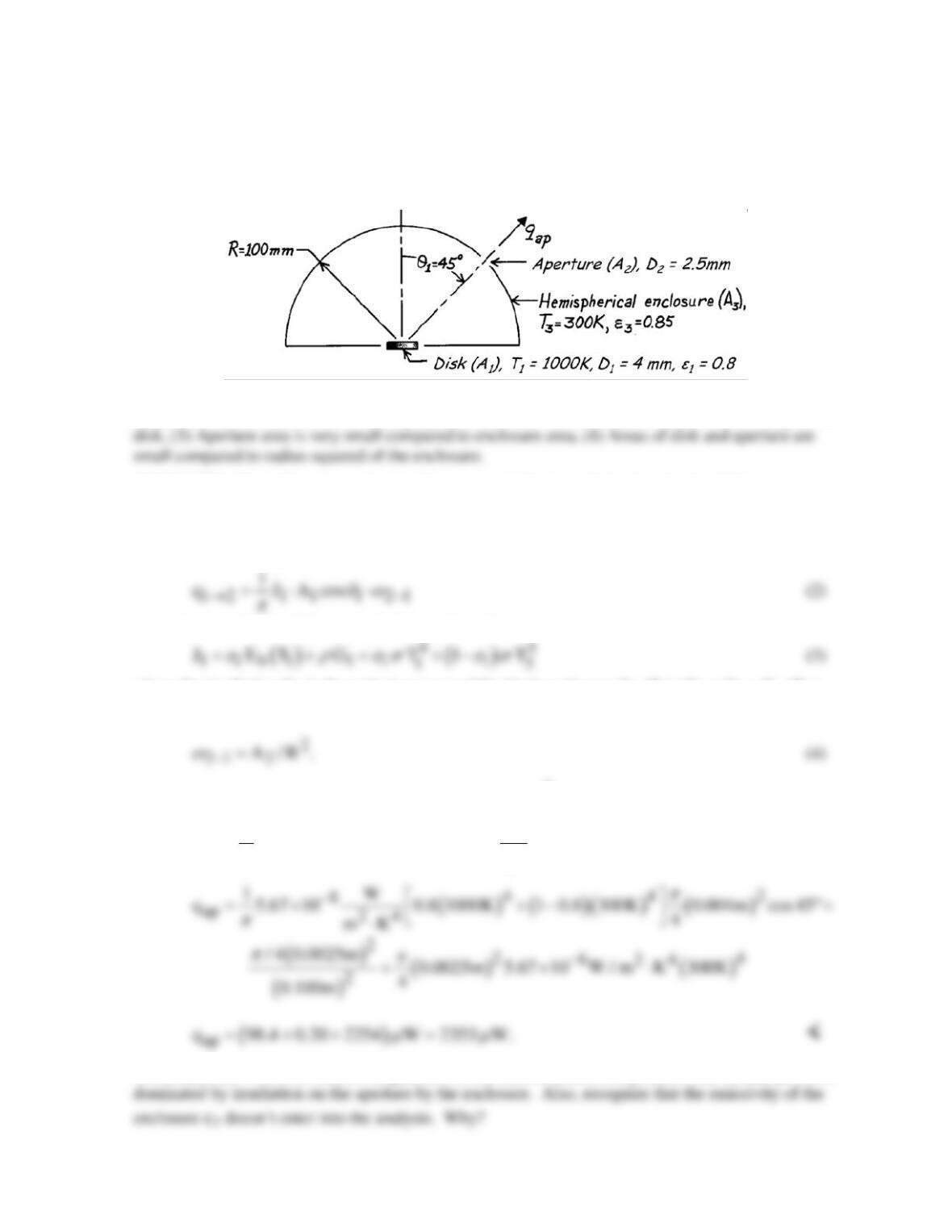
PROBLEM 12.58
KNOWN: Small disk positioned at center of an isothermal, hemispherical enclosure with a small
aperture.
FIND: Radiant power leaving the aperture.
SCHEMATIC:
ASSUMPTIONS: (1) Disk is diffuse–gray, (2) Enclosure is isothermal and has area much larger than
ANALYSIS: The radiant power leaving the aperture is due to radiation leaving the disk and to
irradiation on the aperture from the enclosure. That is,
ap 1 2 2 2
q q G A.
→
= +⋅
(1)
The radiation leaving the disk can be written in terms of the radiosity of the disk. For the diffuse disk,
and with ε = α for the diffuse-gray behavior, the radiosity is
where the irradiation G1 is the emissive power of the black enclosure, Eb (T3); G1 = G2 = Eb (T3).
The solid angle ω2 – 1 follows from Eq. 12.7,
Combining Eqs. (2), (3) and (4) into Eq. (1) with
4
23
G T,
s
=
the radiant power is
( )
44 4
2
ap 1 1 1 1 2
13 3
2
1A
q T 1 T A cos A T
R
sε ε q s
π
= +− ⋅ +
COMMENTS: Note the relative magnitudes of the three radiation components. The radiant power is
PROBLEM 12.59
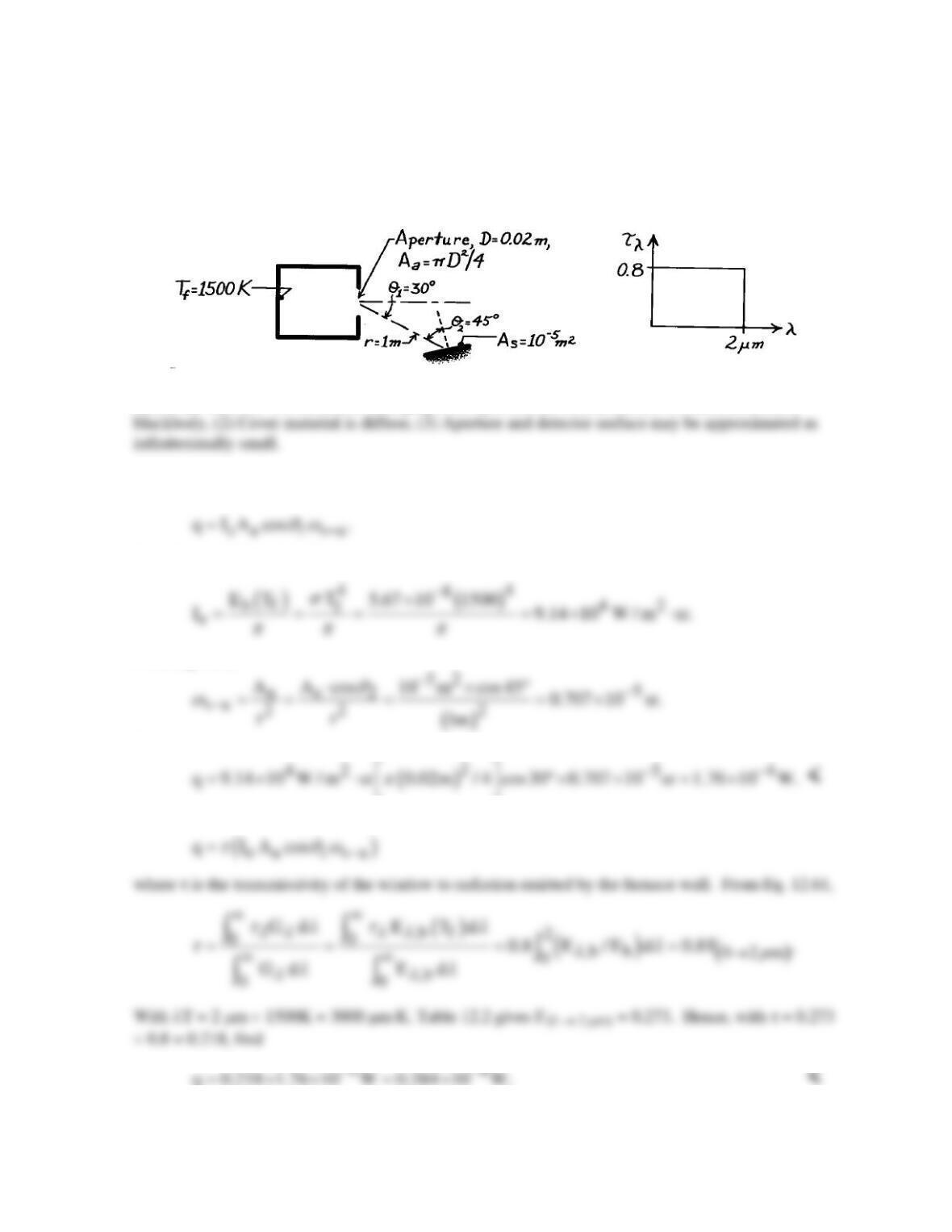
KNOWN: Furnace wall temperature and aperture diameter. Distance of detector from aperture and
orientation of detector relative to aperture.
FIND: (a) Rate at which radiation from the furnace is intercepted by the detector, (b) Effect of
aperture window of prescribed spectral transmissivity on the radiation interception rate.
SCHEMATIC:
ASSUMPTIONS: (1) Radiation emerging from aperture has characteristics of emission from a
ANALYSIS: (a) From Eq. 12.12, the heat rate leaving the furnace aperture and intercepted by the
detector is
From Eqs. 12.17 and 12.32
From Eq. 12.7,
Hence
(b) With the window, the heat rate is

PROBLEM 12.60
KNOWN: Spectral transmissivity of low iron glass (see Fig. 12.23).
FIND: Interpretation of the greenhouse effect.
SCHEMATIC:
ANALYSIS: The glass affects the net radiation transfer to the contents of the greenhouse. Since
most of the solar radiation is in the spectral region λ < 3 µm, the glass will transmit a large fraction of