12-1
CHAPTER 12
Soil Strength
QUESTIONS AND PRACTICE PROBLEMS
Section 12.1 Strength Analyses in Geotechnical Engineering
12.1 Explain why the shear strength, not the tensile or compressive strength, is used in failure
analyses of soils.
Solution
Empirical observations show that soils usually fail in shear, not in compression.
Section 12.2 Shear Failure in Soils
12.2 Describe the difference between the frictional strength and cohesive strength.
Solution
The frictional strength is the part of the shear strength on a plane that depends on the
12.3 List the factors that affect the frictional strength.
Solution
• Mineralogy
12.4 Describe the difference between true cohesion and apparent cohesion.
Solution
12-2 Soil Strength Chap. 12
12.5 Describe two ways in which the measured cohesion of a sand can be nonzero.
Solution
Negative pore water pressures can result in apparent cohesion in a sand, due to capillary
Section 12.3 The Drained and Undrained Conditions
12.6 Define the drained condition and the undrained condition.
Solution
We define the drained condition as a limiting condition under which there is no excess
12.7 Describe a situation in which a sand can be assumed to be under the drained condition.
Solution
The dead load from a building is generated as the building is constructed, a process that
12.8 Describe a situation in which a sand can be assumed to be under the undrained condition.
Solution
The undrained condition can normally be assumed in sands when subjected to very rapid
12.9 Describe a situation in which a clay can be assumed to be under the drained condition.
Solution
12.10 Describe a situation in which a clay can be assumed to be under the undrained condition.
Solution
Saturated clays are most often assumed to be under the undrained condition during the
Chap. 12 Soil Strength 12-3
12.11 Describe how changes in the mean normal stress affects the sign and magnitude of the
excess pore water pressure in a soil.
Solution
When a soil is subjected to an increase or decrease in the hydrostatic mean normal stress,
12.12 Describe how changes in the deviator stress affects the sign and magnitude of the excess
pore water pressure in a soil.
Solution
When a soil is subjected to an increase in the deviator stress, shear stresses are induced in
the soil. These induced shear stresses will cause the soil particles to rearrange and can
12.13 Describe how the density of a sand is related to its volume change during shear.
Solution
A low density soil subjected to a high mean normal stress will contract during shear as
12-4 Soil Strength Chap. 12
12.14 Describe the conditions under which a sand is susceptible to earthquake-induced
liquefaction.
Solution
Section 12.4 Mohr-Coulomb Failure Criterion
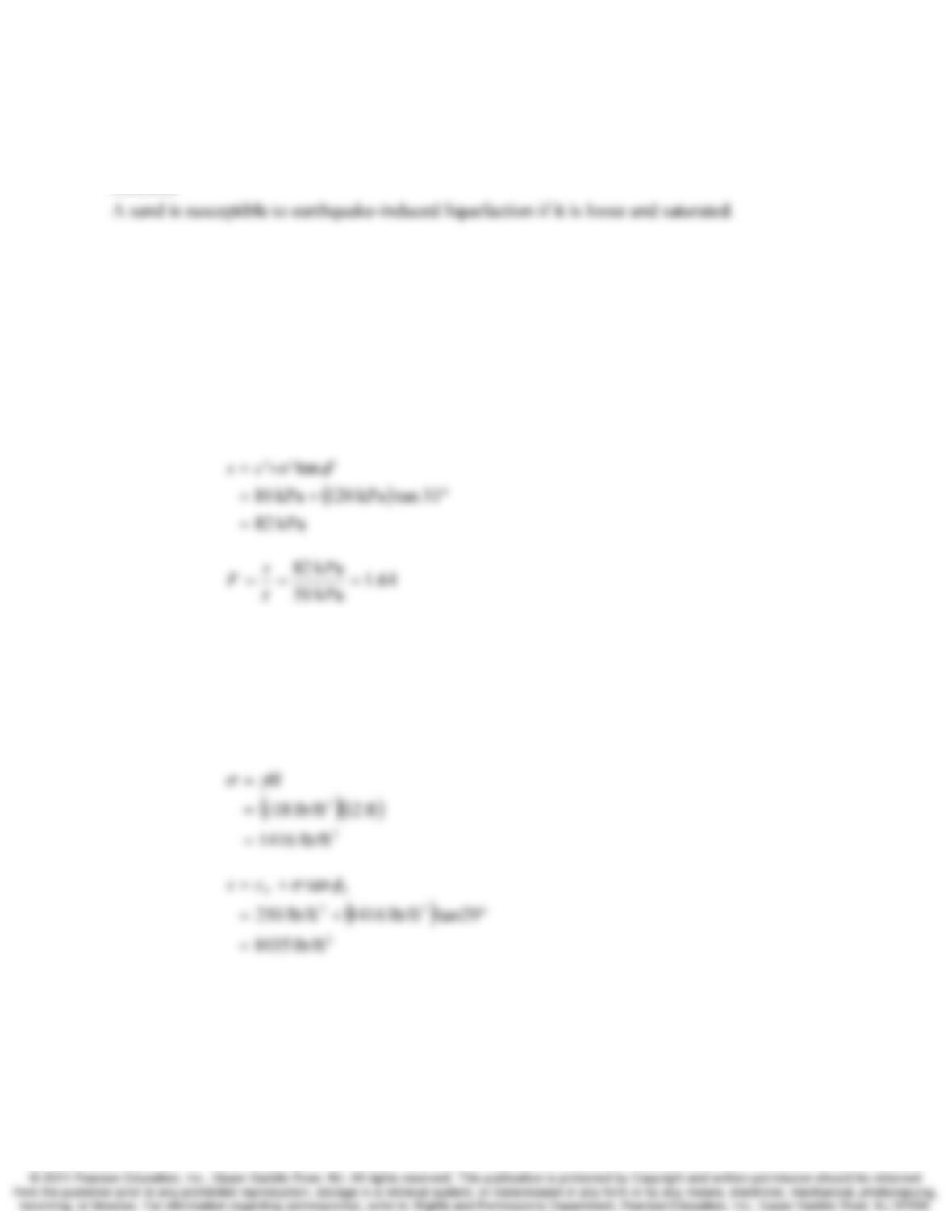
12.15 The effective normal stress on a certain plane at a given point in a soil is 120 kPa. The
effective cohesion and effective friction angle of the soil are 10 kPa and 31°, respectively.
A foundation to be built nearby will induce a shear stress of 50 kPa on this plane. Using
an effective stress analysis, compute the long-term factor of safety against shear failure
on this plane.
Solution
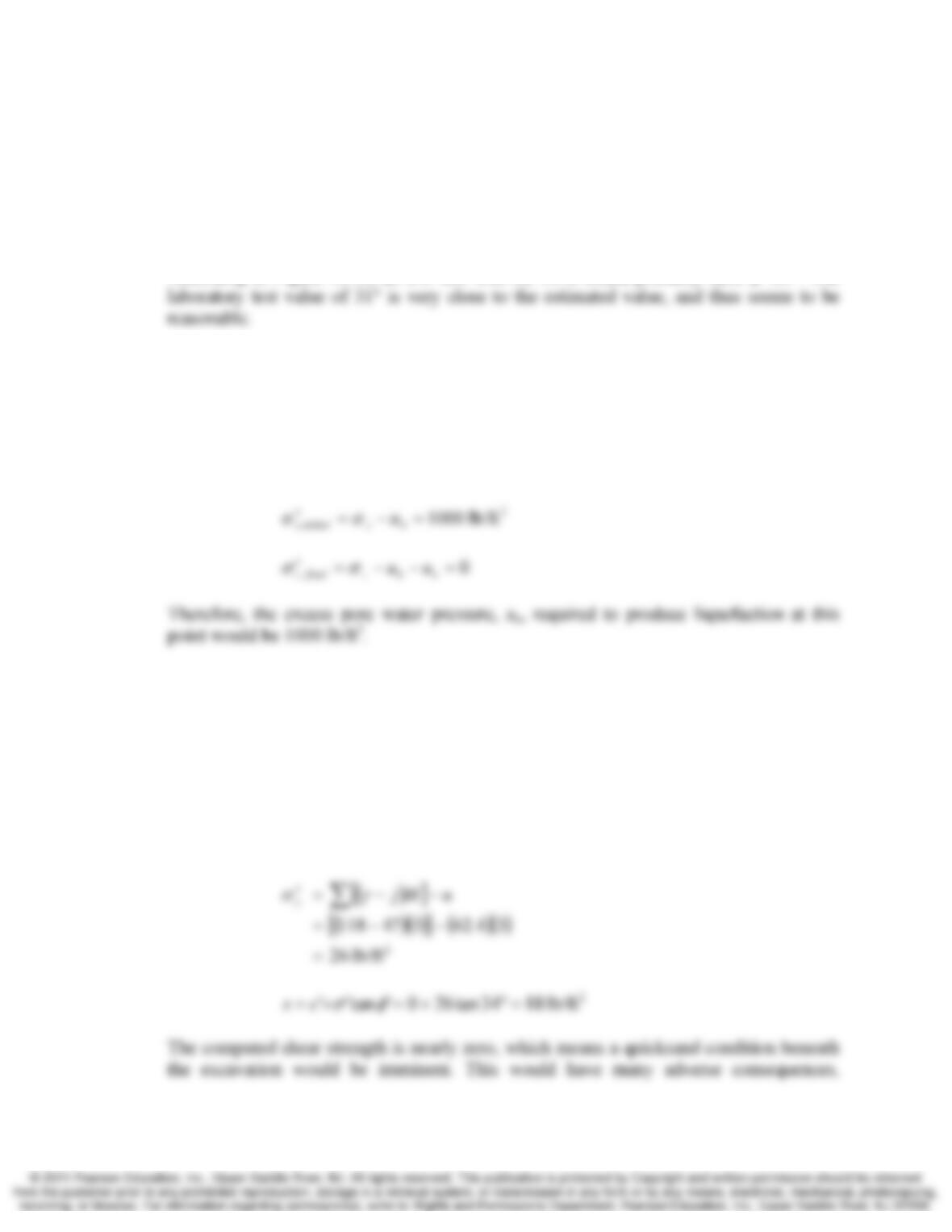
12.16 A site is underlain by a soil that has a unit weight of 118 lb/ft3. From laboratory shear
strength tests that closely simulated the field conditions, the total stress parameters were
measured to be cT = 250 lb/ft2 and φT = 29°. Estimate the shear strength on a horizontal
plane at a depth of 12 ft below the ground surface at this site.
Solution
Chap. 12 Soil Strength 12-5
Section 12.5 Shear Strength of Saturated Sands and Gravels
12.17 A certain well-graded sand deposit has an in situ relative density of about 50%. A
laboratory strength test on a specimen of this soil produced an effective friction angle of
31°. Does this test result seem reasonable? Explain the basis for your answer.
Solution
According to Figure 12.12, an SW soil with Dr=50% would probably have φ‘≈33°. The
12.18 The vertical effective stress at a certain point in a loose sand is 1000 lb/ft2. If an
earthquake were to occur, how much excess pore water pressure would need to develop
at this point for liquefaction to occur? Show a numerical rationale for your answer.
Solution
Liquefaction occurs when ‘
z
σ
approaches zero:
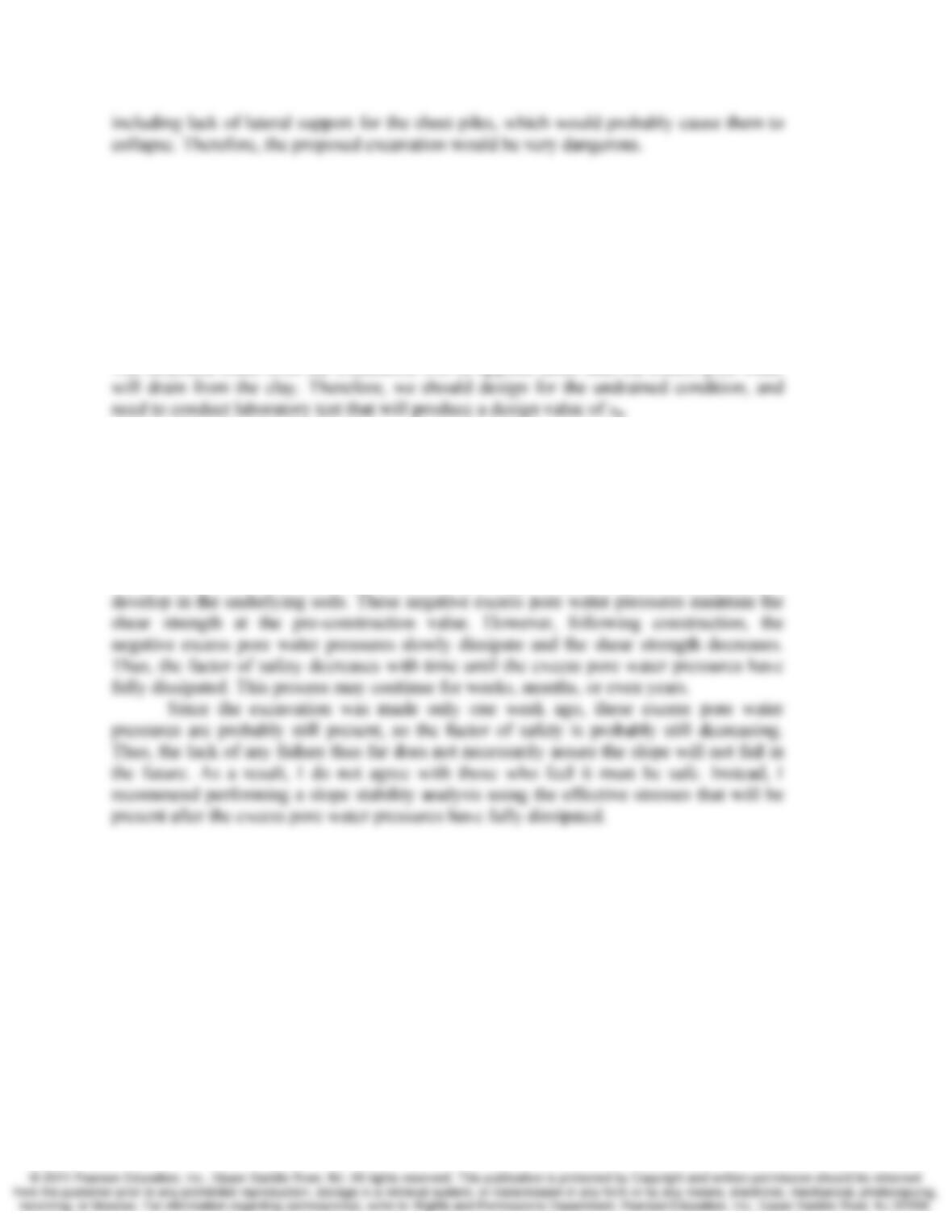
12.19 A temporary excavation similar to the one shown in Figure 8.7 is to be built. The soil is a
clean sand with γ = 118 lb/ft3, c
′
= 0, and
φ′
= 34°. According to a flow net analysis, the
groundwater flow in the soil immediately below the excavation will be upward and have
a hydraulic gradient of 0.76. Compute the shear strength on a horizontal plane at a depth
of 3 ft below the bottom of the excavation. Discuss the significance of your answer.
Solution
()
(
)
33 lb/ft 47lb/ft 62.40.76 === w
ij
γ
12-6 Soil Strength Chap. 12
Section 12.6 Shear Strength of Saturated Clays
12.20 A new building is to be built on a series of spread footing foundations that will be
underlain by a saturated clay. Undisturbed soil samples have been obtained from this site
and are ready to be tested. Should the laboratory test program focus on producing values
of c′ and
φ′
, or su? Explain.
Solution
The structural loads from the foundation will be applied faster than the excess pore water
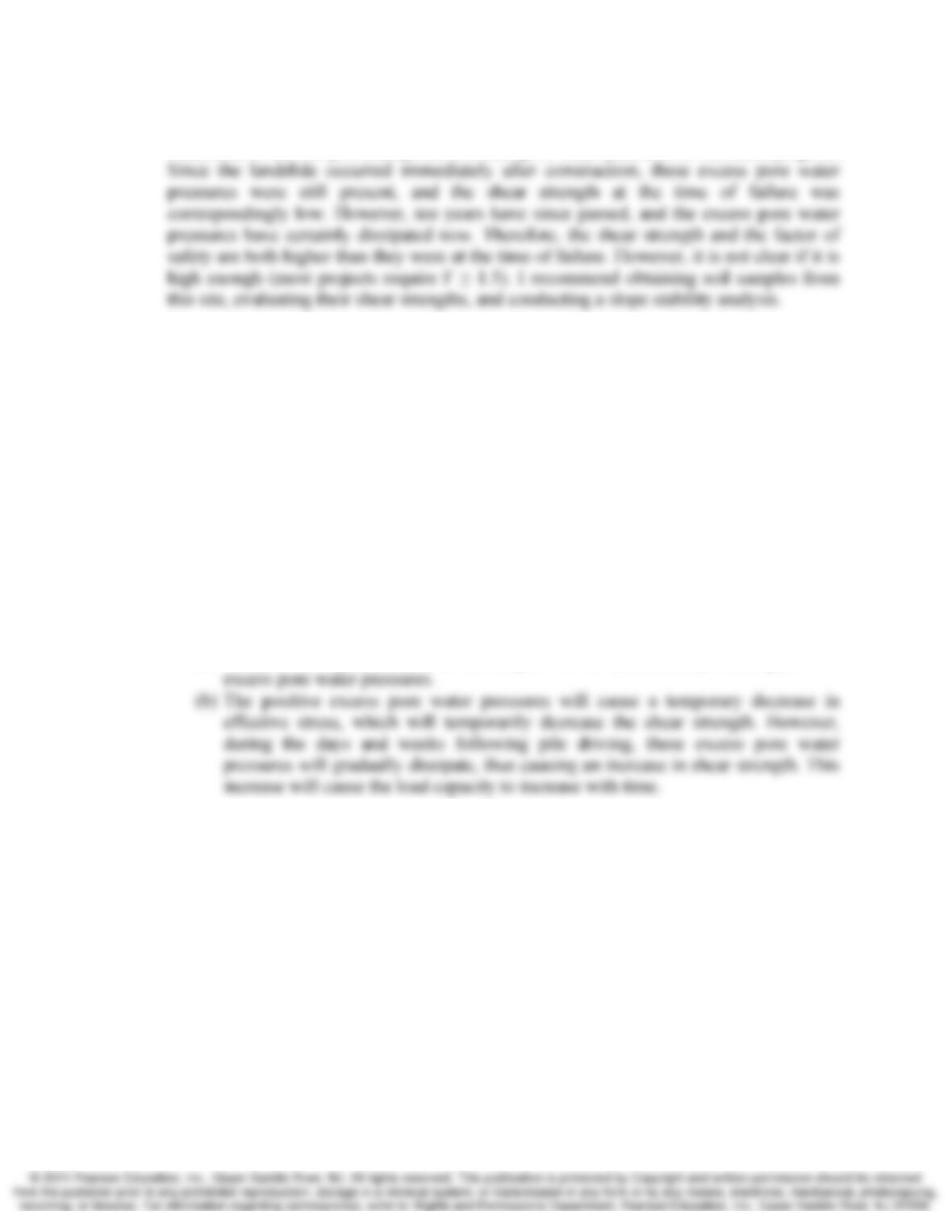
12.21 A steep excavation has been made in a saturated clay without the benefit of a slope
stability analysis. It was completed one week ago, and thus far has not shown any signs
of instability. Several people working on this project believe this is adequate
demonstration of its stability, and feel it is safe. Do you agree? Why or why not?
Solution
When excavations are made in saturated clays, negative excess pore water pressures
12.22 A 5 m thick fill has recently been placed over clayey wetlands to support a new highway.
The groundwater table was at or near the natural ground surface. Soon after the fill was
completed, but before the paving began, a small landslide occurred in the fill and the
underlying soils. Unfortunately, a sudden budget crisis stopped all work on the project
and nothing has been done for ten years. At present, a new source of funding will permit
construction to resume. The fill slope, at the time of its failure, can be assumed to have a
factor of safety of 1.0. Is the factor of safety still equal to 1.0 at present? Will remedial
construction definitely be necessary to increase the factor of safety? What should be
done to evaluate this situation? Explain.
Chap. 12 Soil Strength 12-7
Solution
Placement of this fill produced positive excess pore water pressures in the underlying soil.
12.23 Pile foundations consist of long poles driven into the ground. They transmit structural
loads into the ground through end bearing (compression between the bottom of the pile
and the soil below) and through skin friction (sliding friction along the sides of the pile).
Both of these depend on the shear strength of the surrounding soil.
When piles are driven into saturated clays, they push the soil aside, causing it to
compress and generating excess pore water pressures. After construction, these pressures
eventually dissipate.
(a) Would you expect these excess pore water pressures to be positive or negative?
Why?
(b) Would you expect the load carrying capacity of the pile to increase, decrease, or
remain constant with time? Why?
Solution
(a) The pile driving causes the surrounding soil to compress, thus producing positive
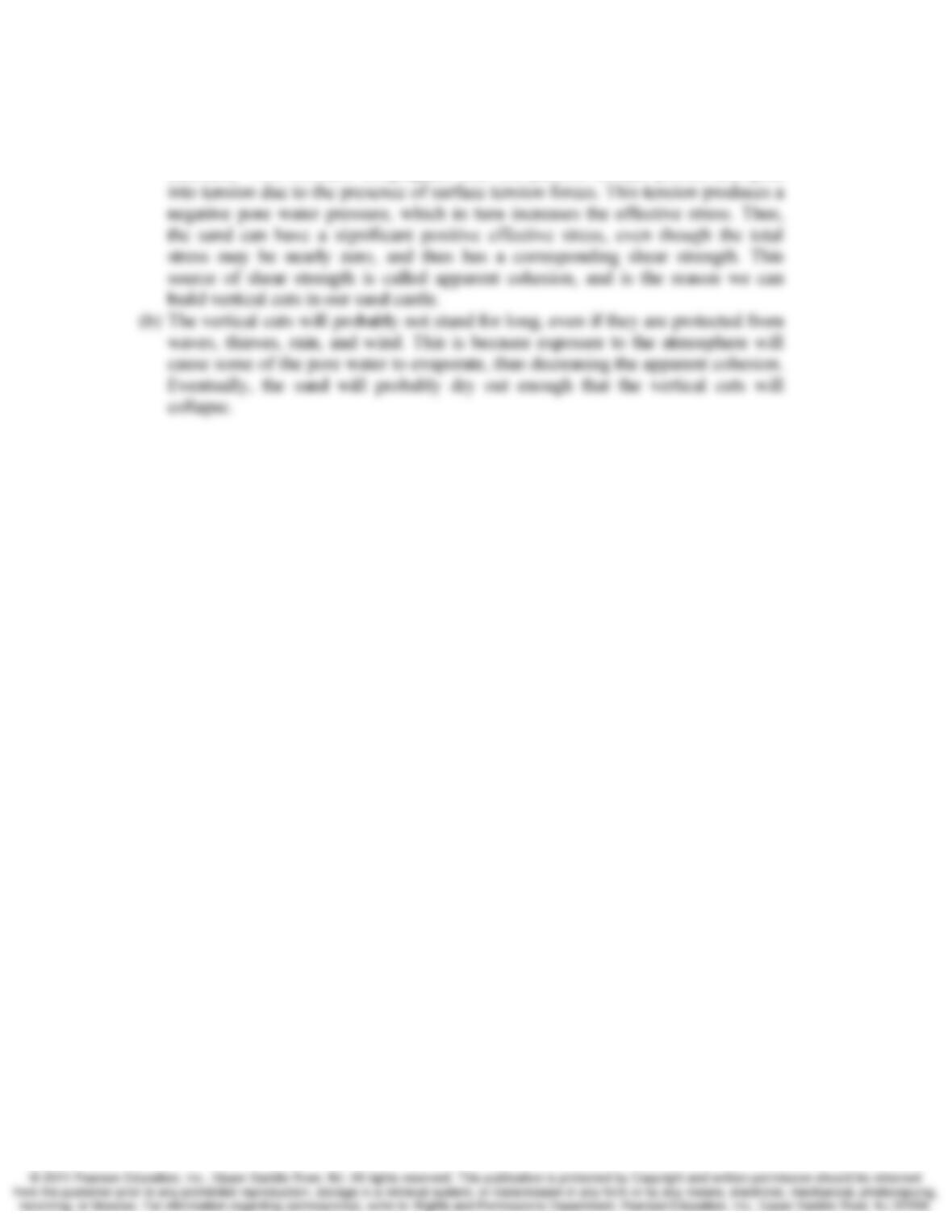
12.24 Soil can stand in vertical cuts only if it has cohesive strength. Even so, anyone can build
a sand castle at the beach using clean fine-to-medium sand, and these castles can have
vertical cuts. This appears to be a contradiction.
(a) Explain why sand castles can be built in this way.
(b) If no waves, thieves, rain, or wind disturb the castle, will the vertical cuts stand
for a long time? Explain why or why not.
12-8 Soil Strength Chap. 12
Solution
(a) Sand castles with vertical cuts can be built only if the sand is moist, but not
saturated. This moisture congregates near the particle contact points, and goes
Section 12.9 Shear Strength Evaluation
12.25 The soils in Figure 10.26 have the following strength parameters:
Silty sand c′ = 0
φ′
= 31°
Soft clay c
T = 20 kPa
φ
T = 0°
Medium clay cT = 45 kPa
φ
T = 0°
Glacial till c′ = 15 kPa
φ′
= 40°
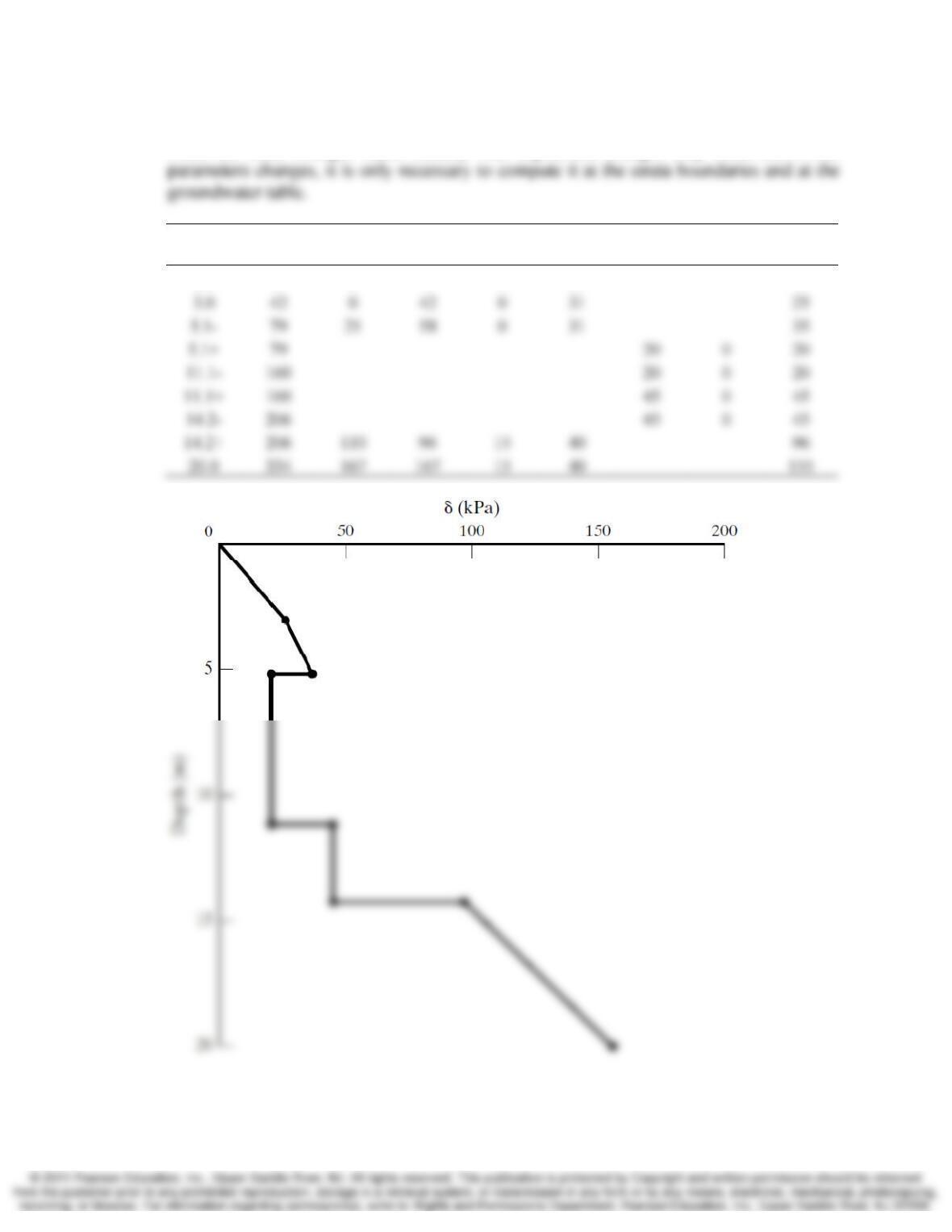
In addition, the glacial till has a unit weight of 22.0 kN/m3. Develop a plot of the
shear strength applicable to short-term analyses on a horizontal plane versus depth, for a
depth of 0-20 m. Keep in mind the shear strength at a point depends on the cohesion and
friction angle at that point, so it can suddenly change at strata interfaces.
Chap. 12 Soil Strength 12-9
Solution
Since the shear strength varies linearly with depth, and changes only when one of the
Depth
(m) σz (kPa) u (kPa)
σ
‘z
(kPa) c‘ (kPa) φ‘ (deg) cT (kPa)
φT
(Deg) s (kPa)
0.0 0 0 0 0 31 0
12-10 Soil Strength Chap. 12
12.26 Pile foundations consist of prefabricated poles, usually made of steel, wood, or concrete,
that are driven into the ground with a pile hammer. The number of hammer blows per
0.1 m of pile penetration (known as the blow count) depends on the strength of the soil
around the pile tip (along with other factors).
A series of piles is to be driven at the site described in Problem 12.25. The
geotechnical engineer requires them to be driven until the tip is embedded 0.2 m into the
glacial till. Could the field engineer use the blow count to determine when this
penetration has been achieved? Explain.
Solution
The glacial till is much stronger than the overlying soils. Thus, when the pile tip reaches
12.27 Which laboratory and in situ tests would be appropriate for measuring
φ′
of a sand?
Solution
Laboratory tests
12.28 Which laboratory tests would be most appropriate for measuring c′ and
φ′
of a clay?
Solution
• Consolidated undrained (CU) triaxial compression test with pore pressure
12.29 Which laboratory and in situ tests would be appropriate for measuring su of a clay?
Solution
Laboratory tests
Chap. 12 Soil Strength 12-11
12.30 A series of direct shear tests has been performed on a dense well-graded sand. All tests
were performed on 3.00-in.-diameter, 1.25-in. tall cylindrical specimens, and were run
slowly enough to produce the drained condition. The results of these tests are
summarized in the following table:
Test Number Normal Load (lb) Shear Load at Failure (lb)
1 100 84
2 200 159
3 400 319
Assuming the shear area remains constant during the test, determine the effective
cohesion and effective friction angle from these test results. What values of these
parameters would you expect? Are the test results consistent with your expectations?
What values would you use for design?
Solution
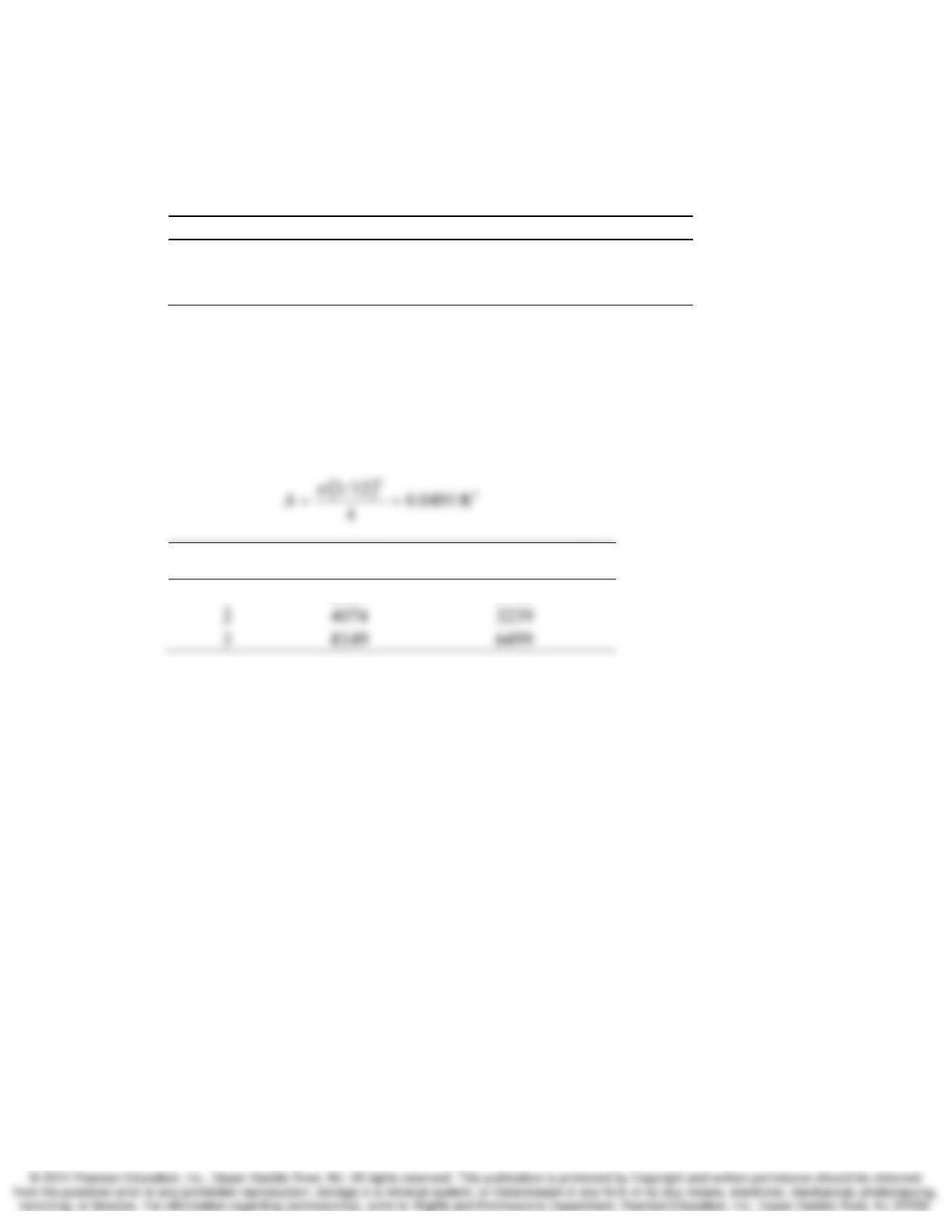
Test Number σ‘ (lb/ft2) Shear Strength (lb/ft2)
1 2037 1711