12-34
P12-17 (AICPA adapted solution)
(1)
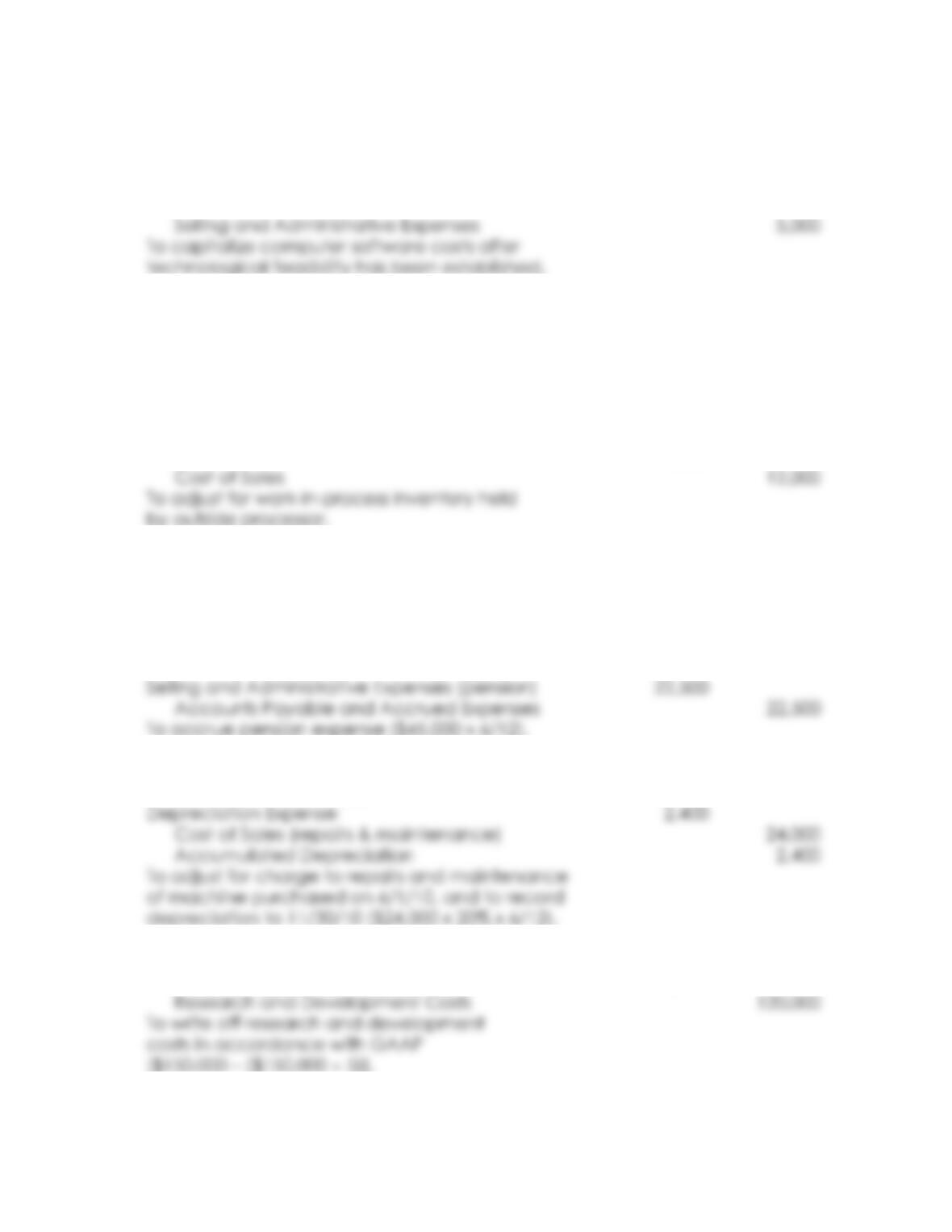
1. Computer Software Costs 5,000
(2)
Allowance for Doubtful Accounts 23,000
Selling and Administrative Expenses (bad debts) 23,000
To reduce allowance account to balance determined
by aging of receivables ($59,000 – $36,000).
(3)
Inventories 12,000
(4)
Prepaid Insurance 3,000
Selling and Administrative Expenses (insurance) 3,000
To adjust for nonrecognition of prepaid expense.
(5)
(6)
Property, Plant, and Equipment 24,000
(7)
Research and Development Expense 120,000
P12-17 (continued)
1. (continued)
(8)
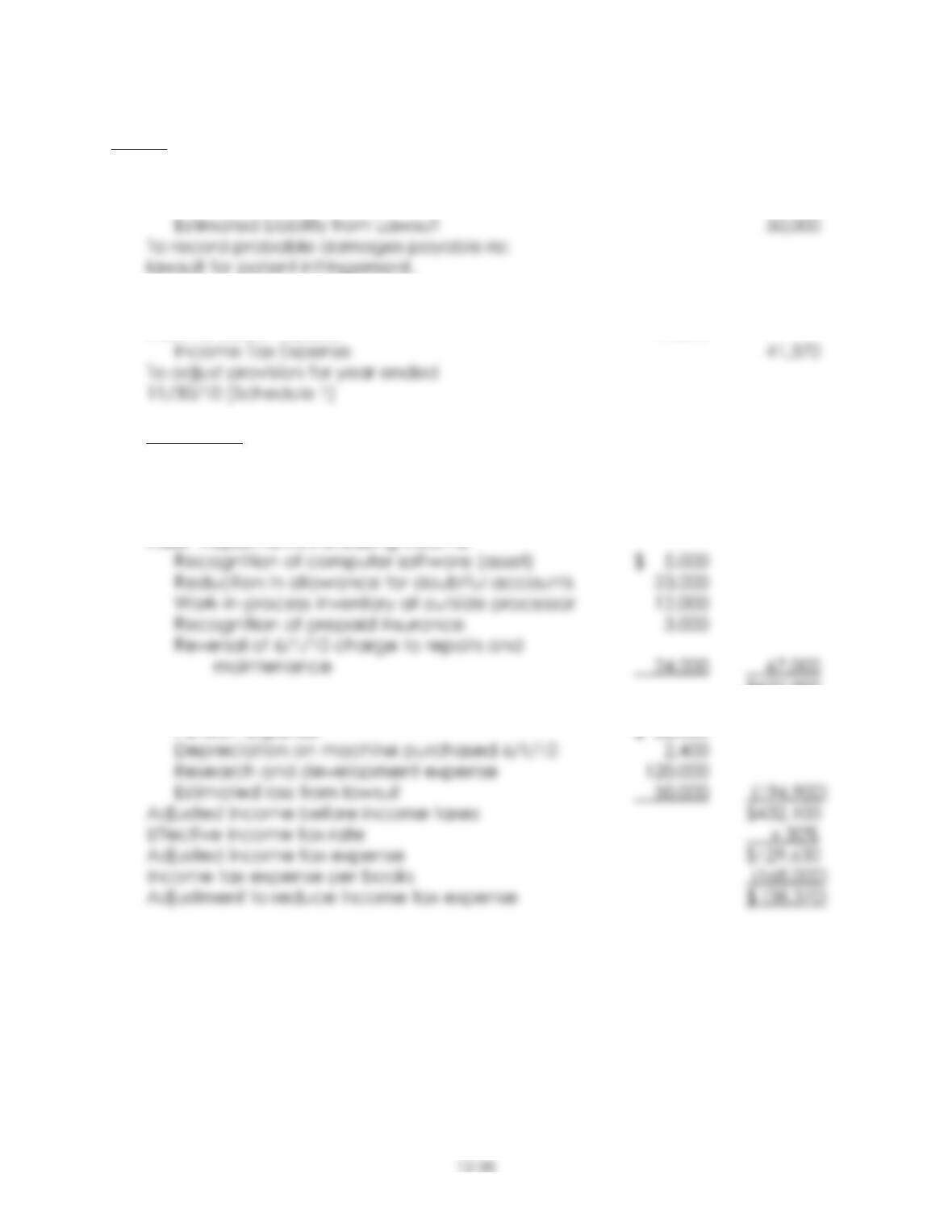
Estimated Loss from Lawsuit 50,000
(9)
Income Taxes Payable 41,370
Schedule 1
Adjustment to Income Tax Expense–Year Ended November 30, 2010
Unadjusted income before income taxes $560,000
Add: Adjustments increasing income
$627,000
Deduct: Adjustments decreasing income
Pension expense $ 22,500
P12-17 (continued)
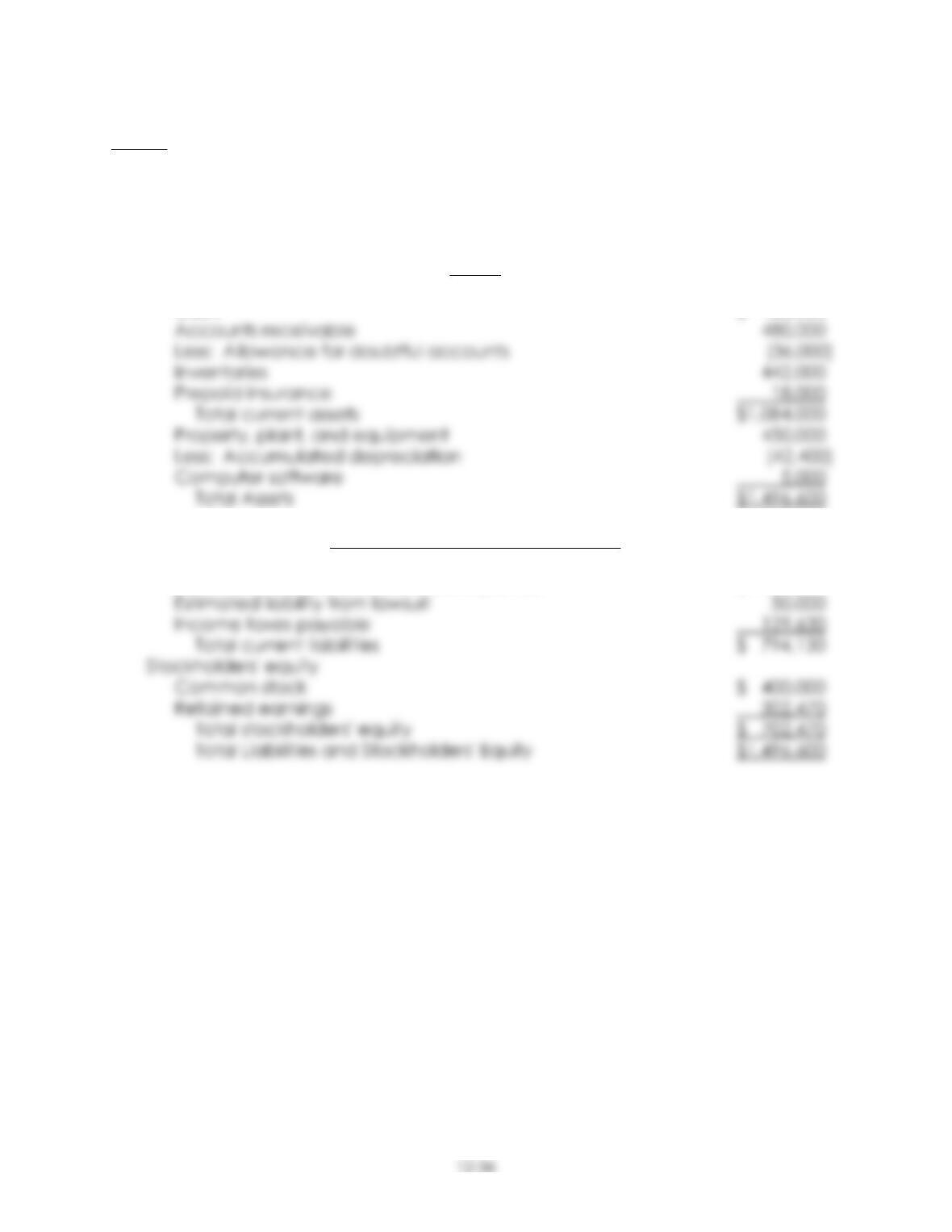
2. BRYANT CORPORATION
Balance Sheet
November 30, 2010
Assets
Current assets
Cash $ 180,000
Liabilities and Stockholders’ Equity
Current liabilities
Accounts payable and accrued expenses $ 614,500
P12-17 (continued)
2. (continued)
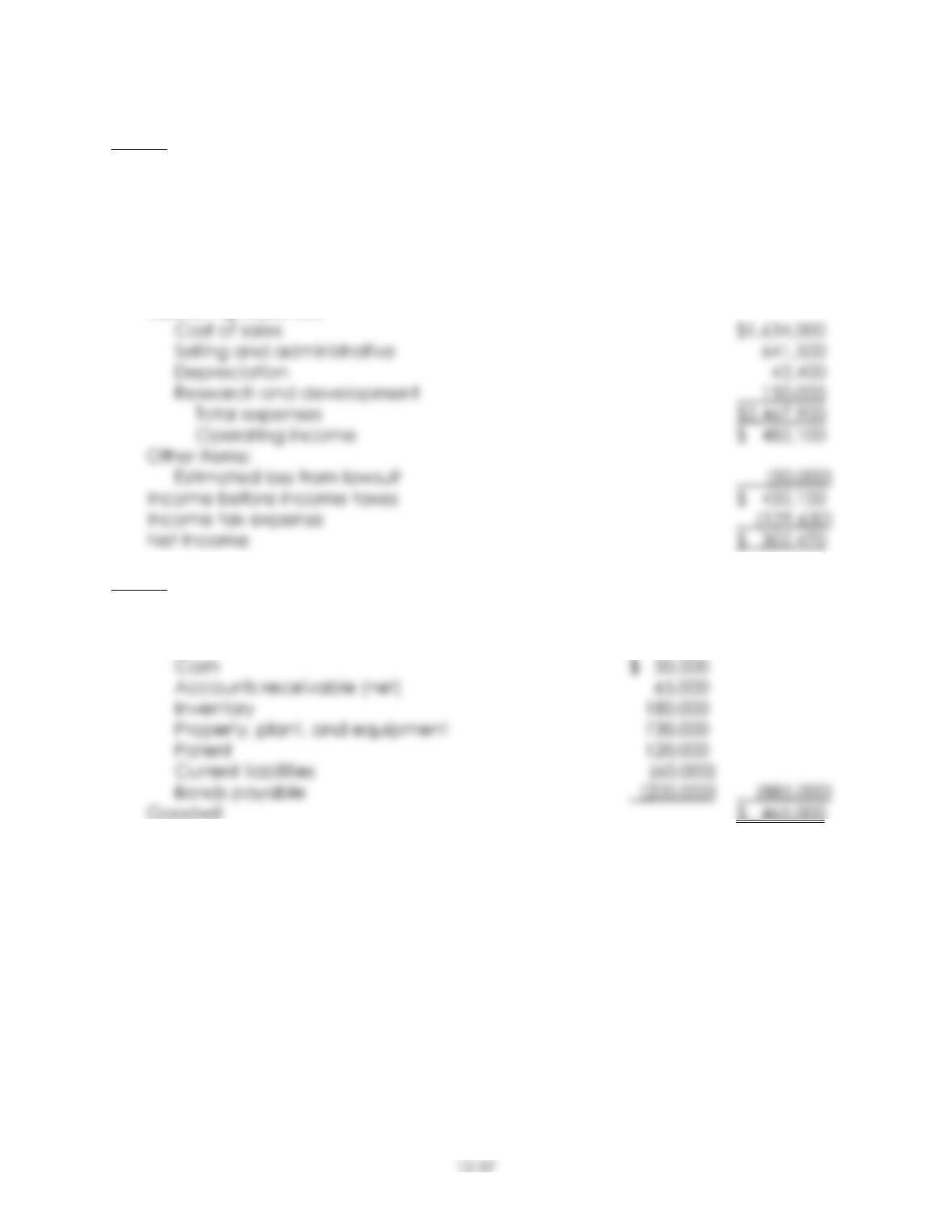
BRYANT CORPORATION
Statement of Income
For Year Ended November 30, 2010
Net sales $2,950,000
Operating expenses:
P12-18
Cost $1,350,000
Market value of net assets:
12-38
ANSWERS TO CASES
C12-1 (AICPA adapted solution)
The legal costs in defending the validity of the patent and those costs incurred in the
successful outcome of the infringement suit are properly capitalized according to sound
accounting logic, as indicated in the detailed Patent account in the case. However, the
cost of litigation in successfully defending a patent case is required, in conforming to the
C12-2 (AICPA adapted solution)
1. The costs of research equipment used exclusively for Trouver would be reported as
research and development expenses in the period incurred.
2. a. Matching refers to the process of expense recognition by associating costs with
revenues on a cause and effect basis.
3. Corporate headquarters’ costs allocated to research and development would be
4. On Clonal’s statement of cash flows, the legal expenses incurred in defending the
patent should be reported under investing activities in the period paid.
12-39
C12-3 (AICPA adapted solution)
1. In GAAP, research is “planned search or critical investigation aimed at discovery of new
knowledge with the hope that such knowledge will be useful in developing a new product
2. The current accounting and reporting practices for R&D costs were promulgated by the
FASB in order to reduce the number of alternatives that previously existed and to provide
useful financial information about R&D costs. The FASB considered four alternative
methods of accounting: (a) charge all costs to expense when incurred; (b) capitalize all
costs when incurred; (c) selective capitalization; and (d) accumulate all costs in a special
3. In accordance with GAAP, the following costs attributable only to research and
development are expensed as incurred:
Design and engineering studies
C12-4 (AICPA adapted solution)
1. In a purchase transaction, assets are recorded at their acquisition price, which becomes
2. When a price is paid for a group of assets, the total price must be allocated to the
individual assets. Because we know neither the total fair value of the tangible and other
intangible assets acquired from Felzar Company nor the price to be paid by the Rothman
C12-5 (AICPA adapted solution)
1. Goodwill represents the expectation of extraordinary financial performance in the future.
Justification for expecting superior future performance depends on the degree of certainty
that the causes (for example, customers’ preferences or established business locations) of
2. The book and fair values of the goodwill of Elson Corporation differ because of changes in
conditions since the date of acquisition (2006). Because one cannot be certain that the
conditions out of which goodwill arises will continue to exist in the future, goodwill is
3. (a) Increasing the stated value of goodwill on the balance sheet prior to negotiations
would represent a departure from accepted practice, an unjustified departure in this
situation since the value of goodwill cannot be measured reliably until after an
agreement is reached on the selling price. The evidence to support such a
12-41
C12-5 (continued)
3. (continued)
(b) Goodwill is purchased in recognition of an advantage created by the prior owner of
the business. Whether a new owner can maintain that advantage is problematical.
C12-6
1. Patents, copyrights, and computer software would typically be amortized. They would be
usually considered to have indefinite lives. Goodwill is never amortized.
2. Any intangible that is not amortized must be reviewed for impairment annually. Therefore,
C12-7 (AICPA adapted solution)
1. Accounting for the penalty as a charge to the current period is justified if the penalty is
considered the result of an unusual event (the assessment) occurring within the period.
2. Accounting for the penalty as a correction of prior periods is justified if the penalty is
considered a result of the business activities of prior periods, rather than a result of an event
of the current period. The penalty is assessed to correct damage that occurred as a result
of production of prior periods and thus represents a cost of production that was omitted
C12-7 (continued)
3. Accounting for the penalty as a capitalizable item to be amortized over future periods is
justified if the penalty is viewed as a payment made to benefit future periods. If the
C12-8 (AICPA adapted solution)
1. A dollar to be received in the future is worth less than a dollar received today because of
2. If the royalty receipts are expected to occur at regular intervals and the amounts are to be
fairly constant, their discounted value can be calculated by multiplying the value of one
such receipt by the present value of an annuity of 1 for the number of periods the receipts
are expected. On the other hand, if receipts are expected to be irregular in amount or if
they are to occur at irregular intervals, each expected future receipt would have to be
3. The basis of valuation for the patents that is generally accepted in accounting is cost.
Evidently the cartons were developed and the patents obtained directly by the client
corporation. Therefore, their cost would include applicable experimental and
C12-8 (continued)
4. Intangible assets represent rights to future benefits. The ideal measure of the value of
intangible assets is the discounted present value of their future benefits. For the Sprauge
5. The amortization policy is implied in the definition of intangible assets as rights to future
benefits. As the benefits are received by the firm, the cost or other value should be
6. The litigation can, and probably should, be mentioned in the notes to the financial
statements. Some indication of the expectations of legal counsel in respect to the
outcome can properly accompany the statements. It would be inappropriate to record a
contingent asset reflecting the expected damages to be recovered. Costs incurred by
C12-9 (AICPA adapted solution)
Interest on mortgage bonds: An amount equal to the interest cost incurred in 2010
($60,000) is clearly a cost that can be associated with the normal construction period and
12-44
C12-9 (continued)
Instead of treating interest during construction as an element of the cost of the physical
assets, it can be argued that it represents an element of the general cost of bringing the
business to the point of revenue production and should therefore be treated as an
organization cost. This view regards interest during construction as just another of the many
expensed as a loss from the tornado.
Cost of obtaining tenants: Both the 2010 and 2011 costs of obtaining tenants should be
capitalized and amortized over the life of the leases. The fact that all of the tenants who
were signed when the tornado occurred accepted the October occupancy date
indicates that the total cost of obtaining tenants was not affected by the delay.
C12-10 (dollars in millions)
2. The company has additional “intangibles” that are not recorded on the balance sheet,
such as its name, world-wide reputation, and the secret formula for Coke. This means that
Coca-Cola’s assets are understated (although under the historical cost framework, assets
C12-10 (continued)
3. Amortized Intangible Assets 333
a
Cash, etc. 333
Accumulated Amortization: Amortized Intangible Assets 20
C12-11
Note to Instructor: This case does not have a definitive answer. From a financial reporting
perspective, GAAP is identified and summarized. From an ethical perspective, various
issues are raised for discussion purposes.
From a financial reporting perspective, the company’s policies are within the constraints
From an ethical perspective, an issue is whether the company’s disclosures are adequate.
The primary stakeholders are the company’s current and potential stockholders and
creditors. The purpose of financial reporting is to provide useful information to users. Do
the minimum disclosures required by GAAP necessarily satisfy that purpose? The