12-1
CHAPTER 12
INTANGIBLES
CONTENT ANALYSIS OF EXERCISES AND PROBLEMS
Number
Content
Time Range
(minutes)
E12-1
Patent. (Easy) Amount to be capitalized. Determination of
economic life.
5-10
E12-6
(AICPA adapted). Research and Development Costs. (Easy)
Determination of amount charged to income.
5-10
E12-7
Research and Development. (Moderate) Determination and
justification of R&D activities.
5-10
E12-8
Research and Development. (Moderate) Determination and
justification of current period R&D costs.
5-15
P12-2
Intangibles. (Moderate) Franchise, tradename, copyright.
Journal entries to record transactions and any amortization.
20-30
P12-3
Classification of Intangibles. (Challenging) Adjusting journal
entries to correctly classify intangibles.
20-30
12-2
Number
Content
Time Range
(minutes)
P12-5
Patents. (Moderate) Journal entries to record various
transactions. Purchase, costs of improving, legal fees, licensing,
royalty receipt.
20-30
P12-9
Research and Development. (Challenging) Preparation of the
financial statements according to GAAP. Return on assets.
20-30
P12-10
Intangibles. (Challenging) Preparation of journal entries to
record correct information under GAAP.
30-40
P12-11
Impairment. (Challenging) Preparation of journal entries to
record impairment and subsequent amortization expense.
30-40
P12-15
(AICPA adapted). Comprehensive: Intangibles. (Challenging)
Numerous intangible asset transactions. Worksheet to adjust
accounts. Preparation of financial statements.
45-60
P12-16
(AICPA adapted). Comprehensive: Intangibles. (Challenging)
Prepare schedules to determine intangible assets and related
expenses.
35-45
12-3
ANSWERS TO QUESTIONS
Q12-1 Intangible assets are distinguished from tangible assets by the fact that intangibles do
not have a physical substance. In addition, intangible assets generally have a higher
degree of uncertainty regarding the future benefits to be derived, their value is
Q12-2 Identifiable intangibles are assets, such as patents and franchises, that are clearly
Q12-3 When accounting for the cost of identifiable or unidentifiable intangibles, a company
distinguishes between those that are purchased and those that are internally
Q12-4 In accordance with GAAP, intangible assets are separated into three categories to
determine whether or not they are amortized and how they are reviewed for
Q12-5 A company selects the amortization method based on the expected pattern of
benefits the intangible asset will produce, except that if the company cannot reliably
determine the pattern, it must use the straight-line method.
Q12-6 In estimating the economic life of an intangible, a company should consider the
following factors:
1. The expected use of the asset
2. The expected useful life of another asset that is related to the life of the intangible
12-4
Q12-7 Research is the planned search or critical investigation aimed at discovering new
knowledge with the hope that such knowledge will be useful in developing a new
Q12-8 Activities that are included in research and development (R&D) are as follows:
1. Laboratory research for new knowledge
2. Searching for application of new research and knowledge
Among activities excluded from research and development are the following:
1. Engineering in early phase of commercial production
2. Quality control, testing, etc., during commercial production
Q12-9 A company includes expenditures for the following elements of R&D in R&D costs:
1. Materials, equipment, and facilities
However, if any of the costs have alternative future uses, they are capitalized and
then depreciated or amortized over their useful lives. This depreciation or
amortization is included in R&D expense.
12-5
Q12-10 One alternative considered by the FASB was to expense all R&D costs when incurred.
The main argument in favor of this was the high degree of uncertainty regarding the
future benefits of R&D projects; opponents, on the other hand, argued that a policy
of expensing all costs would result in a significant understatement of assets if there
were identifiable future benefits.
Q12-11 Patents have a legal life of 20 years, but may not be useful for that full amount of
time due to technological changes, competition, or a change in demand. Thus, a
Q12-12 A company records a patent acquired by purchase at cost. Thus, in (a) it capitalizes
the asset at $90,000. It also capitalizes (b) internally developed identifiable
Q12-13 Four possible components of goodwill are an advantageous location, superior
employees or managers, a good reputation, or a group of reliable customers.
Q12-14 From an asset valuation standpoint, goodwill is the difference between the purchase
price (market value) of the company as a whole and the fair value of the net
Q12-15 Factors that may account for the difference between the value of a company as a
whole and the book value of the net assets include:
1. Although assets are generally carried on the books at historical cost, the fair value
Q12-16 Goodwill is capitalized at acquisition only when it results from the purchase of a
company or of a significant portion of a company (at a price greater than the fair
value of the net identifiable assets acquired), the value can be established with
Q12-17 Internal goodwill is the ability to earn excess profits, or the difference between the fair
value of the net assets and the value of the company as a whole, that the company
Q12-18 Goodwill is never amortized. A company must review its goodwill for impairment at
least annually at the reporting unit level. It must also review its goodwill for impair-
ment whenever events or changes in circumstances occur that would more-likely-
than-not reduce the fair value of the goodwill below its carrying value. Examples of
events or changes in circumstances that indicate that goodwill may be impaired
12-7
Q12-19 It is true that goodwill is different from other assets in its nature. However, writing off
goodwill directly to stockholders’ equity recognizes goodwill neither as an asset nor as
Q12-20 A bargain purchase (negative goodwill) is the excess of the book value of a
company as a whole over the fair value of its identifiable net assets. The acquiring
company recognizes a gain on the bargain purchase.
Q12-21 Under IFRS, activities leading to the generation of an intangible asset are classified as
Q12-22 Two major differences exist between IFRS and U.S. GAAP with regard to the
measurement and reporting of impaired intangible asset:
ANSWERS TO MULTIPLE CHOICE
SOLUTIONS TO REVIEW EXERCISES
RE12-1
Research and Development Expense 148,500
RE12-2
Purchase:
RE12-3
June 1, Year 1:
RE12-4
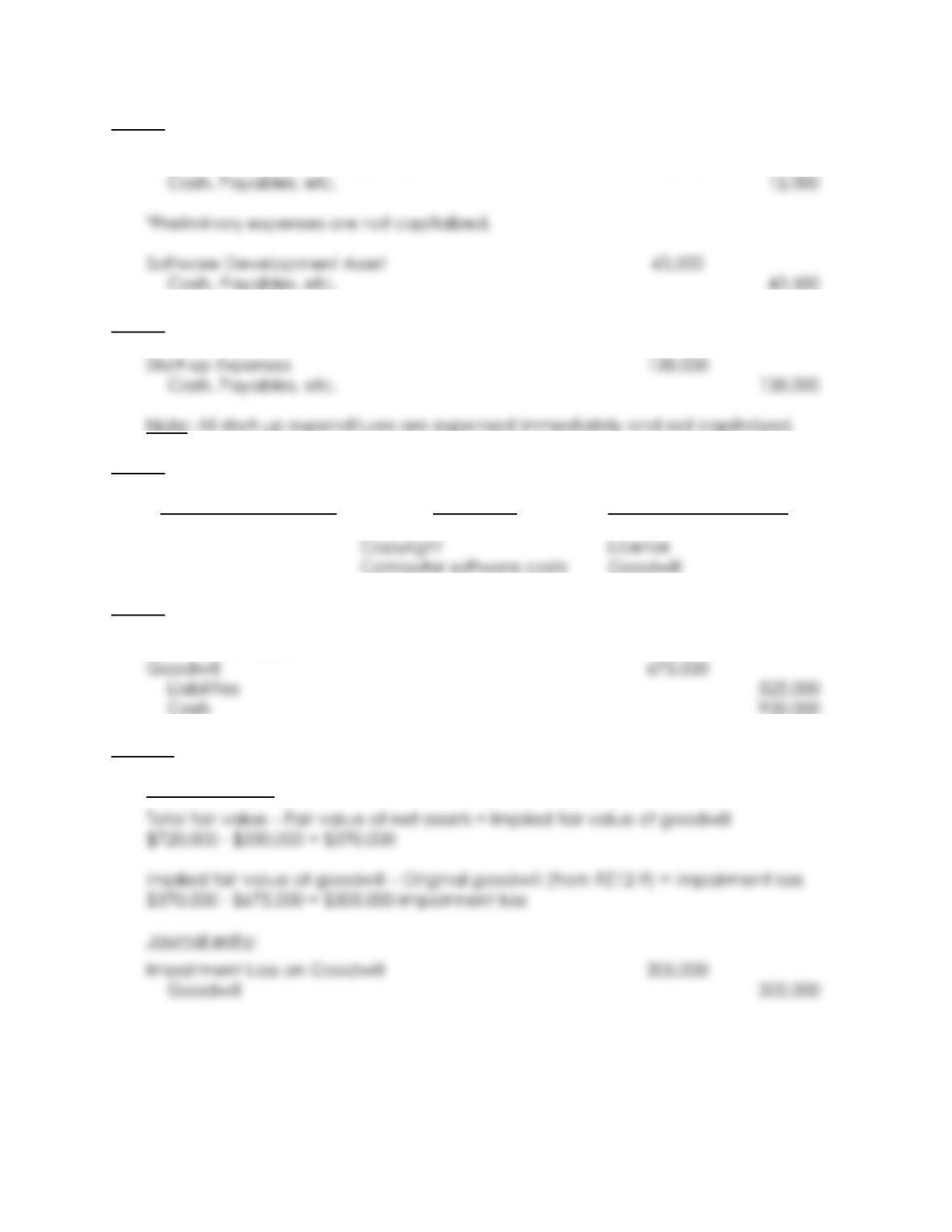
RE12-5
12-9
RE12-6
Software Development Expenses* 12,000
RE12-7
RE12-8
Expensed as Incurred Amortized Tested for Impairment
R&D Patent Trademark
RE12-9
Identifiable Assets 750,000
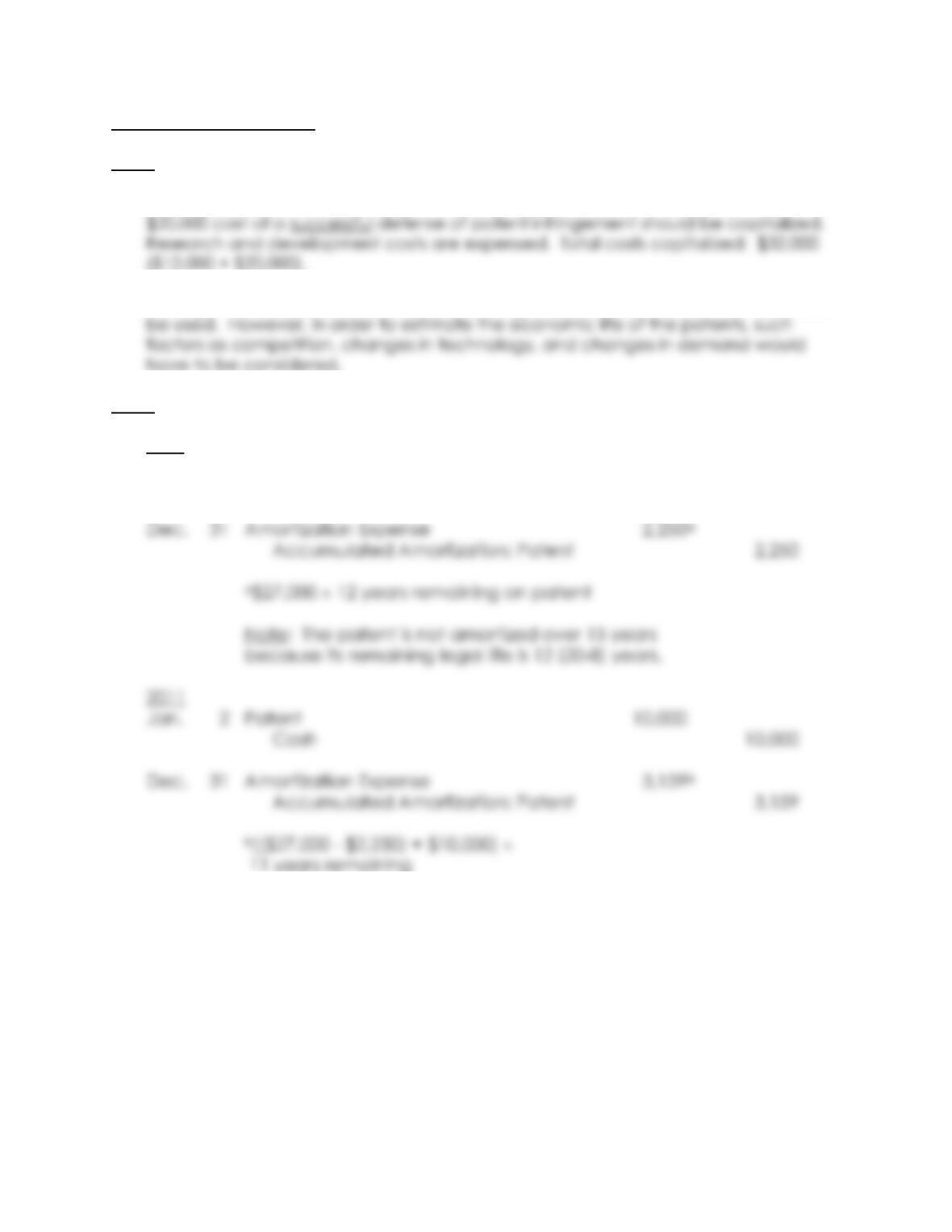
RE12-10
Impairment loss:
12-10
SOLUTIONS TO EXERCISES
E12-1
1. The legal and patent application costs of $12,000 should be capitalized. Also, the
2. The legal life of 20 years from the date of filing is the maximum useful life that could
E12-2
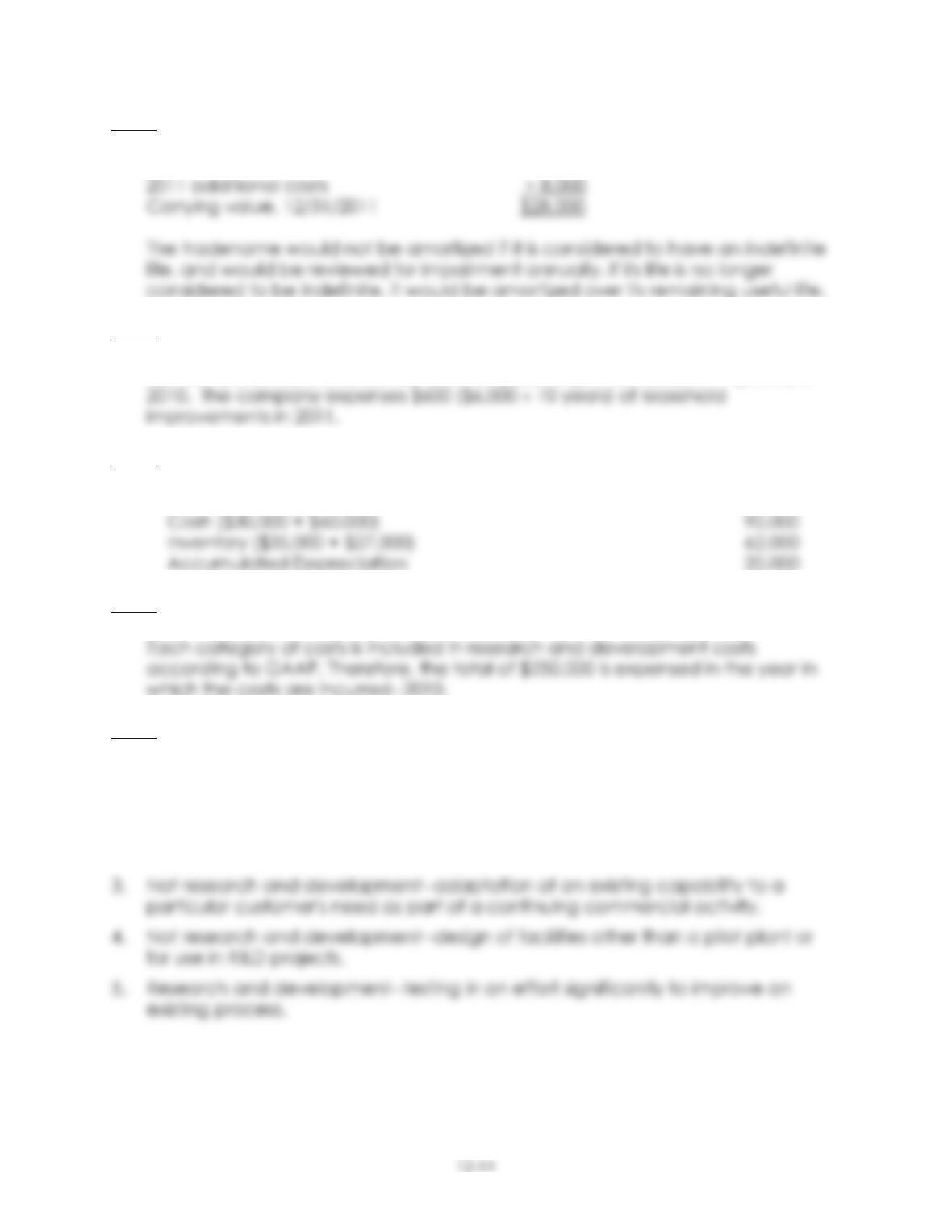
2010
Jan. 3 Patent 27,000
Cash 27,000
E12-3
2010 cost of tradename $20,000
E12-4
The company expenses start-up costs of $20,000 ($3,000 + $12,000 + $5,000) in
E12-5
Research and Development Expenses 172,000
E12-6 (AICPA adapted solution)
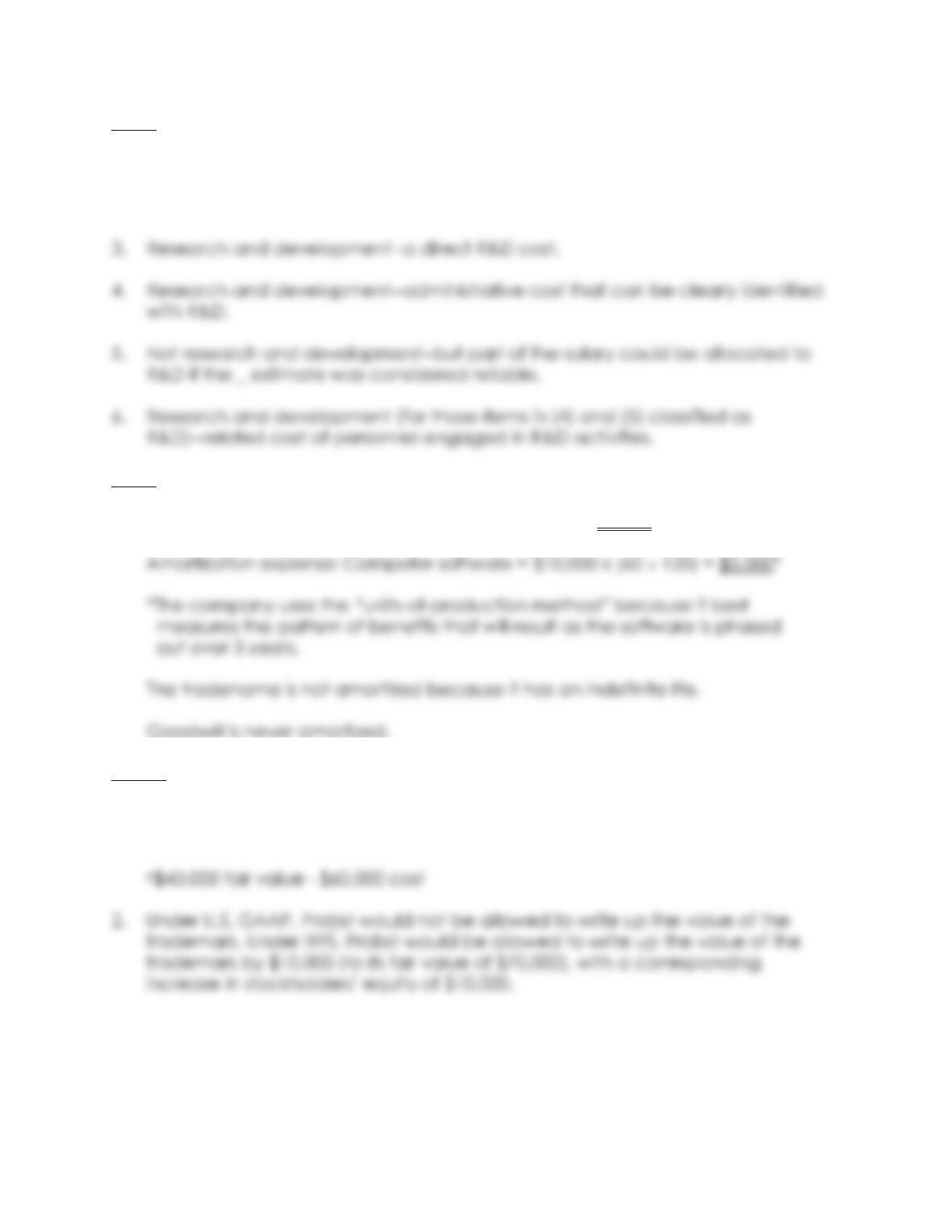
E12-7
1. Research and development–costs incurred to test and determine the possibility
of a process.
2. Research and development–testing to evaluate efficiencies and usefulness of
new process.
12-12
E12-8
1. Research and development–indirect cost clearly related to R&D projects.
2. Not research and development–advertising cost.
E12-9
Amortization expense: Patent = $20,000 ÷ 10 years = $2,000
E12-10
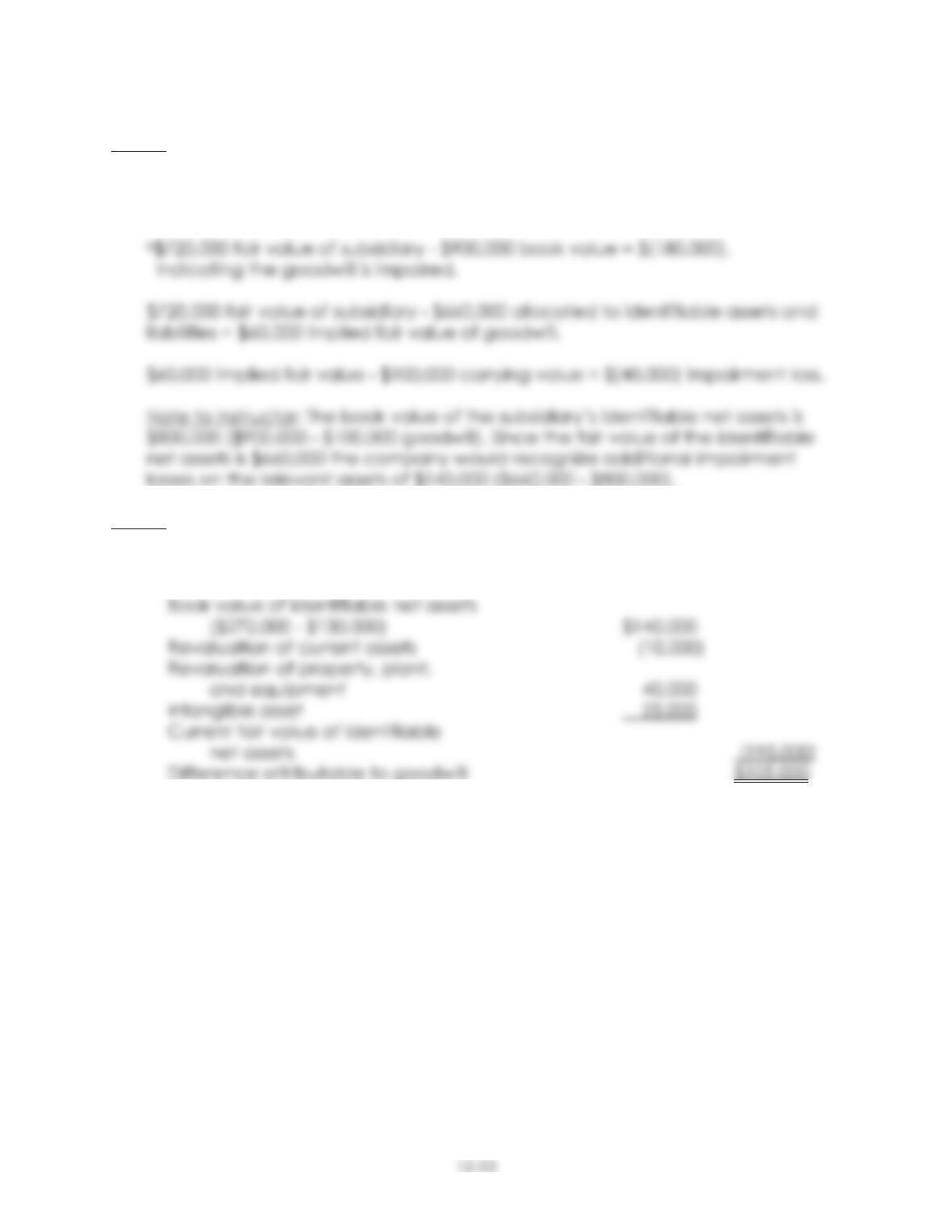
1. Impairment Loss on Tradename 20,000a
Tradename 20,000
E12-11
Impairment Loss on Goodwill 40,000a
Goodwill 40,000
E12-12
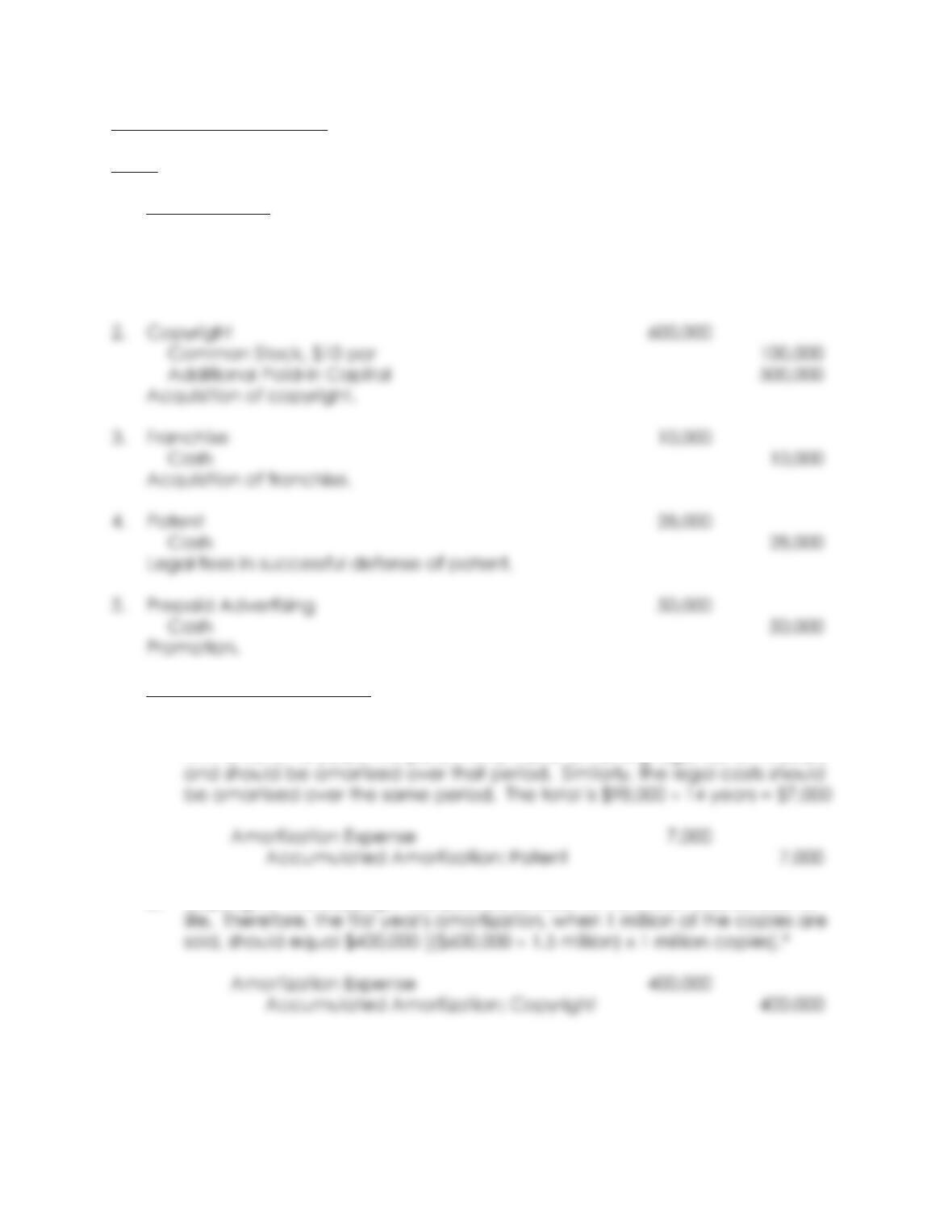
Purchase price of Marino Company $300,000
Marino Company
12-14
SOLUTIONS TO PROBLEMS
P12-1
Journal entries:
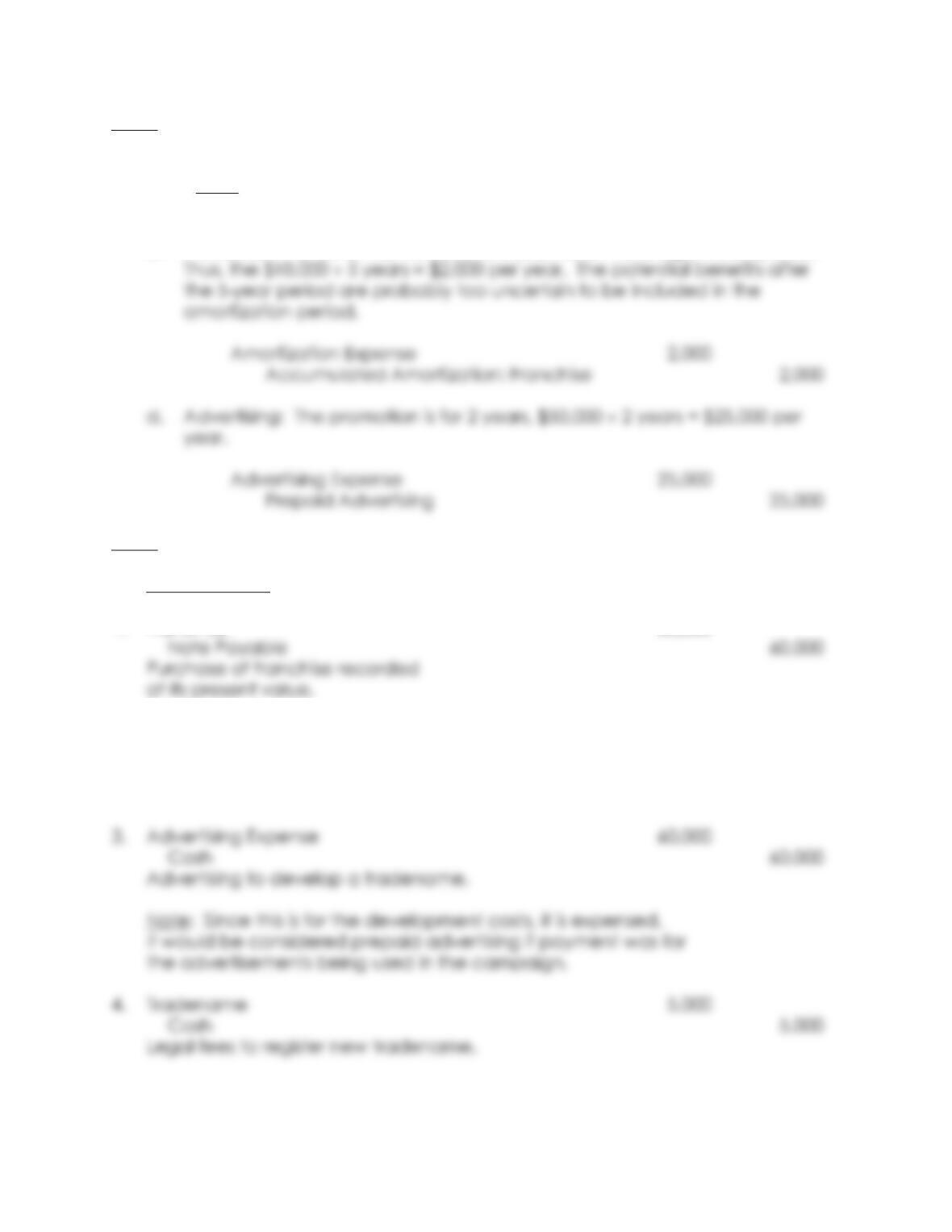
1. Patent 70,000
Cash 70,000
Acquisition of patent.
Year-end adjusting entries:
a. Patent: Although the patent was purchased to protect another patent
with a life of 16 years, the patent only has a remaining legal life of 14 years
b. Copyright: The copyright is expected to result in 1.5 million copies over its
12-15
P12-1 (continued)
5. b. (continued)
*Note: A copyright is usually considered to have an indefinite life, but in
this case, a limited life of 1.5 million copies has been identified.
c. Franchise: The life of the franchise is 5 years until the bridge is completed.
P12-2
Journal entries:
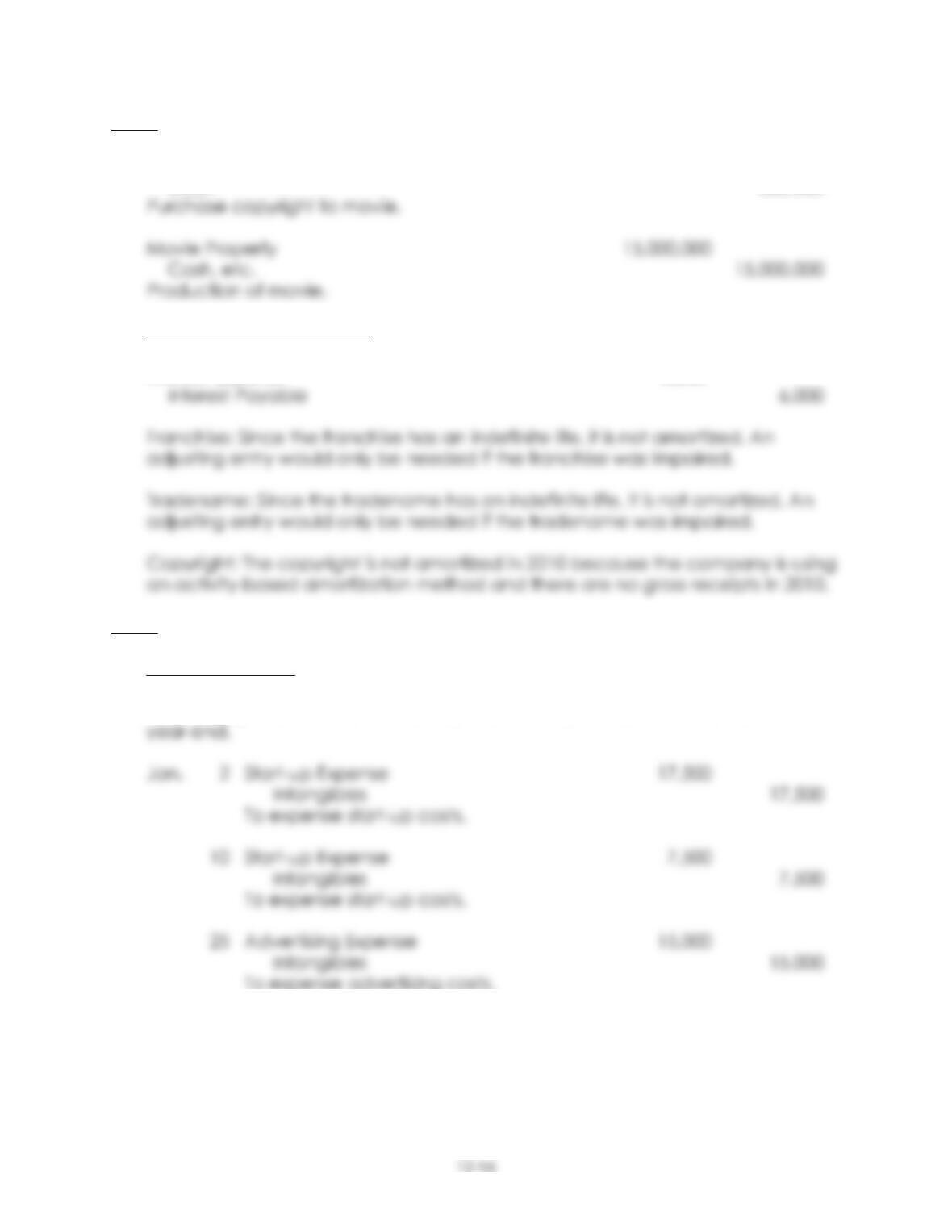
1. Franchise 60,000
2. Cash 50,000
Gain on Sale of Tradename 45,000
Tradename 5,000
Sale of tradename.
P12-2 (continued)
5. Copyright 500,000
Cash 500,000
Year-end adjusting entries:
Interest Expense 6,000
P12-3
Note to Instructor: For ease of discussion, the adjusting entries to eliminate the
Intangibles account in the solution are dated to correspond with the original
erroneous journal entries. In actual practice, they would be dated as of the
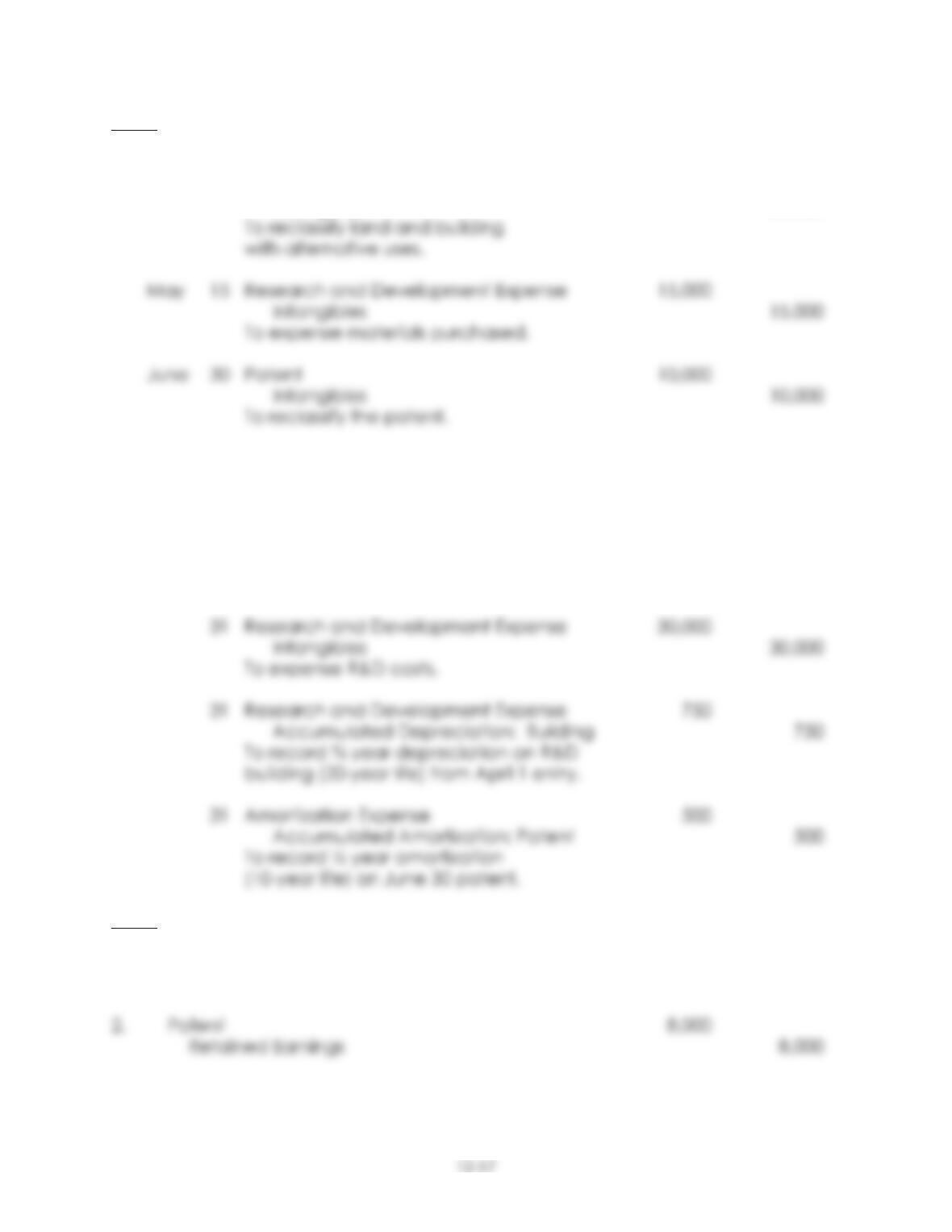
P12-3 (continued)
Apr. 1 Land 15,000
Building 20,000
Intangibles 35,000
July 1 Income Summary 12,000
Intangibles 12,000
To record operating loss.
Dec. 11 Research and Development Expense 12,000
Intangibles 12,000
To record acquisition of equipment.
P12-4
1. Retained Earnings 50,000
Patent 50,000
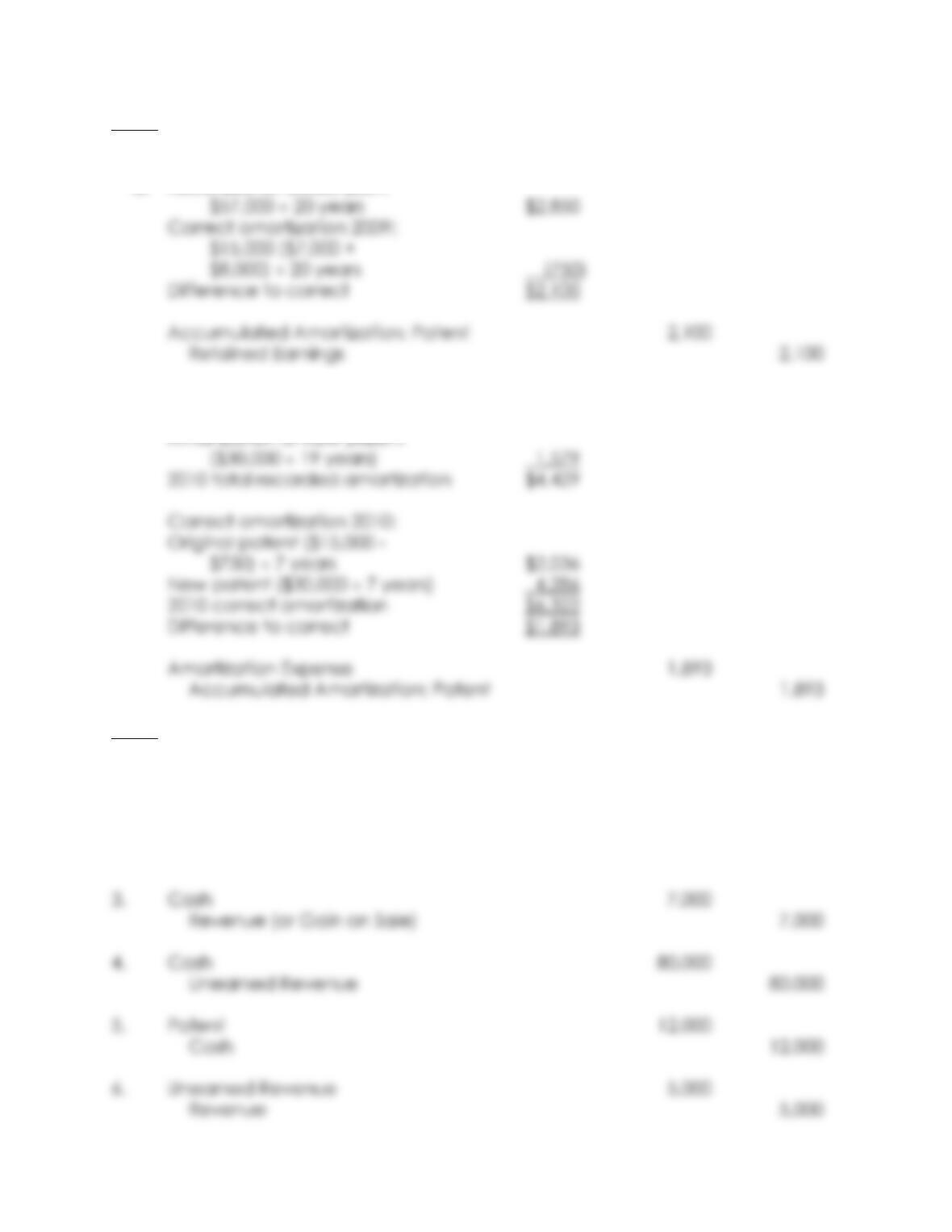
12-18
P12-4 (continued)
3. Amortization:
a. Recorded on books 2009:
b. Recorded on books in 2010:
Amortization of original patent $2,850
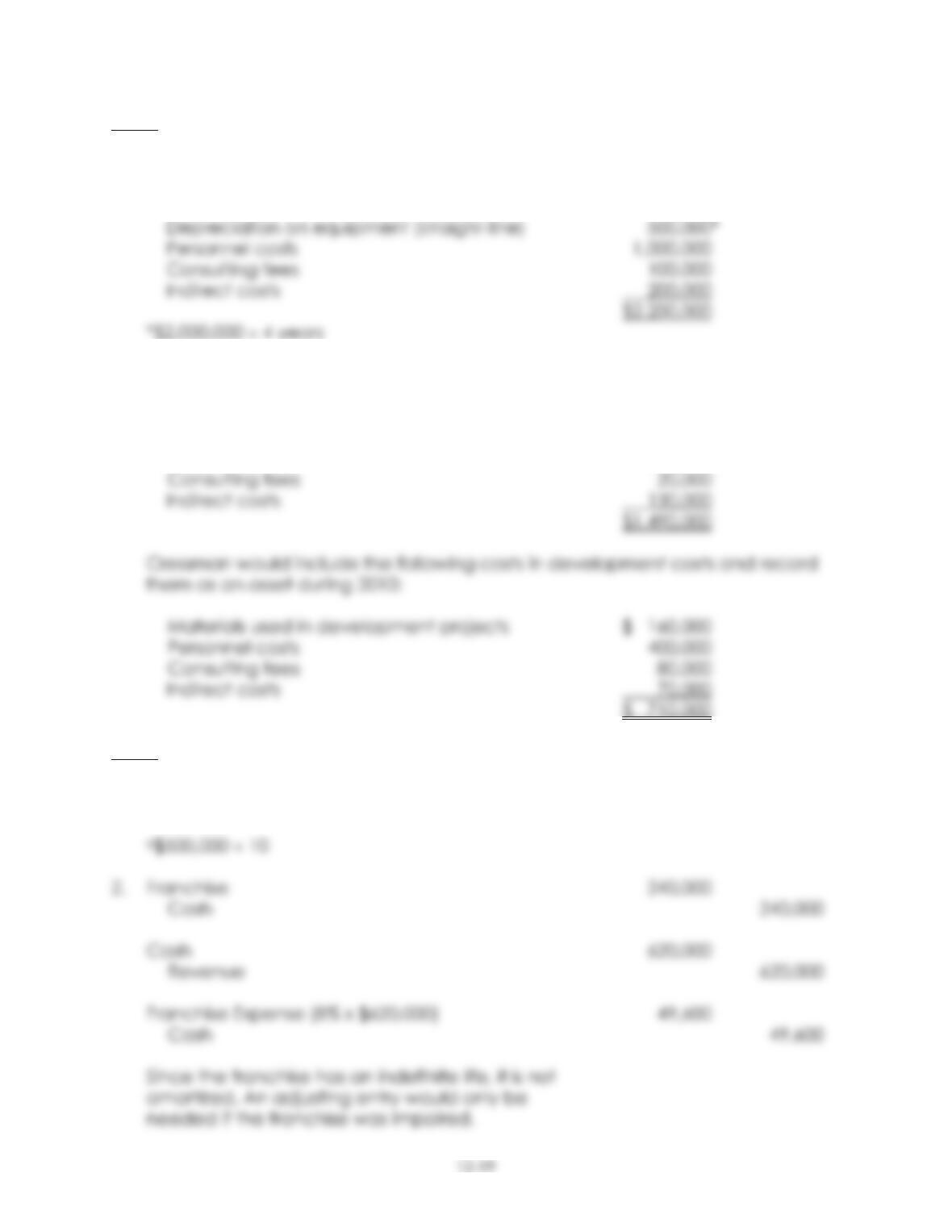
P12-5
1. Patent 40,000
Cash 40,000
2. Research and Development Expense 55,000
Cash, etc. 55,000
P12-6
1. The following costs are included as R&D expenses for 2010:
Materials used in R&D projects $ 400,000
2. Cressman would include the following costs in research expenses for 2010:
Materials used in research projects $ 240,000
Depreciation on equipment (straight-line) 500,000
Personnel costs 600,000
P12-7
1. Amortization Expense: Patent 50,000a
Accumulated Amortization: Patent 50,000
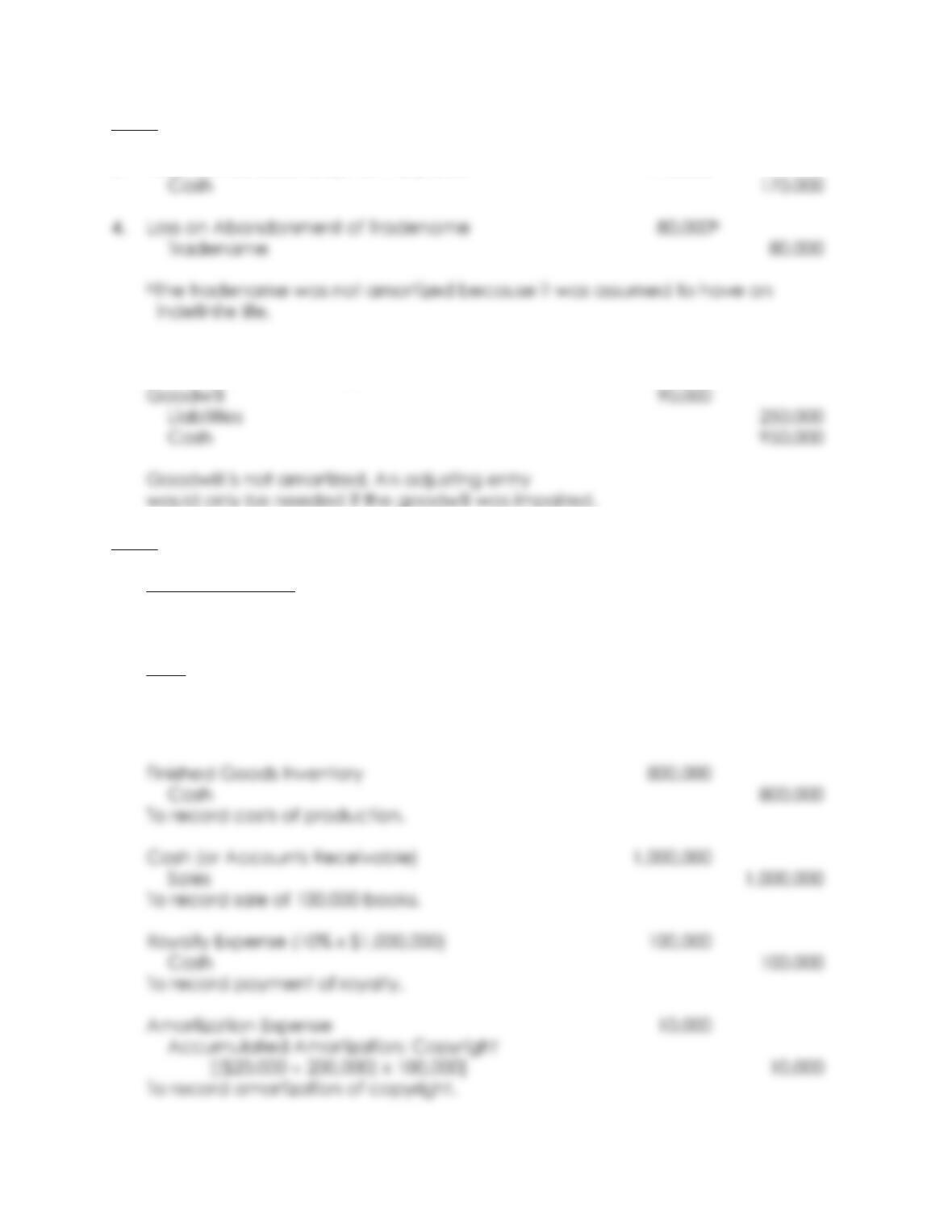
12-20
P12-7 (continued)
3. Research and Development Expense 170,000
5. Current Assets 210,000
Property, Plant, and Equipment 900,000
P12-8
Note to Instructor: Requirement 2 of this problem requires a knowledge of
“contingencies,” discussed briefly in Chapter 4 and more thoroughly in Chapter
13.
1. 2010
Copyright 20,000
Cash 20,000
Payment for copyright.