PROBLEM 12.61
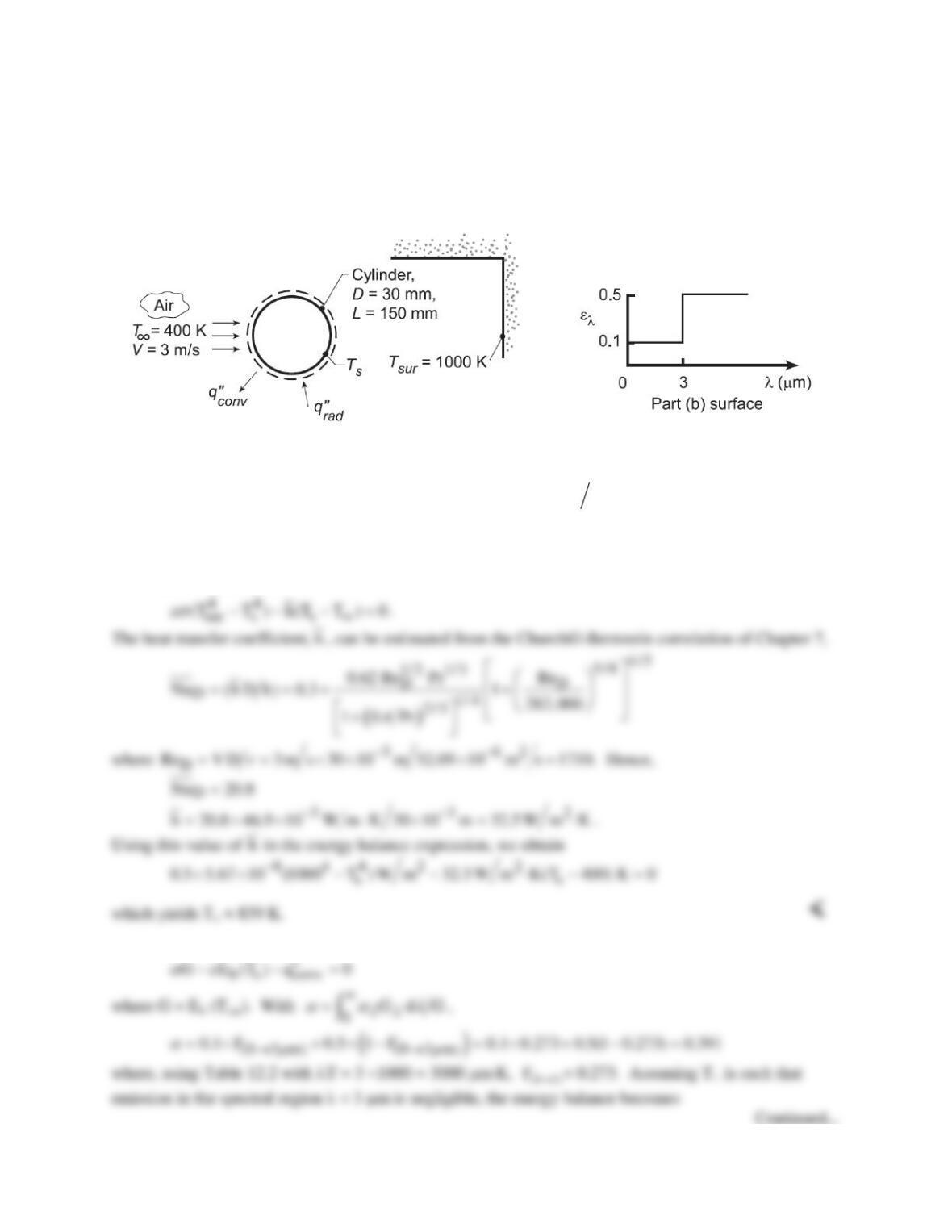
KNOWN: Cross flow of air over a cylinder placed within a large furnace.
FIND: (a) Steady–state temperature of the cylinder when it is diffuse and gray with e = 0.5, (b) Steady-
state temperature when surface has spectral properties shown below, (c) Steady-state temperature of the
diffuse, gray cylinder if air flow is parallel to the cylindrical axis, (d) Effect of air velocity on cylinder
temperature for conditions of part (a).
SCHEMATIC:
ASSUMPTIONS: (1) Cylinder is isothermal, (2) Furnace walls are isothermal and large in area
compared to the cylinder, (3) Steady-state conditions.
PROPERTIES: Table A.4, Air (Tf ≈ 600 K):
62
52.69 10 m s
ν
−
= ×
, k = 46.9 × 10⁻³ W/m⋅K, Pr =
0.685.
ANALYSIS: (a) When the cylinder surface is gray and diffuse with e = 0.5, the energy balance is of the
form,
rad conv
qq 0
′′ ′′
−=
. Hence,
(b) When the cylinder has the spectrally selective behavior, the energy balance is written as
PROBLEM 12.61 (Cont.)
(c) When the cylinder is diffuse–gray with air flow in the longitudinal direction, the characteristic length
for convection is different. Assume conditions can be modeled as flow over a flat plate of L = 150 mm.
With
3 62
L
Re V L 3m s 150 10 m 52.69 10 m s 8540
ν
−−
= = ×× × =
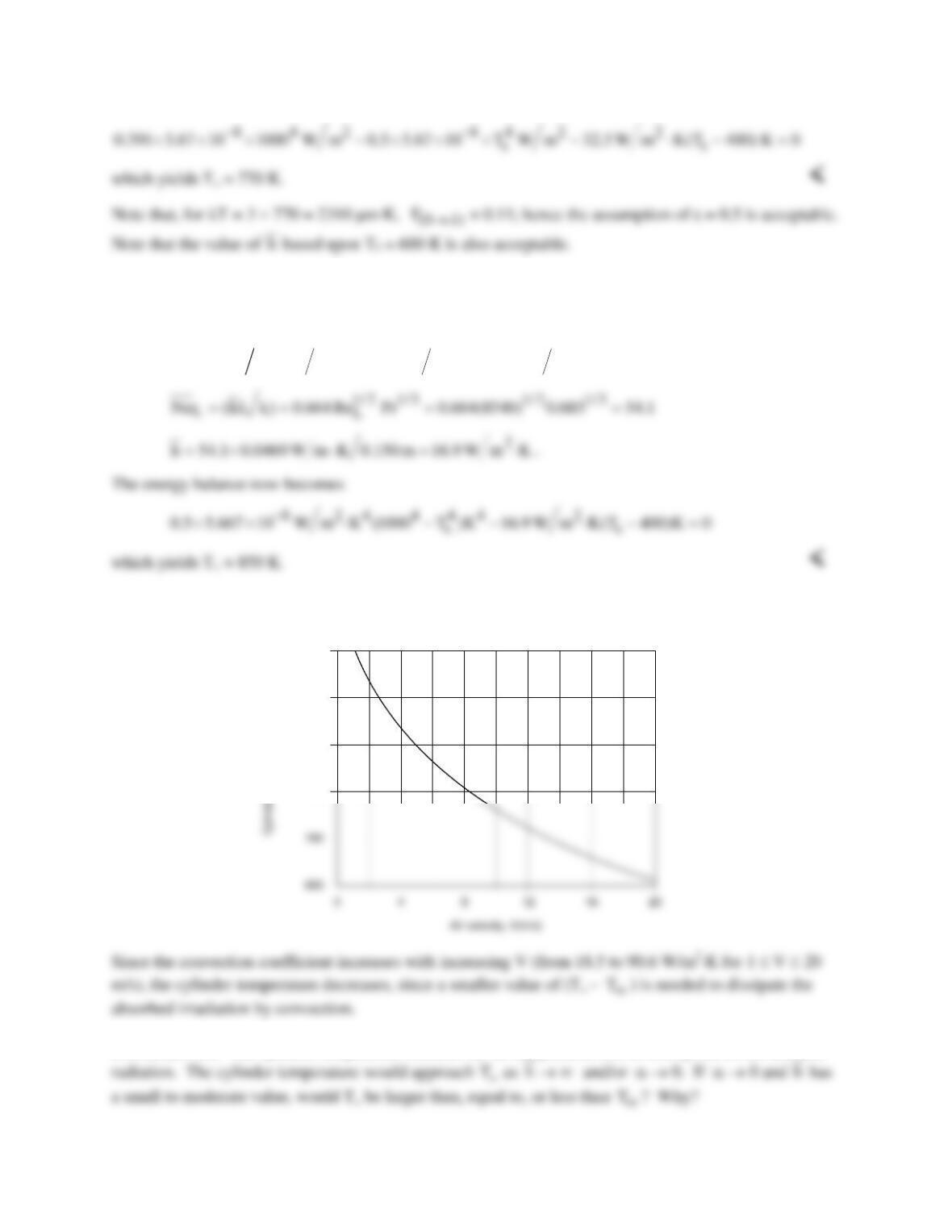
(b) Using the IHT, the effect of velocity may be determined and the results are as follows:
750
800
850
900
COMMENTS: The cylinder temperature exceeds the air temperature due to absorption of the incident
PROBLEM 12.62
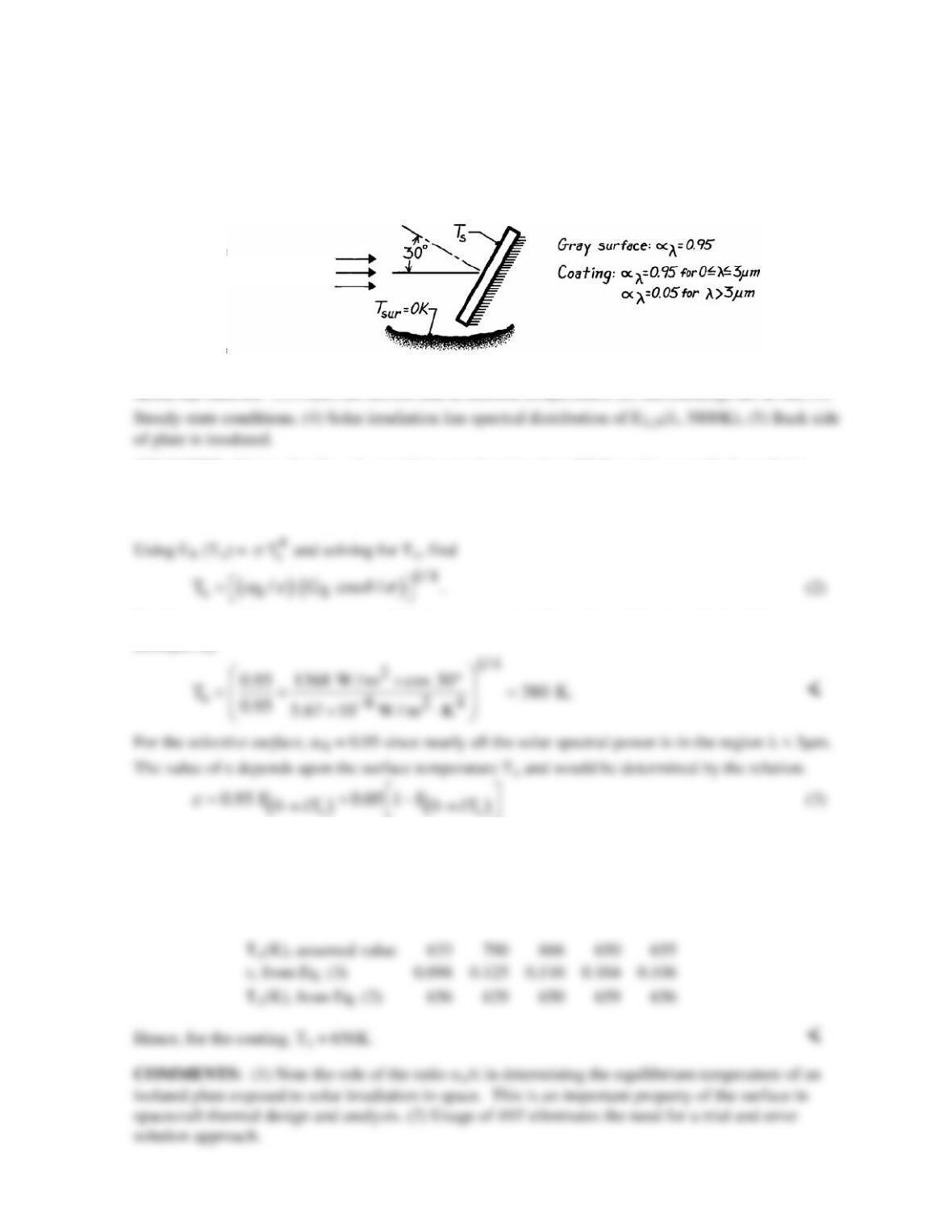
KNOWN: Spectrally selective and gray surfaces in earth orbit are exposed to solar irradiation, GS,
in a direction 30° from the normal to the surfaces.
FIND: Equilibrium temperature of each plate.
SCHEMATIC:
ASSUMPTIONS: (1) Plates are diffuse and at uniform temperature, (2) Surroundings are at 0K, (3)
ANALYSIS: Noting that the solar irradiation is directional (at 30° from the normal), the radiation
balance has the form
( )
SS b s
G cos E T 0.
a θe
−=
(1)
For the gray surface, aS = e = aλ and the temperature is independent of the magnitude of the
absorptivity.
where λ = 3µm and Ts is as yet unknown. To find Ts, a trial-and-error procedure as follows will be
used: (1) assume a value of Ts, (2) using Eq. (3), calculate e with the aid of Table 12.2 evaluating
F(0→λT) at λTs = 3µm⋅Ts, (3) with this value of e, calculate Ts from Eq. (2) and compare with
assumed value of Ts. The results of the iterations are:
G
s
= 1368 W/m
2
PROBLEM 12.63
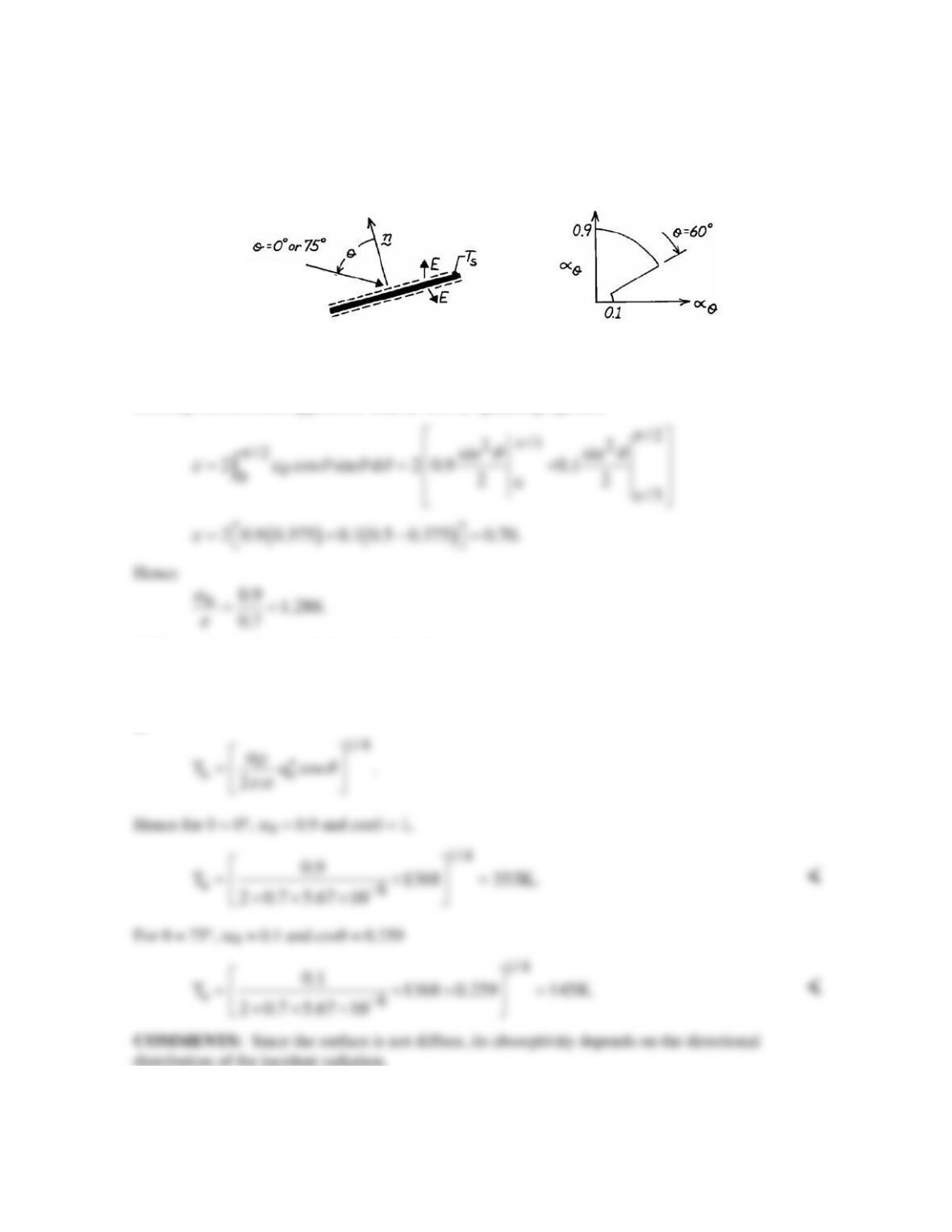
KNOWN: Directional absorptivity of a plate exposed to solar radiation on one side.
FIND: (a) Ratio of normal absorptivity to hemispherical emissivity, (b) Equilibrium temperature of
plate at 0° and 75° orientation relative to sun’s rays.
SCHEMATIC:
ASSUMPTIONS: (1) Surface is gray, (2) Properties are independent of φ.
ANALYSIS: (a) From the prescribed aθ (θ), an = 0.9. Since the surface is gray, eθ = aθ. Hence
from Eq. 12.42, which applies for total as well as spectral properties.
(b) Performing an energy balance on the plate,
4
ss
q cos 2 T 0
θ
a θ es
′′ −=
or
q
S
= 1368 W/m
2
“
PROBLEM 12.64
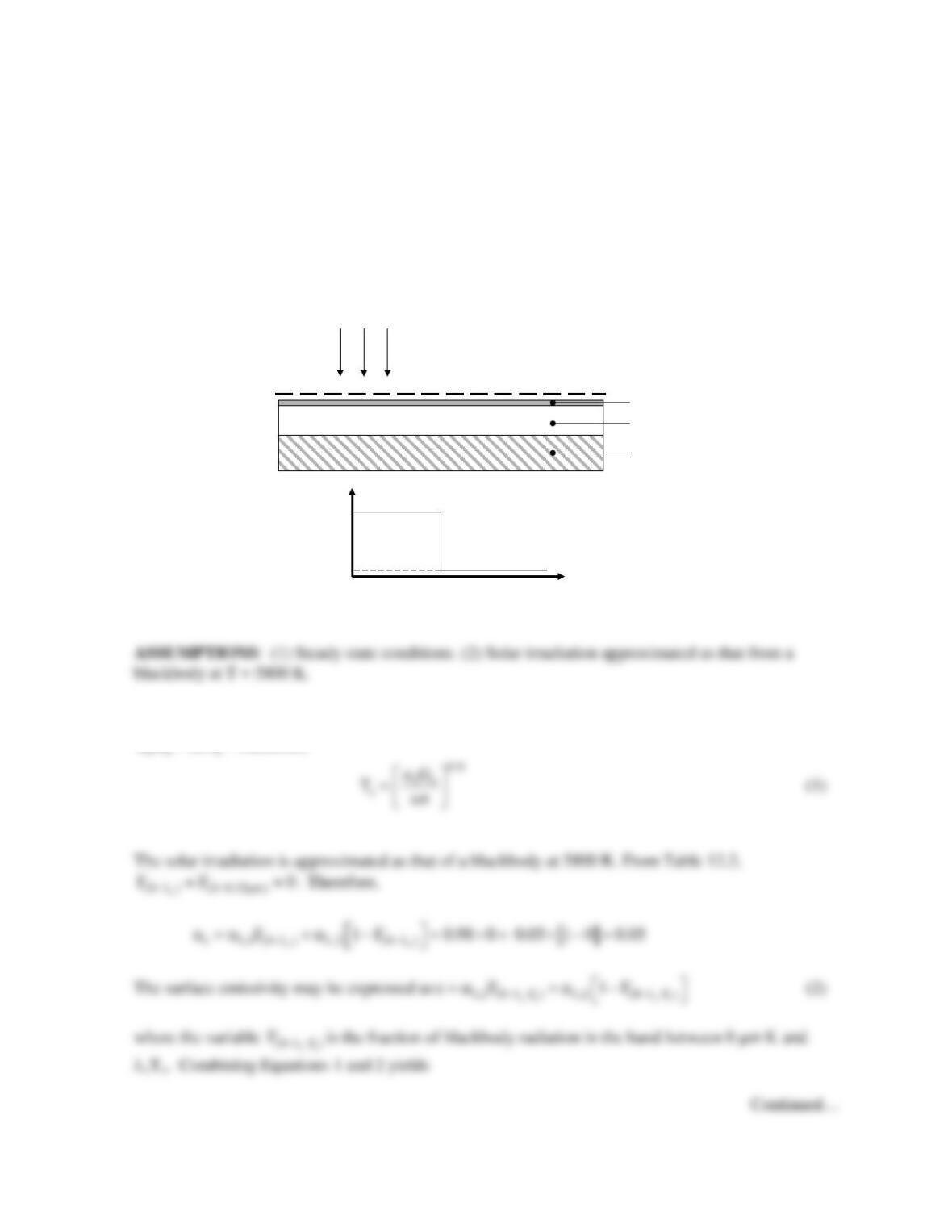
KNOWN: Solar irradiation of coated aluminum. Spectral absorptivities above and below cutoff
wavelength. Cutoff wavelength under normal conditions.
FIND: (a) Equilibrium temperature for normal conditions with λc = 0.15 µm. (b) Value of λc that will
maximize surface temperature.
SCHEMATIC:
ANALYSIS: (a) For the control surface shown in the schematic
in out
EE=
or Gs = J or
4
GTa = es
. Therefore,
G
s
= 1368 W/m
2
Insulation
Aluminum
Coating
λ(µm)
a
λ
λ
c
0.98
0.05
PROBLEM 12.64 (Cont.)
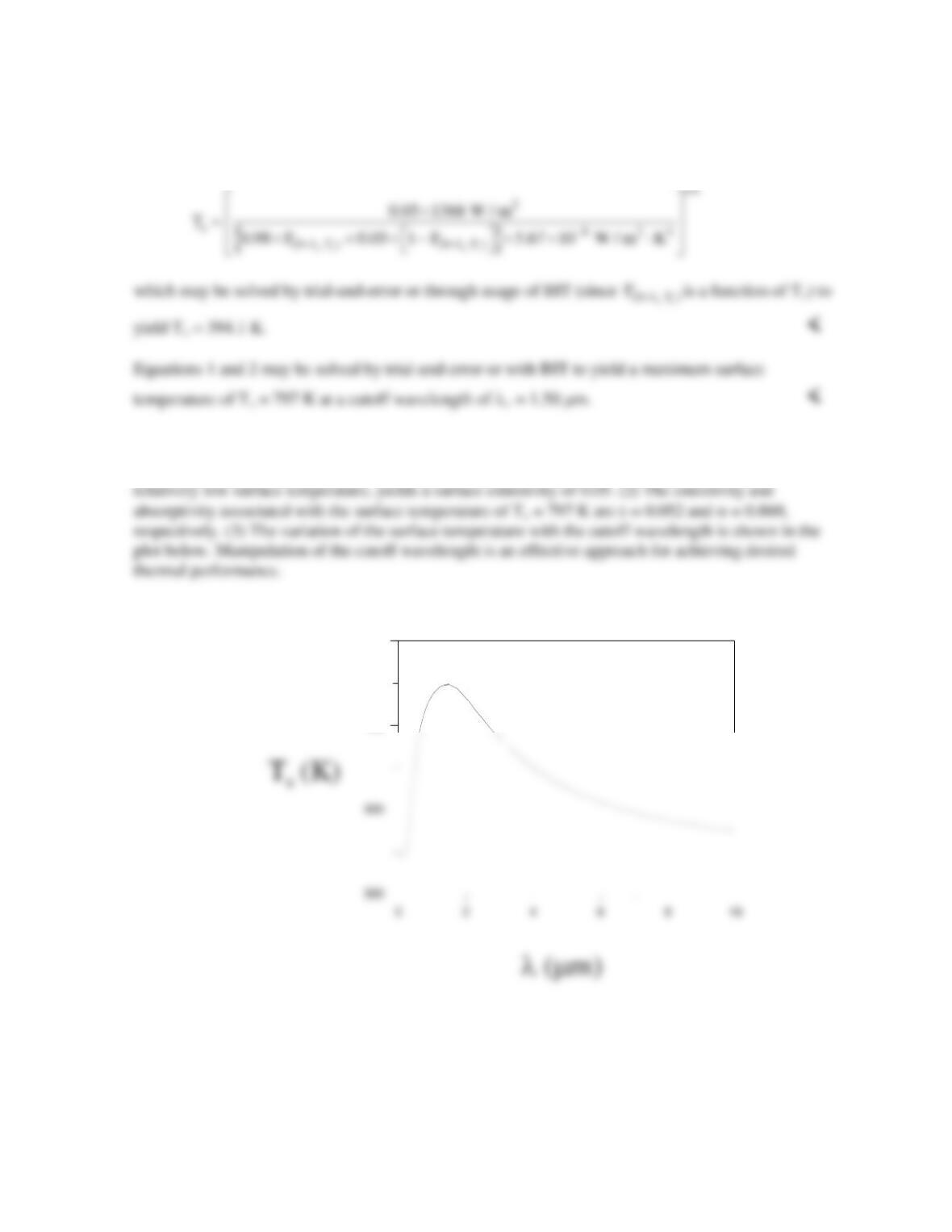
COMMENTS: (1) The small value of λc that exists under normal conditions, coupled with the
700
900
PROBLEM 12.65
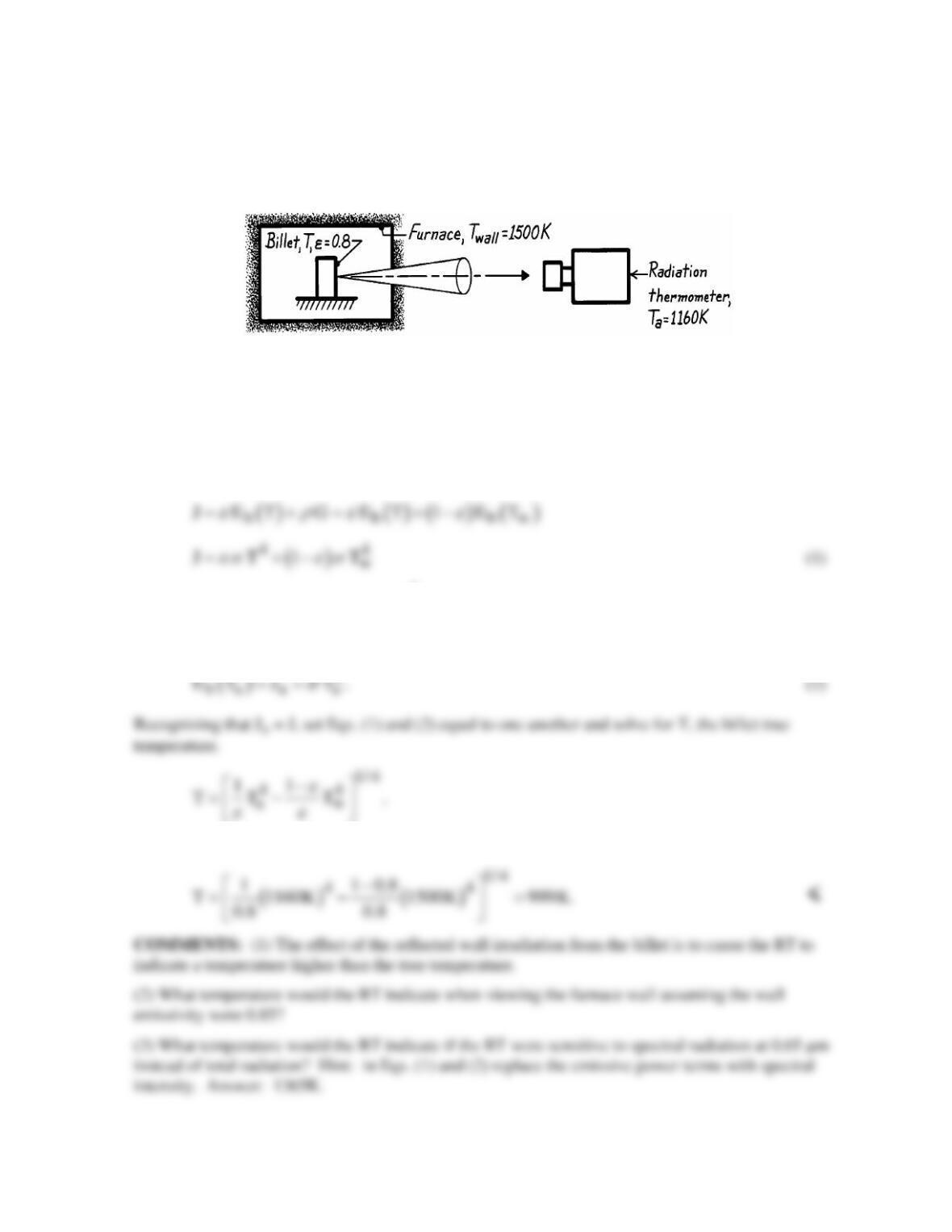
KNOWN: Radiation thermometer (RT) viewing a steel billet being heated in a furnace.
FIND: Temperature of the billet when the RT indicates 1160K.
SCHEMATIC:
ASSUMPTIONS: (1) Billet is diffuse–gray, (2) Billet is small object in large enclosure, (3) Furnace
behaves as isothermal, large enclosure, (4) RT is a radiometer sensitive to total (rather than a
prescribed spectral band) radiation and is calibrated to correctly indicate the temperature of a black
body, (5) RT receives radiant power originating from the target area on the billet.
ANALYSIS: The radiant power reaching the radiation thermometer (RT) is proportional to the
radiosity of the billet. For the diffuse-gray billet within the large enclosure (furnace), the radiosity is
where a = e, G = Eb (Tw) and Eb = s T4. When viewing the billet, the RT indicates Ta = 1100K,
referred to as the apparent temperature of the billet. That is, the RT indicates the billet is a blackbody
at Ta for which the radiosity will be
4
Substituting numerical values, find
PROBLEM 12.66
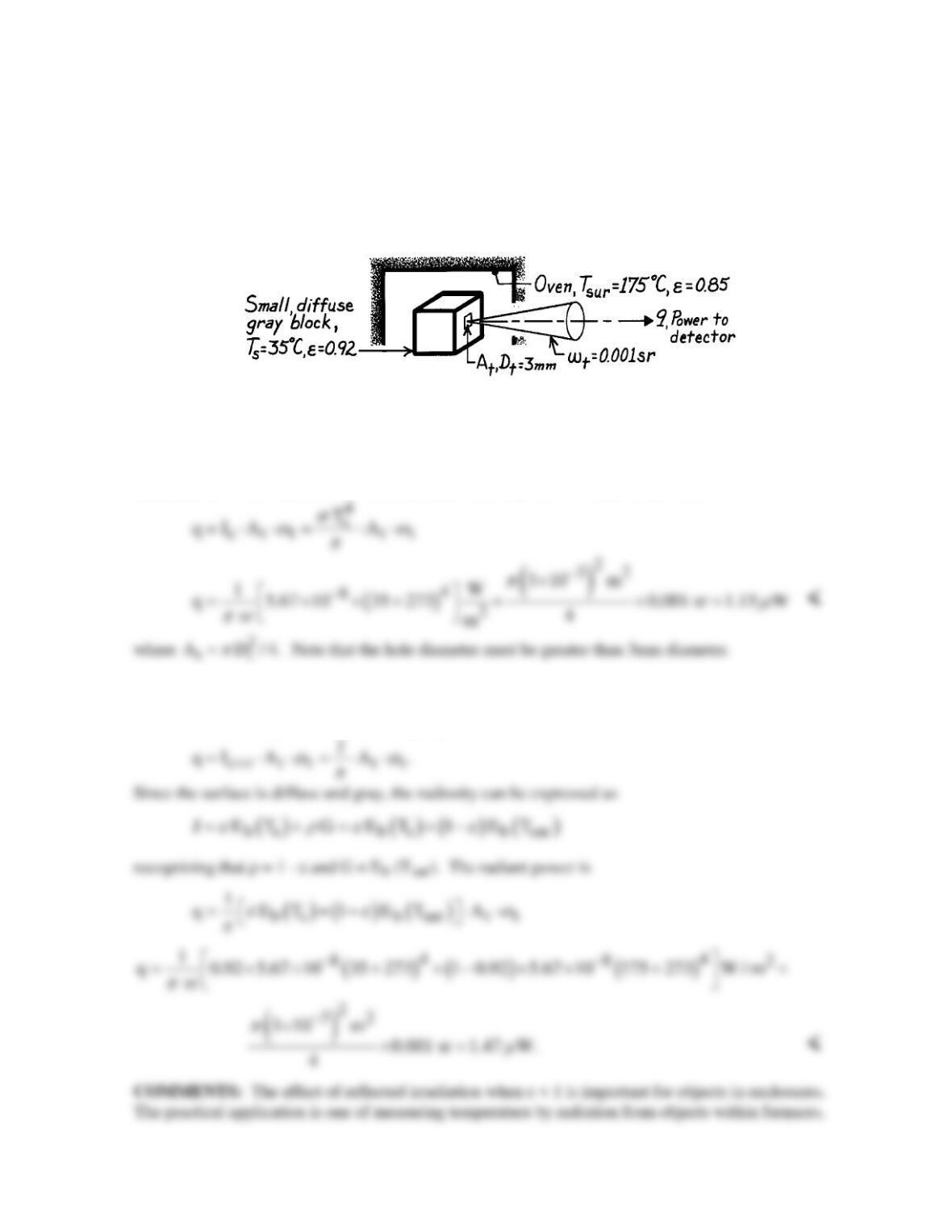
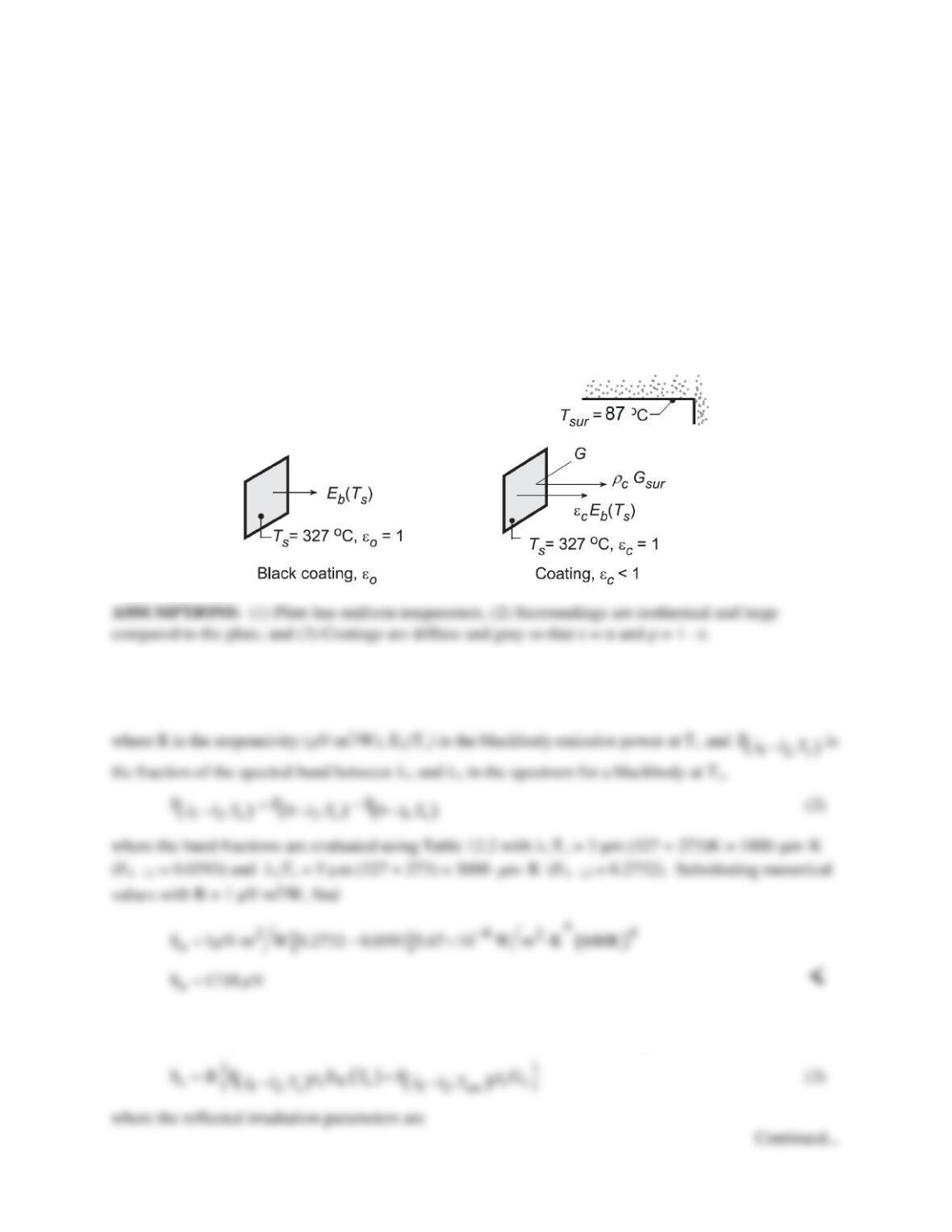
KNOWN: Small, diffuse, gray block with e = 0.92 at 35°C is located within a large oven whose
walls are at 175°C with e = 0.85.
FIND: Radiant power reaching detector when viewing (a) a deep hole in the block and (b) an area on
the block’s surface.
SCHEMATIC:
ASSUMPTIONS: (1) Block is isothermal, diffuse, gray and small compared to the enclosure, (2)
Oven is isothermal enclosure.
ANALYSIS: (a) The small, deep hole in the isothermal block approximates a blackbody at Ts. The
radiant power to the detector can be determined from Eq. 12.11 written in the form:
(b) When the detector views an area on the surface of the block, the radiant power reaching the
detector will be due to emission and reflected irradiation originating from the enclosure walls. In
terms of the radiosity, we can write using Eq. 12.23,
PROBLEM 12.67
KNOWN: Infrared thermograph with a 3– to 5-micrometer spectral bandpass views a metal plate
maintained at Ts = 327°C having four diffuse, gray coatings of different emissivities. Surroundings at
Tsur = 87°C.
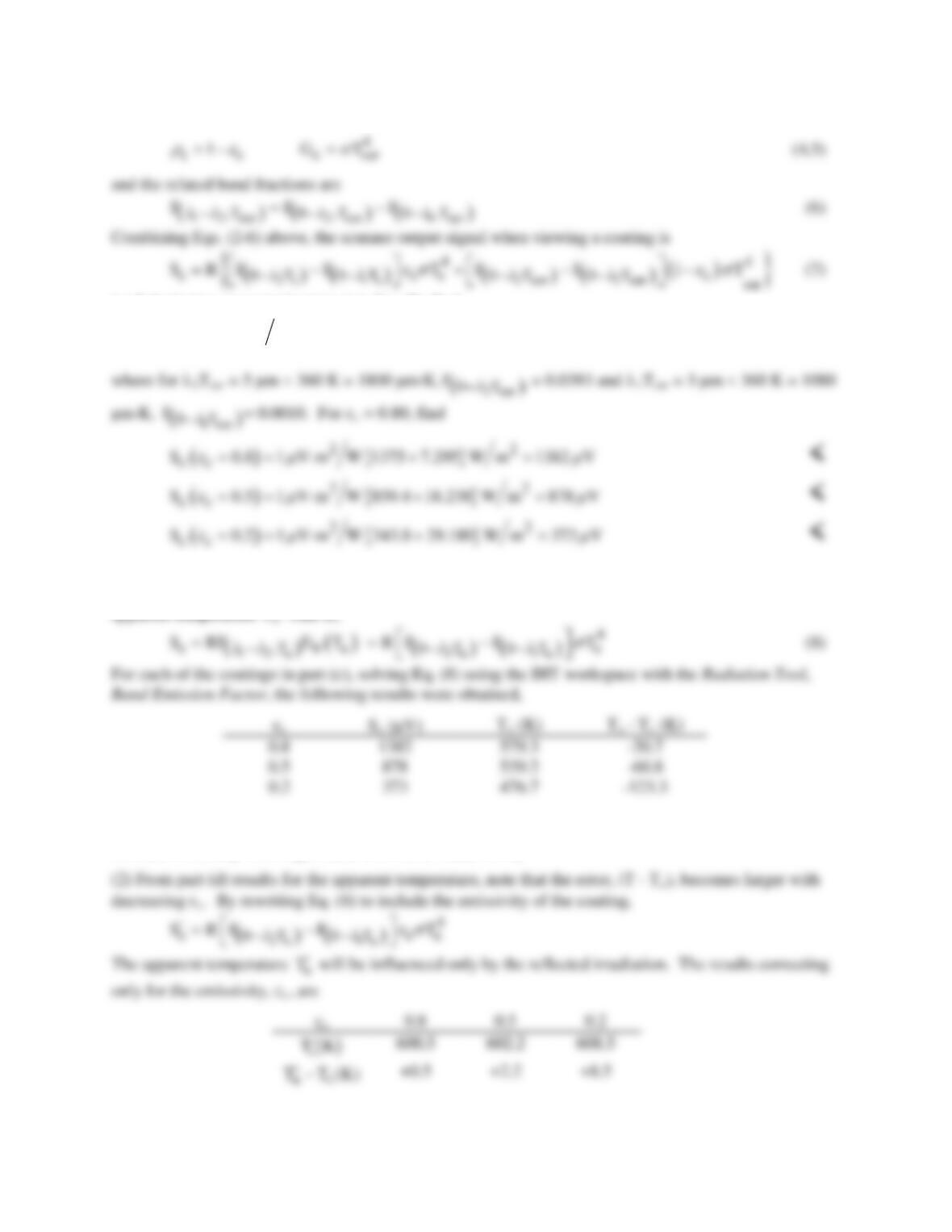
FIND: (a) Expression for the output signal, So, in terms of the responsivity, R (µV⋅m2/W), the black
coating (eo = 1) emissive power and appropriate band emission fractions; assuming R = 1 µV⋅m2/W,
evaluate So(V); (b) Expression for the output signal, Sc, in terms of the responsivity R, the blackbody
emissive power of the coating, the blackbody emissive power of the surroundings, the coating emissivity,
ec, and appropriate band emission fractions; (c) Thermograph signals, Sc (µV), when viewing with
emissivities of 0.8, 0.5 and 0.2 assuming R = 1 µV⋅m2/W; and (d) Apparent temperatures which the
device will indicate based upon the signals found in part (c) for each of the three coatings.
SCHEMATIC:
ANALYSIS: (a) When viewing the black coating (eo = 1), the scanner output signal can be expressed as
( )
( )
1 2s
o bs
,T
S RF E T
λλ
−
=
(1)
(b) When viewing one of the coatings (ec < eo = 1), the output signal as illustrated in the schematic above
will be affected by the emission and reflected irradiation from the surroundings,
PROBLEM 12.67 (Cont.)
(c) Substituting numerical values into Eq. (7), find
[ ]
( )
[ ]
( ) ( )
{ }
44
2
cc c
S 1 V m W 0.2732 0.0393 600K 0.0393 0.0010 1 360K
µ es e s
=⋅ − +− −
(d) The thermograph calibrated against a black surface (e1 = 1) interprets the radiation reaching the
detector by emission and reflected radiation from a coating target (ec < eo ) as that from a blackbody at an
apparent temperature Ta. That is,
COMMENTS: (1) From part (c) results for Sc, note that the contribution of the reflected irradiation
becomes relatively more significant with lower values of ec.
PROBLEM 12.68
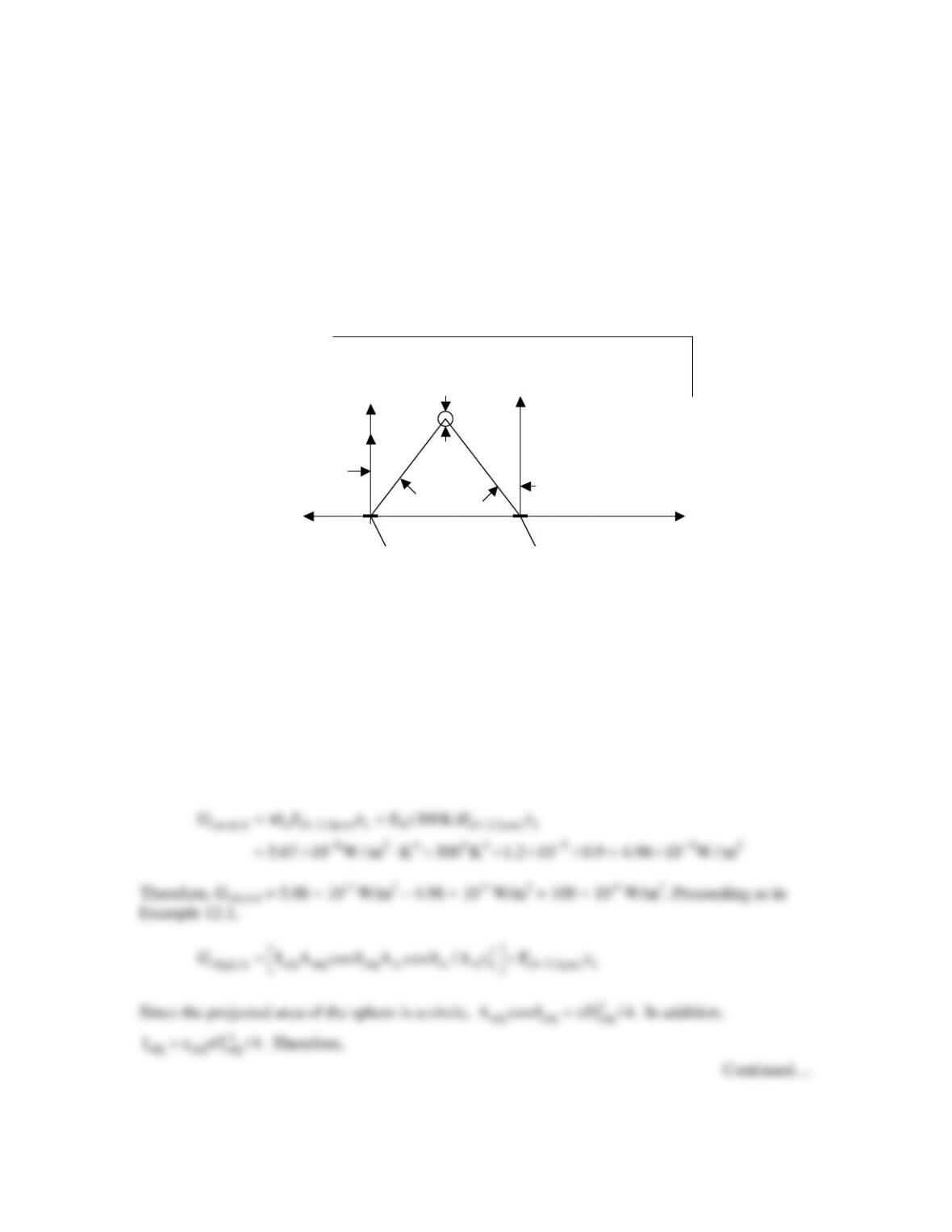
KNOWN: Diameter, emissivity and temperature of a spherical object. Aperture areas, locations,
and spectral transmissivity of the optics of two detectors. Surroundings temperature and
irradiation detected at two times.
FIND: Velocity of the object, location and time at which the object will strike the y = 0 plane.
SCHEMATIC:
ASSUMPTIONS: (1) Diffuse object, (2) Object travels in a straight line, (3) Object is located
above y = 2 m.
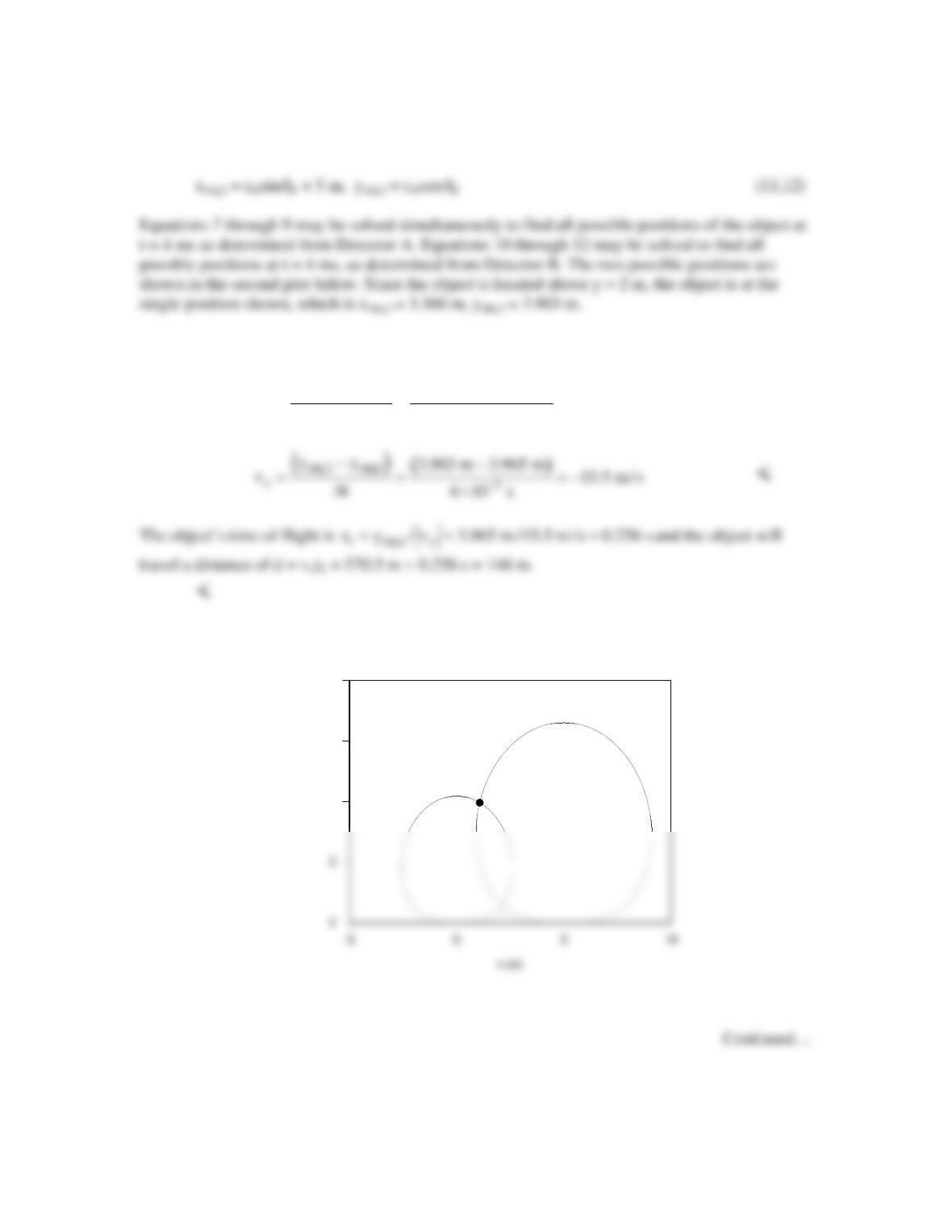
ANALYSIS: We begin by analyzing the situation at time t = 0. For Detector A, the irradiation
that is detected, Gd,A, is composed of irradiation from the surroundings, Gsur , and irradiation from
the object, Gobj. Hence, Gd,A = Gsur,d,A + Gobj,d,A. The irradiation from the surroundings that is
detected is
Tsur = 300 K
-x x
y
nn
rA
rB
θB
θA
AA= 300 ×10-6 m2
Gd,A
AB= 300 ×10–6 m2
Gd,B
Detector A (x = 0) Detector B (x = 5m)
Object
Tobj = 600 K
Dobj = 9 mm eobj = 0.95
Tsur = 300 K
-x x
y
nn
rA
rB
θB
θA
AA= 300 ×10-6 m2
Gd,A
AB= 300 ×10–6 m2
Gd,B
Detector A (x = 0) Detector B (x = 5m)
Object
Tobj = 600 K
Dobj = 9 mm eobj = 0.95
PROBLEM 12.68 (Cont.)
where
32
A
2
cos 28.57 10 m
r
−−
θ= ×
(7)
32
A
2
r
−−
θ= ×
r
PROBLEM 12.68 (Cont.)
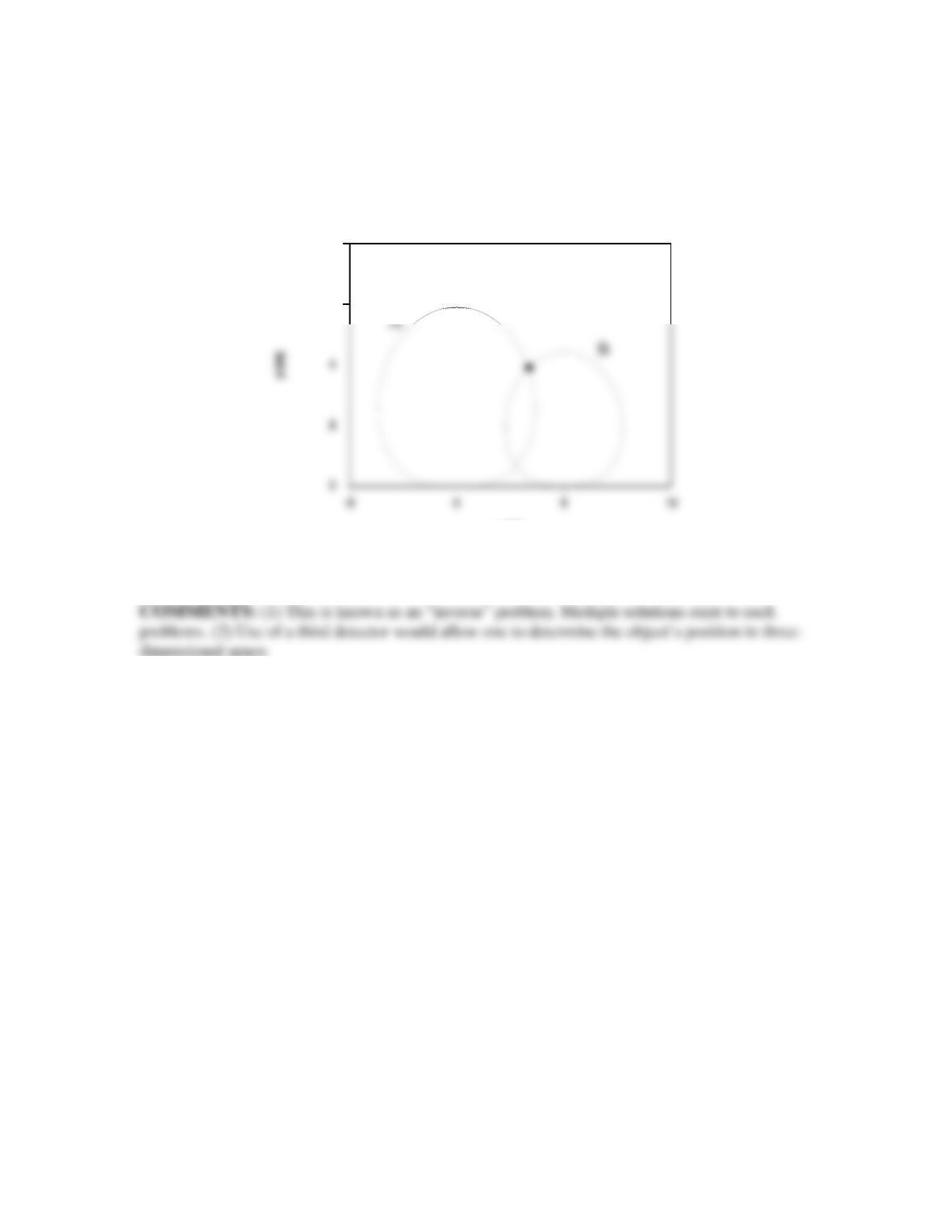
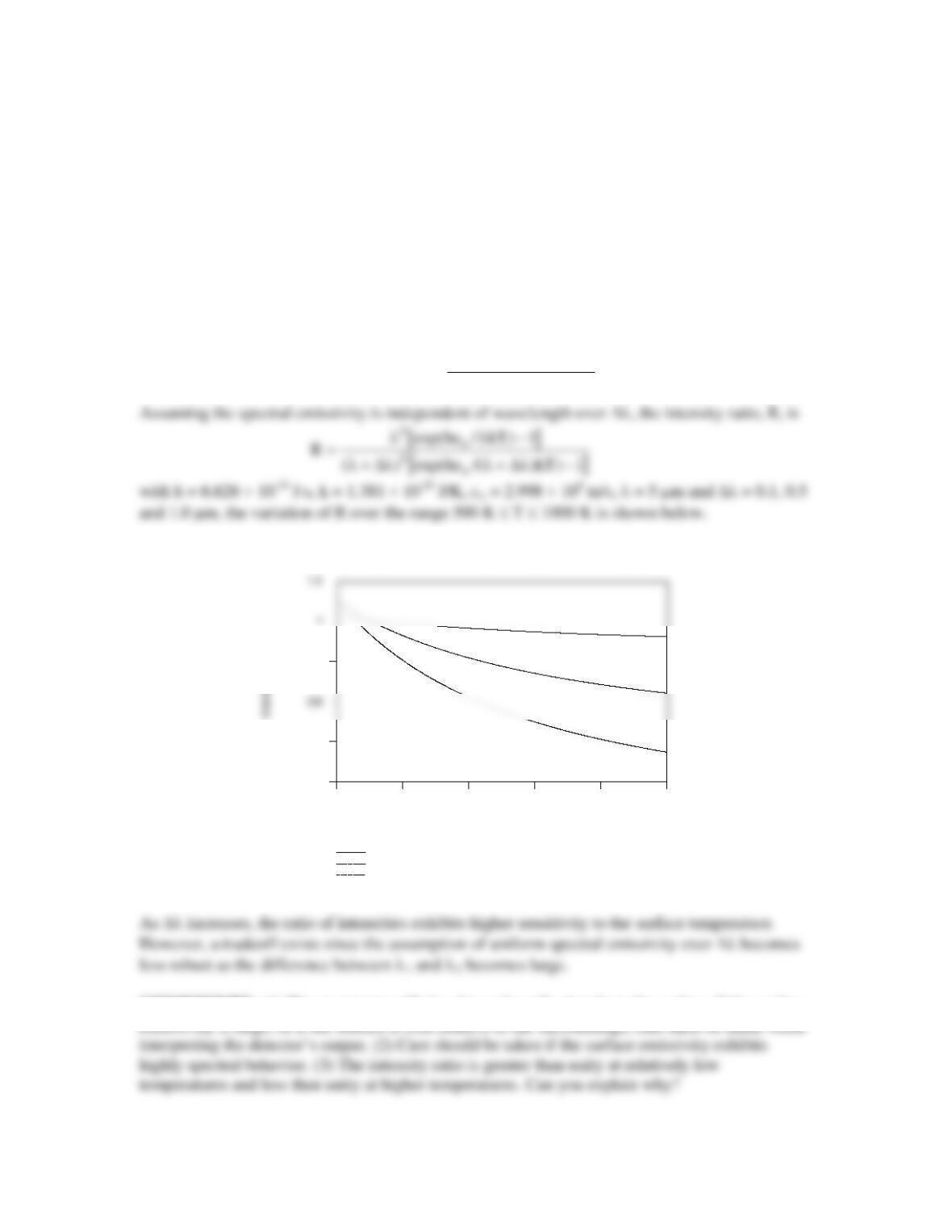
The velocity components of the object are
( )
( )
obj,2 obj,1
x3
xx 3.360 m 1.078 m
v 571 m /s
t4 10 s
−
−−
= = =
∆×
<
4
6
8
y (m)
4
6
8
y (m)
t = 0 s
A
B
PROBLEM 12.68 (Cont.)
x (m)
6
8
t = 4 ms
x (m)
6
8
PROBLEM 12.69
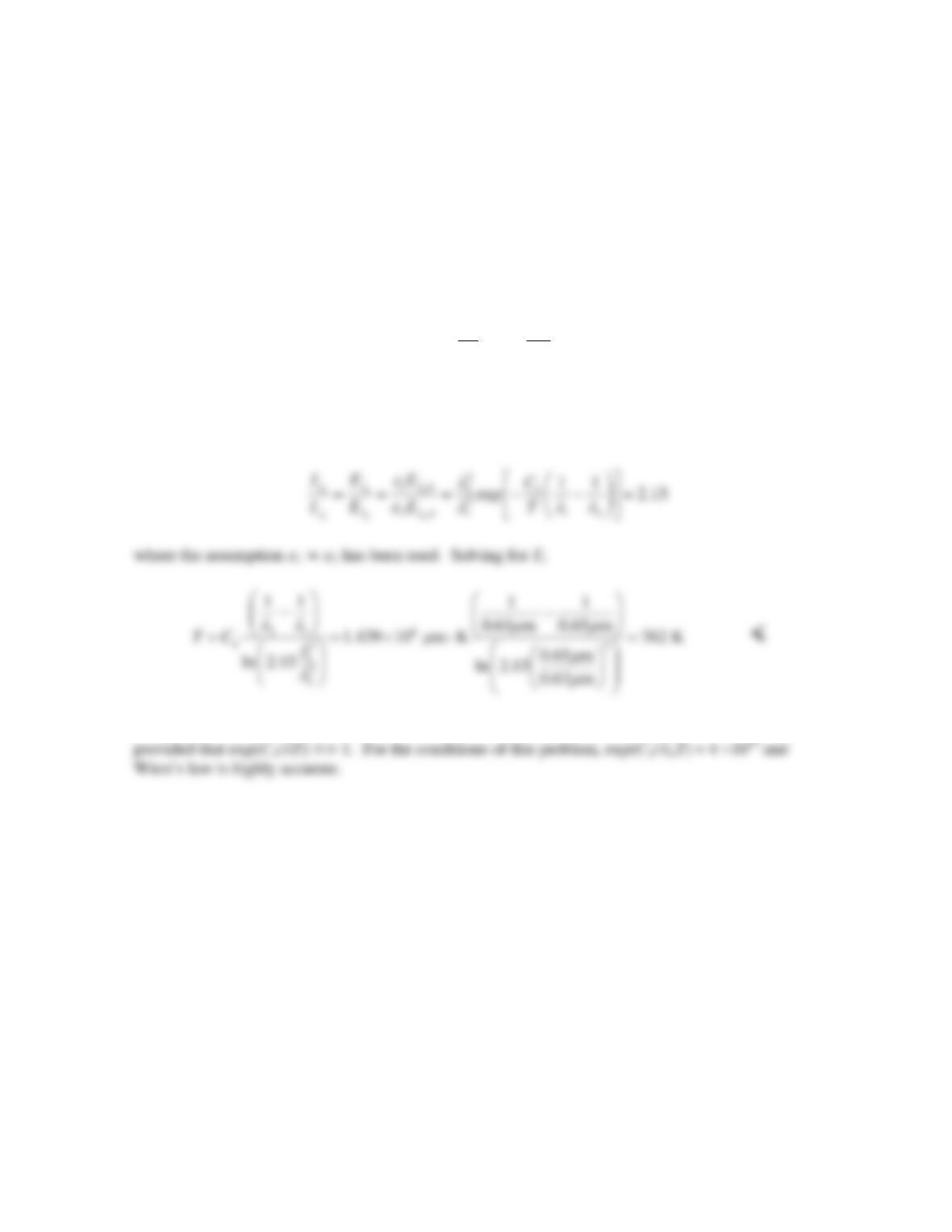
KNOWN: Wavelengths associated with a two–color pyrometer.
FIND: The ratio of intensities emitted by the surface at nominal wavelength of λ = 5
µ
m and ∆λ
= 0.1, 0.5 and 1 µm.
ASSUMPTIONS: Surface is hot relative to the surroundings so that reflection is negligible
relative to emission.
ANALYSIS: The spectral intensity emitted by the surface is
[ ]
2
o
,e ,b 5
o
2hc
I I ( ,T) exp(hc / kt) 1
λ
λ λλ e
=e λ=
λ λ−
Intensity Ratio vs. Sur face Temperatur e (Lambda = 5 micron)
500 600 700 800 900 1000
Temperatur e (K)
0.6
0.7
0.9
DelLambda = 0.1
DelLambda = 0.5
DelLambda = 1.0
COMMENTS: (1) The pyrometer will also detect the reflection from the surface. If the surface
PROBLEM 12.70
KNOWN: Two wavelength values associated with a two–color pyrometer. Ratio of detected
radiation from stainless steel.
FIND: Temperature of stainless steel.
ASSUMPTIONS: (1) Surface is hot relative to the surroundings so that reflection is negligible
relative to emission, (2) Wien’s law holds, (3) Emissivity does not vary greatly over the wavelength
range associated with the pyrometer.
ANALYSIS: From Problem 12.19, Wien’s law is
12
,5exp
b
CC
ET
λ
λλ
≈−
The detected radiation flux is equal to the radiation flux emitted from the steel surface, since reflection
has been assumed negligible. The ratio of intensities is equal to the ratio of emissive power (since I
λ
=
p
E
λ
). Thus,
COMMENTS: Comparing Eq. 12.30 to Wien’s law, it can be seen that Wien’s law is accurate
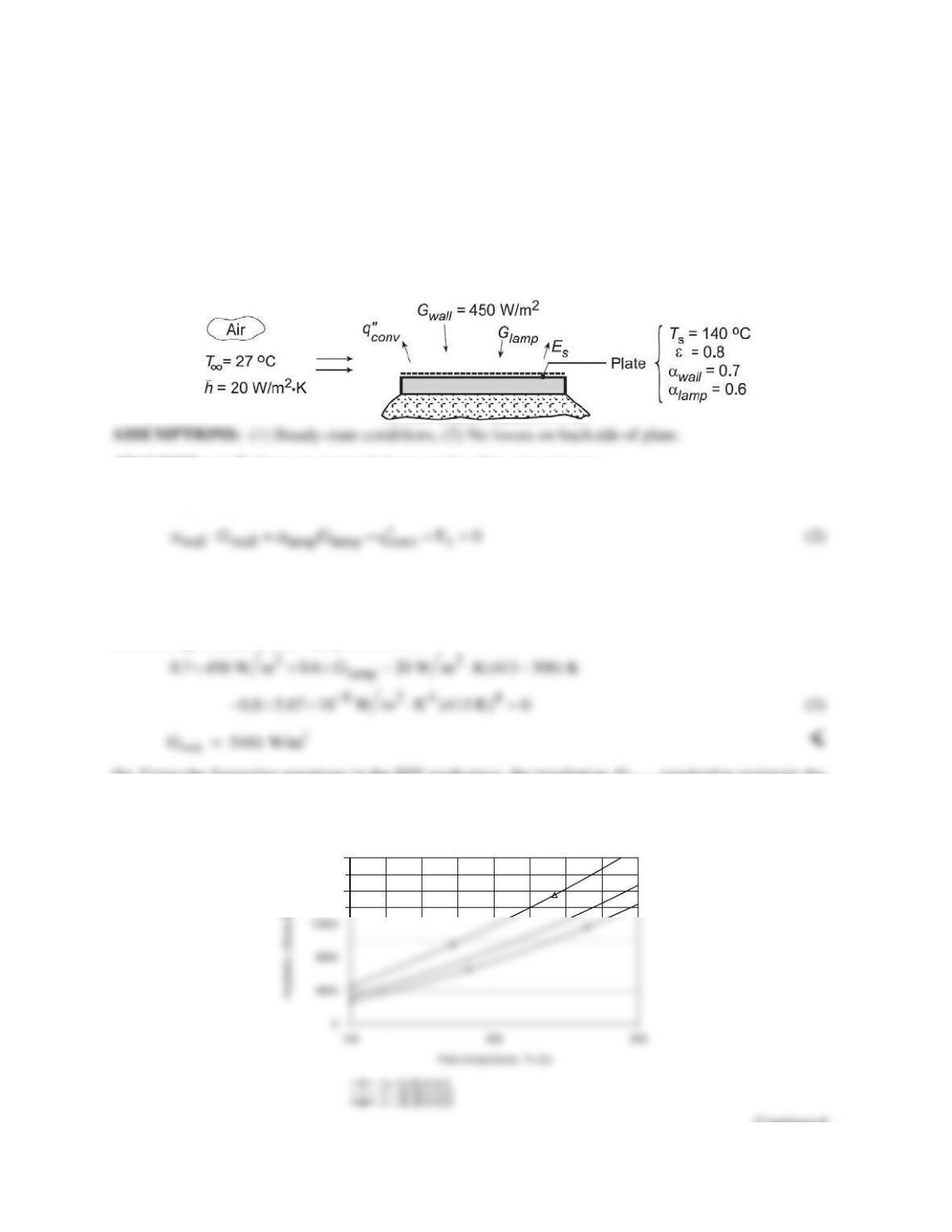
PROBLEM 12.71
KNOWN: Painted plate located inside a large enclosure being heated by an infrared lamp bank.
FIND: (a) Lamp irradiation required to maintain plot at Ts = 140oC for the prescribed convection and
enclosure irradiation conditions, (b) Compute and plot the lamp irradiation, Glamp , required as a function
of the plate temperature, Ts, for the range 100 ≤ Ts ≤ 300 oC and for convection coefficients of h = 15, 20
and 30 W/m2⋅K, and (c) Compute and plot the air stream temperature,
T∞
, required to maintain the plate
at 140oC as a function of the convection coefficient h for the range 10 ≤ h ≤ 30 W/m2⋅K with a lamp
irradiation Glamp = 3000 W/m2.
SCHEMATIC:
ANALYSIS: (a) Perform an energy balance on the plate, per unit area,
in out
EE 0−=
(1)
where the emissive power of the surface and convective fluxes are
4
s sb s s s
E E (T ) T
e es
= = ⋅
conv s
q h(T T )
∞
′′ = −
(3,4)
Substituting values, find the lamp irradiation
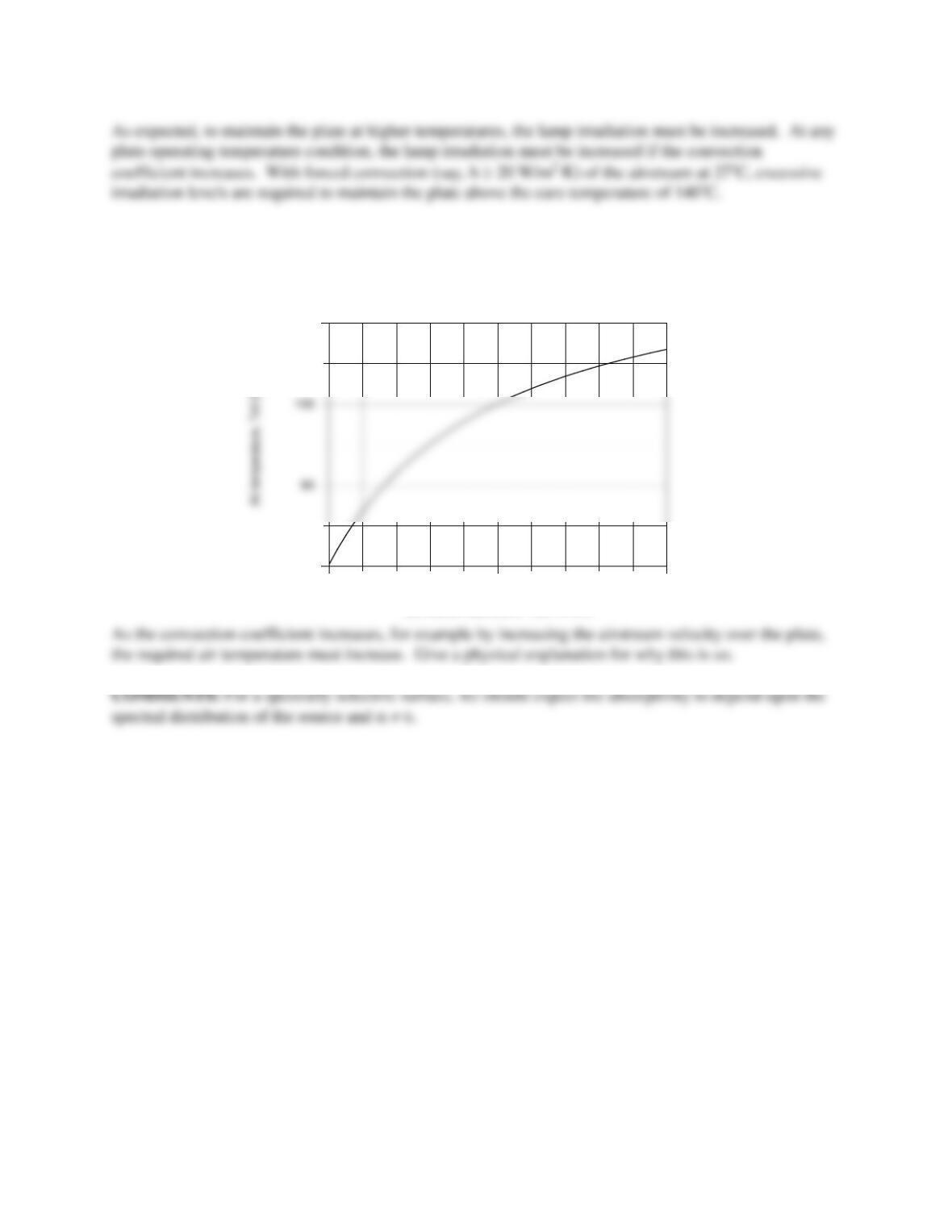
(b) Using the foregoing equations in the IHT workspace, the irradiation, Glamp , required to maintain the
plate temperature in the range 100 ≤ Ts ≤ 300 oC for selected convection coefficients was computed. The
results are plotted below.
16000
20000
Continued…
PROBLEM 12.71 (Cont.)
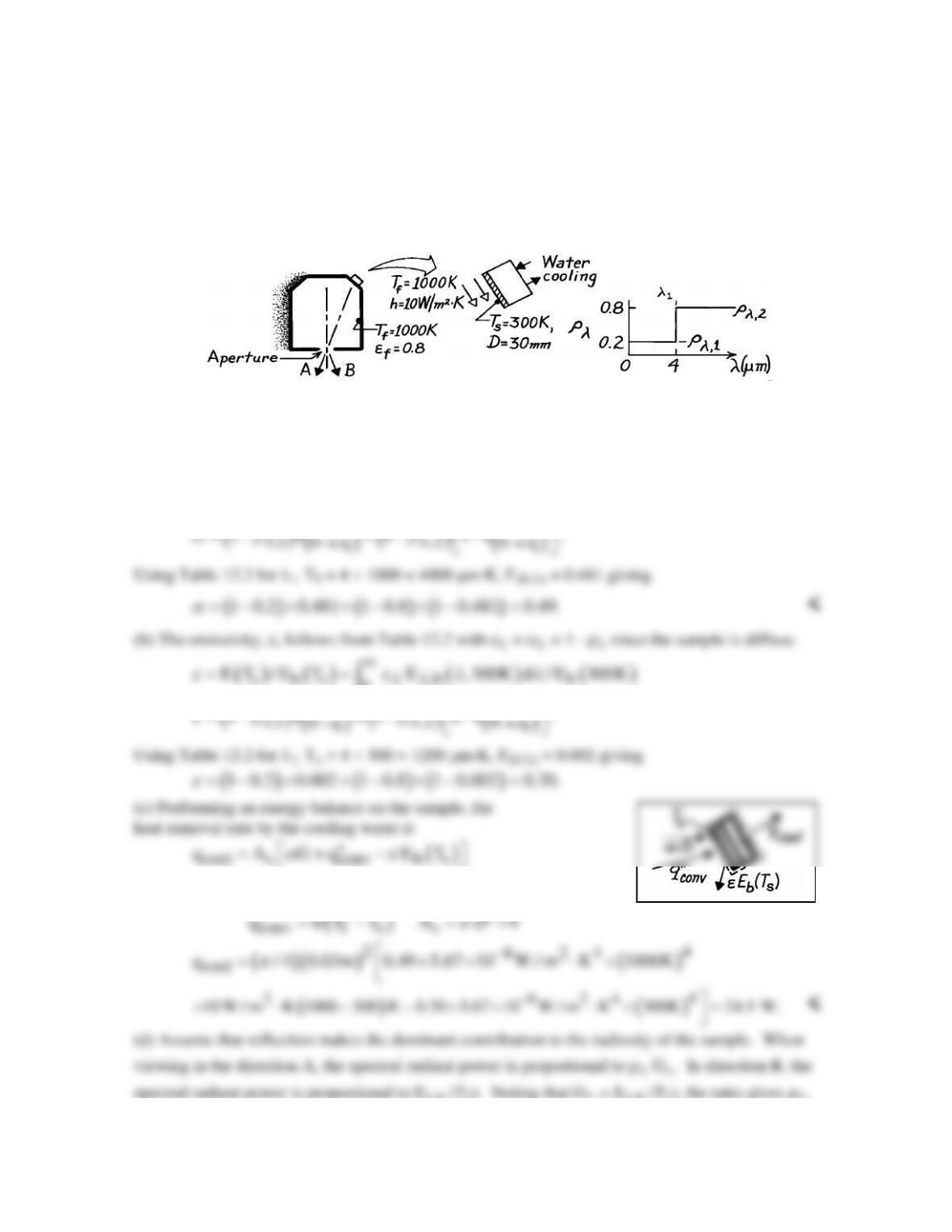
(c) Using the IHT model developed for part (b), the airstream temperature,
T
∞
, required to maintain the
plate at Ts = 140oC as a function of the convection coefficient with Glamp = 3000 W/m2⋅K was computed
and the results are plotted below.
10 20 30
Convection coefficient, h (W/m^2.K)
60
120
PROBLEM 12.72
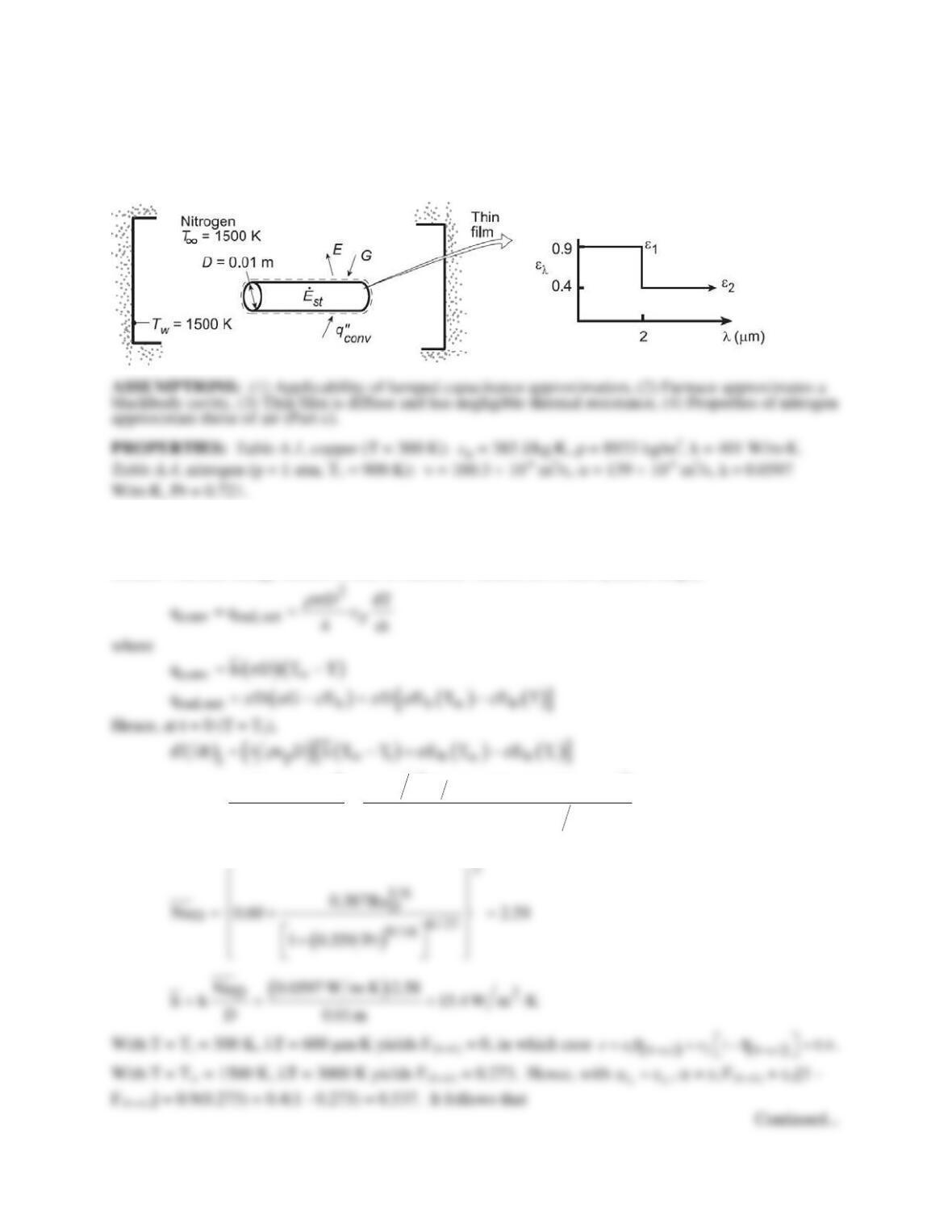
KNOWN: Small sample of reflectivity, rλ, and diameter, D, is irradiated with an isothermal
enclosure at Tf.
FIND: (a) Absorptivity, a, of the sample with prescribed rλ, (b) Emissivity, e, of the sample, (c)
Heat removed by coolant to the sample, (d) Explanation of why system provides a measure of rλ.
SCHEMATIC:
ASSUMPTIONS: (1) Sample is diffuse and opaque, (2) Furnace is an isothermal enclosure with area
much larger than the sample, (3) Aperture of furnace is small.
ANALYSIS: (a) The absorptivity, a, follows from Eq. 12.48, where the irradiation on the sample is
G = Eb (Tf) and aλ = 1 – rλ.
( ) ( ) ( )
,b b
00
G d / G 1 E ,1000K d / E 1000K
λλ λ λ
aa λ r λ λ
∞∞
= = −
∫∫
0
where
( ) ( )
bf b
G E T E 1000K= =
2
PROBLEM 12.73
KNOWN: Diameter and initial temperature of copper rod. Wall and gas temperature.
FIND: (a) Expression for initial rate of change of rod temperature, (b) Initial rate for prescribed
conditions, (c) Transient response of rod temperature.
SCHEMATIC:
ANALYSIS: (a) Applying conservation of energy at an instant of time to a control surface about the
cylinder,
in out st
EE E−=
, where energy inflow is due to natural convection and radiation from the
furnace wall and energy outflow is due to emission. Hence, for a unit cylinder length,
(b) With
( ) ( )( )( )
3
32
i
D12 4 2
g T T D 9.8 m s 1 900 K 1200 K 0.01m
Ra 937
100.3 139 10 m s
β
aν
∞
−
−
= = =
××
, the Churchill-Chu
correlation of Chapter 9 yields