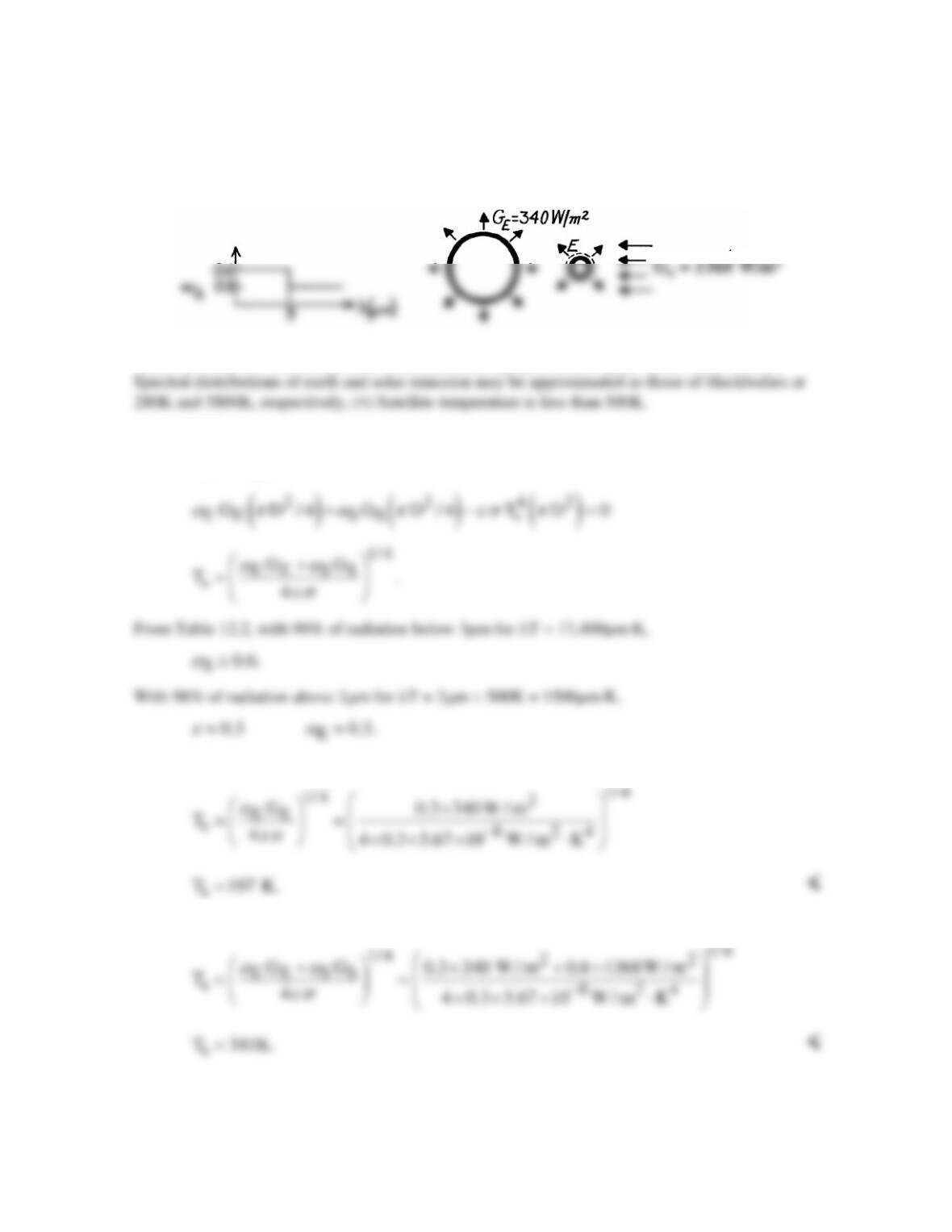
PROBLEM 12.83
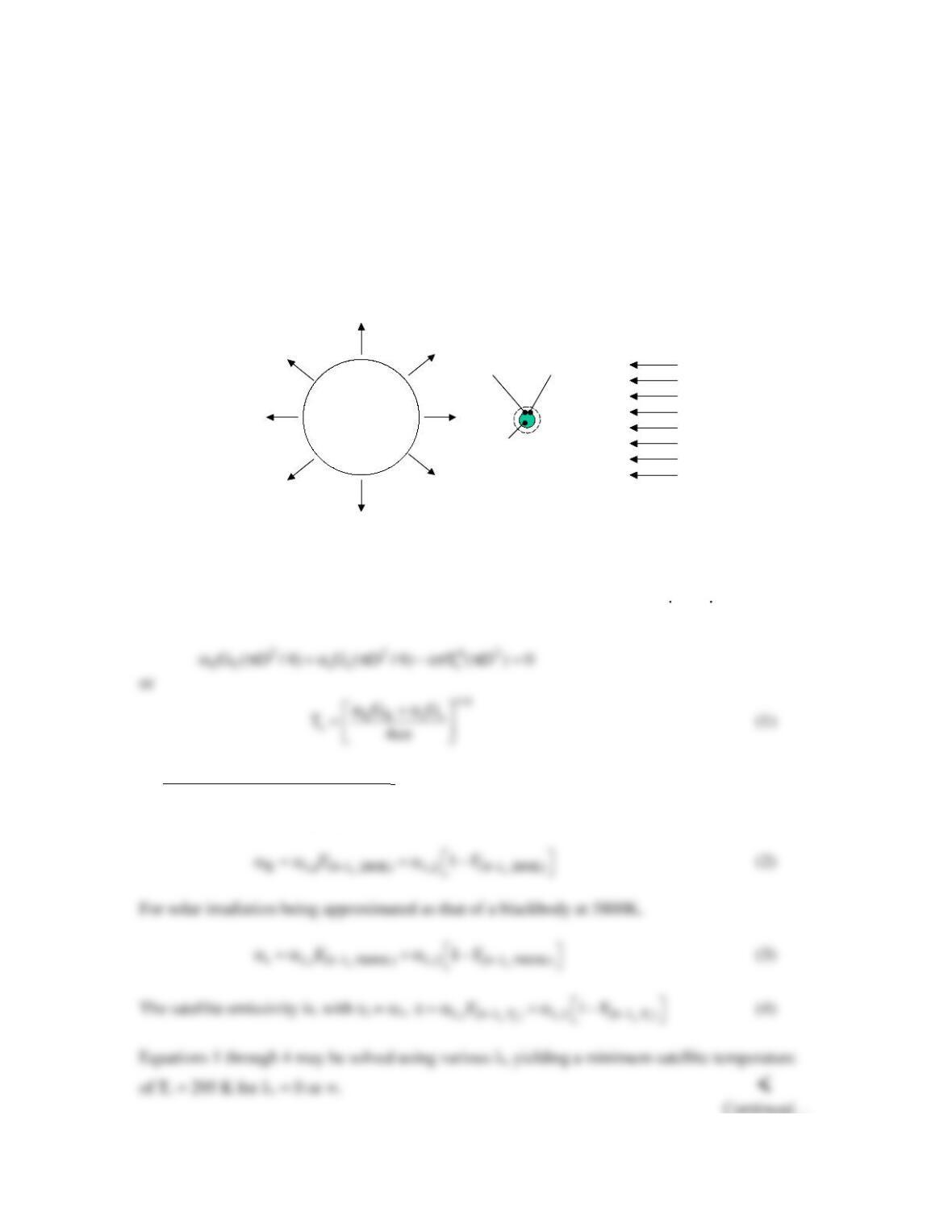
KNOWN: Spectral distribution of coating on satellite surface. Irradiation from earth and sun.
FIND: (a) Steady–state temperature of satellite on dark side of earth, (b) Steady–state temperature on
bright side.
SCHEMATIC:
ASSUMPTIONS: (1) Steady-state conditions, (2) Opaque, diffuse-gray surface behavior, (3)
ANALYSIS: Performing an energy balance on the satellite,
in out
EE 0−=
(a) On dark side,
(b) On bright side,
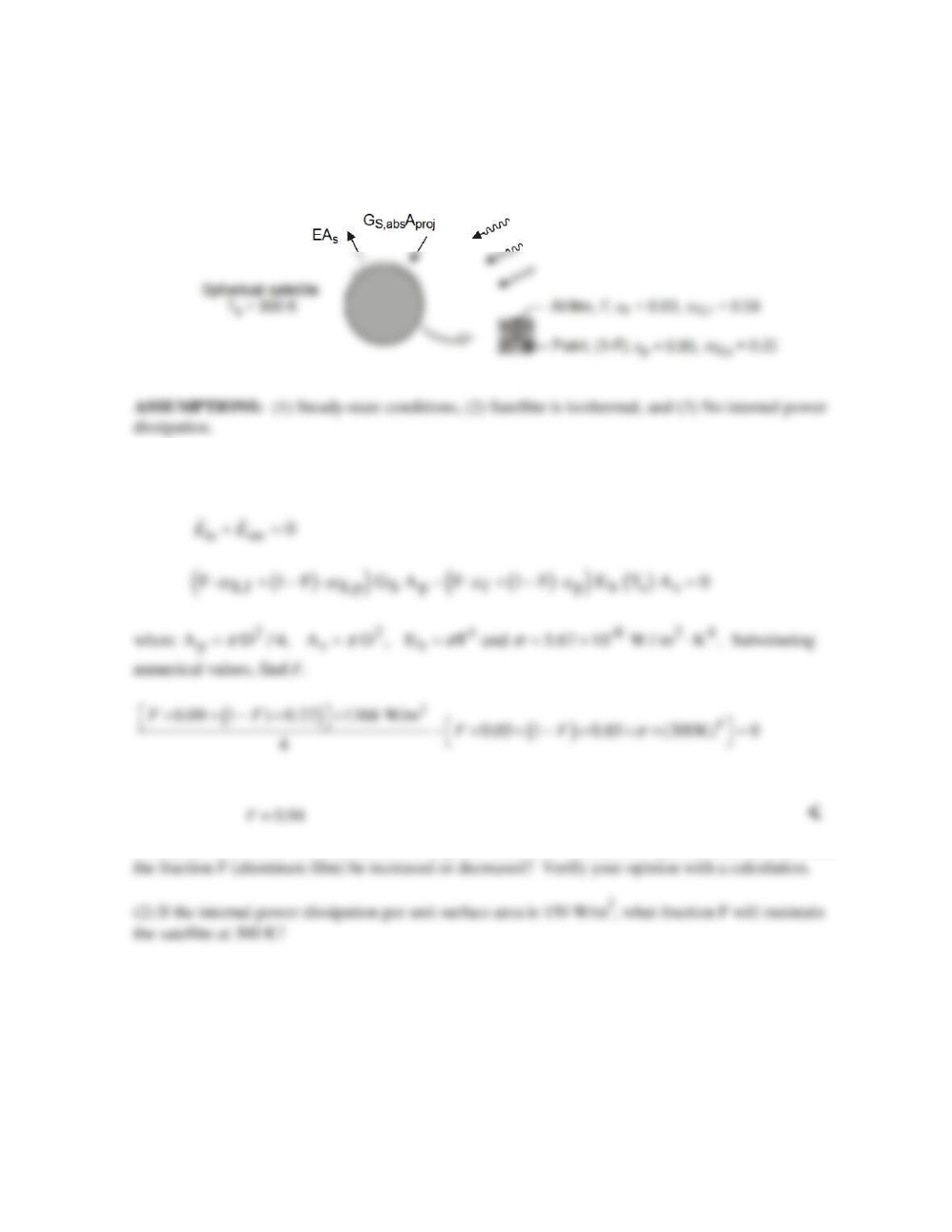
PROBLEM 12.84
KNOWN: Spherical satellite exposed to solar irradiation of 1368 m2; surface is to be coated with a
checker pattern of evaporated aluminum film, (fraction, F) and white zinc-oxide paint (1 – F).
FIND: The fraction F for the checker pattern required to maintain the satellite at 300 K.
SCHEMATIC:
ANALYSIS: Perform an energy balance on the satellite, as illustrated in the schematic, identifying
absorbed solar irradiation on the projected area, Ap, and emission from the spherical area As.
COMMENTS: (1) If the thermal control engineer desired to maintain the spacecraft at 325 K, would
GS= 1368 W/m2
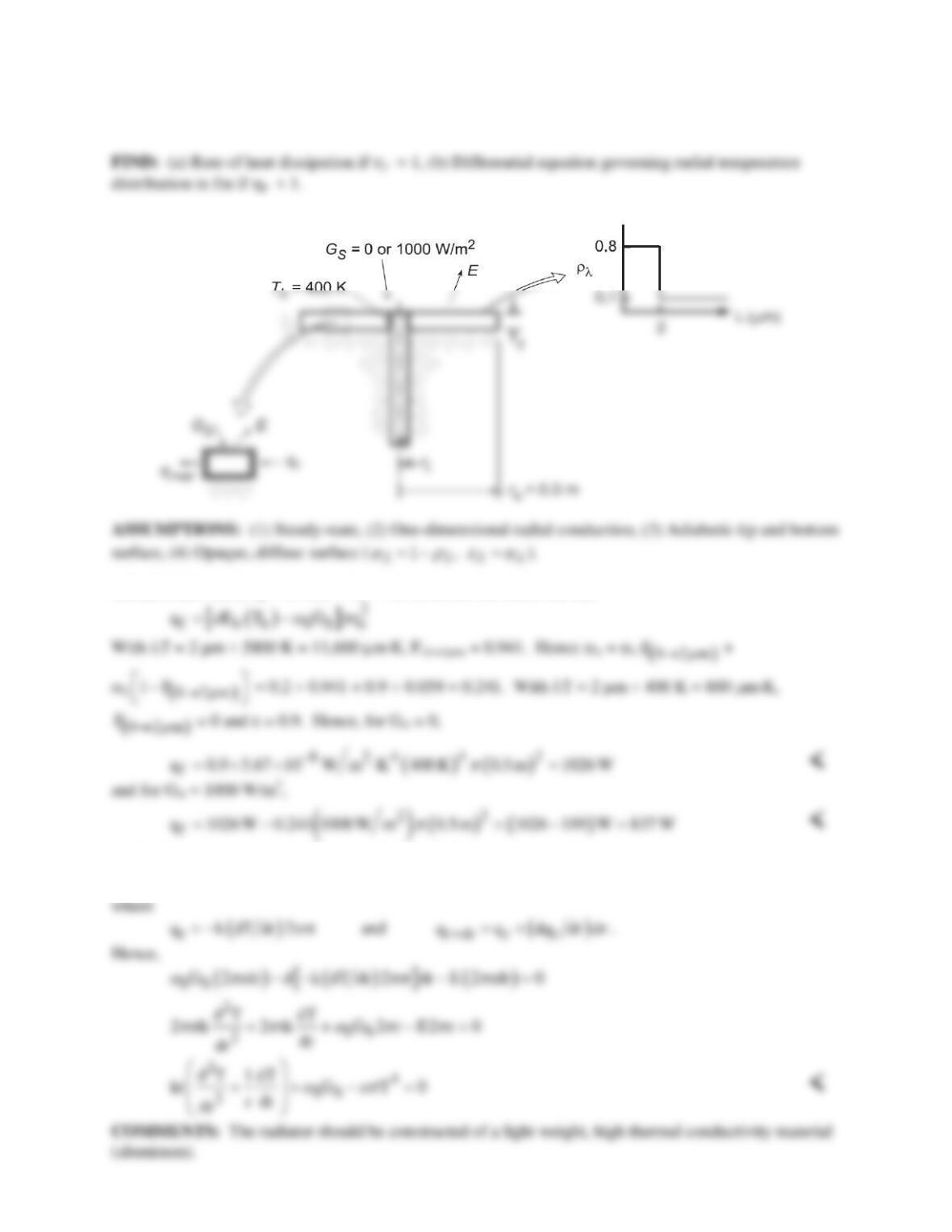
PROBLEM 12.85
KNOWN: Inner and outer radii, spectral reflectivity, and thickness of an annular fin. Base temperature
and solar irradiation.
SCHEMATIC:
ANALYSIS: (a) If ηf = 1, T(r) = Tb = 400 K across the entire fin and
(b) Performing an energy balance on a differential element extending from r to r+dr, we obtain
( ) ( )
r S S r dr
q G 2 rdr q E 2 rdr 0
απ π
+
+ −− =
r
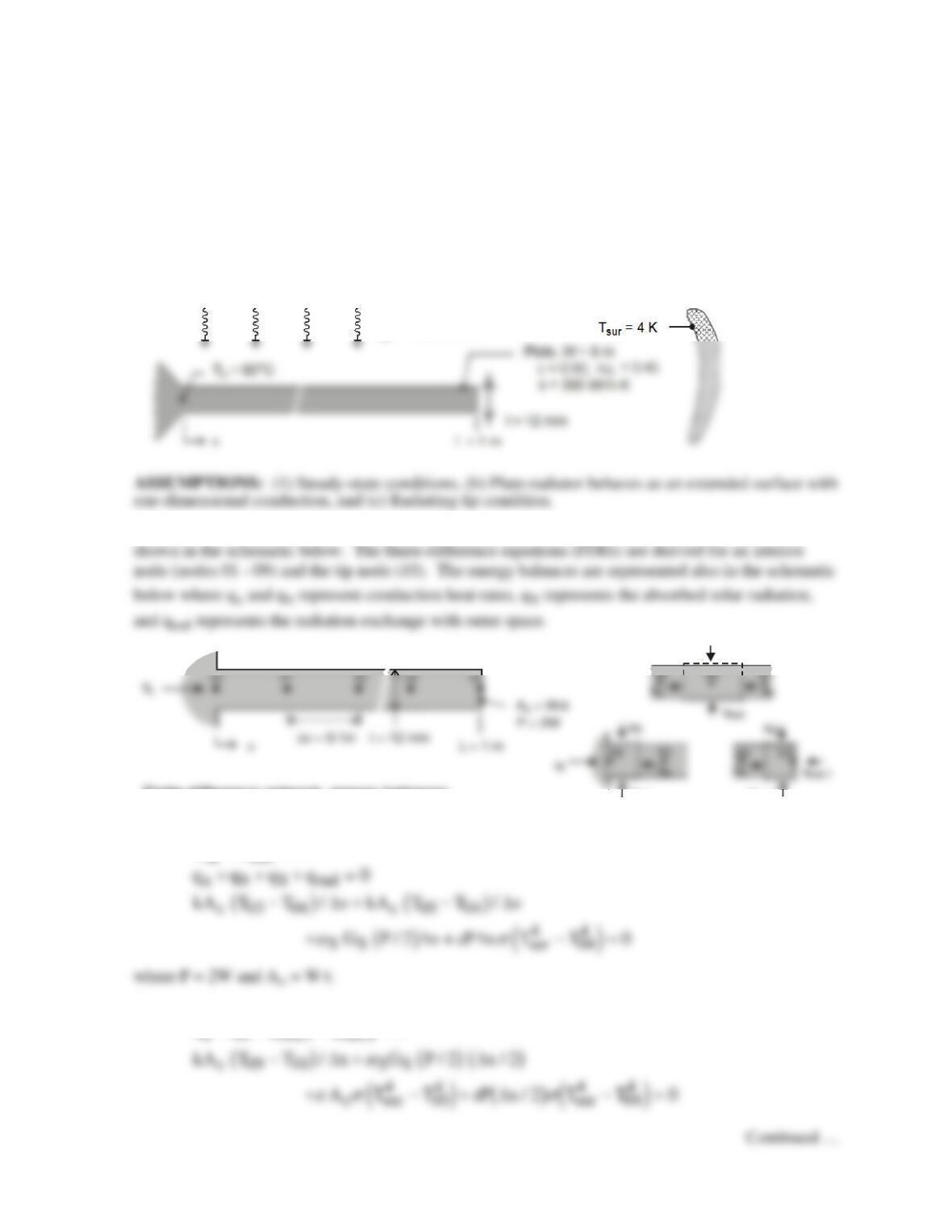
PROBLEM 12.86
KNOWN: Rectangular plate, with prescribed geometry and thermal properties, for use as a radiator
in a spacecraft application. Radiator exposed to solar radiation on upper surface, and to deep space
on both surfaces.
FIND: Using a computer-based, finite-difference method with a space increment of 0.1 m, find the
tip temperature, TL, and rate of heat rejection, qf, when the base temperature is maintained at 80°C
for the cases: (a) when exposed to the sun, (b) on the dark side of the earth, not exposed to the sun;
and (c) when the thermal conductivity is extremely large. Compare the case (c) results with those
obtained from a hand calculation assuming the radiator is at a uniform temperature.
SCHEMATIC:
ANALYSIS: The finite–difference network with 10 nodes and a space increment ∆x = 0.1 m is
T00
= Tb T10 = TL
Finite-difference network, energy balances
qS
qrad,2
qrad
Interior node 04
E E
in out
− = 0
Tip node 10
q q q q
+ + + = 0
GS= 1368 W/m2
PROBLEM 12.86 (Cont.)
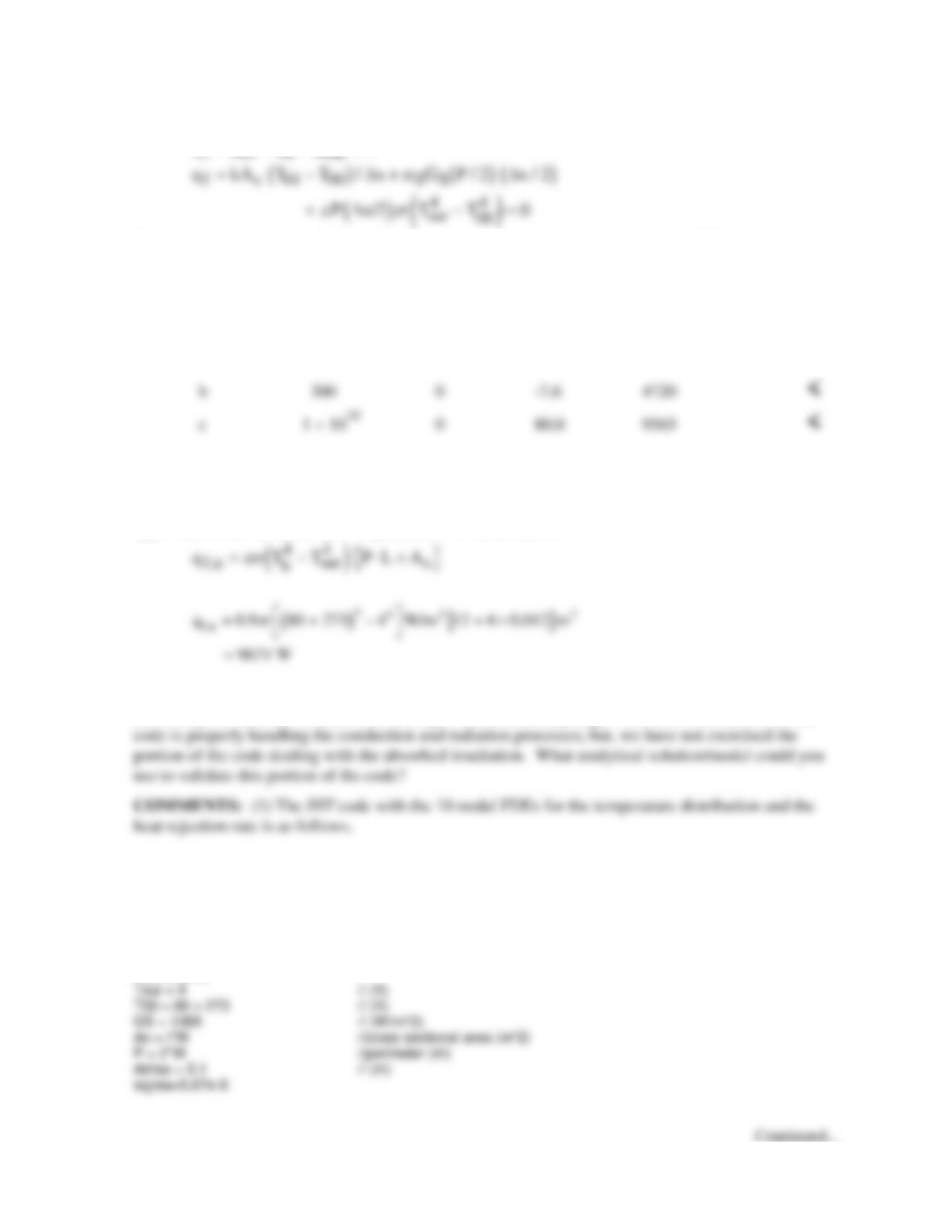
Heat rejection, qf. From an energy balance on the base node 00,
q q q q
+ + + = 0
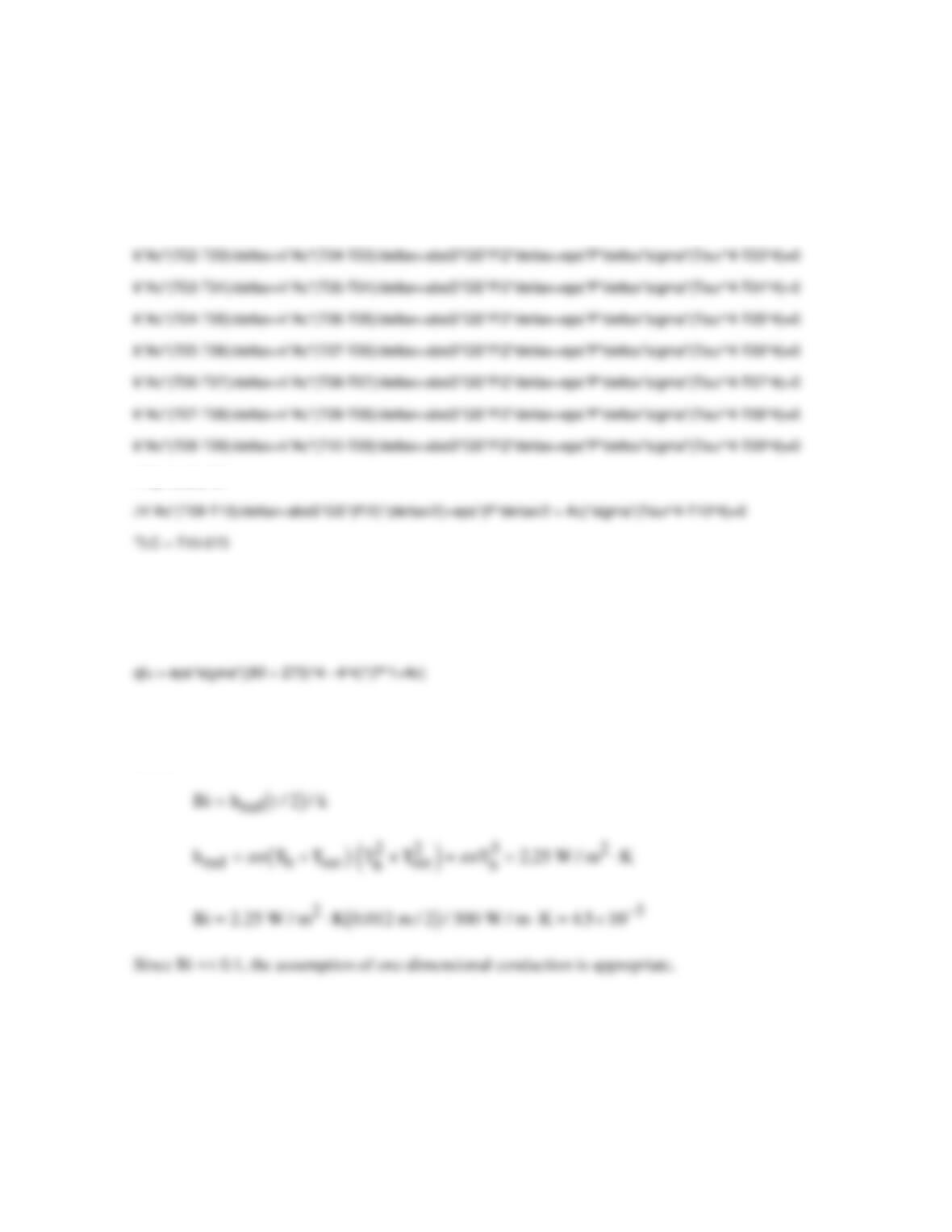
The foregoing nodal equations and the heat rate expression were entered into the IHT workspace to
obtain solutions for the three cases. See Comment 2 for the IHT code, and Comment 1 for code
validation remarks.
Case k(W/m⋅K) GS(W/m2) TL(°C) qf(W)
a 300 1368 30.9 2746 <
Case (c) using the IHT code with k = 1 × 10¹⁰ W/m⋅K corresponds to the condition of the plate at the
uniform temperature of the base; that is T(x) = Tb. For this condition, the heat rejection from the
upper and lower surfaces and the tip area can be calculated as
Note that the heat rejection rate for the uniform plate is in excellent agreement with the result of the
FDE analysis when the thermal conductivity is made extremely large. We have confidence that the
//Properties and dimensions
W = 6 //m
t = 12/1000 //m
k = 300 //thermal conductivity (W/m-K)
eps = 0.90 //emissivity
absS = 0.45 //solar absorptivity
//Conditions
PROBLEM 12.86 (Cont.)
//Interior nodes, 01 to 09
k*Ac*(T00–T01)/deltax+k*Ac*(T02–T01)/deltax+absS*GS*P/2*deltax+eps*P*deltax*sigma*(Tsur^4–T01^4)=0
k*Ac*(T01–T02)/deltax+k*Ac*(T03–T02)/deltax+absS*GS*P/2*deltax+eps*P*deltax*sigma*(Tsur^4–T02^4)=0
//Tip node, 10
//Rejection heat rate, energy balance on base node
qf+k*Ac*(T01–T00)/deltax+absS*GS*(P/2)*(deltax/2)+eps*(P*deltax/2)*sigma*(Tsur^4–T00^4)=0
//Check
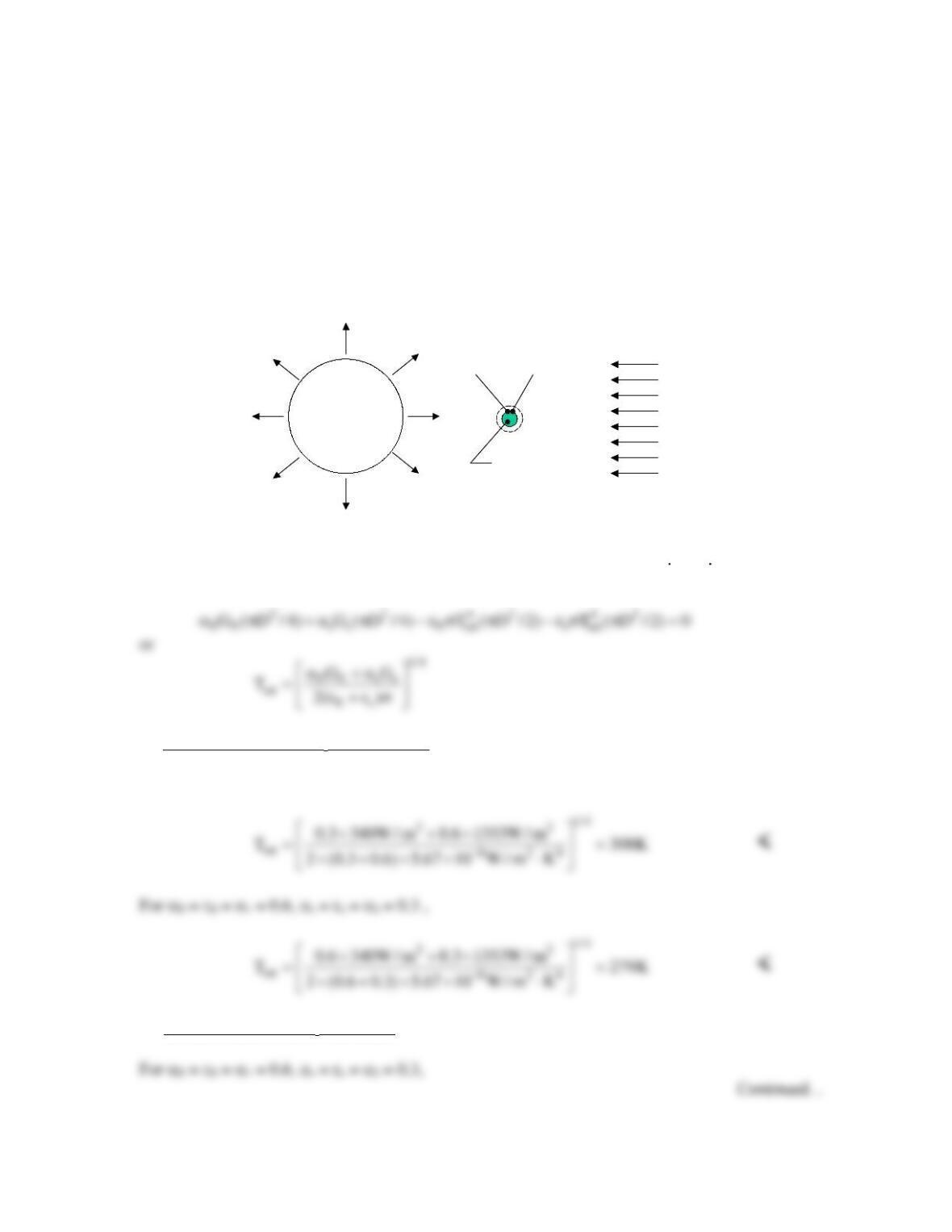
(2) To determine the validity of the one-dimensional, extended surface analysis, calculate the Biot
number estimating the linearized radiation coefficient based upon the uniform plate condition, Tb =
80°C.
PROBLEM 12.87
KNOWN: Irradiation of satellite from earth and sun. Two emissivities associated with the
satellite.
FIND: (a) Steady-state satellite temperature when satellite is on bright side of earth for
E/
s > 1
and
E/
s < 1, (b) Steady-state satellite temperature when satellite is on dark side of earth for
E/
s > 1 and
E/
s < 1, (c) Scheme to minimize temperature variations of the satellite.
SCHEMATIC:
ASSUMPTIONS: (1) Steady-state conditions, (2) Opaque, diffuse gray behavior.
ANALYSIS: Performing an energy balance on the satellite, it follows that
in out
EE
or
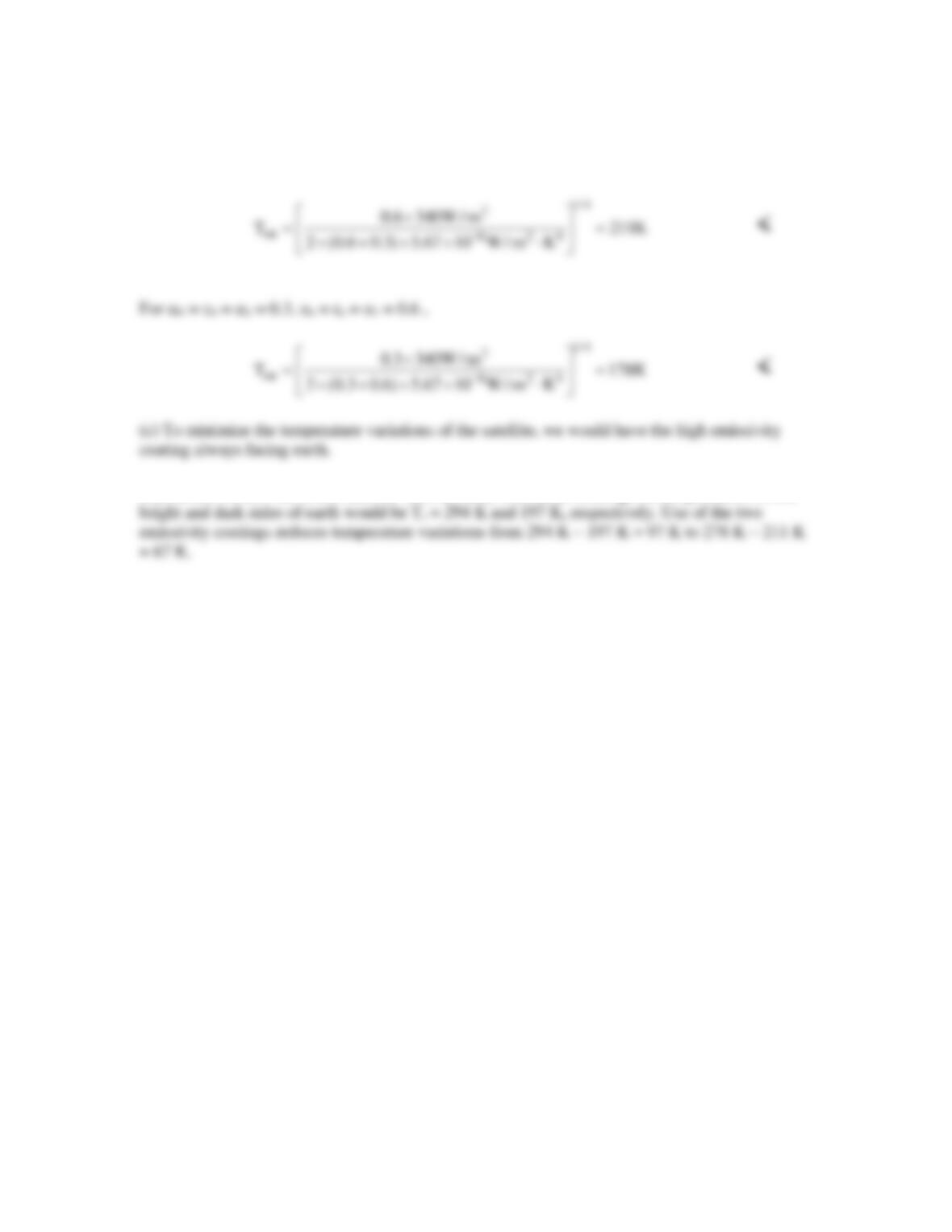
(a) Bright Side of Earth (Gs = 1368 W/m2)
For E = E = 2 = 0.3, s = s = 1 = 0.6 ,
(b) Dark Side of Earth (Gs = 0 W/m2)
Earth
GE= 340 W/m2
Satellite
Tsat
1= 0.6
2= 0.3
s
E
Gs= 1353 W/m2
Earth
GE= 340 W/m2
Satellite
Tsat
1= 0.6
2= 0.3
s
E
Gs= 1353 W/m2
GS= 1368 W/m2
PROBLEM 12.87 (Cont.)
COMMENTS: If the entire satellite were covered with either coating, the temperatures on the
PROBLEM 12.88
KNOWN: Irradiation from the sun and earth on a spherical satellite. Spectral absorptivities of
the satellite surface below and above a cutoff wavelength.
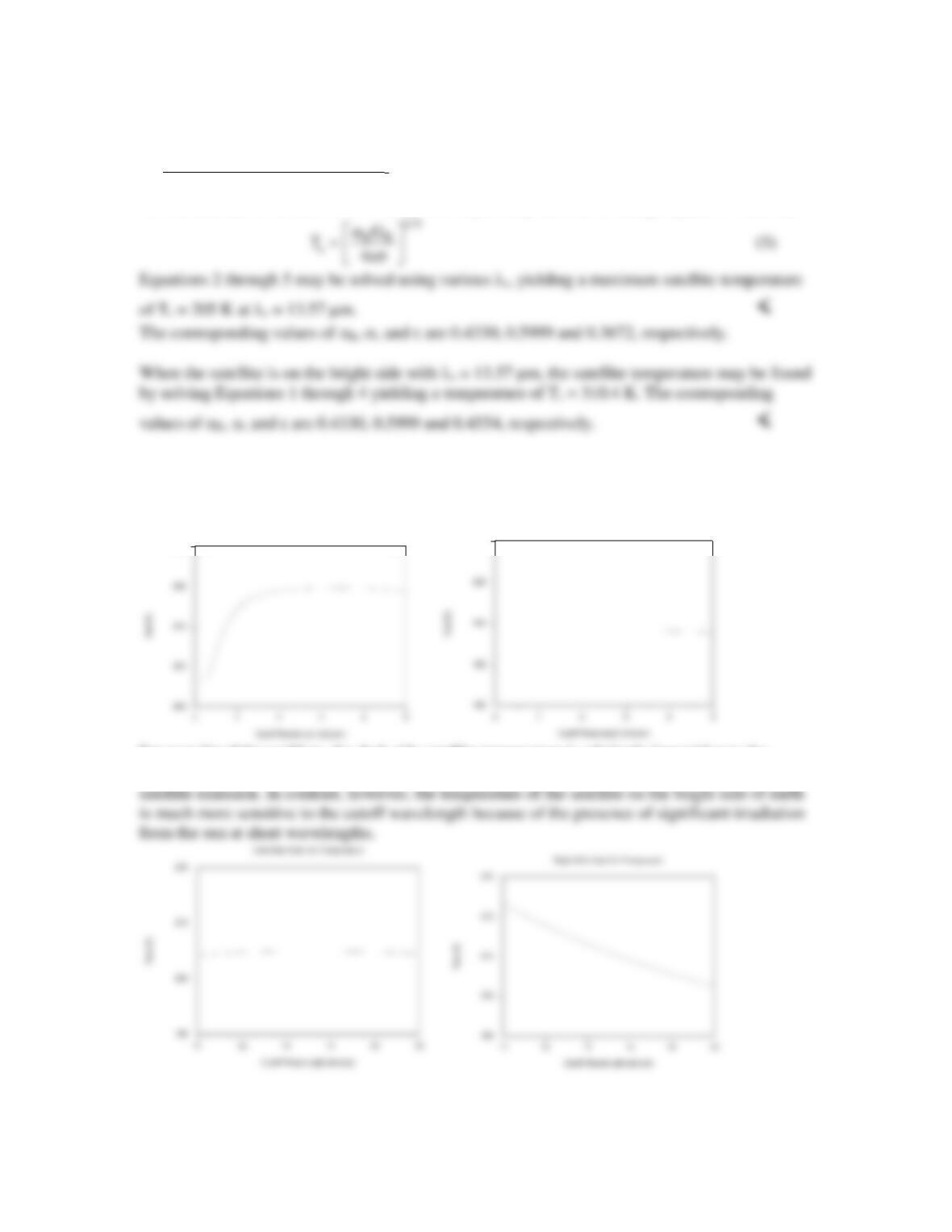
FIND: (a) Cutoff wavelength to minimize satellite temperature on bright side of earth,
corresponding satellite temperature on dark side of earth, (b) Cutoff wavelength to maximize
satellite temperature on dark side of earth, corresponding satellite temperature on bright side of
earth.
SCHEMATIC:
ASSUMPTIONS: (1) Steady-state conditions, (2) Opaque, diffuse satellite surface.
ANALYSIS: Performing an energy balance on the satellite, it follows that
in out
EE
or
(a) Bright Side of Earth, Minimize Ts.
For earth irradiation being approximated as that of a blackbody at 280 K,
Continued…
Earth
GE= 340 W/m2
Satellite
Ts, s,E,
,1 = 0.6 for c
,2 = 0.3 for > c
s
E
Gs= 1353 W/m2
Earth
GE= 340 W/m2
Satellite
Ts, s,E,
,1 = 0.6 for c
,2 = 0.3 for > c
s
E
Gs= 1353 W/m2
GS= 1368 W/m2
PROBLEM 12.88 (Cont.)
(a) Dark Side of Earth, Maximize Ts.
For the satellite on the dark side of earth with a spectrally-selective coating, Equation 1 becomes
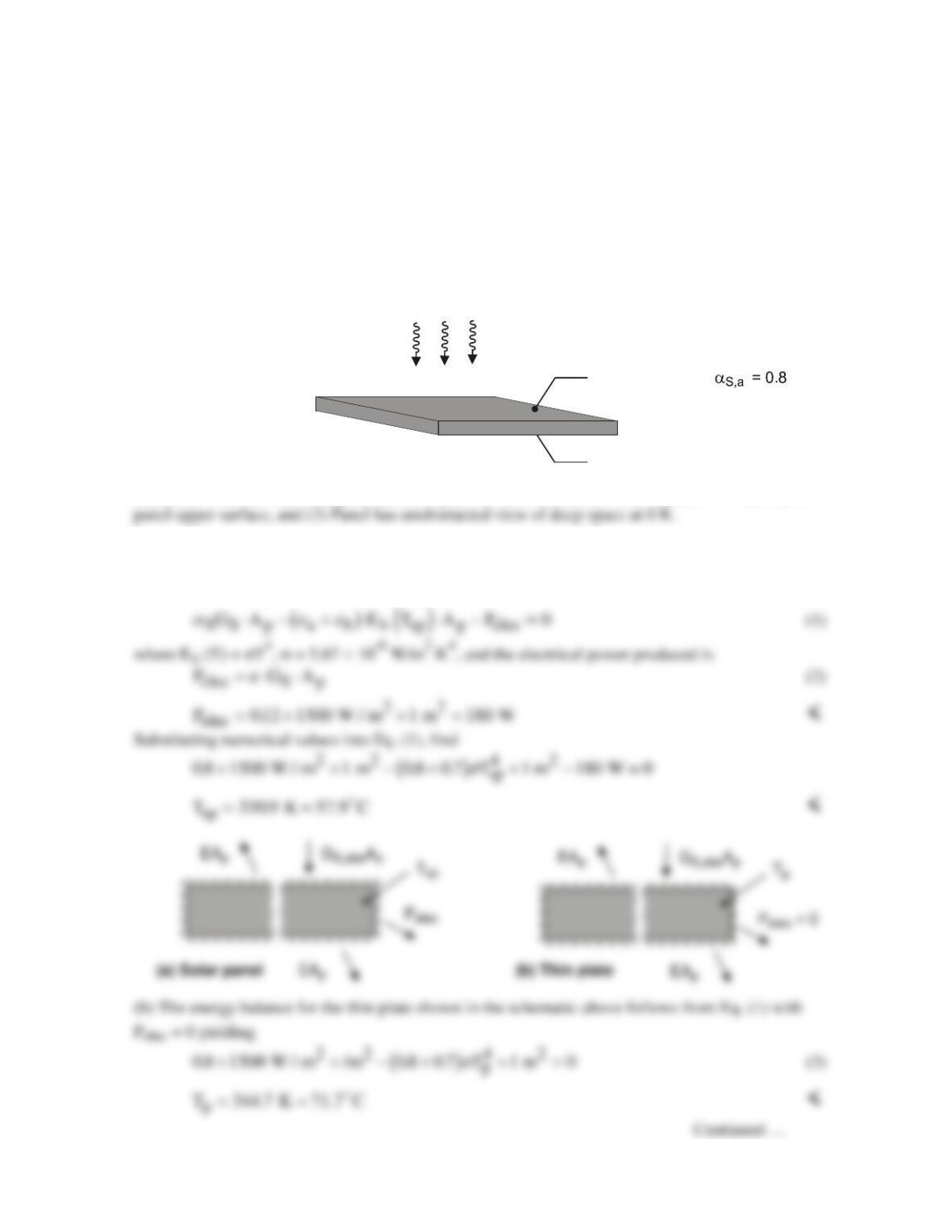
COMMENTS: In part (a) of the problem the satellite temperature is very sensitive to the cutoff
wavelength of c = 0 when the satellite is on the bright side of earth. This is because of the
presence of a significant amount of solar irradiation at relatively short wavelengths.
Bright Side Satellite Temperature
360
Dark Side Satellite Temperature
240
For part (b) of the problem, the dark side satellite temperature is relatively insensitive to the
cutoff wavelength because of the similar spectral distributions of the earth irradiation and the
PROBLEM 12.89
KNOWN: Solar panel mounted on a spacecraft of area 1 m2 having a solar–to–electrical power
conversion efficiency of 12% with specified radiative properties.
FIND: (a) Steady–state temperature of the solar panel and electrical power produced with solar
irradiation of 1500 W/m2, (b) Steady-state temperature if the panel were a thin plate (no solar cells)
with the same radiative properties and for the same prescribed conditions, and (c) Temperature of the
solar panel 1500 s after the spacecraft is eclipsed by a planet; thermal capacity of the panel per unit
area is 9000 J/m2⋅K.
SCHEMATIC:
G
S
= 1500 W/m
2
Solar panel, T, A = 1 m ,
thermal capacity, 9000 J/m -K
p 2
2
conversion efficiency, e = 12%
ε
b
= 0.7
ε
a
= 0.8,
Backside,
Array,
ASSUMPTIONS: (1) Solar panel and thin plate are isothermal, (2) Solar irradiation is normal to the
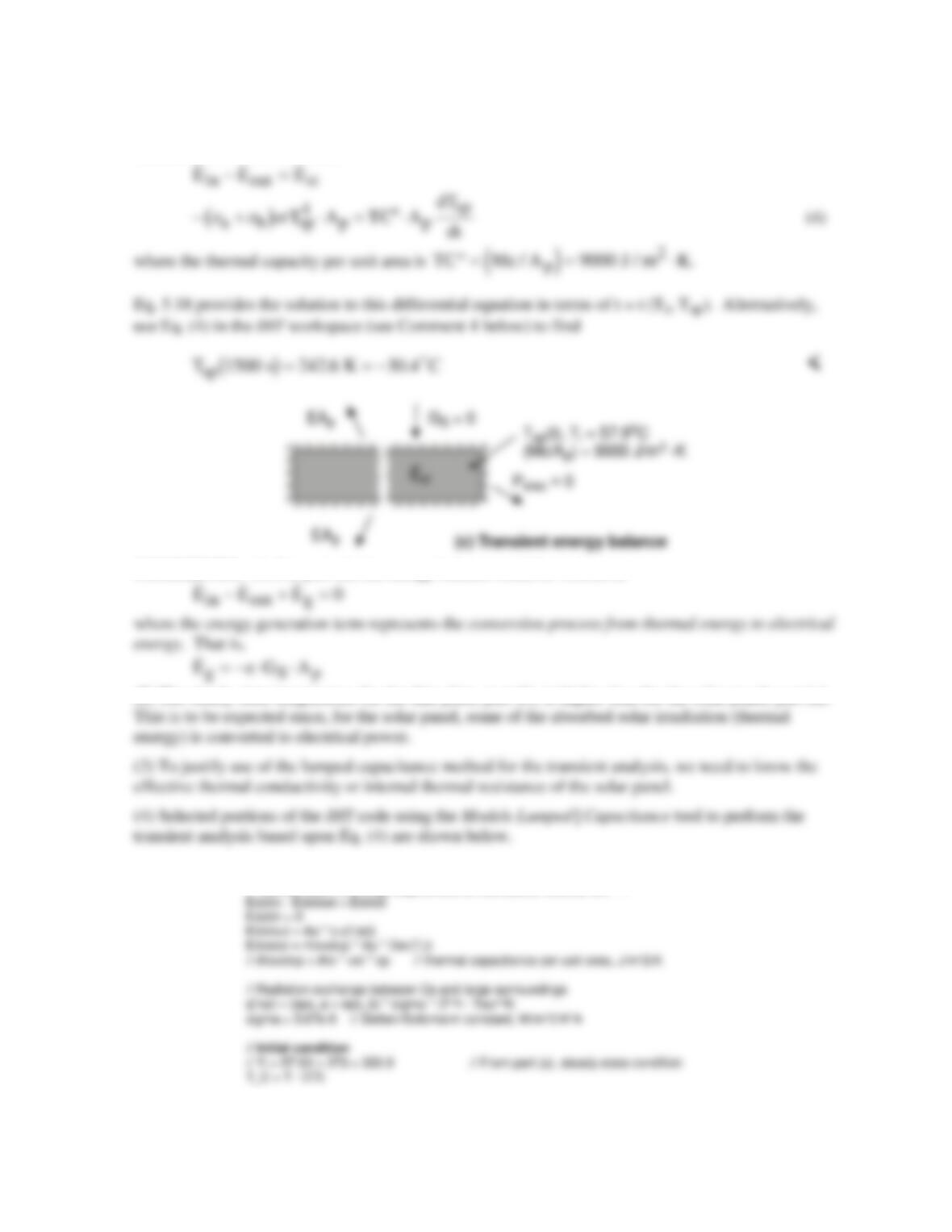
ANALYSIS: (a) The energy balance on the solar panel is represented in the schematic below and has
the form
E E
in out
− = 0
PROBLEM 12.89 (Cont.)
(c) Using the lumped capacitance method, the energy balance on the solar panel as illustrated in the
schematic below has the form
COMMENTS: (1) For part (a), the energy balance could be written as
(2) The steady–state temperature for the thin plate, part (b), is higher than for the solar panel, part (a).
// Energy balance, Model | Lumped Capacitance
/ * Conservation of energy requirement on the control volume, CV. * /
(5) The solar flux exceeds the solar constant value of 1368 W/m2. Hence the spacecraft is closer to the
sun than it is to earth.
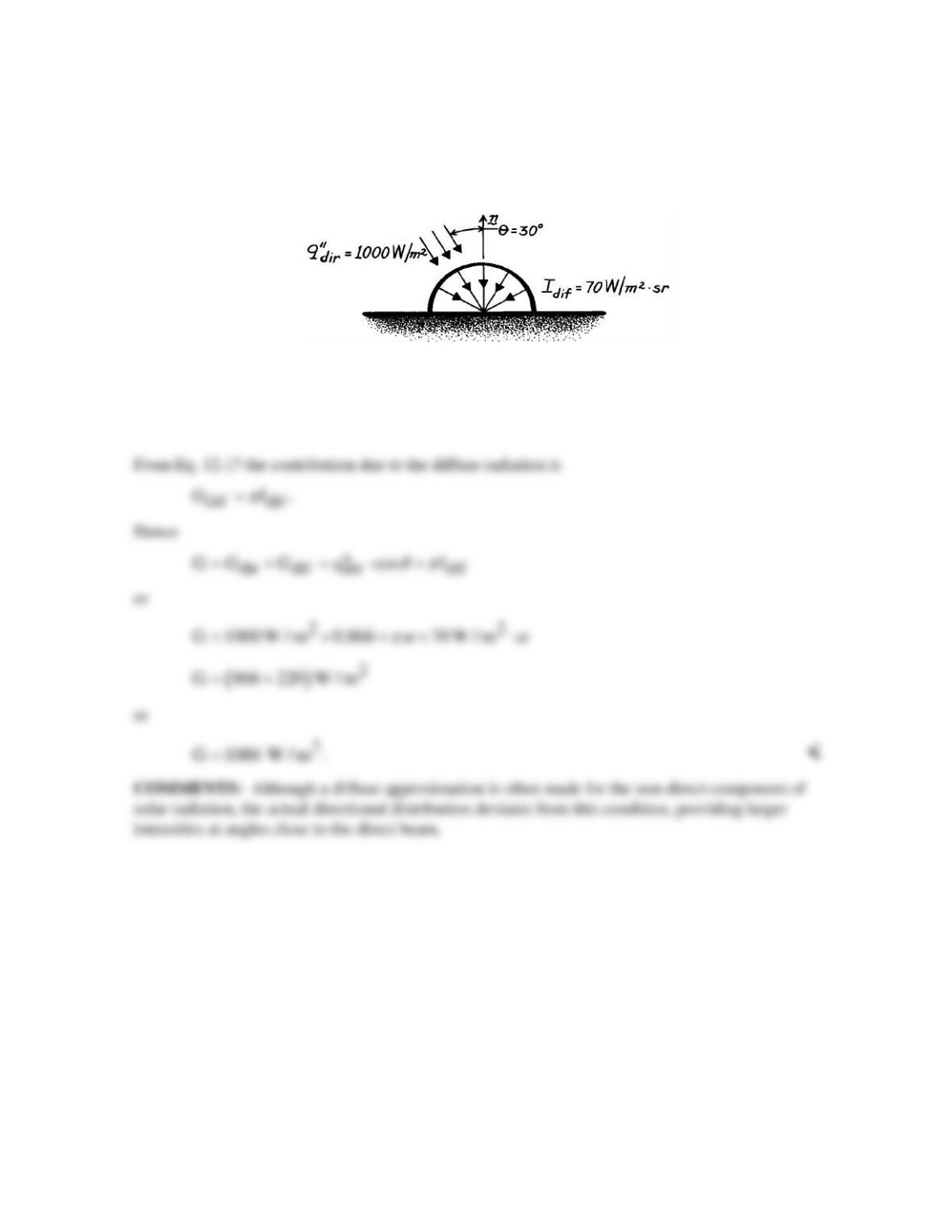
PROBLEM 12.90
KNOWN: Flux and intensity of direct and diffuse components, respectively, of solar irradiation.
FIND: Total irradiation.
SCHEMATIC:
ANALYSIS: Since the irradiation is based on the actual surface area, the contribution due to the
direct solar radiation is
dir dir
G q cos .
θ
′′
= ⋅
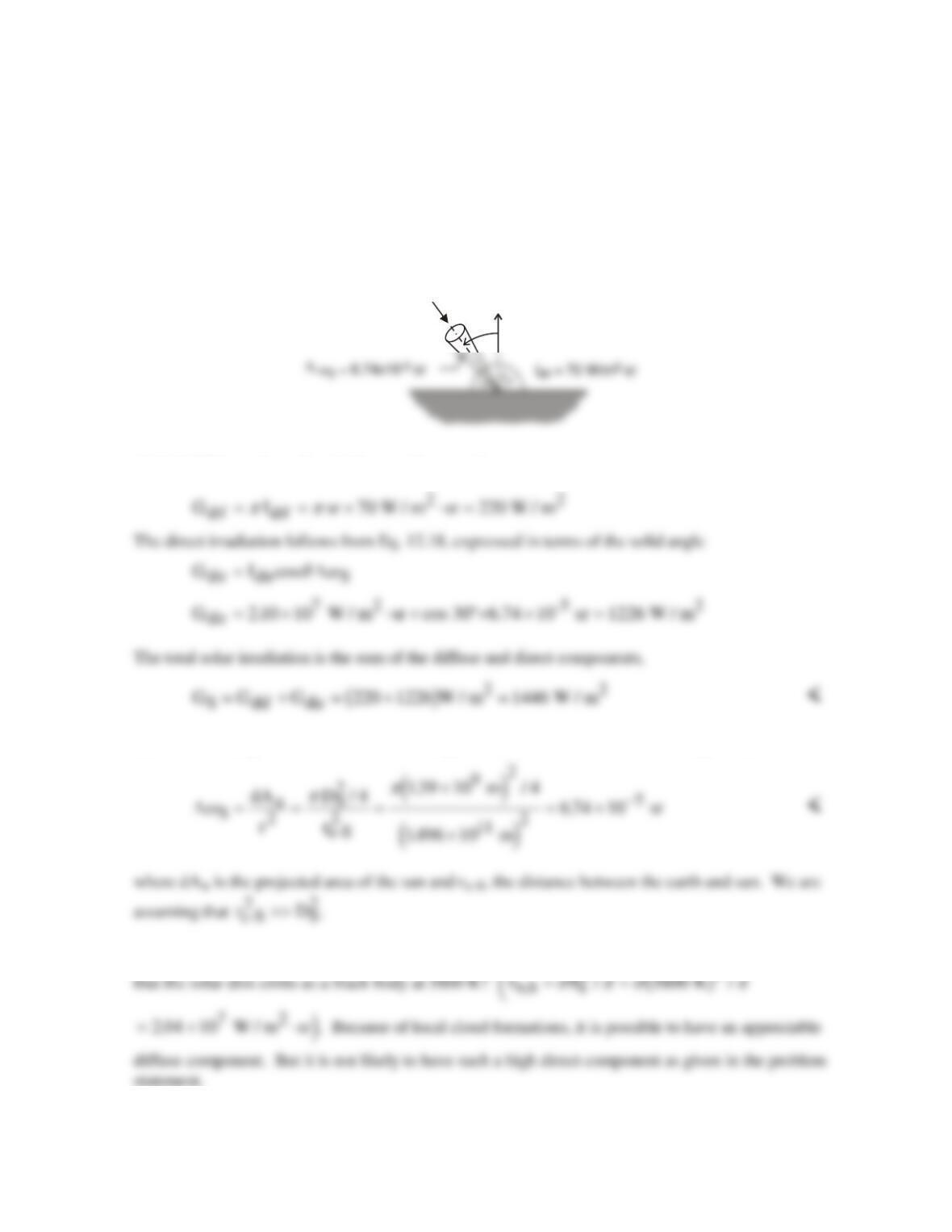
PROBLEM 12.91
KNOWN: Daytime solar radiation conditions with direct solar intensity Idir = 2.10 × 10⁷ W/m2⋅sr
within the solid angle subtended with respect to the earth, ∆ωS = 6.74 × 10⁻⁵ sr, and diffuse intensity
Idif = 70 W/m2⋅sr.
FIND: (a) Total solar irradiation at the earth’s surface when the direct radiation is incident at 30°,
and (b) Verify the prescribed value of ∆ωS recognizing that the diameter of the earth is DS = 1.39 ×
109 m, and the distance between the sun and the earth is re-S = 1.496 × 10¹¹ m (1 astronomical unit).
SCHEMATIC:
ANALYSIS: (a) From Eq. 12.22 the diffuse irradiation is
(b) The solid angle the sun subtends with respect to the earth is calculated from Eq. 12.7,
COMMENTS: Can you verify that the direct solar intensity, Idir, is a reasonable value, assuming
4
4
30o
I = 2.10×10 W/m -sr
diir 27
30o
I = 2.10×10 W/m -sr
diir 27
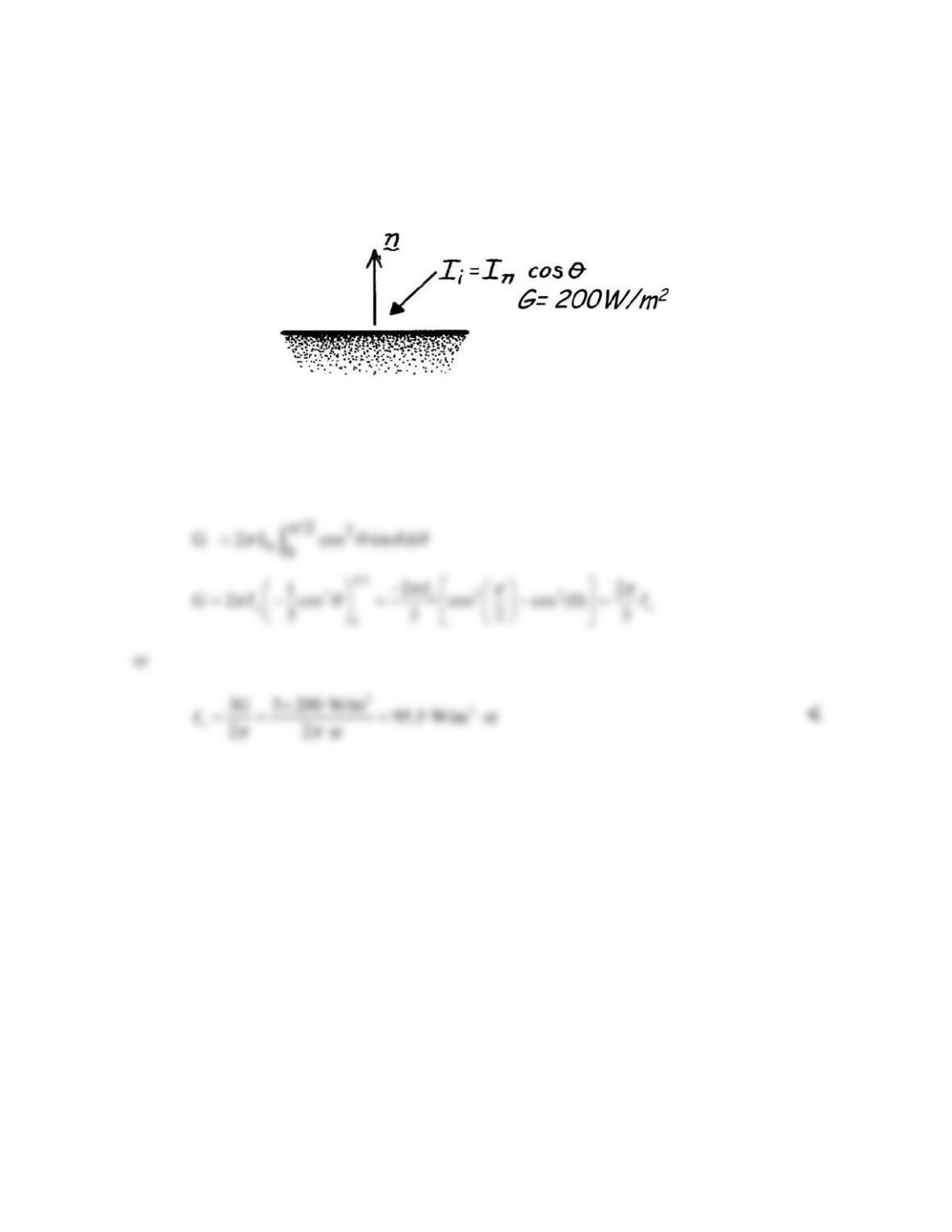
PROBLEM 12.92
KNOWN: Directional distribution of solar radiation intensity incident at earth’s surface on an
overcast day.
FIND: Total intensity of solar radiation incident normal to earth’s surface.
SCHEMATIC:
ASSUMPTIONS: (1) Intensity is independent of azimuthal angle θ.
ANALYSIS: Applying Eq. 12.18 to the total intensity
( )
2 /2
i
00
G I cos sin d d
ππ
θ θ θθφ
=
∫∫
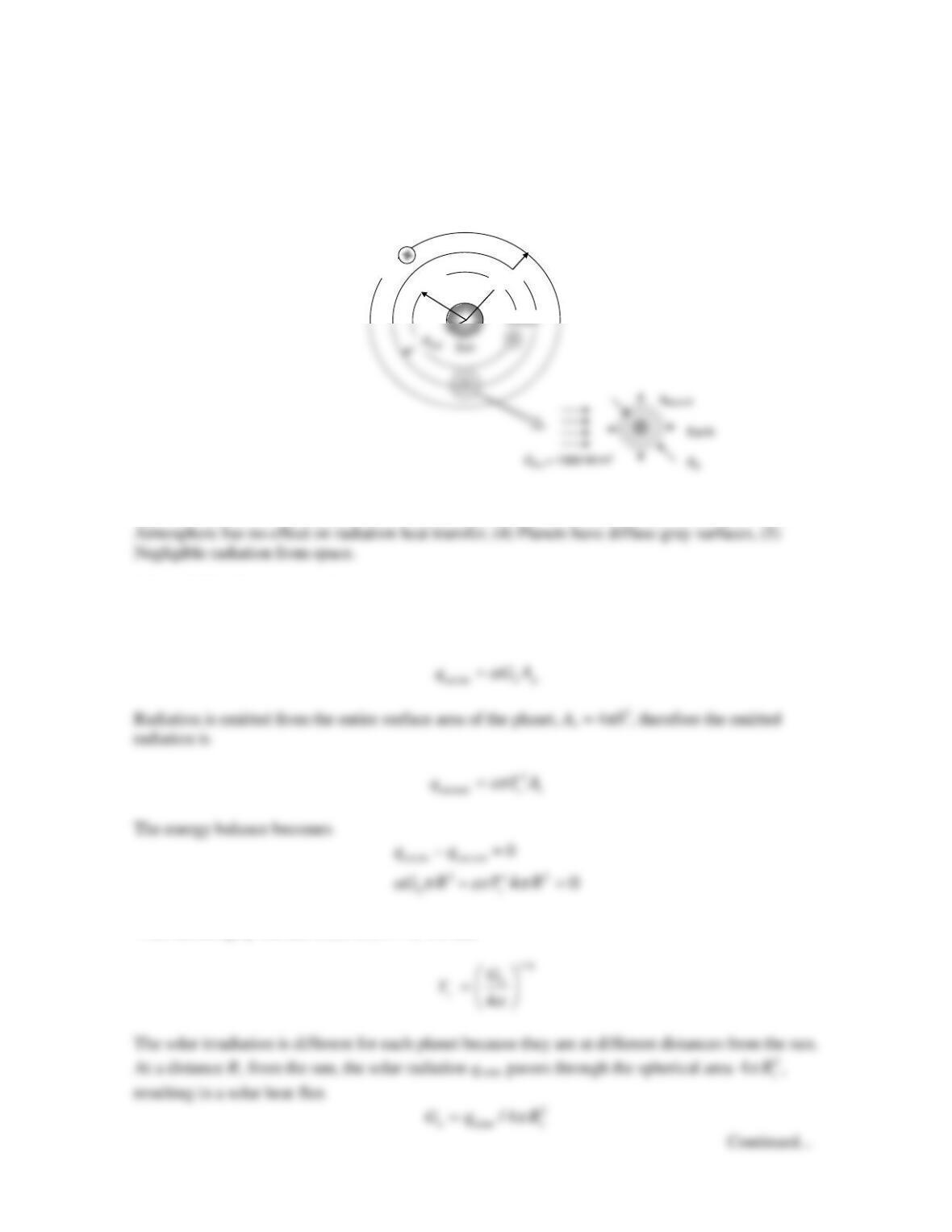
PROBLEM 12.93
KNOWN: Solar flux above Earth’s atmosphere. Distance of Earth, Venus, and Mars from the sun.
Measured average temperatures of planets.
FIND: Planet temperatures neglecting atmospheric radiation effects and assuming diffuse-gray
behavior. Planet most affected by radiation transfer through its atmosphere.
SCHEMATIC:
ASSUMPTIONS: (1) Steady–state conditions, (2) Planets are at constant distance from sun, (3)
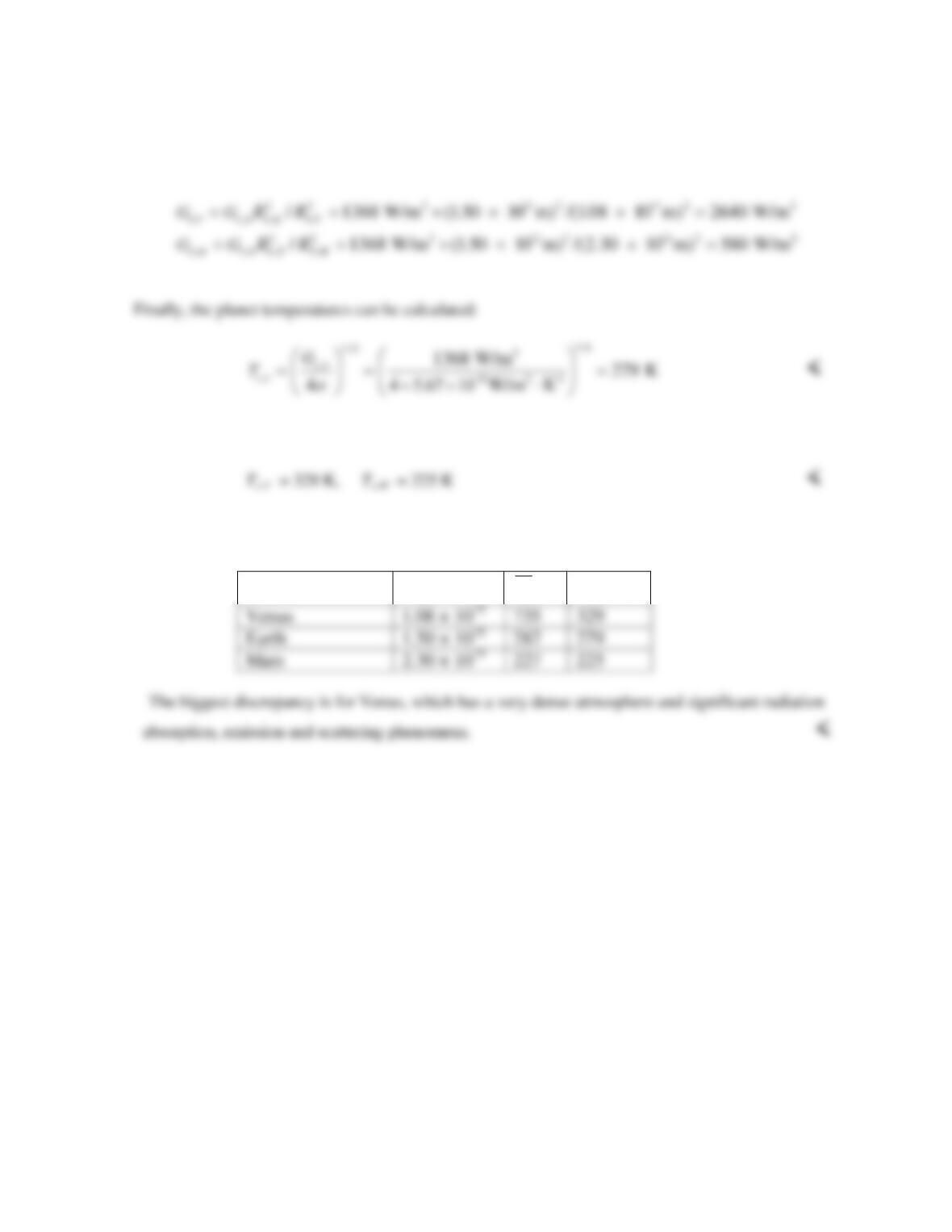
ANALYSIS: The energy balance for each planet is between absorbed solar radiation and emitted
radiation. The appropriate area for the intercepted solar radiation is the projected area Ap = πR2, where
R is the planet’s radius, thus
With diffuse-gray surface behavior, α =
ε
, we find
Mars
RS,V
RS,M
PROBLEM 12.93 (Cont.)
Thus, knowing the solar irradiation for Earth, GS,E, we can find the solar irradiation for Venus and
Mars:
Similarly,
The calculated temperatures are compared with the measured average temperatures in the chart:
Planet LS-p, m p
T, K Tcalc, K
PROBLEM 12.94
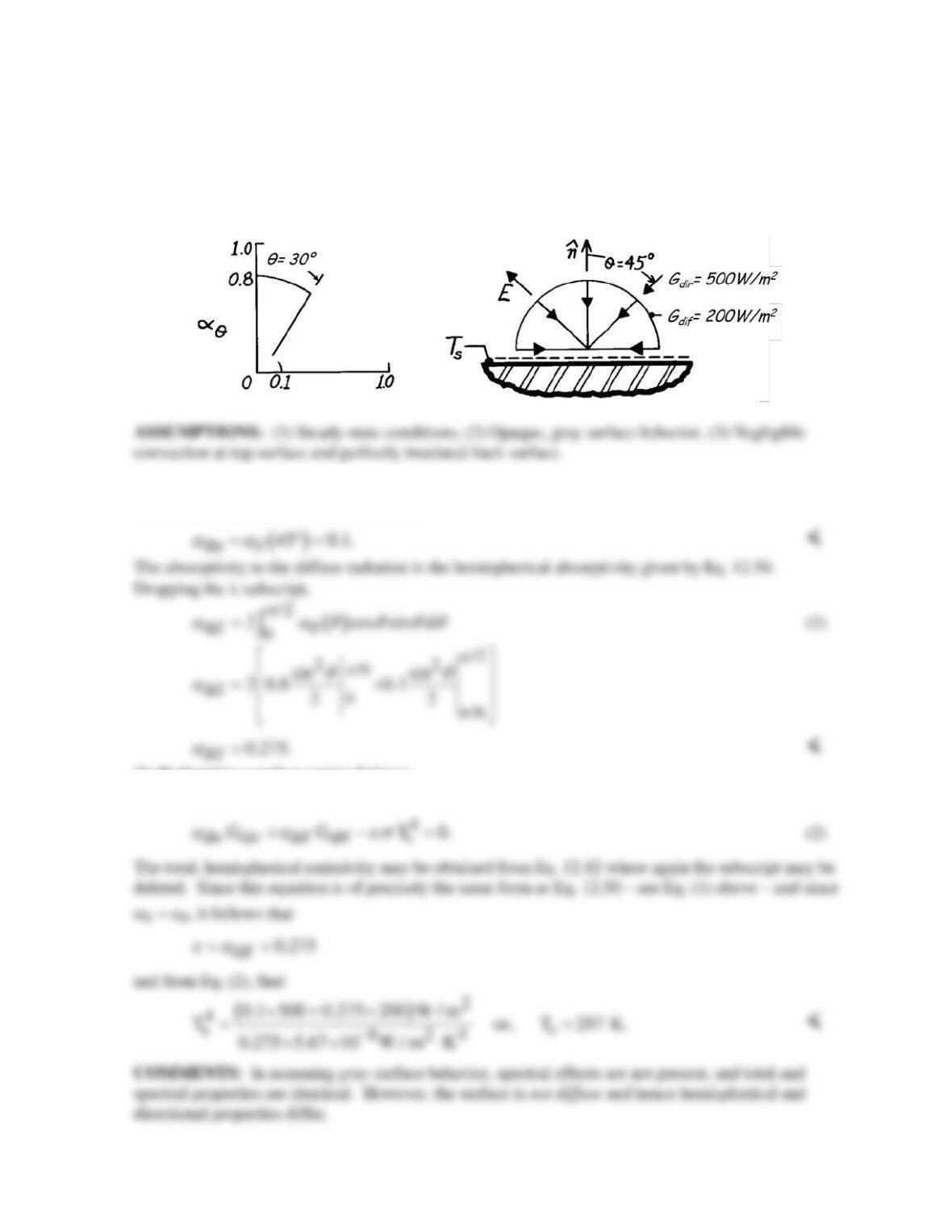
KNOWN: Directional distribution of αθ for a horizontal, opaque, gray surface exposed to direct and
diffuse irradiation.
FIND: (a) Absorptivity to direct radiation at 45° and to diffuse radiation, and (b) Equilibrium
temperature for specified direct and diffuse irradiation components.
SCHEMATIC:
ANALYSIS: (a) From knowledge of αθ (θ) – see graph above – it is evident that the absorptivity of
the surface to the direct radiation (45°) is
(b) Performing a surface energy balance,
in out
EE 0
′′ ′′
−=