PROBLEM 12.95
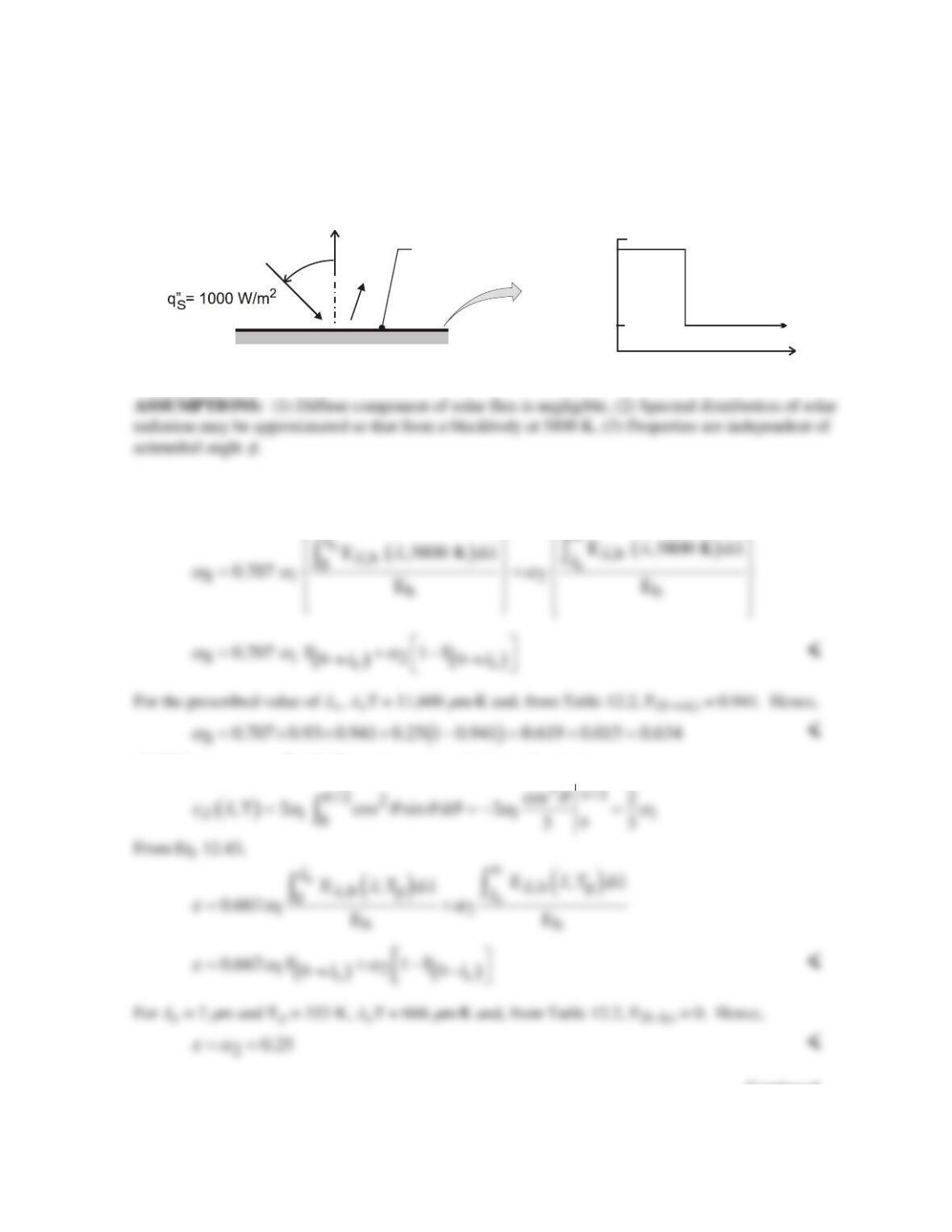
KNOWN: Plate temperature and spectral and directional dependence of its absorptivity. Direction
and magnitude of solar flux.
FIND: (a) Expression for total absorptivity, (b) Expression for total emissivity, (c) Net radiant flux,
(d) Effect of cut-off wavelength associated with directional dependence of the absorptivity.
SCHEMATIC:
λ
1
0
0
a
λ,θ
a
1 = 0.93
a
2 = 0.25
λ
1
E
nAbsorber plate ( , )
aε
S
T = 60 C
po
θ
= 45o
ANALYSIS: (a) For
λ
<
λ
c and
θ
= 45°,
aλ
=
a
1 cos
θ
= 0.707
a
1. From Eq. 12.53 the total
absorptivity is then
(b) With
ελ
,
θ
=
aλ
,o, Eq 12.42 may be used to obtain
ελ
for
λ
<
λ
c.
Continued …
PROBLEM 12.95 (Cont.)
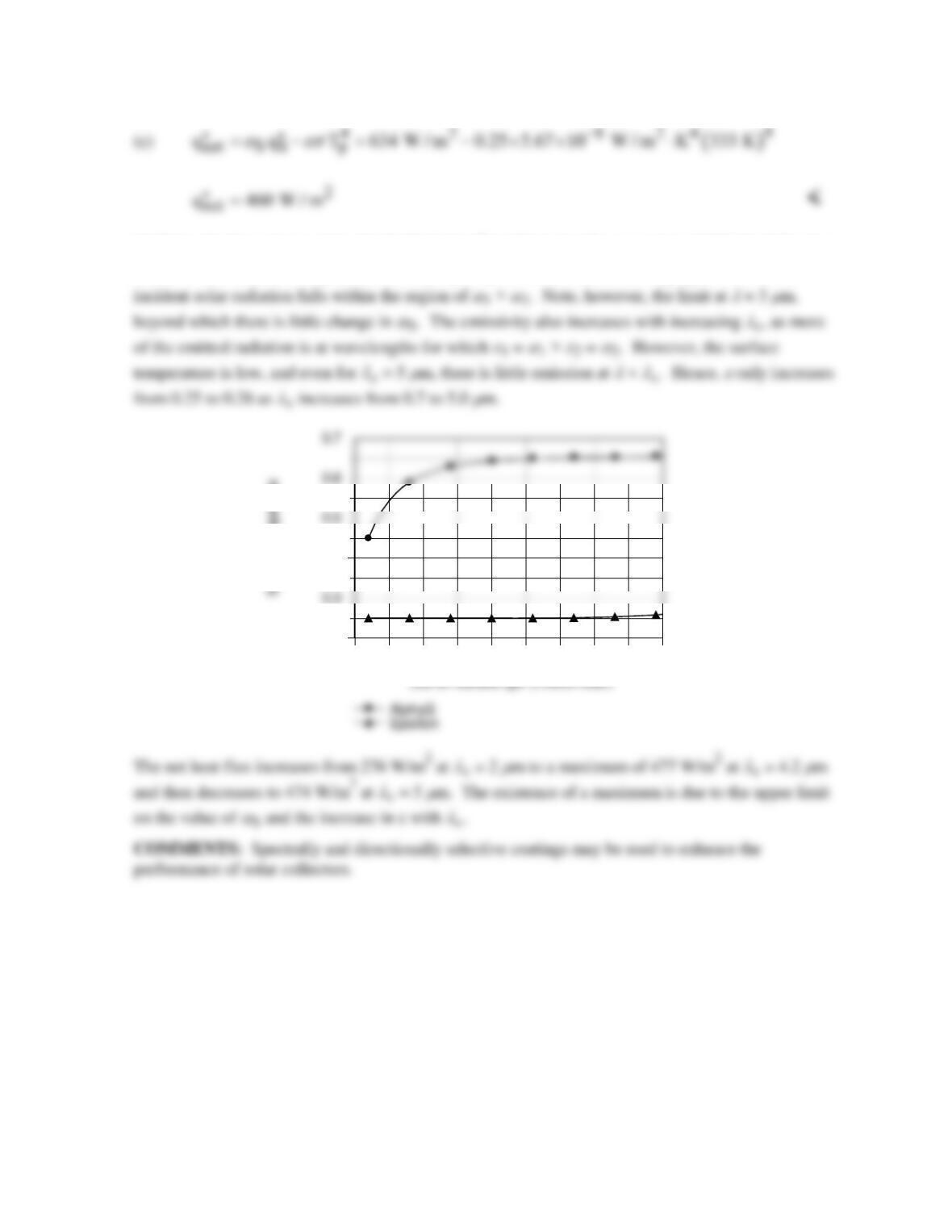
(d) Using the foregoing model with the Radiation/Band Emission Factor option of IHT, the following
results were obtained for
a
S and
ε
. The absorptivity increases with increasing
λ
c, as more of the
0.5 11.5 22.5 33.5 44.5 5
Cut–off wavelength (micrometer)
0.2
0.4
PROBLEM 12.96
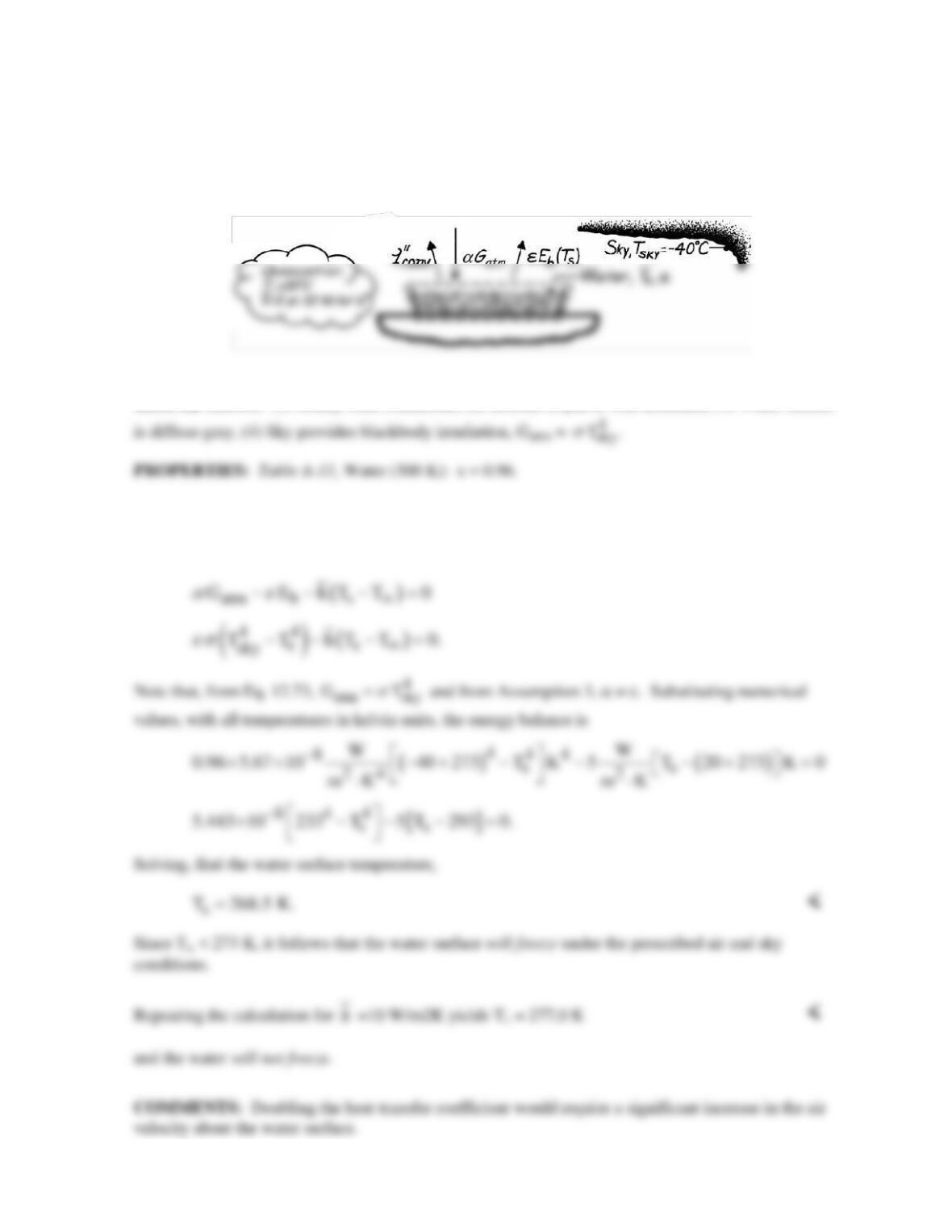
KNOWN: Shallow pan of water exposed to night desert air and sky conditions.
FIND: Whether water will freeze.
SCHEMATIC:
ASSUMPTIONS: (1) Steady-state conditions, (2) Bottom of pan is well insulated, (3) Water surface
ANALYSIS: To estimate the water surface temperature for these conditions, begin by performing an
energy balance on the pan of water considering convection and radiation processes.
in out
EE 0
′′ ′′
−=
PROBLEM 12.97
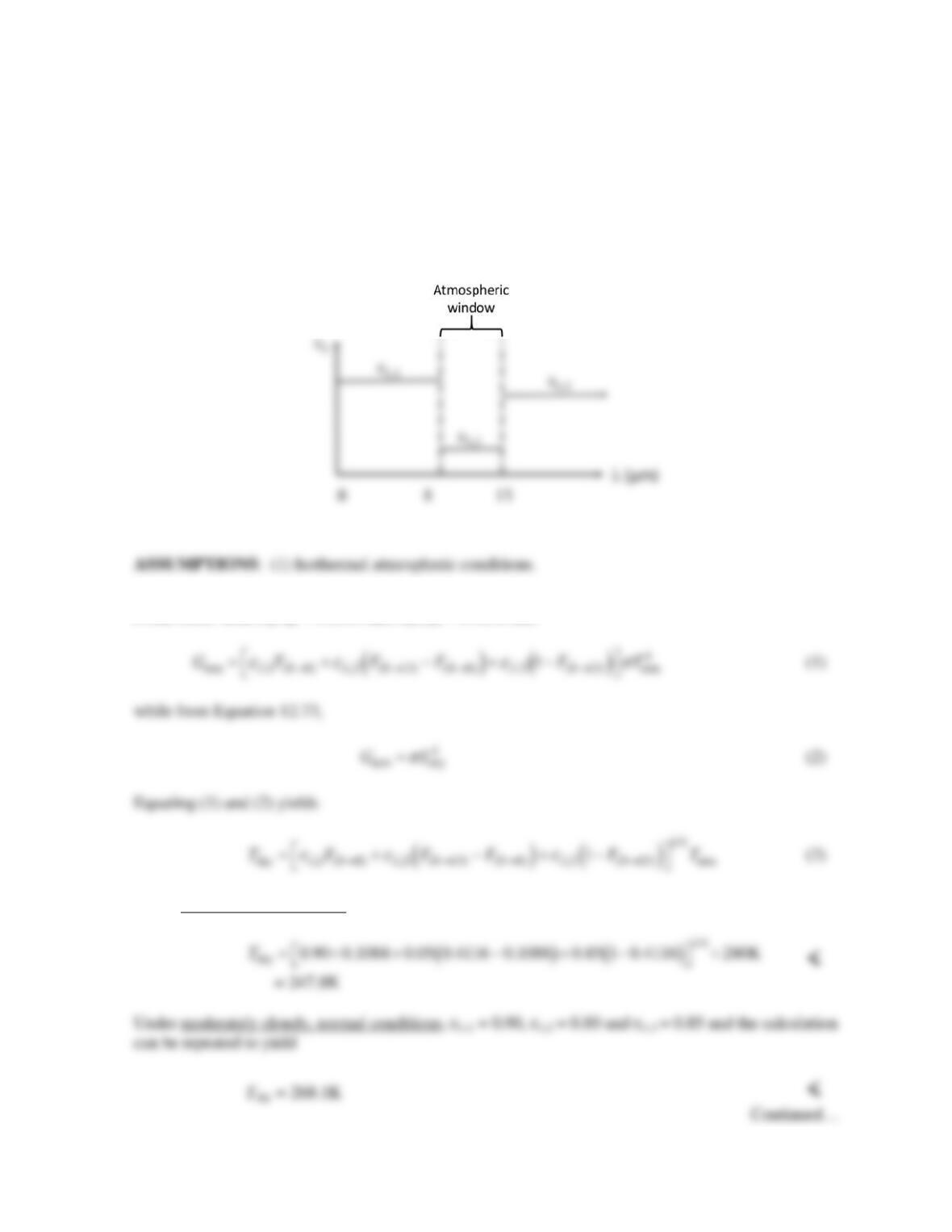
KNOWN: Spectral emissivity of sky at wavelengths less than, greater than, and within atmospheric
window. Atmospheric window spectral emissivity under clear, moderately cloudy, and cloudy
conditions.
FIND: (a) Effective sky temperature corresponding to actual atmospheric temperature under clear,
moderately cloudy, and cloudy conditions. (b) Effective sky temperature under low water vapor
conditions in Antarctica.
SCHEMATIC:
ANALYSIS: (a) For Tatm = 280K, λ1Tatm = 8µm × 280K = 2240 µm∙K and λ2Tatm = 3640 µm∙K.
From Table 12.2, F(0→8) = 0.1088 and F(0→13) = 0.4116 and
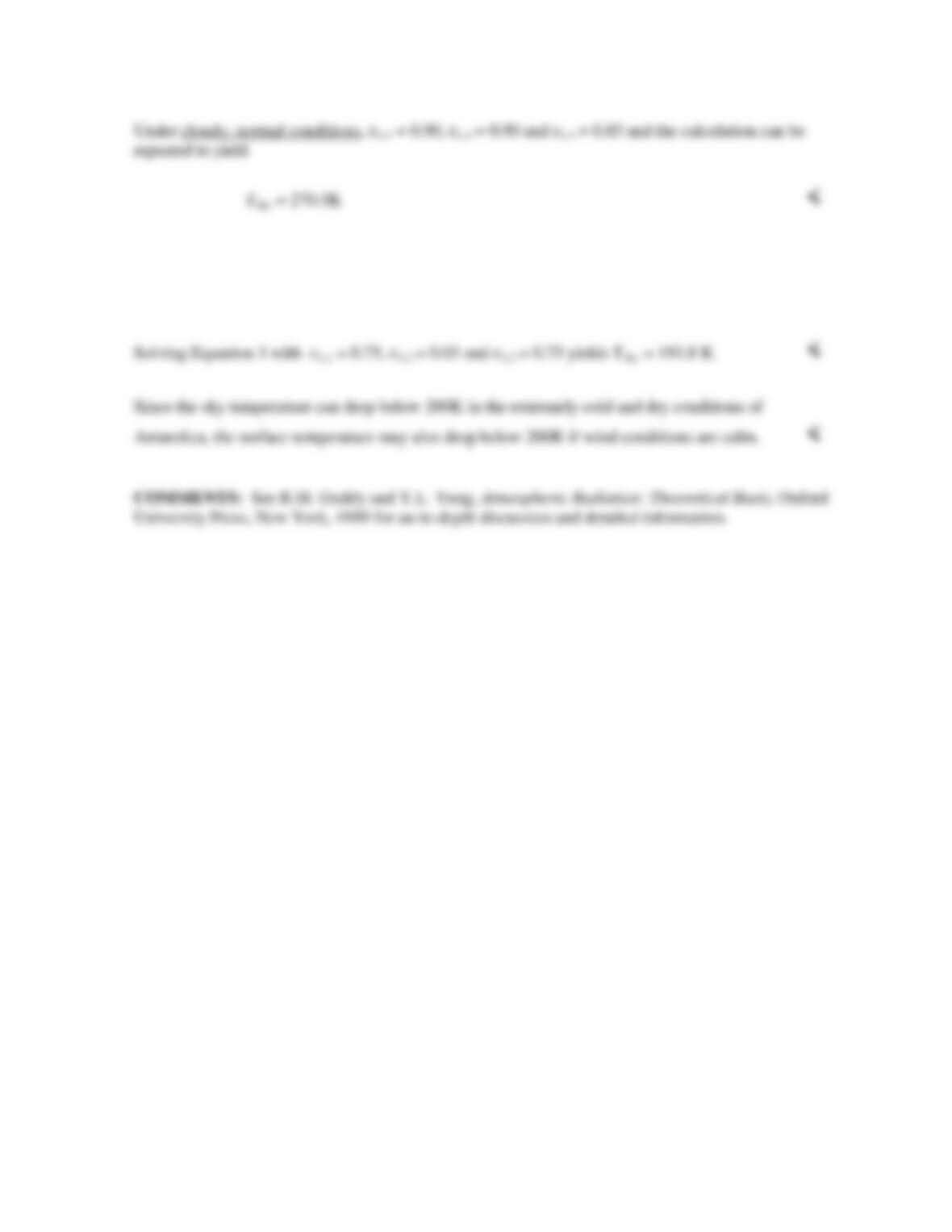
Under clear, normal conditions, ελ,1 = 0.90, ελ,2 = 0.05 and ελ,3 = 0.85 yielding
PROBLEM 12.97 (Cont.)
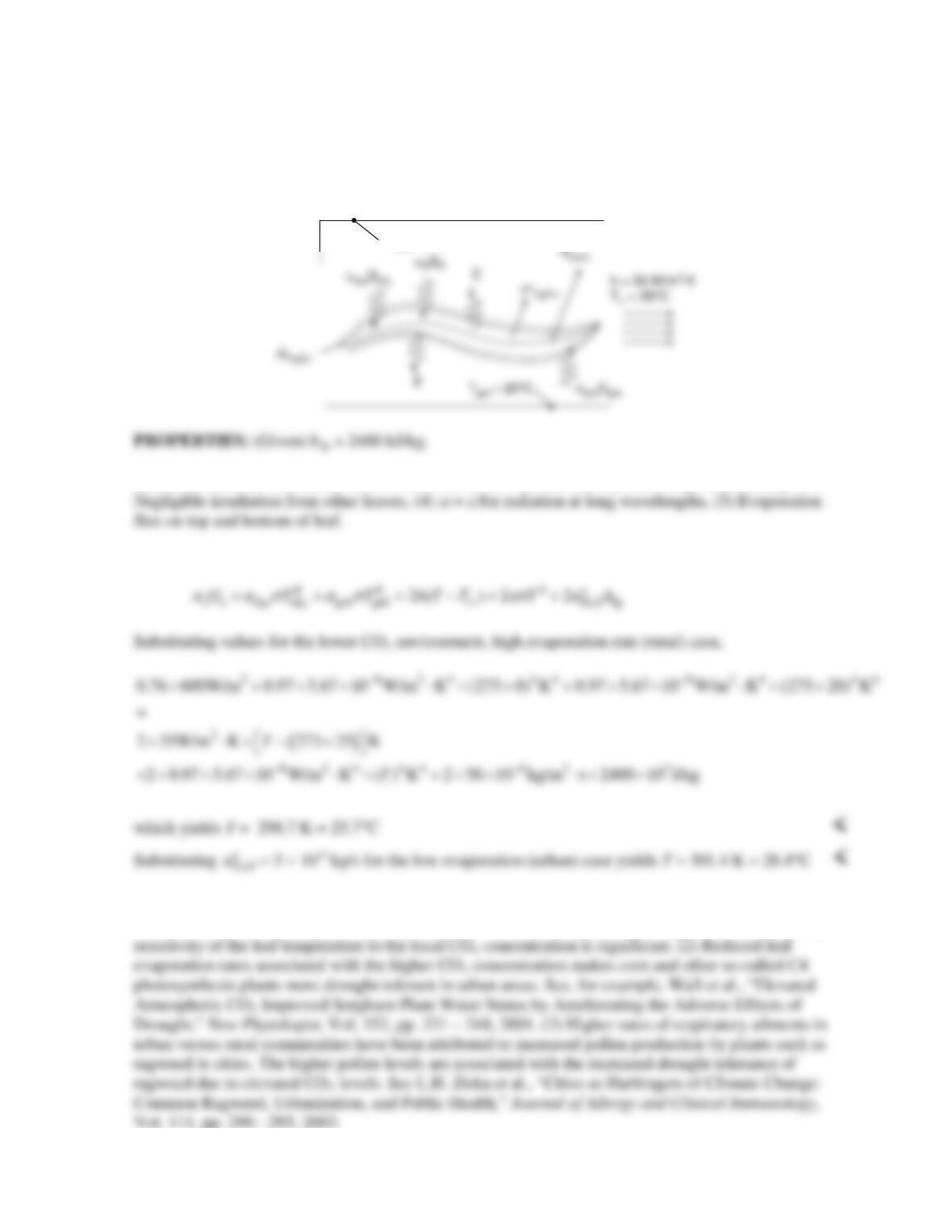
(b) For conditions in Antarctica, Tatm = 220K and λ1Tatm = 8µm × 280K = 1760 µm∙K while λ2Tatm =
2860 µm∙K. From Table 12.2, F(0→8) = 0.0355 and F(0→13) = 0.2415
PROBLEM 12.98
KNOWN: Environmental conditions associated with a corn leaf, evaporative fluxes in rural and
urban settings due to differences in ambient CO2 concentrations, absorptivity and emissivity values.
FIND: Leaf temperature for high (urban) and low (rural) ambient CO2 concentrations.
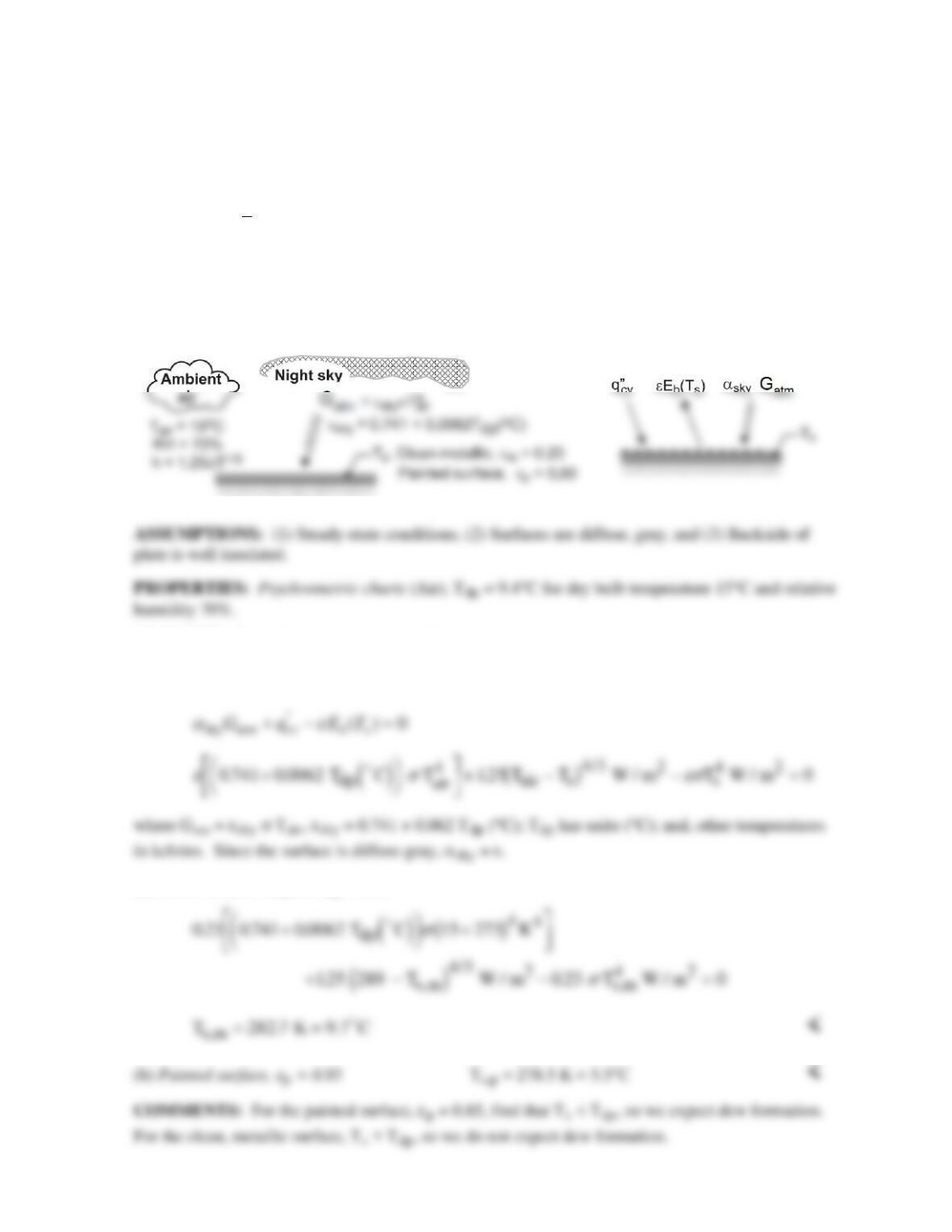
SCHEMATIC:
T
sky
= 0°C
ASSUMPTIONS: (1) Steady state conditions, (2) Ground and sky represent large surroundings, (3)
ANALYSIS: Performing an energy balance on the leaf on a per unit area basis,
COMMENTS: (1) Carbon dioxide levels in urban areas can be more than three times greater than in
rural communities due to, primarily, fossil fuel combustion corresponding to high traffic density. The
PROBLEM 12.99
KNOWN: Flat plate exposed to night sky and in ambient air at Tair = 15°C with a relative humidity
of 70%. Radiation from the atmosphere or sky estimated as a fraction of the blackbody radiation
corresponding to the near-ground air temperature, Gsky = εsky s Tair, and for a clear night, εsky =
0.741 + 0.0062 Tdp where Tdp is the dew point temperature (°C). Convection coefficient estimated
by correlation,
h W / m K T
2 1/3
⋅ =
ej125. ∆
where ∆T is the plate–to–air temperature difference (K).
FIND: Whether dew will form on the plate if the surface is (a) clean metal with εm = 0.23 and (b)
painted with εp = 0.85.
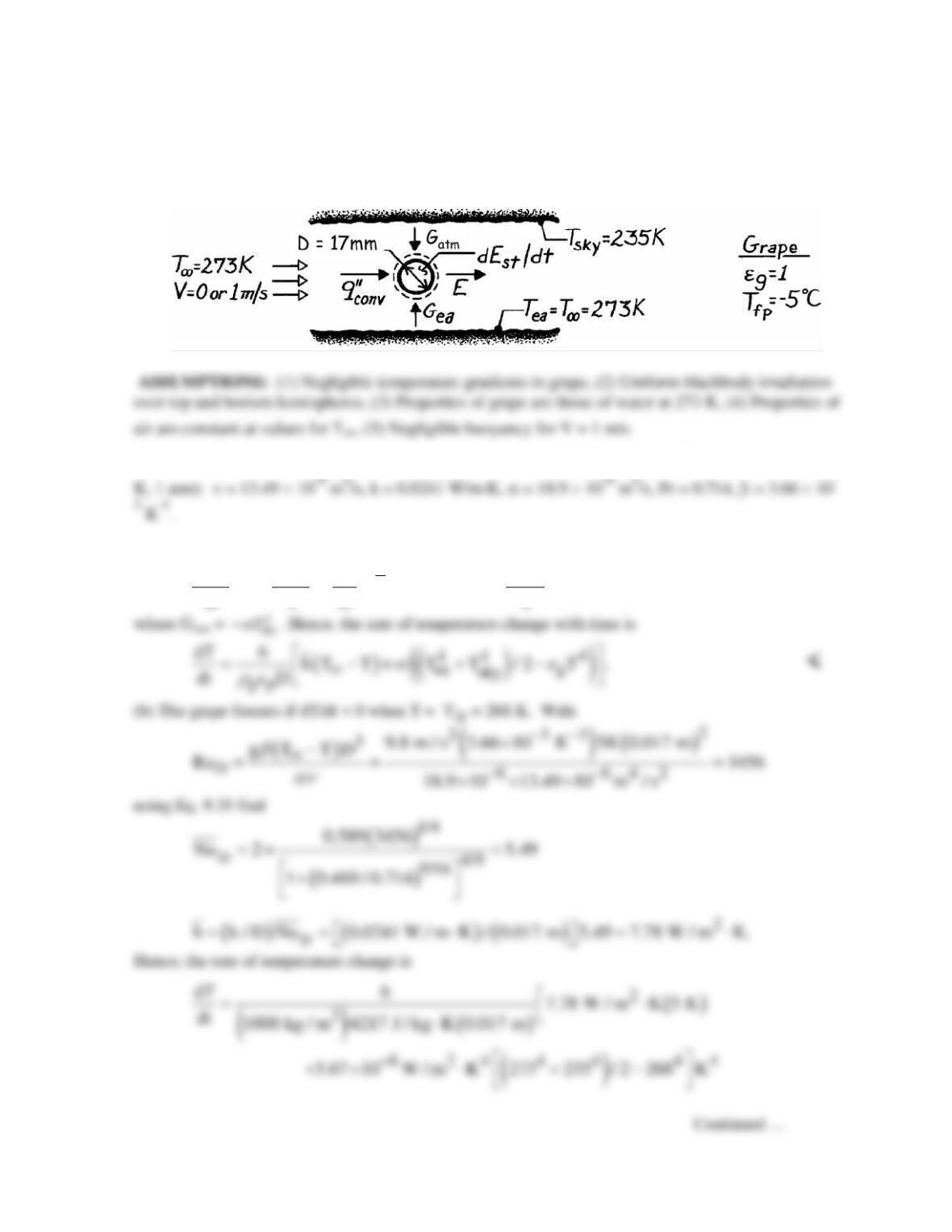
SCHEMATIC:
ANALYSIS: From the schematic above, the energy balance on the plate is
′′ −′′ =E E
in out 0
(a) Clean metallic surface, εm = 0.23
PROBLEM 12.100
KNOWN: Sky, ground, and ambient air temperatures. Grape of prescribed diameter and properties.
FIND: (a) General expression for rate of change of grape temperature, (b) Whether grapes will freeze
in quiescent air, (c) Whether grapes will freeze for a prescribed air speed.
SCHEMATIC:
PROPERTIES: Table A-6, Water (273 K): cp = 4217 J/kg⋅K, ρ = 1000 kg/m3; Table A-4, Air (273
ANALYSIS: (a) Performing an energy balance for a control surface about the grape,
( )
( )
32
22
st g p ea atm
dE D dT D
c h D T T G G E D.
dt 6 dt 2
pp
ρp p
∞
= = −+ + −
PROBLEM 12.100 (Cont.)
(c) For V = 1 m/s,
PROBLEM 12.101
KNOWN: Shed roof of weathered galvanized sheet metal exposed to solar insolation on a cool, clear
spring day with ambient air at – 10°C and convection coefficient estimated by the empirical
correlation
h T1/3
=10. ∆
(W/m2⋅K with temperature units of kelvins).
FIND: Temperature of the roof, Ts, (a) assuming the backside is well insulated, and (b) assuming the
backside is exposed to ambient air with the same convection coefficient relation and experiences
radiation exchange with the ground, also at the ambient air temperature. Comment on whether the
roof will be a comfortable place for the neighborhood cat to snooze for these conditions.
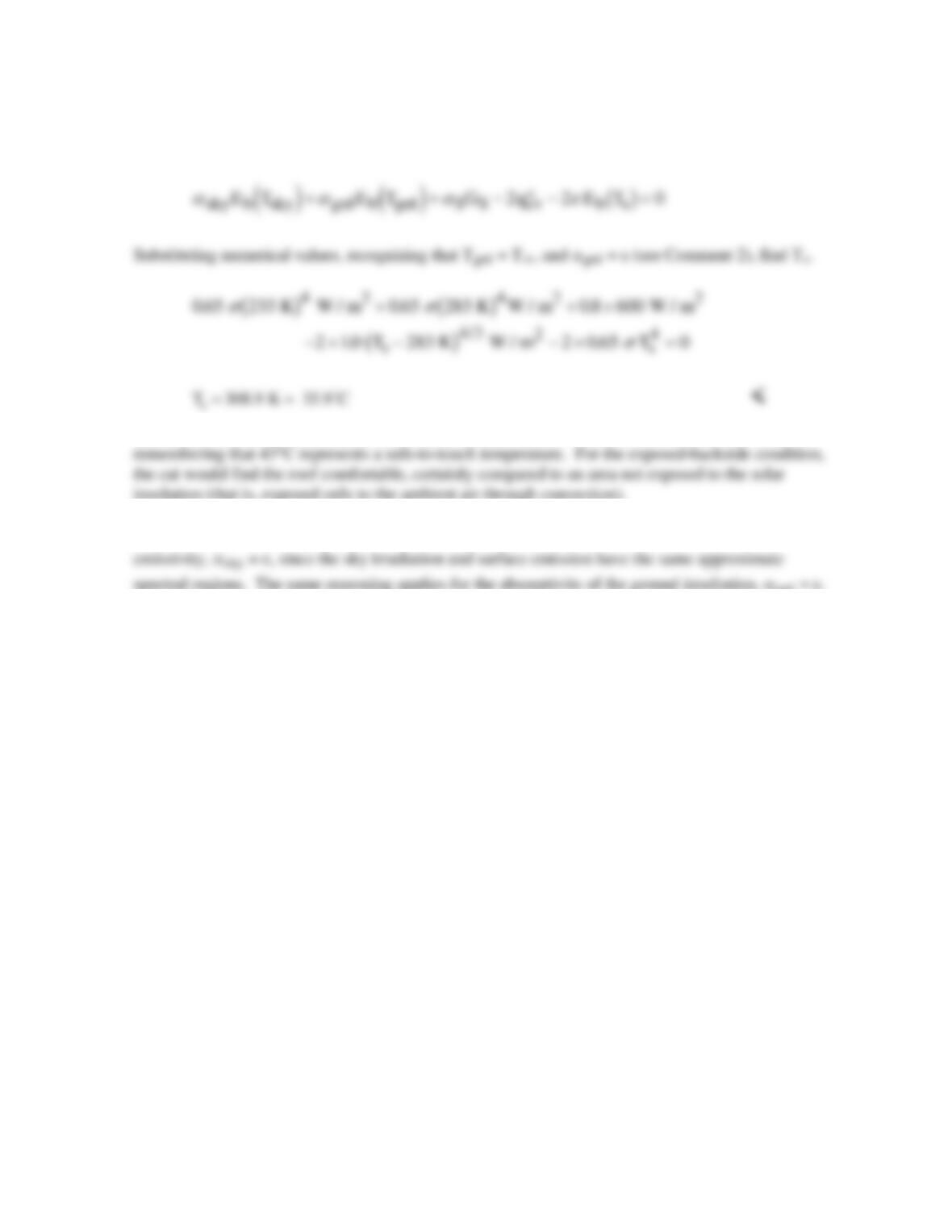
SCHEMATIC:
ASSUMPTIONS: (1) Steady-state conditions, (2) The roof surface is diffuse, spectrally selective,
ANALYSIS: (a) For the backside-insulated condition, the energy balance, represented schematically
below, is
′′ −′′ =E E
in out 0
aSS
G
εE (T )
bs asky b sky
E (T ) asky b sky
E (T )
aSS
G
εE (T )
bs
Continued …
PROBLEM 12.101 (Cont.)
(b) With the backside exposed to convection with the ambient air and radiation exchange with the
ground, the energy balance, represented schematically above, is
COMMENTS: (1) For the insulated-backside condition, the cat would find the roof too hot
(2) For this spectrally selective surface, the absorptivity for the sky irradiation is equal to the
PROBLEM 12.102
KNOWN: Opaque, spectrally–selective horizontal plate with electrical heater on backside is exposed
to convection, solar irradiation and sky irradiation.
FIND: Electrical power required to maintain plate at 60°C.
SCHEMATIC:
ASSUMPTIONS: (1) Plate is opaque, diffuse and uniform, (2) No heat lost out the backside of
heater.
ANALYSIS: From an energy balance on
the plate–heater system, per unit area basis,
The total, hemispherical emissivity is
PROBLEM 12.103
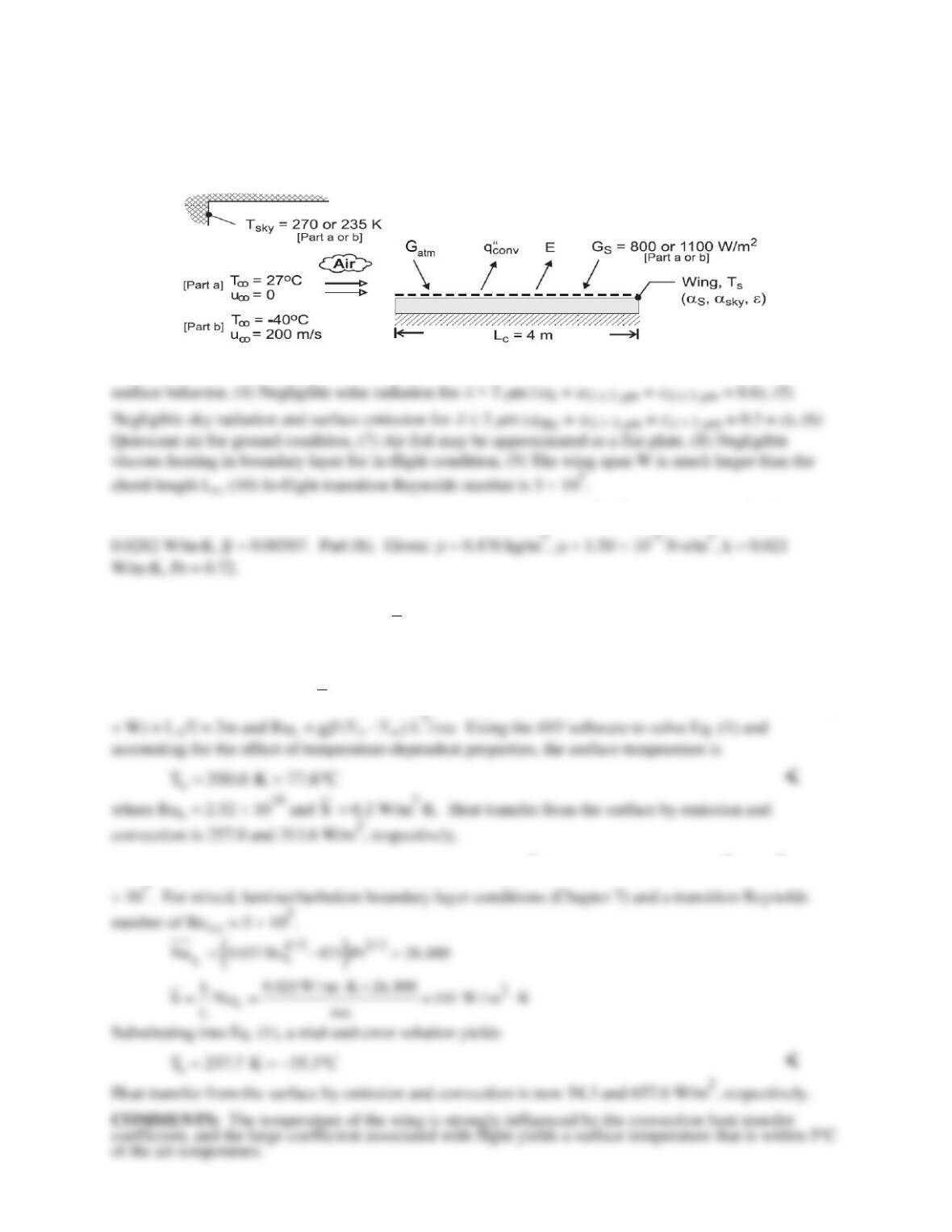
KNOWN: Chord length and spectral emissivity of wing. Ambient air temperature, sky temperature and
solar irradiation for ground and in-flight conditions. Flight speed.
FIND: Temperature of top surface of wing for (a) ground and (b) in-flight conditions.
SCHEMATIC:
ASSUMPTIONS: (1) Steady-state, (2) Negligible heat transfer from back of wing surface, (3) Diffuse
PROPERTIES: Part (a). Table A-4, air (Tf ≈ 325 K): ν = 1.84 × 10⁻⁵ m2/s, a = 2.62 × 10⁻⁵ m2/s, k =
ANALYSIS: For both ground and in-flight conditions, a surface energy balance yields
( )
4
sky sky S S s s
G G T hT T
a a εs
∞
+ = +−
(1)
where
sky 0.3
aε
= =
, and
S
0.6.
a
=
(a) For the ground condition,
h
may be evaluated from Eq. 9.30 or 9.31, where L = As/P = Lc × W/2 (Lc
(b) For the in-flight condition, ReL =
ρ
u
∞
Lc/
µ
= 0.470 kg/m3 × 200 m/s × 4m/1.50 × 10-5 N⋅s/m2 = 2.51
PROBLEM 12.104
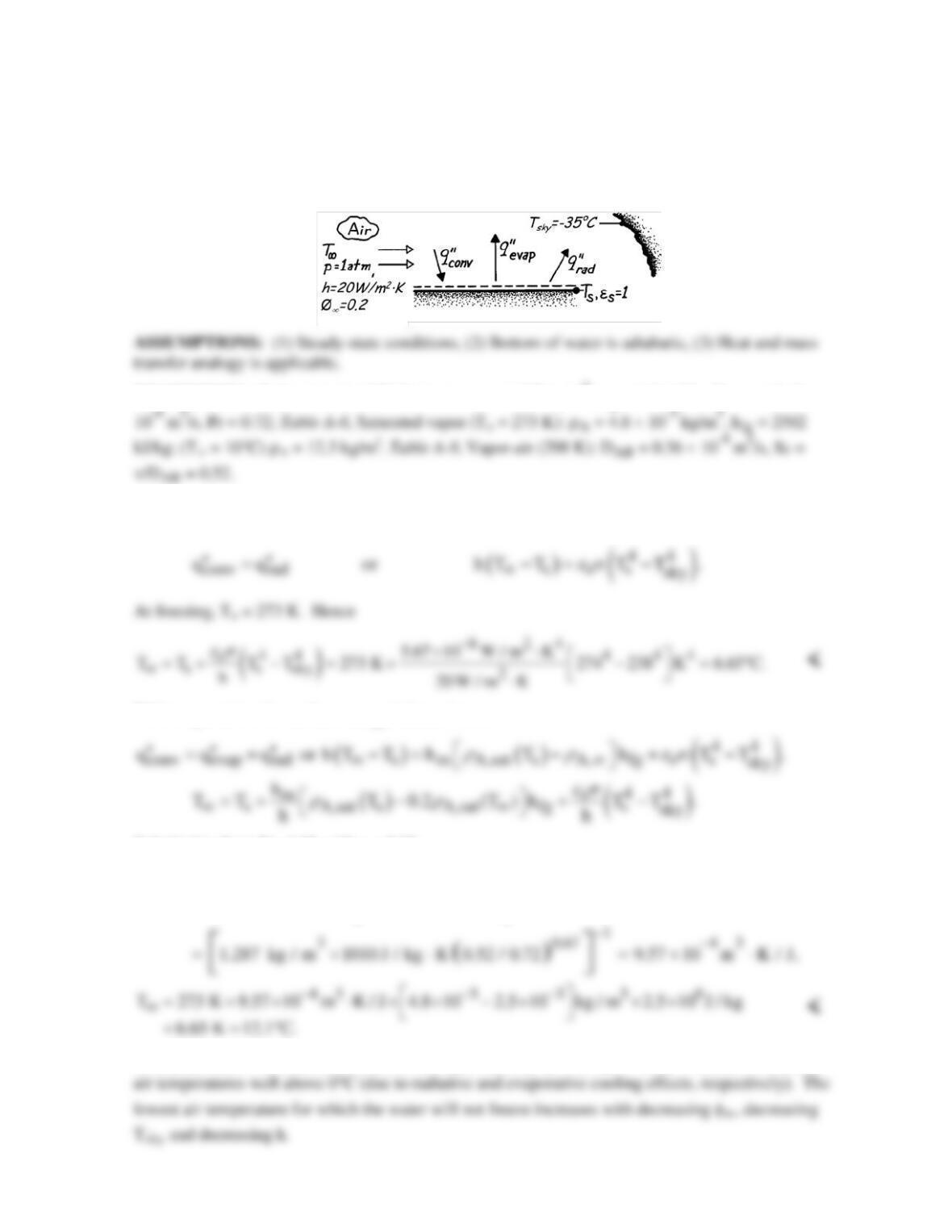
KNOWN: Effective sky temperature and convection heat transfer coefficient associated with a thin
layer of water.
FIND: Lowest air temperature for which the water will not freeze (without and with evaporation).
SCHEMATIC:
PROPERTIES: Table A-4, Air (273 K, 1 atm): ρ = 1.287 kg/m3, cp = 1.01 kJ/kg⋅K, ν = 13.49 ×
ANALYSIS: Without evaporation, the surface heat loss by radiation must be balanced by heat gain
due to convection. An energy balance gives
With evaporation, the surface energy balance is now
Substituting from Eq. 6.60, with n ≈ 0.33,
( )
( )
11
0.67 0.67
mp p
h / h c Le c Sc / Pr
ρρ
−−
= =
COMMENTS: The existence of clear, cold skies and dry air will allow water to freeze for ambient
PROBLEM 12.105
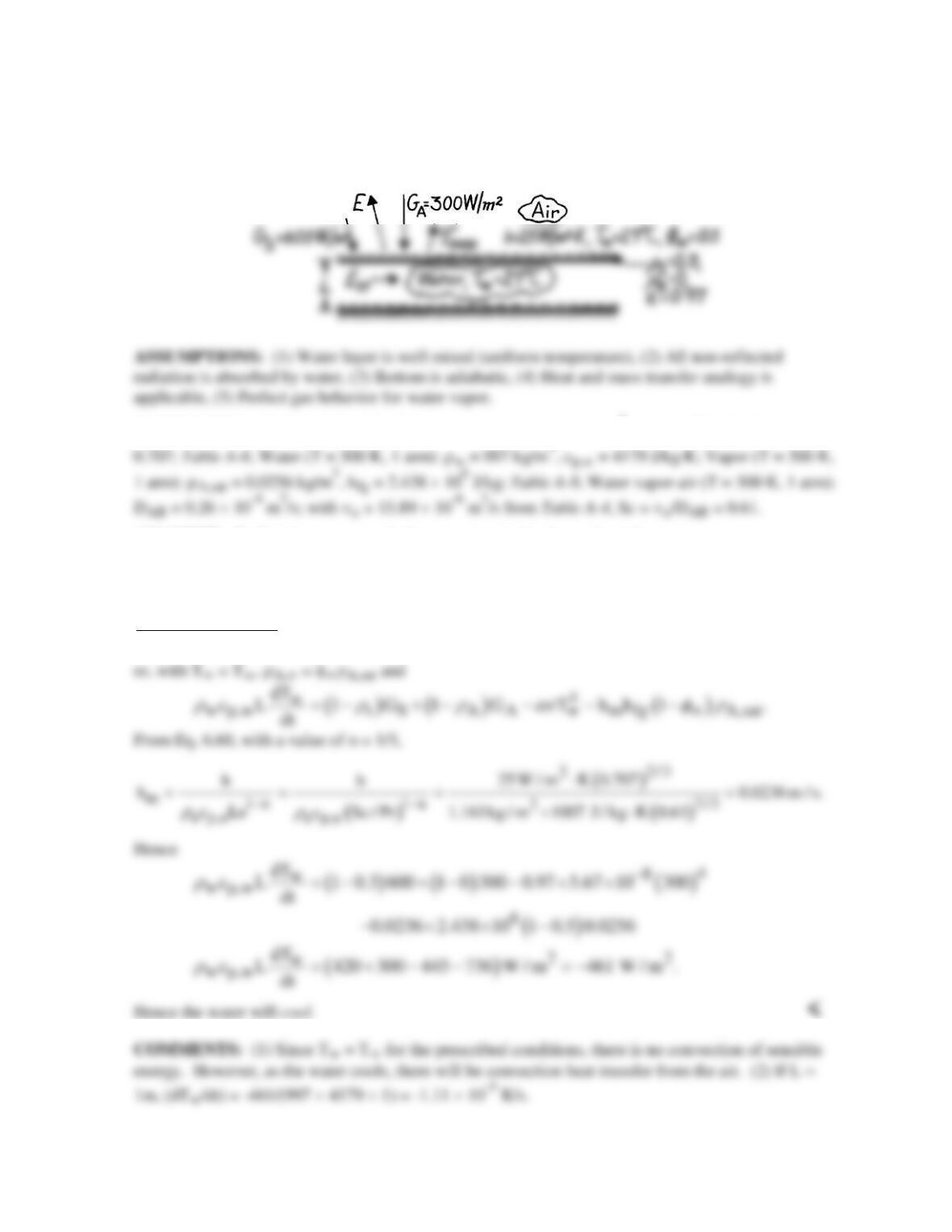
KNOWN: Temperature and environmental conditions associated with a shallow layer of water.
FIND: Whether water temperature will increase or decrease with time.
SCHEMATIC:
PROPERTIES: Table A-4, Air (T = 300 K, 1 atm): ρa = 1.161 kg/m3, cp,a = 1007 J/kg⋅K, Pr =
ANALYSIS: Performing an energy balance on a control volume about the water,
( )
st S,abs A,abs evap
E G G Eq A
′′
= + −−
( )
( ) ( )
( )
w p,w w 4
s S A A w m fg A,sat A,
d c LAT
1 G 1 G T hh A
dt
ρρ ρ εs ρ ρ
∞
= − +− − − −
PROBLEM 12.106
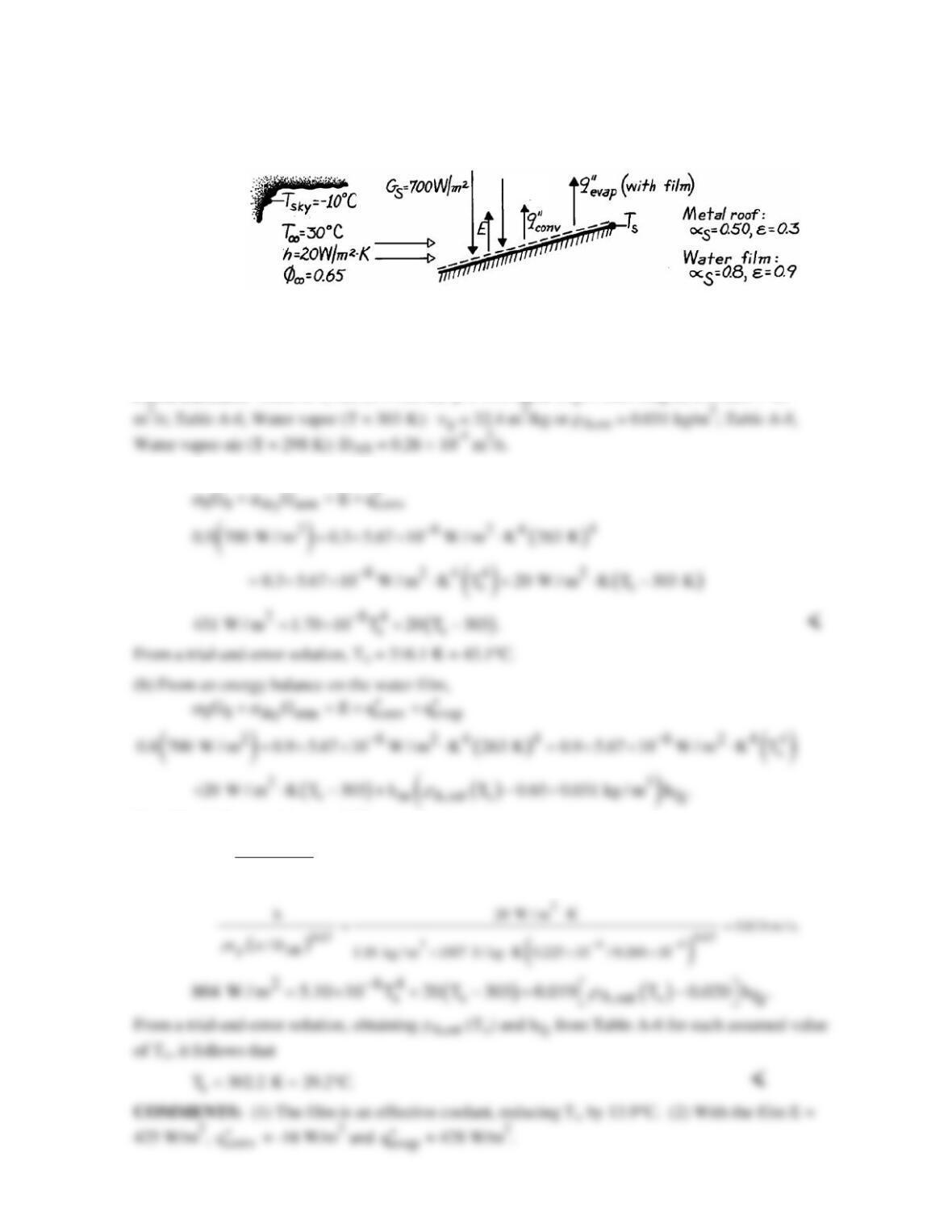
KNOWN: Environmental conditions for a metal roof with and without a water film.
FIND: Roof surface temperature (a) without the film, (b) with the film.
SCHEMATIC:
ASSUMPTIONS: (1) Steady-state conditions, (2) Diffuse-gray surface behavior in the infrared (for
the metal, asky = ε = 0.3; for the water, asky = ε = 0.9), (3) Adiabatic roof bottom, (4) Perfect gas
behavior for vapor.
PROPERTIES: Table A-4, Air (T ≈ 300 K): ρ = 1.16 kg/m3, cp = 1007 J/kg⋅K, a = 22.5 × 10⁻⁶
ANALYSIS: (a) From an energy balance on the metal roof
From Eq. 6.60, assuming n = 0.33,
m0.67
p
h
h
c Le
ρ
= =
G
atm
PROBLEM 12.107
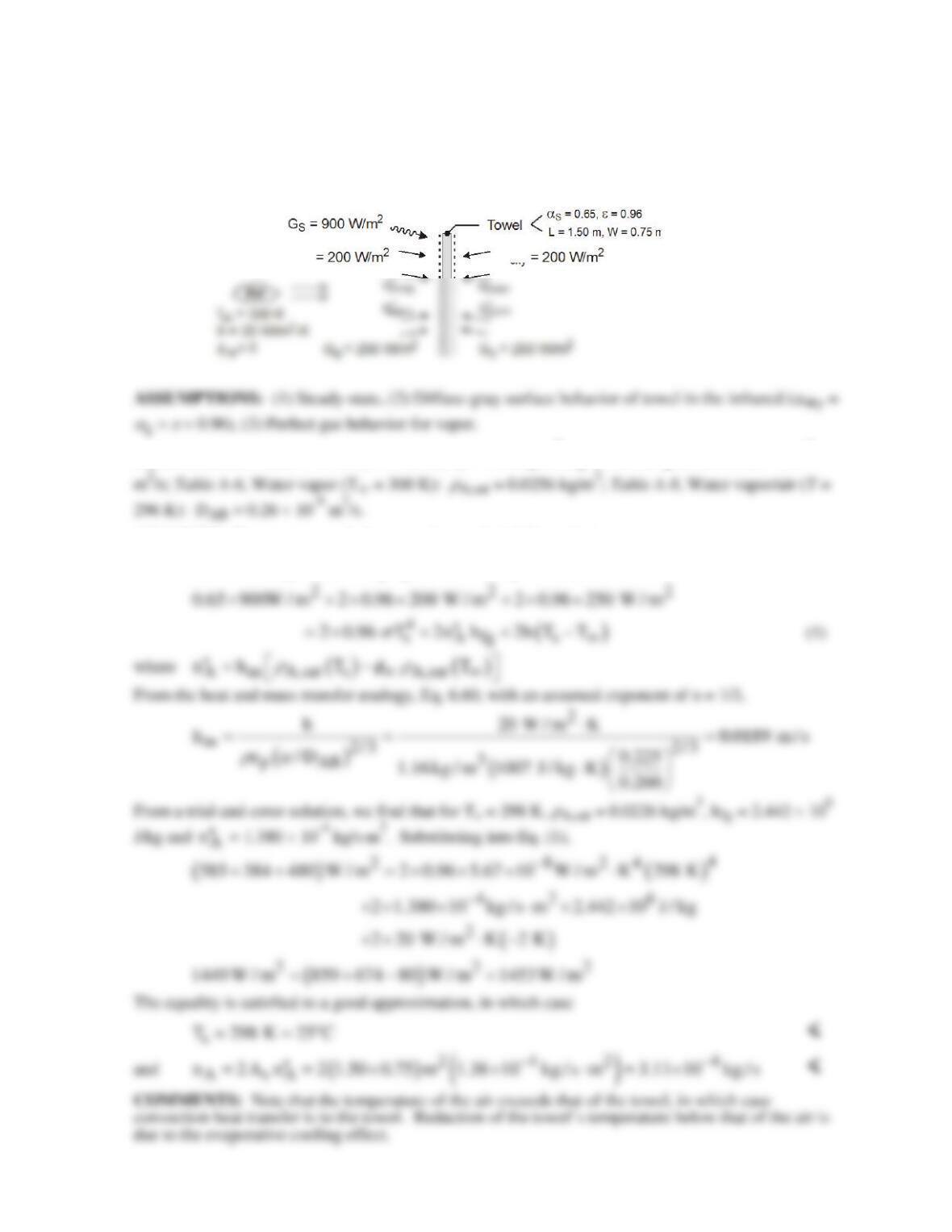
KNOWN: Solar, sky and ground irradiation of a wet towel. Towel dimensions, emissivity and solar
absorptivity. Temperature, relative humidity and convection heat transfer coefficient associated with
air flow over the towel.
FIND: Temperature of towel and evaporation rate.
SCHEMATIC:
PROPERTIES: Table A-4, Air (T ≈ 300 K):
ρ
= 1.16 kg/m3, cp = 1007 J/kg⋅K,
a
= 0.225 × 10⁻⁴
ANALYSIS: From an energy balance on the towel, it follows that
S S sky atm g g evap conv
G 2 G 2 G 2E 2q 2q
aa a
′′ ′′
+ +=++
G
atm
G
atm
PROBLEM 12.108
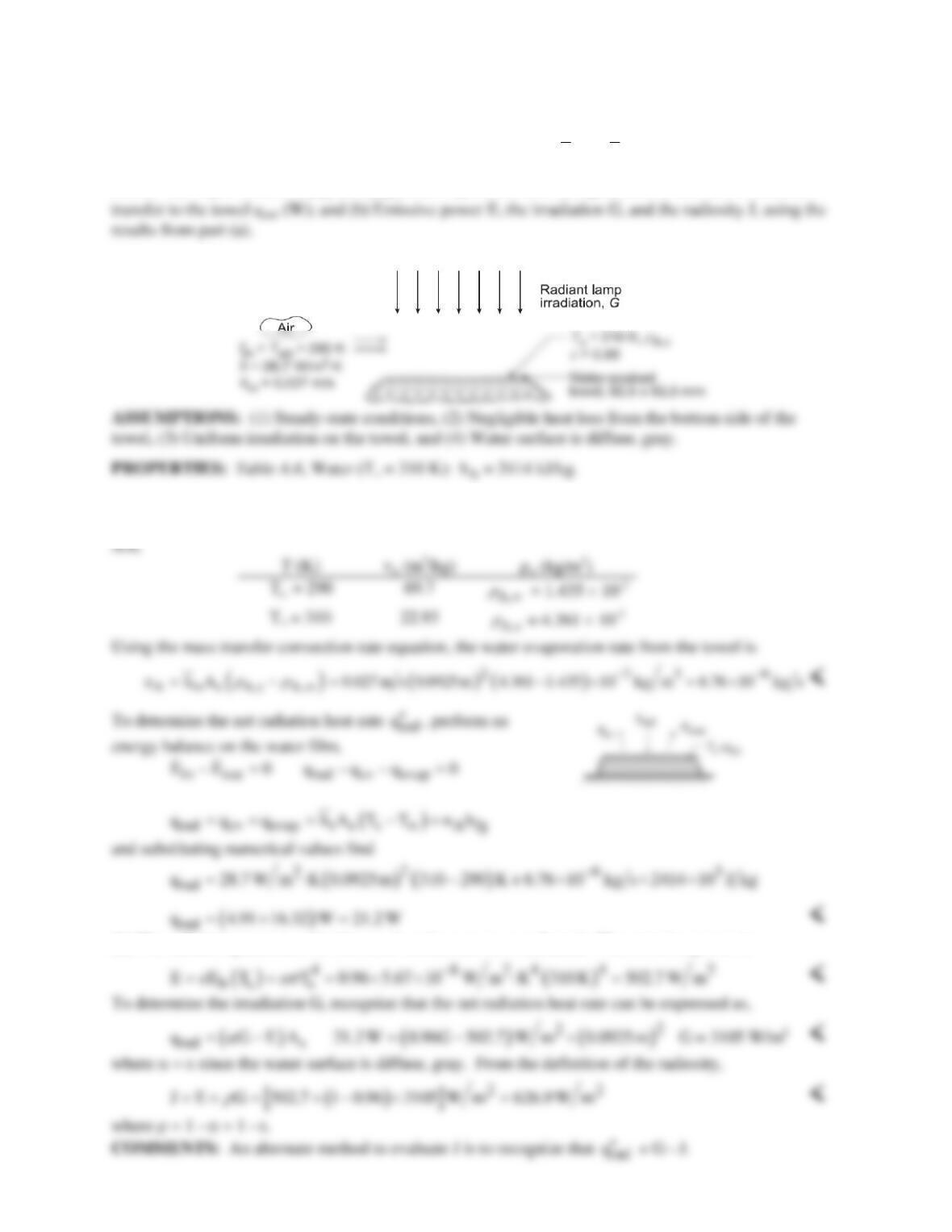
KNOWN: Wet paper towel experiencing forced convection heat and mass transfer and irradiation from
radiant lamps. Prescribed convection parameters including wet and dry bulb temperature of the air
stream, Twb and
T
∞
, average heat and mass transfer coefficients,
h
and
m
h
. Towel temperature Ts.
FIND: (a) Vapor densities,
ρ
A s,
and
ρ
A,∞
; the evaporation rate nA (kg/s); and the net rate of radiation
SCHEMATIC:
ANALYSIS: (a) Since Twb =
T
∞
, the free stream contains water vapor at its saturation condition. The
water vapor at the surface is saturated since it is in equilibrium with the liquid in the towel. From Table
T
∞
(b) The radiation parameters for the towel surface are now evaluated. The emissive power is