Chapter 12
Financial Statement Analysis
Concept Questions
1. (LO 1—The purpose of financial statement analysis)
Financial statement analysis provides useful information to supplement
2. (LO 1—Limitations of financial statement analysis)
Ratio analysis by itself does not indicate the various accounting methods,
estimates, and assumptions that a company used in the preparation of financial
3. (LO 2—Trend analysis)
Decision makers might wish to perform a trend analysis because it is useful in
4. (LO 2—Trend analysis: Number of years)
5. (LO 3—Usefulness of common-size financial statements)
Common-size financial statements are useful because they allow decision
Solutions Manual
12-2
6. (LO 3—Working capital)
7. (LO 4—Formula to compute accounts receivable turnover)
8. (LO 4—Decreasing the current ratio)
High current ratios can indicate problems in collecting accounts receivable,
9. (LO 4—Increasing the current ratio)
While a current ratio of 2.0 is probably adequate, the company may need
additional cash to finance new investments or could be expecting a seasonal
10. (LO 5—Interpretation of the debt-to-equity ratio)
The debt-to-equity ratio tells how a company is capitalized, that is, how much
11. (LO 6—Calculation of the asset turnover ratio)
Chapter 12: Financial Statement Analysis
12-3
Exercises
1. (LO 3—Return on assets: Margin vs. turnover)
Dan’s Duds is likely the specialty retailer. It has a higher profit margin (7.06%)
2. (LO 4—Liquidity ratios)
Accounts receivable turnover = Net credit sales ÷ Average accounts receivable
Solutions Manual
12-4
without additional information.
3. (LO 4—Liquidity ratios)
A. Inventory turnover = UCost of goods sold
Average inventory
B. Number of days’ sales in average inventory = 365 ÷ Inventory turnover
C. Cost of goods sold to sales = Cost of goods sold ÷ Sales
D. The increasing rate of inventory turnover coupled with the decreasing cost
4. (LO 4—Asset turnover ratio)
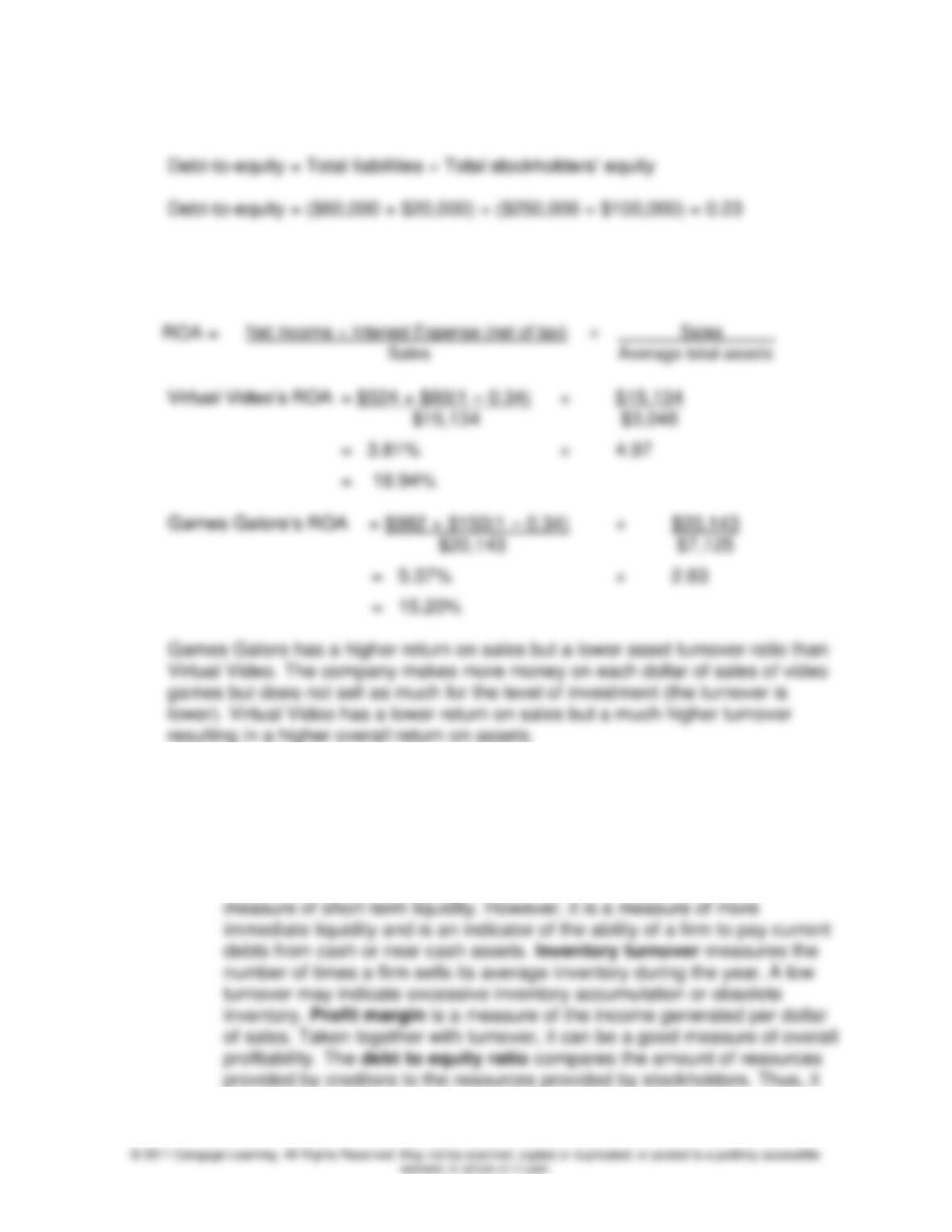
A. Asset turnover = Sales ÷ Average total assets
Chapter 12: Financial Statement Analysis
12-5
5. (LO 5—Solvency ratio: Calculation of debt-to-equity)
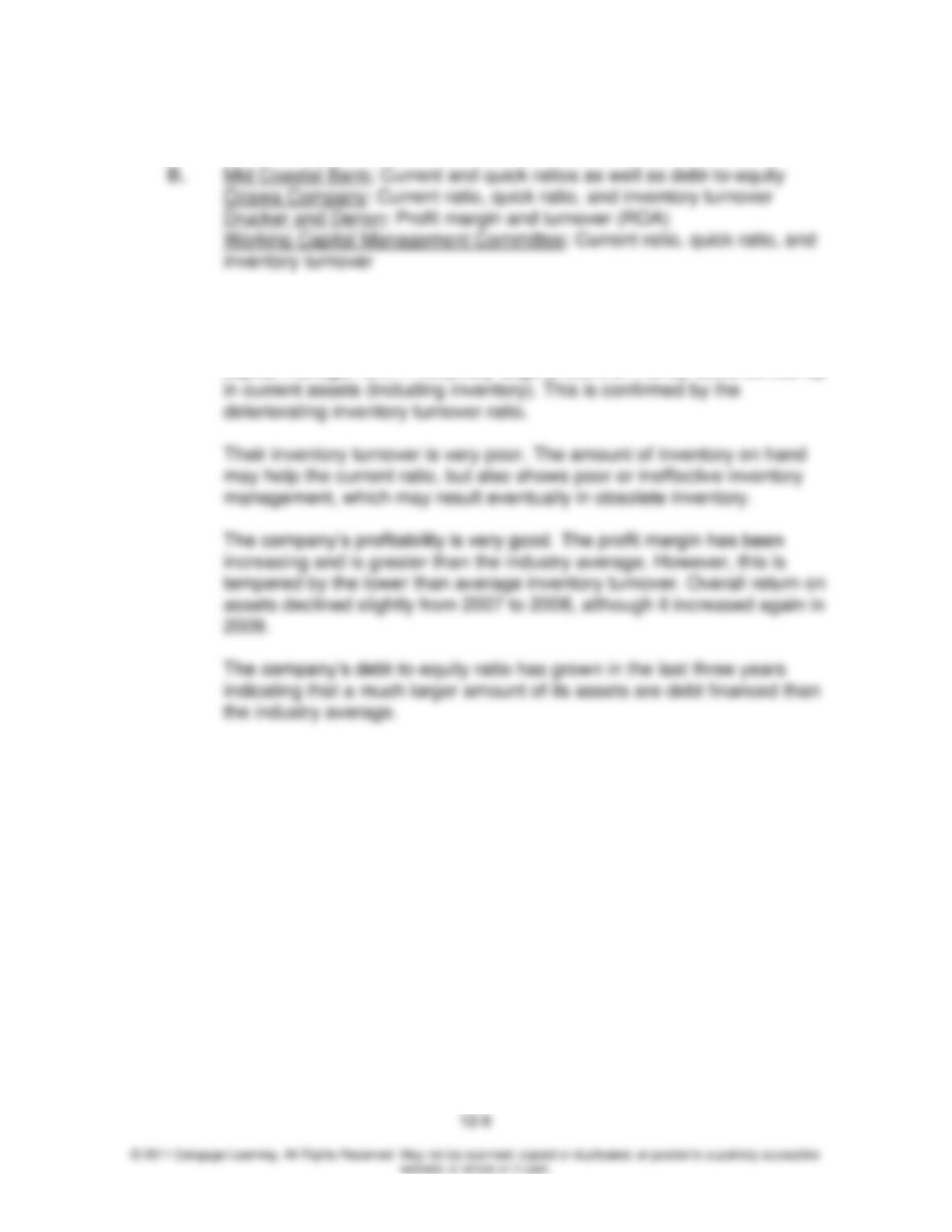
6. (LO 6—Return on assets: Margin vs. turnover)
ROA =
Return on Sales
× Asset turnover
Problems
7. (LO 1, 2, 4, 5, and 6—Ratio analysis: Decision focus)
A. The current ratio measures overall short-term liquidity and is an indicator
of the short-term debt paying ability of the firm. The quick ratio is also a
Solutions Manual
measures the extent of leverage in a company’s financial structure and is
used as a measure of risk.
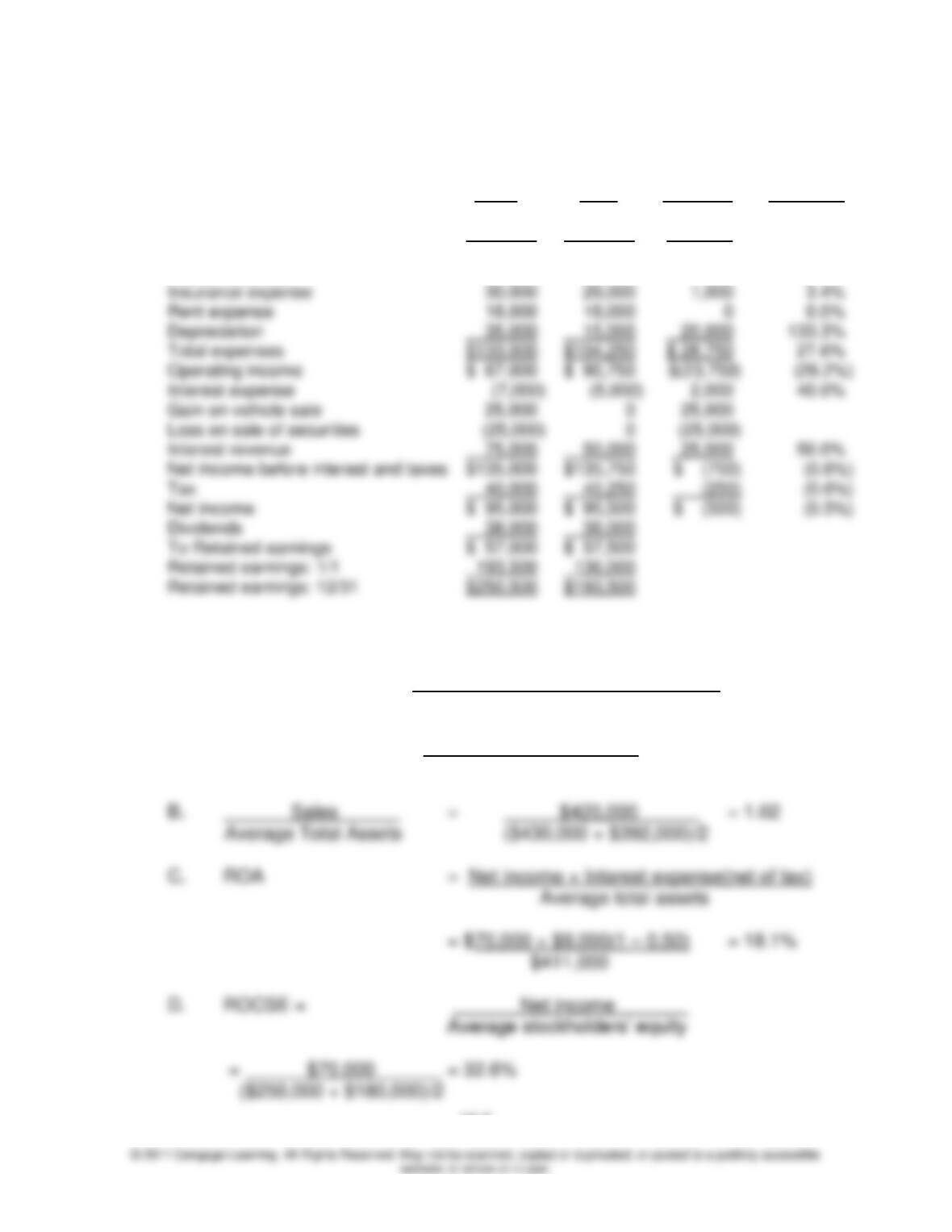
C. 9BAvantronics’ current and quick ratios have been improving over time and
are currently near or above industry averages. However, one must look at
the total picture when analyzing the company’s liquidity and working
capital management. A relatively large amount of money could be tied up
Chapter 12: Financial Statement Analysis
12-7
8. (LO 2—Horizontal analysis) Martha’s Miscellaneous
Comparative Statements of Income and Retained Earnings
U 2009U
U2008U
U$ changeU
U% changeU
Sales revenue
$700,000
$650,000
$ 50,000
7.7%
Cost of goods sold
U 500,000U
U 455,000U
U 45,000U
9.9%
Gross profit
$200,000
$195,000
$ 5,000
2.6%
Payroll expense
50,000
42,250
7,750
18.3%
Insurance expense
3.4%
Rent expense
18,000
18,000
0.0%
Depreciation
U 35,000U
U 15,000U
U 20,000U
Total expenses
U$133,000U
U$104,250U
U$ 28,750U
Operating income
$ 67,000
$ 90,750
(26.2%)
Interest expense
Gain on vehicle sale
25,000
25,000
Loss on sale of securities
Interest revenue
U 75,000U
U 50,000U
U 25,000U
Net income before interest and taxes
$135,750
U 40,000U
U 40,250U
Net income
$ 95,000
$ 95,500
Dividends
U 38,000U
U 38,000U
To Retained earnings
$ 57,000
$ 57,500
Retained earnings: 1/1
Retained earnings: 12/31
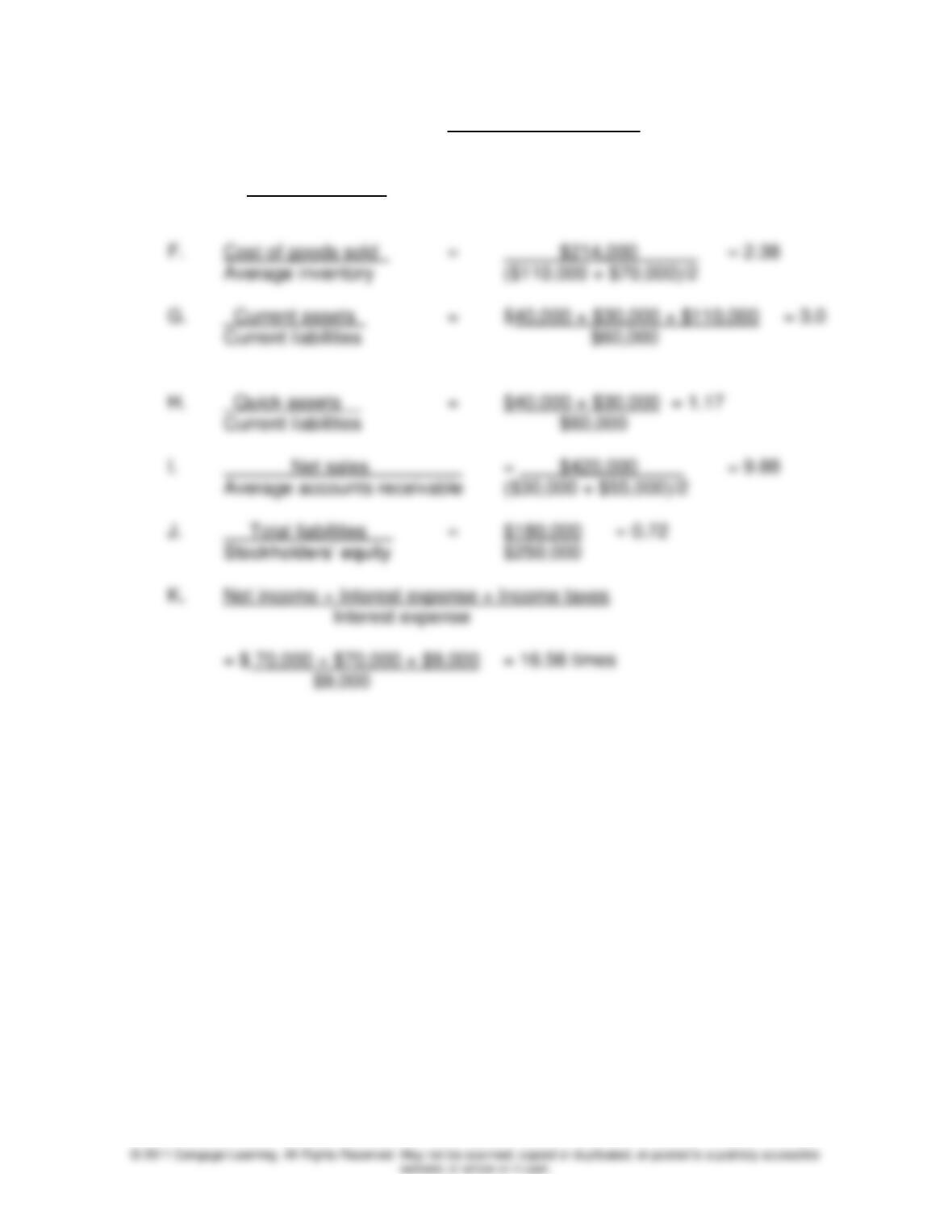
9. (LO 4, 5, and 6—Comprehensive ratio analysis)
A. Profit margin ratio = UNet income + Interest exp.(net of tax)
Sales
= $U70,000 + $9,000(1 – 0.50)U = 17.7%
$420,000
Solutions Manual
12-8
E. 2BEPS = U Net income U
# of shares outstanding
= U $70,000 U= $2.33/share
30,000 shares